

Submitted:
17 October 2026
Posted:
20 October 2026
You are already at the latest version
Abstract
Background and aims: Serum vitamin B12 may increase during liver injury, but its association with clinical outcomes in acute hepatitis remains incompletely characterized. We evaluated admission vitamin B12 in relation to in-hospital outcomes and explored a combined vitamin B12–ferritin index. Methods: This retrospective single-center study included 186 adults hospitalized with acute hepatitis or acute liver injury during 2018–2025. Clinical outcomes were gastroenterology ward length of stay, liver transplantation, and in-hospital mortality. Additional exploratory analyses evaluated ICU admission, recorded encephalopathy, and a composite of ICU admission, transplantation, or death. Discrimination was assessed using receiver operating characteristic analysis. Eight vitamin B12 results exceeded the assay reporting limit of 4000 pg/mL; available numerical analyses used a top-coded representation, with these observations tied at the upper limit. Results: Nine patients (4.8%) died and one (0.5%) underwent transplantation; 20 (10.8%) met the exploratory composite outcome, all of whom required ICU care. Eleven patients had recorded hepatic encephalopathy. Vitamin B12 AUCs were 0.935 (95% CI 0.891–0.979) for mortality, 0.944 (0.904–0.984) for death or transplantation, and 0.938 (0.897–0.980) for the ICU-inclusive composite. Vitamin B12 was not associated with gastroenterology ward length of stay (Spearman ρ=0.017; P=0.818). The exploratory B12–Ferritin Index had a composite-outcome AUC of 0.892, providing no demonstrated improvement over vitamin B12. Conclusions: Higher admission vitamin B12 was associated with adverse in-hospital outcomes, but not with gastroenterology ward length of stay. The limited event count, assay upper-limit censoring, and uncertain timing of sampling relative to deterioration restrict prognostic interpretation. Prospective validation is required before clinical application.
Keywords:
vitamin B12
; cobalamin
; acute hepatitis
; acute liver injury
; ferritin
; prognosis
1. Introduction
Adults hospitalized with acute hepatitis have a wide range of clinical trajectories. Many recover, whereas others require intensive care, develop encephalopathy, or progress to liver failure. Acute liver failure (ALF) is a specific syndrome that requires coagulopathy and hepatic encephalopathy in an appropriate acute clinical context. It should be distinguished from the broader population with acute hepatocellular injury, including patients without impaired synthetic function [1,2]. Identifying risk across this spectrum remains relevant to monitoring and referral, but a biomarker associated with hospital outcomes is not necessarily suitable for transplant decision-making.
The Model for End-Stage Liver Disease (MELD) and its sodium-containing modification summarize selected biochemical abnormalities. Their use as comparators does not remove the need to consider etiology, neurological status, and the endpoint being predicted. Recent work illustrates the value of population-specific evaluation. The DILI-Inpt study developed an outcome model in 305 patients with severe idiosyncratic drug-induced liver injury, using bilirubin, INR, encephalopathy grade, and herbal or dietary supplement exposure [3]. Its population and 21-day death-or-transplantation endpoint differ substantially from an unselected acute hepatitis cohort.
Vitamin B12 is a candidate marker because the liver participates in its storage and handling. High total serum concentrations may accompany altered release or clearance of cobalamin-binding proteins. In chronic viral liver disease, Sugihara et al. linked elevated total vitamin B12 predominantly to increased haptocorrin-bound cobalamin and to worse disease severity and prognosis [4]. Dou et al. found associations with severity and mortality in acute-on-chronic liver failure [5]. These observations support investigation in acute hepatitis but cannot establish performance in patients without established chronic liver disease. A 2026 sepsis cohort also associated elevated pre-sepsis vitamin B12 with short-term mortality, emphasizing that this signal is not specific to hepatic disease [6].
Ferritin provides a relevant comparison. Studies of acute hepatitis and ALF have described marked ferritin elevations and associations with adverse outcomes, although elevated ferritin also occurs in patients who recover [7,8]. Multicenter ALF data further implicate disturbances in iron metabolism, including hepcidin, in short-term prognosis [9]. Whether vitamin B12 and ferritin convey clinically useful complementary information requires direct assessment rather than inference from their biological plausibility.
We therefore examined the association between admission vitamin B12 and adverse in-hospital outcomes in adults hospitalized with acute hepatitis or acute liver injury. Secondary aims were to evaluate outcome-specific discrimination, compare vitamin B12 with ferritin and conventional severity measures, and assess an exploratory B12–Ferritin Index (BFI). We treated the index and adjusted model as exploratory analyses requiring validation.
2. Materials and Methods
Study Design and Participants
This retrospective cohort study was conducted in the Department of Gastroenterology at Istanbul Aydin University Medical Park Florya Hospital, Istanbul, Türkiye. Adults hospitalized between January 2018 and December 2025 with acute hepatitis or acute liver injury were identified from institutional electronic records. Vitamin B12 testing was part of the routine assessment performed within the first 24 hours of presentation, rather than selectively requested for this study. Patients with unavailable vitamin B12 results or insufficient clinical data were excluded, as were those with known chronic liver disease or cirrhosis, hepatocellular carcinoma, previous liver transplantation, hematological disease, or active vitamin B12 supplementation. The final analytical cohort comprised 186 patients. The total number screened and exclusion counts were not available.
The study was approved by the Istanbul Aydin University Non-Interventional Clinical Research Ethics Committee on 16 July 2026 (decision number 291/2026) and was conducted in accordance with the Declaration of Helsinki. The informed-consent or waiver status remains to be confirmed from the approval documentation. Reporting followed the STROBE guidelines [10]. ChatGPT (OpenAI) was used to assist with statistical analysis code development and drafting of the Methods section, with the authors retaining full responsibility for the analytical decisions, interpretation of results, and final manuscript content.
Clinical Definitions and Outcome Ascertainment
Acute hepatitis denoted a clinically diagnosed acute hepatocellular injury syndrome with elevated aminotransferases. Acute liver injury with coagulopathy was operationally defined by INR ≥1.5 without encephalopathy. ALF requires encephalopathy with coagulopathy in an acute illness, generally within 26 weeks, without pre-existing cirrhosis [1,2]. These terms were not used interchangeably. Because the analytical dataset did not contain serial INR values or the timing of encephalopathy, it could not establish incident progression to ALF; no ALF-progression endpoint was analyzed.
Etiologies were assigned from the recorded clinical diagnoses after review of the available history, serology, imaging, and medication exposure. The investigators confirmed that evaluation of acute viral hepatitis included acute-phase serological markers and HBV DNA or HCV RNA testing, as appropriate; patients with known chronic liver disease were excluded. Patient-level serological patterns and prior viral test results were not available in the analytical dataset for independent adjudication of acute versus chronic infection. Autoimmune hepatitis was supported by liver biopsy and diagnostic scoring, with the simplified International Autoimmune Hepatitis Group criteria specified in the clinical protocol [11]. Drug-induced or toxic hepatitis encompassed the recorded medication, herbal-product, and other toxic-exposure categories; exposure-specific counts were unavailable. Cases without an identified cause were classified as indeterminate. The pre-eclampsia-associated case was classified as pregnancy-associated liver injury.
The clinical outcomes of interest were gastroenterology ward length of stay, liver transplantation, and in-hospital mortality. Length of stay represented time spent in the gastroenterology ward and did not include subsequent ICU stay; it was analyzed separately as a duration measure. Additional exploratory outcomes were ICU admission, recorded hepatic encephalopathy, death or transplantation, and a composite of ICU admission, transplantation, or death. Each patient was counted once for each binary composite. The ICU-inclusive composite was retained to document the existing analysis and was not treated as a composite of ward stay, transplantation, and death. A transplantation-only model was not fitted because only one transplantation occurred. Encephalopathy was recorded as a binary variable; its onset, West Haven grade, and contemporaneous INR were unavailable in the analytical file. Outcomes were restricted to the index hospitalization.
Laboratory Measurements and Severity Scores
Vitamin B12, ferritin, aminotransferases, total bilirubin, INR, creatinine, and sodium were obtained within 24 hours of first presentation. Their timing relative to ICU admission or encephalopathy onset could not be verified. Measurements were performed in the central laboratory using automated methods. Vitamin B12 was expressed in pg/mL and ferritin in ng/mL. Eight vitamin B12 results were reported as >4000 pg/mL because of the assay upper reporting limit; these were upper-limit-censored observations, not exact measurements of 4000 pg/mL. Exact concentrations above this limit were unavailable. Analyzer and reagent details, reference intervals, and the dilution protocol were not available for reporting.
The stored calculated MELD and MELD-Na variables were used for the analyses. MELD was calculated as 3.78×ln(total bilirubin)+11.2×ln(INR)+9.57×ln(creatinine)+6.43, with bilirubin and creatinine in mg/dL [12]. The reconstructed calculation used lower input bounds of 1.0 and an upper creatinine bound of 4.0 mg/dL. MELD-Na used MELD+1.32×(137−sodium)−0.033×MELD×(137−sodium), with sodium bounded at 125–137 mmol/L [13]. Scores were retained as continuous values to two decimal places. No patient was receiving dialysis at the time of admission score calculation; dialysis-specific creatinine adjustments were therefore not required. These biochemical scores were used as comparators, not as observed transplant allocation scores.
Statistical Analysis
Continuous variables are presented as medians with the 25th and 75th percentiles, and categorical variables as counts and percentages. Group comparisons used two-sided Mann–Whitney U tests for continuous variables and Fisher’s exact test for binary variables. Spearman coefficients summarized monotonic associations. The variables used in the reported analyses were complete for all 186 patients; no imputation was performed. Ward length of stay was examined separately using Spearman correlation and group comparisons. For numerical summaries and rank-based analyses, the eight above-limit vitamin B12 observations were represented by the same highest value (4000); this denotes top coding, not exact concentration. No values above the reporting limit were imputed.
Receiver operating characteristic analyses evaluated discrimination by vitamin B12, ferritin, MELD, MELD-Na, and INR. Higher values were specified to indicate higher risk. AUC confidence intervals and paired comparisons used the nonparametric DeLong covariance method [14]. Normal-approximation intervals were bounded at 0 and 1. Comparisons were exploratory and were not adjusted for multiplicity. Outcome-specific AUCs for mortality, encephalopathy, and death or transplantation were reported separately from the exploratory composite endpoint.
Exploratory univariable and multivariable logistic regression evaluated the ICU-inclusive composite using age, vitamin B12, and MELD-Na. The previously specified three-variable model was retained without further selection or interaction terms. Vitamin B12 was scaled per 1000 pg/mL, age per year, and MELD-Na per point. The available model treated above-limit vitamin B12 observations numerically as 4000 pg/mL. These estimates are reported only as an exploratory top-coded analysis, not as estimates based on fully observed continuous concentrations or a censoring-aware model. Odds ratios and Wald 95% confidence intervals were derived from maximum-likelihood estimates. With only 20 events, the model was susceptible to overfitting and residual confounding.
Apparent model discrimination and Brier score were calculated. Internal assessment used 500 ordinary patient-level bootstrap samples, refitting the fixed three-variable model in each sample and evaluating it in both the bootstrap sample and the original cohort. Mean optimism was subtracted from apparent performance. Calibration-slope optimism was assessed by regressing the original outcomes on each bootstrap model’s linear predictor. This procedure did not reproduce any earlier variable-selection process and does not constitute external validation [15].
Exploratory Index and Sensitivity Analyses
The BFI was retained in its original form: one point for vitamin B12 >1774 pg/mL and one point for ferritin >7178 ng/mL, yielding scores of 0–2. These thresholds had been selected in the same cohort using different outcomes: the composite endpoint for vitamin B12 and mortality for ferritin. Index performance therefore represents derivation-sample performance. Strict greater-than operators were used to preserve the original index definition. The performance of vitamin B12 ≥1774 pg/mL was separately examined to clarify the effect of a measurement exactly equal to the threshold. No clinical rule-out interpretation was assigned to either threshold.
A sensitivity analysis excluded the alcohol-associated hepatitis case, the pre-eclampsia-associated case, and one patient recorded as refusing treatment. These exclusions addressed potential population heterogeneity and incomplete observation. Analyses were performed in Python 3.12.14 using NumPy, pandas, SciPy 1.17.0, and scikit-learn 1.8.0. Two-sided P values are reported, with P<0.05 used as a descriptive significance threshold.
3. Results
Cohort Characteristics and Clinical Outcomes
The cohort included 186 adults, with a median age of 42.0 years (IQR 34.0–52.0); 90 (48.4%) were male. Median vitamin B12 was 1086.0 pg/mL (682.2–1627.8), ferritin 915.0 ng/mL (270.0–2475.2), and INR 1.40 (1.20–1.70). Seventy-six patients (40.9%) had an admission INR ≥1.5. Baseline characteristics and comparisons by the exploratory composite endpoint are shown in Table 1.
Values are median (25th–75th percentile) unless stated otherwise. The exploratory composite endpoint was ICU admission, transplantation, or in-hospital death; its membership was identical to ICU admission. P values: two-sided Mann–Whitney U or Fisher’s exact test. AST, aspartate aminotransferase; ALT, alanine aminotransferase; INR, international normalized ratio; MELD, Model for End-Stage Liver Disease. Vitamin B12 summaries use top-coded values; 4000.0 at an upper quartile denotes the assay ceiling rather than an exact measured concentration. Ward stay excludes subsequent ICU time.
The main recorded etiologies were acute hepatitis B in 79 patients (42.5%), drug-induced or toxic hepatitis in 56 (30.1%), and autoimmune hepatitis in 37 (19.9%). The remaining categories were indeterminate injury, hepatitis A, hepatitis C, pregnancy-associated injury, and alcohol-associated hepatitis (Table 2).
Etiological categories reflect the recorded clinical diagnoses. The pregnancy-associated record was labeled pre-eclampsia. Small event counts precluded reliable adjusted etiological subgroup analyses.
Twenty patients (10.8%) experienced the exploratory composite endpoint. All 20 required ICU care, including all nine patients who died and the single transplant recipient. The transplant recipient was not among the recorded deaths. Accordingly, the composite endpoint and ICU admission identified exactly the same patients. Eleven patients (5.9%) had recorded encephalopathy, all within the ICU group. Two of these patients had admission INR values below 1.5; this did not permit retrospective classification of their later ALF status. Ten patients (5.4%) died or underwent transplantation. Median gastroenterology ward stay was 16.0 days (IQR 10.2–20.8).
Vitamin B12 and Adverse Outcomes
Vitamin B12 was higher in patients with the exploratory composite endpoint than in those without it: 2850.0 pg/mL (1897.2–4000.0) versus 1003.5 pg/mL (659.0–1340.2), respectively (P<0.001). Patients with the endpoint were older and had higher AST, INR, MELD, MELD-Na, and ferritin, whereas ALT, bilirubin, creatinine, and length of stay did not differ significantly (Table 1).
Non-survivors had a median vitamin B12 concentration of 2900.0 pg/mL (2700.0–4000.0), compared with 1008.0 pg/mL (674.0–1477.0) among survivors (P<0.001). Corresponding values in patients with and without recorded encephalopathy were 2900.0 pg/mL (1923.0–3897.5) and 1008.0 pg/mL (672.0–1469.0), respectively (P<0.001). Outcome-specific comparisons are summarized in Supplementary Table S1.
Vitamin B12 showed weak, non-significant monotonic associations with the routine biochemical measures, including AST (ρ=0.061), ALT (ρ=0.029), INR (ρ=0.029), MELD-Na (ρ=0.096), and ferritin (ρ=0.108; P=0.143). These findings describe the observed correlations and do not establish distinct biological pathways (Supplementary Table S2). Vitamin B12 was also not associated with gastroenterology ward length of stay (ρ=0.017; P=0.818).
Discrimination and Adjusted Association
Vitamin B12 discriminated the exploratory composite endpoint with an AUC of 0.938 (95% CI 0.897–0.980). Corresponding AUCs were 0.773 for MELD-Na, 0.757 for MELD, 0.775 for INR, and 0.648 for ferritin (Table 3; Figure 1). Paired DeLong comparisons favored vitamin B12 over MELD-Na (P=0.003), MELD (P=0.002), INR (P=0.005), and ferritin (P<0.001). These comparisons concern in-sample discrimination for an endpoint identical to ICU admission.
Values are AUC (95% CI), using normal-approximation DeLong intervals bounded at 0 and 1. HE, hepatic encephalopathy; LT, liver transplantation; BFI, B12–Ferritin Index. BFI uses strict >1774 pg/mL and >7178 ng/mL thresholds. All estimates are from the derivation cohort. Composite-endpoint paired comparisons against vitamin B12: MELD P=0.002; MELD-Na P=0.003; INR P=0.005; ferritin P<0.001; BFI P=0.102. No multiplicity adjustment was applied. Above-limit vitamin B12 observations are tied at the highest rank; these AUCs do not resolve their ordering above 4000 pg/mL.
For mortality, vitamin B12 had an AUC of 0.935 (95% CI 0.891–0.979), while ferritin had an AUC of 0.864 (0.744–0.983). Vitamin B12 AUCs were 0.906 (0.837–0.975) for recorded encephalopathy and 0.944 (0.904–0.984) for death or transplantation. The small event counts limit the precision and transportability of these estimates.
At vitamin B12 >1774 pg/mL, 18 of 20 patients with the exploratory composite endpoint tested positive, giving 90.0% sensitivity and 88.6% specificity. Positive and negative predictive values were 48.6% and 98.7%, respectively. Using ≥1774 pg/mL included one additional event, increasing sensitivity to 95.0% without changing specificity. Thus, the inequality is material to the reported operating characteristics.
In the exploratory top-coded model, the adjusted odds ratio for the exploratory composite endpoint per 1000-pg/mL increase in vitamin B12 was 7.00 (95% CI 3.23–15.17; P<0.001). MELD-Na remained associated with the endpoint (OR 1.30 per point, 95% CI 1.11–1.53; P=0.001), whereas age did not (Table 4). The full model had an apparent AUC of 0.947 and Brier score of 0.049. All 500 bootstrap fits met numerical acceptance criteria. Optimism-corrected estimates were 0.941 for the AUC, 0.056 for the Brier score, and 0.894 for the calibration slope. These estimates apply to the fixed model and do not account for earlier model-selection uncertainty. The odds ratio per 1000 pg/mL refers to the capped numerical variable and should not be interpreted as a dose–response estimate across unobserved concentrations above 4000 pg/mL.
All 186 patients and 20 events were included. Adjusted estimates are from one exploratory model containing all three variables. Confidence intervals use Wald standard errors. Apparent model AUC 0.947, Brier score 0.049; optimism-corrected AUC 0.941, Brier score 0.056, calibration slope 0.894 (500 fixed-model bootstrap resamples). These estimates do not account for earlier variable selection. Vitamin B12 >4000 pg/mL was numerically top-coded as 4000 in this exploratory fit; coefficients and validation measures depend on this assumption.
Exploratory Bfi and Sensitivity Analysis
BFI scores were 0 in 140 patients, 1 in 38, and 2 in eight. The exploratory composite endpoint occurred in 2/140 (1.4%), 11/38 (28.9%), and 7/8 (87.5%), respectively. Mortality occurred in 1/140 (0.7%), 3/38 (7.9%), and 5/8 (62.5%) (Table 5). The index AUC was 0.892 for the exploratory composite endpoint, 0.889 for mortality, and 0.832 for encephalopathy. Its composite-endpoint AUC was numerically below that of continuous vitamin B12; the paired difference was not statistically significant (P=0.102). There was therefore no demonstrated improvement from combining the markers in this form.
BFI: one point for vitamin B12 >1774 pg/mL and one point for ferritin >7178 ng/mL. The thresholds were developed using different outcomes in the same cohort. Counts and percentages are descriptive. The single transplantation occurred in the BFI 2 group. The index is not externally validated.
After exclusion of the two uncommon etiologies and the patient recorded as refusing treatment, 183 patients and all 20 composite events remained. The vitamin B12 AUC was 0.941, compared with 0.938 in the full cohort. This sensitivity analysis does not resolve diagnostic uncertainty within the larger etiological groups.
4. Discussion
Higher admission vitamin B12 was associated with mortality, death or transplantation, and the exploratory ICU-inclusive composite in this cohort. It was not associated with gastroenterology ward length of stay. These outcomes capture different aspects of illness: ward stay excludes ICU time and may be shortened by transfer, transplantation, or death, so it should not be interpreted as a simple measure of disease severity or total hospital resource use. The composite identified exactly the ICU group. Mortality and encephalopathy analyses support a broader association, but only nine deaths and 11 encephalopathy records were available.
The findings extend a line of investigation previously concentrated on chronic liver disease. Sugihara et al. linked total vitamin B12 elevation to increased haptocorrin-bound concentrations in chronic viral liver disease, while Dou et al. reported associations with mortality in acute-on-chronic liver failure [4,5]. Our population differs in disease chronicity, etiological composition, and event frequency. These earlier studies support biological plausibility but are not external validation of the present estimates or thresholds. Likewise, the 2026 sepsis study measured vitamin B12 before sepsis and followed 90-day outcomes [6]. Its relevance is that hypercobalaminemia may reflect systemic illness or comorbidity, limiting liver-specific interpretation.
Several mechanisms could contribute to elevated total vitamin B12, including release from injured hepatocytes and altered clearance of binding proteins [4]. Our measurements cannot distinguish these explanations. Haptocorrin, holotranscobalamin, methylmalonic acid, and serial vitamin B12 were not available. Absence of a significant correlation with aminotransferases or MELD-Na does not prove that vitamin B12 measures hepatic functional reserve, nor does it establish independence from inflammatory activity. Total vitamin B12 should therefore be interpreted as a candidate risk-associated marker rather than a direct measurement of liver storage capacity or a causal mediator of deterioration.
Ferritin showed a different outcome pattern: its AUC was modest for the ICU-dominated composite but higher for mortality. This is compatible with prior reports of ferritin elevation in both severe and recovering acute hepatitis [7]. Anastasiou et al. studied 102 patients with ALF and associated high ferritin and low transferrin with worse outcomes [8]. That study, rather than a chronic liver disease cohort, is the more appropriate direct comparator for acute injury. Spivak et al. subsequently evaluated iron metabolism in a multicenter ALF cohort and linked lower hepcidin to reduced short-term survival [9]. Together, these data support continued investigation of iron-related markers without implying that ferritin and vitamin B12 must improve prediction when combined.
Indeed, the BFI did not improve discrimination over continuous vitamin B12. Although event rates increased across score categories, the highest category contained only eight patients. Dichotomization discards information, and deriving its two cutoffs from different endpoints complicates interpretation. The score was also developed and evaluated in the same cohort. The higher event rate at BFI 2 should consequently be viewed as descriptive enrichment, not as an established decision threshold. Its high negative predictive value largely reflects the low event prevalence and cannot justify discharge or reduced monitoring.
Comparison with conventional scores also requires a distinction between discrimination and clinical utility. The paired AUC tests provide evidence of higher in-sample discrimination than MELD-based scores for this particular endpoint. They do not show that adding vitamin B12 to routine assessment improves patient outcomes or transplant referral decisions. The fixed-model bootstrap suggests some optimism in model fit and a calibration slope below 1, consistent with overly extreme predictions. It does not account for the full historical model-building process. Contemporary reporting standards emphasize transparent model specification, calibration, and validation [15]. External evaluation and assessment of decision consequences would be needed before a clinical prediction claim. All model performance measures inherit the top-coding assumption and do not validate handling of upper-limit-censored concentrations.
Acute hepatitis B, drug-induced or toxic hepatitis, and autoimmune hepatitis accounted for most patients, but the event count was insufficient for reliable adjusted etiological subgroup models. The investigators confirmed serological and virological evaluation of viral cases and biopsy-supported diagnostic scoring for autoimmune hepatitis. However, patient-level diagnostic details and toxic-exposure subgroup counts were unavailable for independent reclassification. Contemporary DILI-specific work, including DILI-Inpt, illustrates why predictors and endpoints should be evaluated within clinically defined populations [3]. Its AUC cannot be directly ranked against ours because populations, follow-up periods, and outcomes differ.
The retrospective single-center design limits generalizability. Although vitamin B12 testing was routinely performed within 24 hours, exclusion of patients with unavailable results or incomplete records may still introduce selection bias; screening and exclusion counts were unavailable. Exact measurement and event timestamps were absent, preventing confirmation that sampling preceded ICU admission or encephalopathy. ICU admission also depends on local practice and capacity. Serial INR values were unavailable, preventing reliable assessment of incident ALF. Treatment, infection, and organ-support variables were not incorporated, leaving residual confounding. Eight vitamin B12 observations were censored above 4000 pg/mL. Rank-based analyses therefore tied these observations at the highest rank, while the exploratory regression imposed a numerical ceiling; neither approach recovers the unobserved concentrations. This may affect discrimination, correlations, dose–response estimates, and calibration. The bootstrap does not address this measurement limitation. Finally, few events, multiple exploratory comparisons, and lack of external validation constrain the stability of estimates.
The study nevertheless provides a coherent signal across observed clinical outcomes and a reproducible basis for further investigation. A prospective evaluation should enroll consecutive patients, specify sampling before outcome ascertainment, document assay limits and supplement exposure, and adjudicate etiologies and encephalopathy. The most informative next question is whether vitamin B12 adds calibrated and clinically useful information to an established assessment, rather than whether another optimized cutoff can be found in the same cohort.
5. Conclusions
Higher admission vitamin B12 was associated with adverse in-hospital outcomes in adults with acute hepatitis or acute liver injury, but not with gastroenterology ward length of stay. The exploratory BFI offered no demonstrated improvement over vitamin B12. Small event counts, an ICU-inclusive composite identical to ICU admission, and upper-limit-censored vitamin B12 values restrict prognostic interpretation. These findings warrant prospective validation and do not establish a biomarker-based treatment or referral threshold.
Supplementary Materials
The following supporting information can be downloaded at the website of this paper posted on Preprints.org.
Author Contributions
[To be completed using the target journal’s required format.].
Funding
[To be completed by the authors.].
Institutional Review Board Statement
Approved by the Istanbul Aydin University Non-Interventional Clinical Research Ethics Committee on 16 July 2026 (decision number 291/2026). The study followed the Declaration of Helsinki.
Informed Consent Statement
Informed-consent or waiver status: [confirm from the ethics approval].
Data Availability Statement
[Specify the approved conditions for access to de-identified data.].
Conflicts of Interest
[To be completed by each author.].
References
- Shingina, A.; Mukhtar, N.; Wakim-Fleming, J.; et al. Acute Liver Failure Guidelines. Am. J. Gastroenterol. 2023, 118(7), 1128–1153. Available online: https://pubmed.ncbi.nlm.nih.gov/37377263/. [CrossRef] [PubMed]
- European Association for the Study of the Liver. EASL Clinical Practical Guidelines on the management of acute (fulminant) liver failure. J. Hepatol. 2017, 66(5), 1047–1081. Available online: https://pubmed.ncbi.nlm.nih.gov/28417882/. [CrossRef] [PubMed]
- Likhitsup, A.; Su, Z.; Rule, J.A.; et al. The DILI-Inpt Prognostic Score to Identify Hospitalized Idiosyncratic DILI Patients at Risk for Adverse Outcomes. Clin. Gastroenterol. Hepatol. 2026, 24(7), 1867–1876. Available online: https://pmc.ncbi.nlm.nih.gov/articles/PMC13461135/. [CrossRef] [PubMed]
- Sugihara, T.; Koda, M.; Okamoto, T.; et al. Falsely Elevated Serum Vitamin B12 Levels Were Associated with the Severity and Prognosis of Chronic Viral Liver Disease. Yonago Acta Med. 2017, 60(1), 31–39. Available online: https://pubmed.ncbi.nlm.nih.gov/28331419/. [PubMed]
- Dou, J.; Xu, W.; Ye, B.; Zhang, Y.; Mao, W. Serum vitamin B12 levels as indicators of disease severity and mortality of patients with acute-on-chronic liver failure. Clin. Chim. Acta 2012, 413(23–24), 1809–1812. Available online: https://pubmed.ncbi.nlm.nih.gov/22814196/. [CrossRef] [PubMed]
- Hung, K.C.; Chang, L.C.; Wu, J.Y.; et al. Elevated baseline vitamin B12 level and all-cause mortality risk in patients with sepsis: a cohort analysis. Front Nutr. 2026, 13, 1758059. Available online: https://www.frontiersin.org/journals/nutrition/articles/10.3389/fnut.2026.1758059/full. [CrossRef] [PubMed]
- Kotoh, K.; Ueda, A.; Tanaka, M.; et al. A high prevalence of extreme hyperferritinemia in acute hepatitis patients. Hepat. Med. 2009, 1, 1–8. Available online: https://pubmed.ncbi.nlm.nih.gov/24623996/. [CrossRef] [PubMed]
- Anastasiou, O.E.; Kälsch, J.; Hakmouni, M.; et al. Low transferrin and high ferritin concentrations are associated with worse outcome in acute liver failure. Liver Int. 2017, 37(7), 1032–1041. Available online: https://pubmed.ncbi.nlm.nih.gov/28109050/. [CrossRef] [PubMed]
- Spivak, I.; Arora, J.; Meinzer, C.; et al. Low Serum Hepcidin Is Associated With Reduced Short-Term Survival in Adults With Acute Liver Failure. Hepatology 2019, 69(5), 2136–2149. Available online: https://pubmed.ncbi.nlm.nih.gov/30582749/. [CrossRef] [PubMed]
- von Elm, E.; Altman, D.G.; Egger, M.; et al. The Strengthening the Reporting of Observational Studies in Epidemiology (STROBE) statement: guidelines for reporting observational studies. PLoS Med. 2007, 4(10), e296. Available online: https://pmc.ncbi.nlm.nih.gov/articles/PMC2020495/. [CrossRef] [PubMed]
- Hennes, E.M.; Zeniya, M.; Czaja, A.J.; et al. Simplified criteria for the diagnosis of autoimmune hepatitis. Hepatology 2008, 48(1), 169–176. Available online: https://pubmed.ncbi.nlm.nih.gov/18537184/. [CrossRef] [PubMed]
- Kamath, P.S.; Wiesner, R.H.; Malinchoc, M.; et al. A model to predict survival in patients with end-stage liver disease. Hepatology 2001, 33(2), 464–470. Available online: https://pubmed.ncbi.nlm.nih.gov/11172350/. [CrossRef] [PubMed]
- OPTN/UNOS Liver and Intestinal Organ Transplantation Committee. Report to the Board of Directors, June 23–24, 2014. Serum sodium incorporation into MELD. Available online: https://optn.transplant.hrsa.gov/media/1834/liver_boardreport_20140702.pdf.
- DeLong, E.R.; DeLong, D.M.; Clarke-Pearson, D.L. Comparing the areas under two or more correlated receiver operating characteristic curves: a nonparametric approach. Biometrics 1988, 44(3), 837–845. Available online: https://pubmed.ncbi.nlm.nih.gov/3203132/. [CrossRef] [PubMed]
- Collins, G.S.; Moons, K.G.M.; Dhiman, P.; et al. TRIPOD+AI statement: updated guidance for reporting clinical prediction models that use regression or machine learning methods. BMJ 2024, 385, e078378. Available online: https://pubmed.ncbi.nlm.nih.gov/38626948/. [CrossRef] [PubMed]
Figure 1.
Receiver operating characteristic curves. Panel A shows the composite endpoint, which identified the same 20 patients as ICU admission. Panel B shows the nine in-hospital deaths. Legend values are AUCs. Curves describe discrimination in the same cohort used for analysis and should not be interpreted as external validation. The diagonal represents chance discrimination.
Figure 1.
Receiver operating characteristic curves. Panel A shows the composite endpoint, which identified the same 20 patients as ICU admission. Panel B shows the nine in-hospital deaths. Legend values are AUCs. Curves describe discrimination in the same cohort used for analysis and should not be interpreted as external validation. The diagonal represents chance discrimination.
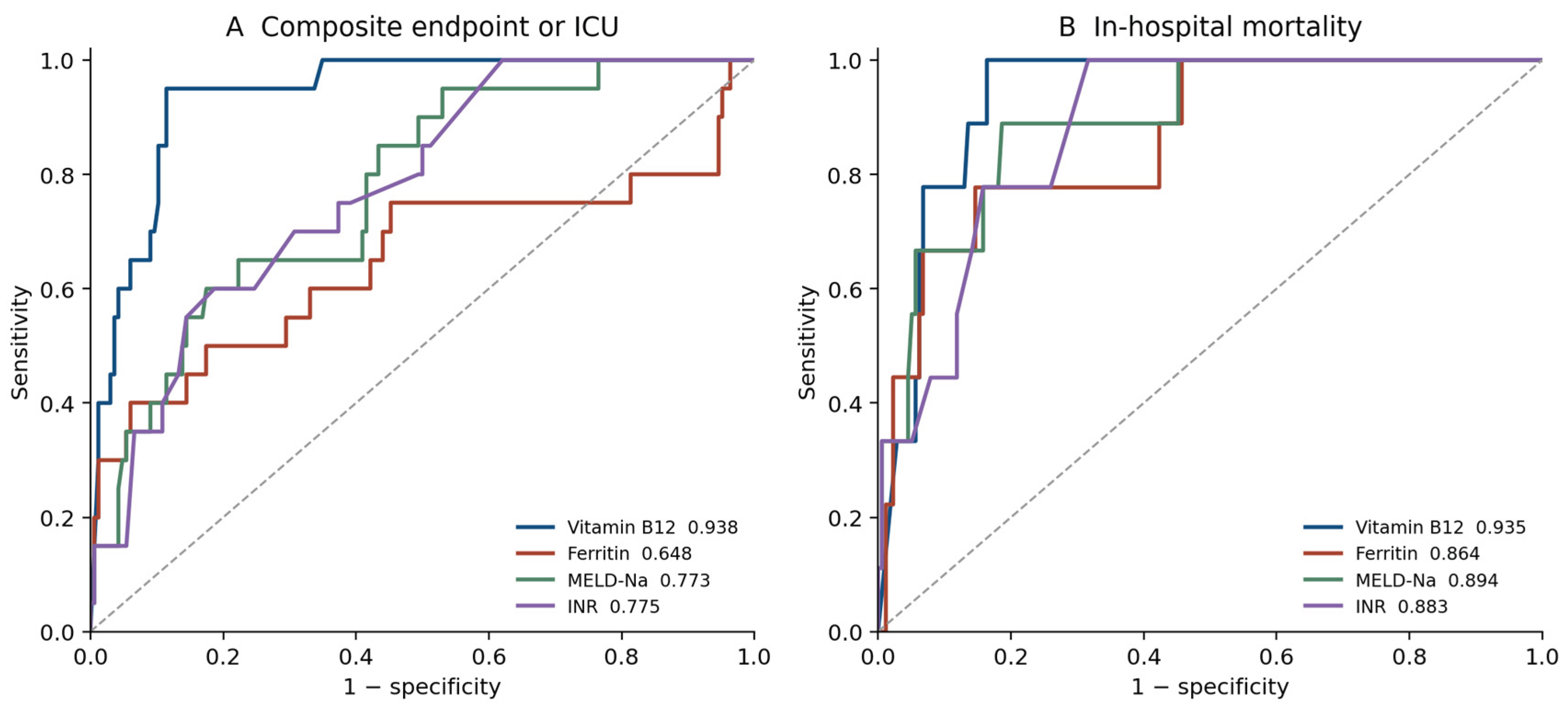

Table 1.
Characteristics by the exploratory composite endpoint.
| Variable | Total n=186 |
No event n=166 |
Event n=20 |
P |
|---|---|---|---|---|
| Age, years | 42.0 (34.0–52.0) | 41.0 (33.0–51.0) | 52.5 (40.0–57.0) | 0.013 |
| Male sex, n (%) | 90 (48.4) | 83 (50.0) | 7 (35.0) | 0.242 |
| Body mass index, kg/m² | 25.0 (22.4–28.1) | 24.8 (22.3–28.1) | 26.1 (23.8–29.3) | 0.395 |
| Vitamin B12, pg/mL | 1086.0 (682.2–1627.8) | 1003.5 (659.0–1340.2) | 2850.0 (1897.2–4000.0) | <0.001 |
| Ferritin, ng/mL | 915.0 (270.0–2475.2) | 828.0 (270.0–2000.0) | 2677.5 (780.5–12782.5) | 0.031 |
| AST, U/L | 982.5 (589.8–1964.8) | 963.0 (582.2–1821.8) | 1635.5 (875.2–3438.2) | 0.017 |
| ALT, U/L | 1415.5 (743.2–2331.5) | 1373.0 (743.2–2223.5) | 2189.0 (997.0–3486.0) | 0.091 |
| Total bilirubin, mg/dL | 9.4 (4.0–14.8) | 9.0 (3.7–14.7) | 12.4 (5.3–15.3) | 0.211 |
| INR | 1.40 (1.20–1.70) | 1.35 (1.20–1.60) | 1.90 (1.47–2.30) | <0.001 |
| Creatinine, mg/dL | 0.71 (0.59–0.86) | 0.71 (0.59–0.83) | 0.78 (0.58–1.02) | 0.304 |
| Sodium, mmol/L | 137.5 (136.0–139.0) | 138.0 (136.0–139.0) | 136.5 (134.8–140.2) | 0.452 |
| MELD | 18.8 (14.8–22.6) | 18.5 (14.4–21.9) | 23.5 (19.4–25.7) | <0.001 |
| MELD-Na | 19.4 (15.7–23.3) | 18.9 (15.1–22.8) | 24.5 (20.3–27.1) | <0.001 |
| Gastroenterology ward stay, days | 16.0 (10.2–20.8) | 16.0 (11.0–20.0) | 17.0 (7.8–25.0) | 0.600 |
Table 2.
Recorded etiologies.
| Etiology | Patients, n (%) | Composite events, n |
|---|---|---|
| Acute hepatitis B | 79 (42.5) | 10 |
| Drug-induced or toxic hepatitis | 56 (30.1) | 7 |
| Autoimmune hepatitis | 37 (19.9) | 3 |
| Indeterminate injury | 5 (2.7) | 0 |
| Acute hepatitis A | 4 (2.2) | 0 |
| Acute hepatitis C | 3 (1.6) | 0 |
| Pregnancy-associated injury | 1 (0.5) | 0 |
| Alcohol-associated hepatitis | 1 (0.5) | 0 |
Table 3.
Outcome specific discrimination.
| Marker | Composite or ICU 20 events |
Mortality 9 events |
Recorded HE 11 events |
Death or LT 10 events |
|---|---|---|---|---|
| Vitamin B12, pg/mL | 0.938 (0.897–0.980) | 0.935 (0.891–0.979) | 0.906 (0.837–0.975) | 0.944 (0.904–0.984) |
| Ferritin, ng/mL | 0.648 (0.483–0.814) | 0.864 (0.744–0.983) | 0.772 (0.622–0.923) | 0.882 (0.772–0.992) |
| MELD | 0.757 (0.649–0.865) | 0.875 (0.741–1.000) | 0.827 (0.737–0.917) | 0.876 (0.755–0.996) |
| MELD-Na | 0.773 (0.669–0.877) | 0.894 (0.796–0.992) | 0.841 (0.748–0.935) | 0.903 (0.814–0.992) |
| INR | 0.775 (0.678–0.873) | 0.883 (0.804–0.963) | 0.796 (0.698–0.895) | 0.881 (0.808–0.954) |
| BFI | 0.892 (0.816–0.969) | 0.889 (0.762–1.000) | 0.832 (0.699–0.966) | 0.903 (0.787–1.000) |
Table 4.
Logistic regression for the exploratory composite endpoint.
| Variable | Unadjusted OR (95% CI) |
P | Adjusted OR (95% CI) |
P |
|---|---|---|---|---|
| Age, per year | 1.04 (1.01–1.08) | 0.023 | 1.01 (0.96–1.06) | 0.768 |
| Vitamin B12, per 1000 pg/mL | 5.38 (3.06–9.46) | <0.001 | 7.00 (3.23–15.17) | <0.001 |
| MELD-Na, per point | 1.22 (1.10–1.36) | <0.001 | 1.30 (1.11–1.53) | 0.001 |
Table 5.
Exploratory BFI and observed outcomes.
| BFI score | Patients, n | Composite or ICU n (%) |
Recorded HE n (%) |
Mortality n (%) |
|---|---|---|---|---|
| 0 | 140 | 2 (1.4) | 2 (1.4) | 1 (0.7) |
| 1 | 38 | 11 (28.9) | 5 (13.2) | 3 (7.9) |
| 2 | 8 | 7 (87.5) | 4 (50.0) | 5 (62.5) |
Disclaimer/Publisher’s Note: The statements, opinions and data contained in all publications are solely those of the individual author(s) and contributor(s) and not of MDPI and/or the editor(s). MDPI and/or the editor(s) disclaim responsibility for any injury to people or property resulting from any ideas, methods, instructions or products referred to in the content. |
© 2026 by the authors. Licensee MDPI, Basel, Switzerland. This article is an open access article distributed under the terms and conditions of the Creative Commons Attribution (CC BY) license (http://creativecommons.org/licenses/by/4.0/).
Copyright: This open access article is published under a Creative Commons CC BY 4.0 license, which permit the free download, distribution, and reuse, provided that the author and preprint are cited in any reuse.