
Submitted:
17 October 2026
Posted:
20 October 2026
You are already at the latest version
Abstract
Background: Vision is important for baseball players, and this study compiled relevant literature to explore the impact of vision on baseball. Methodology: A systematic literature search was conducted across the PubMed and Airiti Library databases, following the PRISMA guidelines. The search employed keywords including "Baseball AND Vision", "Gait AND Myopia", "Dynamic Visual Acuity AND Baseball", "Predict AND Baseball", "Refractive Error AND Baseball", "Laser AND Baseball" and "Dynamic Vision Acuity AND Baseball [in Chinese]." After screening for relevance and quality, a total of 36 articles were ultimately included for analysis. Results: In baseball batting performance, visual stability is a core capacity for elite players, with moderate-to-high myopia (> 2.00 D) significantly impairing seam recognition and batting quality. Studies have shown that although refractive surgery improves static vision, it does not significantly improve batting performance metrics and carries the risk of glare. In the future, it is necessary to clarify the causal relationship between different degrees of refraction and corrective methods on the effectiveness of striking in high-ecological validity scenarios. In terms of defense and Locomotor mechanisms, visual quality affects center of gravity stability and eye-hand/foot coordination, while moderate to severe myopia increases gait variability and compensatory risk. Defensive interceptions rely on predictive control of visual expansion and auditory integration. Subsequently, a cross-sensory compensatory model should be constructed to explore the spatial localization mechanism when vision is limited, and to verify whether dynamic visual acuity (DVA) is a key variable in level promotion. In terms of decision-making efficiency and training, high-level players have excellent information processing efficiency, and uncorrected vision defects can increase cognitive load. Through neuroplasticity training, contrast sensitivity and actual combat performance can be optimized. In the future, virtual reality and actual combat simulation should be combined to explore the interactive effects of different corrective tools and training on competitive levels. Conclusions: For baseball, visual management should shift from simple vision correction to the pursuit of visual stability and neurocognitive integration, and through high ecological validity research and training, visual indicators should be transformed into core advantages to improve competitive performance and player selection.
Keywords:
baseball
; dynamic visual acuity
; sports vision
; Myopia
1. Introduction
Baseball is a sport that relies heavily on precise vision. for example, batters must judge the speed, spin, and trajectory of the pitch in a very short amount of time to hit the ball (Burris et al., 2018; Chen et al., 2021), Upon catching the ball, fielders must rapidly estimate the ball’s trajectory, move to an optimal interception point, and instantaneously determine the throwing direction to retire the runner before they reach the base. This process involves the integration of multiple perceptual movements such as visual tracking, dynamic spatial orientation, reaction time, and decision-making speed (Ho et al., 2023).
Since baseball relies heavily on vision, the quality of vision may be directly related to batting and fielding performance (Ho et al., 2023). If baseball players have myopia, astigmatism, or other refractive abnormalities, it will cause baseball players to lack visual clarity and depth perception, thereby reducing game performance (Laby & Kirschen, 2017; Laby et al., 2019). Furthermore, when players with refractive errors, rely on corrective modalities such as glasses, contact lenses, or laser refractive surgery to improve their visual ability. However, whether these corrections allow athletic performance to recover or further improve remains a critical topic of investigation.
Sports vision in baseball is related to the visual ability of baseball players during the game, including the ability to track moving objects, maintain visual concentration during fast movement, predict the ball path and reaction timing, etc. Studies have shown that baseball players with excellent athletic vision often have an advantage in hitting, fielding, and tactical judgment (Uchida et al., 2013). Therefore, delving into the role of sports vision in baseball not only helps to understand the success factors of elite baseball athletes, but also provides a scientific foundation for training protocols and practical applications. In addition, these abilities cannot be improved by general vision correction alone but also need to be cultivated through specialized sports vision training (Liu et al., 2020).
As discussed, baseball players must integrate specialized technical skills and physical conditioning with a high degree of reliance on visual function. Relevant studies have explored the effects of refractive errors and visual correction on the performance of baseball players. The role of sports vision in baseball and its impact on baseball performance has also been a topic of continuous research in recent years. This study will focus on the two core issues of refractive errors and visual correction on baseball athletes, as well as sports vision in baseball, in order to comprehensively examine the visual needs of baseball athletes and provide theoretical support and practical suggestions for future visual training and sports performance improvement. Based on this, this article first explains the proper terms related to refractive errors, and then collects and discusses the research literature on refractive errors and visual correction in baseball. Secondly, it also explains the relevant terms of sports vision and compiles and discusses sports vision literature in baseball. The details of this article are as follows.
2. Survey Methodology
This study conducted a systematic literature search and screening following the PRISMA (Preferred Reporting Items for Systematic Reviews and Meta-Analyses) guidelines, aiming to review the impact of visual ability on baseball performance. The literature search was conducted between January 2026 and May 2026, and eligible studies published between 2004 and 2026 were considered for inclusion. Searches were performed using the PubMed and Airiti Library databases with the following keyword combinations: "Baseball AND Vision", "Gait AND Myopia", "Dynamic Visual Acuity AND Baseball", "Predict AND Baseball", "Refractive Error AND Baseball", "Laser AND Baseball". In addition, in order to include Chinese-related studies, the search was also conducted using "dynamic vision Acuity AND baseball" as the keyword. Two researchers independently performed the literature screening and data extraction, with any discrepancies resolved through consensus.
A total of 607 records were initially identified. The search results for each keyword combination were as follows: 101 records for "Baseball AND Vision" in the PubMed database, 14 for "Gait AND Myopia," 16 for "Dynamic Visual Acuity AND Baseball," 445 for "Predict AND Baseball," 7 for "Refractive Error AND Baseball," and 15 for "Laser AND Baseball." Additionally, 9 records were retrieved from the Airiti Library using the keywords "Dynamic Vision Acuity AND Baseball." Studies involving human participants that examined visual function in relation to athletic performance were eligible, including studies of visual training or rehabilitation. Non-journal publications, non-human studies, and studies unrelated to vision or athletic performance were excluded. The records were combined and checked for duplicates; no duplicate records were identified. Title screening excluded 571 records. Full texts of the remaining 36 articles were obtained and assessed against the eligibility criteria. All 36 articles met the inclusion criteria and were included in the review. The study selection process is presented in Figure 1.
3. Result
3.1. Definitions and Terminology of Refractive Errors
Refractive errors refer to refractive or functional deviations of the human eye that prevent images from focusing correctly on the retina. These issues lead to blurred vision, image distortion, or poor binocular coordination, which can further impact overall visual performance (Lee et al., 2025). Common abnormalities include myopia, hyperopia, and astigmatism. These conditions not only affect daily life but may also directly impair the performance of baseball players in a sport that relies heavily on DVA. Definitions of refractive errors and explanations of key terminology are summarized in Table 1.
3.2. Definitions and Terminology of Sports Vision
Sports vision encompasses a variety of high-level visual functions that enable athletes to make accurate judgments and motor responses in high-speed and complex environments. The following section provides a summary of common terminology and definitions in sports vision. Definitions of sports vision and explanations of key terminology are summarized in Table 2.
3.3. The Impact of Vision on Batting Performance in Baseball
Vision is considered one of the critical factors influencing athletic performance. Previous studies have indicated that superior visual abilities enable athletes to complete tasks such as object identification, trajectory judgment, and motor responses within short timeframes, thereby enhancing overall performance (Berman, 1993; Christenson & Winkelstein, 1988; Hitzeman & Beckerman, 1993). In the context of baseball, batters must assess pitch velocity and spin within extremely narrow timeframes, while fielders are required to rapidly predict the ball’s landing spot and flight path. These demands underscore the pivotal role that visual function plays in both hitting and defensive performance.
In a study by Laby and Kirschen (2017), a refractive error distribution analysis was conducted on 413 professional baseball players (826 eyes) who qualified for and participated in the 2016 Major League Baseball (MLB) spring training. Results showed that myopia was the most prevalent refractive error, accounting for approximately 53% (439 eyes) of the sample. The average spherical equivalent (M) was -0.192 D for the right eye and -0.264 D for the left eye, both falling within the range of mild myopia. Hyperopia accounted for 38% (312 eyes), while individuals with no spherical refractive error (emmetropia, defined as M values within ±0.12 D) represented approximately 9% (75 eyes). These findings indicate that a proportion of professional players maintains a clinical state of emmetropia. Regarding astigmatism, the analysis revealed that the mean values ranged only between -0.05454 D and +0.00270 D. These data represent minimal cylindrical refractive errors; thus, astigmatism was clinically negligible in this population. This study reveals that the fundamental visual characteristics of professional baseball players reaching the MLB spring training level include: a relative absence of astigmatism, combined with either mild myopia, emmetropia, or hyperopia (Laby & Kirschen, 2017). However, as this study primarily sampled athletes from a specific context (MLB spring training), further verification is necessary to determine whether these findings can be generalized to baseball players of different competitive levels or diverse populations.
Research has explored the impact of correcting refractive errors through refractive laser surgery on the performance of professional baseball players. This study focused on 12 eligible MLB fielders who underwent refractive surgery. It analyzed their offensive statistics before and after the procedure, including Batting Average (AVG), On-Base Percentage (OBP), Slugging Percentage (SLG), and On-Base Plus Slugging (OPS). The study found that the mean performance before and after surgery showed no significant differences from both statistical and practical perspectives. Furthermore, the majority of players actually exhibited higher batting averages and slugging percentages prior to the procedure, and their performance showed no significant differences when compared to players who did not undergo surgery. These results indicate that there is currently no empirical evidence to support the claim that refractive laser surgery effectively enhances the batting performance of players. On the other hand, considering that surgery may be accompanied by potential risks such as corneal haze, night glare, or a decrease in best-corrected visual acuity (BCVA), these factors could adversely impact a player’s competitive performance and professional career. Consequently, the study suggests that active professional players should avoid undergoing surgery for the sole purpose of performance enhancement. A more prudent strategy would be to delay the evaluation and potential implementation of such procedures until after retirement (Laby et al., 2005). However, due to privacy concerns, the study was unable to obtain the players specific pre-operative refractive status. Consequently, it remains unclear whether athletes with different degrees of refractive error would exhibit similar outcomes after undergoing the procedure. Synthesizing the findings of Laby and Kirschen (2017), which established that MLB players predominantly belong to a low refractive error population, it can be inferred that the results of the current study may primarily reflect the outcomes of athletes with minimal refractive impairments. Consequently, the impact of surgery on the post-operative performance of players with higher degrees of refractive error remains to be further explored. Therefore, given these limitations, the findings of Laby et al. (2005) should be interpreted with caution.
Other studies have explored the impact of myopic defocus on baseball batting performance, with independent variables including gender, hand dominance, refractive error, and playing experience (Reuscher et al., 2021). The participants consisted of 30 young adults with corrected visual acuity of 20/20. The batting tasks were performed under four visual conditions: normal vision (plano), low myopia (+1.00 D), moderate myopia (+2.00 D), and moderate-to-high myopia (+3.00 D). Batting performance was evaluated using a batting quality grading scale to assess the participants execution. The results indicated that batting performance under low myopia (+1.00 D) showed no significant decline compared to normal vision (plano), suggesting that low-level myopia does not markedly affect batting execution. However, performance decreased significantly under moderate (+2.00 D) and moderate-to-high (+3.00 D) myopic conditions. These findings suggest that the threshold for visual impairment in batting tasks is approximately at the level of moderate myopia. The results also indicated that participants with more competitive experience performed significantly better than those with less experience, with an average score approximately 23% higher. However, no correlation was found between the degree of myopia and competitive experience. Furthermore, given that professional baseball players typically exhibit either emmetropia or very mild myopia (consistent with the observations of Laby & Kirschen, 2017), this suggests that the experimental design of Reuscher et al. (2021) was not specifically restricted to professional baseball players. Furthermore, the study by Reuscher et al. (2021) demonstrated that gender, hand dominance, and the sequential order of testing with different lenses had no significant impact on performance scores. However, a significant correlation remained between the participants baseline refractive status (e.g., hyperopia, myopia, or astigmatism) and the degree of induced myopic defocus. In summary, research confirms that low-level myopia does not exert a significant impact on baseball batting performance. However, a refractive deficit exceeding 2.00 D will lead to a significant decline in batting execution. However, as this study was conducted on the general adult population within a controlled laboratory environment, it may not fully reflect the actual performance of baseball players in real-world game situations. Therefore, future research should further investigate the impact of refractive errors on batting performance across different levels of baseball players (e.g., amateur vs. professional). Such studies would provide a more concrete clarification of the relationship between visual function and baseball batting performance.
In baseball batting, the auditory input consists of the sound generated at the moment of bat-ball impact, while the visual focus remains strictly on the baseball as the primary target. Regarding the baseball as a gaze target, the seams provide critical visual cues for the hitter. Clutter et al. (2024) conducted a study involving 16 adults aged 18 to 30 (non-baseball players) to investigate their ability to identify the seams of a stationary baseball rotating in place at various distances. The objective was to determine whether baseball seams serve as critical visual cues for predicting ball trajectories. The participants consisted of adults with a corrected visual acuity of 20/20 or better. During the experiment, the baseball’s rotation speed was set at 550 rpm. Participants were required to identify three distinct seam patterns: two-seam, four-seam, and a single wide red band at randomized distances ranging from 10 to 45 feet. The results showed an overall identification accuracy of 67% across all distances. At a distance of approximately 29 feet (corresponding to the position of a 90-mph pitch 200 ms after release), the accuracy reached 90% or higher. Additionally, at closer ranges of 16 feet and 10 feet, the identification rate exceeded 95%. Interestingly, while previous research (Bahill AT, 2005) suggested that two-seam patterns should be easier to identify than four-seam patterns, the error rates for both were found to be nearly identical in the present study. In conclusion, the study by Clutter et al. (2024) suggests that adults (non-baseball players) are capable of reliably identifying three distinct seam patterns to judge a pitch’s trajectory. Additionally, this identification ability allows them to determine the critical distance at which a swing decision must be initiated. The author also posits that visual resolution is the primary determinant of seam identification. Furthermore, the ability to recognize seam patterns likely constitutes a fundamental component in the estimation and prediction of pitch trajectories (Clutter et al., 2024).
In summary, the literature review confirms that vision is a pivotal factor in baseball performance, exerting a critical influence on batting execution. However, notable discrepancies exist among various studies regarding participant characteristics, experimental designs, and environmental contexts. Overall, research indicates that the majority of MLB players exhibit mild myopia (approximately 53%), while the prevalence of astigmatism remains extremely low and clinically insignificant. This stable and superior visual system provides a distinct advantage, facilitating high-level performance in competitive game environments. Regarding refractive correction, while laser refractive surgery can improve postoperative visual acuity and patient satisfaction, research analyzing 12 MLB position players revealed no significant enhancement in batting performance. Key metrics, including batting average (AVG), on-base percentage (OBP), slugging percentage (SLG), and on-base plus slugging (OPS), showed no improvement; in fact, the majority of players performed better prior to the surgery. Furthermore, potential risks such as corneal haze and night glare suggest that active players should not expect surgery to serve as a means of performance enhancement. In terms of myopic severity, low myopia (below +2.00 D) has a limited impact on batting performance. However, myopic defocus exceeding this threshold (moderate to moderate-to-high myopia) leads to a significant decline in both batting execution and ball-striking quality. Synthesizing these findings, it is evident that MLB players predominantly belong to a low-refractive-error demographic. Given that moderate-to-high myopia has been shown to exert a significantly negative impact on batting performance, it can be inferred that higher degrees of refractive error must be addressed through correction early in a player’s development. Failure to do so may inherently limit their capacity to advance into high-level competitive environments. However, empirical research focusing on baseball players with moderate-to-high refractive errors remains scarce. In particular, whether batting performance can be effectively restored following refractive correction (such as laser surgery) in this specific population has yet to be fully elucidated. Furthermore, as a primary visual cue, baseball seams (such as two-seam and four-seam patterns) enable hitters to identify pitch types and trajectories within ms, which is critical for determining swing timing. Since visual resolution is the primary determinant of seam identification, research indicates that the recognition levels for two-seam and four-seam patterns are comparable following proper visual correction. Nevertheless, existing experiments on seam recognition are largely confined to laboratory settings. While the identification of seams following visual correction is well-documented, a significant research gap remains regarding whether individuals with refractive errors exhibit differential recognition abilities across various seam patterns. Future research should validate the effects of varying refractive levels on the recognition of the three seam patterns within a laboratory setting. Furthermore, this scope should be expanded to investigate the impact of refractive errors and subsequent visual corrections in real-world game situations. Such an approach is essential to clarify the causal relationships and underlying mechanisms between visual function and batting performance. Furthermore, baseball players span various levels of expertise. Investigating whether differences exist between elite and lower-level players in terms of refractive error prevalence and seam recognition ability represents a valuable direction for future research.
3.4. The Impact of Vision on Defensive Movement in Baseball
Regarding balance and postural control, existing studies have confirmed that myopia exerts an adverse effect on gait stability. Research utilizing convex lenses to simulate moderate (+1.50 D) and high (+4.50 D) myopia has demonstrated that such conditions lead to gait instability. Specifically, individuals exhibit a greater range of vertical center of gravity (COG) displacement compared to emmetropes. Furthermore, these individuals show an increased proportion of single-support phase and a decreased double-support phase, indicating impaired postural control. As the severity of myopia reaches high levels, increased angular variability is observed in the hip, knee, and ankle joints. This suggests that individuals must employ more compensatory movements to maintain equilibrium, thereby further elevating the risk of falls (Amemiya et al., 2014; Xue et al., 2023; Pesenti et al., 2022). Given that baseball involves extensive base running, fielding on the move, and defensive transitions, these activities depend heavily on stable gait and dynamic balance. Consequently, the gait instability induced by myopia may exert potential impacts on a player’s speed, agility, and overall movement fluidity. This issue warrants further investigation to clarify the actual effects of myopia on the base-running and defensive performance of baseball players. Such research will provide a critical reference for visual management strategies and the optimization of athletic performance.
Regarding DVA, a study involving 149 baseball players aged 10 to 22 investigated whether differences exist in DVA performance across various defensive positions, including pitchers, catchers, infielders, and outfielders. The study utilized ATHLEVISION software to conduct DVA assessments across four directions: superior, inferior, left, and right. Based on these measurements, indices for horizontal DVA, vertical DVA, and an overall DVA composite were calculated. Results indicated no significant differences in DVA among the various defensive positions (p > 0.05). Furthermore, no significant disparities were observed across the groups in terms of static visual acuity or levels of visual fatigue. Based on these findings, the authors suggest that while DVA is fundamental to baseball success, the long-term exposure of all players to integrated batting and fielding drills leads to a universal adaptation of the visual system. Consequently, distinct differences between defensive positions are less likely to emerge. In practical terms, coaches need not utilize DVA as a primary criterion for positional assignment or role selection, as this capacity remains largely consistent across all players on the field (Liu et al., 2009). However, the broad age range of the study’s sample, coupled with the lack of differentiation between professional and non-professional players, necessitates a cautious interpretation of the findings applicability across different competitive levels.
In the context of multisensory integration, Kreyenmeier et al. (2023) highlighted that human perception of the external environment relies not only on vision but also on critical auditory cues. The synergy between visual and auditory inputs has been shown to further enhance athletic performance. Their study investigated the mechanisms by which visual and auditory signals integrate to enhance human performance in interceptive actions, such as catching and hitting in baseball. When visual and auditory information are combined, they facilitate faster and more accurate predictions of an object’s motion and Time-of-Interception (TOI) than vision alone. Particularly during the initial stages of a target’s trajectory, auditory cues provide a rapid preliminary estimate of velocity, which subsequently guides visual tracking and enhances the precision of trajectory judgment. This rapid sensory integration is likely mediated by subcortical circuits, enabling athletes to establish a velocity model earlier and judge the ball’s trajectory with higher precision. In the context of baseball, the impact sound of the bat and ball is far more than mere background noise; rather, these serve as critical sensory cues. Such auditory information enables both hitters and fielders to predict the ball’s time-of-arrival and spatial coordinates more effectively, thereby significantly enhancing athletic performance during competition (Kreyenmeier et al., 2023).
During batting, the seams of the baseball provide essential visual cues for the hitter. In contrast, when performing defensive maneuvers, players utilize a broader and more diverse array of ball-related visual cues to execute successful catches. Research related to these topics often explores theoretical models of sports vision, with the outfielder’s catching maneuver being a frequently investigated subject. Aguado and López-Moliner (2025) noted that while the traditional closed-loop control model accounts for how outfielders utilize feedback to continuously refine their catching maneuvers, it fails to explain whether or how players employ predictive strategies to facilitate the completion of a catch. Based on this premise, the authors proposed a novel model that integrates optic variables with physical constants, such as gravity (g) and ball size (s). This model enables the real-time prediction of a fly ball’s Time-to-Contact (TTC) and landing position. Furthermore, these predictions are continuously updated during the outfielder’s movement, based on their dynamic elevation angle (γ), azimuth angle (β), and visual expansion rate (θ̇). The study further utilized Virtual Reality (VR) to simulate flight scenarios with varying levels of gravity and ball sizes. Results demonstrated that outfielders typically follow a slightly curved running trajectory. Moreover, the morphology of these running paths underwent significant alterations as the magnitude of gravity increased. This model successfully predicts walking trajectories and reaction times across various gravitational conditions, demonstrating that when facing high-velocity fly balls, outfielders do not rely solely on visual reactions. Instead, they integrate visual cues with a gravity prior (an internal neural model of Earth’s gravitational acceleration). Through continuous predictive control and dynamic adjustments to their movement strategies, players achieve precise spatiotemporal judgments and successful catching behavior. Synthesizing these findings, it is evident that contemporary research on outfielder interception has moved beyond the constraints of traditional closed-loop control theory. While the traditional model emphasizes continuous error correction via sensory feedback, it remains limited in explaining the full complexity of successful catching behavior. Consequently, the development of predictive models that integrate dual mechanisms utilizing both prediction and feedback represents a pivotal direction for future investigations in this field. Furthermore, the literature highlights that audio-visual integration acts as a key driver in enhancing motor skills and execution, exploring how auditory inputs can be incorporated into predictive models (by utilizing sound localization to supplement judgments of spatial positioning and distance) represents a promising frontier for future research (Aguado & López-Moliner, 2025).
In alignment with the aforementioned discussions, baseball players actively leverage their perception of the external environment to enhance performance. Consequently, contemporary studies frequently incorporate DVA, reaction time, and eye-hand/foot coordination into a comprehensive framework for athletic research and evaluation. For instance, a right fielder determining that a fly ball will land approximately five steps to their back-right and rapidly sprinting to that specific location serves as a quintessential example of eye-foot coordination. This scenario illustrates the tight integration between DVA, reaction time, and eye-hand/foot coordination in a high-pressure environment (Benson et al., 2025; Sander & Fogt, 2022).
Overall, visual function is fundamentally indispensable for defensive maneuvers and locomotive actions, including catching, throwing, and base running. Research indicates that myopia has a potential negative impact on gait stability and center of gravity (COG) control. Specifically, moderate (1.50 D) to high (4.50 D) myopia leads to an increased vertical COG amplitude and a higher proportion of single-limb support. Furthermore, it results in greater variability in hip, knee, and ankle joint angles, triggering compensatory movements that increase fall risk and potentially compromise the speed and agility required for base-running, defensive positioning, and throwing. Regarding defensive mechanisms, outfielders do not rely solely on traditional closed-loop feedback control during the catching process. Instead, they employ predictive control by integrating visual optic variables such as elevation angle, azimuth angle, and visual expansion rate with the brain’s "gravity prior" hypothesis, continuously refining their action strategies to achieve precise interception. Furthermore, the multisensory integration of visual and auditory inputs such as hitting sounds strengthens the prediction of target motion. This synergy provides a critical advantage in identifying the ball’s initial velocity and enhancing the overall interception process. Although DVA shows no significant differences across defensive positions including pitchers, catchers, infielders, and outfielders due to long-term specialized training, it remains evident that a robust visual system serves as the fundamental cornerstone supporting high-level defensive performance. Future research should strive to construct a more comprehensive framework within baseball sports science. Specifically, investigations should explore the interactive effects of physiological myopia on DVA and gait stability. By developing integrative models that encompass refractive errors, auditory inputs, and eye-hand/foot coordination, researchers can clarify the cross-modal compensatory mechanisms athletes employ to maintain defensive performance when visual integrity is compromised. Building upon this foundation, future studies should conduct comparative analyses of multisensory integration capabilities across various skill levels. Such endeavors aim to facilitate the development of emerging multisensory predictive models that can eventually supersede traditional "closed-loop control" frameworks. This study aims to elucidate the sophisticated spatial localization mechanisms established by high-level athletes through the integration of auditory and dynamic visual inputs under competitive conditions. Finally, it is recommended that differences in DVA, reaction time, and motor coordination be compared across various competitive levels to verify whether myopia serves as a critical variable in career advancement. Such research would enable the prediction of performance based on an individual’s unique audiovisual sensory capacities, thereby providing a more comprehensive, evidence-based foundation for vision management and scientific training in baseball.
3.5. The Impact of Vision on Decision-Making Speed in Baseball
Post-refractive laser surgery, some patients may still perceive their vision as insufficiently sharp or experience persistent glare, despite the successful correction of their optical refractive error (Durrie & McMinn, 2007; Yamane et al., 2004). In such instances, cognitive vision training programs such as NeuroVision or RevitalVision become instrumental. The core principle of these interventions is not to alter the physical structure of the eye, but rather to leverage "perceptual learning " to stimulate neural plasticity within the visual cortex, thereby optimizing image processing efficiency. The training process utilizes specific visual stimuli, such as Gabor patches, to enhance the sensitivity of the primary visual cortex to subtle signals. This allows patients to achieve clinically significant improvements in visual acuity post-surgery averaging an enhancement of approximately 2 lines on the logMAR chart (the standardized symbols on a vision chart) despite no change in refractive error, demonstrating that improvement stems from neural adaptation in the brain. Importantly, such training significantly enhances contrast sensitivity, enabling individuals to maintain image clarity even in low-contrast, complex lighting, or glare-intensive environments. This effectively mitigates the glare and halo effects caused by optical scattering. Overall, visual cognitive training represents a non-invasive, personalized follow-up therapy that further optimizes post-operative visual function and quality of life without the need for additional surgery or optical correction (Durrie & McMinn, 2007; Lim & Fam, 2006). However, most pertinent studies have focused on the general population or post-operative patients. Whether the benefits of such training can be directly translated into enhanced athletic performance in a real-world sporting context remains to be substantiated through further empirical investigation.
Regarding reaction speed, Laby et al. (2019) demonstrated that when a batter faces a fastball traveling at approximately 90 mph (about 145 km/h), the entire window from the pitcher’s release to the ball reaching home plate spans only about 400 ms. Given that the swing execution itself requires approximately 150 ms to complete, the actual time remaining for the batter to track the trajectory, identify the pitch type, and finalize the "go/no-go" decision is reduced to a mere 250 ms. The average human blink lasts approximately 300 ms, meaning that a batter must complete visual judgments and motor responses in less time than a single blink. (Laby et al.,2019). Given the extremely limited time available for a baseball player’s motor response, how do visual abnormalities influence an athlete’s reaction speed? According to relevant literature, the images perceived by myopic individuals are inherently blurred, which diminishes perceived brightness. This combination of blur and reduced brightness subsequently prolongs the brain’s processing time for visual signals (Mohanraj & Karthikeyan., 2017), The overlapping images and focusing difficulties caused by astigmatism can increase visual workload and ocular fatigue, which in turn hampers the efficiency of information processing (Wolffsohn et al.,2011). Synthesizing the arguments from these two studies, it is evident that both myopia and astigmatism can significantly impair the timing and efficiency of an individual’s visual signal processing. Active participants in baseball hitting are by no means limited to elite professionals; a significant number of enthusiasts are found across student teams, community leagues, and amateur circles. Within these diverse populations, a substantial proportion likely contends with refractive errors such as astigmatism or myopia. Therefore, how astigmatism and myopia specifically modulate the reaction time of baseball hitters remains a critical avenue for future empirical exploration.
Regarding gaze velocity, studies have compared the fundamental gaze speeds among three cohorts: Major League Baseball (MLB) players, young amateur athletes, and non-athletes. Utilizing the RightEye CGP eye-tracking test, researchers measured the reaction times as the eyes moved from a central fixation point to eight fundamental gaze targets. The study cohorts comprised 17 MLB players (ages 19–34), 160 young amateur athletes (ages 15–19), and 128 non-athletes (ages 18–32). The findings revealed that the gaze velocity of MLB players was significantly faster than that of the other two cohorts. Specifically, the mean response time for MLB players was 238 ms, which was approximately 102 ms faster than that of young amateur athletes (341 ms) and 98 ms faster than that of non-athletes (337 ms). Notably, no significant difference was observed between the young amateur athletes and the non-athletes. A comparison across different gaze directions revealed that horizontal movements were the fastest (approximately 285 ms toward the right), while downward movements were the slowest (approximately 337 ms). This indicates that the direction of ocular Locomotion significantly influences gaze velocity. These research results confirm that the visual performance of MLB players is superior to other groups, suggesting that gaze velocity serves as a critical visual metric correlated with the level of athletic proficiency (Kubitz et al., 2020). However, the relatively small sample size of professional players, coupled with the inherent gap between controlled testing environments and real-world game scenarios, suggests that these findings should be interpreted with caution.
Synthesizing the aforementioned literature, it is evident that within the high-velocity context of competitive baseball, both decision-making speed and the efficiency of neural information processing serve as hallmark indicators for distinguishing between different tiers of athletic proficiency. Research indicates that the gaze velocity of MLB players (averaging 238 ms) is significantly faster than that of amateur athletes and non-athletes, demonstrating that rapid visual search and ocular movement are critical prerequisites for high-level athletic performance. Given that a batter has only a 250-millisecond window for decision-making after accounting for swing execution, any incremental visual workload possesses the potential to induce critical processing delays. High astigmatism or uncorrected myopia increases ocular fatigue and diminishes perceived brightness, which subsequently impairs the brain’s information-processing efficiency and decelerates reaction speed. For postoperative patients or those with suboptimal visual quality, visual cognitive training (such as NeuroVision or RevitalVision) utilizes perceptual learning and Gabor filter stimuli to tap into neural plasticity. By strengthening the visual cortex’s sensitivity to subtle signals, this training effectively enhances contrast sensitivity and visual clarity without changing the refractive error, allowing athletes to sustain high-level performance even in low-light or glare environments. Overall, sports vision encompasses high-level perceptual processes including visual processing, reactive decision-making, and multisensory integration. Future research should focus on the comprehensive impact of varying visual conditions on athletic performance. By comparing the hitting efficacy of purely refractive correction versus integrated visual training, researchers can further elucidate the role of neural compensatory mechanisms within actual competitive scenarios. Future research should encompass both novice and veteran players with myopia and astigmatism to conduct in-depth investigations into the variances in their visual reaction times and the long-term impact on baseball performance. Furthermore, the study should explore the interaction between different corrective modalities (such as spectacles, contact lenses, and post-operative status) and the overall efficacy of visual training interventions. In addition, future studies should combine live-pitching matchups with virtual reality (VR) game simulations to analyze the variances in hitting accuracy among participants of different professional levels when facing visual constraints. By enhancing the ecological validity of the testing environment, this approach will enable precise verification of the critical effects that physiological visual limitations, corrective tools, and cognitive training exert on actual competitive performance.
4. Conclusions
Visual capability is both a critical determinant of baseball performance and a core variable that distinguishes between different levels of athletic proficiency. In terms of batting performance, MLB players generally exhibit exceptional visual stability and minimal refractive errors. While mild myopia is surprisingly prevalent within this cohort, experimental study suggests that moderate to high refractive errors (> +2.00 D) significantly impair seam recognition and hitting quality. Notably, while refractive laser surgery effectively enhances static visual acuity, it does not yield a significant gain in competitive metrics such as On-base Plus Slugging (OPS). Furthermore, the procedure carries the risk of optical side effects that may impede peak performance. Regarding defense, Locomotor mechanisms, and motor control, visual quality does more than predict interceptive behavior through optical variables like the expansion rate (tau); it further influences gait stability and eye-hand/foot coordination. Moderate to severe visual deficits may induce compensatory movements and increase the risk of athletic injury. Furthermore, decision-making performance depends on the integration of visual search efficiency and neural processing speed; suboptimal or uncorrected visual quality increases cognitive load and delays reaction time. In summary, for professional athletes, vision management should prioritize visual stability over the mere pursuit of refractive correction. Future research should further elucidate the effects of various corrective modalities on dynamic vision, focusing specifically on the compensatory mechanisms of individuals with moderate to high refractive errors. By transcending traditional closed-loop control models, researchers should aim to construct an integrated predictive model that synthesizes visual, auditory, and spatial localization inputs. Concurrently, empirical investigations should evaluate the extent to which visual training grounded in the principles of neural plasticity translates into a competitive advantage within both virtual and real-world scenarios. By extending laboratory findings to high-ecological-validity on-field setting, this research can establish a causal link between visual impairment and batting efficacy, while validating whether visual metrics can serve as critical predictive variables for talent selection and professional promotion.:
Acknowledgments
The authors received no financial support for the research, authorship, and/or publication of this article. Although a formal protocol was not prospectively registered, the review process was conducted in strict accordance with pre-defined objectives and PRISMA standards to ensure methodological rigor and minimize potential bias.
References
- Aguado B, López-Moliner J. 2025. The predictive outfielder: a critical test across gravities. R Soc Open Sci 12(2):241291. [CrossRef]
- Amemiya A, Noguchi H, Oe M, Ohashi Y, Ueki K, Kadowaki T, Mori T, Sanada H. 2014. Elevated plantar pressure in diabetic patients and its relationship with their gait features. Gait & posture, 40(3):408-414. [CrossRef]
- Artal P, Schwarz C, Cánovas C, Mira-Agudelo A. 2012. Night myopia studied with an adaptive optics visual analyzer. PLoS One 7(7):e40239. [CrossRef]
- Bahill AT, Baldwin DG, Venkateswaran J. 2005. Predicting a baseball’s path: A batter watches the pitcher’s motion plus the spin on the ball to calculate when and where it will cross the plate. Am Sci 3:218-225. [CrossRef]
- Benson E, Toole AJ, Fogt N. 2025. Ball-Flight Viewing Duration and Estimates of Passing Height in Baseball. Vision (Basel) 9(1). [CrossRef]
- Berman AM. 1993. Clinical evaluation of the athlete. Optom Clin 3(1):1-26.
- Burris K, Vittetoe K, Ramger B, Suresh S, Tokdar ST, Reiter JP, Appelbaum LG. 2018. Sensorimotor abilities predict on-field performance in professional baseball. Scientific reports 8(1):116. [CrossRef]
- Chen G, Zhang J, Qiao Q, Zhou L, Li Y, Yang J, Wu J, Huangfu H. 2023. Advances in dynamic visual acuity test research [Review]. Frontiers in Neurology 13:2022. [CrossRef]
- Chen PY, Jheng YC, Huang SE, Po-Hung LiL, Wei SH, Schubert MC, Kao CL. 2021. Gaze shift dynamic visual acuity: A functional test of gaze stability that distinguishes unilateral vestibular hypofunction. J Vestib Res 31(1):23-32. [CrossRef]
- Chen R, Stone LS, Li L. 2021. Visuomotor predictors of batting performance in baseball players. Journal of Vision 21(3):3-3. [CrossRef]
- Christenson GN, Winkelstein AM. 1988. Visual skills of athletes versus nonathletes: development of a sports vision testing battery. J Am Optom Assoc 59(9):666-675.
- Clutter M, Do MV, Zimmerman A, Fogt N. 2024. Baseball Seam Recognition at Different Distances. Optom Vis Perform 12(2):83-89.
- Dean HL, Martí D, Tsui E, Rinzel J, Pesaran B. 2011. Reaction time correlations during eye-hand coordination: behavior and modeling. J Neurosci 31(7):2399-2412. [CrossRef]
- Drobnyk W, Rocco K, Davidson S, Bruce S, Zhang F, Soumerai SB. 2019. Sensory Integration and Functional Reaching in Children With Rett Syndrome/Rett-Related Disorders. Clin Med Insights Pediatr 13:1179556519871952. [CrossRef]
- Durrie D, McMinn PS. 2007. Computer-based primary visual cortex training for treatment of low myopia and early presbyopia. Trans Am Ophthalmol Soc 105:132-138.
- Gurnani B, Kaur K. 2025. Astigmatism. In StatPearls. StatPearls Publishing.
- Copyright © 2025, StatPearls Publishing LLC.
- Hitzeman SA, Beckerman SA. 1993. What the literature says about sports vision. Optom Clin 3(1):145-169.
- Ho J, Liu S, Feng Z, Appelbaum LG. 2023. Psychomotor and visual skills underlying position specialization in 1352 elite youth baseball players. PLoS One 18(1):e0278689. [CrossRef]
- Kaluga E, Straburzynska-Lupa A, Rostkowska E. 2019. Hand-eye coordination, movement reaction time and hand tactile sensitivity depending on the practiced sports discipline. The Journal of sports medicine and physical fitness 60. [CrossRef]
- Kreyenmeier P, Schroeger A, Cañal-Bruland R, Raab M, Spering M. 2023. Rapid Audiovisual Integration Guides Predictive Actions. eNeuro 10(8). [CrossRef]
- Kubitz K, Roberts CM, Hunfalvay M, Murray N. 2020. A Comparison of Cardinal Gaze Speed between Major League Baseball Players, Amateur Prospects, and Non-athletes. Journal of Sports and Performance Vision 1:17-28. [CrossRef]
- Laby DM, Kirschen DG. 2017. The Refractive Error of Professional Baseball Players. Optom Vis Sci 94(5):564-573. [CrossRef]
- Laby DM, Kirschen DG, De Land P. 2005. The effect of laser refractive surgery on the on-field performance of professional baseball players. Optometry 76(11):647-652. [CrossRef]
- Laby DM, Kirschen DG, Govindarajulu U, DeLand P. 2019. The Effect of Visual Function on the Batting Performance of Professional Baseball Players. Scientific reports 9(1):16847. [CrossRef]
- Lee T, Leung M, van Boxtel JA, Boon MY. 2025. The Effects of Refractive Imbalance on Binocular Vision Status, Reading Performance, and Vision-Related Reading Difficulty Symptoms in Expert Readers. Invest Ophthalmol Vis Sci 66(9):15. [CrossRef]
- Lim KL, Fam HB. 2006. NeuroVision treatment for low myopia following LASIK regression. J Refract Surg 22(4):406-408. [CrossRef]
- Liu YC, Wu WC, Chung CW. 2009. The Comparison to Dynamic Visual Acuity among Different Fielding Positions Players in Baseball. Journal of Physical Education and Sports 19(3):55-64. [CrossRef]
- Liu S, Ferris LM, Hilbig S, Asamoa E, LaRue JL, Lyon D, Connolly K, Port N, Appelbaum LG. 2020. Dynamic vision training transfers positively to batting practice performance among collegiate baseball batters. Psychology of Sport and Exercise 51. [CrossRef]
- Majumdar S, Tripathy K. Hyperopia. 2025. In: StatPearls [Internet]. Treasure Island (FL): StatPearls Publishing. [CrossRef]
- Mohanraj S, Karthikeyan A. 2017. Comparison of visual reaction time in myopic subjects with emmetropic subjects. National Journal of Physiology, Pharmacy and Pharmacology 7:1. [CrossRef]
- Pesenti S, Garcia L, Pomero V, Authier G, Boulay C. 2022. Gait abnormalities in adolescent idiopathic scoliosis patients. Do curvature amplitude matter? Gait & Posture 97:399. [CrossRef]
- Reuscher N, Bulson R, Kempgens C, Fischer M, Hayes J. 2021. Effect of Myopic Defocus on Baseball Batting Performance. Optometry & Visual Performance 9(3).
- Saluja G, Kaur K. 2025. Childhood Myopia and Ocular Development. [Updated 2023 May 4]. In: StatPearls [Internet]. Treasure Island (FL): StatPearls Publishing; 2025 Jan-. Available from: https://www.ncbi.nlm.nih.gov/books/NBK587350/.
- Sander J, Fogt N. 2022. Estimations of the Passing Height of Approaching Objects. Optom Vis Sci 99(3):274-280. [CrossRef]
- Tahhan N, Bullimore MA, He X, Ostrin LA, Gawne TJ, Gifford KL, Kang P, Morgan I, Couturier A, Ohno-Matsui K, Logan NS, Flitcroft I. 2025. IMI-2025 Digest. Invest Ophthalmol Vis Sci 66(12):27. [CrossRef]
- Uchida Y, Kudoh D, Higuchi T, Honda M, Kanosue K. 2013. Dynamic visual acuity in baseball players is due to superior tracking abilities. Med Sci Sports Exerc 45(2):319-325. [CrossRef]
- Xiao H, Jiang D, Wang Y, Sun B, Li C, Lin Y, Liu L, Huang X, Vasudevan B, Chen, Y. 2022. A comparative study of the prevalence of myopia and behavioral changes in primary school students. BMC Ophthalmol 22(1):370. [CrossRef]
- Xue A, Zeng Z, Wang H, Han J, Pang B. 2023. Kinematic characteristics of gait with different myopia: a cross-sectional study [Original Research]. Frontiers in Public Health 11. [CrossRef]
- Wolffsohn JS, Bhogal G, Shah S. 2011. Effect of uncorrected astigmatism on vision. Journal of cataract and refractive surgery 37(3):454–460. [CrossRef]
- Yamane N, Miyata K, Samejima T, Hiraoka T, Kiuchi T, Okamoto F, Hirohara Y, Mihashi T, Oshika T. 2004. Ocular higher-order aberrations and contrast sensitivity after conventional laser in situ keratomileusis. Investigative ophthalmology & visual science 45(11):3986–3990. [CrossRef]
Figure 1.
PRISMA flow diagram of the literature search and study selection process.
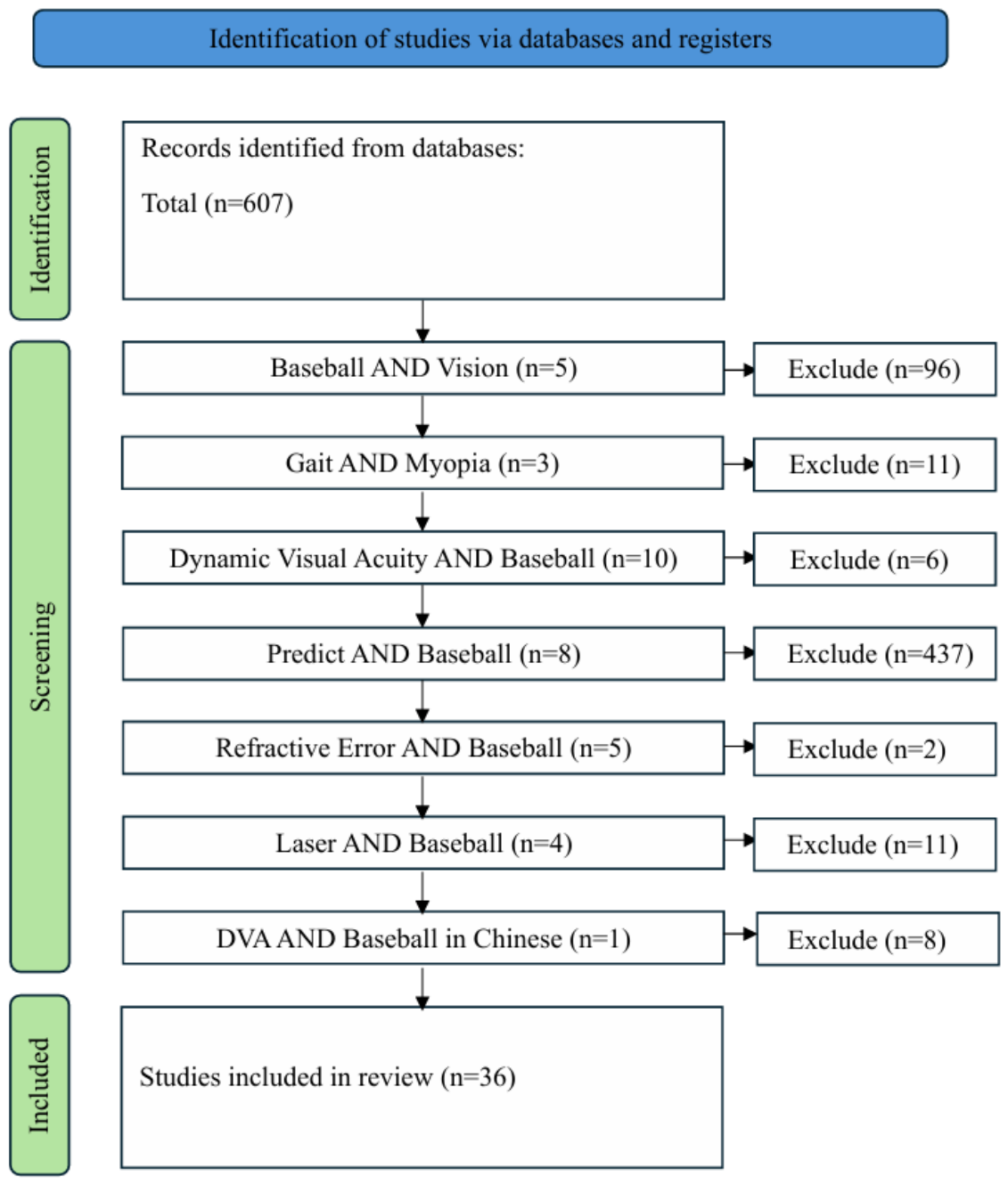

Table 1.
Definitions of refractive errors and summary of key terminology.
| Terminology | Definitions | Relevance to Baseball |
| Myopia | Light focuses in front of the retina, resulting in blurred vision for distant objects (Saluja & Kaur, 2025). | It impairs the judgment of the pitcher’s release point and the landing point of fly balls during hitting. |
| Hyperopia | Light focuses behind the retina, leading to blurred vision for near objects (Majumdar & Tripathy, 2025). | Catchers and batters are prone to visual fatigue during prolonged periods of near-distance focus. |
| Astigmatism | Uneven curvature of the cornea or lens, resulting in ghosting (double vision) or blurred images. (Gurnani & Kaur, 2025). | Impairs the judgment of ball velocity and the ability to perceive the seams of a spinning ball. |
| Refractive Error | Refractive errors, including myopia, hyperopia, and astigmatism, indicate abnormalities in the eye’s focusing ability. "Spherical power (Sph, D)" is used to assess myopia and hyperopia, while "Cylindrical power (Cyl, D)" is used to evaluate astigmatism. Note that 1.00 D is equivalent to 100 degrees (in common parlance). (Xiao et al., 2022). | Refractive error statistics are analyzed using the "eye" as the unit of measure rather than the "individual." This approach is taken because the refractive status of an individual’s eyes is not necessarily identical; for instance, a person may present with myopia in one eye and hyperopia in the other, or varying degrees of myopia in both eyes. If data were aggregated solely by "individual," these significant inter-ocular differences would be obscured. Therefore, conducting statistics on a per-eye basis more accurately reflects visual status and allows for a more precise analysis of refractive error distribution among baseball players. |
| Mean Spherical Equivalent | The sum of the spherical power and half of the cylindrical power is used to represent the overall refractive status. This value allows for a comprehensive evaluation of the combined degree of myopia, hyperopia, and astigmatism. (Tahhan et al., 2025). | Used to assess the visual characteristics and the distribution of refractive abnormalities within the baseball player population. |
| Myopic Defocus | Refers to a blurred state where the focal point of an image temporarily falls in front of the retina. This can occur due to uncorrected myopia or can be intentionally induced in experiments by adding positive spherical (+D) lenses to create a myopic state in participants. (Artal et al., 2012). | Used to simulate the effects of varying degrees of visual blur on hitting performance. |
Table 2.
Definitions of sports vision and summary of key terminology.
| Terminology | Definitions | Relevance to Baseball |
| gaze speed | The speed at which the eyes move rapidly from one fixation point to another, typically measured using an eye-tracking system (Chen et al.,2021). | Professional baseball players exhibit significantly higher saccadic velocities than amateur players and non-athletes, facilitating faster capture of pitching and on-field dynamics. |
| dynamic visual acuity (DVA) | The visual ability to maintain clear resolution and discrimination of an object while it is in continuous motion (Chen et al., 2023). | Batters must clearly perceive the rotation and trajectory of a high-velocity baseball within milliseconds (ms); this is a core capability for both hitting and defensive performance. |
| multisensory integration | The neural process of combining signals from different sensory modalities (e.g., vision and audition) to enhance judgment accuracy and response speed. (Drobnyk et al., 2019). | Batters can integrate the auditory cue of the ball impacting the bat with visual signals to enhance the predictive accuracy of ball velocity and landing position. |
| reaction time | The time elapsed from the reception of a visual signal to the initiation of a motor response (Dean et al., 2011). | Both batting swings and defensive decision-making rely on minimizing reaction time to execute movements within extremely narrow time windows. |
| eye-hand/foot coordination | The coordination between visual signals and limb movements (Kaluga et al., 2019). | Outfielders rapidly move to the ball’s landing position based on the flight trajectory, demonstrating a high degree of eye-foot coordination. |
Disclaimer/Publisher’s Note: The statements, opinions and data contained in all publications are solely those of the individual author(s) and contributor(s) and not of MDPI and/or the editor(s). MDPI and/or the editor(s) disclaim responsibility for any injury to people or property resulting from any ideas, methods, instructions or products referred to in the content. |
© 2026 by the authors. Licensee MDPI, Basel, Switzerland. This article is an open access article distributed under the terms and conditions of the Creative Commons Attribution (CC BY) license (http://creativecommons.org/licenses/by/4.0/).
Copyright: This open access article is published under a Creative Commons CC BY 4.0 license, which permit the free download, distribution, and reuse, provided that the author and preprint are cited in any reuse.