

Submitted:
16 October 2026
Posted:
20 October 2026
You are already at the latest version
Abstract
We analysed International Waterbird Census data from the Caorle Lagoon (northern Adriatic, Italy), collected during 1993–2022, to assess changes in abundance, diversity, community composition, habitat distribution and thermal affinity in a wetland complex dominated by fish farms managed for waterbird hunting. Across 29 censuses, 947,541 in-dividuals belonging to 84 species were recorded, excluding raptors. Total abundance in-creased significantly and more than doubled, while species richness and Shannon diver-sity also increased. Ducks, geese and swans, particularly grazing feeders, showed the strongest positive trends, whereas coots and rails declined. Low similarity between the first and last censuses indicated substantial community reorganisation, including in-creasing goose and Eurasian Teal Anas crecca abundance and reduced Eurasian Coot Fulica atra dominance. Fish farms supported 80.9% of all individuals, while the contribution of large, reclaimed areas increased from 0.7% in 1994–2002 to 10.2% in 2012–2022. Abun-dance-weighted Community Temperature Index showed no significant temporal trend or relationship with local winter temperature. However, presence-weighted CTI increased, whereas CTI excluding the five most abundant species declined. These contrasting results highlight the influence of community weighting on thermal indicators. Overall, the Caorle lagoon supported increasing wintering numbers alongside pronounced compositional and spatial changes, consistent with an important role of managed wetlands and sur-rounding agricultural habitats.
Keywords:
wintering assemblage
; long-term monitoring
; fish farms
; community temperature index
; semi-natural habitats
1. Introduction
Long-term monitoring of wintering waterbirds provides essential information on population trends, changes in distribution and habitat use, and the conservation status of wetlands at local, national and flyway scales (Marchowski et al. 2026). The non-breeding season is particularly suitable for monitoring many waterbird populations because individuals tend to concentrate in a limited number of wetlands, where coordinated counts can reveal changes that would be difficult to detect across their more dispersed breeding ranges (Wetlands International 2012; Lehikoinen et al. 2013; Gaget et al. 2021).
The International Waterbird Census (IWC), initiated in 1967 and coordinated by Wetlands International, is one of the longest-running biodiversity monitoring programmes worldwide. Annual mid-winter counts are conducted across Europe, the Mediterranean basin, Africa and parts of Asia using broadly standardised protocols. The resulting datasets are extensively used to estimate population sizes and trends, identify wetlands of national and international importance, evaluate protected-area networks, and support implementation of the Ramsar Convention and the European Union Birds Directive (Wetlands International 2012; Zenatello et al. 2014; Nagy et al. 2022).
Analyses conducted at continental and flyway scales have shown that wintering waterbird populations are highly dynamic. Temporal changes at individual wetlands may reflect variation in breeding success and survival, population-level demographic trajectories, hunting pressure, habitat transformation and changes in food availability (Pavón-Jordán et al. 2019; Lehikoinen et al. 2013). They may also result from redistribution among wintering areas rather than from genuine changes in overall population size (Maclean et al. 2008; Lehikoinen et al. 2013; Pavón-Jordán et al. 2019; Nagy and Langendoen 2025). Consequently, trends measured at a single wetland should be interpreted within a broader geographical and ecological context.
Climate warming has become an especially important driver of waterbird redistribution. Milder winters and reduced ice cover have allowed several species to winter farther north and east in Europe, causing increases in some northern areas and stable or declining numbers near the southern and western margins of their wintering ranges (Maclean et al. 2008; Lehikoinen et al. 2013; Pavón-Jordán et al. 2019). Changes in the composition of winter bird communities may occur even more rapidly than corresponding changes during the breeding season because wintering individuals are generally less constrained by breeding-site fidelity and can adjust their distribution in response to short-term environmental conditions (Lehikoinen et al. 2021). Protected areas can facilitate these redistributions, although their effectiveness depends on site size, habitat quality and active management (Gaget et al. 2021).
Large-scale climatic effects nevertheless interact with local environmental conditions. Water depth, salinity, hydrological connectivity, tidal regime, food availability, disturbance and habitat management can strongly influence the abundance and composition of waterbirds using a particular wetland. This interaction is especially evident in Mediterranean coastal wetlands, where natural intertidal habitats coexist with saltpans, aquaculture ponds, hunting wetlands and other artificially regulated water bodies. Managed wetlands may provide relatively stable water levels, extensive shallow-water habitats and abundant food resources, and can therefore maintain large waterbird concentrations even when regional climatic conditions might otherwise favour redistribution towards higher latitudes (Rendón et al. 2008; Barnagaud et al. 2019; Jonas et al. 2025; but see also Navedo 2024).
The northern Adriatic coast of Italy contains a closely spaced network of lagoons, river mouths, fish farms and reclaimed coastal areas that collectively support an important proportion of the approximately 1.6–2 million waterbirds wintering in the country (Zenatello et al. 2021; Zenatello and Baccetti 2023). Previous comparative analyses have demonstrated the national and international importance of the coastal wetlands of Veneto and Friuli Venezia Giulia regions and documented substantial differences in trends among sites and species (Scarton et al. 2012; Scarton et al. 2026a). However, research effort has been unevenly distributed among the principal wetland systems. In particular, the large (55,000 ha) Venice Lagoon has received considerable attention (Scarton et al. 2026a, 2026b), whereas the much smaller Caorle Lagoon has been less intensively investigated in the scientific literature.
The Caorle Lagoon is a highly heterogeneous and strongly human-modified coastal wetland. Its ornithological importance has long been recognised: the area is identified as an Important Bird Area (Gustin et al. 2025) and is currently listed as a regional Key Biodiversity Area (https://www.keybiodiversityareas.org/en). Despite this recognised importance and the availability of standardised waterbird counts since 1993, the wintering waterbird assemblage of the Caorle Lagoon remains comparatively poorly documented in the published literature (Bon and Scarton 2012). Regional comparisons and unpublished annual IWC reports provide additional information on abundance and distribution, but no published study has yet provided an integrated quantitative assessment of the complete multidecadal series for the entire lagoon and associated fish-farming wetland system.
In this study, we use International Waterbird Census data collected between 1993 and 2022 with the aim to: (i) quantify long-term changes in total wintering waterbird abundance and species richness; (ii) assess trends in the principal species and eco-functional guilds; (iii) examine changes in community composition and dominance; (iv) evaluate the relative importance and temporal dynamics of the main environmental compartments, particularly fish farms and the remaining open lagoon and associated wetlands, and (v) assess changes in community thermal affinity and their relationship with local winter temperature. By analysing a relatively small lagoon complex dominated by managed and human-modified habitats, this study also contributes to a broader understanding of how habitat transformation and management interact with regional population changes and climate-driven redistribution in Mediterranean coastal wetlands.
2. Materials and Methods
2.1. Study Area
The Caorle Lagoon is a complex coastal wetland system located in the eastern Veneto Region, north-eastern Italy, along the northern Adriatic coast, extending from the lower Tagliamento River and its mouth in the east (45.6439° N, 13.1003° E) to the mouth of the Nicessolo Canal (45.6125° N, 12.9185° E) in the west (Figure 1). The lagoon is very shallow, with most water bodies approximately 0.5–1.5 m deep, although substantially greater depths occur locally within the main channels. Salinity is highly variable because of the combined influence of freshwater inputs and tidal exchange. The Caorle Lagoon has a temperate climate influenced by the northern Adriatic Sea. Mean annual air temperature is approximately 14 °C, with mean winter temperatures around 3–5 °C and summer means 23–24 °C. Mean annual precipitation is approximately 900–1,000 mm, distributed throughout the year but generally peaking in spring and autumn (Visintin 2022).
The Caorle Lagoon system is a highly heterogeneous but predominantly human-modified wetland complex, in which managed and semi-natural habitats greatly exceed the residual extent of open tidal lagoon. The largest component comprises six privately owned fish farms (valli da pesca in Italian), covering approximately 2,600 ha and traditionally managed for fish production and increasingly for waterbird hunting in recent decades. Fish farms in the northern Adriatic are hydraulically regulated systems, disconnected from natural tidal exchange and where water levels are actively managed (Stocco et al. 2023). During the whole winter, site managers regularly provide waterbirds with large quantities of food, such as rice, grain and millet; along with water level regulation, this encourages the occurrence of game species in the brackish ponds. These management practices provide stable, shallow habitats with high food resources and periods of limited disturbance between hunting days, supporting very high densities of wintering waterbirds, particularly dabbling ducks (Scarton et al. 2026a).
A further approximately 1,000 ha consist of a public owned coastal area reclaimed in the 1960s, where environmental restoration since the early 1990s has recreated more than 60 ha of brackish wetlands and substantially increased the extent of woodland and hedgerow habitats. In addition to these, the study area includes another reclaimed agricultural area, covering approximately 800 ha; this area has become an important feeding habitat for geese and other waterbirds, which regularly commute between the reclaimed fields and nearby fish farms. Finally, approximately 900 ha consist of open lagoon waters, channels and associated transitional habitats, such as small saltmarsh islets. The entire area considered in this study therefore covers approximately 5,300 ha. The coastal littoral forms the seaward boundary of the study system and includes the shoreline extending from the Tagliamento River mouth towards Caorle, over a total length of approximately 14 km. Sandy beaches and adjacent marine waters provide additional feeding and resting habitats for gulls, cormorants, divers, grebes and shorebirds. In particular, the principal high-tide roosts used by wintering shorebirds within the study system are located along the sandy littoral rather than within the lagoon itself. Large parts of the study area are included within two Natura 2000 sites; despite regularly hosting at least 20,000 birds, the Caorle Lagoon is not currently designated as a Ramsar Wetland of International Importance.
2.2. Methods
Meteorological data
Winter climatic conditions were characterised using monthly mean air temperatures from the ARPAV meteorological station at Lugugnana, approximately 9 km from the centre of the study area. Winter temperature was calculated as the mean of the monthly temperatures for November and December of the preceding year and January of the census year (Lehikoinen et al. 2013). The Lugugnana series was available from 1994 onwards; for the winters of 1992/93 and 1993/94, monthly mean temperatures were obtained from the Venice Tessera meteorological station, approximately 50 km from the study area. The year 2021 was excluded from bird–climate analyses because no IWC census was conducted that year.
Bird counts
Wintering waterbird data for the study area were obtained from the International Waterbird Census (IWC), conducted annually in mid-January within the national monitoring programme coordinated in Italy by ISPRA, the Italian Environmental Agency. The analysed time series covered 1993–2022, while no census was conducted in 2021 because of COVID-19 restrictions; thus, the dataset comprised 29 annual counts. The study area encompasses 16 IWC count units.
Counts followed standardised IWC procedures and were carried out by experienced observers across lagoon waters, fish farms, channels, reclaimed areas, sandy beaches and adjacent marine waters. Birds were identified to species level and counted within each census unit. Surveys of adjacent sectors were coordinated within a restricted temporal window to minimise double counting. As in other long-term IWC datasets, counts are subject to imperfect detectability, variation in weather and visibility, observer effects and estimation errors in large flocks. Nevertheless, the long-term consistency of spatial coverage and counting procedures provides a robust basis for analysing medium- and long-term changes in abundance and community composition. All species recorded at least once during the study period were initially retained; six taxa considered likely escapes from captivity were excluded from subsequent analyses. Scientific and English names follow the IOC World Bird List, version 15.2 (https://www.worldbirdnames.org/new).
Data aggregation and community descriptors
Analyses were conducted for the whole study system and at species, systematic-group and eco-functional-group levels. Six raptor species (Hen Harrier Circus cyaneus, Greater Spotted Eagle Clanga clanga, White-tailed Eagle Haliaeetus albicilla, Western Marsh Harrier Circus aeruginosus, Osprey Pandion haliaetus and Short-eared Owl Asio flammeus) were not included in any analysis. The remaining 84 waterbird species were assigned to broad systematic groups and, where appropriate, to the following ten eco-functional guilds according to their predominant feeding mode and habitat use (see for instance Liordos et al. 2014; Mander et al. 2021): surface dabblers/filter-feeders, grazing feeders, benthic feeders, diving feeders, diving piscivores, aerial piscivores, wading piscivores, wading benthic feeders, shoreline invertivores and omnivores.
For each winter, waterbird community structure was described using total abundance, species richness and Shannon diversity. The relative contribution of systematic and eco-functional groups to total abundance was also calculated for the complete study period and, where informative, for successive temporal intervals. To describe broad temporal changes in community structure, the study period was divided into three consecutive intervals: 1994–2002, 2003–2011 and 2012–2022. These intervals were chosen to obtain three nearly balanced temporal blocks in terms of the number of available censuses, comprising 9, 9 and 10 census years, respectively; no census was conducted in 2021. The year 1993 was retained in all analyses of the complete time series but excluded from this period-based comparison to keep the three blocks as comparable as possible in duration and sampling effort. The three periods were therefore used as a descriptive framework for comparing early, intermediate and recent community conditions rather than as ecologically predefined phases. Interannual changes in community composition were assessed using Jaccard similarity, based on species presence/absence, and Bray–Curtis similarity, based on species abundances. Similarity was calculated between successive available censuses and, additionally, between the first and last census years (1993 and 2022) to quantify the overall magnitude of community reorganisation across the study period.
Trend analysis
Long-term trends were analysed using TRIM v. 3.54, a software based on the log-linear Poisson modelling framework developed for monitoring count data (van Strien et al. 2004; Pannekoek and van Strien 2005). The approach included temporal effects and accounted for overdispersion, serial correlation and missing observations. The missing 2021 census was therefore treated as a missing value rather than as a zero count. Trends were estimated for total abundance, individual species, systematic groups and eco-functional groups. Species recorded in fewer than 20 census years were excluded from species-specific analyses, leaving 33 species for individual trend assessment. This threshold was adopted to ensure that trend estimates were based on sufficiently long and temporally representative time series, reducing the influence of sporadic occurrences and excessive numbers of zero-count years. Trends were assigned to the standard TRIM categories: strong increase, moderate increase, stable, uncertain, moderate decline and steep decline. Annual model-based indices were also retained to describe temporal variation around the overall trend. Model-based and imputed estimates were compared as a sensitivity check; in this dataset, imputed estimates generally showed similar directions and magnitudes but substantially larger standard errors, resulting in a much higher frequency of uncertain classifications. Model-based estimates were therefore used for the primary assessment and classification of long-term trends, whereas imputed estimates were retained for sensitivity analysis.
Species Temperature Index and Community Temperature Index
Species thermal affinities were described using the Species Temperature Index (STI). To ensure consistency among species, only STI values referring to the winter season for species occurring in Europe were used, following Lehikoinen et al. (2021). Among the 84 species a winter-European STI was available for 81. No corresponding value was available for Black Swan Cygnus atratus, African Sacred Ibis Threskiornis aethiopicus and Canada Goose Branta canadensis; these species were therefore excluded from CTI calculations. For each census year, the Community Temperature Index (CTI) was calculated as the abundance-weighted mean STI, as follows:
where Ni,t is the abundance of species i in year t, STIi is the Species Temperature Index of species i, and S is the number of species with available STI values in that year. Because abundance-weighted CTI can be strongly influenced by a few numerically dominant species, sensitivity analyses were also performed; CTI was recalculated after excluding the five most abundant species in 1993–2022 (Coot Fulica atra, Mallard Anas platyrhynchos, Eurasian Teal Anas crecca, Greater white-fronted Goose Anser albifrons and Black-headed Gull Chroicocephalus ridibundus), and the standard abundance-weighted metric was compared with a presence-weighted CTI, in which each species contributed equally irrespective of its abundance.
Statistical analyses
Temporal trends of species richness, Shannon diversity and CTI were assessed using linear regression, whereas total abundance, species-, systematic-group- and eco-functional-group trends were derived from the TRIM modelling framework described above. Relationships between mean winter temperature and annual CTI or total abundance were assessed using Pearson correlations, with two-sided tests and 29 paired observations. The year 2021 was excluded from all regression-based analyses because no IWC census was conducted. Statistical analyses were performed primarily using PAST (PAleontological Statistics v. 5.3: Hammer et al., 2001). ChatGPT (OpenAI) was used as an auxiliary tool for selected data checks, calculations and graphical preparation. All outputs were independently verified and interpreted by the authors.
3. Results
3.1. Winter Temperature
Mean November–January temperature over the study period was 5.61 ± 1.11 °C (mean ± SD). Winter temperatures showed considerable interannual variability but no significant long-term trend between 1993 and 2022 (slope = +0.023 °C yr−1, r = 0.18, p = 0.345).
3.2. Community Composition and Diversity
A total of 947,541 individuals belonging to 84 species were counted during the 29 winters surveyed (Figure 2 and see Supplementary Material S1). Species richness increased significantly from 24 species in 1993 to 49 in 2022, with annual values ranging from 24 to 53 species (slope = +0.829 species yr−1, r = 0.870, p < 0.001). Total abundance more than doubled, from 17,112 individuals in 1993 to 39,789 in 2022, and showed a significant positive trend (slope = +1,090.877 individuals yr−1, r = 0.767, p < 0.001). Shannon diversity (Supplementary Material S2) also increased significantly, from 0.98 in 1993 to 2.12 in 2022 (range: 0.98–2.43; slope = +0.031 yr−1, r = 0.741, p < 0.001). The assemblage was strongly dominated by a relatively small set of species. Fifteen species individually accounted for at least 1% of all individuals recorded during 1993–2022 and together represented 95.3% of total abundance.
Eurasian Coot was by far the most abundant species, accounting for 31.5% of individuals, followed by Mallard (15.3%, Eurasian Teal (11.5%) and Greater White-fronted Goose (10.7%) (Figure 3). Black-headed Gull accounted for a further 6.1%. All remaining species individually represented less than 3% of abundance. The dominance structure changed substantially in the most recent decade (2013–2022). Greater White-fronted Goose became the most abundant species (20.9%), due to a noteworthy increase that began in 2010, followed by Eurasian Teal (19.6%), Eurasian Coot (17.6%) and Mallard (11.4%). Only thirteen species accounted for at least 1% of total abundance during this period and together represented 93.8% of all individuals included in community analyses. The progressive reorganisation of the assemblage was also evident when the series was divided into three nearly balanced temporal intervals. Mean species richness increased concurrently from 33.9 to 45.6 and 48.8 species, respectively, while mean Shannon diversity increased from 1.74 to 2.18 and 2.32 (Supplementary Material S2). Overall, these descriptive findings indicate that the long-term increase in total waterbird abundance was not the result of a uniform increase across the assemblage, but reflected substantial changes in dominance structure, including the strong expansion of geese and the Eurasian Teal together with a relative decline of the Eurasian Coot.
3.3. Interannual Community Similarity
Jaccard similarity between successive censuses ranged from 0.52 to 0.86 (mean = 0.70) and increased significantly through time (r = 0.67, p < 0.001), indicating increasing similarity in species occurrence between consecutive winters. Bray–Curtis similarity ranged from 0.52 to 0.87 (mean = 0.73) and showed only a weak positive temporal tendency (r = 0.34, p = 0.077; Supplementary Material S2). Despite the increasing similarity in species occurrence between successive censuses, the assemblage underwent substantial change over the complete study period. Direct comparison of the first and last census years yielded a Jaccard similarity of only 0.377 and a Bray–Curtis similarity of 0.319. Twenty species occurred in both 1993 and 2022, out of 53 species recorded in at least one of the two years. Thus, the community present at the end of the study period differed markedly from that recorded at its beginning, both in species composition and in relative abundances.
3.4. Distribution Among Major Habitat Types
Fish farms were by far the most important component of the study system in numerical terms, hosting 80.9% of all waterbirds recorded during 1993–2022. Open lagoon habitats accounted for 7.3%, reclaimed areas for 6.9% and sandy littoral for 5.0% (Figure 4). However, the relative contribution of these habitats changed through time. Fish farms accounted for 86.3% of all individuals in 1994–2002, decreasing to 78.6% in 2003–2011 and 79.2% in 2012–2022. Conversely, reclaimed areas increased markedly from only 0.7% in 1994–2002 to 6.7% in 2003–2011 and 10.2% in 2012–2022. The proportional contribution of open lagoon habitats remained comparatively stable (6.9%, 8.0% and 7.1%, respectively), whereas sandy littoral habitats declined from 6.1% to 3.5% between the first and last periods. In absolute terms, fish-farm abundance increased from 16,427 individuals in 1993 to 21,144 in 2022 and reached a maximum of 58,682 individuals in 2019. Numbers in reclaimed areas showed a particularly marked increase, from 400 individuals in 1993 to 13,588 in 2022, the highest value in the series.
3.5. Systematic and Eco-Functional Composition
Ducks, geese and swans were the dominant systematic group, accounting for 47.6% of the 947,541 individuals included in systematic- and guild-level analyses (Figure 5). Coots and rails represented 31.7%, gulls and terns 10.3%, waders 5.0% and cormorants 3.2%. Loons and grebes, and wading birds, each accounted for approximately 1.1% of abundance. At the eco-functional level, omnivores represented 42.0%, followed by surface dabblers/filter-feeders (29.6%) and grazing feeders (14.8%). Diving piscivores accounted for 4.3%, benthic feeders for 3.7% and diving feeders for 3.2%, while each of the remaining guilds contributed less than 2% of abundance.
3.6. Community Temperature Index
The abundance-weighted Community Temperature Index showed considerable interannual variability but no significant long-term trend (Figure 6 and Supplementary Material S3). CTI ranged from 6.77 to 9.91 and decreased from 7.69 in 1993 to 6.77 in 2022 (slope = −0.014 yr−1, r = −0.18, p = 0.359). The result was strongly dependent on the weighting procedure. In contrast to the standard abundance-weighted CTI, presence-weighted CTI showed a weak but significant positive trend (slope = +0.038 yr−1, r = 0.40, p = 0.033). Conversely, after excluding the five most abundant species over the whole study period, the resulting truncated abundance-weighted CTI showed a significant negative trend (slope = −0.097 yr−1, r = −0.58, p < 0.001). No significant relationship was detected between annual abundance-weighted CTI and mean winter temperature (r = 0.14, p = 0.453), or between total abundance and mean winter temperature (r = 0.06, p = 0.744).
3.7. Trends of Species and Ecological Groups
TRIM analyses indicated a significant long-term increase in the total number of wintering waterbirds, with an average annual increase of approximately 3.4% (moderate increase, p < 0.01; Table 1). Among systematic groups, ducks, geese and swans showed the strongest positive trend (slope = 1.0722 ± 0.0073; strong increase, p < 0.01). Significant moderate increases were also recorded for cormorants, gulls and terns, waders, wading birds and the residual “other” group. In contrast, coots and rails showed a significant moderate decline (slope = 0.9809 ± 0.0072; p < 0.01), while loons and grebes were stable. Among eco-functional guilds, grazing feeders showed the strongest increase (slope = 1.1665 ± 0.0125; strong increase, p < 0.01; Table 1). Significant moderate increases were also observed for benthic feeders, diving piscivores, surface dabblers / filter-feeders and wading piscivores. Omnivores were stable, whereas diving feeders and shoreline invertivores were classified as uncertain. Aerial piscivores and wading benthic feeders could not be analysed with TRIM because of insufficient data structure.
At the species level, model-based overall slopes were available for the 33 selected species (Table 2). Nineteen species (58%) showed significant increases, including seven classified as strong increases and eleven as moderate increases at p < 0.01, with one additional moderate increase at p < 0.05. Particularly marked positive trends were recorded for Greylag Goose, Greater White-fronted Goose, Common Shelduck Tadorna tadorna, Pygmy Cormorant Microcarbo pygmaeus, Eurasian Teal, Black Swan and Common Moorhen Gallinula chloropus. Two species (6%) showed significant moderate declines: Common Pochard Aythya ferina and Eurasian Coot. Six species (18%) were classified as stable and six (180%) as uncertain.
The sensitivity analysis based on imputed TRIM, instead of modeled, slopes showed broadly similar trend directions and magnitudes, but with substantially greater uncertainty. At the species level, 27 of 33 species were classified as uncertain using imputed estimates, compared with six using model-based slopes. In 20 species, a defined model-based trend became uncertain with the imputed approach, whereas the reverse pattern was not observed. Only one species, the Eurasian Coot, changed broad classification, from moderate decline under the model-based approach to stable using imputed estimates. A similar pattern was observed for the total assemblage, systematic groups and guilds, where eight of the 17 analysable series were classified as uncertain with imputed estimates compared with only two using model-based slopes. The overall wintering-waterbird trend, however, remained a significant moderate increase under both approaches.
4. Discussion
The present study documents a marked long-term reorganisation of the wintering waterbird community of the Caorle Lagoon between 1993 and 2022. Total abundance more than doubled between the beginning and the end of the series (from 17,000 to 39,800 birds), while species richness and Shannon diversity also increased significantly. These changes were accompanied by substantial shifts in species dominance and habitat use, as shown by the low similarity between the first and last census years and by the increasing contribution of reclaimed areas, used particularly by geese as feeding grounds during the most recent period. At the same time, the abundance-weighted Community Temperature Index showed no significant long-term increase, indicating that the observed community changes cannot be interpreted simply as a local thermophilisation of the wintering assemblage.
The overall increase in wintering waterbirds observed in the Caorle Lagoon is broadly consistent with patterns reported from several other Mediterranean wetlands, although the magnitude and taxonomic composition of these changes vary among sites. In the nearby Venice Lagoon, long-term IWC data likewise showed a marked increase in total wintering abundance, accompanied by substantial changes in community composition and contrasting trends among species and functional groups (Scarton et al. 2026a and 2026b). Comparable long-term increases have been reported from Mediterranean lagoon systems such as Messolonghi (Greece), where changes were not uniform among taxa and included increases in several piscivorous and wading species together with declines in some diving ducks (Liordos et al. 2014). At Doñana, long-term trajectories were similarly heterogeneous and strongly influenced by habitat availability and the increasing use of managed or artificial wetlands, particularly fishponds and aquaculture areas (Rendón et al. 2008). The positive overall trend recorded at Caorle Lagoon should therefore be regarded as the net outcome of species-specific responses to changes in habitat availability, management and broader population dynamics rather than as evidence of a generalized improvement in wetland conditions. More generally, increases in local winter abundance should not necessarily be interpreted as evidence of population recovery, because they may also reflect large-scale redistribution among wintering areas (Marchowski et al. 2026). This interpretation is consistent with the contrasting trends observed among guilds and systematic groups, including the strong increase of grazing feeders and several piscivorous groups, the decline of coots and rails, and the heterogeneous responses of individual species. Such contrasting species- and guild-level trajectories are indicative of community reorganization rather than a uniform increase of the original assemblage, as recently shown also for wintering diving birds in the southern Baltic (Marchowski et al. 2026). The very large contribution of fish farms to total abundance, also observed in other major northern Adriatic wetlands such as the Venice Lagoon (Scarton et al. 2026a) and the nearby Po Delta (Verza and Trombin 2012), appears to be a characteristic feature of this regional wetland system.
The simultaneous increase in richness and Shannon diversity is particularly noteworthy. In Caorle Lagoon, richness rose from 24 species in 1993 to 49 in 2022, while Shannon diversity increased from 0.98 to 2.12. This differs from the nearby Venice Lagoon, where richness increased but Shannon diversity declined, largely because the numerical expansion of a few highly abundant species progressively increased community dominance (Scarton et al. 2026a). The Caorle Lagoon assemblage therefore appears to have undergone a broader diversification: increasing total abundance was accompanied not only by the establishment or more regular occurrence of additional species, but also by a redistribution of relative abundance among dominant taxa. This interpretation is supported by the direct comparison between 1993 and 2022, for which Jaccard and Bray–Curtis similarities were only 0.38 and 0.32, respectively. The increasing Jaccard similarity between consecutive censuses nevertheless suggests that, as the assemblage progressively changed, year-to-year species turnover became more limited. The community thus appears to have shifted towards a different but increasingly recurrent configuration rather than simply becoming more variable.
The selected-species comparisons further illustrate this reorganization. The Eurasian Coot, the numerically dominant species over the complete series, declined in mean abundance across the three periods, whereas the Eurasian Teal and especially the Greater White-fronted Goose and Greylag Goose increased strongly in the most recent period. Similar long-term changes in the relative importance of herbivorous and grazing waterfowl have been observed elsewhere in Europe, where redistribution of wintering populations may reflect changes in both population size and wintering geography. Large-scale analyses have demonstrated substantial shifts in the winter distributions of European waterbirds in association with winter weather, with many species changing their population centroids over periods of two or more decades (Pavón-Jordán et al. 2019). Recent long-term analyses likewise emphasise that apparently favorable local trends may coexist with broader population declines or redistribution, underlining the need to interpret changes at individual wintering sites within a wider biogeographic context (Marchowski et al. 2026).
Comparison with Italian IWC data provides further context for these changes. In 2018, 36,384 waterbirds were counted in the Caorle Lagoon, corresponding to approximately 2% of the 1,922,148 waterbirds recorded in Italy that year (Zenatello et al. 2021). National waterbird numbers showed a slightly positive pattern during 2009–2018, whereas total counts at Caorle were comparatively stable over the same interval, increasing only from 35,936 to 36,384 individuals (+1.2%). At the species level, however, several striking correspondences emerged. The Eurasian Teal, classified as strongly increasing nationally, increased at Caorle Lagoon from 1,897 individuals in 2009 to 9,963 in 2018, a more than fivefold increase; the latter count represented about 3.0% of the 331,933 individuals recorded in Italy. Conversely, the Eurasian Coot declined from 11,108 to 5,874 individuals (−47%), closely matching its moderate national decline, while Caorle Lagoon still held approximately 2.7% of the Italian total in 2018. A similar concordance was observed for the Eurasian Curlew Numenius arquata, which decreased at Caorle from 250 to 191 individuals while also declining nationally; the 2018 Caorle Lagoon count represented about 3.0% of the 6,393 birds recorded in Italy. In contrast, some abundant Anatidae showed local trajectories opposite to the national pattern. The Mallard declined at Caorle from 10,488 to 3,351 individuals (−68%) despite a moderate increase nationally, while the Common Pochard decreased from 728 to 575 individuals (−21%) despite being classified as strongly increasing in Italy during 2009–2018. These contrasting responses indicate that changes in the Caorle Lagoon assemblage cannot be interpreted simply as a local reflection of national population trends; broad-scale demographic processes interact with site-specific habitat conditions, management and food availability.
Among the 84 species recorded in at least one winter, three were non-native species occurring as free-living birds: Black Swan, Canada Goose and African Sacred Ibis. Black Swan began breeding in the Caorle Lagoon in 1999 (Bon and Stival 2026), and since then some pairs have regularly nested in fish farms. The peak of 60 wintering birds recorded in 2018, compared with 64 in the whole of Italy in the same year, made approximately 94% of all Black Swans counted in Italy that winter. Breeding of Canada Goose has been irregularly reported in the Caorle Lagoon (Bon and Stival 2026), while one to three birds have occurred in nine of the eleven surveyed winters during 2011–2022; thus, this allochthonous species remained scarce during the study period. The first African Sacred Ibis was observed during the study period in 2013, but its occurrence became regular only from 2019 onwards. Although wintering data after 2022 were not available for the present analysis, the species has probably continued to increase, in line with the trend observed for the whole province of Venice (Scarton and Valle 2026).
The marked increase of geese represents one of the most conspicuous changes in the Caorle wintering assemblage. Both Greylag Goose and Greater White-fronted Goose showed strong positive trends, with the latter increasing markedly after 2010 and becoming one of the dominant species. This pattern closely mirrors recent national trends: both species were classified as strongly increasing in Italy during 2009–2018 (Zenatello et al. 2021). At Caorle, numbers increased over the same period from 1,391 to 4,140 individuals in Greater White-fronted Goose and from 792 to 1,263 in Greylag Goose, corresponding to increases of approximately 198% and 59%, respectively. Particularly noteworthy is the contribution of Caorle to the national population: in 2018 the study area held approximately 21.9% of all Greater White-fronted Geese and 5.1% of all Greylag Geese counted in Italy.
These increases form part of a broader geographical process. Along the Atlantic flyway, the wintering population of Greylag Goose increased from approximately 120,000 to 610,000 birds over three decades, accompanied by a marked northward redistribution of wintering numbers (Ramo et al. 2015). Likewise, Greater White-fronted Goose increased strongly in parts of central Europe; in the Pannonian flyway, counts at Hortobágy rose from fewer than 2,000 to more than 30,000 individuals between 1989 and 2019, while regular overwintering developed only from the mid-2000s and subsequently increased rapidly, a pattern associated in part with increasingly mild winters (Gyüre and Lengyel 2026). At Caorle Lagoon, however, such regional population growth is likely to interact strongly with local habitat availability. Both species exploit open agricultural and reclaimed land for feeding while using adjacent wetlands as resting and refuge areas. The exceptionally high concentration of Greater White-fronted Goose therefore highlights the functional importance of the wetland–agricultural mosaic occurring in the Caorle Lagoon.
The spatial distribution of the Caorle Lagoon community further emphasises the role of managed and transformed habitats. Fish farms accounted for approximately 81% of all individuals recorded over the study period, confirming their dominant role as wintering habitats. In the Caorle system they can provide relatively stable water levels, predictable food resources, including food supplied by managers during winter, and comparatively low levels of disturbance, with hunting practised only twice a week. Similar patterns occur elsewhere in the Mediterranean and adjacent coastal regions: at Doñana, species using fishponds and other artificial wetlands tended to show more positive long-term trajectories than species associated primarily with natural marshes (Rendón et al. 2008). In the Venice Lagoon, fish farms occupy a relatively small fraction of the overall lagoon surface but support the large majority of wintering waterbirds and accounted for much of the long-term numerical increase (Scarton et al. 2026a). At Messolonghi, the coexistence of lagoons, saltworks, fishery areas and other managed habitats likewise contributes to maintaining high wintering numbers (Liordos et al. 2014). Managed wetlands can therefore make a major contribution to the carrying capacity of Mediterranean landscapes for wintering waterbirds. More broadly, habitat management specifically aimed at attracting wintering ducks can alter their spatial distribution by maintaining favorable water levels and providing predictable food resources. Across 851 sites in south-western Europe, Gaget et al. (2024) found that hunted ducks responded less strongly to climate warming through northward redistribution than other waterbirds and suggested that management of hunting wetlands may increase local persistence and site fidelity. Such a mechanism is particularly relevant to Caorle, where most wintering birds occur in intensively regulated fish-farming wetlands and where ducks, geese and swans showed the strongest increase among systematic groups.
Their importance for birds, however, should not be equated with ecological integrity. In the Camargue, extensive wetland conversion and long-term artificialization of hydrological regimes have substantially modified ecosystem functioning and affected wetland biodiversity despite the continued international importance of the area for waterbirds (Tamisier and Grillas 1994; Fraixedas et al. 2019). Similarly, long-term changes in the Mar Menor waterbird assemblage were associated with eutrophication and altered ecosystem productivity; total waterbird biomass increased substantially, but this reflected ecosystem transformation rather than straightforward habitat improvement (Robledano et al. 2011). The large concentrations observed in Caorle fish farms should consequently be interpreted primarily as evidence of their present capacity to support wintering birds, rather than as a direct indicator of the overall ecological condition of the wetland system.
A particularly distinctive feature of Caorle was the growing contribution of reclaimed areas. These habitats, now used mostly for maize and soybean cultivation, accounted for less than 1% of total abundance of waterbirds in 1994–2002 but exceeded 10% in 2012–2022, with annual numbers reaching their maximum in 2022. This shift is closely associated with the recent expansion of grazing waterfowl, particularly geese, which commonly exploit agricultural landscapes for feeding while using nearby wetlands for resting and roosting. At the European scale, farmland-associated waterbirds differ from aquatic species in their response to winter weather and may be less directly constrained by short-term variation in aquatic conditions (Pavón-Jordán et al. 2019). In Caorle Lagoon, the growing functional connection between lagoon and fish-farm refuges and surrounding reclaimed farmland therefore represents an important component of recent community change and supports the treatment of the study area as an integrated wetland complex rather than as the geomorphological lagoon alone.
The thermal signal was much weaker than might have been expected from large-scale studies. Across Europe and North America, winter bird communities have generally shown increasing CTI values, with winter assemblages tracking warming faster than breeding assemblages, presumably because winter distributions are more flexible and individuals can change wintering areas over relatively short time scales (Lehikoinen et al. 2021). Earlier work on European wintering waders likewise identified a strong increase in CTI over several decades, interpreted as climate-associated restructuring of migratory assemblages (Godet et al. 2011). At the Mediterranean scale, Gaget et al. (2018) detected increasing thermal affinity of wintering waterbird communities across 2,786 wetlands in 22 countries, although responses differed according to conservation-policy context and species protection status.
By contrast, abundance-weighted CTI at Caorle Lagoon showed no significant long-term trend and showed no significant relationship with local November–January temperature. The result was also highly sensitive to community weighting: presence-weighted CTI increased weakly, whereas removal of the five numerically dominant species produced a significant negative trend. This indicates that CTI at the scale of a single wetland complex may be strongly conditioned by fluctuations in a small number of abundant taxa. A comparable effect emerged in the Venice Lagoon, where an overall positive CTI signal was disproportionately influenced by dominant species rather than representing a uniform response across the community (Scarton et al. 2026a). Moreover, winter redistribution of waterbirds is mediated not only by temperature but also by habitat type, large-scale atmospheric conditions and species-specific population trajectories (Pavón-Jordán et al. 2019). A local CTI series therefore integrates several simultaneous processes, including changes in flyway population size, geographic redistribution, local habitat suitability, food availability and the management of artificial wetlands.
The predominance of managed wetlands may be particularly relevant in this context. Gaget et al. (2024) showed that hunted ducks in south-western Europe contributed disproportionately little to the community adjustment to climate warming, suggesting that habitat management can partly decouple local winter distributions from changing climatic conditions. At Caorle, the persistence of large concentrations of waterbirds within regulated fish farms could therefore contribute to weakening a simple relationship between local winter temperature and community thermal affinity. This interpretation remains necessarily cautious, however. As emphasised by Navedo (2024), the observed association between habitat management and reduced distributional shifts does not by itself establish causality, and the long-term consequences of maintaining migratory populations in increasingly warm southern wintering areas remain uncertain.
At Caorle, the strong increase of geese and Eurasian Teal, the reduced relative dominance of Eurasian Coot and the increasing use of reclaimed areas were among the most conspicuous components of community change during the study period. These changes occurred in the context of only a modest and non-significant local winter-temperature trend, suggesting that local community dynamics were shaped by multiple interacting factors rather than by temperature alone. Accordingly, the absence of a positive CTI trend at Caorle should not be interpreted as evidence that climate-driven redistribution is absent at broader spatial scales.
Taken together, the Caorle Lagoon series describes a wetland system that has substantially increased its importance for wintering waterbirds while undergoing pronounced compositional and spatial reorganization. Its trajectory parallels the increasing importance reported for Messolonghi and, in terms of overall abundance, for the nearby Venice Lagoon, but differs from Venice in the concurrent increase in diversity and the absence of a clear positive thermal signal. It also resembles Doñana in showing how strongly long-term waterbird trajectories may be mediated by the availability and management of transformed habitats. The conservation significance of Caorle Lagoon therefore lies not only in the absolute numbers supported by the system, but also in the functional complementarity among fish farms, residual lagoon habitats, sandy coastal sectors and reclaimed agricultural areas. In this respect, the Caorle Lagoon represents an unusual case in which the conservation value for wintering waterbirds depends predominantly on a network of managed, transformed and restored habitats rather than on extensive remnants of a natural tidal lagoon.
These findings also underline the limitations of total abundance as a stand-alone indicator of wetland condition. Mediterranean-wide analyses show that large numbers of waterbirds may be concentrated in a relatively small subset of protected or intensively managed wetlands, while trajectories remain heterogeneous among species, conservation-status groups and geographic sectors (Gaget et al. 2020). Continued standardised IWC monitoring of the Caorle Lagoon system should therefore be complemented by species-specific trend analyses, assessment of redistribution among habitat types and evaluation of changes in community and functional composition. Such an integrated approach would allow future changes in the ecological role and conservation value of this highly dynamic wetland complex to be identified more effectively.
Supplementary Materials
The following supporting information can be downloaded at the website of this paper posted on Preprints.org: Table S1. Annual counts of wintering waterbirds by species in the Caorle Lagoon, 1993–2022. Table S2. Annual waterbird abundance, species richness, diversity, community similarity and winter temperature in the Caorle Lagoon, 1993–2022. Table S3. Species temperature indices, annual community temperature indices (CTI) and CTI trends in the Caorle Lagoon, 1993–2022.
Author Contributions
Methodology, F.S. and M.B.; formal analysis, F.S.; writing—original draft preparation, F.S.; writing—review and editing, F.S., M.B. and R.V. All authors have read and agreed to the published version of the manuscript.
Funding
This study received no dedicated external funding. Funding of the census programme is acknowledged below.
Data Availability Statement
Acknowledgments
Sincere thanks are extended to the Associazione Faunisti Veneti (AsFaVe) for providing the original database. Many skilled volunteers participated in the mid-January counts, too many to be acknowledged here. M. Basso coordinated surveys since 2004. The then Provincia di Venezia (now Città metropolitana di Venezia) funded the counts between 1996 and 2016, and AsFaVe between 2017 and 2022. During the preparation of this manuscript, the authors used ChatGPT v. 5.2 (OpenAI) for some statistical analysis and styling improvement. The authors have reviewed and edited the output and take full responsibility for the content of this publication.
Conflicts of Interest
The authors declare no conflicts of interest. Author F.S. was employed by the company SELC soc. coop. The remaining authors declare that the research was conducted in the absence of any commercial or financial relationships that could be construed as a potential conflict of interest.
References
- Barnagaud, J.-Y.; Papaïx, J.; Audevard, A.; Lascève, M.; Wroza, S.; Geoffroy, D. Interspecific variations in shorebird responses to management practices on protected Mediterranean saltpans. Biol Conserv. 2019, 237, 470–479. [CrossRef]
- Bon, M.; Scarton, F. Lo svernamento degli uccelli acquatici in provincia di Venezia (1993–2012); Provincia di Venezia, Assessorato alla Caccia; 2012.
- Bon, M.; Stival, E. Atlante degli uccelli nidificanti e svernanti nella Città metropolitana di Venezia (2019–2023); 2026. Mare di Carta, 248 pp.
- Fraixedas, S.; Galewski, T.; Ribeiro-Lopes, S.; Loh, J.; Blondel, J.; Fontès, H.; Grillas, P.; Lambret, P.; Nicolas, D.; Olivier, A.; Geijzendorffer, I.R. Estimating biodiversity changes in the Camargue wetlands: An expert knowledge approach. PLOS ONE. 2019, 14 (10), e0224235. [CrossRef]
- Gaget, E.; Galewski, T.; Jiguet, F.; Le Viol, I. Waterbird communities adjust to climate warming according to conservation policy and species protection status. Biol Conserv. 2018, 227, 205–212. [CrossRef]
- Gaget, E.; Le Viol, I.; Pavón-Jordán, D.; Cazalis, V.; Kerbiriou, C.; Jiguet, F.; Popoff, N.; Dami, L.; Mondain-Monval, J.-Y.; Defos du Rau, P.; Abdou, W.A.I.; Božič, L.; Dakki, M.; Encarnação, V.M.F.; Erciyas-Yavuz, K.; Etayeb, K.S.; Molina, B.; Petkov, N.; Uzunova, D.; … Galewski, T. Assessing the effectiveness of the Ramsar Convention in preserving wintering waterbirds in the Mediterranean. Biol Conserv. 2020, 243, 108485. [CrossRef]
- Gaget, E.; Pavón-Jordán, D.; Johnston, A.; Lehikoinen, A.; Hochachka, W.M.; Sandercock, B.K.; Soultan, A.; Azafzaf, H.; Bendjedda, N.; Bino, T.; Božič, L.; Clausen, P.; Dakki, M.; Devos, K.; Domșa, C.; Encarnação, V.; Erciyas-Yavuz, K.; Faragó, S.; Frost, T.; … Brommer, J.E. Benefits of protected areas for nonbreeding waterbirds adjusting their distributions under climate warming. Conserv Biol. 2021, 35, 834–845. [CrossRef]
- Gaget, E.; Galewski, T.; Brommer, J.E.; Le Viol, I.; Jiguet, F.; Baccetti, N.; Langendoen, T.; Molina, B.; Moniz, F.; Moussy, C.; Zenatello, M.; Guillemain, M. Habitat management favouring hunted waterbird species prevents distribution changes in response to climate warming. Animal Conservation. 2024, 27, 5–16. [CrossRef]
- Godet, L.; Jaffré, M.; Devictor, V. Waders in winter: Long-term changes of migratory bird assemblages facing climate change. Biol Lett. 2011, 7 (5), 714–717. [CrossRef]
- Gustin, M.; Celada, C.; Ferrarini, A. Aggiornamento al 2024 dell’Inventario delle IBA in Italia / 2024 update of the IBA inventory in Italy; LIPU. 2025. Pp. 962.
- Gyüre, P.; Lengyel, S. Flyway population increase and emergence of new wintering grounds with climate change in an Arctic-breeding goose. Sci Rep. 2026, 16, 11878. [CrossRef]
- Hammer, Ø.; Harper, D.A.T.; Ryan, P.D. PAST: Paleontological statistics software package for education and data analysis. Palaeontol Electron. 2001, 4 (1), 9pp. http://palaeo-electronica.org/2001_1/past/issue1_01.htm.
- Jonas, L.; Brommer, J.E.; Jung, M.; Baláž, M.; Borg, J.J.; Božič, L.; Clausen, P.; Deroux, A.; Devos, K.; Domșa, C.; Faragó, S.; Fitzgerald, N.; Georgiev, V.; Haas, F.; Hornman, M.; Ieronymidou, C.; Langendoen, T.; Lehikoinen, A.S.; Lindner, K.; … Gaget, E. Interactions between climate warming and management actions determining bird community change in protected areas. Biol Conserv. 2025, 308, 111213. [CrossRef]
- Lehikoinen, A.; Jaatinen, K.; Vähätalo, A.V.; Clausen, P.; Crowe, O.; Deceuninck, B.; Hearn, R.; Holt, C.A.; Hornman, M.; Keller, V.; Nilsson, L.; Langendoen, T.; Tománková, I.; Wahl, J.; Fox, A.D. Rapid climate-driven shifts in wintering distributions of three common waterbird species. Glob Change Biol. 2013, 19, 2071–2081. [CrossRef]
- Lehikoinen, A.; Lindström, Å.; Santangeli, A.; Sirkiä, P.M.; Brotons, L.; Devictor, V.; Elts, J.; Foppen, R.P.B.; Heldbjerg, H.; Herrando, S.; Herremans, M.; Hudson, M.-A.R.; Jiguet, F.; Johnston, A.; Lorrillière, R.; Marjakangas, E.-L.; Michel, N.L.; Moshøj, C.M.; Nellis, R.; … van Turnhout, C. Wintering bird communities are tracking climate change faster than breeding communities. J Anim Ecol. 2021, 90 (5), 1085–1095. [CrossRef]
- Liordos, V.; Pergantis, F.; Perganti, I.; Roussopoulos, Y. Long-term population trends reveal increasing importance of a Mediterranean wetland complex (Messolonghi lagoons, Greece) for wintering waterbirds. Zool Stud. 2014, 53, 12. [CrossRef]
- Maclean, I.M.D.; Austin, G.E.; Rehfisch, M.M.; Blew, J.; Crowe, O.; Delany, S.; Devos, K.; Deceuninck, B.; Günther, K.; Laursen, K.; van Roomen, M.; Wahl, J. Climate change causes rapid changes in the distribution and site abundance of birds in winter. Glob Change Biol. 2008, 14, 2489–2500. [CrossRef]
- Mander, L.; Scapin, L.; Thaxter, C.B.; Forster, R.M.; Burton, N.H.K. Long-term changes in the abundance of benthic foraging birds in a restored wetland. Front Ecol Evol. 2021, 9, 673148. [CrossRef]
- Marchowski, D.; Meissner, W.; Wardecki, Ł.; et al. Population shifts in diving seabirds in the southern Baltic: a 35-year analysis. J Ornithol. 2026. [CrossRef]
- Nagy, S.; Breiner, F.T.; Anand, M.; Butchart, S.H.M.; Flörke, M.; Fluet-Chouinard, E.; Guisan, A.; Hilarides, L.; Jones, V.R.; Kalyakin, M.; Lehner, B.; Pearce-Higgins, J.W.; Voltzit, O. Climate change exposure of waterbird species in the African–Eurasian flyways. Bird Conserv Int. 2022, 32, 1–26. [CrossRef]
- Nagy, S.; Langendoen, T. Trends of wintering waterbirds in the European Union: 2025 update; Wetlands International Europe; 2025.
- Navedo, J.G. Habitat management favouring duck hunting seems to prevent shifting distribution due to climate warming: Another avenue for hunting ‘greenwashing’? Anim Conserv. 2024, 27 (1), 19–20. [CrossRef]
- Pannekoek, J.; van Strien, A. TRIM 3 manual (TRends & Indices for Monitoring data); Statistics Netherlands; 2005. Available online: https://www.cbs.nl/en-gb/society/nature-and-environment/indices-and-trends--trim-- (accessed on 1 March 2026).
- Pavón-Jordán, D.; Clausen, P.; Dagys, M.; Devos, K.; Encarnação, V.; Fox, A.D.; Frost, T.; Gaudard, C.; Hornman, M.; Keller, V.; Langendoen, T.; Ławicki, Ł.; Lewis, L.J.; Lorentsen, S.-H.; Luigujoe, L.; Meissner, W.; Molina, B.; Musil, P.; Musilová, Z.; … Lehikoinen, A. Habitat- and species-mediated short- and long-term distributional changes in waterbird abundance linked to variation in European winter weather. Divers Distrib. 2019, 25 (2), 225–239. [CrossRef]
- Ramo, C.; Amat, J.A.; Nilsson, L.; Schricke, V.; Rodríguez-Alonso, M.; Gómez-Crespo, E.; Jubete, F.; Navedo, J.G.; Masero, J.A.; Palacios, J.; Boos, M.; Green, A.J. Latitudinal-related variation in wintering population trends of Greylag Geese (Anser anser) along the Atlantic Flyway: A response to climate change? PLOS ONE. 2015, 10 (10), e0140181. [CrossRef]
- Rendón, M.A.; Green, A.J.; Aguilera, E.; Almaraz, P. Status, distribution and long-term changes in the waterbird community wintering in Doñana, south-west Spain. Biol Conserv. 2008, 141 (5), 1371–1388. [CrossRef]
- Robledano, F.; Esteve, M.A.; Martínez-Fernández, J.; Farinós, P. Determinants of wintering waterbird changes in a Mediterranean coastal lagoon affected by eutrophication. Ecol Indic. 2011, 11 (2), 395–406. [CrossRef]
- Scarton, F.; Bon, M.; Miotti, C.; Valle, R. Wintering waterbirds in the Venice Lagoon, years 1993–2022: Trends, spatial patterns and management issues. Diversity. 2026a, 18 (5), 276. [CrossRef]
- Scarton, F.; Bon, M.; Valle, R.G. Long-Term Changes (1993–2022) in Wintering Waders of the Largest Mediterranean Coastal Lagoon: Compositional Reorganization, Dominance Effects and Weak Thermal Signals. Coasts. 2026b, 6 (3), 29. [CrossRef]
- Scarton, F.; Bon, M.; Perco, F.; Verza, E. Gli uccelli acquatici svernanti nelle zone umide costiere del Friuli-Venezia Giulia e del Veneto: consistenza, dinamiche ed aspetti gestionali nel decennio 1997–2006. Riv Ital Ornitol. 2012, 82 (1–2), 94–99. [CrossRef]
- Scarton, F.; Valle, R.G. Assessing Flight Initiation Distance and behavioural tolerance of an alien invasive species, the Sacred Ibis (Threskiornis aethiopicus), in Northern Adriatic coasts (Italy): Implications for management of invasive waterbirds. Coasts. 2026, 6 (1), 4. [CrossRef]
- Stocco, A.; Pranovi, F. The paradoxical need for human intervention in the conservation of natural environments in Venice lagoon. Scientific Reports. 2023, 13, 6798. https://doi:10.1038/s41598-023-33754-3.
- Stocco, A.; Basconi, L.; Rova, S.; Pranovi, F. Like Little Lagoons: The Contribution of Valli da Pesca to the Ecosystem Services Supply of the Venice Lagoon. Estuaries and Coasts. 2023, 46, 616–629. [CrossRef]
- Tamisier, A.; Grillas, P. A review of habitat changes in the Camargue: An assessment of the effects of the loss of biological diversity on the wintering waterfowl community. Biol Conserv. 1994, 70 (1), 39–47. [CrossRef]
- van Strien, A.J.; Pannekoek, J.; Hagemeijer, W.; Verstrael, T.J. A loglinear Poisson regression method to analyse bird monitoring data. Bird Census News. 2004, 13, 33–39.
- Verza, E.; Trombin, D.; Eds. Le Valli del delta del Po; Ente Parco Regionale del delta del Po. Apogeo Editore, 255 pp; 2012.
- Visintin, F. Comparative evaluation of the effectiveness of the ECO-SMART project pilot cases; Interreg V-A Italy–Slovenia Cooperation Programme 2014–2020, Municipality of Monfalcone, Monfalcone.https://2014-2020.ita-slo.eu/sites/default/files/progetti/14_PP2_REPORT_COMPARATIV_ENGL.pdf; 2022.
- Wetlands International. Waterbird population estimates (5th ed.); Wetlands International; 2012.
- Zenatello, M.; Baccetti, N. Uccelli acquatici svernanti (progetto IWC). In Atlante dei dati ambientali. Edizione 2023; De Corso, S.; De Benedetti, A.A.; Di Leginio, M.; Munafò, M., Eds.; ISPRA, 2023; pp. 76–77.
- Zenatello, M.; Baccetti, N.; Borghesi, F. Risultati dei censimenti degli uccelli acquatici svernanti in Italia: Distribuzione, stima e trend delle popolazioni nel 2001–2010 (Rapporti 206/2014); ISPRA; 2014.
- Zenatello, M.; Baccetti, N.; Luchetta, A. International Waterbird Census: Report Italy 2009–2018; 2021. [CrossRef]
Figure 1.
Location of the study area and major environmental compartments. Fish farms are shown in green, open lagoon waters and associated transitional habitats in light blue, and reclaimed areas in yellow. The sandy littoral extends between the Tagliamento river mouth and the mouth of the Nicessolo canal.
Figure 1.
Location of the study area and major environmental compartments. Fish farms are shown in green, open lagoon waters and associated transitional habitats in light blue, and reclaimed areas in yellow. The sandy littoral extends between the Tagliamento river mouth and the mouth of the Nicessolo canal.
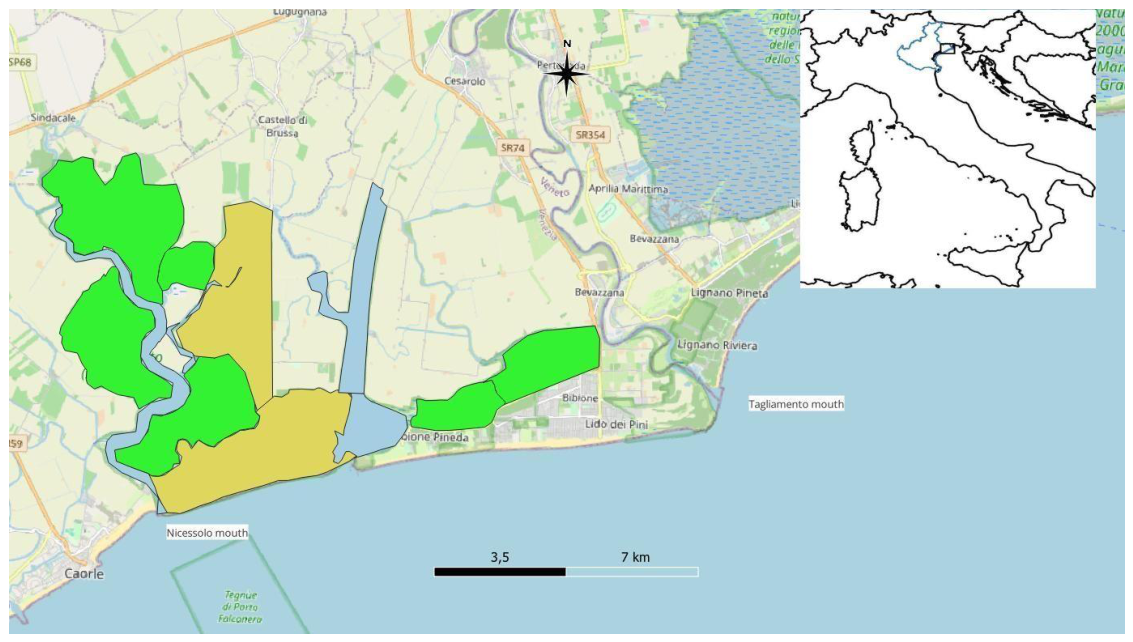
Figure 2.
Annual total abundance (bars, left axis) and species richness (line, right axis) of wintering waterbirds recorded in the Caorle Lagoon during International Waterbird Census surveys, 1993–2022. No census was conducted in 2021.
Figure 2.
Annual total abundance (bars, left axis) and species richness (line, right axis) of wintering waterbirds recorded in the Caorle Lagoon during International Waterbird Census surveys, 1993–2022. No census was conducted in 2021.
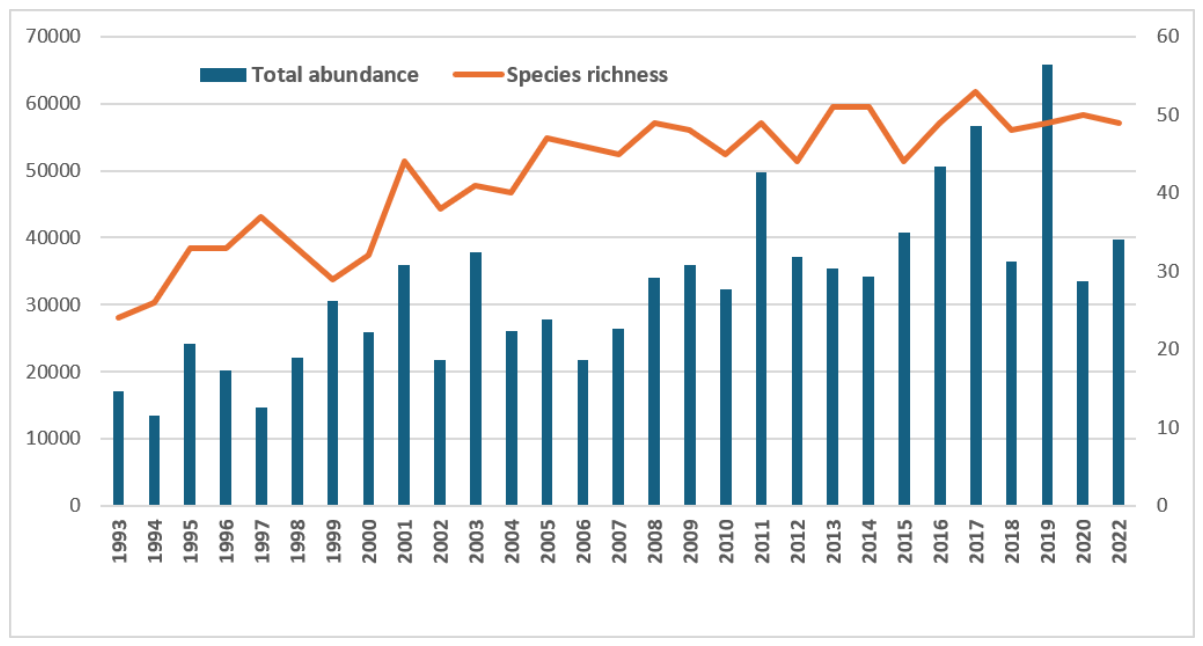
Figure 3.
Annual abundance of the four most abundant wintering waterbird species in the Caorle Lagoon during 1993–2022. No census was conducted in 2021.
Figure 3.
Annual abundance of the four most abundant wintering waterbird species in the Caorle Lagoon during 1993–2022. No census was conducted in 2021.
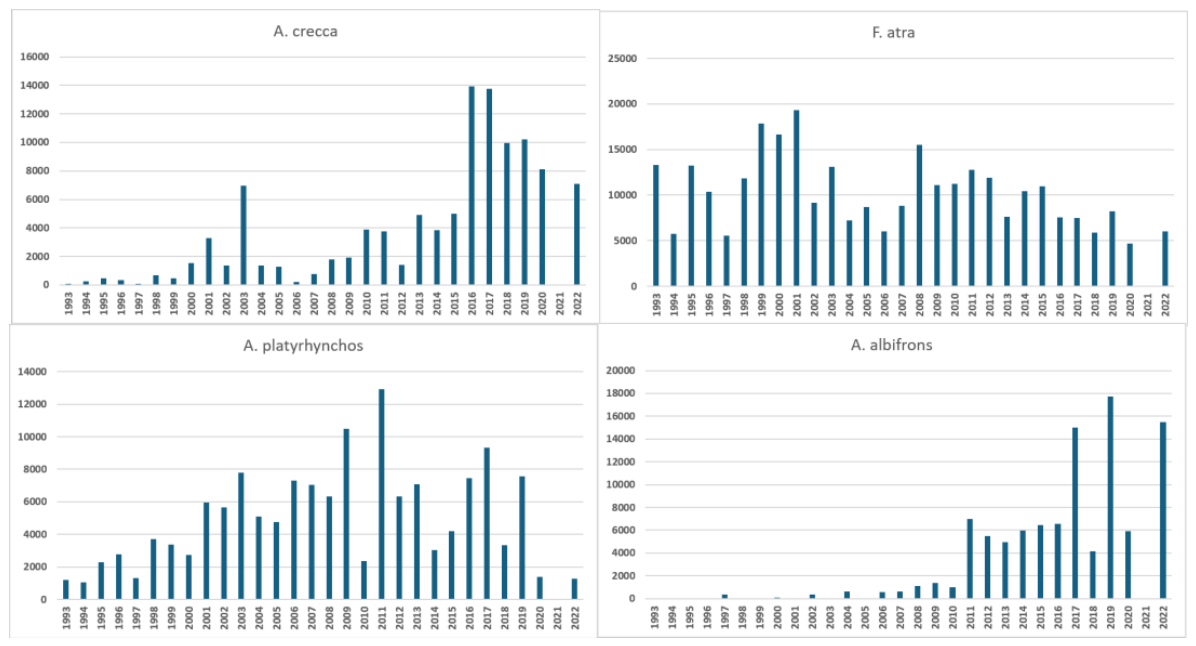
Figure 4.
Annual abundance of wintering waterbirds in the Caorle Lagoon system according to the four main habitat types: fish farms, open lagoon, reclaimed areas and sandy littoral, 1993–2022. No census was conducted in 2021.
Figure 4.
Annual abundance of wintering waterbirds in the Caorle Lagoon system according to the four main habitat types: fish farms, open lagoon, reclaimed areas and sandy littoral, 1993–2022. No census was conducted in 2021.
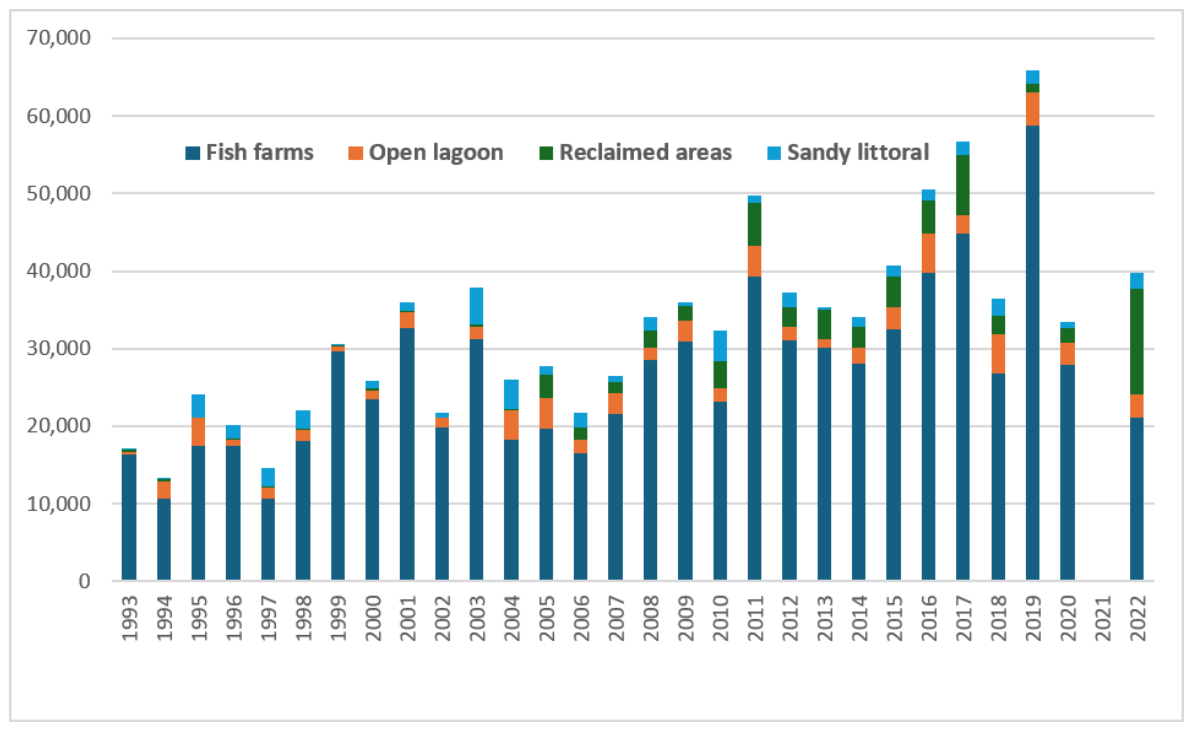
Figure 5.
Annual abundance of wintering waterbirds in the Caorle Lagoon according to eco-functional guilds (above) and major systematic groups (below), 1993–2022. No census was conducted in 2021.
Figure 5.
Annual abundance of wintering waterbirds in the Caorle Lagoon according to eco-functional guilds (above) and major systematic groups (below), 1993–2022. No census was conducted in 2021.
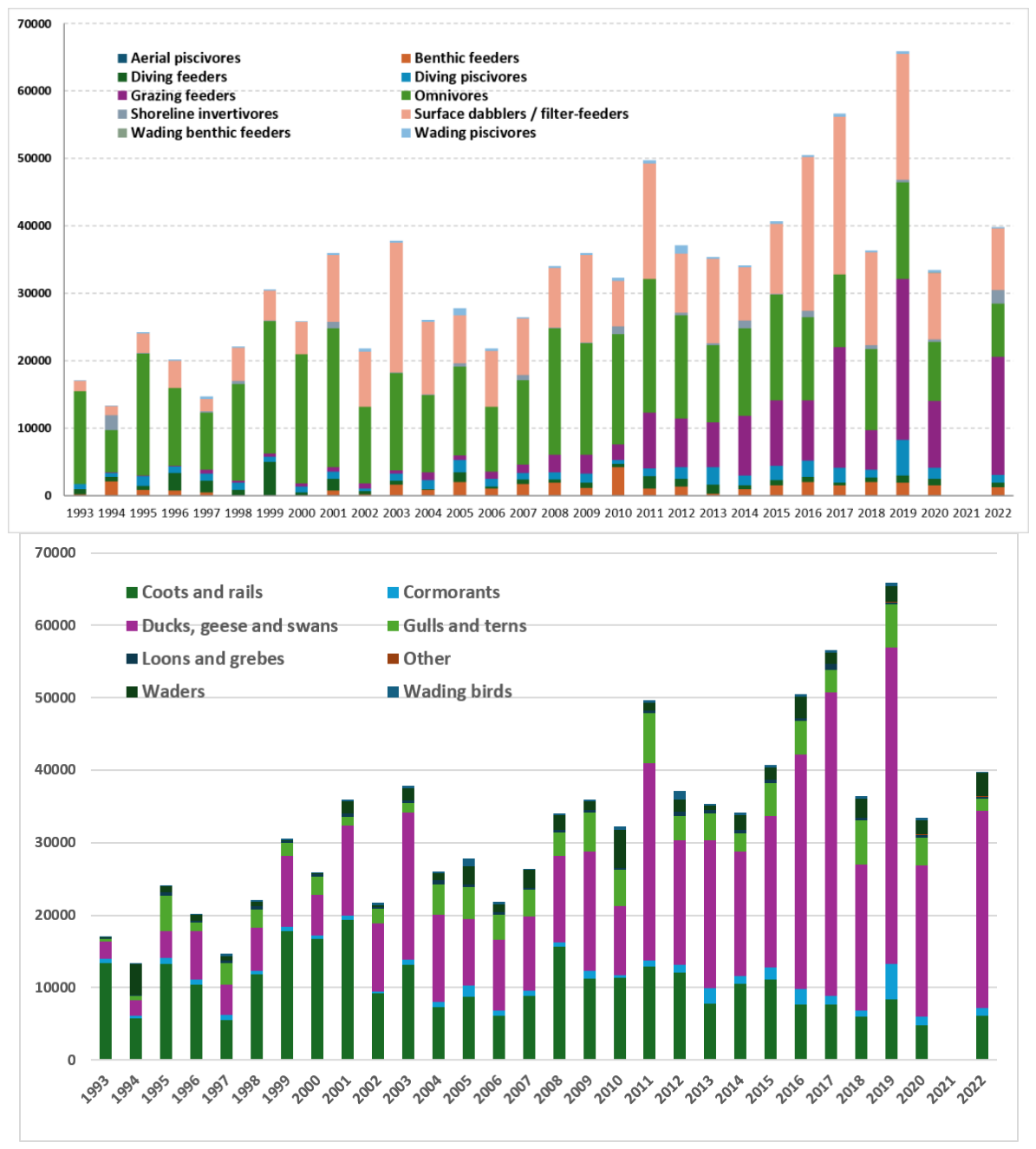
Figure 6.
Annual variation in abundance-weighted and presence-weighted Community Temperature Index (CTI) of the wintering waterbird assemblage in the Caorle Lagoon, 1993–2022. No census was conducted in 2021.
Figure 6.
Annual variation in abundance-weighted and presence-weighted Community Temperature Index (CTI) of the wintering waterbird assemblage in the Caorle Lagoon, 1993–2022. No census was conducted in 2021.
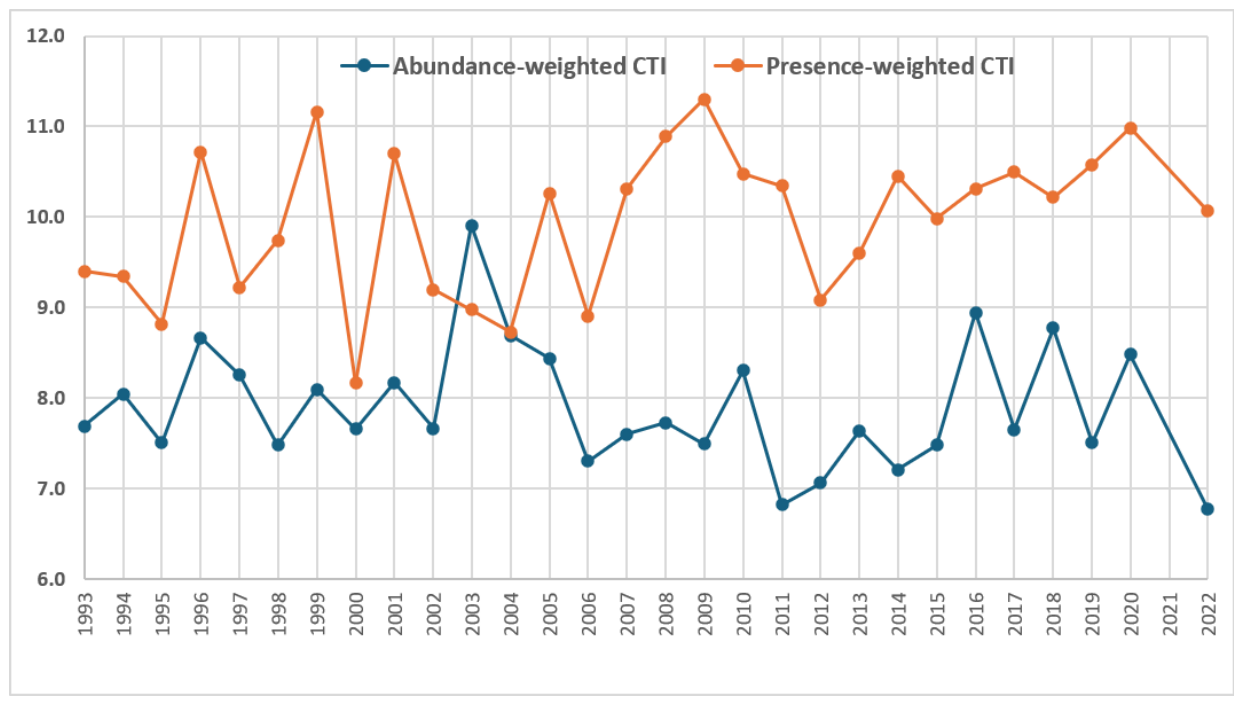

Table 1.
Long-term trends in total wintering waterbirds, systematic groups and eco-functional guilds in the Caorle Lagoon, 1993–2022, estimated with TRIM using model-based overall slopes.
Table 1.
Long-term trends in total wintering waterbirds, systematic groups and eco-functional guilds in the Caorle Lagoon, 1993–2022, estimated with TRIM using model-based overall slopes.
| Category | Multiplicative slope | SE | Annual change (%) | p-value |
Trend classification |
| Total wintering waterbirds | 1.0336 | 0.0051 | +3.36 | <0.01 | Moderate increase |
| Coots and rails | 0.9809 | 0.0072 | -1.91 | <0.01 | Moderate decline |
| Cormorants | 1.0565 | 0.0090 | +5.65 | <0.01 | Moderate increase |
| Ducks, geese and swans | 1.0722 | 0.0073 | +7.22 | <0.01 | Strong increase |
| Gulls and terns | 1.0320 | 0.0093 | +3.20 | <0.01 | Moderate increase |
| Loons and grebes | 1.0113 | 0.0070 | +1.13 | — | Stable |
| Other | 1.0487 | 0.0114 | +4.87 | <0.01 | Moderate increase |
| Waders | 1.0348 | 0.0118 | +3.48 | <0.01 | Moderate increase |
| Wading birds | 1.0218 | 0.0096 | +2.18 | <0.05 | Moderate increase |
| Aerial piscivores | — | — | — | — | Not analysed |
| Benthic feeders | 1.0383 | 0.0102 | +3.83 | <0.01 | Moderate increase |
| Diving feeders | 0.9752 | 0.0131 | -2.48 | — | Uncertain |
| Diving piscivores | 1.0442 | 0.0071 | +4.42 | <0.01 | Moderate increase |
| Grazing feeders | 1.1665 | 0.0125 | +16.65 | <0.01 | Strong increase |
| Omnivores | 0.9933 | 0.0068 | -0.67 | — | Stable |
| Shoreline invertivores | 1.0279 | 0.0164 | +2.79 | — | Uncertain |
| Surface dabblers / filter-feeders | 1.0494 | 0.0072 | +4.94 | <0.01 | Moderate increase |
| Wading benthic feeders | — | — | — | — | Not analysed |
| Wading piscivores | 1.0218 | 0.0096 | +2.18 | <0.05 | Moderate increase |
Note. Annual change was calculated as (multiplicative slope - 1) × 100. p-values are reported for significant trend classifications; — indicates that no significance threshold applies. Aerial piscivores and wading benthic feeders could not be analysed with TRIM and are reported as Not analysed.
Table 2.
Long-term trends of wintering waterbird species in the Caorle Lagoon, 1993–2022, estimated with TRIM using model-based overall slopes. Only species occurring in at least 20 winters were considered.
Table 2.
Long-term trends of wintering waterbird species in the Caorle Lagoon, 1993–2022, estimated with TRIM using model-based overall slopes. Only species occurring in at least 20 winters were considered.
| Species |
Multiplicative slope |
SE | Annual change (%) | p-value | Trend classification |
| Anas crecca | 1.1143 | 0.0092 | +11.43 | <0.01 | Strong increase |
| Anas platyrhynchos | 1.0193 | 0.0074 | +1.93 | <0.01 | Moderate increase |
| Anser albifrons | 1.1948 | 0.0230 | +19.48 | <0.01 | Strong increase |
| Anser anser | 1.1721 | 0.0137 | +17.21 | <0.01 | Strong increase |
| Ardea cinerea | 1.0226 | 0.0085 | +2.26 | <0.01 | Moderate increase |
| Aythya ferina | 0.9618 | 0.0148 | -3.82 | <0.05 | Moderate decline |
| Aythya fuligula | 1.2202 | 0.1151 | +22.02 | — | Uncertain |
| Botaurus stellaris | 0.9852 | 0.0205 | -1.48 | — | Uncertain |
| Bucephala clangula | 0.9985 | 0.0208 | -0.15 | — | Stable |
| Calidris alpina | 1.0245 | 0.0141 | +2.45 | — | Uncertain |
| Cygnus atratus | 1.1114 | 0.0163 | +11.14 | <0.01 | Strong increase |
| Cygnus olor | 1.0389 | 0.0088 | +3.89 | <0.01 | Moderate increase |
| Ardea alba | 1.0259 | 0.0096 | +2.59 | <0.01 | Moderate increase |
| Egretta garzetta | 1.0138 | 0.0153 | +1.38 | — | Stable |
| Fulica atra | 0.9804 | 0.0084 | -1.96 | <0.05 | Moderate decline |
| Gallinago gallinago | 1.0342 | 0.0229 | +3.42 | — | Uncertain |
| Gallinula chloropus | 1.0887 | 0.0110 | +8.87 | <0.01 | Strong increase |
| Larus canus | 1.0658 | 0.0175 | +6.58 | <0.01 | Moderate increase |
| Larus michahellis | 1.0091 | 0.0097 | +0.91 | — | Stable |
| Chroicocephalus ridibundus | 1.0267 | 0.0099 | +2.67 | <0.01 | Moderate increase |
| Mareca penelope | 0.9752 | 0.0244 | -2.48 | — | Uncertain |
| Mareca strepera | 0.9979 | 0.0163 | -0.21 | — | Stable |
| Numenius arquata | 1.0557 | 0.0120 | +5.57 | <0.01 | Moderate increase |
| Phalacrocorax carbo | 1.0497 | 0.0096 | +4.97 | <0.01 | Moderate increase |
| Microcarbo pygmaeus | 1.1296 | 0.0135 | +12.96 | <0.01 | Strong increase |
| Pluvialis squatarola | 1.0733 | 0.0160 | +7.33 | <0.01 | Moderate increase |
| Podiceps cristatus | 1.0359 | 0.0096 | +3.59 | <0.01 | Moderate increase |
| Podiceps nigricollis | 0.9893 | 0.0075 | -1.07 | — | Stable |
| Rallus aquaticus | 1.0472 | 0.0131 | +4.72 | <0.01 | Moderate increase |
| Spatula clypeata | 1.0560 | 0.0244 | +5.60 | <0.05 | Moderate increase |
| Tachybaptus ruficollis | 0.9976 | 0.0089 | -0.24 | — | Stable |
| Tadorna tadorna | 1.1784 | 0.0263 | +17.84 | <0.01 | Strong increase |
| Vanellus vanellus | 1.0209 | 0.0168 | +2.09 | — | Uncertain |
Note. Annual change was calculated as (multiplicative slope - 1) × 100. p-values are reported for significant trend classifications; — indicates that no significance threshold applies.
Disclaimer/Publisher’s Note: The statements, opinions and data contained in all publications are solely those of the individual author(s) and contributor(s) and not of MDPI and/or the editor(s). MDPI and/or the editor(s) disclaim responsibility for any injury to people or property resulting from any ideas, methods, instructions or products referred to in the content. |
© 2026 by the authors. Licensee MDPI, Basel, Switzerland. This article is an open access article distributed under the terms and conditions of the Creative Commons Attribution (CC BY) license (http://creativecommons.org/licenses/by/4.0/).
Copyright: This open access article is published under a Creative Commons CC BY 4.0 license, which permit the free download, distribution, and reuse, provided that the author and preprint are cited in any reuse.