

Submitted:
17 October 2026
Posted:
19 October 2026
You are already at the latest version
Abstract
Drug-safety evaluation rests on a largely implicit structural-determinist premise: that a defined molecular design feature, such as an engineered silencing modification, secures safety across host contexts. Extreme human populations living under sustained environmental stress (for example, indigenous communities at chronic high altitude) constitute naturally occurring, high-sensitivity settings in which this premise can be probed, because a molecular design that is unremarkable in a standard-population trial may behave differently under extreme host conditions. This review articulates a framework that treats extreme populations as a natural stress-test for drug safety and that converts a single, catastrophic sentinel toxicity event into defensible causal inference without over-claiming. We synthesize three strands: the theoretical case for extreme-population pharmacology as an institutionalized observation window; the methodological status of the sentinel case as a naturally imposed, exhaustively documented experiment whose inferential weight derives from inference architecture rather than sample size; and an operational four-tier causal ladder, FOCUS (spatial necessity, temporal priority, biological plausibility, and counterfactual intervention), expressed through a DABR workflow (Data-anchored, Assumption-explicit, Boundary-declared, Reproducible). FOCUS functions as a gate rather than a verdict: a claim advances only as far as its evidence supports, and unmet tiers are declared rather than imputed. We further specify the disciplines that keep a low-n framework honest, namely explicit grading of certainty, the rule that claim strength must not exceed evidence strength, and the treatment of a declared absence of evidence as an evidentiary asset. Finally, we argue that novelty should be asserted as a bounded claim, that reproducibility is a governance requirement rather than an aspiration, and that the framework's value lies in stating both the standard such studies should meet and the claims they should not make. This review is framework-level and deliberately contains no primary data claims; the applied analytic operations implied by the framework belong to companion work.
Keywords:
drug safety
; pharmacovigilance
; real-world evidence
; causal inference
; sentinel case
; extreme populations
; high-altitude hypoxia
; Fc-engineered biologics
1. Introduction
1.1. The Structural-Determinist Premise and Its Blind Spot
Contemporary biologic drug safety has been built on an implicit structural-determinist premise: that safety is essentially encoded in molecular design, and may be guaranteed by removing or silencing a defined functional element. Fc-engineering is the paradigmatic case: engineered Fc-silencing (e.g., effector-null Fc designs such as P329G-LALA) is widely treated as a structural guarantee of reduced effector-mediated toxicity (Schlothauer et al., 2016). Effector function is set by defined Fc–receptor and complement interfaces (Idusogie et al., 2000; Nimmerjahn and Ravetch, 2008), antibody persistence is governed by FcRn-mediated recycling (Roopenian and Akilesh, 2007), and engineering strategies are correspondingly directed at these interfaces (Wang et al., 2018). This premise is powerful precisely because it is simple, portable, and regulatorily legible. It is also, by construction, context-blind: it assumes that the host setting in which a molecule operates is a constant against which a fixed design can be judged. Where host context is extreme or non-canonical, the guarantee must be treated as a falsifiable hypothesis rather than an axiom (Ferner and Aronson, 2019). On that reading the guarantee is retained only for as long as it survives attempts at refutation, and the observation that would count against it can be specified in advance (Figure 1).
1.2. Why the "Extreme" is the Right Place to Look
If host context can modulate the consequences of molecular design, then the most informative settings are those in which context is pushed to an extreme. Populations indigenous to chronic high altitude (exposed to sustained hypobaric hypoxia, altered immune and vascular regulation, and distinctive nutritional and metabolic conditions) act as high-sensitivity probes: the same design that is unremarkable in a standard-population trial may be revealed, under such stress, to behave differently (Pham et al., 2021; Villafuerte et al., 2022). Extreme populations thus function less as an epidemiological "edge case" and more as a natural stress-test, i.e., an observational window of unusually high signal-to-noise for context-dependent effects (Wang et al., 2024). Host context enters the framework as a candidate modifier of the exposure-outcome relationship. Aggregation can dilute or even reverse an effect that is strong within a single host setting, and an extreme setting is precisely where this otherwise hidden structure becomes observable. We argue that such populations should be institutionalized as deliberate observation windows in safety evaluation, rather than treated as incidental outliers.
1.3. The Sentinel Event Is an Evidentiary Asset, not a Deficit
When an extreme-context toxicity does occur, it frequently presents as a single, catastrophic, sentinel case. Conventional hierarchies of evidence discount n = 1 as anecdotal. We take the opposite methodological stance: a sentinel case is best understood as a "naturally imposed precision experiment", a perturbation applied by nature to a real host, under conditions that would be difficult or unethical to reproduce experimentally (Schork et al., 2023). The methodological question is therefore not whether such an event is informative; it is whether the event can be rendered into defensible causal inference without over-claiming. The difficulty lies in inference architecture rather than sample size.
1.4. The Gap and This Review's Aim
Despite growing interest in rare-adverse-event and n-of-1 methodology, there is no widely accepted, operational framework that (i) positions extreme populations as natural safety test-beds and (ii) converts a sentinel event into a graded, falsifiable causal claim (Coste et al., 2023; Hammad et al., 2023). Signal detection from spontaneous reports and from longitudinal health data has its own quantitative tradition (Bate et al., 1998; Harpaz et al., 2012), and real-world evidence is now formally positioned as a regulatory input (Sherman et al., 2016). This review addresses that gap. We read extreme-population toxicity through a single, explicit causal ladder (FOCUS) and express its operationalization as a DABR (Data-anchored, Assumption-explicit, Boundary-declared, Reproducible) workflow. Our central claim is framework-level and deliberately data-free: extreme populations are a natural stress-test for drug safety, and single sentinel events can be turned into defensible causal inference by an explicit, graded criterion set.
1.5. Scope and Roadmap
Section 2 states the approach and scope of this review. Section 3 develops extreme-population pharmacology as the rationale for who should be studied. Section 4 develops the evidentiary status of the sentinel case. Section 5 sets out the FOCUS four-tier causal ladder as the operational core. Section 6 addresses evidence grading and the discipline of non-over-claiming. Section 7 addresses governance, reproducibility, and the boundary-versus-breadth principle of novelty. We close with the prospect of an institutionalized, transferable framework for context-dependent safety evaluation.
2. Approach and Scope of This Review
This is a framework-level, narrative review and deliberately contains no primary data claims. The framework was assembled by iterative conceptual synthesis under the DABR workflow it describes: every assertion is anchored to documented provenance (Data-anchored), the assumptions on which it depends are stated explicitly (Assumption-explicit), the limits of its applicability are declared as boundaries rather than as breadth (Boundary-declared), and each claim is expressed so that it could be re-derived and checked by an independent reader (Reproducible). The review synthesizes three previously separate strands (the biology of extreme host settings, the methodology of single-case and n-of-1 causal inference, and the grading and governance of low-certainty evidence) into one operational ladder. The construct is pitched deliberately between a general theory of drug safety and any single dataset: it is bounded and checkable, and it is offered so that specific studies can test it and, where the evidence fails, refute it. In seeking the internal integrity of a single, thoroughly documented observation, the framework gives up breadth of generalization, and it states explicitly how far its conclusions may travel. Two scope limits are declared at the outset and are binding on every subsequent section: this review makes no patient-specific genetic claim, and it makes no claim about any specific cohort's outcome. The applied analytic operations that the framework implies, together with any empirical findings they yield, belong to companion work and are named here only to mark the intended direction.
The DABR workflow is itself a small set of checkable requirements rather than a slogan, and Table 1 states them explicitly so that a reader can audit a report against them; a corresponding audit-log template is provided as Supplementary Material S2.
3. Extreme-Population Pharmacology: Who Should Be Studied
3.1. The Rationale: Extremes as Amplified Readouts
The premise of extreme-population pharmacology is that a population's evolutionary and ecological setting can act as a natural amplifier of otherwise small, context-dependent effects. Where standard-population studies provide a low-variance, well-characterized background, extreme settings compress multiple stressors (hypobaric hypoxia, altered immune and vascular regulation, distinctive metabolic and nutritional states) onto the same host (Pham et al., 2021; Zhang et al., 2025). The physiological signature of chronic high-altitude residence, including erythrocytosis and hypoxic pulmonary vascular responses, has been characterized in detail (León-Velarde et al., 2005; Beall, 2007). The practical consequence is a high-signal observation window: effects that are buffered in canonical populations may become detectable, and sometimes clinically severe, at the extreme (Wang et al., 2024). Host-drug interaction is potentially part of that signal: chronic hypoxia alters drug-metabolizing enzyme activity and the pharmacokinetics of several agents (Zhou et al., 2018).
3.2. Who Qualifies: Criteria, Not Convenience
We propose that "extreme population" be defined by explicit criteria rather than by geographic convenience: (i) a sustained, biologically consequential environmental stressor; (ii) a well-characterized host background against which deviations can be read; and (iii) feasibility of longitudinal observation. Under this definition, high-altitude indigenous communities are a canonical example, with additional candidates in polar and isolated founder populations (Kristiansson et al., 2008; Zeggini, 2014). The aim is a principled selection rule for whom to study rather than an expansion of sample size for its own sake.
3.3. From Edge Case to Institutionalized Observation Window
If extreme populations are high-sensitivity probes, then their systematic, prospective observation is a safety-evaluation design decision rather than an accident. The conceptual move is to treat extreme populations as an institutionalized observation window: an explicitly designated, longitudinally followed group whose deviations from canonical expectations are escalated for mechanistic scrutiny (Wang et al., 2024). Read as a regulated system, a host under chronic stress is one whose physiological reserve is already partly spent, so that a second perturbation can cross a threshold which a well-reserved host would absorb; an extreme setting thus turns a small, buffered deviation into an observable one. This has institutional implications (cohort designation, standardized capture, escalation pathways) that lie beyond any single study's data; our review is therefore positioned at the framework level rather than as a claim about any specific cohort's outcome.
3.4. Boundaries and the Discipline of Inference
Two boundaries constrain this section. First, genetic inference is bounded: where no individual-level sequencing is available, evolutionary or adaptation reasoning must be framed as literature-level inference, never as a patient-specific genetic claim (we therefore exclude any individual genotype attribution) (Yi et al., 2010; Beall et al., 2010; Simonson et al., 2010; Bigham and Lee, 2014; Storz and Cheviron, 2021). Second, cross-population generalization is bounded: an extreme-population finding is a hypothesis with amplified prior plausibility rather than a universal effect. These boundaries are stated here, at the outset, because they are binding for every subsequent section. The next section turns from the population to the event: within an extreme setting, a context-dependent effect most often surfaces as a single, exhaustively documented case, whose evidentiary status Section 4 takes up.
4. The Evidentiary Status of the Sentinel Case: Why n = 1 Can Be Made to Carry Weight
4.1 A Single Case as a Naturally Imposed Experiment
The standard objection to n = 1 is the absence of a comparator. We reframe the problem. A sentinel case is a perturbation applied by nature to a real host under a configuration (an extreme host, a full exposure, a complete longitudinal course) that chance or ethics would not permit us to construct deliberately. The inferential task is to extract from a single, exhaustively documented instance the kind of graded claim that case-based causal reasoning is designed to support, rather than to pretend that n = 1 reproduces a randomized design (Green et al., 2022). In this sense, the sentinel case belongs to a recognized methodological family rather than to the family of anecdote. For n-of-1 designs, the field has already moved from "is it legitimate" to "how should it be reported", as reflected in explicit reporting standards for single-case and n-of-1 studies (Vohra et al., 2015; Tate et al., 2016). The design itself has a long lineage in formal within-patient randomization (Guyatt et al., 1986), and its credibility, reporting, and aggregation have since been elaborated (Kratochwill and Levin, 2010; Lillie et al., 2011; Zucker et al., 2010). The sentinel case should be held to the same standard of transparent reporting rather than dismissed on grounds of sample size.
4.2. Dense Within-Person Longitudinal Analysis
A single case is a trajectory rather than a cross-sectional point. When measurements are dense across an episode (serials of biochemistry, imaging, and clinical events), the case can be analyzed as an explicit within-person time series rather than collapsed into a single summary value. Methods developed for intensive longitudinal data make the within-person process itself the object of estimation, allowing event–metric alignment, lagged relationships, and the discrimination of synchronized from delayed responses (McNeish and Hamaker, 2020). Two design principles follow for sentinel-case analysis: (i) align every candidate causal marker to the event timeline, and (ii) treat any concurrently administered intervention as a confounder to be annotated rather than merged, so that its contribution is never silently attributed to the exposure of interest.
4.3. Temporal Anchoring
Causal inference requires that the exposure precede the outcome and that the relevant latency be plausible. This is the classical temporality criterion (Hill, 1965), and its modern treatment explicitly restates it within contemporary causal thinking rather than as a checklist item (Shimonovich et al., 2021). For a sentinel case, temporality imposes a hard boundary on what may be attributed to the drug: any marker measured before first exposure defines the baseline and cannot be credited to the drug, and post-exposure rises must be read against that anchored baseline. Where a rise precedes a documented exposure, or where the exposure cannot be reliably timed, the corresponding claim must be downgraded rather than reconstructed.
4.4. Cross-Source Closure by Triangulation
No single source (clinical course, histopathology, mechanism, or external data) is by itself decisive. Inference gains strength when independent lines of evidence converge on the same causal target, a principle formalized as triangulation in aetiological epidemiology (Lawlor et al., 2016; Lipsitch et al., 2010) and extended by explicit guidance for planning triangulation studies around complex causal questions (Treur et al., 2024). Two conditions define genuine closure: (i) the converging lines must be independent, since repetition of the same measurement is not triangulation; and (ii) the convergence must target a pre-specified causal question rather than a post-hoc selection among favourable readings. Where a line is unavailable (in a sentinel case this is the rule, not the exception), its absence is declared rather than substituted.
5. An Operational Causal Ladder: The FOCUS Four-Tier Framework
5.1. Why a Ladder, not a Verdict
Causal questions are, at root, counterfactual: they compare what happened with what would have happened under a different exposure (Hernán and Robins, 2020; Bezuidenhout et al., 2025; Maldonado and Greenland, 2002; Rubin, 1974). In a sentinel case the comparison can rarely be observed directly, so the framework replaces a binary verdict ("caused" or "did not cause") with an ordered ladder whose tiers can be separately evidenced or left unmet. The FOCUS ladder has four tiers (spatial necessity, temporal priority, biological plausibility, and counterfactual intervention), applied in that order (Figure 2). The governing rule is a gate: a claim advances only as far as the evidence supports, and no tier may be inferred from a weaker one.
5.2. Tier 1: Spatial Necessity
The pathogenic process must be demonstrable where the proposed mechanism requires it. If the mechanism predicts damage localized to a particular tissue compartment or niche, then the absence of that lesion at the required site falsifies the mechanism, and its presence at that site is a necessary (though not sufficient) condition. Spatial necessity is thus a structural constraint on mechanism: it can eliminate a hypothesis, it cannot by itself confirm one. The condition is falsifiable in a definite way: an injury confined to tissue compartments other than the one the mechanism requires would count against the mechanism.
5.3. Tier 2: Temporal Priority
The exposure must precede the outcome, with a biologically plausible interval. This tier operationalizes the temporality criterion of Section 4.3 into a discrete check: the anchored baseline, the post-exposure rise, and the latency are each stated explicitly. Failure at this tier is decisive: an effect that precedes its proposed cause cannot be attributed to it. The falsifying observations are therefore specific: an outcome documented before first exposure, or an interval outside the plausible latency window, counts against the causal claim.
5.4. Tier 3: Biological Plausibility
A coherent mechanistic chain consistent with known biology raises the prior for a causal interpretation. Mechanistic reasoning is treated here as a legitimate but non-decisive evidential tier: it supports a claim and constrains which mechanism is credible, but plausibility alone never proves causation (Aronson et al., 2021). This is the tier at which framework-level reviews most often overclaim, and where the discipline of "support, not prove" applies most sharply. Plausibility is falsifiable at the level of mechanism: a chain that contradicts established biology, or a competing mechanism carrying equal support, weakens rather than strengthens the claim.
5.5. Tier 4: Counterfactual Intervention
The strongest tier asks the counterfactual directly: would the outcome have occurred absent the exposure? In observational settings this is approximated through target-trial emulation, in which the trial that would answer the question is specified explicitly and its design is then emulated with the available data (Hernán and Robins, 2016; Hernán et al., 2022). Specifying the target trial before the analysis also prevents avoidable self-inflicted biases in such emulations (Hernán et al., 2016), and where several emulations of the same question are available, agreement among them strengthens the claim while empirical calibration against negative-control outcomes provides a check on residual bias (Lipsitch et al., 2010; Schuemie et al., 2018). In a sentinel case, this tier is frequently unattainable, and the framework's requirement is that it be declared unmet rather than imputed. The value of the tier is as much in its honesty as in its strength: naming it as unmet prevents the reader from assuming the counterfactual was settled when it was not. In principle the tier is falsifiable: a counterfactual design that can be emulated and that fails to reproduce the predicted contrast would count against the claim. Table 2 restates the ladder in operational form, giving for each tier the question it poses, the evidence it requires, and the consequence of its failure.
5.6. Gate Logic and the Non-Over-Claiming Rule
The four tiers function as a gate rather than an opportunistic menu. A defensible claim states (i) which tiers are met, (ii) on what evidence, and (iii) which tiers remain unmet. The rule that an unmet tier is declared rather than filled rests on an older recognition: a given body of evidence can be compatible with more than one causal account, so the framework records what the evidence does not settle instead of supplying the gap by assumption. This converts "how strong is the causal claim?" from a matter of rhetoric into a matter of checkable structure, and connects directly to the evidence-grading and non-over-claiming principles developed in Section 6 and Section 7.
5.7. Positioning FOCUS Against Established Causality-Assessment Instruments
FOCUS is not offered as a replacement for the causality-assessment instruments already in routine use, and it should not be read as a competing checklist. Each of those instruments answers a narrower question, and FOCUS functions as the tiered scaffold into which they can be placed. Each instrument also has its own documented provenance: structured adjudication of drug-induced liver injury derives from the consensus criteria of the Council for International Organizations of Medical Sciences and their formalization as RUCAM (Benichou, 1990; Danan and Benichou, 1993; Benichou et al., 1993; Danan and Teschke, 2015), the probability scale widely used in drug-safety reports derives from Naranjo et al. (1981), and the standard causality terminology of the WHO programme derives from its collaborating centre (Meyboom et al., 1997). Table 3 sets out the relationship.
The instruments named in Table 3 are widely used and are referred to here by name; where one of them is invoked in a specific study, its primary source should be cited in that study.
5.8. A Schematic Walk-Through
To make the ladder concrete without introducing any data claim, consider a schematic and deliberately non-specific instance. An individual from an extreme-context population develops a severe and poorly explained organ toxicity during treatment with a biologic whose design is generally regarded as safe. Applied in order, the tiers pose the following questions. Tier 1: is the injury present in the compartment the proposed mechanism would require, and is it absent where the mechanism predicts it should be? Tier 2: is there a documented pre-exposure baseline against which the post-exposure change can be read, and does the interval between exposure and injury fall within a plausible latency? Tier 3: is there a coherent mechanistic chain consistent with the published biology, and are the competing explanations named? Tier 4: can the counterfactual be approached, or must it be declared unmet? Under the gate rule, the claim is written at the level the answered tiers support; where Tier 4 is unmet, the claim is one of consistency with or contribution to the hypothesis. The walk-through is included to show that the ladder proceeds in definite steps and stops at definite points.
6. Evidence Grading and the Discipline of Non-Over-Claiming
6.1. Graded Certainty, Not an All-or-Nothing Verdict
Framework-level and case-level claims are frequently argued as though evidence were binary, either "demonstrated" or "not demonstrated." A more defensible convention is to grade certainty explicitly. The GRADE approach separates the direction of an effect from its certainty, and assigns a discrete level (high, moderate, low, or very low) that may be moved up or down by defined domains rather than fixed by study design alone (Guyatt et al., 2008; Balshem et al., 2011). For the present framework the consequence is direct: a sentinel-case claim is not "proved or discarded"; it is assigned a stated certainty, which travels with the claim and limits how far it may be generalized. Recent guidance on producing and reading evidence syntheses restates the same requirement: certainty is a communicated property of the evidence rather than an implied tone (Lima et al., 2023).
6.2. The Discipline of Causal Language: Claim Strength ≤ Evidence Strength
Over-claiming in this area is rarely a matter of inventing data; it is more often a matter of letting language outrun the evidence. The remedy is a stated discipline: the strength of a causal verb must not exceed the strength of the evidence behind it, and euphemism is no solution, since deliberately avoiding causal language does not improve causal inference from observational data (Hernán, 2018). Reporting guidance for observational research has converged on the same point, requiring that causal claims be made explicit and justified rather than left ambiguous (Vickers et al., 2023). Applied to the sentinel case, this discipline takes a concrete form: when the lower tiers of the FOCUS ladder are met but the counterfactual tier is not, the claim must be written as one of contribution or consistency with, never of proof.
6.3. Absence of Evidence Is an Evidentiary Asset, Not a Null Result
The caution that "absence of evidence is not evidence of absence" is standard (Altman and Bland, 1995), and it has been argued, repeatedly and in a clinical register, that missing or negative findings deserve the same reporting care as positive ones (Alderson, 2004). We extend this to sentinel-case reasoning in a specific way: a pre-specified and appropriately bounded negative or missing result is itself evidence about the mechanism, and belongs in the causal ledger rather than being quietly dropped. Two rules follow. First, unavailable lines of evidence are declared, together with the reason for their absence, so that a gap is read as a boundary rather than mistaken for a null. Second, any signal identified only after the data have been examined is labelled post-hoc and exploratory, and is never presented as though it had been the pre-specified question. These rules keep a low-n framework from converting underpowered or after-the-fact observations into confident claims.
7. Governance, Reproducibility, and the Boundary Principle of Novelty
7.1. Reproducibility as a Governance Requirement
If the framework asks that single-case claims be graded and bounded, it owes the reader the means to re-derive those claims. Reproducibility therefore enters as a governance requirement rather than an aspiration: every number that supports a claim should be traceable to documented provenance, ideally with a record of the exact source and its integrity (for example, a checksum) so that "we found it" can be independently re-checked. The case for restructuring scientific practice around reproducibility is now well established (Munafò et al., 2017), and the reform literature has documented the structural, procedural, and community changes that follow from taking it seriously (Korbmacher et al., 2023). The drivers of irreproducibility have been diagnosed at the level of study design, analytic flexibility, and incentive structure (Ioannidis, 2005; Begley and Ellis, 2012), shared principles for data and materials have been stated (Nosek et al., 2015; Wilkinson et al., 2016), and the scale of the shortfall has been measured directly (Open Science Collaboration, 2015). For extreme-context safety evaluation the corresponding design principle is a full-chain audit trail: from the raw source, through every transformation, to the sentence that states the result, so that any claim that cannot be traced along that chain is, by this standard, not yet a claim.
7.2. Transparent Reporting Against Established Standards
Grading and boundaries are only usable if they are visible to the reader. This is what reporting standards are for, and two are directly relevant here: STROBE for observational studies (von Elm et al., 2007) and CARE for case reports (Gagnier et al., 2013). Related standards extend the same disclosure logic to case reports in detail (Riley et al., 2017), to routinely collected health data (Benchimol et al., 2015), to evidence syntheses (Page et al., 2021), and, in the pharmacovigilance setting, to disproportionality analyses of individual case safety reports (Fusaroli et al., 2024). These are not formatting conventions; they operationalize disclosure (what was done, what was missing, and why). Their particular value for a low-n framework is that they make omissions visible, which is precisely the property such a framework needs. We therefore treat checklist adherence as a governance mechanism rather than a formality, while noting that a checklist is a floor for disclosure, not a substitute for the analytical discipline described above.
7.3. Novelty by Boundary Declaration, Not Breadth Declaration
Priority claims are easily inflated: a framework can be made to sound unprecedented simply by widening its asserted scope. We adopt the opposite convention: each priority claim is stated together with its boundary. A novelty statement is written as "first to do X, under conditions Y, to extent Z", never as "first to do X", and every such statement carries an explicit account of what it does not cover. The motivation is methodological rather than cosmetic. Work on how novelty is signalled in the scientific literature shows that novelty language has become increasingly inflated and that this inflation tracks citation and journal-prestige pressure rather than substantive contribution (Ottaviani et al., 2025), and the reverse direction (reading and writing with awareness of such persuasive devices) has been urged explicitly (Corneille et al., 2023). An unbounded priority claim is not merely rhetorical excess; because it states no testable limit, it is a reproducibility hazard. A bounded claim, by contrast, is falsifiable and therefore usable. This is what we mean by replacing a breadth declaration with a boundary declaration. A declared boundary also keeps the framework open to correction: a stated limit can be tested and, if it fails, revised, whereas an assertion of unlimited scope shields itself from disconfirmation.
7.4. A Reporting Checklist Derived from the Framework
A framework that asks for explicit grading is more useful if its requirements can be checked rather than merely read. Table 4 gives a short reporting checklist derived from the four FOCUS tiers and the DABR workflow. It is offered as a reporting floor for low-n, extreme-context safety reports, in the spirit of an extension to an established reporting standard (STROBE, CARE), and not as a substitute for the analytical work itself. A fillable version of the checklist is provided as Supplementary Material S1.
8. Discussion and Outlook
Two prospects follow from the framework, and both are deliberately modest.
The first is institutional. If extreme populations are high-sensitivity observation windows, then their systematic, prospective inclusion in safety evaluation is a design decision rather than an accident. Recent work on identifying drug-safety knowledge gaps already integrates real-world data with postmarketing surveillance to locate populations in which evidence is thin (Rahurkar et al., 2025), and regulatory attention has been drawn to groups underrepresented in premarket trials (Collins et al., 2024); the step we propose is to add extreme-context populations to that agenda as an explicitly designated class. Susceptibility to an adverse reaction is itself a host property: it varies with developmental stage and age (Kearns et al., 2003; Mangoni and Jackson, 2004), and post-approval safety actions for biologics have repeatedly been taken on the basis of such variation (Giezen et al., 2008). The second is methodological: the DABR workflow and its FOCUS ladder are intended as a portable, checkable procedure that a single thorough observation (carried out by any group, in any extreme context) can put to use. What this review does not attempt is to supply the applied content of that procedure: the concrete analytic operations through which each tier is executed, and the paradigm that the resulting findings imply. Those belong to companion work (in preparation) and are named here only to mark the intended direction.
The framework is therefore deliberately narrow in its assertions and deliberately explicit about its limits. It proposes where to look (extreme populations as natural stress-tests) and how to reason (a graded, falsifiable causal ladder), and it leaves the content of any specific finding to studies that can supply the corresponding data. Whether extreme-context safety evaluation becomes an institutionalized practice will depend on the studies this framework is meant to structure rather than on the framework itself. What the framework can contribute is a precise statement of the standard those studies should meet, and equally of the claims they should not make.
The framework's main limitation is that it is a normative template rather than a validated instrument: it specifies how low-n, extreme-context safety evidence should be graded and bounded, but it does not by itself demonstrate that adopting the template changes downstream conclusions. That demonstration is an empirical question, and one that can only be answered by the very studies the framework is designed to structure. A second limitation is scope: because the review is deliberately data-free, it cannot adjudicate between competing mechanistic accounts of any particular toxicity, and it should not be read as doing so.
9. Conclusion
Rare, extreme-context toxicity is conventionally treated as a data deficit. We have argued that it is better treated as an evidentiary asset: extreme populations are a natural stress-test for drug safety, and a single sentinel event can be turned into a defensible, graded causal claim when it is read through an explicit inference architecture rather than dismissed for its sample size. The FOCUS four-tier ladder and the DABR workflow are offered as that architecture: a gate that advances a claim only as far as its evidence supports, and that declares unmet tiers instead of imputing them. The framework is intentionally narrow: it states the standard such studies should meet, and the claims they should not make.
Ethics Statement
"Not applicable. This review contains no primary human-subject or animal data; it synthesizes previously published, publicly available literature.".
Supplementary Materials
The following supporting information can be downloaded at the website of this paper posted on Preprints.org. Supplementary Material S1: a fillable version of the reporting checklist given in Table 4. Supplementary Material S2: a DABR audit-log template for recording, principle by principle, how each of the four workflow requirements was documented. Both are blank templates and contain no data.
Author Contributions
Z.D.: Conceptualization, Methodology, Writing – original draft, Supervision, Project administration, Funding acquisition. G.R.: Methodology, Writing – review & editing. Z.W.: Validation (evidence verification), Writing – review & editing. Z.N.: Investigation (literature screening), Writing – review & editing. H.Z.: Visualization, Writing – review & editing. Y.F.: Investigation (literature screening), Writing – review & editing. Y.D.: Conceptualization (pathology/translational-medicine perspective), Supervision (co-corresponding author), Writing – review & editing. All authors contributed to the article and approved the submitted version.
Funding
This work was supported by the Qinghai Red Cross Hospital Research Grant (Grant No. YNZXKT2026007), awarded to Z.D. The funder had no role in the conceptual design of the framework, the appraisal of the literature, or the preparation of the manuscript.
Data Availability Statement
"No primary datasets were generated or analysed for this framework-level review. All cited sources are publicly available as referenced.".
Acknowledgments
The authors acknowledge the use of a generative AI large-language-model assistant for literature-retrieval support, for the organization and synthesis of conceptual material drawn from the authors' own earlier manuscripts, and for English-language drafting and polishing. Model: DeepSeek (model version DeepSeek-V4.1-Flash); source/access: the Trae CN integrated development environment. The intellectual core of the FOCUS/DABR framework and the design of this review are the authors' own; the assistant did not originate or adjudicate the scientific content. Every AI-assisted passage was critically reviewed, fact-checked and revised by the authors, who take full responsibility for the accuracy, originality and integrity of the manuscript. No AI tool was used to generate or analyse data, and no AI tool was used to make the causal-inference or evidence-grading judgments presented here.
Conflicts of Interest
"The authors declare that the research was conducted in the absence of any commercial or financial relationships that could be construed as a potential conflict of interest.".
References
- Alderson, P. Absence of evidence is not evidence of absence. BMJ 2004, 328, 476–477. [Google Scholar] [CrossRef] [PubMed]
- Altman, D.G.; Bland, J.M. Absence of evidence is not evidence of absence. BMJ 1995, 311, 485. [Google Scholar] [CrossRef] [PubMed]
- Aronson, J.K.; Auker-Howlett, D.; Ghiara, V.; Kelly, M.P.; Williamson, J. The use of mechanistic reasoning in assessing coronavirus interventions. J. Eval. Clin. Pract. 2021, 27, 684–693. [Google Scholar] [CrossRef] [PubMed]
- Balshem, H.; Helfand, M.; Schünemann, H.J.; Oxman, A.D.; Kunz, R.; Brozek, J.; et al. GRADE guidelines: 3. Rating the quality of evidence. J. Clin. Epidemiol. 2011, 64, 401–406. [Google Scholar] [CrossRef] [PubMed]
- Bate, A.; Lindquist, M.; Edwards, I.R.; Olsson, S.; Orre, R.; Lansner, A.; De Freitas, R.M. A Bayesian neural network method for adverse drug reaction signal generation. Eur. J. Clin. Pharmacol. 1998, 54, 315–321. [Google Scholar] [CrossRef] [PubMed]
- Beall, C.M. Two routes to functional adaptation: Tibetan and Andean high-altitude natives. Proc. Natl. Acad. Sci. U.S.A. 2007, 104, 8655–8660. [Google Scholar] [CrossRef] [PubMed]
- Beall, C.M.; Cavalleri, G.L.; Deng, L.; et al. Natural selection on EPAS1 (HIF2α) associated with low hemoglobin concentration in Tibetan highlanders. Proc. Natl. Acad. Sci. U.S.A. 2010, 107, 11459–11464. [Google Scholar] [CrossRef] [PubMed]
- Begley, C.G.; Ellis, L.M. Raise standards for preclinical cancer research. Nature 2012, 483, 531–533. [Google Scholar] [CrossRef] [PubMed]
- Benchimol, E.I.; Smeeth, L.; Guttmann, A.; Harron, K.; Moher, D.; Petersen, I.; et al. The REporting of studies Conducted using Observational Routinely-collected health Data (RECORD) statement. PLoS Med. 2015, 12, e1001885. [Google Scholar] [CrossRef] [PubMed]
- Benichou, C. Criteria of drug-induced liver disorders: Report of an international consensus meeting. J. Hepatol. 1990, 11, 272–276. [Google Scholar] [CrossRef] [PubMed]
- Benichou, C.; Danan, G.; Flahault, A. Causality assessment of adverse reactions to drugs. II. An original model for validation of drug causality assessment methods: Case reports with positive rechallenge. J. Clin. Epidemiol. 1993, 46, 1331–1336. [Google Scholar] [CrossRef] [PubMed]
- Bezuidenhout, D.; Forthal, S.; Rudolph, K.; Lamb, M.R. Single world intervention graphs (SWIGs): A practical guide. Am. J. Epidemiol. 2025, 194, 2047–2052. [Google Scholar] [CrossRef] [PubMed]
- Bigham, A.W.; Lee, F.S. Human high-altitude adaptation: Forward genetics meets the HIF pathway. Genes Dev. 2014, 28, 2189–2204. [Google Scholar] [CrossRef] [PubMed]
- Collins, G.; Andrews, H.S.; McKelvey, B.; Rice, C.; Allen, J.D.; Stewart, M.D. An evaluation of novel oncology approvals with a PMR/C for assessing data in racial and ethnic populations underrepresented in premarket clinical trials. Clin. Cancer Res. 2024, 30, 3388–3394. [Google Scholar] [CrossRef] [PubMed]
- Corneille, O.; Havemann, J.; Henderson, E.L.; et al. Beware 'persuasive communication devices' when writing and reading scientific articles. eLife 2023, 12, e88654. [Google Scholar] [CrossRef] [PubMed]
- Coste, A.; Wong, A.; Bokern, M.; Bate, A.; Douglas, I.J. Methods for drug safety signal detection using routinely collected observational electronic health care data: A systematic review. Pharmacoepidemiol. Drug Saf. 2023, 32, 28–43. [Google Scholar] [CrossRef] [PubMed]
- Danan, G.; Benichou, C. Causality assessment of adverse reactions to drugs. I. A novel method based on the conclusions of international consensus meetings: Application to drug-induced liver injuries. J. Clin. Epidemiol. 1993, 46, 1323–1330. [Google Scholar] [CrossRef] [PubMed]
- Danan, G.; Teschke, R. RUCAM in drug and herb induced liver injury: The update. Int. J. Mol. Sci. 2015, 17, 14. [Google Scholar] [CrossRef] [PubMed]
- Ferner, R.E.; Aronson, J.K. Susceptibility to adverse drug reactions. Br. J. Clin. Pharmacol. 2019, 85, 2205–2212. [Google Scholar] [CrossRef] [PubMed]
- Fusaroli, M.; Salvo, F.; Begaud, B.; AlShammari, T.M.; et al. The Reporting of a Disproportionality Analysis for Drug Safety Signal Detection Using Individual Case Safety Reports in PharmacoVigilance (READUS-PV): Development and statement. Drug Saf. 2024, 47, 575–584. [Google Scholar] [CrossRef] [PubMed]
- Gagnier, J.J.; Kienle, G.; Altman, D.G.; Moher, D.; Sox, H.; Riley, D. The CARE guidelines: Consensus-based clinical case reporting guideline development. J. Med. Case Rep. 2013, 7, 223. [Google Scholar] [CrossRef] [PubMed]
- Giezen, T.J.; Mantel-Teeuwisse, A.K.; Straus, S.M.J.M.; Schellekens, H.; Leufkens, H.G.M.; Egberts, T.C.G. Safety-related regulatory actions for biologicals approved in the United States and the European Union. JAMA 2008, 300, 1887–1896. [Google Scholar] [CrossRef] [PubMed]
- Green, J.; Hanckel, B.; Petticrew, M.; Paparini, S.; Shaw, S. Case study research and causal inference. BMC Med. Res. Methodol. 2022, 22, 307. [Google Scholar] [CrossRef]
- Guyatt, G.; Sackett, D.; Taylor, D.W.; Chong, J.; Roberts, R.; Pugsley, S. Determining optimal therapy: Randomized trials in individual patients. N. Engl. J. Med. 1986, 314, 889–892. [Google Scholar] [CrossRef] [PubMed]
- Guyatt, G.H.; Oxman, A.D.; Vist, G.E.; Kunz, R.; Falck-Ytter, Y.; Alonso-Coello, P.; et al. GRADE: An emerging consensus on rating quality of evidence and strength of recommendations. BMJ 2008, 336, 924–926. [Google Scholar] [CrossRef] [PubMed]
- Hammad, T.A.; Afsar, S.; McAvoy, L.B.; Le Louet, H. Aspects to consider in causality assessment of safety signals: Broadening the thought process. Front. Drug Saf. Regul. 2023, 3, 1193413. [Google Scholar] [CrossRef] [PubMed]
- Harpaz, R.; DuMouchel, W.; Shah, N.H.; Madigan, D.; Ryan, P.; Friedman, C. Novel data-mining methodologies for adverse drug event discovery and analysis. Clin. Pharmacol. Ther. 2012, 91, 1010–1021. [Google Scholar] [CrossRef] [PubMed]
- Hernán, M.A. The C-word: Scientific euphemisms do not improve causal inference from observational data. Am. J. Public Health 2018, 108, 616–619. [Google Scholar] [CrossRef] [PubMed]
- Hernán, M.A.; Robins, J.M. Using big data to emulate a target trial when a randomized trial is not available. Am. J. Epidemiol. 2016, 183, 758–764. [Google Scholar] [CrossRef] [PubMed]
- Hernán, M.A.; Robins, J.M. Causal Inference: What If; Chapman & Hall/CRC: Boca Raton, FL, 2020; ISBN 9781420076165. [Google Scholar]
- Hernán, M.A.; Sauer, B.C.; Hernández-Díaz, S.; Platt, R.; Shrier, I. Specifying a target trial prevents immortal time bias and other self-inflicted injuries in observational analyses. J. Clin. Epidemiol. 2016, 79, 70–75. [Google Scholar] [CrossRef] [PubMed]
- Hernán, M.A.; Wang, W.; Leaf, D.E. Target trial emulation: A framework for causal inference from observational data. JAMA 2022, 328, 2446–2447. [Google Scholar] [CrossRef] [PubMed]
- Hill, A.B. The environment and disease: Association or causation? Proc. R. Soc. Med. 1965, 58, 295–300. [Google Scholar] [CrossRef] [PubMed]
- Idusogie, E.E.; Presta, L.G.; Gazzano-Santoro, H.; Totpal, K.; Wong, P.Y.; Ultsch, M.; et al. Mapping of the C1q binding site on Rituxan, a chimeric antibody with a human IgG1 Fc. J. Immunol. 2000, 164, 4178–4184. [Google Scholar] [CrossRef] [PubMed]
- Ioannidis, J.P.A. Why most published research findings are false. PLoS Med. 2005, 2, e124. [Google Scholar] [CrossRef] [PubMed]
- Kearns, G.L.; Abdel-Rahman, S.M.; Alander, S.W.; Blowey, D.L.; Leeder, J.S.; Kauffman, R.E. Developmental pharmacology: Drug disposition, action, and therapy in infants and children. N. Engl. J. Med. 2003, 349, 1157–1167. [Google Scholar] [CrossRef] [PubMed]
- Korbmacher, M.; Azevedo, F.; Pennington, C.R.; et al. The replication crisis has led to positive structural, procedural, and community changes. Commun. Psychol. 2023, 1, 3. [Google Scholar] [CrossRef] [PubMed]
- Kratochwill, T.R.; Levin, J.R. Enhancing the scientific credibility of single-case intervention research: Randomization to the rescue. Psychol. Methods 2010, 15, 124–144. [Google Scholar] [CrossRef] [PubMed]
- Kristiansson, K.; Naukkarinen, J.; Peltonen, L. Isolated populations and complex disease gene identification. Genome Biol. 2008, 9, 109. [Google Scholar] [CrossRef] [PubMed]
- Lawlor, D.A.; Tilling, K.; Davey Smith, G. Triangulation in aetiological epidemiology. Int. J. Epidemiol. 2016, 45, 1866–1886. [Google Scholar] [CrossRef] [PubMed]
- León-Velarde, F.; Maggiorini, M.; Reeves, J.T.; Aldashev, A.; Asmus, I.; Bernardi, L.; et al. Consensus statement on chronic and subacute high altitude diseases. High Alt. Med. Biol. 2005, 6, 147–157. [Google Scholar] [CrossRef] [PubMed]
- Lillie, E.O.; Patay, B.; Diamant, J.; Issell, B.; Topol, E.J.; Schork, N.J. The n-of-1 clinical trial: The ultimate strategy for individualizing medicine? Per Med. 2011, 8, 161–173. [Google Scholar] [CrossRef] [PubMed]
- Lima, J.P.; Chu, X.; Guyatt, G.H.; Tangamornsuksan, W. Certainty of evidence, why? J. Bras. Pneumol. 2023, 49, e20230167. [Google Scholar] [CrossRef] [PubMed]
- Lipsitch, M.; Tchetgen Tchetgen, E.; Cohen, T. Negative controls: A tool for detecting confounding and bias in observational studies. Epidemiology 2010, 21, 383–388. [Google Scholar] [CrossRef] [PubMed]
- Maldonado, G.; Greenland, S. Estimating causal effects. Int. J. Epidemiol. 2002, 31, 422–429. [Google Scholar] [CrossRef]
- Mangoni, A.A.; Jackson, S.H.D. Age-related changes in pharmacokinetics and pharmacodynamics: Basic principles and practical applications. Br. J. Clin. Pharmacol. 2004, 57, 6–14. [Google Scholar] [CrossRef] [PubMed]
- McNeish, D.; Hamaker, E.L. A primer on two-level dynamic structural equation models for intensive longitudinal data in Mplus. Psychol. Methods 2020, 25, 610–635. [Google Scholar] [CrossRef] [PubMed]
- Meyboom, R.H.B.; Hekster, Y.A.; Egberts, A.C.G.; Gribnau, F.W.J.; Edwards, I.R. Causal or casual? The role of causality assessment in pharmacovigilance. Drug Saf. 1997, 17, 374–389. [Google Scholar] [CrossRef] [PubMed]
- Munafò, M.R.; Nosek, B.A.; Bishop, D.V.M.; Button, K.S.; Chambers, C.D.; Percie du Sert, N.; et al. A manifesto for reproducible science. Nat. Hum. Behav. 2017, 1, 0021. [Google Scholar] [CrossRef] [PubMed]
- Naranjo, C.A.; Busto, U.; Sellers, E.M.; Sandor, P.; Ruiz, I.; Roberts, E.A.; et al. A method for estimating the probability of adverse drug reactions. Clin. Pharmacol. Ther. 1981, 30, 239–245. [Google Scholar] [CrossRef] [PubMed]
- Nimmerjahn, F.; Ravetch, J.V. Fcγ receptors as regulators of immune responses. Nat. Rev. Immunol. 2008, 8, 34–47. [Google Scholar] [CrossRef] [PubMed]
- Nosek, B.A.; Alter, G.; Banks, G.C.; Borsboom, D.; Bowman, S.D.; Breckler, S.J.; et al. Promoting an open research culture. Science 2015, 348, 1422–1425. [Google Scholar] [CrossRef] [PubMed]
- Open Science Collaboration. Estimating the reproducibility of psychological science. Science 2015, 349, aac4716. [Google Scholar] [CrossRef] [PubMed]
- Ottaviani, G.; Martínez, A.; Petit Bon, M.; et al. On the quest for novelty in ecology. Peer Community J. 2025, 5, e59. [Google Scholar] [CrossRef]
- Page, M.J.; McKenzie, J.E.; Bossuyt, P.M.; Boutron, I.; Hoffmann, T.C.; Mulrow, C.D.; et al. The PRISMA 2020 statement: An updated guideline for reporting systematic reviews. BMJ 2021, 372, n71. [Google Scholar] [CrossRef] [PubMed]
- Pham, K.; Parikh, K.; Heinrich, E.C. Hypoxia and inflammation: Insights from high-altitude physiology. Front. Physiol. 2021, 12, 676782. [Google Scholar] [CrossRef] [PubMed]
- Rahurkar, S.; Ouyang, J.; Jonnalagadda, P.; Liu, X.; Zhang, S.; Chiang, C.W.; et al. Identifying pediatric drug safety knowledge gaps: An integrated approach leveraging real-world data, a biomedical knowledge base, and postmarketing surveillance data. Pharmacotherapy 2025, 45, 667–676. [Google Scholar] [CrossRef] [PubMed]
- Riley, D.S.; Barber, M.S.; Kienle, G.S.; Aronson, J.K.; von Schoen-Angerer, T.; Tugwell, P.; et al. CARE guidelines for case reports: Explanation and elaboration document. J. Clin. Epidemiol. 2017, 89, 218–235. [Google Scholar] [CrossRef] [PubMed]
- Roopenian, D.C.; Akilesh, S. FcRn: The neonatal Fc receptor comes of age. Nat. Rev. Immunol. 2007, 7, 715–725. [Google Scholar] [CrossRef] [PubMed]
- Rubin, D.B. Estimating causal effects of treatments in randomized and nonrandomized studies. J. Educ. Psychol. 1974, 66, 688–701. [Google Scholar] [CrossRef]
- Schlothauer, T.; Herter, S.; Ferrara Koller, C.; et al. Novel human IgG1 and IgG4 Fc-engineered antibodies with completely abolished immune effector functions. Protein Eng. Des. Sel. 2016, 29, 457–466. [Google Scholar] [CrossRef] [PubMed]
- Schork, N.J.; Beaulieu-Jones, B.; Liang, W.S.; et al. Exploring human biology with N-of-1 clinical trials. Camb. Prism. Precis. Med. 2023, 1, e12. [Google Scholar] [CrossRef] [PubMed]
- Schuemie, M.J.; Ryan, P.B.; Hripcsak, G.; Madigan, D.; Suchard, M.A. Improving reproducibility by using high-throughput observational studies with empirical calibration. Philos. Trans. R. Soc. A 2018, 376, 20170356. [Google Scholar] [CrossRef] [PubMed]
- Sherman, R.E.; Anderson, S.A.; Dal Pan, G.J.; Gray, G.W.; Gross, T.; Hunter, N.L.; et al. Real-world evidence: What is it and what can it tell us? N Engl. J. Med. 2016, 375, 2293–2297. [Google Scholar] [CrossRef] [PubMed]
- Shimonovich, M.; Pearce, A.; Thomson, H.; Keyes, K.; Katikireddi, S.V. Assessing causality in epidemiology: Revisiting Bradford Hill to incorporate developments in causal thinking. Eur. J. Epidemiol. 2021, 36, 873–887. [Google Scholar] [CrossRef] [PubMed]
- Simonson, T.S.; Yang, Y.; Huff, C.D.; Yun, H.; Qin, G.; Witherspoon, D.J.; et al. Genetic evidence for high-altitude adaptation in Tibet. Science 2010, 329, 72–75. [Google Scholar] [CrossRef] [PubMed]
- Storz, J.F.; Cheviron, Z.A. Physiological genomics of adaptation to high-altitude hypoxia. Annu. Rev. Anim. Biosci. 2021, 9, 149–171. [Google Scholar] [CrossRef] [PubMed]
- Tate, R.L.; Perdices, M.; Rosenkoetter, U.; Shadish, W.; Vohra, S.; Barlow, D.H.; et al. The Single-Case Reporting Guideline In BEhavioural Interventions (SCRIBE) 2016: Explanation and elaboration. Arch. Sci. Psychol. 2016, 4, 10–31. [Google Scholar] [CrossRef]
- Treur, J.L.; Lukas, E.; Sallis, H.M.; et al. A guide for planning triangulation studies to investigate complex causal questions in behavioural and psychiatric research. Epidemiol. Psychiatr. Sci. 2024, 33, e61. [Google Scholar] [CrossRef] [PubMed]
- Vickers, A.J.; Assel, M.; Dunn, R.L.; Zabor, E.C.; Kattan, M.W.; van Smeden, M.; et al. Guidelines for reporting observational research in urology: The importance of clear reference to causality. Urology 2023, 177, 1–5. [Google Scholar] [CrossRef] [PubMed]
- Villafuerte, F.C.; Simonson, T.S.; Bermudez, D.; León-Velarde, F. High-altitude erythrocytosis: Mechanisms of adaptive and maladaptive responses. Physiology 2022, 37, 175–186. [Google Scholar] [CrossRef] [PubMed]
- Vohra, S.; Shamseer, L.; Sampson, M.; et al. CONSORT extension for reporting N-of-1 trials (CENT) 2015 Statement. BMJ 2015, 350, h1738. [Google Scholar] [CrossRef] [PubMed]
- von Elm, E.; Altman, D.G.; Egger, M.; Pocock, S.J.; Gøtzsche, P.C.; Vandenbroucke, J.P. The Strengthening the Reporting of Observational Studies in Epidemiology (STROBE) statement: Guidelines for reporting observational studies. Ann. Intern. Med. 2007, 147, 573–577. [Google Scholar] [CrossRef] [PubMed]
- Wang, G.; Hamad, R.; White, J.S. Advances in difference-in-differences methods for policy evaluation research. Epidemiology 2024, 35, 628–637. [Google Scholar] [CrossRef] [PubMed]
- Wang, X.; Mathieu, M.; Brezski, R.J. IgG Fc engineering to modulate antibody effector functions. Protein Cell 2018, 9, 63–73. [Google Scholar] [CrossRef] [PubMed]
- Wilkinson, M.D.; Dumontier, M.; Aalbersberg, I.J.; Appleton, G.; Axton, M.; Baak, A.; et al. The FAIR Guiding Principles for scientific data management and stewardship. Sci. Data 2016, 3, 160018. [Google Scholar] [CrossRef] [PubMed]
- Yi, X.; Liang, Y.; Huerta-Sanchez, E.; et al. Sequencing of 50 human exomes reveals adaptation to high altitude. Science 2010, 329, 75–78. [Google Scholar] [CrossRef] [PubMed]
- Zeggini, E. Using genetically isolated populations to understand the genomic basis of disease. Genome Med. 2014, 6, 83. [Google Scholar] [CrossRef] [PubMed]
- Zhang, Y.; Wang, J.; He, M.; et al. Hypobaric hypoxia-driven energy metabolism disturbance facilitates vascular endothelial dysfunction. Redox Biol. 2025, 84, 103675. [Google Scholar] [CrossRef] [PubMed]
- Zhou, X.; Nian, Y.; Qiao, Y.; Yang, M.; Xin, Y.; Li, X. Hypoxia plays a key role in the pharmacokinetic changes of drugs at high altitude. Curr. Drug Metab. 2018, 19, 960–969. [Google Scholar] [CrossRef] [PubMed]
- Zucker, D.R.; Ruthazer, R.; Schmid, C.H. Individual (N-of-1) trials can be combined to give population comparative treatment effect estimates: Methodologic considerations. J. Clin. Epidemiol. 2010, 63, 1312–1323. [Google Scholar] [CrossRef] [PubMed]
Figure 1.
The structural-determinist premise and its context-blind blind spot. Left: the default reading, in which safety is treated as encoded in molecular design and secured by silencing a defined functional element, with host context held constant, so that the claim functions as an axiom. Right: the context-aware reading, in which host context enters as a variable, so that the same design guarantee becomes a falsifiable hypothesis whose refuting observation can be specified in advance. The two panels depict the same molecular design read under two different assumptions about host context; the blind spot named at the foot is the region the default reading leaves unexamined. Schematic only; contains no data.
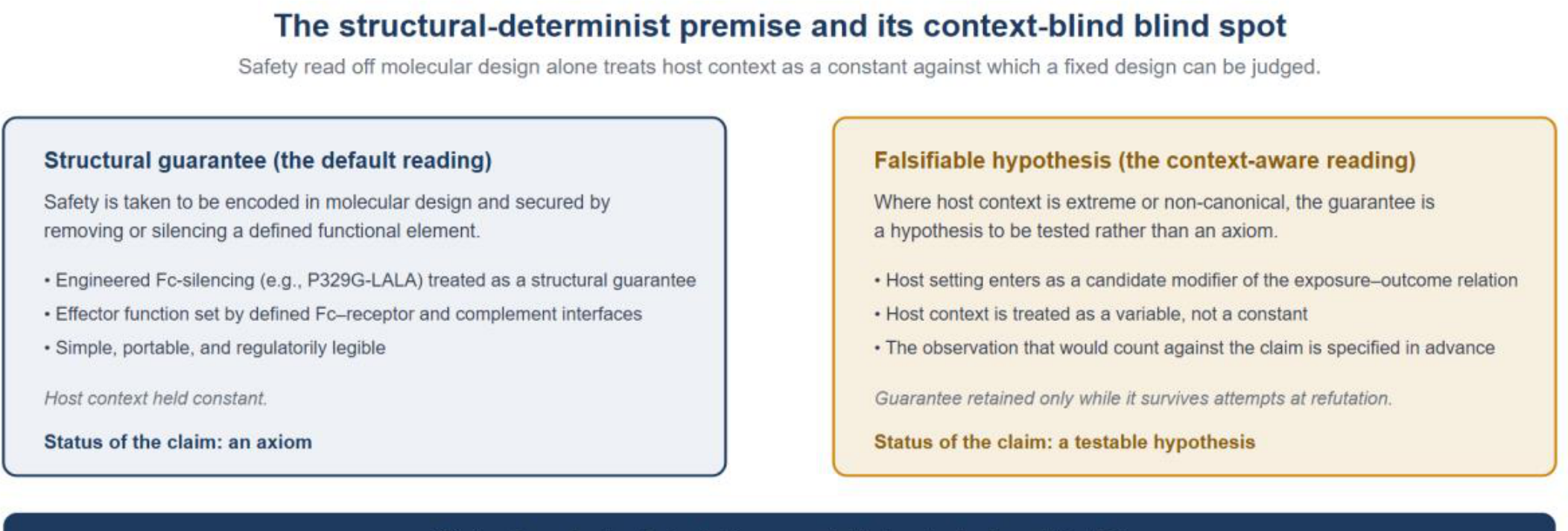
Figure 2.
The FOCUS four-tier causal ladder as a gate. The four tiers (spatial necessity, temporal priority, biological plausibility, counterfactual intervention) are traversed in order; each tier carries its own falsifying observation, and the gate rule admits a claim only as far as the answered tiers support. Where the counterfactual tier is unmet, the claim is written as one of consistency with, or contribution to, the hypothesis. The DABR workflow carries the ladder. Schematic only; contains no data.
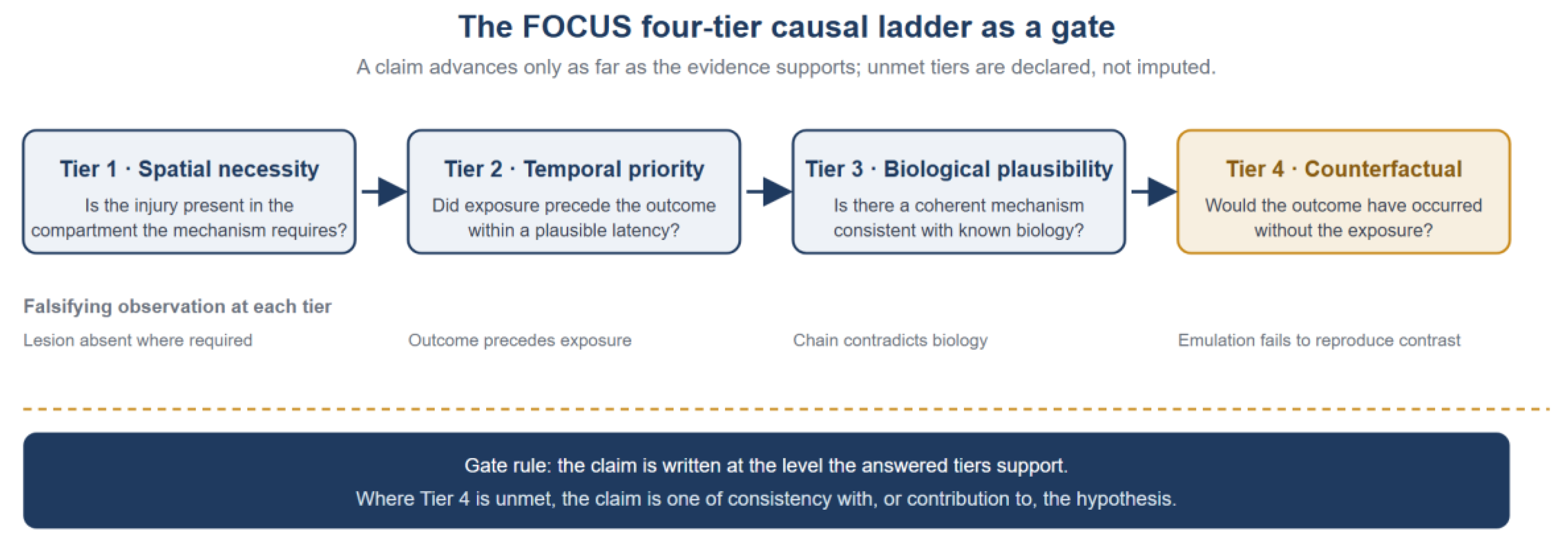

Table 1.
DABR principles and their operational requirements.
| Principle | What it demands of a report | How a reader can check it |
| Data-anchored | Every assertion is tied to a documented source of provenance. | Each claim traces back to a named source rather than undocumented recollection. |
| Assumption-explicit | The assumptions a claim depends on are stated in the text and remain inspectable. | The report names its assumptions about host context and concurrent interventions. |
| Boundary-declared | The limits of applicability are declared as explicit boundaries. | The report states what a claim does not cover and where evidence is unavailable. |
| Reproducible | Each claim is expressed so that an independent reader could re-derive and re-check it. | Every number's provenance is documented, ideally with an integrity record such as a checksum. |
Table 2.
The FOCUS tiers: operative question, required evidence, and consequence of failure.
| Tier | Operative question | Required evidence | Consequence of failure |
| Tier 1, spatial necessity | Is the injury present where the proposed mechanism requires it? | A documented lesion at the required compartment or niche, reported together with its absence elsewhere. | The candidate mechanism is eliminated. |
| Tier 2, temporal priority | Did the exposure precede the outcome within a plausible latency? | An anchored pre-exposure baseline and a stated exposure-to-outcome interval. | The outcome cannot be attributed to the exposure. |
| Tier 3, biological plausibility | Is there a coherent mechanistic chain consistent with known biology? | A mechanism consistent with published biology, with competing accounts named. | The claim is weakened rather than confirmed. |
| Tier 4, counterfactual intervention | Would the outcome have occurred absent the exposure? | A specified target trial and, where possible, its emulation with the available data. | The claim is written as one of consistency with, or contribution to, the hypothesis. |
Table 3.
FOCUS tiers mapped to established causality-assessment instruments.
| FOCUS tier or output | Question it answers | Established instruments addressing the same question | What the tier adds |
| Tier 1, spatial necessity | Is the injury present where the proposed mechanism requires it? | RUCAM organ-histology items in drug-induced liver injury adjudication; WHO-UMC organ-system terms | Makes the required site an explicit, falsifiable precondition rather than a general plausibility impression |
| Tier 2, temporal priority | Did exposure precede the outcome within a plausible latency? | Naranjo onset-time item; WHO-UMC chronology axis | Requires an anchored pre-exposure baseline and a stated latency window |
| Tier 3, biological plausibility | Is there a coherent mechanism consistent with known biology? | Bradford Hill plausibility criterion; mechanistic-reasoning frameworks | Keeps plausibility as a supporting tier that cannot confirm a claim by itself |
| Tier 4, counterfactual intervention | Would the outcome have occurred without the exposure? | Target-trial emulation; WHO-UMC dechallenge and rechallenge | Requires the tier to be declared unmet when it is unattainable, rather than approximated by analogy |
| Overall verdict | How strong is the claim, and how far may it travel? | RUCAM and Naranjo composite scores; WHO-UMC causality categories | Replaces a single composite score with a per-tier ledger and an explicit certainty grade |
Table 4.
Reporting checklist derived from the FOCUS tiers and the DABR workflow.
| Item | Requirement | Tier or workflow element |
| C1 | The anatomical or compartmental site at which injury is required is specified in advance | Tier 1; Data-anchored |
| C2 | Presence or absence of the lesion at that site is reported, negative findings included | Tier 1; Boundary-declared |
| C3 | A pre-exposure baseline is defined and the availability of data for it is stated | Tier 2; Data-anchored |
| C4 | The latency between exposure and each candidate marker is reported | Tier 2; Reproducible |
| C5 | The proposed mechanism is stated together with the level of biological support it rests on | Tier 3; Assumption-explicit |
| C6 | Competing mechanisms and unexplained findings are named rather than omitted | Tier 3; Boundary-declared |
| C7 | Whether the counterfactual tier is met, partly met, or unmet is declared | Tier 4; Boundary-declared |
| C8 | A certainty grade is attached to every causal statement | Overall; Reproducible |
| C9 | Concurrent interventions are annotated separately and are not merged into the exposure of interest | Tiers 2 and 3; Assumption-explicit |
| C10 | Any analysis performed after examining the data is labelled post-hoc and exploratory | Overall; Boundary-declared |
Disclaimer/Publisher’s Note: The statements, opinions and data contained in all publications are solely those of the individual author(s) and contributor(s) and not of MDPI and/or the editor(s). MDPI and/or the editor(s) disclaim responsibility for any injury to people or property resulting from any ideas, methods, instructions or products referred to in the content. |
© 2026 by the authors. Licensee MDPI, Basel, Switzerland. This article is an open access article distributed under the terms and conditions of the Creative Commons Attribution (CC BY) license (http://creativecommons.org/licenses/by/4.0/).
Copyright: This open access article is published under a Creative Commons CC BY 4.0 license, which permit the free download, distribution, and reuse, provided that the author and preprint are cited in any reuse.