
Submitted:
17 October 2026
Posted:
19 October 2026
You are already at the latest version
Abstract
Enterprise agentic AI requires an architecture that preserves institutional authority while models, tools, and execution resources change. This article develops the Mindful Machine as a governance-native process architecture in which a ratified Digital Genome specifies purpose, delegated authority, constraints, expected consequences, and recovery duties. The Autopoietic and Metacognitive Orchestration System executes declared governance processes; consequential actions require bounded Authorization Warrants; and an episode of record links proposals, decisions, effects, observations, obligations, and accountable closure. Eight properties make the architecture testable: purpose governance, authority separation, continuity preservation, consequence grounding, human-accountable closure, self-regulation, causal memory, and substrate independence. A conditional argument establishes commitment admission under explicit enforcement assumptions, while a conformance method separates architectural requirements from implementation evidence. Published video-streaming and credit-default implementations establish a broader engineering lineage; governed account recovery illustrates consequence recording and closure; and 25 synthetic prior-authorization records contain 10 accepted, 3 denied, and 12 escalated dispositions. These implementations provide existence evidence for reusable mechanisms rather than a universal assurance claim. The contribution is a coherent specification of authority custody and commitment-aware continuity across heterogeneous workflows, together with falsifiable requirements for evaluating its realizations.
Keywords:
governance-native architecture
; agentic AI
; institutional authority
; Digital Genome
; AMOS
; governed continuity
; causal memory
; accountable closure
; distributed systems
1. Introduction
An enterprise remains accountable for its processes even when its models, software vendors, cloud resources, or service providers change. This creates an architectural requirement: the process must retain its purpose, authority, commitments, evidence, and recovery obligations independently of the components that happen to execute it. Agentic AI makes the requirement more visible because a component can generate plausible proposals and invoke powerful tools without possessing the institutional standing needed to bind the enterprise.
The Mindful Machine research program approaches this requirement through explicit knowledge structures and runtime governance. Earlier Computers articles developed Digital Genome-based distributed applications, associative memory and event-driven history [1], runtime-switchable prediction and reasoning in a credit-default application [2], and governance of commitments above infrastructure services [3]. The present article extends this lineage by specifying how authority, consequence, closure, and continuity fit together as one architecture. AMOS is a reference implementation of that architecture, not its definition.
Architecture identifies the entities, relationships, authority boundaries, and invariants that must hold across implementations. An implementation supplies constructive evidence that selected mechanisms can be realized. Multiple heterogeneous implementations strengthen the case for reuse, while tests and measurements determine the assurance justified for a particular deployment. These roles are complementary: a limited cohort does not define the scope of an architectural contribution, and a coherent specification does not remove the need to establish the properties of its software realization.
The research question is therefore: how can an enterprise process preserve legitimate action, accountable consequence, and continuity while its intelligence and execution substrates remain replaceable? We answer through a ratified Digital Genome, separated authority mediation, a durable episode of record, and eight falsifiable properties. The design applies to conventional distributed services as well as AI-assisted workflows; its governance boundary is the enterprise process.
1.1. Contributions
The article makes four contributions. First, it defines institutional authority as governed state carried across an episode rather than a permission bit attached to a tool invocation. Second, it specifies eight properties and their failure conditions under a common separation principle. Third, it provides an execution protocol, a conditional commitment-admission argument, and continuity and closure requirements. Fourth, it organizes the implementation lineage into an evidence matrix and interprets account recovery and prior authorization through the same architectural objects. The contribution is assessed through construction, explicit assumptions, and falsifiability rather than a vendor ranking.
2. Background and Related Work
2.1. Self Management and Security Separation
Autonomic computing established a program for systems that manage themselves under high-level objectives [4]. The Mindful Machine retains that engineering objective while making institutional purpose, authority, and open obligations explicit objects of management. Recovery is evaluated against the process commitments that it must preserve. A container restart alone cannot establish that a pending decision, notification, or recovery duty survived.
Complete mediation and separation of privilege are established security principles [5]. NIST Zero Trust Architecture separates policy decisions from enforcement and requires explicit authorization for resource access [6]. The present architecture builds on these principles. Its additional unit of analysis is an episode whose commitments, applicable rules, consequences, and closure remain governed over time. A separate service or network is useful only when access controls prevent the proposing component from changing or bypassing the authority it must satisfy.
2.2. Agent Approvals Policy Engines and Durable Workflows
Contemporary agent platforms already provide substantial governance mechanisms. The OpenAI Agents SDK supports tool approvals and serializable state for paused execution [7]. LangGraph supplies checkpoints for human intervention and durable graph execution [8]. OPA externalizes policy evaluation over structured inputs [9], and Amazon Verified Permissions provides application authorization using Cedar policies [10]. These mechanisms can serve as components in a Mindful Machine implementation.
The architectural question is whether the composition preserves one authority and obligation model through every consequential path. A checkpoint can retain arbitrary metadata, but the application must still define which metadata constitutes authority, how it becomes effective, which actor records consequence, and what makes an episode complete. The proposed architecture makes these cross-component requirements explicit. It does not claim that another technology stack is incapable of satisfying them.
2.3. Management Frameworks Provenance and Domain Interfaces
NIST AI RMF and its Generative AI Profile provide lifecycle risk-management guidance [11,12]; ISO/IEC 42001 addresses organizational AI management systems [13]. The architecture supplies runtime objects to which selected organizational requirements can be assigned and tested. W3C PROV provides a vocabulary for relationships among entities, activities, and agents [14]. Provenance relationships support reconstruction, while an authoritative episode additionally requires admission, standing, and closure rules.
In healthcare, CMS-0057-F and the HL7 Da Vinci CRD, DTR, and PAS implementation guides address prior-authorization modernization and information exchange [15,16,17,18]. They provide important domain interfaces. This article uses prior authorization as a systems example and makes no certification, payer-conformance, or clinical-validation claim. Domain obligations must be derived from the rules applicable to each deployment.
Figure 1 introduces the reference architecture used in the following sections.
3. Architectural Objects and Authority Custody
3.1. Digital Genome and Governed Processes
The Digital Genome is a versioned, machine-readable specification of a process and its governance. It contains identity, purpose, roles, delegated authority, admissible actions, policies, invariants, functional requirements, non-functional requirements, evidence duties, recovery policies, and declared terminal conditions. A ratification binds a version and its integrity digest to an accountable principal, authority basis, and effective interval. Runtime components may propose amendments; they cannot make their own proposal effective.
AMOS interprets the genome through process and topology management, workflow regulation, event management, and recovery. Its implementation roles include APM for deployment and process management, CNM for connections and rewiring, SWM for service workflow management, and SEM for event management. Governance outcomes such as accept, deny, defer, escalate, and close are processes declared by the genome. They are not unrestricted powers intrinsic to the runtime.
Cognizing Oracles supply critique, evidence evaluation, or adjudication as declared by the process. A probabilistic model can assist evaluation, but its confidence is not an authority credential. Machine-verifiable requirements at the enforcement boundary remain explicit, and uncertain or contested semantic judgments follow the declared escalation process. The architecture therefore separates the role of an oracle from any particular model or algorithm used to implement it.
3.2. Permission Authorization and Commitment
Permission determines whether an identity may invoke a resource. Authorization determines whether a concrete action is admitted under current conditions. Institutional commitment is the resulting obligation, decision, or protected state transition undertaken for an accountable principal. These concepts can coexist in one system without being equivalent. A support service account may technically invoke a reset endpoint while the requester still lacks recovery standing for the target account.
The Authorization Warrant binds an admitted proposal to its exact authority context. It identifies the episode, principal, delegated scope, action, target, parameter digest, effector, governing versions, evidence references, issuer, validity interval, revocation conditions, and replay policy. The warrant is an architectural authorization object, not a legal instrument. Transport identity authenticates a message sender; it does not replace the warrant authorizing the side effect.

Table 1.
Core objects and custody requirements.
| Object | Required content | Authority or writer |
|---|---|---|
| Digital Genome | Purpose, rules, constraints, expected consequences, recovery and terminal conditions | Ratified under accountable institutional authority |
| Proposal | Episode, exact action and target, evidence references, expected consequence | Proposer with no consequential execution credential |
| Authorization Warrant | Bounded authority, proposal digest, versions, issuer, time and replay constraints | Authorized issuer outside proposer control |
| Consequence event | Observed effect, action reference, source, timestamp and uncertainty | Effector or independent monitor |
| Closure assertion | Terminal condition, standing, evidence and residual obligations | Declared party with standing |
| Episode of record | Causally linked transitions, warrants, effects, observations and obligations | Controlled append-only institutional history |
3.3. Episode of Record
An episode of record is the durable, authoritative account of a governed process instance. It begins with a declared purpose and expected outcome, retains the applicable versions and all consequential transitions, and remains queryable after sessions or executors end. Its identity belongs to the process instance. Agent context windows, orchestration run identifiers, and vendor sessions can be associated with that identity without owning it.
The record distinguishes proposals, authority decisions, execution attempts, committed effects, consequence observations, and closure assertions. Evidence references must resolve to immutable versions or integrity-checked snapshots. Causal edges record dependencies and authorization relationships, while timestamps record order and deadlines. Such edges establish recorded operational dependence; they do not alone prove scientific causation of clinical, economic, or social outcomes.
One authoritative history is a logical property. Replicated stores, graph projections, dashboards, caches, and vector indexes are permitted if accepted assertions reconcile to the same history. The operator view shows runtime state and recovery; the service-user view shows progress, requests, and dispositions; the service-management view shows obligations, service levels, and assurance. Governance queries reconstruct who authorized a change and under which rules. Access controls can limit each view without creating competing institutional records.
4. Eight Properties of a Mindful Machine
The eight properties retain the P1–P8 identifiers and public names of Schema v0.2 [19], interpreted through the runtime specification [20]. They are requirements of the architectural definition. A property label is not an assurance certificate for a deployed system. Figure 2 groups them by the question they answer; numbering remains stable across the groups.
The governing principle is that the checker cannot be the sole validator of the claim it checks. Operationally, proposal and authorization, execution and closure, and change proposal and ratification require distinct authority roles. Consequence must be grounded outside the proposer’s narrative; where an effector supplies telemetry, stronger assurance uses independent reconciliation. Correction should rely on protected measurements outside the uncontrolled semantic surface being corrected. Logical separation requires enforced write and invocation boundaries, not merely different component names.
Table 2.
Architectural requirements and falsification conditions.
| Property | Required invariant | A falsifying observation |
|---|---|---|
| P1 Purpose-Governed | Effective genome version has ratified purpose and delegated authority; amendments require separate ratification. | Runtime activates an unratified governing version. |
| P2 Authority-Separated | Proposer lacks consequential credentials; every protected effect requires external adjudication and a valid warrant. | An effect occurs without a valid warrant, or proposer rewrites its admission rules. |
| P3 Continuity-Preserving | Episode identity, authority context, open commitments and provenance survive execution change. | Failover loses, duplicates or silently reauthorizes a commitment. |
| P4 Consequence-Grounded | Expectation precedes action; observation comes from effector or independent monitor. | Proposer success text is the only outcome evidence. |
| P5 Closed and Human-Accountable | Declared terminal conditions and standing govern closure; remaining duties stay queryable. | Session end closes an unresolved obligation without an authorized assertion. |
| P6 Self-Regulating | Protected measurements drive bounded correction followed by remeasurement. | Correction is claimed without a later measurement or detector state is proposer-writable. |
| P7 Causal Memory | Append-only history links transitions to evidence, authority, versions and consequences. | A decision cannot be reconstructed under its governing version. |
| P8 Substrate-Independent | External entities use declared interfaces; replacement preserves authority custody and governance semantics. | Replacement gains authority or creates a new unmediated path. |
4.1. Consequence and Closure
P4 separates expectation from observation. For a password reset, a proposal that access will be restored is different from an identity service reporting a credential transition, an email service reporting delivery, or a user demonstrating restored access. Each observation has its own scope. The genome must state which observation is required for the claimed terminal condition; a sent notification cannot silently substitute for restored access.
P5 separates completion of a machine step from closure of an institutional obligation. A denied proposal can complete the admission subprocess while the broader service request remains unresolved. An escalation completes routing only when custody transfer is acknowledged, and final business closure still requires a party with the declared standing. Timeouts create timeout events and recovery or escalation duties. They do not manufacture evidence that the original expectation was met.
Human accountability is anchored in an institutional delegation chain. A declared role may assert routine closure through an authenticated service operating under that role, provided the accountability and evidence remain explicit. This is a design choice about responsibility and authority; it does not depend on proving a philosophical claim about machine consciousness.
4.2. Self Regulation and Reviewed Learning
P6 compares declared expectations with measured outcomes and applies responses already admitted by the genome. Structural detectors can use liveness, topology, identities, counts, signatures, and timestamps without interpreting untrusted prompt content. Such separation reduces one common manipulation path; it does not make the control plane immune to compromised sensors, keys, or administrators. Semantic quality still requires domain-appropriate evaluation and, where necessary, human review.
Coherence debt denotes unresolved divergence between commitments and observed consequences. For an episode e, a useful candidate measure is Equation (1), where J(e) is its declared obligation set, each weight is nonnegative, d is a domain-specific normalized discrepancy, and ρ is verified recovery progress in the interval [0,1].
The units, observation window, thresholds, missing-data treatment, and aggregation rules must be specified before this measure is used. An unobserved outcome remains unknown; it is not scored as success. Recovery progress requires evidence and must not double-count a correction already reflected in the observed discrepancy. Debt can increase when new failures appear. Only the residual attributable to a successfully verified correction is expected to decrease. No independent coherence-debt benchmark is reported here.
The Discover–Reflect–Apply–Share loop uses the record to identify recurring divergence and propose improvements. Applying an already authorized recovery process is runtime regulation. Changing purpose, admissible actions, authority scope, or evaluation rules creates a proposed genome revision and requires separate ratification before activation. Learning therefore contributes evidence to constitutional change without acquiring the authority to enact it.
5. Runtime Protocol and Conditional Admission Argument
5.1. Admission Execution and Reconciliation
A governed episode first verifies the effective genome version and creates a proposal with an exact target, parameters, evidence references, and expected consequence. Adjudication evaluates purpose, delegation, current facts, invariants, and required approvals. The declared process then denies, defers, escalates, or issues a warrant. Acceptance at this stage admits the action; it does not assert that the effect has already occurred.
Immediately before a protected state change, the enforcement point verifies issuer authenticity, genome applicability, proposal and target binding, delegated scope, current conditions, validity interval, revocation, and replay constraints. A state version or equivalent concurrency precondition prevents a warrant issued for one state from authorizing an incompatible later state. Execution produces a stable action identifier, and subsequent observations reconcile actual effects with that identifier and warrant.
The authority context is recorded durably before an external side effect is released. Transactional coupling may be possible within one store; external services usually require an outbox, idempotency key, effect query, or compensation protocol. If a crash occurs after effect but before acknowledgement, recovery must query or reconcile the result rather than repeat the action blindly. The architecture requires an accountable treatment of the uncertain outcome; it does not assume distributed exactly-once execution.
5.2. Conditional Commitment Admission
Proposition 1. Every protected effect has valid institutional admission at its enforcement point if the following assumptions hold: all effecting paths pass through the gate; proposer identities cannot write the genome, issuer state, or gate configuration; issuer credentials and verification are sound; the gate checks a complete validity predicate against sufficiently fresh authoritative state; and it rejects failure or uncertainty. These are explicit trusted-computing-base and deployment assumptions.
Proof. Consider any protected effect. Complete mediation implies that its request reached the gate. The gate admits the request only if the validity predicate succeeds. Integrity and isolation ensure that the proposer cannot create the required issuer authority or change the governing predicate. Binding and freshness checks connect the validated authority to this action and current state. Therefore the effect has the admission required by the ratified specification. A bypass, compromised issuer, stale required fact, or mutable predicate violates an assumption and defeats the conclusion.
This is a conditional safety argument about admission. It does not establish that a ratified rule is lawful, that an input fact is true, that a model recommendation is correct, or that execution achieves its expected outcome. P4–P7 supply the additional obligations for observation, closure, regulation, and reconstruction. Together, the properties define a stronger systems contract than the admission proposition alone.
5.3. Governed Continuity and Component Succession
A continuity contract identifies what must survive a change: episode identity, accepted history, governing versions, warrants and revocation state, effect identifiers, pending obligations, deadlines, closure standing, and recovery policy. A replacement executor receives only the authority available under that contract. Host identity and software identity may change; authority is neither inherited from model capability nor silently regenerated by replay.
Failover requires fencing or equivalent exclusion of a stale executor. A single-use warrant needs an atomic consumption or deduplication rule shared with the effecting boundary. During a partition, a deployment must follow its declared safe behavior, including refusing commitments whose authority freshness cannot be established. Availability does not override an invariant merely because the authority service is unreachable.
Model, tool, database, or cloud substitution passes through a succession check against the declared interface and functional and non-functional constraints. A replacement can change relevant facts, including jurisdiction, risk, evidence quality, or latency, and therefore legitimately change an authorization result. P8 preserves who governs and how authority becomes effective; it does not require identical outputs from different models or forbid justified changes in decisions.
6. Materials and Methods
6.1. Study Design and Evidence Sources
This is an architecture and constructive systems study. We analyze the specification, relate it to established mechanisms, and examine heterogeneous realizations. Evidence consists of published distributed-application and credit-default studies [1,2], the commitment-governance study [3], the reported synthetic prior-authorization cohort and its public preprint [21], and the account-recovery demonstration described in the authors’ technical schema [19]. The runtime specification [20] provides the common object and protocol definitions. No new execution experiment was conducted for this manuscript revision.
The implementations are existence evidence at different levels of maturity. They are not pooled into a statistical sample, because streaming availability, prediction workflows, identity recovery, and prior authorization have different outcomes and observation boundaries. For each, the analysis identifies the exercised architectural mechanism, source, and warranted inference. Development-session observations are separated from published experimental results.
6.2. Prior Authorization Cohort and Endpoint
The prior-authorization cohort contains 25 synthetic completion records counted by persisted disposition in a read-only graph query, as reported in the source manuscript [21]. Each case was counted once. Percentages use 25 as the denominator. The cases were constructed to exercise governance paths rather than to estimate population rates. No statistical hypothesis test, clinical reference standard, or real-patient outcome evaluation was performed.
The observed endpoint is the stored governance disposition. Accept, Deny, and Escalate are the three observed categories. A possible defer or do-nothing process is not reported as an exercised category in this cohort. The 12 escalations represent routing beyond the machine’s delegated decision boundary; the aggregate does not establish reviewer acknowledgement, subsequent adjudication, or downstream consequence closure for those cases.
6.3. Conformance Assessment Method
Conformance assessment asks whether each property holds for the declared process boundary and threat model. Evidence strength is reported separately using a proposed ordinal scale: E0 for specification, E1 for inspectable implementation artifacts, E2 for repeatable controlled demonstration with retained test materials, E3 for independent or adversarial measurement, and E4 for operational evidence across external boundaries. These grades are an assessment convention, not a recognized standard or an automatic measure of safety.
A video or author report demonstrates an execution sequence but does not automatically meet E2 unless the configuration, inputs, expected outcomes, and records needed for rerun are retained. Similarly, a 16/16 architectural alignment score cannot establish deployment conformance. This article therefore reports source-specific observations rather than assigning unsupported aggregate grades to the entire architecture.
7. Implementation Evidence Across Workflows
7.1. Distributed Video Service and Runtime Continuity
The 2024 video-streaming implementation [1] represents distributed components and their relationships through a Digital Genome and managed knowledge structures. Its declared non-functional requirements include failover, scaling, and migration, with control components managing placement, connectivity, and workflow. This supplies published construction evidence that application structure and continuity policy can be managed above particular execution resources.
The relevant consequence domain is the operator-controlled service network: health and performance signals can drive topology and process changes. This is an important realization of regulation and continuity, even though it does not establish closure across an uncontrolled external institution. The newer P1–P8 vocabulary makes the required assurance artifacts more explicit; it should not be projected backward as if every current conformance test had already been run in the 2024 study.
7.2. Credit Default and Heterogeneous Knowledge Processes
The 2025 credit-default study [2] compares a static logistic-regression pipeline with a distributed implementation combining machine learning and rule-based simulation under AMOS. It reports runtime switching and reconfiguration of components and logic. Its architectural relevance is that different reasoning methods can be services inside a governed workflow rather than fixed owners of its identity or policy.
Predictive validity and governance validity remain different measurements. A better or worse prediction does not by itself show that authority was preserved during migration, and a governed algorithm switch does not establish improved credit outcomes. The study supports reuse of orchestration and knowledge mechanisms; the present article adds the authority, consequence, and closure conditions under which such switching should be assessed.
7.3. Governed Password Reset and Account Recovery
The account-recovery demonstration reported in Schema v0.2 [19] supplies a concrete separation of proposal, execution, consequence source, and closure. The assistant proposes recovery without holding the consequential reset credential. A separate authority process checks requester standing against authoritative account state, evidence, risk, delegated scope, and policy. If admitted, the warrant binds the exact account, recovery method, permitted destination, action, and validity interval. The reset effector must validate that binding before altering protected state.
The demonstration description identifies an email authority as the consequence source and an administrator as the closure authority. These are distinct from the proposing agent. This illustrates P4, P5, and the use of declared external entities in P8 at a bounded terminal node. It also exposes the importance of the terminal definition: a recorded email event supports the claim about that event, while a claim that legitimate access was restored requires additional identity-platform or access evidence.
This is a reported demonstration rather than an independently measured security benchmark. The available description supplies no run count, attack denominator, latency distribution, or independently audited recovery-success rate; none is inferred here. Its architectural value is the realized allocation of authority and evidence roles, which can be reused in other consequential workflows.
A separate development test, TC-GOV-001, was recorded as a pass under active genome MM-HTS-001:1.0.0: a request missing a warrant received HTTP 403 with reason MISSING_WARRANT; no application side effect or commit event was reported. This is a specific author-reported negative-path observation. It supports enforcement of that tested entry point and does not establish complete mediation across every reset path. Appendix A identifies the artifacts required to elevate this observation into reproducible evidence.
7.4. Synthetic Prior Authorization Results
Table 3.
Persisted dispositions in the synthetic prior-authorization cohort reported in [21].
Table 3.
Persisted dispositions in the synthetic prior-authorization cohort reported in [21].
| Disposition | Cases | Share | Interpretation of the observed endpoint |
|---|---|---|---|
| Accepted | 10 | 40% | Acceptance path is present in the completion records; aggregate counts do not independently verify downstream effects. |
| Denied | 3 | 12% | Adverse-disposition path is present; clinical correctness and satisfaction of every review condition are separate questions. |
| Escalated | 12 | 48% | Machine decision boundary is reached; final human resolution and business closure are not established by the category. |
| Total | 25 | 100% | All three observed disposition categories are represented. |
The counts establish that the persisted cohort contains all three designed disposition paths. They are implementation evidence for governance routing and recording. They do not establish a 100% success rate for end-to-end prior authorization, and the escalation share is not an estimate of operational workload. An escalation is useful governance behavior when authority or evidence is insufficient, but routing and acknowledged transfer must be distinguished.
The common pattern with account recovery is structural. Both workflows need an accountable owner, exact action scope, evidence, an authority decision, an independent consequence source, and an explicit terminal condition. Prior authorization additionally spans clinical review, payer and provider communication, appeals, and potentially patient outcomes. These external obligations may outlive the machine decision process and must remain open or be linked to a subsequent episode.
7.5. Evidence Synthesis and Wider Implementations
Table 4.
Implementation lineage and the inference supported by each source.
| Implementation and source | Mechanisms exercised or described | Evidence interpretation |
|---|---|---|
| Video streaming [1] | Digital Genome, distributed components, placement/connectivity control, continuity policies | Published construction within an operator-controlled network; current eight-property certification is not implied. |
| Credit-default workflow [2] | Hybrid ML/rules, runtime switching, distributed orchestration and memory | Published evidence of heterogeneous knowledge-process reuse; no authority or closure success rate inferred. |
| Commitment governance [3] | Policy and commitment abstractions above infrastructure | Published architectural lineage supporting the process-level framing. |
| Account recovery [19,20] | Proposer/effector separation, external consequence record, administrator closure | Author-reported demonstration and worked protocol; no independent attack or throughput measurement. |
| Governance admission test | TC-GOV-001 missing-warrant denial, reported no effect or commit | Bounded development observation; retained test bundle needed for independent reproduction. |
| Prior authorization [21] | 25 persisted records across acceptance, denial and escalation | Reported synthetic routing result; no clinical or external consequence-closure measurement. |
Related engineering work includes medical knowledge assistants, managed messaging networks, legacy-application migration, and security workflows. These applications motivate the intended reuse of the same specification, regulation, and memory mechanisms. They are not counted here as additional measured cohorts because comparable protocols and retained results are not supplied in this study. The architecture’s scope is broader than its current measurements, and the table preserves that distinction without reducing the architecture to the two most recent demonstrations.
8. Comparison Security and Deployment
8.1. Composition and Architectural Responsibility
Table 5.
Relationship to established mechanisms. This is a responsibility comparison, not a product score.
Table 5.
Relationship to established mechanisms. This is a responsibility comparison, not a product score.
| Mechanism | What it provides | Additional process-level obligation |
|---|---|---|
| IAM and application authorization [6,10] | Identity, principal/resource/action scope and access decisions | Bind admitted effect to purpose, delegation, evidence, current state and open obligations. |
| Tool approval [7] | Pause and resume sensitive tool requests | Make every consequential path obey the same external authority and warrant conditions. |
| Durable workflow [8] | Checkpoints, resumability and execution state | Preserve authority, effects, pending duties and closure standing through recovery. |
| Policy engine [9] | External evaluation of structured policy | Protect policy custody, evidence freshness, issuance and enforcement across the full process. |
| Provenance and tracing [14] | Recorded entities, activities, actors and dependencies | Designate accepted history and distinguish proposal, effect, consequence and closure. |
| Infrastructure orchestration | Placement, restart, scaling and deployment | Recover the same governed commitments and validate successor authority. |
A conventional stack can satisfy the architecture by implementing these obligations coherently. Conversely, a system labeled Mindful Machine fails conformance if it permits bypass, unratified change, unsupported closure, or lost commitments. The distinction is property-based. The process owner controls purpose, delegation, and governing change; vendors provide replaceable capabilities under those requirements.
8.2. Threat Model and Residual Risks
The threat model includes mistaken or manipulated proposals, forged or replayed requests, stale evidence, compromised execution resources, partial failure, and misleading success reports. The protected authority base includes the ratification mechanism, active genome and its integrity, issuer keys, enforcement point, authoritative state sources, trusted measurement paths, and accepted history. Compromise of that base can invalidate the conditional argument. Logical separation must be backed by credential custody, network and service access controls, and restricted write paths.
Prompt injection must not become authority merely because a model repeats an instruction. Typed proposal interfaces, protected policy sources, least-privilege service identities, and warrant-bound effects reduce that path. They cannot establish the truth of a forged external fact; evidence authenticity and freshness need their own checks. A semantically complex adjudicator requires independent safeguards against the same content-driven failure that affects a proposer.
The authority service also introduces latency and availability requirements. Deployments may replicate it, distribute bounded delegated authority, or enforce pre-authorized envelopes close to an effector. Each option must preserve versioning, revocation, scope, and history. A claimed low-latency exception that lets an executor mint unrestricted authority defeats the architecture.
8.3. Incremental Adoption
Adoption can begin around one protected action in an existing service. The process owner declares purpose, invariants, evidence requirements, expected outcome, standing, and recovery duties; moves consequential credentials out of the proposer; inserts warrant validation at the effector; and creates the episode record. Existing orchestration, monitoring, databases, and identity systems remain usable through declared adapters. Additional actions and continuity scenarios can then be brought under the same contract.
A practical pilot should demonstrate authority custody, invalid-warrant denial with absence of side effect, independent outcome observation, accountable closure, and recovery of an open episode. The cost, latency, operational complexity, and recovery behavior must be measured locally. No adoption-cost or financial-return estimate is derived from the present evidence.
9. Limitations and Validation Agenda
The architectural argument depends on explicit assumptions and a bounded system model. It is not a mechanized proof of all implementations. A full proof would require formal models of credential reachability, policy updates, concurrent effects, warrant consumption, failure handling, and the authoritative record. Safety at admission must be distinguished from liveness: a process can correctly refuse an unsafe action while failing to deliver its service within the required time.
The evidence spans published constructions, a synthetic aggregate, and author-reported demonstrations. These establish a lineage of implementable mechanisms with different observation boundaries. They do not provide a common benchmark, independent adversarial assessment, production-scale latency distribution, or general outcome superiority. The prior-authorization records lack independently adjudicated clinical ground truth in this analysis, and account recovery lacks a supplied repeated security-test dataset.
Cross-boundary consequence closure remains the hardest extension. A provider, customer, administrator, or third-party identity platform may not expose a trustworthy outcome signal. The process must retain uncertainty, deadlines, responsible parties, and unresolved duties until its terminal condition can be asserted. Human ratification and closure introduce accountability but remain vulnerable to organizational error, approval fatigue, and flawed delegation.
Architecture makes these obligations explicit and enables implementations to address them systematically. Broader assurance requires the test families in Table 6, run against frozen artifacts with exact configurations, retained records, and declared success criteria. They are proposed validation requirements rather than additional results of the present study.
10. Conclusions
Institutional authority must persist beyond an individual model invocation or runtime session. The Mindful Machine architecture assigns that persistence to the enterprise process through a ratified Digital Genome, separated authority mediation, bounded warrants, consequence grounding, accountable closure, and authoritative causal memory. Its eight properties specify what must remain true during ordinary execution and during failure, adaptation, and replacement.
Published video-streaming and credit-default systems provide a constructive engineering lineage. Governed account recovery makes consequence source and closure authority concrete, while the synthetic prior-authorization records show three implemented disposition paths across 25 cases. These realizations support architectural feasibility and reuse without becoming the sole definition of the architecture or substituting for a deployment assurance case.
The resulting design preserves process-owner control while permitting models, services, and infrastructure to evolve. Future evaluation should measure the cost and fidelity of that preservation, test adversarial enforcement and concurrent recovery, and retain evidence linking committed actions to observed outcomes and legitimate closure across external boundaries.
Supplementary Materials
Author Contributions
Conceptualization, R.M.; methodology, R.M.; software, W.P.K.; validation, R.M. and W.P.K.; formal analysis, R.M.; investigation, R.M. and W.P.K.; writing—original draft preparation, R.M.; writing—review and editing, R.M. and W.P.K.; visualization, R.M.; supervision, R.M.
Funding
This research received no external funding.
Institutional Review Board Statement
Not applicable. The reported prior-authorization cohort used synthetic cases and no patient data.
Informed Consent Statement
Not applicable.
Data Availability Statement
The synthetic query outputs underlying the 25-case disposition counts and relevant implementation artifacts are available from the corresponding author upon reasonable request, as stated in the source manuscript. No public reproduction repository is claimed. The account-recovery demonstration and development observation are described at the evidence level available to this article; their complete rerun bundles are not included.
Acknowledgments
The authors thank Justin Kromelow of Opos, Inc. for continued support. OpenAI ChatGPT assisted with manuscript restructuring, language revision, reference checking, and preparation of the figures and Word document. The authors remain responsible for verifying the technical claims, source evidence, and final submission.
Conflicts of Interest
The authors are also affiliated with organizations developing the Mindful Machine architecture described in this article. The paper presents an architecture and implementation lineage; it does not report an independent commercial-product evaluation.
Abbreviations
AMOS, Autopoietic and Metacognitive Orchestration System; APM, autopoietic process management; CNM, cognitive network management; CRD, Coverage Requirements Discovery; DRAS, Discover–Reflect–Apply–Share; DTR, Documentation Templates and Rules; IAM, identity and access management; NFR, non-functional requirement; OPA, Open Policy Agent; PAS, Prior Authorization Support; SEM, service event management; SWM, service workflow management.
Appendix A Reproduction and Evidence Requirements
The 25-case result can be recomputed from a frozen graph export or immutable query output containing one unique case identifier and one persisted disposition per case. The reproduction bundle should identify the genome and implementation versions, synthetic-case generation method, query text, filters, deduplication rule, query timestamp, graph snapshot digest, and handling of missing or duplicate records. Counting the three reported categories yields 10, 3, and 12; dividing by 25 yields 40%, 12%, and 48%. This arithmetic reproduces the summary, while verification of the original graph requires the underlying export.
Account recovery requires a frozen genome, declared terminal condition, standing assignments, proposal and warrant examples, authoritative account-state fixture, effector and email/identity observation records, closure assertion, and negative-path tests. TC-GOV-001 additionally requires the exact request, gate response, active version, before/after effect-store state, and event/audit records. The retained record must distinguish an absent protected commit from the expected denial audit event.
For continuity testing, retain a before/after episode comparison, fault-injection timeline, executor identities, fencing and replay state, active rules, outstanding warrants, side-effect identifiers, pending obligations, and recovery measurements. A complete episode must permit reconstruction without the original agent session. These requirements make implementation evidence reviewable while leaving the choice of database, workflow engine, and cloud open.
Appendix B Relationship to Earlier Publications
This article develops the authority-custody, episode, closure, and eight-property specification beyond the earlier Computers studies [1,2,3]. It revises and extends the preprint From Permission to Institutional Authority [21], whose 25-case cohort is retained rather than presented as a new experiment. The account-recovery interpretation and explicit property model draw on the later technical schema and runtime specification [19,20]. The contribution is the integrated architectural specification and evidence synthesis, not a claim that previously reported demonstrations are newly executed results.
References
- Mikkilineni, R.; Kelly, W.P.; Crawley, G. Digital Genome and Self-Regulating Distributed Software Applications with Associative Memory and Event-Driven History. Computers 2024, 13, 220. [Google Scholar] [CrossRef]
- Mikkilineni, R.; Kelly, W.P. From Static Prediction to Mindful Machines: A Paradigm Shift in Distributed AI Systems. Computers 2025, 14, 541. [Google Scholar] [CrossRef]
- Mikkilineni, R.; Kelly, W.P. The Missing Layer in Modern IT: Governance of Commitments, Not Just Compute and Data. Computers 2026, 15, 275. [Google Scholar] [CrossRef]
- Kephart, J.O.; Chess, D.M. The Vision of Autonomic Computing. Computer 2003, 36, 41–50. [Google Scholar] [CrossRef]
- Saltzer, J.H.; Schroeder, M.D. The Protection of Information in Computer Systems. Proc. IEEE 1975, 63, 1278–1308. [Google Scholar] [CrossRef]
- Rose, S.; Borchert, O.; Mitchell, S.; Connelly, S. Zero Trust Architecture; NIST SP 800-207; National Institute of Standards and Technology: Gaithersburg, MD, USA, 2020. [Google Scholar] [CrossRef]
- OpenAI. Agents SDK Human-in-the-Loop. Available online: https://openai.github.io/openai-agents-python/human_in_the_loop/ (accessed on 16 October 2026).
- LangChain. LangGraph Persistence. Available online: https://docs.langchain.com/oss/python/langgraph/persistence (accessed on 16 October 2026).
- Open Policy Agent. Open Policy Agent Documentation. Available online: https://www.openpolicyagent.org/docs (accessed on 16 October 2026).
- Amazon Web Services. What Is Amazon Verified Permissions. Available online: https://docs.aws.amazon.com/verifiedpermissions/latest/userguide/what-is-avp.html (accessed on 16 October 2026).
- Tabassi, E. Artificial Intelligence Risk Management Framework AI RMF 1.0; NIST AI 100-1; National Institute of Standards and Technology: Gaithersburg, MD, USA, 2023. [Google Scholar] [CrossRef]
- Autio, C.; Schwartz, R.; Dunietz, J.; Jain, S.; Stanley, M.; Tabassi, E.; Hall, P.; Roberts, K. NIST AI 600-1; Artificial Intelligence Risk Management Framework Generative Artificial Intelligence Profile. National Institute of Standards and Technology: Gaithersburg, MD, USA, 2024. [CrossRef]
- International Organization for Standardization. ISO/IEC 42001:2023 Information Technology—Artificial Intelligence—Management System; ISO. Geneva, Switzerland, 2023. Available online: https://www.iso.org/standard/42001.
- Lebo, T.; Sahoo, S.; McGuinness, D. (Eds.) PROV-O The PROV Ontology; W3C Recommendation; 30 April 2013; Available online: https://www.w3.org/TR/prov-o/ (accessed on 16 October 2026).
- Centers for Medicare; Medicaid Services. CMS Interoperability and Prior Authorization Final Rule CMS-0057-F. Available online: https://www.cms.gov/initiatives/burden-reduction/overview/interoperability/policies-regulations/cms-interoperability-prior-authorization-final-rule-cms-0057-f (accessed on 16 October 2026).
- HL7 International. Da Vinci Coverage Requirements Discovery CRD FHIR Implementation Guide. Available online: https://hl7.org/fhir/us/davinci-crd/ (accessed on 16 October 2026).
- HL7 International. Da Vinci Documentation Templates and Rules DTR FHIR Implementation Guide. Available online: https://hl7.org/fhir/us/davinci-dtr/ (accessed on 16 October 2026).
- HL7 International. Da Vinci Prior Authorization Support PAS FHIR Implementation Guide. Available online: https://hl7.org/fhir/us/davinci-pas/ (accessed on 16 October 2026).
- Mikkilineni, R. Mindful Machine Schema v0.2; author-held technical specification, unpublished; Mindful Machines and Mindful AI Foundation, 18 September 2026. [Google Scholar]
- Mikkilineni, R. Mindful Machine Governance-Native Runtime Specification v1.0; author-held technical specification, unpublished; Mindful Machines and Mindful AI Foundation, 18 September 2026. [Google Scholar]
- Mikkilineni, R.; Kelly, W.P. From Permission to Institutional Authority: Governance-Native Agentic AI with Governed Continuity and Authoritative Memory. Preprints 2026, 2026090878, version 1. posted. 2026. [Google Scholar] [CrossRef]
Figure 1.
Reference architecture. Institutional authority ratifies the specification; proposals cross a warrant-enforced boundary before effect. Consequence and closure enter authoritative memory. Arrows show logical dependencies, not a required physical deployment topology.
Figure 1.
Reference architecture. Institutional authority ratifies the specification; proposals cross a warrant-enforced boundary before effect. Consequence and closure enter authoritative memory. Arrows show logical dependencies, not a required physical deployment topology.
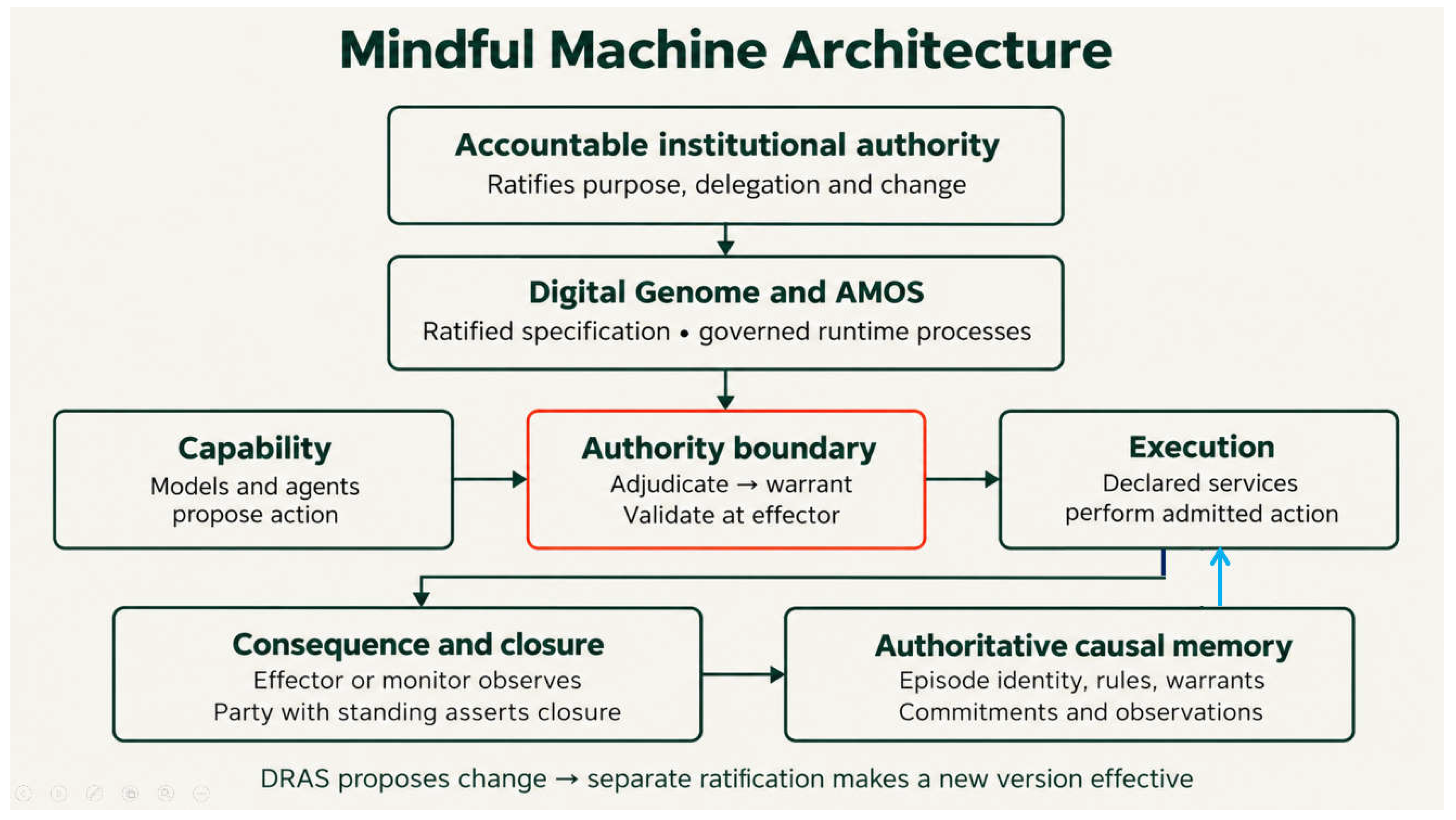
Figure 2.
Eight architectural properties grouped by custody, mediation, consequence, and continuity. The grouping follows Schema v0.2; the separation principle governs all eight. Auditability, resilience, and governed adaptation are derived outcomes.
Figure 2.
Eight architectural properties grouped by custody, mediation, consequence, and continuity. The grouping follows Schema v0.2; the separation principle governs all eight. Auditability, resilience, and governed adaptation are derived outcomes.
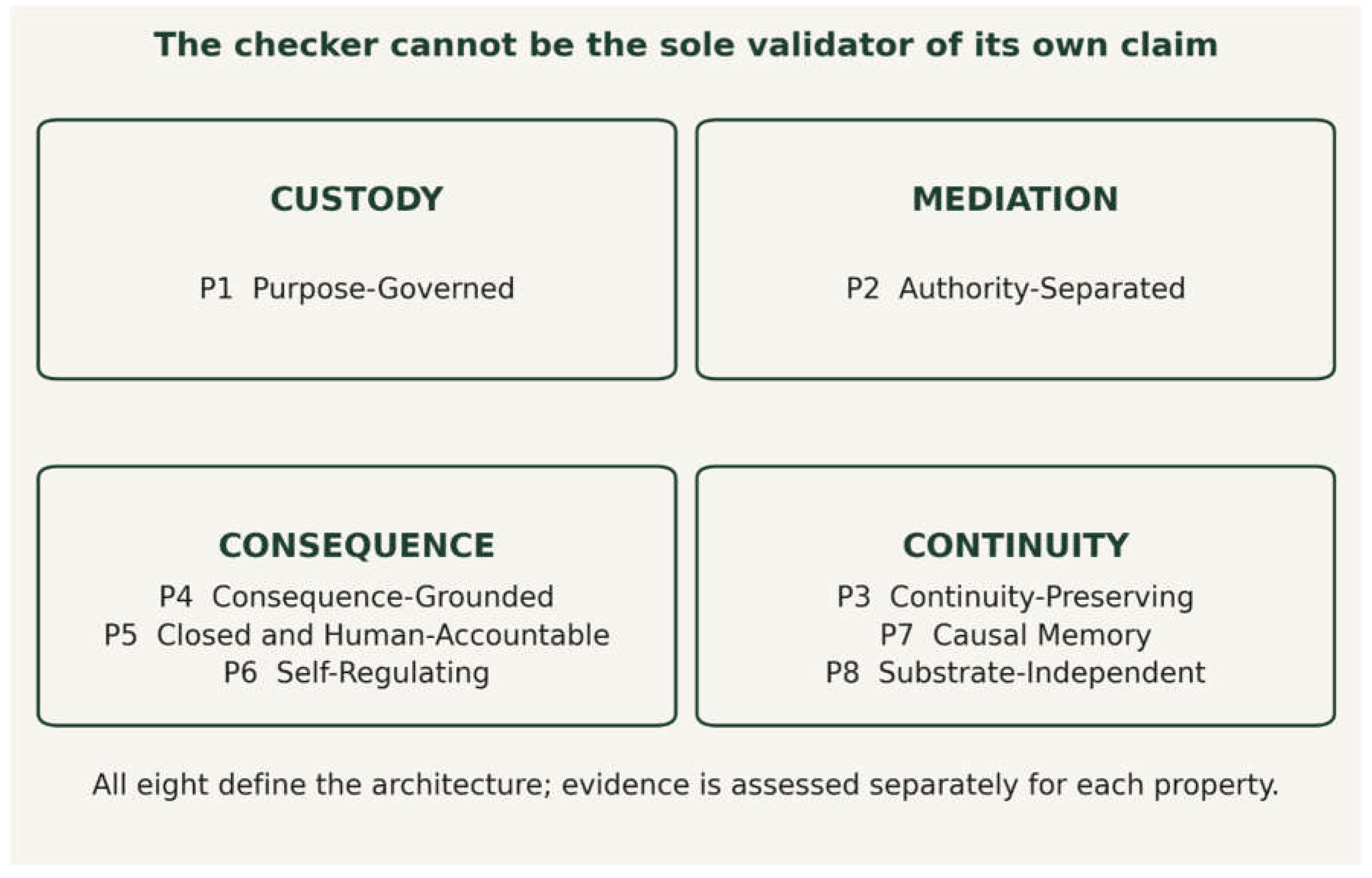
Figure 3.
Episode protocol. Denial, deferral and escalation branch from adjudication under genome-declared processes. The illustrated admitted path preserves separate action, observation and closure semantics. The episode record persists across recovery and executor replacement.
Figure 3.
Episode protocol. Denial, deferral and escalation branch from adjudication under genome-declared processes. The illustrated admitted path preserves separate action, observation and closure semantics. The episode record persists across recovery and executor replacement.
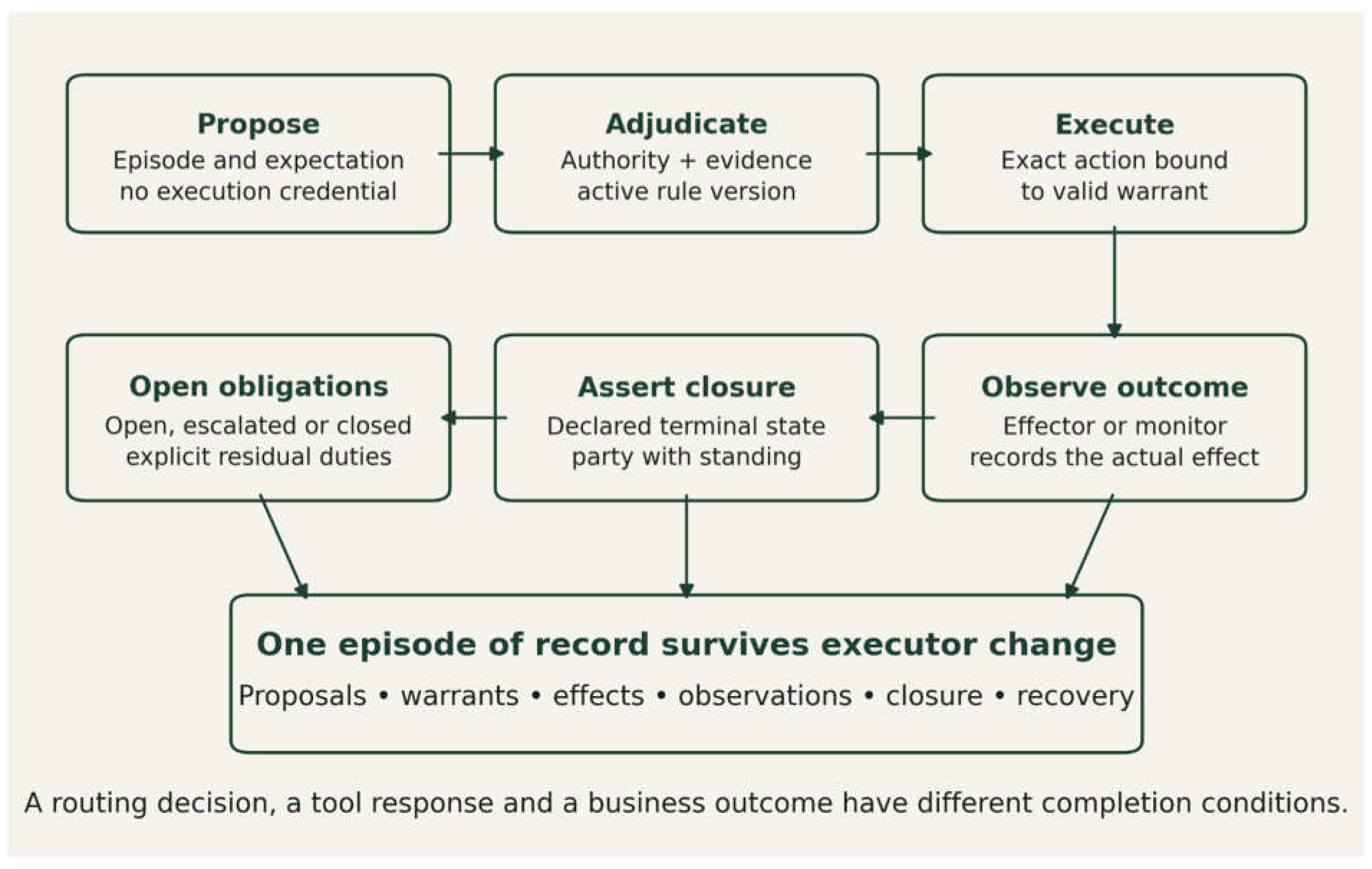
Table 6.
Required validation families for a deployment assurance case.
| Test family | Required observation | Properties |
|---|---|---|
| Authority and bypass | Attempt direct effector access, forged/expired/mismatched/revoked warrant and altered policy; verify denial and absence of protected effect. | P1 P2 |
| Concurrency and replay | Crash after effect but before acknowledgement; retry and race workers; show no duplicate commitment and reconcile uncertain outcomes. | P2 P3 P7 |
| Consequence disagreement | Make proposer claim success while effector or monitor records failure; retain open duty and invoke declared response. | P4 P5 P6 |
| Closure and escalation | End a session, delay human response, and assert closure without standing; duties remain visible and unauthorized closure fails. | P5 P7 |
| Recovery and substitution | Fail, migrate or replace an executor mid-episode; compare identity, versions, warrants, effects and obligations before/after. | P3 P8 |
| Regulation and change | Measure divergence before/after correction; attempt unratified genome change; only ratified revisions become effective. | P1 P6 |
| History integrity | Modify, omit or reorder an event; detect inconsistency and reconstruct episode under preserved governing versions. | P7 |
Disclaimer/Publisher’s Note: The statements, opinions and data contained in all publications are solely those of the individual author(s) and contributor(s) and not of MDPI and/or the editor(s). MDPI and/or the editor(s) disclaim responsibility for any injury to people or property resulting from any ideas, methods, instructions or products referred to in the content. |
© 2026 by the authors. Licensee MDPI, Basel, Switzerland. This article is an open access article distributed under the terms and conditions of the Creative Commons Attribution (CC BY) license (http://creativecommons.org/licenses/by/4.0/).
Copyright: This open access article is published under a Creative Commons CC BY 4.0 license, which permit the free download, distribution, and reuse, provided that the author and preprint are cited in any reuse.