

Submitted:
18 October 2026
Posted:
19 October 2026
You are already at the latest version
Abstract
This conceptual review proposes a descriptive, heuristic clinical-phenotypic framework for autism spectrum disorder (ASD) without intellectual disability and with fluent functional language. Drawing on a purposive, non-systematic reading of the literature, it arranges heterogeneous constructs—circumscribed abilities, pragmatic-language profiles, nonverbal learning disorder/disability, high-functioning autism as a historical-descriptive overlap, co-occurring attention-deficit/hyperactivity disorder and tic/Tourette-related features, camouflaging and social fatigue, demand-avoidant presentations, feeding and eating difficulties, and gender dysphoria/incongruence—into parallel, non-hierarchical clinical-conceptual domains, with sensory reactivity as a cross-cutting dimension. The framework is intended to support multidimensional clinical formulation, but it requires future empirical validation. Because several of these domains emerge or become clinically salient during childhood and adolescence, the framework is intended to support developmentally informed formulation in paediatric, adolescent and transitional care.
Keywords:
autism without intellectual disability
; adaptive functioning
; clinical formulation
; camouflaging
; sensory reactivity
; co-occurring conditions
1. Introduction
The condition historically described as Asperger syndrome (AS) is now subsumed under Autism Spectrum Disorder (ASD). In DSM-5 and DSM-5-TR, the previous categories of autistic disorder, Asperger disorder and pervasive developmental disorder not otherwise specified were merged into a single diagnosis [1]. In ICD-11, the profile closest to the former Asperger diagnosis corresponds to category 6A02.0, defined as “Autism spectrum disorder without disorder of intellectual development and with mild or no impairment of functional language” (World Health Organisation, 2025; APA 2022, ICD-11, release 2025-01) [2]. The eponym has also become a matter of debate following archival documentation of Hans Asperger’s role in Nazi-era Vienna, which supports a historically informed and context-aware use of the term, and following the Pediatric Research editorial board’s recommendation to discontinue its use [3,4]. For these reasons, the term does not appear in the title and is used in the manuscript only in a historical and descriptive sense — including to denote the area of overlap between high-functioning autism and the former Asperger profile (cluster A4) — not as an autonomous nosographic category. The target population comprises autistic people without intellectual disability and with fluent functional language. These characteristics do not, by themselves, determine the DSM-5-TR support level.
This population, however, is defined as much by what it presents with as by what remains unrecognised. Autism is diagnosed more frequently in males, but the traditionally reported male-to-female ratio of 4:1 is likely to be an overestimate: the meta-analysis by Loomes and colleagues placed the true ratio at approximately 3:1, with an odds ratio of 3.25 (95% CI 2.93–3.62) in population-screening studies compared with 4.56 (95% CI 4.10–5.07) in studies based on already established diagnoses [5,6]. The gap between these two estimates reflects diagnostic bias, whose clinical expression is well recognised: less immediately identifiable presentations, supported by social compensation strategies such as masking or camouflaging, with interests that are more socially contextualised and therefore less readily identified as atypical [7,8,9].
A major clinical concern in this population is the underestimation of support needs when fluent language or intellectual ability is taken as evidence of adequate adaptive functioning [10]. The risk operates across the whole range: at its lower end, borderline intellectual functioning may go unrecognised because fluent language conceals it; at its upper end, high intellectual functioning may sustain more effective compensation and further delay recognition. This may lead to late recognition, environmental demands calibrated to apparent competence, and a psychopathological burden that services often identify before the underlying condition itself: anxiety, depression, eating disorders, social withdrawal and fatigue [11].
Clinical formulation is further complicated by the heterogeneity of the presentation, which may include executive difficulties, psychopathological vulnerability, co-occurring neurodevelopmental conditions, food selectivity, social fatigue and other adaptive difficulties. A purely categorical reading, such as a simple distinction between “mild” and “severe” forms, does not account for this variability [12,13]. The literature has addressed this problem in two main ways: by deriving subgroups from data and by constructing transdiagnostic dimensional models. Both approaches address research questions. Neither, however, directly answers the operational question faced by the clinician assessing an individual person: what should be observed, in what order, and with what differential cautions. This is particularly relevant when the domains to be explored belong to different conceptual levels — a functional domain, a historical category, a co-occurring condition, an adaptive trajectory, or an area of ability — and may coexist within the same individual.
This is the space in which the present work is situated. Its aim is not to evaluate intervention efficacy, estimate prevalence, or produce evidence-based recommendations, but to provide clinicians with an observational framework that makes the status of each domain explicit, reduces the risk of inappropriate overlap between distinct constructs, and supports multidimensional clinical formulation. The proposal is explicitly heuristic, and the conditions for its empirical testing are described in the dedicated section.
1.1. Aims
This article aims to provide a descriptive and heuristic clinical-phenotypic framework for autistic people without intellectual disability and with fluent functional language. The framework integrates pragmatic-communicative dimensions, neuropsychological profiles, areas of specific ability, the overlapping ASD/Asperger presentation, co-occurring neurodevelopmental conditions, adaptive/compensatory trajectories and psychopathological or identity-related clinical associations, organised into three clinical-conceptual clusters, with sensory reactivity as a cross-cutting dimension. The proposal is intended as a narrative tool for clinical formulation, interdisciplinary discussion and future empirical validation. Particular attention is given to developmental periods in which these domains may become clinically recognisable, especially childhood and adolescence.
2. Methods
2.1. Methodological Approach
The manuscript is a conceptual paper. It is neither a systematic review nor a scoping review; no protocol was registered; records identified, screened, or included were not counted; and no formal risk-of-bias assessment was conducted.
For each profile, several aspects were considered, including the nature of the clinical construct, the age or period of onset or recognition, the main phenotypic characteristics, possible developmental trajectories, and the relationship with current diagnostic classifications. The profiles included in the table do not necessarily belong to the same conceptual level: some refer to cognitive, communicative, or neuropsychological domains, including areas of exceptional ability and overlapping ASD/Asperger presentations; others indicate co-occurring neurodevelopmental conditions; and others describe adaptive strategies and psychopathological or identity-related clinical associations.
2.2. Targeted Literature Review
To support the proposal, a targeted, structured consultation of the literature was conducted to identify contributions relevant to defining the profiles included in the map. PubMed/MEDLINE, Scopus, Web of Science, PsycINFO and Google Scholar were searched, together with the reference lists of selected articles. The initial searches were completed by 30 June 2026; selected publications identified during manuscript revision were subsequently considered. Search terms included those referring to the clinical profile of interest — “Asperger syndrome”, “autism spectrum disorder”, “ASD level 1”, “high-functioning autism”, “autism without intellectual disability”, “fluent language” — and those referring to the specific domains of the map: “pragmatic language”, “social pragmatic communication disorder”, “nonverbal learning disorder/disability”, “ADHD”, “Tourette”, “tic disorders”, “pathological demand avoidance”, “demand avoidance”, “feeding difficulties”, “eating disorders”, “ARFID”, “gender dysphoria”, “gender incongruence”, “camouflaging”, “autistic burnout”, “social fatigue”, “sensory processing”, “sensory reactivity”, “adaptive functioning”, “savant skills”, and “circumscribed abilities”.
The selection did not follow a systematic screening protocol; accordingly, record counts are not reported, since these would imply a procedure that was not applied. What is transparent and verifiable, instead, is the outcome of the selection. Each of the ten profiles included, together with the cross-cutting sensory dimension, was selected on the basis of clinical relevance and the authors’ clinical experience and is supported by an explicit number of independent bibliographic contributions; the remaining bibliographic entries concern the methodological framework, reference models and terminological issues.
The number and type of sources cited for individual profiles vary and should not be interpreted as quantitative indicators of the volume or strength of the available evidence, because the literature consultation was purposive rather than systematic. The cited contributions were selected to document the constructs and the main areas of clinical or conceptual uncertainty.
Peer-reviewed articles, narrative or systematic reviews, meta-analyses, observational studies, clinical-conceptual contributions and methodological papers were included when considered relevant to: (a) describing profiles observable in autistic people without intellectual disability and with fluent functional language; (b) clarifying relevant co-occurrences or diagnostic overlaps; (c) distinguishing established clinical constructs from controversial or nosographically unvalidated descriptors; and (d) informing paediatric, neuropsychiatric or neuropsychological clinical formulation.
The following were excluded: papers not relevant to the clinical profile/presentation of interest; studies focused exclusively on ASD with intellectual disability or absence of functional language; purely neurobiological contributions without clinical-phenotypic implications; non-peer-reviewed articles; commentaries lacking an explicit empirical or clinical basis; and profiles that were not sufficiently represented in the literature or were not distinguishable from domains already included in the map.
The final selection of profiles was guided by clinical relevance, recurrence in the literature, the authors’ clinical experience, usefulness for multidimensional formulation, and the need to distinguish cognitive, communicative and neuropsychological domains — including areas of ability — from co-occurring neurodevelopmental conditions and from adaptive, psychopathological and identity-related trajectories.
The search was not intended to provide epidemiological estimates, a quantitative assessment of effect size, or nosographic classification. The evidence was synthesised qualitatively and does not support claims of graded evidence. An intrinsic limitation of the selection criterion should be made explicit: the profiles were included partly on the basis of their usefulness to the map, and the map consists of the selected profiles. The criterion is therefore partly circular. Consequently, the map’s composition cannot be considered exhaustive or data-derived, and its structure requires external verification; the predictions formulated in the “Future research directions and empirical validation” section are intended precisely for this purpose.
3. The Clinico-Phenotypic Map
Table 1 presents a concise clinical-phenotypic map of the profiles observable in autistic people without intellectual disability and with fluent functional language. The profiles are organised into three clinical-conceptual clusters: (A) the cognitive, communicative and neuropsychological domain, which opens with areas of ability and also includes the overlapping ASD/Asperger presentation historically labelled HFA; (B) co-occurring neurodevelopmental conditions; and (C) adaptive, psychopathological and identity-related trajectories. The map has a descriptive and heuristic function: the profiles are not mutually exclusive, do not identify autonomous nosographic subtypes, and do not replace diagnostic assessment according to DSM-5-TR/ICD-11 criteria. Within this framework, sensory reactivity is considered a cross-cutting dimension of the ASD profile, relevant to social fatigue, avoidance, adaptive rigidity, food selectivity, and internalising vulnerability.
A more detailed description of the profiles, including the period of recognition, clinical-phenotypic features and possible clinical implications, is provided in Supplementary Table 1.
Supplementary Table 2 provides a cross-cutting synthesis of the three clusters and of the characteristics that may span more than one profile. This organisation is descriptive in function and does not replace the clinical-conceptual reading of Table 1, in which the profiles are distinguished according to their predominant status: cognitive, communicative, and neuropsychological domains (including areas of ability), co-occurring neurodevelopmental condition, or adaptive, psychopathological, and identity-related trajectory.
4. Discussion
This work proposes a descriptive clinical-phenotypic framework to organise the heterogeneity of autism without intellectual disability and with fluent functional language. The profiles included in Table 1 belong to different conceptual levels and can be combined within the same individual; this approach helps to avoid both reducing the picture to a generic ‘mild autism’ or ‘high functioning’ and fragmenting it into unvalidated diagnostic subtypes [12,13].
4.1. Relationship with Existing Frameworks
The proposal should be situated within a body of work addressing the same problem — the heterogeneity of autism — using different tools. Lombardo and colleagues distinguish supervised approaches, which start from theoretically defined a priori hypotheses, from unsupervised approaches, which derive subgroups from data, and propose model utility as the evaluation criterion, that is, the capacity of a model to account for clinical or mechanistic phenomena [14]. In these terms, the present proposal is an a priori, theory-informed clinical framework rather than a data-derived model. Its intended utility is organisational and communicative rather than mechanistic or predictive.
Astle and colleagues argue that taxonomies that assign individuals to discrete categories are poorly suited to explaining variability in neurodevelopmental disorders because they do not map reliably onto genetics, neurobiology, or cognition [15]. This objection is also relevant to the present proposal, and we do not consider it sufficient to describe the domains as “non-hierarchical” alone: the map names profiles, and any named profile may be reified. Our response concerns the level of application, rather than the substance of the objection. The domains of the map are not proposed as natural entities or explanatory categories, but as entries within a clinical observation framework. Their value should therefore be assessed in terms of inter-rater agreement and usefulness for clinical case formulation, rather than biological validity. In this sense, the proposal is complementary to, and not an alternative to, dimensional and transdiagnostic approaches.
It should also be noted that Mottron and Bzdok, cited elsewhere in this paper, take a partly antagonistic position: fragmenting the phenotype into dimensional traits and sub-profiles may produce a partly artefactual heterogeneity, and research should instead preserve a line of enquiry focused on prototypical autism [13]. We consider this argument especially relevant to aetiological research and less directly applicable to the clinical formulation of an individual case, where observed heterogeneity is the starting point. The disagreement, however, should be made explicit rather than absorbed into the proposed framework.
On the empirical side, HiTOP organises psychopathological co-occurrence into spectra derived from observed symptom covariances [16], and transdiagnostic dimensional frameworks applied to the autistic phenotype have recently been updated [17]. Compared with these approaches, the map does not provide a data-derived structure. It does, however, address a level that they do not directly capture: the juxtaposition, within the individual case, of constructs with different epistemic status — a functional domain, a historical category, a co-occurring condition, an adaptive trajectory, or an area of ability.
Finally, there are direct clinical precedents. Lai and Baron-Cohen described the “lost generation” of autistic adults without intellectual disability, addressing camouflaging, psychiatric co-occurrences, female underdiagnosis and the diagnostic process [18]. More recently, Bostwick and McKean re-examined the contemporary clinical relevance of presentations historically referred to as “high-functioning autism” [19]. The specific contribution of the present paper, compared with these precedents, does not lie in identifying new constructs but in explicitly arranging them across distinct conceptual levels and formulating testable predictions about the resulting structure.
4.2. Empirical Subgroups: What the Data Says
A legitimate question is why an a priori structure should be proposed when data-derived subgroups already exist. The answer requires acknowledging that such subgroups do exist and that they yield a structure different from the one proposed here. In autistic adults with average or above-average intellectual functioning, community detection applied to cognitive, psychological and wellbeing variables identified two subgroups replicated across independent samples [20]; the same subgroups proved stable at two and five years and predictive of psychological difficulties and quality of life [21]. Neither corresponds to the domains of the present map.
Similarly, a latent profile analysis conducted in autistic adults without intellectual disability found that a substantial proportion of the sample showed fully normative socio-cognitive performance [22]. This argues against treating the pragmatic-semantic profile as a uniform characteristic of the population. It follows that the map should not be presented as an alternative to empirical subgroups, but as a tool of a different order: an observation framework for case formulation, whose expected value lies in the systematic coverage of domains to be explored, rather than in the discovery of latent partitions within the population. If future analyses identify empirical subgroups, their validation could be guided by the SUVAC checklist [23], which allows the proposal to state transparently which requirements it meets and which it does not.
4.3. The Cognitive, Communicative and Neuropsychological Domain (Cluster A)
Cluster A brings together the profiles that describe the cognitive and communicative architecture of the presentation: areas of circumscribed ability, the pragmatic-semantic profile, the visuo-spatio-temporal profile of NLD/NVLD and the overlapping ASD/Asperger presentation historically labelled HFA. These profiles form a single cluster because they concern how the person processes information, communicates and learns — rather than co-occurring conditions or adaptive trajectories — and because, in clinical formulation, they are explored with the same communicative and neuropsychological assessment instruments.
4.3.1. Savant-Like Abilities (A1)
The map also allows areas of strength to be recognised, and deliberately places them at the opening of cluster A: the savant-like/circumscribed exceptional abilities profile (A1) describes circumscribed or exceptional abilities that may support motivation, learning and educational planning. However, such abilities should not be confused with global giftedness, nor interpreted as evidence of good overall adaptive functioning [24,25,26]. Clinical formulation should therefore integrate both vulnerabilities and resources, avoiding both global pathologisation and the idealisation of specialised abilities. To reduce the risk of inappropriate overlap between distinct constructs, Supplementary Table 3 summarises, for each profile, the appropriate relationship with ASD level 1 and the main critical point for differential diagnosis or clinical formulation.
4.3.2. Pragmatic-Semantic / Pragmatic-Language Profile (A2)
Within this framework, the pragmatic-semantic profile (A2) describes a communicative-pragmatic vulnerability, characterised by difficulties in the social, contextual and inferential use of language; when marked, these difficulties can be captured by standardised measures of social communication, and the degree of impairment is itself clinically informative. This profile is close to the communicative core of ASD level 1, but is not sufficient, on its own, to define a diagnosis. In DSM-5-TR, the distinction from Social (Pragmatic) Communication Disorder (SCD) does not rest only on the note included in the ASD criteria, which invites consideration of SCD in cases with marked social-communication difficulties that do not fully meet criteria for ASD, but also on criterion D of SCD itself, which excludes the diagnosis when the presentation is better explained by autism spectrum disorder. Since assessment requires the absence of restricted and repetitive behaviours and interests not only in the present but also across developmental history, current or historical RRB point towards a diagnosis of ASD and make a separate diagnosis of SCD inappropriate.
The pragmatic-semantic profile should therefore be interpreted either as a possible component of ASD level 1 or as an area for differential diagnosis, not as an autonomous subtype. This distinction is clinically relevant. In DSM-5-TR, Social (Pragmatic) Communication Disorder is excluded when the presentation is better explained by autism spectrum disorder. For this reason, current or historical restricted and repetitive behaviours and interests support an ASD formulation rather than a separate SCD diagnosis - American Psychiatric Association, 2022 — DSM-5-TR [27].
4.3.3. Nonverbal Learning Disorder / Nonverbal Learning Disability (NLD/NVLD) (A3)
Nonverbal learning disorder / nonverbal learning disability (A3), by contrast, represents a neuropsychological profile centred on the visuo-spatio-temporal domain, with visuospatial, motor, mathematical, organisational and non-verbal interpretation vulnerabilities. The available prevalence estimate is 3–4% in North American children and adolescents (2.78%, 95% CI 2.03–3.52; 3.10%, 95% CI 1.93–4.27; 3.9%, 95% CI 1.96–5.78 across the three samples examined) [28,29]. The profile may phenotypically overlap with ASD level 1 or coexist with it, but it should not be automatically assimilated into the autistic profile. The severity and pattern of visuospatial difficulties should inform clinical formulation, but should not be used alone to distinguish NVLD from ASD. Social difficulties secondary to visuospatial or pragmatic-contextual vulnerabilities are not, on their own, sufficient to infer ASD. The presence of social difficulties secondary to visuospatial or pragmatic-contextual vulnerabilities is not, on its own, sufficient to infer a diagnosis of ASD, which requires developmental assessment of socio-communicative criteria and restricted and repetitive behaviours and interests [30].
4.3.4. HFA as an Overlapping ASD/Asperger Profile, and the Problem of the Theory of Mind (A4)
HFA is retained in the map as a historical-descriptive shorthand for the area of overlap between high-functioning autism and the former Asperger profile, not as a separate diagnostic category. It is therefore placed within cluster A rather than treated as an autonomous subtype. Its use requires caution, because intelligence quotient is not a sufficient indicator of adaptive functioning. Fluent language and an average or above-average IQ do not necessarily ensure good social, educational, occupational or psychological adaptation [10]. This point is particularly relevant because the main clinical risk in autistic people without intellectual disability is the underestimation of support needs.
A further reason for caution is that the label obscures a wide range of intellectual functioning. The target population may include people with borderline intellectual functioning, conventionally described as an IQ of approximately 70–84. However, this range should not be used alone to establish or exclude intellectual disability; intellectual and adaptive functioning should be assessed together. For clinical formulation, fluent language should not be taken as sufficient evidence of adequate everyday functioning.
Greater compensation has been associated with higher verbal IQ, better executive functioning and higher self-reported anxiety [31,32]. These findings suggest that observable social performance may not fully reflect the effort required to achieve it. Intellectual level is therefore relevant to the map as a source of individual variation, rather than as a substitute for assessment of adaptive functioning and support needs.
Similarly, difficulties in Theory of Mind or in inferring mental states should not be used as the sole defining feature of the overlapping profile referred to as HFA. The “double empathy problem” perspective suggests that many communication difficulties between autistic and non-autistic people may also arise from a lack of reciprocal interpretative alignment and from bidirectional differences in communicative styles, rather than solely from an intrinsic socio-cognitive deficit in the autistic person. This clarification is consistent with a dimensional and contextual understanding of social functioning in ASD and reduces the risk of reductionist or stigmatising interpretations [33,34].
4.4. Co-Occurring Neurodevelopmental Conditions (Cluster B)
Co-occurring neurodevelopmental conditions, namely ADHD (B1) and tic/Tourette-related features (B2), should not be interpreted as autism-specific variants. They may, however, modify the clinical presentation, adaptive burden, psychopathological risk and developmental trajectory. They form a cluster of their own because their status differs from that of the profiles in cluster A: they are conditions with independent diagnostic criteria that may co-occur with ASD level 1, not descriptions of the autistic presentation itself, and their recognition changes both the clinical formulation and the support plan.
4.4.1. ASD with ADHD Co-Occurring Features (B1)
Co-occurrence or overlap between ASD and ADHD may complicate the differential diagnosis between inattention, executive dysregulation, sensory overload, rigidity and social difficulties [35,36]. A true ADHD co-occurrence should therefore be distinguished from ADHD-like manifestations secondary to rigidity, anxiety or sensory overload.
4.4.2. ASD with Tic/Tourette-Related Features (B2)
Similarly, tics, stereotypies, compulsions and restricted repetitive behaviours require careful phenomenological distinction [37,38]. The literature reports symptomatic overlap between Tourette syndrome and ASD, and with it a risk of diagnostic confusion: the relationship is one of overlap and possible co-occurrence, and calls for differential caution rather than an evolutionary reading.
4.5. Adaptive, Psychopathological and Identity-Related Trajectories (Cluster C)
Cluster C groups adaptive, psychopathological and identity-related trajectories: social fatigue/camouflaging, demand avoidance, feeding and eating difficulties, and GD/GI. What unites these profiles is their epistemic status: none describes the cognitive architecture of the presentation; all describe how the presentation adapts, evolves or is associated with other clinical phenomena, with a logic of overlap or association rather than causation. Several of them tend to become clinically evident in adolescence or young adulthood. Feeding and eating difficulties and the ASD–GD/GI association may also be particularly relevant in clinical discussions of female presentations, but they should not be treated as female subtypes of ASD.
4.5.1. Social Fatigue, Camouflaging and Autistic Burnout (C1)
Among the adaptive trajectories, the social fatigue/social adaptation/camouflaging profile (C1) is particularly relevant. Apparent social competence may be sustained by cognitively and emotionally demanding compensatory strategies, with a possible increase in fatigue, anxiety, stress, sleep disturbance, burnout or depressive symptoms [32,39,40]. This profile helps distinguish observable performance from the person’s internal functioning: good social performance in structured contexts does not necessarily imply low support needs.
The construct of camouflaging should nevertheless be used with the cautions that the literature has made explicit. Fombonne questioned its construct and measurement validity, also noting, among other issues, the intentionality implied by the term [41]. In their response, Lai and colleagues acknowledged that camouflaging is not necessarily a characteristic of autism in females [42,43]. The systematic review by Cook and colleagues shows that the two main measurement approaches — the discrepancy between external presentation and internal characteristics, and self-report assessment using the CAT-Q — are not equivalent and do not yield the same results [44]. It has also been proposed that camouflaging may be reconceptualised as a particular case of impression management, and therefore as not specific to autism [45]; levels of camouflaging and mental-health correlates have also been documented in the general population [43]. Accordingly, in the map, this profile should be understood as a descriptor of the subjective cost of compensation, not as a diagnostic marker or as a trait specific to a subgroup.
Autistic burnout has been described as a state of exhaustion, reduced functioning and reduced tolerance to stimuli. The initial qualitative definition referred to episodes typically lasting three months or longer [46]. Subsequent research has not established a consistent duration criterion, and further work is needed to clarify how it differs from depression and occupational burnout [47,48]. Conceptual models of risk and protective factors have also been proposed [49]. These findings raise concern that interventions focused primarily on concealing autistic characteristics may add to the burden of compensation. This is a clinical implication of the available evidence, rather than a demonstrated causal effect of masking-focused interventions. Clinical formulation should therefore consider environmental adjustments, subjective effort and support needs, rather than focusing solely on observable social performance.
4.5.2. Demand Avoidance and PDA-Like Features (C2)
The construct of demand avoidance/PDA-like features (C2) should be retained as a cautious and controversial clinical descriptor, not as an autonomous diagnosis or as a validated subtype of autism. Rigid avoidance of demands should be interpreted primarily in functional terms, as a possible expression of intense anxiety, a need for control, sensory or executive overload, reduced tolerance for unpredictability, and interactions between individual vulnerabilities and environmental demands. Clinical formulation should therefore explore anxiety, trauma, oppositionality, cognitive rigidity, sensory profile, executive functions, and family/school context, while avoiding the diagnostic reification of PDA as a separate syndrome [50,51].
The debate remains open and has evolved since 2021. In 2024, the journal that had published Green’s review also published a contribution calling for priority to be given to establishing the prevalence and causes of the construct, together with the related replies [52]. A German-language critical review concluded that PDA is neither a diagnostic entity nor a subtype of autism, but rather a behavioural profile [53]. A more recent systematic review documented, across twelve studies, a problem of circular logic in the definition and measurement of the construct [54]. Within the present framework, PDA is therefore exemplary of the very risk that this proposal must avoid: a clinically useful descriptor which, if reified, may alter referral practices and communication between professionals and families before it has been validated.
4.5.3. Feeding/Eating Difficulties and Eating Disorders (C3)
Feeding difficulties and eating disorders (C3) are grouped within cluster C because they represent psychopathological co-occurrences or overlaps that may modify the clinical presentation, adaptive burden and support needs. Their relationship with ASD/ADHD should be interpreted as possible overlap or heterogeneous co-occurrence, rather than as a simple causal relationship [55,56,57]. They may be particularly relevant in some female presentations, but this observation should not be used to define a sex-specific subtype of ASD.
4.5.4. Gender Dysphoria / Gender Incongruence (C4)
For GD/GI (C4), the meta-analysis by Kallitsounaki and Williams estimated a pooled prevalence of ASD diagnoses among people with GD/GI of 11% (95% CI 8–16%), with substantial heterogeneity (I² ≈ 97%) and a prediction interval of 1–54%. In the cumulative meta-analysis, restricting the analysis to the 10 largest studies, each with more than 200 participants, yielded an estimate of 8% (95% CI 4–13%). Subgroup analyses by study design yielded estimates of 8% in clinical samples and 20% in population-based samples [58]. These estimates were obtained across different age groups, recruitment settings and methods of identifying ASD diagnoses. They should not be regarded as interchangeable across populations or as estimates specific to children or to ASD level 1. Given this heterogeneity, the pooled estimate should not be applied directly to an individual patient or used alone to guide clinical decisions. Assessment should remain individualised and avoid causal interpretations.
4.6. ASD-Like Phenotypic Convergence
A specific aspect of the proposal concerns possible ASD-like phenotypic convergence. Some individuals with neuropsychological, neurodevelopmental or adaptive profiles may, over time, develop behavioural characteristics resembling those observed in ASD level 1, such as compensatory rigidity, hyperfocus, reduced social flexibility, avoidance of unpredictable contexts, secondary isolation, pragmatic difficulties and social fatigue. This convergence may reflect co-occurrence, transdiagnostic overlap, late recognition of a pre-existing ASD, or rigid adaptive strategies developed in response to persistent difficulties [31,35,36]. However, it does not imply a causal transformation of ADHD, NLD/NVLD, tic/Tourette-related features, eating disorders or other profiles into ASD. ASD remains a neurodevelopmental disorder with its own diagnostic criteria, and phenotypic convergence should prompt an in-depth clinical re-evaluation, not automatic diagnostic reclassification [59,60]. The distinction between late-recognised ASD, ASD-like adaptation, co-occurrence, diagnostic overlap and diagnostic conversion is summarised in Supplementary Table 4.
4.7. The So-Called Female Autism Phenotype
A further implication concerns the so-called female autism phenotype. In autistic females without intellectual disability and with fluent functional language, the clinical presentation may be less immediately recognisable than in diagnostic models traditionally developed from predominantly male samples. In this population, socio-communicative difficulties and restricted interests may be partly masked by social adaptation strategies, imitation, explicit control of conversational reciprocity, and more socially contextualised interests. These strategies may delay diagnostic recognition and increase the risk that clinical assessment initially identifies only anxiety, depression, eating disorders, social withdrawal, emotional dysregulation or fatigue.
Within the proposed map, we suggest assessing social fatigue and camouflaging in female presentations, with attention to the difference between observable social performance and the demands of adaptation [5,40].
The domains considered in this map should not be interpreted as female subtypes of ASD or as evidence of causal relationships. In clinical formulation, we suggest taking account of potential barriers to diagnostic recognition [5,6,7], together with the possible discrepancy between observable social performance and the demands of compensation [31,40]. This assessment should include a detailed developmental history, sensory load and real-world adaptive functioning. Feeding and eating difficulties should also be considered: overlapping eating behaviours, including food selectivity, have been described in female samples with ASD or anorexia nervosa (AN) [56].
Camouflaging should not be regarded as exclusive to females or as a defining feature of a female autism subtype [42]. It has also been conceptualised as a form of impression management shaped by the social context [45]. The distinction between sex assigned at birth and gender identity should be maintained, particularly when discussing GD/GI. Findings from sex-based comparisons should not automatically be interpreted as differences associated with gender identity.
4.8. Sensory Reactivity as a Cross-Cutting Dimension
Sensory reactivity represents a cross-cutting dimension of the model. In DSM-5/DSM-5-TR, hyper- or hypo-reactivity to sensory input and unusual interest in sensory aspects of the environment are included among the domain B criteria for ASD; therefore, sensory reactivity should not be interpreted as a separate variant, but as a core and cross-cutting component of the ASD clinical profile/presentation. Within the present framework, sensory load is hypothesised to contribute to social fatigue and other adaptive difficulties. This proposed cross-cutting role requires empirical testing. Assessment of social fatigue should therefore include not only masking and camouflaging, but also the sensory profile and environmental load [38,61,62,63,64].
An empirical caveat should be noted regarding this choice. Factor mixture modelling applied to large samples suggests that sensory features are organised both along continuous dimensions and into latent classes [65]. The placement of sensory reactivity as a single cross-cutting dimension is therefore an operational simplification adopted for clinical formulation, not a claim about the construct’s latent structure.
Figure 1 visually summarises this multidimensional logic. The figure does not add a second classification; it graphically represents the same three clusters as in Table 1 (A. cognitive, communicative, and neuropsychological domains, including areas of ability; B. co-occurring neurodevelopmental conditions; C. adaptive, psychopathological, and identity-related trajectories), with sensory reactivity as a cross-cutting dimension. Its function is to clarify that these levels are parallel and non-hierarchical, that they may overlap within the same person, and that they do not imply any order of clinical priority.
4.9. Clinical Implications
The risk highlighted at the outset—that observable competence may be mistaken for adaptive functioning and that support needs may consequently be underestimated—provides a rationale for a structured and multidimensional approach to clinical observation. The heterogeneity described in autism without intellectual disability supports consideration of communicative, neuropsychological, co-occurring, adaptive, and ability-related domains within individual clinical formulations [12,13]. The proposed map is intended to organise these domains and to identify areas that may warrant further assessment, including pragmatic communication, cognitive-neuropsychological functioning, neurodevelopmental or psychopathological co-occurrences, camouflaging, sensory load, social fatigue and circumscribed strengths. Its clinical utility has not yet been established and requires empirical evaluation.
4.10. Limitations of the Instruments in the Target Population
ADOS-2 and ADI-R findings should be integrated with developmental history and clinical assessment rather than interpreted in isolation, particularly when evaluating adults without intellectual disability [66]. The CAT-Q measures self-reported camouflaging; however, observational and self-report approaches to the construct are not equivalent and may yield different results [44,67]. The discrepancy between IQ and Vineland scores may indicate a gap between cognitive ability and everyday adaptive functioning, but is not diagnostic in itself. Instruments should be selected according to age, clinical context, assessment aim, local availability, validation in the target population and clinical judgement. The checklist has not been validated and is intended as a structured aid to clinical formulation rather than as a diagnostic scale; the requirements for its future empirical evaluation are described in the section “Future research directions and empirical validation”.
4.11. Limitations
The main limitation of the present work is methodological. The proposal was developed as a descriptive-narrative contribution, integrating indexed literature and clinical experience, and cannot be interpreted as a validated diagnostic classification, a source of epidemiological or prognostic estimates, or a classificatory algorithm. The profiles described are flexible, non-mutually exclusive clinical-conceptual domains: in practice, the same individual may present pragmatic difficulties, ADHD, camouflaging, food selectivity, social fatigue and specialised abilities. The value of the map is therefore clinical-descriptive, heuristic and oriented towards individualised formulation.
A further methodological limitation concerns potential selection bias in the choice of included profiles. Since selection was based on clinical relevance, recurrence in the literature, and usefulness for multidimensional formulation, more established or widely described profiles, such as ADHD, camouflaging/social fatigue, or eating disorders, may be more strongly represented than emerging, controversial, or less-studied profiles that may nevertheless be relevant in clinical practice. In addition, the narrative nature of the review does not exclude the possibility that other clinical-phenotypic domains may be identified in future systematic reviews, Delphi studies or empirical analyses of large clinical samples.
Another limitation concerns the differing levels of evidence available for the profiles included in the map. Some dimensions, such as ADHD, eating disorders, camouflaging/social fatigue or co-occurring ASD–gender dysphoria/gender incongruence, are supported by a relatively broad literature. PDA/demand avoidance, by contrast, remains conceptually debated and methodologically less consolidated. This heterogeneity of evidence requires caution when interpreting profiles and calls for a distinction among co-occurring conditions, debated clinical constructs, adaptive trajectories, and areas of specific ability.
A further limitation is that sensory reactivity, although a core dimension of ASD, spans several profiles on the map and is not easily assigned to a single cluster. Future studies should systematically assess the extent to which sensory load contributes to social fatigue, avoidance, food selectivity and adaptive functioning.
A further limitation, and perhaps the main one at the epistemic level, concerns the circularity of the construction. The profiles were selected partly on the basis of their usefulness for the map, which consists of the selected profiles; the authors’ clinical experience guided the selection and is then organised by the map derived from it. The checks outlined below, in “Future research directions”, are intended precisely to break this circularity by exposing the proposal to external scrutiny.
A different kind of limitation concerns the absence of the perspective of autistic people. The map was developed by clinicians, for clinicians, without participatory involvement or systematic consultation of first-person sources. This asymmetry is particularly relevant because some of the constructs used — camouflaging, autistic burnout and monotropism — did not originate in academic settings but in the autistic community, and were only subsequently formalised in the literature [46,68]. The literature on terminology also shows that community preferences do not always coincide with academic usage [69,70]. A subsequent version of the proposal should include a participatory consultation phase before any Delphi study among clinicians.
Finally, it should be acknowledged that some of the literature suggests that attempts to reduce the heterogeneity of autism through descriptive subgroups have so far failed to yield results [71]. The present proposal does not dispute that assessment at the level of aetiological research; rather, it acknowledges it and explicitly limits its claim to the level of individual clinical formulation.
4.12. Potential and Clinical Contribution of the Proposal
Despite these limitations, the proposal offers an integrated framework for describing the heterogeneity of autism without intellectual disability, avoiding both reduction to generic expressions such as “mild autism” or “high functioning” and fragmentation into unvalidated subtypes. Its contribution does not lie in identifying new constructs — for example, camouflaging, the double empathy problem, ASD–ADHD co-occurrences, ASD–eating disorder co-occurrences and ASD–GD/GI associations are already documented — but in arranging them explicitly across distinct conceptual levels and in declaring the epistemic status of each domain.
At the operational level, the synthetic map, conceptual figure, checklist and Supplementary Tables may provide clinicians, families, schools and services with a shared language for describing complex profiles without turning them into new diagnoses. The value of this language, however, remains to be demonstrated according to the criteria outlined in “Future research directions”.
4.13. Future Research Directions and Empirical Validation
For the proposal to be testable, and not merely plausible, future studies should prespecify the domains, outcomes and criteria by which its reliability and clinical usefulness will be evaluated. Poor inter-rater agreement in assigning domains would indicate that the current operational definitions require revision. Associations between specific domains and external measures should be examined using prespecified outcomes and interpreted on the basis of effect estimates, confidence intervals and precision, rather than statistical significance alone.
Hypotheses concerning individual domains should be tested at the level to which they apply. For example, associations between camouflaging and discrepancies between cognitive ability and adaptive functioning would primarily inform the validity of the social fatigue/camouflaging profile, rather than cluster C as a whole. Similarly, the incremental contribution of sensory measures should be evaluated across relevant outcomes, such as fatigue, avoidance, food selectivity and adaptive functioning, rather than inferred from a single outcome.
Evidence that the proposed domains largely collapse onto a general severity dimension, or that the framework provides little clinically meaningful information beyond already replicated empirical subgroups, would call into question the added value of the map. Such conclusions should, however, be based on adequately powered studies, predefined criteria for clinically meaningful incremental value and, where possible, replication across independent samples [20,21] .
Validation should proceed in phases. In a first phase, participatory consultation with autistic people and a Delphi study conducted according to transparent standards for conduct and reporting could be used to refine the domains, definitions and clinical relevance of the framework, thereby addressing content validity and expert consensus [72]. Inter-rater agreement should be evaluated separately, by asking independent clinicians to apply the framework to the same clinical cases and by using agreement statistics appropriate to the type of data generated.
In a second phase, the empirical structure of the framework should be examined in multicentre clinical samples of autistic people without intellectual disability and with fluent functional language, integrating developmental, diagnostic, neuropsychological, adaptive, sensory and psychopathological data. Factor-analytic approaches could be used to examine the structure of measured dimensions, whereas cluster analysis, latent class analysis or latent profile analysis could be used to investigate whether reproducible subgroups of individuals emerge from the data. These analyses address different questions and should not be treated as interchangeable [14]. The incremental contribution of sensory load should be tested separately using a prespecified clinical outcome and a multivariable model including camouflaging and other theoretically justified covariates. Effect estimates, confidence intervals and model performance should be considered when evaluating added value. Comparison with empirically replicated subgroups could then assess whether the proposed framework provides clinically relevant information beyond existing data-derived classifications. The analytical strategy described here represents a proposal for future validation and should not be attributed directly to the cited methodological literature.
Evaluation of the checklist in Table 2 should begin early and should be tailored to its intended use as a structured aid to clinical formulation rather than as a psychometric scale. Initial work should therefore examine comprehensibility, feasibility, acceptability and content validity, including whether the proposed domains are clinically meaningful and can be applied consistently in practice. Principles from measurement-property frameworks may be adapted where appropriate to the type of information collected and the intended clinical use of the checklist [73], without assuming a total score, a single latent factor or internal consistency across heterogeneous domains.
Subsequent evaluation should examine inter-rater agreement and domain-specific validity. Test–retest stability should be considered only for domains expected to remain relatively stable over the assessment interval, whereas convergent validity should be assessed separately for individual domains using independent external measures. The framework’s ability to identify clinically relevant differences in support needs should be evaluated empirically rather than assumed. Criteria for subtype validation in psychiatry [23] would become relevant only if future empirical work identifies discrete and reproducible subgroups. This approach preserves the heuristic and formulation-oriented nature of the proposal while avoiding premature treatment of the checklist as a validated diagnostic or psychometric scale.
5. Conclusion
Autistic people without intellectual disability and with fluent functional language are exposed to a specific risk: observable competence may be mistaken for adaptive functioning, and support needs may consequently be underestimated. The map proposed here addresses this risk through a deliberately circumscribed instrument — an observation framework that lists the domains to be explored and declares their epistemic status, distinguishing a functional domain from a historical category, a co-occurring condition from an adaptive trajectory, and an identity-related association from an area of ability.
The proposal does not introduce new clinical constructs or diagnostic subtypes, is not data-derived, and does not replace empirically replicated subgroups already described in the literature. Rather, it operates alongside them at a different level. Within this framework, ASD-like phenotypic convergence should be understood as co-occurrence, diagnostic overlap, late recognition of pre-existing autism, or the outcome of rigid compensatory strategies, and not as the causal transformation of other neuropsychological, neurodevelopmental or psychopathological profiles into ASD.
Its clinical value should be assessed through independent studies of reliability, content validity and incremental usefulness for case formulation. Consistently poor reliability or no clinically meaningful added value would warrant revision before wider adoption
Supplementary Materials
The following supporting information can be downloaded at the website of this paper posted on Preprints.org. Supplementary Table 1. Extended description of clinical phenotypes, period of recognition and possible clinical implications. Supplementary Table 2. Predominant clusters and cross-cutting characteristics in ASD level 1 profiles. Supplementary Table 3. Critical interpretation of clinical-phenotypic profiles in relation to the ASD level 1 profile. Supplementary Table 4. Conceptual distinction between late-recognised ASD, ASD-like adaptation, comorbidity, diagnostic overlap and diagnostic conversion.
Author Contributions
LZ conceptualised the review. MaZ and MtZ conducted the literature search and wrote the first draft of the manuscript. MaZ contributed to the assessment of the manuscript’s clinical content and bibliographic appropriateness. MtZ,: LZ, and RK critically revised the manuscript for important intellectual content. All authors contributed to the article and approved the submitted version.
Funding
No funding was received to assist with the preparation of this manuscript.
Institutional Review Board Statement
Not applicable. This is a conceptual review based on previously published literature and did not involve collecting data from human participants.
Informed Consent Statement
Not applicable.
Data Availability Statement
No datasets were generated or analysed for this article. All sources discussed are available through the references listed in the manuscript.
Acknowledgments / Use of AI tools: During the preparation of this manuscript, the authors used to support language translation, editorial refinement and the restructuring of selected passages. All scientific interpretations, methodological decisions, literature selection, citation verification and final wording were independently reviewed and approved by the authors, who take full responsibility for the content of the publication.
Participatory involvement: This work did not include participation by autistic individuals. This limitation is acknowledged in the Limitations section.
Conflicts of Interest
The authors have no relevant financial or non-financial interests to disclose.
Abbreviations
ADHD, Attention-Deficit/Hyperactivity Disorder; ADI-R, Autism Diagnostic Interview-Revised; ADOS-2, Autism Diagnostic Observation Schedule, Second Edition; AS, Asperger syndrome (historical use); ASD, Autism Spectrum Disorder; CAT-Q, Camouflaging Autistic Traits Questionnaire; DSM-5-TR, Diagnostic and Statistical Manual of Mental Disorders, Fifth Edition, Text Revision; ED, eating disorders; GD/GI, gender dysphoria/gender incongruence; HFA, high-functioning autism (historical use); IQ, intelligence quotient; NLD/NVLD, nonverbal learning disorder/disability; OCD, obsessive-compulsive disorder; PDA, pathological demand avoidance; RRB, restricted and repetitive behaviours; SCD, social (pragmatic) communication disorder.
References
- First, M.B.; Yousif, L.H.; Clarke, D.E.; Wang, P.S.; Gogtay, N.; Appelbaum, P.S. DSM-5-TR: overview of what’s new and what’s changed. World Psychiatry 2022, 21, 218–219. [Google Scholar] [CrossRef]
- Barahona-Corrêa, J.B.; Filipe, C.N. A Concise History of Asperger Syndrome: The Short Reign of a Troublesome Diagnosis. Front Psychol. 2015, 6, 2024. [Google Scholar] [CrossRef]
- Czech, H. Hans Asperger, National Socialism, and “race hygiene” in Nazi-era Vienna. Mol. Autism 2018, 9, 29. [Google Scholar] [CrossRef]
- Bearer, C.; Abman, S.H.; Agostoni, C.; Ballard, P.; Bliss, J.; de Boode, W.P.; Canpolat, F.E.; Chalak, L.; Cilio, M.R.; Dammann, O.; et al. Asperger’s syndrome - about time to rename it? Pediatr. Res. 2024, 95, 582–584. [Google Scholar] [CrossRef]
- Loomes, R.; Hull, L.; Mandy, W.P.L. What Is the Male-to-Female Ratio in Autism Spectrum Disorder? A Systematic Review and Meta-Analysis. J. Am. Acad. Child Adolesc. Psychiatry 2017, 56, 466–474. [Google Scholar] [CrossRef]
- Duvekot, J.; van der Ende, J.; Verhulst, F.C.; Slappendel, G.; van Daalen, E.; Maras, A.; Greaves-Lord, K. Factors influencing the probability of a diagnosis of autism spectrum disorder in girls versus boys. Autism 2017, 21, 646–658. [Google Scholar] [CrossRef]
- Halladay, A.K.; Bishop, S.; Constantino, J.N.; Daniels, A.M.; Koenig, K.; Palmer, K.; Messinger, D.; Pelphrey, K.; Sanders, S.J.; Singer, A.T.; et al. Sex and gender differences in autism spectrum disorder: summarizing evidence gaps and identifying emerging areas of priority. Mol. Autism 2015, 6, 36. [Google Scholar] [CrossRef]
- Hiller, R.M.; Young, R.L.; Weber, N. Sex differences in pre-diagnosis concerns for children later diagnosed with autism spectrum disorder. Autism 2016, 20, 75–84. [Google Scholar] [CrossRef]
- McFayden, T.C.; Albright, J.; Muskett, A.E.; Scarpa, A. Brief Report: Sex Differences in ASD Diagnosis-A Brief Report on Restricted Interests and Repetitive Behaviors. J. Autism Dev. Disord. 2019, 49, 1693–1699. [Google Scholar] [CrossRef]
- Alvares, G.A.; Bebbington, K.; Cleary, D.; Evans, K.; Glasson, E.J.; Maybery, M.T.; Pillar, S.; Uljarević, M.; Varcin, K.; Wray, J.; et al. The misnomer of ‘high functioning autism’: Intelligence is an imprecise predictor of functional abilities at diagnosis. Autism 2020, 24, 221–232. [Google Scholar] [CrossRef]
- Lai, M.C.; Lombardo, M.V.; Baron-Cohen, S. Autism. Lancet 2014, 383, 896–910. [Google Scholar] [CrossRef]
- Ousley, O.; Cermak, T. Autism Spectrum Disorder: Defining Dimensions and Subgroups. Curr. Dev. Disord. Rep. 2014, 1, 20–28. [Google Scholar] [CrossRef]
- Mottron, L.; Bzdok, D. Autism spectrum heterogeneity: fact or artifact? Mol. Psychiatry 2020, 25, 3178–3185. [Google Scholar] [CrossRef]
- Lombardo, M.V.; Lai, M.C.; Baron-Cohen, S. Big data approaches to decomposing heterogeneity across the autism spectrum. Mol. Psychiatry 2019, 24, 1435–1450. [Google Scholar] [CrossRef]
- Astle, D.E.; Holmes, J.; Kievit, R.; Gathercole, S.E. Annual Research Review: The transdiagnostic revolution in neurodevelopmental disorders. J. Child Psychol. Psychiatry 2022, 63, 397–417. [Google Scholar] [CrossRef]
- Kotov, R.; Krueger, R.F.; Watson, D.; Achenbach, T.M.; Althoff, R.R.; Bagby, R.M.; Brown, T.A.; Carpenter, W.T.; Caspi, A.; Clark, L.A.; et al. The Hierarchical Taxonomy of Psychopathology (HiTOP): A dimensional alternative to traditional nosologies. J. Abnorm Psychol. 2017, 126, 454–477. [Google Scholar] [CrossRef]
- Chetcuti, L.C.; Spackman, E.K.; Frazier, T.W.; Whitehouse, A.J.O.; Uljarević, M. The autism phenotype and transdiagnostic dimensional frameworks. Dev. Med. Child Neurol. 2025, 67, 1130–1136. [Google Scholar] [CrossRef]
- Lai, M.C.; Baron-Cohen, S. Identifying the lost generation of adults with autism spectrum conditions. Lancet Psychiatry 2015, 2, 1013–1027. [Google Scholar] [CrossRef]
- Bostwick, J.M.; McKean, A.J.S. On the Spectrum: High-Functioning Autism and Its Contemporary Relevance. Mayo Clin. Proc. 2026, 101, 846–853. [Google Scholar] [CrossRef]
- Radhoe, T.A.; Agelink van Rentergem, J.A.; Torenvliet, C.; Groenman, A.P.; van der Putten, W.J.; Geurts, H.M. Finding Similarities in Differences Between Autistic Adults: Two Replicated Subgroups. J. Autism Dev. Disord. 2024, 54, 3449–3466. [Google Scholar] [CrossRef]
- Radhoe, T.A.; Agelink van Rentergem, J.A.; Torenvliet, C.; Groenman, A.P.; van der Putten, W.J.; Geurts, H.M. The clinical relevance of subgroups of autistic adults: Stability and predictive value. Autism Res. 2024, 17, 747–760. [Google Scholar] [CrossRef]
- Hajdúk, M.; Pinkham, A.E.; Penn, D.L.; Harvey, P.D.; Sasson, N.J. Heterogeneity of social cognitive performance in autism and schizophrenia. Autism Res. 2022, 15, 1522–1534. [Google Scholar] [CrossRef]
- Agelink van Rentergem, J.A.; Deserno, M.K.; Geurts, H.M. Validation strategies for subtypes in psychiatry: A systematic review of research on autism spectrum disorder. Clin. Psychol. Rev. 2021, 87, 102033. [Google Scholar] [CrossRef]
- Howlin, P.; Goode, S.; Hutton, J.; Rutter, M. Savant skills in autism: psychometric approaches and parental reports. Philos. Trans. R Soc. Lond. B Biol. Sci. 2009, 364, 1359–1367. [Google Scholar] [CrossRef]
- Treffert, D.A. The savant syndrome: an extraordinary condition. A synopsis: past, present, future. Philos. Trans. R Soc. Lond. B Biol. Sci. 2009, 364, 1351–1357. [Google Scholar] [CrossRef]
- Hughes, J.E.A.; Ward, J.; Gruffydd, E.; Baron-Cohen, S.; Smith, P.; Allison, C.; Simner, J. Savant syndrome has a distinct psychological profile in autism. Mol. Autism 2018, 9, 53. [Google Scholar] [CrossRef]
- Swineford, L.B.; Thurm, A.; Baird, G.; Wetherby, A.M.; Swedo, S. Social (pragmatic) communication disorder: a research review of this new DSM-5 diagnostic category. J. Neurodev. Disord. 2014, 6, 41. [Google Scholar] [CrossRef]
- Margolis, A.E.; Broitman, J.; Davis, J.M.; Alexander, L.; Hamilton, A.; Liao, Z.; Banker, S.; Thomas, L.; Ramphal, B.; Salum, G.A.; et al. Estimated Prevalence of Nonverbal Learning Disability Among North American Children and Adolescents. JAMA Netw. Open 2020, 3, e202551. [Google Scholar] [CrossRef]
- Mammarella, I.C. The Importance of Defining Shared Criteria for the Diagnosis of Nonverbal Learning Disability. JAMA Netw. Open 2020, 3, e202559. [Google Scholar] [CrossRef]
- Semrud-Clikeman, M.; Walkowiak, J.; Wilkinson, A.; Minne, E.P. Direct and indirect measures of social perception, behavior, and emotional functioning in children with Asperger’s disorder, nonverbal learning disability, or ADHD. J. Abnorm Child Psychol. 2010, 38, 509–519. [Google Scholar] [CrossRef]
- Livingston, L.A.; Shah, P.; Happé, F. Compensatory strategies below the behavioural surface in autism: a qualitative study. Lancet Psychiatry 2019, 6, 766–777. [Google Scholar] [CrossRef]
- Livingston, L.A.; Colvert, E.; Bolton, P.; Happé, F. Good social skills despite poor theory of mind: exploring compensation in autism spectrum disorder. J. Child Psychol. Psychiatry 2019, 60, 102–110. [Google Scholar] [CrossRef]
- Milton, D.E.M. On the ontological status of autism: the ‘double empathy problem’. Disabil. Soc. 2012, 27, 883–887. [Google Scholar] [CrossRef]
- Crompton, C.J.; Ropar, D.; Evans-Williams, C.V.; Flynn, E.G.; Fletcher-Watson, S. Autistic peer-to-peer information transfer is highly effective. Autism 2020, 24, 1704–1712. [Google Scholar] [CrossRef]
- Hours, C.; Recasens, C.; Baleyte, J.M. ASD and ADHD Comorbidity: What Are We Talking About? Front Psychiatry 2022, 13, 837424. [Google Scholar] [CrossRef]
- Martinez, S.; Stoyanov, K.; Carcache, L. Unraveling the spectrum: overlap, distinctions, and nuances of ADHD and ASD in children. Front Psychiatry 2024, 15, 1387179. [Google Scholar] [CrossRef]
- Darrow, S.M.; Grados, M.; Sandor, P.; Hirschtritt, M.E.; Illmann, C.; Osiecki, L.; Dion, Y.; King, R.; Pauls, D.; Budman, C.L.; et al. Autism Spectrum Symptoms in a Tourette’s Disorder Sample. J. Am. Acad. Child Adolesc. Psychiatry 2017, 56, 610–617.e611. [Google Scholar] [CrossRef]
- Prato, A.; Saia, F.; Ferrigno, M.; Finocchiaro, V.; Barone, R.; Rizzo, R. Sensory phenomena in children with Tourette syndrome or autism spectrum disorder. Front Psychiatry 2024, 15, 1338234. [Google Scholar] [CrossRef]
- Richdale, A.L.; Chetcuti, L.; Hayward, S.M.; Abdullahi, I.; Morris, E.M.J.; Lawson, L.P. The impact of sleep quality, fatigue and social well-being on depressive symptomatology in autistic older adolescents and young adults. Autism Res. 2023, 16, 817–830. [Google Scholar] [CrossRef]
- Sunagawa, M. How much of my true self can i show? social adaptation in autistic women: a qualitative study. BMC Psychol. 2023, 11, 144. [Google Scholar] [CrossRef]
- Fombonne, E. Camouflage and autism. J. Child Psychol. Psychiatry 2020, 61, 735–738. [Google Scholar] [CrossRef]
- Lai, M.C.; Hull, L.; Mandy, W.; Chakrabarti, B.; Nordahl, C.W.; Lombardo, M.V.; Ameis, S.H.; Szatmari, P.; Baron-Cohen, S.; Happé, F.; et al. Commentary: ‘Camouflaging’ in autistic people - reflection on Fombonne (2020). J. Child Psychol. Psychiatry 2021, 62. [Google Scholar] [CrossRef]
- Ai, W.; Cunningham, W.A.; Lai, M.C. Camouflaging, internalized stigma, and mental health in the general population. Int. J. Soc. Psychiatry 2024, 70, 1239–1253. [Google Scholar] [CrossRef]
- Cook, J.; Hull, L.; Crane, L.; Mandy, W. Camouflaging in autism: A systematic review. Clin. Psychol. Rev. 2021, 89, 102080. [Google Scholar] [CrossRef]
- Ai, W.; Cunningham, W.A.; Lai, M.C. Reconsidering autistic ‘camouflaging’ as transactional impression management. Trends Cogn. Sci. 2022, 26, 631–645. [Google Scholar] [CrossRef]
- Raymaker, D.M.; Teo, A.R.; Steckler, N.A.; Lentz, B.; Scharer, M.; Delos Santos, A.; Kapp, S.K.; Hunter, M.; Joyce, A.; Nicolaidis, C. “Having All of Your Internal Resources Exhausted Beyond Measure and Being Left with No Clean-Up Crew”: Defining Autistic Burnout. Autism Adulthood 2020, 2, 132–143. [Google Scholar] [CrossRef]
- Higgins, J.M.; Arnold, S.R.; Weise, J.; Pellicano, E.; Trollor, J.N. Defining autistic burnout through experts by lived experience: Grounded Delphi method investigating #AutisticBurnout. Autism 2021, 25, 2356–2369. [Google Scholar] [CrossRef]
- Arnold, S.R.; Higgins, J.M.; Weise, J.; Desai, A.; Pellicano, E.; Trollor, J.N. Confirming the nature of autistic burnout. Autism 2023, 27, 1906–1918. [Google Scholar] [CrossRef]
- Mantzalas, J.; Richdale, A.L.; Dissanayake, C. A conceptual model of risk and protective factors for autistic burnout. Autism Res. 2022, 15, 976–987. [Google Scholar] [CrossRef]
- Green, J.; Absoud, M.; Grahame, V.; Malik, O.; Simonoff, E.; Le Couteur, A.; Baird, G. Pathological Demand Avoidance: symptoms but not a syndrome. Lancet Child Adolesc. Health 2018, 2, 455–464. [Google Scholar] [CrossRef]
- Kildahl, A.N.; Helverschou, S.B.; Rysstad, A.L.; Wigaard, E.; Hellerud, J.M.; Ludvigsen, L.B.; Howlin, P. Pathological demand avoidance in children and adolescents: A systematic review. Autism 2021, 25, 2162–2176. [Google Scholar] [CrossRef]
- Gillberg, C.; Larsson, Y.; Billstedt, E. Extreme or pathological demand avoidance: prioritising research to understand the prevalence and cause. Lancet Child Adolesc. Health 2024, 8, 471–473. [Google Scholar] [CrossRef]
- Kamp-Becker, I.; Schu, U.; Stroth, S. [Pathological Demand Avoidance: Current State of Research and Critical Discussion]. Z. Kinder Jugendpsychiatr Psychother. 2023, 51, 321–332. [Google Scholar] [CrossRef]
- Company, D.; Rotella, J.A. A Systematic Review of Pathological Demand Avoidance (PDA): A Veritable Diagnosis or a Case of Circular Logic? J. Autism Dev. Disord. 2026. [Google Scholar] [CrossRef]
- Nickel, K.; Maier, S.; Endres, D.; Joos, A.; Maier, V.; Tebartz van Elst, L.; Zeeck, A. Systematic Review: Overlap Between Eating, Autism Spectrum, and Attention-Deficit/Hyperactivity Disorder. Front Psychiatry 2019, 10, 708. [Google Scholar] [CrossRef]
- Karjalainen, L.; Råstam, M.; Paulson-Karlsson, G.; Wentz, E. Do autism spectrum disorder and anorexia nervosa have some eating disturbances in common? Eur. Child Adolesc. Psychiatry 2019, 28, 69–78. [Google Scholar] [CrossRef]
- Kirkovski, M.; Papavasiliou, G.; Speranza, B.E.; Scarfo, J.; Albein-Urios, N.; Linardon, J.; Phillipou, A.; Fuller-Tyszkiewicz, M.; Enticott, P.G. Autism spectrum disorder and anorexia nervosa: Investigating the behavioural and neurocognitive overlap. Psychiatry Res. 2024, 344, 116285. [Google Scholar] [CrossRef]
- Kallitsounaki, A.; Williams, D.M. Autism Spectrum Disorder and Gender Dysphoria/Incongruence. A systematic Literature Review and Meta-Analysis. J. Autism Dev. Disord. 2023, 53, 3103–3117. [Google Scholar] [CrossRef]
- Volkmar, F.; Siegel, M.; Woodbury-Smith, M.; King, B.; McCracken, J.; State, M. Practice parameter for the assessment and treatment of children and adolescents with autism spectrum disorder. J. Am. Acad. Child Adolesc. Psychiatry 2014, 53, 237–257. [Google Scholar] [CrossRef]
- Sharma, S.R.; Gonda, X.; Tarazi, F.I. Autism Spectrum Disorder: Classification, diagnosis and therapy. Pharmacol. Ther. 2018, 190, 91–104. [Google Scholar] [CrossRef]
- Dunn, W.; Myles, B.S.; Orr, S. Sensory processing issues associated with Asperger syndrome: a preliminary investigation. Am. J. Occup. Ther. 2002, 56, 97–102. [Google Scholar] [CrossRef]
- Marco, E.J.; Hinkley, L.B.; Hill, S.S.; Nagarajan, S.S. Sensory processing in autism: a review of neurophysiologic findings. Pediatr. Res. 2011, 69, 48r–54r. [Google Scholar] [CrossRef]
- Balasco, L.; Provenzano, G.; Bozzi, Y. Sensory Abnormalities in Autism Spectrum Disorders: A Focus on the Tactile Domain, From Genetic Mouse Models to the Clinic. Front Psychiatry 2019, 10, 1016. [Google Scholar] [CrossRef]
- Gentil-Gutiérrez, A.; Cuesta-Gómez, J.L.; Rodríguez-Fernández, P.; González-Bernal, J.J. Implication of the Sensory Environment in Children with Autism Spectrum Disorder: Perspectives from School. Int. J. Environ. Res. Public Health 2021, 18. [Google Scholar] [CrossRef]
- Tillmann, J.; Uljarevic, M.; Crawley, D.; Dumas, G.; Loth, E.; Murphy, D.; Buitelaar, J.; Charman, T. Dissecting the phenotypic heterogeneity in sensory features in autism spectrum disorder: a factor mixture modelling approach. Mol. Autism 2020, 11, 67. [Google Scholar] [CrossRef]
- Fusar-Poli, L.; Brondino, N.; Rocchetti, M.; Panisi, C.; Provenzani, U.; Damiani, S.; Politi, P. Diagnosing ASD in Adults Without ID: Accuracy of the ADOS-2 and the ADI-R. J. Autism Dev. Disord. 2017, 47, 3370–3379. [Google Scholar] [CrossRef]
- Hull, L.; Mandy, W.; Lai, M.C.; Baron-Cohen, S.; Allison, C.; Smith, P.; Petrides, K.V. Development and Validation of the Camouflaging Autistic Traits Questionnaire (CAT-Q). J. Autism Dev. Disord. 2019, 49, 819–833. [Google Scholar] [CrossRef]
- Murray, D.; Lesser, M.; Lawson, W. Attention, monotropism and the diagnostic criteria for autism. Autism 2005, 9, 139–156. [Google Scholar] [CrossRef]
- Kenny, L.; Hattersley, C.; Molins, B.; Buckley, C.; Povey, C.; Pellicano, E. Which terms should be used to describe autism? Perspectives from the UK autism community. Autism 2016, 20, 442–462. [Google Scholar] [CrossRef]
- Bottema-Beutel, K.; Kapp, S.K.; Lester, J.N.; Sasson, N.J.; Hand, B.N. Avoiding Ableist Language: Suggestions for Autism Researchers. Autism Adulthood 2021, 3, 18–29. [Google Scholar] [CrossRef]
- Waterhouse, L. Heterogeneity thwarts autism explanatory power: A proposal for endophenotypes. Front Psychiatry 2022, 13, 947653. [Google Scholar] [CrossRef]
- Jünger, S.; Payne, S.A.; Brine, J.; Radbruch, L.; Brearley, S.G. Guidance on Conducting and REporting DElphi Studies (CREDES) in palliative care: Recommendations based on a methodological systematic review. Palliat. Med. 2017, 31, 684–706. [Google Scholar] [CrossRef]
- Mokkink, L.B.; Terwee, C.B.; Patrick, D.L.; Alonso, J.; Stratford, P.W.; Knol, D.L.; Bouter, L.M.; de Vet, H.C. The COSMIN checklist for assessing the methodological quality of studies on measurement properties of health status measurement instruments: an international Delphi study. Qual. Life Res. 2010, 19, 539–549. [Google Scholar] [CrossRef]
- Cooper, K.; Russell, A.; Mandy, W.; Butler, C. The phenomenology of gender dysphoria in adults: A systematic review and meta-synthesis. Clin. Psychol. Rev. 2020, 80, 101875. [Google Scholar] [CrossRef]
Figure 1.
Conceptual map of the descriptive clinical-phenotypic framework. The figure represents the three clusters of Table 1 as parallel, non-hierarchical levels, with sensory reactivity as a cross-cutting dimension. It introduces no second classification and implies no order of clinical priority among clusters. Profiles can co-occur within the same individual, change over development, and should be integrated with DSM-5-TR or ICD-11 diagnostic assessment.
Figure 1.
Conceptual map of the descriptive clinical-phenotypic framework. The figure represents the three clusters of Table 1 as parallel, non-hierarchical levels, with sensory reactivity as a cross-cutting dimension. It introduces no second classification and implies no order of clinical priority among clusters. Profiles can co-occur within the same individual, change over development, and should be integrated with DSM-5-TR or ICD-11 diagnostic assessment.
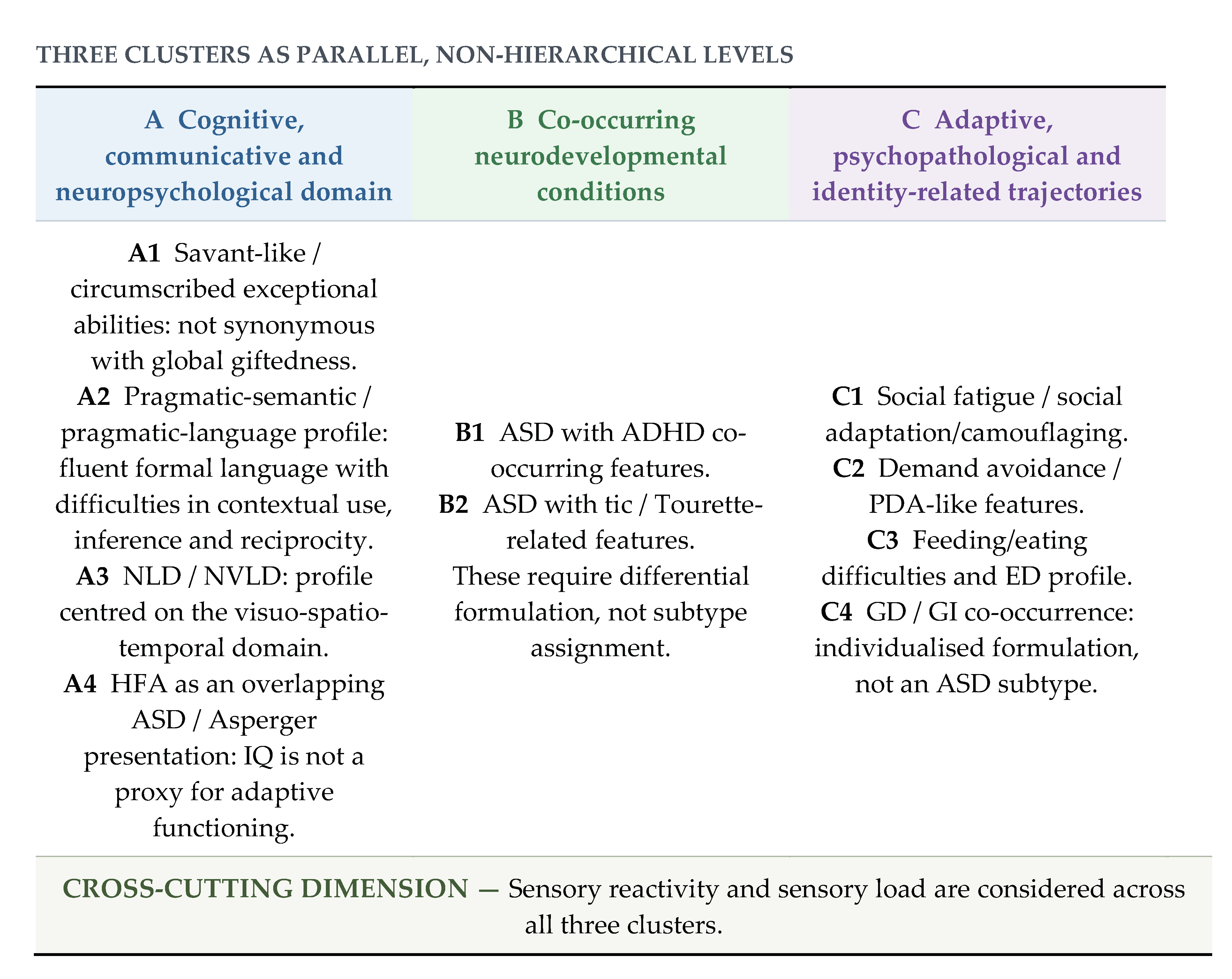

Table 1.
Synthetic clinical-phenotypic map of the descriptive profiles in autistic people without intellectual disability and with fluent functional language.
Table 1.
Synthetic clinical-phenotypic map of the descriptive profiles in autistic people without intellectual disability and with fluent functional language.
| Clinical-conceptual cluster | Profile | Main domain | Period of recognition | Primary clinical marker | Main clinical caution |
| (A) Cognitive, communicative and neuropsychological domain | A1. Savant-like abilities | Areas of ability / strengths | Childhood or adolescence | Circumscribed or exceptional abilities in specific domains | Specific abilities do not amount to global giftedness and do not exclude adaptive vulnerabilities |
| A2. Pragmatic-semantic / pragmatic-language profile | Pragmatic-communicative dysfunction | Childhood; more evident as reciprocal-conversational demands increase | Formally fluent language, but difficulties with contextual, inferential and reciprocal use of language | Consider social (pragmatic) communication disorder (SCD) only if ASD Domain B criteria are not met; SCD and ASD should not be treated as overlapping subtypes | |
| A3. Nonverbal learning disorder / nonverbal learning disability | Visuo-spatio-temporal | School age; more evident in adolescence | Visuospatial deficits, motor, mathematical and organisational difficulties, and difficulty interpreting non-verbal information | May mimic or coexist with ASD, but should not be automatically assimilated to the autistic profile | |
| A4. HFA — overlapping ASD/Asperger profile | ASD/Asperger overlap | Childhood, sometimes late recognition | ASD without intellectual disability and with functional language; intellectual functioning from borderline to superior | IQ is not a proxy for adaptive functioning or support needs; the label covers a wide range of intellectual functioning, and profiles at its lower and upper ends differ in recognition, compensation and support needs | |
| (B) Co-occurring neurodevelopmental conditions |
B1. ASD with ADHD co-occurring features | Neurodevelopmental / co-occurring | Early childhood or school age | Inattention, impulsivity, hyperactivity and executive dysregulation | Distinguish true ADHD co-occurrence from ADHD-like manifestations secondary to rigidity, anxiety or sensory overload |
| B2. ASD with tic/Tourette-related features | Neurodevelopmental / differential | Childhood, with a fluctuating course | Motor/vocal tics, compulsive phenomena or complex tics | Distinguish tics, autistic stereotypies, OCD-like compulsions and RRB | |
| (C) adaptive, psychopathological and identity-related trajectories | C1. Social fatigue / camouflaging profile | Adaptive / compensatory | Adolescence or adulthood | Apparent social competence supported by masking or burdensome compensatory strategies | Observable performance may underestimate fatigue, sensory load and support needs, especially in profiles with high camouflaging or late diagnostic recognition |
| C2. Demand avoidance / PDA-like features | Adaptive / controversial construct | Childhood or adolescence | Rigid avoidance of demands, need for control, anxiety, rigidity, sensory or executive overload | Use as a cautious functional descriptor; avoid diagnostic reification and assess anxiety, trauma, oppositionality, cognitive rigidity, sensory/executive overload and family/school context | |
| C3. Feeding/eating difficulties and ED profile | Psychopathological / co-occurring | Food selectivity already in childhood; ED more often in adolescence or young adulthood | Food selectivity, food-related rituals, sensory sensitivities, rigidity, possible ED | Interpret as overlap or co-occurrence; avoid simple causal or sex-specific inferences | |
| C4. Gender dysphoria / gender incongruence | Identity-related clinical association | Childhood, adolescence or young adulthood | Possible co-occurrence between ASD/autistic traits and GD/GI | Requires individualised and multidisciplinary assessment; avoid automatic causal explanations |
Abbreviations. ADHD, Attention-Deficit/Hyperactivity Disorder; ASD, Autism Spectrum Disorder; ED, Eating Disorders; GD/GI, Gender Dysphoria / Gender Incongruence; HFA, High-Functioning Autism; IQ, intelligence quotient; NLD, Nonverbal Learning Disorder; NVLD, Nonverbal Learning Disability; OCD, Obsessive-Compulsive Disorder; PDA, Pathological Demand Avoidance; RRB, Restricted and Repetitive Behaviours; SCD, Social (Pragmatic) Communication Disorder. Note. The profiles described do not represent autonomous diagnostic subtypes of ASD, but parallel, non-hierarchical and non-mutually exclusive clinical-conceptual domains, organised into three clusters: (A) cognitive, communicative and neuropsychological domain, which includes areas of ability and the overlapping ASD/Asperger presentation; (B) co-occurring neurodevelopmental conditions; (C) adaptive, psychopathological and identity-related trajectories. The table intentionally juxtaposes constructs with different statuses solely to guide multidimensional clinical formulation. Accordingly, profiles such as HFA, demand avoidance/PDA-like features, GD/GI or savant-like abilities should not be interpreted as nosographic variants of ASD, but as descriptive dimensions or clinical elements to be integrated with DSM-5-TR/ICD-11 criteria, developmental history and individual functional assessment. Sensory reactivity is not presented as a separate profile, but as a cross-cutting dimension of the ASD phenotype, potentially relevant to social fatigue, avoidance, adaptive rigidity, food selectivity and everyday functioning.
Table 2.
Clinical assessment checklist for autism without intellectual disability and with fluent functional language.
Table 2.
Clinical assessment checklist for autism without intellectual disability and with fluent functional language.
| Assessment axis | Clinical focus | Indicative tools | Practical output |
| Core ASD clinical profile/presentation | Functional language, social reciprocity, pragmatics, RRB, restricted interests, predictability and sensory profile | ADOS-2, ADI-R, SRS-2, Sensory Profile 2 or equivalents | Description of the ASD clinical profile/presentation and support needs |
| Cognitive, neuropsychological and adaptive profile | IQ, unevenness of the profile, executive functions, visuospatial abilities, learning and adaptive functioning | WISC-V/WAIS-IV, Vineland-3, targeted neuropsychological batteries | Strengths, vulnerabilities and IQ-adaptive functioning discrepancy |
| Co-occurring conditions | ADHD, tic/Tourette-related features, OCD-like features, anxiety/depression, ED/feeding, GD/GI | Conners/ADHD-RS, YGTSS, EDE-Q/EDE, specialist clinical interview | Differential diagnosis and integrated plan for co-occurrences |
| Adaptation, sensory load and context | Camouflaging, social fatigue, sensory load, demand avoidance, late recognition, sex/gender differences in clinical presentation, school/family/work, sleep and recovery | CAT-Q, Sensory Profile, clinical interviews, school/family reports | Identification of contextual needs and the cost of compensation |
| Strengths and clinical risks | Specific interests, circumscribed abilities, motivation, burnout, isolation, depression and suicide risk | Clinical-educational history, functional observation, targeted psychopathological assessment | Individualised strength-based and risk-informed plan |
Note. This checklist is intended as a structured aid to multidimensional clinical formulation and initial assessment. It is not a validated diagnostic scale, screening instrument, prognostic tool or therapeutic algorithm. The domains and example instruments should be selected according to age, clinical context, assessment objectives, local availability and clinical judgement. Abbreviations. ADI-R, Autism Diagnostic Interview-Revised; ADOS-2, Autism Diagnostic Observation Schedule, Second Edition; ADHD, Attention-Deficit/Hyperactivity Disorder; ADHD-RS, ADHD Rating Scale; ASD, Autism Spectrum Disorder; CAT-Q, Camouflaging Autistic Traits Questionnaire; ED, Eating Disorders; EDE, Eating Disorder Examination; EDE-Q, Eating Disorder Examination Questionnaire; GD/GI, Gender Dysphoria/Gender Incongruence; IQ, intelligence quotient; OCD, Obsessive-Compulsive Disorder; RRB, Restricted and Repetitive Behaviours; SRS-2, Social Responsiveness Scale, Second Edition; WAIS-IV, Wechsler Adult Intelligence Scale, Fourth Edition; WISC-V, Wechsler Intelligence Scale for Children, Fifth Edition; YGTSS, Yale Global Tic Severity Scale.
Disclaimer/Publisher’s Note: The statements, opinions and data contained in all publications are solely those of the individual author(s) and contributor(s) and not of MDPI and/or the editor(s). MDPI and/or the editor(s) disclaim responsibility for any injury to people or property resulting from any ideas, methods, instructions or products referred to in the content. |
© 2026 by the authors. Licensee MDPI, Basel, Switzerland. This article is an open access article distributed under the terms and conditions of the Creative Commons Attribution (CC BY) license.
Copyright: This open access article is published under a Creative Commons CC BY 4.0 license, which permit the free download, distribution, and reuse, provided that the author and preprint are cited in any reuse.