

Submitted:
16 October 2026
Posted:
19 October 2026
You are already at the latest version
Abstract
Background: Misuse and overuse of antibiotics in childhood diarrhea pose a high risk of antimicrobial resistance (AMR), which is a public health threat globally, and Bangladesh is no exception. This study aims to describe urban-rural differences and determine the factors associated with antibiotic use at home in children before seeking care for diar-rhea at the health care facilities. Methods: This cross-sectional study, over an 18-month period, included 5,894 children aged 1-59 months from two large health facilities: a rural secondary-level district hospital, located in Tangail, and an urban diarrhea specialized facility, icddr,b Dhaka hospital. Following clinical care, trained staff used a pre-validated structured questionnaire to collect data on child demographics, clinical symptoms, feeding practices, and treatment received prior to hospital visit. The primary outcome was antibiotic use at home before hospital presentation. Multivariable logistic regression models analyzed factors linked to home antibiotic use. Results: The preva-lence of antibiotic use at home before seeking care among diarrheal children was sig-nificantly higher in children visiting a rural facility as compared to that of the urban facility (90.0% vs. 68.4%). Pharmacies were the primary source of antibiotics for children in both rural and urban areas (64.1% vs. 61.2%). Multivariable analysis showed that in urban settings, children with diarrhea for 1-3 days were more than twice as likely (aOR:2.39, 95% CI:1.66.4), and those sick for 4 or more days were three times as likely (aOR:3.09, 95% CI: 2.21–4.43) to receive antibiotics at home compared to children who had less than one day of diarrhea. Children with no history of a prior hospital visit for diarrhea were also 1.86 times at higher risk of using antibiotics (aOR: 1.86, 95% CI:1.28–2.72). In a rural setting, children with diarrhea for 1–3 days had five times (aOR:5.11, 95% CI: 3.6–7.1), and those who had diarrhea for 4 days or more had two times higher odds (aOR: 1.97, 95% CI: 1.43–2.73) for antibiotic use. Moreover, children whose caregivers used ORS were 2.8 times more likely to use antibiotics at home (aOR:2.80, 95% CI: 1.06-7.35). Conclusions: This study demonstrates that antibiotic use at home before seeking care is alarmingly high among children with diarrhea in Bangladesh, particu-larly in rural settings, driven by informal pharmacy access and symp-tom-duration-driven decision-making in urban areas. This emphasizes the need to en-hance awareness in both sectors of the public and healthcare providers. Moreover, im-plementing and monitoring strict regulations for antibiotic sales over-the-counter in pharmacies is essential to impede escalating trends of AMR in Bangladesh.
Keywords:
antibiotic use
; childhood diarrhea
; home treatment
; pharmacies
; bangladesh
; antimicrobial resistance
1. Introduction
Diarrhea is the third leading cause of mortality among children under five years of age in low-and middle-income countries (LMICs), accounting for an estimated 1.7 billion diarrheal cases globally, leading to around 443,832 deaths of children under five annually [1,2]. Despite a significant reduction in under-five mortality in countries including Bangladesh, diarrhea remains a major cause of undernutrition, particularly in remote and underserved communities where healthcare facilities are scarce [3,4].
The World Health Organization (WHO) recommends antibiotics only for dysentery (bloody diarrhea) and severe cholera cases [5,6]. Despite clear guidelines, antibiotics are often used to treat watery diarrhea, even when viral etiologies are likely [7,8]. In Southeast Asia, the prevalence of antibiotic use for diarrhea in children under-five ranges from 5% in some regions of Maldives to 44% in parts of Indonesia, showing a variety of practices across the continent [9]. Such practices impact on healthcare costs, endorse the emergence of resistant pathogens, and disrupt the developing gut microbiota in young children [10,11].
Antimicrobial resistance (AMR) poses a significant public health concern worldwide. In 2019, AMR was directly responsible for 1.27 million global deaths and contributed to nearly 4.95 million total deaths [12]. In addition to mortality and morbidity, AMR has an alarmingly high economic burden. The World Bank estimated an additional healthcare cost of US$1 trillion by 2050, and gross domestic product (GDP) losses of US$1 trillion to US$3.4 trillion per year by 2030 [2,12]. Addressing the burden of antibiotic overuse is a critical global health priority, as the misuse of these drugs drives AMR, which affects people of all ages, but is particularly hostile to the elderly, young children, and those with compromised immune system [2,13].
In Bangladesh, the easy availability of antibiotics, low cost, not completing the dose, and short adherence to therapeutic use escalates the abuse of antibiotics, especially in scenarios like childhood diarrhea [2,14]. A study conducted in Bangladesh analyzed antibiotic sensitivity patterns of enterotoxigenic E. coli (ETEC) strains while specimens were collected from diarrheal patients and environmental sources over several years in coastal Mathbaria and inland Chhatak of rural Bangladesh. The findings showed a high prevalence of multidrug-resistant (MDR) ETEC strains in both human and aquatic samples. The similarity in antimicrobial resistance (AMR) profiles indicates a substantial risk of transmission between the environment and human populations, with many strains demonstrating resistance to commonly used antidiarrheal antibiotics [15,16]. While urban areas may have more access to healthcare services, rural communities often rely on unlicensed healthcare providers like pharmacies for treatment, thus further complicating the situation [17]. Studies have shown that caregivers in Bangladesh tend to self-medicate with antibiotics, often without consulting licensed healthcare providers [17,18,19].
While many studies have documented high rates of antibiotic prescribing and polypharmacy for childhood diarrhea in Bangladesh and other LMICs, most have been limited in scope, focusing on single settings with small sample size and without systematically comparing between urban and rural contexts [8,11,20], leaving an important gap in our understanding of the factors influencing antibiotic use.
We conducted a cross-sectional study among 5,894 under-five children presented with diarrhea to a rural secondary level district hospital in Tangail district and an urban diarrheal disease specialized facility, icddr,b Dhaka Hospital in Dhaka, the capital city of Bangladesh. We studied and compared the factors associated with antibiotic use among those children before seeking care at the study hospitals in urban and rural areas. These location-specific prevalence of antibiotic use and associated factors will help design better antibiotic stewardship programs.
2. Results
2.1. Sociodemographic and Clinical Characteristics of Study Participants
A total of 5,894 children aged 1-59 months with acute diarrhea were studied; 1,500 (25.4%) were from the urban icddr,b Dhaka Hospital, and 4,394 (74.6%) were from the rural secondary level district hospital, Tangail. In both settings, nearly 60% of study participants were male. In the urban setting, of the 1500 participants, 1026 (68.4%) received antibiotics at home before seeking care at the icddr,b Dhaka Hospital. In the rural setting, 90.0% (n=3953) of the children reported receiving antibiotics prior to hospital visit. Children in urban facilities reported a delay in seeking care following the onset of diarrhea, resulting in a significant proportion of children experiencing diarrhea that lasted longer than 4 days (urban=53.6% vs. rural= 31.6%), whereas rural children tended to seek care early, within 1 to 3 days of diarrhea started (urban=35.0% vs. rural=45.3%). The practice of receiving Oral Rehydration Solution (ORS), zinc, and a combination of ORS and zinc use was higher among rural children (rural=98.8% vs. urban=94.3%) than urban children. In both urban (61.2%) and rural (64.1%) areas, pharmacies were the primary source of antibiotics. (Table 1).
2.2. Antibiotic Use and Associated Characteristics in Urban Settings
Participants presenting to the urban icddr,b Hospital, who had received antibiotics at home reported a longer duration of diarrhea before hospital presentation. Among antibiotic users, 57.6% (n = 591) visited the hospital >4 days following the onset of diarrhea, compared with 44.9% (n = 213) among non-antibiotic users (p = 0.001). The presence of fever and visible blood in stool did not differ significantly between the two groups (55.4% vs. 54.2%;p=0.68 and 3.4% vs. 3.6%; p=0.863, respectively). Use of ORS and zinc was significantly higher among antibiotic users compared to non-users of antibiotics (54.5% vs. 41.6%, p=0.001). Children with no prior history of hospital visit for any diarrheal episodes in the preceding year were more likely to receive antibiotics (92.5% vs. 87.8%, p=0.003) (Table 2).
2.3. Antibiotic Use and Associated Characteristics in Rural Settings
In rural facility, antibiotic use was significantly more frequent among children aged 6-11 months as opposed to those 24-59 months old (37.8% vs. 27.4%; p=0.001). Participants who used antibiotics had delayed presentation to the hospitals than non-antibiotic users. Children with diarrhea who received antibiotics at home presented after 1-3 days (47.5% vs. 25.9%, p<0.001) and after more than 4 days (32.5% vs. 23.6%, p<0.001) from the onset of diarrhea than non-antibiotic users. Children who had visible blood in stool were more likely to not receive antibiotics before hospital presentation (7.0% vs. 1.4%, p=0.001). Fever was reported more often by the non-antibiotic users (52.6% vs. 37.3%, p=0.001). Antibiotic use was more frequent among ORS and zinc users than among non-users (90.2% vs. 63.5%, p=0.001) (Table 3).
2.4. Factors Associated with Pre-Hospital Antibiotic Use: Multivariable Analysis
After adjusting for age, sex, duration of diarrhea, presence of fever, use of ORS, and prior hospital visit for diarrheal episode, children in rural setting presented to hospital 1-3 days following the onset of diarrhea, had five times higher odds of using antibiotics at home (aOR: 5.11, 95% CI: 3.65-7.14, p < 0.001) compared to those who presented less than one day of diarrhea onset. Similarly, in urban areas, children with diarrhea of four or more days were associated with three times higher odds of antibiotic use before seeking care from icddr,b Dhaka Hospital (aOR: 3.09, 95% CI: 2.18-4.38, p < 0.001). In the rural setting, children who used ORS were 2.8 times more likely to use antibiotics at home (aOR: 2.80, 95% CI: 1.06–7.35, p < 0.001). In urban contexts, children with no prior hospital visit for diarrhea in the prior year had 86% higher risk of antibiotic exposure prior to facility visit (aOR: 1.86, 95% CI: 1.28-2.72, p < 0.001) (Table 4).
2.5. Pattern of Antimicrobial Agents Used
In both urban and rural areas, azithromycin was the most frequently prescribed antibiotic for treating watery diarrhea in children. Notably, the usage was significantly higher among rural children, with 51.9% compared to 40.7% in urban settings, as illustrated in Figure 1. While nitazoxanide was used significantly more often in rural (16.2%) than in urban contexts (4.4%); ciprofloxacin and metronidazole were used more frequently in urban (24.3%) than in rural settings (11.2%). Use of other antibiotics included cefixime, ceftriaxone, cefuroxime, and amoxicillin.
3. Discussion
This study observed antibiotic use in a high proportion prior to seeking care from a health facility among children under five with acute diarrhea. In both urban and rural settings, pharmacies constituted the predominant source of antibiotics, with comparable proportions in urban (61.21%) and rural (64.13%) areas. Multivariable analysis revealed that delaying 3 or more days to seek care from a health care facility was significantly associated as an independent explanatory variable with antibiotic use in both settings. The overall prevalence of antibiotic use before hospital visit in this study is much higher than estimates reported elsewhere in Bangladesh and across LMICs [8,21]. The factors that influenced antibiotic use before seeking care at a health care facility differed between the urban and rural settings, which is a key finding of this study. In rural areas, 64% of children received antibiotics from non-healthcare facilities, predominantly pharmacies, without a prescription, reflecting a supply-driven pattern in which drug sellers act as the first point of contact. This is consistent with evidence that antibiotics are frequently dispensed without prescription in Bangladesh and comparable LMIC settings, where more than 50% of pharmacies reportedly lack a proper license and drug sellers often have no formal professional pharmaceutical training [22]. Informal providers, including unlicensed practitioners, also actively participate in antibiotic prescribing in rural areas, an observation reported by prior studies from similar settings [20,23]. Our findings revealed significant differences in time to present to the hospital following diarrhea onset in urban and rural settings. Compared to rural, urban caregivers were more likely to wait longer after the diarrhea onset to seek care for their children from the hospital. In both urban and rural setting, the children who waited longer than 24 hours to seek care from the hospital are more likely to receive antibiotics from a non-healthcare source. This finding is supported by previous studies suggesting that longer diarrhea episodes may influence caregivers and healthcare providers to prescribe antibiotics, even in the absence of indications of bacterial infections, or need for antibiotic use [17,24].
With regard to drug selection, azithromycin was the most commonly used antibiotic in both settings, with notable use of ciprofloxacin. While metronidazole use was more common in urban areas, nitazoxanide was more common in rural areas. This widespread use of macrolides and fluoroquinolones in children with watery diarrhea can increase resistance to enteric as well as respiratory pathogens [25]. Also, a major proportion of watery diarrhea being due to viral etiology, the use of antibiotics including antiprotozoal agents like metronidazole and nitazoxanide without any diagnostic confirmation is a concern [22,25,26]. Together, these findings highlight the need for antibiotic stewardship to reduce the burden of antimicrobial resistance.
ORS use was high in both settings (rural=98.8% vs. urban=94.3%), and rural children had higher ORS and zinc use (rural=87.15% vs. urban=50.4%). However, in the adjusted model, ORS use at home was strongly associated with antibiotic use in rural children. This is likely indicating that when caregivers perceive watery diarrhea as concerning or when diarrhea persists for a longer duration, they tend to use antibiotics as an additional treatment. Similar co-use has been reported where recommended diarrhea management behavior was associated with unnecessary antibiotic use due to fear of complications [11,27]. In Other studies, it is also found that in rural settings, poor communication system, long distances, long waiting times in hospitals, and high transport costs often lead to dependency on local pharmacies [28]. Children under 5 who live 5 miles away from health facilities are found to be more likely to use antimicrobials at home [17].
Rural areas also show a higher proportion of children with watery diarrhea who seek care from healthcare facilities, which suggests that rural caregivers, despite facing challenges such as distance from healthcare centers, are more likely to access care through formal healthcare facilities.
In rural area, fever was associated with antibiotic use, possibly reflecting caregivers’ concern about serious illness and drug sellers’ tendency to interpret fever as bacterial infection, both contributing to unnecessary antibiotic prescribing in case of watery diarrhea episodes [11,29]. However, in urban setting, fever did not show significant association with antibiotic use, indicating a potential difference in interpreting the symptoms, diagnostic approach, or over-prescribing.
Among urban caregivers, those who had not visited the health facilities in the last year had twice the times higher odds of getting antibiotics at home. One possible explanation might be that caregivers who had prior visits to the hospital had a better understanding of diarrhea management than those who did not visit. The association was not observed in rural areas, where healthcare facility visits appear to have less influence on antibiotic use.
4. Materials and Methods
4.1. Study Design and Study Site
A cross-sectional study design was employed among children aged 1–59 months who presented with diarrhea to the pediatric departments of two hospitals in Bangladesh- icddr,b Dhaka Hospital (urban site) and District Hospital, Tangail (rural site). This study was conducted between May 2023 and December 2024 over 19 months [30].
icddr,b Dhaka Hospital, established in 1962 in urban Dhaka, is recognized as the world’s largest diarrheal disease hospital. It provides free medical care to approximately 200,000 patients annually, serving primarily low-income urban and peri-urban populations irrespective of age or gender. District Hospital, Tangail, is a secondary-level public hospital located approximately 53 miles from Dhaka. In 2024, the hospital recorded approximately 364,916 outpatients and emergency department visits, along with 52,014 admissions for children under five years of age, of which approximately 20% were childhood diarrheal illnesses. Together, these two facilities represent contrasting healthcare settings, urban and rural, enabling a meaningful comparative analysis of antibiotic use and prescribing practices for childhood diarrhea across different contexts in Bangladesh.
Upon arrival at each facility, children first received the required clinical care from the attending physicians. Study staff then approached the caregiver of each child with a study eligibility flyer. Caregivers of eligible children who provided informed, voluntary written consent were administered a pre-validated structured questionnaire recording information on the child’s age, sex, residential address, type of diarrhea, treatments received prior to hospital presentation, including antibiotic use and its source.
Diarrhea: Acute diarrhea was defined as three or more loose, liquid, or watery stools within the preceding 24 hours [6].
Dysentery: Any diarrheal episode in which the loose or watery stools contain visible blood [6].
4.2. Sample Size Calculation
The sample size was calculated to estimate the proportion of children receiving recommended diarrhea treatment. Based on recent evidence, antibiotic use among children with diarrhea was reported as 52.45% in urban areas and 55.0% in rural areas. Sample size was therefore calculated separately for the urban and rural sites using these expected proportions.
4.3. Data Collection
The outcome variable of this study was the prior use of antibiotics for the current diarrheal episode within 3 days before coming to the hospital.
Other variables included the child’s demographics, such as age, sex, and residence; clinical features of the current diarrheal episode, specifically the type of diarrhea (watery or dysentery), and duration of the present diarrheal illness. Information on feeding practices was also gathered, including the history of breastfeeding during the first six months, exclusive breastfeeding, and the current breastfeeding status. Details on medications were collected, covering the use of oral rehydration solution, zinc, folic acid, and antibiotics, along with the sources of antibiotics administered at home (healthcare facility, pharmacy, private clinic, or self-medication) and their names. Additionally, a question was asked about any previous hospital visits for any diarrheal episode other than this episode within the past year.
Data were initially recorded on hard copies and subsequently entered into an electronic database. Routine quality checks and validation procedures were implemented to ensure data accuracy. When possible, antibiotics were identified through physical evidence such as prescriptions, medication packages, or suspension bottles. In cases where physical evidence was unavailable, caregivers were asked to provide the drug name and/or describe its color, dosage form (liquid, pill), and mode of administration. Caregivers had the opportunity to talk to the family members over the cellphone to gather further information.
4.4. Statistical Analysis
Statistical analysis was done using STATA version 15.0 (StataCorp, College Station, TX, USA). Descriptive statistics (frequencies, proportions, means, and standard deviations) were used to summarize the characteristics of the study population in both urban and rural healthcare facilities. For categorical variables, differences between rural and urban settings and between antibiotic users and non-users before coming to the hospital were assessed using Pearson’s chi-square tests, and the analysis of association was examined using bivariate analysis and calculation of odds ratios with 95% confidence intervals. Also, multivariable logistic regression models were used separately for urban and rural settings to estimate adjusted odds ratios (aORs) and 95% confidence intervals (CI) for associations between explanatory variables and antibiotic use after adjusting for covariates. Probability of exclusion was considered p < 0.05 to identify the factors significantly associated with the dependent variable. Multicollinearity among explanatory variables was assessed using variance inflation factors, with values greater than five indicating potential collinearity. Model fit was evaluated using appropriate likelihood-based statistics and residual diagnostics.
5. Strengths and Limitations
This study has several strengths. It includes a large sample size of under-five children from both rural and urban areas and collects detailed information on clinical symptoms, care, sources, and types of antibiotics.
However, some limitations should be acknowledged. The study was conducted in two facilities and may not fully represent all rural and urban areas of Bangladesh. While we controlled for confounders in the multivariable analysis, there may still be some unmeasured factors influencing antibiotic use, such as socio-economic status or access to healthcare facilities.
6. Conclusions
This study highlights significant urban-rural differences in antibiotic use at home among children with diarrhea in Bangladesh, with rural children receiving antibiotics more frequently, primarily through informal sources such as pharmacies and unlicensed providers. In urban settings, antibiotic use was more strongly driven by prolonged symptom-duration. Across both settings, macrolides and quinolones dominated antibiotic selection, and inappropriate antibiotic use co-occurred alongside ORS and zinc use. These findings underscore that interventions to curb inappropriate antibiotic use must be context-specific, prioritizing pharmacy regulation and informal provider engagement in rural areas, and caregiver counseling at the point of formal care in urban settings.
Author Contributions
Conceptualization, E.S, S.C., and A.S.G.F.; Methodology, E.S., S.D., S.C., A.S.G.F., F.A., F.N., M.A., and; Investigation, E.S., S.D., A.S.G.F., F.A., M.A., S.A.S., S.C., Writing-original draft preparation, E.S.; Writing, reviewing and editing, E.S., S.C., A.S.G.F., F.A. S.A.S, Funding acquisition, S.C. All authors have read and agreed to the published version of the manuscript.
Funding
This study was funded by the National Institute of Allergy and Infectious Diseases of the National Institute of Health, R01AI153399. The content of this article is solely the responsibility of the authors and does not necessarily represent the official views of the NIH, NIAID.
Institutional Review Board Statement
The INSIGHT study protocol was reviewed and approved by the Institutional Review Board of the Johns Hopkins Bloomberg School of Public Health and the Ethical Review Committee of the icddr,b (code: PR-21012 and 15285, date: 25 January 2023).
Informed Consent Statement
All the study participants of this study were asked for informed written consent.
Data Availability Statement
All data generated or analyzed during this study are included in this published article. Any additional data related to this paper are available upon request to the corresponding author. Email: schakr11@jhu.edu.
Acknowledgments
The authors appreciate the dedicated efforts and significant input of the study staff. We thank all the children and their caregivers who participated in this study. We acknowledge the contribution of icddr,b’s core donors, including the Government of the People’s Republic of Bangladesh, Global Affairs Canada (GAC), Canada, for their continuous support and commitment to icddr,b’s research efforts.
Conflicts of Interest
The authors declare no conflict of interest.
References
- Quantifying risks and interventions that have affected the burden of diarrhoea among children younger than 5 years: an analysis of the Global Burden of Disease Study 2017. Lancet Infect. Dis. 2020, 20, 37–59. [CrossRef]
- WHO. Antimicrobial resistance. Available online: https://www.who.int/news-room/fact-sheets/detail/antimicrobial-resistance.
- Wardlaw, T.; Salama, P.; Brocklehurst, C.; Chopra, M.; Mason, E. Diarrhoea: why children are still dying and what can be done. The Lancet 2010, 375, 870–872. [Google Scholar] [CrossRef]
- Unicef. Available online: https://data.unicef.org/country/bgd/.
- Williams, P.C.M.; Berkley, J.A. Guidelines for the treatment of dysentery (shigellosis): a systematic review of the evidence. Paediatr. Int. Child Health 2018, 38, S50–s65. [Google Scholar] [CrossRef]
- WHO. Pocket book of hospital care for children: Second edition. Available online: https://www.who.int/publications/i/item/978-92-4-154837-3.
- Rhee, C.; Aol, G.; Ouma, A.; Audi, A.; Muema, S.; Auko, J.; Omore, R.; Odongo, G.; Wiegand, R.E.; Montgomery, J.M.; et al. Inappropriate use of antibiotics for childhood diarrhea case management - Kenya, 2009-2016. BMC Public Health 2019, 19, 468. [Google Scholar] [CrossRef]
- Ahmed, S.; Korpe, P.; Ahmed, T.; Chisti, M.J.; Faruque, A.S.G. Burden and Risk Factors of Antimicrobial Use in Children Less Than 5 Years of Age with Diarrheal Illness in Rural Bangladesh. Am. J. Trop. Med. Hyg. 2018, 98, 1571–1576. [Google Scholar] [CrossRef]
- Ahmed, M.S.; Khanam, S.; Kamruzzaman, M.; Morshed, M.S. Prevalence of antibiotic use for diarrhea among 1.3 million under-five years children: A multicounty retrospective analysis from 2006–2018. PLoS ONE 2023, 18, e0289045. [Google Scholar] [CrossRef]
- Shallcross, L.J.; Howard, S.J.; Fowler, T.; Davies, S.C. Tackling the threat of antimicrobial resistance: from policy to sustainable action. Philos. Trans. R. Soc. B Biol. Sci. 2015, 370, 20140082. [Google Scholar] [CrossRef]
- Dash, S.; Ali, M.; Sultana, E.; Ram, M.; Perin, J.; Naz, F.; Roy, B.; Ali Hasan, A.; Afroze, F.; Tofail, F.; et al. Healthcare seeking behavior and antibiotic use for diarrhea among children in rural Bangladesh before seeking care at a healthcare facility. Res. Sq. 2025. [Google Scholar] [CrossRef]
- Murray, C.J.L.; Ikuta, K.S.; Sharara, F.; Swetschinski, L.; Robles Aguilar, G.; Gray, A.; Han, C.; Bisignano, C.; Rao, P.; Wool, E.; et al. Global burden of bacterial antimicrobial resistance in 2019: a systematic analysis. The Lancet 2022, 399, 629–655. [Google Scholar] [CrossRef]
- Holloway, K.; Mathai, E.; Gray, A. Surveillance of community antimicrobial use in resource-constrained settings--experience from five pilot projects. Trop. Med. Int. Health 2011, 16, 152–161. [Google Scholar] [CrossRef]
- Sarker, R.; Khan, M.S.I.; Tareq, M.A.; Ghosh, S.; Chowdhury, S. Antibiotic Use Among Children Under 5 Years of Age in a Tertiary Care Hospital, Bangladesh. SN Compr. Clin. Med. 2021, 3, 982–988. [Google Scholar] [CrossRef]
- Johura, F.T.; Sultana, M.; Sadique, A.; Monira, S.; Sack, D.A.; Sack, R.B.; Alam, M.; Chakraborty, S. The Antimicrobial Resistance of Enterotoxigenic Escherichia coli from Diarrheal Patients and the Environment in Two Geographically Distinct Rural Areas in Bangladesh over the Years. Microorganisms 2024, 12. [Google Scholar] [CrossRef]
- Okumu, N.O.; Muloi, D.M.; Moodley, A.; Watson, J.; Kiarie, A.; Ochieng, L.; Wasonga, J.O.; Mutisya, C.; Alumasa, L.; Ngeranwa, J.J.N.; et al. Antimicrobial resistance in community-acquired enteric pathogens among children aged ≤ 10-years in low-and middle-income countries: a systematic review and meta-analysis. Front Microbiol. 2025, 16, 1539160. [Google Scholar] [CrossRef]
- Ahmed, S.; Farzana, F.D.; Ferdous, F.; Chisti, M.J.; Malek, M.A.; Faruque, A.S.G.; Das, S.K. Urban-rural differentials in using antimicrobials at home among under-5 children with diarrhea. Sci. J. Clin. Med. 2013, 2, 81–86. [Google Scholar] [CrossRef]
- Biswas, D.; Watt, M.H.; Mangadu, A.; Das, J.B.; Munim, M.S.; Shihab, R.M.; Khan, Z.H.; Amin, M.A.; Khan, I.I.; Islam, M.T.; et al. Antibiotic dispensing behaviors for pediatric diarrhea: A qualitative study of informal healthcare providers in rural Bangladesh. PLoS ONE 2025, 20, e0339283. [Google Scholar] [CrossRef]
- Biswas, M.; Roy, M.N.; Manik, M.I.; Hossain, M.S.; Tapu, S.M.; Moniruzzaman, M.; Sultana, S. Self medicated antibiotics in Bangladesh: a cross-sectional health survey conducted in the Rajshahi City. BMC Public Health 2014, 14, 847. [Google Scholar] [CrossRef]
- Rasu, R.S.; Iqbal, M.; Hanifi, S.; Moula, A.; Hoque, S.; Rasheed, S.; Bhuiya, A. Level, pattern, and determinants of polypharmacy and inappropriate use of medications by village doctors in a rural area of Bangladesh. Clin. Outcomes Res. 2014, 6, 515–521. [Google Scholar] [CrossRef]
- Mahmudul Islam, A.F.M.; Raihan, M.A.; Ahmed, K.T.; Islam, M.S.; Nusrat, N.A.; Hasan, M.A.; Emran, M.G.I.; Das, A.K.; Lamisa, A.B.; Ahmed, T.; et al. Prevalence of inappropriate antibiotic doses among pediatric patients of inpatient, outpatient, and emergency care units in Bangladesh: A cross-sectional study. PLoS Glob. Public Health 2024, 4, e0003657. [Google Scholar] [CrossRef]
- Saha, S.; Hossain, M.T. Evaluation of medicines dispensing pattern of private pharmacies in Rajshahi, Bangladesh. BMC Health Serv. Res. 2017, 17, 136. [Google Scholar] [CrossRef]
- Hasan, S.M.R.; Hossain, M.M.; Akter, R.; Karim, S.M.H.; Haque, S.; Kamaluddin, M.; Ghani, A. Pattern of Antibiotics Use at the Primary Health Care Level of Bangladesh: Survey Report-1. Stamford J. Pharm. Sci. 2010, 2, 1–7. [Google Scholar] [CrossRef]
- Nahar, P.; Unicomb, L.; Lucas, P.J.; Uddin, M.R.; Islam, M.A.; Nizame, F.A.; Khisa, N.; Akter, S.M.S.; Rousham, E.K. What contributes to inappropriate antibiotic dispensing among qualified and unqualified healthcare providers in Bangladesh? A qualitative study. BMC Health Serv. Res. 2020, 20, 656. [Google Scholar] [CrossRef]
- Bashar, S.J.; Islam, M.R.; Nuzhat, S.; Amin, R.; Rahman, M.M.; Pavlinac, P.B.; Arnold, S.L.M.; Newlands, A.; Ahmed, T.; Chisti, M.J. Antibiotic use prior to attending a large diarrheal disease hospital among preschool children suffering from bloody or non-bloody diarrhea: A cross-sectional study conducted in Bangladesh. PLoS ONE 2024, 19, e0314325. [Google Scholar] [CrossRef]
- Tate, J.E.; Burton, A.H.; Boschi-Pinto, C.; Parashar, U.D. Global, Regional, and National Estimates of Rotavirus Mortality in Children . Clin. Infect. Dis. 2016, 62 Suppl 2, S96–s105. [Google Scholar] [CrossRef]
- Lazzerini, M.; Wanzira, H. Oral zinc for treating diarrhoea in children. Cochrane Database Syst. Rev. 2016, 12, Cd005436. [Google Scholar] [CrossRef]
- Lucas, P.J.; Uddin, M.R.; Khisa, N.; Akter, S.M.S.; Unicomb, L.; Nahar, P.; Islam, M.A.; Nizame, F.A.; Rousham, E.K. Pathways to antibiotics in Bangladesh: A qualitative study investigating how and when households access medicine including antibiotics for humans or animals when they are ill. PLoS ONE 2019, 14, e0225270. [Google Scholar] [CrossRef]
- Zwisler, G.; Simpson, E.; Moodley, M. Treatment of diarrhea in young children: results from surveys on the perception and use of oral rehydration solutions, antibiotics, and other therapies in India and Kenya. J. Glob. Health 2013, 3, 010403. [Google Scholar] [CrossRef]
- Chakraborty, S.; Dash, S.; Antara, N.A.; Roy, B.R.; Mamun, S.A.; Ali, M.; Naz, F.; Johura, F.T.; Lewis, J.; Afroze, F.; et al. The Impact of Non-Dysentery Shigella Infection on the Growth and Health of Children over Time (INSIGHT)-A Prospective Case-Control Study Protocol. Microorganisms 2024, 12. [Google Scholar] [CrossRef]
Figure 1.
Pattern of antimicrobial use in 1-59-month-old children with diarrhea before coming to the facilities in both urban and rural contexts.
Figure 1.
Pattern of antimicrobial use in 1-59-month-old children with diarrhea before coming to the facilities in both urban and rural contexts.
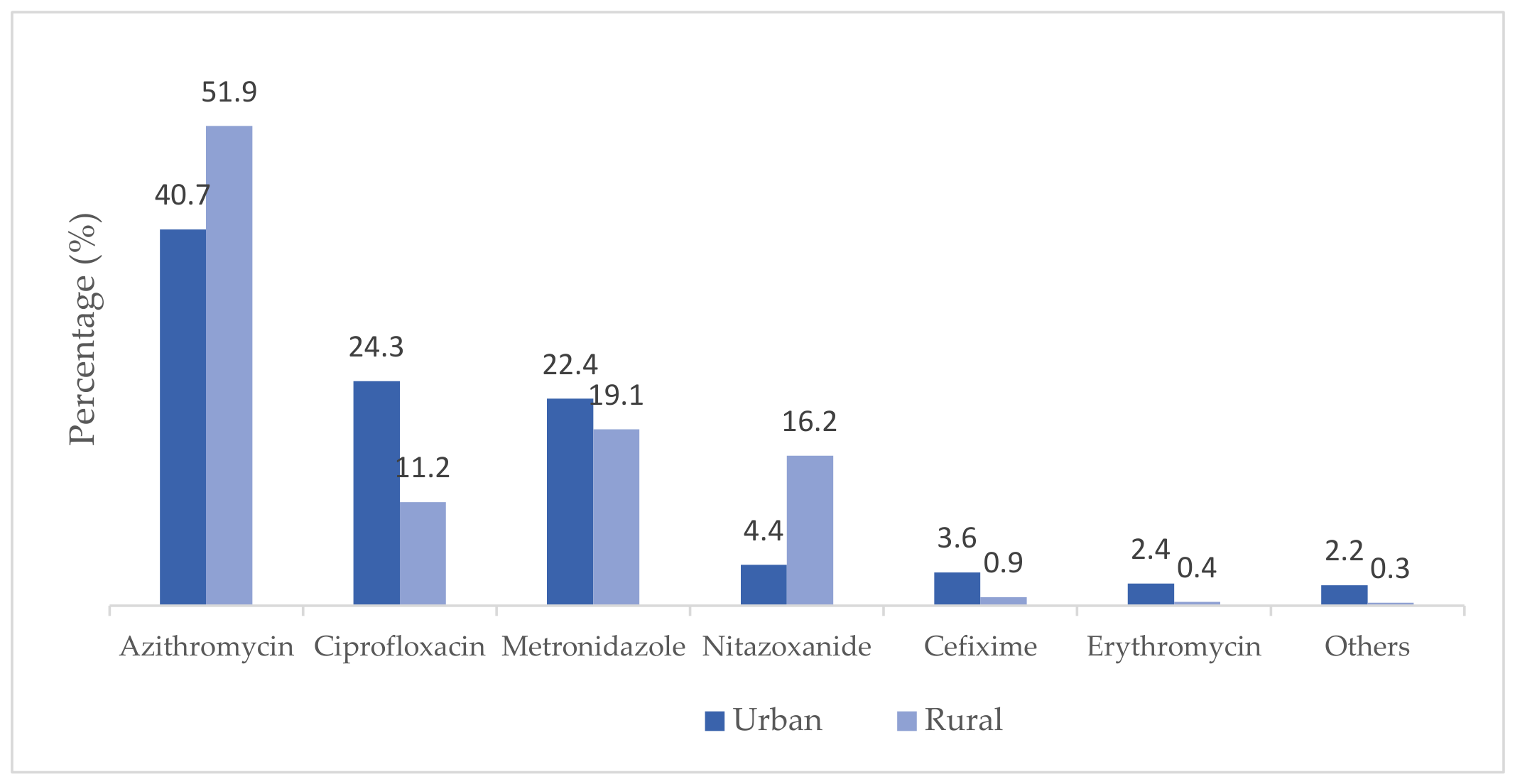

Table 1.
Sociodemographic and clinical features of diarrheal children visiting the rural and urban health facilities.
Table 1.
Sociodemographic and clinical features of diarrheal children visiting the rural and urban health facilities.
| Characteristics | Urban n (%) |
Rural n (%) |
Total n(%) |
|---|---|---|---|
| Age | |||
| < 6 Months | 188 (12.5) | 381(8.6) | 569 (9.65) |
| 6-11 Months | 592 (39.4) | 1614 (36.7) | 2206 (37.4) |
| 12-23 Months | 567 (37.8) | 1656 (37.7) | 2223 (37.7) |
| 24-59 Months | 153 (10.2) | 743 (16.9) | 896 (15.2) |
| Sex | |||
| Male | 919 (61.2) | 2575 (58.6) | 3494 (59.3) |
| Female | 581 (38.7) | 1819 (41.4) | 2400 (40.7) |
| Duration of diarrhea before coming to the hospital | |||
| <1 day | 171 (11.4) | 1016 (23.1) | 1187 (20.1) |
| >1-3 days | 525 (35) | 1990 (45.3) | 2515 (42.7) |
| > 4 days | 804 (53.6) | 1388 (31.6) | 2192 (37.2) |
| Presence of visible blood in stool | |||
| Yes | 52 (3.5) | 86 (1.9) | 138 (2.4) |
| No | 1448 (96.5) | 4306 (98.0) | 5754 (97.6) |
| Presence of fever | |||
| Yes | 825 (55) | 1382 (38.5) | 2207 (43.3) |
| No | 675 (45) | 2205 (61.4) | 2880 (56.6) |
| Use of antibiotics at home | |||
| Yes | 1026 (68.4) | 3953 (89.9) | 4979 (84.5) |
| No | 474 (31.6) | 441 (10.0) | 915 (15.5) |
| Use of ORS | |||
| Yes | 1415 (94.3) | 4339 (98.8) | 5754 (97.6) |
| No | 85 (5.7) | 55 (1.25) | 140 (2.4) |
| Use of ORS and zinc (both) | |||
| Yes | 756 (50.4) | 3845 (87.1) | 4601 (78.1) |
| No | 744 (49.6) | 549 (12.5) | 1293 (21.9) |
| Folic acid | |||
| Yes | 39 (2.6) | 64 (1.8) | 103 (2.0) |
| No | 1461 (97.4) | 3523 (98.2) | 4984 (97.9) |
| Breastfed for the first six months | |||
| Yes | 1353 (90.2) | 3563 (99.3) | 4916 (96.6) |
| No | 147 (9.8) | 24 (0.7) | 171 (3.4) |
| Exclusively breastfed | |||
| Yes | 168 (11.2) | 94 (2.6) | 262 (5.2) |
| No | 1332 (88.8) | 3493 (97.3) | 4825 (94.8) |
| Currently breastfed | |||
| Yes | 1238 (82.5) | 2999 (83.6) | 4237 (83.3) |
| No | 262 (17.5) | 588 (16.3) | 850 (16.7) |
| Visited the hospital before for diarrhea (in last 1 year) | |||
| Yes | 135 (9) | 523 (14.5) | 658 (12.9) |
| No | 1365 (91) | 3064 (85.4) | 4429 (87.0 |
| Source of antibiotics before coming to the hospital | |||
| Non-healthcare facility | 628 (61.2) | 2535 (64.1) | 3163 (63.5) |
| Healthcare facilities | 398 (38.7) | 1418 (35.8) | 1816 (36.4) |
Table 2.
Characteristics of the children and antibiotic use before seeking care at the urban health facility, icddr,b, Dhaka hospital.
Table 2.
Characteristics of the children and antibiotic use before seeking care at the urban health facility, icddr,b, Dhaka hospital.
| Urban n=1500 | |||||
|---|---|---|---|---|---|
| Characteristics | With Antibiotic |
Without antibiotic |
p-value | ||
| 1026 (68.4) | 95% CI | 474 (31.6) | 95% CI | ||
| Age | 0.443 | ||||
| < 6 Months | 122 (11.8) | 10.0-14.0 | 66 (13.9) | 11.1-17.4 | 0.269 |
| 6-11 Months | 413 (40.2) | 37.3-43.3 | 179 (37.7) | 33.5-42.2 | 0.426 |
| 12-23 Months | 392 (38.2) | 35.3-41.2 | 175 (36.9) | 32.6-41.3 | 0.343 |
| 24-59 Months | 99 (9.6) | 7.9-11.6 | 54 (11.3) | 8.8-14.5 | 0.361 |
| Sex | |||||
| Female | 395 (38.5) | 35.6-41.5 | 186 (39.2) | 34.9-43.7 | 0.784 |
| Male | 631 (61.5) | 58.5-64.4 | 288 (60.7) | 56.2-65.0 | |
| Duration of diarrhea before coming to the hospital | |||||
| <1 day | 77 (7.5) | 6.0-9.2 | 94 (19.8) | 16.4-23.6 | <0.001 |
| 1-3 days | 358 (34.9) | 32.0-37.8 | 167 (35.2) | 31.0-39.6 | 0.898 |
| > 4 days | 591 (57.6) | 54.5-60.6 | 213 (44.9) | 40.5-49.4 | <0.001 |
| Presence of visible blood in stool | |||||
| No | 991 (96.6) | 95.3-97.5 | 457 (96.4) | 94.3-97.7 | 0.863 |
| Yes | 35 (3.4) | 2.4-4.7 | 17 (3.6) | 2.2-5.7 | |
| Presence of fever | |||||
| No | 458 (44.6) | 41.6-47.7 | 217 (45.7) | 41.3-50.2 | 0.68 |
| Yes | 568 (55.3) | 52.3-58.3 | 257 (54.2) | 49.7-58.6 | |
| Use of ORS | |||||
| No | 48 (4.6) | 3.5-6.1 | 37 (7.8) | 5.7-10.6 | 0.015 |
| Yes | 978 (95.3) | 93.8-96.4 | 437 (92.2) | 89.4-94.3 | |
| Use ORS and zinc (both) at home | |||||
| No | 467 (45.5) | 42.5-48.5 | 277 (58.4) | 53.9-62.8 | 0.001 |
| Yes | 559 (54.5) | 51.4-57.5 | 197 (41.5) | 37.2- 46.0 | |
| Folic acid | |||||
| No | 995 (96.9) | 95.7-97.8 | 466 (98.3) | 96.6-99.1 | 0.131 |
| Yes | 31 (3.0) | 2.1-4.3 | 8 (1.7) | 0.8-3.3 | |
| Breastfed for the first six months | |||||
| No | 94 (9.1) | 7.5-11.1 | 53 (11.1) | 8.6-14.3 | 0.221 |
| Yes | 932 (90.8) | 88.9-92.4 | 421 (88.8) | 85.6-91.3 | |
| Exclusively breastfed | |||||
| No | 902 (87.9) | 85.7-89.7 | 430 (90.7) | 87.7-93.0 | 0.11 |
| Yes | 124 (12.1) | 10.2-14.2 | 44 (9.3) | 6.9-12.2 | |
| Currently breastfeeding | |||||
| No | 170 (16.5) | 14.4-18.9 | 92 (19.4) | 16.1-23.2 | 0.178 |
| Yes | 856 (83.4) | 81.0-85.5 | 382 (80.5) | 76.7-83.9 | |
| Status of any previous hospital visit for another diarrheal episode (in last 1 year) | |||||
| No | 949 (92.5) | 90.7-93.9 | 416 (87.7) | 84.5-90.4 | 0.003 |
| Yes | 77 (7.5) | 6.0-9.2 | 58 (12.2) | 9.5-15.5 | |
Table 3.
Characteristics of the children and antibiotic use before seeking care at the rural hospital in Tangail.
Table 3.
Characteristics of the children and antibiotic use before seeking care at the rural hospital in Tangail.
| Rural n= 4394 |
|||||
|---|---|---|---|---|---|
| Characteristics | With Antibiotic | Without antibiotic | p-value | ||
| 3953 (89.96) | 95% CI | 441 (10.04) | 95% CI | ||
| Age | 0.001 | ||||
| < 6 Months | 338 (8.5) | 7.7-9.4 | 43 (9.7) | 7.3-12.8 | 0.396 |
| 6-11 Months | 1493 (37.8) | 36.2-39.3 | 121 (27.4) | 23.4-31.8 | 0.001 |
| 12-23 Months | 1502 (38.0) | 36.5-39.5 | 154 (34.9) | 30.6-39.4 | 0.206 |
| 24-59 Months | 620 (15.6) | 14.6-16.8 | 123 (27.8) | 23.9-32.2 | 0.001 |
| Sex | |||||
| Female | 1622 (41.0) | 39.5-42.5 | 197 (44.8) | 40.1-49.3 | 0.141 |
| Male | 2331 (58.9) | 57.4-60.5 | 244 (55.3) | 50.6-59.9 | |
| Duration of diarrhea before coming to the hospital | |||||
| <1 day | 793 (20.1) | 18.8-21.3 | 223 (50.6) | 45.9-55.2 | <0.001 |
| 1-3 days | 1876 (47.5) | 45.9-49.0 | 114 (25.8) | 21.9-30.1 | <0.001 |
| >4 days | 1284 (32.4) | 31.0-33.9 | 104 (23.6) | 19.8-27.7 | <0.001 |
| Presence of visible blood in stool | |||||
| No | 3896 (98.6) | 98.2-98.9 | 410 (92.9) | 90.2-95.0 | 0.001 |
| Yes | 55 (1.4) | 1.1-1.8 | 31 (7.0) | 4.9-9.8 | |
| Presence of fever | |||||
| No | 2066 (62.7) | 61.0-64.3 | 139 (47.4) | 41.7-53.1 | 0.001 |
| Yes | 1228 (37.2) | 35.6-38.9 | 154 (52.5) | 46.8-58.2 | |
| Use of ORS | |||||
| No | 22 (0.5) | 0.3-0.8 | 33 (7.4) | 5.3-10.3 | 0.001 |
| Yes | 3931 (99.4) | 99.1-99.6 | 408 (92.5) | 89.6-94.6 | |
| Use of ORS and zinc (both) at home | |||||
| No | 388 (9.8) | 8.9-10.7 | 161 (36.1) | 32.1-41.1 | 0.001 |
| Yes | 3565 (90.2) | 89.2-91.0 | 280 (63.4) | 58.8-67.8 | |
| Folic Acid | |||||
| No | 3236 (98.2) | 97.7-98.6 | 287 (97.9) | 95.5-99.1 | 0.722 |
| Yes | 58 (1.7) | 1.3-2.2 | 6 (2.0) | 0.9-4.5 | |
| Breastfed for the first six months | |||||
| No | 23 (0.7) | 0.4-1.0 | 1 (0.3) | 0.0-2.3 | 0.473 |
| Yes | 3271 (99.3) | 98.9-99.5 | 292 (99.6) | 97.6-99.9 | |
| Exclusively breastfed | |||||
| No | 3207 (97.3) | 96.7-97.8 | 286 (97.6) | 95.0-98.8 | 0.796 |
| Yes | 87 (2.6) | 2.1-3.2 | 7 (2.4) | 1.1-4.9 | |
| Currently breastfeeding | |||||
| No | 520 (15.8) | 14.5-17.0 | 68 (23.2) | 18.7-28.3 | 0.001 |
| Yes | 2774 (84.2) | 82.9-85.4 | 225 (76.7) | 71.6-81.2 | |
| Status of any previous hospital visit for another diarrheal episode (in last 1 year) | |||||
| No | 2811 (85.3) | 84.1-86.5 | 253 (86.3) | 81.9-89.8 | 0.638 |
| Yes | 483 (14.6) | 13.-15.9 | 40 (13.6) | 10.2-18.0 | |
Table 4.
Multivariable logistic regression of factors associated with antibiotic use for diarrhea among children in urban and rural areas.
Table 4.
Multivariable logistic regression of factors associated with antibiotic use for diarrhea among children in urban and rural areas.
| Covariates | Urban |
Rural |
||||||
|---|---|---|---|---|---|---|---|---|
| Unadjusted OR | p-value | Adjusted OR | p-value | Unadjusted OR | p-value | Adjusted OR | p- value | |
|
Age | ||||||||
| < 6 Months | Ref | Ref | Ref | Ref | ||||
| 6-11 Months | 1.25 (0.88-1.77) | 0.21 | 1.17 (0.81–1.69) | 0.4 | 1.57 (1.09–2.27) | 0.02 | 0.97 (0.54–1.74) | 0.92 |
| 12-23 Months | 1.21 (0.86-1.72) | 0.28 | 1.18 (0.81–1.72) | 0.38 | 1.24 (0.87–1.78) | 0.24 | 0.70 (0.39–1.24) | 0.22 |
| 24-59 Months | 0.99(0.63-1.55) | 0.97 | 1.12 (0.70–1.81) | 0.63 | 0.64 (0.44–0.93) | 0.02 | 0.50 (0.27–0.93) | 0.03 |
|
Sex | ||||||||
| Female | Ref | Ref | Ref | Ref | ||||
| Male | 1.03(0.83-1.28) | 0.78 | 0.99 (0.78–1.24) | 0.91 | 1.16 (0.95–1.41) | 0.14 | 1.15 (0.88–1.51) | 0.3 |
|
Duration of diarrhea before coming to the hospital | ||||||||
| <1 day | Ref | Ref | Ref | Ref | ||||
| 1-3 days | 2.62(1.84-3.73) | 0.001 | 2.39 (1.66–3.43) | <0.001 | 4.63 (3.64–5.89) | <0.001 | 5.11 (3.65–7.14) | <0.001 |
| >4 days | 3.39(2.41-4.76) | 0.001 | 3.09 (2.18–4.38) | <0.001 | 3.47 (2.71–4.45) | <0.001 | 1.97 (1.43–2.73) | <0.001 |
|
Presence of visible blood in stool | ||||||||
| No | Ref | Ref | Ref | Ref | ||||
| Yes | 0.95 (0.53-1.71) | 0.86 | 1.01 (0.54–1.89) | 0.96 | 0.19 (0.12–0.29) | 0.001 | 2.05 (0.87–4.84) | 0.1 |
|
Presence of fever | ||||||||
| No | Ref | Ref | Ref | Ref | ||||
| Yes | 1.05 (0.84-1.30) | 0.68 | 0.92 (0.73–1.16) | 0.49 | 0.54 (0.42–0.68) | 0.001 | 0.60 (0.47–0.78) | <0.001 |
|
Use of ORS | ||||||||
| No | Ref | Ref | Ref | Ref | ||||
| Yes | 1.72(1.11-2.95) | 0.02 | 3.52 (0.28–44.77) | 0.33 | 14.45 (8.35–25.02) | 0.001 | 2.80 (1.06–7.35) | <0.001 |
|
Use of ORS and zinc (both) at home | ||||||||
| No | Ref | Ref | Ref | Ref | ||||
| Yes | 1.68 (1.35-2.09) | 0.001 | 1.54 (1.21–1.95) | 0.001 | 5.28 (4.23–6.58) | 0.01 | 3.71 (2.23–6.14) | 0.91 |
|
Folic acid | ||||||||
| No | Ref | Ref | Ref | Ref | ||||
| Yes | 1.81 (0.83-3.98) | 0.14 | 1.47 (0.64–3.34) | 0.36 | 0.86 (0.37–2.00) | 0.72 | 0.85 (0.32–2.26) | 0.74 |
|
Breastfed for the first six months | ||||||||
| No | Ref | Ref | Ref | Ref | ||||
| Yes | 1.25 (0.87-1.78) | 0.22 | 1.12 (0.72–1.73) | 0.61 | 0.49 (0.07–3.62) | 0.48 | 0.48 (0.06–3.78) | 0.49 |
|
Exclusively breastfed | ||||||||
| No | Ref | Ref | Ref | Ref | ||||
| Yes | 1.34(0.93-1.93) | 0.11 | 0.78 (0.53–1.14) | 0.2 | 1.11 (0.51–2.42) | 0.8 | 0.25 (0.09–0.66) | 0.01 |
|
Currently breastfed | ||||||||
| No | Ref | Ref | Ref | Ref | ||||
| Yes | 1.21 (0.92-1.61) | 0.18 | 1.09 (0.76–1.55) | 0.64 | 1.61 (1.21–2.15) | <0.001 | 1.08 (0.75–1.56) | 0.69 |
|
Status of any previous hospital visit for another diarrheal episode (in last 1 year) | ||||||||
| No | 1.72 (1.20-2.46) | 0.003 | 1.86 (1.28–2.72) | <0.001 | 0.92 (0.65–1.30) | 0.64 | 0.81 (0.55–1.19) | 0.28 |
| Yes | Ref | Ref | Ref | Ref | ||||
Disclaimer/Publisher’s Note: The statements, opinions and data contained in all publications are solely those of the individual author(s) and contributor(s) and not of MDPI and/or the editor(s). MDPI and/or the editor(s) disclaim responsibility for any injury to people or property resulting from any ideas, methods, instructions or products referred to in the content. |
© 2026 by the authors. Licensee MDPI, Basel, Switzerland. This article is an open access article distributed under the terms and conditions of the Creative Commons Attribution (CC BY) license.
Copyright: This open access article is published under a Creative Commons CC BY 4.0 license, which permit the free download, distribution, and reuse, provided that the author and preprint are cited in any reuse.