

Submitted:
15 October 2026
Posted:
16 October 2026
You are already at the latest version
Abstract
Sport is increasingly associated with sustainability and legacy objectives, although documentary commitments do not necessarily establish achieved effects. This study compared how sustainability- and legacy-related content was documented in Voga&Share, an Erasmus+ community-oriented rowing initiative, and the Paris 2024 Olympic and Paralympic Games, with attention to the Marseille sailing-host context. A comparative qualitative document analysis was conducted using a corpus of 15 English-language documents: six relating to Voga&Share and nine to Paris 2024. Documents were converted into page-level records and screened deductively across governance; environment; health and inclusion; economy and heritage; and monitoring and evidence. Match frequencies were normalised per 1,000 words, and six high-density extracts were manually coded to distinguish claim types and evidence status. Paris 2024 showed a higher overall density of thematic matches (53.3 per 1,000 words) than Voga&Share (34.4). Monitoring and evidence was the most frequent dimension in Paris 2024 (12.4 per 1,000 words), whereas health and inclusion predominated in Voga&Share (13.5). Pilot coding identified strategic commitments, implemented activities and reported outputs, but did not independently demonstrate achieved outcomes. The findings indicate contrasting documentary profiles shaped by organisational scale, institutional setting, document type and reporting purpose. Documentary analysis can clarify priorities and reported actions, but it cannot establish causality, additionality or durable sustainability legacy.
Keywords:
sport sustainability
; sport-event legacy
; documentary analysis
; Paris 2024
; community sport
; rowing
; sailing
; monitoring and evaluation
1. Introduction
Sport is increasingly positioned as a vehicle for sustainable development through its potential contributions to health and wellbeing, social inclusion, education, gender equality, environmental awareness, local economic activity, and community participation. This potential has encouraged sport organisations, public authorities, and event hosts to align programmes and strategies with broader sustainability agendas. However, sport does not contribute to sustainability automatically or uniformly. Its effects depend on institutional arrangements, resources, stakeholder collaboration, the characteristics of the activity, and the social, territorial, and environmental conditions in which it is embedded [1,2,3].
In this context, sustainability in sport should be understood as a multidimensional rather than exclusively environmental issue. Environmental responsibility is relevant to resource use, mobility, waste, infrastructure, and the protection of ecosystems. At the same time, social sustainability concerns equitable access, health, inclusion, education, and community participation, while economic and governance dimensions concern local value creation, procurement, institutional coordination, accountability, and the capacity to sustain initiatives beyond a particular event or funding period [2,4]. Addressing these interconnected dimensions requires analytical approaches that do not reduce sustainability to a single indicator or assume that strategic commitments necessarily result in measurable outcomes.
The issue is particularly salient in research on sport-event legacy. Mega-events can mobilise public investment, institutional coordination, international visibility, and policy attention across multiple domains. Nevertheless, anticipated benefits do not necessarily translate into durable outcomes for host communities, participation, local economies, or environmental conditions. Reviews of sport-event and Olympic legacy research have documented the expansion of the field while also identifying conceptual and methodological limitations in the assessment of claimed effects [5,6,7]. In particular, legacy narratives may conflate intended objectives, programme activities, reported outputs, and longer-term outcomes, even though these represent distinct forms of evidence [7,8].
This distinction is consequential for the interpretation of policy and organisational documents. Such documents can provide valuable information on priorities, governance arrangements, planned interventions, implementation processes, monitoring frameworks, and reported achievements. They cannot, however, independently establish causality, additionality, or the durability of claimed effects. A critical documentary perspective is therefore needed to identify what is being claimed, how it is framed, and what type of evidence is available for those claims. This approach does not dismiss organisational reporting; rather, it distinguishes documentary emphasis from demonstrated programme effectiveness and contributes to more transparent interpretation of sustainability and legacy narratives [7,8].
Community-based sport initiatives provide a complementary perspective to mega-event settings. Their smaller scale can support proximity to participants, local partnerships, educational objectives, and context-specific forms of engagement. In marine and coastal settings, rowing and sailing may also connect physical activity with place-based learning, cultural heritage, environmental awareness, and stewardship of aquatic environments. Research on environmental and sustainability education suggests that embodied and participatory learning can support awareness and pro-sustainability orientations. Yet claims regarding behavioural change or environmental improvement require empirical support beyond the articulation of educational intentions or the delivery of activities [9].
Despite growing research on sport events, sustainability, and legacy, direct comparisons between community-oriented sport initiatives and mega-event settings remain limited, particularly where both cases are connected to marine and coastal environments. Such a comparison is analytically useful because it places contrasting organisational scales, institutional configurations, and documentary purposes in dialogue. The Erasmus+ Voga&Share project used rowing, youth participation, training, inclusion, and environmental education as interconnected elements of a community-oriented initiative [10,11,12,13,14,15]. In contrast, the Paris 2024 Olympic and Paralympic Games produced an institutional corpus addressing sustainability, legacy, governance, social inclusion, economic activity, and monitoring, including material relevant to the Marseille sailing-host context [16,17,18,19,20,21,22,23,24].
Accordingly, this study compares how sustainability- and legacy-related content is documented in Voga&Share, an Erasmus+ community rowing initiative, and the Paris 2024 Olympic and Paralympic Games, with attention to the Marseille sailing-host context. It pursues four objectives: (1) to map documentary content relating to governance, environment, health and inclusion, economy and heritage, and monitoring and evidence; (2) to compare the relative thematic emphasis of the two corpora after normalisation by corpus size; (3) to use pilot manual coding to distinguish strategic commitments, implementation-related statements, reported outputs, and their associated evidence status; and (4) to identify the evidential limits of documentary claims about sustainable sport legacy.
The study addresses the following question: how do a community-based rowing initiative and an Olympic mega-event document sustainability-related priorities, implementation, and evidence within marine and coastal sport contexts?
2. Materials and Methods
2.1. Study Design and Analytical Approach
This study used a comparative qualitative document analysis of two contrasting sport contexts: Voga&Share, a community-oriented rowing initiative, and the Paris 2024 Olympic and Paralympic Games, with attention to the Marseille sailing-host context. The analysis combined computer-assisted thematic screening with interpretive review of prioritised textual extracts. Automated thematic frequencies were used to identify potentially relevant passages and to describe differences in documentary emphasis; they were not treated as direct measures of programme effectiveness, social impact or environmental performance.
2.2. Document Corpus
The corpus comprised 15 English-language documents: six documents relating to Voga&Share and nine documents relating to the Paris 2024 Olympic and Paralympic Games, including materials relevant to the Marseille sailing-host context. The documents included a project description, operational and training manuals, environmental guidance, a vademecum, institutional reports, sustainability and legacy reports, policy material, an economic impact document, a social-impact report and a sport-specific event guide [10,11,12,13,14,15,16,17,18,19,20,21,22,23,24].
The Voga&Share documents addressed community-level sport, rowing, health, social inclusion, environmental education, training and transferable project practices [10,11,12,13,14,15]. The Paris 2024 materials addressed social, environmental, economic, cultural and governance dimensions of the Games and their anticipated or reported legacy [16,17,18,19,20,21,22]. Additional documents were used to contextualise the Marseille sailing-host setting, the economic dimensions of the Games and the nautical event environment [20,22,23,24].
2.3. Metadata and Document Selection
Each document was recorded in a metadata matrix containing the document identifier, case, analytical level, document type, year, issuing organisation, title, stable identifier, language and inclusion rationale. Documents were included when they provided information relevant to at least one of the study’s analytical dimensions: governance, environment, health and inclusion, economy and heritage, or monitoring and evidence.
2.4. Text Preparation and Thematic Screening
The documents were converted into page-level textual records. The resulting dataset contained 921 page-level records and 302,475 words: 497 page-level records and 181,607 words for Paris 2024, and 424 page-level records and 120,868 words for Voga&Share. Thirteen page-level records contained no extractable text and had a word count of zero; these records were retained in the corpus structure but contributed no words or dictionary matches to the thematic frequency calculations.
A deductive thematic screening procedure was used to identify documentary content relevant to five analytical dimensions: governance; environment; health and inclusion; economy and heritage; and monitoring and evidence. At page level, the procedure generated dimension-specific and total match counts. Absolute frequencies and frequencies per 1,000 words were calculated to account for differences in corpus size. These measures were used as exploratory indicators of documentary emphasis and source coverage, rather than as measures of programme effectiveness, social impact, environmental performance, or causal influence.
To enhance transparency, Supplementary Table S1 reports a versioned post hoc reconstruction of the thematic screening dictionary and matching rules. This reconstruction was retained as a conservative reproducibility aid and should not be interpreted as an exact replacement for the original operational dictionary or as a basis for combining reconstructed and original frequency counts.
Text preparation, page-level aggregation, thematic frequency calculations, normalisation per 1,000 words, and the generation of analytical outputs were conducted in R (R Foundation for Statistical Computing, Vienna, Austria) using RStudio Desktop version 4.2.3 (Posit PBC, Boston, MA, USA). The analytical workflow used case-insensitive whole-word matching for single-word terms and exact phrase matching for multi-word terms, as documented in Supplementary Table S1. The code and derived datasets required to reproduce the reported analytical outputs are available in the associated data repository.
2.5. Interpretive Coding and Evidence Assessment
Page-level records with the highest thematic density were prioritised for interpretive review. A pilot sample of six extracts was manually coded to test the analytical categories and to distinguish the types of claim made in the documents. The coding framework allowed extracts to be classified as strategic commitments, implemented activities, reported outputs, reported outcomes, or contextual information; the pilot sample included strategic commitments, implemented activities, and reported outputs. Evidence status was classified as documented, partially documented, or not demonstrated.
The coding procedure distinguished between declared objectives, planned activities, documented products, reported changes, and general contextual statements. Statements describing intended benefits, expected effects, or future evaluation were not treated as evidence of achieved outcomes unless the source provided corresponding empirical results. References to potential, expected, or anticipated benefits were therefore retained as documentary claims but were not interpreted as demonstrated effects.
The six pilot-coded extracts are reported in Supplementary Table S2. The pilot was used to test and clarify the distinction between strategic commitments, implemented activities, reported outputs, and their associated evidence status; it was not designed to estimate the prevalence of claim types or evidence statuses across the full corpus.
3. Results
3.1. Corpus Composition and Analytical Coverage
The final corpus comprised 15 English-language documents. Six documents related to Voga&Share, whereas nine documents concerned the Paris 2024 Olympic and Paralympic Games, with attention to the Marseille sailing-host context. The Voga&Share documents included a project description, an operational manual, a training manual, an environmental manual, a vademecum and an educational deliverable. The Paris 2024 corpus included institutional reports, interim and post-Games evaluations, policy and economic reports, a local social-impact report, a pre-Games sustainability and legacy report, and a sport-specific event guide [10,11,12,13,14,15,16,17,18,19,20,21,22,23,24].
The two cases differed in scale, institutional setting and documentary purpose. The Voga&Share documents primarily described a community-oriented project involving rowing, education, training, health, inclusion, environmental awareness and cooperation between schools, clubs and other organisations. By contrast, the Paris 2024 documents addressed a multi-level mega-event framework involving the Olympic and Paralympic movement, public authorities, local stakeholders, educational institutions, sport organisations and other partners [10,11,12,13,14,15,16,17,18,19,20,21,22,23,24].
The corpus was analysed across five dimensions: governance; environment; health and inclusion; economy and heritage; and monitoring and evidence. These dimensions were applied to both cases, although their documentary expression differed according to the type and purpose of each source. In Voga&Share, the documents mainly presented project objectives, planned activities, operational guidance and transferable practices. In the Paris 2024 corpus, the documents combined strategic commitments, implementation reports, evaluation frameworks, reported outputs and post-Games assessments [10,11,12,13,14,15,16,17,18,19,20,21,22,23,24].
The Paris 2024 corpus comprised more documents and a larger textual volume, and it included more extensive institutional and evaluation material than the Voga&Share corpus. Absolute thematic frequencies were therefore not interpreted as direct evidence of greater importance or impact. Frequencies per 1,000 words were used to support comparison between the two cases.
3.2. Thematic Distribution
The thematic screening procedure produced 9,671 matches in the Paris 2024 corpus and 4,159 matches in the Voga&Share corpus. After normalisation by corpus size, the overall frequency was 53.3 matches per 1,000 words for Paris 2024 and 34.4 matches per 1,000 words for Voga&Share. These values indicate a higher density of thematically screened documentary content in the Paris 2024 materials, although this difference may partly reflect the greater institutional and evaluative scope of that corpus. They should therefore be interpreted as indicators of documentary emphasis rather than as measures of programme effectiveness or impact.
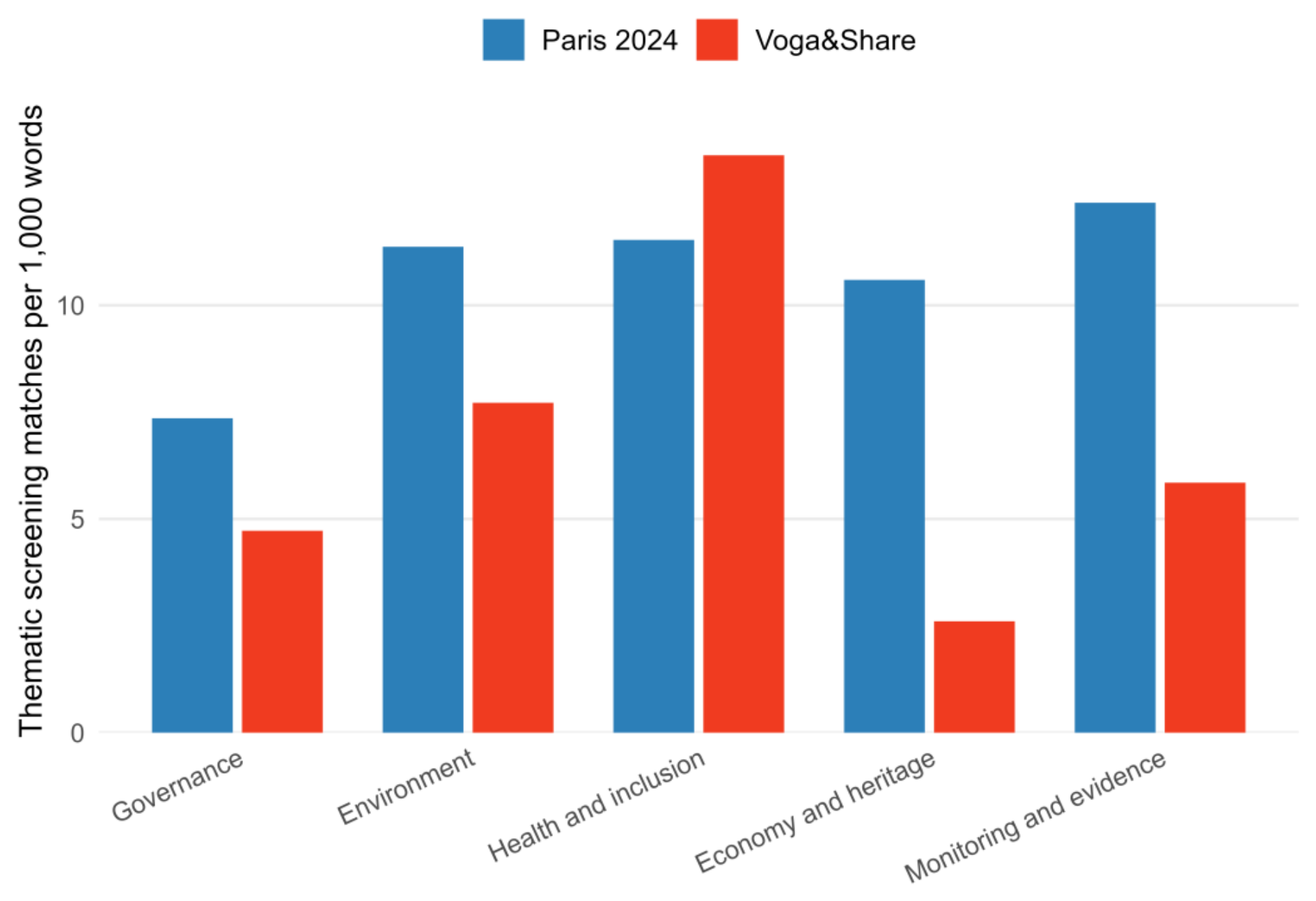
The distribution of thematic matches differed between the two cases. In the Paris 2024 corpus, monitoring and evidence was the most frequent dimension, with 12.4 matches per 1,000 words, followed by health and inclusion at 11.5, environment at 11.4, economy and heritage at 10.6, and governance at 7.36 matches per 1,000 words. The relatively similar frequencies across the environment, health and inclusion, economy and heritage, and monitoring and evidence dimensions indicate broad thematic coverage within the Paris 2024 documentation.
In the Voga&Share corpus, health and inclusion was the most frequent dimension, with 13.5 matches per 1,000 words. It was followed by environment at 7.72, monitoring and evidence at 5.85, governance at 4.72, and economy and heritage at 2.61 matches per 1,000 words. This distribution places greater documentary emphasis on health and inclusion than on economic and heritage-related themes.
The two cases therefore showed different documentary profiles. Paris 2024 displayed a comparatively balanced distribution across the five dimensions, with the highest frequency relating to monitoring and evidence. Voga&Share showed a more concentrated profile, particularly around health and inclusion, whereas economy and heritage appeared less frequently. These differences describe the emphases of the documents analysed and should not be interpreted as evidence that one case achieved greater effects than the other.

Table 1.
Thematic screening matches by case and analytical dimension.
| Analytical dimension | Paris 2024: matches | Paris 2024: per 1,000 words | Voga&Share: matches | Voga&Share: per 1,000 words |
| Governance | 1,336 | 7.36 | 571 | 4.72 |
| Environment | 2,065 | 11.4 | 933 | 7.72 |
| Health and inclusion | 2,094 | 11.5 | 1,633 | 13.5 |
| Economy and heritage | 1,924 | 10.6 | 315 | 2.61 |
| Monitoring and evidence | 2,252 | 12.4 | 707 | 5.85 |
Note: Frequencies represent matches generated through the deductive thematic screening procedure. They indicate documentary emphasis and should not be interpreted as direct measures of programme effectiveness, impact, or causal influence.
3.3. Evidence Status and Claim Types
The pilot coding exercise included six prioritised extracts, four from Voga&Share and two from the Paris 2024 corpus. The extracts covered the dimensions of health and inclusion, monitoring and evidence, environment and governance. The pilot sample included strategic commitments, implemented activities and one reported output. No extract was coded as a reported outcome.
Four extracts were classified as documented and two as partially documented. The two partially documented extracts concerned a proposed monitoring mechanism in Voga&Share and a planned implementation mode for the project. These passages contained relevant information about intended procedures or activities but did not provide sufficient empirical evidence to establish achieved outcomes.
The Paris 2024 extracts included one reported output relating to a structured evaluation system and one implemented activity concerning formal management and procurement. In the Voga&Share extracts, the coding identified strategic commitments concerning health and inclusion, monitoring and evidence, and environmental education, together with an implemented activity relating to project delivery. The pilot exercise showed the analytical usefulness of distinguishing between documentary commitments, implementation-related statements and reported outputs, while also highlighting that the reviewed extracts did not by themselves demonstrate achieved outcomes.
Because the interpretive coding was based on a six-extract pilot sample, its descriptive distribution was not used to estimate the prevalence of claim types or evidence statuses across the full corpus. Rather, the pilot tested the operational distinction between documentary commitments, implementation-related statements, reported outputs and evidence status, thereby informing interpretation of the automated thematic screening results.
Figure 1 illustrates the contrasting thematic profiles of the two cases. Health and inclusion was the most frequent dimension in Voga&Share, whereas monitoring and evidence was the most frequent dimension in the Paris 2024 corpus. The figure also shows the comparatively low frequency of economy and heritage in Voga&Share and the more even distribution of thematic matches across the Paris 2024 dimensions.
4. Discussion
4.1. Documentary Emphasis and the Assessment of Sustainability Claims
This study compared how sustainability- and legacy-related content was documented in a community-oriented rowing initiative and an Olympic mega-event setting connected to marine and coastal sport. The findings show that the two corpora displayed distinct documentary profiles. Paris 2024 contained a higher overall density of thematic screening matches and a comparatively even distribution across environment, health and inclusion, economy and heritage, and monitoring and evidence. Voga&Share, by contrast, showed a more concentrated profile, with health and inclusion as the most frequent dimension and substantially less emphasis on economy and heritage. These results should not be read as a ranking of sustainability performance. Rather, they indicate that organisational scale, document type, institutional capacity and reporting purpose shape which sustainability-related issues are made visible in documentary records.
This distinction is important because sport sustainability and legacy claims are commonly articulated through strategic plans, policy reports, educational materials, evaluation documents and communication products that serve different purposes. A project description or training manual may legitimately foreground intended objectives, pedagogical methods and transferable practices, whereas institutional reports associated with a mega-event are more likely to address governance arrangements, procurement, monitoring systems, indicators and formal reporting. Consequently, the higher thematic density identified in the Paris 2024 corpus is likely to reflect, at least in part, its broader institutional architecture and more extensive reporting requirements rather than a direct indication of greater programme effectiveness.
This interpretation is consistent with legacy scholarship warning against treating event-related claims as self-validating evidence of durable change. Research has identified conceptual inconsistencies in the definition and measurement of Olympic legacy, together with a continuing need for robust empirical research capable of explaining how particular outcomes arise [5,6,7]. The systematic review by Thomson et al. identified extensive attention to intangible legacies, particularly participation, public life, politics and culture, while also highlighting uneven evidential coverage across the field [5]. Chen and Henry further argue that assessments should move beyond claims of Olympic-inspired outcomes by examining the causal mechanisms through which outcomes are expected to occur [7].
The present analysis therefore contributes a documentary perspective to this debate. It does not ask whether Voga&Share or Paris 2024 “was more sustainable”; rather, it examines how claims, priorities and evidence are represented across different sport settings. This framing is especially relevant when sport is positioned as a contributor to multiple SDGs, because broad alignment with SDG language does not itself establish the scale, distribution or durability of benefits. Systematic evidence indicates that sport can contribute to health, inclusion, economic activity and environmental practices, but these contributions remain conditional on programme design, implementation capacity and contextual factors [2,4]. This caution is reinforced by research on sport-for-development evaluation, which has long identified a tendency for ambitious social claims to exceed the quality and scope of available evaluation evidence [26].
4.2. Institutional Scale and the Production of Evidence
The comparatively high frequency of monitoring and evidence-related content in the Paris 2024 corpus is one of the clearest contrasts between the cases. This pattern is consistent with the institutional demands placed on Olympic and Paralympic Games, where hosts, organising committees, public authorities, international sport bodies, funders and other stakeholders require formal strategies, performance frameworks, procurement arrangements, reporting processes and post-event assessments. These documents create an extensive record of how sustainability and legacy are framed, managed and communicated across multiple levels of governance [16,17,18,19,20,21,23].
However, the existence of extensive reporting should not be conflated with demonstrated effectiveness. The pilot coding showed that a structured evaluation system could be identified as a documented output, while the extracts reviewed did not independently establish that all anticipated social, environmental or economic effects had been achieved. This distinction matters because monitoring arrangements can document the presence of an evaluation infrastructure without resolving questions about attribution, counterfactual conditions, unequal distribution of benefits or persistence over time. The capacity to measure is therefore analytically different from evidence that a desired outcome occurred because of a specific intervention [7,26].
The findings also suggest that the production of evidence is unevenly distributed across sport organisations. Mega-events can mobilise specialised evaluation expertise, formal partnerships, public-sector resources and a substantial documentary infrastructure. Community projects often operate through smaller teams, time-limited funding and practical materials designed to support delivery, learning and replication. Such initiatives may generate meaningful local experiences without producing the same volume or type of formal evaluation evidence. This is not a deficit inherent to community sport, but it does affect what can be established from the documentary record.
The capacity to produce documentary evidence is also shaped by governance and by the position of communities within decision-making structures. Sport-for-development research has shown that programmes cannot be understood independently of local institutional arrangements, power relations and the assumptions that may accompany externally defined development agendas [27,28]. Accordingly, an evaluation framework should consider not only whether reporting systems exist, but also who defines indicators, whose experiences are captured, whether stakeholders can scrutinise claims, and how findings are communicated to affected communities.
The implication is that monitoring should be designed proportionately but deliberately across both large and small sport initiatives. For mega-events, this entails transparent indicators, publicly accessible reporting, independent evaluation where feasible and follow-up beyond the event cycle. For community initiatives, feasible systems may include participant reach, retention, inclusion indicators, learning outcomes, partnership continuity and follow-up measures suited to the project’s resources. Such approaches would support stronger comparisons between stated intentions, delivered activities, observable outputs and longer-term outcomes.
4.3. Health, Inclusion and Community Orientation in Voga&Share
The prominence of health and inclusion in the Voga&Share corpus is compatible with the project’s community-oriented design. Its documentation foregrounds rowing, youth participation, training, care, cooperation, environmental education and transferable practice [10,11,12,13,14,15]. This profile indicates that the project framed sustainability principally through social participation and educational engagement rather than through economic activation, destination development or large-scale infrastructure. In this sense, the programme reflects a bottom-up understanding of sustainable sport in which local relationships, skills development and participation opportunities are central.
The result should nevertheless be interpreted carefully. A high frequency of health and inclusion-related terminology does not establish the magnitude of health benefits, changes in participation patterns or the inclusiveness experienced by particular groups. The manual coding reinforced this point: the Voga&Share extracts primarily documented strategic commitments and implementation-related statements. These materials show that health, inclusion and environmental learning were embedded within the project’s stated orientation, but they do not by themselves demonstrate achieved health outcomes, sustained behavioural change or reductions in inequality.
This distinction does not diminish the value of such initiatives. Community-based sport can provide accessible settings in which physical activity, social interaction, place-based learning and cultural engagement are combined. In the specific context of rowing and coastal environments, activities can link physical practice to local waterways, maritime heritage and environmental awareness. Research on sport and physical activity in education for sustainable development suggests that embodied and experiential learning can support environmental awareness, cooperation, participation and antecedents of more sustainable behaviour [9]. However, educational potential should not be translated automatically into claims of behavioural or environmental effects. Studies of sport, gender and development further demonstrate that participants’ experiences are shaped by social position, power and cultural context; participatory and context-sensitive approaches are therefore especially important when inclusion is claimed as a programme outcome [27].
The comparatively low frequency of economy and heritage-related content in Voga&Share should also not be interpreted as an absence of cultural or local value. Rather, it reflects the purpose of the analysed materials. Project manuals and training resources were designed primarily to describe educational, operational and community-oriented practices. They were not principally designed as tourism, destination-marketing, economic-impact or heritage-policy reports. Future community sport projects could nevertheless make their local contribution more visible by documenting connections with cultural associations, schools, clubs, environmental organisations and municipal partners, together with evidence of participation continuity and place-based learning.
4.4. Paris 2024: Breadth of Coverage and Evidential Caution
Paris 2024 displayed a more balanced thematic profile than Voga&Share. Environment, health and inclusion, economy and heritage, and monitoring and evidence were all documented at relatively similar frequencies, while governance remained present at a lower level. This pattern is consistent with the breadth of the Paris 2024 institutional corpus, which includes sustainability and legacy strategy, interim evaluation, post-Games social legacy assessment, economic activation, tourism and destination-oriented material, and sport-specific documentation related to sailing in Marseille [16,17,18,19,20,21,22,23,24].
The prominence of monitoring and evidence is notable because it suggests that the Paris 2024 documentary environment places considerable emphasis on reporting, evaluation and accountability. This may provide stakeholders with more detailed information about commitments, delivery arrangements and reported outputs than is usually available in small-scale initiatives. Yet, as the pilot analysis indicates, documentation of governance processes, procurement arrangements or evaluation systems should not be treated as proof that all intended legacies materialised. The evidential strength of a claim depends on the design of the evaluation, the transparency of indicators, the timing of measurement, the availability of baseline data and the extent to which plausible alternative explanations have been considered [7,25,26].
This caution reflects a broader issue in Olympic legacy research. Although the literature has expanded substantially, reviews continue to identify tensions between the strategic use of legacy narratives and the empirical challenges of demonstrating long-term effects [5,6,8]. The central question is not simply whether a legacy is mentioned, but whether a plausible pathway links intervention, implementation, intermediate outputs and sustained outcomes. A documentary corpus can reveal how organisations construct this pathway, but it cannot independently verify causality or additionality [7].
For the Marseille sailing-host context, this observation is particularly relevant. Sailing events can connect global sporting visibility with coastal infrastructure, tourism, public space, local participation, environmental stewardship and maritime identity [20,21,22,23,24]. At the same time, the benefits and costs of event-related transformations may be distributed unevenly across residents, user groups and coastal stakeholders. Documentary materials can identify planned initiatives and reported achievements, but complementary evidence from residents, local clubs, schools, civil-society organisations, public authorities and environmental stakeholders is needed to determine how such changes were experienced and whether they endured.
Longitudinal evidence is particularly important when social legacy is invoked. A study examining community experience after the 2002 Winter Olympics demonstrated that assessments of social legacy benefit from tracing perceived community effects over time rather than relying solely on pre-event expectations or immediate post-event accounts [29]. For Paris 2024 and Marseille, this supports the need for follow-up that considers residents’ experiences, participation pathways, local organisational capacity and the distribution of benefits across groups and territories.
4.5. Marine and Coastal Sport as Place-Based Sustainability
The marine and coastal orientation of both cases provides a meaningful context for interpreting sustainability in sport. Rowing and sailing occur in environments in which activity, mobility, safety, water quality, ecosystems, public access and cultural heritage can become visibly interconnected. This setting can create opportunities for place-based approaches that integrate sport participation with environmental learning and local identity. It can also make sustainability issues tangible: participants encounter waterways, weather, coastline, infrastructure and other users directly rather than as abstract topics.
The findings suggest, however, that the two cases institutionalised this relationship differently. Voga&Share documented environmental education alongside community participation, training and health-related objectives [10,11,12,13,14,15]. Paris 2024 documented environmental priorities as part of a wider mega-event framework encompassing governance, operational planning, reporting and legacy [16,17,18,19,23,24]. Neither approach should be regarded as inherently superior. They represent different routes through which sport may engage with sustainability: one centred on educational and community practice, the other on multi-level coordination and institutional programme design.
For both routes, environmental claims require evidence appropriate to the level of intervention. Educational initiatives may assess knowledge, attitudes, perceived connection to place, intention and reported behaviour, while recognising the limits of self-report and short-term measurement. Event organisers may assess operational indicators such as mobility, procurement, waste, energy, water use, biodiversity measures and accessibility, while also considering rebound effects, displacement and the durability of changes after the event. The systematic review of sustainability in sport facilities by Gregori-Faus et al. similarly shows that meaningful assessment requires indicators across environmental, social and economic dimensions rather than a narrow focus on a single environmental measure [30].
The environmental dimension also requires assessment frameworks that are proportionate to intervention scale and sensitive to the full event lifecycle. Müller et al., in a longitudinal evaluation of 16 Summer and Winter Olympic Games, argued that Olympic sustainability cannot be inferred from ambition or symbolic commitments alone [25]. Although the present study does not assess Paris 2024 using their indicators, this work reinforces the rationale for interpreting institutional documents as evidence of priorities, procedures and reported actions rather than conclusive proof of environmental, economic or social performance.
4.6. Implications for Sport Sustainability Evaluation
The comparison has four implications for research and practice. First, documentary analysis is a useful starting point for examining how sustainability and legacy are framed, prioritised and supported by available reporting. It is especially useful where cases differ substantially in scale and where a corpus includes plans, manuals, institutional reports, evaluation documents and communication materials. However, it should be explicitly framed as analysis of documentary emphasis and evidential claims, not as impact evaluation.
Second, sport organisations should distinguish clearly between strategic commitments, implemented activities, outputs, outcomes and impacts. This distinction should be reflected in sustainability and legacy reports. For example, a commitment to improve inclusion is not equivalent to an implemented programme; an implemented programme is not equivalent to the number of participants reached; participant reach is not equivalent to improved access, wellbeing or long-term participation. Making these distinctions visible would reduce ambiguity and improve the interpretability of organisational reporting [7,26].
Third, evaluation systems should be proportionate to organisational scale while retaining a credible theory of change. Large sport events should make their assumptions, indicators, baselines, data sources and limitations transparent. Community projects should adopt feasible monitoring approaches that capture who participated, which activities were delivered, how partnerships operated, what participants learned and whether engagement continued after funding ended. In both settings, longitudinal follow-up and mixed methods are necessary if claims concern durable legacy [7,25,26].
Fourth, the evidence base would benefit from greater attention to the distribution of effects. A sustainability claim may look positive at aggregate level while masking unequal access, uneven territorial benefits or different consequences for vulnerable groups. This is particularly important in coastal settings, where sport, tourism, public space, heritage and environmental protection may involve overlapping users and competing priorities. The SDG framework’s commitment to leaving no one behind is relevant here: the critical question is not only whether an initiative produces benefits, but also for whom, where and for how long [1,27,28].
4.7. Limitations and Future Research
This study has several limitations. The corpus was purposively assembled and consists of English-language documents that vary in authorship, purpose, publication date, audience and evidential status. It is therefore not a complete archive of either Voga&Share or Paris 2024, nor does it represent the perspectives of all organisations and communities involved. The Paris 2024 corpus is also larger in both document number and textual volume, although the analysis addressed this imbalance through normalised frequencies.
Second, thematic screening relied on a deductive dictionary and match counts. Although the post hoc reconstructed dictionary and matching rules are provided for transparency, thematic matches may capture different contextual uses of a term and cannot determine the substantive quality, accuracy or outcomes of a reported intervention. The interpretive pilot was deliberately limited to six prioritised extracts and cannot establish the prevalence of claim types or evidence statuses across the full corpus.
Third, this design cannot establish causality, additionality or long-term legacy. It does not test whether Paris 2024 caused changes in Marseille, whether Voga&Share improved health or environmental behaviour, or whether either case produced enduring social, economic or ecological effects. These questions require longitudinal and mixed-method research that combines documentary analysis with stakeholder interviews, participant surveys, administrative and operational data, environmental indicators, local economic evidence and, where possible, baseline or comparison data [7,25,26].
Future research could therefore extend the present approach in three directions. First, longitudinal studies could trace whether commitments and early outputs are sustained after project funding or the Olympic cycle. Second, participatory research with rowers, sailors, schools, clubs, residents, tourism actors, environmental organisations and public authorities could assess how sustainability claims are understood and experienced locally. Third, comparative research across coastal sport settings could investigate how governance arrangements, resource capacity, access to water, heritage and environmental conditions influence the production, distribution and durability of sustainability-related outcomes.
5. Conclusions
This study compared how sustainability- and legacy-related content was documented in Voga&Share, a community-oriented rowing initiative, and the Paris 2024 Olympic and Paralympic Games, with attention to the Marseille sailing-host context. The analysis identified contrasting documentary profiles across the five dimensions of governance, environment, health and inclusion, economy and heritage, and monitoring and evidence. Paris 2024 showed a higher overall density of thematic screening matches and relatively broad coverage across the five dimensions, with monitoring and evidence as the most frequent dimension. Voga&Share showed a more concentrated profile, in which health and inclusion were most prominent and economy and heritage received comparatively limited documentary attention.
These findings do not establish that Paris 2024 produced greater sustainability outcomes or that Voga&Share generated stronger social benefits. Rather, they show that organisational scale, institutional setting, document type and reporting purpose shape the sustainability-related content that becomes visible in documentary corpora. The Paris 2024 materials included strategic, operational, evaluative and post-Games reporting, whereas the Voga&Share materials primarily documented project objectives, educational approaches, implementation guidance and transferable practices. Consequently, differences in thematic frequency should be interpreted as differences in documentary emphasis and source coverage, not as direct measures of effectiveness, impact or causal influence.
The pilot coding further demonstrated the value of distinguishing between strategic commitments, implemented activities, reported outputs and evidence status. Across the selected extracts, the materials documented objectives, planned or implemented procedures, and a structured evaluation output, but they did not independently demonstrate achieved social, environmental or economic outcomes. This distinction is central to more credible sustainability and legacy assessment in sport, because commitments, activities, outputs, outcomes and impacts represent different forms of evidence.
The study therefore supports a proportionate and transparent approach to sustainability evaluation. Large sport events should report clear theories of change, indicators, baselines, data sources, methodological limitations and post-event follow-up. Community-based initiatives should use feasible monitoring systems capable of documenting participation, inclusion, learning, partnerships, delivery and continuity beyond the funding period. In both contexts, documentary analysis can provide a valuable first account of organisational priorities and reported action, but it should be complemented by longitudinal, mixed-method and stakeholder-centred research when claims concern durable legacy or demonstrated change.
In marine and coastal sport contexts, this approach is particularly relevant because sustainability claims may encompass participation, public access, environmental awareness, maritime heritage, tourism, infrastructure and ecosystem stewardship. Future research should examine how these claims are experienced by participants, residents, clubs, schools, public authorities and environmental organisations, and whether documented commitments translate into equitable and lasting outcomes. The contribution of the present study lies in offering a transparent comparative framework for separating what sport organisations document from what available evidence can substantiate.
Supplementary Materials
The following supporting information can be downloaded at the website of this paper posted on Preprints.org, Table S1: Versioned deductive thematic dictionary used for post hoc reproducibility screening; Table S2: Manual coding extract matrix for priority documentary review.
Author Contributions
Conceptualization, F.J.B.-B., V.M.-B. and J.M.V.-F.; methodology, F.J.B.-B., V.M.-B. and C.B.; software, F.J.B.-B.; validation, V.M.-B., C.B. and J.M.V.-F.; formal analysis, F.J.B.-B.; investigation, F.J.B.-B., V.M.-B. and J.M.V.-F.; resources, C.B.; data curation, F.J.B.-B.; writing—original draft preparation, F.J.B.-B. and V.M.-B.; writing—review and editing, F.J.B.-B., C.B. and J.M.V.-F.; visualization, V.M.-B.; supervision, C.B. and J.M.V.-F.; project administration, F.J.B.-B and J.M.V.-F. All authors have read and agreed to the published version of the manuscript.
Funding
This research received no specific external funding.
Institutional Review Board Statement
Not applicable.
Informed Consent Statement
Not applicable.
Data Availability Statement
The derived analytical data, document-level metadata, R code, thematic-screening materials, manual-coding materials, and outputs supporting the findings of this study are openly available in Mendeley Data: Borrego Balsalobre, F. J. (2026), “Replication data and code for ‘Documenting Sustainability and Legacy in Sport: A Comparative Analysis of VogaShare and Paris 2024’”, V1, https://doi.org/10.17632/d4xj28ptg9.1.
GenAI Diclosure
During the preparation of this manuscript, the authors used generative artificial intelligence tools, including Gemini Thinking 3.6 free version (Google), exclusively for language editing, readability, structural organisation and refinement of methodological wording. Generative AI was not used to generate raw data, perform thematic matching, assign coding categories, replace source verification, or make final analytical decisions. All methodological decisions, data processing, coding and interpretations were reviewed, corrected and approved by the authors, who take full responsibility for the content of the manuscript.
Acknowledgments
This research was developed within the framework of the Voga&Share project, funded by the European Commission through a competitive call for proposals. The project’s final participation activity took place in connection with the Vogalonga nautical sporting event in Venice. The study also benefited from institutional cooperation during the authors’ research stay at the Faculty of Sport Sciences, Aix-Marseille University, in 2023–2024, which focused on the social, tourism and urban implications of major nautical sport events.
Conflicts of Interest
The authors declare no conflicts of interest. The funders had no role in the design of the study; in the collection, analyses, or interpretation of data; in the writing of the manuscript; or in the decision to publish the results.
References
- United Nations. Transforming Our World: The 2030 Agenda for Sustainable Development; United Nations: New York, NY, USA, 2015; Available online: https://sdgs.un.org/2030agenda (accessed on 29 September 2026).
- Campillo-Sánchez, J.; Borrego-Balsalobre, F.J.; Díaz-Suárez, A.; Morales-Baños, V. Sports and Sustainable Development: A Systematic Review of Their Contribution to the SDGs and Public Health. Sustainability 2025, 17, 562. [Google Scholar] [CrossRef]
- Chong, Y.-Y.; Sherry, E.; Harith, S.; Khoo, S. Sport for Development Programs Contributing to Sustainable Development Goal 5: A Review. Sustainability 2022, 14, 6828. [Google Scholar] [CrossRef]
- Ulloa-Hernández, M.; Farías-Torbidoin, E.; Seguí-Urbaneja, J. Sporting Events and Sustainability. A Systematic Review (1964-2020). Apunt. Educ. Física Y Deport. 2023, 153, 101–113. [Google Scholar] [CrossRef]
- Thomson, A.; Cuskelly, G.; Toohey, K.; Kennelly, M.; Burton, P.; Fredline, L. Sport event legacy: A Systematic Quantitative Review of Literature. Sport Manag. Rev. 2019, 22, 295–321. [Google Scholar] [CrossRef]
- Scheu, A.; Preuß, H.; Könecke, T. The Legacy of the Olympic Games: A Review. J. Glob. Sport Manag. 2021, 6(3), 212–233. [Google Scholar] [CrossRef]
- Chen, S.; Henry, I. Assessing Olympic Legacy Claims: Evaluating Explanations of Causal Mechanisms and Policy Outcomes. Evaluation 2020, 26, 275–295. [Google Scholar] [CrossRef]
- Shi, P.; Bairner, A. Sustainable Development of Olympic Sport Participation Legacy: A Scoping Review Based on the PAGER Framework. Sustainability 2022, 14, 8056. [Google Scholar] [CrossRef]
- Thurm, S.; Frank, P.; Greve, S.; Schröder, S. Can learning to move foster sustainable development? A systematic literature review examining the potential of sport and physical activity in the context of environmental and sustainability education. Ger. J. Exerc Sport Res. 2024, 54, 29–42. [Google Scholar] [CrossRef]
- Voga&Share. Voga&Share Erasmus+ Project Description; Erasmus+ Sport Programme, 2020. [CrossRef]
- Voga&Share. Manual: Voga Save the Planet; Erasmus+ Sport Programme, 2020. Available online: https://vogandshare.com/wp-content/uploads/2023/08/Manual-Voga-Save-the-planet.pdf (accessed on 29 September 2026).
- Voga&Share. Voga&Share Vademecum; Erasmus+ Sport Programme, 2023. Available online: https://vogandshare.com/wp-content/uploads/2023/12/Vogashare-vademecum-english-version.pdf (accessed on 29 September 2026).
- Voga&Share. Historical Information of Venice and Health Benefits of Rowing for Youth; Erasmus+ Sport Programme, 2023. Available online: https://vogandshare.com/wp-content/uploads/2023/05/Historical-information-of-Venice-and-health-benfits-of-rowing-for-youth.pdf (accessed on 29 September 2026).
- Voga&Share. Manual Voga&Care; Erasmus+ Sport Programme, 2023. Available online: http://hdl.handle.net/10201/199109 (accessed on 29 September 2026).
- Voga&Share. VogaTrain: The Trainers’ Manual; Erasmus+ Sport Programme, 2023. Available online: https://vogandshare.com/wp-content/uploads/2023/05/VOGATRAIN-THE-TRAINERS-MANUAL.pdf (accessed on 29 September 2026).
- Centre de Droit et d’Économie du Sport. Interim Evaluation Report on the Legacy and Sustainability Strategy of Paris 2024; 2024. Available online: https://cdes.fr/wp-content/uploads/2023/11/Executive-Summery-VENG-final.pdf (accessed on 29 September 2026).
- Paris 2024; Centre de Droit et d’Économie du Sport. Paris 2024 Analytical Report Post-Games: Building the Social Legacy of the Paris 2024 Games; 2025. Available online: https://library.olympics.com/Default/doc/SYRACUSE/3704740/ (accessed on 29 September 2026).
- Sustainability and Legacy Pre-Games Report: Summary Strategic Focus; 2024. Available online: https://library.olympics.com/Default/search.aspx?SC=DEFAULT&QUERY=Identifier_idx%3a3415037 (accessed on 29 September 2026).
- International Olympic Committee. Sustainability Progress Report 2021–2024; IOC: Lausanne, Switzerland, 2025; Available online: https://library.olympics.com/CNOSPA/doc/SYRACUSE/3703354/ (accessed on 29 September 2026).
- France, Atout. Game’s Legacy; Atout France: Paris, France, 2025; Available online: https://www.atout-france.fr/sites/default/files/2025-04/DP%20GAME%27S%20LEGACY%20ATOUT%20FRANCE_EN.pdf (accessed on 29 September 2026).
- OECD. The Legacy of the Paris 2024 Olympic and Paralympic Games: Upping the Game; OECD Publishing: Paris, France, 2025. [Google Scholar] [CrossRef]
- Vegara-Ferri, J.M.; Borrego-Balsalobre, F.J.; Morales-Baños, V. Social Impact Report: Paris 2024, Marseille; University of Murcia: Murcia, Spain, 2026; Available online: https://hdl.handle.net/10201/246921 (accessed on 29 September 2026).
- Paris 2024; International Olympic Committee. Paris 2024 Economic Accelerator; 2024. Available online: https://stillmed.olympics.com/media/Documents/Olympic-Games/Hosting-Olympic-Paralympic-Games-resources/Paris-2024/P2024-Economic-accelerator.pdf (accessed on 29 September 2026).
- World Sailing. World Sailing Media Guide: Paris 2024; 2024. Available online: https://d2cx26qpfwuhvu.cloudfront.net/sailingparis2024/wp-content/uploads/2024/07/22143831/World-Sailing-Media-Guide-Paris-2024.pdf (accessed on 29 September 2026).
- Müller, M.; Wolfe, S.D.; Gaffney, C.; Gogishvili, D.; Hug, M.; Leick, A.; Mowatt, R.A.; Nordin, S.; Vanwynsberghe, R. An Evaluation of the Sustainability of the Olympic Games. Nat. Sustain. 2021, 4, 340–348. [Google Scholar] [CrossRef]
- Levermore, R. Evaluating Sport-for-Development: Approaches and Critical Issues. Prog. Dev. Stud. 2011, 11, 339–353. [Google Scholar] [CrossRef]
- Hayhurst, L.M.C.; Giles, A.R.; Radforth, W.M. ‘I Want to Come Here to Prove Them Wrong’: Using a Post-Colonial Feminist Participatory Action Research (PFPAR) Approach to Studying Sport, Gender and Development Programmes for Urban Indigenous Young Women. Sport Soc. 2015, 18, 952–967. [Google Scholar] [CrossRef]
- Lindsey, I.; Grattan, A. An ‘International Movement’? Decentring Sport-for-Development within Zambian Communities. Int. J. Sport Policy Politics 2012, 4, 91–110. [Google Scholar] [CrossRef]
- June, H.M.; Kernan, A.R.; Sumsion, R.M.; Cope, M.R.; Sanders, S.R.; Ward, C. The Relationship Between Mega Events, Sustainable Social Legacies, and Community Experience: A Longitudinal Analysis Following the 2002 Winter Olympics. Sustainability 2024, 16, 8993. [Google Scholar] [CrossRef]
- Gregori-Faus, C.; Crespo, J.; Calabuig, F.; Parra-Camacho, D. State-of-the-Art of Sustainability in Sports Facilities: A Systematic Review. Environ. Dev. Sustain. 2025. [Google Scholar] [CrossRef]
Figure 1.
Thematic screening matches per 1,000 words by case and analytical dimension. Normalised frequencies indicate documentary emphasis and should not be interpreted as direct measures of programme effectiveness, impact, or causal influence.
Figure 1.
Thematic screening matches per 1,000 words by case and analytical dimension. Normalised frequencies indicate documentary emphasis and should not be interpreted as direct measures of programme effectiveness, impact, or causal influence.
Disclaimer/Publisher’s Note: The statements, opinions and data contained in all publications are solely those of the individual author(s) and contributor(s) and not of MDPI and/or the editor(s). MDPI and/or the editor(s) disclaim responsibility for any injury to people or property resulting from any ideas, methods, instructions or products referred to in the content. |
© 2026 by the authors. Licensee MDPI, Basel, Switzerland. This article is an open access article distributed under the terms and conditions of the Creative Commons Attribution (CC BY) license (http://creativecommons.org/licenses/by/4.0/).
Copyright: This open access article is published under a Creative Commons CC BY 4.0 license, which permit the free download, distribution, and reuse, provided that the author and preprint are cited in any reuse.