

Submitted:
15 October 2026
Posted:
16 October 2026
You are already at the latest version
Abstract
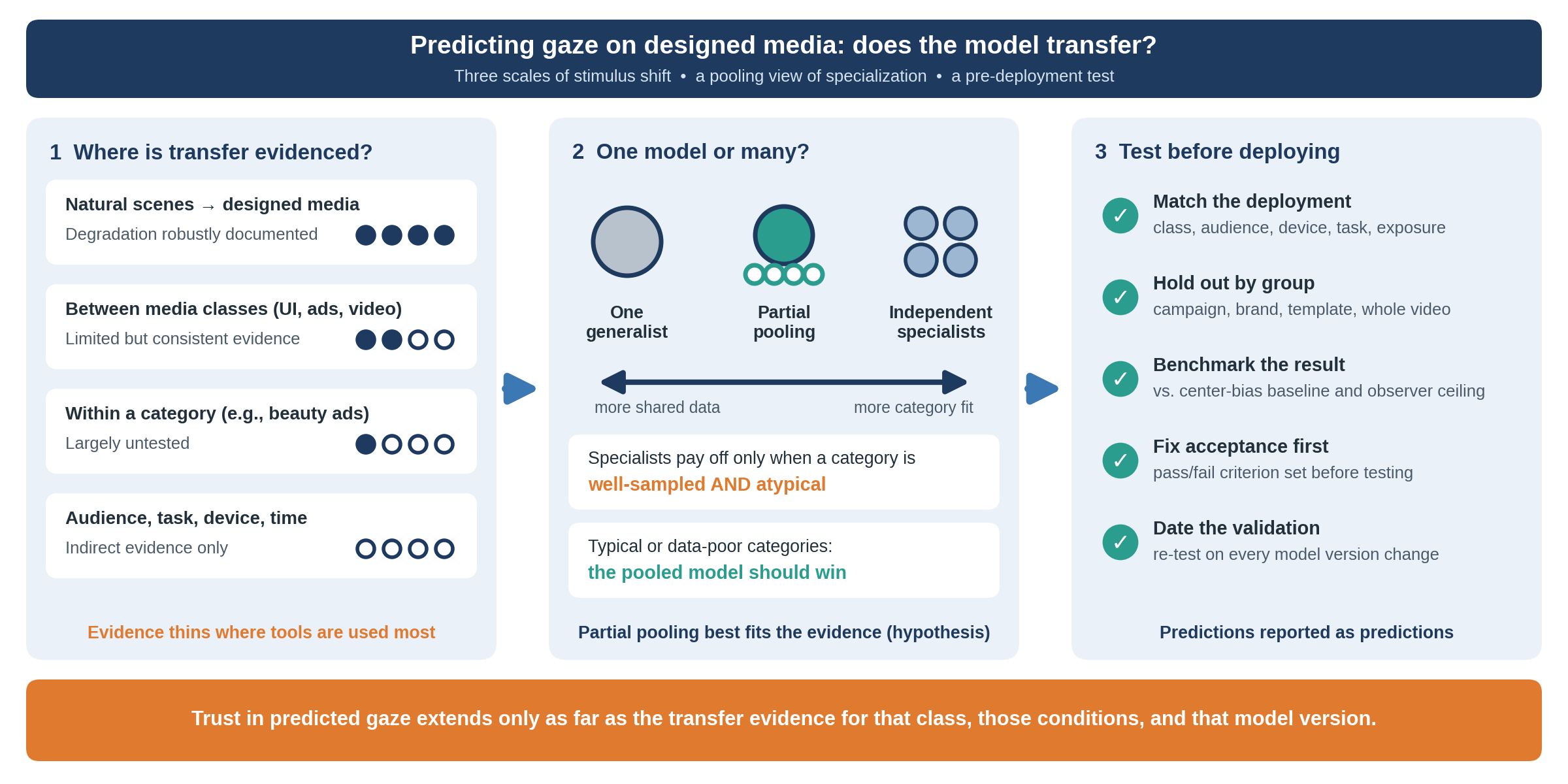
Deep-learning models that predict aggregate fixation density from a media asset alone are now used as measurement instruments in advertising, packaging, interface, and educational research. The central validity question for this practice is domain transfer: whether a model trained on one distribution of stimuli, observers, tasks, and viewing contexts predicts fixations on the materials it is actually deployed on. This critical narrative review organizes the transfer problem into three progressively finer scales of stimulus shift—from natural scenes to designed media, between classes of designed media, and between categories within a class—and a cross-cutting axis of observers, tasks, contexts, and time, and finds the evidence sharply asymmetric: degradation from natural scenes to designed media is robustly documented; transfer between designed-media classes is supported by limited but consistent evidence; within-category and population-level transfer remain largely untested. I then reframe the practical response, specialization, as a finite-data pooling problem—complete pooling (one generalist), no pooling (independent specialists), and partial pooling (shared structure with category-specific adaptation)—and argue that partial pooling is the hypothesis most consistent with the evidence, not an established result. A company practice vignette, drawn from an unpublished internal development program, illustrates how the trade-off resolves operationally. I close with a pre-deployment transfer-testing protocol with predefined acceptance criteria and reporting items for studies that rely on predicted rather than measured gaze.
Keywords:
gaze prediction
; predictive gaze modeling
; visual attention
; saliency models
; domain transfer
; generalization
; consumer neuroscience
; neuromarketing
; AI eye tracking
; model validation
Copyright: This open access article is published under a Creative Commons CC BY 4.0 license, which permit the free download, distribution, and reuse, provided that the author and preprint are cited in any reuse.