
Submitted:
15 October 2026
Posted:
16 October 2026
You are already at the latest version
Abstract
We re-examine Maynard Smith and Szathmáry’s thesis that ‘human societies and language’ represent a major transition in evolution based on changes in the storage, transmission, and translation of information. We argue that they understated the scope and significance of the transition associated with humans, the most consequential effects of which lie in the translation of large quantities of non-genetic information to structure in the form of artificial creatures (automata) that mimic living organisms. Humans evolved three specialized anatomical features related to the storage, transmission, and translation of non-genetic information (enlarged brain, vocal tract, and hands) that function in concert to compute the solutions to problems of adaptation through an evolutionary computational process with non-genetic information. We treat artifact production sequences dating to 3.3–0.025 million years ago as algorithms and apply algorithmic information theory to measure the amount of information translated to structure (‘program size’). We find that the transition linked to humans is an extended and nonlinear process that may be subdivided into phases based on trends in artifact production program size and algorithmic complexity. The transition will be complete when self-reproducing automata begin to evolve independently of the organisms that generated them.
Keywords:
human evolution
; design theory
; evolutionary algorithms
; computational complexity
; Paleolithic archaeology
1. Introduction: Information and Human Evolution
1.1. Humans as a ‘Major Transition in Evolution’
In a 1995 Nature paper and book, followed by a 1999 book for general readers, the late John Maynard Smith and Eörs Szathmáry described the ‘major transitions in evolution’ as follows (Szathmáry & Maynard Smith, 1995; Szathmáry & Maynard Smith, 1995, 1999):
replicating molecules → populations of molecules in compartments
independent replicators → chromosomes
RNA as gene and enzyme → DNA and protein (genetic code)
prokaryotes → eukaryotes
asexual clones → sexual populations
protists → animals, plants, fungi (cell differentiation)
solitary individuals → colonies (non-reproductive castes)
primate societies → human societies (language)
Explaining why they had excluded events such as the ‘conquest of land by plants and animals’ or the ‘origin of flight,’ the authors stated that their focus was on transitions that involved changes in the storage, transmission, and translation of information (Szathmáry & Maynard Smith, 1999, p. 16). They noted that a feature common to many of the transitions on their list was that “entities that were capable of independent replication before the transition can only replicate only as part of a larger whole after it” (Szathmáry & Maynard Smith, 1995, p. 6). Each transition also involves an increase in complexity (although this depends on how complexity is measured).
Following Maynard Smith’s death, Szathmáry (2015) authored a paper in which he proposed some revisions to the original set of major transitions (e.g., combining the first two transitions into one, deleting asexual clones → sexual populations). He left intact, however, the most recent transition, i.e., ‘human society with language.’ The advent of human language is unique among the major transitions of evolution because it involves changes in the storage, transmission, and translation of non-genetic information. With two other colleagues, Szathmáry had already explored some ideas regarding evolutionary mechanisms and non-genetic information (i.e., ‘neuronal replicator hypothesis’ [Fernando et al., 2010]).
Maynard Smith and Szathmáry’s proposed ‘major transitions in evolution’ stimulated some discussion among evolutionary biologists (Bourke, 2011; Calcott & Sterelny, 2011), and their application of the concept to humans provoked a lively debate among researchers in a variety of fields (Carmel et al., 2023; Okasha, 2022; Smit, 2014). The primary focus of most commentaries and critiques of the major transitions thesis was the evolution of hierarchy or levels of organization and selection in biology (e.g., individual organism versus super-organism). Some critics of the application of Maynard Smith and Szathmáry’s thesis to humans were skeptical of the implication that ‘human societies with language’ represent a level of organization above that of the individual (McShea, 2023).
In this paper, we re-examine the idea that humans or human societies represent a major transition in evolution, as defined by Maynard Smith and Szathmáry. Our principal focus is not on levels of organization or selection, however, but on changes in the storage, transmission, and translation of (non-genetic) information. Humans evolved a capacity for translating large amounts of non-genetic information to structure in the form of artifacts, including artifacts that function independently of the organisms that created them (i.e., automata). Changes in the storage and transmission of non-genetic information played an essential role in the evolution of this capacity by providing the computational power required to design and produce complex artifacts to solve complex engineering problems. In our view, humans represent the most important transition since the appearance of prokaryotes, not only because it was the first to entail changes in the storage, transmission, and translation of non-genetic information, but because it established a new form of evolutionary computation that contains the basic elements of the evolutionary process and generated a Kingdom of Artificial Creatures (sometimes labelled the ‘techno-sphere’ to distinguish it from the biosphere [e.g., Walker, 2024]).
The most penetrating insights into the character of the transition associated with humans are derived not from biology or anthropology, but from design theory in modern engineering science (e.g., Braha & Maimon, 1998; Haik et al., 2011; Hubka & Eder, 1996; Suh et al., 2021; Ullman, 2016). A ‘theory of design’ was slow to emerge in engineering because of the unpredictable and creative character of the process of artifact design; its relatively recent development was driven by software applications to design problems in a variety of engineering sub-fields beginning in the 1960s (Braha & Maimon, 1998; Simon, 1996). The software automated the tedious and time-consuming random—although structured—search through design alternatives typically necessary in the trial-and-error (i.e., nondeterministic) process of artifact design (e.g., Hubka & Eder, 1996). It also provided a mathematical model for the design process and gave birth to the field of evolutionary computation (aka ‘evolutionary algorithms’) (Bäck, 1996; De Jong, 2006; Fogel, 1998; Goldberg, 2002).
We suggest that evolutionary computation provides an interpretive model for the design and production of artifacts for the entire archaeological record (i.e., extending back to 3.3 mya). We view early human societies as ‘living evolutionary algorithms’ that collectively computed the solutions to engineering problems with a small set of raw materials and production rules (and existing components after 0.3–0.2 mya) in the form of information translated to structure or artifacts. Their computations comprised the basic elements of the evolutionary process (i.e., reproduction, mutation, recombination, selection) but with non-genetic information (Arthur, 2009; Castle et al., 2024). Most importantly, they developed the capacity to store information concerning raw materials and production rules and gradually accumulated an engineering knowledge base (Layton, 1974; Vincenti, 1990). This accumulated engineering knowledge was used to address more complex problems (i.e., problems that required the control of more variables to solve) by building more complex solutions out of both new and existing materials, production rules, and components.
Although we emphasize the central role of translation of information to structure in the transition associated with humans, rather than ‘societies and language,’ we recognize that the latter are critical components of the non-genetic evolutionary computational process in humans. Both human society and language are integral parts of computation with non-genetic information because language provides a digital tool for computation that supplemented the analog form of computation inherited from the African apes. At the same time, as a communication system, language integrates computation among the members of social groups, creating a powerful ‘super-brain’ (Hoffecker, 2013). Design theorists stress the collective and cumulative character of the artifact design process (Braha & Maimon, 1998; Goldberg, 2002; Haik et al., 2011; Hubka & Eder, 1996; Suh et al., 2021; Ullman, 2016).
In the sections that follow, we describe the changes in the storage, transmission, and translation of non-genetic information in humans and suggest how they are related to changes in human anatomy over the past few million years. Humans evolved three specialized organs or anatomical features related to the storage, transmission, and translation of non-genetic information, all of which had deep roots in the Order Primates. These included the (paired) hands, which function to translate information stored in the brain to structure in the form of artifacts, and the vocal tract, which, in its unique human form, allows individuals to transmit (translated) information stored in the brain to other individuals in the form of complex coded vocalizations. The third specialized organ related to non-genetic information in humans is the allometrically enlarged brain, which allows storage of a very large quantity of information and is involved in both the transmission and translation of non-genetic information.
1.2. Evolutionary Algorithms and Information Theory
Before we review the fossil and archaeological records for changes in the storage, transmission, and translation of non-genetic information, we consider the concept and definition of information and how it may be used as a unit of measurement in the archaeological record. We also discuss the related measurement of computational or algorithmic complexity in that record.
The conventional or ‘semantic’ definition of information is focused on the content or ‘meaning’ of a body of information. In his ‘mathematical theory of communication,’ Shannon (1948) focused instead on the contents of a message in relation to alternative possible messages (i.e., if a message has no possible alternatives, it contains no information). He proposed a measurement of information (or ‘reduction of uncertainty’) with the same formula used in statistical mechanics for entropy (Boltzmann’s H theorem):
where p is the probability of message i and the information (H) is equal to the sum of the probabilities of the possible messages. The alternative possibilities are broken down into a series of binary choices or decisions and information is measured in terms of binary digits (or ‘bits’).
H = -∑ pi log pi
A synthesis of information theory and computation theory was developed by Solomonoff (1964), Kolmogorov (1968), and Chaitin (1975, 1987), who suggested that Shannon’s measure of information content could be applied to algorithms as a measure of complexity or simply ‘program size.’ Chaitin (1987, p. 107) treated “programs as code words and the result of the computation as the decoded message” and redefined H in terms of information bits in the “shortest self-delimiting program” (algorithm or string) for computing a solution to a problem with a given input: H(s) ≡ HU(s), where s is a binary string and U is a universal computer (Chaitin, 1987, p. 109). In their book for general readers, Maynard Smith and Szathmáry (1999, p. 15) suggested that Chaitin’s measure of algorithmic complexity might be applied to the measure of structural complexity in evolutionary biology, while Chaitin (1977, p. 357) himself suggested that the application of information theory to biology might contribute to a mathematical definition of life.
Here, we apply algorithmic information theory to the translation of information to structure in the form of artifacts. We treat the production sequence for an artifact (or chaîne opératoire) as an algorithm comprising a series of predetermined steps (derived from a non-deterministic evolutionary algorithm) (Cormen et al., 2009). The ‘input’ is the raw material and the ‘output’ is the finished artifact, which is designed to solve a specific problem (often in conjunction with a series of predetermined actions for its use). We define a ‘step’ as the application of a production rule and a binary choice between the action required to yield the finished artifact and all possible alternative actions (i.e., for each step H = 1).
The ‘production rule’ is a key concept. The term is used both in engineering design theory (e.g., Braha & Maimon, 1998) and information theory. In the Encyclopedia of Information Systems, a production rule is defined as an ‘IF-THEN rule:’
Production rules relate the conditions under which the rule can be applied . . . to the action to be performed when the rule is applied . . . (E)ach rule represents one “unit” of knowledge, simplifying knowledge acquisition and maintenance of the knowledge base (Das, 2003, p. 35).
Production rules are the means by which information is translated to structure. An example is the production rule that ‘instructs’ a chimpanzee to strip the smaller twigs off a stick to produce a termite-fishing stick, while an example of a production rule encoded in genetic information is a step in the construction of a honeybee nest. Production rules exist as both a set of instructions (or ‘program’) and a message transmitted among organisms in a social group and, as such, may be measured in accordance with both information theory and algorithmic information theory (Chaitin, 1987; Shannon, 1948).
Treating artifact production sequences as algorithms and counting the steps (as we have defined them) provides a measurement of computational or algorithmic complexity (also applied in an engineering context [Braha & Maimon, 1998; Summers & Shah, 2010]). The measurement of computational complexity and the development of computational complexity theory was another consequence of engineering advances in computer hardware and software in the 1960s (e.g., Arora & Barak, 2009; Lewis & Papadimitriou, 1998; Sipser, 2013). The computational complexity of an algorithm (or ‘algorithmic complexity’) was initially defined in terms of the amount of computer time required to yield the output (‘time complexity’) (Hartmanis & Stearns, 1965) but quickly redefined in terms of the number of steps required in the algorithm, in order to decouple it from specific hardware and software features (Cobham, 1965).
The broad analogy between the translation of non-genetic information to structure in the form of artifacts and the translation of genetic information to structure in the form of organisms invites us to consider past and current applications of information theory to evolutionary biology. Early approaches were developed by Gatlin (1972) and later by Adami (1998, 2000), who also proposed Shannon’s measure of information (H) as a complexity measure in evolutionary biology. More recently, evolving computer science applications in biology (bioinformatics), combined with next generation sequencing (NGS) techniques for DNA, have yielded complex models of protein synthesis (e.g., Hayes et al., 2025; Heinzinger et al., 2019). There are fundamental differences between the storage, transmission, and translation of non-genetic and genetic information, however, and we have opted for an approach that is better suited to artifact production, especially in an archaeological context.
Readers familiar with archaeological theory and method will notice some resemblance between our approach and ‘evolutionary (or Darwinian) archaeology,’ which invokes evolutionary mechanisms such as ‘selection’ and ‘drift’ to explain the archaeological record (Dunnell, 1980; Lyman & O’Brien, 1998; Shennan, 2008). There also is some overlap between our approach and ‘evolutionary cognitive archaeology’ (Wynn & Coolidge, 2022), which—among other topics—addresses the cognitive requirements of Paleolithic artifact production (e.g., Lombard & Haidle, 2012; Stout et al., 2015).
In both cases, the resemblance is limited and superficial. The focus of ‘Darwinian archaeology’ is on changes in artifact attributes (or ‘traits’) in artifact assemblages over time, which are explained in terms of a non-genetic or cultural evolutionary process. We pay no attention to artifact attributes and their pattern of change over time but rather focus on measurement of the artifact production process in terms of information content (program size) and computational complexity. Evolutionary cognitive archaeology is based on application of concepts borrowed from cognitive psychology (or ‘cognitive science’), such as ‘theory of mind’ and ‘working memory,’ to archaeological data with the goal of reconstructing the evolution of human cognition (Wynn & Coolidge, 2022, pp 5–10). Our approach is essentially an application of engineering (formal) design theory (e.g., Braha & Maimon, 1998) and computational complexity theory (e.g., Arora & Barak, 2009; Sipser, 2013) to the archaeological record.
On the other hand, our approach to the question of humans as a major transition in evolution is similar in many respects to ‘assembly theory,’ described in several recent publications. Assembly theory concerns the construction of complex but non-random objects and makes no distinction between living organisms (biosphere) and complex artifacts (techno-sphere). Although Marshall et al. (2022) and Walker (2024) make no reference to algorithmic information theory, their proposed measure of object assembly complexity (‘assembly index’) is equivalent to program size, as defined by Chaitin (1987). The assembly theory literature does, however, refer to von Neumann’s ‘theory of self-reproducing automata,’ which contains concepts that are fundamental to the evolutionary transition described here (von Neumann, 1966).
2. The Evolution of Specialized Organs Related to Non-Genetic Information
2.1. Introduction
The changes in the storage, transmission, and translation of non-genetic information that represent the transition in evolution associated with humans are tied to the evolution of three specialized organs in the Subfamily Homininae: the paired hands, vocal tract, and enlarged brain. In this section of the paper, we briefly review the evidence for the timing and pattern of the evolution of these organs to understand their role in the transition. Following Tattersall (2022), we attempt to avoid the assumption—historically widespread in paleoanthropology—that all traits considered characteristic of living humans, including the three specialized organs listed above, evolved gradually in a single lineage. Especially with the discoveries of the past few decades, the human fossil record now appears similar as other groups with a wide variety of adaptations, lineages, interspecific competition, and extinctions.
2.2. The Human Hand
The transition in evolution associated with humans began with changes in the translation of non-genetic information to structure in the form of artifacts with the paired hands. Initially, the artifacts were produced by non-random modifications to cobbles and rock fragments and contained a small quantity of information (comparable to artifacts made by other animals). By the end of the Lower (or beginning of the Middle) Paleolithic ~0.3–0.2 mya, however, representatives of Homo were producing simple multiple-component artifacts that contained a greater amount of non-genetic information than any artifacts produced by other living organisms.
Like the vocal tract, the paired hands have evolved into a highly versatile and precise instrument for translating information stored in the brain to structure. The human hand comprises no fewer than 27 bones and 35 muscles and is capable of performing a wide range of movements and grips for the manipulation and modification of objects and features (Mountcastle, 2005; Napier, 1993). Especially characteristic of modern humans is an elongated pollex or thumb (62–66% the length of the third digit) and an associated muscle (flexor pollicis longus) that allow many of the movements and grips employed in artifact production (Kivell et al., 2023). It is important to keep in mind that the unique functions of both the hand and vocal tract in humans are only possible with extensive supporting neurological structures, including the biological equivalent of ‘software’ or non-genetic information acquired by learning.
Relatively new evidence for stone tool production as early as 3.3 mya has altered our perspective on the evolution of the human hand (Harmand et al., 2015), because it indicates that at least some of the australopiths were making tools similar as those made by early Homo at 2.75 mya (i.e., Oldowan artifacts). Changes in hand morphology associated with Oldowan tools previously thought to have played a role in early tool-making now appear less important. In fact, a comparative survey of hand function among living primates shows that many of them regularly use the power and precision grips that humans employ in making artifacts and raises the possibility that most of the hand movements required for tool production during the Lower Paleolithic (3.3–0.3 mya) were possible among a variety of fossil primates at a much earlier time (Kivell et al., 2023). From our perspective, the most important question is: what—if any—evolved changes in functional hand morphology (both before and after 3.3 mya) played a significant role in changes to artifact production or the translation of information to structure?
A recent review by Kivell et al. (2023, p. 40) found that the evolution of the human hand was “not linear” and that hominin hand morphology over the past few million years—and more broadly primate hand morphology over tens of millions of years—exhibits a “mosaic” pattern of adaptive variation. Thus, for example, while a separate flexor pollicis longus is not found in the closest living relatives of Homo, it is present in the more distantly related hylobatids. Reconstruction of the evolution of the hand from fossil data is based on a growing sample of hand bones dating to the last few million years, although there are some significant gaps in the fossil record (and Kivell et al. [2023, pp. 7–10] argue that the evolution of the unpreserved soft tissues is more important than the bones for understanding the evolution of the human hand).
The primates are among the few mammals that carry food to the mouth—instead of bringing the mouth to the food—and as early as the Eocene, the fossil ancestors of modern prosimians had evolved grasping hands with nails instead of claws. Pollex-digit (thumb-finger) opposition appeared in the catarrhines, who evolved a variety of specialized hand adaptations—all but one of which combined locomotor and manipulative functions (Napier, 1993). Fossil hand bones of Proconsul, the early Miocene ape from Africa, reveal a hand that—like other aspects of its anatomy—combines typical ape and monkey features (Walker & Shipman, 2005). By the later Miocene (~9.5 mya) a generic ape pattern is evident in hand bones of Dryopithecus from western Eurasia (Moyà-Solà & Kohler, 1996).
The African apes subsequently evolved their own specialized hand with shortened pollex and elongated digits (for suspending from branches) and other features related to their peculiar knuckle-walking locomotion. (In the genus Gorilla, the pollex is 46% of the length of the third digit.) The early human fossil record is sparse and fragmentary, and it is not known if changes in the hand took place at the time that the human lineage diverged from African apes (7–5 mya). However, the shift to bipedal locomotion, which apparently took place at this time, established the context for the evolution of the human hand—lacking a role in locomotion except during infancy (Kivell et al., 2023; Napier, 1993).
A significant development is evident at 3.67 mya with a complete australopith hand preserved in breccia at Sterkfontein (South Africa) that exhibits a pollex length of 60% of the length of the third digit (i.e., comparable to modern human proportions), as well as a reconstructed composite hand for Australopithecus afarensis from Hadar (Ethiopia) at 3.2 mya with a pollex length of 61% the length of the third digit. The pollex from Hadar also exhibits a gable for attachment of a flexor pollicis longus muscle (Kivell et al., 2023; Marzke, 1983). (Both features could have evolved somewhat earlier, however.) Although interpretations of hand function in A. afarensis vary widely, discovery of the (West Turkana, Kenya) stone tool industry dating to 3.3 mya—as noted above—has altered our perspective on hand evolution (Harmand et al., 2015). It now is apparent that one or more species of australopith was making artifacts similar as those made later by early Homo and must have been capable of most of the power and precision grips found among modern humans (Figure 1).
Hand bones of early Homo (H. habilis) associated with stone tools and dating to at least 1.75 mya were recovered in 1960 at Olduvai Gorge (Tanzania) and described by John Napier, who noted the expanded apical tufts—broad finger tips—similar as modern human fingers, as well as some ape-like features (e.g., the curvature of the phalanges) (Na pier, 1962). Napier questioned the full precision grip capability of the Olduvai hand. A modest sample of hand bones from multiple sites in Africa and Eurasia assigned to Homo erectus suggests that a modern human pattern had fully evolved by 1.5–1.4 mya or roughly the beginning of the Acheulian industry. The sample includes a robust metacarpal bone (Mc3) from Kaitio (Kenya) dating to ~1.42 mya that exhibits the earliest known styloid process (Ward et al., 2014), as well as several phalanges and metacarpals from Nariokotome (Kenya) that lack any archaic features (Kivell et al., 2023; Walker & Leakey, 1993).
2.3. The Enlarged Brain
Computational complexity theory informs us that memory storage capacity is critical to computational power (e.g., Feynman, 1996, p. 55) and thus provides an important insight into human evolution. There is a mathematical basis for the inference that significant increases in the algorithmic or computational complexity of artifact production are related to corresponding increases in the capacity for storage of non-genetic information. Initially, the expansion of memory storage capacity was confined to increases in the number of neurons and synaptic connections in the brain. After the appearance and spread of modern humans, however, storage capacity was expanded with production of artifacts for storage of non-genetic information outside the brain.
From our perspective, the important question in this context is similar as the question asked regarding the evolution of the human hand: what role did the enlargement of the human brain play in the evolutionary transition? How is the timing of human endocranial expansion (i.e., expanded memory storage capacity) related to changes in the program size/algorithmic complexity of artifact production?
In many respects, the mammalian brain is the antithesis of a ‘specialized organ,’ but among humans it has evolved a uniquely enlarged capacity for the storage of non-genetic information. This storage capacity is measured in terms of the estimated number of ‘extra neurons,’ which are defined as neurons not required for maintenance and control of the body (and are located chiefly in the cortex) (Roth & Dicke, 2012). Because the number of neurons required for body functions is related to the size of the body, the extra neurons must be calculated in terms of the brain:body ratio or encephalization quotient (EQ), defined by Jerison (1973). Modern humans have an EQ of 7.79 (compared to 2.48 in chimpanzees) and a very large number (8.83 x 10⁹) of ‘extra neurons’ (Roth & Dicke, 2012). Because each neuron has an estimated average of 7,000 synaptic connections, it is the latter that provides the best estimate of information storage capacity. The average modern human brain contains an estimated 100 trillion synaptic connections (Herculano-Houzel, 2009).
The brain is expensive in terms of energy requirements and significant increases in the number of extra neurons presumably reflect strong selection pressures for a higher EQ, as well as adequate sources of energy to feed the larger brain (e.g., high protein/fat diet). The adult human brain consumes roughly 280–420 kcal a day, which is about 20–25% of metabolic energy at rest, and the proportionately larger brain of an infant may consume more than 60% of total metabolic energy (Isler & van Schaik, 2014). By contrast, the energy needs of a chimpanzee brain are only about 100–120 kcal a day and it is estimated that the early Homo brain of about 800 cc would have required ~200 kcal per day (Lieberman, 2011).
Like the hand, the enlarged human brain has deep roots in mammalian evolution. Mammals evolved the neo-cortex, which integrates other parts of the brain with each other and stores information about the environment, and the early primates evolved a significantly expanded visual processing area as well as a unique cortical area for enhanced visual control of muscle movements (ventral premotor area) (Allman, 1999; Strieder, 2005). Brain size increased in monkeys, although brain:body ratios remained similar as those of the prosimians; the neocortex expanded, however. Although apes exhibit some increase in brain:body ratio, neither brain volume nor brain:body ratio increased over apes in the early hominins (Monson et al., 2026; Roth & Dicke, 2012).
The general trend in human evolution is a gradual increase in brain size (measured with endocranial volume in human fossils) during the past 3.5 million years (Beaudet et al., 2019; Du et al., 2018; Lieberman, 2011). Endocranial volume (absolute brain size) increased roughly threefold, from ~450 cc in Australopithecus afarensis to a mean of between 1130 cc (females) and 1275 cc (males) in living humans (with a wide range of 1,000–1,500 cc), although the increase is less when adjusted for body size (Lieberman, 2011; Monson et al., 2026; Tattersall, 2023). Brain size in African Homo reaches an essentially modern human level (~1,200 cc) as early as 0.5 mya (especially when adjusted for climate setting) (Beals et al., 1984; Du et al., 2018; Lieberman, 2011). While there is a subsequent increase in brain size relative to body size (roughly 10%) in Homo sapiens compared to its immediate predecessor (H. heidelbergensis), it is followed by a 12.7% reduction in mean brain volume among recent populations (Lieberman, 2011; Tattersall, 2023). With respect to potential memory storage space among the ‘extra neurons,’ the increases are potentially exponential because each neuron may develop thousands of synaptic connections with other neurons, as noted above (Figure 2).
Although there is a consensus among paleoanthropologists on the general trend in endocranial volume in human evolution, there is no consensus regarding the pattern and process by which the increase in brain size has taken place. Tattersall (2023) notes that the discovery and dating of recent small-brained H. floresiensis and H. naledi (neither are included in Figure 2) undermine the narrative of gradual increase, although Monson et al. (2026) found their brain:body ratio comparable to that of other hominins. In a major 2018 study, Du et al. (2018) found that “the dominant signal is consistent with a gradual increase,” but also recognized evidence for periods of stasis within specific lineages. More recently, Gingerich (2022) identified two major periods of stasis during the past 3.2 million years, including 3.2–2.0 mya and 1.5–0.7 mya, interspersed with episodes of directional increase during 2.0–1.5 mya and from 0.7 mya to 10 ka.
Tattersall (2023) noted two inflexion points over the past 4 mya, the first of which occurred in the later australopiths (e.g., A. afarensis) with a roughly 20% increase in brain volume (without a significant increase in body size). The second is associated with Homo heidelbergensis during 0.6–0.2 mya, when brain volume reaches a modern human level, as noted above. Monson et al. (2026) found only one significant inflexion point in brain:body ratio (or ‘encephalization’) at ~3 mya. Most of the uncertainty regarding the pattern of change in human brain size seems to lie in the taxonomic level under consideration, compounded by disagreements over the classification and dating of many individual fossils and estimates of body size (Du et al., 2018; Monson et al., 2026; Tattersall, 2023).
There also is a lack of consensus regarding the factor(s) that drove the general increase in human brain size, and the differing perspectives on this question often are tied to the differing views on the pattern of change. Some paleoanthropologists concur with the ‘social brain hypothesis,’ which attributes the steady increase in brain size to selection for social skills—the ability to develop and maintain alliances with other individuals; long-term management of social relationships requires substantial memory storage space (Dunbar, 2009; 2024). Adopting a ‘metabolic approach,’ González-Forero and Gardner (2018) concluded that ecological factors were the primary driver for larger brains, given their high metabolic costs (see above), while Stibel (2022) found a correlation between climate and brain size in Homo over the past 50,000 years. Tattersall (2023) suggested a link between the increased size of the H. heidelbergensis brain and more complex artifacts, including multiple-component forms, after 0.5 mya.
Overall, we find a weak correlation between endocranial volume and increases in artifact production program size and algorithmic complexity, as described below (Section 3.2). While there may be a link between the 20% increase in brain size in the later australopiths and the earliest known stone tool industry at Lomekwi (Harmand et al., 2015), the threefold increase in endocranial volume (at the clade level) that took place between 3.3 and 0.5 mya—with implications for exponential growth in memory storage space in terms of potential synaptic connections—is associated with very gradual and limited increases in artifact production complexity. (It should be noted that Archer et al. [2020] have questioned the provenience and dating of the Lomekwi industry.) Even more striking is the lack of net increase in brain size preceding and during the explosive growth of production complexity and the engineering knowledge base that occurred after the appearance and spread of modern humans <0.1 mya (Tattersall, 2023).
There is however a strong correlation between the explosive growth of production complexity and engineering knowledge after 0.1 mya and a set of neuroanatomical changes in those parts of the brain required for maintenance and control of the body (i.e., areas of the brain that do not contain ‘extra neurons’) (Hublin & Changeux, 2022; Neubauer et al., 2018). These changes included expansion of both the parietal and temporal lobes, along with the cerebellum and probably the prefrontal cortex, that create the unique globular shape of the adult cranium in living humans during development (without increasing overall endocranial volume). All these changes are related to language, as well as other functions, and are therefore related not only to the transmission of non-genetic information but also to computational complexity (see below).
2.4. The Human Vocal Tract
Language plays a dual role in the genus Homo. It is a system of communication (i.e., for the transmission of information from one brain to others) and a tool for computation (i.e., formal language as defined in mathematics and computer science). Although humans sometimes ‘think out loud,’ more often than not they compute the solutions to everyday problems with the reproduced or imagined vocal sounds of natural language in the brain (‘internal language’) (Fernyhough & Borghi, 2023). As a computation tool, language supplemented the analog form of computation that early humans inherited from their primate ancestors with a digital form of computation that provides greater precision and provided a hierarchical data structure for information storage. Because it doubles as a communication system, language also provides the means for collective computation among the members of a social network (i.e., creates a ‘super-brain’ [Hoffecker, 2013]).
The emergence of computer science during the 1950s and 1960s helped create a hierarchy of languages in terms of computational complexity (Chomsky Hierarchy) (Lewis & Papadimitriou, 1998; Sipser, 2013). At the top of this hierarchy is ‘natural language’ (e.g., English, Japanese) with an unrestricted grammar and the computational power of a Turing Machine (TM), which can compute all computable numbers and generate/accept all recursively enumerable languages. At the bottom of the hierarchy is a ‘regular language’ with a regular grammar and the very limited computational power of a Finite State Machine (FSM). As Feynman (1996) noted, the computational power of the machines or automata is a function of memory storage capacity: while a TM has a theoretically infinite memory tape, an FSM has no stored memory (its limited memory is “built into the machine”). Between the extremes lies a ‘context-free language’ or grammar, which can generate many but not all the sentences of a natural language and exhibits the computational power of a Pushdown Automaton (PDA) with the constrained function of a ‘single-stack’ memory (Sipser, 2013). We suggest that this hierarchy of languages and automata provides abstract models for systems of both communication and computation in early Homo, and we apply them below to the archaeological record.
Natural language initially evolved in its spoken form, which ties its origin to the human vocal tract and clearly has evolutionary roots in the vocalizations of the higher primates. The latter include examples of alarm calls with specific referents (e.g., leopard versus snake in vervet monkeys [Seyfarth et al., 1980]). In humans, the vocal tract has evolved into a highly precise instrument—analogous, as noted earlier, to the paired hands—capable of translating complex digital information to coded sounds that may be transmitted to other brains.
As among most mammals, the larynx (or ‘voice box’) is positioned relatively high in the neck in the African apes—at the same level as the first three cervical vertebrae. In this location, it can shift position to separate the passageway to the lungs (‘windpipe’ or trachea) from the tube to the stomach (oesophagus). In living humans, the larynx migrates downward during infancy to a location opposite the fourth to seventh cervical vertebrae, where it cannot separate the windpipe from the oesophagus. This creates a choking risk but expands the size of the vocal chamber or pharynx. Using the vocal folds of the larynx, living humans generate a wide range of sounds in this enlarged vocal chamber (Ekström, 2025; Lieberman, 1984).
Of the three specialized organs related to the storage, transmission, and translation of non-genetic information, the vocal tract is the most difficult to track in the fossil record. The key elements of the vocal tract are composed of soft parts or cartilage and they do not preserve in the fossil record. Various researchers have attempted to reconstruct vocal tract morphology of pre-modern humans based on related skeletal parts that have been preserved. The degree of flexure at the base of the cranium was one suggested indication of a lowered position of the larynx, but the relationship between the two has been questioned. Other suggestions have included the length of the neck, morphology of the hyoid bone, and size of the hypoglossal canal, but these also have proven problematic (Ekström, 2025; Lieberman, 1984).
The size of the thoracic canal (containing the upper spinal cord) appears to be a reliable indicator of the degree of fine motor control of breathing (lung pressure), however, which is as critical to speech as the position of the larynx. The small size of the thoracic canal in the 1.5-million-year-old Nariokotome skeleton from Kenya—roughly half the size of the canal in modern humans—indicates a more ape-like condition, suggesting a significant difference in speech capabilities (Walker & Shipman, 1996). Given the presence of Broca’s area in the skull 1470 endocast, a reasonable inference is that early Homo evolved a form of language less complex than that of modern humans (e.g., a ‘proto-language’) (Falk, 2004; Holloway, 1995).
Ekström et al. (2025, pp. 48–49) suggest that the origins of the human vocal tract lie in changes to the face and jaw that evolved in conjunction with dietary adaptations (increased meat consumption and food processing with tools and possibly controlled fire) among the later australopiths and early Homo. They argue that “retraction of face below the frontal lobes of the brain, flexion of the basicranium, and shortening of the face and underlying naso- and oropharynx” forced changes in the shape of the oral cavity and the position of the larynx (Ekström et al., 2025, p. 33). According to this view, the size and shape of the oral cavity and lower position of the larynx in Homo were a preadaptation to natural language with an unrestricted grammar, driven by changes in the face and jaw that were unrelated to vocalization and transmission of non-genetic information.
3. Evolutionary Computation with Non-Genetic Information
3.1. Human Societies as ‘Living Evolutionary Algorithms’
After the beginning of the Lower Paleolithic (~3.3 mya), humans computed the solutions to a growing range of problems of adaptation with the modification and use of natural objects, building on a pattern inherited from the African apes and earlier hominins. As the complexity of the problems addressed and the solutions computed (i.e., computational complexity) increased, the amounts of information translated to structure in the form of artifacts also increased.
We suggest that the artifact production sequences were developed through a process of evolutionary computation with non-genetic information fundamentally similar as the trial-and-error process of design in modern engineering (i.e., random but structured search through possible alternatives). Lower Paleolithic societies seem to have functioned like non-deterministic evolutionary algorithms (Braha & Maimon, 1998; Goldberg, 2002; Mitchell, 1996). These societies probably lacked the technical specialization characteristic of more recent societies, and we assume that most or all adult males and females worked stone and other raw materials on a regular basis (i.e., parallel processing). We may think of the artifacts as ‘populations’ that were continually ‘reproduced’ by individuals with considerable variation (‘mutation’ and ‘recombination’) introduced by both the raw materials and idiosyncrasies of individual anatomical function. The ‘selection’ of artifact forms or types for preferential reproduction was made by individual artifact-makers but likely reinforced by the approval of other members of the group.
Despite the reported discovery of stone tools and cut-marked bones predating the earliest known fossils assigned to the genus Homo by roughly 0.5 million years (Harmand et al., 2015; McPherron et al., 2010), it remains unclear if the late australopiths (e.g., Australopithecus garhi) consumed substantial quantities of meat. New stable isotope analyses of remains assigned to Australopithecus at Sterkfontein (South Africa) dating to ~3.7–3.3 mya indicate a plant-based diet (Lüdecke et al., 2025). A major shift in hominin diet and foraging adaptations—including significant meat consumption—is documented for early Homo after 3.0 mya, however, and these adaptations and their environmental setting (initially sub-Saharan Africa but later North Africa and southern and mid-latitude Eurasia) are an essential context for the changes in storage, transmission, and translation of non-genetic information during the Lower Paleolithic. Early Homo pursued a social foraging strategy in open landscapes that entailed increased consumption of meat obtained from hunted and/or scavenged large-mammal carcasses, which required stone tools with sharp edges for skinning and dismembering (Ferraro et al., 2013; Klein, 2009; Plummer et al., 2023). The increased caloric intake provided by greater meat consumption supported brain expansion (Aiello & Wheeler, 1995).
Two significant developments related to the translation of information to structure precede the increases in algorithmic complexity and information content (and fall outside the artifact production sequences that we use to measure ‘program size’ and algorithmic complexity). One is the selection of stone material (input) for superior flaking characteristics, which is observed in the earliest reported Lower Paleolithic artifact assemblages (3.3 mya) and has information storage requirements (it can be measured in bits with binary decision trees for specific stone types) (Harmand et al., 2015) (Figure 3). The second is the control of fire (>2.5 mya?), which also requires a predetermined sequence of steps, and is indirectly related to increased brain size (i.e., information storage capacity) through the effects of cooking food on metabolic intake (Wrangham, 2009).
3.2. Translation of Information: Production Rules → Artifacts
3.2.1. Introduction
Humans evolved a process for translating large quantities of non-genetic information to structure in the form of artifacts broadly analogous to protein synthesis/developmental biology, but one clearly very different from the latter. The process, as originally developed during the Paleolithic, entails translation of neuronal information to artifact structure through anatomical function coordinated by a stream of incoming sensory information (primarily visual). The closest analog—in our view—lies not in the primates or even vertebrates, but in the social insects, especially the honeybee, which collectively translates genetic information to structure in the form of a nest (also transmits non-genetic information about the environment from one honeybee to others through body movements (‘dance’) and collectively computes new nest site locations) (Seeley, 2010).
Although information may take any form, it always exists in some physical form as matter or energy, and is therefore, in theory, observable (although not necessarily to the human senses) and measurable (Landauer, 1991). However, most known forms of information do not preserve in the fossil or archaeological records; Maynard Smith and Szathmáry drew most of their conclusions about changes in the storage, transmission, and translation of genetic and non-genetic information related to the major transitions of evolution from comparative analysis of living organisms (Szathmáry & Maynard Smith, 1995; Szathmáry & Maynard Smith, 1995, 1999). Excepting recent periods, both the fossil and archaeological records only yield traces of information translated to preservable structure in the form of fossil organisms (which sometimes include soft parts) and artifacts/features, respectively.
Materials and Methods. As explained briefly in Section 1.2, we measure the quantity of information (in ‘bits’ as defined by Shannon [1948]) translated to structure in the form of artifacts in the prehistoric archaeological record, by treating artifact production sequences as algorithms (comprising input, functions or steps, and output). We measure the ‘program size’ of the latter (number of steps), defined by Chaitin (1987), in the context of algorithmic information theory. Before we can count the number of steps in a production sequence, however, we must reconstruct the sequence with the materials of the archaeological record. The materials may be subdivided into two major categories: those that pertain to single-component artifacts and those that pertain to multiple-component artifacts (including mechanical or ‘multiple-state artifacts’).
The overwhelming majority of artifacts produced during the Lower Paleolithic (3.3–0.25 mya) appear to have been single-component artifacts, and more than 99% of those preserved in the archaeological record are artifacts of stone (e.g., cores, retouched flakes, bifaces). The production sequence (or chaîne opératoire) is reconstructed by re-fitting blanks to cores and waste flakes to tools to generate core and tool reduction sequences. The process of reconstruction is informed by experimental lithic technology, including duplication of specific reduction sequences (e.g., Bleed, 2011; Eren et al., 2016; Shott, 2003).
Despite the low probability of their preservation in any Paleolithic context, a growing sample of wood artifacts has been recovered from Lower and Middle Paleolithic sites. They include some isolated finds that antedate 400 ka (e.g., Barham et al., 2023), a large assemblage dating to 361–250 ka recently reported from southern China (Liu et al., 2025), and a well-known set of wooden implements from Germany (Schöningen), now redated to ~200 ka (Hutson et al., 2025). The pattern—combined with the heavy use of wood among recent hunter-gatherers—suggests that wood artifacts were a major part of Paleolithic technology; they were critical to the development of multiple-component artifacts at the end of the Lower Paleolithic (see below). The reconstruction of production sequences for single-component wood artifacts (e.g., digging sticks, spears) is based on analysis of traces of working on the surface of the artifact, such as whittling facets and striations (e.g., Leder et al., 2023; Liu et al., 2025, pp. 79–81). Accordingly, while the minimum number of steps may be determined, the order of the sequence often is unknown.
Single-component artifacts of bone also are known from Lower and Middle Paleolithic sites, although surprisingly rare, given the large quantities of bone often preserved in these sites (Bradfield & Langley, 2026). Based on the analysis of flake scars, most Lower and Middle Paleolithic bone artifacts were produced by a sequence of steps/rules similar as those applied to stone. The pattern is best illustrated by the small sample of bifacially worked ‘handaxes’ (or Large Cutting Tools) recovered from Lower Paleolithic sites in Africa and Eurasia; a technological analysis of the oldest known specimen (Konso, Ethiopia) indicates a chaîne opératoire similar as that of stone handaxes (Sano et al., 2020, p. 18395). There also is evidence, however, for Middle Paleolithic bone tools produced with a different set of steps/rules not applicable to stone (e.g., lissoirs recovered from France); here the production sequence was reconstructed based on analysis of traces of working on the surface of the artifact, informed by experimental bone technology (Soressi et al., 2013).
A different approach is employed for reconstruction of artifact production sequences of Paleolithic multiple-component artifacts. Although hafted tools and weapons probably were produced during the final phase of the Lower Paleolithic, their presence in the archaeological record is not reliably established until the early Middle Paleolithic (Barham, 2013; Rots & Plisson, 2014). No intact multiple-component artifacts have been recovered to date from a Middle Paleolithic context (some isolated examples are known from late Upper Paleolithic sites [e.g., Abramova, 1979, p. 110]), and their presence is inferred from traces of hafting wear and adhesives on the stone blanks (Barham, 2013; Kuhn, 2021). The earliest known multiple-component artifacts comprised at least three parts: a wooden handle or shaft, stone blade or point, and a binding agent (e.g., tar, pine resin, cordage) to attach the stone blank to the wooden haft (an additional binding agent may have contributed a fourth component) (Boëda et al., 2008; Mazza et al., 2006; Rots & Van Peer, 2006).
The hierarchically organized production sequence includes the chaîne opératoire for each part, as well as assembly of the components into the finished composite artifact. The latter is reconstructed primarily from ethnographic sources (e.g., Lee, 1979; Marlowe, 2010; Osgood, 1940), while the production sequence for the stone blank is based on lithic reduction (as above) and production of an adhesive is based on both ethnographic observation and experimental archaeology (e.g., Fajardo et al., 2022; Kozowyk et al., 2017). The reconstruction of production sequences for Paleolithic multiple-component artifacts is less precise than that for single-component stone artifacts, and the former inevitably yields a range of steps/production rules (see Section 3.2.3).
A third category of artifacts considered here is mechanical or multiple-state artifacts, evidence for which appears in the late Middle Stone Age of Africa and the early Upper Paleolithic. Although multiple-state artifacts fall within the wider category of multiple-component artifacts, they contain moving parts or parts that alter their relationship to other parts during use of the artifact (Oswalt, 1976). They include mechanical artifacts that operate in conjunction with human anatomical function (e.g., spear-thrower, throwing dart, bow-and-arrow) and those that function independently of human actors (self-acting facilities such as snares, traps, and weirs), which may be classified as automata (Hoffecker, 2017).
As in the case of multiple-component artifacts, no intact examples of multiple-state artifacts have been recovered from a Paleolithic context, although fragments of at least one type of mechanical artifact (spear-thrower [Cattelain, 2018]) are known from the Upper Paleolithic. Their presence has been inferred from multiple lines of evidence, depending on the artifact type. Production of snares and/or traps is inferred based on the characteristics of faunal assemblages (e.g., Prendergast et al., 2023), while the use of mechanical projectiles, including spear-thrower and bow-and-arrow, is based on the morphometrics and impact fractures of stone points (e.g., Coppe et al., 2023; Sahle & Brooks, 2019). Recently, Coppe and Rots (2025) proposed a revised approach to the identification of mechanical projectiles based solely on fracture mechanics. The reconstruction of multiple-state artifact production sequences is based primarily on ethnographic sources (e.g., Lombard & Haidle, 2012).
Once the artifact production sequence has been reconstructed, the algorithmic complexity or program size of the chaîne opératoire is measured by simply counting the number of steps required to yield the output or finished artifact. Each step in the sequence is defined not by an individual action (e.g., striking one small flake off the margin of a stone blank), but by the introduction of a new production rule (e.g., striking a series of small flakes off the margin of a blank to alter the margin of the tool). Although the production rule is a key concept for objective and systematic measurement of artifact production complexity (see Section 1.2), it may be defined differently by different investigators in this context. In their study of stone tool production complexity, Perreault et al. (2013, pp. S400–S401) note that production rules (or ‘procedural units’ in their terminology) may be defined in a ‘liberal’ or ‘conservative’ manner. An example of the former would be counting the rotation of a core as a discrete production rule. Our approach is conservative and we do not recognize any actions of the artifact maker that do not cause a physical change to the input (material) as a discrete production rule.
We illustrate the steps and production rules for a production sequence with an ethnographic example from the Ju/’hoan (Namibia). In Table 1, we list the steps and production rules for production of an adhesive from bulbs of Ammocharis coranica, based on the description and analysis in Fajardo et al. (2022), who modeled the process with Petri nets as a complexity measure. We omit the procurement of raw materials and other preparatory steps (collection of firewood, ignition of fire, collection of anvils) and list only those steps required to yield the output (adhesive) from the input (A. coranica bulbs). However, both the preparatory steps and other requirements (e.g., knife required to peel bulbs) underscore the complexity and information storage requirements of the engineering knowledge base; moreover, an adhesive functions only in the wider context of producing a multiple-component artifact (in this case, poison arrows, which, in turn, function as part of a bow-and-arrow system).
The production rules listed in Table 1 illustrate some general themes regarding their definition and application to the program size and algorithmic complexity of artifact production. It is apparent from the description of individual rules that not all production rules are equal in terms of time and energy requirements and—most importantly—information/memory storage requirements. Some of the rules listed in Table 1 largely repeat production rules applied earlier in the sequence of steps, and we can conceive of an artifact production sequence comprising ten steps/rules that has lower memory storage requirements than a production sequence comprising five steps/rules.
For the sake of simplicity—and because the memory storage requirements of individual production rules in terms of neurons and synaptic connections cannot be measured—we treat all production rules as equal in terms of information content or bits (H). Below, we measure the increasing program size of artifact production during the Paleolithic in terms of the maximum number of steps/rules in the reconstructed artifact production sequences (i.e., maximum program size). The chaîne opératoire is reconstructed as a binary decision tree comprising a sequence of choices between the predetermined step required to yield the desired output and all possible alternative steps or actions. Although each predetermined step breaks down into a series of sub-steps, each of which in turn comprises an embedded series of binary choices, we are subsuming all these alternatives into one binary choice per step (H = 1) (Figure 4).
Our approach is similar as that developed by Perreault et al. (2013), who measured the pattern of increasing complexity in stone technology by identifying production rules and counting the number of rules in use at each stage of the Paleolithic. However, they counted the total number of stone artifact production rules in use (rather than the maximum number of steps/rules in an artifact production sequence), which provides a more accurate assessment of the total information storage requirements than our approach because—except for the early Lower Paleolithic—the total number of production rules in use at any specific time exceeds the maximum number of rules used for any specific artifact production sequence.
We argue nevertheless that our approach provides a more accurate assessment of changes in artifact production program size/algorithmic complexity over time because we avoid an exclusive focus on stone artifacts. We find that the most significant changes in production complexity, which take place after 0.5 mya (e.g., multiple-component and multiple-state artifacts), reflect the incorporation of non-stone materials into increasingly complex chaînes opératoires. Although reconstruction of the steps/rules for producing artifacts or components from non-stone raw materials is more difficult than reconstruction of lithic technology—and introduces more uncertainty into the measurement of program size/algorithmic complexity—it is essential to understanding the broad pattern of changes in the storage, transmission, and translation of non-genetic information during the Paleolithic.
In the context of formal design theory in modern engineering science, Maimon and Braha (Braha & Maimon, 1998; Maimon & Braha, 1991) showed that the design of all but the simplest artifacts from ‘scratch’ (or the “basic synthesis problem”) is intractable. This is because the range of alternative actions at each step of the production process (or the size of the ‘search space’ for an evolutionary algorithm) is very large; moreover, it grows exponentially as the structural or hierarchical complexity of the designs that lie in the ‘solution space’ increase. Some anecdotal evidence from recent engineering history illustrates the phenomenon: for example, Thomas Edison’s lab tested hundreds of different raw materials for the filament of the light bulb (Friedel et al., 2010). The intractability of the basic synthesis problem underscores the necessity of searching heuristically for solutions to engineering problems within the framework of an accumulated engineering knowledge base (i.e., random but structured searches).
Counting the reconstructed steps/rules of artifact production sequences in the archaeological record not only provides a measure of program size or information content, but also of algorithmic or computational complexity (see Section 1.2). Computational complexity theory provides a means of drawing inferences about both information storage and transmission (language). Artifact production sequences can be described with computation models originally conceived during the 1950s in the context of linguistics and later incorporated into automata and computation theory (e.g., FSM, PDA) [see Section 2.3]). Below, we apply these models to the chaînes opératoires of the Paleolithic and discuss their implications for information storage requirements and the computational power of language.
3.2.2. Multiple-Step Production of Single-Component Artifacts
The Lower Paleolithic began with single-step production of flakes from stream cobbles that yielded both sharp flakes and core/choppers. After 1.7–1.6 mya, early Homo groups expanded artifact production to a two-step process by retouching the edges of the flakes and striking much larger flakes off giant cores that were bifacially retouched into large cutting tools. A third step (bifacial edge retouching) was later added to large cutting tool production to create more finely shaped artifacts. By 0.3–0.2 mya there is evidence for production of multiple-component artifacts (e.g., stone-tipped spears), which suggests that production of wood artifacts had developed along similar lines (i.e., two-step and three-step production sequences) as the lithic technology during the Lower Paleolithic.
We interpret the archaeological record of the Lower Paleolithic as the early phases of evolutionary computation with non-genetic information to solve problems of adaptation with the production and use of simple stone, bone, and wooden artifacts. Human social groups collectively produced artifacts with a small set of raw materials and production rules and a substantial amount of variation generated by both the raw material input and individual behavior. In comparison with the Upper Paleolithic and later periods, the increases in the number of steps (program size and algorithmic complexity) of the production sequences were slow and limited and the ‘computational complexity’ of the system was low. At times—we suspect—excessive variation overwhelmed the system and artifact solutions were lost and later reinvented. This may have been the case with the earliest reported Lower Paleolithic industry (Lomekwi), which vanished in the archaeological record ~3.3 mya and reappeared in a different form (probably made by a different hominin) several hundred thousand years later (Oldowan) (Kuhn, 2021, pp. 290–291).
We suggest that there are at least two major reasons why the collective computational power of human societies during most of the Lower Paleolithic was so low in comparison to later periods. First, memory storage capacity is critical to computational complexity and human endocranial volume was between one third and one half of that among living humans during the early Lower Paleolithic (see Section 2.2). Significant increases in artifact production complexity are not evident until after growth in brain size attained a modern human level (Lieberman, 2011; Tattersall, 2023). Second, although it is impossible to prove that early Homo did not speak a language with an unrestricted grammar (like living humans), it is reasonable to assume—based on the anatomy of both the brain and the vocal tract—that early humans spoke at the most a simpler ‘proto-language’ (Bickerton, 1990; Fitch, 2010; Newmeyer & Preston, 2014). Accordingly, they would have lacked the digital computational power of modern language; we assume that early Homo computed the solutions to engineering problems with a largely or wholly analog system inherited from the higher primates.
Before 1.8–1.7 mya, Lower Paleolithic stone artifacts represent the product of a single production rule—the striking of flakes from stream cobbles and fragments (chiefly lava) that yielded three categories of artifacts: cores, choppers and other ‘core tools,’ and unretouched flakes. Rounded cobbles were flaked at one end on one or both sides to create a sharp but resistant edge; the unworked opposite end provided a suitable surface for holding and using with the hands. Some cobbles and fragments were more fully flaked to produce multiple flakes that could be employed as small, sharp-edged tools. The flakes often were produced in multiple series; each series started with a shift to a new striking platform (Harmand et al., 2015; Roche et al., 1999; Semaw et al., 1997; 2003, 2009; Shea 2017).
In our view, a Finite State Machine (FSM) computation model adequately describes the production of unretouched flakes from cobbles with a single production rule, despite that multiple flake removals typically are required to create a workable core/chopper. Each action (flake removal) of the artifact maker is related to the preceding action (as in a Markov chain) and no memory storage of production rules is required because the single production rule is “built into the machine” (Feynman, 1996; Hopcroft et al., 2007; Lewis & Papadimitriou, 1998; Sipser, 2013) (Figure 5).
Two variations on the single production rule were sources for subsequent expansion of rules and production sequences. First, refitted flakes and cores dated to ~2.5 mya show that multiple flakes sometimes were removed from one (unprepared) striking platform, followed by a shift to a new natural platform from which another series of flakes was removed (i.e., two steps with the same production rule). Second, early Lower Paleolithic assemblages contain cobbles or fragments that have been flaked on more than one face or side (i.e., bifacially), anticipating the multiple-step process of large cutting tool (handaxe) production (Delagnes & Roche, 2005; Shea, 2017; Stout, 2011).
Although flakes in Oldowan assemblages occasionally exhibit edge retouch, it is unclear if the retouch was applied at the time that the flake was produced from a core (i.e., it may represent a separate one-step production process). After 1.8 mya, however, retouched flake tools became common and presumably represent the earliest known two-step production process. The second-step production rule was therefore not a ‘mutation,’ but simply present in low frequencies among earlier generations of artifact makers. The retouching production rule may be described as scaled-down variant of the rule for striking flakes off cobbles or fragments. The shift from flaking the core to retouching the blank anticipates the later emergence of multiple components (Leakey, 1971; Shea, 2017; Stout, 2011).
The appearance of large cutting tools or LCTs (traditionally termed ‘handaxes’) made on flakes at ~1.7 mya marks the beginning of the Acheulean industry (Beyne et al., 2013; de le Torre, 2016; Diez-Martin et al., 2015; Lepre et al., 2011). These tools apparently fulfilled the same functions as the choppers and other core tools (including ‘proto-bifaces’) of the Oldowan, but while many early LCTs on flakes exhibit limited retouch, their two-stage production sequence parallels that of the retouched flake tools. In contrast to the latter, they were made by scaling up the production of the blank (step one) from a ‘giant core,’ rather than scaling down the removal of flakes from the blank (step two). In addition to ovate LCTs (classic ‘handaxes’), Acheulean LCTs included cleavers and pointed picks. The flake blanks for these tools lacked the rounded surface of a river cobble and often required shaping of the proximal end to render it suitable for holding and using in the hand(s). Many LCTs of the later Acheulean (<1.0 mya) are finely shaped and finished with soft hammer percussion, reflecting a third production step (and rule) (Gowlett, 2006; Newcomer, 1971). The added step was based on application of production rules for retouching the edges of flake tool blanks, but with an alternative material (e.g., antler) for the hammer (Table 2).
While the appearance of LCTs marks the beginning of the Acheulean, a more significant development is the emergence of new core reduction methods associated with production of the tool blanks (de la Torre, 2016). Core techniques proliferate during the Acheulean, including new methods for producing smaller blanks for flake tools, as well as blanks for large bifaces from ‘giant cores.’ At least some of the novel core methods constitute regional variants (e.g., Victoria West [south-central Africa]), while others seem to have been designed to exploit locally available raw materials (e.g., ‘sliced-slab method’ used on locally available limestone slabs). The overall pattern appears to represent alternative solutions to the same problem—increased control over the size and shape of the tool blank. Some of the techniques entailed preparation (a) of the surface of the core from which the blank was struck, and/or (b) the striking platform, which may be described as application of production rules for shaping and finishing a large biface, respectively, to producing blanks from the core (Goren-Inbar et al. 2011; Sharon, 2009).
Although one of us suggested in an earlier publication (Hoffecker, 2018) that an FSM model provides an adequate description of any single-component production sequence, we now conclude that a more powerful model is needed for multiple-step artifact production, because the latter requires storage of production rules in memory. We suggest that a Pushdown Automaton (PDA) model provides an appropriate description of multiple-step production of single-component artifacts. A PDA model contains a ‘single-stack’ memory that pops up with a new production rule as the preceding step is completed. As the amount of information translated to structure increases (i.e., as new steps and production rules are added), the PDA model and its single-stack memory can be expanded (Hopcroft et al., 2007; Lewis & Papadimitriou, 1998; Sipser, 2013) (Figure 6).
Unlike our suggested use of an FSM model to describe single-step artifact production, we have some qualifications and additional comments to offer on the application of a PDA model to multiple-step production sequences. First, although a default PDA model is nondeterministic, this applies to the operation of the single-stack memory, not the execution of individual steps (or application of the production rules) (Hopcroft et al., 2007; Lewis & Papadimitriou, 1998; Sipser, 2013). Accordingly, it lacks the probabilistic character of the FSM and does not capture the inevitable sources of variability in hunter-gatherer artifact production (see earlier discussion). Second, like the more powerful Turing Machine (TM), a PDA model has a theoretically infinite amount of memory storage space; its memory is constrained only by the organization of the single stack (“no mixing or matching” of production rules). In our view, the archaeological record suggests the reverse: while there is no reason to believe that Lower Paleolithic artifact makers were unable to mix and match rules at their discretion during artifact production, it is apparent that the amount of stored memory remained small until after the appearance of modern humans (<0.3 mya).
3.2.3. Production of Multiple-Component Artifacts
The production of multiple-component artifacts at the end of the Lower and beginning of the Middle Paleolithic (0.3–0.2 mya) represents the first major threshold in the translation of non-genetic information to structure. It also represents an exponential increase (= 42) in the program size and algorithmic complexity of artifact production. While composed of modified natural objects, multiple-component artifacts are assembled into an object that has no analog in the natural environment. On the highest organizational level (i.e., the fully assembled artifact), they are based solely on the translation of non-genetic information to structure or a ‘design’ (Ambrose, 2001; Kuhn, 2021).
The individual components are produced through a sequence of steps designed to adapt each part to the other parts and only one of the parts—the wooden shaft or handle—is adapted to human anatomy. Successful adaptation of one component to another often requires increased precision in the design and production of at least one of the components. This seems to have begun 0.5–0.4 mya with the reduction of variation in the width and length of flakes with prepared-core techniques.
Although the coefficient of variation is the standard measure of precision in engineering design (e.g., Pardo, 2023, pp. 287–288), we suggest that an increase in precision is also an increase in information content (I), as defined by Suh (1990), because it requires a ‘reduction in uncertainty’ (e.g., reducing the acceptable range of an edge angle from 30-45° to 35-40°). Although Suh (1990, p. 65) defined it in terms of “the logarithm of the probability of fulfilling the specified functional requirement” of the artifact, I provides an indirect measure of precision because an increase in precision requires an increase in information. Suh’s definition of information is tied to complexity and to one of two principal axioms in his axiomatic design theory: ‘minimize the information content of the design’ (Suh, 1990; Suh et al., 2021). We also suggest that Suh’s information axiom applies equally to Paleolithic and post-Paleolithic engineering (as well as nonhuman artifact design).
In a popular book, Winchester (2018) described how increases in engineering precision were required to design 18th century technologies such as the marine chronometer and to facilitate mass production by making interchangeable parts. There seem to have been a series of increases in precision at various times in human prehistory and history, beginning with the multiple-component artifacts of the early Middle Paleolithic. The development of language likely played a significant role in the increased precision of artifact design and production, because it provided human groups with a digital system of computation, which allows greater precision than analog computation (von Neumann, 1966).
The earliest multiple-component artifacts were composed of at least three parts, each produced from a different raw material with a different set of production rules: (a) wooden handle or shaft; (b) stone blank; and (c) an adhesive (e.g., bitumen, pine resin). A possible fourth component—common in ethnographic contexts—is a lashing line (Figure 7). Archaeological evidence for multiple-component artifacts dates to the early Middle Paleolithic (0.3–0.2 mya) and comprises flakes with microwear traces of hafting and residue of an adhesive used to secure the stone blank to a wooden handle (Barham, 2013; Boëda et al., 2008; Kuhn, 2021; Mazza et al., 2006; Niekus et al., 2019). There are possible microwear traces of hafting on stone artifacts from Schöningen (Germany) recently re-dated to ~0.2 mya (Hutson et al., 2025) and equally important, there is a large set of objects from the same site that provide information on production sequences for wooden artifacts, some of which comprise at least five steps/production rules (Leder et al., 2024; Rots et al., 2015).
The earlier development of prepared-core techniques is a likely prelude to multiple-component artifacts because it allowed greater control over the size and shape of the blank (i.e., a potentially ‘interchangeable part’). Lithic technology experiments indicate that classic Levallois prepared-core methods, which were developed no later than 0.4 mya (Adler et al., 2014), show a significant reduction in the coefficient of variation for both length and width of the blank (Muller & Clarkson, 2023). To achieve this greater level of control, removal of a Levallois blank requires additional production steps for preparation of the flaking surface and platform (for a total of four steps) (Boëda, 1995; Schlanger, 1996).
For production of the wooden shaft or handle component, we refer to the reconstructed five-step chaîne opératoire for ‘round woods’ at Schöningen (we substituted a step for fashioning an inset for the stone point in place of the step for shaping a wooden point) (Leder et al., 2024). We assume that the production of wood artifacts has a lengthy and gradual history of development similar as that of stone artifacts, but one that is largely obscured by preservation bias (analogous to the soft parts of fossil organisms). Traces of wear attributed to working wood are reported on stone artifacts of early Lower Paleolithic age, while exceptional preservation conditions have yielded isolated examples of worked wood or wood artifacts from Lower and Middle Paleolithic sites (Aranguren et al., 2018; Barham et al., 2023; Goren-Inbar et al., 2002; Liu et al., 2025; Movius, 1950; Oakley, 1961) (see Table 3).
Along with the increased precision of stone blank production, the component(s) used to solve the problem of firmly securing the stone point or blade to the wooden shaft or handle represent the most significant aspect of the development of multiple-component artifacts—especially adhesive glue, which has no obvious function other than combining two or more artifacts into a weapon or tool composed of multiple parts. The earliest multiple-component artifacts likely were made with adhesives collected directly from plants such as Euphorbia or produced with a simple two-step process of burning the leaves of plants such as Podocarpus or birch bark over a cobble and scraping off the dried residue (Schmidt et al. 2019; Schmidt & Koch, 2022). However, adhesives were produced with increased program size/algorithmic complexity by both anatomically modern humans of the African Middle Stone Age and Neanderthals (Eurasian Middle Paleolithic) (Schmidt et al., 2024a, 2024b) comparable to the production sequences employed by the Ju/’hoan described by Fajardo et al. (2022) (see Section 3.2.1).
A possible fourth component in the form of a lashing line falls into a different category. String or cordage—typically made from plant materials—has many functions in recent hunter-gatherer settings and may have been developed initially for other purposes. Cordage has even lower visibility in the archaeological record than adhesive glue but has been reported from at least one Middle Paleolithic context (adhering to a stone flake) in Europe dating to >40 ka (Hardy et al., 2020). As in the case of adhesive glue, production of string can be simple. The Ju/’hoan made twine from Sansevieria scabrifolia leaves with a two-step production sequence by drawing an individual leaf through a narrow aperture to strip its outer covering from the vegetal fibers. The long fibers are rolled into twine or rope of desired length and thickness and used for snares, bowstrings, and other artifacts (Lee, 1979, p. 141).
The complete chaîne opératoire for an early multiple-component artifact would include the four-step production sequence for a stone blank from a prepared core, added to the five steps required to produce the wooden component, plus three-four steps for an adhesive and/or lashing line. A minimum of two or three additional steps would have been required to assemble the components, yielding a total of 14–16 steps (and production rules). The sequence for a multiple-component artifact produced with more complex adhesive glue-making process (‘distillation method’) would include an additional five-six steps (not counting the steps/rules required to build a two-chambered raised structure (Schmidt et al., 2024a, 2024b; Schmidt & Koch, 2022) for a total of 19–22 steps/rules.
We suggest that production of multiple-component artifacts may be described with a variant of the PDA model. The equivalent of a PDA model in computational linguistics is a context-free grammar or CFG, which also contains of a set of stored production rules that allow it to generate phrases within a larger, hierarchically organized, sentence in the form of a parse tree (Lewis & Papadimitriou, 1998; Sipser, 2013). To model the process of building up an artifact from a set of individual components, each of which requires its own production sequence, we use a bottom-up parsing variant of the CFG applied to artifact production (Lewis & Papadimitriou, 1998) (Figure 8).
The exponential growth curve of program size and algorithmic complexity in artifact production after 0.5 mya is somewhat illusory in our view. The earliest multiple-component artifacts were most probably made by combining previously developed artifact production sequences for each part. This is almost certainly the case for the stone and wood components, but also may apply to the adhesive, which has even lower visibility in the archaeological record than wood. There may or may not be an analog in organic evolution with the transition from prokaryotes to eukaryotes (i.e., ‘symbiotic model’ [Maynard Smith & Szathmáry, 1995, 1999]), but the origin of multiple-component artifacts clearly illustrates basic principles of engineering design theory. The combined artifact production sequences reflect decomposition of the larger problem into smaller and more manageable sub-problems, while the previously developed sub-problem solutions represent ‘building blocks’ stored in the long-term collective memory of social groups over many generations (Braha & Maimon, 1998; Goldberg, 2002) (Figure 9).
Despite the somewhat illusory character of the exponential jump in program size, we view the development of multiple-component artifacts as a critical threshold in the evolutionary transition associated with humans with respect to the translation of non-genetic information to structure in the form of artifacts (with implications for the storage and transmission of non-genetic information). We see at least a broad parallel with the evolution of the early metazoa (Ediacaran biota) that preceded the Cambrian explosion of metazoan life. The design and production of artifacts composed of multiple parts set the stage for all subsequent developments in human engineering, including the design of mechanical artifacts and automata (which followed within a few hundred thousand years). From this point onward, at least some representatives of Homo computed the solutions to engineering problems with existing components, as well as raw materials and production rules (Arthur, 2009).
The earliest known multiple-component artifacts, which include stone-tipped spears and hafted cutting and scraping tools, appear to be solutions to less fundamental engineering problems than the more ancient single-component artifacts for killing and butchering large mammals. Instead, they seem to be improvements in the effectiveness and efficiency of previously designed artifacts. Securely attached stone points increased the ‘killing power’ of wooden spears, while the attachment of stone blanks to handles for cutting and scraping various plant and animal materials solved a long-standing problem: adapting small flake tools—difficult to hold firmly in the hand due to their size and shape—to the hand in a way that allows much greater leverage in their use (Coe et al., 2022; Wilkins et al., 2014).
3.2.4. Production of Multiple-State Artifacts (Including Automata)
A quantum advance in computational complexity and the program size of artifact production sequences is evident following the evolution of anatomically modern humans in Africa (<0.3 mya) and their subsequent global dispersal. After 0.1 mya there is explosive growth in the complexity and diversity of artifacts that we have likened to the ‘Cambrian explosion’ of metazoa roughly 540 mya and development of a large engineering knowledge base (Layton, 1974; Vincenti, 1990). Many artifacts exhibit a complex hierarchical structure containing multiple organizational levels and embedded sub-components. There is evidence for mechanical or ‘multiple-state’ artifacts with moving parts that either function in concert with human anatomical functions (e.g., spear-thrower) or as self-acting facilities such as traps and snares (i.e., automata) (Hoffecker, 2017). The latter represent the second threshold in the major transition in evolution associated with humans.
The expansion in the structural and production complexity of artifacts is best illustrated by tailored and insulated winter clothing, following the spread of modern humans (recently derived from the lower latitudes) to parts of northern Eurasia characterized by extreme winter temperatures (Gilligan, 2010; Hoffecker & Hoffecker, 2017). Although some form of clothing undoubtedly was made by other representatives of Homo during earlier periods (Collard et al., 2016), as well as by modern humans in other settings, modern humans in the more continental regions of northern Eurasia produced it with eyed sewing needles after 45 ka, suggesting more effective insulation (Gilligan et al., 2024). After 25 ka, insulated winter clothing—including a tight-fitting hood—is depicted on human figurines from southern Siberia (Mal’ta, Buret’) (e.g., Abramova, 1989, pp. 204–211). While manufacture of the eyed needles of bone and ivory alone indicates a significant increase in precision (see Section 3.2.3), it is the required program size for production of a complete winter suit that illustrates the quantum advance in algorithmic complexity at this time. Reconstruction of the hierarchical organization of tailored winter clothing in this context is based on ethnographic data (e.g., Issenman, 1997; Murdoch, 1892).
In Figure 10, we have simplified Murdoch’s (1892) description of a winter clothing suit produced by an Iñupiat group in arctic Alaska, omitting non-essential components and not counting some parts, such as ornaments, strings for attachment, and thread (dried caribou sinew). In contrast to the multiple-component artifacts of the Middle Paleolithic, insulated tailored clothing exhibits a complex hierarchical or recursive structure with embedded components (i.e., the sub-components fold into the components) comprising four organizational levels: 1) complete suit, 2) major components (e.g., parka), 3) sub-components (e.g., hood), and 4) sub-component parts (e.g., right arm sleeve parts). If equipped with drawstrings, it may be included as an example of mechanical technology.
There is an exponential increase in the total number of components and organizational levels over the multiple-component artifacts of the Middle Paleolithic (see Figure 7), and we find a fivefold or greater increase in program size and algorithmic complexity over the latter (although it is not possible to determine the exact number of steps due to uncertainties regarding early winter clothing). The production of winter clothing in a hunter-gatherer setting cannot be described with a PDA model because the production rules cannot be stored and fired in the form of a single stack. Accordingly, we have developed a model specifically for winter clothing production that is computationally equivalent to a Turing Machine (TM) (Arora & Barak, 2009; Hopcroft et al., 2007; Lewis & Papadimitriou, 1998; Sipser, 2013). The total number of production rules required to produce a complete winter clothing set is at least five times greater than that required to produce the multiple-component artifacts of the Middle Paleolithic (i.e., reflects a large increase in memory storage requirements).
Our model of the chaîne opératoire for winter clothing production combines the hierarchical structure of the finished artifact with a generative capability to model linear sequential production chains inherent in the production process. The model is defined over a directed acyclic graph (DAG) of production steps (e.g., Harary, 1994; Lauritzen, 1996; Roberts, 1976), where each node represents a generative intent and production step (e.g., ‘sew left arm to body’) and edges represent requirements (e.g., ‘requires eyed needle, sinew thread, and precut hide components’). Unlike a PDA model, the DAG structure permits the reuse of subcomponents, such as shared raw material preparations (e.g., treatment of hide), across multiple higher-level assemblies. The generative traversal through this structure is recursive, goal-directed, and stochastic, reflecting both the hierarchical logic of production and the variability of real-world practice (as with the FSM model). By encoding stochasticity into both traversal and emission, the model accommodates alternate paths, multiple realizations, and informational loss without abandoning structure. Mathematical details of the model, including emission equations and a formal simulation walkthrough, are provided in the Appendix.
The earliest archaeological evidence for mechanical artifacts (75–45 ka) is based on diagnostic impact fractures on stone points (indicating mechanical projectile weaponry) and concentrations of small and medium mammal remains (from which the use of mechanical snares or traps is inferred) (Hoffecker & Hoffecker, 2017; Prendergast et al., 2023; Sano et al., 2019; Sahle & Brooks, 2019; Wadley, 2010). Spear-throwers have been recovered from younger Upper Paleolithic sites (~31–25 ka) (Cattelain, 2018; Coppe et al., 2023; Lombard, 2022). Although the evidence for mechanical artifacts does not precede the evidence for self-acting facilities or automata, we assume that the former preceded the latter, because they appear to occupy an intermediate position between multiple-component artifacts and machines. Mechanical or multiple-state artifacts such as a spear-thrower are functional with moving parts, but only in concert with human anatomical function. By contrast, automata function independently of the organisms that created them and therefore represent a major threshold in the transition from the biosphere to the techno-sphere.
The earliest automata, such as snares/traps, were characterized by very limited function powered by a small quantity of stored energy (e.g., a bent branch) and had to be reset by a human operator after each use (Lee, 1979; Osgood, 1937). We suggest that for automata, models developed in computational complexity theory can be applied to the finished artifact, as well as the production sequence, because the finished artifact functions as an algorithm and performs a computation. We describe the function of a self-acting snare or trap with the FSM model (i.e., no stored memory required) (Figure 11).
The ‘Cambrian explosion’ of artifact diversity and complexity is especially evident in northern latitudes, where heavy use of materials like bone, antler, and ivory (often preserved in both caves and open-air sites) created an engineering knowledge base comparable to that of recent hunter-gatherers at these latitudes (Hoffecker, 2017, 2023). The size of the knowledge base reflects a large increase in computational power (supported by an exponential increase in memory storage capacity) that we equate with the computational complexity of a TM. This is consistent with the observation that natural language with an unrestricted grammar—also computationally equivalent to a TM (which can accept all recursive languages [Arora & Barak, 2009; Lewis & Papadimitriou, 1998; Sipser, 2013])—spread with modern humans throughout the world, because there is no other way to explain the interrelated pattern of languages (i.e., they all have a common origin) (Atkinson 2011; Cavalli-Sforza & Cavalli-Sforza, 1995).
The structurally and functionally complex artifacts of modern humans solved a variety of problems of adaptation after 75 ka that facilitated their global dispersal—which included places not previously occupied by humans—and permanently altered human ecology and population size (Hoffecker, 2023). While the cold-weather technologies (which included heated artificial shelters) allowed groups to survive and forage under conditions of extreme winter temperature, mechanical implements and self-acting devices allowed them to expand foraging efficiency and dietary breadth in relatively unproductive habitats. All other hominin species became extinct (Klein, 2009; Tattersall, 2023).
When biological productivity rose significantly at the end of the Pleistocene (~14–11 ka), the food-getting technologies allowed sedentary settlements in several parts of the world, which in turn promoted widescale domestication of plants and animals and exponential population growth (Hoffecker & Hoffecker, 2017). If the engineering knowledge base of Upper Paleolithic groups in northern Eurasia was comparable to that of recent hunter-gatherers in the higher latitudes, we suspect that technical specialization by gender, which is characteristic of the latter, allowed a doubling of available memory storage space in the brain. Later expansions of the knowledge base associated with urban centers, however, required an increasing amount of digital and analog memory storage outside the brain (i.e., writing, mathematics, drawing).
3.3. Storage of Information: Endocranial Volume and Algorithmic Complexity
As discussed earlier, the use of computational models borrowed from computational complexity and automata theory underscores the critical role of memory storage capacity in the pattern of increasing program size and algorithmic complexity of artifact production during the Paleolithic (Feynman, 1996). Exponential increases in memory storage capacity are necessary to account for the quantum advance in artifact production complexity and exponential expansion of the engineering knowledge base that follows the appearance and spread of modern humans after 0.3 mya. Until the later development of artifacts for the storage of information outside the brain, all increases in memory storage capacity are tied to the growth of endocranial volume (and more specifically to increases in ‘extra neurons’ (Jerison, 1973; Roth & Dicke, 2012).
As noted in Section 2.2, there is a major discrepancy between the pattern of change in artifact production program size and algorithmic complexity—in terms of memory storage requirements—and the growth of endocranial volume. While the growth of artifact production program size/algorithmic complexity is a slow arithmetic progression between ~3.3 and 0.5 mya, endocranial volume reaches a modern human level during this period with the potential memory storage capacity of living humans (Du et al., 2018; Lieberman, 2011; Monson et al. 2026). Even more striking is the mismatch between the exponential expansion of artifact production program size/algorithmic complexity after 0.1 mya (i.e., the explosive growth of the engineering knowledge base associated with later modern humans) and the absence of a net increase in endocranial volume (Beaudet & Wood, 2019; Herculano-Houzel, 2009).
Because the growth of hominin endocranial volume—beginning with the 20% increase in the late australopiths (3.9–2.5 mya) and continuing in Homo between 2.5 and 0.5 mya—exhibits a weak relationship to increases in the program size/algorithmic complexity of artifact production, we conclude that most expanded memory storage space in the Homo brain served other functions (e.g., storage of information related to long-term social relationships [Dunbar, 2009, 2024]). Although the quantum advance in program size/algorithmic complexity of artifact production that follows the appearance of modern humans is not associated with a net increase in endocranial volume, it is coterminous with changes in brain organization. These changes, which are reflected in the globular shape of the adult modern human cranium, include expansion of the parietal and temporal lobes, cerebellum, and prefrontal cortex. An analysis of fossil crania assigned to H. sapiens reveals that the globular shape was not present among the earliest known modern humans dating to 0.3 mya (e.g., Jebel Irhoud), but evolved gradually after 150 ka, including changes as late as 35 ka (Hublin & Changeux, 2022; Neubauer et al., 2018).
The timing of the evolution of globular brain shape in modern humans strengthens the link with the quantum advance in artifact production complexity—at least based on current data. At present, there is no archaeological evidence for mechanical artifacts, automata, and artifacts comprising many hierarchical organizational levels until after 0.1 mya (Hoffecker, 2017; Prendergast et al., 2023; Sahle & Brooks, 2019; Sano et al., 2019). We suggest that the exponential increase in artifact production program size/algorithmic complexity associated with modern humans is probably a direct or indirect result of the neuroanatomical changes that underlie the globular cranium of recent and living H. sapiens. Conceivably, these changes mark the transition from some form of proto-language to natural language with an unrestricted grammar (Bickerton, 1990; Fitch, 2010; Newmeyer & Preston, 2014), which also would represent an increase in computational power (i.e., from some level of computational complexity below that of a TM to the equivalent of a TM). We conclude that this increased computational power—and the critical supporting memory storage capacity that had evolved before 0.3 mya—was applied to the design and production of artifacts after 0.1 mya.
3.4. Transmission of Information: Language and Proto-Language
The transmission of information through language is more difficult to observe and measure in the prehistoric archaeological record than the translation and storage of information, while the evolution of the human vocal tract is very difficult to reconstruct in the fossil record (see Section 2.3). Our focus on the computational—as well as the communicative—aspects of language use invites us to consider the implications of the computational models we have applied to artifact production sequences of the Paleolithic. Furthermore, the collective computation that underlies Paleolithic artifact production implies that the sequences or chaînes opératoires also represent messages transmitted in space and time (i.e., from one generation to the next).
There is a lengthy history of discussion in archaeology and other disciplines about parallels between the production of sentences and the production of artifacts (Deetz, 1967; Greenfield, 1991; Holloway, 1969; Moore, 2010). At the same time, there is a fundamental overlap between computational complexity theory and linguistics, based on the use of models in the Chomsky Hierarchy to describe formal languages in computer science (e.g., the equivalence between an FSM and a ‘finite state grammar’), as discussed in Section 2.3 (Hopcroft et al., 2007; Lewis & Papadimitriou, 1998; Sipser, 2013). More recently, there have been efforts to draw inferences about earlier forms of communication in humans that were less complex than natural language (i.e., ‘proto-language’) from the Chomsky Hierarchy (Balari et al., 2013; Balari & Lorenzo, 2013). What inferences can be made about language and proto-language, based on the algorithmic complexity of artifact production?
As discussed in the preceding section, we conclude that the discrepancy between the pattern of slow and limited change in the algorithmic complexity of artifact production and the exponential growth of available memory storage space between ~3.3 and 0.5 mya indicates a disconnect between human computational complexity and the design and production of artifacts. This possibility has been suggested by others (Moore 2010; Wynn & McGrew, 1989); in our case, the inference is based on the critical role of memory storage space in computational complexity (Arora & Barak, 2009; Feynman, 1996; Lewis & Papadimitriou, 1998; Sipser, 2013). Noting the high energy costs of larger brains (see Section 2.2), we suggest that the modest increases in artifact complexity between 3.3 and 0.3 mya provided little return for the high caloric costs of 8.83 x 10⁹ extra neurons (Lieberman, 2011; Roth & Dicke, 2012).
In contrast to the discrepancy between endocranial expansion and the algorithmic complexity of artifact production, there appears to be a link between the neuroanatomical changes that altered the shape of the adult cranium and the quantum advance in artifact production complexity that took place after 0.1 mya in modern humans (or at least one population of modern humans). Although these changes, which include expansion of the parietal and temporal lobes, cerebellum, and prefrontal cortex, are related to a variety of cognitive and motor functions, they all are tied to language function (Coslett & Schwartz, 2018; Gabrielli et al., 1998; LeBel & D’Mello, 2023; Ubellacker & Hillis, 2022). As noted in Section 3.2.4, modern humans almost certainly were speaking a natural language with an unrestricted grammar by the time that they began their global dispersal (<0.1 mya) and we have argued that the algorithmic or computational complexity of artifact production at this time may be equated with a TM. An unrestricted grammar may, in turn, be equated with the computational power of a TM (although some of the subtleties and nuances of spoken natural language may lie outside the range of sentences that can be generated or accepted by a TM).
In sum, while we cannot determine, based on the archaeological record or fossil data pertaining to the vocal tract, what type of language or proto-language was spoken before roughly 0.1 mya, we can show that the computational power of natural language with an unrestricted grammar was not applied to the design and production of artifacts until after 0.1 mya. The timing of the neuroanatomical changes that affected the shape of the adult brain suggests that they—not the earlier expansion of endocranial volume—triggered the Cambrian explosion of artifact complexity and diversity including automata after 0.1 mya. We conclude that these neuroanatomical changes either effected or (more likely) completed the transformation of the vocalizations of the ancestral primates to a formal language with the computational power of a TM that functioned as both a system of communication and computation with non-genetic information (both analog and digital). The computational power (and memory storage capacity) of the system was amplified by the integration of brains within a social network (or super-brain) (Hoffecker, 2013, 2017).
4. A Major Transition in Evolution
We concur with Maynard Smith and Szathmáry’s (1995, 1999) thesis that ‘human societies and language’ represent a major transition in evolution based on “changes to the storage, transmission, and translation of information.” As with other major transitions identified by Maynard Smith and Szathmáry, it involves “entities capable of independent replication before the transition” that could “only replicate as parts of a larger whole afterwards.” Although they recognized the unique character of this transition, which is based on changes in non-genetic information, we suggest that they understated its scope and significance. In our view, the transition associated with humans is the most important major transition in evolution since the emergence of prokaryotes.
Evolutionary Computation with Non-Genetic Information. Humans evolved a system of evolutionary computation with non-genetic information that is an analog to the evolutionary computational process with genetic information that produced living organisms or the biosphere. This system, which comprises the basic elements of the latter (i.e., reproduction, mutation, recombination, selection), is described by the evolutionary algorithms developed to search for solutions to artifact design problems in various fields of engineering during the 1960s and later (Braha & Maimon, 1998; Dasgupta & Michalewicz, 1997; Goldberg, 2002). We view early human societies as ‘living evolutionary algorithms’ that collectively computed the solutions to problems of adaptation through ‘reproduction’ of randomly varying ‘populations’ of artifacts (Bäck, 1996; De Jong, 2006; Mitchell, 1996).
The algorithmic or computational complexity of the artifacts produced to solve these problems of adaptation remained low until the end of the Lower Paleolithic (~0.3 mya), when a significant increase took place with the design of multiple-component artifacts. This was followed by an explosion of artifact complexity and diversity after 0.1 mya in at least one African population assigned to H. sapiens that brought the complexity of their evolutionary computations to a level comparable to that of recent hunter-gatherers (based on their archaeological record). Why was the collective computational complexity of early human societies so low? The simplest explanation is that available memory storage capacity remained limited due to brain volume; all significant increases in computational power—as measured by the program size of artifact production sequences—took place after endocranial volume reached a modern human level at ~0.5 mya (Beals et al., 1984; Du et al., 2018; Lieberman, 2011; Monson et al., 2026). Additionally, early humans probably did not compute engineering solutions with the power of natural language with an unrestricted grammar, which integrates multiple brains within a social group (creating a ‘super-brain’) and provides a digital system of computation and a data storage structure (e.g., Cormen et al., 2015, p. 9) for an engineering knowledge base (Hoffecker, 2013, 2017).
Kingdom of Artificial Creatures. The most striking consequence of human evolutionary computation with non-genetic information is the emergence of a Kingdom of Artificial Creatures in the form of artifacts that mimic some of the functions of living organisms. This entity has been labelled the ‘techno-sphere’ to distinguish it from the biosphere (e.g., Walker, 2024), but both are part of the same phenomenon and may be subsumed under a broader definition of life based on information proposed by von Neumann (1966) (i.e., ‘Theory of Self-Reproducing Automata’). The artificial creatures that populate the techno-sphere are products of the translation of non-genetic information to structure through a process broadly analogous to protein synthesis and developmental biology.
While the process of evolutionary computation with non-genetic information that produced the techno-sphere functions very differently from the process that produced the biosphere, the archaeological record for the past 3.3 million years suggests some parallels with the evolution of living organisms. These include some ‘major transitions’ in evolution analogous to those described by Maynard Smith and Szathmáry (1995, 1999) that entailed changes in the storage, transmission, and translation of (non-genetic) information (e.g., design of automata). Until now, the techno-sphere has evolved symbiotically with living organisms. In theory, however, the former could evolve independently of the latter with the design of self-reproducing automata, as envisioned by von Neumann (1966). In our view, this would complete the evolutionary transition associated with humans (otherwise still in progress).
Human Societies and Language. While we place primary emphasis on the translation of information to structure and its consequences, we concur with Maynard Smith and Szathmáry that ‘societies and language’ are a critical component of the evolutionary transition associated with humans (Szathmáry & Maynard Smith, 1995; Szathmáry & Maynard Smith, 1995, 1999). Together, human societies and languages represent entities that “could only replicate as parts of a larger whole” after—or in this case during—the transition, which Maynard Smith and Szathmáry identified as a feature common to many of the major transitions in evolution. Language functions as both a system of computation and communication in humans and it provides a powerful system of collective computation (or ‘super-brain’) among the members of a social group (Hoffecker, 2013). Language also provides a data structure for memory storage. As a formal language, natural language with an unrestricted grammar exhibits the computational power of a Turing Machine (TM) with a finite but very large memory storage capacity distributed among individuals in a human social group. Equally important, natural language provides a means of digital computation that supplements the analog form of computation that humans inherited from their primate ancestors.
The Process of the Transition. In general, we find that the major transition in evolution associated with humans is represented by an extended and nonlinear process that may be subdivided into three phases, based on trends in artifact production program size and algorithmic complexity. Below, we summarize each of the three phases in artifact production and attempt to integrate them with the evolution of the three specialized organs that function to store, transmit, and translate non-genetic information (i.e., the enlarged brain, vocal tract, and hands).
The First Phase of the Transition (3.3–0.5 mya). The transition began with foraging and dietary adaptations among the later australopiths in sub-Saharan Africa 3.5–2.5 mya that entailed production of simple stone tools (choppers and flakes) (Harmand et al., 2015; McPherron et al., 2010; Plummer et al., 2023). The increased consumption of meat seems to have been the primary reason for the tools, which were required for processing large mammal carcasses (Ferraro et al., 2013; McPherron et al., 2010), but at least some of the late australopiths continued to consume a plant food diet (Lüdecke et al., 2025). A meat diet (and indirect evidence for cooking) is more closely linked to early Homo <2.5 mya (Klein, 2009; Wrangham, 2009).
The single-component stone tools produced during early Lower Paleolithic (3.3–1.8 mya) required only one step/production rule and were of comparable algorithmic complexity to artifacts produced by the living apes (e.g., the termite-fishing sticks of chimpanzees [McGrew, 2004]). However, they reflect much greater selectivity of raw material input than the artifacts of the living apes, requiring storage of non-genetic information that may be measured in bits with a binary decision tree. Even more significant from our perspective are the computational demands of obtaining and controlling fire for food processing (i.e., cooking), which required multiple steps/production rules. It is here, in our view, that the changes in the translation of non-genetic information to structure in the form of artifacts began.
Between 1.8 and 0.5 mya (the middle and later Lower Paleolithic), the program size/algorithmic complexity of artifact production sequences exhibit a pattern of slow and limited increases (arithmetic progression). As ‘living evolutionary algorithms,’ Lower Paleolithic societies collectively computed the solutions to simple engineering problems, but with limited memory storage capacity and low computational power. Initially, the increase in the program size of stone tool production was confined to added steps/production rules for retouching small and large blanks, but a more significant development was the later proliferation of core preparation techniques, apparently for controlling the size and shape of blanks large and small. The production of wooden tools seems to have followed a similar trajectory, although they have very low visibility in the archaeological record before 0.5 mya (see Table 3).
While the hand morphology (elongated pollex) of the later australopiths enhanced stone tool production, it is not known when this morphology first evolved (Kivell et al., 2023). Essentially all expansion of human brain size took place during the extended interval that we have assigned to the first phase of the transition. Following an increase exhibited by the late australopiths (3.5–2.5 mya), endocranial volume doubled—at least in some human taxa—between roughly 2.5 and 1.0 mya and continued to increase after 1.0 mya, reaching a modern level by 0.5 mya (adjusted for climate) (Beals et al., 1984; Du et al., 2018). Monson et al. (2026) argue that brain:body ratio remained essentially unchanged after the initial jump roughly 3 mya. The discrepancy between the expansion of memory storage capacity and the limited increase in program size/algorithmic complexity of artifact production suggests that relatively little of the added memory storage space was applied to computing solutions to engineering problems.
The Second Phase of the Transition (0.5–0.1 mya). The second phase of the transition is the most difficult of the three phases to delineate and interpret. Between 0.5 and 0.3–0.2 mya, at least two species assigned to the genus Homo began to produce multiple-component artifacts comprising 3 or 4 components (stone blank, wooden handle or shaft, adhesive and/or lashing line) (Ambrose, 2001; Barham, 2013; Kuhn, 2021). Although current evidence does not confirm the presence of multiple-component artifacts until 0.3–0.2 mya, they probably have deeper roots in the Lower Paleolithic: Levallois prepared-core methods for controlling the size and shape of stone blanks were in use no later than 0.4 mya (Adler et al., 2014). Both African and Eurasian populations produced multiple-component artifacts, which suggests that the latter may predate the divergence between ancestral Neanderthals and modern humans before 0.5 mya (Zeberg et al., 2024).
We have identified the production of multiple-component artifacts as the first major threshold of the transition. Although composed of modified natural objects, fully assembled multiple-component artifacts do not represent modified natural objects—on the highest organizational level, they represent objects based on the translation of non-genetic information to structure. Their development was a prerequisite for all subsequent increases in the structural complexity of artifacts, including mechanical artifacts and automata. From this point onward, human societies computed the solutions to engineering problems with existing components, as well as raw materials and production rules.
Although the second phase of the transition represents an intermediate stage between the first and third phases, we see discontinuity with respect to the latter. While the increase in the program size and algorithmic complexity of artifact production after 0.5 mya is exponential, a parsimonious explanation for the seemingly abrupt change is that existing production sequences were strung together to produce multiple components. This probably applies to the stone and wood components, which could account for most of the increase in program size for early multiple-component artifacts, but might also apply to the simpler production sequences (i.e., two-step sequences) for adhesives or cordage used to bind the stone blank to the wooden handle or shaft. By contrast, we see discontinuity between this phase and third phase, as described below.
A fully modern human hand probably had evolved in Homo by 1.5 mya (Walker & Leakey, 1993; Ward et al., 2014), while most or all the expansion of human endocranial volume had occurred by roughly 0.5 mya (Du et al., 2018; Lieberman, 2011). Subsequent neuroanatomical changes that underlie the globular shape of the adult cranium in living humans did not take place until after 150 ka (Neubauer et al., 2018). On the other hand, the jump in memory storage requirements for the increased program size of production sequences most likely indicates greater use of the very large number of extra neurons in the Homo brain for artifact production. Among the three specialized organs that function to store, transmit, and translate non-genetic information, only changes in the vocal tract are potentially implicated in the second phase of the transition, but the near invisibility of the human vocal tract in the fossil record precludes any conclusions about such changes during 0.5–0.1 mya (Ekström et al., 2025; Lieberman, 2011).
The Third Phase of the Transition (<0.1 mya). In our view, the third phase represents the major inflection point of the evolutionary transition associated with humans—not the early civilizations or later industrial economies of the postglacial epoch. Modern human societies generated a ‘Cambrian explosion’ of artifact complexity and diversity that gave birth to the techno-sphere, and they produced the earliest examples of machines or automata after 0.1 mya (Hoffecker, 2017, 2023; Hoffecker & Hoffecker, 2017). Automata perform at least some of the functions of living organisms and their appearance marks the second threshold of the transition. Subsequent thresholds include machines to produce artifacts, machines to produce other machines, computers, and AI.
Modern human groups massively expanded the engineering knowledge base, which was critical for all subsequent increases in the program size and algorithmic complexity of production sequences (and parallels the expansion of genome in eukaryotes, which provided the genetic information storage space required to produce multicellular organisms). Like the societies of the Lower Paleolithic, modern human groups collectively computed the solutions to engineering problems with the design, production, and use of artifacts, but they did so at a much higher level of computational complexity that may be equated with a TM with a large (but finite) memory space. Modern human groups designed new artifacts by narrowing their searches to comparatively small spaces within the hierarchical structure of the existing knowledge base of raw materials, components, and production rules (‘building blocks’) (Goldberg, 2002; Mitchell, 1996). Engineering design theory shows us that complex artifacts such as winter clothing, a bow-operated fire-drill, or a small-mammal trap cannot be designed from scratch (i.e., ‘basic synthesis problem’) but must be developed step by step from an existing knowledge base (Braha & Maimon, 1998; Maimon & Braha, 1991).
The explosion in artifact complexity and diversity is not associated with early fossils assigned to Homo sapiens but now appears to be linked to a set of neuroanatomical changes that are found in a younger subset of modern human remains (<130 ka), and included expansion of the temporal and parietal lobes, as well as the cerebellum and prefrontal cortex (Hublin & Changeux, 2022; Neubauer et al., 2018). These changes affected a variety of cognitive and motor functions and are all related to language function, but they did not increase overall endocranial volume (Coslett & Schwartz, 2018; Gabrielli et al., 1998; LeBel & D’Mello, 2023; Ubellacker & Hillis, 2022). What drove them? We suggest that the simplest explanation is that the same factors that drove endocranial expansion during 3.3–0.5 mya drove the neuroanatomical changes in modern humans after 130 ka, but at a time when further expansion of the cranium was constrained by one or more factors, including the size of the birth canal (‘obstetric dilemma’) and thermoregulation of a large brain in warm climates (Falk, 2004).
Although it is almost certain that the African source population of the global dispersal that began before 50 ka spoke a natural language with an unrestricted grammar (Atkinson, 2011; Cavalli-Sforza & Cavalli-Sforza, 1995; Nichols, 1992), it is not possible to reconstruct the type of language or proto-language that preceded it, and therefore not possible to determine what changes in language took place as a result of the neuroanatomical changes. We can show, however, that the algorithmic or computational complexity of artifact production exhibits a very large increase after 100 ka, as described above. All three specialized organs in humans related to the storage, transmission, and translation of non-genetic information appear to have evolved fully (i.e., same structure and function found among living humans) before the neuroanatomical changes took place and thus represent pre-adaptations to the quantum advance in computational power underlying the translation of non-genetic information to structure after 100 ka. Especially significant, in our view, is the very large memory storage capacity provided by the 8.2–8.8 x 10⁹ extra neurons in the brain (Roth & Dicke, 2012), most or all of which apparently evolved for functions other than artifact production by 0.5 mya.
Also critical to the third phase and major inflection point of the evolutionary transition associated with humans is the delayed maturation and extended childhood that includes a ‘critical learning period’ for natural language between 5 and 12 years (Nowell, 2016; Pinker, 1994; Vincent & Lledo, 2014). Although delayed maturation is not found among the living apes or early hominins, it probably evolved before 0.3 mya in Homo (i.e., before the appearance of H. sapiens) (Dean et al., 2001; Rosas et al., 2017) and may represent another preadaptation to the expanded computational power manifest in artifact production after 100 ka. The critical learning period for language acquisition shows that the growing brain of a human child is shaped by the translation of non-genetic information to structure in the form of neural networks or a living machine for nondeterministic computation in both analog and digital mode.
Author Contributions
Conceptualization, J.F.H. and I.T.H.; methodology, J.F.H. and I.T.H.; formal modeling, I.T.H.; writing—original draft preparation, J.F.H.; writing—review and editing, J.F.H. and I.T.H.; Both authors have read and agreed to the published version of the manuscript.
Funding
This research received no external funding.
Data Availability Statement
All the data used in this paper have been previously published. For example, the data used to model winter clothing production were published in Murdoch (1892), while the data used to measure the algorithmic complexity of adhesive production from Ammocharis coranica were published in Fajardo et al. (2022).
Acknowledgments
The authors are grateful to Lilian Hoffecker, who prepared Figures 5, 6, 7, and 10.
Conflicts of Interest
The authors declare no conflicts of interest.
Abbreviations
The following abbreviations are used in this manuscript:
| EQ | Encephalization Quotient |
| FSM | Finite State Machine |
| ka | thousand years ago |
| mya | million years ago |
| PDA | Pushdown Automaton |
| TM | Turing Machine |
Appendix A Generative Recursive Model of Tailored Winter Clothing Production
Introduction
The exponential growth in the program size or algorithmic complexity of artifact production after 0.1 mya is best illustrated by the production of tailored winter clothing. We simplified Murdoch’s (1892) description of a winter clothing suit produced by an Iñupiat group in arctic Alaska, omitting non-essential components and not counting some parts, such as ornaments, strings for attachment, and thread (dried caribou sinew). In contrast to the multiple-component artifacts of the Middle Paleolithic, insulated tailored clothing exhibits a complex hierarchical or recursive structure (i.e., the sub-components fold into the components) comprising four organizational levels: 1) complete suit, 2) major components (e.g., parka), 3) sub-components (e.g., hood), and 4) sub-component parts (e.g., right arm sleeve parts) (see Figure 10). The total number of production rules required to produce a complete winter clothing set is greater than five times that of the rules/steps required to produce the multiple-component artifacts of the Middle Paleolithic (i.e., reflects an exponential increase in memory storage).
The production of winter clothing in a hunter-gatherer setting cannot be described with a PDA model because the production rules cannot be stored and fired in the form of a single stack. Accordingly, we have developed a model specifically for winter clothing production that is computationally equivalent to a Turing Machine (TM). Our model combines the hierarchical structure of the finished artifact with a generative capability to model linear sequential production chains inherent in the production process. The model is defined over a Directed Acyclic Graph (DAG) of production steps (e.g., Harary, 1994; Lauritzen, 1996; Pearl, 2009; Roberts, 1976), where each node represents a generative intent and production step (e.g., “sew left arm to body”) and edges represent requirements (e.g., “requires eyed needle, sinew thread, and precut hide components”). The approach is similar as that followed by Fajardo et al. (2022), who modeled adhesive production with Petri nets.
Unlike a PDA model, the DAG structure permits the reuse of subcomponents, such as shared raw material preparations (e.g., treatment of hide), across multiple higher-level assemblies. The generative traversal through this structure is recursive, goal-directed, and stochastic, reflecting both the hierarchical logic of production and the variability of real-world practice (as with the FSM model). By encoding stochasticity into both traversal and emission, the model accommodates alternate paths, multiple realizations, and informational loss without abandoning structure.
A recursive traversal process (i.e. the exploration of a graph of connected steps) was then introduced to reflect the idea that artifact production can be viewed as goal-driven, intent-based exploration of dependencies. Here we define a dependency as a production step that must be fulfilled before its ‘parent,’ a higher level production step, may be fulfilled. This is in line with the logic of the chaîne opératoire approach, where construction is sequential, while also allowing for hierarchical organization. To incorporate variation and allow generative diversity, the traversal process was made stochastic: both in the order of resolving dependencies and whether observable features are emitted. A second parallel graph of emitted observables was added, maintaining topological correspondence with the production graph but introducing probabilistic loss. This distinction between what was done (the production history) and what can be seen (the observed outcome) introduces a fundamental epistemic gap that models the individual variability and probabilistic character of preindustrial technology.
We define the production model as a structured stochastic traversal on a DAG that models artifact construction processes, paired with a parallel emission process over a linked observable graph. Formally: a structured recursive generative model over a DAG with node-wise probabilistic emissions conditioned on fulfilled dependencies. Or, in other words, a DAG-structured, recursive stochastic process where each node represents a production intent that may emit a structural observable upon fulfillment, influenced by the emission states of its dependencies.
Generative process graph structure
Let G = (V, E) be a finite directed acyclic graph, where:
• V: set of production tasks or operations
• E ⊂ V × V: directed edges representing dependency constraints
Let R ⊂ V denote the root (goal) nodes, and T ⊂ V the terminal (sink) nodes with no children.
We also define a parallel observable graph G′ = (V′, E′):
• For each v ∈ V, there exists a corresponding v′ = o(v) ∈ V′
• E′ consists of edges (o(u), o(v)) where (u, v) ∈ E
Each node v ∈ V has a probability distribution over its dependencies:
∑ Pv(u) = 1
u ∈ Dep(v)
where Dep(v) = {u ∈ V : (u, v) ∈ E}
These probabilities govern the stochastic selection of which unresolved dependency to fulfill.
Traversal, Fulfillment, and Emission Dynamics
We define a recursive process W that produces a sequence of actions:
• F ⊆ V: fulfilled nodes
• O ⊆ V: nodes with emitted observables
Process W(v, d):
1. Log intent at depth d
2. While u ∈ Dep(v)\ F, sample u ∼ Pv, recurse on u
3. For u ∈ Dep(v) ∩ F, note dependency already fulfilled
4. Fulfill v, add to F
5. Emit o(v) with probability: pv = min (1, p0 + α ·|{u ∈ Dep(v) : o(u) ∈ O}|)
A complete run yields a trajectory or instance of a chaîne opératoire sequence:
S = [intent,. . .,fulfill,. . .,emit,. . .]
A simple example
We consider an illustrative example which shows how subcomponents (like D) can serve as shared dependencies for multiple parent vertices (B and C), i.e. vertices that are related to child vertices via directed outgoing connections, a key feature of DAGs. This example also illustrates the probabilistic nature of emission influenced by emitted predecessors, and the fact that fulfillment of higher-order nodes occurs only after recursive fulfillment of all transitive dependencies.
Consider the production graph G = (V, E) where:
• V = A, B, C, D, E with A the root node
• E = (B, A), (C, A), (D, B), (D, C), (E, C)
• Dep(A) = B, C, Dep(B) = D, Dep(C) = D, E, Dep(D) = Dep(E) = ∅
• Transition priors: PA(B) = 0.6, PA(C) = 0.4; PB(D) = 1.0; PC(D) = 0.5, PC(E) = 0.5
Let the base emission probability p0 = 0.4 and the dependency influence α = 0.3.
Initially, F = O = ∅. Begin traversal at A:
1. Log intent A.
2. Choose one unfulfilled dependency of A: suppose u = B (sampled with 60)
3. Log intent B, then select D (its only dependency).
4. Log intent D, fulfill D, add to F.
5. Emit o(D) with pD = 0.4.
6. Fulfill B, add to F.
7. Emit o(B): if D emitted, then pB = min(1, 0.4 + 0.3 × 1) = 0.7.
8. Backtrack to A, sample remaining dependency u = C.
9. Log intent C, select one of its dependencies: suppose u = E.
10. Log intent E, fulfill it, emit o(E) with pE = 0.4, add to F.
11. Now return to C and fulfill remaining dependency D (already fulfilled).
12. Fulfill C, add to F.
13. Emit o(C): if D and E emitted, then pC = min(1, 0.4 + 0.3 × 2) = 1.0.
14. Fulfill A, add to F.
15. Emit o(A): if B and C emitted, then pA = min(1, 0.4 + 0.3 × 2) = 1.0.
Model properties
The model guarantees termination due to the acyclic nature of the production graph: no dependency loop can form, and traversal necessarily reaches a base case. At each step, fulfillment proceeds only once all dependencies are met, enforcing a consistent topological ordering in execution. Emission probabilities grow cumulatively as more dependent components emit observables. This design reflects the intuition that structural observability increases with compositional completeness, i.e. an observable trait is more likely to persist or be detected when its constituent components are also present.
An aspect of the model is its support for re-used subcomponents and shared processes. Because the dependency graph is a DAG rather than a tree, subroutines (e.g. a common material preparation) can be invoked by multiple parent nodes without duplication. This aligns with realistic craft systems where certain production steps fulfill higher-order assemblies.
From a computational standpoint, the model is more powerful than an FSM or a PDA. The traversal process requires:
• Memory of fulfilled nodes (set-based tracking), which is not last-in-first-out (thus not a stack), and
• Recursive backtracking through a dependency network.
Thus, the model simulates computation beyond context-free capabilities, as it requires arbitrary memory access to track state across non-nested, parallel substructures. This is equivalent in power to a TM. Note that a TM may be deterministic or non-deterministic.
We note that the model is not a Markov or Hidden Markov Model, although it shares some similarities to Markov models. For example, the emission probability at a node is determined only by the current set of fulfilled and emitted predecessors, not by the full path taken to reach that state. This locality in emission logic preserves a constrained, probabilistic nature of the process while the traversal and fulfillment logic reflects more complex memory requirements.
Thus, while the observable emission structure can be seen as conditionally Markovian, the full model as a generative process belongs to the domain of general recursive computation.
Interpretation
The model is inspired by and based on the notion of a chaîne opératoire: i.e., a recursive, probabilistic planning gives rise to a linear sequence of steps that emit structural traces upon fulfillment. Emitted observables comprise a parallel structure whose topology mirrors causal production logic.
Observables are more likely when their causal precursors emit, which models the propagation of structural cues in an artifact. Overall, this reasoning allows us to model both the generative structure and its visible outcome.
We can interpret the idea of emission in the model in multiple ways. One interpretation is to treat emitted observables as those aspects of an artifact that survive through the entire chain of transmission from production to archaeological observation. In this sense, emission probability captures the fragility or resilience of specific traces. A high-probability emission might correspond to a robust feature likely to survive degradation and other disorganizing processes, while a low-probability emission reflects a more fragile trace perhaps one easily lost, obscured, or decoupled from its origin.
The model takes a deliberate ontological stance: it assumes the existence of an underlying, latent generative structure, i.e. a network of production intents and operations that together comprise the full causal history of the artifact. Each node in the graph corresponds to a real action or transformation in the world, whether it leaves a visible trace or not. This ontological stance allows the model to act as a simulator of processes that may or may not result in observable features.
The model is therefore ‘omniscient’ in the sense that the model has full access to the production DAG, the transition priors, and the emission outcomes. This is appropriate for generative and illustrative purposes, for example, for simulating chaînes opératoires or testing hypotheses about observability and structural redundancy. However, for inference purposes, such as reconstructing plausible production paths from a set of observed features, this omniscient stance would need to be modified. Doing so would entail probabilistic inference over the latent space of possible production histories, given incomplete or noisy observations.
Case study: winter clothing production
We now present a more realistic and complex example, representing a stylized chaîne opératoire for assembling winter clothing. This example illustrates the full power of the model, including deep hierarchies, reused subcomponents, and conditional emissions.
The production structure is defined as a dependency DAG G = (V, E) G = (V, E), where each node represents an intent to perform a production step (e.g., SEW_LEFT_ARM_ TO_BODY), and edges define prerequisite relationships. For example, before one can cut a parka piece, the hide must be prepared. Similarly, stitching requires thread preparation. A corresponding observable DAG G′ = (V′, E′) G′ = (V′, E′) contains one observable node o(v) for each v ∈ V, preserving the same topological structure:
G = (V, E), G′ = (V′, E′), Dep(v) = {u ∈ V: (u, v) ∈ E}
G’= (V′, E’), V’ = {o(v) | v ∈ V}, E′ = {(o(u), o(v)) | (u, v) ∈ E}
The structure of this graph is shown in Figure A1 with proposed labels applied to production steps for the construction of winter clothing.
A generative walk W begins at the root node ASSEMBLE_WINTER_CLOTHING and recursively fulfills dependencies. At each node, one of its unfulfilled dependencies is selected probabilistically according to a categorical transition prior Pv(u), and the walk continues into that dependency. Once all dependencies of a node have been fulfilled, the node itself is fulfilled and may emit an observable:
S ∼W(v0; P), W(v) = [intent v] ∥ u ∼ Pv(u) ∥ W(u) ∥ [fulfill v]
A probabilistic emission occurs upon fulfillment of each node, depending on how many of its dependencies successfully emitted observables.
Figure A1.
Production and emission structure for Arctic winter clothing. This diagram visualizes the dependency graph (right, blue) and its corresponding observable graph (left, orange), laid out with horizontal mirror symmetry. Each node on the right represents a production intent or action, arranged vertically by hierarchical depth, from high-level assembly (e.g., ASSEMBLE_WINTER low-level operations (e.g., SCRAPE_HAIR_CLOTHING) at the top to GENERAL) at the bottom. Nodes on the left represent hypothetical observable traces (e.g., structural or material features of the artifact) associated with each production step. Gray dotted arcs connect each production node to its corresponding emission node, reflecting the one-to-one mapping between generative acts and potential observables. Edges within each graph preserve the same topological structure, such that dependencies among production steps are mirrored as inferred relationships among observable traces.
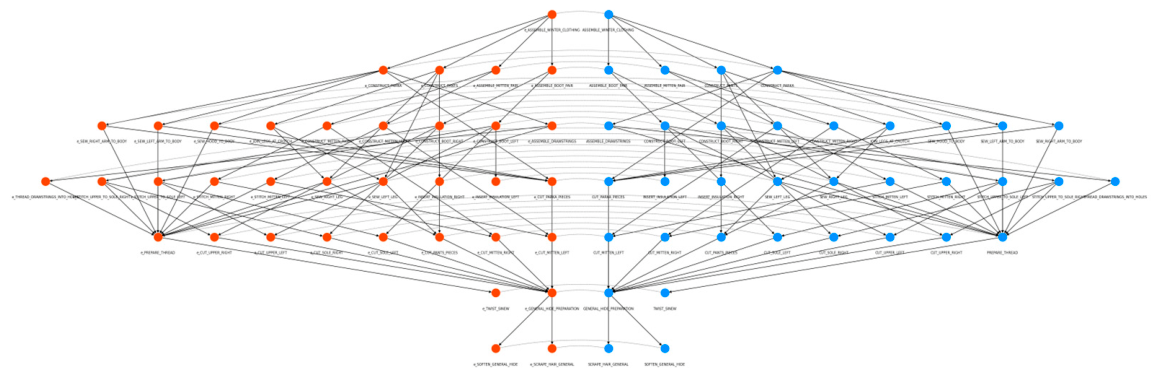
For example, the observability of CONSTRUCT_PARKA if its subcomponents like SEW_HOOD_TO_BODY or ASSEMBLE_DRAWSTRINGS were also observable:
pvemit = min (1, p0 + α · ∑ 1{o(u) ∈ O} ) ,o(v) ~Bernoulli (pvemit)
u ∈ Dep(v)
In the winter clothing case, subassemblies such as PREPARE_THREAD and GENERAL_HIDE_PREPARATION are shared among many garment components. For example, both boots and mittens require hide preparation, and multiple sewing actions rely on prepared thread. The model captures this reuse without duplicating structure, reflecting the realistic reuse of knowledge and material processes. As the walk progresses, observability propagates through the structure. Some nodes emit reliably (e.g., terminal steps with high base probability), while others may not, depending on the emission status of their dependencies. This allows the model to express plausible partial observations, as seen in archaeological contexts. Multiple runs of the model applied to this structured domain are presented below, showing how stochastic resolution and emission dynamics yield plausible, variably observable production sequences.
Sample Production Sequences
--- Chaîne opératoire sample 1—
[intent] ASSEMBLE_WINTER_CLOTHING
[intent] ASSEMBLE_MITTEN_PAIR
[intent] CONSTRUCT_MITTEN_RIGHT
[intent] CUT_MITTEN_RIGHT
[intent] GENERAL_HIDE_PREPARATION
[intent] SCRAPE_HAIR_GENERAL
[fulfill] SCRAPE_HAIR_GENERAL
[emit] observable_from(SCRAPE_HAIR_GENERAL)
[intent] SOFTEN_GENERAL_HIDE
[fulfill] SOFTEN_GENERAL_HIDE
[emit] observable_from(SOFTEN_GENERAL_HIDE)
[note] dependencies satisfied: SCRAPE_HAIR_GENERAL for GENERAL_HIDE_PREPARATION
[note] dependencies satisfied: SOFTEN_GENERAL_HIDE for GENERAL_HIDE_PREPARATION
[fulfill] GENERAL_HIDE_PREPARATION
[emit] observable_from(GENERAL_HIDE_PREPARATION)
[note] dependencies satisfied: GENERAL_HIDE_PREPARATION for CUT_MITTEN_RIGHT
[fulfill] CUT_MITTEN_RIGHT
[emit] observable_from(CUT_MITTEN_RIGHT)
[intent] STITCH_MITTEN_RIGHT
[intent] PREPARE_THREAD
[intent] TWIST_SINEW
[fulfill] TWIST_SINEW
[note] dependencies satisfied: TWIST_SINEW for PREPARE_THREAD
[fulfill] PREPARE_THREAD
[emit] observable_from(PREPARE_THREAD)
[note] dependencies satisfied: CUT_MITTEN_RIGHT for STITCH_MITTEN_RIGHT
[note] dependencies satisfied: STITCH_MITTEN_RIGHT for CONSTRUCT_MITTEN_RIGHT
[fulfill] CONSTRUCT_MITTEN_RIGHT
[intent] CONSTRUCT_MITTEN_LEFT
[intent] CUT_MITTEN_LEFT
[note] dependencies satisfied: GENERAL_HIDE_PREPARATION for CUT_MITTEN_LEFT
[fulfill] CUT_MITTEN_LEFT
[emit] observable_from(CUT_MITTEN_LEFT)
[intent] STITCH_MITTEN_LEFT
[note] dependencies satisfied: CUT_MITTEN_LEFT for STITCH_MITTEN_LEFT
[note] dependencies satisfied: PREPARE_THREAD for STITCH_MITTEN_LEFT
[fulfill] STITCH_MITTEN_LEFT
[emit] observable_from(STITCH_MITTEN_LEFT)
[note] dependencies satisfied: CUT_MITTEN_LEFT for CONSTRUCT_MITTEN_LEFT
[note] dependencies satisfied: STITCH_MITTEN_LEFT for CONSTRUCT_MITTEN_LEFT
[fulfill] CONSTRUCT_MITTEN_LEFT
[emit] observable_from(CONSTRUCT_MITTEN_LEFT)
[note] dependencies satisfied: CONSTRUCT_MITTEN_LEFT for ASSEMBLE_MITTEN_PAIR
[note] dependencies satisfied: CONSTRUCT_MITTEN_RIGHT for ASSEMBLE_MITTEN_PAIR
[fulfill] ASSEMBLE_MITTEN_PAIR
[emit] observable_from(ASSEMBLE_MITTEN_PAIR)
[intent] ASSEMBLE_BOOT_PAIR
[intent] CONSTRUCT_BOOT_RIGHT
[intent] INSERT_INSULATION_RIGHT
[fulfill] INSERT_INSULATION_RIGHT
[emit] observable_from(INSERT_INSULATION_RIGHT)
[intent] CUT_UPPER_RIGHT
[note] dependencies satisfied: GENERAL_HIDE_PREPARATION for CUT_UPPER_RIGHT
[fulfill] CUT_UPPER_RIGHT
[intent] CUT_SOLE_RIGHT
[note] dependencies satisfied: GENERAL_HIDE_PREPARATION for CUT_SOLE_RIGHT
[fulfill] CUT_SOLE_RIGHT
[emit] observable_from(CUT_SOLE_RIGHT)
[intent] STITCH_UPPER_TO_SOLE_RIGHT
[note] dependencies satisfied: CUT_SOLE_RIGHT for STITCH_UPPER_TO_SOLE_RIGHT
[note] dependencies satisfied: CUT_UPPER_RIGHT for STITCH_UPPER_TO_SOLE_RIGHT
[note] dependencies satisfied: PREPARE_THREAD for STITCH_UPPER_TO_SOLE_RIGHT
[fulfill] STITCH_UPPER_TO_SOLE_RIGHT
[emit] observable_from(STITCH_UPPER_TO_SOLE_RIGHT)
[note] dependencies satisfied: CUT_SOLE_RIGHT for CONSTRUCT_BOOT_RIGHT
[note] dependencies satisfied: CUT_UPPER_RIGHT for CONSTRUCT_BOOT_RIGHT
[note] dependencies satisfied: STITCH_UPPER_TO_SOLE_RIGHT for CONSTRUCT_BOOT_RIGHT
[note] dependencies satisfied: INSERT_INSULATION_RIGHT for CONSTRUCT_BOOT_RIGHT
[fulfill] CONSTRUCT_BOOT_RIGHT
[emit] observable_from(CONSTRUCT_BOOT_RIGHT)
[intent] CONSTRUCT_BOOT_LEFT
[intent] CUT_UPPER_LEFT
[note] dependencies satisfied: GENERAL_HIDE_PREPARATION for CUT_UPPER_LEFT
[fulfill] CUT_UPPER_LEFT
[intent] STITCH_UPPER_TO_SOLE_LEFT
[intent] CUT_SOLE_LEFT
[note] dependencies satisfied: GENERAL_HIDE_PREPARATION for CUT_SOLE_LEFT
[fulfill] CUT_SOLE_LEFT
[emit] observable_from(CUT_SOLE_LEFT)
[note] dependencies satisfied: CUT_SOLE_LEFT for STITCH_UPPER_TO_SOLE_LEFT
[note] dependencies satisfied: CUT_UPPER_LEFT for STITCH_UPPER_TO_SOLE_LEFT
[note] dependencies satisfied: PREPARE_THREAD for STITCH_UPPER_TO_SOLE_LEFT
[fulfill] STITCH_UPPER_TO_SOLE_LEFT
[intent] INSERT_INSULATION_LEFT
[fulfill] INSERT_INSULATION_LEFT
[note] dependencies satisfied: CUT_SOLE_LEFT for CONSTRUCT_BOOT_LEFT
[note] dependencies satisfied: CUT_UPPER_LEFT for CONSTRUCT_BOOT_LEFT
[note] dependencies satisfied: STITCH_UPPER_TO_SOLE_LEFT for CONSTRUCT_BOOT_LEFT
[note] dependencies satisfied: INSERT_INSULATION_LEFT for CONSTRUCT_BOOT_LEFT
[fulfill] CONSTRUCT_BOOT_LEFT
[note] dependencies satisfied: CONSTRUCT_BOOT_LEFT for ASSEMBLE_BOOT_PAIR
[note] dependencies satisfied: CONSTRUCT_BOOT_RIGHT for ASSEMBLE_BOOT_PAIR
[fulfill] ASSEMBLE_BOOT_PAIR
[intent] CONSTRUCT_PARKA
[intent] CUT_PARKA_PIECES
[note] dependencies satisfied: GENERAL_HIDE_PREPARATION for CUT_PARKA_PIECES
[fulfill] CUT_PARKA_PIECES
[intent] SEW_LEFT_ARM_TO_BODY
[note] dependencies satisfied: CUT_PARKA_PIECES for SEW_LEFT_ARM_TO_BODY
[note] dependencies satisfied: PREPARE_THREAD for SEW_LEFT_ARM_TO_BODY
[fulfill] SEW_LEFT_ARM_TO_BODY
[emit] observable_from(SEW_LEFT_ARM_TO_BODY)
[intent] SEW_RIGHT_ARM_TO_BODY
[note] dependencies satisfied: CUT_PARKA_PIECES for SEW_RIGHT_ARM_TO_BODY
[note] dependencies satisfied: PREPARE_THREAD for SEW_RIGHT_ARM_TO_BODY
[fulfill] SEW_RIGHT_ARM_TO_BODY
[emit] observable_from(SEW_RIGHT_ARM_TO_BODY)
[intent] SEW_HOOD_TO_BODY
[note] dependencies satisfied: CUT_PARKA_PIECES for SEW_HOOD_TO_BODY
[note] dependencies satisfied: PREPARE_THREAD for SEW_HOOD_TO_BODY
[fulfill] SEW_HOOD_TO_BODY
[emit] observable_from(SEW_HOOD_TO_BODY)
[intent] ASSEMBLE_DRAWSTRINGS
[intent] THREAD_DRAWSTRINGS_INTO_HOLES
[note] dependencies satisfied: PREPARE_THREAD for THREAD_DRAWSTRINGS_INTO_HOLES
[fulfill] THREAD_DRAWSTRINGS_INTO_HOLES
[emit] observable_from(THREAD_DRAWSTRINGS_INTO_HOLES)
[note] dependencies satisfied: PREPARE_THREAD for ASSEMBLE_DRAWSTRINGS
[note] dependencies satisfied: THREAD_DRAWSTRINGS_INTO_HOLES for ASSEMBLE_DRAWSTRINGS
[fulfill] ASSEMBLE_DRAWSTRINGS
[note] dependencies satisfied: CUT_PARKA_PIECES for CONSTRUCT_PARKA
[note] dependencies satisfied: SEW_HOOD_TO_BODY for CONSTRUCT_PARKA
[note] dependencies satisfied: SEW_LEFT_ARM_TO_BODY for CONSTRUCT_PARKA
[note] dependencies satisfied: SEW_RIGHT_ARM_TO_BODY for CONSTRUCT_PARKA
[note] dependencies satisfied: ASSEMBLE_DRAWSTRINGS for CONSTRUCT_PARKA
[fulfill] CONSTRUCT_PARKA
[emit] observable_from(CONSTRUCT_PARKA)
[intent] CONSTRUCT_PANTS
[intent] SEW_RIGHT_LEG
[intent] CUT_PANTS_PIECES
[note] dependencies satisfied: GENERAL_HIDE_PREPARATION for CUT_PANTS_PIECES
[fulfill] CUT_PANTS_PIECES
[note] dependencies satisfied: CUT_PANTS_PIECES for SEW_RIGHT_LEG
[note] dependencies satisfied: PREPARE_THREAD for SEW_RIGHT_LEG
[fulfill] SEW_RIGHT_LEG
[intent] SEW_LEFT_LEG
[note] dependencies satisfied: CUT_PANTS_PIECES for SEW_LEFT_LEG
[note] dependencies satisfied: PREPARE_THREAD for SEW_LEFT_LEG
[fulfill] SEW_LEFT_LEG
[emit] observable_from(SEW_LEFT_LEG)
[intent] JOIN_LEGS_AT_CROTCH
[note] dependencies satisfied: SEW_LEFT_LEG for JOIN_LEGS_AT_CROTCH
[note] dependencies satisfied: SEW_RIGHT_LEG for JOIN_LEGS_AT_CROTCH
[fulfill] JOIN_LEGS_AT_CROTCH
[emit] observable_from(JOIN_LEGS_AT_CROTCH)
[note] dependencies satisfied: CUT_PANTS_PIECES for CONSTRUCT_PANTS
[note] dependencies satisfied: SEW_LEFT_LEG for CONSTRUCT_PANTS
[note] dependencies satisfied: SEW_RIGHT_LEG for CONSTRUCT_PANTS
[note] dependencies satisfied: JOIN_LEGS_AT_CROTCH for CONSTRUCT_PANTS
[fulfill] CONSTRUCT_PANTS
[emit] observable_from(CONSTRUCT_PANTS)
[note] dependencies satisfied: CONSTRUCT_PARKA for ASSEMBLE_WINTER_CLOTHING
[note] dependencies satisfied: ASSEMBLE_MITTEN_PAIR for ASSEMBLE_WINTER_CLOTHING
[note] dependencies satisfied: CONSTRUCT_PANTS for ASSEMBLE_WINTER_CLOTHING
[note] dependencies satisfied: ASSEMBLE_BOOT_PAIR for ASSEMBLE_WINTER_CLOTHING
[fulfill] ASSEMBLE_WINTER_CLOTHING
--- Chaîne opératoire sample 2—
[intent] ASSEMBLE_WINTER_CLOTHING
[intent] ASSEMBLE_BOOT_PAIR
[intent] CONSTRUCT_BOOT_LEFT
[intent] STITCH_UPPER_TO_SOLE_LEFT
[intent] CUT_UPPER_LEFT
[intent] GENERAL_HIDE_PREPARATION
[intent] SOFTEN_GENERAL_HIDE
[fulfill] SOFTEN_GENERAL_HIDE
[intent] SCRAPE_HAIR_GENERAL
[fulfill] SCRAPE_HAIR_GENERAL
[emit] observable_from(SCRAPE_HAIR_GENERAL)
[note] dependencies satisfied: SCRAPE_HAIR_GENERAL for GENERAL_HIDE_PREPARATION
[note] dependencies satisfied: SOFTEN_GENERAL_HIDE for GEN ERAL_HIDE_PREPARATION
[fulfill] GENERAL_HIDE_PREPARATION
[emit] observable_from(GENERAL_HIDE_PREPARATION)
[note] dependencies satisfied: GENERAL_HIDE_PREPARATION for CUT_UPPER_LEFT
[fulfill] CUT_UPPER_LEFT
[intent] CUT_SOLE_LEFT
[note] dependencies satisfied: GENERAL_HIDE_PREPARATION for CUT_SOLE_LEFT
[fulfill] CUT_SOLE_LEFT
[emit] observable_from(CUT_SOLE_LEFT)
[intent] PREPARE_THREAD
[intent] TWIST_SINEW
[fulfill] TWIST_SINEW
[emit] observable_from(TWIST_SINEW)
[note] dependencies satisfied: TWIST_SINEW for PREPARE_THREAD
[fulfill] PREPARE_THREAD
[emit] observable_from(PREPARE_THREAD)
[note] dependencies satisfied: CUT_SOLE_LEFT for STITCH_UPPER_TO_SOLE_LEFT
[note] dependencies satisfied: CUT_UPPER_LEFT for STITCH_UPPER_TO_SOLE_LEFT
[note] dependencies satisfied: PREPARE_THREAD for STITCH_UP PER_TO_SOLE_LEFT
[fulfill] STITCH_UPPER_TO_SOLE_LEFT
[emit] observable_from(STITCH_UPPER_TO_SOLE_LEFT)
[intent] INSERT_INSULATION_LEFT
[fulfill] INSERT_INSULATION_LEFT
[note] dependencies satisfied: CUT_SOLE_LEFT for CONSTRUCT_BOOT_LEFT
[note] dependencies satisfied: CUT_UPPER_LEFT for CONSTRUCT_BOOT_LEFT
[note] dependencies satisfied: STITCH_UPPER_TO_SOLE_LEFT for CONSTRUCT_BOOT_LEFT
[note] dependencies satisfied: INSERT_INSULATION_LEFT for CONSTRUCT_BOOT_LEFT
[fulfill] CONSTRUCT_BOOT_LEFT
[emit] observable_from(CONSTRUCT_BOOT_LEFT)
[intent] CONSTRUCT_BOOT_RIGHT
[intent] INSERT_INSULATION_RIGHT
[fulfill] INSERT_INSULATION_RIGHT
[intent] CUT_SOLE_RIGHT
[note] dependencies satisfied: GENERAL_HIDE_PREPARATION for CUT_SOLE_RIGHT
[fulfill] CUT_SOLE_RIGHT
[intent] STITCH_UPPER_TO_SOLE_RIGHT
[intent] CUT_UPPER_RIGHT
[note] dependencies satisfied: GENERAL_HIDE_PREPARATION for CUT_UPPER_RIGHT
[fulfill] CUT_UPPER_RIGHT
[emit] observable_from(CUT_UPPER_RIGHT)
[note] dependencies satisfied: CUT_SOLE_RIGHT for STITCH_UPPER_TO_SOLE_RIGHT
[note] dependencies satisfied: CUT_UPPER_RIGHT for STITCH_UPPER_TO_SOLE_RIGHT
[note] dependencies satisfied: PREPARE_THREAD for STITCH_UPPER_TO_SOLE_RIGHT
[fulfill] STITCH_UPPER_TO_SOLE_RIGHT
[emit] observable_from(STITCH_UPPER_TO_SOLE_RIGHT)
[note] dependencies satisfied: CUT_SOLE_RIGHT for CONSTRUCT_BOOT_RIGHT
[note] dependencies satisfied: CUT_UPPER_RIGHT for CONSTRUCT_BOOT_RIGHT
[note] dependencies satisfied: STITCH_UPPER_TO_SOLE_RIGHT for CONSTRUCT_BOOT_RIGHT
[note] dependencies satisfied: INSERT_INSULATION_RIGHT for CONSTRUCT_BOOT_RIGHT
[fulfill] CONSTRUCT_BOOT_RIGHT
[note] dependencies satisfied: CONSTRUCT_BOOT_LEFT for ASSEMBLE_BOOT_PAIR
[note] dependencies satisfied: CONSTRUCT_BOOT_RIGHT for ASSEMBLE_BOOT_PAIR
[fulfill] ASSEMBLE_BOOT_PAIR
[intent] CONSTRUCT_PARKA
[intent] SEW_LEFT_ARM_TO_BODY
[intent] CUT_PARKA_PIECES
[note] dependencies satisfied: GENERAL_HIDE_PREPARATION for CUT_PARKA_PIECES
[fulfill] CUT_PARKA_PIECES
[emit] observable_from(CUT_PARKA_PIECES)
[note] dependencies satisfied: CUT_PARKA_PIECES for SEW_LEFT_ARM_TO_BODY
[note] dependencies satisfied: PREPARE_THREAD for SEW_LEFT_ARM_TO_BODY
[fulfill] SEW_LEFT_ARM_TO_BODY
[emit] observable_from(SEW_LEFT_ARM_TO_BODY)
[intent] ASSEMBLE_DRAWSTRINGS
[intent] THREAD_DRAWSTRINGS_INTO_HOLES
[note] dependencies satisfied: PREPARE_THREAD for THREAD_DRAWSTRINGS_INTO_HOLES
[fulfill] THREAD_DRAWSTRINGS_INTO_HOLES
[emit] observable_from(THREAD_DRAWSTRINGS_INTO_HOLES)
[note] dependencies satisfied: PREPARE_THREAD for ASSEMBLE_DRAWSTRINGS
[note] dependencies satisfied: THREAD_DRAWSTRINGS_INTO_HOLES for ASSEMBLE_DRAWSTRINGS
[fulfill] ASSEMBLE_DRAWSTRINGS
[emit] observable_from(ASSEMBLE_DRAWSTRINGS)
[intent] SEW_RIGHT_ARM_TO_BODY
[note] dependencies satisfied: CUT_PARKA_PIECES for SEW_RIGHT_ARM_TO_BODY
[note] dependencies satisfied: PREPARE_THREAD for SEW_RIGHT_ARM_TO_BODY
[fulfill] SEW_RIGHT_ARM_TO_BODY
[emit] observable_from(SEW_RIGHT_ARM_TO_BODY)
[intent] SEW_HOOD_TO_BODY
[note] dependencies satisfied: CUT_PARKA_PIECES for SEW_HOOD_TO_BODY
[note] dependencies satisfied: PREPARE_THREAD for SEW_HOOD_TO_BODY
[fulfill] SEW_HOOD_TO_BODY
[emit] observable_from(SEW_HOOD_TO_BODY)
[note] dependencies satisfied: CUT_PARKA_PIECES for CONSTRUCT_PARKA
[note] dependencies satisfied: SEW_HOOD_TO_BODY for CONSTRUCT_PARKA
[note] dependencies satisfied: SEW_LEFT_ARM_TO_BODY for CONSTRUCT_PARKA
[note] dependencies satisfied: SEW_RIGHT_ARM_TO_BODY for CONSTRUCT_PARKA
[note] dependencies satisfied: ASSEMBLE_DRAWSTRINGS for CONSTRUCT_PARKA
[fulfill] CONSTRUCT_PARKA
[emit] observable_from(CONSTRUCT_PARKA)
[intent] ASSEMBLE_MITTEN_PAIR
[intent] CONSTRUCT_MITTEN_RIGHT
[intent] STITCH_MITTEN_RIGHT
[intent] CUT_MITTEN_RIGHT
[note] dependencies satisfied: GENERAL_HIDE_PREPARATION for CUT_MITTEN_RIGHT
[fulfill] CUT_MITTEN_RIGHT
[note] dependencies satisfied: CUT_MITTEN_RIGHT for STITCH_MITTEN_RIGHT
[note] dependencies satisfied: PREPARE_THREAD for STITCH_MITTEN_RIGHT
[fulfill] STITCH_MITTEN_RIGHT
[note] dependencies satisfied: CUT_MITTEN_RIGHT for CONSTRUCT_MITTEN_RIGHT
[note] dependencies satisfied: STITCH_MITTEN_RIGHT for CONSTRUCT_MITTEN_RIGHT
[fulfill] CONSTRUCT_MITTEN_RIGHT
[intent] CONSTRUCT_MITTEN_LEFT
[intent] STITCH_MITTEN_LEFT
[intent] CUT_MITTEN_LEFT
[note] dependencies satisfied: GENERAL_HIDE_PREPARATION for CUT_MITTEN_LEFT
[fulfill] CUT_MITTEN_LEFT
[emit] observable_from(CUT_MITTEN_LEFT)
[note] dependencies satisfied: CUT_MITTEN_LEFT for STITCH_MITTEN_LEFT
[note] dependencies satisfied: PREPARE_THREAD for STITCH_MITTEN_LEFT
[fulfill] STITCH_MITTEN_LEFT
[emit] observable_from(STITCH_MITTEN_LEFT)
[note] dependencies satisfied: CUT_MITTEN_LEFT for CONSTRUCT_MITTEN_LEFT
[note] dependencies satisfied: STITCH_MITTEN_LEFT for CONSTRUCT_MITTEN_LEFT
[fulfill] CONSTRUCT_MITTEN_LEFT
[emit] observable_from(CONSTRUCT_MITTEN_LEFT)
[note] dependencies satisfied: CONSTRUCT_MITTEN_LEFT for ASSEMBLE_MITTEN_PAIR
[note] dependencies satisfied: CONSTRUCT_MITTEN_RIGHT for ASSEMBLE_MITTEN_PAIR
[fulfill] ASSEMBLE_MITTEN_PAIR
[emit] observable_from(ASSEMBLE_MITTEN_PAIR)
[intent] CONSTRUCT_PANTS
[intent] CUT_PANTS_PIECES
[note] dependencies satisfied: GENERAL_HIDE_PREPARATION for CUT_PANTS_PIECES
[fulfill] CUT_PANTS_PIECES
[emit] observable_from(CUT_PANTS_PIECES)
[intent] JOIN_LEGS_AT_CROTCH
[intent] SEW_LEFT_LEG
[note] dependencies satisfied: CUT_PANTS_PIECES for SEW_LEFT_LEG
[note] dependencies satisfied: PREPARE_THREAD for SEW_LEFT_LEG
[fulfill] SEW_LEFT_LEG
[emit] observable_from(SEW_LEFT_LEG)
[intent] SEW_RIGHT_LEG
[note] dependencies satisfied: CUT_PANTS_PIECES for SEW_RIGHT_LEG
[note] dependencies satisfied: PREPARE_THREAD for SEW_RIGHT_LEG
[fulfill] SEW_RIGHT_LEG
[emit] observable_from(SEW_RIGHT_LEG)
[note] dependencies satisfied: SEW_LEFT_LEG for JOIN_LEGS_AT_CROTCH
[note] dependencies satisfied: SEW_RIGHT_LEG for JOIN_LEGS_AT_CROTCH
[fulfill] JOIN_LEGS_AT_CROTCH
[note] dependencies satisfied: CUT_PANTS_PIECES for CONSTRUCT_PANTS
[note] dependencies satisfied: SEW_LEFT_LEG for CONSTRUCT_PANTS
[note] dependencies satisfied: SEW_RIGHT_LEG for CONSTRUCT_PANTS
[note] dependencies satisfied: JOIN_LEGS_AT_CROTCH for CONSTRUCT_PANTS
[fulfill] CONSTRUCT_PANTS
[emit] observable_from(CONSTRUCT_PANTS)
[note] dependencies satisfied: CONSTRUCT_PARKA for ASSEMBLE_WINTER_CLOTHING
[note] dependencies satisfied: ASSEMBLE_MITTEN_PAIR for ASSEMBLE_WINTER_CLOTHING
[note] dependencies satisfied: CONSTRUCT_PANTS for ASSEMBLE_WINTER_CLOTHING
[note] dependencies satisfied: ASSEMBLE_BOOT_PAIR for ASSEMBLE_WINTER_CLOTHING
[fulfill] ASSEMBLE_WINTER_CLOTHING
[emit] observable_from(ASSEMBLE_WINTER_CLOTHING)
References
- Abramova, Z. A. (1979). The Paleolithic of the Yenisei. Nauka (in Russian).
- Abramova, Z. A. (1989). The Paleolithic of Northern Asia. In The Paleolithic of the Caucasus and Northern Asia (pp. 143–243). Nauka. (in Russian).
- Adami, C. (2000). Evolution of biological complexity. Proceedings of the National Academy of Sciences, 97(9), 4463–4468.
- Adami, C. (1998). Introduction to artificial life. Springer.
- Adler, D. S., Wilkinson, K. N., Blockley, S., Mark, D. F., Pinhasi, R., Schmidt-Magee, B. A., Nahapetyan, S., Mallol, C., Berna, F., Glauberman, P. J., Raczynski-Henk, Y., Wales, N., Frahm, E., Jöris, O., MacLeod, A., Smith, V. C., Cullen, V. L., & Gasparian, B. (2014). Early Levallois technology and the Lower to Middle Paleolithic transition in the southern Caucasus. Science, 345, 1609–1613.
- Aiello, L., & Dean, C. (1990). An introduction to human evolutionary anatomy. Academic Press.
- Aiello, L. C., & Wheeler, P. (1995). The expensive-tissue hypothesis: the brain and the digestive system in human and primate evolution. Current Anthropology, 36, 199–221.
- Allman, J. M. (1999). Evolving brains. Scientific American Library.
- Ambrose, S. H. (2001). Paleolithic technology and human evolution. Science, 291, 1748–1753.
- Aranguren B, Ravedin A, Amico N, Cavulli F, Giachi G, Grimaldi S, Macchioni, N., & Santanielloet, F. (2018). Wooden tools and fire technology in the early Neanderthal site of Poggetti Vecchi (Italy). Proceedings of the National Academy of Sciences, 115(9), 2054–2059.
- Archer, W., Aldeias, V., & McPherron, S. P. (2020). What is ‘in situ’? a reply to Harmand et al. (2015). Journal of Human Evolution, 142, 102740.
- Arora, S., & Barak, B. (2009). Computational complexity: a modern approach. Cambridge University Press.
- Arthur, W. B. (2009). The nature of technology: what it is and how it evolves. Free Press.
- Atkinson, Q. D. (2011). Phonemic diversity supports a serial founder effect model of language expansion from Africa. Science, 332, 346–349.
- Bradfield, J., & Langley, M. C. (2026). Bone tool diversity during the Stone Age: more insights into the human story. Journal of Archaeological Research, 34, 151–205.
- Bäck, T. (1996). Evolutionary algorithms in theory and practice. Oxford University Press.
- Balari S, Benítez-Burraco A, Longa VM, & Lorenzo G. (2013). The fossils of language: what are they? who has them? How did they evolve? In The Cambridge handbook of biolingusitics (pp. 489–523). Cambridge University Press.
- Balari, S, & Lorenzo, G. (2013). Computational phenotypes: towards an evolutionary developmental biolingusitics. Oxford University Press.
- Barham, L., Duller, G. A. T., Candy, I., Scott, C., Cartwright, C. R., Peterson, J. R., Kabukcu, C., Chapot, M. S., Melia, F., Rots, V., George, N., Taipale, N., Gethin, P., & Nkombwe, P. (2023). Evidence for the earliest structural use of wood at least 476,000 years ago. Nature, 622, 107–111.
- Barham, L. S. (2013). From hand to handle: the first industrial revolution. Oxford University Press.
- Beals, K. L., Smith, C. L., Dodd, S. M. (1984). Brain size, cranial morphology, climate, and time machines. Current Anthropology, 25, 301–330.
- Beaudet, A., Du, A., & Wood, B. (2019). Evolution of the modern human brain. In Progress in brain research, vol. 250 (pp. 219–250). Elsevier.
- Beyne, Y., Katoh, S., WoldeGabriel, G., Kart, W. K., Uto, K., Sudo, M., Kondo, M., Hyodo, M., Renne, P. R., Suwa, G., & Asfaw, B. (2013). The characteristics and chronology of the earliest Acheulean at Konso, Ethiopia. Proceedings of the National Academy of Sciences, 110(5), 1584–1591.
- Bickerton, D. (1990). Language & species. University of Chicago Press.
- Bleed, P. (2011). Reduction sequence, chaîne opératoire, and other methods: the epistemologies of different approaches to lithic analysis loosening our chaînes: cognitive insights for the archaeological application of sequence models. PaleoAnthropology, 2011, 297–304.
- Boëda, E., Bonilauri, S., Connan, J., Jarvie, D., Mercier, N., Tobey, N., Valladas, H., al Sakhel, H., & Muhesenet, S. (2008). Middle Palaeolithic bitumen use at Umm el Tlel around 70,000 BP. Antiquity, 82, 853–861.
- Boëda, E. (1995). Levallois: a volumetric construction, methods, a technique. In The definition and interpretation of Levallois technology (pp. 41–68). Prehistory Press.
- Bourke, A. F. G. (2011). Principles of social evolution. Oxford University Press.
- Bradfield, J., & Langley, M. C. (2026). Bone tool diversity during the Stone Age: more insights into the human story. Journal of Archaeological Research, 34, 151–205.
- Braha, D., & Maimon, O. (1998). A mathematical theory of design: foundations, algorithms and applications. Kluwer Academic Publishers.
- Calcott, B., & Sterelny, K., editors. (2011). The major transitions in evolution revisited. MIT Press.
- Carmel, Y., Havit, A., Lamm, E., & Szathmáry, E. (2023). Human socio-cultural evolution in light of evolutionary transitions: introduction to the theme issue. Philosophical Transactions of the Royal Society B, 378, 20210397.
- Castle, S. D., Stock, M., & Gorochowski, T. E. (2024). Engineering is evolution: a perspective on design process to engineer biology. Nature Communications, 15, 3640.
- Cattelain, P. (2018). The Le Placard spearthrowers. In The Grotte Du Placard at 150: new considerations on an exceptional prehistoric site (pp. 146–156). Archaeopress.
- Cavalli-Sforza, L. L., & Cavalli-Sforza, F. (1995). The great human diasporas: the history of diversity and evolution. Addison-Wesley.
- Chaitin, G. J. (1975). A theory of program size formally identical to information theory. Journal of the Association for Computing Machinery, 22(3), 329–340.
- Chaitin, G. J. (1977). Algorithmic information theory. IBM Journal of Research and Development, July, 350–359.
- Chaitin, G. J. (1987). Algorithmic information theory. Cambridge University Press.
- Cobham, A. (1965). The intrinsic computational difficulty of functions. In Proceedings of the 1964 International Conference for Logic, Methodology, and Philosophy of Sciences (pp. 24–30). North Holland.
- Coe, D., Barham, L., Gardiner, J., & Crompton, R. (2022). A biomechanical investigation of the efficiency hypothesis of hafted tool technology. Journal of the Royal Society Interface, 19, 20210660.
- Collard, M., Tarle, L., Sandgathe, D., & Allan, A. (2016). Faunal evidence for a difference in clothing use between Neanderthals and early modern humans in Europe. Journal of Anthropological Archaeology, 44, 235–246.
- Coppe, J., Taipale, N, & Rots, V. (2023). Terminal ballistic analysis of impact fractures reveals the use of a spearthrower 31 ky age at Maisières-Canal, Belgium. Scientific Reports, 13, 18305.
- Cormen, T. H., Leiserson, C. E., Rivest, R. L., & Stein, C. (2009). Introduction to algorithms. 3rd ed. MIT Press.
- Coslett, H. B., & Schwartz, M. F. (2018). The parietal lobe and language. In Handbook of clinical neurology, vol. 151, the parietal lobe (pp. 365–375). Elsevier.
- Das, A. (2003). Knowledge representation. In Encyclopedia of information systems, volume 3 (pp. 33–41). Elsevier.
- Dasgupta, D., & Michalewicz, Z., editors. (1997). Evolutionary algorithms in engineering applications. Springer.
- De Jong, K. A. (2006). Evolutionary computation: a unified approach. MIT Press.
- de la Torre, I. (2016). The origins of the Acheulean: past and present perspectives on a major transition in human evolution. Philosophical Transactions of the Royal Society B, 371, 20150245.
- Dean, C., Leakey, M. G., Reid, D., Friedemann-Schrenk, G., Schwartz, T., Stringer, C., & Walker, A. (2001). Growth processes in teeth distinguish modern humans from Homo erectus and earlier hominins. Nature, 414, 628–631.
- Deetz, J. (1967). Invitation to archaeology. The Natural History Press.
- Delagnes, A, & Roche, H. (2005). Late Pliocene hominid knapping skills: the case of Lokalalei 2C, West Turkana, Kenya. Journal of Human Evolution, 48, 435–472.
- Diez-Martin, F., Sánchez Yustos, P., Uribelarrea, Baquedano, E., Mark, D. F., Mabulla, A., Fraile, C., Duque, J., Díaz, I., Pérez-González, A., Yravedra, J., Egeland, C. P., Organista, E., & Domínguez-Rodrigo, M. (2015). The origin of the Acheulean: the 1.7 million-year-old site of FLK West, Olduvai Gorge (Tanzania). Scientific Reports, 5, 17839.
- Du, A., Zipkin, A. M., Hatala, K. G., Renner, E., Baker, J. L., Bianchi, S., Bernal, K. H., & Wood, B. A. (2018). Pattern and process in hominin brain size evolution are scale-dependent. Proceedings of the Royal Society B, 285, 20172738.
- Dunbar, R. I. M. (2009). The social brain hypothesis and its implications for social evolution. Annals of Human Biology, 36(5), 562–572.
- Dunbar, R. I. M. (2024). The social brain hypothesis – thirty years on. Annals of Human Biology, 51(1), 2359920.
- Dunnell, R. C. (1980). Evolutionary theory and archaeology. Advances in Archaeological Method and Theory, 3, 35–99.
- Ekström, A. G., Gärdenfors, P., Snyder, W. D., Friedrichs, D., McCarthy, R. C., Tsapos, M., Tennie, C., Strait, D. S., Edlund, J. & Moran, S. (2025). Correlates of vocal tract evolution in late Pliocene and Pleistocene hominins. Human Nature, 36, 22–69.
- Eren, M. I., Lycett, S. J., Patten, R. J., Buchanan, B., Pargeter, J., & O’Brien, M. J. (2016). Test, model, and method validation: the role of experimental stone artifact replication in hypothesis-driven archaeology. Ethnoarchaeology, 8, 103–136.
- Fajardo, S., Kleijn, J., Takes, F. W., & Langejans, G. H. J. (2022). Modelling and measuring complexity of traditional and ancient technologies using Petri nets. PLoS ONE, 17(11), e0278310.
- Falk, D. (2004). Braindance: new discoveries about human origins and brain evolution. 2nd ed. University Press of Florida.
- Fernando, C., Goldstein, R., & Szathmáry, E. (2010). The neuronal replicator hypothesis. Neural Computation, 22(11), 2809–2857.
- Fernyhough, C., & Borghi, A. M. (2023). Inner speech as language process and cognitive tool. Trends in Cognitive Sciences, 27(12), 1180–1193.
- Ferraro, J. V., Plummer, T. W., Pobiner, B. L., Oliver, J. S., Bishop, L. C., Braun, D. R., Ditchfield, P. W., Seaman III, J. W., Binetti, K. M., Seaman Jr, J. W., Hertel, F., & Potts, R. (2013). Earliest archaeological evidence of persistent hominin carnivory. PLoS ONE, 8, e62174.
- Feynman, R. P. (1996). Feynman lectures on computation. Addison-Wesley.
- Fitch, W. T. (2010). The evolution of language. Cambridge University Press.
- Fogel, D. B, editor. (1998). Evolutionary computation: the fossil record. IEEE Press.
- Friedel, R., & Israel, P. (2010). Edison’s electric light: the art of invention. John Hopkins University Press.
- Gabrielli, J. D. E., Poldrack, R. A, & Desmond, J. E. (1998). The role of the left prefrontal cortex in language and memory. Proceedings of the National Academy of Sciences, 95, 906–913.
- Gatlin, L. L. (1972). Information theory and the living system. Columbia University Press.
- Gilligan, I. (2010). The prehistoric development of clothing: archaeological implications of a thermal model. Journal of Archaeological Theory and Method, 17, 15–80.
- Gilligan, I., d’Errico, F., Doyon, L., Wang, W. & Kuzmin, Y. V. (2024). Paleolithic eyed needles and the evolution of dress. Science Advances, 10(26), eadp2887.
- Gingerich, P. D. (2022). Pattern and rate in the Plio-Pleistocene evolution of modern human brain size. Scientific Reports, 12, 11216.
- Goldberg, D. E. (2002). The design of innovation: lessons from and for competent genetic algorithms. Kluwer Academic Publishers.
- González-Forero, M., & Gardner, A. (2018). Inference of ecological and social drivers of human brain-size evolution. Nature, 557, 554–557.
- Goren-Inbar, N., Grosman, L., & Sharon, G. (2011). The technology and significance of the Acheulian giant cores of Gesher Benot Ya’aqov, Israel. Journal of Archaeological Science, 38, 1901–1917.
- Goren-Inbar, N., Werker, E., & Feibel, C. S, editors. (220). The Acheulian site of Gesher Benot Ya’aqov, Israel: I the wood assemblage. Oxbow Books.
- Gowlett, J. A. J. (2006). The elements of design form in Acheulean bifaces: modes, modalities, rules, and language. In Axe age: Acheulean tool-making from quarry to discard (pp. 203–221). Equinox.
- Greenfield, P. M. (1991). Language, tools, and brain: the ontogeny and phylogeny of hierarchically organized sequential behavior. Behavioral and Brain Sciences, 14, 531–595.
- Haik, Y., Sivaloganathan, S., & Shahin, T. (2011). Engineering design process. 3rd edition. Cengage Learning.
- Harary, F. (1994). Graph theory. Perseus.
- Hardy, B. L., Moncel, M-H., Kerfant, C., Lebon, M., Bellot-Gurlet, L., & Mélard, N. (2020). Direct evidence of Neanderthal fibre technology and its cognitive and behavioral implications. Scientific Reports, 10, 4889.
- Harmand, S., Lewis, J. E., Feibel, C. S., Lepre, C. J., Prat, S., Lenoble, A., Boës, X., Quinn, R. L., Brenet, M., Arroyo, A., Taylor, N., Clément, S., Daver, G., Brugal, J-P., Leakey, L., Mortlock, R. A., Wright, J. D., Lokorodi, S., Kirwa, C., Kent, D. V., & Roche, H. (2015). 3.3-million-year-old stone tools from Lomekwi 3, West Turkana, Kenya. Nature, 521, 310–315.
- Hartmanis, J., & Stearns, R. E. (1965). On the computational complexity of algorithms. Transactions of the American Mathematical Society, 177, 285–306.
- Hayes, T., Rao, R., Akin, H., Sofroniew, N. J., Oktay, D., Lin, Z., Verkuil, R., Tran, V. Q., Deaton, J., Wiggert, M., Badkundri, R., Shafkat, I., Gong, J., Derry, A., Molina, R. S., Thomas, N., Khan, Y. A., Mishra, C., Kim, C., Bartie, L. J., Nemeth, M., Hsu, P. D., Sercu, T., Candido, S., & Rives, A. (2025). Simulating 500 million years of evolution with a language model. Science, 387, 850–858.
- Heinzinger, M., Elnaggar, A., Wang, Y., Dallago, C., Nechaev, D., Matthes, F., & Rost, B. (2019). Modeling aspects of the language of life through transfer-learning protein sequences. BMC Bioinformatics, 20, 723.
- Herculano-Houzel, S. (2009). The human brain in numbers: a linearly scaled-up primate brain. Frontiers in Human Neuroscience, 3, 1–11.
- Hoffecker, J. F. (2013). The information animal and the super-brain. Journal of Archaeological Method and Theory, 20(1), 18–41.
- Hoffecker, J. F. (2017). Modern humans: their African origin and global dispersal. Columbia University Press.
- Hoffecker, J. F. (2018). The complexity of Neanderthal technology. Proceedings of the National Academy of Sciences, 114, 1959–1961.
- Hoffecker, J. F. (2023). Human settlement of northern Eurasia and Beringia: anatomy, diet, and technology. Anthropological Papers of the University of Alaska, 7(1–2), 14–40.
- Hoffecker, J. F., & Hoffecker, I. T. (2017). Technological complexity and the global dispersal of modern humans. Evolutionary Anthropology, 26, 285–299.
- Holloway, R. L. (1995). Evolution of the human brain. In Handbook of human symbolic evolution (pp. 74–125). Clarendon Press.
- Holloway, R. L. (1969). Culture: a human domain. Current Anthropology, 10, 395–412.
- Hopcroft, J. E., Motwani, R., & Ullman, J. D. (2007). Introduction to automata theory, languages, and computation. 3rd ed. Addison-Wesley.
- Hubka, V., & Eder, W. E. (1996). Design science: introduction to the needs, scope and organization of engineering design knowledge. Springer.
- Hublin, J-J, & Changeux, J. P. (2022). Paleoanthropology of cognition: an overview on Hominins brain evolution. Comptes Rendus Biologies, 345(2), 57-75.
- Hutson, J. M., Bittmann, F., Fischer, P., García-Moreno, A., Gaudzinski-Windheuser, S., Nelson, E., Ortiz, J. E., Penkman, K. E. H., Perić, Z. M., Richter, D., Torres, T., Turner, E., Villaluenga, A., White, D., & Jöris, O. (2025). Revised age for Schöningen hunting spears indicates intensification of Neanderthal cooperative behavior around 200,000 years ago. Science Advances, 11, eadv0752.
- Isler, K., & van Schaik, C. P. (2014). How humans evolved large brains: comparative evidence. Evolutionary Anthropology, 23, 65–75.
- Issenman, B. K. (1997). Sinews of survival: the living legacy of Inuit clothing. University of British Columbia Press.
- Jerison, H. J. (1973). Evolution of the brain and intelligence. Academic Press.
- Kivell, T.L., Baraki, N., Lockwood, V., Williams-Hatala, E. M., & Wood, B. (2023). Form, function and evolution of the human hand. Yearbook of Biological Anthropology, 181(Suppl 76), 6–57.
- Klein, R. G. (2009). The human career: human biological and cultural origins. 3rd ed. University of Chicago Press.
- Kolmogorov, A. N. (1968). Logical basis for information theory and probability theory. IEEE Transactions on Information Theory, IT-14, 662.
- Kozowyk, P. R. B., Soressi, M., Pomstra, D., & Langejans, G. H. J. (2017). Experimental methods for the Palaeolithic dry distillation of birch bark: implications for the origins and development of Neandertal adhesive technology. Scientific Reports, 7, 8033.
- Kuhn, S. L. (2021). The evolution of Paleolithic technologies. Routledge.
- Landauer, R. (1991). Information is physical. Physics Today, May 1991, 23–29.
- Lauritzen, S. L. (1996). Graphical models. Oxford University Press.
- Layton, E. T., (1974). Technology as knowledge. Technology and Culture, 15, 31–41.
- Leakey, M. D. (1971). Olduvai Gorge volume 3: excavations in beds I & II 1960–1963. Cambridge University Press.
- LeBel, A., & D’Mello, A. N. (2023). A seat at the (language) table: incorporating the cerebellum into frameworks for language processing. Current Opinion in Behavioral Sciences, 53, 101310.
- Leder, D., Lehmann, J., Milks, A., Koddenberg, T., Sietz, M., Vogel, M., Böhner, U., & Terberger, T. (2024). The wooden artifacts from Schöningen’s spear horizon and their place in human evolution. Proceedings of the National Academy of Sciences, 121(15), e2320484121.
- Lee, R. B. (1979). The !Kung San: men, women, and work in a foraging society. Cambridge University Press.
- Lepre, C. J, Roche, H., Kent, D. K., Harmand, S., Quinn, R., Brugal, J-P., Texier, P-J., Lenoble, A., & Feibel, C. S. (2011). An earlier origin for the Acheulian. Nature, 477, 82–85.
- Lewis, H. R., & Papadimitriou, C. H. (1998). Elements of the theory of computation. 2nd ed. Prentice-Hall.
- Lieberman, D. E. (2011). The evolution of the human head. Belknap Press of Harvard University Press.
- Lieberman, P. (1984). The biology and evolution of language. Harvard University Press.
- Liu, J-H., Ruan, Q-J., Ge, J-Y., Huang, Y-J., Zhang, X-L., Liu, J., Li, S. F., Shen, H., Wang, Y., Stidham, T. A., Deng, C-L., Li, S. H., Han, F., Jin, Y. S., O’Gorman, K., Li, B., Dennell, R., & Gao, X. (2025). 300,000-year-old wooden tools from Gantangqing, southwest China. Science, 389, 78–83.
- Lombard, M. (2022). Re-considering the origins of Old World spearthrower-and-dart hunting. Quaternary Sciences Reviews, 293, 107677.
- Lombard, M., & Haidle, M. N. (2012). Thinking a bow-and-arrow set: cognitive implications of Middle Stone Age bow and stone-tipped arrow technology. Cambridge Archaeological Journal, 22(02), 237–64.
- Lombard, M., & Wadley, L. (2016). Hunting technologies during the Howiesons Poort at Sibudu Cave: what they reveal about human cognition in KwaZulu-Natal, South Africa, between ~65 and 62 ka. In Multidisciplinary approaches to the study of stone age weaponry (pp. 273–286). Springer.
- Lyman, R. L., & O’Brien, M. J. (1998). The goals of evolutionary archaeology: history and explanation. Current Anthropology, 39(5), 615–652.
- Lϋdecke, T., Leichliter, J. N., Stratford, D., Sigman, D. M., Vonhof, H., Haug, G. H., Bamford, M. K., & Martínez-García, A. (2025). Australopithecus at Sterkfontein did not consume substantial mammalian meat. Science, 387, 309–314.
- Maimon, O., & Braha, D. (1991). A proof of the complexity of design. Kybernetes, 21(7), 59–63.
- Marlowe, F. W. (2010). The Hadza: hunter-gatherers of Tanzania. University of California Press.
- Marshall, S. M., Moore, D. G., Murray, A. R. G., Walker, S. I., & Cronin, L. (2022). Formalising the pathways to life using assembly spaces. Entropy, 24, 884.
- Marzke, M. W. (1983). Joint function and grips of the Australopithecus afarensis hand, with special reference to the region of the capitate. Journal of Human Evolution, 12, 197–211.
- Maynard Smith, J., & Szathmáry, E. (1995). The major transitions in evolution. Oxford University Press.
- Maynard Smith, J., & Szathmáry, E. (1999). The origins of life: from the birth of life to the origins of language. Oxford University Press.
- Mazza, P. P. A., Martini, F., Sala, B., Magi, M., Colombini, M. P., Giacchi, G., Landucci, F., Lemorini, C., Modugno, F., & Ribechini, E. (2006). A new Palaeolithic discovery: tar-hafted stone tools in a European Mid-Pleistocene bone-bearing bed. Journal of Archaeological Science, 33(1), 310–318.
- McGrew, W. (2004). The cultured chimpanzee: reflections on cultural primatology. Cambridge University Press.
- McPherron, S. P., Alemseged, Z., Marean, C. W., Wynn, J. G., Reed, D., Geraads, D., Bobe, R., & Béarat, H. A. (2020). Evidence for stone-tool-assisted consumption of animal tissues before 3.39 million years ago at Dikika, Ethiopia. Nature, 466, 857–860.
- McShea, D. W. (2023). Four reasons for scepticism about a human major transition in social individuality. Philosophical Transactions of the Royal Society B, 378, 20210403.
- Mitchell, M. (1996). An introduction to genetic algorithms. MIT Press.
- Monson, T. A., Weitz, A. P., & Brasil, M. F. (2026). The evolution of brain and body size in genus Homo. Humans, 6, 12.
- Moore, M. W. (2010). “Grammars of action” and stone flaking design space. In Stone tools and the evolution of cognition. University Press of Colorado.
- Mountcastle, V. B. (2005). The sensory hand: neural mechanisms of somatic sensation. Harvard University Press.
- Movius, H. L. (1950). A wooden spear of third interglacial age from Lower Saxony. Southwestern Journal of Anthropology, 6, 139–142.
- Moyà-Solà, S., & Köhler, M. (1996). A Dryopithecus skeleton and the origin of Great-Ape locomotion. Nature, 379, 156–159.
- Muller, A., & Clarkson, C. (2023). Filling in the blanks: standardization of lithic flake production throughout the stone age. Lithic Technology, 48, 222–236.
- Murdoch, J. (1892). Ethnological results of the Point Barrow Expedition. Ninth Annual Report of the Bureau of [American] Ethnology 1887–1888. Government Printing Office.
- Napier, J. (1993). Hands. Princeton University Press.
- Napier, J. (1962). Fossil hand bones from Olduvai Gorge. Nature, 196, 409–411.
- Neubauer, S., Hublin, J. J., & Gunz, P. (2018). The evolution of modern human brain shape. Science Advances, 4(1), eaao5961.
- Newcomer, M. H. (1971). Some qualitative experiments in handaxe manufacture. World Archaeology, 3, 85–94.
- Newmeyer, F. J., & Preston, L. B., editors. (2014). Measuring grammatical complexity. Oxford University Press.
- Nichols, J. (1992). Linguistic diversity in space and time. University of Chicago Press.
- Niekus, M. J. L. T., Kozowyk, P. R. B., Langejans, G. H. J., Ngan-Tillard, D., van Keulen, H., van der Plicht, J., Cohen, K. M., van Wingerden, W., van Os, B., Smit, B. I., Amkreutz, L. W. S. W., Johansen, L., Verbaas, A., & Dusseldorp, G. L. (2019). Middle Paleolithic complex technology and a Neandertal tar-backed tool from the Dutch North Sea. Proceedings of the National Academy of Sciences, 116(44), 22081–22087.
- Nowell, A. (2016). Childhood, play and the evolution of cultural capacity in Neanderthals and modern humans. In The nature of culture (pp. 87–98). Springer.
- Oakley, K. P. (1961). Man the tool-maker. University of Chicago Press.
- Okasha, S. (2022). The major transitions in evolution – a philosophy of science perspective. Frontiers in Ecology and Evolution, 10, 793824.
- Osgood, C. (1940). Ingalik material culture. Yale University Press.
- Osgood, C. (1937). The ethnography of the Tanaina. Yale University Press.
- Oswalt, W. H. (1976). An anthropological analysis of food-getting technology. John Wiley & Sons.
- Pardo, S. A. (2023). Statistical methods and analyses for medical devices. Springer.
- Pearl, J. (2009). Causality: models, reasoning, and inference. 2nd edition. Cambridge University Press.
- Perreault, C., Brantingham, P. J., Kuhn, S. L., Wurz, S., & Gao, X. (2013). Measuring the complexity of lithic technology. Current Anthropology, 54, S397–S406.
- Pinker, S. (1994). The language instinct: how the mind creates language. William Morrow and Co.
- Plummer, T. W., Oliver, J. S., Finestone, E. M., Ditchfield, P. W., Bishop, L. C., Blumenthal, S. A., Lemorini, C., Caricola, I., Bailey, S. E., Herries, A. I. R., Parkinson, J. A., Whitfield, E., Hertel, F., Kinyanjui, R. N., Vincent, T. H., Li, Y., Louys, J., Frost, S. R., Braun, D. R., Reeves, J. S., Early, E. D. G., Onyango, B., Lamela-Lopez, R., Forrest, F. L., He, H., Lane, T. P., Frouin, M., Nomade, S., Wilson, E. P., Bartilol, S. K., Rotich, N. K., & Potts, R. (2023). Expanded geographic distribution and dietary strategies of the earliest Oldowan hominins and Paranthropus. Science, 379, 561–566.
- Prendergast, M. E., Miller, J., Mwebi, O., Ndiema, E., Shipton, C., Boivin, N., & Petraglia, M. (2023). Small game forgotten: Late Pleistocene foraging strategies in eastern Africa, and remote capture at Panga ya Saidi, Kenya. Quaternary Science Reviews, 305, 108032.
- Roberts, F. (1976). Discrete mathematical models. Prentice-Hall.
- Roche, H., Delagnes, A., Brugal, J.-P., Feibel, C., Kibunjia, M., Mourre, V., & Texier, P.-J. (1999). Early hominid stone tool production and technical skill 2.34 myr ago in West Turkana, Kenya. Nature, 399, 57–60.
- Rosas, A., Ríos, L., Estalrrich, A., Liversidge, H., García-Tabernero, A., Huguet, R., Cardoso, H., Bastir, M., Lalueza-Fox, C., de la Rasilla, M., & Dean, C. (2017). The growth pattern of Neandertals, reconstructed from a juvenile skeleton from El Sidrón (Spain). Science, 357, 1282-1287.
- Roth, G., & Dicke, U. (2012). Evolution of the brain and intelligence in primates. In Progress in Brain Research 195 (pp. 413–430). Elsevier.
- Rots, V., Hardy, B. L., Serangeli, J., & Conard, N. J. (2015). Residue and microwear analyses of the stone artifacts from Schöningen. Journal of Human Evolution, 89, 298–308.
- Rots, V., & Plisson, H. (2014). Projectiles and the abuse of the use-wear method in a search for impact. Journal of Archaeological Science, 48, 154–165.
- Rots, V., & Van Peer, P. (2006). Early evidence of complexity in lithic economy: core-axe production, hafting and use at Late Middle Pleistocene site 8-B-11, Sai Island (Sudan). Journal of Archaeological Science, 33, 360–371.
- Sahle, Y., & Brooks, A. S. (2019). Assessment of complex projectiles in the early Late Pleistocene at Aduma, Ethiopia. PLoS ONE, 14(5), e0216716.
- Sano, K., Arrighi, S., Stani, C., Aureli, D., Boschin, F., Fiore, I., Spagnolo, V., Ricci, S., Crezzini, J., Boscato, P., Gala, M., Tagliacozzo, A., Birarda, G., Vaccari, L., Ronchitelli, A., Moroni, A., & Benazzi, S. (2019). The earliest evidence for mechanically delivered projectile weapons in Europe. Nature Ecology & Evolution, 3, 1409–1414.
- Sano, K., Beyene, Y., Katoh, S., Koyabu, D., Endo, H., Sasaki, T., Asfaw, B., & Suwa, G. (2020). A 1.4-million-year-old bone handaxe from Konso, Ethiopia, shows advanced tool technology in the early Acheulean. Proceedings of the National Academy of Sciences, 117(31), 18393–18400.
- Schlanger, N. (1996). Understanding Levallois: lithic technology and cognitive archaeology. Cambridge Archaeological Journal, 6, 231–254.
- Schmidt, P., Blessing, M., Rageot, M., Iovita, R., Pfleging, J., Nickel, K. G., Righetti, L., & Tennie, C. (2019). Birch tar production does not prove Neanderthal behavioral complexity. Proceedings of the National Academy of Sciences, 116(36), 17707–17711.
- Schmidt, P., Charrié-Duhaut, A., February, E., & Wadley, L. (2024). Adhesive technology based on biomass tar documents engineering capabilities in the African Middle Stone Age. Journal of Human Evolution, 194, 103578.
- Schmidt, P., Iovita, R., Charrié-Duhaut, A., Möller, G., Namen, A., & Dutkiewicz, E. (2024). Ochre-based compound adhesives at the Mousterian type-site document complex cognition and high investment. Science Advances, 10, ead10822.
- Schmidt, P., Koch, T. J., & February, E. (2022). Archaeological adhesives made from Podocarpus document innovative potential in the African Middle Stone Age. Proceedings of the National Academy of Sciences, 119(40), e2209592119.
- Seeley, T. D. (2020). Honeybee democracy. Princeton University Press.
- Semaw, S., Renne, P., Harris, J. W. K., Feibel, C. S., Bernor, R. L., Fesseha, N. & Mowbray, K. (1997). 2.5-million-year-old stone tools from Gona, Ethiopia. Nature, 385, 333–336.
- Semaw, S., Rogers, M. J., Quade, J., Renne, P. R., Butler, R. F., Dominguez-Rodrigo, M., Stout, D., Hart, W. S., Pickering, T., & Simpson, S. W. (2003). 2.6-million-year-old stone tools and associated bones from OGS-6 and OGS-7, Gona, Afar, Ethiopia. Journal of Human Evolution, 45, 169–177.
- Semaw, S., Rogers, M. J., & Stout, D. (2009). Insights into late Pliocene lithic assembly variability: the East Gona and Ounda Gona South Oldowan archaeology (2.6 million years ago), Afar, Ethiopia. In The cutting edge: new approaches to the archaeology of human origins (pp. 211–246). Stone Age Institute Press.
- Seyfarth, R., Cheney, D., & Marler, P. (1980). Vervet monkey alarm calls: semantic communication in a free-ranging primate. Animal Behaviour, 28, 1070–1094.
- Shannon, C. E. (1948). A mathematical theory of communication. Bell System Technical Journal, July, 379–423.
- Sharon, G. (2009). Acheulian giant core technology: a worldwide perspective. Current Anthropology, 50(3), 335–367.
- Shea, J. J. (2017). Stone tools in human evolution: behavioral differences among technological primates. Cambridge University Press.
- Shennan, S. (2008). Evolution in archaeology. Annual Review of Anthropology, 37, 75–91.
- Shott, M. J. (2003). Chaîne opératoire and reduction sequence. Lithic Technology, 28(2), 95–105.
- Simon, H. (1996). The sciences of the artificial. MIT Press.
- Sipser, M. (2013). Introduction to the theory of computation. 3rd ed. Cengage Learning.
- Smit, H. (2014). The social evolution of human nature: from biology to language. Cambridge University Press.
- Solomonoff, R. (1964). A formal theory of inductive inference. Information and Control, 7(1), 1–22.
- Soressi, M., McPherron, S. P., Lenoir, M., Dogandčić, T., Goldberg, P., Jacobs, Z., Maigrot, Y., Martisius, N. L., Miller, C. E., Rendu, W., Richards, M., Skinner, M. M., Steele, T. E., Talamo, S., & Texier, J.-P. (2013). Neandertals made the first specialized bone tools in Europe. Proceedings of the National Academy of Sciences, 110(35), 14186–14190.
- Stibel, J. M. (2022). Climate change influences brain size in humans. Brain, Behavior and Evolution, 98, 93–106.
- Stout, D. (2011). Stone toolmaking and the evolution of human culture and cognition. Philosophical Transactions of the Royal Society B, 366, 1050–1059.
- Stout, D., Hecht, E., Khreisheh, N., Bradley, B., & Chaminade, T. (2015). Cognitive demands of Lower Paleolithic toolmaking. PLoS ONE, 10(4), e0121804.
- Strieder, G. F. (2005). Principles of brain evolution. Sinauer Associates.
- Suh, N. P., Cavique, M., & Foley JT, editors. (2021). Design engineering and science. Springer.
- Suh, N. P. (1990). The principles of design. Oxford University Press.
- Summers, J. D. & Shah, J. J. (2010). Mechanical engineering design complexity metrics: size, coupling, and solvability. Journal of Mechanical Design, 132, 021004-1–11.
- Szathmáry, E., & Maynard Smith J. (1995). The major evolutionary transitions. Nature, 374, 227–232.
- Szathmáry, E. (2015). Toward major evolutionary transitions theory 2.0. Proceedings of the National Academy of Sciences, 112, 10104–10111.
- Tattersall, I. (2023). Endocranial volumes and human evolution. F1000Research, 12, 565.
- Tattersall, I. (2022). Understanding human evolution. Cambridge University Press.
- Thieme, H. (1997). Lower Palaeolithic hunting spears from Germany. Nature, 385, 807–810.
- Ubellacker, D. M., & Hillis, A. E. (2022). The neural underpinnings of word comprehension and production: the critical roles of the temporal lobes. In Handbook of clinical neurology, vol. 187, the temporal lobe (pp. 211–220). Elsevier.
- Ullman, D. G. (2016). The mechanical design process. 6th edition. McGraw-Hill Education.
- Vincent, J-D., & Lledo, P-M. (2014). The custom-made brain: cerebral plasticity, regeneration, and enhancement. Columbia University Press.
- Vincenti, W. G. (1990). What engineers know and how they know it. Johns Hopkins University Press.
- von Neumann, J. (1966). Theory of self-reproducing automata. University of Illinois Press.
- Wadley L. (2010). Were snares and traps used in the Middle Stone Age and does it matter? A review and a case study from Sibudu, South Africa. Journal of Human Evolution, 58, 179–192.
- Walker, A., & Leakey, R. (1993). The postcranial bones. In The Nariokotome Homo erectus skeleton (pp. 136–138). Springer.
- Walker, A., & Shipman, P. (2005). The ape in the tree: an intellectual and natural history of Proconsul. Harvard University Press.
- Walker, A., & Shipman, P. (1996). The wisdom of the bones: in search of human origins. Knopf.
- Walker, S. I. (2024). Life as no one knows it: the physics of life’s emergence. Riverhead Books.
- Ward, C. V., Tocheri, M. W., Plavcan, J. M., Brown, F. H., & Manthi, F. K. (2014). Early Pleistocene third metacarpal from Kenya and the evolution of modern human-like hand morphology. Proceedings of the National Academy of Sciences, 111, 121–124.
- Wilkins, J., Schoville, B. J., & Brown, K. S. (2014). An experimental investigation of the functional hypothesis and evolutionary advantage of stone-tipped spears. PLoS ONE, 9(8), e104514.
- Winchester, S. (2018). The perfectionists: how precision engineers created the modern world. HarperCollins.
- Wrangham, R. (2009). Catching fire: how cooking made us human. Basic Books.
- Wynn, T., & Coolidge, F. L. (2022). An introduction to evolutionary cognitive archaeology. Routledge.
- Wynn, T., & McGrew, W. C. (1989). An ape’s view of the Oldowan. Man, 46, 467–487.
- Zeberg, H., Jakobsson, M., & Pääbo, S. (2024). The genetic changes that shaped Neandertals, Denisovans, and modern humans. Cell, 187(5), 1047-1058.
Figure 1.
This The power and precision grips of the modern human hand as defined by Napier, most of which require an elongated pollex or thumb. The 5 jaw chuck, pad-to-pad, and pad-to-side grips are commonly used in making stone tools (Kivell et al., 2023) (redrawn from Aiello and Dean. 1990, p. 372, Figure 18.1).
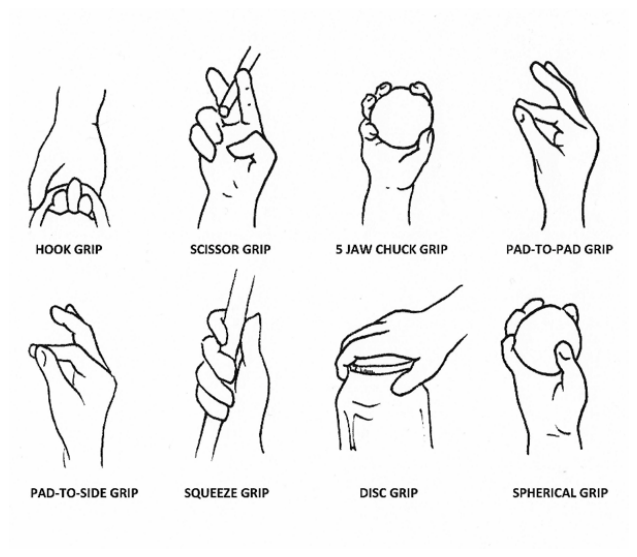
Figure 2.
Endocranial volume in the australopiths and Homo (subdivided into four groups, each containing multiple taxa) over the past 3.3 million years; the volume and estimated age of many specimens represent means (adapted from Du et al. 2018, Figure 2 with their supporting information table).
Figure 2.
Endocranial volume in the australopiths and Homo (subdivided into four groups, each containing multiple taxa) over the past 3.3 million years; the volume and estimated age of many specimens represent means (adapted from Du et al. 2018, Figure 2 with their supporting information table).
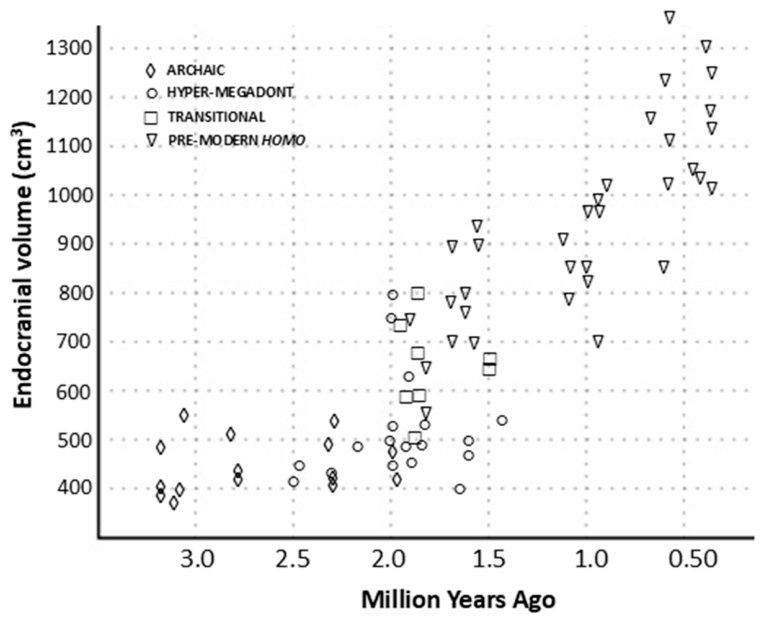
Figure 3.
The selection of stone raw material (quartzite), represented as a binary decision tree. Each binary decision requires one bit of non-genetic information.
Figure 3.
The selection of stone raw material (quartzite), represented as a binary decision tree. Each binary decision requires one bit of non-genetic information.
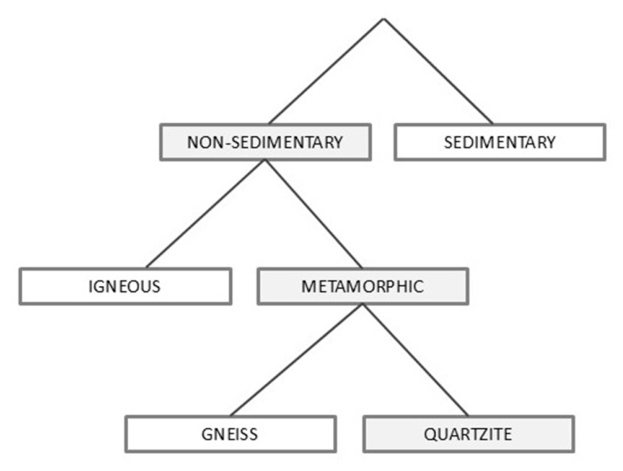
Figure 4.
Steps and production rules required to produce an adhesive from Ammocharis coranica as a binary decision tree, based on Fajardo et al. (2022).
Figure 4.
Steps and production rules required to produce an adhesive from Ammocharis coranica as a binary decision tree, based on Fajardo et al. (2022).
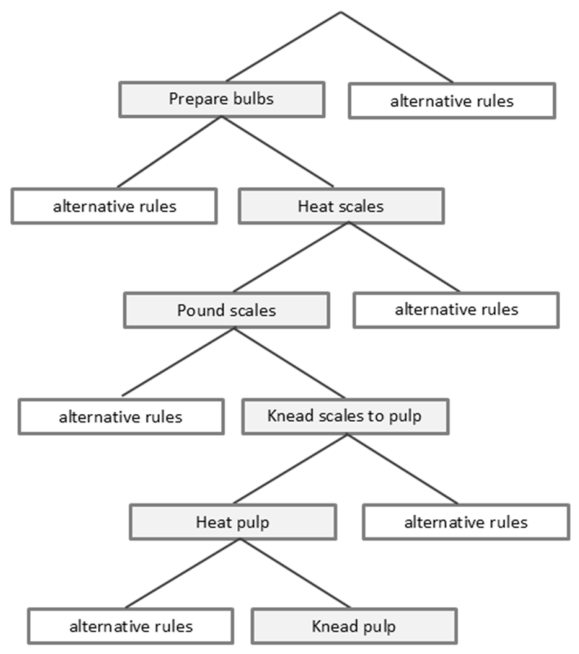
Figure 5.
The production of unretouched flakes from a river cobble described—in a state diagram format—with an FSM model. There is no stored memory (except the organization of the ‘machine’).
Figure 5.
The production of unretouched flakes from a river cobble described—in a state diagram format—with an FSM model. There is no stored memory (except the organization of the ‘machine’).
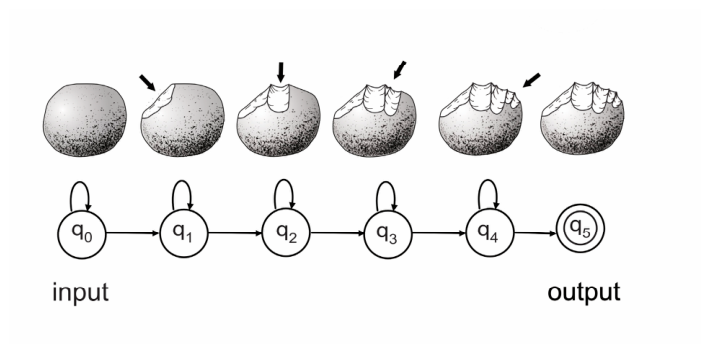
Figure 6.
Production of a retouched flake tool described—in a state diagram format—with a nondeterministic PDA model. Each step requires a production rule (α, β) stored in a ‘single-stack’ memory.
Figure 6.
Production of a retouched flake tool described—in a state diagram format—with a nondeterministic PDA model. Each step requires a production rule (α, β) stored in a ‘single-stack’ memory.
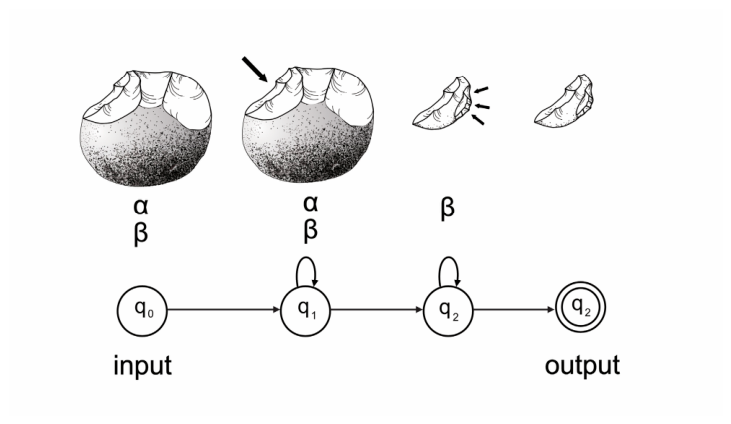
Figure 7.
The organization of a multiple-component artifact (stone-tipped spear) with four components, each of which requires a specific raw material input and sequence of production steps/rules before assembly of the components.
Figure 7.
The organization of a multiple-component artifact (stone-tipped spear) with four components, each of which requires a specific raw material input and sequence of production steps/rules before assembly of the components.
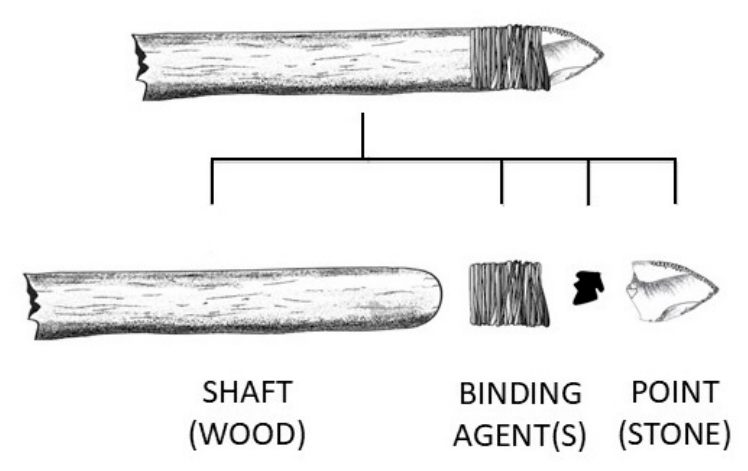
Figure 8.
Bottom-up parsing model, which generates a hierarchical structure from the branches of the tree beginning with one of the branches (steps 1–4) and ending with assembly of the whole structure (steps 14 & 15) and provides a computational model for production of an early multiple-component artifact with three parts requiring 15 steps/rules.
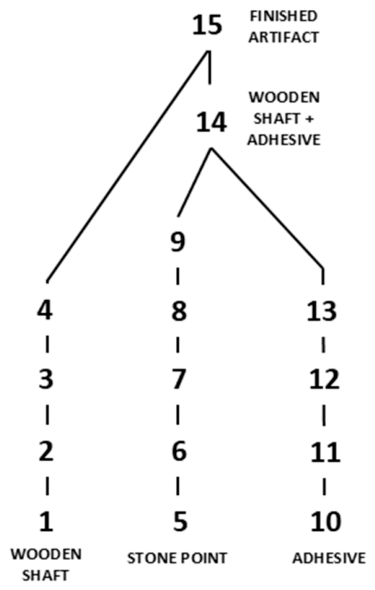
Figure 9.
The maximum ‘program size’ (number of steps/ production rules) among artifact production sequences between 3.0 and 0.3 mya.
Figure 9.
The maximum ‘program size’ (number of steps/ production rules) among artifact production sequences between 3.0 and 0.3 mya.
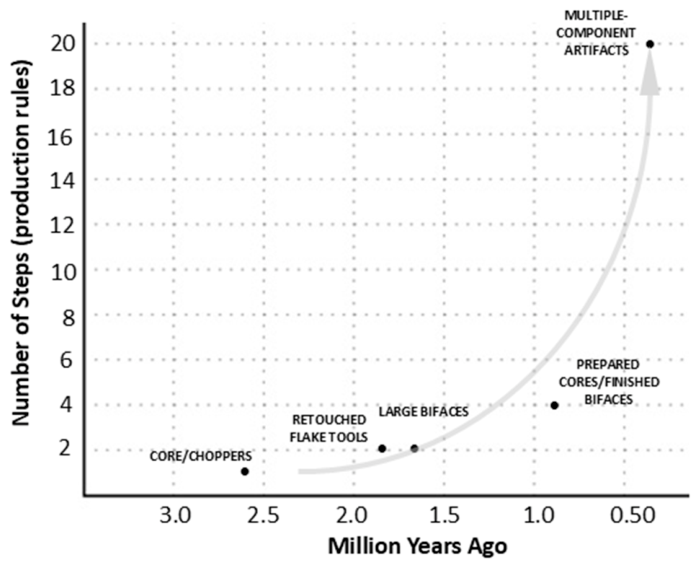
Figure 10.
The hierarchical or recursive structure of tailored winter clothing: Buret’ figurine dating to 24 ka (redrawn from Abramova, 1989, p. 211, Figure 27) (left); organizational breakdown of components and sub-components, based on Iñupiat winter clothing described by Murdoch (1892) (right).
Figure 10.
The hierarchical or recursive structure of tailored winter clothing: Buret’ figurine dating to 24 ka (redrawn from Abramova, 1989, p. 211, Figure 27) (left); organizational breakdown of components and sub-components, based on Iñupiat winter clothing described by Murdoch (1892) (right).
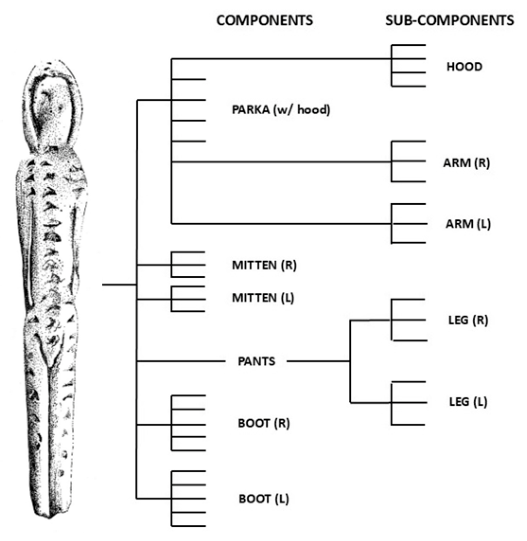
Figure 11.
The artifact as algorithm, described with an FSM model (above): (a) automaton in the form of a Tanaina rabbit snare, (b) showing detail of mechanical trigger pin (from Osgood, 1937, p. 93, Figure 20; courtesy of Yale University Publications in Anthropology).
Figure 11.
The artifact as algorithm, described with an FSM model (above): (a) automaton in the form of a Tanaina rabbit snare, (b) showing detail of mechanical trigger pin (from Osgood, 1937, p. 93, Figure 20; courtesy of Yale University Publications in Anthropology).
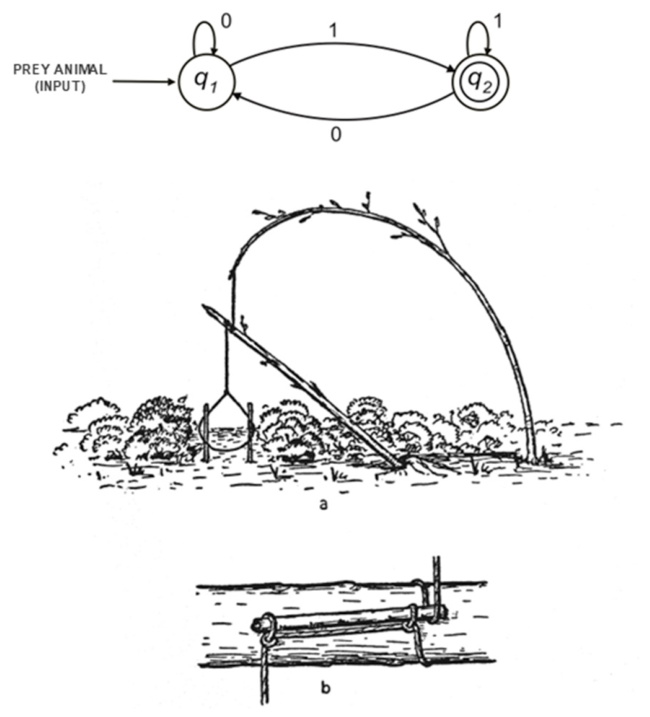

Table 1.
Steps and production rules required to produce an adhesive from Ammocharis coranica, based on Fajardo et al. (2022).
Table 1.
Steps and production rules required to produce an adhesive from Ammocharis coranica, based on Fajardo et al. (2022).
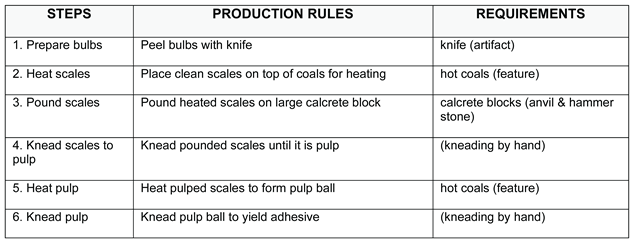
Table 2.
Steps and production rules required to produce a Large Cutting Tool (LCT).
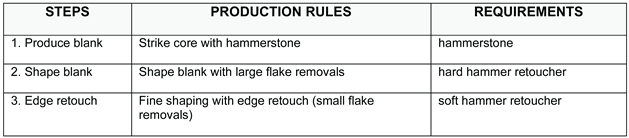
Table 3.
Wood artifacts and modified wood dating to the Lower and Middle Paleolithic (3.3–0.05 mya).
Table 3.
Wood artifacts and modified wood dating to the Lower and Middle Paleolithic (3.3–0.05 mya).
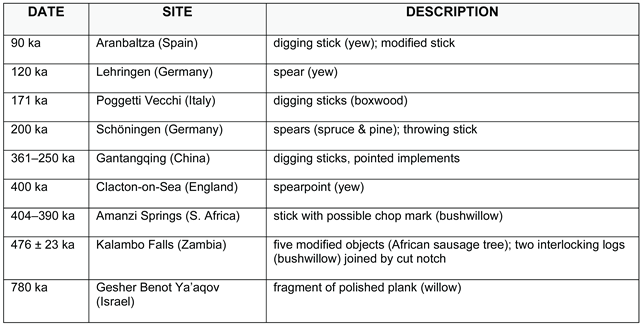
Disclaimer/Publisher’s Note: The statements, opinions and data contained in all publications are solely those of the individual author(s) and contributor(s) and not of MDPI and/or the editor(s). MDPI and/or the editor(s) disclaim responsibility for any injury to people or property resulting from any ideas, methods, instructions or products referred to in the content. |
© 2026 by the authors. Licensee MDPI, Basel, Switzerland. This article is an open access article distributed under the terms and conditions of the Creative Commons Attribution (CC BY) license (http://creativecommons.org/licenses/by/4.0/).
Copyright: This open access article is published under a Creative Commons CC BY 4.0 license, which permit the free download, distribution, and reuse, provided that the author and preprint are cited in any reuse.