

Submitted:
15 October 2026
Posted:
16 October 2026
You are already at the latest version
Abstract
Background: Congenital Adrenal Hyperplasia (CAH) due to 21-hydroxylase deficiency is caused by biallelic pathogenic variants in CYP21A2. Although well-established genotype-phenotype correlations exist for the common pseudogene-derived alleles, next-generation sequencing increasingly identifies rare missense variants whose clinical significance is unknown, which hampers classification, counselling and the selection of patients for new targeted therapies.Methods: We characterized three CYP21A2 missense variants reported in patients with non-classic (NC) or simple-virilizing (SV) CAH, p.A90V (c.269C>T), p.L108Q (c.323T>A) and p.L318M (c.952C>A), together with the intron 2 splice variant c.293-13C>G (I2G) found in trans in two of the patients. Variants were annotated at the gene level with NCBI E-utilities (ClinVar, dbSNP), Ensembl VEP, SpliceAI and AlphaGenome, at the population level with gnomAD v4.1 and the 1000 Genomes Project, and at the protein level with AlphaMissense, REVEL, CADD, MetaRNN, PrimateAI, evolutionary conservation, AlphaFold and FoldX stability calculations mapped on the CYP21A2 crystal structure. Wild-type and variant enzymes were expressed in HEK293T cells, protein levels were quantified by Western blot, and 21-hydroxylase activity was measured with radiolabelled progesterone and 17-hydroxyprogesterone (17-OHP) followed by thin-layer chromatography.Results: All three missense variants are absent from or singletons in 1.6 million gnomAD alleles, absent from the 1000 Genomes Project and absent from ClinVar, affect residues that are conserved in mammalian orthologues and lie in high-confidence regions of the AlphaFold model (pLDDT 97-99). AlphaMissense classified p.A90V and p.L108Q as likely pathogenic (0.76 and 0.85) but p.L318M as likely benign (0.31), whereas CADD, MetaRNN and REVEL supported deleteriousness for all three; SpliceAI and AlphaGenome excluded a splicing effect of the missense changes but reproduced the acceptor-site loss and cryptic-acceptor activation caused by I2G. In vitro, protein expression was reduced to 52%, 65% and 59% of wild type for p.A90V, p.L108Q and p.L318M. Total 17-OHP 21-hydroxylation was 36.7%, 1.4% and 38.5% of wild type, and total progesterone conversion 24.9%, 9.2% and 17.5%, revealing a substrate-dependent, almost complete loss of function for p.L108Q. FoldX predicted destabilization for p.A90V (ΔΔG 3.2 kcal/mol) and p.L108Q (2.5 kcal/mol) but not for p.L318M (0.1 kcal/mol); structural analysis attributes the severe p.L108Q defect to disruption of the hydrogen-bond network (L108-G111-R427) that anchors the heme propionates.Conclusions: Combining functional assays with gene- and protein-level computational analysis classifies all three variants as pathogenic. p.L108Q is a severe allele consistent with classic SV CAH, which resolves the ambiguous SV/NC classification of the male index patient, whereas p.A90V (homozygous) and p.L318M (in trans with I2G) are mild alleles that explain the NC phenotypes. The data illustrate that AlphaMissense alone would have misclassified p.L318M and that residual activity, not in silico scores, should guide counselling and the selection of patients for CRF1-receptor-antagonist therapy.
Keywords:
congenital adrenal hyperplasia
; 21-hydroxylase
; CYP21A2
; variant of uncertain significance
; AlphaMissense
; AlphaGenome
; gnomAD
; functional genomics
; steroidogenesis
1. Introduction
Congenital adrenal hyperplasia (CAH) comprises a group of autosomal recessive disorders of adrenal steroidogenesis, and 90-95% of cases are caused by 21-hydroxylase deficiency (21-OHD) due to pathogenic variants in CYP21A2 [1,2,3]. Steroid 21-hydroxylase (CYP21A2) is a microsomal cytochrome P450 that depends on electron transfer redox partner NADPH cytochrome P450 oxidoreductase and converts progesterone to 11-deoxycorticosterone in the zona glomerulosa and 17-hydroxyprogesterone (17-OHP) to 11-deoxycortisol in the zona fasciculata, the committed steps of aldosterone and cortisol biosynthesis (Figure 1) [4,5,6]. Loss of 21-hydroxylase activity leads to cortisol deficiency, loss of negative feedback on the hypothalamic-pituitary-adrenal (HPA) axis, chronic ACTH excess, adrenal hyperplasia and diversion of accumulated precursors into androgen synthesis, including the alternative "backdoor" pathway that is active during fetal sexual differentiation [2,7,8,9,10,11].
Clinically, 21-OHD is a continuum that is conventionally divided into salt-wasting (SW), simple-virilizing (SV) and non-classic (NC) forms. The SW form reflects near-complete loss of enzyme activity, the SV form is associated with 1-10% residual activity, and the NC form with 20-80% residual activity [12,13,14]. These values depend on in vitro assays and results of controls used. Classic CAH affects 1 in 10,000 to 1 in 20,000 live births, whereas NC CAH is one of the most common autosomal recessive disorders with a prevalence of 1 in 200 to 1 in 1,000, and higher in some populations such as Ashkenazi Jews [13,15]. CYP21A2 lies in the RCCX module of the HLA class III region next to the 98% identical pseudogene CYP21A1P, and about 95% of disease alleles arise from gene conversion or unequal crossover between the two loci [16,17,18]. The remaining 5% are pseudogene-independent, frequently private, variants whose functional consequences cannot be inferred from the genotype-phenotype tables derived from the common alleles [19,20,21,22].
The crystal structures of human CYP21A2 with progesterone and 17-OHP provide a framework for interpreting missense variants [23,24]. Variants that disturb the hydrophobic core, the heme-binding environment or the substrate access channel typically cause classic disease, whereas surface variants that affect salt bridges or hydrogen bonds often retain partial activity and cause NC CAH [25,26]. In silico predictors such as AlphaMissense, REVEL and CADD and structure-based stability calculations are increasingly used to triage variants of uncertain significance (VUS), but the ACMG/AMP framework still assigns the strongest weight to well-validated functional assays [27,28,29,30]. Large population resources (gnomAD, 1000 Genomes) and ClinVar add essential frequency and prior-classification evidence [31,32,33,34], and sequence-to-function models such as SpliceAI and AlphaGenome can exclude or reveal effects on splicing and expression that protein-level predictors do not capture [35,36].
Accurate functional classification has direct therapeutic relevance [37,38,39,40]. The CRF1-receptor antagonist crinecerfont, approved in late 2024 as adjunctive treatment for classic CAH, allows glucocorticoid doses to be lowered while controlling androgen excess [41,42]. Because its indication is restricted to classic CAH, the distinction between classic and NC disease, which is often ambiguous in males and in compound heterozygotes with a rare allele, must be made with confidence [2,43]. We previously combined in vitro assays with structural analysis to resolve eleven CYP21A2 VUS [44]. Here we extend this approach to three uncharacterized missense variants, p.A90V, p.L108Q and p.L318M, reported in patients with NC or SV CAH [26,45,46], and integrate gene-level, population-level and protein-level analyses with recombinant enzyme assays to establish their pathogenicity and to explain the observed phenotypes.
2. Patients and Methods
2.1. Patients and Variants
Clinical information on the three index patients was extracted from the original reports (Table 1). Case 1 is an 18-year-old 46,XX woman of Turkish ancestry with hirsutism (Ferriman-Gallwey score 17), acne and polycystic ovaries, elevated total testosterone and ACTH, and an ACTH-stimulated 17-OHP of 11.4 ng/mL, diagnosed with NC CAH and homozygous for p.A90V [45]. Case 2 is a 46,XY male compound heterozygous for p.L108Q and c.293-13C>G whose phenotype was recorded as SV or NC CAH because the external genitalia of males do not allow the distinction [26]. Case 3 is a French 46,XX woman with post-pubertal hirsutism and oligomenorrhea, an ACTH-stimulated 17-OHP of 63 ng/mL and NC CAH, compound heterozygous for p.L318M and c.293-13C>G, which was identified along with another female with p.L318M/p.V282L [46]. The intron 2 variant c.293-13C>G (also written c.293-13A/C>G, IVS2-13A/C>G or I2G; rs6467) creates a cryptic splice acceptor 19 nucleotides upstream of exon 3 and is the most frequent pathogenic CYP21A2 allele worldwide [47,48,49]. Variant nomenclature follows NM_000500.9 and NP_000491.4 (GRCh38 coordinates were derived with Ensembl VEP).
2.2. Gene-Level and Population-Level Annotation
Variants were annotated with the Ensembl Variant Effect Predictor (VEP, GRCh38, MANE Select transcript ENST00000644719.2 / NM_000500.9) with the SpliceAI, CADD, dbNSFP and gnomAD plugins [29,35,50]. ClinVar and dbSNP records for the individual variants and for all CYP21A2 variants were retrieved with the NCBI E-utilities (esearch/esummary, databases clinvar and snp) [34,51]. Allele counts for every CYP21A2 variant in gnomAD v4.1 (exomes and genomes) were obtained from the gnomAD GraphQL API [31,32], and 1000 Genomes phase 3 super-population frequencies from the Ensembl REST API [33]. dbNSFP scores (AlphaMissense, REVEL, MetaRNN, PrimateAI, phyloP 100-way) were obtained through MyVariant.info [27,28]. Splicing and expression effects were further predicted with AlphaGenome (API version 0.10) using the recommended variant scorers in a 1-Mb window and tissue-resolved splice-site, splice-site-usage and RNA-seq tracks for adrenal gland (UBERON:0002369) [36]. Hardy-Weinberg genotype frequencies were calculated from gnomAD allele frequencies.
2.3. Protein-Level Analysis
Orthologous 21-hydroxylase sequences from nine vertebrates were retrieved from RefSeq with E-utilities and aligned to human CYP21A2 (NP_000491.4) with Biopython (BLOSUM62, global alignment). The AlphaFold model AF-P08686-F1 (version 6) was downloaded from the AlphaFold Protein Structure Database to extract per-residue pLDDT confidence [52]. Changes in Gibbs free energy of folding (ΔΔG) were calculated with the FoldX plugin in YASARA (version 25.1.13) on the energy-minimized crystal structure of CYP21A2 [44,53]. Point mutations were modelled on the structure of human CYP21A2 in complex with progesterone (PDB 4Y8W) using the Dunbrack rotamer library in UCSF Chimera, and hydrogen-bond networks were analysed and visualized in ChimeraX 1.11 [23,44].
2.4. Expression of Recombinant CYP21A2 in HEK293T Cells
Mammalian expression vectors pcDNA3.1+/C-(K)-DYK encoding wild-type (WT) CYP21A2 (NM_000500.9) with a C-terminal DYK (FLAG) tag and the three variants were obtained from GenScript and verified by Sanger sequencing. HEK293T cells (5 x 10⁵ per well of a six-well plate) were transfected with 1.5 µg plasmid DNA using Lipofectamine 2000; eGFP served as transfection control. Forty-eight hours after transfection cells were re-seeded in 12-well plates (2 x 10⁵ per well) in duplicate for activity assays, as described [44,54].
2.5. Western Blot
Cells were lysed and total protein was quantified with the Pierce BCA assay. Fifteen micrograms of protein were separated by SDS-PAGE, transferred to PVDF membranes and probed with mouse anti-FLAG (GenScript A00187, 1:1000) and mouse anti-β-actin (Sigma SAB3500350, 1:1500) followed by IRDye 680CW donkey anti-mouse IgG (LI-COR, 1:10,000). Signals were acquired on a Fusion FX system (Vilber) and band intensities were quantified; CYP21A2 signals were normalized to β-actin and expressed relative to WT.
2.6. 21-Hydroxylase Activity Assays
Seventy-two hours after transfection the medium was replaced by medium containing 1 µM progesterone with 10,000 cpm [14C]-progesterone (45 min, 37°C) or 1 µM 17-OHP with 50,000 cpm [3H]-17-OHP (90 min). Steroids were extracted with ethyl acetate:isooctane (1:1), separated by thin-layer chromatography and quantified on a Typhoon FLA-7000 phosphorimager with ImageQuant TL software [44]. Conversion was calculated as the radioactivity in 11-deoxycorticosterone or 11-deoxycortisol relative to total radioactivity per lane, normalized to total protein, and expressed as percent of WT (total activity). Specific activity was obtained by dividing total activity by the relative protein expression determined by Western blot.
2.7. Statistics
Data were analysed in Python (numpy, pandas, scipy, statsmodels). Each variant was compared with WT by unpaired two-tailed t-tests with Holm correction for multiple testing; adjusted p < 0.05 was considered significant. Data are shown as mean ± SD.
3. Results
3.1. Gene-Level Annotation and Population Genetics Place the Three Variants Among Ultra-Rare CYP21A2 Alleles
ClinVar contains 499 CYP21A2 records, of which 86 are classified pathogenic, 61 likely pathogenic, 21 pathogenic/likely pathogenic, 171 of uncertain significance, 55 likely benign, 49 benign and 34 conflicting; 190 distinct missense positions are represented, and pathogenic missense variants are distributed along the entire protein with clusters around the heme-binding cysteine 428 (Figure 2A). None of the three variants studied here has a ClinVar record, although different substitutions at the same codons are listed: p.Ala90Ser (VUS), p.Leu108Arg (pathogenic) and the synonymous p.Leu318= (conflicting). gnomAD v4.1 lists 3,208 CYP21A2 variants, among them 1,041 missense variants, of which only 18 reach an allele frequency above 0.001 (Figure 2B). p.A90V (rs1416000971) and p.L318M are absent from 1,253,110 and 1,612,972 gnomAD alleles, respectively, and p.L108Q (rs957886272) is a singleton observed once in 1,414,500 alleles in an individual of admixed American ancestry (Table 2). None of the three variants is present in the 1000 Genomes Project. The three substituted residues are conserved in mammalian orthologues: A90 in 9 of 10 species (valine in chicken), L108 in primates, dog and horse (isoleucine in cattle and pig, with the loop deleted in rodents) and L318 in all mammals examined, valine in chicken and isoleucine in frog (Figure 2C).
3.2. Protein-Level Predictions and Structural Mapping
FoldX predicted a strongly destabilizing effect of p.A90V (ΔΔG 3.2 ± 0.23 kcal/mol), moderate destabilization by p.L108Q (2.5 ± 0.06 kcal/mol) and no effect of p.L318M (0.1 ± 0.13 kcal/mol) (Figure 3A). The in silico pathogenicity predictors were concordant for p.A90V and p.L108Q, which AlphaMissense classified as likely pathogenic with scores of 0.76 and 0.85 and which also received high MetaRNN (0.93, 0.97) and CADD (26.2, 24.4) scores, but they disagreed for p.L318M, which AlphaMissense placed in the likely benign to ambiguous range (0.27-0.36) despite deleterious SIFT and PolyPhen-2 calls, a CADD score of 24.1 and the highest PrimateAI score of the three (0.60) (Figure 3B). All three residues lie in regions of very high AlphaFold confidence (pLDDT 97-99 against a model mean of 92.4), so the structural interpretation is not limited by model uncertainty (Figure 3C).
A90 lies near the N-terminal region close to helix B'. Replacement of alanine by the bulkier, β-branched valine does not alter the hydrogen bond to R427 but introduces steric strain that, according to FoldX, propagates into the fold; the variant does not contact the heme or the substrate (Figure 3D). L108 is located in the loop preceding helix C, less than 10 Å from the bound progesterone and adjacent to the propionate groups of the heme, in a region where R92, K121 and R427 anchor the heme carboxylates. In the WT structure L108 hydrogen-bonds with G111, which in turn forms two hydrogen bonds with R427; in the p.L108Q model the polar glutamine side chain instead contacts W117, T124 and D288 and loses the interaction with G111, thereby weakening the network that positions the heme (Figure 3E). L318 is buried in helix I, the long central helix of the P450 fold; methionine is isosteric enough to maintain the backbone hydrogen bonds to I314 and L322, and the only predicted consequence is a modest increase in side-chain volume within the packed helix core (Figure 3F).
3.3. All Three Variants Reduce Protein Expression and 21-Hydroxylase Activity In Vitro
Western blots of transfected HEK293T cells showed a single band of the expected size (about 55 kDa) for WT and all variants and no signal in mock-transfected cells (Figure 4A and Table 3). After normalization to β-actin, steady-state protein levels were reduced to 52% (p.A90V), 65% (p.L108Q) and 59% (p.L318M) of WT (Figure 4B). Radio-TLC demonstrated conversion of [14C]-progesterone to 11-deoxycorticosterone and of [3H]-17-OHP to 11-deoxycortisol by WT CYP21A2 and no endogenous 21-hydroxylase activity in HEK293T cells (Figure 4C, D). Total activity with progesterone was 24.9 ± 1.8% of WT for p.A90V, 9.2 ± 0.2% for p.L108Q and 17.5 ± 0.7% for p.L318M, and with 17-OHP 36.7 ± 4.5%, 1.4 ± 1.4% and 38.5 ± 3.7%, respectively (all adjusted p ≤ 0.001) (Figure 4E). After normalization to protein expression, specific activities were 47.7 ± 3.4% (progesterone) and 70.3 ± 8.7% (17-OHP) for p.A90V, 14.1 ± 0.4% and 2.1 ± 2.1% for p.L108Q, and 29.5 ± 1.2% and 64.8 ± 6.1% for p.L318M (Figure 4F). The results are summarized in Table 3. p.A90V and p.L318M therefore combine a moderate loss of protein with a moderate catalytic defect that is more pronounced for progesterone than for 17-OHP, whereas p.L108Q combines reduced expression with a near-complete loss of intrinsic 17-OHP 21-hydroxylation, a substrate-selective defect consistent with the location of L108 next to the heme and the substrate-binding pocket.
3.4. Sequence-to-Function Models Exclude Splicing Effects of the Missense Variants and Recapitulate the I2G Splice Defect
Because exonic substitutions can act through splicing rather than through the encoded amino acid, we scored all four variants with SpliceAI and AlphaGenome. SpliceAI delta scores were ≤ 0.06 for the three missense variants, far below the 0.2 threshold, and AlphaGenome predicted changes in adrenal splice-site usage of ≤ 0.02 and negligible changes in CYP21A2 RNA abundance in adrenal gland (Figure 5). In contrast, for c.293-13C>G SpliceAI predicted loss of the canonical exon 3 acceptor (ΔS 0.75) with gain of an upstream acceptor (ΔS 0.18), and AlphaGenome predicted a fall in the canonical acceptor probability from 0.94 to 0.36 together with the activation of a cryptic acceptor 19 nucleotides upstream whose adrenal usage increased from 0.02 to 0.27 (Figure 5), reproducing the experimentally established mechanism of this allele in which retention of 19 intronic nucleotides shifts the reading frame [47,49]. Importantly, the residual canonical-acceptor probability predicted by AlphaGenome is in line with the leaky splicing that allows I2G homozygotes to present with SV rather than SW disease in about 8% of cases [19,49].
Population data for I2G illustrate the contribution of this allele to the burden of 21-OHD. Its allele frequency in gnomAD v4.1 is 0.245% in exomes and 0.216% in genomes, ranging from 0.10% in Finns to 0.39% in Ashkenazi Jews (Figure 5C), and it is carried by 5 of 5,008 chromosomes (0.10%) in the 1000 Genomes Project (Figure 5D). Under Hardy-Weinberg equilibrium the gnomAD frequency corresponds to one heterozygous carrier in 205 individuals and one homozygote in about 167,000 births, that is, about one tenth of the incidence of classic CAH, which is consistent with I2G accounting for roughly a quarter of classic alleles once compound heterozygosity with other severe alleles is taken into account (Figure 5E) [19,20,21]. Short-read mapping in the duplicated RCCX locus is expected to under-call I2G, so these figures are lower bounds. The fact that two of our three patients carry I2G in trans is therefore not surprising and provides a well-defined, essentially null, second allele against which the missense alleles can be interpreted.
3.5. Genotype-Phenotype Correlation
Integration of the functional data with the genotypes explains the clinical presentation of all three patients (Table 4). The homozygous p.A90V patient retains 37% of WT 17-OHP conversion and 25% of progesterone conversion, which lies in the range associated with NC CAH and matches her late-onset hyperandrogenic phenotype without salt loss or prenatal virilization. In the two compound heterozygotes the I2G allele contributes at most 1-2% activity, so the phenotype is determined by the missense allele. p.L318M retains 38.5% of 17-OHP conversion and therefore protects against classic disease, consistent with the late-onset NC phenotype of case 3. p.L108Q retains only 1.4% of 17-OHP conversion and 9.2% of progesterone conversion; a genotype combining this allele with I2G is expected to produce classic SV CAH, which resolves the ambiguous classification of the male patient and predicts virilization of the external genitalia in a 46,XX fetus with the same genotype.
4. Discussion
About 2% of individuals carry a rare missense variant in any given gene, and the diagnostic yield of CYP21A2 sequencing is increasingly limited by variants that cannot be classified from population data, in silico scores or the literature [20,55]. This study characterized three such variants by combining gene-level annotation, population genetics, protein-level prediction and recombinant enzyme assays. All three are ultra-rare (absent or singleton in 1.6 million gnomAD alleles, absent from the 1000 Genomes Project and ClinVar), affect conserved residues, and reduce both protein expression and catalytic activity. Under the ACMG/AMP framework the functional data (PS3), the extreme rarity (PM2) and the in silico evidence (PP3 for p.A90V and p.L108Q) together support a pathogenic classification for all three [30]. Figure 6 summarizes the workflow and the resulting classification.
The most informative result is the substrate-selective defect of p.L108Q. The variant retains 9-14% of WT progesterone conversion but only 1-2% of 17-OHP conversion. The crystal structures of CYP21A2 show that progesterone and 17-OHP occupy the active site in slightly different poses, and residues in the loop preceding helix C and in helix B' contribute to the substrate-binding pocket and to the positioning of the heme [23,24]. Replacement of the buried leucine by glutamine removes the L108-G111 hydrogen bond that links this loop to R427, one of the residues that anchor the heme propionates, and introduces polar contacts with W117, T124 and D288. A perturbation of the heme environment and of the adjacent substrate pocket that affects the hydroxylation of 17-OHP more than that of progesterone is a plausible explanation for the observed selectivity, and such substrate-specific effects have been described for other CYP21A2 variants and for variants of other steroidogenic P450s [25,44,54,56]. Clinically, the 17-OHP reaction determines cortisol synthesis, and 1-2% residual activity is the range associated with SV CAH [14,19]. Because I2G is essentially null, the p.L108Q/I2G genotype predicts classic SV disease. This classification matters for management: patients with classic CAH require lifelong glucocorticoid and, in SW disease, mineralocorticoid replacement, and they are the population in which the CRF1-receptor antagonist crinecerfont was shown to permit glucocorticoid dose reduction in the CAHtalyst trials [2,41,42].
p.A90V and p.L318M are mild alleles. Both are more impaired with progesterone than with 17-OHP, and both retain more than 35% of 17-OHP conversion, which prevents prenatal virilization and adrenal crisis. The homozygous p.A90V patient was diagnosed in a cohort of hirsute women, which is a typical presentation of NC CAH [15,45]. The reduction of p.A90V protein to 52% of WT agrees with the strongly destabilizing FoldX prediction and indicates that reduced steady-state abundance, rather than an intrinsic catalytic defect, is the main mechanism, as described for other destabilizing CYP21A2 variants [25,26]. For p.L318M the FoldX ΔΔG is negligible, AlphaMissense predicts a benign or ambiguous effect, and the conservative leucine-to-methionine change in helix I would be difficult to call pathogenic from sequence information alone, yet the variant reduces protein level to 59% and progesterone-specific activity to 30%. In trans with the null I2G allele this residual activity is sufficient for an NC phenotype, which is exactly what was observed in the index patient [46]. This case highlights a general limitation of protein language and structure-based predictors for mild, hypomorphic alleles that are nevertheless disease-causing in the recessive context, and it supports the ClinGen position that functional assays retain the strongest weight for variant interpretation in CAH [27,30,44].
The gene-level analyses added two useful layers. First, SpliceAI and AlphaGenome allowed us to exclude that the three exonic substitutions act through aberrant splicing, so that the in vitro cDNA-based assay captures the relevant mechanism [35,36]. Second, the same tools recapitulated the well-characterized I2G splicing defect, including the activation of the cryptic acceptor 19 nucleotides upstream of exon 3 and a residual canonical-acceptor probability that is consistent with the leaky splicing underlying the SV presentation of a minority of I2G homozygotes [19,47,49]. AlphaGenome has only recently been released, and CYP21A2, with its pseudogene and its restricted adrenal expression, is a demanding test case; the concordance between its tissue-resolved splice predictions and the known biology of I2G is encouraging for its application to intronic and synonymous CYP21A2 VUS that are not accessible to protein-based assays.
The population data also deserve comment. gnomAD v4.1 lists more than 1,000 CYP21A2 missense variants, but only 18 exceed an allele frequency of 0.001, and the allele-frequency spectrum of the gene is dominated by singletons, so absence from gnomAD is a weak discriminator and cannot substitute for functional evidence [31,32,57]. For I2G the gnomAD and 1000 Genomes frequencies (0.10-0.39%) are lower than the frequencies expected from the incidence of classic CAH and the contribution of this allele to disease chromosomes, which reflects the known difficulty of short-read genotyping in the RCCX module, where reads from CYP21A1P (which carries the I2G sequence constitutively, and applies to all frequent variants present in CYP21A1P) and CYP21A2 are frequently mis-assigned [18,22]. Clinical genotyping of CYP21A2, including the two compound-heterozygous patients described here, therefore still depends on locus-specific long-range PCR and, where parental samples are available, segregation analysis.
This study has limitations. Enzyme activities were measured in a transient heterologous system and the residual-activity thresholds that define SW, SV and NC disease are themselves derived from such assays and should be interpreted as ranges rather than cut-offs. In addition, CYP21A2 expression and activity can be influenced by transcription factors and redox partner availability, and therefore, variants in those genes may have an impact on individual CYP21A2 mediated steroid metabolism [58,59,60,61]. Clinical data on the p.L108Q patient were limited to the genotype and the SV/NC assignment in the original report. The FoldX and rotamer-based structural models are static and do not capture the dynamics of the substrate access channel.
5. Conclusions
By integrating NCBI, Ensembl, gnomAD, 1000 Genomes, AlphaMissense, AlphaFold, SpliceAI and AlphaGenome annotation with structural modelling and recombinant enzyme assays, we classify the CYP21A2 variants p.A90V, p.L108Q and p.L318M as pathogenic. p.L108Q is a severe allele that disrupts the heme-anchoring network and, in trans with I2G, causes classic SV CAH, whereas p.A90V and p.L318M are mild, hypomorphic alleles that explain the non-classic phenotypes of the index patients. Functional characterization of rare CYP21A2 alleles remains indispensable for genotype-based classification, prenatal and genetic counselling, and the rational selection of patients for emerging targeted therapies.
Author contributions
A.M. performed the experiments, and the structural analysis, supervised the experimental work, and analyzed results. J.D.H. performed the experiments and the structural analysis and wrote the first draft. Y.X. performed experiments and analyzed data. V.T.-G. analyzed results and edited the manuscript. A.V.P. conceived and supervised the study, edited and revised the manuscript. All authors approved the final version.
Funding
This study was funded by a grant from Strategic Fonds Board of the Faculty of Medicine, University of Bern, 2025-GUITAR, to A.V.P.
Conflict of interest
The authors declare no conflict of interest.
References
- White, P.C. and P.W. Speiser, Congenital adrenal hyperplasia due to 21-hydroxylase deficiency. Endocr Rev, 2000. 21(3): p. 245–91. [CrossRef]
- Claahsen-van der Grinten, H.L., et al., Congenital Adrenal Hyperplasia-Current Insights in Pathophysiology, Diagnostics, and Management. Endocr Rev, 2022. 43(1): p. 91–159. [CrossRef]
- Yang, M. and P.C. White, Genetics and Pathophysiology of Classic Congenital Adrenal Hyperplasia Due to 21-Hydroxylase Deficiency. J Clin Endocrinol Metab, 2025. 110(Supplement_1): p. S1–S12. [CrossRef]
- Miller, W.L. and R.J. Auchus, The molecular biology, biochemistry, and physiology of human steroidogenesis and its disorders. Endocr Rev, 2011. 32(1): p. 81–151. [CrossRef]
- Miller, W.L., A.V. Pandey, and C.E. Fluck, Disordered Electron Transfer: New Forms of Defective Steroidogenesis and Mitochondriopathy. J Clin Endocrinol Metab, 2025. 110(3): p. e574–e582. [CrossRef]
- Pandey, A.V. and C.E. Flück, NADPH P450 oxidoreductase: structure, function, and pathology of diseases. Pharmacology & therapeutics, 2013. [CrossRef]
- Speiser, P.W. and P.C. White, Congenital adrenal hyperplasia. N Engl J Med, 2003. 349(8): p. 776–88. [CrossRef]
- Biason-Lauber, A., et al., Steroidogenesis across species: aldo keto reductases in marsupials, fish and humans, in Genetic Steroid Disorders, M.I. New, Editor. 2023, Academic Press: San Diego. p. 423–434.
- Biason-Lauber, A., et al., Marsupial Pathway in Humans, in Genetic Steroid Disorders, M.I. New, et al., Editors. 2014, Academic Press: San Diego. p. 215–224.
- Biason-Lauber, A., et al., Of marsupials and men: "Backdoor" dihydrotestosterone synthesis in male sexual differentiation. Mol Cell Endocrinol, 2013. 371(1-2): p. 124–32. [CrossRef]
- Fluck, C.E., et al., Why boys will be boys: two pathways of fetal testicular androgen biosynthesis are needed for male sexual differentiation. Am J Hum Genet, 2011. 89(2): p. 201–18. [CrossRef]
- Auer, M.K., et al., Congenital adrenal hyperplasia. Lancet, 2023. 401(10372): p. 227–244. [CrossRef]
- Merke, D.P. and R.J. Auchus, Congenital Adrenal Hyperplasia Due to 21-Hydroxylase Deficiency. N Engl J Med, 2020. 383(13): p. 1248–1261. [CrossRef]
- Speiser, P.W., et al., Congenital Adrenal Hyperplasia Due to Steroid 21-Hydroxylase Deficiency: An Endocrine Society Clinical Practice Guideline. J Clin Endocrinol Metab, 2018. 103(11): p. 4043–4088. [CrossRef]
- Hannah-Shmouni, F., et al., Revisiting the prevalence of nonclassic congenital adrenal hyperplasia in US Ashkenazi Jews and Caucasians. Genet Med, 2017. 19(11): p. 1276–1279. [CrossRef]
- Rodrigues, N.R., et al., Molecular characterization of the HLA-linked steroid 21-hydroxylase B gene from an individual with congenital adrenal hyperplasia. EMBO J, 1987. 6(6): p. 1653–61. [CrossRef]
- Tusie-Luna, M.T. and P.C. White, Gene conversions and unequal crossovers between CYP21 (steroid 21-hydroxylase gene) and CYP21P involve different mechanisms. Proc Natl Acad Sci U S A, 1995. 92(23): p. 10796–800. [CrossRef]
- Carrozza, C., et al., Genes and Pseudogenes: Complexity of the RCCX Locus and Disease. Front Endocrinol (Lausanne), 2021. 12: p. 709758. [CrossRef]
- New, M.I., et al., Genotype-phenotype correlation in 1,507 families with congenital adrenal hyperplasia owing to 21-hydroxylase deficiency. Proc Natl Acad Sci U S A, 2013. 110(7): p. 2611–6. [CrossRef]
- Simonetti, L., et al., CYP21A2 mutation update: Comprehensive analysis of databases and published genetic variants. Hum Mutat, 2018. 39(1): p. 5–22. [CrossRef]
- Riedl, S., et al., Genotype/phenotype correlations in 538 congenital adrenal hyperplasia patients from Germany and Austria: discordances in milder genotypes and in screened versus prescreening patients. Endocr Connect, 2019. 8(2): p. 86–94. [CrossRef]
- Concolino, P. and A. Costella, Congenital Adrenal Hyperplasia (CAH) due to 21-Hydroxylase Deficiency: A Comprehensive Focus on 233 Pathogenic Variants of CYP21A2 Gene. Mol Diagn Ther, 2018. 22(3): p. 261–280. [CrossRef]
- Pallan, P.S., et al., Human Cytochrome P450 21A2, the Major Steroid 21-Hydroxylase: STRUCTURE OF THE ENZYME.PROGESTERONE SUBSTRATE COMPLEX AND RATE-LIMITING C-H BOND CLEAVAGE. J Biol Chem, 2015. 290(21): p. 13128–43. [CrossRef]
- Zhao, B., et al., Three-dimensional structure of steroid 21-hydroxylase (cytochrome P450 21A2) with two substrates reveals locations of disease-associated variants. J Biol Chem, 2012. 287(13): p. 10613–10622. [CrossRef]
- Haider, S., et al., Structure-phenotype correlations of human CYP21A2 mutations in congenital adrenal hyperplasia. Proc Natl Acad Sci U S A, 2013. 110(7): p. 2605–10. [CrossRef]
- Bruque, C.D., et al., Structure-based activity prediction of CYP21A2 stability variants: A survey of available gene variations. Sci Rep, 2016. 6: p. 39082. [CrossRef]
- Cheng, J., et al., Accurate proteome-wide missense variant effect prediction with AlphaMissense. Science, 2023. 381(6664): p. eadg7492. [CrossRef]
- Ioannidis, N.M., et al., REVEL: An Ensemble Method for Predicting the Pathogenicity of Rare Missense Variants. Am J Hum Genet, 2016. 99(4): p. 877–885. [CrossRef]
- Rentzsch, P., et al., CADD: predicting the deleteriousness of variants throughout the human genome. Nucleic Acids Res, 2019. 47(D1): p. D886–D894. [CrossRef]
- Richards, S., et al., Standards and guidelines for the interpretation of sequence variants: a joint consensus recommendation of the American College of Medical Genetics and Genomics and the Association for Molecular Pathology. Genet Med, 2015. 17(5): p. 405–24. [CrossRef]
- Karczewski, K.J., et al., The mutational constraint spectrum quantified from variation in 141,456 humans. Nature, 2020. 581(7809): p. 434–443. [CrossRef]
- Chen, S., et al., A genomic mutational constraint map using variation in 76,156 human genomes. Nature, 2024. 625(7993): p. 92–100. [CrossRef]
- Genomes Project, C., et al., A global reference for human genetic variation. Nature, 2015. 526(7571): p. 68–74. [CrossRef]
- Landrum, M.J., et al., ClinVar: improving access to variant interpretations and supporting evidence. Nucleic Acids Res, 2018. 46(D1): p. D1062–D1067. [CrossRef]
- Jaganathan, K., et al., Predicting Splicing from Primary Sequence with Deep Learning. Cell, 2019. 176(3): p. 535–548 e24. [CrossRef]
- Avsec, Z., et al., Advancing regulatory variant effect prediction with AlphaGenome. Nature, 2026. 649(8099): p. 1206–1218. [CrossRef]
- Tardy, V., et al., Phenotype-genotype correlations of 13 rare CYP21A2 mutations detected in 46 patients affected with 21-hydroxylase deficiency and in one carrier. J Clin Endocrinol Metab, 2010. 95(3): p. 1288–300. [CrossRef]
- Menassa, R., et al., p.H62L, a rare mutation of the CYP21 gene identified in two forms of 21-hydroxylase deficiency. J Clin Endocrinol Metab, 2008. 93(5): p. 1901–8. [CrossRef]
- Prado, M.J., et al., Variant predictions in congenital adrenal hyperplasia caused by mutations in CYP21A2. Front Pharmacol, 2022. 13: p. 931089. [CrossRef]
- Prado, M.J., et al., Characterization of Mutations Causing CYP21A2 Deficiency in Brazilian and Portuguese Populations. Int J Mol Sci, 2021. 23(1): p. 296. [CrossRef]
- Auchus, R.J., et al., Phase 3 Trial of Crinecerfont in Adult Congenital Adrenal Hyperplasia. N Engl J Med, 2024. 391(6): p. 504–514. [CrossRef]
- Sarafoglou, K., et al., Phase 3 Trial of Crinecerfont in Pediatric Congenital Adrenal Hyperplasia. N Engl J Med, 2024. 391(6): p. 493–503. [CrossRef]
- Lao, Q., et al., Clinical and Biochemical Phenotype Across the Genotypic Spectrum of 21-hydroxylase Deficiency in 457 Individuals. J Clin Endocrinol Metab, 2026. 111(4): p. 1098–1113. [CrossRef]
- Xu, Y., et al., Integrated mapping resolves pathogenicity of 11 CYP21A2 variants in congenital adrenal hyperplasia. J Endocr Soc, 2026. 10(7): p. bvag127. [CrossRef]
- Polat, S., et al., Comprehensive genotyping of Turkish women with hirsutism. J Endocrinol Invest, 2019. 42(9): p. 1077–1087. [CrossRef]
- Deneux, C., et al., Phenotype-genotype correlation in 56 women with nonclassical congenital adrenal hyperplasia due to 21-hydroxylase deficiency. J Clin Endocrinol Metab, 2001. 86(1): p. 207–13. [CrossRef]
- Higashi, Y., et al., Aberrant splicing and missense mutations cause steroid 21-hydroxylase [P-450(C21)] deficiency in humans: possible gene conversion products. Proc Natl Acad Sci U S A, 1988. 85(20): p. 7486–90. [CrossRef]
- Mornet, E., et al., Distribution of deletions and seven point mutations on CYP21B genes in three clinical forms of steroid 21-hydroxylase deficiency. Am J Hum Genet, 1991. 48(1): p. 79–88.
- Kocova, M., P. Concolino, and H. Falhammar, Characteristics of In2G Variant in Congenital Adrenal Hyperplasia Due to 21-Hydroxylase Deficiency. Front Endocrinol (Lausanne), 2021. 12: p. 788812. [CrossRef]
- McLaren, W., et al., The Ensembl Variant Effect Predictor. Genome Biol, 2016. 17(1): p. 122. [CrossRef]
- Sayers, E.W., et al., Database resources of the national center for biotechnology information. Nucleic Acids Res, 2022. 50(D1): p. D20–D26. [CrossRef]
- Jumper, J., et al., Highly accurate protein structure prediction with AlphaFold. Nature, 2021. 596(7873): p. 583–589. [CrossRef]
- Schymkowitz, J., et al., The FoldX web server: an online force field. Nucleic Acids Res, 2005. 33(Web Server issue): p. W382–8. [CrossRef]
- Cohen, M., et al., In Silico Structural and Biochemical Functional Analysis of a Novel CYP21A2 Pathogenic Variant. Int J Mol Sci, 2020. 21(16). [CrossRef]
- Miosge, L.A., et al., Comparison of predicted and actual consequences of missense mutations. Proc Natl Acad Sci U S A, 2015. 112(37): p. E5189–98. [CrossRef]
- Fernandez-Cancio, M., et al., Mechanism of the Dual Activities of Human CYP17A1 and Binding to Anti-Prostate Cancer Drug Abiraterone Revealed by a Novel V366M Mutation Causing 17,20 Lyase Deficiency. Pharmaceuticals (Basel), 2018. 11(2). [CrossRef]
- Lek, M., et al., Analysis of protein-coding genetic variation in 60,706 humans. Nature, 2016. 536(7616): p. 285–91. [CrossRef]
- Parween, S., et al., Differential effects of variations in human P450 oxidoreductase on the aromatase activity of CYP19A1 polymorphisms R264C and R264H. J Steroid Biochem Mol Biol, 2020. 196: p. 105507. [CrossRef]
- Camats, N., et al., Ten novel mutations in the NR5A1 gene cause disordered sex development in 46,XY and ovarian insufficiency in 46,XX individuals. J Clin Endocrinol Metab, 2012. 97(7): p. E1294–306. [CrossRef]
- Parween, S., et al., Molecular Basis of CYP19A1 Deficiency in a 46,XX Patient With R550W Mutation in POR: Expanding the PORD Phenotype. J Clin Endocrinol Metab, 2020. 105(4): p. dgaa076. [CrossRef]
- Parween, S., et al., P450 Oxidoreductase Deficiency: Loss of Activity Caused by Protein Instability From a Novel L374H Mutation. The Journal of clinical endocrinology and metabolism, 2016. [CrossRef]
Figure 1.
CYP21A2 and 21-hydroxylase deficiency. (A) The RCCX module on chromosome 6p21.33 contains the active CYP21A2 gene and the CYP21A1P pseudogene in tandem; gene conversion and unequal crossover transfer pseudogene sequences into CYP21A2 and account for about 95% of pathogenic alleles, whereas about 5% are rare pseudogene-independent variants such as those studied here. (B) Exon structure of CYP21A2 (NM_000500.9) with the positions of p.A90V (exon 2), c.293-13C>G (intron 2, I2G), p.L108Q (exon 3) and p.L318M (exon 8), and the adrenal steroidogenic pathway with the two 21-hydroxylation reactions catalyzed by CYP21A2. (C) Loss of cortisol feedback on the HPA axis increases ACTH and adrenal androgen output; the CRF1-receptor antagonist crinecerfont lowers ACTH independently of glucocorticoid dosing, and its indication depends on the classic versus non-classic classification, which in turn depends on residual enzyme activity.
Figure 1.
CYP21A2 and 21-hydroxylase deficiency. (A) The RCCX module on chromosome 6p21.33 contains the active CYP21A2 gene and the CYP21A1P pseudogene in tandem; gene conversion and unequal crossover transfer pseudogene sequences into CYP21A2 and account for about 95% of pathogenic alleles, whereas about 5% are rare pseudogene-independent variants such as those studied here. (B) Exon structure of CYP21A2 (NM_000500.9) with the positions of p.A90V (exon 2), c.293-13C>G (intron 2, I2G), p.L108Q (exon 3) and p.L318M (exon 8), and the adrenal steroidogenic pathway with the two 21-hydroxylation reactions catalyzed by CYP21A2. (C) Loss of cortisol feedback on the HPA axis increases ACTH and adrenal androgen output; the CRF1-receptor antagonist crinecerfont lowers ACTH independently of glucocorticoid dosing, and its indication depends on the classic versus non-classic classification, which in turn depends on residual enzyme activity.
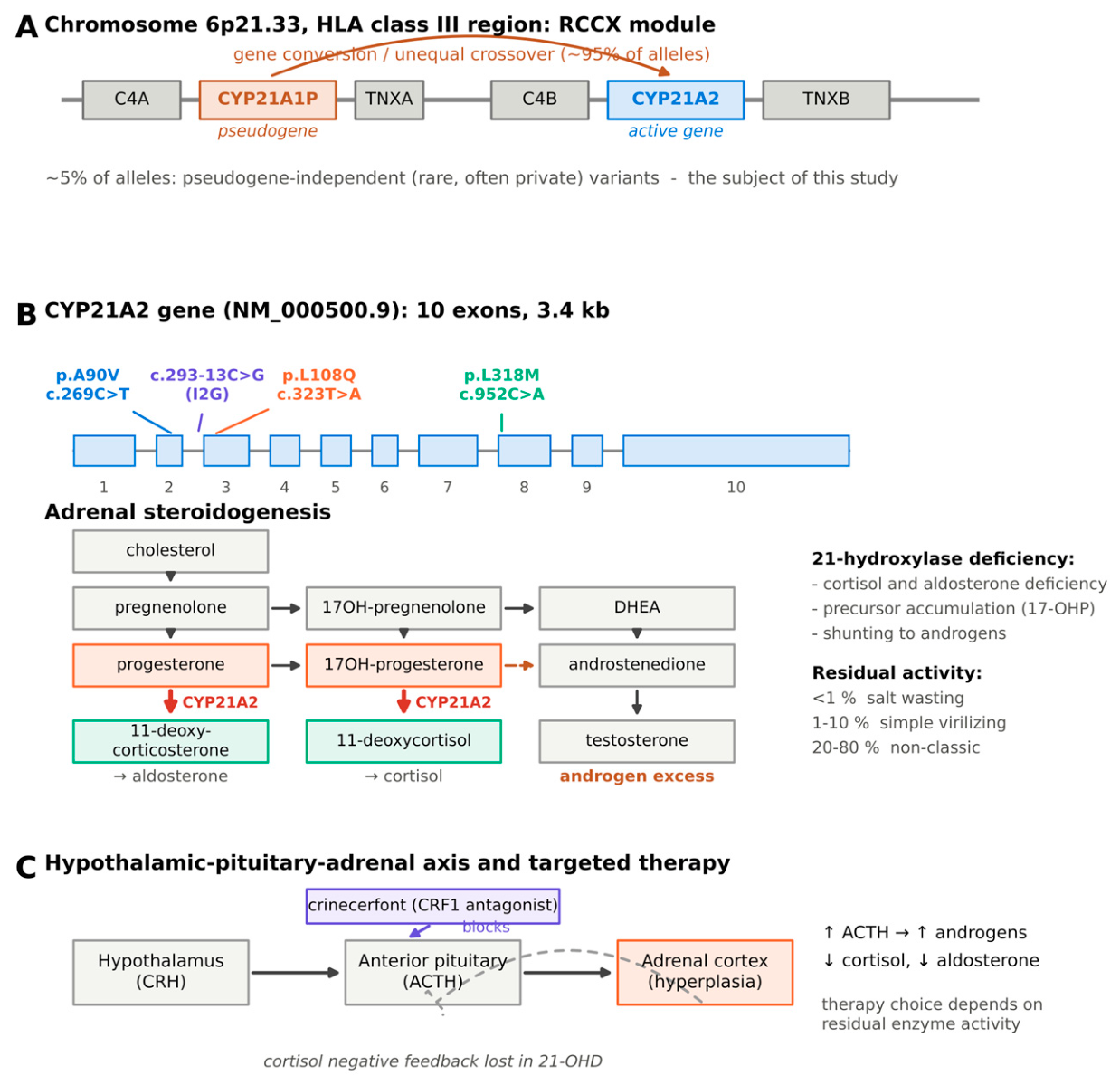
Figure 2.
Gene-level landscape of CYP21A2 variation and position of the studied variants. (A) ClinVar missense variants (NCBI E-utilities, October 2026) along the 495-residue CYP21A2 protein, grouped by germline classification (P/LP, pathogenic or likely pathogenic; VUS, uncertain significance; B/LB, benign or likely benign); the heme-ligand cysteine 428 is marked; arrows indicate p.A90V, p.L108Q and p.L318M, none of which has a ClinVar entry. (B) Allele frequencies of the 1,041 CYP21A2 missense variants in gnomAD v4.1 (exomes plus genomes); p.A90V and p.L318M are absent, p.L108Q is a singleton. (C) Alignment of RefSeq orthologues (NCBI) around the three residues (bold, centre); residues differing from human are shaded orange.
Figure 2.
Gene-level landscape of CYP21A2 variation and position of the studied variants. (A) ClinVar missense variants (NCBI E-utilities, October 2026) along the 495-residue CYP21A2 protein, grouped by germline classification (P/LP, pathogenic or likely pathogenic; VUS, uncertain significance; B/LB, benign or likely benign); the heme-ligand cysteine 428 is marked; arrows indicate p.A90V, p.L108Q and p.L318M, none of which has a ClinVar entry. (B) Allele frequencies of the 1,041 CYP21A2 missense variants in gnomAD v4.1 (exomes plus genomes); p.A90V and p.L318M are absent, p.L108Q is a singleton. (C) Alignment of RefSeq orthologues (NCBI) around the three residues (bold, centre); residues differing from human are shaded orange.
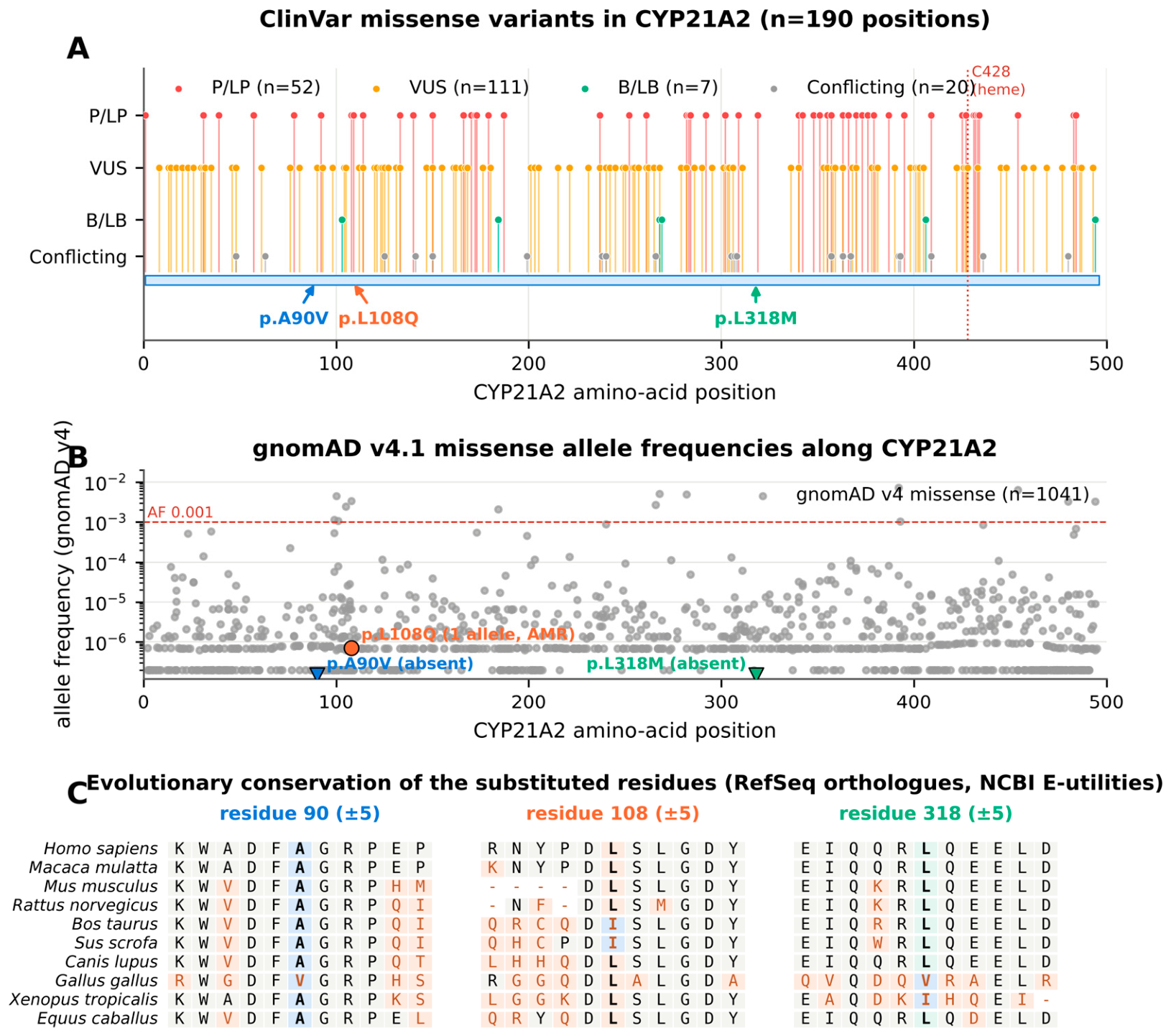
Figure 3.
Protein-level in silico analysis of p.A90V, p.L108Q and p.L318M. (A) FoldX ΔΔG (mean ± SD of five runs) on the CYP21A2 crystal structure; positive values indicate destabilization. (B) Heat map of pathogenicity predictors (dbNSFP via MyVariant.info and Ensembl VEP); CADD and phyloP are scaled to 0-1 for colouring, cell labels give the raw scores. (C) Per-residue pLDDT of the AlphaFold model AF-P08686-F1 with the positions of the three variants and the heme ligand C428. (D-F) Structural models of the WT (left) and mutant (right) residues (red) on PDB 4Y8W in ChimeraX; hydrogen bonds in light blue; the heme is shown in stick representation. In (E) the loop preceding helix C is green, helix B' pink and the heme-anchoring residues are shown explicitly.
Figure 3.
Protein-level in silico analysis of p.A90V, p.L108Q and p.L318M. (A) FoldX ΔΔG (mean ± SD of five runs) on the CYP21A2 crystal structure; positive values indicate destabilization. (B) Heat map of pathogenicity predictors (dbNSFP via MyVariant.info and Ensembl VEP); CADD and phyloP are scaled to 0-1 for colouring, cell labels give the raw scores. (C) Per-residue pLDDT of the AlphaFold model AF-P08686-F1 with the positions of the three variants and the heme ligand C428. (D-F) Structural models of the WT (left) and mutant (right) residues (red) on PDB 4Y8W in ChimeraX; hydrogen bonds in light blue; the heme is shown in stick representation. In (E) the loop preceding helix C is green, helix B' pink and the heme-anchoring residues are shown explicitly.
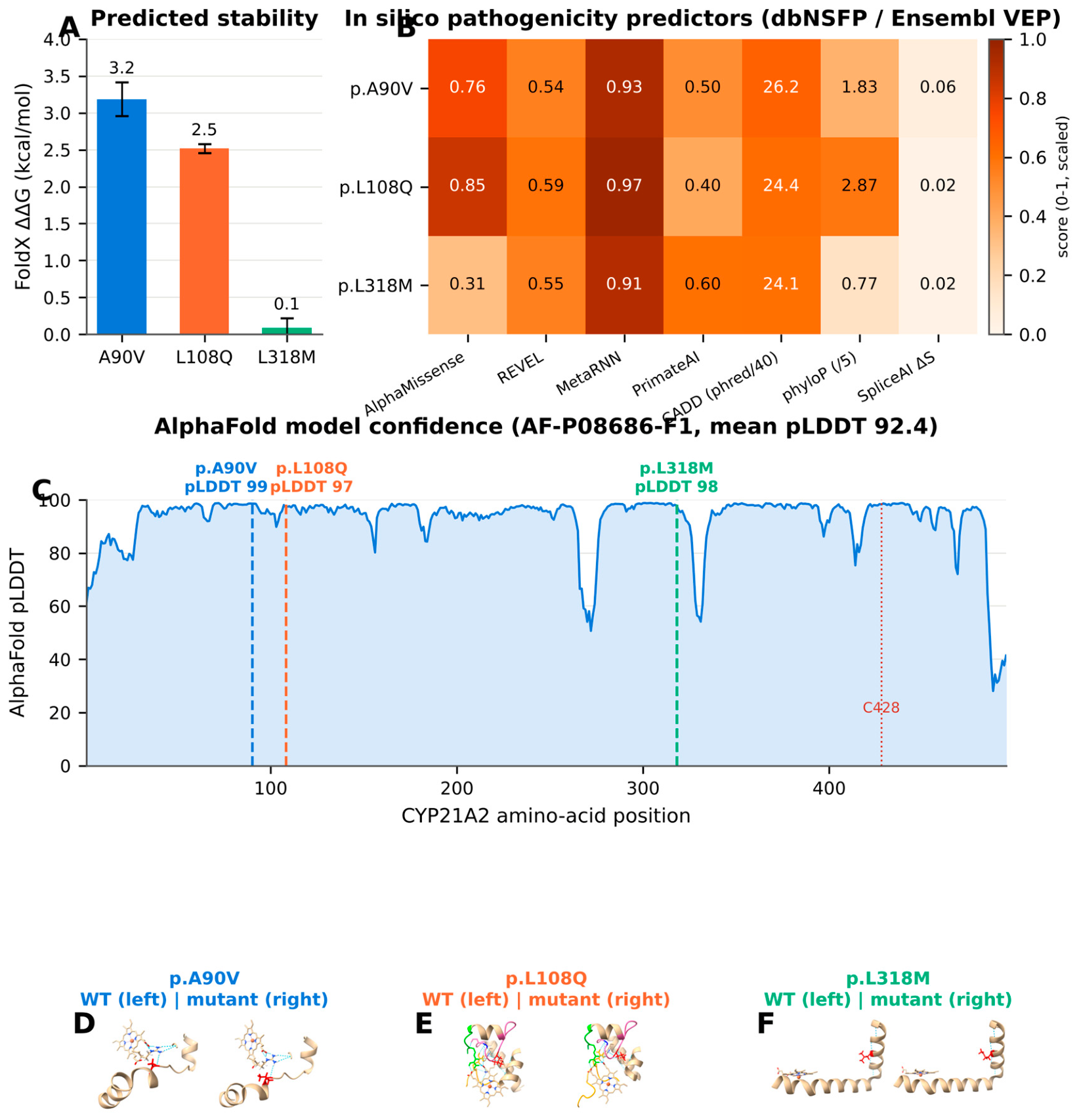
Figure 4.
In vitro characterization of CYP21A2 variants in HEK293T cells. (A) Western blot of FLAG-tagged CYP21A2 (about 55 kDa) and β-actin (42 kDa) in duplicate lysates; NC, mock-transfected (eGFP) cells. (B) Densitometric quantification of CYP21A2 normalized to β-actin and expressed relative to WT. (C) Autoradiograph of the TLC separation of [14C]-progesterone and its product 11-deoxycorticosterone after 45 min; P, substrate alone. (D) TLC of [3H]-17-OHP and 11-deoxycortisol after 90 min, duplicate assays. (E) Total 21-hydroxylase activity (percentage of radioactivity converted, normalized to total protein and expressed relative to WT; mean ± SD). (F) Specific activity after normalization to the protein expression in (B). Dotted lines indicate the residual-activity ranges associated with the SV (1-10%) and NC (≥20%) phenotypes. *, ** and *** denote Holm-adjusted p ≤ 0.05, 0.01 and 0.001 versus WT.
Figure 4.
In vitro characterization of CYP21A2 variants in HEK293T cells. (A) Western blot of FLAG-tagged CYP21A2 (about 55 kDa) and β-actin (42 kDa) in duplicate lysates; NC, mock-transfected (eGFP) cells. (B) Densitometric quantification of CYP21A2 normalized to β-actin and expressed relative to WT. (C) Autoradiograph of the TLC separation of [14C]-progesterone and its product 11-deoxycorticosterone after 45 min; P, substrate alone. (D) TLC of [3H]-17-OHP and 11-deoxycortisol after 90 min, duplicate assays. (E) Total 21-hydroxylase activity (percentage of radioactivity converted, normalized to total protein and expressed relative to WT; mean ± SD). (F) Specific activity after normalization to the protein expression in (B). Dotted lines indicate the residual-activity ranges associated with the SV (1-10%) and NC (≥20%) phenotypes. *, ** and *** denote Holm-adjusted p ≤ 0.05, 0.01 and 0.001 versus WT.
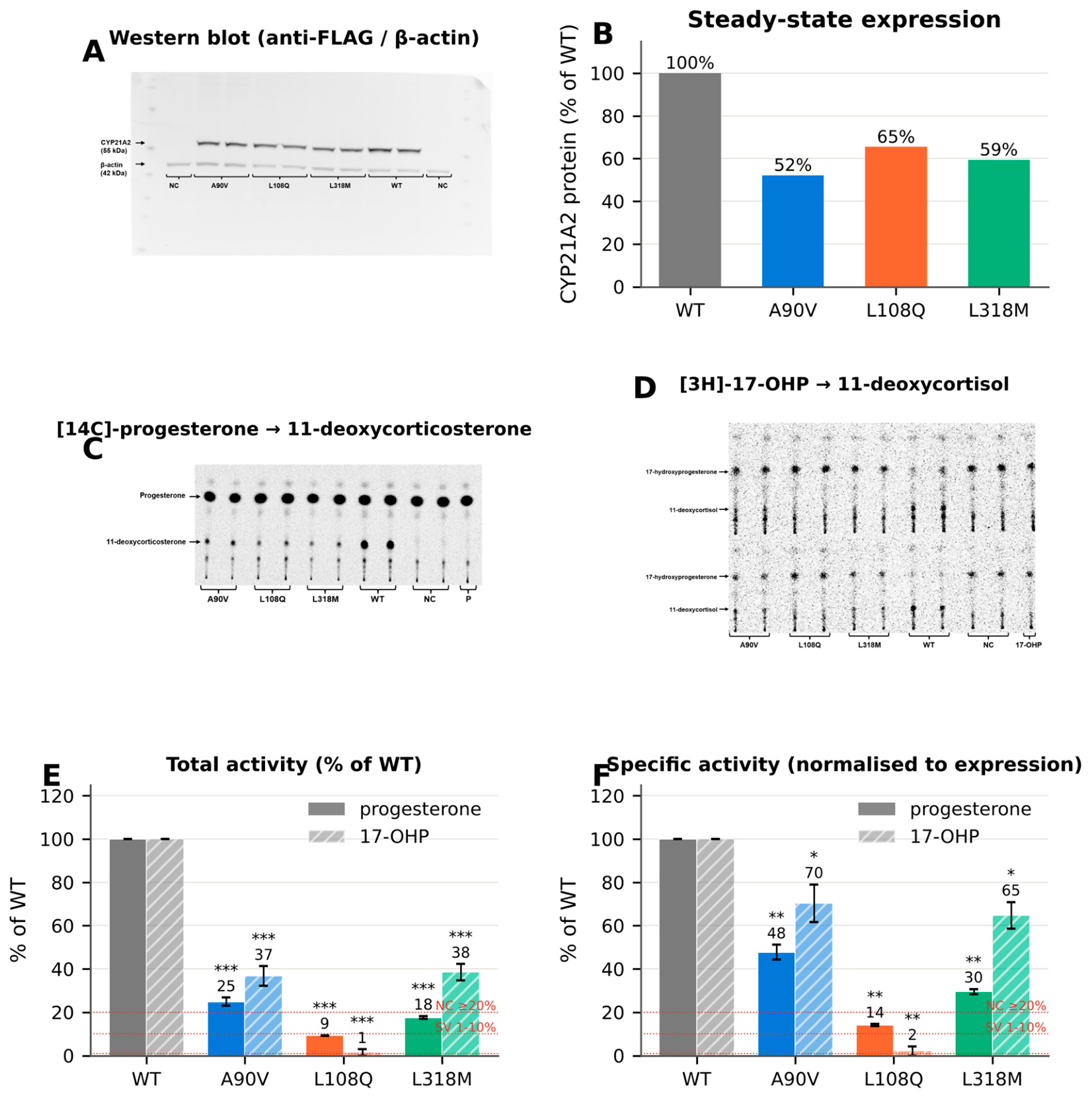
Figure 5.
Splicing predictions and population genetics. (A) AlphaGenome predictions for the intron 2 - exon 3 junction in adrenal gland: acceptor-site probability (bars, reference versus c.293-13C>G) and splice-site usage (lines); the variant reduces the canonical acceptor and activates a cryptic acceptor 19 nt upstream. (B) Maximal SpliceAI delta score and maximal AlphaGenome change in adrenal splice-site usage for the four variants. (C) c.293-13C>G allele frequency in the gnomAD v4.1 genetic-ancestry groups (exomes plus genomes; allele counts in parentheses). (D) Allele frequency in the 1000 Genomes phase 3 super-populations. (E) Expected carrier and homozygote frequencies of c.293-13C>G under Hardy-Weinberg equilibrium compared with the reported incidence of classic CAH and prevalence of non-classic CAH (error bars, published ranges).
Figure 5.
Splicing predictions and population genetics. (A) AlphaGenome predictions for the intron 2 - exon 3 junction in adrenal gland: acceptor-site probability (bars, reference versus c.293-13C>G) and splice-site usage (lines); the variant reduces the canonical acceptor and activates a cryptic acceptor 19 nt upstream. (B) Maximal SpliceAI delta score and maximal AlphaGenome change in adrenal splice-site usage for the four variants. (C) c.293-13C>G allele frequency in the gnomAD v4.1 genetic-ancestry groups (exomes plus genomes; allele counts in parentheses). (D) Allele frequency in the 1000 Genomes phase 3 super-populations. (E) Expected carrier and homozygote frequencies of c.293-13C>G under Hardy-Weinberg equilibrium compared with the reported incidence of classic CAH and prevalence of non-classic CAH (error bars, published ranges).
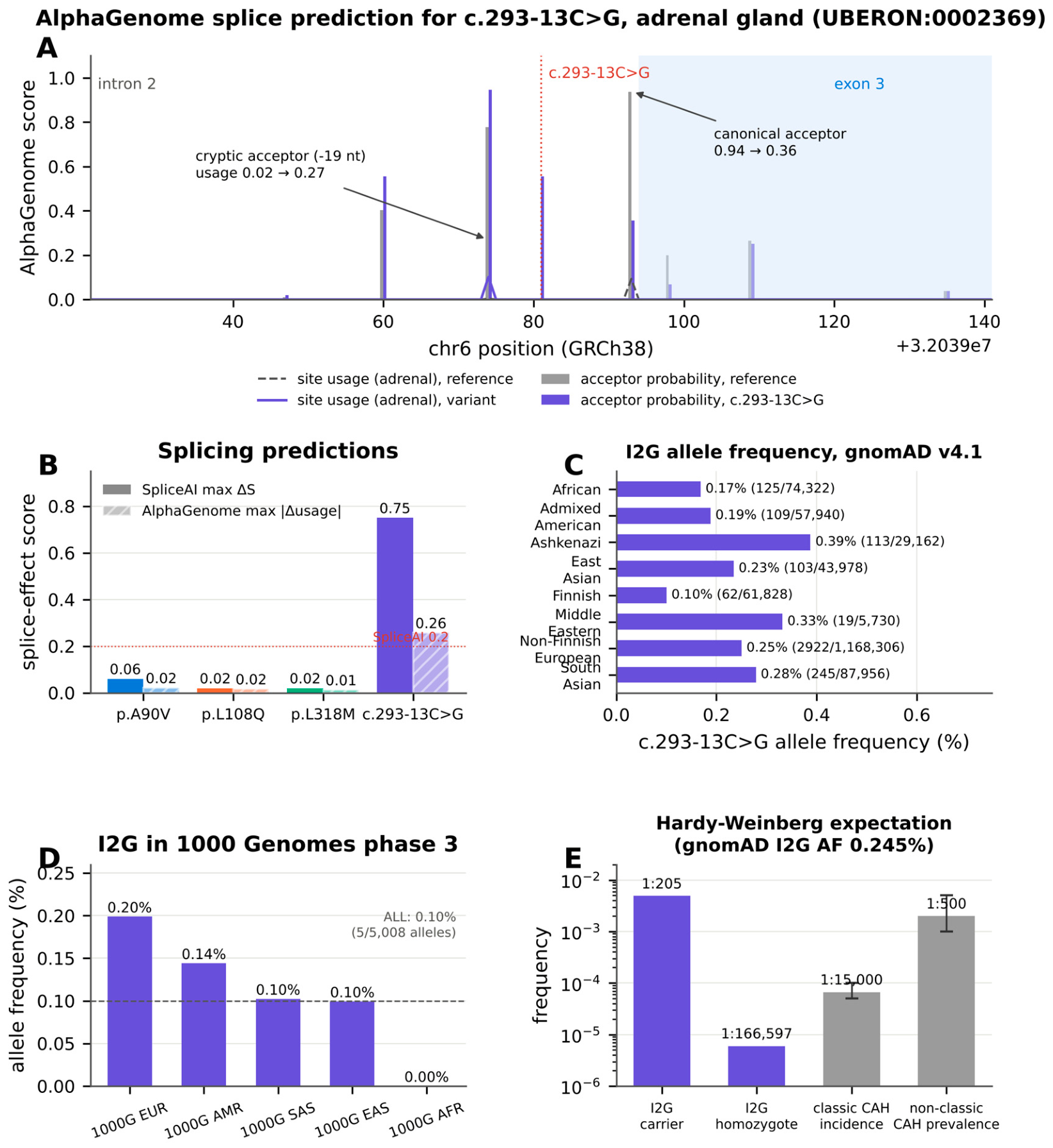
Figure 6.
Summary of the integrated classification of rare CYP21A2 variants. Top, the workflow applied in this study, from variant identification through silico prediction, population genomics and in vitro functional assays to structural interpretation. Bottom, the residual 17-OHP 21-hydroxylase activity of the three variants projected on the activity ranges associated with salt-wasting, simple-virilizing and non-classic CAH, and the resulting clinical consequences for classification, counselling and eligibility for CRF1-receptor-antagonist therapy.
Figure 6.
Summary of the integrated classification of rare CYP21A2 variants. Top, the workflow applied in this study, from variant identification through silico prediction, population genomics and in vitro functional assays to structural interpretation. Bottom, the residual 17-OHP 21-hydroxylase activity of the three variants projected on the activity ranges associated with salt-wasting, simple-virilizing and non-classic CAH, and the resulting clinical consequences for classification, counselling and eligibility for CRF1-receptor-antagonist therapy.
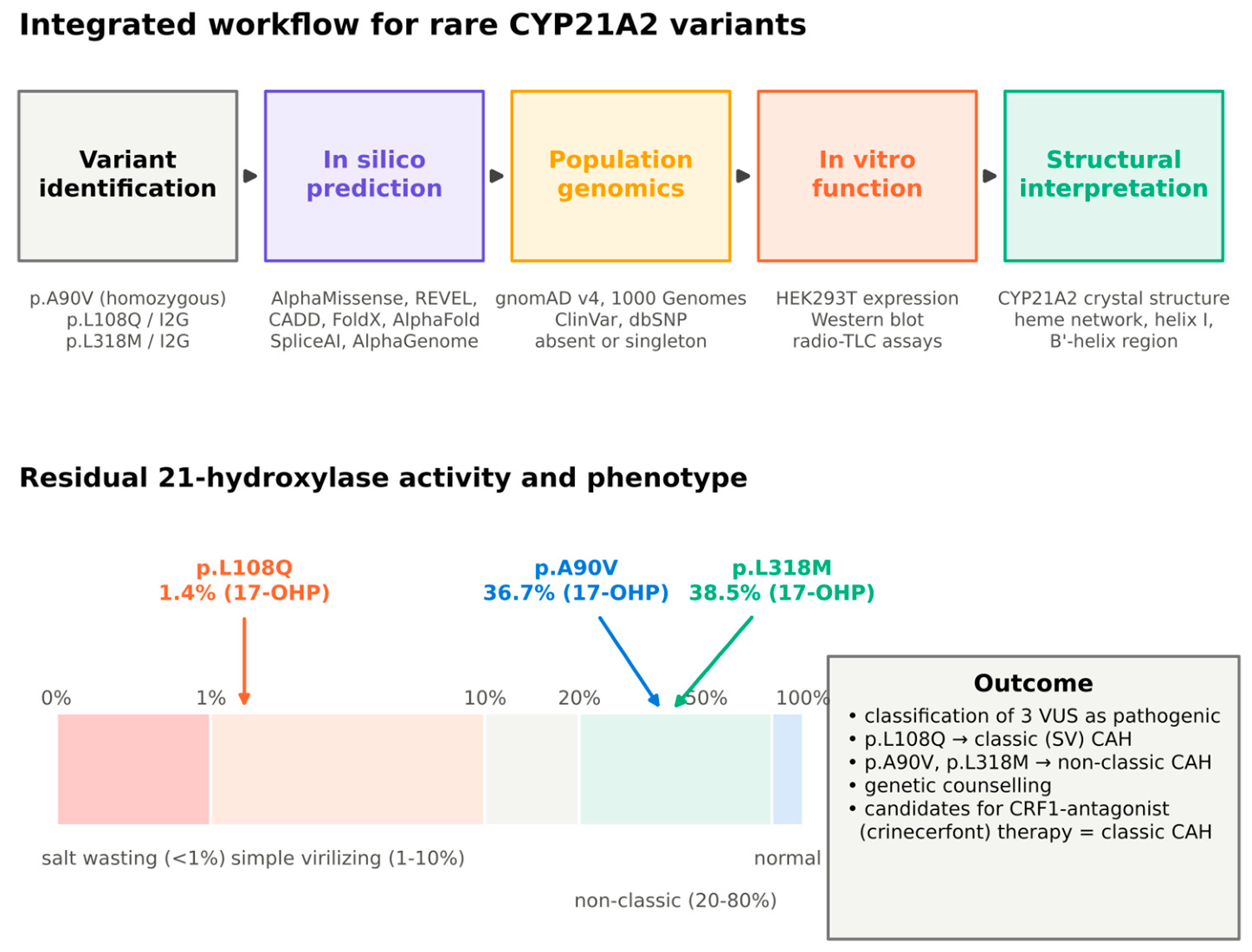

Table 1.
Index patients carrying the three CYP21A2 missense variants. FGS, Ferriman-Gallwey score; PCO, polycystic ovaries; SV, simple virilizing; NC, non-classic.
Table 1.
Index patients carrying the three CYP21A2 missense variants. FGS, Ferriman-Gallwey score; PCO, polycystic ovaries; SV, simple virilizing; NC, non-classic.
| Case | Sex / karyotype | Genotype (allele 1 / allele 2) | Clinical presentation | Reported phenotype | Source |
|---|---|---|---|---|---|
| 1 | Female, 46,XX (Turkish) | p.A90V / p.A90V | Hirsutism (FGS 17), acne, PCO on ultrasound, testosterone 141 ng/dL, ACTH 66.6 pg/mL; 17-OHP basal 1.34 ng/mL, ACTH-stimulated 11.38 ng/mL | Non-classic | [45] |
| 2 | Male, 46,XY | p.L108Q / c.293-13C>G | No clinical details available; genital virilization not informative in males | SV or NC (ambiguous) | [26] |
| 3 | Female, 46,XX (French) | p.L318M / c.293-13C>G | Post-pubertal hirsutism, oligomenorrhea; ACTH-stimulated 17-OHP 63 ng/mL | Non-classic, late onset | [46] |
Table 2.
Gene-, population- and protein-level annotation of the four CYP21A2 variants. AF, allele frequency; AC/AN, allele count/allele number; AMR, admixed American. AlphaMissense ranges reflect the values reported for the different CYP21A2 transcript annotations in dbNSFP. n.a., not applicable.
Table 2.
Gene-, population- and protein-level annotation of the four CYP21A2 variants. AF, allele frequency; AC/AN, allele count/allele number; AMR, admixed American. AlphaMissense ranges reflect the values reported for the different CYP21A2 transcript annotations in dbNSFP. n.a., not applicable.
| Annotation | p.A90V | p.L108Q | p.L318M | c.293-13C>G (I2G) |
|---|---|---|---|---|
| cDNA (NM_000500.9) / exon | c.269C>T, exon 2 | c.323T>A, exon 3 | c.952C>A, exon 8 | intron 2 |
| GRCh38 (chr6) | g.32038788C>T | g.32039124T>A | g.32040418C>A | g.32039081C>G |
| dbSNP | rs1416000971 | rs957886272 | not assigned | rs6467 |
| ClinVar | no record | no record (p.L108R pathogenic) | no record | P/LP (conflicting; 26 submitters) |
| gnomAD v4.1 AF (AC/AN) | 0 (0/1,253,110) | 7.1e-7 (1/1,414,500; AMR) | 0 (0/1,612,972) | 2.45e-3 exomes (3,525/1,440,550); 2.16e-3 genomes |
| 1000 Genomes phase 3 AF | absent | absent | absent | 1.0e-3 (5/5,008) |
| AlphaMissense (class) | 0.71-0.85 (likely pathogenic) | 0.79-0.90 (likely pathogenic) | 0.27-0.36 (likely benign / ambiguous) | n.a. |
| REVEL / MetaRNN / PrimateAI | 0.54 / 0.93 / 0.50 | 0.59 / 0.97 / 0.40 | 0.55 / 0.91 / 0.60 | n.a. |
| CADD phred / phyloP | 26.2 / 1.83 | 24.4 / 2.87 | 24.1 / 0.77 | 1.7 / -0.23 |
| SIFT / PolyPhen-2 | deleterious / possibly damaging | deleterious / probably damaging | deleterious / probably damaging | n.a. |
| SpliceAI (max ΔS, type) | 0.06 (donor gain) | 0.02 (acceptor gain) | 0.02 (acceptor gain) | 0.75 acceptor loss; 0.18 acceptor gain |
| AlphaGenome adrenal (max |Δ splice-site usage|) | 0.02 | 0.02 | 0.01 | 0.26 (cryptic acceptor), canonical acceptor 0.94 to 0.36 |
| AlphaFold pLDDT (residue) | 98.6 | 97.3 | 97.8 | n.a. |
| FoldX ΔΔG (kcal/mol) | 3.2 ± 0.23 | 2.5 ± 0.06 | 0.1 ± 0.13 | n.a. |
| Conservation (10 vertebrates) | 9/10 (V in chicken) | 7/10 (I in cattle, pig; gap in rodents) | 8/10 (V chicken, I frog) | n.a. |
Table 3.
Protein expression, total and specific 21-hydroxylase activity of CYP21A2 variants (percent of wild type, mean ± SD). Total activity is substrate conversion by TLC normalized to total cellular protein; specific activity is total activity divided by relative CYP21A2 protein expression.
Table 3.
Protein expression, total and specific 21-hydroxylase activity of CYP21A2 variants (percent of wild type, mean ± SD). Total activity is substrate conversion by TLC normalized to total cellular protein; specific activity is total activity divided by relative CYP21A2 protein expression.
| Variant | Protein expression | Total activity, progesterone | Specific activity, progesterone | Total activity, 17-OHP | Specific activity, 17-OHP | Predominant mechanism |
|---|---|---|---|---|---|---|
| WT | 100 | 100 | 100 | 100 | 100 | - |
| p.A90V | 52.2 | 24.9 ± 1.8 | 47.7 ± 3.4 | 36.7 ± 4.5 | 70.3 ± 8.7 | Protein destabilization (ΔΔG 3.2) |
| p.L108Q | 65.4 | 9.2 ± 0.2 | 14.1 ± 0.4 | 1.4 ± 1.4 | 2.1 ± 2.1 | Disruption of heme-anchoring network |
| p.L318M | 59.4 | 17.5 ± 0.7 | 29.5 ± 1.2 | 38.5 ± 3.7 | 64.8 ± 6.1 | Mild steric perturbation of helix I |
Table 4.
Genotype-phenotype correlation. Residual-activity ranges are from the Endocrine Society guideline and reviews [13,14].
| Case | Genotype | Total 17-OHP activity of the milder allele | Total progesterone activity of the milder allele | Reported phenotype | Phenotype predicted from residual activity |
|---|---|---|---|---|---|
| 1 | p.A90V / p.A90V | 36.7% | 24.9% | NC | NC (20-80%) |
| 2 | p.L108Q / I2G | 1.4% | 9.2% | SV or NC | SV (1-10%) |
| 3 | p.L318M / I2G | 38.5% | 17.5% | NC | NC (20-80%) |
Disclaimer/Publisher’s Note: The statements, opinions and data contained in all publications are solely those of the individual author(s) and contributor(s) and not of MDPI and/or the editor(s). MDPI and/or the editor(s) disclaim responsibility for any injury to people or property resulting from any ideas, methods, instructions or products referred to in the content. |
© 2026 by the authors. Licensee MDPI, Basel, Switzerland. This article is an open access article distributed under the terms and conditions of the Creative Commons Attribution (CC BY) license (http://creativecommons.org/licenses/by/4.0/).
Copyright: This open access article is published under a Creative Commons CC BY 4.0 license, which permit the free download, distribution, and reuse, provided that the author and preprint are cited in any reuse.