

Submitted:
15 October 2026
Posted:
16 October 2026
You are already at the latest version
Abstract
Despite institutional commitments to equality, diversity and inclusion, women, particularly those from ethnic minority backgrounds, remain underrepresented in senior academic positions in the United Kingdom. This critical appraisal examines structural and cultural barriers to equitable career progression, with particular attention to clinical academics balancing research, teaching and patient care. Drawing on published literature and workforce statistics, it discusses opaque promotion criteria, unequal funding opportunities, limited mentorship, caregiving responsibilities, racism and the undervaluation of clinical contributions and unpaid diversity work. These intersecting disadvantages are compounded by insecure career pathways and competing institutional demands. Lessons from National Health Service initiatives highlight potential approaches to improving transparency, mentorship and accountability. The paper proposes integrated career pathways, explicit promotion criteria, targeted sponsorship, recognition of invisible labour and measurable institutional equity targets. Research should capture ethnic minority women’s lived experiences and evaluate interventions. Sustainable progress requires structural reform supported by institutional accountability and cultural change.
Keywords:
gender gap
; academic research
; structural barriers
; systemic change
UK universities have long expressed a commitment to inclusion, equality, and diversity (IED), embedding these values into their policies and strategic frameworks. (UK universities 2019).However, significant demographic disparities persist, particularly at senior academic levels. The persistent underrepresentation of ethnic minority women in professorial roles raises critical concerns about the effectiveness of universities' IED initiatives. Can institutions truly achieve inclusivity by merely adopting strategic approaches, or are deeper structural barriers left unaddressed?
Data from the Higher Education Statistics Agency (HESA) highlights the stark reality of gender and racial inequality in academia. While only 10% of academic staff hold professorial positions, the proportion of female professors has risen only marginally from 28% to 30%. Even more concerning is the continued underrepresentation of ethnic minority women. Among professors who disclosed their ethnicity, less than 1% identified as Black, 8% as Asian, while 88% were White. These statistics expose the limited progress universities have made in improving diversity at the highest levels of academia, indicating that institutional efforts have barely scratched the surface of meaningful inclusion(Higher Education Statistics Agency (HESA) 2025).
Structural Barriers Limiting Progress
One of the key reasons for gender and racial disparities in academia is the persistence of structural barriers. The traditional pathways to academic leadership favour those with continuous, uninterrupted career trajectories, often having had continuous employee contracts. Women, particularly of ethnic minority backgrounds, are more likely to experience career interruptions due to caregiving responsibilities, workplace bias, and a lack of mentorship opportunities (Llorens et al. 2021). Women in clinical academia also face challenges with inconsistent maternity rights and pay when transitioning between clinical and academic contracts, varying maternity pay policies among medical research funders, and a lack of flexible working arrangements (Murphy et al. 2021), which further exacerbates the issue for those of ethnic minorities.
Additionally, promotion criteria and decision-making processes remain opaque and highly influenced by informal networks, disproportionately disadvantaging those outside the dominant cultural group (Sara 2012). The systemic exclusion from research funding opportunities has a direct impact on the ability of ethnic minority women to advance to senior academic positions. The existence of institutional diversity policies, such as the Workforce Race Equality Standard (WRES, 2021) within the National Health Service (NHS) in the UK highlights the organisation’s achievements in fostering diversity, demonstrating that institutional commitment to inclusion can translate into measurable outcomes (NHS England 2022). However, most institutional policies remain largely performative rather than transformative in addressing intersectional barriers. Furthermore, most studies do not address how variations across different types of universities (e.g., Russell Group vs. post-1992 universities) may influence disparities in career progression.
The Dual Role of Clinical Academics
Clinical academics—professionals who balance clinical practice with academic responsibilities—play a pivotal role in integrating patient care with research and education. Despite their significant contributions, these individuals often encounter challenges related to recognition and understanding within academic institutions. This critical appraisal examines the unique position of clinical academics in the UK, the systemic issues affecting their careers, and the perceptions that may lead to their achievements being overlooked or undervalued(Medical Schools Council 2024).
Clinical academics are uniquely positioned at the intersection of healthcare delivery and academic inquiry. Their dual roles enable them to translate clinical experiences into research questions and apply research findings directly to patient care. This synergy enhances the quality of both medical education and healthcare services (Boaz et al. 2015). However, balancing these responsibilities can be challenging, as clinical duties and academic pursuits often compete for time and resources (Harvey Bluemel et al. 2024; Jensen et al. 2024). Despite these challenges, there is limited primary research exploring the lived experiences of clinical academics, particularly ethnic minority women, to understand their specific barriers.
Addressing Challenges in the United Kingdom – The NHS as a Model
Challenges in Career Progression
The career trajectory of clinical academics is fraught with obstacles that can impede their professional development:
- Declining Numbers: There has been a notable reduction in the clinical academic workforce. Between 2010 and 2022, the number of medical clinical academics employed in UK universities decreased by 25%, raising concerns about the sustainability of this career path (Wise 2024).
- Recruitment and Retention Difficulties: Medical schools have reported challenges in recruiting clinical academics, particularly in specialties like psychiatry and pathology. This shortage threatens the future of academic medicine and the integration of research into clinical practice (Medical Schools Council 2024).
- Insufficient Incentives: The decline in the number of clinical academics receiving Clinical Excellence Awards—from 83% in 2014 to 59% in 2023—indicates diminishing recognition and financial incentives, which are crucial for attracting and retaining talent in clinical academia (Davies 2022).
Individual and interpersonal racism for female ethnic minority academics often face microaggressions and stereotypes that can hinder their professional growth where these encounters could contribute to a hostile work environment, affecting job satisfaction and retention(Bhopal 2018; Stephen and Gwen 2025).
Institutional racism, policies and practices may inadvertently disadvantage ethnic minority women. For instance, historical practices in UK medical schools included discriminatory admissions processes that limited opportunities for women and ethnic minorities. A 1985 study by Aggrey Burke and Joe Collier revealed that London medical schools employed secret quotas to restrict the admission of women and ethnic minority students(Anon 2025). The following year, it was discovered that St George's hospital medical school used discriminatory computer software to enforce these quotas, limiting access for these groups. This practice was investigated and ceased in 1988 after the Commission for Racial Equality's intervention(Medical Schools Council 2023).
Structural racism is a broader societal structures perpetuate inequalities through systemic policies and cultural norms. The intersectionality framework highlights how overlapping identities—such as race, gender, and class—result in compounded disadvantages(Stephen and Gwen 2025). For example, the "weathering hypothesis" suggests that chronic exposure to social, economic, and political exclusion leads to adverse health outcomes among African American women, reflecting the cumulative impact of systemic discrimination(Forde et al. 2019).
Evidence indicates that both direct experiences of racism and the fear of discrimination are linked to negative mental and physical health outcomes. Racism has been associated with increased risks of depression, stress, emotional distress, anxiety, post-traumatic stress disorder (PTSD), and suicidal ideation(Brooks Stephens et al. 2025; Polanco-Roman et al. 2021). Additionally, it can contribute to physical health issues, including high blood pressure and a weakened immune system(Cuevas et al. 2020). Studies from the United States suggest that chronic exposure to racism-induced stress can trigger inflammatory responses, which may increase susceptibility to chronic illnesses(Simons et al. 2021). This can inadvertently impact female academics.
Perceptions and Recognition within Academia
The unique position of clinical academics can lead to misunderstandings and undervaluation within traditional academic settings
- Epistemological Differences: Clinical academics often operate at the nexus of biomedical and clinical research paradigms, which can lead to challenges in aligning their work with the expectations of traditional academia. These differences may result in their research being undervalued or misunderstood by full-time academic researchers (Harvey Bluemel et al. 2024).
- Overlooked Achievements: The dual commitments of clinical academics can lead to perceptions that they are less dedicated to academic pursuits, resulting in their scholarly contributions being overlooked or undervalued compared to their full-time counterparts (Buckley et al. 2000).
- Structural Barriers: The academic promotion system often favours traditional research outputs, such as publications and grant income, which may not fully capture the impact of clinical academics who also contribute significantly to teaching and clinical innovation(Walling 2018).
Payne et al (2025) showed the disconnect between academia and clinical training adds stress for trainees managing multiple demands. Research funded by major UK institutions highlighted similar challenges, emphasising the need for universities and healthcare organisations to collaborate in supporting clinical academics. Proactive measures are needed to address the specific difficulties faced by academic trainees taking time out of training, recognising their unique experiences. One approach implemented in the Yorkshire and Humber region is the introduction of academic Support champions, informed by research data, to enhance support for these trainees (Payne et al. 2025).
Systemic Factors Contributing to Challenges
Several systemic issues exacerbate the challenges faced by clinical academics:
- Financial Pressures: Economic constraints within both the NHS and academic institutions can limit funding opportunities and resources available for clinical research, hindering the ability of clinical academics to pursue their research interests (Bisson 2025).
- Career Uncertainty: The complexity of balancing clinical and academic responsibilities can create uncertainty in career progression, making clinical academia a less attractive path for early-career professionals (Thomsen, Jarbøl, and Søndergaard 2006; Trusson, Rowley, and Barratt 2021).
- Workforce Demographics: Changing demographics and expectations within the workforce necessitate more flexible and supportive career structures to accommodate diverse career paths in clinical academia (Shauman et al. 2018).
One of the most significant aspects of the NHS's approach is the transparency and accountability embedded in its promotion processes. The NHS promotion process was more structured, performance-based, and incorporated regular progress reviews with 360-degree feedback. This approach provided clear pathways for advancement, ensuring that opportunities were accessible to all employees, regardless of gender or ethnicity (Emam, Fakhry, and Abdrabou 2024; Kanaslan and Iyem 2016).
The NHS also actively integrates diversity considerations into its leadership training and mentorship programs, ensuring that ethnic minority staff have the support necessary to advance in their careers (Raza and Onyesoh 2020). By embedding inclusivity within its operational frameworks, the NHS has fostered an environment where diversity is not merely an aspirational goal but a fundamental aspect of its organisational culture (Kalra, Abel, and Esmail 2009).
The Role of Transparency and Accountability in Universities
Universities could learn valuable lessons from the NHS model in terms of transparency and engagement with cultural diversity. A key issue in academia is the lack of clarity surrounding promotion criteria and performance expectations(Van Den Brink and Benschop 2012). In many cases, career advancement depends on informal networks and subjective evaluations, making it difficult for ethnic minority women to navigate the system.
To address these challenges, universities should implement structured and transparent promotion processes, similar to those in the NHS. Regular performance reviews, incorporating multi-source feedback and clear assessment criteria, would help mitigate bias and ensure that all academics have equal opportunities for career progression(Committee on Maximizing the Potential of Women in Academic Science and Engineering (U.S.) et al. 2007). Furthermore, mentorship and sponsorship programs tailored to ethnic minority women could provide the necessary guidance and support to help them achieve senior academic positions(Kalra et al. 2009; Sealy and Singh 2010).
Another critical aspect is the integration of diversity metrics into institutional performance evaluations(Committee on Maximizing the Potential of Women in Academic Science and Engineering (U.S.) et al. 2007). Universities should be held accountable for their progress in achieving gender and racial equality, with clear targets and regular reporting on their achievements(Llorens et al. 2021). By making diversity a key performance indicator, institutions can shift from performative commitments to tangible outcomes.
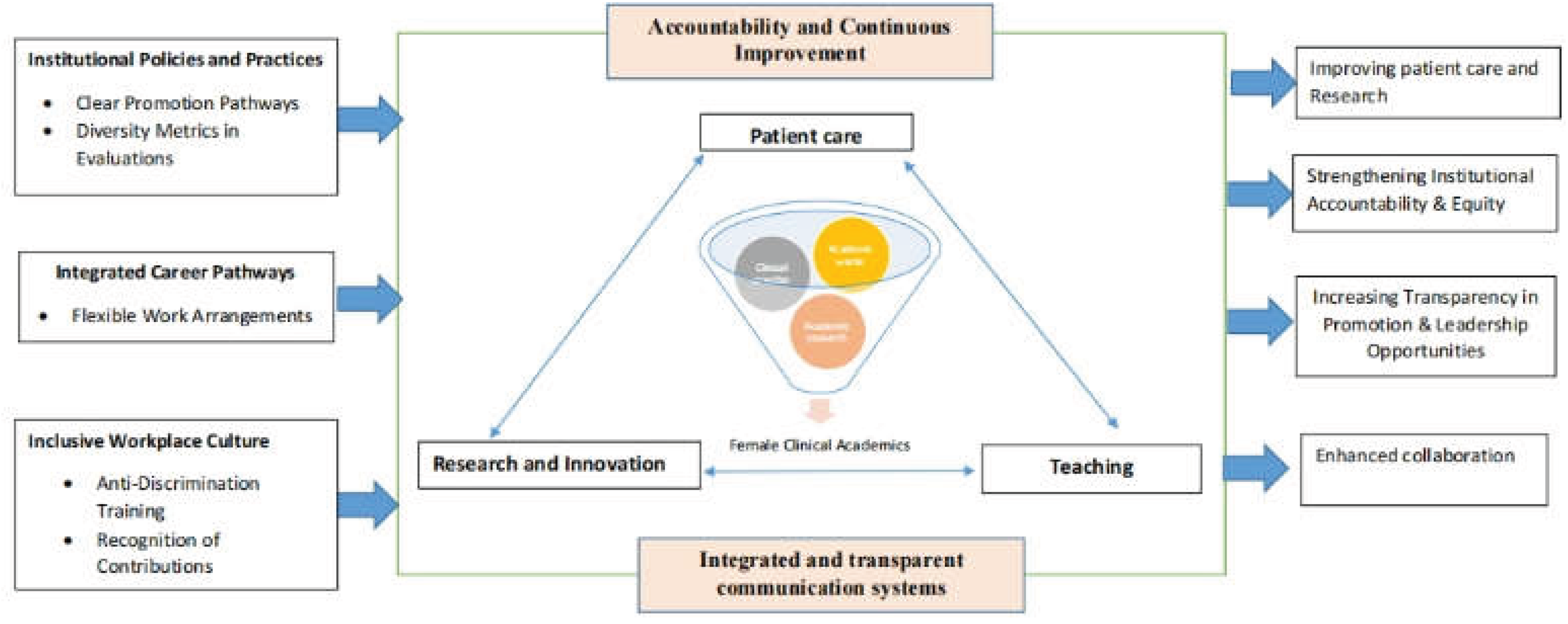
Figure 1.
Diagram of Integrated transparent communication system on addressing gender gap in academic research.
Figure 1.
Diagram of Integrated transparent communication system on addressing gender gap in academic research.
Addressing the Challenge of Institutional Programmes and Cultures
Institutional initiatives like the NIHR Incubator for Clinical Education Research (NIHR, 2017) aim to support women's career development in clinical education research through capacity-building and mentorship. However, evidence on career trajectories within this field remains limited, and the lack of structured pathways hinders sustainable progress.
Robinson et al. (2016) identified key factors for research career success—including protected research time, mentorship, and financial support—but most studies were based on the U.S. system and did not differentiate between early-career and experienced researchers, limiting their applicability in diverse academic contexts (Robinson et al. 2016). Moreover, structural barriers such as short-term funding cycles, unclear promotion criteria, and persistent gender bias continue to disadvantage women in academia, particularly in securing leadership roles and research funding (Llorens et al. 2021; Murphy et al. 2021; Steinþórsdóttir et al. 2020).
Beyond programme-based interventions, a deeper cultural shift is necessary to foster an inclusive academic environment, particularly for ethnic minority women who frequently face micro aggressions, exclusion from informal networks, and a lack of recognition for their contributions (Nair and Good 2021; Osho and Alormele 2024).
The expectation that they undertake disproportionate amounts of unpaid diversity-related work—often termed "invisible labour"—further exacerbates disparities in research productivity and career progression (Braun et al. 2017). Additionally, austerity measures and funding cuts have disproportionately affected gender and racial equity in academia, making systemic reform even more urgent (Rafstedt 2022). Addressing these challenges requires proactive measures, including anti-racism training, allyship initiatives, and institutional accountability mechanisms to combat discrimination and ensure equitable career advancement opportunities.
Recommendations for Addressing Gender Disparities in Academia
To enhance the recognition and support for clinical academics, several measures can be considered:
- Primary Data Collection: Future studies should include qualitative and quantitative research capturing first-hand experiences of ethnic minority women in academia to provide a more robust evidence base for policy recommendations.
- Intersectional Approaches: Institutions should develop policies that explicitly address the combined impact of race, gender, and socioeconomic background on academic career progression.
- Integrated Career Pathways: Universities should create structured and transparent promotion criteria to ensure all academics—particularly those balancing clinical and research roles—have equal access to career progression.
- Mentorship and Sponsorship: Dedicated mentorship and sponsorship programs tailored for ethnic minority women should be institutionalized to provide clearer guidance and support networks.
- Accountability Measures: Universities should be held accountable for their diversity and inclusion efforts, integrating diversity metrics into institutional performance evaluations.
- Recognition of Invisible Labour: Institutions should formally recognize and compensate diversity-related work as a legitimate academic contribution to ensure equitable distribution of responsibilities.
- International Comparative Analysis: Future research should explore successful interventions from international institutions that have effectively addressed gender and racial disparities in academia.
Conclusion
While universities have made some progress in improving gender diversity, the persistent underrepresentation of ethnic minority women at senior levels highlights the need for more radical change. Institutions must move beyond strategic declarations and implement systemic reforms that address the structural barriers limiting career progression for underrepresented groups.
The academic landscape must evolve to reflect the diversity of the society it serves. Without significant structural changes, universities will continue to fall short of their commitment to true inclusivity, leaving talented individuals locked out of opportunities for advancement. The time for action is now.
Data Availability
Data sharing does not apply to this article as no database were generated or analysed during current study.
Ethics approval
Not applicable.
Consent to participate
No participants were involved within this paper.
Consent for publication
All authors consented to publish this manuscript.
Availability of data and material
The data shared within this manuscript is publicly available.
Author Contributions
GD conceptualised and prepared the first draft that was furthered by all other authors. All authors critically appraised, reviewed and commented on all versions of the manuscript. All authors read and approved the final manuscript.
Funding
Not funded.
Acknowledgments
Not applicable.
Conflicts of interest
All authors report no conflict of interest. The views expressed are those of the authors and not necessarily those of the NHS, the National Institute for Health Research, the Department of Health and Social Care or the Academic institutions.
References
- Anon. ‘Secret Quotas behind Medical Schools’ Bias against Women and Ethnic Minorities’. In The Guardian; 9 March 2025. [Google Scholar]
- Bhopal, Kalwant. White Privilege: The Myth of a Post-Racial Society, 1st ed.; Bristol University Press, 2018. [Google Scholar]
- Bisson, Sophie Hogan Robin. ‘Four UK Universities Announce Plans to Cut over 750 Jobs’. Research Professional News. 2025. Available online: https://www.researchprofessionalnews.com/rr-news-uk-universities-2025-1-university-of-east-anglia-to-cut-163-jobs-amid-11m-deficit/.
- Boaz, Annette; Hanney, Stephen; Jones, Teresa; Soper, Bryony. ‘Does the Engagement of Clinicians and Organisations in Research Improve Healthcare Performance: A Three-Stage Review’. BMJ Open 2015, 5(12), e009415. [Google Scholar] [CrossRef]
- Braun, Y.; Gwartney, Patricia A.; Hollander, Jocelyn A.; Otis, Eileen M.; Saperstein, Aliya; Scott, Ellen; Britton, D. ‘The Burden of Invisible Work in Academia: Social Inequalities and Time Use in Five University Departments’. 2017. [Google Scholar]
- Stephens, Brooks; Jasmin, R.; Murphy, Elijah R.; Gallagher, Matthew W.; Walker, Rheeda L. ‘Racial Trauma and Mental Health: The Adaptive Role of Psychological Flexibility for Young Black Adults’. Behav. Ther. S0005789425000103 2025. [Google Scholar] [CrossRef]
- Buckley, Lenore M.; Sanders, Karen; Shih, Margaret; Hampton, Carol L. ‘Attitudes of Clinical Faculty About Career Progress, Career Success and Recognition, and Commitment to Academic Medicine: Results of a Survey’. Arch. Intern. Med. 2000, 160(17), 2625. [Google Scholar] [CrossRef]
- Committee on Maximizing the Potential of Women in Academic Science and Engineering (U. S.), Committee on Science, Engineering, and Public Policy (U.S.), National Academy of Sciences (U.S.), National Academy of Engineering, and Institute of Medicine (U.S.) Beyond Bias and Barriers: Fulfilling the Potential of Women in Academic Science and Engineering; National Academies Press: Washington, D.C, 2007. [Google Scholar]
- Cuevas, Adolfo G.; Ong, Anthony D.; Carvalho, Keri; Ho, Thao; Chan, Sze Wan (Celine); Allen, Jennifer D.; Chen, Ruijia; Rodgers, Justin; Biba, Ursula; Williams, David R. ‘Discrimination and Systemic Inflammation: A Critical Review and Synthesis’. Brain Behav. Immun. 2020, 89, 465–79. [Google Scholar] [CrossRef]
- Davies, K. ‘The New Clinical Impact Awards Scheme’. Bull. R. Coll. Surg. Engl. 2022, 104(3), 136–38. [Google Scholar] [CrossRef]
- Emam, Sabrine Mohammed; Fakhry, Samah Faisal; Abdrabou, Hanaa Mohamed. ‘Leaders Development Program by 360 Degree Feedback: Reflection on Head Nurses’ Leadership Practices’. BMC Nurs. 2024, 23(1), 772. [Google Scholar] [CrossRef]
- Forde, Allana T.; Crookes, Danielle M.; Suglia, Shakira F.; Demmer, Ryan T. ‘The Weathering Hypothesis as an Explanation for Racial Disparities in Health: A Systematic Review’. Ann. Epidemiol. 2019, 33, 1–18.e3. [Google Scholar] [CrossRef]
- Bluemel, Harvey Anna; Burton, Oliver E.; Burford, Bryan; Ellis, Janice; Finn, Gabrielle; Bala, Laksha; Byrne, Matthew Hv.; Vance, Gillian; Alao, Adedoyin. ‘Barriers and Facilitators to Establishing a Clinical Academic Career in Clinical Education Research in the UK: A Focus Group Study’. Med. Teach. 2024, 46(10), 1369–77. [Google Scholar] [CrossRef]
- Higher Education Statistics Agency (HESA). Higher Education Staff Statistics: UK, 2023/24 | HESA . In Statistical Bulletin; SB270. UK., 2025. [Google Scholar]
- Jensen, Janet; Jensen, Cecilie; Pedersen, Malene; Leth-Larsen, Rikke; Christensen, Marit; Høgsgaard, Ditte. ‘Lack of Integration of Research in Clinical Practice: A Qualitative Study of Clinical Academics’ Challenges in the Workplace Environment of Danish Hospitals’. Int. Med. Educ. 2024, 3(3), 331–45. [Google Scholar] [CrossRef]
- Kalra, V. S.; Abel, P.; Esmail, A. ‘Developing Leadership Interventions for Black and Minority Ethnic Staff: A Case Study of the National Health Service (NHS) in the UK’. J. Health Organ. Manag. 2009, 23(1), 103–18. [Google Scholar] [CrossRef]
- Kanaslan, Ece Kuzulu; Iyem, Cemal. Is 360 Degree Feedback Appraisal an Effective Way of Performance Evaluation? Int. J. Acad. Res. Bus. Soc. Sci. 2016, 6(5), Pages 172–182. [Google Scholar] [CrossRef]
- Llorens, Anaïs; Tzovara, Athina; Bellier, Ludovic; Bhaya-Grossman, Ilina; Bidet-Caulet, Aurélie; Chang, William K.; Cross, Zachariah R.; Dominguez-Faus, Rosa; Flinker, Adeen; Fonken, Yvonne; Gorenstein, Mark A.; Holdgraf, Chris; Hoy, Colin W.; Ivanova, Maria V.; Jimenez, Richard T.; Jun, Soyeon; Kam, Julia WY.; Kidd, Celeste; Marcelle, Enitan; Marciano, Deborah; Martin, Stephanie; Myers, Nicholas E.; Ojala, Karita; Perry, Anat; Pinheiro-Chagas, Pedro; Riès, Stephanie K.; Saez, Ignacio; Skelin, Ivan; Slama, Katarina; Staveland, Brooke; Bassett, Danielle S.; Buffalo, Elizabeth A.; Fairhall, Adrienne L.; Kopell, Nancy J.; Kray, Laura; Lin, Jack J.; Nobre, Anna C.; Riley, Dylan; Solbakk, Anne-Kristin; Wallis, Joni D.; Wang, Xiao-Jing; Yuval-Greenberg, Shlomit; Kastner, Sabine; Knight, Robert T.; Dronkers, Nina F. ‘Gender Bias in Academia: A Lifetime Problem That Needs Solutions’. Neuron 2021, 109(13), 2047–74. [Google Scholar] [CrossRef]
- Medical Schools Council. Medical School Admissions : Report of a Formal Investigation into St. George’s Hospital Medical School / [Commission for Racial Equality].; Commission for Racial Equality: London, 2023. [Google Scholar]
- Medical Schools Council. ‘Investment in Clinical Academia Needed to Deliver Medical Expansion’. Medical Schools Council. 2024. Available online: https://www.medschools.ac.uk/news/investment-in-clinical-academia-needed-to-deliver-medical-expansion.
- Murphy, Marie; Callander, Jacquelyn K.; Dohan, Daniel; Grandis, Jennifer R. ‘Women’s Experiences of Promotion and Tenure in Academic Medicine and Potential Implications for Gender Disparities in Career Advancement: A Qualitative Analysis’. JAMA Netw. Open 2021, 4(9), e2125843. [Google Scholar] [CrossRef]
- Nair, Nisha; Good, Deborah Cain. ‘Microaggressions and Coping with Linkages for Mentoring’. Int. J. Environ. Res. Public Health 2021, 18(11), 5676. [Google Scholar] [CrossRef]
- NHS England. Workforce Race Equality Standard 2021. 2021 data analysis report for NHS trusts; NHS England: United Kingdom, 2022. [Google Scholar]
- Osho, Yaz Iyabo; Alormele, Naomi. ‘Negotiated Spaces: Black Women Academics’ Experiences in UK Universities’. In Higher Education; 2024. [Google Scholar] [CrossRef]
- Payne, Ruth; Frejah, Isabella; Abbey, Elizabeth; Badcoe, Rosemary; Delaney, Brigitte; Mitchell, Caroline. ‘Transitioning between Clinical and Academic Practice from the Perspectives of Clinical Academic Trainees, Academic Training Programme Directors and Academic Supervisors: A Mixed Methods Study’. BMC Med. Educ. 2025, 25(1), 236. [Google Scholar] [CrossRef]
- Polanco-Roman, Lillian; Miranda, Regina; Hien, Denise; Anglin, Deidre M. Racial/Ethnic Discrimination as Race-Based Trauma and Suicide-Related Risk in Racial/Ethnic Minority Young Adults: The Explanatory Roles of Stress Sensitivity and Dissociation. Psychol. Trauma Theory Res. Pract. Policy 2021, 13(7), 759–67. [Google Scholar] [CrossRef]
- Rafstedt, My. ‘Austerity Policies and the Strategic Silencing of Their Gendered Effects: Evidence from Spain’. Soc. Politics Int. Stud. Gend. State Soc. 2022, 29(3), 1009–33. [Google Scholar] [CrossRef]
- Raza, Ali; Onyesoh, Kiki. ‘Reverse Mentoring for Senior NHS Leaders: A New Type of Relationship’. Future Healthc. J. 2020, 7(1), 94–96. [Google Scholar] [CrossRef]
- Robinson, Georgeanna F. W. B.; Schwartz, Lisa S.; DiMeglio, Linda A.; Ahluwalia, Jasjit S.; Gabrilove, Janice L. ‘Understanding Career Success and Its Contributing Factors for Clinical and Translational Investigators’. Acad. Med. 2016, 91(4), 570–82. [Google Scholar] [CrossRef]
- Sara, Ahamed. On Being Included: Racism and Diversity in Institutional Life; Duke University Press, 2012. [Google Scholar]
- Sealy, Ruth H. V.; Singh, Val. ‘The Importance of Role Models and Demographic Context for Senior Women’s Work Identity Development’. Int. J. Manag. Rev. 2010, 12(3), 284–300. [Google Scholar] [CrossRef]
- Shauman, Kimberlee; Howell, Lydia P.; Paterniti, Debora A.; Beckett, Laurel A.; Villablanca, Amparo C. ‘Barriers to Career Flexibility in Academic Medicine: A Qualitative Analysis of Reasons for the Underutilization of Family-Friendly Policies, and Implications for Institutional Change and Department Chair Leadership’. Acad. Med. 2018, 93(2), 246–55. [Google Scholar] [CrossRef]
- Simons, Ronald L.; Lei, Man-Kit; Klopack, Eric; Zhang, Yue; Gibbons, Frederick X.; Beach, Steven R. H. ‘Racial Discrimination, Inflammation, and Chronic Illness Among African American Women at Midlife: Support for the Weathering Perspective’. J. Racial Ethn. Health Disparities 2021, 8(2), 339–49. [Google Scholar] [CrossRef]
- Steinþórsdóttir, Finnborg S.; Einarsdóttir, Þorgerður; Pétursdóttir, Gyða M.; Himmelweit, Susan. ‘Gendered Inequalities in Competitive Grant Funding: An Overlooked Dimension of Gendered Power Relations in Academia’. High. Educ. Res. Dev. 2020, 39(2), 362–75. [Google Scholar] [CrossRef]
- Stephen, Walcott; Gwen, Nightingale. How Racism Affects Health | The Health Foundation; The Runnymede Trust and the Health Foundation, 2025. [Google Scholar]
- Thomsen, Janus Laust; Jarbøl, Dorthe; Søndergaard, Jens. ‘Excessive Workload, Uncertain Career Opportunities and Lack of Funding Are Important Barriers to Recruiting and Retaining Primary Care Medical Researchers: A Qualitative Interview Study’. Fam. Pract. 2006, 23(5), 545–49. [Google Scholar] [CrossRef]
- Trusson, Diane; Rowley, Emma; Barratt, Jonathan. ‘Anticipating, Experiencing and Overcoming Challenges in Clinical Academic Training’. Br. J. Healthc. Manag. 2021, 27(8), 1–8. [Google Scholar] [CrossRef]
- UK universities. BLACK, ASIAN AND MINORITY ETHNIC STUDENT ATTAINMENT AT UK UNIVERSITIES: #CLOSINGTHEGAP . 2019. [Google Scholar]
- Van Den Brink, Marieke; Benschop, Yvonne. ‘Slaying the Seven-Headed Dragon: The Quest for Gender Change in Academia’. Gend. Work Organ. 2012, 19(1), 71–92. [Google Scholar] [CrossRef]
- Walling, Anne. Why Is Academic Promotion So Challenging for Clinicians?’ Pp. 3–15 in Academic Promotion for Clinicians; Springer International Publishing: Cham, 2018. [Google Scholar]
- Wise, Jacqui. ‘Leading Clinical Academic Warns of Crisis in UK Research’. BMJ q1017 2024. [Google Scholar] [CrossRef]
Disclaimer/Publisher’s Note: The statements, opinions and data contained in all publications are solely those of the individual author(s) and contributor(s) and not of MDPI and/or the editor(s). MDPI and/or the editor(s) disclaim responsibility for any injury to people or property resulting from any ideas, methods, instructions or products referred to in the content. |
© 2026 by the authors. Licensee MDPI, Basel, Switzerland. This article is an open access article distributed under the terms and conditions of the Creative Commons Attribution (CC BY) license (http://creativecommons.org/licenses/by/4.0/).
Copyright: This open access article is published under a Creative Commons CC BY 4.0 license, which permit the free download, distribution, and reuse, provided that the author and preprint are cited in any reuse.