

Submitted:
15 October 2026
Posted:
16 October 2026
You are already at the latest version
Abstract
Background: The FAUCS technique has been proposed as an alternative cesarean section approach potentially associated with improved postoperative recovery. Objective: To compare postoperative pain characteristics, functional recovery, analgesic requirements, and psychological outcomes between women undergoing intraperitoneal cesarean section (CS) and FAUCS cesarean section. Methods: A total of 201 women were included in this prospective single-center observational cohort study (CS: n = 101; FAUCS: n = 100). Postoperative pain intensity was assessed using the Numerical Rating Scale (NRS) and the McGill Pain Questionnaire. Functional recovery, emotional status, analgesic intake, and anxiety levels were evaluated during the early postoperative period. Results: FAUCS was associated with significantly lower pain intensity on postoperative day 0 (adjusted β = −1.97, 95% CI −2.63 to −1.32; p < 0.001), lower total McGill Pain Questionnaire scores (adjusted β = −2.85, 95% CI −4.68 to −1.02; p = 0.002), and lower sensory McGill scores (adjusted β = −2.59, 95% CI −4.31 to −0.86; p = 0.003). Time to first sitting and standing was approximately 10 h shorter following FAUCS (both p < 0.001). FAUCS was also associated with lower anxiety levels, better functional independence and overall well-being, and substantially lower weak opioid use (adjusted RR = 0.11, 95% CI 0.03–0.45; p = 0.002). Conclusions: FAUCS was associated with improved early postoperative functional recovery, lower pain burden, lower anxiety levels, and better overall well-being compared with intraperitoneal cesarean section. These findings should be interpreted in the context of the observational, non-randomized study design.
Keywords:
cesarean section
; FAUCS
; functional recovery
; postoperative pain
Introduction
Operative delivery remains an integral component of contemporary obstetric practice, with cesarean section rates steadily increasing worldwide over recent decades [1]. Although cesarean delivery is an effective and often life-saving procedure for both mother and child, it is associated with considerable postoperative morbidity, including increased pain, delayed mobilization, prolonged recovery, and reduced maternal autonomy during the early postpartum period compared with vaginal birth [2,3]. Consequently, growing attention has been directed toward optimizing perioperative care and improving the overall patient experience following operative delivery [4].
In parallel with the development of enhanced recovery protocols, increasing emphasis has been placed not only on surgical safety and neonatal outcomes, but also on maternal satisfaction and quality of postoperative recovery [4,5]. Early mobilization, independence in newborn care, effective pain control, and preservation of maternal well-being are now recognized as important determinants of patient-centered obstetric care [5,6]. These factors may substantially influence the overall childbirth experience and maternal perception of operative delivery [6].
Intraperitoneal cesarean section techniques are performed via a transperitoneal approach requiring entry into the abdominal cavity and manipulation of intra-abdominal structures. Despite advances in surgical techniques, including the Misgav-Ladach method, postoperative discomfort and functional limitations remain common following standard cesarean delivery [7,8]. In response to these limitations, minimally invasive operative approaches have been developed with the aim of reducing surgical trauma and accelerating maternal recovery [9].
French Ambulatory Cesarean Section (FAUCS) is an extraperitoneal cesarean technique designed to minimize tissue manipulation and facilitate enhanced postoperative recovery [9,10]. The procedure combines an extraperitoneal surgical approach with principles of enhanced recovery after surgery, potentially enabling earlier mobilization, reduced postoperative pain, faster return to daily functioning, and greater maternal independence in newborn care [10,11]. By limiting peritoneal irritation and intra-abdominal intervention, FAUCS may also contribute to improved maternal comfort and overall satisfaction during the postoperative period [10].
Although previous studies have demonstrated favorable perioperative and neonatal outcomes associated with FAUCS, available evidence regarding patient-reported postoperative recovery and maternal satisfaction remains limited [10,11,12].
Aim of the Study
This study aimed to evaluate functional recovery after operative delivery by intraperitoneal cesarean section (CS) or French Ambulatory Cesarean Section (FAUCS), with particular emphasis on postoperative recovery, pain perception, functional independence, and maternal well-being.
Materials and Methods
This prospective comparative cohort study was conducted at the Department of Obstetrics and Gynecology of the Regional Hospital in Kielce, a tertiary referral center. The study included women who underwent cesarean section between January 2024 and December 2025. FAUCS procedures were performed by an experienced surgeon (D.W.) according to the technique described by Ami et al. (2017), with two modifications. In contrast to the original protocol, bladder catheterization was routinely used, and skin closure was performed with non-absorbable sutures instead of tissue adhesive. No other modifications to the original FAUCS technique were introduced. The study was approved by the Bioethics Committee of Jan Kochanowski University in Kielce (approval number 12/2024) and written consent was obtained from all women. The manuscript was prepared in compliance with the Strengthening the Reporting of Observational Studies in Epidemiology (STROBE) recommendations for cohort studies [13].Postoperative pain intensity and qualitative pain characteristics were assessed using the McGill Pain Questionnaire (MPQ) and the Numerical Rating Scale (NRS; 0 = no pain, 10 = the worst pain imaginable) at rest on the day of surgery (postoperative day 0) and on the first postoperative day (postoperative day 1) [14]. Psychological status and anxiety levels were evaluated using the State-Trait Anxiety Inventory (STAI-S) questionnaire [15].
Eligibility Criteria
Women were eligible for inclusion if they had a singleton pregnancy at term (≥37 weeks of gestation) and underwent cesarean delivery using either the intraperitoneal cesarean section (CS) technique or the French Ambulatory Cesarean Section (FAUCS) technique. Women with a history of one or more previous cesarean deliveries were also eligible for inclusion. All women received information about the study and provided written informed consent before enrollment.
Exclusion criteria were emergency cesarean delivery, multiple pregnancy, preterm delivery (<37 weeks of gestation), placenta previa, suspected placenta accreta spectrum, major fetal anomalies, and the need for general anesthesia.
Women undergoing intraperitoneal cesarean delivery typically received intrathecal hyperbaric bupivacaine (9–12 mg) with fentanyl (10–25 μg), whereas FAUCS was performed using lower doses of hyperbaric bupivacaine (7–8 mg) combined with fentanyl (10–25 μg). Following birth and cord clamping, intravenous fentanyl (100–200 μg) was administered when required. Postoperative analgesia was administered according to the institutional ERAC protocol. All patients received scheduled multimodal non-opioid analgesia as the baseline postoperative analgesic regimen. Opioid analgesics and additional on-demand analgesia were administered when clinically indicated.
Study Design and Statistical Analysis
This single-center observational cohort study compared outcomes in two groups of women undergoing cesarean delivery: 100 patients operated on using the French Ambulatory Cesarean Section (FAUCS) and 101 women who underwent an intraperitoneal cesarean section (CS). Consecutive eligible cases were included in the analysis without exclusion based on baseline characteristics. Patients were enrolled prospectively between January 2024 and December 2025. Clinical and questionnaire data were collected prospectively at predefined time points according to the study protocol. The number of pregnancies refers to gravidity, whereas the number of deliveries includes the index delivery. Previous cesarean sections refer only to cesarean deliveries before the index pregnancy. After completion of patient recruitment and follow-up, all data were entered into an anonymized study database, which was subsequently exported for statistical analysis.
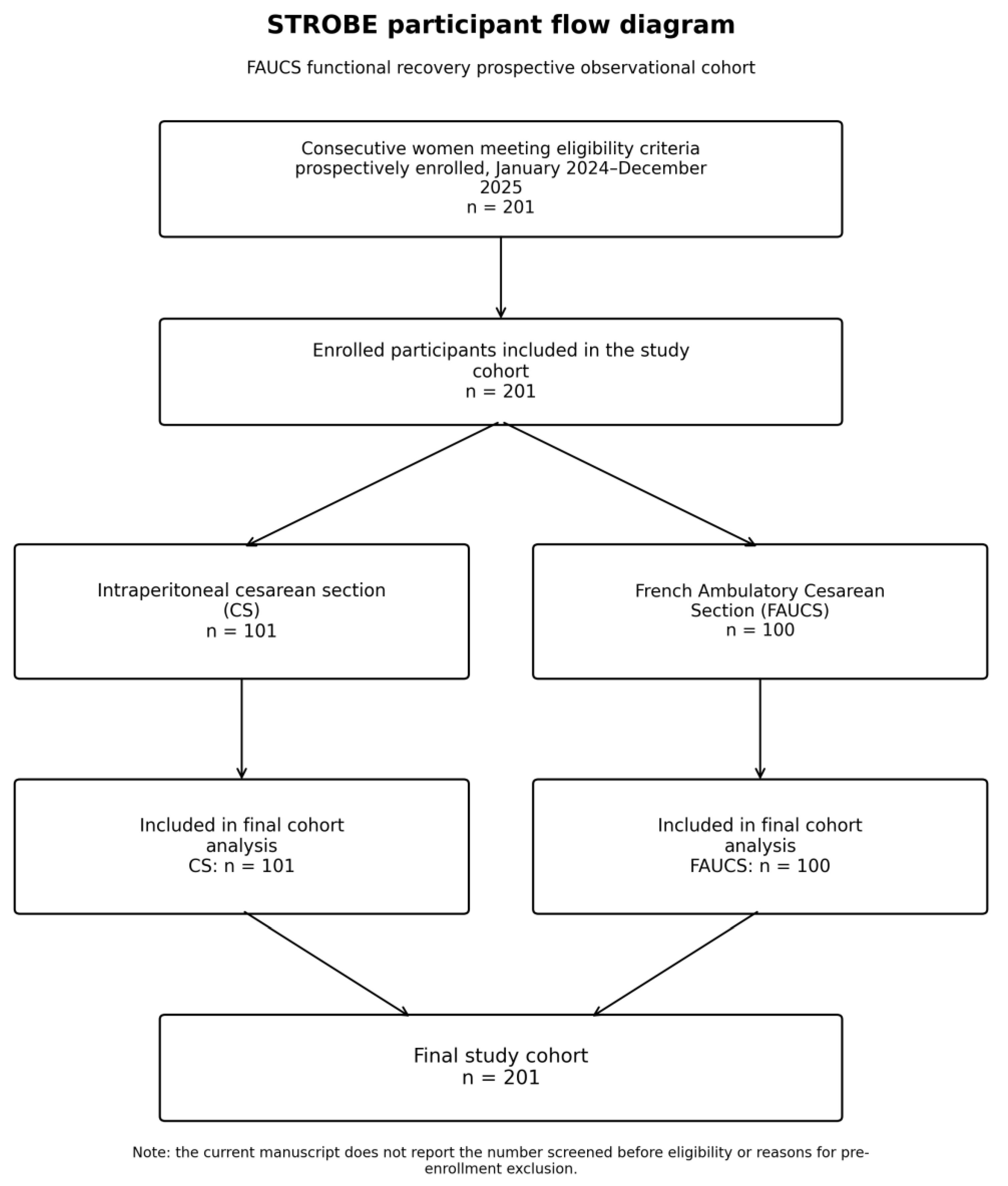
During the study period, 201 consecutive women meeting the eligibility criteria were prospectively enrolled. All 201 enrolled participants were retained in the study cohort and included in the final analysis, with outcome-specific analyses performed using available observations. (Fig.1)
Postoperative day 1 NRS data were available for a smaller subset of participants because of logistical difficulties in collecting follow-up questionnaires on the day after surgery. Missing observations were not imputed, and analyses were performed using available cases for each outcome.
Study Size
No formal a priori sample size or power calculation was performed. The study size was determined pragmatically by the number of consecutive eligible women available for recruitment during the predefined study period. Between January 2024 and December 2025, 201 women meeting the study eligibility criteria were prospectively enrolled, including 101 women undergoing intraperitoneal cesarean section (CS) and 100 women undergoing French Ambulatory Cesarean Section (FAUCS). All enrolled participants were included in the final cohort analysis. Given the absence of a formal a priori sample size calculation, the analyses should be regarded as exploratory.Statistical analyses were performed using the R programming language in the RStudio environment. Continuous variables were summarized using mean and standard deviation (SD) and/or median and interquartile range (IQR), as appropriate. Categorical variables were presented as numbers and percentages. Continuous variables with an approximately normal distribution were compared between groups using Student’s t-test, whereas non-normally distributed continuous or ordinal variables were analyzed using the Mann–Whitney U test. Categorical variables were compared using Pearson’s chi-square test or Fisher’s exact test when expected cell counts were small. For categorical variables with multiple categories, the reported p-values refer to the overall comparison of the distribution between study groups.
Figure 1.
STROBE participant flow diagram of the prospective observational cohort comparing intraperitoneal cesarean section (CS; n = 101) and French Ambulatory Cesarean Section (FAUCS; n = 100).
Figure 1.
STROBE participant flow diagram of the prospective observational cohort comparing intraperitoneal cesarean section (CS; n = 101) and French Ambulatory Cesarean Section (FAUCS; n = 100).
In addition to the unadjusted analyses, multivariable regression analyses were performed to account for potential confounding related to baseline differences between the study groups. Surgical technique (FAUCS versus intraperitoneal cesarean section [CS]) was included as the primary exposure variable, with CS serving as the reference group. The primary adjusted models included gravidity and the presence of metabolic disorders as covariates, selected on the basis of their clinical relevance and observed baseline imbalance between the study groups.
Continuous outcomes were analyzed using multiple linear regression with heteroscedasticity-consistent (HC3) robust standard errors. Results are reported as adjusted regression coefficients (β) with corresponding 95% confidence intervals (CI) and two-sided p-values. The regression coefficient for surgical technique represents the adjusted mean difference between the FAUCS and CS groups. Accordingly, a negative β indicates a lower adjusted outcome value in the FAUCS group, whereas a positive β indicates a higher adjusted value.
For binary analgesic outcomes, modified Poisson regression with robust standard errors was used to estimate adjusted risk ratios (aRR) and corresponding 95% CIs. Models were adjusted for gravidity and metabolic disorders, consistent with the primary adjusted analyses.
As a sensitivity analysis, the principal continuous-outcome models were additionally adjusted for maternal age and pre-pregnancy body mass index (BMI), in addition to gravidity and metabolic disorders, to assess the robustness of the observed associations to broader adjustment for baseline maternal characteristics.
Analyses were performed using available observations for each outcome. No formal adjustment for multiple comparisons was applied; therefore, results from analyses of multiple individual questionnaire items and pain descriptors should be interpreted with appropriate caution. All statistical tests were two-sided, and a p-value <0.05 was considered statistically significant.
For the interpretation of postoperative functional recovery, questionnaire items scored on a 0–10 scale were analyzed individually. Higher scores for functional items indicated better functional recovery, whereas higher scores for symptom items indicated greater symptom severity. No composite functional recovery score was calculated.
This study represents a predefined analysis of a prospective observational cohort. Although part of the study population overlaps with our previously published cohort investigating early postoperative recovery following FAUCS, the present analysis addresses different research objectives by focusing on patients qualitative pain characteristics, psychological outcomes, and functional recovery using validated patient-reported outcome measures.
Results
A total of 201 patients were included in the analysis, comprising 101 women in the CS group and 100 in the FAUCS group. The groups were comparable with regard to maternal age (CS 32.3 ± 4.9 vs. FAUCS 32.2 ± 3.9 years; p = 0.90) and pre-pregnancy BMI (24.8 ± 5.1 vs. 23.6 ± 4.3 kg/m²; p = 0.07). No statistically significant differences were observed in the prevalence of endocrinological disorders (18.8% vs. 12.0%; p = 0.25), psychiatric disorders (3.0% vs. 2.0%; p = 1.00), neurological disorders (0.0% vs. 2.0%; p = 0.47), orthopedic diseases (2.0% vs. 0.0%; p = 0.48), or internal medicine comorbidities (17.8% vs. 17.0%; p = 1.00).
Significant baseline differences were identified for metabolic disorders, which were more common in the CS cohort (15.8% vs. 3.0%; p = 0.004). Reproductive history also differed between groups. Women in the CS group had a higher number of pregnancies overall (p < 0.001), whereas primigravid women (women in their first pregnancy) were observed exclusively in the FAUCS group (33.0%). The number of previous deliveries and prior cesarean sections did not differ significantly between the study groups (p = 0.41 and p = 0.35, respectively). The time to first sitting and standing after surgery was significantly shorter in patients undergoing FAUCS cesarean section compared with those undergoing intraperitoneal cesarean section (CS). The median time to sitting was 4 hours (Q1–Q3: 3–5) in the FAUCS group versus 14 hours (Q1–Q3: 10–16) in the CS group (mean ± SD: 4.13 ± 2.05 vs. 13.77 ± 4.44 hours; p < 0.001). Similarly, the median time to first standing was 6 hours (Q1–Q3: 5–7) after FAUCS and 16 hours (Q1–Q3: 13–19) after CS (mean ± SD: 6.33 ± 2.86 vs. 15.96 ± 5.27 hours; p < 0.001). These baseline differences were presented in the table no.1

Table 1.
Baseline demographic, postoperative outcomes and clinical characteristics of women undergoing intraperitoneal cesarean section (CS) and FAUCS.
Table 1.
Baseline demographic, postoperative outcomes and clinical characteristics of women undergoing intraperitoneal cesarean section (CS) and FAUCS.
| Characteristics | Category | CS (n=101) | FAUCS (n=100) | p-value |
| Maternal age (years) | 32.307 ± 4.931 | 32.23 ± 3.869 | 0.902 | |
| Pre-pregnancy BMI (kg/m²) | 24.83 ± 5.079 | 23.598 ± 4.325 | 0.065 | |
| gravidity | 1 | 0 (0.00%) | 33 (33.00%) | <0.001 |
| 2 | 32 (31.68%) | 43 (43.00%) | ||
| 3 | 37 (36.63%) | 12 (12.00%) | ||
| 4 | 14 (13.86%) | 6 (6.00%) | ||
| 5 | 12 (11.88%) | 5 (5.00%) | ||
| 6 | 4 (3.96%) | 1 (1.00%) | ||
| 7 | 1 (0.99%) | 0 (0.00%) | ||
| 8 | 1 (0.99%) | 0 (0.00%) | ||
| parity | 1 | 42 (41.58%) | 36 (36.00%) | 0.405 |
| 2 | 40 (39.60%) | 51 (51.00%) | ||
| 3 | 13 (12.87%) | 9 (9.00%) | ||
| 4 | 6 (5.94%) | 4 (4.00%) | ||
| Previous cesarean sections | 1 | 39 (38.61%) | 51 (51.00%) | 0.353 |
| 2 | 10 (9.90%) | 8 (8.00%) | ||
| Endocrinological disorders | 19 (18.81%) | 12 (12.00%) | 0.254 | |
| Metabolic disorders | 16 (15.84%) | 3 (3.00%) | 0.004 | |
| Psychiatric disorders | 3 (2.97%) | 2 (2.00%) | 1.000 | |
| Neurological disorders | 0 (0.00%) | 2 (2.00%) | 0.473 | |
| Orthopedic disorders | 2 (1.98%) | 0 (0.00%) | 0.482 | |
| Internal medicine disorders | 18 (17.82%) | 17 (17.00%) | 1.000 | |
| Time to first sitting (h) | 13.772 ± 4.436 | 4.13 ± 2.053 | <0.001 | |
| Time to first standing (h) | 15.96 ± 5.271 | 6.33 ± 2.864 | <0.001 | |
Continuous variables are presented as mean ± standard deviation (SD) or median (interquartile range), as appropriate. Categorical variables are presented as number (percentage). Comparisons were performed using Student's t-test, Mann–Whitney U test, chi-square test, or Fisher's exact test, as appropriate.
Characteristics of Postpartum Pain
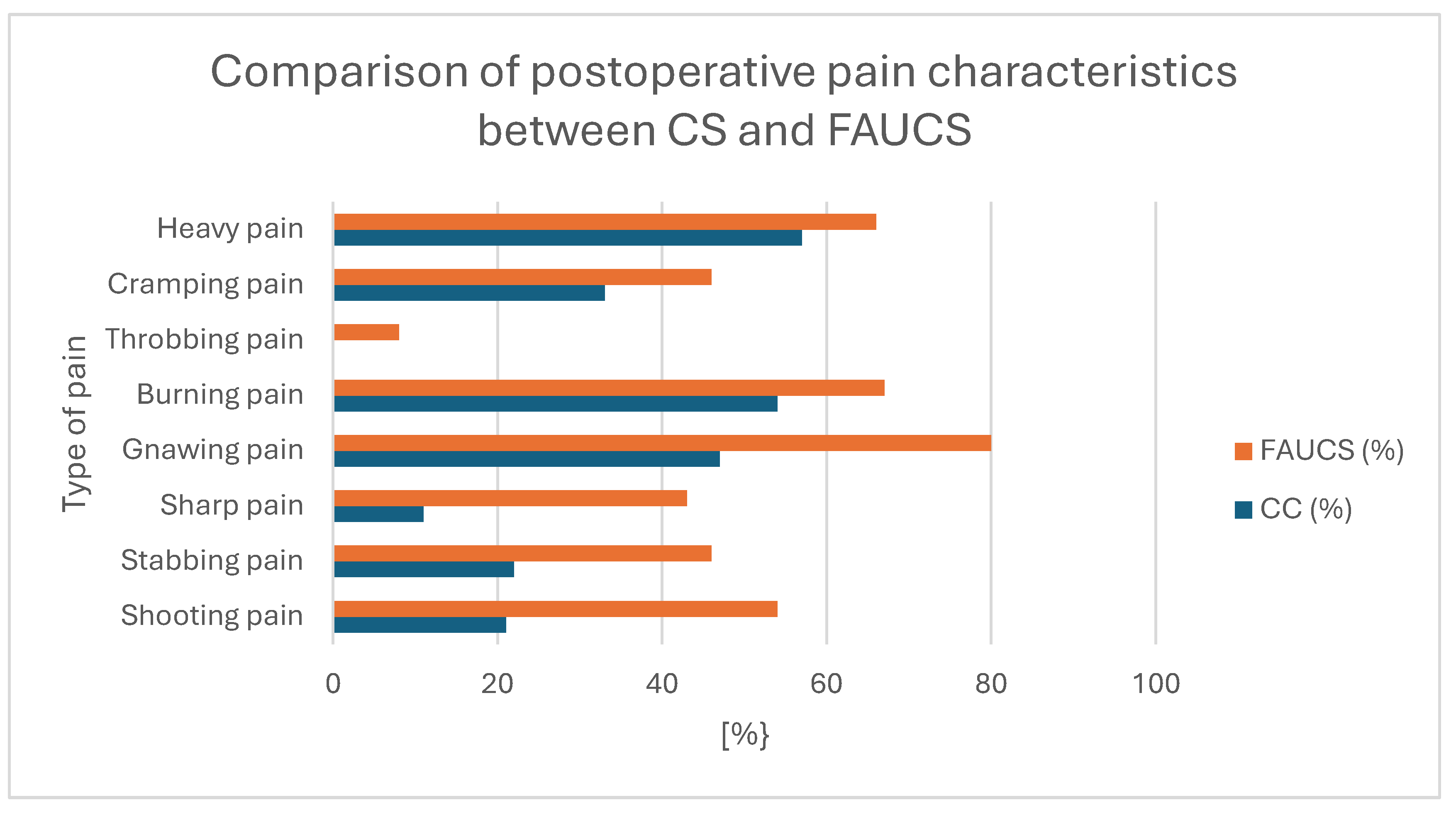
Postoperative pain profiles differed between the CS and FAUCS groups across several sensory descriptors. Patients undergoing the FAUCS procedure more frequently reported the absence of throbbing pain (8.0% vs. 0.0%; p = 0.006), shooting pain (54.0% vs. 20.8%; p < 0.001), stabbing pain (46.0% vs. 21.8%; p = 0.002), sharp pain (43.0% vs. 10.9%; p < 0.001), and gnawing pain (80.0% vs. 47.0%; p < 0.001), suggesting a generally lower intensity of acute pain sensations following FAUCS. Similarly, hot/burning pain was less commonly reported in the FAUCS group (p = 0.047).
In contrast, no statistically significant differences were observed between groups regarding cramping pain (p = 0.175), troublesome pain (p = 0.207), bursting pain (p = 0.683), exhausting pain (p = 0.223), nausea-inducing pain (p = 0.113), terrible pain (p = 0.249), or cruel/merciless pain (p = 1.00). Pain associated with touching the postoperative wound also did not differ significantly between groups (p = 0.076), although higher pain scores were numerically more frequent among FAUCS patients. The particular data regarding the postpartum pain characteristics are presented in the supplementary material. Overall, these findings indicate that FAUCS may be associated with a more favorable qualitative postoperative pain profile, particularly with respect to sharp, shooting, and stabbing pain sensations.
Postpartum Pain Intensity
Patients in the FAUCS group reported significantly lower pain intensity on postoperative day 0, as reflected by lower NRS scores compared with the CS group (p < 0.001). Similarly, total pain perception assessed using the McGill Pain Questionnaire, particularly within the sensory domain, was significantly lower in the FAUCS cohort (p = 0.004 for both comparisons). No significant difference was identified for the affective component of the McGill scale.
Figure 2.
Distribution of McGill Pain Questionnaire descriptor scores in patients undergoing intraperitoneal cesarean section (CS) and FAUCS. Scores are presented as the percentage of patients reporting each descriptor intensity.
Figure 2.
Distribution of McGill Pain Questionnaire descriptor scores in patients undergoing intraperitoneal cesarean section (CS) and FAUCS. Scores are presented as the percentage of patients reporting each descriptor intensity.
Postoperative day 1 NRS scores were available for 58 participants because of logistical difficulties in collecting follow-up questionnaires on the day after surgery. No significant association between surgical technique and NRS pain intensity on postoperative day 1 was observed in the adjusted analysis (adjusted β = 0.08, 95% CI −3.23 to 3.38; p = 0.963). Given the reduced number of available observations, this result should be interpreted cautiously.
Functional recovery occurred substantially earlier in the FAUCS group. Time to sitting and time to standing were both significantly shorter among FAUCS patients compared with those undergoing cesarean section (p < 0.001 for both). Additionally, FAUCS patients achieved significantly higher scores in measures related to postoperative independence, including the ability to get out of bed independently, hold and care for the newborn and care for their own needs. The above-described data are presented in Table 2.
Moderate pain scores were significantly lower in the FAUCS group than in the CS group (5.67 ± 1.94 vs. 6.17 ± 1.99; p=0.030). Severe pain scores were also lower following FAUCS (2.17 ± 2.03 vs. 2.65 ± 1.83; p=0.023). Nausea/vomiting scores differed significantly between groups, with lower median values in the FAUCS group (median [IQR]: 0 [0–1.25] vs. 2 [0–2]; p<0.001). No statistically significant between-group differences were observed for dizziness (p=0.387) or chills (p=0.518). Anxiety levels assessed using the STAI were significantly lower in the FAUCS group (33.53 ± 6.52 vs. 35.78 ± 7.73; p=0.027). No significant difference was observed for the item “I felt very well” (p=0.550).
Pain Localization
Pain during the postoperative period was most commonly provoked by mobilization-related activities in both study groups. Patients undergoing FAUCS cesarean section more frequently reported pain associated with getting out of bed compared with patients after intraperitoneal cesarean section (75.00% vs. 57.43%; p = 0.013). No significant between-group differences were observed for pain provoked by changing position in bed, walking, or breastfeeding.
The predominant pain location in both groups was the postoperative wound area, reported by 93.00% of patients after FAUCS and 83.17% after CS, although this difference did not reach statistical significance (p = 0.053). Abdominal and spinal pain were reported with similar frequency in both groups. Pain located in the head, ribs, and shoulder occurred rarely and did not differ significantly between groups.
Analgesics Intake
Postoperative analgesia was administered according to the ERAC protocol. All patients in both groups received multimodal non-opioid analgesia (100% in both CS and FAUCS groups); therefore, no between-group statistical comparison was applicable for this component of analgesic treatment. Weak opioids were used significantly more frequently in the intraperitoneal CS group than in the FAUCS group (22/97 [22.7%] vs. 2/99 [2.0%], respectively; p<0.001). Strong opioid use was uncommon in both groups and did not differ significantly between CS and FAUCS (5/97 [5.2%] vs. 2/99 [2.0%]; Fisher’s exact p=0.276).
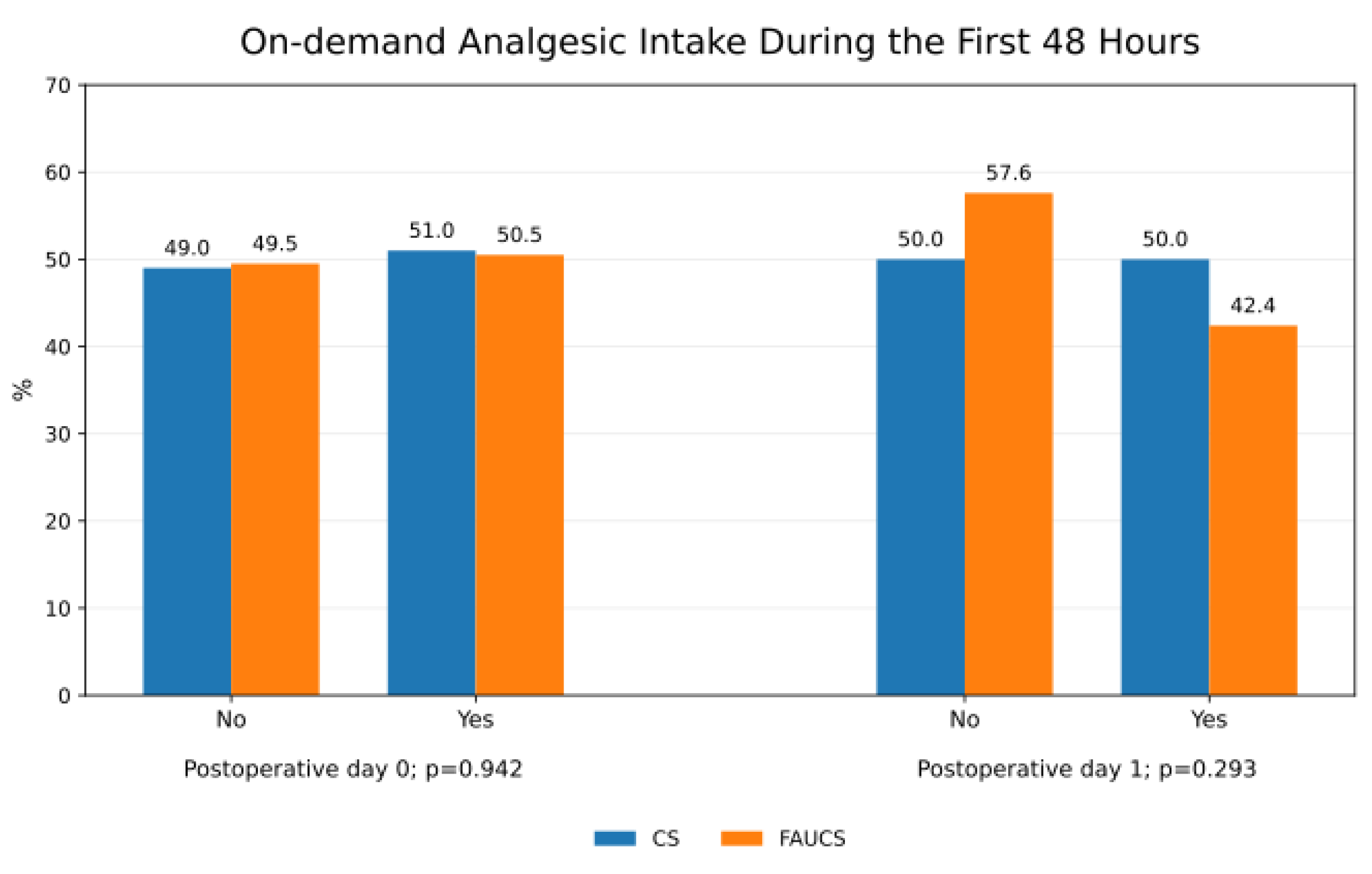
The need for additional on-demand analgesia was comparable between the groups. On postoperative day 0, on-demand analgesics were administered to 50/98 (51.0%) patients in the CS group and 50/99 (50.5%) patients in the FAUCS group (p=0.942). On postoperative day 1, the corresponding proportions were 49/98 (50.0%) and 39/92 (42.4%), respectively (p=0.293). Thus, no statistically significant between-group differences in the use of on-demand analgesia were observed during the first 48 postoperative hours (Table 3 and Figure 3).
Figure 4.
Comparison of analgesic intake during the first 48 postoperative hours in patients undergoing intraperitoneal cesarean section (CS) and FAUCS. Analgesic use was assessed separately on postoperative day 0 and postoperative day 1.
Figure 4.
Comparison of analgesic intake during the first 48 postoperative hours in patients undergoing intraperitoneal cesarean section (CS) and FAUCS. Analgesic use was assessed separately on postoperative day 0 and postoperative day 1.
Postoperative Functional Recovery, Symptom Burden, and Psychological Outcomes
Patients undergoing FAUCS cesarean section demonstrated significantly lower anxiety levels, as reflected by lower STAI scores compared with the intraperitoneal cesarean section (CS) group (33.53 ± 6.52 vs. 35.78 ± 7.73; p = 0.027). Simultaneously, FAUCS patients achieved significantly better postoperative functional recovery, including independent mobilization, the ability to hold, feed, and care for the newborn, and self-care capacity (all p ≤ 0.001). Overall well-being during the preceding 24 hours was significantly higher in the FAUCS group than in the CS group (9.11 ± 0.96 vs. 7.56 ± 1.82; median [IQR]: 9 [8,9,10] vs. 8 [7,8,9]; p<0.001). The differences between the groups are presented in Figure 5.
Psychological and Emotional Outcomes
No significant between-group difference was observed for the item “I felt very well” (FAUCS: 6.92 ± 2.02 vs. CS: 7.05 ± 2.00; p=0.550). In contrast, women undergoing FAUCS reported significantly greater ability to get out of bed independently (9.32 ± 1.39 vs. 7.71 ± 1.81), hold the baby independently (9.21 ± 1.67 vs. 7.84 ± 1.77), feed or care for the baby independently (8.78 ± 1.73 vs. 7.83 ± 1.76), and care for themselves and their own needs (8.57 ± 1.67 vs. 7.88 ± 1.75; all p<0.001). (Tab. 4)
Table 4.
Comparison of postoperative functional status between women undergoing FAUCS and intraperitoneal cesarean section.
Table 4.
Comparison of postoperative functional status between women undergoing FAUCS and intraperitoneal cesarean section.
| Variable | Group | Min | Max | Median | Mean | SD | p |
| I feel very well (0–10) | CS | 2 | 10 | 7 | 7.052 | 1.997 | 0.550 |
| FAUCS | 2 | 10 | 7 | 6.920 | 2.019 | ||
| I am able to get out of bed independently (0–10) | CS | 1 | 10 | 8 | 7.708 | 1.812 | <0.001 |
| FAUCS | 4 | 10 | 10 | 9.320 | 1.392 | ||
| I can hold the baby in my arms (0–10) | CS | 1 | 10 | 8 | 7.840 | 1.768 | <0.001 |
| FAUCS | 1 | 10 | 10 | 9.212 | 1.674 | ||
| I can feed/care for the baby on my own (0–10) | CS | 1 | 10 | 8 | 7.830 | 1.758 | <0.001 |
| FAUCS | 3 | 10 | 9.5 | 8.780 | 1.733 | ||
| I can take care of myself and my needs (0–10) | CS | 0 | 10 | 8 | 7.875 | 1.755 | <0.001 |
| FAUCS | 2 | 10 | 9 | 8.566 | 1.673 |
Data are presented as observed minimum, maximum, median, mean, and standard deviation (SD). Group comparisons were performed using the Mann–Whitney U test. FAUCS, French Ambulatory Cesarean Section; CS, intraperitoneal cesarean section.
Adjusted Analyses
In multivariable analyses adjusted for gravidity and metabolic disorders, the main associations between surgical technique and postoperative recovery outcomes remained significant. FAUCS remained associated with lower NRS pain scores on postoperative day 0 (adjusted β = −1.97, 95% CI −2.63 to −1.32; p<0.001), lower total McGill pain scores (adjusted β = −2.85, 95% CI −4.68 to −1.02; p=0.002), and substantially shorter times to sitting and standing (both p<0.001). FAUCS was also associated with lower anxiety levels and better functional recovery outcomes, including independent mobilization, holding the baby, feeding/caring for the baby, and self-care. Overall well-being during the preceding 24 hours remained significantly higher in the FAUCS group after adjustment. In addition, weak opioid use was significantly less frequent following FAUCS (adjusted RR = 0.11, 95% CI 0.03–0.45; p=0.002). The principal adjusted results are presented in Table 5
For continuous outcomes, adjusted β coefficients and 95% CIs were estimated using multiple linear regression with HC3 robust standard errors. Negative β values indicate lower adjusted values in FAUCS; positive β values indicate higher adjusted values in FAUCS.
*For weak opioid use, the effect estimate is an adjusted risk ratio (aRR) from modified Poisson regression with robust standard errors; aRR <1 indicates lower use in FAUCS.
FAUCS = French Ambulatory Cesarean Section; CS = intraperitoneal cesarean section; CI = confidence interval; STAI = State-Trait Anxiety Inventory.
The direction and statistical significance of the principal associations were generally preserved in sensitivity analyses additionally adjusted for maternal age and pre-pregnancy BMI (Supplementary Table 8).
Discussion
The present study demonstrates that the French Ambulatory Cesarean Section (FAUCS) technique was associated with significantly improved postoperative functional recovery compared with intraperitoneal cesarean section. Women undergoing FAUCS achieved earlier mobilization, lower pain intensity on the day of surgery, greater independence in newborn care and self-care, and lower anxiety levels. These findings suggest that FAUCS was associated with a more favorable early postoperative recovery profile, characterized by earlier mobilization, greater functional independence, lower pain burden, lower anxiety levels, and better overall well-being. [16,17,18,19].
One of the most clinically relevant findings of this study was the markedly shorter time to first sitting and standing observed in the FAUCS group. Early mobilization is considered a key component of enhanced recovery after cesarean (ERAC) protocols and has been associated with improved postoperative recovery and maternal autonomy [20,21,22,23]. The extraperitoneal approach may contribute to earlier mobilization; however, the mechanisms underlying this association cannot be determined from the present observational data. Our findings are consistent with previous reports suggesting accelerated postoperative recovery following FAUCS procedures
Postoperative pain remains an important determinant of recovery after cesarean delivery. In the present study, patients undergoing FAUCS reported significantly lower pain intensity on the day of surgery, as reflected by lower NRS scores and lower total and sensory McGill Pain Questionnaire scores. Several individual pain descriptors, including sharp, shooting, stabbing, and gnawing pain, were also reported less frequently in the FAUCS group. These findings indicate a more favorable early postoperative pain profile following FAUCS, although no significant difference in NRS pain intensity was observed on postoperative day 1 [16,17]. Postoperative analgesia was standardized according to the ERAC protocol, with all patients receiving multimodal non-opioid analgesia. Despite this standardized baseline analgesic regimen, weak opioids were required significantly less frequently in the FAUCS group than in the intraperitoneal CS group (2.0% vs. 22.7%). Strong opioid use was infrequent and did not differ significantly between groups. Moreover, the use of additional on-demand analgesia during postoperative day 0 and postoperative day 1 was comparable between FAUCS and intraperitoneal CS. These findings are consistent with the lower postoperative pain scores observed in the FAUCS group and suggest that the more favorable pain profile following FAUCS was not accompanied by greater opioid or rescue analgesic requirements.
An important aspect of the present study is the evaluation of functional recovery and maternal independence. Women undergoing FAUCS demonstrated significantly greater ability to independently mobilize and care for their newborns. Restoration of maternal autonomy is increasingly recognized as an important component of postoperative recovery and may facilitate maternal participation in newborn care [20,23,24]. The observed improvement in functional recovery may therefore be clinically relevant, particularly with regard to early maternal independence and newborn care.The psychological findings also deserve attention. Patients undergoing FAUCS had significantly lower anxiety levels, as reflected by lower STAI scores compared with the intraperitoneal cesarean section group. Lower anxiety may be clinically relevant during the early postoperative period, particularly in the context of increasing maternal independence and participation in newborn care [22,24]. However, this observational study cannot establish a causal relationship between surgical technique, functional recovery, and psychological outcomes. Further studies using validated measures of maternal psychological well-being and longer follow-up are needed to determine whether the observed differences persist beyond the immediate postoperative period.Nevertheless, several findings require cautious interpretation. Although women undergoing FAUCS demonstrated superior functional recovery, earlier mobilization, greater independence in newborn care, and lower anxiety levels, these findings should be interpreted alongside the subjective well-being outcomes. Although no significant between-group difference was observed for the individual item “I felt very well”, overall well-being during the previous 24 hours was significantly higher in the FAUCS group. Together with the superior functional recovery outcomes, these findings suggest a generally more favorable patient-reported early recovery profile following FAUCS.
The symptom profile did not indicate a generalized increase in postoperative adverse symptoms following FAUCS.
Importantly, the principal findings remained robust after adjustment for baseline differences between the study groups. In multivariable analyses adjusted for gravidity and metabolic disorders, FAUCS remained associated with lower postoperative pain intensity, shorter time to mobilization, lower anxiety levels, greater functional independence, and better overall well-being. The lower use of weak opioids in the FAUCS group also remained significant after adjustment. These findings indicate that the main associations persisted after adjustment for the observed baseline differences in gravidity and metabolic disorders.
The robustness of these associations was further supported by sensitivity analyses incorporating maternal age and pre-pregnancy BMI in addition to gravidity and metabolic disorders. The direction and statistical significance of the principal associations were generally preserved in these extended models (Supplementary Table 6). Taken together, the adjusted and sensitivity analyses strengthen the evidence for an association between the FAUCS technique and a more favorable early postoperative recovery profile. Nevertheless, because treatment allocation was not randomized, residual confounding from unmeasured or incompletely measured factors cannot be excluded.
The present study has several strengths, including its prospective design, relatively balanced study groups, and comprehensive evaluation of both physical and psychological postoperative outcomes. Furthermore, the analysis focused not only on traditional surgical endpoints but also on patient-reported recovery measures, which are increasingly important in contemporary obstetric research.
However, several limitations should be acknowledged. First, this was a single-center observational study, which may limit the generalizability of the findings. Second, baseline differences were observed between the groups, particularly in gravidity and the prevalence of metabolic disorders. These variables were therefore included in the primary multivariable models, and the principal associations remained significant after adjustment. Nevertheless, given the non-randomized observational design, residual confounding due to unmeasured or incompletely measured factors cannot be excluded. Third, treatment allocation was not randomized, introducing a potential risk of selection bias.
Postoperative day 1 NRS data were available for only 58 participants because of logistical difficulties in collecting follow-up questionnaires on the day after surgery. This substantial amount of missing data reduced the precision of the day 1 pain analysis and may have introduced bias; therefore, this secondary outcome should be interpreted cautiously.Another limitation concerns a modification to the original FAUCS technique. During all procedures, a urinary catheter was routinely inserted and maintained according to the institutional perioperative protocol, whereas the classical FAUCS approach generally avoids urinary catheterization. Routine catheterization may have partially attenuated some of the intended advantages of the original FAUCS technique, particularly regarding early mobilization, patient comfort, and overall postoperative recovery. Consequently, the observed differences between the study groups may underestimate the potential benefits reported for the standard FAUCS procedure, limiting direct comparison with previous studies.An additional limitation concerns the assessment of postoperative pain. Perioperative anesthesia was administered by different anesthesiologists, potentially introducing variability in analgesic management. Furthermore, anesthesia was provided according to the standard protocol used for intraperitoneal cesarean section rather than a dedicated FAUCS-specific pathway. Consequently, differences in postoperative pain perception and analgesic requirements may have been partially influenced by variations in anesthetic practice, introducing a potential source of measurement bias.
In addition, the intrathecal bupivacaine dose differed between the surgical groups as part of the respective perioperative protocols. Therefore, some of the observed differences in early pain, mobilization, or functional recovery may reflect the combined effects of surgical and anesthetic management rather than the surgical approach alone.Another potential source of bias is related to patient expectations. Women undergoing the FAUCS procedure may have been exposed to positive opinions and favorable information regarding this innovative surgical approach before delivery. Such expectations could have influenced subjective assessments of functional recovery, and overall childbirth experience, potentially leading to an overestimation of patient-reported satisfaction outcomes. Finally, postoperative outcomes were assessed primarily during the early recovery period, and long-term maternal outcomes were not evaluated.
Conclusions
The FAUCS technique was associated with earlier postoperative mobilization, lower pain intensity, greater functional independence, improved ability to care for the newborn, lower anxiety levels, and better overall well-being compared with intraperitoneal cesarean section. These findings suggest a more favorable early postoperative recovery profile following FAUCS. However, given the observational, non-randomized study design and baseline differences between the groups, the results should be interpreted cautiously. Larger multicenter randomized studies are needed to confirm these findings.
Ethics Statement
The study was conducted in accordance with the principles of the Declaration of Helsinki. The Bioethics Committee of Collegium Medicum of Jan Kochanowski University of Kielce approved the study protocol and granted ethical approval under approval number 12/2024. Written informed consent was obtained from all participants before inclusion in the study.
Funding
This research received no external funding.
Data Availability Statement
The data presented in this study are available from the corresponding author upon reasonable request.
Acknowledgments
The authors have no acknowledgments to declare.
Conflicts of Interest
The authors declare no conflicts of interest.
References
- Betrán, A.P.; Ye, J.; Moller, A.B.; Souza, J.P.; Zhang, J. Trends and projections of caesarean section rates: global and regional estimates. BMJ Glob. Health 2021, 6, e005671. [Google Scholar] [CrossRef] [PubMed]
- Karlström, A.; Lindgren, H.; Hildingsson, I. Maternal and infant outcome after caesarean section without medical indication: findings from a Swedish register study. BJOG 2013, 120(4), 479–486. [Google Scholar] [CrossRef] [PubMed]
- Eisenach, J.C.; Pan, P.H.; Smiley, R.; Lavand’homme, P.; Landau, R.; Houle, T.T. Severity of acute pain after childbirth, but not type of delivery, predicts persistent pain and postpartum depression. Pain 2008, 140(1), 87–94. [Google Scholar] [CrossRef] [PubMed]
- Wilson, R.D.; Caughey, A.B.; Wood, S.L.; et al. Guidelines for antenatal and preoperative care in cesarean delivery: Enhanced Recovery After Surgery Society recommendations. Am. J. Obstet. Gynecol. 2018, 219(6), 523.e1–523.e15. [Google Scholar] [CrossRef] [PubMed]
- Bollag, L.; Lim, G.; Sultan, P.; et al. Society for Obstetric Anesthesia and Perinatology: consensus statement and recommendations for enhanced recovery after cesarean. Anesth. Analg. 2021, 132(5), 1362–1377. [Google Scholar] [CrossRef] [PubMed]
- Nilvér, H.; Begley, C.; Berg, M. Measuring women's childbirth experiences: a systematic review for identification and analysis of validated instruments. BMC Pregnancy Childbirth 2017, 17, 203. [Google Scholar] [CrossRef] [PubMed]
- Stark, M.; Chavkin, Y.; Kupfersztain, C.; Guedj, P.; Finkel, A.R. Evaluation of combinations of procedures in cesarean section. Int. J. Gynaecol. Obstet. 1995, 48(3), 273–276. [Google Scholar] [CrossRef] [PubMed]
- Dahlke, J.D.; Mendez-Figueroa, H.; Maggio, L.; et al. Prevention and management of postoperative cesarean pain. Obstet. Gynecol. 2013, 122(5), 1134–1141. [Google Scholar]
- Thoma, V.; Simon, E.; Noël, J.C.; et al. French ambulatory cesarean section: a new extraperitoneal technique. J. Gynecol. Obstet. Hum. Reprod. 2021, 50(3), 101898. [Google Scholar]
- Wolder, D.; et al. Early postoperative recovery following FAUCS versus intraperitoneal cesarean section. Ginekol. Pol. 2025. [Google Scholar] [PubMed]
- Kehlet, H. Multimodal approach to control postoperative pathophysiology and rehabilitation. Br. J. Anaesth. 1997, 78(5), 606–617. [Google Scholar] [CrossRef] [PubMed]
- Sagi, S.; Bleicher, I.; Bakhous, R.; Pelts, A.; Talhamy, S.; Caspin, O.; Sammour, R.; Sagi-Dain, L. Comparison between the modified French AmbUlatory Cesarean Section and standard cesarean technique-a randomized double-blind controlled trial. Am. J. Obstet. Gynecol. MFM;Epub 2023, 5(7), 100910. [Google Scholar] [CrossRef]
- von Elm, E.; Altman, D.G.; Egger, M.; et al. STROBE Initiative. The Strengthening the Reporting of Observational Studies in Epidemiology (STROBE) statement: guidelines for reporting observational studies. Lancet 2007, 370(9596), 1453–1457. [Google Scholar] [CrossRef] [PubMed]
- Melzack, R. The McGill Pain Questionnaire: major properties and scoring methods. Pain 1975, 1(3), 277–299. [Google Scholar] [CrossRef] [PubMed]
- Spielberger, C. D.; Gorsuch, R. L.; Lushene, R.; Vagg, P. R.; Jacobs, G. A. Manual for the State-Trait Anxiety Inventory (Form Y); Consulting Psychologists Press, 1983. [Google Scholar]
- Dimassi, K.; Halouani, A.; Kammoun, A.; Ami, O.; Simon, B.; Velemir, L.; et al. The extraperitoneal French AmbUlatory cesarean section technique leads to improved pain scores and a faster maternal autonomy compared with the intraperitoneal Misgav Ladach technique: A prospective randomized controlled trial. PLoS ONE 2021, 16(1), e0245645. [Google Scholar] [CrossRef] [PubMed]
- Hendler, I.; et al. The French Ambulatory Cesarean Section: Safety and Recovery Characteristics. J. Obstet. Gynaecol. Can. 2024, 46(8), 102606. [Google Scholar] [CrossRef] [PubMed]
- Ituk, U.; Habib, A.S. Enhanced recovery after cesarean delivery. F1000Research 2018, 7, 513. [Google Scholar] [CrossRef] [PubMed]
- Corso, E.; et al. Enhanced recovery after elective cesarean: a rapid review of clinical protocols. BMC Pregnancy Childbirth 2017, 17, 91. [Google Scholar] [CrossRef]
- Tazreean, R.; et al. Early mobilization in enhanced recovery pathways after cesarean delivery. Curr. Opin. Anaesthesiol. 2022, 35(3), 262–268. [Google Scholar]
- Engel, J.; et al. Postoperative ambulation and maternal recovery after cesarean delivery. Obstet. Gynecol. 2021, 138(2), 269–276. [Google Scholar]
- Laronche, A.; et al. Enhanced recovery programme after cesarean delivery: impact on maternal satisfaction and bonding. Midwifery 2017, 50, 212–218. [Google Scholar] [CrossRef]
- Walker, K.F.; et al. Enhanced recovery after cesarean improves quality of recovery and maternal satisfaction. BMJ Open Qual. 2024, 14. [Google Scholar] [CrossRef]
- Na, H.S.; et al. Current perspectives on enhanced recovery after cesarean delivery. Anesth. Pain Med. 2024, 19(1), 15–27. [Google Scholar]
Figure 3.
Percentage of patients reporting activities provoking postoperative pain and the anatomical location of postoperative pain following intraperitoneal cesarean section (CS) and FAUCS.
Figure 3.
Percentage of patients reporting activities provoking postoperative pain and the anatomical location of postoperative pain following intraperitoneal cesarean section (CS) and FAUCS.
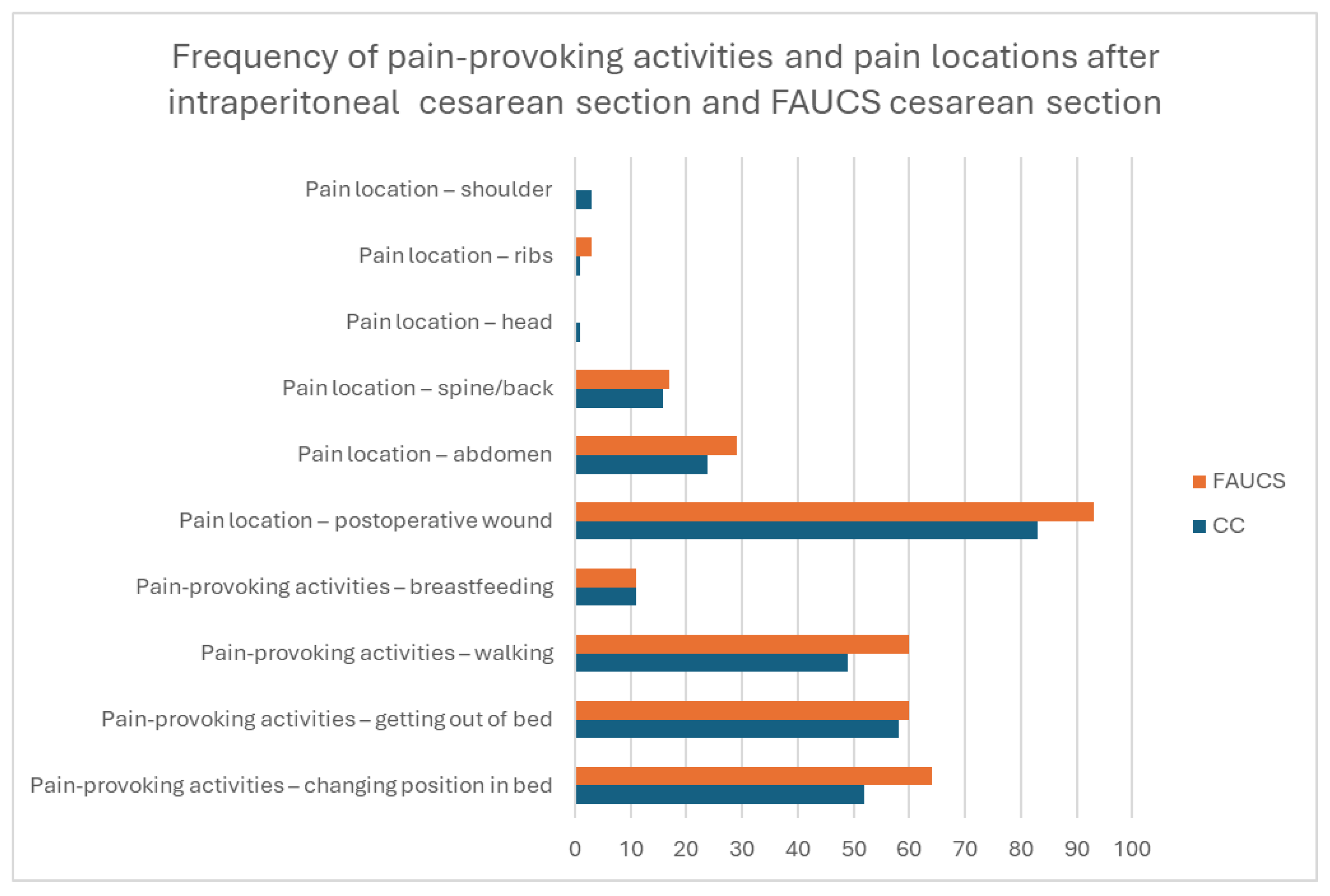
Figure 5.
Comparison of postoperative recovery outcomes in patients undergoing intraperitoneal cesarean section (CS) and FAUCS. The figure presents postoperative symptom burden, anxiety levels, functional recovery, self-care, and newborn care outcomes.
Figure 5.
Comparison of postoperative recovery outcomes in patients undergoing intraperitoneal cesarean section (CS) and FAUCS. The figure presents postoperative symptom burden, anxiety levels, functional recovery, self-care, and newborn care outcomes.
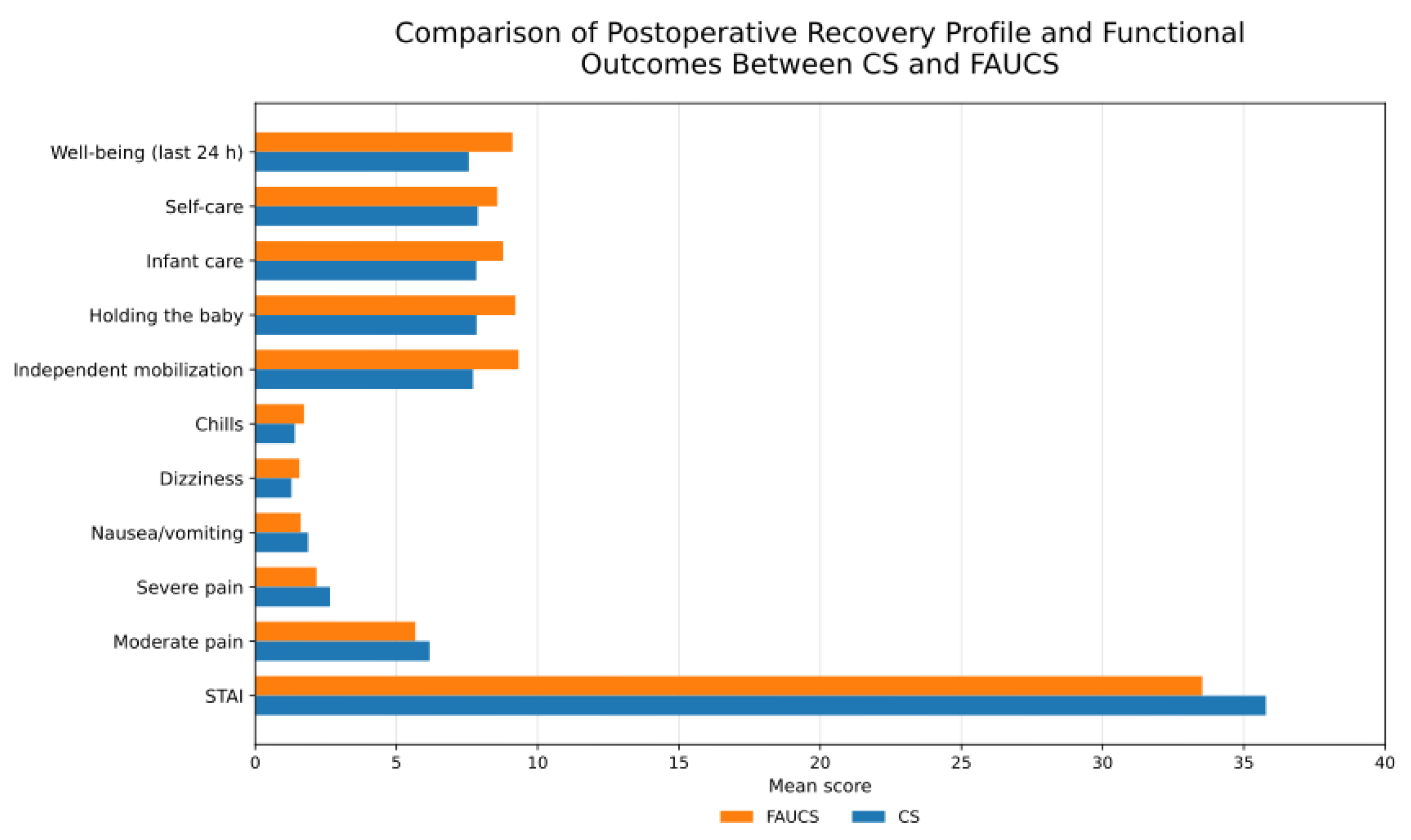
Table 2.
Postoperative pain intensity assessed using the Numerical Rating Scale (NRS).
| Statistic | CS | FAUCS | p-value | |
| NRS Day 0 | Min–Max; (Q1–Q3) | 0–10 (6-8) | 0–10 (4-6) | <0.001 |
| Mean | 6.96 | 5 | ||
| SD | 1.809 | 1.902 | ||
| NRS Day 1 | Min–Max; (Q1–Q3) | 1–6; (2–4.5) | 0–9; (2-3) | 0.642 |
| Mean | 3.33 | 2.66 | ||
| SD | 2.517 | 1.506 | ||
| McGill Pain Questionnaire | Min–Max; (Q1–Q3) | 4–25 (7-16) | 2–32 (5-12) | 0.004 |
| Mean | 11.8 | 9.71 | ||
| SD | 5.878 | 6.183 | ||
| McGill Affective | Min–Max (Q1–Q3) | 0–5 (0-1) | 0–4 (0-1) | 0.927 |
| Mean | 0.782 | 0.73 | ||
| SD | 1.145 | 1.033 | ||
| McGill Sensory | Min–Max (Q1–Q3) | 3–21 (6-15) | 2–28 (5-11,25) | 0.004 |
| Mean | 11.04 | 8.98 | ||
| SD | 5.378 | 5.643 |
NRS scores range from 0 (no pain) to 10 (worst pain imaginable). Pain was assessed on postoperative day 0 (day of surgery) and postoperative day 1 (first postoperative day). Continuous variables are presented as mean ± SD, median (interquartile range), and observed minimum–maximum values.
Table 3.
Comparison of postoperative analgesic treatment between women undergoing intraperitoneal cesarean section (CS) and FAUCS.
Table 3.
Comparison of postoperative analgesic treatment between women undergoing intraperitoneal cesarean section (CS) and FAUCS.
| Analgesic variable | CS, n/N (%) | FAUCS, n/N (%) | p-value |
| Polytherapy | 101/101 (100.0%) | 100/100 (100.0%) | — |
| Non-opioid analgesics | 101/101 (100.0%) | 100/100 (100.0%) | — |
| Weak opioids | 22/97 (22.7%) | 2/99 (2.0%) | <0.001 |
| Strong opioids | 5/97 (5.2%) | 2/99 (2.0%) | 0.276* |
| On-demand analgesics – postoperative day 0 | 50/98 (51.0%) | 50/99 (50.5%) | 0.942 |
| On-demand analgesics – postoperative day 1 | 49/98 (50.0%) | 39/92 (42.4%) | 0.293 |
Data are presented as number of participants with the characteristic / number of participants with available data (n/N) and percentage. Categorical variables were compared using Pearson's chi-square test. *Fisher's exact test was used for strong opioids because of small expected cell counts. No p-value was calculated for polytherapy or non-opioid analgesics because there was no between-group variability in the observed data.Missing observations were excluded separately for each variable (available-case analysis). FAUCS = French Ambulatory Cesarean Section; CS = intraperitoneal cesarean section.
Table 5.
Multivariable adjusted analysis of the main postoperative outcomes associated with FAUCS versus intraperitoneal cesarean section.
Table 5.
Multivariable adjusted analysis of the main postoperative outcomes associated with FAUCS versus intraperitoneal cesarean section.
| Outcome | N | Adjusted β / aRR* | 95% CI | p-value |
| NRS day 0 | 200 | -1.97 | -2.63 to -1.32 | <0.001 |
| NRS day 1 | 58 | 0.08 | -3.23 to 3.38 | 0.963 |
| McGill total | 201 | -2.85 | -4.68 to -1.02 | 0.002 |
| McGill affective | 201 | -0.26 | -0.57 to 0.05 | 0.101 |
| McGill sensory | 201 | -2.59 | -4.31 to -0.86 | 0.003 |
| Time to first sitting (h) | 201 | -9.92 | -11.20 to -8.64 | <0.001 |
| Time to first standing (h) | 201 | -9.98 | -11.57 to -8.39 | <0.001 |
| STAI | 201 | -3.07 | -5.06 to -1.07 | 0.003 |
| Able to get out of bed independently (0–10) | 196 | 1.67 | 1.19 to 2.16 | <0.001 |
| Able to hold baby independently (0–10) | 193 | 1.55 | 1.07 to 2.04 | <0.001 |
| Able to feed/care for baby independently (0–10) | 194 | 1.11 | 0.56 to 1.66 | <0.001 |
| Able to care for myself and my needs (0–10) | 195 | 0.87 | 0.37 to 1.37 | <0.001 |
| Well-being during last 24 h (0–10) | 195 | 1.44 | 0.96 to 1.92 | <0.001 |
| Weak opioid use | 196 | 0.11* | 0.03 to 0.45 | 0.002 |
Data are from multivariable models adjusted for gravidity and metabolic disorders; CS was the reference group.
Disclaimer/Publisher’s Note: The statements, opinions and data contained in all publications are solely those of the individual author(s) and contributor(s) and not of MDPI and/or the editor(s). MDPI and/or the editor(s) disclaim responsibility for any injury to people or property resulting from any ideas, methods, instructions or products referred to in the content. |
© 2026 by the authors. Licensee MDPI, Basel, Switzerland. This article is an open access article distributed under the terms and conditions of the Creative Commons Attribution (CC BY) license.
Copyright: This open access article is published under a Creative Commons CC BY 4.0 license, which permit the free download, distribution, and reuse, provided that the author and preprint are cited in any reuse.