

Submitted:
15 October 2026
Posted:
15 October 2026
You are already at the latest version
Abstract
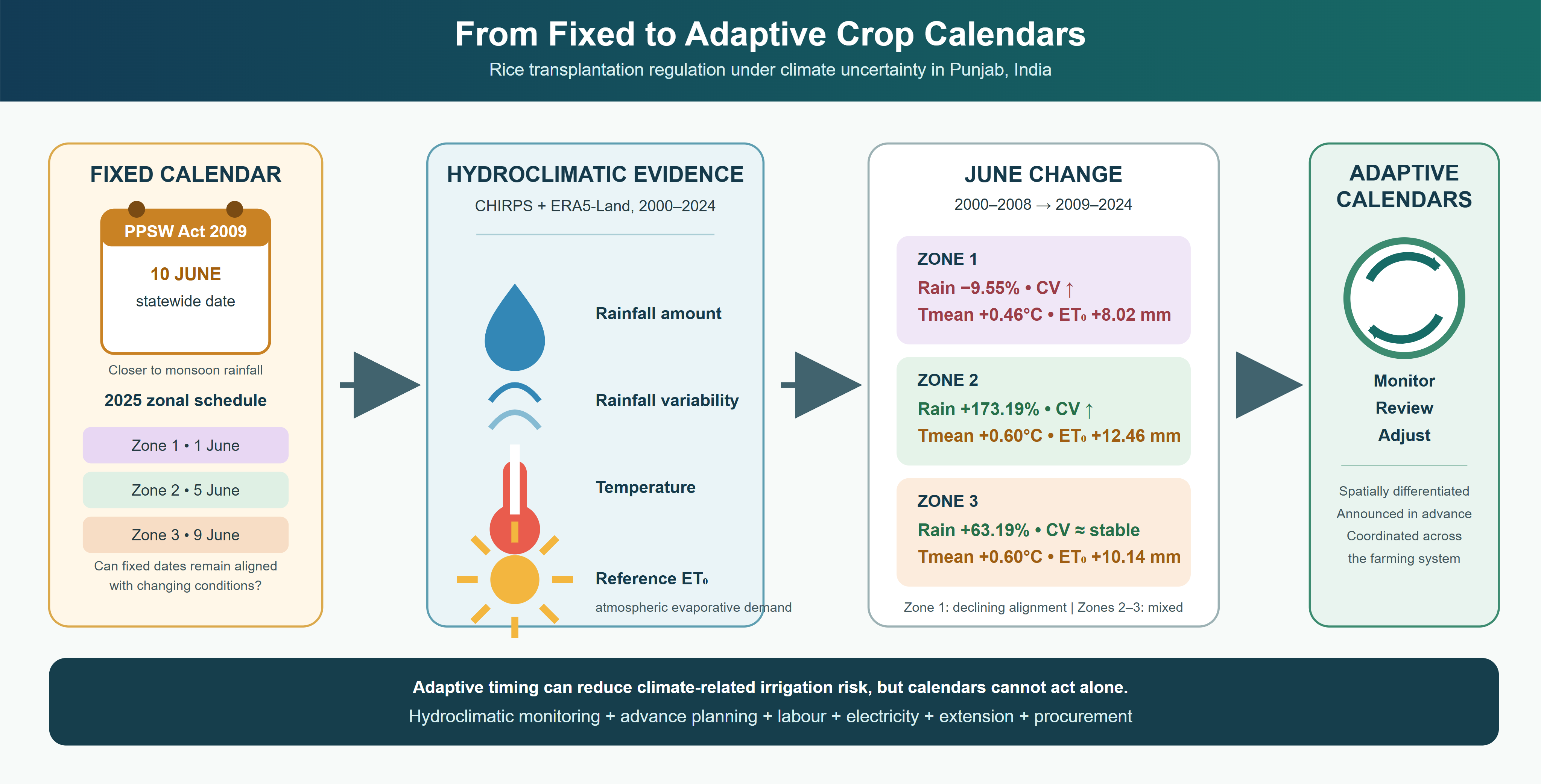
Punjab’s rice transplantation regulation seeks to reduce groundwater demand by moving cultivation closer to monsoon rainfall. This study examines how the hydroclimatic conditions supporting that rationale have changed over time. Using CHIRPS v2.0 rainfall and ERA5-Land temperature data for 2000–2024, we compare rainfall magnitude, interannual rainfall variability, temperature, and Hargreaves reference evapotranspiration between 2000–2008 and 2009–2024 for May–July. The district groupings assigned to Punjab’s three transplantation zones in 2025 provide the spatial units for this retrospective analysis. June conditions changed differently across zones. In Zone 1, mean rainfall declined by 9.55%, rainfall variability increased, and temperature and reference evapotranspiration rose, indicating less favourable conditions within the hydroclimatic alignment framework. In Zones 2 and 3, June rainfall increased by 173.19% and 63.19%, respectively, alongside higher temperature and evaporative demand. Rainfall variability increased in Zone 2 but remained broadly stable in Zone 3, producing mixed patterns of alignment. July accounted for a larger share of May–July rainfall across all three zones. These findings suggest that the environmental basis of transplantation regulation requires spatially differentiated reassessment. They do not establish changes in groundwater extraction or the suitability of individual prescribed dates. Adaptive crop-calendar governance could retain the conservation rationale of regulation while periodically reviewing timing against changing conditions. Its feasibility depends on coordination with labour, electricity, inputs, and procurement, linking cultivation timing to both immediate production needs and longer-term groundwater conservation.
Keywords:
groundwater depletion
; rice transplantation
; hydroclimatic variability
; hydroclimatic misalignment
; rainfall variability
; temperature trends
; evapotranspiration
; Punjab
Copyright: This open access article is published under a Creative Commons CC BY 4.0 license, which permit the free download, distribution, and reuse, provided that the author and preprint are cited in any reuse.