
Submitted:
14 October 2026
Posted:
15 October 2026
You are already at the latest version
Abstract
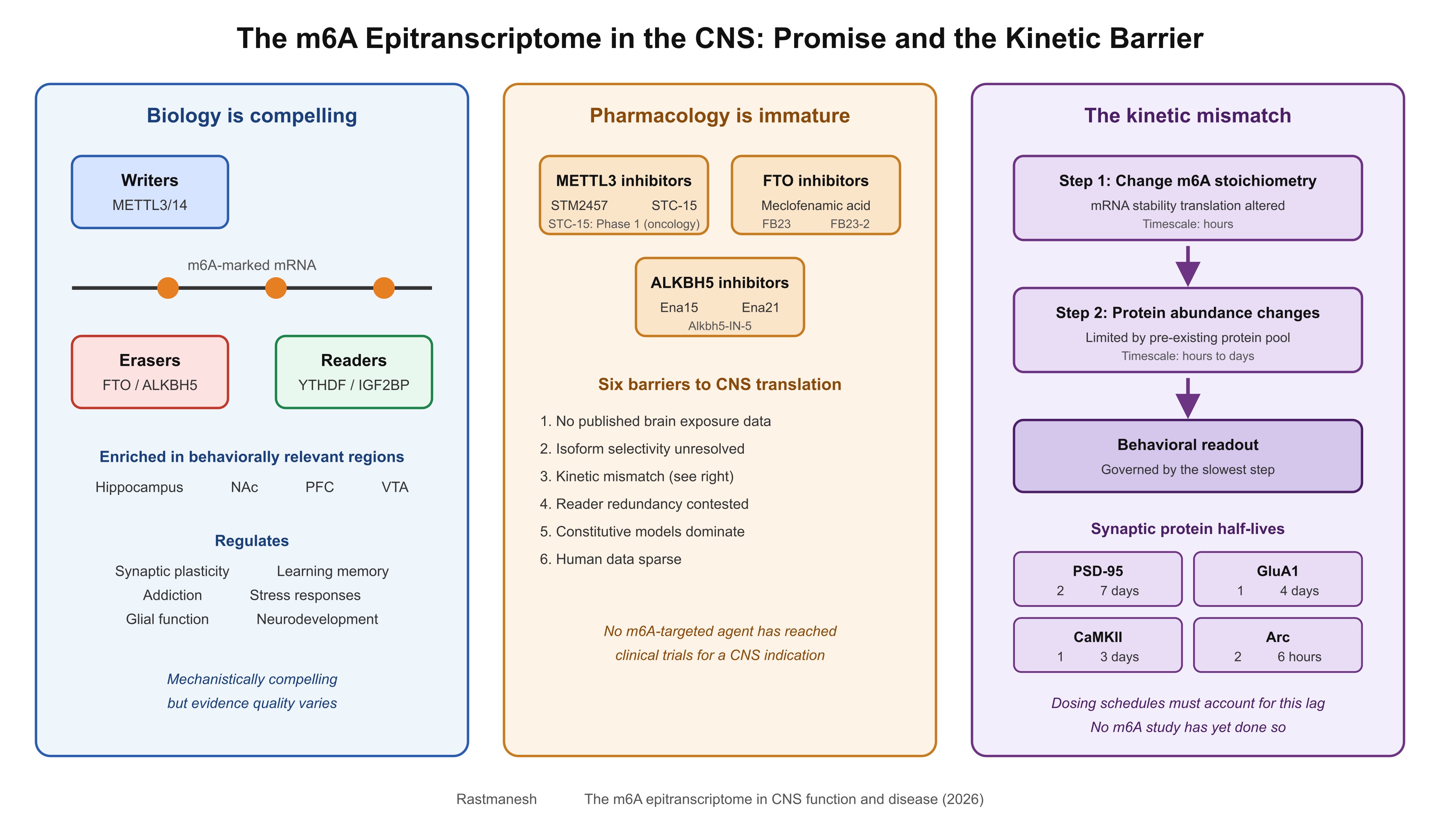
Background: N6-methyladenosine (m6A) is the most abundant internal modification of eukaryotic mRNA. Writers deposit it, erasers remove it, and readers interpret it. In the central nervous system (CNS), this system regulates local translation, synaptic plasticity, neurodevelopment, glial function, and behavioral adaptations relevant to addiction, stress, and cognitive disorders.
Methods: Literature was identified through PubMed, Scopus, and Web of Science searches up to March 2026. We reviewed primary literature on the m6A enzymatic machinery, its roles in neuronal and glial function, its involvement in CNS disorders, and the current state of m6A-targeted pharmacology.
Results: The m6A machinery concentrates in the brain and regulates transcripts encoding synaptic proteins, ion channels, and neurotrophic factors. Manipulating the pathway alters learning, memory, stress responses, and drug-related behaviors in rodents. In glial cells, m6A regulates microglial polarization, astrocyte reactivity, and oligodendrocyte differentiation, though this literature is less mature and replication is limited. Inhibitors of METTL3 and FTO exist, as do early-stage reader ligands; none has demonstrated the selectivity, brain penetration, or kinetic compatibility required for a CNS therapeutic. A METTL3 inhibitor (STC-15) has entered Phase 1 oncology trials, confirming druggability in principle but not CNS applicability.
Conclusions: The m6A epitranscriptome is mechanistically compelling but pharmacologically immature for CNS application. Realizing its potential requires brain-penetrant, isoform-selective probes; relapse-relevant behavioral models with replication across drug classes; and circuit-level data on m6A dynamics relative to protein half-lives. Human data remain sparse, limited by postmortem RNA stability and the absence of validated m6A biomarkers.
Keywords:
epitranscriptome
; m6A
; synaptic plasticity
; addiction
; drug discovery
; METTL3
Copyright: This open access article is published under a Creative Commons CC BY 4.0 license, which permit the free download, distribution, and reuse, provided that the author and preprint are cited in any reuse.