

Submitted:
14 October 2026
Posted:
15 October 2026
You are already at the latest version
Abstract
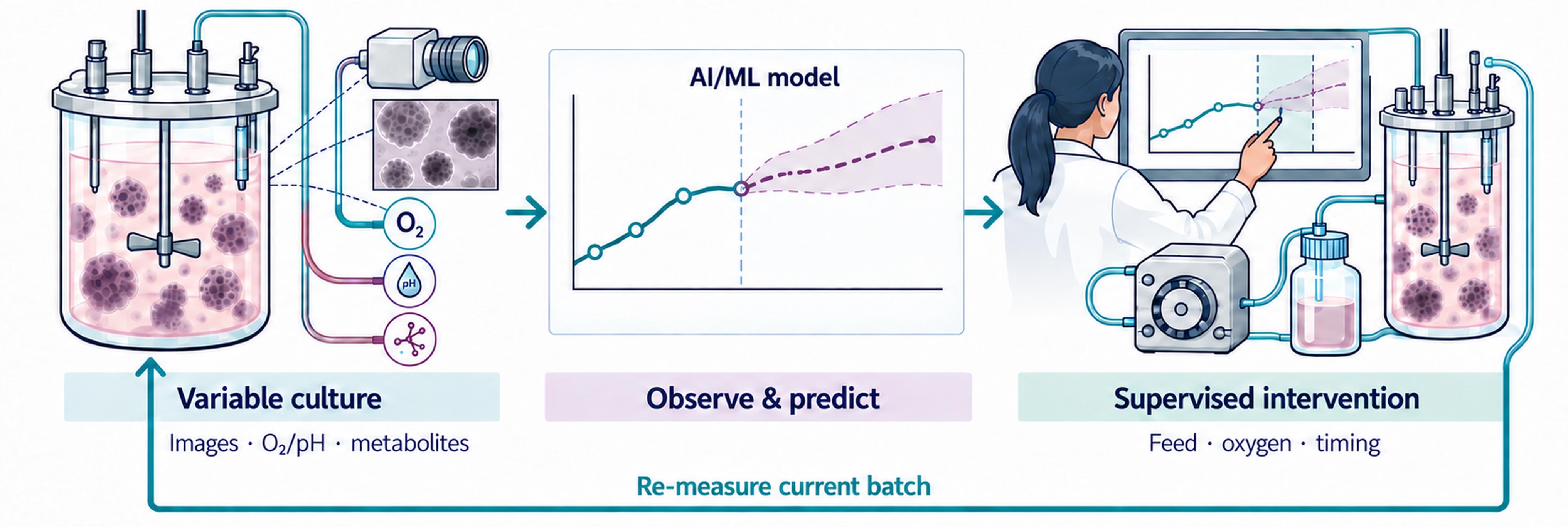
Background: Stem cell bioprocessing requires timely assessment of cell state and control over variable expansion and differentiation. Automated culture can execute predefined steps, whereas adaptive manufacturing uses observations to guide decisions during an ongoing batch.Objective: This review examines how artificial intelligence and machine learning connect process monitoring to prediction and feedback control, and assesses which links have been demonstrated in stem cell systems.Key Content: This topic covers image-based phenotyping, physical and multimodal sensing, growth and differentiation forecasts, process optimization, hybrid models, and proposed digital twins. A descriptive Level 0–6 continuum distinguishes endpoint assessment, monitoring, state estimation, prediction, operator decision support, within-run feedback, and coordinated workflow autonomy. Reported studies demonstrate image-guided adjustments to differentiation, robotic optimization across experiments, and rule-based feedback within a culture. However, these capabilities do not demonstrate autonomous production of a clinically releasable cell product. Translation is further limited by reduced model performance when entire experiments are withheld from training, fragmented datasets, variation across donors and processes, uncertain links between surrogate measures and potency, and the need for model governance.Conclusion: Supervised adaptation and supervised autonomy are credible near-term targets, characterized by bounded, traceable interventions with human oversight and a defined response to uncertainty. Prospective studies should compare adaptive and fixed processes across independent batches and assess cell identity, relevant function, safety-related attributes, and resource use. Claims of full autonomy require verified performance across the manufacturing workflow.
Keywords:
stem cell bioprocessing
; artificial intelligence
; machine learning
; feedback control
; supervised autonomy
Copyright: This open access article is published under a Creative Commons CC BY 4.0 license, which permit the free download, distribution, and reuse, provided that the author and preprint are cited in any reuse.