
Submitted:
15 October 2026
Posted:
15 October 2026
You are already at the latest version
Abstract
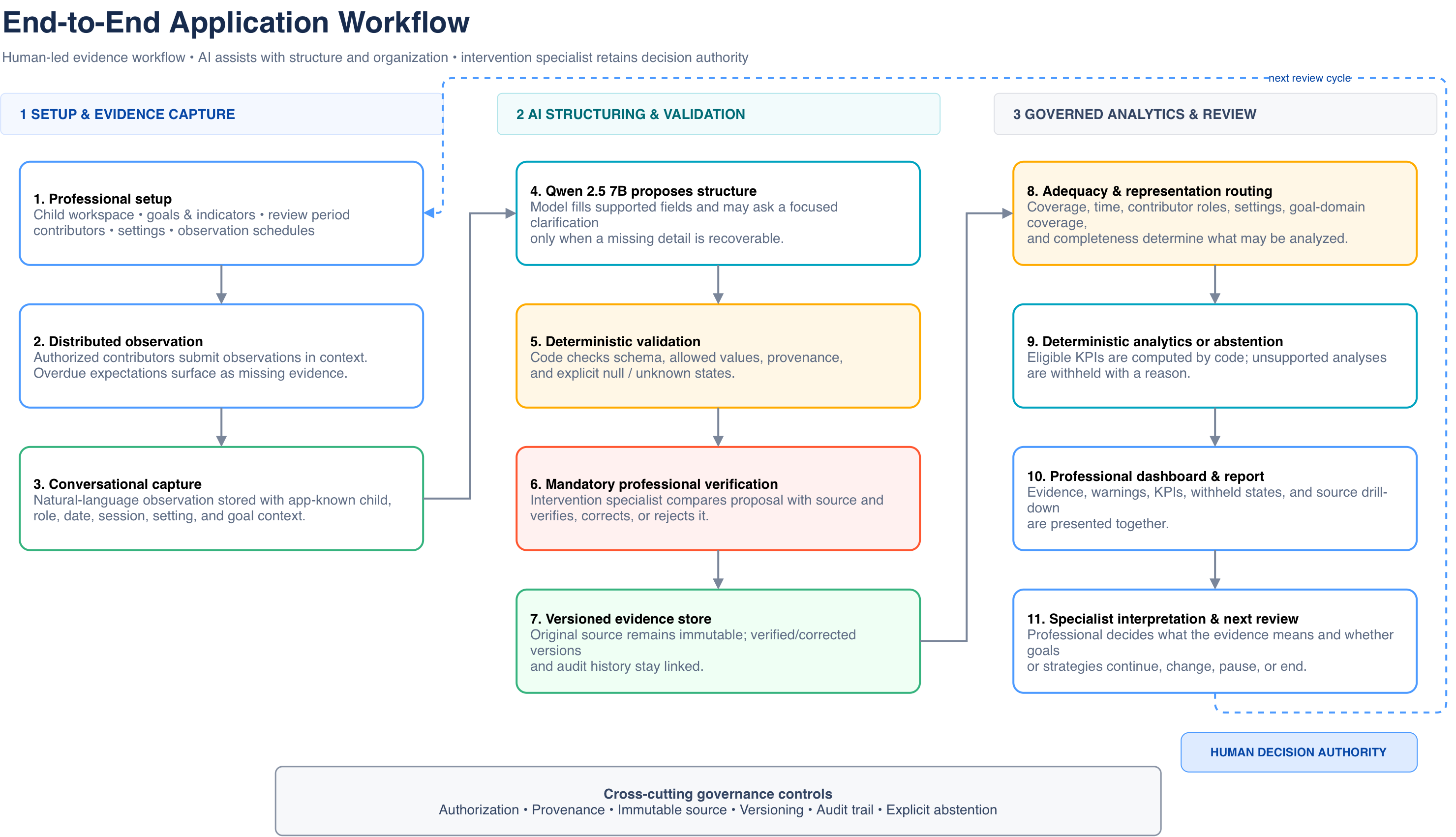
Longitudinal autism intervention review requires specialists to combine observations from caregivers, teachers, and intervention staff across settings and time. We developed a governance-aware human-in-the-loop application that uses AI to organize evidence while keeping intervention decisions with professionals. The system preserves original observations, proposes structured records with Qwen 2.5 7B, requires professional verification or correction before analytics, checks evidence adequacy, supports abstention, and produces traceable reports. Evaluation used archival ASDBank data from 11 children, 85 sessions, and 9,018 behavioral episodes. Two experienced autism specialists created the reference standard, followed by a final-codebook compliance audit. Qwen 2.5 7B achieved 41.3% merged categorical agreement on the 330-segment main batch and remained the strongest evaluated generator. The offline MARS selector returned records for 80.3% of segments but showed no clear field-level advantage over the strongest reviewable generator. A historical generative-reporting experiment failed its full governance contract (0/11), motivating deterministic operational reporting. Final controlled end-to-end testing passed all predefined governance scenarios (77/77 API tests and 9/9 UI scenarios). These findings support a practical architecture in which AI assists evidence organization, while professional review, abstention, provenance, and deterministic controls protect the longitudinal workflow.
Keywords:
autism
; large language models
; natural language processing
; human-in-the-loop AI
; trustworthy AI
; information extraction
; abstention
; evidence provenance
; longitudinal monitoring
; digital health
Copyright: This open access article is published under a Creative Commons CC BY 4.0 license, which permit the free download, distribution, and reuse, provided that the author and preprint are cited in any reuse.