
Submitted:
14 October 2026
Posted:
15 October 2026
You are already at the latest version
Abstract
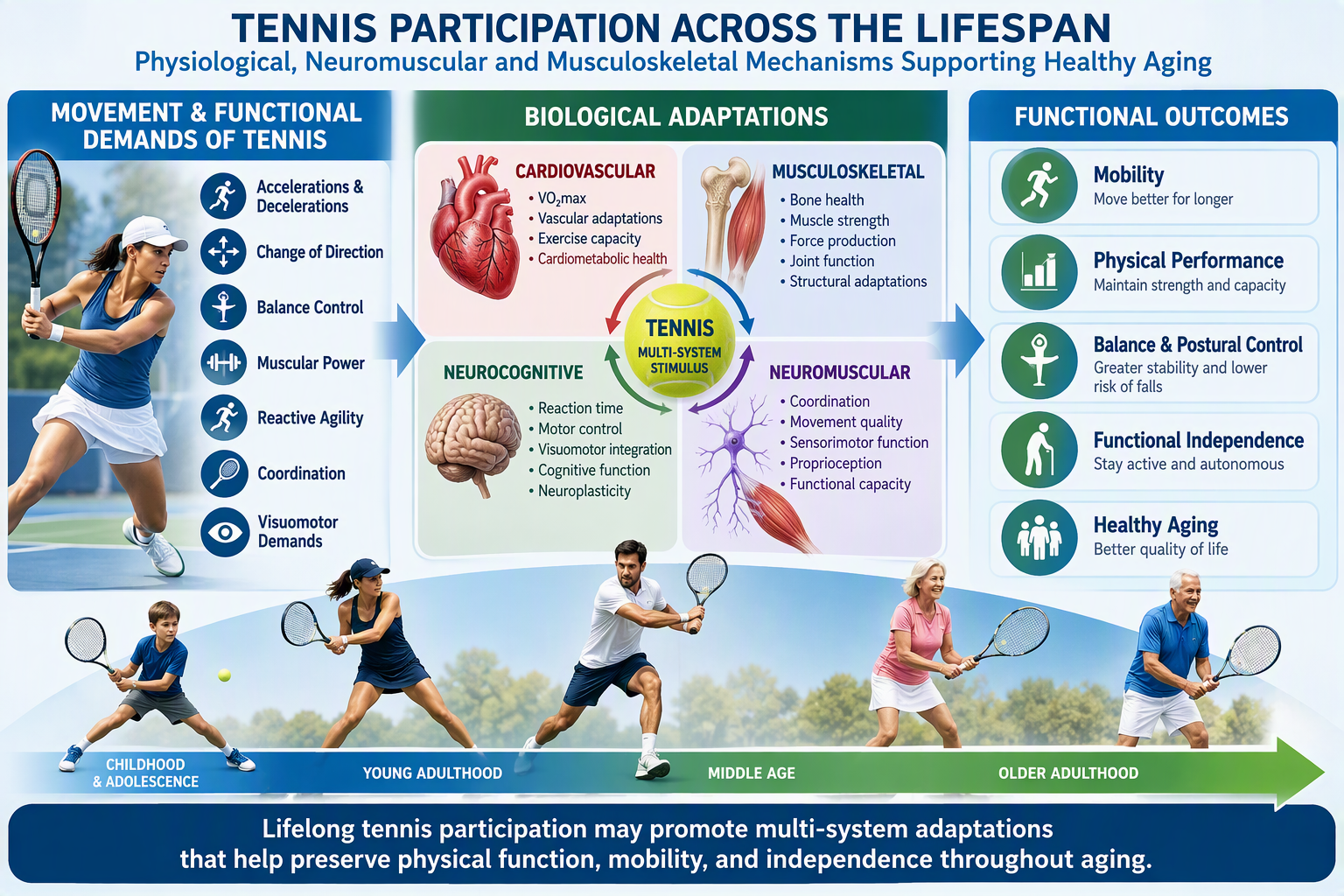
Maintaining physiological function, mobility, and independence throughout aging remains a major challenge in exercise and health sciences. Physical activity is widely recognized as a key determinant of healthy aging, yet different sports may confer distinct biological benefits. Tennis is unique in that it combines aerobic and anaerobic exercise, neuromuscular coordination, cognitive engagement, perceptual demands, and functional movement demands (balance, agility, change-of-direction performance, motor coordination) within a single activity. This comprehensive review synthesizes current evidence regarding the biological adaptations associated with tennis participation across the lifespan and evaluates its potential contribution to healthy aging and longevity. Available evidence indicates that regular tennis participation is associated with improved cardiovascular and cardiometabolic health, enhanced musculoskeletal function, greater bone mineral density, maintenance of cognitive and perceptual abilities, and improved psychological well-being. Studies involving veteran and masters tennis players further suggest that long-term participation may attenuate age-related declines in physical and cognitive function while supporting successful aging and quality of life. Emerging research also highlights potential benefits related to neuromuscular function, sensorimotor performance, perceptual-cognitive abilities and functional independence. Collectively, the literature supports tennis as a multidimensional lifelong physical activity capable of promoting health across biological, psychological, and social domains. While much of the current evidence remains observational, the available literature consistently suggests that tennis participation is associated with adaptations relevant to healthy aging and functional health. Further longitudinal studies are needed to clarify the underlying mechanisms and strengthen evidence-based recommendations for healthy aging, maintenance of physical function, and preservation of mobility across the lifespan.
Keywords:
tennis
; healthy aging
; longevity
; health span
; physical activity
; cardiovascular health
; bone health
; musculoskeletal adaptations
; cognitive function
; neuroplasticity
; successful aging
Copyright: This open access article is published under a Creative Commons CC BY 4.0 license, which permit the free download, distribution, and reuse, provided that the author and preprint are cited in any reuse.