

Submitted:
13 October 2026
Posted:
15 October 2026
You are already at the latest version
Abstract
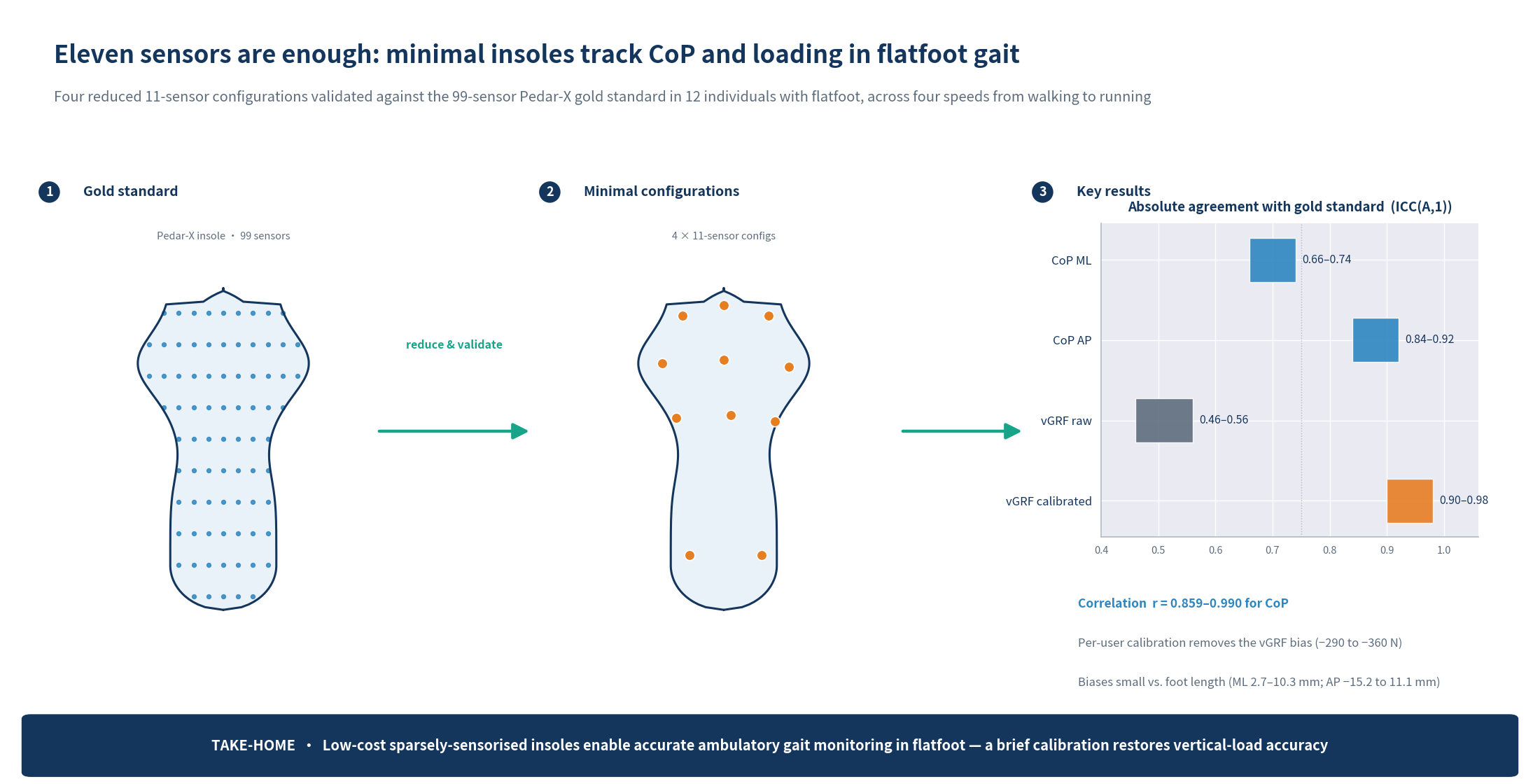
Dense in-shoe pressure arrays (e.g., 99 sensors) are costly and cumbersome, limiting gait monitoring during dynamic activities. This study evaluated the agreement between the center of pressure (CoP) and pressure-derived vertical ground reaction force (vGRF) estimated from minimal 11-sensor configurations and a full Pedar-X array in individuals with flatfoot during walking and running. Twelve adults with flatfoot performed walking (5 and 7 km/h) and running (11 and 13 km/h) trials with simultaneous Pedar-X recording. Four 11-sensor configurations were compared against the 99-sensor gold standard using Pearson correlation, root mean square error (RMSE), two-way random-effects intraclass correlation coefficients ICC(A,1), and Bland–Altman analysis. All configurations correlated significantly with the gold standard for CoP (r = 0.859–0.971) and vGRF (r = 0.867–0.990). CoP RMSE ranged from 5.23 to 8.13 mm (medial–lateral) and 14.26 to 28.20 mm (anterior–posterior), with ICCs of 0.66–0.74 and 0.84–0.92, respectively. Raw vGRF showed moderate agreement (ICC = 0.46–0.56) with systematic underestimation, whereas per-user proportional calibration improved agreement to ICC = 0.90–0.98. Carefully placed minimal sensor configurations can accurately track CoP and the vGRF waveform in flatfoot, supporting low-cost wearable gait monitoring with brief user calibration.
Keywords:
plantar pressure
; in-shoe sensing
; vertical ground reaction force
; center of pressure
; flatfoot
; gait analysis
; wearable sensors
; agreement analysis
Copyright: This open access article is published under a Creative Commons CC BY 4.0 license, which permit the free download, distribution, and reuse, provided that the author and preprint are cited in any reuse.