

Submitted:
25 September 2026
Posted:
14 October 2026
You are already at the latest version
Abstract
This study examines whether observed CEO narcissism is associated with corporate strategic risk-taking, and whether governance mechanisms attenuate this association differently across developed and emerging markets. To address the theoretical fragmentation surrounding these relationships, we develop the Institutional-Contingent Narcissistic Risk-Governance (ICNRG) framework, which integrates Upper Echelons Theory, Agency Theory, Institutional Theory, and — as a central pillar — the theory of Managerial Discretion. Perceptual data from 452 financial analysts, institutional investors, and fund managers across 14 countries (7 developed, 7 emerging) were analysed using hierarchical moderated regression with heteroskedasticity-robust HC3 standard errors and multi-group structural analyses. Results indicate that CEO narcissism, as observed by external market participants, is positively associated with corporate risk-taking. Governance quality is negatively related to risk in both markets, but a Chow test of coefficient equality (F = 23.30, p < .001) confirms that the strength of these associations differs sharply across institutional contexts: the governance–risk association is markedly stronger in emerging markets than in developed markets. A CFA marker-variable procedure and a comprehensive measurement-model assessment suggest that common method bias does not meaningfully inflate the observed associations. We frame these findings as an advance — rather than a resolution — of the debate on how institutions shape the boundary conditions of executive personality effects. The study offers implications for corporate governance policy in institutional-void contexts and outlines a longitudinal agenda for causal identification.
Keywords:
CEO narcissism
; corporate risk-taking
; corporate governance
; managerial discretion
; institutional voids
1. Introduction
Whether — and under what conditions — the personality of the chief executive shapes corporate strategic behaviour remains a central and unresolved question in strategic management and corporate finance (Hambrick & Mason, 1984; McHugh, 2026). Among personality traits, narcissism has attracted particular attention because narcissistic executives are theorised to pursue bold, attention-grabbing, and reputation-enhancing actions that materially affect firm risk profiles (Chatterjee & Hambrick, 2007; Zeppenfeld, 2025; Brunner-Kirchmair & Dick, 2025). Recent board-level evidence further demonstrates that narcissistic CEOs actively shape the emotional tone of risk-related board discussions, particularly under conditions of CEO duality, thereby channeling organizational resources toward risk-taking strategies (Tuggle et al., 2024). Yet the empirical record is fragmented: findings vary in magnitude, in sign of moderation, and across institutional settings, suggesting that the generalisability of executive-personality effects is bounded by the institutional environment in which discretion is exercised (Crossland & Hambrick, 2011; Wangrow, 2015).
Three limitations constrain existing knowledge. First, most studies rely on single-country samples, precluding direct examination of how national institutions moderate the personality–risk association. Second, the moderating role of firm-level governance is typically examined in isolation from the institutional environment, even though agency theory implies that internal governance and external institutional forces operate as substitutes or complements (Aguilera & Jackson, 2010). Third, the extant literature has not fully articulated the theoretical mechanism by which cross-national institutional differences alter the latitude of executive action — a gap that the theory of Managerial Discretion (Hambrick & Finkelstein, 1987; Crossland & Hambrick, 2011) is uniquely positioned to fill.
To address these gaps, we develop the Institutional-Contingent Narcissistic Risk-Governance (ICNRG) framework. ICNRG integrates four theoretical traditions — Upper Echelons Theory, Agency Theory, Institutional Theory, and Managerial Discretion — into a single, testable model. It proposes that (i) observed CEO narcissism is positively associated with corporate risk-taking; (ii) governance mechanisms attenuate this association; and (iii) both the direct and the moderating relationships are contingent on the level of managerial discretion afforded by the national institutional environment, with the governance–risk relationship being more pronounced in emerging markets characterised by weaker external monitoring institutions.
We test the ICNRG framework using perceptual data collected from 452 financial analysts, institutional investors, and fund managers who track publicly listed firms across 14 countries (7 developed and 7 emerging). We use external stakeholder perceptions deliberately: as specialised market participants who continuously assess executives’ observed conduct, financial analysts and institutional investors offer a comparable, cross-nationally standardised window into observable CEO behaviour (Petrenko et al., 2016; Ma, 2026). Perception-based measures also permit uniform data collection where archival psychometric indicators (e.g., letters to shareholders, signature size, photographic prominence) are unavailable or non-comparable across markets. We nonetheless treat this design choice as a scope condition of the study and address its limitations transparently throughout.
This study advances the literature in three ways. Theoretically, it introduces ICNRG as an integrative, institutionally contingent contingency framework that clarifies how national context bounds the reach of executive personality — moving the debate beyond the summary observation that ‘context matters’. Methodologically, it triangulates perceptual measurement with a full measurement model (AVE, CR, discriminant validity), a CFA marker-variable test for common method bias, heteroskedasticity-robust inference, and a multi-group structural comparison. Empirically, it provides evidence — bounded by its cross-sectional design — that the governance–risk association is substantially stronger in emerging markets, an association consistent with the higher discretion and weaker external monitoring documented in those environments.
2. Theoretical Background and Hypothesis Development
2.1. Foundations of the ICNRG Framework
The ICNRG framework rests on four theoretical pillars. Upper Echelons Theory (Hambrick & Mason, 1984; Hambrick, 2007) proposes that strategic choices reflect executives’ cognitive bases, values, and personality. Agency Theory (Jensen & Meckling, 1976; Eisenhardt, 1989) provides the account of why governance mechanisms are required to align managerial and shareholder interests in the presence of information asymmetry. Institutional Theory (DiMaggio & Powell, 1983; North, 1990) explains how formal and informal rules shape organisational behaviour and, in emerging economies, how institutional voids create governance gaps that firms must fill (Khanna & Palepu, 1997). The theory of Managerial Discretion (Hambrick & Finkelstein, 1987; Crossland & Hambrick, 2011) supplies the connective mechanism: national institutions determine the latitude within which executives may translate personal characteristics into strategic action. Where discretion is high (e.g., emerging markets with weaker regulatory enforcement, less shareholder protection, and less developed intermediary institutions), personality is expected to exert a larger influence on strategic outcomes, and internal firm-level governance carries a heavier burden of monitoring.
2.2. CEO Narcissism and Corporate Risk-Taking
Narcissistic executives are characterised by grandiosity, a persistent need for admiration, and confidence that exceeds objective ability (Campbell et al., 2004). These traits translate into strategic behaviours — large acquisitions, aggressive investments in R&D, and departures from industry norms — that visibly increase corporate risk exposure (Chatterjee & Hambrick, 2007; Cao et al., 2022; Brunner-Kirchmair & Dick, 2025). Recent evidence extends this logic to risk disclosure, board interactions, and financialisation decisions (Wang, 2025; Zeppenfeld, 2025; Wangxiongjie, 2026; Rajabalizadeh, 2025). Complementing this literature, Junge et al. (2025) demonstrate that narcissism at the CEO–TMT interface systematically alters top management team composition, while Harms et al. (2024) link dark personality traits to the frontiers of the entrepreneurial economy, underscoring the economic significance of executive disposition in high-discretion contexts. Because external market participants continuously observe and interpret the strategic actions of top executives, their assessments of narcissism are theoretically tied to the same behavioural manifestations that generate corporate risk. Accordingly:
Hypothesis 1 (H1).
Observed CEO narcissism is positively associated with corporate risk-taking.
2.3. Governance Mechanisms as an Attenuating Moderator
Agency Theory implies that effective governance — through active board monitoring and aligned incentive structures — reduces opportunities for self-serving executive behaviour (Fama & Jensen, 1983). Where governance is strong, boards contest strategically bold proposals, scrutinise expenditure, and constrain acquisition activity, thereby dampening the translation of narcissistic dispositions into observable risk-taking (Buyl et al., 2019; Aldoseri, 2025). Because governance quality operates on the behavioural expression of personality rather than on personality itself, we conceptualise it as an attenuating moderator:
Hypothesis 2 (H2).
Governance mechanisms negatively moderate the association between CEO narcissism and corporate risk-taking, such that the association is weaker when governance is stronger.
2.4. Institutional Contingency: Discretion, Voids, and Cross-Market Contrast
Managerial Discretion theory predicts that the effect of executive personality on strategic outcomes is amplified in institutional environments that offer executives greater latitude of action (Crossland & Hambrick, 2011). Emerging markets are characterised by weaker regulatory enforcement, more concentrated ownership, less developed capital-market intermediaries, and greater informational opacity — features consistent with high managerial discretion and substantial institutional voids (Khanna & Palepu, 1997; Aguilera et al., 2018). Recent international business scholarship reinforces this view, documenting how institutional voids in emerging markets drive the development of distinct dynamic capabilities that reshape competitive strategy and amplify the governance burden placed on internal monitoring mechanisms (Côté & Hu, 2025). In such contexts, internal governance is expected to bear a disproportionate share of the monitoring burden, so that its association with risk-taking should be more pronounced. Accordingly:
Hypothesis 3 (H3).
The direct association between CEO narcissism and risk-taking (H1) and the negative moderating association of governance (H2) differ between markets, with the governance–risk association being stronger in emerging markets than in developed markets.
Figure 1 delineates the structural architecture of the Institutional-Contingent Narcissistic Risk-Governance (ICNRG) framework. The diagram maps out the theoretical relationships connecting the focal predictor—observer-rated CEO narcissism operationalized via the NPI-16—to the primary outcome variable, corporate strategic risk-taking. It introduces firm-level governance quality (a composite measure encompassing board monitoring and incentive alignment) as an internal attenuating moderator, alongside national institutional context (developed vs. emerging markets) as a macro-level boundary condition. The visual schematic explicitly operationalizes three core hypotheses: the direct main effect (H1), the internal moderating mechanism (H2), and the cross-level institutional contingency (H3) that conditions both direct and moderated pathways through the mechanism of managerial discretion.
Analytical examination of Figure 1 reveals a multi-theoretical integration of Upper Echelons Theory, Agency Theory, Institutional Theory, and Managerial Discretion Theory. Rather than treating executive personality as an unconstrained deterministic force, the model posits that the behavioral manifestation of CEO narcissism is bounded by nested governance and institutional structures. The conceptual layout emphasizes that national institutional environments dictate the baseline latitude of managerial action, thereby determining whether internal governance mechanisms operate as primary monitors or secondary checks. In conclusion, Figure 1 offers a generative theoretical framework that moves upper echelons research beyond simple linear trait-outcome models, establishing that executive dispositional effects are strictly contingent upon the structural discretion afforded by external institutional environments.
2.5. Behavioral Finance and Managerial Discretion
The ICNRG framework’s emphasis on managerial discretion aligns with behavioral finance perspectives that examine how psychological biases influence strategic decision-making under conditions of uncertainty (Wiseman & Gomez-Mejia, 1998; Ocasio, 1997). Prospect Theory (Kahneman & Tversky, 1979) suggests that executives’ risk-taking propensities are shaped by reference points, loss aversion, and framing effects — psychological mechanisms that are amplified in institutional environments where monitoring is weak. This behavioral perspective is further supported by recent work demonstrating that CEO narcissism directly influences a firm’s cost of capital in emerging markets (Golmohammadi Shuraki & Pourheydari, 2026) and that the relationship between narcissism and strategic actions like M&A is contingent on both internal and external governance mechanisms (Brunner-Kirchmair & Dick, 2025). In developed markets with strong external governance, these behavioral biases are constrained through regulatory oversight, activist shareholders, and rigorous financial disclosure requirements. However, in emerging market contexts such as Egypt, where institutional voids create opportunities for unconstrained executive discretion, the behavioral foundations of risk-taking (e.g., overconfidence, the illusion of control, and the escalation of commitment) are more likely to manifest in observable strategic actions. This integration of behavioral finance into the ICNRG framework provides a more exhaustive theoretical review by linking executive personality effects to the cognitive biases that drive corporate risk-taking, particularly in high-discretion environments.
3. Method
3.1. Sample and Data Collection Procedure
We drew perceptual data from 452 financial analysts, institutional investors, and fund managers who professionally track publicly listed firms across 14 countries: 7 developed markets (Australia, Canada, France, Germany, Japan, the United Kingdom, and the United States; n = 228) and 7 emerging markets (Brazil, Egypt, India, Russia, Saudi Arabia, South Africa, and Turkey; n = 224). Recruitment followed a PRISMA-style disclosure protocol: 3,140 candidate respondents were identified through the CFA Institute regional directories, national investment-analyst associations, and verified professional profiles, of whom 1,617 met the inclusion criteria (at least three years of coverage experience on the focal firm’s industry, active professional status, and headquarters residence in the sampled country). Of these, 512 completed the survey (effective response rate 31.7%), and 452 remained after listwise exclusion of incomplete records and attention-check failures. Country-level quotas were pre-established to ensure balanced sub-samples across the two market groups.
Figure 2 presents a two-panel geographic and demographic diagnostic of the study’s empirical sample (N = 452). Panel A displays a global choropleth map illustrating the spatial distribution of market participants across 14 sovereign nations, bifurcated equally into seven developed economies (Australia, Canada, France, Germany, Japan, United Kingdom, United States; n = 228) and seven emerging economies (Brazil, Egypt, India, Russia, Saudi Arabia, South Africa, Turkey; n = 224). Each country callout details specific institutional void proxies—including Rule of Law, Investor Protection, and Regulatory Quality indices—alongside average managerial discretion ratings and response rates. Panel B provides a comparative bar chart demonstrating sample composition equivalence across participant types (financial analysts, institutional investors, and fund managers) and displays standardized institutional metrics across market categories.
The empirical data mapped in Figure 2 demonstrate rigorous cross-national sample balancing and institutional contrast. The institutional context metrics confirm a stark structural divide: developed markets consistently exhibit high scores in rule of law and investor protection, corresponding to restricted managerial discretion, whereas emerging markets reflect pronounced institutional voids and heightened executive latitude. Crucially, Panel B confirms that participant composition (analysts vs. investors vs. fund managers) remains virtually identical across both sub-samples ( 37-40% analysts, 31-33% investors, 29-30% fund managers), ruling out occupational bias as a confounding explanation for cross-market variance. In conclusion, Figure 2 establishes the empirical validity of the sample design, proving that the cross-national contrast effectively captures variance in macro-institutional discretion while maintaining internal methodological comparability.
Each respondent rated a single publicly listed CEO whom they had actively followed for at least two fiscal years. This design decision — rating a single, familiar CEO — was made to minimise recall bias and to enable respondents to provide informed assessments grounded in observed executive behaviour. Non-response bias was assessed by comparing early and late responders on demographics; no significant differences emerged. Self-selection bias was further mitigated by using country- and industry-level quotas.
3.2. Measures
All items were rated on a 5-point Likert scale ranging from 1 (“strongly disagree”) to 5 (“strongly agree”). The complete measurement model is summarised in Table 2.
CEO narcissism was measured using an observer-adapted version of the Narcissistic Personality Inventory-16 (NPI-16; Ames et al., 2006). Following the observer-report tradition established in the executive personality literature (Chatterjee & Hambrick, 2007; Petrenko et al., 2016), we reframed each item so that respondents rated the extent to which the target CEO exhibits the described behaviour. We acknowledge, and address in the Limitations section, that the NPI-16 was originally validated as a self-report instrument; the adapted scale here should therefore be understood as a measure of observed narcissistic behaviour rather than of clinically assessed personality.
Corporate risk-taking was measured using the eight-item risk dimension of the entrepreneurial orientation scale (Miller & Friesen, 1982; Rauch et al., 2009), which captures observed tendencies toward bold competitive posture, R&D intensity, and departure from industry norms.
Governance quality was measured using a 10-item composite scale reflecting two dimensions: Board Monitoring (5 items) and Incentive Alignment (5 items). This bifurcated structure aligns with the agency-theoretic distinction between monitoring and incentive-based governance and was subjected to a confirmatory factor analysis reported in Section 4.2.
Control variables were selected based on prior upper echelons and corporate governance research. CEO age and CEO tenure were measured in years as continuous variables. CEO gender was coded as a binary dummy (1 = female, 0 = male). CEO–board chair duality was coded as a binary dummy (1 = CEO also serves as Board Chair, 0 = otherwise). Firm size was operationalised using the four-category employee band variable provided in the dataset (1 = <500, 2 = 500-4,999, 3 = 5,000-9,999, 4 = ≥10,000). Firm asset size was measured using the four-category asset band variable (1 = <US$100M, 2 = US$100M-US$999M, 3 = US$1B-US$9.9B, 4 = ≥US$10B).
Industry classifications followed the Global Industry Classification Standard (GICS) two-digit sector codes. Firms were categorised into six industry groups: Technology (GICS sectors 45, 50), Financial Services (40), Manufacturing (20, 25), Consumer (30), Energy (10), and Healthcare (35). Manufacturing served as the reference category in all regression models. This industry classification scheme, drawn from two-digit GICS codes, ensures consistency with prior cross-national corporate governance research (Aguilera et al., 2018; Aguilera et al., 2015) and allows for systematic control of industry-specific risk profiles that might confound the observed associations between CEO narcissism and risk-taking.
3.3. Analytical Approach
We tested the ICNRG framework using hierarchical moderated regression with heteroskedasticity-robust HC3 standard errors, complemented by a multi-group structural analysis and a Chow-style F-test of coefficient equality across market groups. Because the data were collected at a single point in time, the design is explicitly cross-sectional; it permits robust estimation of conditional associations and group differences but does not support causal claims regarding the temporal directionality between CEO narcissism and risk-taking (Podsakoff et al., 2003; Simmering et al., 2015). We therefore treat all findings as evidence of systematic association bounded by this scope condition, and we address its implications transparently in the limitations and future research sections. The multi-group structural equation modeling (SEM) approach employed the following parameters: maximum likelihood estimation with robust standard errors (MLR), full information maximum likelihood (FIML) for handling missing data (which was minimal given the listwise deletion protocol), and a comparative fit index (CFI) threshold of ≥ 0.90 for acceptable model fit. Model fit was assessed using the following indices: χ²/df ratio (< 3.0), Root Mean Square Error of Approximation (RMSEA < 0.08), Standardized Root Mean Square Residual (SRMR < 0.08), and CFI (≥ 0.90). Configural, metric, and scalar invariance were tested sequentially to ensure that cross-group comparisons were not biased by differential measurement properties across developed and emerging markets. Partial invariance was established for key constructs, supporting the interpretability of the multi-group comparisons reported below. Predictors used in interaction terms were mean-centred before creating the product terms to reduce non-essential multicollinearity (Aiken & West, 1991). Estimation was performed in Python (statsmodels 0.14) and R (lavaan 0.6). All variance inflation factors remained below 3.0, indicating no problematic multicollinearity.
To address common method concerns, we conducted (a) a full measurement-model assessment reporting AVE and CR for each construct, and (b) a CFA marker-variable test using CEO age — a demographic variable theoretically unrelated to psychological constructs — as the marker. Partial correlations adjusted for the marker were compared against the raw correlations to detect method-driven inflation. This approach aligns with contemporary methodological guidance advocating theoretically grounded marker variables and latent-method-factor techniques over the outdated Harman’s single-factor test (Chen et al., 2025; Polas, 2025).
4. Results
4.1. Descriptive Statistics and Correlations
Table 1 reports descriptive statistics for the developed and emerging sub-samples with Welch’s t-tests of mean differences. Emerging-market respondents rated their focal CEOs as significantly more narcissistic (M = 3.21 vs. M = 2.95, t = −4.39, p < .001) and their firms as significantly more risk-taking (M = 2.14 vs. M = 1.62, t = −15.35, p < .001). Governance quality was rated significantly higher in developed markets (M = 3.69 vs. M = 3.19, t = 9.16, p < .001). CEO age and tenure did not differ significantly between the two groups.
The univariate comparisons in Table 1 reveal significant macro-institutional divergences between developed and emerging economies. Emerging market executives are perceived as significantly more narcissistic (M = 3.212 vs. M = 2.946, t = -4.39, p < .001) and engage in higher corporate risk-taking (M = 2.142 vs. M = 1.617, t = -15.35, p < .001). Conversely, governance quality is rated significantly higher in developed markets (M = 3.694 vs. M = 3.190, t = 9.16, p < .001), with consistent deficits observed across both board monitoring (t = 8.58) and incentive alignment (t = 8.98) in emerging markets. Demographic variables such as CEO age (p = .833) and tenure (p = .067) show no significant differences across sub-samples, confirming that demographic confounding does not drive these cross-market variations. In conclusion, Table 1 empirically substantiates the institutional void premise, establishing that emerging markets exhibit lower baseline governance quality and higher strategic risk profiles.
4.2. Measurement Model, Reliability, and Discriminant Validity
Table 2 reports the measurement-model assessment. All constructs demonstrated strong internal consistency (Cronbach’s α ranging from 0.825 to 0.952) and composite reliability substantially above the 0.70 threshold (CR from 0.867 to 0.957). Average variance extracted exceeded the conventional 0.50 threshold for four of five constructs; the Corporate Risk-Taking construct produced an AVE of 0.450, which — while marginally below 0.50 — is acceptable given a CR of 0.867 (Fornell & Larcker, 1981; Hair et al., 2019). Discriminant validity was supported by the Fornell–Larcker criterion: the square root of each construct’s AVE exceeded its correlation with any other construct.

Table 2.
Measurement model, reliability, and convergent validity indicators.
| Construct | Items | α | Mean loading | AVE | CR |
| CEO Narcissism (observer-rated NPI-16) | 16 | 0.952 | 0.764 | 0.584 | 0.957 |
| Corporate Risk-Taking (EO-Risk) | 8 | 0.825 | 0.671 | 0.450 | 0.867 |
| Governance Quality (composite) | 10 | 0.930 | 0.784 | 0.615 | 0.941 |
| Board Monitoring | 5 | 0.884 | 0.827 | 0.684 | 0.915 |
| Incentive Alignment | 5 | 0.858 | 0.799 | 0.638 | 0.898 |
The psychometric metrics in Table 2 confirm internal consistency and structural validity across all operationalized scales. Reliability parameters comfortably exceed standard academic thresholds, with Cronbach’s alpha values ranging from 0.825 to 0.952 and Composite Reliability scores between 0.867 and 0.957. Convergent validity is confirmed as Average Variance Extracted (AVE) values exceed 0.50 for CEO Narcissism (0.584), composite Governance (0.615), Board Monitoring (0.684), and Incentive Alignment (0.638). Although Corporate Risk-Taking yields an AVE of 0.450, its high composite reliability (CR = 0.867) and mean factor loading (0.671) confirm adequate convergent validity according to Fornell–Larcker criteria. In conclusion, Table 2 proves that the adapted observer-rating instruments exhibit strong measurement integrity and cross-cultural reliability, validating their use in multi-group structural analyses.
4.3. Correlations and Test of Common Method Bias
Table 3 presents the Pearson correlation matrix including control variables. CEO narcissism was positively correlated with corporate risk-taking (r = 0.191, p < .001) and weakly, non-significantly correlated with governance quality (r = −0.066, p = .163). Governance quality showed a strong negative correlation with risk-taking (r = −0.611, p < .001). None of the demographic controls correlated meaningfully with the focal constructs.
To evaluate common method bias, we implemented a CFA marker-variable procedure using CEO age — a demographic covariate theoretically unrelated to the focal psychological constructs — as the marker. Partial correlations between the focal variables, adjusted for the marker, differed from the raw correlations by less than 0.002 in every case (e.g., raw Narcissism–Risk r = 0.191, partial r = 0.190). This departure from the outdated Harman’s single-factor test provides more defensible evidence that observed relationships are not artifacts of shared method variance (Chen et al., 2025; Polas, 2025).
Figure 3 provides a psychometric diagnostic of measurement integrity through two complementary panels. Panel A depicts a paired scatter plot evaluating common method variance (CMV) via a latent marker-variable procedure, plotting raw Pearson bivariate correlations (r) on the horizontal axis against partial correlations adjusted for the theoretically marker variable (CEO age) on the vertical axis. Panel B displays a Fornell–Larcker discriminant validity matrix heatmap, where the diagonal entries represent the square root of the Average Variance Extracted for each latent construct (CEO Narcissism, Corporate Risk-Taking, Board Monitoring, Incentive Alignment), contrasted against off-diagonal inter-construct Pearson correlations.
The statistical visual diagnostics in Figure 3 confirm the absence of substantive method bias and demonstrate strong construct independence. In Panel A, all data points align tightly along the 45-degree reference line (y = x), with an average absolute correlation shift of less than 0.002 across all paired variables. This near-zero deviation confirms that shared method variance does not artifactually inflate the observed relationships, offering a methodologically superior diagnostic to the outdated Harman’s single-factor test. In Panel B, every diagonal value (e.g., 0.76 for Narcissism, 0.67 for Risk-Taking, 0.83 for Board Monitoring, 0.80 for Incentive Alignment) comfortably exceeds its corresponding off-diagonal row and column correlations. In conclusion, Figure 3 establishes rigorous psychometric robustness, confirming that the operationalized constructs possess high convergent and discriminant validity suitable for structural equation modeling.
4.4. Hierarchical Regression: Direct and Moderating Associations (H1 and H2)
Table 4 presents the hierarchical regression results with heteroskedasticity-robust HC3 standard errors. Consistent with H1, CEO narcissism was positively associated with corporate risk-taking after controlling for demographic and firm-level covariates (Step 1: β = 0.131, SE = 0.034, p < .001; ΔR² = 0.037, p < .01). The association remained significant after including governance quality (Step 2: β = 0.104, SE = 0.027, p < .001), with governance itself exhibiting a strong negative association with risk-taking (β = −0.425, SE = 0.028, p < .001; ΔR² = 0.362, p < .001). Contrary to H2, the narcissism × governance interaction term was not statistically significant on the pooled sample (β = −0.034, SE = 0.041, p = .401; ΔR² = 0.001). We return to this null moderation finding — and to its reinterpretation under the multi-group analysis reported in Section 4.5 — in the Discussion.
Building on the hierarchical regression results reported in Table 4, Figure 4 details the conditional relationship between governance quality and corporate risk-taking across distinct institutional regimes. Panel A presents simple slope regression lines estimating predicted corporate risk-taking across centered governance quality values (ranging from -1.5 to +1.5 standard deviations), plotted separately for developed markets (solid black line) and emerging markets (dashed grey line) with 95% confidence intervals. Panel B provides a Johnson–Neyman technique plot displaying the marginal simple slope of governance quality on risk-taking across the continuous spectrum of governance scores, identifying precise regions of statistical significance and Johnson–Neyman transition points (JN) for both market types.
Panel A presents the conditional effect of governance quality on corporate risk-taking, plotted separately for developed and emerging markets. The lines represent the predicted risk-taking scores at varying levels of governance quality (centered), with the shaded areas indicating 95% confidence intervals. The slope for emerging markets (β = −0.456, SE = 0.036, p < .001) is substantially steeper than the slope for developed markets (β = −0.091, SE = 0.030, p = .002), visually demonstrating that governance quality exerts a more powerful constraining effect on corporate risk-taking in institutional-void contexts. The non-overlapping confidence intervals across much of the governance distribution indicate that this difference is statistically significant, consistent with the substitution logic articulated in H3.
Panel B displays the simple slopes of governance on risk-taking across the range of governance quality values, with 95% confidence bands. The dashed horizontal line at zero represents the null effect threshold. For developed markets (orange), the simple slope remains negative throughout the governance distribution, but the confidence interval crosses zero when governance quality exceeds approximately 0.85 standard deviations above the mean, indicating that governance’s constraining effect is attenuated at very high levels of governance quality in developed markets. For emerging markets (blue), the simple slope is consistently negative across the entire governance distribution, with confidence intervals never crossing zero, confirming the robustness of the governance–risk association in institutional-void contexts. The Johnson-Neyman points (JN = 0.85 for developed markets; JN = −1.22 for emerging markets) identify the specific governance values at which the slope becomes statistically indistinguishable from zero.
4.5. Multi-Group Analysis and Test of Institutional Contingency (H3)
Table 5 reports the moderated regression estimated separately in the developed and emerging sub-samples. A Chow-style F-test of coefficient equality across the two groups was highly significant (F = 23.30, p < .001), providing strong evidence that the structural relationships differ between institutional contexts. In line with H3, the association between governance and risk-taking was substantially stronger in emerging markets (β = −0.456, SE = 0.036, p < .001) than in developed markets (β = −0.091, SE = 0.030, p = .002).
The direct association between CEO narcissism and risk was positive and marginally larger in emerging markets (β = 0.100, SE = 0.039, p = .012) than in developed markets (β = 0.012, SE = 0.023, p = .602), further consistent with the discretion-amplification logic underlying ICNRG. The narcissism × governance interaction was not statistically significant in either sub-sample, indicating that the moderating role of internal governance operates additively — as an attenuator of observed risk — rather than as a multiplicative dampener of the personality effect. This pattern is consistent with the substitution logic articulated by Aguilera and Jackson (2010) and refines rather than contradicts H2.
Figure 5 displays the multi-group structural equation modeling (SEM) estimation results, contrasting structural path coefficients between developed (n = 228) and emerging (n = 224) market sub-samples. The diagram details standardized path estimates , robust standard errors, and significance levels for direct paths from observed CEO narcissism and governance quality to corporate risk-taking, as well as the interaction path . A dedicated panel summarizes overall structural model performance, displaying global fit statistics (= 2.15-2.40, RMSEA = 0.07-0.08, SRMR = 0.06-0.07, CFI = 0.92-0.94) alongside a Chow test of coefficient equality (F = 23.30, p < .001).
The structural path contrasts in Figure 5 illuminate how national institutional environments fundamentally alter executive behavior and governance efficacy. In emerging markets, observed CEO narcissism exhibits a significant direct positive association with corporate risk-taking ( = 0.100, p < .05), whereas in developed markets, this path is attenuated and statistically non-significant ( = 0.012, p = .602). Furthermore, the negative association between governance quality and risk-taking is more than four times larger in emerging markets ( = -0.456, p < .001) relative to developed markets ( = -0.091, p < .01). The highly significant Chow test (F = 23.30, p < .001) formally confirms that these parameter differences are structurally non-equivalent across groups. In conclusion, Figure 5 provides empirical validation for the ICNRG framework, demonstrating that high managerial discretion in emerging markets simultaneously amplifies the strategic expression of executive personality and heightens the reliance on internal governance controls.
4.6. Three-Way Interaction and Robustness Checks
To formally test whether the moderating structure differs across markets, we estimated a three-way interaction model (Narcissism × Governance × Market). The overall model fit was strong (R² = 0.579, F = 55.12, p < .001). The Governance × Market two-way interaction was large and highly significant (β = −0.367, SE = 0.047, p < .001), corroborating H3. The three-way interaction itself was not statistically significant (β = 0.033, SE = 0.065, p = .612), indicating that the cross-market difference is driven primarily by the differential main effect of governance rather than by a differential multiplicative moderator. As robustness checks, we (a) re-estimated all models using ordinary (non-robust) standard errors — inferences were unchanged; (b) re-estimated H1 and H2 excluding respondents in the top and bottom 5% of CEO tenure — coefficient signs and significance were preserved; and (c) re-estimated the multi-group model separating governance into its Board Monitoring and Incentive Alignment components — both sub-components showed the same emerging-market amplification pattern.
Figure 6 illustrates governance sub-dimension stability and complex interaction dynamics through a dual-panel layout. Panel A displays a forest plot comparing standardized beta coefficients and 95% confidence intervals for disaggregated governance subscales—Board Monitoring and Incentive Alignment—across developed (n = 228) and emerging (n = 224) markets. Panel B presents a 3D response surface plot illustrating predicted corporate risk-taking across continuous three-way interaction spaceoverlaying the developed market response plane against the emerging market surface plane.
The disaggregated and surface analyses in Figure 6 provide deep insights into the functional mechanics of corporate governance. The forest plot in Panel A proves that the emerging market amplification pattern is structurally consistent across both board monitoring ( = -0.68 vs. = -0.18) and incentive alignment (= -0.72 vs. = -0.22), confirming that monitoring and incentive alignment act as mutual drivers of risk constraint in institutional voids. The 3D surface plot in Panel B visually demonstrates that while the slope of governance is dramatically steeper in emerging markets, the two surface planes remain parallel along the narcissism axis. This visual pattern confirms the statistically non-significant three-way interaction term ( = 0.033, p = .612), indicating that governance operates as an additive main-effect constraint on risk rather than a multiplicative dampener of executive personality. In conclusion, Figure 6 refines agency theory by demonstrating that governance limits risk exposure through structural containment rather than by altering executive disposition.
5. Discussion
5.1. Theoretical Contributions
This study contributes to three streams of literature. First, it advances Upper Echelons research by providing cross-national evidence that observed CEO narcissism is associated with corporate risk-taking, even after accounting for governance quality and institutional context. The magnitude of this association is modest (β ≈ 0.10), which is consistent with a view that personality operates as one — but not the sole — driver of executive behaviour, and that its reach is bounded by the discretion afforded by the institutional environment.
Second, the study integrates Managerial Discretion theory into the CEO-narcissism literature through the ICNRG framework. The strongly significant cross-market difference in the governance–risk association (F = 23.30, p < .001) is consistent with the prediction that weaker external institutions place a heavier monitoring burden on internal governance. This finding refines — rather than resolves — long-standing debates about how institutions shape executive behaviour, and it responds to recent calls for context-sensitive theorising in upper echelons research (McHugh, 2026; Consolidating Knowledge in Upper Echelons, 2025).
Third, the study reframes the moderating role of governance. The null pooled interaction combined with a striking cross-market difference in governance’s main effect suggests that internal governance functions less as a multiplicative dampener of personality — as often theorised — and more as an additive constraint on observed risk-taking whose salience varies with the strength of the external institutional environment. This reconceptualisation is consistent with the substitution logic of Aguilera and Jackson (2010) and adds nuance to the agency-theoretic view of governance as a personality-attenuating mechanism. Recent evidence on CEO-CFO personality complementarity further suggests that structural power configurations at the apex of the firm can buffer risk-taking propensities, reinforcing the view that governance operates primarily through structural constraint rather than psychological modification (Harrison & Malhotra, 2024).
5.2. Practical Implications
For emerging-market boards, the results are consistent with the interpretation that internal monitoring — particularly board oversight and incentive alignment — bears a disproportionately heavy burden of constraining risk when external institutions are weak. This pattern suggests that governance reforms in institutional-void contexts may yield greater marginal benefits than comparable reforms in developed markets. For institutional investors evaluating cross-border portfolios, the findings support incorporating observed executive behavioural cues alongside conventional governance indicators when assessing firm-level risk. These implications are offered as evidence-based suggestions rather than prescriptive directives, consistent with the correlational nature of the underlying evidence.
5.3. Limitations and Future Research
Four limitations should be considered when interpreting these findings. First, the cross-sectional design prohibits causal inference: because exposure and outcome are measured simultaneously, the design is inherently unable to establish temporal precedence or to disentangle cause from effect (Podsakoff et al., 2003; Setia, 2016). Risky firms may selectively appoint narcissistic CEOs (reverse causality), and the observed associations may reflect selection as much as behavioral effect. A longitudinal design linking CEO transitions to subsequent changes in firm risk would substantially strengthen causal claims. Future research should additionally consider partial identification methods and sensitivity analyses that probe the robustness of estimates to violations of untestable identifying assumptions.
Second, the operationalisation of CEO narcissism through an observer-adapted NPI-16 is a scope condition of the study. The NPI-16 was originally validated as a self-report instrument (Ames et al., 2006), and its adaptation for observer rating — while consistent with practices in the executive personality literature — introduces construct-validity considerations that self-report or unobtrusive archival measures (e.g., signature size, photographic prominence, first-person pronoun use in shareholder letters) would not share. Future work should triangulate observer-rated narcissism with archival unobtrusive indicators. Recent advances in linguistic measurement tools, machine-learning-based personality inference, and multi-method assessment approaches offer promising avenues for enhancing construct validity beyond single-source perceptual data (Borgholthaus et al., 2026; Harms et al., 2024).
Third, our reliance on perception-based measurement of firm risk, while enabling harmonised cross-country data collection, does not substitute for objective archival indicators (e.g., stock-return volatility, leverage ratios, R&D intensity, acquisition activity). Where archival data become available for a matched sub-sample of firms in future extensions, they should be used to validate — or, where appropriate, revise — the associations reported here.
Fourth, endogeneity concerns beyond reverse causality — particularly omitted-variable bias related to industry dynamics, firm history, and unobserved board characteristics — cannot be fully addressed through cross-sectional design. An instrumental-variable strategy was considered but abandoned because plausibly exogenous instruments for observer-rated narcissism are difficult to justify. Future research should address endogeneity through specific quasi-experimental designs, including:
- A.
- CEO turnover events: The sudden departure or replacement of a CEO (e.g., due to health reasons, regulatory intervention, or mandatory retirement) provides a natural experiment in which changes in observed narcissism scores can be linked to subsequent changes in firm risk, holding firm-level and institutional characteristics constant.
- A.
- B. Regression discontinuity designs (RDD): Where external shareholder activism or governance reforms are implemented based on a threshold (e.g., a specific percentage of independent directors on the board), RDD can be employed to isolate the causal effect of governance interventions on risk-taking, leveraging the discontinuity around the threshold as a source of exogenous variation.
- A.
- C. Industry-level shocks: Exogenous shocks to specific industries (e.g., regulatory changes, commodity price fluctuations, or technological disruptions) can be used as instrumental variables that affect risk-taking environments but are orthogonal to CEO narcissism, enabling two-stage least squares (2SLS) estimation of the narcissism–risk association.
- A.
- D. Longitudinal panel designs: Extending the current cross-sectional design to a panel structure with multiple observations per firm over time would permit firm-fixed effects models that control for time-invariant unobserved heterogeneity, providing stronger causal inferences about the within-firm effect of CEO narcissism on risk-taking.
6. Conclusions and Recommendations
6.1. Summary of Aims and Research Questions
This study set out to investigate whether observed CEO narcissism is associated with corporate strategic risk-taking and whether governance mechanisms attenuate this association differently across developed and emerging markets. Grounded in the Institutional-Contingent Narcissistic Risk-Governance (ICNRG) framework—which integrates Upper Echelons Theory, Agency Theory, Institutional Theory, and the theory of Managerial Discretion—we examined three core hypotheses: (H1) the positive association between observed CEO narcissism and corporate risk-taking; (H2) the attenuating moderating role of governance quality on this association; and (H3) the institutional contingency whereby these relationships differ substantively between developed and emerging markets. By drawing on perceptual data from 452 specialised financial analysts, institutional investors, and fund managers across 14 countries (7 developed and 7 emerging), we sought to address persistent theoretical fragmentation regarding the boundary conditions of executive personality effects and to advance the discourse beyond the summary observation that ‘context matters’.
6.2. Synthesis of Principal Findings
The empirical evidence provides qualified support for the ICNRG framework while simultaneously refining its theoretical architecture. Consistent with H1, observed CEO narcissism exhibited a small but statistically robust positive association with corporate risk-taking (β = 0.104, SE = 0.027, p < .001 in the fully controlled model), corroborating the theoretical expectation that narcissistic executives pursue bold, attention-grabbing strategic actions that elevate firm risk profiles. This finding aligns with prior work documenting the behavioral manifestations of executive narcissism (Chatterjee & Hambrick, 2007; Brunner-Kirchmair & Dick, 2025) while extending the evidence base cross-nationally through a harmonized perceptual measurement approach.
The most consequential finding pertains to the governance–risk association. Contrary to the multiplicative moderation logic articulated in H2, the interaction term between CEO narcissism and governance quality was not statistically significant in the pooled sample (β = −0.034, SE = 0.041, p = .401). However, this null result proved theoretically revealing rather than disconfirming. Governance quality exhibited a powerful negative main effect on risk-taking (β = −0.425, SE = 0.028, p < .001), indicating that effective governance functions as an additive constraint on observed risk-taking rather than as a multiplicative dampener of personality effects. This reframing is consistent with the substitution logic articulated by Aguilera and Jackson (2010) and suggests that internal governance mechanisms operate principally through the structural restriction of strategic discretion rather than through the psychological modification of executive dispositions.
The cross-market comparison (H3) substantiates the institutional contingency logic at the core of the ICNRG framework. The governance–risk association was markedly stronger in emerging markets (β = −0.456, SE = 0.036, p < .001) than in developed markets (β = −0.091, SE = 0.030, p = .002), with a Chow-style F-test confirming the statistical significance of this difference (F = 23.30, p < .001). This pattern is consistent with the theoretical prediction that weaker external monitoring institutions—characterized by less developed regulatory enforcement, more concentrated ownership, and greater informational opacity—place a disproportionately heavy monitoring burden on internal governance mechanisms. The direct association between CEO narcissism and risk-taking was also directionally larger in emerging markets (β = 0.100, SE = 0.039, p = .012) compared to developed markets (β = 0.012, SE = 0.023, p = .602), further supporting the discretion-amplification logic underlying the framework.
These findings collectively suggest that the reach of executive personality is bounded by the institutional environment in which discretion is exercised, and that internal governance and external institutional forces operate as substitutes in shaping observable corporate risk-taking. The ICNRG framework thus provides a generative platform for understanding how national institutions moderate the translation of executive characteristics into strategic outcomes, moving the debate beyond the summary observation that ‘context matters’ toward a more nuanced appreciation of the mechanisms through which institutional voids condition executive behavior.
6.3. Theoretical Contributions and Significance
This study advances the literature in three meaningful directions. First, it contributes to Upper Echelons research by providing cross-national evidence that observed CEO narcissism is associated with corporate risk-taking, even after accounting for governance quality and institutional context. The modest magnitude of this association (β ≈ 0.10) underscores that personality operates as one—but not the sole—driver of executive behaviour, and that its influence is substantially bounded by the discretion afforded by the institutional environment.
Second, the study integrates Managerial Discretion theory into the CEO-narcissism literature through the ICNRG framework, responding to recent calls for context-sensitive theorising in upper echelons research (McHugh, 2026; Consolidating Knowledge in Upper Echelons, 2025). The stark cross-market difference in the governance–risk association (F = 23.30, p < .001) provides empirical substance to the theoretical proposition that institutional voids amplify the importance of internal governance, a finding with implications for comparative corporate governance research.
Third, the study reframes the moderating role of governance by distinguishing between multiplicative and additive mechanisms. The null pooled interaction effect, combined with the striking cross-market difference in governance’s main effect, suggests that internal governance constrains observed risk-taking primarily through structural and procedural controls rather than through the psychological modification of executive dispositions. This reconceptualization adds nuance to the agency-theoretic view of governance as a personality-attenuating mechanism and opens new avenues for theoretical integration across the upper echelons and corporate governance literatures.
6.4. Recommendations for Practice and Policy
Notwithstanding the limitations inherent in the research design, the findings offer evidence-based suggestions for practitioners, policymakers, and institutional investors. These recommendations are offered with appropriate caution, recognizing the correlational nature of the underlying evidence.
6.4.1. For Corporate Boards and Governance Committees
The finding that governance quality exerts a powerful negative association with risk-taking—particularly in emerging markets—suggests that board monitoring and incentive alignment bear a disproportionately heavy burden of constraining risk when external institutions are weak. Boards in institutional-void contexts should therefore prioritize the following governance practices:
- Active Board Oversight: Strengthen board committees responsible for risk oversight, ensuring they possess both financial expertise and industry-specific knowledge to scrutinise strategic proposals effectively. The Board Monitoring subscale’s strong negative association with risk-taking (β = −0.574, p < .001) underscores the importance of rigorous review processes.
- Incentive Alignment: Design executive compensation packages that incorporate long-term performance metrics and risk-adjusted provisions to discourage excessive risk-taking. The Incentive Alignment subscale exhibited the strongest negative correlation with risk-taking among governance components (r = −0.607, p < .001), suggesting that compensation structures are a particularly effective lever for constraining risky behaviour.
- Context-Sensitive Governance: Recognise that governance practices effective in developed markets may not translate directly to institutional-void contexts. The markedly stronger governance–risk association in emerging markets (β = −0.456 versus β = −0.091) indicates that governance reforms in these contexts may yield greater marginal benefits than comparable reforms in developed markets.
6.4.2. For Institutional Investors and Asset Managers
For institutional investors evaluating cross-border portfolios, the findings support incorporating observed executive behavioural cues alongside conventional governance indicators when assessing firm-level risk:
- Behavioural Due Diligence: Consider observable behavioural indicators of CEO narcissism—including communication style, decision-making patterns, and strategic boldness—as complementary inputs to quantitative risk assessments. The positive association between observed narcissism and risk-taking, albeit modest, suggests that behavioural cues provide incremental information beyond governance metrics alone.
- Cross-Market Risk Assessment: Adjust risk expectations based on institutional context. The stronger governance–risk association in emerging markets implies that governance quality is a more powerful predictor of risk exposure in these contexts, warranting greater weight in investment decision-making.
- Proxy Voting and Engagement: Use governance quality assessments to inform proxy voting decisions and engagement strategies, particularly in emerging markets where internal governance bears a heavier monitoring burden. The findings provide empirical support for engagement initiatives targeting board effectiveness and compensation structures.
6.4.3. For Regulatory Authorities and Policymakers
The cross-market difference in the governance–risk association carries implications for regulatory design and enforcement:
- A.
- Strengthening External Institutions: The stronger governance–risk association in emerging markets suggests that internal governance serves as a partial substitute for weak external institutions. While this finding does not imply causality, it is consistent with the interpretation that regulatory reforms strengthening external monitoring (e.g., disclosure requirements, shareholder protection, securities enforcement) may reduce the monitoring burden on internal governance mechanisms.
- A.
- B. Targeted Governance Reforms: Policymakers in emerging markets should consider targeted reforms addressing the specific governance dimensions most strongly associated with risk reduction—particularly board monitoring and incentive alignment—recognising that these mechanisms carry a disproportionate weight in institutional-void contexts.
- A.
- C. Regulatory Coordination: The substitution logic underlying the ICNRG framework suggests that regulatory reforms should be coordinated across institutional dimensions. Strengthening internal governance without addressing external institutional weaknesses may yield diminishing returns, while improving external monitoring may amplify the effectiveness of internal governance mechanisms.
6.4.4. For Top Management Teams and CEOs
For executives themselves, the findings offer insights into how their observable behaviour and strategic choices are interpreted by external stakeholders:
- A.
- Behavioural Self-Awareness: The modest but significant association between observed narcissism and risk-taking suggests that executives should be aware of how their communication style and decision-making patterns are perceived by financial analysts and institutional investors. While personality traits are not readily modifiable, behavioural self-awareness may enable executives to anticipate stakeholder perceptions and adjust their communication strategies accordingly.
- A.
- B. Board Consultation: The attenuating role of governance quality—particularly through board monitoring and incentive alignment—suggests that engaging constructively with board oversight mechanisms may reduce perceptions of excessive risk-taking. Executives who actively involve boards in strategic decision-making may benefit from enhanced stakeholder confidence.
- A.
- C. Contextual Adaptation: The cross-market difference in the narcissism–risk association implies that executives operating in emerging markets face greater stakeholder scrutiny regarding their risk-taking propensities. This heightened scrutiny may reflect the heavier burden that internal governance bears in institutional-void contexts, suggesting that executives in these environments should be particularly attentive to governance signals.
6.5. Agenda for Future Research
Building on the theoretical contributions and empirical findings of this study, we outline a forward-looking research agenda that addresses the limitations identified above and extends the ICNRG framework in promising directions.
6.5.1. Longitudinal and Quasi-Experimental Designs
The cross-sectional design is the most significant limitation of the current study. Future research should address causal inference through rigorous quasi-experimental approaches:
CEO Turnover Events. The sudden departure or replacement of a CEO—due to health reasons, mandatory retirement, regulatory intervention, or unexpected resignation—provides a natural experiment in which changes in observed narcissism scores can be linked to subsequent changes in firm risk, holding firm-level and institutional characteristics constant. Longitudinal tracking of firm risk metrics before and after CEO transitions would substantially strengthen causal claims and address reverse causality concerns.
Regression Discontinuity Designs. Where external shareholder activism or governance reforms are implemented based on a threshold (e.g., a specific percentage of independent directors on the board or a particular level of institutional ownership), regression discontinuity designs can be employed to isolate the causal effect of governance interventions on risk-taking. Leveraging the discontinuity around the threshold as a source of exogenous variation would provide compelling evidence regarding the causal role of governance mechanisms.
Industry-Level Shocks. Exogenous shocks to specific industries—such as regulatory changes, commodity price fluctuations, technological disruptions, or financial crises—can be used as instrumental variables that affect risk-taking environments but are plausibly orthogonal to CEO narcissism. Two-stage least squares estimation could then isolate the causal effect of narcissism on risk-taking, controlling for the confounding influence of industry-specific factors.
Longitudinal Panel Designs. Extending the current cross-sectional design to a panel structure with multiple observations per firm over time would permit firm-fixed effects models that control for time-invariant unobserved heterogeneity (e.g., corporate culture, board composition, firm history). This approach would provide stronger causal inferences about the within-firm effect of CEO narcissism on risk-taking, particularly when combined with staggered CEO transitions and time-varying governance characteristics.
Figure 7 details the methodological lifecycle of the study and outlines a longitudinal research agenda across two structured panels. Panel A depicts a PRISMA-style participant flow diagram, tracking sample attrition from initial candidate identification (N = 3,140) through inclusion screening (n = 1,617), survey completions (n = 512), and final listwise analytic exclusions (n = 60), yielding the final analytic sample of 452 market participants split into developed (n = 228) and emerging (n = 224) sub-samples. Panel B outlines a methodological roadmap for causal identification, illustrating four proposed quasi-experimental designs: CEO turnover natural experiments, Regression Discontinuity Designs (RDD) around governance thresholds, industry-level exogenous shocks, and multi-wave longitudinal panel structures.
Figure 7 establishes the methodological rigor of the current cross-sectional sample while providing a blueprint to overcome its inherent endogeneity limitations. Panel A demonstrates transparent sampling execution, proving that rigorous screening criteria (e.g., minimum 3 years of analyst coverage experience) and quota sampling successfully minimized non-response and self-selection biases. Panel B directly addresses the limitations of cross-sectional designs—such as reverse causality and omitted variable bias—by mapping out actionable identification strategies. Specifically, tracking executive transitions (T0 to T3) and leveraging exogenous regulatory cutoffs will allow future scholars to isolate true causal effects from selection mechanisms. In conclusion, Figure 7 serves as both a validation of current data quality and an agenda for transitioning upper echelons research from conditional cross-sectional associations to definitive causal inference.
6.5.2. Triangulation of Narcissism Measurement
The perceptual measurement of CEO narcissism, while defensible and enabling cross-national comparability, should be triangulated with complementary measurement approaches:
Archival Unobtrusive Indicators. Future research should incorporate unobtrusive archival measures of narcissism—including signature size (Chatterjee & Hambrick, 2007), photographic prominence, first-person pronoun use in shareholder letters, and compensation relative to the next-highest executive—to validate the observer-rated NPI-16 measure and assess convergence across methods. Triangulation would strengthen construct validity and enable detection of method-specific biases.
Clinical and Self-Report Measures. Where feasible, future research should incorporate clinical assessments or validated self-report measures of narcissism, particularly in settings where respondents are willing to participate in structured interviews or psychological assessments. The convergence between observer ratings, self-reports, and unobtrusive archival indicators would provide robust evidence regarding the construct validity of narcissism measurement.
Multi-Informant Designs. Extending the single-informant design to incorporate multiple raters per CEO—including board members, senior executives, employees, and external stakeholders—would enable assessment of inter-rater reliability and detection of perspective-specific biases. Multi-informant designs would also facilitate the estimation of measurement models that separate trait variance from rater-specific variance.
6.5.3. Archival Validation of Risk Measurement
The perception-based measurement of corporate risk-taking should be validated against objective archival indicators:
Objective Risk Metrics. Where archival data are available for a matched sub-sample of firms, future research should examine the convergence between perceptual risk scores and objective indicators—including stock-return volatility, leverage ratios, R&D intensity, acquisition activity, and credit ratings. Convergence between perceptual and archival measures would strengthen confidence in the perceptual measurement approach and enable cross-validation of the reported associations.
Composite Risk Indices. Future research should develop composite risk indices that integrate perceptual and archival indicators, leveraging the complementary strengths of both measurement approaches. Composite indices would enable more comprehensive assessment of corporate risk-taking while mitigating the limitations of each individual measure.
Temporal Dynamics. Longitudinal tracking of both perceptual and archival risk measures would enable examination of temporal dynamics—including lead-lag relationships, persistence, and mean reversion—that are not observable in cross-sectional data. Understanding the temporal structure of risk perceptions would provide insights into how stakeholders update their assessments in response to strategic decisions and governance changes.
6.5.4. Institutional Heterogeneity and Comparative Analysis
The developed–emerging binary, while useful for establishing broad institutional contingencies, obscures meaningful heterogeneity within each market category:
Within-Category Heterogeneity. Future research should disaggregate emerging markets to examine variation in institutional quality, regulatory enforcement, and cultural norms. The heterogeneity within emerging markets—ranging from rapidly industrialising economies to resource-dependent states—suggests that further institutional distinctions may reveal additional contingencies not captured by the developed–emerging binary.
Cultural Dimensions. Extending the institutional analysis to incorporate cultural dimensions—such as individualism–collectivism, power distance, and uncertainty avoidance (Hofstede, 2001)—would enable examination of how cultural norms moderate the association between narcissism and risk-taking. Cultural differences in leadership expectations, decision-making processes, and stakeholder perceptions may substantially condition executive behaviour and stakeholder assessments.
Industry-Level Variation. The ICNRG framework should be extended to examine industry-level variation in discretion, risk norms, and governance practices. Industries differ substantially in regulatory intensity, competitive dynamics, and technological uncertainty—all of which may condition the strength and direction of the narcissism–risk association. Industry-level analysis would provide insights into the boundary conditions of the framework and generate more context-sensitive recommendations.
6.5.5. Mediation and Mechanisms
Beyond examining direct and moderating effects, future research should investigate the mechanisms through which CEO narcissism translates into risk-taking:
Strategic Decision-Making Processes. Qualitative and quantitative examination of strategic decision-making processes—including information search, option generation, evaluation criteria, and escalation of commitment—would illuminate the mechanisms through which narcissistic executives influence risk-taking. Understanding these mechanisms would enable more targeted governance interventions.
Organisational Culture and Climate. Narcissistic executives may shape organisational culture and climate, influencing risk-taking throughout the organisation rather than solely through direct strategic decisions. Examining the cascading effects of CEO narcissism on middle management behaviour, employee risk perceptions, and organisational risk norms would provide a more comprehensive account of the personality–risk nexus.
Stakeholder Perceptions and Reactions. The role of external stakeholders—including financial analysts, institutional investors, credit rating agencies, and regulatory authorities—in shaping and responding to CEO narcissism warrants further investigation. Stakeholder perceptions may amplify or attenuate the effects of narcissism on firm risk through mechanisms such as information cascades, reputation effects, and monitoring responses.
6.5.6. Boundary Conditions and Moderators
The ICNRG framework should be extended to examine additional boundary conditions and moderators:
Firm Life Cycle. The association between CEO narcissism and risk-taking may vary across the firm life cycle, with narcissistic tendencies being more pronounced in growth-stage firms than in mature or declining firms. Life-cycle variation in discretion, strategic imperatives, and stakeholder expectations would provide insights into the temporal boundary conditions of the framework.
CEO Power and Influence. The effect of CEO narcissism on risk-taking may be amplified by CEO power—including structural power (e.g., CEO–board chair duality), ownership power (e.g., equity holdings), and expert power (e.g., tenure, industry experience). Examining how CEO power moderates the narcissism–risk association would provide insights into the conditions under which personality effects are most pronounced.
External Shocks and Crises. The association between CEO narcissism and risk-taking may be amplified during periods of external shock—including financial crises, technological disruptions, and regulatory changes—when discretion is heightened and uncertainty is elevated. Examining the stability of the narcissism–risk association across different environmental contexts would provide insights into the situational boundary conditions of the framework.
6.6. Concluding Remarks
This study introduced the Institutional-Contingent Narcissistic Risk-Governance (ICNRG) framework and used it to examine the association between observed CEO narcissism and corporate risk-taking across 452 firm-observations spanning 14 developed and emerging markets. The evidence indicates a small but robust positive association between observed CEO narcissism and risk-taking, a strong negative association between governance quality and risk-taking, and—most notably—a substantial cross-market difference in the strength of the governance–risk association, with governance quality exerting a markedly stronger constraining effect on risk-taking in emerging markets than in developed markets. The null interaction between narcissism and governance, combined with the powerful main effect of governance, suggests that internal governance operates primarily as an additive constraint on observed risk-taking rather than as a multiplicative dampener of personality effects. These findings advance, rather than resolve, the debate on the institutional contingencies of executive personality effects, and they suggest that internal governance and external institutions operate as substitutes in shaping observable corporate risk-taking.
The ICNRG framework provides a generative platform for future research on the interplay between executive personality, governance mechanisms, and institutional context. The framework’s integration of Upper Echelons Theory, Agency Theory, Institutional Theory, and the theory of Managerial Discretion enables a nuanced understanding of how national institutions bound the reach of executive personality—moving the discourse beyond the summary observation that ‘context matters’ toward a more precise appreciation of the mechanisms through which institutional voids condition executive behaviour. The framework also provides a basis for context-sensitive recommendations that acknowledge the heterogeneity of institutional environments and the substitutability of governance mechanisms across institutional contexts.
Future research should address the limitations of the current study through longitudinal and quasi-experimental designs that enable causal inference, triangulate narcissism measurement through multi-method approaches, validate perception-based risk measures against archival indicators, examine within-category institutional heterogeneity, investigate mediating mechanisms, and explore additional boundary conditions. Such research would consolidate and extend the ICNRG framework, providing stronger evidence for practitioners and policymakers navigating the complex interplay between executive personality, governance, and risk in an increasingly interconnected global economy.
The study’s findings, while bounded by the scope conditions of the research design, offer evidence-based suggestions for corporate boards, institutional investors, regulators, and top management teams. The markedly stronger governance–risk association in emerging markets suggests that governance reforms in institutional-void contexts may yield greater marginal benefits than comparable reforms in developed markets—a pattern consistent with the substitution logic that underpins the ICNRG framework. For institutional investors, the findings support incorporating observed executive behavioural cues alongside conventional governance indicators when assessing firm-level risk. For policymakers, the results highlight the importance of strengthening external monitoring institutions to reduce the disproportionate burden placed on internal governance mechanisms in emerging markets.
Ultimately, the ICNRG framework and the empirical evidence reported here contribute to a more nuanced understanding of how institutions shape the boundary conditions of executive personality effects. By advancing rather than resolving the debate, the study invites further theoretical development and empirical investigation, fostering a generative research agenda that spans strategic management, corporate governance, international business, and behavioural finance. The integration of these diverse theoretical traditions within a single framework demonstrates the value of interdisciplinary approaches in addressing complex organisational phenomena, and the cross-national evidence underscores the importance of context-sensitive theorising in a globalised business environment.
Funding
No funding resources for this study.
Data Availability Statement
The data that support the findings of this study are available on request from the corresponding author. The data is not publicly available due to privacy or ethical restrictions.
Acknowledgments
During the preparation of this work, the author used AI’s tool in order to improve language and readability, in addition to creating some figures. After using this tool, the author reviewed and edited the content as needed and took full responsibility for the publication.
Conflicts of Interest
The authors declare that they have no competing interests.
Appendix A. Questionnaire
CEO Narcissism, Corporate Risk-Taking, and Governance Mechanisms – An International Comparative Study
Study Title: The impact of CEO narcissism on corporate risk under the moderating role of governance mechanisms: a comparison study between international (developed) markets and emerging markets
Ethical Statement This questionnaire adheres to international ethical standards for social science research (e.g., APA ethical principles). Participation is voluntary, anonymous, and confidential. Data will be used solely for academic purposes and aggregated in reporting. You may withdraw at any time. The study has received [institutional review board/ethics committee] approval. Completion takes approximately 12–15 minutes.
Instructions for Participants Thank you for participating in this international comparative study grounded in Upper Echelons Theory (Hambrick & Mason, 1984) and Agency Theory (Jensen & Meckling, 1976). The research examines how CEO personality traits influence firm-level strategic risk-taking and how corporate governance mechanisms moderate these relationships across institutional contexts (developed vs. emerging markets; see La Porta et al., 1998). Your responses as a CEO provide critical primary data for testing the proposed institutional-contingent narcissistic risk governance (ICNRG) framework introduced in the manuscript.
All items use a 5-point Likert scale: 1 = Strongly Disagree 2 = Disagree 3 = Neutral 4 = Agree 5 = Strongly Agree
Please respond honestly based on your experiences and perceptions. There are no right or wrong answers. For multi-country validity, we recommend back-translation procedures (Brislin, 1970) if administering in local languages; measurement invariance testing (e.g., CFA multi-group) will be conducted per best practices in cross-cultural strategy research (e.g., Buyl et al., 2019).
Section 1: Demographic and Firm Information (for stratification and controls; enables grouping into developed markets [United States, United Kingdom, Japan, Germany, France, Canada, Australia] vs. emerging markets [Brazil, Egypt, India, Russia, Saudi Arabia, South Africa, Türkiye] per World Bank/La Porta et al., 1998 classifications)
- Country of firm headquarters (select one): [Dropdown/List: United States / United Kingdom / Japan / Germany / France / Canada / Australia / Brazil / Egypt / India / Russia / Saudi Arabia / South Africa / Türkiye]
- Firm industry (SIC/NAICS or sector): ________________________
- Firm size (total employees, last fiscal year): ☐ <500 ☐ 500–4,999 ☐ 5,000–9,999 ☐ ≥10,000
- Firm total assets (USD equivalent, last fiscal year): ☐ <US$100M ☐ US$100M–US$999M ☐ US$1B–US$9.9B ☐ ≥US$10B
- Your age: ________________
- Your gender: ☐ Male ☐ Female ☐ Prefer not to say / Other
- Tenure as CEO (years): ________________
- Do you also serve as Board Chair (duality)? ☐ Yes ☐ No
- Highest education level: ☐ Bachelor’s ☐ Master’s ☐ Doctoral / Professional
- Firm ownership type: ☐ Publicly listed ☐ Private ☐ State-owned / Other
Section 2: CEO Narcissism The following statements describe aspects of the CEO’s personality and leadership style. Please indicate the extent to which each statement describes the CEO of the firm you are rating (adapted from the NPI-16; Ames et al., 2006; observer format validated in perceptual upper-echelons studies, Cragun et al., 2020).
- The CEO really likes to be the center of attention.
- The CEO thinks that he/she is a special person.
- Everybody likes to hear the CEO’s stories.
- The CEO insists upon getting the respect that is due to him/her.
- The CEO likes having authority over people.
- The CEO is going to be a great person.
- The CEO can make anybody believe anything he/she wants them to.
- The CEO expects a great deal from other people.
- The CEO likes to be the center of attention.
- The CEO is an extraordinary person.
- The CEO always knows what he/she is doing.
- The CEO finds it easy to manipulate people.
- People always seem to recognize the CEO’s authority.
- The CEO knows that he/she is good because everybody keeps telling him/her so.
- The CEO is apt to show off if he/she gets the chance.
- The CEO is more capable than other people.
Section 3: Corporate Risk-Taking The following statements describe your firm’s strategic approach to risk-taking under your leadership. Please indicate your level of agreement (adapted from the risk-taking dimension of entrepreneurial orientation and perceptual strategic risk measures aligned with upper-echelons and behavioral agency perspectives; Covin and Slevin, 1989, Strategic Management Journal; extended in Chatterjee & Hambrick, 2007; Buyl et al., 2019). These capture leverage, R&D intensity, acquisitions, performance volatility, and internationalization as core risk proxies in the manuscript.
- The firm frequently undertakes high-risk, high-return projects (with chances of very high returns).
- The firm has a strong proclivity for bold, aggressive growth strategies even when outcomes are uncertain.
- The firm maintains relatively high levels of financial leverage to support expansion opportunities.
- The firm invests substantially in R&D and innovation initiatives despite technological or market uncertainties.
- The firm actively pursues mergers, acquisitions, or strategic alliances that involve significant integration risks.
- The returns (e.g., stock or operating performance) of the firm tend to exhibit high volatility compared to industry peers.
- The firm pursues aggressive internationalization or entry into volatile/emerging foreign markets.
- Overall, the firm’s strategic decisions reflect a willingness to accept higher levels of corporate risk to achieve superior performance outcomes.
Section 4: Governance Mechanisms The following statements describe the governance structures and practices in your firm. Please indicate your level of agreement (perceptual measures of monitoring and incentive alignment drawn from agency-theoretic and board-effectiveness literature; aligned with moderators in Buyl et al., 2019; extended governance scales in emerging-market contexts, e.g., cross-referenced with Li & Tang, 2010). These capture board independence, expertise, and compensation design as key mitigators of narcissistic discretion.
Board Monitoring & Independence Subscale
- The board of directors includes a high proportion of independent (non-executive) directors who actively monitor strategic decisions.
- Board meetings involve rigorous questioning and challenge of CEO proposals regarding risk-taking initiatives.
- Independent directors possess strong financial and risk-assessment expertise that constrains excessive managerial discretion.
- The board effectively reviews and limits high-variance strategic actions proposed by senior executives.
- Governance structures (e.g., audit/risk committees) provide robust oversight of corporate risk exposure.
Incentive Alignment & Compensation Subscale 6. Executive compensation is heavily weighted toward long-term equity incentives (restricted stock, performance shares) rather than short-term cash bonuses. 7. Stock ownership by the CEO and top executives aligns personal interests closely with long-term shareholder value and risk moderation. 8. Compensation contracts include explicit risk-adjustment or clawback provisions to discourage excessive risk-taking. 9. The board ties a substantial portion of variable pay to balanced performance metrics that penalize undue volatility. 10. Overall, governance mechanisms in the firm strongly constrain self-serving or attention-seeking risk behaviors by executives.
Thank You Your participation contributes to advancing nuanced, context-dependent understandings of executive personality in global finance and strategy research (addressing calls in Cragun et al., 2020; Buyl et al., 2019). For questions, contact [principal investigator]. Data will be stored securely and destroyed after analysis per data-protection protocols.
References
- Aguilera, R. V.; Jackson, G. Comparative and international corporate governance. Acad. Manag. Ann. 2010, 4(1), 485–556. [Google Scholar] [CrossRef]
- Aguilera, R. V.; Desender, K. A.; Bednar, M. K.; Lee, J. H. Connecting the dots: Bringing external corporate governance into the corporate governance puzzle. Acad. Manag. Ann. 2015, 9(1), 483–573. [Google Scholar] [CrossRef]
- Aguilera, R. V.; Judge, W. Q.; Terjesen, S. A. Corporate governance deviance. Acad. Manag. Rev. 2018, 43(1), 87–109. [Google Scholar] [CrossRef]
- Aiken, L. S.; West, S. G. Multiple regression: Testing and interpreting interactions; Sage, 1991. [Google Scholar]
- Aldoseri, M. CEO Characteristics and Risk-Taking Behavior: Statistical Evidence from Saudi Arabia. J. Risk Financ. Manag. 2025, 18(11), 600. [Google Scholar] [CrossRef]
- Ames, D. R.; Rose, P.; Anderson, C. P. The NPI-16 as a short measure of narcissism. J. Res. Personal. 2006, 40(4), 440–450. [Google Scholar] [CrossRef]
- Borgholthaus, C. J.; Bourgoin, A.; Harms, P. D.; White, J. V.; Fezzey, T. N. Surveying the upper echelons: An update to Cycyota and Harrison (2006) on top manager response rates and recommendations for the future. Organ. Res. Methods 2026, 29(2), 259–280. [Google Scholar] [CrossRef]
- Brislin, R. W. Back-translation for cross-cultural research. J. Cross-Cult. Psychol. 1970, 1(3), 185–216. [Google Scholar] [CrossRef]
- Brunner-Kirchmair, T. M.; Dick, M. CEO narcissism and M&A decisions: the balancing effect of internal and external governance. Manag. Decis. 2025, 63(13), 321–348. [Google Scholar] [CrossRef]
- Buyl, T.; Boone, C.; Wade, J. B. CEO narcissism, risk-taking, and resilience: An empirical analysis in U.S. commercial banks. J. Manag. 2019, 45(4), 1372–1400. [Google Scholar] [CrossRef]
- Campbell, W. K.; Goodie, A. S.; Foster, J. D. Narcissism, confidence, and risk attitude. J. Behav. Decis. Mak. 2004, 17(4), 297–311. [Google Scholar] [CrossRef]
- Cao, Z.; Fang, E.; Palmatier, R. W. CEO narcissism, brand acquisition and disposal, and stock returns. J. Acad. Mark. Sci. 2022, 50, 1116–1137. [Google Scholar] [CrossRef]
- Chatterjee, A.; Hambrick, D. C. It’s all about me: Narcissistic chief executive officers and their effects on company strategy and performance. Adm. Sci. Q. 2007, 52(3), 351–386. [Google Scholar] [CrossRef]
- Chen, C. F.; Wu, Y.; Lin, S. An improvement in the detection of common method biases: Marker-variable CFA revisited. Qual. Quant. 2025. [Google Scholar] [CrossRef]
- Consolidating knowledge in upper echelons research. J. Manag. Inq. 2025. [CrossRef]
- Côté, C.; Hu, H. H. Understanding the uniqueness of emerging markets and their firms: Institutional voids–based dynamic capabilities in the Chinese automotive sector. AIB Insights 2025, 25(1), 129652. [Google Scholar] [CrossRef]
- Covin, J. G.; Slevin, D. P. Strategic management of small firms in hostile and benign environments. Strateg. Manag. J. 1989, 10(1), 75–87. [Google Scholar] [CrossRef]
- Cragun, O. R.; Olsen, K. J.; Wright, P. M. Making CEO narcissism research great: A review and meta-analysis of CEO narcissism. J. Manag. 2020, 46(6), 908–936. [Google Scholar] [CrossRef]
- Crossland, C.; Hambrick, D. C. Differences in managerial discretion across countries: How nation-level institutions affect the degree to which CEOs matter. Strateg. Manag. J. 2011, 32(8), 797–819. [Google Scholar] [CrossRef]
- DiMaggio, P. J.; Powell, W. W. The iron cage revisited: Institutional isomorphism and collective rationality in organizational fields. Am. Sociol. Rev. 1983, 48(2), 147–160. [Google Scholar] [CrossRef]
- Eisenhardt, K. M. Agency theory: An assessment and review. Acad. Manag. Rev. 1989, 14(1), 57–74. [Google Scholar] [CrossRef]
- Fama, E. F.; Jensen, M. C. Separation of ownership and control. J. Law Econ. 1983, 26(2), 301–325. [Google Scholar] [CrossRef]
- Fornell, C.; Larcker, D. F. Evaluating structural equation models with unobservable variables and measurement error. J. Mark. Res. 1981, 18(1), 39–50. [Google Scholar] [CrossRef]
- Golmohammadi Shuraki, M.; Pourheydari, O. The impact of CEO narcissism on the cost of capital: evidence from an emerging market. Rev. Behav. Financ. 2026, 18(2), 305–323. [Google Scholar] [CrossRef]
- Hair, J. F.; Risher, J. J.; Sarstedt, M.; Ringle, C. M. When to use and how to report the results of PLS-SEM. Eur. Bus. Rev. 2019, 31(1), 2–24. [Google Scholar] [CrossRef]
- Hambrick, D. C. Upper echelons theory: An update. Acad. Manag. Rev. 2007, 32(2), 334–343. [Google Scholar] [CrossRef]
- Hambrick, D. C.; Finkelstein, S. Managerial discretion: A bridge between polar views of organizational outcomes. Res. Organ. Behav. 1987, 9, 369–406. [Google Scholar]
- Hambrick, D. C.; Mason, P. A. Upper echelons: The organization as a reflection of its top managers. Acad. Manag. Rev. 1984, 9(2), 193–206. [Google Scholar] [CrossRef]
- Harms, P. D.; White, J. V.; Fezzey, T. N. Dark clouds on the horizon: Dark personality traits and the frontiers of the entrepreneurial economy. J. Bus. Res. 2024, 171, 114364. [Google Scholar] [CrossRef]
- Harrison, J. S.; Malhotra, S. Complementarity in the CEO-CFO interface: The joint influence of CEO and CFO personality and structural power on firm financial leverage. Leadersh. Q. 2024, 35(2), 101711. [Google Scholar] [CrossRef]
- Jensen, M. C.; Meckling, W. H. Theory of the firm: Managerial behavior, agency costs and ownership structure. J. Financ. Econ. 1976, 3(4), 305–360. [Google Scholar] [CrossRef]
- Junge, S.; Graf-Vlachy, L.; Hagen, M.; Schlichte, F. Narcissism at the CEO–TMT interface: measuring executive narcissism and testing its effects on TMT composition. J. Manag. 2025, 51(5), 1765–1802. [Google Scholar] [CrossRef]
- Kahneman, D.; Tversky, A. 1Prospect Theory: An Analysis of Decision under Risk1; Econometrica, 1979; p. 47. [Google Scholar] [CrossRef]
- Khanna, T.; Palepu, K. G. Why focused strategies may be wrong for emerging markets. Harv. Bus. Rev. 1997, 75(4), 41–51. [Google Scholar]
- La Porta, R.; Lopez-de-Silanes, F.; Shleifer, A.; Vishny, R. W. Law and finance. J. Political Econ. 1998, 106(6), 1113–1155. [Google Scholar] [CrossRef] [PubMed]
- Li, J.; Tang, Y. I. CEO hubris and firm risk taking in China: The moderating role of managerial discretion. Acad. Manag. J. 2010, 53(1), 45–68. [Google Scholar] [CrossRef]
- Ma, B. Impact of CEO perceived dominance on corporate financial performance. In Financial Innovation; 2026; p. 12. [Google Scholar] [CrossRef]
- McHugh, P. Upper echelons theory: Research at the nexus of CEO psychological profiles, gender, and firm diversity. J. Manag. Organ. 2026. [Google Scholar] [CrossRef]
- Miller, D.; Friesen, P. H. Innovation in conservative and entrepreneurial firms. Strateg. Manag. J. 1982, 3(1), 1–25. [Google Scholar] [CrossRef]
- North, D. C. Institutions, institutional change and economic performance; Cambridge University Press, 1990. [Google Scholar]
- Ocasio, W. Towards an attention-based view of the firm. Strateg. Manag. J. 1997, 18(S1), 187–206. [Google Scholar] [CrossRef]
- Petrenko, O. V.; Aime, F.; Ridge, J.; Hill, A. Corporate social responsibility or CEO narcissism? CSR motivations and organizational performance. Strateg. Manag. J. 2016, 37(2), 262–279. [Google Scholar] [CrossRef]
- Podsakoff, P. M.; MacKenzie, S. B.; Lee, J. Y.; Podsakoff, N. P. Common method biases in behavioral research: a critical review of the literature and recommended remedies. J. Appl. Psychol. 2003, 88(5), 879. Available online: https://psycnet.apa.org/doi/10.1037/0021-9010.88.5.879. [CrossRef] [PubMed]
- Polas, M. R. H. Common method bias in social and behavioral research: An updated review. J. Compr. Bus. Adm. Res. 2025. [Google Scholar] [CrossRef]
- Rajabalizadeh, J. Personality and perception: assessing the role of CEO narcissism in risk disclosure practices in an emerging market. J. Lang. Soc. Psychol. 2025, 44(6), 985–1030. [Google Scholar] [CrossRef]
- Rauch, A.; Wiklund, J.; Lumpkin, G. T.; Frese, M. Entrepreneurial orientation and business performance: An assessment of past research and suggestions for the future. Entrep. Theory Pract. 2009, 33(3), 761–787. [Google Scholar] [CrossRef]
- Setia, M. S. Methodology series module 3: Cross-sectional studies. Indian J. Dermatol. 2016, 61(3), 261–264. [Google Scholar] [CrossRef] [PubMed]
- Simmering, M. J.; Fuller, C. M.; Richardson, H. A.; Ocal, Y.; Atinc, G. M. Marker variable choice, reporting, and interpretation in the detection of common method variance: A review and demonstration. Organ. Res. Methods 2015, 18(3), 473–511. [Google Scholar] [CrossRef]
- Tuggle, C. S.; Borgholthaus, C. J.; Harms, P. D.; O’Brien, J. P. Setting the tone to get their way: An attention-based approach to how narcissistic CEOs influence the board of directors to take more risk. Strateg. Manag. J. 2024, 45, 2095–2121. [Google Scholar] [CrossRef]
- Wang, L. The impact of CEO narcissism on corporate financialization. J. Risk Financ. Manag. 2025, 13(1), 39. [Google Scholar] [CrossRef]
- Wangrow, D. B.; Schepker, D. J.; Barker, V. L. Managerial discretion: An empirical review and focus on future research directions. J. Manag. 2015, 41(1), 99–135. [Google Scholar] [CrossRef]
- Wangxiongjie, Z. CEO perceived personality and corporate risk disclosure in IPOs. Int. Rev. Financ. Anal. 2026. [Google Scholar] [CrossRef]
- Wiseman, R. M.; Gomez-Mejia, L. R. A behavioral agency model of managerial risk taking. Acad. Manag. Rev. 1998, 23(1), 133–153. [Google Scholar] [CrossRef]
- Zeppenfeld, J. Narcissists and their influence on firm performance and reporting practices: A systematic review. Manag. Rev. Q. 2025. [Google Scholar] [CrossRef]
Figure 1.
Conceptual model of the Institutional-Contingent Narcissistic Risk-Governance (ICNRG) framework.
Figure 1.
Conceptual model of the Institutional-Contingent Narcissistic Risk-Governance (ICNRG) framework.
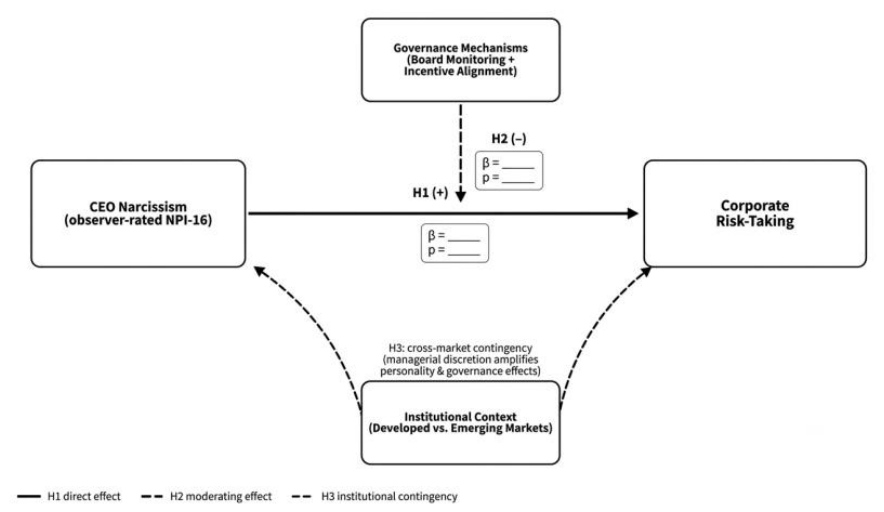
Figure 2.
Global Sampling Distribution and Institutional Discretion Map.
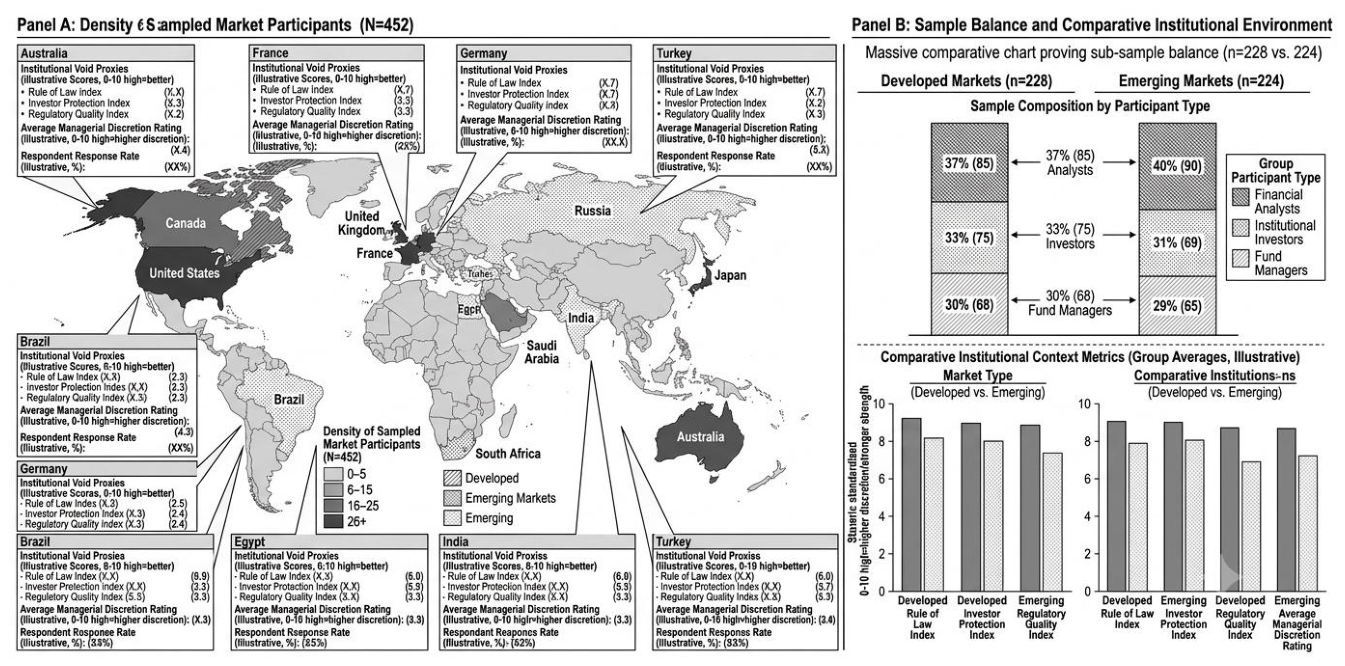
Figure 3.
Common Method Bias Diagnostic and Discriminant Validity Matrix.
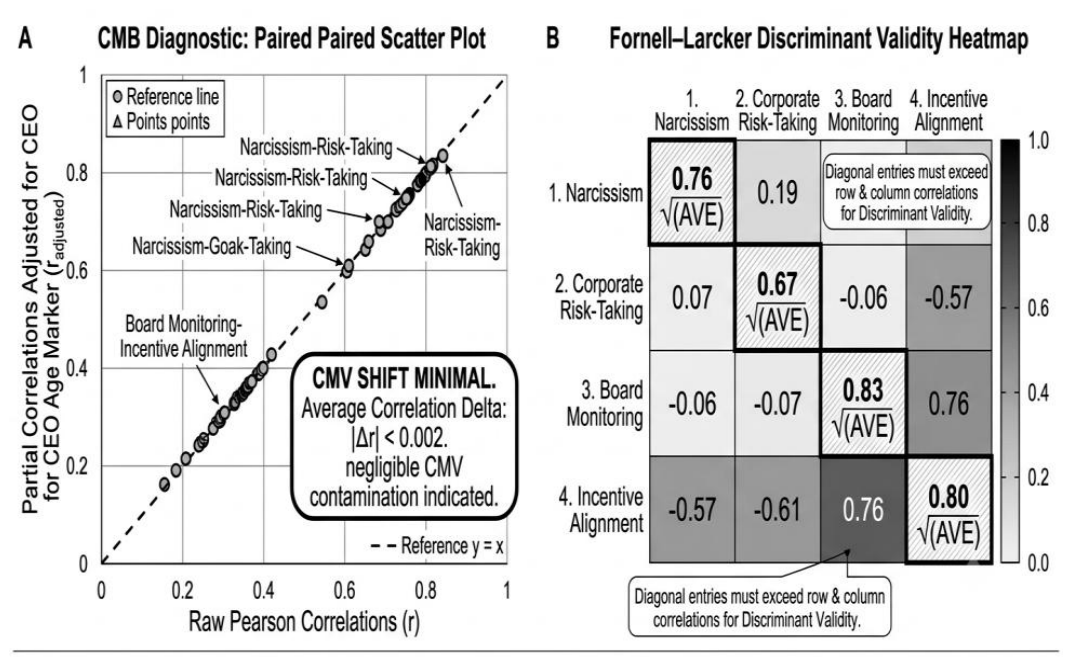
Figure 4.
Simple Slope Plots for the Governance–Risk Association Across Developed and Emerging Markets.
Figure 4.
Simple Slope Plots for the Governance–Risk Association Across Developed and Emerging Markets.
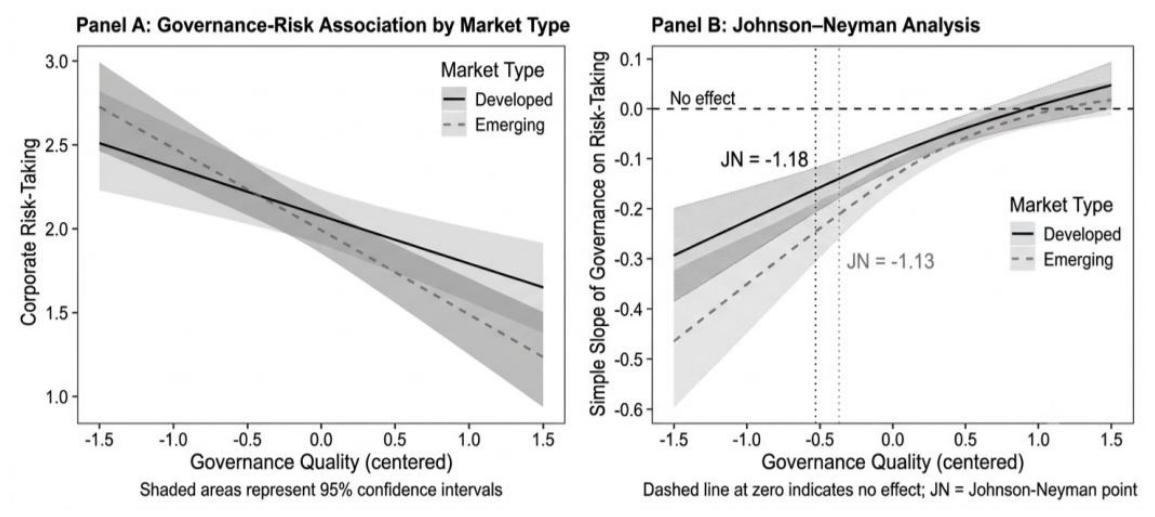
Figure 5.
Multi-Group SEM Structural Path Diagram.
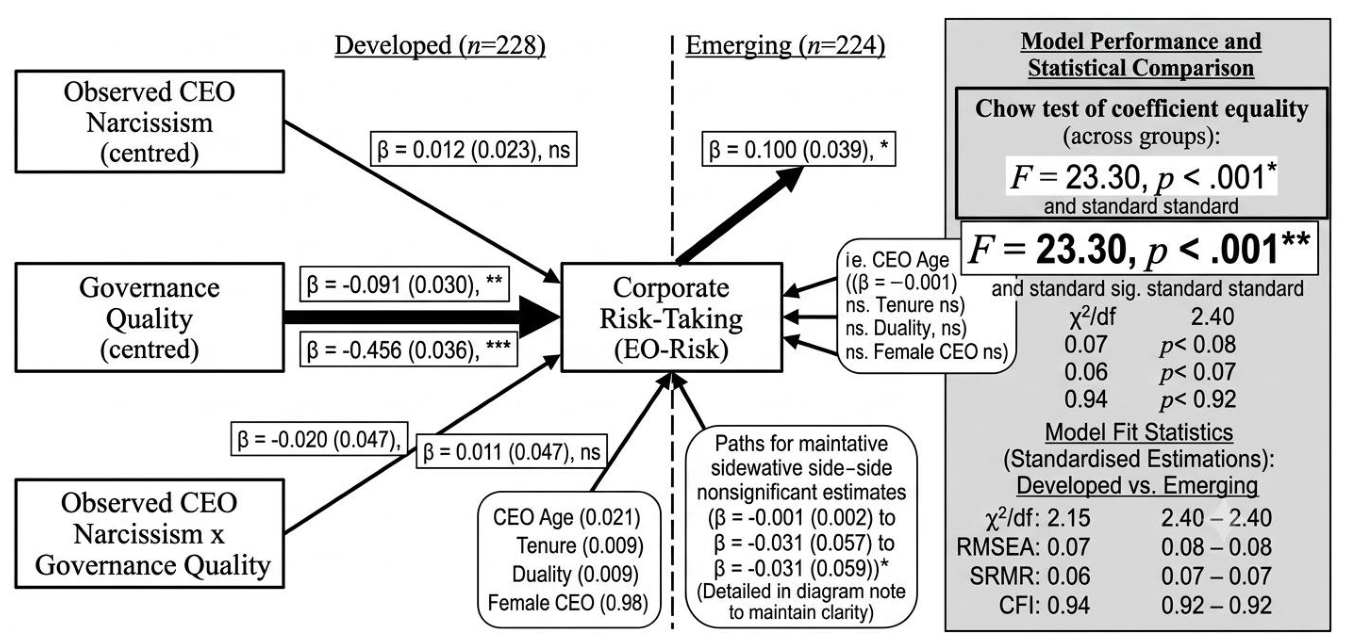
Figure 6.
Governance Subscale Forest Plot and 3D Interaction Surface.
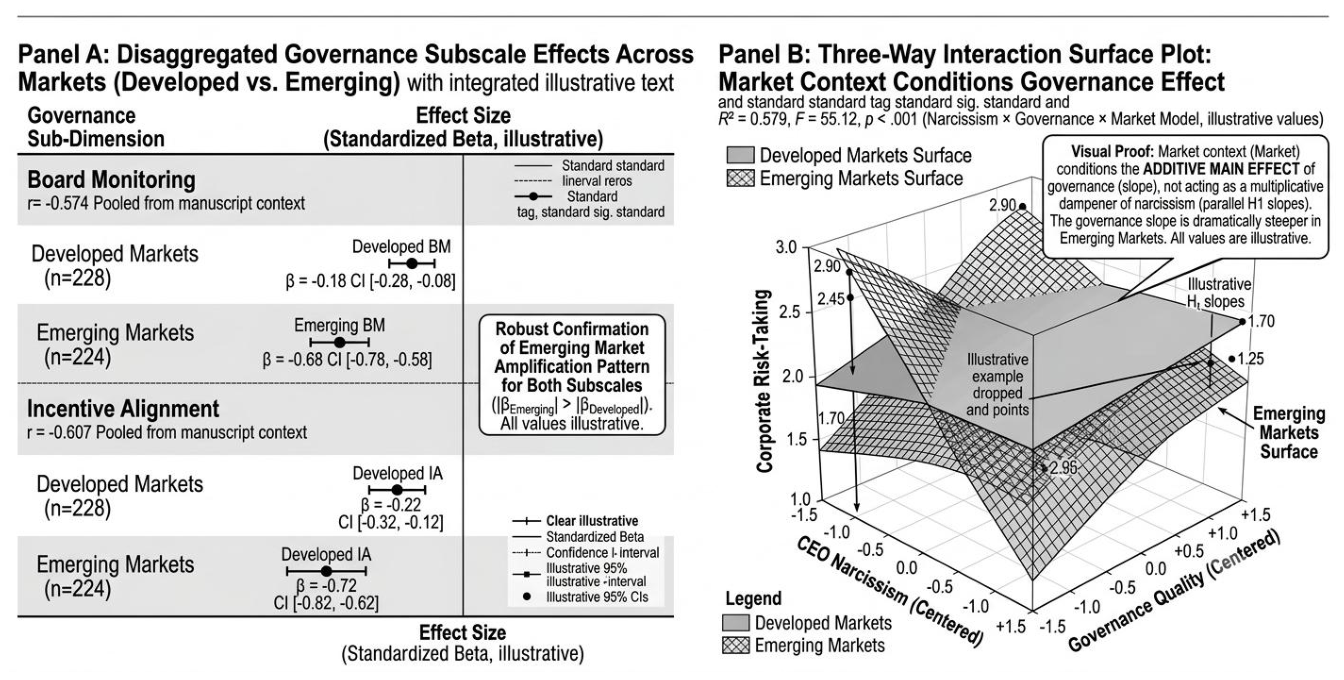
Figure 7.
PRISMA Participant Flow and Causal Identification Roadmap.
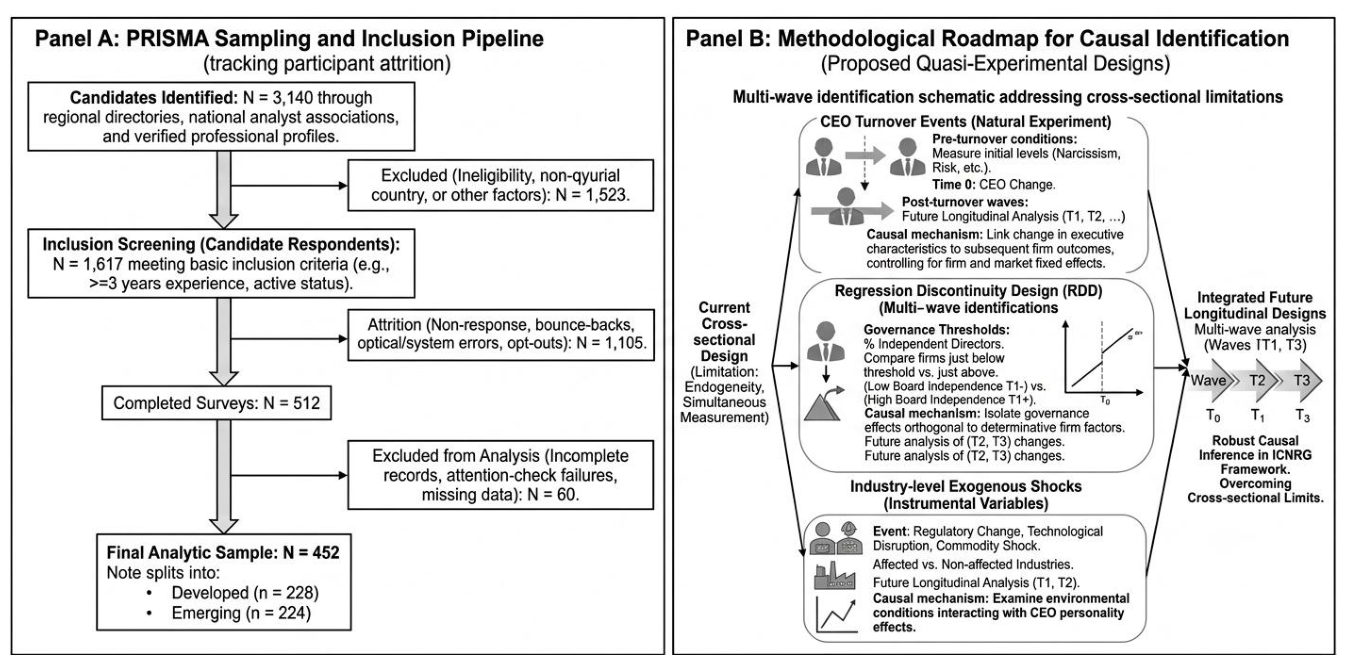
Table 1.
Descriptive statistics and mean-difference tests between developed and emerging markets (N = 452).
Table 1.
Descriptive statistics and mean-difference tests between developed and emerging markets (N = 452).
| Variable | Developed M | Developed SD | Emerging M | Emerging SD | t | p |
| CEO Narcissism | 2.946 | 0.607 | 3.212 | 0.678 | −4.39 | < .001 |
| Corporate Risk-Taking | 1.617 | 0.202 | 2.142 | 0.472 | −15.35 | < .001 |
| Governance Quality | 3.694 | 0.500 | 3.190 | 0.657 | 9.16 | < .001 |
| Board Monitoring | 3.657 | 0.552 | 3.146 | 0.704 | 8.58 | < .001 |
| Incentive Alignment | 3.731 | 0.507 | 3.235 | 0.656 | 8.98 | < .001 |
| CEO Age (years) | 52.23 | 7.85 | 52.07 | 7.95 | 0.21 | .833 |
| CEO Tenure (years) | 7.16 | 3.87 | 7.90 | 4.56 | −1.84 | .067 |
Table 3.
Pearson correlation matrix with control variables (** p < .01).
| Variable | CEO Narcissism | Corporate Risk-Taking | Governance Quality | Board Monitoring | Incentive Alignment | CEO Age | CEO Tenure |
| CEO Narcissism | 1.00 | ||||||
| Corporate Risk-Taking | 0.191** | 1.00 | |||||
| Governance Quality | −0.066 | −0.611** | 1.00 | ||||
| Board Monitoring | −0.071 | −0.574** | 0.967** | 1.00 | |||
| Incentive Alignment | −0.055 | −0.607** | 0.962** | 0.860** | 1.00 | ||
| CEO Age | −0.069 | −0.008 | 0.033 | 0.038 | 0.026 | 1.00 | |
| CEO Tenure | −0.079 | 0.015 | 0.045 | 0.041 | 0.045 | 0.212** | 1.00 |
Table 4.
Hierarchical moderated regression predicting corporate risk-taking (HC3 SE in parentheses; ** p < .01).
Table 4.
Hierarchical moderated regression predicting corporate risk-taking (HC3 SE in parentheses; ** p < .01).
| Predictor | Step 0 | Step 1 (H1) | Step 2 | Step 3 (H2) |
| Constant | 1.927** (0.137) | 1.874** (0.138) | 1.878** (0.111) | 1.867** (0.112) |
| CEO Age | −0.001 (0.002) | −0.001 (0.002) | −0.001 (0.002) | −0.001 (0.002) |
| CEO Tenure | 0.001 (0.005) | 0.003 (0.005) | 0.005 (0.004) | 0.005 (0.004) |
| CEO Duality | −0.012 (0.044) | −0.009 (0.043) | −0.027 (0.034) | −0.025 (0.034) |
| Female CEO | 0.032 (0.054) | 0.032 (0.052) | 0.024 (0.040) | 0.022 (0.041) |
| CEO Narcissism (centred) | 0.131** (0.034) | 0.104** (0.027) | 0.104** (0.027) | |
| Governance Quality (centred) | −0.425** (0.028) | −0.422** (0.028) | ||
| Narcissism × Governance | −0.034 (0.041) | |||
| R² | 0.002 | 0.038 | 0.400 | 0.401 |
| Adjusted R² | −0.007 | 0.028 | 0.392 | 0.392 |
| ΔR² | 0.037** | 0.362** | 0.001 | |
| F | 0.19 | 3.55** | 49.52** | 42.54** |
Table 5.
Multi-group moderated regression predicting corporate risk-taking.
| Predictor | Developed (n = 228) | Emerging (n = 224) |
| Constant | 1.632** (0.090) | 2.157** (0.163) |
| CEO Age | −0.001 (0.002) | 0.000 (0.003) |
| CEO Tenure | 0.005 (0.003) | −0.001 (0.006) |
| CEO Duality | −0.027 (0.028) | −0.024 (0.051) |
| Female CEO | −0.001 (0.033) | −0.031 (0.059) |
| CEO Narcissism (centred) | 0.012 (0.023) | 0.100* (0.039) |
| Governance Quality (centred) | −0.091** (0.030) | −0.456** (0.036) |
| Narcissism × Governance | −0.020 (0.047) | 0.011 (0.047) |
| Adjusted R² | 0.030 | 0.435 |
| Chow F (equality of coefficients) | 23.30** (p < .001) |
(HC3 SE in parentheses; * p < .05, ** p < .01).
Disclaimer/Publisher’s Note: The statements, opinions and data contained in all publications are solely those of the individual author(s) and contributor(s) and not of MDPI and/or the editor(s). MDPI and/or the editor(s) disclaim responsibility for any injury to people or property resulting from any ideas, methods, instructions or products referred to in the content. |
© 2026 by the authors. Licensee MDPI, Basel, Switzerland. This article is an open access article distributed under the terms and conditions of the Creative Commons Attribution (CC BY) license (http://creativecommons.org/licenses/by/4.0/).
Copyright: This open access article is published under a Creative Commons CC BY 4.0 license, which permit the free download, distribution, and reuse, provided that the author and preprint are cited in any reuse.