

Submitted:
05 October 2026
Posted:
14 October 2026
You are already at the latest version
Abstract
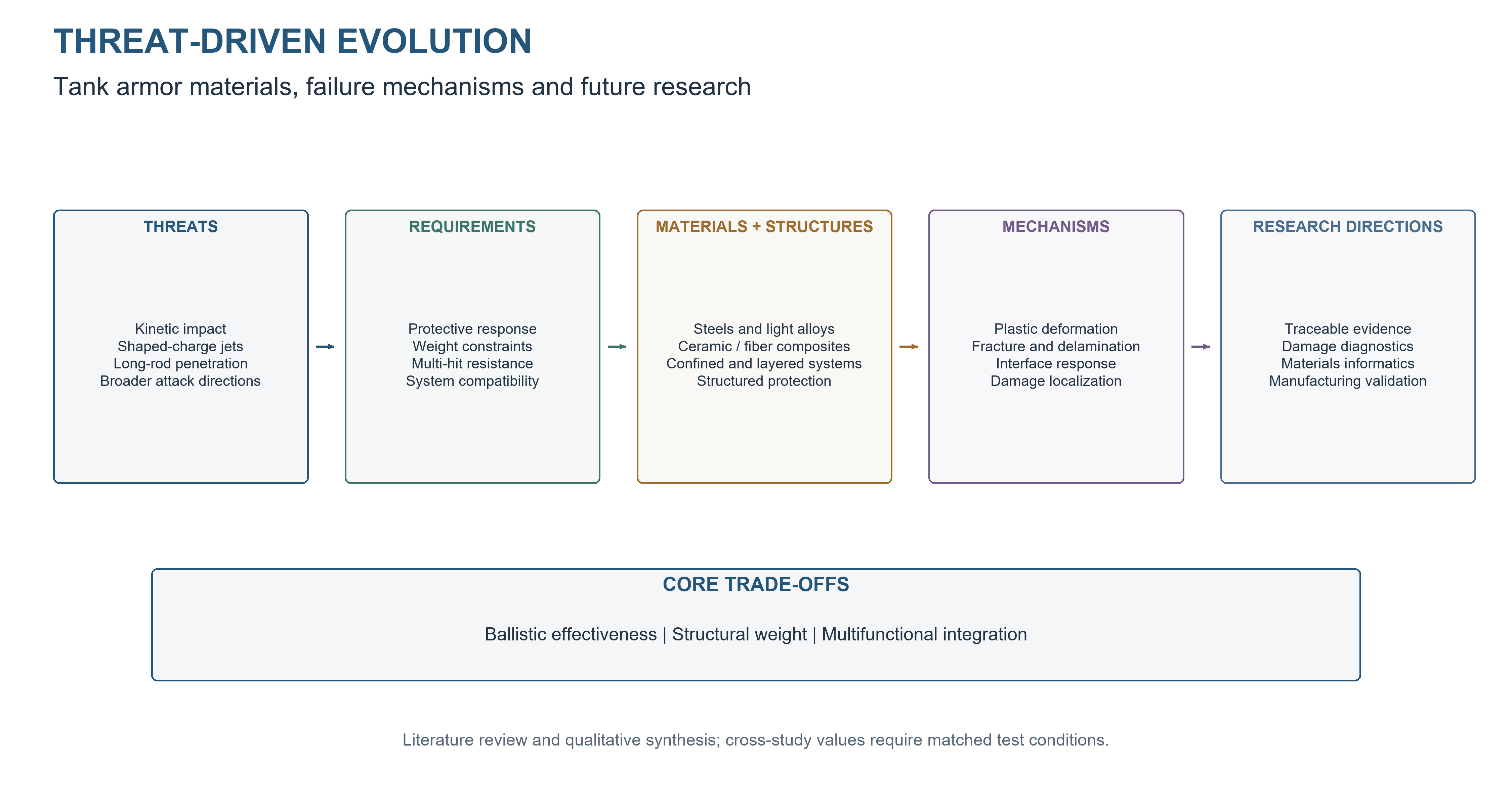
Focusing on the evolution of anti-armor threats and material responses, this review traces the development of tank armor materials from rolled homogeneous armor steel to metal, ceramic, polymer-composite systems, and reactive protective structures. For kinetic projectiles, shaped-charge jets, long-rod penetrators, and top-attack threats, the response mechanisms and application boundaries of high-hardness steels, lightweight alloys, ceramic/fiber composite armor, confined ceramic-metal laminates, explosive reactive armor, and porous, slat, and bio-inspired structures are compared. Material-structure coupled mechanisms including adiabatic shear, impedance matching, and ceramic fracture are summarized. The reviewed literature indicates that armor design is shifting from single-property optimization toward coordinated trade-offs among hardness, toughness, density, spatial configuration, and system interfaces. Functionally graded materials, micro-laminated composites, damage-sensing interfaces, and materials informatics offer possible routes for lightweight design, multi-hit resistance, and maintainability. However, cross-material comparison remains constrained by differences in projectile type, impact velocity, angle of incidence, boundary conditions, and evaluation criteria. Engineering feasibility still requires validation through unified databases, multi-hit tests, environmental durability studies, manufacturing consistency assessment, and cost analysis.
Keywords:
armor materials
; ceramic composite armor
; explosive reactive armor
; functionally graded materials
; ballistic protection
; materials informatics
; intelligent protective material systems
Copyright: This open access article is published under a Creative Commons CC BY 4.0 license, which permit the free download, distribution, and reuse, provided that the author and preprint are cited in any reuse.