
Submitted:
13 October 2026
Posted:
14 October 2026
You are already at the latest version
Abstract
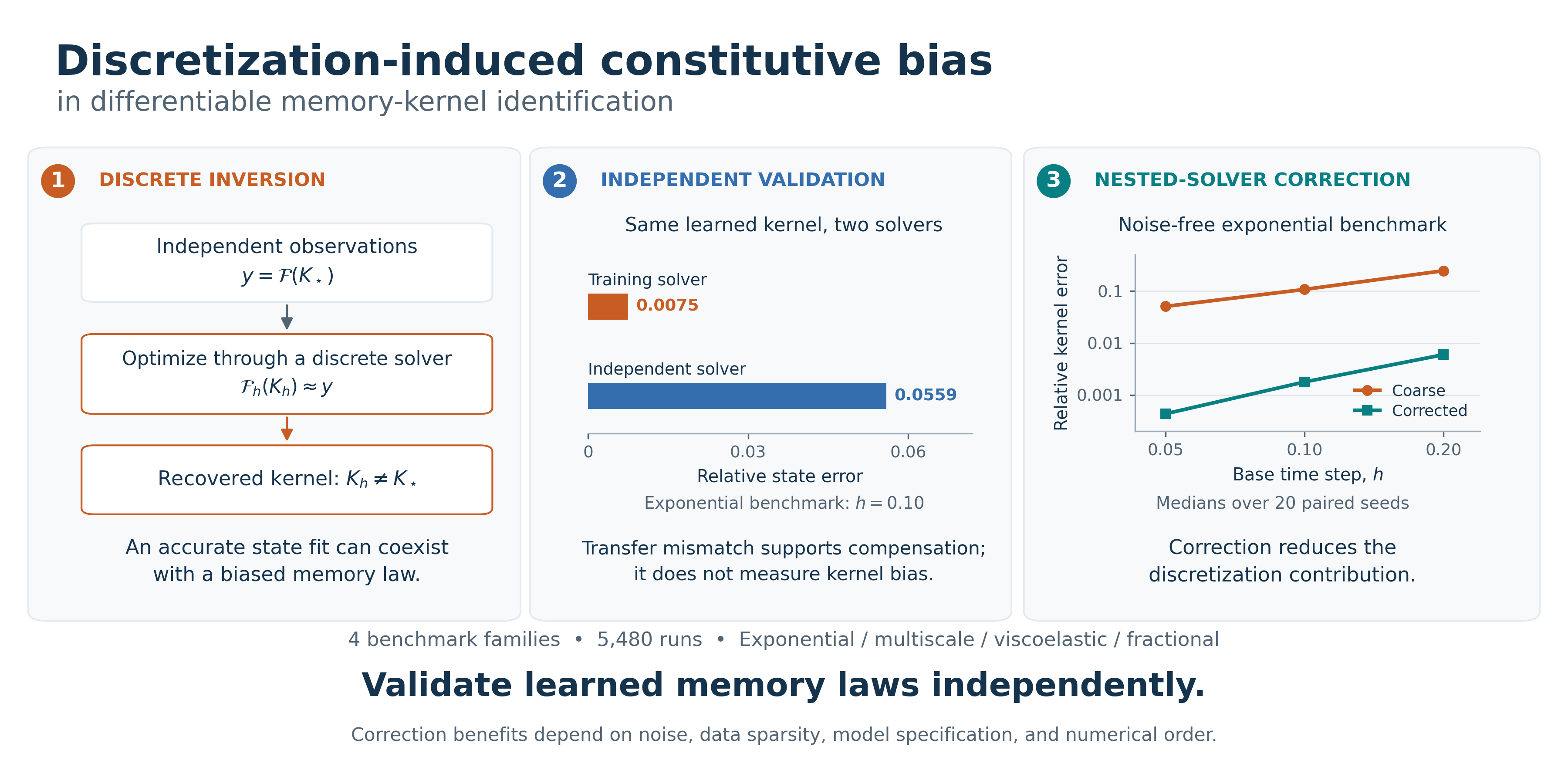
Optimization through a discrete forward solver can introduce constitutive bias into recovered memory kernels, even when fitted trajectories appear accurate. We characterize this discretization-induced bias and assess how independent validation exposes it and nested-solver correction reduces it. A local perturbation analysis separates noise, discretization, and smooth regularization contributions to estimation error. An inverse-crime-free protocol combines independently generated observations, independent forward evaluation, and nested-grid Richardson correction. Four synthetic benchmark families comprise 5480 completed runs, with 20 paired seeds per stochastic condition. Matched-discretization controls yielded nearly exact kernel recovery despite substantial forward state errors relative to the continuous reference. Independent observations exposed systematic resolution-dependent kernel errors. In the exponential benchmark, corrected kernel error decreased at approximately order 1.89, compared with 1.14 for coarse inversion; the manufactured KWW benchmark gave a corrected endpoint rate of approximately 1.54. Correction also improved multiscale and constrained nonparametric recovery, but benefits diminished under noise, sparsity, and misspecification. Accurate Prony kernel recovery coexisted with substantial fast-mode parameter error. Raw forward defects did not reliably estimate kernel error, and fractional and numerical correction orders differed in the tested scheme. These findings support independent forward validation and numerical-convergence assessment as essential components of credible memory-kernel discovery.
Keywords:
constitutive bias
; memory-kernel identification
; differentiable solvers
; inverse-crime-free validation
; Richardson correction
; integro-differential equations
; scientific machine learning
Copyright: This open access article is published under a Creative Commons CC BY 4.0 license, which permit the free download, distribution, and reuse, provided that the author and preprint are cited in any reuse.