

Submitted:
13 October 2026
Posted:
14 October 2026
You are already at the latest version
Abstract
Background: Social media engagement is often framed as either a source of connection and utility or a threat to healthy digital functioning. This binary view is limiting in emerging-market settings where Facebook and Instagram are embedded in communication, information seeking and entertainment. Drawing on Uses and Gratifications Theory (UGT) and a digital well-being perspective, this study examines whether engagement is associated with users’ gratifications and whether gratifications explain digital well-being among Facebook and Instagram users in Bangladesh. Method: The study analyses 385 populated records from the supplied Group 3 Meta master database. The focal model uses three reflective constructs-Social Media Engagement (SME), Uses & Gratifications (UG), and Digital Well-Being (DWB)-each measured with three five-point Likert items. Measurement diagnostics include indicator loadings, Cronbach’s alpha, composite reliability, AVE and HTMT. Structural relationships are assessed with standardized paths, R², effect sizes, bootstrap confidence intervals and mediation analysis. A sensitivity analysis excludes one straight-line response. Results: SME was positively associated with UG (β = .305, p < .001) and with DWB in the total-effect model (β = .199, p < .001). With UG included, the direct SME→DWB path remained significant (β = .174, p = .001), whereas UG→DWB was positive but non-significant (β = .085, p = .107). The indirect effect through UG was small and its 95% bootstrap interval included zero. The model explained 9.3% of UG and 4.6% of DWB variance. Composite reliability was acceptable, although Cronbach’s alpha was below .70 and DWB AVE was marginally below .50. Contribution: The study distinguishes engagement from gratification and digital balance rather than treating social media use as a unitary exposure. The evidence supports a direct engagement-well-being association in this dataset but not a gratification-mediated mechanism.
Keywords:
social media engagement
; uses and gratifications
; digital well-being
; Facebook
; Instagram
; Bangladesh
; PLS-SEM
1. Introduction
This section establishes the empirical and conceptual context of the study and clarifies why the relationship between social media engagement and digital well-being warrants closer examination in Bangladesh. It first situates Facebook and Instagram use within contemporary digital life, then narrows the discussion to the specific research problem, unresolved literature gaps, and the objectives of the present investigation. The section also explains the study’s distinctive contribution relative to related Group 3 studies by concentrating on engagement, user gratifications, and digital well-being rather than privacy, trust, marketing effectiveness, or continued-use intention. This progression provides the rationale for the theoretical model and hypotheses developed in the subsequent section.
Facebook and Instagram have become infrastructural rather than peripheral components of everyday digital life. Users encounter these platforms as spaces for interpersonal communication, information acquisition, entertainment, self-expression, community participation and commercial activity. This multifunctionality makes a simple exposure-based question-whether people use social media and for how long-an incomplete basis for explaining digital well-being. Contemporary research increasingly distinguishes between different forms of social media activity, the motivations attached to those activities, and the conditions under which digital participation is beneficial or harmful. Reviews have repeatedly shown that associations between social media use and well-being are heterogeneous and depend on whether researchers examine active communication, passive browsing, social comparison, problematic use, positive experiences or platform-specific practices [20,21,22].
This issue is especially important in Bangladesh. Social media has expanded alongside mobile connectivity, digital commerce, online education and digitally mediated social relationships. Existing Bangladeshi studies have documented both beneficial and adverse dimensions of Facebook and broader social media use. For example, research among Bangladeshi university students has reported substantial Facebook use alongside concerns about sleep, time loss and concentration [23], while other studies have examined problematic Facebook use, psychological well-being and academic outcomes [24,25,26,27]. More recent evidence suggests that the relationship between social media use and mental health in Bangladesh is not adequately described by a simple direct “more use, worse outcome” model; intervening social and academic processes matter [28]. A 2026 study of Bangladeshi college students likewise reports indirect relationships between social media exposure and mental-health outcomes through study time, relationships and career anxiety [29]. These findings point toward the importance of studying the quality and purpose of engagement rather than relying exclusively on duration.
The present study follows that direction by focusing on Facebook and Instagram users and by operationalizing three conceptually distinct constructs: Social Media Engagement, Uses & Gratifications, and Digital Well-Being. The design is intentionally narrower than the other Group 3 articles. It does not analyse privacy, trust, business marketing capability, perceived business usefulness or continued-use intention. Instead, it asks whether engagement is related to the gratifications users seek from Meta platforms and whether these patterns correspond with a user’s perceived ability to maintain healthy, non-disruptive digital functioning.
The central research problem is the unresolved balance between the social and functional value of high engagement and the possibility that intensive digital participation can disrupt everyday functioning. The research plan for Nazia Akter explicitly identifies this tension: high engagement with Meta platforms may support social connection while simultaneously generating digital well-being concerns among young Bangladeshi users. Importantly, the plan specifies that the “AI-driven” element is contextual rather than a separately tested causal variable. Therefore, the study should not claim that Meta AI features cause changes in well-being. Instead, the contemporary AI-enabled platform ecosystem provides the setting in which users experience recommendation, personalization, content ranking and other digitally mediated affordances.
A second problem is conceptual. The same amount of social media use can represent information seeking, social connection or entertainment. UGT treats users as active, goal-directed participants, while digital well-being emphasizes whether participation remains compatible with functioning and self-regulation [1,2,3,4,5,17,18,19]. Combining the perspectives allows a more precise test of whether gratification explains the engagement-well-being relationship.
Three gaps motivate the study. First, the empirical literature contains inconsistent conclusions about the relationship between social media use and well-being. Umbrella reviews and meta-analyses show that effects vary by activity, outcome and measurement strategy [20,21,22]. Broad measures of social media exposure can therefore conceal meaningful mechanisms.
Second, the theoretical literature often examines either motives and engagement or well-being and problematic use, but less frequently integrates a compact engagement-gratification-well-being pathway. UGT is well established for explaining why people select and use media, while digital well-being research emphasizes the quality and consequences of technology-mediated life [3,5,17,18]. The present study links the two without assuming that gratification automatically improves well-being.
Third, Bangladesh remains underrepresented in theory-driven, platform-specific analyses of positive digital functioning. Existing local research provides valuable evidence about excessive Facebook use, addiction, mental health and academic consequences [23,24,25,26,27,28,29], but there is room for a model that explicitly distinguishes active engagement from the purposes that users derive from that engagement and from their perceived ability to maintain daily functioning. This distinction is particularly relevant in an AI-driven platform environment where engagement can be shaped by personalization and algorithmic content selection.
The general objective is to examine the relationship between social media engagement and digital well-being among Facebook and Instagram users in Bangladesh through a Uses and Gratifications lens.
The study addresses four research questions:
RQ1. Is Social Media Engagement positively associated with Uses & Gratifications?
RQ2. Is Social Media Engagement positively associated with Digital Well-Being?
RQ3. Is Uses & Gratifications positively associated with Digital Well-Being when Social Media Engagement is controlled?
RQ4. Does Uses & Gratifications mediate the relationship between Social Media Engagement and Digital Well-Being?
The study contributes a “purpose-participation-balance” perspective: engagement represents participation, gratifications represent the purposes and benefits attached to participation, and digital well-being represents perceived balance between digital activity and everyday functioning. The model tests whether gratification actually explains the final outcome rather than assuming that it does.
Section 2 develops the conceptual and theoretical foundation and derives the hypotheses. Section 3 explains the research design, sample, measurement, screening and analytical strategy. Section 4 reports descriptive, measurement and structural results. Section 5 discusses the findings in relation to UGT, digital well-being scholarship and Bangladeshi evidence. Section 6 outlines theoretical, managerial and societal implications. Section 7 concludes with contributions, limitations and future research directions, followed by declarations and references.
2. Literature Review and Theoretical Foundation
Building on the problem established in the introduction, this section develops the conceptual and theoretical logic required to explain how social media participation may relate to digital well-being. The discussion begins by defining the focal constructs and distinguishing engagement from the motivations users seek to satisfy through social media. It then draws on Uses and Gratifications Theory and the Digital Well-Being perspective to explain why active participation may be associated with both functional and experiential benefits without necessarily guaranteeing healthy digital balance. The section subsequently synthesizes construct-specific evidence, develops the hypotheses, and integrates them into the proposed conceptual framework. This sequence ensures that the empirical tests are grounded in an explicit theoretical mechanism rather than in simple associations.
2.1. Conceptual Background
Social media engagement refers to the intensity and active involvement with social media content and activities. Engagement is broader than mere access: it can include consuming content, interacting with others, sharing information and contributing content. Research on online engagement emphasizes its cognitive, emotional and behavioural dimensions [8], while social media engagement research distinguishes consuming, contributing and creating activities [6,12]. The present questionnaire uses a concise behavioural-functional operationalization. SME1 captures frequent interaction with Facebook/Instagram content, SME2 captures the platforms’ importance in daily online activity, and SME3 captures active communication or content sharing. Thus, the construct represents users’ perceived involvement in the platform environment rather than a precise time-duration measure.
Uses and Gratifications Theory conceptualizes media audiences as active participants who choose media to satisfy needs. The classical formulation identifies cognitive, affective, personal, social and tension-release functions [1,2]. In digital media, UGT has been extended to account for affordances and novel gratifications that emerge from interactivity, modality, agency and navigability [4]. In the present study, UG is measured through information seeking, social relationship maintenance, and entertainment/relaxation. These items represent three highly recurrent gratification domains and fit the multifunctional nature of Facebook and Instagram [5,7,16].
Digital well-being is concerned with whether technology use contributes to or undermines healthy functioning. Gui et al. [17] conceptualize digital well-being as a condition in which individuals and communities can manage digital stimuli in ways compatible with comfort, safety, satisfaction and fulfillment. Later scholarship emphasizes that digital well-being cannot be reduced to screen time because context, activity, user characteristics and digital self-regulation influence outcomes [18,19]. In the present study, DWB is operationalized through support for rather than disruption of daily functioning, control over time spent on Meta platforms, and the absence of interference with important responsibilities. The construct therefore captures functional balance rather than clinical mental health.
2.2. Theoretical Foundation
UGT provides the primary theoretical foundation because the research problem begins with the question of why users engage with Facebook and Instagram. The theory emerged from an audience-centred tradition that shifted attention from what media do to people toward what people do with media [1,2]. Users are assumed to possess needs and expectations and to select media that can satisfy those needs. Gratifications are therefore not simply passive consequences; they are part of the motivational logic of media choice.
For social media, this proposition becomes especially relevant because one platform can provide information, entertainment, social connection, identity expression and community participation simultaneously. Contemporary UGT research shows that social-media gratifications are shaped by platform affordances and can be linked to different engagement behaviours [4,6,13,16]. The present model extends this logic by asking whether the gratification orientation associated with engagement also has a measurable relationship with digital well-being. This is a theoretically conservative extension: the model does not assume that all gratifications are beneficial, only that the perceived purposes and benefits of use may help explain the relationship between engagement and well-being.
The digital well-being framework complements UGT by defining the outcome of interest. Whereas UGT explains motivation and media choice, digital well-being focuses on the quality and balance of the resulting digital life. Digital well-being scholarship emphasizes self-regulation, the fit between technology use and personal goals, and the avoidance of harmful disruption [17,18,19]. This framework is appropriate because the questionnaire’s DWB items measure functioning, time control and responsibility interference rather than depression or anxiety.
The integrated model treats engagement as participation, gratification as the motivational/functional meaning attached to that participation, and digital well-being as the perceived balance outcome. UGT predicts that more engaged users may report stronger gratification from the platform (H1). The digital well-being framework then motivates the expectation that engagement and purposeful gratification can be associated with healthy digital functioning (H2-H3), while the mediation test examines whether gratification provides the mechanism linking engagement to well-being (H4).
2.3. Construct-Specific Literature
Engagement has become a central concept in interactive media because users are not merely recipients of content; they also participate in creating, sharing and responding to it. Brodie et al. [10] describe engagement as a dynamic relational concept involving interactive experiences and value co-creation, while Hollebeek et al. [8] emphasize cognitive processing, affection and activation. Dolan et al. [6] apply UGT to social media engagement and show that content characteristics can stimulate different engagement behaviours. The present study adopts a user-centred rather than brand-centred definition, appropriate to Facebook and Instagram as everyday social platforms.
Information, social connection and entertainment remain core motives in social media use. UGT research shows that users actively select platforms to satisfy different needs and that motives may predict engagement and continuance [4,6,13,16]. A 2024 study of social media use among adults and older adults found that purposive, entertainment, social-enhancement and interpersonal-connectivity motives were associated with social media use and that social media use was associated with social relationships and psychological well-being [15]. This supports the conceptual relevance of examining gratification alongside engagement and well-being, while also indicating that effects are not necessarily uniform across gratification types.
Digital well-being has developed as a response to the limitations of treating digital technology as either universally beneficial or universally harmful. Gui et al. [17] emphasized skills and social norms that help individuals cope with information abundance and digital overconsumption. Burr et al. [18] broadened the concept through an ethical analysis, highlighting the importance of autonomy, self-determination and human flourishing. More recent work stresses the complexity of digital well-being across multiple devices and contexts [19], while research on digital disconnection and digital-well-being applications shows that regulation is itself an important part of the construct [35,36]. Accordingly, the present study measures perceived functional balance rather than a clinical outcome.
2.4. Hypotheses Development
UGT predicts that users actively select and interact with media because they expect it to satisfy needs. Greater engagement should therefore be accompanied by stronger recognition of the informational, social and entertainment value obtained from the platform. Empirical studies consistently connect gratification motives with social media engagement behaviours [6,13,16]. A 2024 WeChat study, for example, found that entertainment, social interaction, identity, information and other gratification dimensions were significantly associated with engagement [14]. These findings suggest that engagement and gratification are conceptually distinct but positively connected.
H1.
Social Media Engagement is positively associated with Uses & Gratifications.
The engagement-well-being relationship is theoretically ambiguous, which makes it empirically important. Social media can facilitate connection, information access and positive experiences, but excessive or poorly regulated participation may interfere with responsibilities. Recent meta-analytic evidence shows that associations with positive well-being are generally small and become more informative when specific activities rather than broad measures of social media use are examined [21]. An umbrella review likewise concludes that effects vary across types of use and outcomes [20].
In the present framework, engagement is not equated with problematic use. Active communication and participation may support functioning when they serve meaningful social or informational purposes. Therefore, a positive association is expected at the construct level, while acknowledging that the cross-sectional data cannot establish causality.
H2.
Social Media Engagement is positively associated with Digital Well-Being.
The link between gratification and digital well-being is more conditional. Gratifications may indicate that users derive value from digital participation, and such value can support social connection, information access and positive experiences. However, UGT itself does not imply that every gratification produces a beneficial outcome. Entertainment or escape, for example, can be adaptive in one context and disruptive in another. Thus, the proposed positive relationship concerns users’ overall gratification experience rather than any single motive.
The questionnaire combines information, social relationship and entertainment/relaxation motives. These represent purposeful and socially embedded reasons for use that may make digital participation more compatible with daily functioning. Therefore:
H3.
Uses & Gratifications is positively associated with Digital Well-Being.
A mediation mechanism would provide a more sophisticated explanation than a simple direct association. If engagement increases the extent to which users obtain valued gratifications, and those gratifications in turn improve perceived digital balance, then part of the engagement-well-being relationship should operate indirectly through UG. This would integrate UGT and digital well-being by treating gratification as the mechanism through which participation acquires functional meaning.
However, because the literature also documents negative, neutral and context-dependent outcomes of social media use [20,21,22], the mediation hypothesis should be treated as an empirical question rather than a theoretical certainty. The present study therefore tests the indirect effect with bootstrap confidence intervals.
H4.
Uses & Gratifications mediates the positive relationship between Social Media Engagement and Digital Well-Being.
2.5. Conceptual Framework
The conceptual framework translates the preceding theoretical arguments into a parsimonious empirical model. It is built around a three-part distinction: Social Media Engagement (SME) represents users’ behavioural participation in Facebook and Instagram; Uses & Gratifications (UG) represents the informational, relational and entertainment purposes users seek from these platforms; and Digital Well-Being (DWB) represents the extent to which platform use remains compatible with everyday functioning, responsibilities and perceived control. The framework therefore moves from participation, through motivational purpose, to the broader quality of digital life.
As shown in Figure 1, SME is positioned as the exogenous construct, UG as the proposed mediator, and DWB as the focal outcome. H1 specifies that engagement is positively associated with gratification because more active participation should provide greater opportunity to obtain desired information, social connection and entertainment. H2 specifies a direct SME→DWB association, recognising that engagement may relate to digital functioning through mechanisms not captured by gratification alone. H3 tests whether UG is associated with DWB after engagement is taken into account. H4 then formalises the indirect SME→UG→DWB pathway and asks whether gratification explains part of the association between participation and digital well-being.
The mediation structure is theoretically important because the three constructs should not be treated as interchangeable indicators of ‘social-media use.’ A user can be highly engaged because Facebook or Instagram provides meaningful social and informational benefits, yet that same engagement may coexist with distraction, prolonged participation or difficulty controlling digital time. Conversely, purposeful engagement may support functioning in some circumstances. By estimating both direct and indirect pathways, the framework allows these competing possibilities to be distinguished empirically instead of assuming that gratification must either improve or harm well-being.
The framework also establishes the study’s distinct analytical boundary within the Group 3 master dataset. The companion articles address digital marketing effectiveness and privacy, trust and continued use; this article instead focuses on social participation, user motives and digital balance. The AI-driven social-media era is retained as the contemporary platform context in which recommendation, personalisation and algorithmic content selection occur, but AI is not modelled as a separate causal construct because the supplied questionnaire does not contain validated AI-specific causal measures. Figure 1 should therefore be interpreted as a theory-driven test of behavioural and motivational relationships within an evolving platform environment, not as an estimate of the effect of Meta AI features themselves.
Figure 1 is intended to be read from left to right as a proposed explanatory sequence. The H1 arrow establishes the first-stage relationship between participation and gratification; H2 captures the direct engagement-well-being association; H3 evaluates whether gratification has an additional association with well-being once engagement is controlled; and H4 represents the compound indirect mechanism. This structure is analytically useful because support for H1 alone would show that engagement is related to users’ perceived gratifications, whereas support for H4 would require evidence that those gratifications transmit part of the relationship to digital well-being. The empirical tests in Section 4 therefore evaluate each arrow separately before considering the model as a whole.
3. Methodology
The methodology translates the theoretical model into an empirical research procedure designed to provide a transparent and reproducible test of the proposed relationships. Consistent with the research plan, the study uses a quantitative, cross-sectional survey of eligible Facebook and Instagram users in Bangladesh and applies a structured five-point Likert instrument. The methodological discussion proceeds from research design and population definition to sampling, measurement, data screening, and statistical analysis. Particular attention is given to the distinction between the focal constructs of this article and the additional constructs contained in the common Group 3 master questionnaire. This approach ensures that the analysis remains aligned with Nazia Akter’s research problem while preserving methodological consistency with the shared dataset.
3.1. Research Design
The study follows the quantitative, cross-sectional primary-survey design specified in the research plan. The intended design uses a structured five-point Likert questionnaire and purposive/criterion-based screening of eligible Facebook and Instagram users in Bangladesh. The supplied database contains 400 pre-numbered respondent rows, of which 385 contain complete respondent-level records. The analytical strategy is aligned with variance-based SEM because the research objective is predictive and mechanism-oriented and because the conceptual model contains latent constructs represented by multiple reflective indicators [31,32].
The workbook does not contain SmartPLS/SEMinR output. Therefore, the manuscript reports PLS-SEM-compatible diagnostics and bootstrap path analysis based on construct scores rather than claiming that proprietary PLS output was produced. Before submission, the item-level data should be re-estimated in dedicated PLS-SEM software so exact outer loadings, rho_A, Q² and PLSpredict statistics can be reported.
3.2. Study Population and Research Context
The target population comprises active Facebook and/or Instagram users in Bangladesh, including university students and small-business/social-commerce users where relevant. The unit of analysis is the individual user. Eligibility is conceptually consistent with the master questionnaire: respondents should be adults, have relevant Meta experience, and voluntarily consent to participate.
The dataset is heterogeneous rather than restricted to university students. It contains students, employed respondents, self-employed/freelance users and a smaller “other” category. This broad composition is advantageous for the study’s stated objective because digital well-being concerns are not exclusively academic. However, the use of purposive rather than probability sampling means the sample should not be interpreted as statistically representative of all Bangladeshi Meta users.
3.3. Sampling Design and Sample Size
The research plan specifies purposive/criterion-based screening. This approach is appropriate when the study requires respondents with direct experience of the focal platforms. The questionnaire’s screening items include adult status and relevant Meta experience. Online distribution is consistent with the platform-focused population and reduces geographical barriers.
The project plan targeted 400 respondents and specified retention of at least 385 valid cases, referencing Cochran’s large-population formula at a 95% confidence level, 5% margin of error and p = .50. The supplied workbook contains 385 populated records, exactly meeting the planned retention benchmark. However, because the sampling approach is non-probability purposive sampling, the conventional 5% margin-of-error interpretation should not be treated as a probability-sampling guarantee. The sample size is instead reported as meeting the project’s planned analytical target.
The plan recommends a model-specific a priori power analysis. Because the supplied files do not document its effect-size assumptions, this manuscript does not invent a power result; the final submission should add the verified calculation.
The workbook contains 385 populated cases and 15 blank respondent rows. All 385 populated cases have complete focal item responses and an attention-check response of 4 (“Agree”). Respondent IDs are unique. One case exhibits identical responses across all nine focal items, creating a possible straight-lining pattern. It was retained in the primary analysis because it did not fail the formal attention check; a sensitivity analysis excluding this case produced virtually identical structural estimates. Thus, the primary results use n = 385 and the sensitivity analysis uses n = 384.
3.4. Questionnaire Development and Measurement
The master questionnaire uses a five-point Likert response format from 1 = Strongly Disagree to 5 = Strongly Agree. The Nazia Akter article uses only nine focal items: three for Social Media Engagement (SME1-SME3), three for Uses & Gratifications (UG1-UG3), and three for Digital Well-Being (DW1-DW3). The questionnaire covers Facebook/Instagram engagement, information seeking, social relationship maintenance, entertainment/relaxation, time control, daily functioning and interference with responsibilities. The items are context-adapted rather than direct reproductions of one established scale, so their provenance and adaptation should be documented precisely in a final submission.
Before presenting the measurement items, it is important to clarify that the common Group 3 questionnaire contains additional constructs for the other student articles. Table 1 therefore isolates only the nine indicators relevant to Nazia Akter’s research problem. This restriction prevents construct contamination across the three Group 3 papers and creates a transparent link between the research plan, the questionnaire and the present analytical model.
Table 1 shows that the three focal constructs are represented by conceptually distinct item sets. SME captures behavioural participation, UG captures information, relationship and entertainment motives, and DWB captures control and non-disruption of everyday functioning. This separation is important because it permits the article to test whether participation and purpose are empirically distinguishable from the outcome of digital balance.
3.5. Pilot Study and Instrument Refinement
The questionnaire document recommends expert review and a pilot study of approximately 30-50 eligible respondents before full fieldwork. The supplied files do not document such a pilot or any item deletions/revisions. Accordingly, this manuscript does not claim that a pilot study was conducted. The measurement results below are treated as an empirical diagnostic of the supplied dataset, not as evidence that the instrument has been fully validated for future populations.
3.6. Data Collection Procedure
The research plan specifies an online structured questionnaire for active Facebook and/or Instagram users in Bangladesh. The database records respondent demographics, usage frequency, experience length and AI-feature experience alongside the focal Likert items. The supplied workbook does not provide a dated collection log, recruitment advertisement, response-rate denominator or geographic sampling frame. Therefore, the article reports the dataset characteristics that can be verified but does not invent collection dates or response rates.
3.7. Ethical Considerations
The master questionnaire contains explicit consent items and states that participation is voluntary and responses are for academic research. It also requests anonymity/confidentiality. The supplied files do not identify an institutional ethics approval number or committee. Before journal submission, the authors should insert the actual approval information if applicable. If institutional approval was not required, the manuscript should state the documented institutional basis for that determination. No claim of formal ethics approval is made here.
3.8. Data Analysis Strategy
Data were screened for populated cases, missing focal items, duplicate respondent IDs, attention-check performance and straight-lining. The 385 populated records had no missing focal item values, all passed the attention check by selecting 4, and respondent IDs were unique. One case showed identical values across all nine focal indicators. A sensitivity analysis excluding that case was conducted to test whether the primary structural findings depended on it.
Construct scores were calculated as the arithmetic mean of their three indicators. Means, standard deviations and frequency distributions were then examined. Because the items use an ordered five-point scale, means are used descriptively while inferential relationships are evaluated at the composite/latent-construct level.
Indicator reliability was assessed through indicator-construct correlations, used here as transparent proxies for reflective loadings. Internal consistency was evaluated with Cronbach’s alpha and composite reliability. Convergent validity was evaluated through AVE, and discriminant validity through HTMT and the Fornell-Larcker comparison [30,33,34]. Conventional guidelines often view loadings around .70, composite reliability above .70 and AVE near or above .50 as desirable, while HTMT values below .85/.90 provide evidence of discriminant validity [30,31,33].
The alpha results are interpreted cautiously because each construct contains only three items and the study’s focal constructs are broad. Composite reliability and AVE are therefore considered alongside alpha rather than replacing it.
Structural relationships were estimated using standardized regression/path coefficients. For the endogenous constructs, R² was calculated. VIF was examined for predictor collinearity. f² was calculated by comparing R² values with and without each predictor. Ten-fold cross-validated prediction was used as a supplementary predictive-relevance diagnostic; this is reported as cross-validated R² rather than being mislabeled as SmartPLS blindfolding Q². Mediation was tested with 10,000 bootstrap resamples and percentile 95% confidence intervals.
This analysis strategy follows the general logic recommended for PLS-SEM: evaluate the measurement model before interpreting the structural paths, assess collinearity and explanatory power, quantify effect sizes, and use bootstrapping for indirect effects [31,32]. The resulting statistics should be re-estimated using dedicated PLS-SEM software before publication, with predictive assessment and reporting aligned with current PLS-SEM guidance [48,49,50].
4. Results
This section reports the empirical evidence generated from the cleaned Group 3 dataset without extending the results beyond what the data can support. The presentation follows a logical progression from respondent characteristics and descriptive patterns to measurement quality and structural relationships among Social Media Engagement, Uses & Gratifications, and Digital Well-Being. The purpose is first to establish who participated and how the focal constructs were distributed, and then to evaluate whether the proposed relationships are statistically supported. Interpretation is intentionally kept limited in this section; the substantive meaning of the findings, their relationship to prior research, and their theoretical significance are developed in the Discussion section that follows.
4.1. Respondent Profile
The final dataset contains 385 populated records. The sample is relatively young: 248 respondents (64.4%) are below age 26. Gender is 52.2% male and 44.2% female, with 3.6% choosing another/non-response category. Students constitute 48.8%, followed by employed (29.1%) and self-employed/freelance respondents (16.9%). Daily users account for 64.4%, while 40.3% report more than five years of experience. Table 2 provides the full profile.
The respondent profile is presented before the construct-level results so that the empirical context of the analysis is explicit. Table 2 summarises age, gender, current status, usage frequency and experience, allowing readers to assess who is represented in the 385 usable observations and to interpret the scope of the findings accordingly.
Table 2 indicates that the sample is predominantly young and composed largely of frequent Meta users. This composition is consistent with the study’s focus on active Facebook/Instagram users, but it also cautions against generalising the estimates to all Bangladeshi adults. The demographic pattern therefore provides essential context for interpreting the structural relationships rather than functioning as a stand-alone descriptive exercise.
4.2. Descriptive Statistics
Social Media Engagement has the highest mean of the three focal constructs (M = 4.113, SD = 0.510), followed by Uses & Gratifications (M = 4.006, SD = 0.528). Digital Well-Being is lower (M = 3.450, SD = 0.527). This gap is substantively informative: respondents generally report strong engagement and strong gratification, but their perceived ability to maintain digital balance is more moderate.
Item means show the same pattern: SME ≈ 4.10-4.14, UG ≈ 3.99-4.02, and DWB ≈ 3.42-3.50. Thus, high engagement does not automatically correspond to equally high perceived digital balance.
The descriptive analysis next establishes the observed level and dispersion of the three focal constructs. Table 3 compares their means and standard deviations and provides a substantive baseline against which the later structural relationships can be interpreted.
Table 3 shows a clear ordering across the constructs: engagement is highest, gratification is slightly lower, and digital well-being is appreciably lower. This divergence is theoretically informative because it demonstrates why the study does not equate intensive or rewarding participation with healthy digital functioning. The structural model is therefore used to determine whether these descriptive differences translate into statistically supported relationships.
4.3. Measurement Model Assessment
All nine indicator-construct correlations are close to or above .70. SME loadings range from .704 to .729; UG loadings range from .699 to .743; and DWB loadings range from .690 to .713. The pattern indicates that each item is reasonably aligned with its intended construct, although DW1 is slightly below .70 and UG2 is essentially at the .70 threshold.
Cronbach’s alpha values are .525 for SME, .541 for UG and .488 for DWB. These values fall below the conventional .70 benchmark. However, the composite reliability estimates are .760, .766 and .746 respectively. The discrepancy reflects the short three-item measures and moderate inter-item correlations. For a Q1 submission, this is a point that should not be concealed: the instrument shows acceptable composite reliability but weak alpha under conventional criteria. The result supports retaining the constructs for exploratory structural analysis while recommending confirmatory re-estimation and, if needed, item refinement in a future field study.
SME and UG achieve AVE values of .514 and .522, respectively, marginally above .50. DWB has AVE = .494, only slightly below the conventional threshold. Given that DWB composite reliability is .746 and all indicators are near .70, the shortfall is marginal rather than severe. Nevertheless, the DWB measurement should be treated as borderline convergent validity rather than described as unambiguously established.
After describing the constructs, the manuscript evaluates whether their operationalisation is sufficiently reliable and convergent for structural interpretation. Table 4 reports the combined measurement diagnostics so that readers can see both the strengths and the borderline aspects of the three-item scales before the hypothesis tests are considered.
Table 4 shows mixed measurement evidence rather than uniformly strong reliability. Composite reliability is acceptable for the three constructs, whereas Cronbach’s alpha is comparatively low and DWB’s AVE is marginally below the conventional .50 criterion. The table therefore supports cautious continuation to the structural model while motivating the measurement limitations discussed later in the manuscript.
HTMT values are .571 for SME-UG, .396 for SME-DWB and .284 for UG-DWB. All are comfortably below conservative .85/.90 thresholds. The Fornell-Larcker comparison also supports discriminant validity: the square roots of AVE are approximately .717, .722 and .703 for SME, UG and DWB, respectively, and each exceeds the corresponding inter-construct correlations. Thus, the three constructs are empirically distinguishable despite their positive relationships.
Because SME, UG and DWB are theoretically connected, discriminant validity is a necessary step before interpreting the structural paths. Table 5 presents the HTMT ratios and allows the reader to determine whether the constructs remain empirically distinguishable.
Table 5 indicates clear empirical separation among SME, UG and DWB. Together with the construct definitions and loading evidence, this reduces concern that the structural paths simply reflect an inability of the measures to distinguish engagement, gratification and well-being. The discriminant-validity evidence therefore strengthens interpretation of the path estimates, while not resolving the reliability limitations noted in Table 4.
4.4. Structural Model Assessment
The correlation between SME and UG is .305. In the structural equation predicting DWB, the corresponding VIF values are approximately 1.10 for both predictors, far below common concern thresholds. Collinearity therefore does not appear to distort the estimated structural relationships.
SME explains 9.3% of the variance in UG (R² = .093). When SME and UG jointly predict DWB, the model explains 4.6% of variance (R² = .046). These values are small, but the size is substantively plausible because digital well-being is a multifactorial construct influenced by personal, social, psychological, behavioural and contextual conditions not represented in the three-construct model.
H1 is supported: SME is positively associated with UG (β = .305, t = 6.277, p < .001). The bootstrap 95% confidence interval for the unstandardized path is approximately [.228, .410]. This is the strongest structural relationship in the model.
H2 is also supported in the total-effect model: SME is positively associated with DWB (standardized β = .199, p < .001). The total-effect model explains 4.0% of DWB variance. When UG is entered as a mediator, the direct SME→DWB path remains significant (β = .174, p = .001), indicating that the relationship is not explained away by gratification.
H3 is not supported at the conventional 5% significance level. UG has a positive coefficient when predicting DWB (β = .085), but the coefficient is not statistically significant (p = .107). The bootstrap 95% interval for the unstandardized coefficient includes zero.
The measurement assessment is followed by the structural model, where the hypothesised relationships are estimated. Table 6 provides the complete path-level evidence and reports the coefficient, test statistic, significance level and decision for each hypothesis, thereby connecting the statistical output directly to the conceptual framework.
Table 6 shows a positive and statistically significant SME→UG relationship and a positive SME→DWB relationship, whereas the UG→DWB path is not statistically significant at the conventional .05 level. The proposed model is therefore only partially supported: engagement is related to both gratification and well-being, but gratification does not independently account for additional variance in well-being after engagement is considered.
For UG, the SME predictor produces f² ≈ .103, representing a small-to-moderate contribution. For DWB, the unique contribution of SME after accounting for UG is approximately f² = .029, while the unique contribution of UG is approximately f² = .007. Thus, the practical contribution of SME to DWB is larger than that of UG.
Ten-fold cross-validation yields a cross-validated R² of .082 for UG and .036 for DWB. These values indicate modest out-of-sample predictive performance, consistent with the low explained variance of the structural model.
4.5. Mediation Analysis
The indirect effect of SME on DWB through UG is approximately .027. The 10,000-resample bootstrap 95% confidence interval is approximately [−.003, .060], which includes zero. Therefore, H4 is not supported. The data do not provide evidence that the positive SME-DWB association operates significantly through the measured gratification construct.
The result means that engagement is associated with both gratification and digital well-being, but the measured gratification construct does not explain the connection between them.
The final inferential table focuses specifically on the mechanism proposed in H4. Table 7 reports the indirect effect and its bootstrap confidence interval alongside the relevant direct and total effects, allowing mediation to be evaluated on the basis of the indirect effect itself rather than inferred from separate bivariate relationships.
Table 7 provides the most direct test of the proposed mediation mechanism. Although the estimated indirect effect is positive, its bootstrap confidence interval includes zero; consequently, the evidence does not establish a statistically reliable SME→UG→DWB mediation pathway. This prevents the manuscript from treating gratification as an assumed explanatory mechanism simply because SME is associated with UG.
4.6. Sensitivity Analysis
Excluding the one straight-line case (n = 384) produces almost identical results. The SME→UG coefficient remains .316 (p < .001), while the simultaneous DWB model yields SME β ≈ .180 (p = .001) and UG β ≈ .084 (p = .108). The DWB R² changes only from .0463 to .0467. This indicates that the primary findings are not materially driven by the potentially low-quality response pattern.
4.7. Exploratory Usage-Context Analysis
Although not part of the formal theoretical model, the demographic fields provide a useful contextual check. Daily users report DWB M = 3.463, compared with lower values among less-frequent users, but the overall difference across use-frequency categories is not statistically significant at the .05 level (one-way ANOVA p = .087). Experience length also shows no significant DWB differences (p = .643). These results reinforce the argument that frequency or tenure alone is insufficient to explain digital well-being.
The AI-feature-experience variable is associated with some differences in DWB across groups (overall p = .020), but this variable was not part of the proposed theory and should not be interpreted as evidence that AI features cause changes in well-being. The finding is therefore treated as exploratory and hypothesis-generating only.
5. Discussion
The results establish a pattern that requires interpretation beyond statistical significance alone. This section therefore connects the empirical findings back to the study’s theoretical foundations, prior research, and the Bangladeshi social-media context. Rather than treating engagement, gratification, and well-being as interchangeable indicators of positive social-media use, the discussion considers what their distinct relationships imply about participation and digital balance. The interpretation proceeds from the major supported and unsupported paths to the overall configuration of the model, including the absence of a statistically significant indirect effect. Particular attention is given to findings that diverge from a simple sequential explanation so that the discussion remains balanced, theoretically informed, and transparent about uncertainty.
5.1. Overview of Major Findings
The study set out to explain digital well-being through a theoretically differentiated model of social media participation. Four findings stand out. First, social media engagement is strongly and positively related to users’ reported gratifications. Second, engagement has a small but statistically significant positive association with digital well-being. Third, once engagement is controlled, the gratification construct does not significantly predict digital well-being. Fourth, the indirect effect through gratification is not statistically different from zero. The resulting pattern is therefore a direct-association model rather than a confirmed mediation model.
This configuration is theoretically meaningful because it prevents an overly simple conclusion that “people feel better because social media satisfies their needs.” In the supplied data, engagement is clearly connected to gratification, but gratification does not carry the relationship into digital well-being. The findings are therefore more consistent with a distinction between participation and balance than with a fully sequential motivational mechanism.
5.2. Discussion of Finding 1: Engagement Predicts Gratification
H1 was supported, with SME showing a standardized association of .305 with UG. This result is consistent with the central proposition of UGT: users actively engage with media because they expect the medium to serve informational, social and affective purposes [1,2,3,4,5,6]. The result also fits social-media engagement research that distinguishes participation from passive exposure and connects engagement to multiple user motives [6,8,13,14].
The result is also compatible with recent platform-specific research. Bhatiasevi [15] found that purposive, entertainment, social-enhancement and interpersonal-connectivity motives were associated with social media use. Menon [16] similarly identified multiple gratifications associated with Instagram photo-sharing. The present study extends this evidence by using a compact three-domain gratification construct in Bangladesh and by treating engagement as a separate antecedent rather than as a direct proxy for motivation.
5.3. Discussion of Finding 2: Engagement and Digital Well-Being
H2 was supported. The total standardized relationship between SME and DWB was .199, while the direct path remained .174 after UG was introduced. This positive association should be interpreted carefully. It does not mean that more social media engagement necessarily causes better well-being. Rather, within this cross-sectional sample, users who reported greater engagement also tended to report somewhat stronger digital well-being.
This finding is compatible with the literature showing that social media can generate positive outcomes when use is active, communicative and socially meaningful. Marciano et al. [21] found that positive well-being is associated with specific forms of social media activity, including communication and active use, while broad measures of social media exposure often produce effects close to zero. The result also resonates with research emphasizing that social media may provide social support, information and connection while also generating risks under other conditions [20,35].
The finding complements Bangladeshi studies documenting sleep, concentration, problematic-use and mental-health concerns [23,24,25,26,27,28,29] because the present study examines functional digital balance rather than clinical symptoms or addiction. ### 5.4 Discussion of Finding 3: Gratification Does Not Independently Predict Well-Being
H3 was not supported. UG had a positive coefficient (.085) but did not reach conventional statistical significance (p = .107). This result is theoretically informative because UGT is a theory of media choice and motivation, not a theory that guarantees positive psychological consequences.
One explanation is construct breadth. The UG measure combines information, social relationship maintenance and entertainment/relaxation. These motives may have different relationships with well-being. Information seeking may support competence and daily functioning; social connection may support belonging; entertainment may support recovery but can also facilitate disengagement from responsibilities. Combining them into a single reflective score may therefore obscure heterogeneous effects. Recent UGT work increasingly emphasizes the need for more specific gratification dimensions and contemporary affordance-sensitive measurement [4,14,16].
A second explanation concerns the definition of digital well-being. The DWB items measure time control, daily functioning and interference with responsibilities. A user can derive substantial gratification from social media while still struggling to regulate time. Thus, gratification and balance are not conceptually interchangeable. The non-significant H3 result may actually strengthen the theoretical distinction between “I get value from social media” and “my social media use fits well with my life.”
5.5. Discussion of Finding 4: No Significant Mediation
The mediation hypothesis was not supported. The indirect effect was approximately .027 and its bootstrap interval included zero. This means the data do not support a statistically reliable chain in which engagement increases gratification and gratification subsequently improves digital well-being.
The finding should not be interpreted as evidence that gratifications are irrelevant. The first stage is strong, and the direct engagement-well-being association remains significant. Instead, the result suggests that another mechanism may connect engagement with well-being. Possible mechanisms include social connectedness, perceived social support, self-regulation, social comparison, fear of missing out, active versus passive use, content valence, or platform affordances. These mechanisms are consistent with the broader literature, which shows that the relationship between social media and well-being depends heavily on what users do, why they do it, and how the activity is experienced [20,21,22,36].
The finding therefore provides a useful boundary condition for UGT. Gratifications explain why users engage, but they do not necessarily explain whether engagement remains compatible with daily functioning. A future model could distinguish specific gratifications and add self-regulation or social support as mediators.
5.6. Additional and Unexpected Findings
The descriptive profile provides a further insight. Engagement and gratification means are above 4 on the five-point scale, while DWB is approximately 3.45. This divergence is consistent with the conceptual separation proposed in the paper. Users can simultaneously view Facebook and Instagram as highly important and useful while reporting only moderate control over the consequences of that use.
The exploratory frequency analysis also shows why duration or frequency should not be treated as a complete proxy for digital well-being. Daily users did not exhibit a statistically different DWB score from other frequency groups at the .05 level. This is consistent with evidence that time-based measures alone can provide weak or inconsistent explanations of well-being [20,21]. The result supports a more activity- and context-sensitive research agenda.
5.7. Integrated Interpretation
Collectively, the findings support a “participation without automatic mediation” interpretation. Engagement is connected to gratification, and engagement is also directly associated with digital well-being, but the measured gratification pathway is insufficient to explain the second relationship. The conceptual framework therefore works best as a differentiated map rather than a fully confirmed causal mechanism.
For theory, this means UGT can explain the motivational meaning of platform engagement while digital well-being requires additional constructs concerned with regulation, context and consequences. For practice, it means that platform managers, educators and users should not equate high engagement with either positive or negative outcomes. The quality, purpose and controllability of engagement remain important.
6. Theoretical and Practical Implications
The preceding discussion clarifies what the observed relationships mean; this section translates those findings into contributions that extend beyond the immediate statistical model. The implications are considered at three connected levels. First, the theoretical implications address what the findings confirm, qualify, or add to Uses and Gratifications Theory and digital well-being research. Second, the practical implications identify how users, educators, digital-platform stakeholders, and relevant organizations can interpret the distinction between active engagement and healthy digital functioning. Third, where appropriate, the study considers broader societal or policy relevance. The emphasis throughout is on implications that follow directly from the empirical evidence rather than on recommendations that exceed the scope of the cross-sectional design.
6.1. Theoretical Implications
The first theoretical contribution is support for the audience-centred logic of UGT. The positive SME→UG path indicates that more engaged users report stronger informational, social and entertainment gratifications. This supports the view that engagement is not random exposure but meaningful participation shaped by user purposes [1,2,3,4,5,6]. However, the model also shows that UGT should not be stretched into a general well-being theory. The non-significant UG→DWB path indicates that obtaining gratification does not automatically translate into better digital balance.
The second contribution is the empirical separation of participation from balance. The direct SME→DWB path remains significant after gratification is included, while the indirect path is not. This suggests that mechanisms beyond gratification may connect engagement to well-being. Social support, connectedness, self-regulation, content type, social comparison and perceived control are plausible candidates. The study therefore provides a basis for future models that combine UGT with self-regulation or social-psychological mechanisms.
Third, the study adds evidence from Bangladesh to a literature dominated by Western and high-income settings. Local studies have often emphasized problematic use, health effects and mental health [23,24,25,26,27,28,29]. By examining positive digital functioning and motivational use in the same empirical model, this study broadens the conceptual scope of Bangladeshi social media research. The contribution is not that Bangladesh produces a fundamentally different theory, but that the theory is tested in a context where social media serves overlapping social, informational and commercial functions.
6.2. Practical and Managerial Implications
For platform and product designers, the results suggest that engagement metrics should not be treated as sufficient indicators of user welfare. High engagement is associated with strong gratification, but gratification itself does not explain digital well-being. Product teams seeking to support healthier digital experiences could therefore provide clearer time-management controls, meaningful notification settings, transparent content controls and user-facing tools that help people align usage with personal goals.
For universities and educators, the findings support digital-literacy interventions that go beyond warning students about “too much screen time.” Students may benefit more from learning to distinguish purposeful use from unplanned consumption, to manage interruptions, and to recognize when entertainment or social participation begins to interfere with responsibilities.
For social-commerce users and small businesses, the results imply that active engagement can have legitimate informational and relational value. The appropriate managerial objective is therefore not necessarily to reduce engagement but to encourage intentional, task-relevant and sustainable engagement. This is particularly important for users who depend on Facebook and Instagram for communication and commerce.
For individual users, the evidence suggests that the key issue is not whether social media is inherently good or bad. A more useful question is whether the user’s engagement is controllable and compatible with daily functioning. The DWB items in the questionnaire capture exactly this distinction.
6.3. Policy and Societal Implications
Digital well-being policy should avoid relying exclusively on aggregate screen-time thresholds. The literature increasingly shows that social media effects vary by activity and context [20,21]. Policymakers, educators and civil-society organizations should support digital literacy, self-regulation skills, transparent platform controls and research access while avoiding simplistic assumptions that all engagement is harmful.
In Bangladesh, the issue is particularly relevant because social media is integrated into education, communication, entrepreneurship and information access. A balanced policy approach should therefore preserve the benefits of participation while improving users’ ability to manage digital demands. Future policy-oriented research should also examine vulnerable groups, platform-specific algorithmic experiences and inequalities in digital literacy.
7. Conclusions, Limitations and Future Research
The final section synthesizes the study’s research problem, methodological approach, principal findings, and contribution into a concise overall conclusion. It first returns to the central question of how social media engagement, user gratifications, and digital well-being are related among Facebook and Instagram users in Bangladesh. The section then identifies the study’s principal theoretical and empirical contributions while explicitly recognizing the limitations that constrain interpretation, including the cross-sectional design, self-reported measures, and sampling characteristics. Finally, future research directions are derived from these limitations and from the unresolved relationships observed in the model, with emphasis on designs that can better distinguish the temporal, contextual, and behavioural dimensions of digital well-being.
This study examined the relationship between Social Media Engagement, Uses & Gratifications and Digital Well-Being among Facebook and Instagram users in Bangladesh. The analysis was deliberately constructed around the distinct research problem assigned to Nazia Akter and used only the focal constructs required for that article. Across 385 populated records, engagement was positively associated with gratification and with digital well-being. However, gratification did not independently predict digital well-being after engagement was controlled, and the indirect effect through gratification was not statistically significant.
The findings challenge two simplistic interpretations. First, they do not support the idea that social media engagement is inherently harmful. Second, they do not support the opposite idea that gratification automatically makes social media use beneficial. Instead, the results indicate that engagement and digital balance are related but conceptually distinct. Users can value and actively participate in Facebook and Instagram while still reporting only moderate control over digital time and responsibilities.
The study contributes a compact “purpose-participation-balance” framework that integrates UGT with a digital well-being perspective. It demonstrates that UGT can explain why engagement is accompanied by stronger perceived gratification without necessarily explaining the well-being outcome. It also contributes Bangladesh-specific evidence to a global literature in which findings on social media and well-being remain heterogeneous.
The practical contribution is equally important: interventions should focus on intentional, controllable and context-sensitive use rather than assuming that engagement volume alone determines well-being.
Several limitations should guide interpretation. First, the design is cross-sectional, so the path coefficients represent associations rather than causal effects. Second, the data are self-reported and may be affected by recall, social-desirability and common-method biases. Third, purposive sampling limits population generalizability. Fourth, the sample is relatively young and concentrated in frequent users. Fifth, each focal construct has only three items, and Cronbach’s alpha is below conventional thresholds for all three constructs; DWB’s AVE is also marginally below .50. Sixth, the AI-driven context is not a measured causal construct. The study therefore cannot estimate the effects of Meta AI features, recommendation systems or algorithmic personalization. Finally, the workbook does not provide documented collection dates, recruitment procedures, institutional ethics approval information or dedicated PLS-SEM software output.
Future research should use validated multi-item scales with more indicators per construct and confirm the measurement model in a fresh Bangladeshi sample. A longitudinal design could establish temporal ordering between engagement, gratification and well-being. Experience-sampling or digital-trace data could complement self-reports and distinguish active from passive engagement. Future models should also disaggregate gratifications into information, social connection, entertainment, identity and escape rather than treating them as a single reflective factor. Self-regulation, social support, social comparison, fear of missing out and perceived algorithmic control are promising mediators or moderators. Cross-country comparisons between Bangladesh and other South Asian markets would further test contextual robustness. Finally, platform-specific studies should directly measure AI-enabled recommendation and personalization experiences if the AI-driven dimension is to become an explanatory variable rather than a contextual descriptor.
Ethics Approval: The supplied questionnaire includes informed-consent language, but the uploaded project materials do not provide an institutional ethics approval number. The authors should insert the verified approval statement or institutional exemption statement before journal submission.
Informed Consent: The master questionnaire states that participation is voluntary and asks respondents to consent to academic use of their responses. The final submission should confirm that this procedure was actually implemented during data collection.
Funding Statement: No funding information was supplied in the uploaded materials. The final manuscript should state the verified funding position.
Author Contributions
Conceptualization, N.A.; methodology, N.A.; literature review, N.A.; data preparation and formal analysis, N.A.; data curation and data validation, A.A.; statistical analysis support, A.A.; visualization, A.A.; writing—original draft preparation, N.A.; writing—review and editing, A.A. and K.A.M.; supervision and conceptual and methodological guidance, K.A.M. All authors have read and agreed to the published version of the manuscript.
AI/Generative AI Disclosure: The final journal submission should follow the target journal’s policy regarding generative AI-assisted writing or analysis. Any disclosure should accurately describe the actual use of such tools and should not attribute authorship to an AI system.
Data Availability Statement
The analyzed dataset is the Group 3 Meta master database supplied for this study. Public release should be considered only after checking participant privacy, consent and institutional requirements. If the underlying dataset cannot be publicly shared, a controlled-access or reasonable-request statement should be used.
Conflicts of Interest
The authors should declare any actual conflicts of interest. No conflict information was supplied in the uploaded materials.
Appendix A. Focal Questionnaire Items
The following nine items are the focal indicators used in the Nazia Akter article. Response scale: 1 = Strongly Disagree; 2 = Disagree; 3 = Neutral; 4 = Agree; 5 = Strongly Agree.
Social Media Engagement (SME)
SME1. I interact frequently with content on Facebook/Instagram.
SME2. Facebook/Instagram is an important part of my daily online activity.
SME3. I actively communicate or share content through Meta platforms.
Uses & Gratifications (UG)
UG1. I use Meta platforms to obtain useful information.
UG2. I use Meta platforms to maintain social relationships.
UG3. I use Meta platforms for entertainment or relaxation.
Digital Well-Being (DWB)
DW1. My use of Meta platforms generally supports rather than disrupts my daily functioning.
DW2. I can control the amount of time I spend on Meta platforms.
DW3. My use of Meta platforms does not usually interfere with important responsibilities.
Appendix B. Reproducibility and Publication-Readiness Checklist
Verify that the 385 populated records are genuine collected responses and document the collection period.
Verify ethics approval or exemption and retain the approved consent language.
Confirm the exact source/adaptation of every questionnaire item.
Re-run the nine-item measurement and structural model in SmartPLS, ADANCO, or SEMinR.
Report exact outer loadings, rho_A, Cronbach’s alpha, composite reliability, AVE, HTMT, VIF, f² and predictive metrics.
Add the documented a priori power analysis required by the research plan.
Run and report a formal common-method bias procedure appropriate to the target journal.
Archive the final codebook and analysis script and define the data-sharing route consistent with participant consent.
Do not describe the AI-driven context as a tested causal effect unless validated AI-specific indicators are added.
References
- Katz, E.; Blumler, J. G.; Gurevitch, M. Uses and gratifications research. Public Opin. Q. 1973, vol. 37(no. 4), 509–523. [Google Scholar] [CrossRef]
- Katz, E.; Blumler, J. G.; Gurevitch, M. (Eds.) The Uses of Mass Communications: Current Perspectives on Gratifications Research; Sage: Beverly Hills, CA, USA, 1974. [Google Scholar]
- Ruggiero, T. E. Uses and gratifications theory in the 21st century. Mass Commun. Soc. 2000, vol. 3(no. 1), 3–37. [Google Scholar] [CrossRef]
- Sundar, S. S.; Limperos, A. M. Uses and Grats 2.0: New gratifications for new media. J. Broadcast. Electron. Media 2013, vol. 57(no. 4), 504–525. [Google Scholar] [CrossRef]
- Orchard, L. J. Uses and gratifications of social media: Who uses it and why? In The Oxford Handbook of Cyberpsychology; Oxford University Press, 2019; pp. 330–348. [Google Scholar] [CrossRef]
- Dolan, R.; Conduit, J.; Fahy, J.; Goodman, S. Social media engagement behaviour: A uses and gratifications perspective. J. Strateg. Mark. 2016, vol. 24(nos. 3-4), 261–277. [Google Scholar] [CrossRef]
- Muntinga, D. G.; Moorman, M.; Smit, E. G. Introducing COBRAs: Exploring motivations for brand-related social media use. Int. J. Advert. 2011, vol. 30(no. 1), 13–46. [Google Scholar] [CrossRef]
- Hollebeek, L. D.; Glynn, M. S.; Brodie, R. J. Consumer brand engagement in social media: Conceptualization, scale development and validation. J. Interact. Mark. 2014, vol. 28(no. 2), 149–165. [Google Scholar] [CrossRef]
- Dessart, L.; Veloutsou, C.; Morgan-Thomas, A. Consumer engagement in online brand communities: A social media perspective. J. Product. Brand Manag. 2015, vol. 24(no. 1), 28–42. [Google Scholar] [CrossRef]
- Brodie, R. J.; Hollebeek, L. D.; Jurić, B.; Ilić, A. Customer engagement: Conceptual domain, fundamental propositions, and implications for research. J. Serv. Res. 2011, vol. 14(no. 3), 252–271. [Google Scholar] [CrossRef]
- Vivek, S. L.; Beatty, S. E.; Morgan, R. M. Customer engagement: Exploring customer relationships beyond purchase. J. Mark. Theory Pract. 2012, vol. 20(no. 2), 127–145. [Google Scholar] [CrossRef]
- Dolan, R.; Conduit, J.; Frethey-Bentham, C.; Fahy, J.; Goodman, S. Social media engagement behavior: A framework for engaging customers through social media content. Eur. J. Mark. 2019, vol. 53(no. 10), 2213–2243. [Google Scholar] [CrossRef]
- Rathnayake, C.; Winter, J. S. Carrying forward the uses and grats 2.0 agenda: An affordance-driven measure of social media uses and gratifications. J. Broadcast. Electron. Media 2018, vol. 62(no. 3), 371–389. [Google Scholar] [CrossRef]
- Bauer, S.; Tian, F. Why people use social media: An investigation of engagement on an all-service platform. Cogent Bus. Manag. 2024, vol. 11(no. 1), 2389252. [Google Scholar] [CrossRef]
- Bhatiasevi, V. The uses and gratifications of social media and their impact on social relationships and psychological well-being. Front. Psychiatry 2024, vol. 15, 1260565. [Google Scholar] [CrossRef]
- Menon, D. Uses and gratifications of photo sharing on Instagram. Int. J. Hum.-Comput. Stud. 2022, vol. 168, 102917. [Google Scholar] [CrossRef]
- Lu, J.-D. E.; Lin, J.-S. E. Exploring uses and gratifications and psychological outcomes of engagement with Instagram Stories. Comput. Hum. Behav. Rep. 2022, vol. 6, 100198. [Google Scholar] [CrossRef]
- Gui, M.; Fasoli, M.; Carradore, R. Digital well-being: Developing a new theoretical tool for media literacy research. Ital. J. Sociol. Educ. 2017, vol. 9(no. 1), 155–173. [Google Scholar] [CrossRef]
- Burr, C.; Taddeo, M.; Floridi, L. The ethics of digital well-being: A thematic review. Sci. Eng. Ethics 2020, vol. 26, 2313–2343. [Google Scholar] [CrossRef]
- Roffarello, Monge; De Russis, L.; Lottridge, D.; Cecchinato, M. E. Understanding digital wellbeing within complex technological contexts. Int. J. Hum.-Comput. Stud. 2023, vol. 175, 103034. [Google Scholar] [CrossRef]
- Valkenburg, P. M. Social media use and well-being: What we know and what we need to know. Curr. Opin. Psychol. 2022, vol. 45, 101294. [Google Scholar] [CrossRef]
- Marciano, L.; Lin, J.; Sato, T.; Saboor, S.; Viswanath, K. Does social media use make us happy? A meta-analysis on social media and positive well-being outcomes. SSM-Ment. Health 2024, vol. 6, 100331. [Google Scholar] [CrossRef]
- Wong, J.; Yi, P. X.; Quek, F. Y. X.; Lua, V. Y. Q.; Majeed, N. M.; Hartanto, A. A four-level meta-analytic review of the relationship between social media and well-being: A fresh perspective in the context of COVID-19. Curr. Psychol. 2022. [Google Scholar] [CrossRef]
- Hosen, M. J.; Eva, S. A.; Rahman, M. M.; Ibrahim, M.; Lira, U. F.; Hossain, A. B.; Shill, M. C.; Uddin, M. J. Health impacts of excessive use of Facebook among university students in Bangladesh. Heliyon 2021, vol. 7(no. 6), e07271. [Google Scholar] [CrossRef]
- Al-Mamun, F.; Hosen, I.; Griffiths, M. D.; Mamun, M. A. Facebook use and its predictive factors among students: Evidence from a lower- and middle-income country, Bangladesh. Front. Psychiatry 2022, vol. 13, 945802. [Google Scholar] [CrossRef]
- Sayeed; Islam, M. S.; Christopher, E.; Al Zubayer, A.; Kundu, S.; Tariq, M. R.; Sultana, M. S.; Al Banna, M. H.; Rahman, M. H.; Khan, M. S. I.; Hasan, M. T.; Koly, K. N. Investigating problematic uses of Facebook and other Internet activities among university students in Bangladesh during the COVID-19 pandemic. Sci. Rep. 2023, vol. 13, 1307. [Google Scholar] [CrossRef]
- Mosharrafa, R. A.; Akther, T.; Siddique, F. K. Impact of social media usage on academic performance of university students: Mediating role of mental health under a cross-sectional study in Bangladesh. Health Sci. Rep. 2024, vol. 7, e1788. [Google Scholar] [CrossRef]
- Das, S.; Al Zubayer, A.; Snigdha, M. F.; Fahim Uddin, M.; Akter, A.; Jahan, I.; Rafa, A. M.; Kamran, H. M.; Jamil, S.; Biswas, M. S. Social media use time and mental health of young adults: A cross-sectional study in Bangladesh. Health Sci. Rep. vol. 8, e71117, 2025. [CrossRef]
- Sarker, M. J. A.; Maranto, R.; Haque, A.; Sagar, M. S. U. Social media impacts on Bangladeshi college students. Discov. Psychol. 2026, vol. 6, 93. [Google Scholar] [CrossRef]
- Henseler, J.; Ringle, C. M.; Sarstedt, M. A new criterion for assessing discriminant validity in variance-based structural equation modeling. J. Acad. Mark. Sci. 2015, vol. 43, 115–135. [Google Scholar] [CrossRef]
- Hair, J. F., Jr.; Hult, G. T. M.; Ringle, C. M.; Sarstedt, M. A Primer on Partial Least Squares Structural Equation Modeling (PLS-SEM), 3rd ed.; Sage: Los Angeles, CA, USA, 2022. [Google Scholar]
- Sarstedt, M.; Ringle, C. M.; Hair, J. F., Jr. Partial least squares structural equation modeling. In Handbook of Market Research; Homburg, C., Klarmann, M., Vomberg, A., Eds.; Springer: Cham, Switzerland, 2022; pp. 587–632. [Google Scholar] [CrossRef]
- Fornell, C.; Larcker, D. F. Evaluating structural equation models with unobservable variables and measurement error. J. Mark. Res. 1981, vol. 18(no. 1), 39–50. [Google Scholar] [CrossRef]
- Faul, F.; Erdfelder, E.; Buchner, A.; Lang, A.-G. Statistical power analyses using G*Power 3.1: Tests for correlation and regression analyses. Behav. Res. Methods 2009, vol. 41, 1149–1160. [Google Scholar] [CrossRef]
- Vanden Abeele, M. M. P.; Halfmann, A.; Lee, E. W. J. Drug, demon, or donut? Theorizing the relationship between social media use, digital well-being and digital disconnection. Curr. Opin. Psychol. 2022, vol. 45, 101295. [Google Scholar] [CrossRef]
- Parry, D. A.; le Roux, D. B.; Morton, J.; Pons, R.; Pretorius, R.; Schoeman, A. Digital wellbeing applications: Adoption, use and perceived effects. Comput. Hum. Behav. 2023, vol. 139, 107542. [Google Scholar] [CrossRef]
- Hendrikse, C.; Limniou, M. The use of Instagram and TikTok in relation to problematic use and well-being. J. Technol. Behav. Sci. 2024, vol. 9, 846–857. [Google Scholar] [CrossRef]
- Oliver, M. B. Social media use and eudaimonic well-being. Curr. Opin. Psychol. 2022, vol. 45, 101307. [Google Scholar] [CrossRef]
- Naslund, J. A.; Bondre, A.; Torous, J.; Aschbrenner, K. A. Social media and mental health: Benefits, risks, and opportunities for research and practice. J. Technol. Behav. Sci. 2020, vol. 5, 245–257. [Google Scholar] [CrossRef]
- Meier, S. C.; Reinecke, L. Computer-mediated communication, social media, and mental health: A conceptual framework and systematic review. J. Comput.-Mediat. Commun. 2021, vol. 26(no. 3), 155–173. [Google Scholar]
- Verduyn, P.; Ybarra, O.; Résibois, M.; Jonides, J.; Kross, E. Do social network sites enhance or undermine subjective well-being? A critical review. Soc. Issues Policy Rev. 2017, vol. 11(no. 1), 274–302. [Google Scholar] [CrossRef]
- Burke, M.; Kraut, R. E. The relationship between Facebook use and well-being depends on communication type and tie strength. J. Comput.-Mediat. Commun. 2016, vol. 21(no. 4), 265–281. [Google Scholar] [CrossRef]
- Orben. The Sisyphean cycle of technology panics. Perspect. Psychol. Sci. 2020, vol. 15(no. 5), 1143–1157. [Google Scholar] [CrossRef]
- Odgers, L.; Jensen, M. R. Annual Research Review: Adolescent mental health in the digital age: Facts, fears, and future directions. J. Child Psychol. Psychiatry 2020, vol. 61(no. 3), 336–348. [Google Scholar] [CrossRef]
- Kross, E.; Verduyn, P.; Demiralp, E.; Park, J.; Lee, D. S.; Lin, N.; Shablack, H.; Jonides, J.; Ybarra, O. Facebook use predicts declines in subjective well-being in young adults. PLoS ONE 2013, vol. 8(no. 8), e69841. [Google Scholar] [CrossRef]
- Burke, M.; Marlow, C.; Lento, T. Social network activity and social well-being. In Proceedings of the SIGCHI Conference on Human Factors in Computing Systems, 2010; pp. 1909–1912. [Google Scholar] [CrossRef]
- Przybylski, N.; Weinstein, N. A large-scale test of the Goldilocks hypothesis: Quantifying the relations between digital-screen use and the mental well-being of adolescents. Psychol. Sci. 2017, vol. 28(no. 2), 204–215. [Google Scholar] [CrossRef]
- Shmueli, G.; Sarstedt, M.; Hair, J. F., Jr.; Cheah, J.-H.; Ting, H.; Vaithilingam, S.; Ringle, C. M. Predictive model assessment in PLS-SEM: Guidelines for using PLSpredict. Eur. J. Mark. 2019, vol. 53(no. 11), 2322–2347. [Google Scholar] [CrossRef]
- Hair, J. F., Jr.; Sarstedt, M.; Ringle, C. M. PLS-SEM: Indeed a silver bullet. J. Mark. Theory Pract. 2011, vol. 19(no. 2), 139–152. [Google Scholar] [CrossRef]
- Hair, J. F., Jr.; Hult, G. T. M.; Ringle, C. M.; Sarstedt, M.; Danks, N. P.; Ray, S. Partial Least Squares Structural Equation Modeling Using R: A Workbook; Springer: Cham, Switzerland, 2021. [Google Scholar] [CrossRef]
Figure 1.
Proposed conceptual framework linking Social Media Engagement, Uses & Gratifications, and Digital Well-Being.
Figure 1.
Proposed conceptual framework linking Social Media Engagement, Uses & Gratifications, and Digital Well-Being.
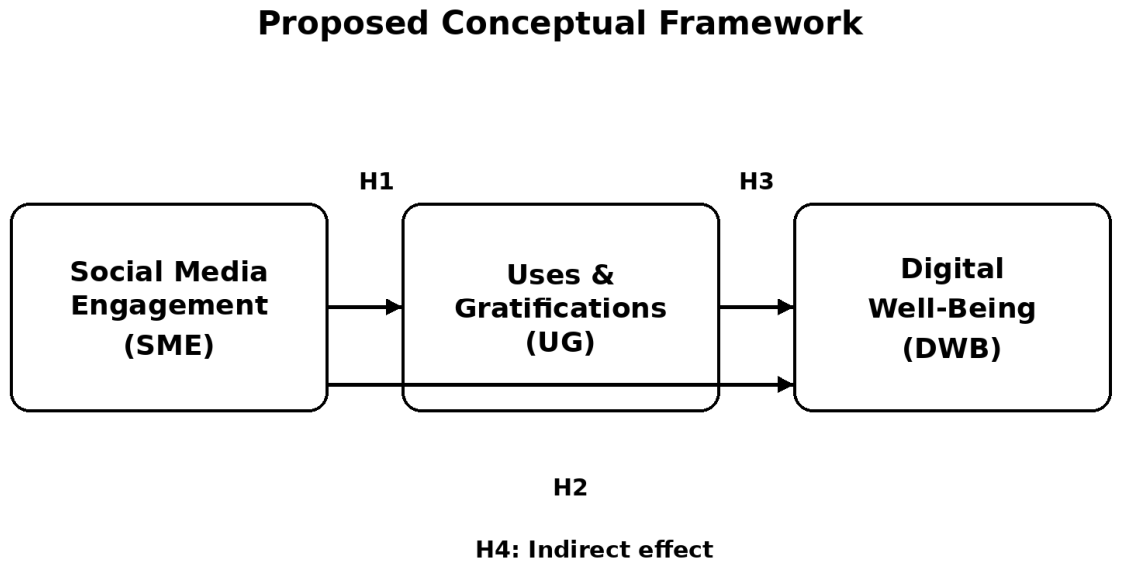

Table 1.
Focal Constructs, Measurement Items, and Source/Adaptation.
| Construct | Code | Measurement item | Source / adaptation |
|---|---|---|---|
| Social Media Engagement | SME1 | I interact frequently with content on Facebook/Instagram. | Group 3 master questionnaire; context-adapted |
| Social Media Engagement | SME2 | Facebook/Instagram is an important part of my daily online activity. | Group 3 master questionnaire; context-adapted |
| Social Media Engagement | SME3 | I actively communicate or share content through Meta platforms. | Group 3 master questionnaire; context-adapted |
| Uses & Gratifications | UG1 | I use Meta platforms to obtain useful information. | Group 3 master questionnaire; UGT-aligned |
| Uses & Gratifications | UG2 | I use Meta platforms to maintain social relationships. | Group 3 master questionnaire; UGT-aligned |
| Uses & Gratifications | UG3 | I use Meta platforms for entertainment or relaxation. | Group 3 master questionnaire; UGT-aligned |
| Digital Well-Being | DW1 | My use of Meta platforms generally supports rather than disrupts my daily functioning. | Group 3 master questionnaire; digital-well-being aligned |
| Digital Well-Being | DW2 | I can control the amount of time I spend on Meta platforms. | Group 3 master questionnaire; digital-well-being aligned |
| Digital Well-Being | DW3 | My use of Meta platforms does not usually interfere with important responsibilities. | Group 3 master questionnaire; digital-well-being aligned |
Table 2.
Demographic and Meta-Platform Usage Profile of Respondents.
| Variable | Category | n-385 | % |
|---|---|---|---|
| Age | 18-20 | 83 | 21.6 |
| 21-25 | 165 | 42.9 | |
| 26-30 | 62 | 16.1 | |
| 31-40 | 56 | 14.5 | |
| 41+ | 19 | 4.9 | |
| Gender | Male | 201 | 52.2 |
| Female | 170 | 44.2 | |
| Prefer not to say | 9 | 2.3 | |
| Self-describe | 5 | 1.3 | |
| Status | Student | 188 | 48.8 |
| Employed | 112 | 29.1 | |
| Self-employed/Freelancer | 65 | 16.9 | |
| Other | 20 | 5.2 | |
| Use frequency | Daily | 248 | 64.4 |
| Several times/week | 103 | 26.8 | |
| Weekly | 17 | 4.4 | |
| Less often | 17 | 4.4 | |
| Experience | <6 months | 16 | 4.2 |
| 6-12 months | 29 | 7.5 | |
| 1-2 years | 61 | 15.8 | |
| 3-5 years | 124 | 32.2 | |
| >5 years | 155 | 40.3 |
Table 3.
Descriptive Statistics of the Focal Constructs.
| Construct | Mean | SD | Minimum | Maximum |
|---|---|---|---|---|
| Social Media Engagement | 4.113 | 0.510 | 2.67 | 5.00 |
| Uses & Gratifications | 4.006 | 0.528 | 2.33 | 5.00 |
| Digital Well-Being | 3.450 | 0.527 | 1.67 | 5.00 |
Table 4.
Measurement Model Reliability and Convergent Validity.
| Construct | Loading range | Cronbach α | Composite reliability | AVE |
|---|---|---|---|---|
| Social Media Engagement | .704-.729 | .525 | .760 | .514 |
| Uses & Gratifications | .699-.743 | .541 | .766 | .522 |
| Digital Well-Being | .690-.713 | .488 | .746 | .494 |
Table 5.
Heterotrait-Monotrait (HTMT) Ratios for Discriminant Validity.
| Construct | SME | UG | DWB |
|---|---|---|---|
| SME | - | .571 | .396 |
| UG | .571 | - | .284 |
| DWB | .396 | .284 | - |
Table 6.
Structural Path Coefficients and Hypothesis Testing.
| Hypothesis | Path | β | t | p | Decision |
|---|---|---|---|---|---|
| H1 | SME → UG | .305 | 6.277 | <.001 | Supported |
| H2 | SME → DWB (total) | .199 | 3.984 | <.001 | Supported |
| H3 | UG → DWB | .085 | 1.614 | .107 | Not supported |
| Direct | SME → DWB controlling UG | .174 | 3.309 | .001 | Supported |
Table 7.
Direct, Indirect, and Total Effects for the Mediation Analysis.
| Effect | Estimate | Bootstrap 95% CI | Interpretation |
|---|---|---|---|
| SME → UG (a) | .317 | [.228, .410] | Positive |
| UG → DWB controlling SME (b) | .084 | [−.010, .179] | Not significant |
| SME → DWB total (c) | .179 | [.075, .287] | Positive |
| SME → DWB direct (c′) | .180 | [.075, .287] | Positive |
| SME → UG → DWB | .027 | [−.003, .060] | No significant mediation |
Disclaimer/Publisher’s Note: The statements, opinions and data contained in all publications are solely those of the individual author(s) and contributor(s) and not of MDPI and/or the editor(s). MDPI and/or the editor(s) disclaim responsibility for any injury to people or property resulting from any ideas, methods, instructions or products referred to in the content. |
© 2026 by the authors. Licensee MDPI, Basel, Switzerland. This article is an open access article distributed under the terms and conditions of the Creative Commons Attribution (CC BY) license.
Copyright: This open access article is published under a Creative Commons CC BY 4.0 license, which permit the free download, distribution, and reuse, provided that the author and preprint are cited in any reuse.