

Submitted:
12 October 2026
Posted:
14 October 2026
You are already at the latest version
Abstract
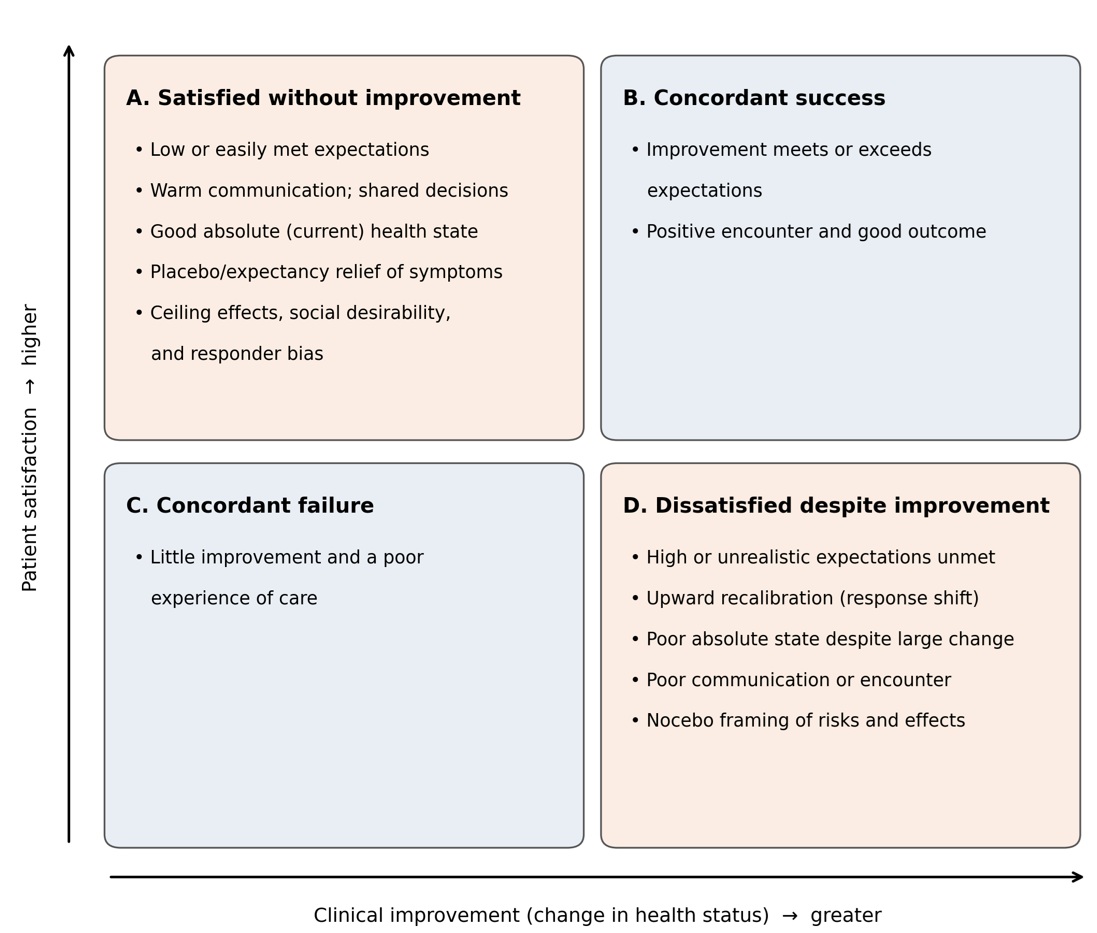
Patient satisfaction has become a dominant metric of health care quality, embedded in public reporting, accreditation, and pay-for-performance programs. Its prominence rests on an implicit assumption that satisfied patients have been treated well and have improved. This narrative review synthesizes conceptual and empirical literature to examine whether, how often, and why patients can be highly satisfied despite minimal clinical gain or dissatisfied despite substantial gain. The 2 constructs are related but explain little of each other. In a cohort of 2116 surgical patients, no outcome measure accounted for more than 8% of the variance in satisfaction, which tracked absolute postoperative state rather than change. Complications and readmissions show weak, inconsistent associations with satisfaction, whereas communication and shared decision-making are strongly and independently associated with it. Six mechanisms explain the divergence: expectancy disconfirmation (unmet expectations raised the odds of dissatisfaction after knee arthroplasty more than 10-fold), relational determinants, health-status confounding, placebo and nocebo effects, response shift (detected in 86.7% of longitudinal studies), and measurement artifacts such as ceiling effects and response bias. In low- and middle-income settings, more than half of respondents rated poor-quality care as good or better. Satisfaction should be neither discarded nor used as a surrogate for effectiveness; complementary measurement of care experience, clinical outcome, and expectation fulfillment is the defensible path.
Keywords:
patient satisfaction
; patient-reported outcome measures
; treatment outcome
; placebo effect
; quality of health care
Copyright: This open access article is published under a Creative Commons CC BY 4.0 license, which permit the free download, distribution, and reuse, provided that the author and preprint are cited in any reuse.