

Submitted:
12 October 2026
Posted:
14 October 2026
You are already at the latest version
Abstract
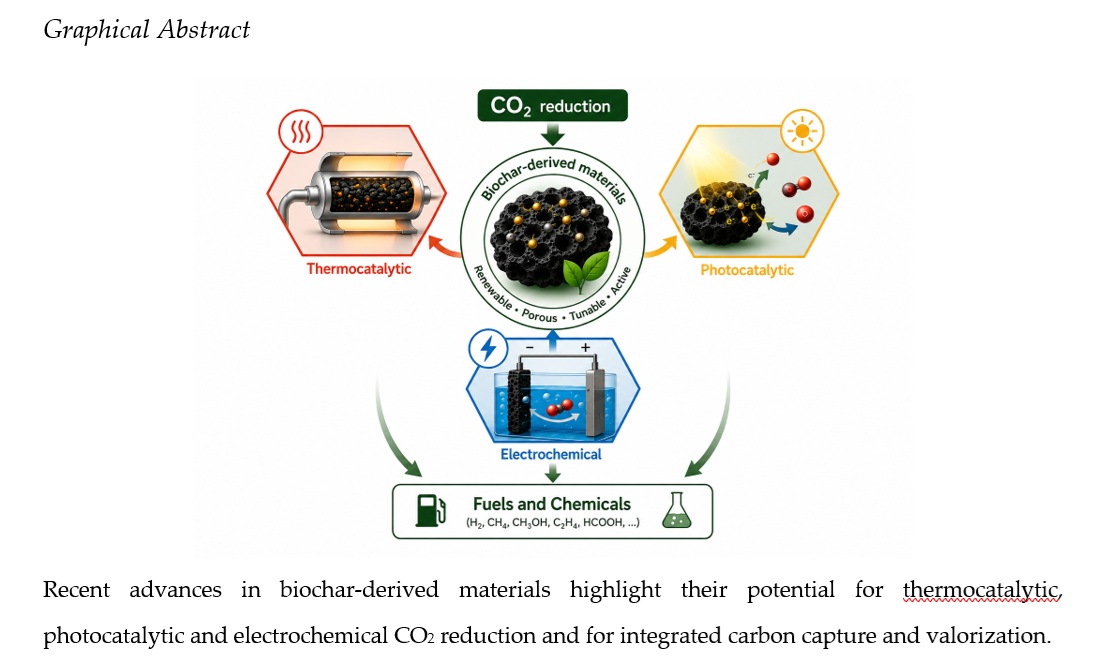
The increasing concentration of atmospheric CO2 has intensified the search for sustainable technologies capable of converting this greenhouse gas into valuable fuels and chemicals. Among the available approaches, thermocatalytic, photocatalytic, and electrochemical CO2 reduction have emerged as key strategies for carbon valorisation. In this regard, biochar-derived materials have recently attracted growing attention due to their renewable origin, tunable porosity, rich surface chemistry, and ability to support active catalytic sites. These properties enhance CO2 adsorption, activation, and charge-transfer processes, making biochar a promising platform across multiple CO2 reduction pathways. This review provides a critical overview of recent advances in thermocatalytic, photocatalytic, and electrochemical CO2 reduction using biochar-based materials, highlighting the relationship between material properties and catalytic performance. Particular attention is given to integrated capture-conversion systems, where biochar enables the coupling of CO2 adsorption and catalytic transformation within a single material architecture. Current challenges and future research directions are discussed to support the development of scalable biochar-based technologies for sustainable carbon utilisation.
Keywords:
Biochar
; carbon dioxide valorisation
; photoreduction
; electroreduction
; thermocatalytic reduction
; capture-conversion sustainable technologies
1. Introduction
The growing interest in carbon-neutral technologies has stimulated extensive research into strategies that can simultaneously address CO2 emissions and promote the sustainable production of fuels and chemicals [1,2]. Within this framework, CO2 utilization has evolved from a purely environmental objective into a broader challenge involving energy storage, resource efficiency and the development of circular carbon systems. Significant progress has been achieved in thermocatalytic, photocatalytic, and electrochemical CO2 conversion, driven by advances in catalyst design and a deeper understanding of reaction mechanisms [3,4,5,6,7]. Nevertheless, the development of materials capable of combining efficient CO2 capture, activation, and conversion remains a critical challenge for the large-scale implementation of these technologies. Among emerging carbon-based materials, biochar has attracted increasing attention due to its versatility, sustainability and structural tunability [8,9]. Originally explored as a low-cost adsorbent for environmental applications, biochar has progressively evolved into a multifunctional platform for catalytic processes. Its physicochemical properties can be tailored through feedstock selection, synthesis conditions, and post-treatment strategies, enabling the design of materials with targeted functionalities for CO2-related applications. Moreover, the possibility of integrating active catalytic sites within a renewable carbon matrix offers new opportunities for developing more sustainable catalyst systems. Recent studies have demonstrated the potential of biochar-derived materials in a wide range of CO2 conversion processes [10,11,12]. However, the available literature remains fragmented, with most reports focusing on specific catalytic approaches or individual material systems. Consequently, a comprehensive evaluation of the role of biochar across the major CO2 reduction pathways is still lacking. In particular, limited attention has been devoted to identifying common structure-performance relationships and assessing the emerging concept of integrated capture-conversion systems, where CO2 adsorption and catalytic transformation occur within the same material architecture. To address this gap, this review critically examines recent advances in the use of biochar-based materials for thermocatalytic, photocatalytic and electrochemical CO2 reduction. Special emphasis is placed on the design principles governing catalytic performance, the opportunities arising from integrated capture-conversion strategies, and the key scientific and technological challenges that must be overcome to enable practical implementation.
2. Chemical CO2 Reduction
The catalytic chemical reduction of CO2 represents a promising strategy for mitigating greenhouse gas emissions while enabling the sustainable production of fuels and value-added chemicals. Nevertheless, the high thermodynamic stability of CO2 requires considerable energy input and the use of highly efficient catalytic systems to achieve meaningful conversion. Among the various approaches explored, thermally driven catalysis remains one of the most established, employing metallic or carbon-based catalysts operated at elevated temperatures and pressures, typically with hydrogen as the reductant [13,14]. Key pathways include the reverse water-gas shift reaction to generate CO, methanation for synthetic natural gas production, and CO2 hydrogenation to methanol, each of them representing important industrial processes [15]. When modified with heteroatoms or decorated with metal nanoparticles, biochar can enhance CO2 adsorption, promote electron transfer, and improve catalyst stability under harsh thermal conditions [15]. As a result, several research groups have reported the synthesis, characterization, and chemical performance of modified biochar materials, as shown in Table 1.
Sun, Zhan and Fu [17] developed an efficient biochar-based catalyst for the selective hydrogenation of CO2 to CO via the reverse water-gas shift (RWGS) reaction (Table 1, Entry 1). The authors synthesized a nitrogen-rich mesoporous biochar (EPBC) derived from the marine macroalga Enteromorpha prolifera, which served as a support for atomic-level Cu-Mo₂C clusters (Figure 1).
The synthesis process involved carbonizing the seaweed to produce N-doped biochar with a high degree of graphitization and large specific surface area. This biochar facilitated the uniform and stable anchoring of Cu-Mo₂C clusters, attributed to the presence of pyridinic nitrogen. The resulting catalyst, Cu-Mo₂C/EPBC, exhibited remarkable performance in CO2 hydrogenation, achieving a CO selectivity of 99.95% at 500 °C and a threefold increase in CO2 conversion rate compared to traditional activated carbon-supported catalysts. The enhanced efficiency was attributed to the synergistic effect between the pyridinic nitrogen and the Cu-Mo₂C clusters, which promotes unblocked electron transfer and lowers the energy barrier for the reaction. Density functional theory calculations confirmed that the pyridinic nitrogen-modified carbon activates local electronic redistribution at the Cu-Mo₂C clusters, facilitating the transformation of the rate-limiting step during the redox pathway. This study demonstrates a sustainable approach to repurposing marine biomass into advanced catalytic materials for CO2 valorization [17].
A high-performance biochar-based catalyst was developed, by the same authors [18], for the continuous-flow reverse water-gas shift (RWGS) reaction by supporting a Cu-Mo₂C nano-interface on a mesoporous biochar-derived from coconut shells (Table 1, entry 2). The mesoporous biochar support was synthesized through consecutive physical activation steps that generated an ordered porous structure with an ultra-high specific surface area (2693 m²·g⁻¹) and narrow mesopore distribution (2–5 nm), providing enhanced CO2 adsorption capacity, high surface accessibility, and efficient mass transfer. Then, the catalyst preparation involved carbothermal hydrogen reduction of a bimetallic Cu–Mo precursor, during which Mo ions were reduced in situ by the carbon matrix of the biochar, yielding finely dispersed Mo₂C nanoparticles. Simultaneously, Cu species were reduced and strongly interacted with Mo₂C to form a stable binary Cu–Mo₂C interface with a particle size of approximately 6.1 nm. The interaction led to partial electron transfer from Cu to Mo₂C, generating Cu⁺ species with enhanced electron-deficient states [18]. This electronic configuration increased the intrinsic reactivity of the catalyst by facilitating CO2 activation at the metal interface and improving the stability of Cu active sites. The catalysts were applied in the RWGS reaction in continuous-flow, at 500 °C, atmospheric pressure, and a gas hourly space rate of 300000 mL·g⁻¹·h⁻¹, where the Cu–Mo₂C/MB catalyst achieved a CO2 conversion rate of 27.74 × 10⁻⁵ mol CO2·gcat⁻¹·s⁻¹ at low H₂ partial pressure. This rate was more than double that obtained with conventional carbon-supported Cu–Mo₂C catalysts. The catalyst also demonstrated exceptional selectivity toward CO formation, reaching 99.08%, and sustained this high performance for over 50 hours of continuous operation without observable deactivation or selectivity loss. The high surface area and well-defined mesoporosity were essential in improving active site accessibility and reactant diffusion, while the in situ carbothermal reduction method effectively integrated the catalytic metal phases within the carbon matrix. Furthermore, the strong Cu–Mo₂C interaction and the formation of Cu⁺/Cu⁰–Mo₂C interfaces were critical in promoting selective CO2 activation and conversion under mild conditions. These findings confirm the potential of tailored mesoporous biochar as an efficient and sustainable platform for the design of advanced catalysts in CO2 valorization applications via the RWGS pathway [18].
Nzihou [19] reported the preparation of biocarbon-based catalysts, by impregnating pyrolyzed fern and willow biomass with iron and nickel nitrates, for application in the continuous-flow reverse water-gas shift (RWGS) reaction, schematically represented in Figure 2 (Table 1, entry 3). The Ni and Fe modified biochars, were designated as FNi-A (fern pyrolyzed with Ni), FFe-B (fern pyrolyzed with Fe), and bimetallic FNiFe (fern pyrolyzed with both Ni and Fe), whose synthesis involved the pyrolysis of biomass feedstocks followed by metal impregnation, producing biocarbon materials with active metal species and inherent alkali and alkaline earth metals (K, Mg, Ca). These materials were tested in a fixed-bed reactor at 400 °C, targeting the RWGS reaction under conditions relevant for integration with Fischer-Tropsch synthesis. The catalysts exhibited high CO selectivity exceeding 84%, although with CO2 conversions below 17%, depending on the biomass precursor and metal impregnation. In comparison with reference catalysts such as rust Fe₂O₃ (30% conversion, 81% selectivity) and Fe/Al₂O₃, (8% conversion, 100% selectivity) the biocarbon-based catalysts achieved a favourable balance. Among the materials, the fern-derived Ni-impregnated catalyst demonstrated the highest catalytic activity, attributed to a synergistic effect between the impregnated metal species, the inherent minerals in the biomass, oxygen vacancies, and strong metal-support interactions [19]. These features improved the electronic properties of the active sites, enhancing CO2 adsorption and dissociation. The superior performance of fern-based biocarbon over willow was associated with its higher content of catalytically beneficial elements and the generation of electron-deficient sites due to the reduction of oxygen-containing functional groups on the biocarbon surface. Catalysts FNi-A, FFe-B, and the bimetallic FNiFe achieved high activity and maintained both CO2 conversion and product selectivity over extended operation periods of up to 288 hours, confirming excellent stability under the reaction conditions tested. The authors have demonstrated the role of biomass-derived components and oxygen vacancies in tuning catalyst performance and proposes further structural tuning via activation and stabilization techniques, such as high-temperature H₂O treatments, to enhance performance at elevated reaction temperatures. Overall, this work demonstrates the feasibility of using fern-derived biochar-based materials as supports for metal catalysts in RWGS, offering a sustainable route for CO2 valorization into syngas through a combination of favourable textural, compositional, and electronic properties of the biocarbon-based catalysts [19].
Makhubela [20] developed a biochar-based nickel catalyst (Ni@CassCat), which was synthesized through a phytomining approach using cyanogenic cassava (Manihot esculenta) as both a metal accumulator and carbon source (Table 1, entry 4). When grown in soils with low nickel concentrations, cassava exhibited remarkable phytoextraction efficiency, removing up to 88% of the available nickel and accumulating up to 1251 ppm in its tissues, primarily in the root. After harvesting, the biomass underwent calcination, resulting in a mesoporous biochar matrix with homogeneously dispersed nickel nanoparticles. This biochar-supported nickel catalyst was subsequently applied to the catalytic hydrogenation of CO2 to formate under heterogeneous conditions. The synthesis involved a direct calcination step that allowed the formation of Ni nanoparticles embedded in a high-surface-area biochar matrix. Characterization techniques, including high-resolution transmission electron microscopy (HRTEM), scanning electron microscopy (SEM), powder X-ray diffraction (XRD), N₂ adsorption-desorption isotherms, and UV-Vis spectroscopy, confirmed the structural integrity and catalytic potential of the material. Mesoporosity and the homogeneous distribution of Ni nanoparticles were essential for increasing the accessible active surface area and facilitating enhanced catalytic interactions [20]. The Ni@CassCat catalyst was tested for CO2 hydrogenation to formate. With only 20 mg of catalyst, corresponding to a Ni loading of 0.305 μmol (8.975 × 10⁻⁵ wt%), the reaction afforded 0.148 mmol of formate, resulting in a turnover number (TON) of 485, demonstrating the high catalytic efficiency achieved at extremely low metal loading. High formate selectivity was maintained throughout the reaction, and the catalyst exhibited partial recyclability, with the decrease in activity being ascribed to physical losses during recovery procedures rather than intrinsic deactivation. This method provides a sustainable route to catalyst production by combining phytomining and biochar generation in a single process, offering an environmentally benign alternative to conventional nickel sourcing and catalyst synthesis. The use of a naturally cyanogen-rich plant eliminates the need for chemical extractants, while the calcination process highlights its potential application in green chemical synthesis [20].
In a recent study, conducted by Sun and Zhang [21], a highly efficient biochar-supported CuZn catalyst was synthesized and applied in the hydrogenation of CO2 to methanol (Table 1, entry 5). The catalyst was prepared, using a one-step method, by directly dispersing Cu and Zn precursors onto mesoporous biochar (MC) derived from coconut shells. This approach enabled the simultaneous formation of well-dispersed Cu-ZnO interfaces and the integration of these metal species into the biochar matrix during the synthesis process. The coconut shell-derived biochar exhibited favourable physicochemical properties, including high specific surface area, narrow mesopore size distribution, and notable reducibility, which facilitated the uniform dispersion of Cu species and the formation of low-valence Cu+ active sites, crucial for enhanced CO2 hydrogenation activity. The synthesis process took advantage of the inherent properties of the mesoporous carbon support, which promoted strong metal-support interactions and stabilized a high density of Cu⁺ species at the Cu-ZnO interface. These characteristics were confirmed by structural and spectroscopic analyses, which demonstrated the efficient incorporation of Cu and ZnO onto the MC surface and the prevalence of highly dispersed Cu⁺ sites with high binding energy [21]. These sites are known to be essential for CO2 activation and its subsequent hydrogenation to methanol. The catalytic performance of the CuZn/MC system was evaluated in continuous-flow CO2 hydrogenation, under moderate reaction conditions (260 °C, CO2:H2 = 1:3, gas hourly space velocity (GHSV) = 14400 ml/g/h), leading to a remarkable space-time yield (STY) of methanol of 121.25 gMeOH kg⁻¹catalyst h⁻¹ (Figure 3) [21]. This value is approximately three times higher than that achieved by the benchmark CuZn/SiO₂ catalyst under similar conditions, clearly indicating the superior catalytic efficiency of the biochar-based system.
Furthermore, the CuZn/MC catalyst maintained excellent operational stability for more than 50 hours on stream, without significant loss of activity, highlighting its robustness and potential for long-term application. The high selectivity towards methanol was attributed to the presence of abundant Cu⁺ active sites and the optimized Cu-ZnO interactions provided by the mesoporous biochar. This work provides a valuable contribution to the development of efficient, sustainable catalytic systems for CO2 valorisation, by utilizing a biomass-derived support material from coconut shell waste and combining it with a streamlined synthesis procedure. Furthermore, the enhanced methanol yield, high selectivity, and long-term stability of the CuZn/MC catalyst demonstrate its potential for industrial application in CO2 hydrogenation processes [21].
A biochar-based catalyst comprising a nickel-copper bimetallic alloy supported on sodium hydroxide-modified biochar (NC/BS) was developed by Wang at room ambient temperature and atmospheric pressure [22]. The biochar support was treated with NaOH to enhance its surface functionality, particularly increasing the content of –OH groups, which was confirmed by FTIR and XPS analysis. The metal phase was introduced via a modified liquid-phase reduction method, with an optimized total metal loading of 10 wt% and a Cu:Ni molar ratio of 2:3. The resulting 10% NC/BS catalyst displayed uniformly dispersed Ni-Cu nanoparticles on the biochar surface, as evidenced by TEM and EDS mapping, ensuring a high degree of catalytic site availability. The catalyst was tested for CO2 reduction using NaBH₄ as a hydrogen donor, under conditions optimized at 20 mg catalyst dosage, 100 mmol·L⁻¹ NaBH₄ concentration, and 20 °C. The use of 10% NC/BS led to a 42% increase in formate yield compared to the non-catalysed reaction, while simultaneously suppressing the competing hydrolysis of NaBH4 by 29% (Table 1, entry 6 and Figure 4) [22].
This resulted in a significant improvement in the effective utilization of borohydride for CO2 reduction, with the share of borohydride contributing to formate production rising from 29% under uncatalyzed conditions to 50% with the catalyst, reducing unwanted hydrogen generation rate (HGR). The reaction selectivity was thus markedly shifted in favour of the target product, formate. Density functional theory (DFT) calculations supported the experimental findings, showing that the –OH groups and alkali metals present on the modified biochar exhibited strong CO2 adsorption capacity, facilitating CO2 activation by lowering the thermodynamic barrier of the reduction reaction. Additionally, the Ni-Cu alloy phase contributed to enhancing the reactivity of NaBH4, promoting its effective use in CO2 conversion rather than in non-productive hydrolysis pathways. The catalytic system demonstrated not only high selectivity towards formate but also energy efficiency due to the mild reaction conditions. Control experiments confirmed that increasing the catalyst loading, metal ratio, NaBH4 concentration and temperature beyond their optimal values can negatively affect performance, primarily due to excessive NaBH4 hydrolysis. The study shows the potential of tailored biochar-supported bimetallic systems in selective CO2 valorisation via low-energy processes, combining surface functionalization, metal dispersion, and strong metal-support interactions to achieve high catalytic efficiency and product selectivity, under mild conditions [22].
3. Photocatalytic CO2 Reduction
Photocatalytic CO2 reduction has attracted considerable attention due to its potential to transform sunlight directly into chemical energy, offering a sustainable route to solar fuels. Progress in semiconductor engineering, including band-gap tuning, defect and interface design and co-catalyst integration, has improved charge separation and broadened light-harvesting efficiency, enabling more selective formation of desired products [22].
The use of biochar-supported photocatalysts for CO2 conversion and solar fuel generation, has been recently reported Hu [23]. This study highlights the critical role of biochar in enhancing photocatalytic efficiency and sustainability. It provides a comprehensive review and a conceptual framework that covers the synthesis, structural engineering, and strategic application of biochar in photocatalytic CO2 reduction. Biochar is described as a highly versatile support for photocatalytic systems since its physicochemical properties, including high surface area, intrinsic functional groups and tunable porosity, make it ideal for improving charge separation, enhancing electron transport, and narrowing the bandgap of the coupled photocatalyst materials. When combined with semiconductor materials, biochar effectively suppresses electron-hole recombination and improves photocatalyst stability [24]. These features are critical for increasing CO2 photoreduction efficiency and product selectivity. Furthermore, the integration of biochar enables more efficient solar-to-chemical energy conversion by acting as an electron sink and thermal buffer, thanks to its capacity to absorb light and convert it into localized heat-boosting catalytic activity via the photothermal effect. The recyclability and chemical stability of biochar further contribute to environmentally friendly and economically feasible photocatalytic systems. These properties position it as a promising platform for the development of scalable CO2 valorisation technologies, enabling the production of clean fuels such as hydrogen and solar-derived carbon fuels. Consequently, several research groups have reported the synthesis, characterization and photocatalytic performance of modified biochar materials, as shown in Table 2.
Zheng and Li [25] reported the development of a biochar-based composite aerogel catalyst derived from cellulose nanocrystals (CNCs), doped with silica and cerium oxide, for the integrated capture and photocatalytic CO2 reduction (Table 2, entry 1). The synthesis strategy employed CNCs as a structural template due to their high specific surface area, which supports the formation and stabilization of a porous framework during high-temperature calcination. The procedure involved the incorporation of silica and cerium nitrate into the CNC matrix, followed by thermal treatment. During calcination, silica contributed to the structural integrity of the aerogel, preventing collapse, while the decomposition of cerium nitrate led to the in situ generation of cerium oxide and nitrogen oxides. This process induced the formation of multi-scale pore networks and a high concentration of oxygen vacancies on the aerogel surface, features that are critical for efficient CO2 adsorption and catalytic reactivity. The resulting material, denoted as Si-Ce-CNC, exhibited outstanding performance in CO2 capture, with an adsorption capacity of 3.18 mmolg⁻¹, surpassing the capacity of most currently available CO2 adsorbents. The material also demonstrated remarkable structural and catalytic stability, maintaining 97% of its adsorption efficiency after ten consecutive adsorption–desorption cycles, confirming its reusability and robustness under operational conditions. Photocatalytic tests revealed the material’s ability to enable the selective reduction of CO2 into carbon monoxide (CO) and methane (CH₄) under light irradiation. The CO generation rate reached 59.5 μmol h⁻¹ g⁻¹, with a corresponding electron consumption rate of 119 μmol h⁻¹ g⁻¹ [25]. Although methane was also formed, carbon monoxide was the predominant product, showing a favourable selectivity toward CO formation. Additionally, the process yielded a theoretical oxygen production of 0.445 μmol, and the overall solar-to-chemical energy conversion efficiency was calculated at 1.9%. These values reflect not only a highly efficient photocatalytic system but also one with promising selectivity, particularly for CO, which is a valuable feedstock for further chemical synthesis via processes such as Fischer–Tropsch or syngas production. The success of this biochar-based catalyst lies in the synergy between the CNC-templated porous structure, the stabilizing effect of silica, and the catalytic activity of cerium oxide, particularly due to the creation of abundant oxygen vacancies that enhance CO2 adsorption and activation. This study contributes significantly to the field of catalytic CO₂ valorisation, offering a scalable and efficient approach to design multifunctional materials capable of coupling CO2 capture with its selective transformation into value-added products. The Si-Ce-CNC aerogel stands out as a highly promising candidate for future applications in sustainable CO2 application systems [25].
Zuo [26] developed a novel S-type Co(Ti)Ox plasmonic heterojunction, synthesized with a microwave-assisted method, for the capture and photothermal reduction of CO2 (Table 2, entry 2). To synthesize the H-ATP/Co(Ti)Oₓ nanocomposite, the authors employed cobalt- and titanium-based materials recovered from end-of-life lithium-ion batteries. Characterization showed that the material exhibits localized surface plasmon resonance in the visible to near-infrared range, promoting the generation of high-energy hot electrons and leading to a significant increase in the catalyst’s surface temperature. Furthermore, the nanocomposite demonstrated remarkable catalytic activity in the photothermal reduction of CO2, achieving a CO yield of 14.7 μmol·g⁻¹·h⁻¹ under sunlight irradiation. This study represents an innovative approach to recycling lithium-ion battery waste while contributing to environmental remediation through sustainable CO2 conversion.
Jiang [27] reported the synthesis of a composite photocatalyst combining flower-like ZnIn₂S₄ (ZIS) with biochar (BC) for application in photocatalytic CO2 reduction (Table 2, entry 3). The biochar, derived from a low-cost biomass source, served both as an efficient electron conductor and a structural support for the ZIS semiconductor. The ZIS/BC composite was prepared through an in-situ low-temperature growth process, which enabled the homogeneous integration of ultrathin ZIS nanosheets onto the biochar surface, forming a three-dimensional porous hybrid structure. This architecture ensures strong interfacial contact between the two components, thereby enhancing charge separation and transfer, while also improving photothermal energy utilization under solar irradiation. The biochar plays a multifaceted role within the composite. Its high electrical conductivity helps suppress the photocorrosion typically observed in ZIS, while also improves the interfacial charge-transfer kinetics, which are essential for efficient photocatalysis. Additionally, the 3D framework provided by the biochar increases the surface area and creates abundant active sites, facilitating improved CO2 adsorption and activation [27]. The synergistic effects between biochar and ZIS, particularly the coupling of light-induced thermal energy with the photocatalytic process, significantly improved the energy conversion efficiency and product selectivity of the system. Photocatalytic experiments under light irradiation demonstrated that the optimized ZIS/BC composite, specifically the ZIS/BC-3 variant, achieved a high CO production rate of 20.7 μmol g⁻¹ h⁻¹. Alongside CO, small amounts of CH₄, C₂H₄, and C₂H₆ were also detected, confirming the system’s ability to cleave C–O bonds and promote C–H bond formation during CO2 photoreduction. In situ FTIR spectroscopy further validated the formation of CO and CH₄ on the catalyst surface, providing direct mechanistic insights into the reaction pathways. Nevertheless, the predominant product was CO, which is a key intermediate for downstream chemical synthesis processes. This work demonstrates the efficacy of combining biochar with semiconductor materials to form high-performance hybrid catalysts for CO2 valorization. The ZIS/BC system illustrates how biomass-derived carbon can be strategically integrated to enhance light absorption, thermal energy utilization, and charge transport, while also contributing to the environmental and economic sustainability of the catalyst. The high CO selectivity and improved photocatalytic efficiency underscore the potential of biochar-based materials as a key component in advanced photocatalytic systems for solar-driven CO2 reduction [27].
Zhong and Ma [28] reported the development of a novel biochar-assisted strategy for synthesizing oxygen-vacancy-rich BiOCl photocatalysts using rape straw biochar (RC) as a carbonaceous additive (Table 2, entry 4). This study demonstrates a simple, low-cost, and sustainable one-pot solvothermal method for producing flower-like BiOCl microspheres with enhanced photocatalytic properties. The use of rape straw as a biomass precursor for biochar not only contributes to the valorisation of agricultural waste but also plays a crucial role in tuning the morphological and electronic properties of the photocatalyst. The incorporation of a small quantity of biochar (0.5 wt% relative to BiOCl) into the synthesis mixture under hydrothermal conditions induces the formation of abundant oxygen vacancies (OVs) and promotes the self-assembly of BiOCl/RC into a hierarchical flower-like structure with increased specific surface area and light harvesting capability [28]. The synergy between the RC-derived biochar and the OVs significantly enhances the charge separation efficiency of photogenerated electron-hole pairs, a key factor for improving catalytic performance in CO2 photoreduction (Figure 5).
The optimized BiOCl/RC-0.5 composite catalyst exhibited a CO production rate of 4.0 μmol g⁻¹ h⁻¹ under photocatalytic conditions, which is 3.08 times higher than that of pristine BiOCl, demonstrating a marked increase in catalytic efficiency and selectivity towards CO as the main product. This enhanced activity can be attributed to improved electron transport enabled by the conductive biochar, along with an increased number of reactive sites resulting from oxygen vacancies.
Rashid [29] reported the successful development of a biochar-derived carbon quantum dot (CQD)-based photocatalyst for application in the visible light-assisted photoreduction of CO2 into ethane (C₂H₆) (Table 2, entry 5). The CQDs were synthesized through a facile hydrothermal top-down method using biochar produced from empty fruit bunches (EFB) of oil palm as the carbon source. The biochar was initially processed into fine powder and subjected to hydrothermal treatment, yielding blue-fluorescent CQDs with sizes ranging from 2.5 to 6.0 nm. These CQDs were then deposited onto commercial copper(I) oxide (Cu2O) nanoparticles via a simple wet impregnation method to form a nanocomposite photocatalyst (CQDs/Cu2O-BC). This synthesis route stands out for its simplicity, low cost, and the valorisation of agricultural waste materials. Within the composite catalyst, CQDs fulfilled a dual function, serving as electron acceptors and promoting enhanced light harvesting in the visible region [29]. High-resolution transmission electron microscopy (HRTEM), Fourier-transform infrared spectroscopy (FTIR), and X-ray photoelectron spectroscopy (XPS) confirmed the successful anchoring of CQDs onto the Cu₂O surface, with uniform dispersion and strong interfacial contact. Photoluminescence (PL) spectroscopy revealed a significant suppression of photoinduced electron–hole pair recombination in the CQDs/Cu₂O-BC nanocomposite compared to pristine Cu₂O, indicating enhanced charge separation and transfer efficiency. Its photocatalytic performance was evaluated in a self-designed gas-phase reactor under visible light irradiation, with an online gas chromatograph used to analyse the products. The CQDs/Cu₂O-BC nanocomposite demonstrated a significant enhancement of 54% in CO2 photoreduction activity compared to pure Cu2O. The main product detected was ethane (C2H₆), a high-value hydrocarbon, highlighting the system's selectivity toward multi-carbon products under mild reaction conditions. This selectivity towards ethane is particularly noteworthy, as it underscores the catalyst’s ability to facilitate the complex multi-electron transfer process required for C–C coupling, a challenging step in CO2 conversion pathways. Furthermore, the photostability of the CQDs/Cu₂O-BC composite was evaluated over five successive reaction cycles, keeping approximately 90% of its initial catalytic activity, which confirms its structural robustness and reusability. The authors proposed a mechanism in which photoexcited electrons in Cu₂O are transferred to CQDs, reducing CO2 adsorbed on the catalyst surface, while the holes in Cu₂O oxidize water to sustain charge balance. Overall, this work demonstrates an effective, low-cost, and sustainable method for producing a biochar-derived photocatalyst capable of selective and efficient CO2 conversion. The use of biomass waste for CQD synthesis, coupled with the enhanced catalytic performance and good stability of the CQDs/Cu₂O-BC system, supports its potential application in future solar-driven CO2 valorisation technologies [29].
Luo and Mao [30] developed a biochar-assisted S-scheme heterojunction photocatalyst for the efficient photoreduction of CO2 to CO (Table 2, entry 6). The material was fabricated by incorporating cattail-derived biochar (BIO) with CeO₂ nanoparticles and g-C₃N₄ nanosheets, yielding a multi-interfacial hybrid system referred to as g-C₃N₄–BIO/CeO₂. The preparation involved calcination of the composite, enabling the development of strong interfacial interactions between CeO₂ and g-C₃N₄, while biochar served as both a structural scaffold and a conductivity-enhancing phase. Its micro- and nanotubular architecture significantly contributed by broadening light absorption, increasing specific surface area, and promoting CO2 adsorption. In addition, the inherent conductivity of biochar facilitated efficient interfacial charge transfer and preserved the directional electron flow characteristic of S-scheme heterojunctions. The photocatalytic activity of g-C₃N₄–BIO/CeO₂ was tested in a gas–solid–liquid phase system under full-spectrum irradiation, where the system showed remarkable CO2 conversion performance. The catalyst achieved a CO selectivity of over 95%, with a CO production yield of 69.1 μmol g⁻¹ [30]. This performance surpassed that of individual CeO₂ and g-C₃N₄ components, demonstrating the importance of the synergistic effect induced by the multicomponent structure. Theoretical and experimental analyses, including DFT calculations, UV–vis spectroscopy, and XPS, confirmed the formation of an internal electric field at the heterojunction interfaces, which significantly enhanced charge carrier separation and suppressed recombination. Ce⁴⁺ species in CeO₂ played a key role as electron traps and redox mediators by accepting photoexcited electrons and transforming into Ce³⁺, thereby promoting the separation and transfer of photogenerated carriers within the catalyst. The presence of the COOH* intermediate was confirmed by in situ diffuse reflectance infrared Fourier transform spectroscopy (DRIFTS) analysis as the key rate-determining species in the CO2-to-CO reduction pathway, providing mechanistic insight into the catalyst’s high selectivity. Overall, the integration of cattail-derived biochar into the g-C₃N₄–BIO/CeO₂ photocatalyst proved essential in enhancing the structural, optical, and electronic properties of the composite, thereby improving its photocatalytic efficiency [30].
Li, Huang, and Liao [31] proposed, a novel photocatalytic strategy for the selective reduction of CO2 into ethane (C₂H₆), using a biochar-based modification of graphite carbon nitride (g-C₃N₄) material (Table 2, entry 7). The synthesis of the photocatalyst, denoted as PCCN-x, was achieved through a simple and eco-friendly two-step process under air atmosphere, using bulk g-C₃N₄ as the precursor and biochar as a carbon dopant (Figure 6) [31]. The biochar, derived from biomass, plays a key role in inducing carbon doping and nitrogen vacancies in the g-C₃N₄ framework, significantly enhancing the material’s photocatalytic performance. These structural modifications promote the formation of electron-rich nitrogen active sites and generate bridged carbon sites, both of which play a crucial role in facilitating CO₂ activation and enabling the challenging C–C coupling steps required for C₂ product formation. Photocatalytic CO2 reduction experiments are carried out in pure water under simulated solar irradiation using a 300 W Xe lamp, notably in the absence of sacrificial agents or co-catalysts.
Among the synthesized materials, the PCCN-10 catalyst (Figure 6) exhibits outstanding performance, achieving a C₂H₆ production rate of 99.14 μmol g⁻¹ h⁻¹ and a high selectivity of 80.33% toward ethane, with only minor formation of CO (9.20 μmol g⁻¹ h⁻¹) and CH₄ (15.07 μmol g⁻¹ h⁻¹). These results represent a significant advancement over previously reported photocatalysts for C₂ product generation from CO2. Moreover, the solar-to-chemical (STC) energy conversion efficiency attains a record value of 1.13%, exceeding the widely recognized 1% benchmark and outperforming state-of-the-art systems under comparable condition. The photocatalyst also demonstrated excellent long-term stability, with no observable decline in activity after 20 hours of continuous operation. Further validation under outdoor sunlight conditions confirmed the robustness of the PCCN-10 catalyst, maintaining a steady C₂H₆ production rate of approximately 43.17 μmol g⁻¹ h⁻¹ over a 50-hour period spanning 10 days. Mechanistic studies, including in situ DRIFTS and theoretical calculations, confirm the formation of key reaction intermediates such as OCCO and OCCOH, thereby supporting the proposed reaction pathway and highlighting the role of engineered surface sites in facilitating multi-electron transfer and C–C coupling processes essential for C₂H₆ production [31].
4. Electrocatalytic CO2 Reduction
Electrochemical CO2 reduction reaction (CO2RR) presents an attractive pathway for coupling CO2 utilization with renewable electricity, enabling the direct conversion of a greenhouse gas into value-added chemicals and fuels [31]. Its operation at ambient temperature and pressure provides a flexible and potentially scalable platform for distributed chemical manufacturing, particularly when integrated with intermittent renewable energy sources. However, several challenges still hinder its industrial implementation, including the relatively high overpotentials often required to achieve technologically relevant reaction rates [32], the competitive hydrogen evolution reaction (HER), which lowers Faradaic efficiency toward CO2-derived products, mass-transport limitations that restrict CO2 availability at the catalyst surface and catalyst degradation or surface reconstruction under prolonged operating conditions. Theoretical and mechanistic studies have provided deeper insight into the elementary steps governing CO2 activation and multi-electron pathways, offering valuable guidance for the rational development of more efficient catalytic interfaces [32]. Consequently, recent research has focused on optimizing catalyst design, electrode materials and reactor configurations, with particular emphasis on improving selectivity, enhancing reaction kinetics and ensuring long-term stability [33,34,35].
Biochar-derived materials offer several features that are particularly attractive for electrocatalytic CO₂ reduction. Their tunable porosity, surface chemistry, defect density, and electronic structure [36,37,38] can improve CO2 accessibility, stabilize active species and modulate catalytic pathways. However, their relatively low degree of graphitization may limit electrical conductivity. Heteroatom doping, controlled graphitization and incorporation of metal-based active sites can help overcome this limitation, while also adjusting the adsorption of key CO₂RR intermediates and influencing competition with HER. These features make biochar-derived carbons versatile platforms for designing electrocatalysts with improved activity and product selectivity.
The performance of these materials is generally assessed through a combination of physicochemical and electrochemical parameters. Relevant physicochemical descriptors include metal content and specific surface area (SSA), whereas electrochemical performance is commonly evaluated through the onset potential (Eₒₙₛₑₜ), defined as the potential at which the reaction initiates; current density (CD), which reflects the overall electrochemical reaction rate per unit electrode area; Faradaic efficiency (FE), which quantifies the fraction of the total charge directed toward a given product; and operational stability, which reflects the ability of the catalyst to maintain its performance during prolonged electrolysis [39].
Early systematic studies by Hori and co-workers [40] established a strong dependence of CO₂RR product selectivity on the nature of the metal electrode. In their early empirical classification, metal electrodes were roughly divided into CO-forming metals (Cu, Au, Ag, Zn, Pd, Ga, Ni, and Pt) and formate-forming metals (Pb, Hg, In, Sn, Cd, and Tl), with both CO and formate resulting from two-electron CO₂ reduction pathways [41,[41]]. Subsequent studies led to a more differentiated classification, with Au, Ag, and Zn generally recognized as preferentially forming CO, Sn, In, Pb, and Bi as favouring formate, and Ni, Pt, Fe, and Ti as predominantly promoting HER in aqueous media. Cu emerged as a distinct class of electrocatalyst owing to its unique behavior [40,42]. Although Cu can also form CO, adsorbed CO (*CO) can undergo further reduction and C–C coupling on Cu surfaces, enabling multi-electron pathways toward hydrocarbons and oxygenates such as methane, ethylene, ethanol, and acetate. This distinctive ability to access more deeply reduced products, including C₂+ species, beyond the two-electron reduction of CO₂ has made Cu particularly attractive for the development of biochar-based CO₂RR electrocatalysts. Representative Cu–biochar systems and their CO₂RR electrocatalytic performance are summarized in Table 3.
Tao’s group developed Cu-modified biochar-based electrocatalysts derived from Elsholtzia harchowensis (E.H.) (Table 3, entries 1–3) [44,45,46]. Cu/C-S was prepared by carbonizing a 1:3 (w/w) CuSO4:E.H. mixture under an inert atmosphere at 700 °C, followed by KOH activation at the same temperature. Cu/C-BN-1 and Cu/C-BN-2, additionally doped with boron and nitrogen, were synthesized by mixing CuCl₂, urea, boric acid, and E.H. powder, followed by nitrogen carbonization at 700 °C [45,46]. Despite similar synthesis routes, the catalysts showed marked differences in Cu content and specific surface area (SSA). Cu/C-S exhibited the highest SSA (1006 m² g⁻¹) and the lowest Cu loading (0.4 wt%) (Table 3, entry 1). All catalysts operated at low current densities (0.25–0.33 mA cm⁻² at −0.32 V). Cu/C-S achieved the highest CO selectivity, with FE(CO) = 74.6% at −0.32 V (vs RHE). Cu/C-BN-1 and Cu/C-BN-2 displayed distinct product distributions: Cu/C-BN-1 favoured CO formation (FE = 64.7%) over CH₄ (12.0%) at −0.32 V, whereas Cu/C-BN-2 showed higher CH₄ selectivity (31.3%) alongside CO (26.9%) under the same conditions (Table 3, entries 2–3). These results show the versatility of Cu-based biochar catalysts, which provide moderate binding strength for CO2 reduction intermediates, enabling efficient conversion pathways. However, at more negative potentials, the hydrogen evolution reaction (HER) became dominant, leading to competing side reactions. All catalysts demonstrated stable performance for at least 8 hours of continuous operation [45,46].
Lisak [47] reported Cu-modified biochars derived from horticultural waste (H.W.), where Cu/K₂CO₃-Cx and Cu/KOH-Cx differ only in the activation method (Table 3, entry 4). In both cases, the biochars were first activated by mixing H.W. with K₂CO₃ or KOH (1:1 w/w), followed by impregnation with copper acetate, drying at 60 °C, and subsequent carbonization at different temperature ranges (400–800 °C for Cu/K₂CO₃-Cx and 600–900 °C for Cu/KOH-Cx). These synthesis variations resulted in catalysts with high Cu content (~55 wt%), attributed to the surface deposition of CuO and Cu₂O species. However, their textural properties varied, with the highest SSA for Cu/K₂CO₃-Cx obtained at 600 °C (~900 m² g⁻¹), while Cu/KOH-Cx reached 1040 m² g⁻¹ at 800 °C. Electrochemically, both catalysts exhibited similar behaviour, with an onset potential of −0.55 V and a current density of ~45 mA cm⁻² at −1.6 V. In terms of selectivity, CO and HCOOH were the main products, indicating typical C1 pathways. Cu/K₂CO₃-Cx achieved FE(CO) = 32% and FE(HCOOH) = 28% at −1.4 V, whereas Cu/KOH-Cx showed slightly lower values of FE(CO) = 28% and FE(HCOOH) = 22% under the same conditions [47].
Wang and Zhang [48] prepared Cu-modified biochar electrocatalysts (Cu–CuO/P-CCDL-X) from Ceratophyllum demersum L. via CuSO₄ impregnation, KOH activation, and subsequent carbonization at 400–700 °C for 2 h (Table 3, entry 5). In parallel, Guo and Wang49 developed CuxO@C by first pyrolyzing locust leaf biomass at 750 °C using K₂CO₃ activation, followed by CuCl₂/NaOH treatment and hydrothermal processing at 160 °C for 12 h (Table 3, entry 6). Despite the higher Cu loading in CuxO@C (5.2 wt% vs 1.55 wt% in Cu–CuO/P-CCDL-X), the latter exhibited a much higher specific surface area (211.5 vs 68.8 m² g⁻¹). However, CuxO@C showed a more favourable onset potential (−0.63 V compared to −1.25 V at 10 mA cm⁻²), indicating easier reaction activation. In terms of selectivity, Cu–CuO/P-CCDL-X achieved FE(C₂H₅OH) = 39% and FE(CO) = 30% at −1.5 V, whereas CuxO@C favoured C₂ hydrocarbons, reaching FE(C₂H₄) = 41.3% at −1.08 V. Notably, Cu–CuO/P-CCDL-X demonstrated superior operational stability, maintaining performance for 26 h compared to only 10 h for CuxO@C [48,49].
Cui, Zhou and Wang [50] synthesized pig manure-derived biochar using a hydrothermal method, in which the dehydrated biomass was suspended in basic water and heated in an autoclave at 300°C. Cu-NB-2000 was then obtained by the pyrolysis of derived biochar, copper(II) acetylacetonate, and KOH at 800 °C under an Ar atmosphere, with urea as the extra N source (Figure 7). Cu-NC-2000 was prepared using the same procedure but without urea (Table 3, entry 7).
Cu-NB-2000 exhibits a higher SSA (422 m² g⁻¹) compared to Cu-NC-2000 (257 m² g⁻¹), which translates into improved CO2RR performance. Accordingly, at −1.1 V vs. RHE, Cu-NB-2000 achieves an FE(C₂H₄) of 44.8%, outperforming Cu-NC-2000 (34.4%), and further increases to 47.4% at −1.51 V, confirming its superior selectivity toward C₂+ products [50]. In a different synthetic strategy, Cristiani [51] prepared 20Cu/10HAP from maize stalk-derived biochar via pyrolysis, followed by grinding and dispersion of Cu nanoparticles under alkaline conditions (pH 10), using KOH to adjust the suspension. The CuNP suspension was then combined with the biochar dispersion and stirred for 48 h before drying to obtain the final catalyst (Table 3, entry 8). Electrochemically, this material delivers a current density of 7.8 mA cm⁻² at −1.2 V, achieving a Faradaic efficiency of 67% for CH₄ (866 ± 199 mmol m⁻² d⁻¹ vs Ag/AgCl), while maintaining excellent stability over 200 h of continuous operation.
Beyond Cu, several other metals, including Ni [51,52,53,54], Zn [55,56], Ag [57], Sn [58], and Bi [59], have been combined with biochar-derived materials for electrocatalytic CO2 reduction. Representative systems and their electrochemical performance are summarized in Table 4.
Liu and Huo [Erro! Marcador não definido.] prepared Ni–BC catalysts from Ligustrum lucidum biomass via hydrothermal carbonization in phosphoric acid, followed by salt-assisted ball milling (KCl, LiCl, KHCO₃) and sequential pyrolysis under Ar (900 °C and 800 °C) to obtain Ni-BC materials with tuned porosity (Table 4, entry 1). The resulting structure strongly influenced texture and metal dispersion, with hp-Ni-BC reaching a high SSA (1029 m² g⁻¹) and Ni loading of 0.3 wt%, compared to lp-Ni-BC (84 m² g⁻¹, 0.05 wt%). Electrochemically, hp-Ni-BC delivered outstanding CO selectivity, achieving FE(CO) = 97.4% at −1.2 V and maintaining >85% over a wide potential window (−0.7 to −1.7 V), significantly outperforming low-porosity counterparts [60].
Kortlever [53] reported a Ni,N-modified biochar (Ni–N–ANBC) derived from sugarcane bagasse, urea, and KOH, carbonized at 800 °C and subsequently Ni-functionalized using Ni(II) acetate/1,10-phenanthroline, followed by heat treatment at 600 °C (Table 4, entry 2). The catalyst reaches 97% FE(CO) at −0.9 V vs. RHE and maintains high stability over 8 h (5% loss), comparable to Ni–N–CNT and superior to Ni–N–CB (∼90% to ∼75%). Long-term electrolysis (8 h) at −0.9 V vs. RHE shows that Ni–N–ANBC retains high stability, with only a 5% drop in FE(CO), matching Ni–N–CNT performance. In contrast, Ni–N–CB exhibits a pronounced decline, with FE(CO) decreasing from ~90% to ~75% [53].
Tao [54] prepared Ni-doped biochar from Chlorella vulgaris via hydrothermal treatment (180 °C), followed by mixing with NiCl₂·6H₂O and urea, drying, and carbonization at 900 °C to yield CN–Ni. For comparison, BC–Ni was synthesized under identical conditions without urea (Table 4, entry 3). CN–Ni exhibits high CO selectivity, reaching 90% FE(CO) at −0.62 V vs. RHE, whereas BC–Ni is significantly less selective (46%) and favours H₂ evolution [54].
Lyu [55] reported Ni-modified biochar (NiPc/N–BMBC) derived from a pine sawdust–rice straw mixture. The biomass was first calcined at 700 °C (3 h), ball-milled for 24 h, mixed with melamine, and re-calcined at 700 °C under N₂ (1 h), followed by incorporation of nickel phthalocyanine and a final calcination at 700 °C for 2 h (Table 4, entry 5). Control samples were prepared analogously at 500 and 600. Ni content and surface area both increase with calcination temperature (Ni: ~0.35 wt% at 500 °C, ~0.77 wt% at 600 °C, 0.94 wt% at 700 °C; surface area: 182.4 to 404.8 m² g⁻¹). Accordingly, NiPc/N–BMBC prepared at 700 °C shows the highest performance, reaching 86% FE(CO) at −0.80 V vs. RHE, compared to 80% (600 °C) and 60% (500 °C) under identical conditions [55].
Lourenço and Zeng [56] synthesized Zn-modified biochars from chitosan (ZnO/CTO) and spent coffee (ZnO/CBC) via pyrolysis at 800 °C in the presence of Zn(NO₃)₂·6H₂O [44]. As expected, materials having lower weight percent of biochar, showed higher ZnO loading and vice versa (Table 4, entry 5). The chitosan-derived ZnO/CTO (59.6 wt% Zn) showed the best performance, with 86% FE(CO) at −1.3 V vs. RHE and >80% FE(CO) across −0.9 to −1.3 V, reaching a maximum CO current density of 75.6 mA cm⁻². It also demonstrated good stability at −1.1 V, sustaining 50–60 mA cm⁻² for 14 h [56].
X. Zhang and J. Zhang [57] described the preparation of Zn-modified biochar from cellulose. The authors mixed KOH and urea with cellulose and epichlorohydrin (2h) and an aerogel was obtained. Then, the gel was immersed in a ZnCl2 solution to obtain the Zn-aerogel. Finally, pyrolysis at 650 °C to 950 °C for 1 h under nitrogen atmosphere yielded the Zn-modified carbon aerogels Zn-BC (Figure 8 and Table 4, entry 6).
The Zn–BC catalyst prepared at 950 °C exhibited the best overall performance, with a high specific surface area (SSA = 1589 m² g⁻¹). It enabled effective tuning of syngas composition, achieving a CO:H₂ ratio of 1:1 at −1.0 V vs. RHE, which remained stable over 8 h of operation [57].
Kai [58] reported Ag-modified biochar (Ag/CHx) derived from coconut husk. The biomass was pyrolyzed in a tube furnace at 700, 800, or 900 °C for 2 h to obtain biochar, which was then dispersed in ethanol and deposited onto an Ag-coated PTFE layer. The latter was prepared by incorporating commercial Ag nanoparticles into a PTFE/Nafion solution, followed by solvent evaporation (Table 4, entry 7).
All biochar-derived electrodes achieved high current densities up to 300 mA cm⁻² (Figure 9a), with Ag–CH900 (900 °C) requiring the least cathodic potential at a given current, indicating lower energy input [60]. A reference Ag catalyst delivered 89.3% FE(CO) at −1.0 V vs. RHE, but selectivity rapidly shifted toward H₂ formation at higher current densities (−1.4 to −1.8 V) (Figure 9b). In contrast, Ag–CH900 maintained consistently higher CO selectivity across all conditions, outperforming lower-temperature counterparts (Figure 9c–e), and reaching 94.4% and 86.5% FE(CO) at −1.0 V and −1.2 V, respectively [58].
Su [Erro! Marcador não definido.] prepared SnO₂–NH–BC and SnO₂–BC from rice husk biochar pyrolyzed at 550 °C under N₂. The biochar was oxidatively functionalized (H₂SO₄/HNO₃) and aminated using diethanolamine and dicyclohexylcarbodiimide, followed by incorporation of SnCl₂, NH₄OH treatment, reflux at 100 °C, and centrifugation to obtain the final catalysts (Table 4, entry 8). Despite similar current densities (17 vs. 15 mA cm⁻2) and differing surface areas (99 vs. 63 m² g⁻¹ for SnO₂–NH–BC and SnO₂–BC, respectively), SnO₂–NH–BC exhibited higher selectivity toward formic acid, reaching 73.3% FE(HCOOH) at −1.5 V vs. Ag/AgCl, compared to 59.1% for SnO₂–BC [Erro! Marcador não definido.].
Zeng [60] reported BiOₓ-modified biochar derived from coffee waste. The biomass was pyrolyzed at 800 °C under N₂ for 0.5 h, after which Bi(NO₃)₃ was dissolved in HNO₃ and the biochar was gradually added and heated at 150 °C for 2 h, followed by calcination at 400 °C (Table 4, entry 9). The resulting BiOₓ–BC electrode showed high CO₂ reduction activity, achieving >90% FE(CO) at −1.2 V vs. RHE and >80% selectivity for HCOOH across −0.9 to −1.3 V, with a high formic acid production rate of 59.6 mg cm⁻² h⁻1.
Metal-free N-doped biochars have also been investigated as electrocatalysts for CO₂ reduction [61,62,63]. In this regard, Kortlever [62] developed activated N-doped biochar (BC–N) from sugarcane bagasse, urea, and NaOH, carbonized at 600–900 °C with varying urea ratios. Increasing temperature enhanced surface defects and porosity, although excessive heating (900 °C) reduced SSA (from 1427 to 1229 m² g⁻¹) due to structural degradation and heteroatom loss. The best performance was obtained at 800 °C, reaching 89.3% FE(CO) at −0.82 V vs. RHE. Further tuning of N content (1:0.5:3 to 1:3:3 bagasse:urea:NaOH) showed that moderate N doping was optimal: while higher urea loadings increased N content (3.2–4.2 at%), excessive doping did not improve structure or performance [62].
In addition, Deng’s group [63] prepared N-doped biochar, starting from dried plant mosses, which were pyrolyzed at 900 °C to give the biochars: Hypnum plumaeforme (BC-N-HP), Rhodobryum roseum Limpr (BC-N-RR), and Funaria hygrometrica (BC-N-RH). BC-N-HP SSA was approximately 314 m2/g, which is 1.85 and 2.63 times higher than that of BC-N-RR (170 m2/g) and BC-N-FH (119 m2/g). The CO2 electroreduction produced mainly CH₄ and C₂H₅OH, with minor CH₃OH formation (Figure 10). Product rates and Faradaic efficiencies increased with applied potential up to −1.2 V, then declined at more negative values, indicating an optimal operating window. At −1.2 V, all catalysts reached maximum activity, with BC–N–HP outperforming the others. It achieved production rates of 36.1 (CH₄), 32.1 (C₂H₅OH), and 18.1 μg cm⁻² h⁻¹, corresponding to FE values of 56.0%, 26.0%, and 10.5%, respectively, and a total FE of 92.6%.
5. Integrated Systems for CO2 Capture and Reduction
The integration of CO2 capture and catalytic conversion into a single process represents a paradigm shift in carbon management, aiming to overcome the substantial energy penalties associated with conventional carbon-capture technologies, including sorbent regeneration, gas purification, compression and transport. Rather than treating capture and conversion as sequential operations, integrated systems seek to adsorb, concentrate, activate and transform CO2 within a unified material or reactor architecture. This approach has the potential to improve energy efficiency, reduce process complexity and lower operating costs, thereby bringing CO2 valorisation closer to practical deployment. Consequently, integrated capture-conversion technologies, particularly reactive-capture and electrocatalytic systems, have emerged as one of the most rapidly evolving frontiers in carbon utilisation research [64,65].
In this context, biochar-derived materials present a distinctive combination of physicochemical attributes that make them particularly attractive platforms for integrated CO2 capture-conversion systems. Their high surface area, hierarchical porosity, oxygenated functional groups, defect sites, and inherent mineral content (e.g., K, Ca and Mg) provide strong CO2 affinity through adsorption and carbonate/bicarbonate formation, while simultaneously offering suitable anchoring sites for metal nanoparticles and semiconductor interfaces [66]. This dual functionality enables the co-location of CO2 capture and catalytic transformation within a single material architecture, facilitating the coupling of adsorption, activation and conversion processes in close spatial and temporal proximity. Furthermore, these properties can be rationally tailored through feedstock selection, pyrolysis conditions, activation treatments and heteroatom doping, allowing precise control over pore structure, surface chemistry and electronic properties, and thereby optimising the performance of biochar-based systems operating under thermochemical, photocatalytic and electrochemical regimes [67].
To benchmark the level of sophistication required for integrated systems, it is instructive to consider non-biochar ICCU platforms that demonstrate fully coupled capture–conversion operation. In thermochemical systems, dual-function materials such as CeO2-CaO operate via a cyclic mechanism involving CO2 capture on CaO followed by its in situ conversion through the reverse water–gas shift (RWGS) reaction. Notably, conversion levels approaching ~49% with nearly 100% CO selectivity have been achieved at elevated temperatures, with clear evidence that the reaction products originate from previously adsorbed CO₂ [68]. Similarly, electrochemical ICCU systems based on bipolar membrane membrane–electrode assemblies enable the direct conversion of captured bicarbonate streams without the need for gaseous CO₂ feeds. These systems achieve Faradaic efficiencies for CO formation of ~93% at high partial current densities (−186 mA cm⁻²) over extended operation (>18 h), demonstrating a fully closed capture–conversion loop at the device level [69]. Such systems establish a benchmark for “truly integrated” operation, where capture and conversion are sequentially coupled and the carbon origin is unambiguously demonstrated.
Although biochar-based systems have not yet demonstrated fully sequential ICCU operation under similarly rigorous conditions, a growing body of evidence suggests that biochar possesses many of the characteristics required for integrated capture–conversion. Beyond its well-established role as a CO₂ adsorbent, biochar can simultaneously provide catalytic, electronic and structural functions that promote CO₂ reduction across thermochemical, photocatalytic and electrochemical pathways. Consequently, the most significant advances reported to date involve one-pot architectures in which adsorption and catalytic transformation occur concurrently within the same material framework, offering valuable insights into how biochar may ultimately be incorporated into next-generation ICCU platforms.
For instance, Yu and co-workers prepared and characterised biochar-modified Co–Al layered double hydroxide (LDH) nanosheets, which exhibited markedly improved CO production compared to pristine LDH materials under UV irradiation [70]. This enhancement was attributed to the presence of biochar, which improved light harvesting, facilitated interfacial charge transfer and provided CO₂ adsorption sites that locally concentrate reactants near catalytic centres. Mechanistic analysis revealed a COOH* intermediate pathway for CO formation. Upon irradiation, photogenerated electrons in the LDH conduction band are rapidly transferred to the biochar phase, which acts as an electron sink, suppressing recombination and extending charge carrier lifetimes. Meanwhile, holes oxidise water to produce O₂ and protons that migrate to the biochar interface. The accumulated electrons activate adsorbed CO₂ to form COOH*, which is subsequently reduced to CO (Figure 11). Importantly, adsorption and conversion occur concurrently within a single step, demonstrating a fully integrated one-pot adsorb-and-react system rather than a sequential ICCU configuration [71].
Complementary behaviour was reported by Luo and co-workers, who developed a biochar-assisted S-scheme CeO2/g-C3N4 heterostructure [71]. In this system, cattail-derived biochar contributed simultaneously to CO₂ pre-concentration and to the generation of internal electric fields that sustain efficient charge separation at the multi-interface junction. The catalyst achieved CO selectivity exceeding 95% under CO2 photoreduction conditions, with in situ spectroscopic analysis confirming COOH* as the key intermediate. As observed in the previous example, adsorption and catalytic conversion occur concurrently within a single reactor, reinforcing the classification of these systems as integrated one-pot platforms rather than sequential capture-conversion systems [72].
A related strategy was reported by Rashid and co-workers, who employed biochar-derived carbon quantum dots (CQDs) integrated with Cu2O nanoparticles [72]. In this system, CQDs act as electron acceptors, improving interfacial charge transfer and suppressing recombination. The CQDs/Cu2O composite exhibited a 54% enhancement in CO2 photoreduction activity compared to Cu2O alone and maintained approximately 90% of its activity over multiple cycles, while enabling the formation of C2 products such as ethane. As in the previous cases, adsorption and reduction occur simultaneously within the photoreactor, further confirming the integrated nature of these systems despite the absence of stepwise capture–conversion operation [73].
These representative examples demonstrate that biochar can simultaneously fulfil multiple functional roles within a single catalytic architecture, including CO₂ adsorption, charge mediation and catalytic enhancement. This multifunctionality is summarised in Table 5, which highlights the mechanistic contributions of biochar across different integrated functions and their direct correlation with experimentally demonstrated systems.
Biochar works not simply a structural support but an active component that contributes directly to CO2 capture and conversion through multiple mechanisms. Its properties can be tuned through feedstock selection, pyrolysis temperature, activation processes and heteroatom doping, enabling rational control over adsorption capacity, electronic properties and catalytic performance.
The contribution of biochar to integrated capture-conversion systems extends across all major CO2 reduction pathways. As summarised in Table 6, biochar can contribute to integrated CO2 capture-reduction systems based on thermochemical, photocatalytic and electrochemical pathways, with its role adapting to the specific requirements of each catalytic platform.
In thermochemical systems, CO2 is typically stabilised on mineral or defect sites and subsequently hydrogenated in situ, enabling efficient coupling between adsorption and catalytic transformation [69]. Photocatalytic systems exploit the ability of biochar to enhance CO2 adsorption, facilitate charge separation and improve light utilisation, whereas in electrochemical systems biochar-based electrodes provide conductive frameworks for electron transfer and may facilitate in situ CO2 regeneration from bicarbonate species, addressing key limitations of reactive-capture electrolysis [66].
Several scientific and technological challenges must still be addressed before biochar-centred integrated systems can achieve practical deployment. In reactive-capture configurations, the release and transport of captured CO2 species remain important bottlenecks, particularly in bicarbonate-mediated systems where slow CO2 regeneration can limit reaction rates and overall carbon utilisation efficiency. Here, mineral-rich biochar containing alkaline and alkaline-earth elements may offer a significant advantage by promoting local carbonate-bicarbonate equilibria and facilitating in situ CO2 release. Catalyst durability represents another critical challenge, especially under prolonged thermal, photochemical or electrochemical operation, where surface restructuring, poisoning and deactivation can occur. Nevertheless, the structural robustness, tunable defect chemistry and strong metal-support interactions characteristic of many engineered biochars provide promising opportunities to improve catalyst lifetime and operational stability. Similarly, limitations associated with product selectivity, particularly competition with the hydrogen evolution reaction in electrochemical systems, may be mitigated through rational heteroatom doping and defect engineering, which enable finer control over adsorption energetics and reaction intermediates. In photocatalytic systems, the relatively low utilisation of incident photons remains a major constraint, further highlighting the potential value of biochar-derived conductive networks and photothermal effects for improving charge separation and overall energy utilisation.
Importantly, these challenges do not diminish the strong conceptual alignment between biochar-based one-pot systems and the broader integrated-capture conversion framework. By co-locating CO2-affinitive sites and catalytic centres within conductive, defect-engineered carbon matrices, biochar architectures inherently promote the adsorb–activate–transform sequence required for effective process integration, in agreement with current developments in reactive-capture technologies [65,66]. Similar concepts have already been demonstrated in photocatalytic systems, where biochar-derived carbon domains contribute to band-structure modulation and interfacial charge-transfer control [23]. Despite their strong conceptual alignment with integrated capture-conversion strategies, biochar-based systems have yet to demonstrate sequential integrated carbon capture and utilisation (ICCU) under the level of experimental rigour established by current benchmarks. The principal challenge is therefore no longer demonstrating the coexistence of capture and conversion functionalities within a single material architecture, but rather establishing unequivocal carbon-transfer pathways between these two stages. In this regard, isotopic-labelling protocols based on 13CO2 provide one of the most robust approaches for validating the origin and fate of carbon throughout the integrated process.
Several research avenues, directly inspired by advances in ICCU technologies, could accelerate progress in this area. One possibility involves thermally driven systems employing alkaline mineral-rich biochars co-dispersed with hydrogenation sites and operated under cyclic temperature-swing conditions, where 13CO2 capture is followed by quantitative monitoring of 13CO or 13CH4 formation, analogous to methodologies developed for dual-function materials [69]. A second approach involves photocatalytic or electrochemical platforms incorporating biochar-containing heterojunctions or electrodes, where controlled ¹³CO₂ pre-adsorption, followed by inert-gas purging and subsequent conversion, could provide direct evidence of carbon utilisation pathways, similarly to validation protocols adopted in integrated bicarbonate electrolysis [70]. These observations highlight the potential of biochar as a versatile platform for integrated CO2 capture-conversion systems across thermochemical, photocatalytic and electrochemical routes.
5. Conclusions and Outlook
Biochar-derived materials have emerged as versatile and sustainable platforms for CO₂ valorisation across thermocatalytic, photocatalytic and electrochemical reduction processes. Their tunable porosity, surface chemistry, defect structure, and ability to host catalytically active species enable biochar to function not only as a catalyst support but also as an active component capable of influencing CO₂ adsorption and activation, charge transfer, reaction pathways, and product selectivity.
Despite these advances, several challenges remain before large-scale implementation can be achieved. A deeper understanding of the structure–property–performance relationships governing biochar-based catalysts is still required, particularly regarding the roles of surface functionalities, defect sites, heteroatom doping and metal–support interactions. The lack of standardized synthesis protocols and performance metrics also complicates meaningful comparison between studies and limits the identification of broadly applicable design principles. Future research should therefore focus on the rational design of biochar materials with controlled physicochemical properties, supported by advanced operando characterization, theoretical modelling and long-term stability studies.
Particular attention should be given to integrated CO₂ capture-conversion systems, where biochar offers the possibility of combining CO₂-affinitive sites and catalytic centres within a single material architecture. However, important challenges remain regarding carbon-transfer pathways, catalyst durability and the rigorous validation of truly integrated operation. Beyond demonstrating the coexistence of capture and conversion functionalities, future studies should establish unequivocally that the captured carbon is subsequently converted. Isotopic-labelling approaches, including controlled 13CO2 capture followed by conversion, will be particularly valuable for confirming the origin and fate of carbon in thermochemical, photocatalytic and electrochemical ICCU systems. Addressing these aspects will be essential to advance biochar-centred systems beyond proof-of-concept demonstrations toward more mature integrated carbon utilisation technologies.
Finally, techno-economic assessments, life-cycle analyses and evaluation under realistic long-term operating conditions will be essential to determine whether the environmental and process advantages of biochar-based systems can be translated into practical technologies. By combining renewable feedstocks, CO2 capture capability and catalytic functionality, biochar-derived materials have the potential to contribute to the development of next-generation carbon utilisation technologies and a more sustainable circular carbon economy.
Author Contributions
Conceptualization, M.J.F.C., R.M.B.C. and M.M.P.; validation, R.M.B.C. and M.M.P.; data curation, S.Z.; writing—original draft preparation, M.J.F.C., S.Z., L.D.D., J.S.P., J.B.R., R.M.B.C. and M.M.P.; writing—review and editing, M.J.F.C., R.M.B.C. and M.M.P.; supervision, M.J.F.C. and R.M.B.C.; funding acquisition, J.S.P. and M.M.P. All authors have read and agreed to the published version of the manuscript.
Funding
The authors thank Fundação para a Ciência e a Tecnologia (FCT) and European Regional Development Fund of the European Union through the Innovation and Digital Transition Program of Portugal (COMPETE 2030) for funding through the project ECOXOPLAS-COMPETE2030-FEDER-00882400-n.º 15161. The authors also thank COMPETE 2030 for funding the project Bio-Waste2Carbon (BW2C), contract number COMPETE2030-FEDER-00591900. SZ acknowledges Associação para o Desenvolvimento da Aerodinâmica Industrial (ADAI) for funding the research Grant BW2C-BI13-2024. The authors further acknowledge the Coimbra Chemistry Centre – Institute of Molecular Sciences (CQC-IMS), which is funded by Fundação para a Ciência e a Tecnologia (FCT) through project UIDB/00313/2025 (DOI: https://doi.org/10.54499/UIDB/00313/2025), and by the European Union – NextGenerationEU, through the Plano de Recuperação e Resiliência (PRR), under projects UID/PRR/00313/2025 (DOI: https://doi.org/10.54499/UID/PRR/00313/2025) and UID/PRR2/00313/2025 (DOI: https://doi.org/10.54499/UID/PRR2/00313/2025). The Institute of Molecular Sciences (IMS) is also funded by FCT through project LA/P/0056/2020 (DOI: https://doi.org/10.54499/LA/P/0056/2020.
Data Availability Statement
No new data were created or analysed in this study. Data sharing is not applicable to this article.
Conflicts of Interest
The authors declare no conflicts of interest.
References
- Yusuf, B.O.; Abdulrasheed, A.A.; Hambali, H.U.; Gbadamosi, A.; Yusuff, A.S.; Afolabi, F.; Aliyu, M.; Ganiyu, S.A. Carbon dioxide (CO₂) capture and utilization technologies: New developments toward net-zero emissions and climate-change mitigation. Carbon Capture Sci. Technol. 2026, 18, 100589. [Google Scholar] [CrossRef]
- Song, Q.-W.; Ma, R.; Liu, P.; Zhang, K.; He, L.-N. Recent progress in CO₂ conversion into organic chemicals by molecular catalysis. Green Chem. 2023, 25, 6538–6560. [Google Scholar] [CrossRef]
- Shen, J. A review of catalytic reduction of carbon dioxide. Appl. Comput. Eng. 2024, 63, 100–105. [Google Scholar] [CrossRef]
- Atsbha, T.A.; Yoon, T.; Park, S.; Lee, C.-J. A review on the catalytic conversion of CO₂ using H₂ for synthesis of CO, methanol, and hydrocarbons. J. CO₂ Util. 2021, 44, 101413. [Google Scholar] [CrossRef]
- Cui, L.; Liu, C.; Yao, B.; Edwards, P.P.; Xiao, T.; Cao, F. A review of catalytic hydrogenation of carbon dioxide: From waste to hydrocarbons. Front. Chem. 2022, 10, 1037997. [Google Scholar] [CrossRef] [PubMed]
- Luo, H.; Liu, X. Catalytic conversion of carbon dioxide (CO₂) using coal-based nano-carbon materials. RSC Adv. 2024, 14, 27298–27309. [Google Scholar] [CrossRef] [PubMed]
- Pei, Y.; Zhong, H.; Jin, F. A brief review of electrocatalytic reduction of CO₂—Materials, reaction conditions, and devices. Energy Sci. Eng. 2021, 9, 1012–1032. [Google Scholar] [CrossRef]
- Sakthivel, A.; Antony, R.; Jacob, J.A.E.; Raja, J.D. Methods for CO₂ mitigation and role of biochar (A review). Russ. J. Gen. Chem. 2025, 95, 783–799. [Google Scholar] [CrossRef]
- Qiao, Y.; Wu, C. Nitrogen-enriched biochar used as CO₂ adsorbents: A brief review. Carbon Capture Sci. Technol. 2022, 2, 100018. [Google Scholar] [CrossRef]
- Zomorodbakhsh, S.; Dias, L.D.; Calvete, M.J.F.; Peixoto, A.F.; Carrilho, R.M.B.; Pereira, M.M. Biochar-based materials for catalytic CO₂ valorization. Catalysts 2025, 15, 568. [Google Scholar] [CrossRef]
- Bartoli, M.; Giorcelli, M.; Tagliaferro, A. A comprehensive overview on biochar-based materials for catalytic applications. Catalysts 2023, 13, 1336. [Google Scholar] [CrossRef]
- Zomorodbakhsh, S.; Gonzalez, A.C.S.; Cruz, I.G.; Piccirillo, G.; Maria, T.M.R.; Marques, I.S.; Peixoto, A.F.; Gil, J.M.; Ferreira, F.; Carrilho, R.M.B. Modified Biochar Materials From Eucalyptus globulus Wood as Efficient CO2 Adsorbents and Recyclable Catalysts. Adv. Sustain. Syst. 2025, 9, 2400431. [Google Scholar] [CrossRef]
- Ye, R.; Ding, J.; Reina, T.R.; Duyar, M.S.; Li, H.; Luo, W.; Zhang, R.; Fan, M.; Feng, G.; Sun, J.; et al. Design of catalysts for selective CO₂ hydrogenation. Nat. Synth. 2025, 4, 288–302. [Google Scholar] [CrossRef]
- Shi, Y.; Su, W.; Xing, Y.; Cui, Y.; Liu, X.; Guo, W.; Che, Z. Research progress and future prospects of chemical utilisation of CO₂. Chem. Eng. J. 2025, 510, 161579. [Google Scholar] [CrossRef]
- Matsagar, B.M.; Yang, R.-X.; Dutta, S.; Ok, Y.S.; Wu, K.C.-W. Recent progress in the development of biomass-derived nitrogen-doped porous carbon. J. Mater. Chem. A 2021, 9, 3703. [Google Scholar] [CrossRef]
- Pan, X.; Wang, C.; Li, B.; Ma, M.; Sun, H.; Zhan, G.; Wang, K.; Fan, M.; Ding, L.; Fu, G.; et al. Coupling Enteromorpha prolifera-derived N-doped biochar with Cu–Mo₂C clusters for selective CO₂ hydrogenation to CO. Adv. Powder Mater. 2025, 4, 100259. [Google Scholar] [CrossRef]
- Pan, X.; Sun, H.; Ma, M.; Liao, H.; Zhan, G.; Wang, K.; Fan, M.; Xu, J.; Ding, L.; Sun, K.; et al. Preparation of nano Cu–Mo₂C interface supported on ordered mesoporous biochar of ultrahigh surface area for reverse water–gas shift reaction. Biochar 2024, 6, 93. [Google Scholar] [CrossRef]
- Graul, T.; González Martínez, M.; Nzihou, A. Nickel- and iron-doped biocarbon catalysts for reverse water–gas shift reaction. ChemCatChem 2024, 16, e202301398. [Google Scholar] [CrossRef]
- Akinbile, B.J.; Matsinha, L.C.; Ambushe, A.A.; Makhubela, B.C.E. Catalytic conversion of CO₂ to formate promoted by a biochar-supported nickel catalyst sourced from nickel phytoextraction using cyanogen-rich cassava. ACS Earth Space Chem. 2021, 5, 2846–2854. [Google Scholar] [CrossRef]
- Xu, J.; Sun, H.; Pan, X.; Wang, K.; Zhang, S.; Ma, M.; Tan, W.; Liao, H.; Wang, Y.; Yuan, H.; et al. One-step preparation of coconut shell-derived mesoporous biochar-supported CuZn catalysts for CO₂ hydrogenation to methanol. Biomass Bioenergy 2025, 195, 107710. [Google Scholar]
- Wang, T.; Sheng, H.; Xi, J.; Zhao, Y.; Yuan, B.; Zhao, Y. CO₂ reduction by borohydride over modified biochar-loaded nickel–copper alloy at ambient temperature and atmospheric pressure. J. Alloys Compd. 2025, 1010, 177908. [Google Scholar] [CrossRef]
- Fang, S.; Rahaman, M.; Bharti, J.; Reisner, E.; Robert, M.; Ozin, G.A.; Hu, Y.H. Photocatalytic CO₂ reduction. Nat. Rev. Methods Primer 2023, 3, 61. [Google Scholar]
- Mohtaram, S.; Mohtaram, M.S.; Sabbaghi, S.; You, X.; Wu, W.; Golsanami, N. Enhancement strategies in CO₂ conversion and management of biochar-supported photocatalysts for effective generation of renewable and sustainable solar energy. Energy Convers. Manag. 2024, 300, 117987. [Google Scholar] [CrossRef]
- Xu, Z.; Zheng, X.; Ji, B.; Bao, S.; Mei, J.; Yang, Z.; Rong, J.; Li, Z. Development of cerium-doped porous composite aerogel using cellulose nanocrystals for enhanced CO₂ capture and conversion. J. Colloid Interface Sci. 2025, 683, 322–334. [Google Scholar] [CrossRef] [PubMed]
- Zuo, S.; Qin, S.; Xue, B.; Xu, R.; Shi, H.; Lu, X.; Yao, C.; Gui, H.; Li, X. Development of plasmonic attapulgite/Co(Ti)Oₓ nanocomposite using spent batteries toward photothermal reduction of CO₂. Molecules 2024, 29, 2865. [Google Scholar] [CrossRef] [PubMed]
- Chen, T.; Zhou, M.; Zhang, Z.; Yang, K.; Fu, X.; Li, H.; Shi, W.; Jiang, Z. Reinforcing flower-like ZnIn₂S₄ via interfacial charge separation to boost CO₂ photoreduction. Chem. Eng. Sci. 2024, 285, 119546. [Google Scholar] [CrossRef]
- Yang, P.; Luo, S.; Liu, Q.; Ma, S.; Zhong, J.; Ma, D. Rape straw biochar-assisted preparation of flower-like BiOCl with enriched oxygen vacancies for efficient photocatalytic CO₂ reduction and pollutant degradation. J. Phys. Chem. Solids 2025, 196, 112400. [Google Scholar] [CrossRef]
- Kulandaivalu, T.; Rashid, S.A.; Sabli, N.; Tan, T.L. Visible-light-assisted photocatalytic reduction of CO₂ to ethane using CQDs/Cu₂O nanocomposite photocatalyst. Diam. Relat. Mater. 2019, 91, 64–73. [Google Scholar]
- Yu, X.; Tang, X.; Luo, H.; Mao, Y. Construction of biochar-assisted S-scheme CeO₂/g-C₃N₄ with enhanced photoreduction of CO₂ to CO activity and selectivity. Mater. Res. Bull. 2025, 181, 113085. [Google Scholar]
- Chen, Z.; Ding, G.; Wang, Z.; Xiao, Y.; Liu, X.; Chen, L.; Li, C.; Huang, H.; Liao, G. Precision molecular engineering of carbon nitride for efficient and selective photoreduction of CO₂ to C₂H₆ in pure water. Adv. Funct. Mater. 2025, 35, 2423213. [Google Scholar] [CrossRef]
- Wang, H.; Kang, X.; Han, B. Optimising CO₂ electroreduction: Theoretical insights for enhancing efficiency across elementary steps. Chem. Soc. Rev. 2025, 54, 10156–10244. [Google Scholar] [CrossRef] [PubMed]
- Birdja, Y.Y.; Perez-Gallent, E.; Figueiredo, M.C.; Gottle, A.J.; Calle-Vallejo, F.; Koper, M.T.M. Advances and challenges in understanding the electrocatalytic conversion of carbon dioxide to fuels. Nat. Energy 2019, 4, 732–745. [Google Scholar] [CrossRef]
- Kumar, B.; Brian, J.P.; Atla, V.; Kumari, S.; Bertram, K.A.; White, R.T.; Spurgeon, J.M. New trends in the development of heterogeneous catalysts for electrochemical CO₂ reduction. Catal. Today 2016, 270, 19–30. [Google Scholar] [CrossRef]
- Wang, Y.H.; Liu, J.L.; Wang, Y.F.; Al-Enizi, A.M.; Zheng, G.F. Tuning of CO₂ reduction selectivity on metal electrocatalysts. Small 2017, 13, 1701809. [Google Scholar] [CrossRef] [PubMed]
- Álvarez-Gómez, J.M.; Varela, A.S. Review on long-term stability of electrochemical CO₂ reduction. Energy Fuels 2023, 37, 15283–15308. [Google Scholar] [CrossRef]
- Yuan, X.; Suvarna, M.; Lim, J.Y.; Pérez-Ramírez, J.; Wang, X.; Ok, Y.S. Active learning-based guided synthesis of engineered biochar for CO2 capture. Environ. Sci. Technol. 2024, 58, 6628–6636. [Google Scholar] [CrossRef] [PubMed]
- Li, Y.; Ruan, G.; Jalilov, A.S.; Tarkunde, Y.R.; Fei, H.; Tour, J.M. Biochar as a renewable source for high-performance CO2 sorbent. Carbon 2016, 107, 344–351. [Google Scholar] [CrossRef]
- Zhang, C.; Ji, Y.; Li, C.; Zhang, Y.; Sun, S.; Xu, Y.; Jiang, L.; Wu, C. The application of biochar for CO2 capture: Influence of biochar preparation and CO₂ capture reactors. Ind. Eng. Chem. Res. 2023, 62, 17168–17181. [Google Scholar] [CrossRef] [PubMed]
- Li, L.; Huang, Y.; Li, Y. Carbonaceous materials for electrochemical CO₂ reduction. EnergyChem 2020, 2, 100024. [Google Scholar] [CrossRef]
- Hori, Y.; Kikuchi, K.; Suzuki, S. Production of CO and CH₄ in electrochemical reduction of CO₂ at metal electrodes in aqueous hydrogencarbonate solution. Chem. Lett. 1985, 14, 1695–1698. [Google Scholar] [CrossRef]
- Hori, Y.; Wakebe, H.; Tsukamoto, T.; Koga, O. Electrocatalytic process of CO selectivity in electrochemical reduction of CO₂ at metal electrodes in aqueous media. Electrochim. Acta 1994, 39, 1833–1839. [Google Scholar] [CrossRef]
- Nitopi, S.; Bertheussen, E.; Scott, S.B.; Liu, X.; Engstfeld, A.K.; Horch, S.; Seger, B.; Stephens, I.E.L.; Chan, K.; Hahn, C.; et al. Progress and perspectives of electrochemical CO₂ reduction on copper in aqueous electrolyte. Chem. Rev. 2019, 119, 7610–7672. [Google Scholar] [CrossRef] [PubMed]
- Chen, S.; Liu, W.; Mei, Z.; Li, H.; Zhao, W.; Zhao, J.; Tao, H. The synthesis of copper-modified biochar from Elsholtzia harchowensis and its electrochemical activity towards the reduction of carbon dioxide. Front. Chem. 2023, 11, 1238424. [Google Scholar] [CrossRef] [PubMed]
- Liu, W.; Chen, S.; Mei, Z.; Li, L.; Tao, H. Study on the inhibition of hydrogen evolution reaction by electrocatalytic reduction of carbon dioxide using Elsholtzia harchowensis biochar. Catalysts 2024, 14, 172. [Google Scholar] [CrossRef]
- Liu, W.; Chen, S.; Mei, Z.; Li, L.; Li, H.; Zhao, W.; Tao, H. Boron- and nitrogen-doping modulating the coordination environment of copper in biochar for reformative electrocatalytic CO₂ reduction. Surf. Interfaces 2024, 44, 103608. [Google Scholar] [CrossRef]
- Chen, W.Q.; Foo, J.C.L.; Veksha, A.; Chan, W.-P.; Ge, L.Y.; Lisak, G. Unveiling key impact parameters and mechanistic insights towards activated biochar performance for carbon dioxide reduction. Bioresour. Technol. 2024, 411, 131355. [Google Scholar] [CrossRef] [PubMed]
- Yu, Z.; Gu, M.; Wang, H.; Jiang, L.; Sun, P.; Liu, X.; Pei, Y.; Wang, G.; Zhang, X. Dual sites on graphitic biochar for electrocatalytic CO₂ reduction to ethanol conversion. J. Phys. Chem. C 2024, 128, 4171–4179. [Google Scholar] [CrossRef]
- Chen, C.; Zhang, J.; Qi, Y.; Zhang, J.; Guo, T.; Wang, H. Locust leaves-derived biochar-coupled CuₓO composites for efficient electrocatalytic CO₂ reduction. Fuel 2024, 372, 132245. [Google Scholar]
- Hu, Y.; Wang, X.; Liu, J.; Lu, X.; Huang, L.; Jiang, Y.; Zhao, L.; Li, J.; Yin, Z.; Cui, J.; et al. Constructing fecal-derived electrocatalysts for CO₂ upcycling: Simultaneously tackling waste and carbon emissions. Nanoscale 2025, 17, 5056. [Google Scholar] [CrossRef] [PubMed]
- Ghiara, G.; Campisi, S.; Goglio, A.; Formicola, F.; Balordi, M.; Gervasini, A.; Trasatti, S.P.M.; Adani, F.; Franzetti, A.; Cristiani, P. Biochar-based cathode enriched with hydroxyapatite and Cu nanoparticles boosting electromethanogenesis. Sustain. Energy Technol. Assess. 2023, 57, 103274. [Google Scholar] [CrossRef]
- Zhang, B.; Song, D.; Liu, Y.; Deng, Q.; Yuan, Y.; Liu, Q.; Huo, J. Porosity engineering of biochar-based single-atom Ni catalysts to promote CO₂ electroreduction over a broad potential window. AIChE J. 2023, 69, e18175. [Google Scholar] [CrossRef]
- Fu, S.; Izelaar, B.; Li, M.; An, Q.; Li, M.; de Jong, W.; Kortlever, R. The effect of carbon supports on the electrocatalytic performance of Ni–N–C catalysts for CO₂ reduction to CO. Nano Energy 2025, 133, 110461. [Google Scholar] [CrossRef]
- Mei, Z.; Liu, W.; Zhou, W.; Li, L.; Chen, S.; Xie, S.; Liu, X.; Yang, S.; Tao, H. Electrolytic conversion of CO₂ to proportionally tunable syngas using nickel–nitrogen-doped carbon materials derived from Chlorella sp. Electrochim. Acta 2024, 508, 145271. [Google Scholar] [CrossRef]
- Hu, K.; Jia, S.; Shen, B.; Wang, Z.; Dong, Z.; Lyu, H. Nickel phthalocyanine anchored onto N-doped biochar for efficient electrocatalytic carbon dioxide reduction. Chem. Eng. J. 2024, 497, 154686. [Google Scholar] [CrossRef]
- Lourenço, M.A.O.; Zeng, J.; Jagdale, P.; Castellino, M.; Sacco, A.; Farkhondehfal, M.A.; Pirri, C.F. Biochar/zinc oxide composites as effective catalysts for electrochemical CO₂ reduction. ACS Sustain. Chem. Eng. 2021, 9, 5445–5453. [Google Scholar] [CrossRef]
- Zhang, S.; Zheng, H.; Zhang, X.; Zhang, J.; He, Y.; Shao, J.; Yang, H.; Zhang, S.; Chen, H. Biomass-based carbon aerogels prepared by ZnCl₂-assisted pyrolysis of cellulosic aerogels for selective electrocatalytic CO₂ reduction. J. Anal. Appl. Pyrolysis 2024, 177, 106363. [Google Scholar] [CrossRef]
- Tan, Y.C.; Jia, S.; Tan, J.; Leow, Y.; Zheng, R.; Tan, X.Y.; Dolmanan, S.B.; Zhang, M.; Yew, P.Y.M.; Ni, X.P.; et al. Coconut husk-derived biochar for enhancing electrochemical conversion of CO₂. Mater. Today Chem. 2023, 30, 101595. [Google Scholar] [CrossRef]
- Su, M.; Li, N. The influence of amino anchoring position on SnO₂/biochar for electroreduction of CO₂ to HCOOH. BioResources 2024, 19, 9049–9059. [Google Scholar] [CrossRef]
- Zeng, J.; Jagdale, P.; Lourenço, M.A.O.; Farkhondehfal, M.A.; Sassone, D.; Bartoli, M.; Pirri, C.F. Biochar-supported BiOₓ for effective electrosynthesis of formic acid from carbon dioxide reduction. Crystals 2021, 11, 363. [Google Scholar] [CrossRef]
- Zhang, X.; Guo, S.-X.; Gandionco, K.A.; Bond, A.M.; Zhang, J. Electrocatalytic carbon dioxide reduction: From fundamental principles to catalyst design. Mater. Today Adv. 2020, 7, 100074. [Google Scholar] [CrossRef]
- Fu, S.; Li, M.; de Jong, W.; Kortlever, R. Tuning the properties of N-doped biochar for selective CO₂ electroreduction to CO. ACS Catal. 2023, 13, 10309–10323. [Google Scholar] [CrossRef]
- Yuan, H.; Qian, X.; Luo, B.; Wang, L.; Deng, L.; Chen, Y. Carbon dioxide reduction to multicarbon hydrocarbons and oxygenates on plant moss-derived, metal-free, in situ nitrogen-doped biochar. Sci. Total Environ. 2020, 739, 140340. [Google Scholar] [CrossRef] [PubMed]
- Zhang, S.; Zhang, X.; Zhang, S.; Zhang, J.; Li, G.; He, Y.; Shao, J.; Zhang, S.; Yang, H.; Chen, H. Biomass-derived functional carbon material for CO₂ adsorption and electrochemical CO₂ reduction reaction. Carbon Capture Sci. Technol. 2023, 9, 100135. [Google Scholar] [CrossRef]
- Badreldin, A.; Li, Y. A critical appraisal of advances in integrated CO₂ capture and electrochemical conversion. Chem. Sci. 2025, 16, 2483–2513. [Google Scholar] [CrossRef] [PubMed]
- Kwon, Y.; Wu, B.; Zhang, N.; Hand, D.; Mou, T.; Han, X.; Chang, Q. Recent advances in integrated capture and electrochemical conversion of CO₂. MRS Commun. 2024, 14, 728–740. [Google Scholar] [CrossRef]
- Lungkadee, T.; Katongtung, T.; Pokkanta, P.-R.; Onsree, T.; Jaroenkhasemmeesuk, C.; Tippayawong, N. Current technology landscape of biochar in carbon capture and storage research via bibliometric analysis. AIMS Energy 2024, 12, 277–303. [Google Scholar] [CrossRef]
- Guo, S.; Li, Y.; Wang, Y.; Wang, L.; Sun, Y.; Liu, L. Recent advances in biochar-based adsorbents for CO₂ capture. Carbon Capture Sci. Technol. 2022, 4, 100059. [Google Scholar] [CrossRef]
- Sun, S.; Zhang, C.; Chen, S.; Zhao, X.; Wang, Y.; Xu, S.; Wu, C. Integrated CO₂ capture and reverse water–gas shift reaction over CeO₂–CaO dual functional materials. R. Soc. Open Sci. 2023, 10, 230067. [Google Scholar] [CrossRef] [PubMed]
- Song, H.; Fernández, C.A.; Choi, H.; Huang, P.-W.; Oh, J.; Hatzell, M.C. Integrated carbon capture and CO production from bicarbonates through bipolar membrane electrolysis. Energy Environ. Sci. 2024, 17, 3570–3579. [Google Scholar] [CrossRef]
- Yang, J.; Gao, G.; Zhu, Z.; Yu, X. Biochar-modified Co–Al LDH for enhancing photocatalytic CO₂ reduction performance and mechanistic insight. Res. Chem. Intermed. 2022, 48, 2313–2323. [Google Scholar]
- Yu, X.; Tang, X.; Luo, H.; Mao, Y. Construction of biochar-assisted S-scheme CeO₂/g-C₃N₄ with enhanced photoreduction of CO₂ to CO activity and selectivity. Mater. Res. Bull. 2025, 181, 113085. [Google Scholar]
- Kulandaivalu, T.; Rashid, S.A.; Sabli, N.; Tan, T.L. Visible-light-assisted photocatalytic reduction of CO₂ to ethane using CQDs/Cu₂O nanocomposite photocatalyst. Diam. Relat. Mater. 2019, 91, 64–73. [Google Scholar]
Figure 1.
Synthesis of nitrogen-rich mesoporous biochar (EPBC) derived from the marine macroalga Enteromorpha prolifera and supported Cu-Mo₂C clusters. Adapted from reference [17] with permission from Elsevier, Copyright 2025.
Figure 1.
Synthesis of nitrogen-rich mesoporous biochar (EPBC) derived from the marine macroalga Enteromorpha prolifera and supported Cu-Mo₂C clusters. Adapted from reference [17] with permission from Elsevier, Copyright 2025.
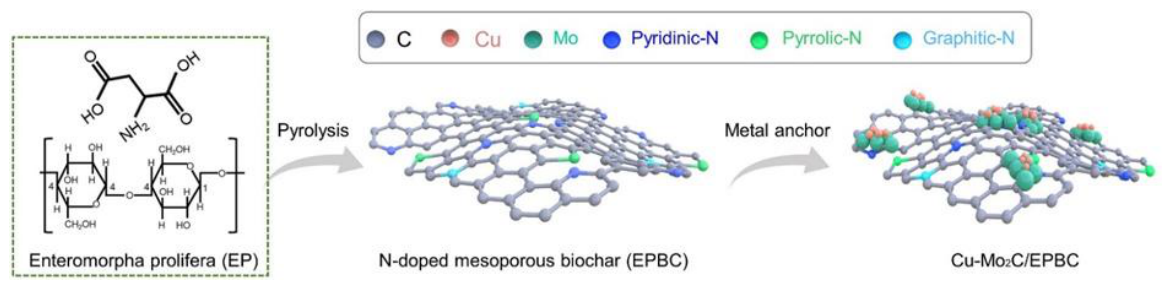
Figure 2.
Set-up for the continuous-flow reverse water-gas shift (RGWS) reaction, using nickel and iron-doped biocarbon catalysts, developed by Nzihou [19]. Adapted from reference 19 with permission from Wiley & Sons, Copyright 2024.
Figure 2.
Set-up for the continuous-flow reverse water-gas shift (RGWS) reaction, using nickel and iron-doped biocarbon catalysts, developed by Nzihou [19]. Adapted from reference 19 with permission from Wiley & Sons, Copyright 2024.
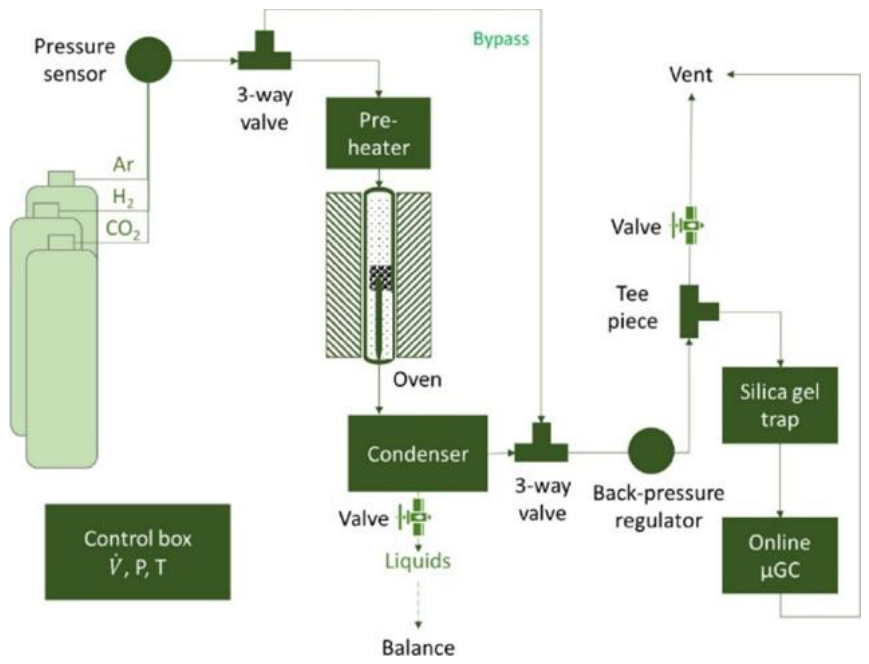
Figure 3.
Catalytic performance for CO2 hydrogenation to methanol with: (a) copper-zinc series catalysts; (b) different copper-zinc ratio of CuZn/MC catalysts (Reaction conditions: 3.0 MPa, 260 °C, CO2:H2 = 1:3, GHSV = 14400 ml/g/h). Adapted from reference [21] with permission from Elsevier, Copyright 2025.
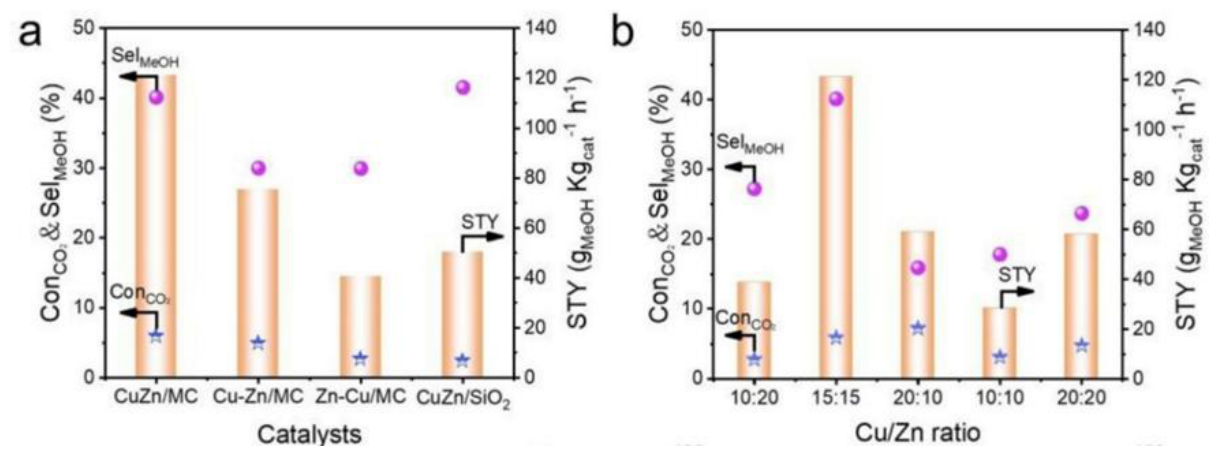
Figure 4.
Catalytic performance of NC/BS in CO2 reduction: (A) hydrogen production volume versus reaction time, and (B) Hydrogen generation rate (HGR) and formate concentration under catalytic and non-catalytic conditions (Reaction conditions: 10 % NC/BS dosage (20 mg), [NaBH4] = 50 mmol/L, reaction temperature = 40℃, [CO2] = 8 % (v/v), gas flow rate = 150 mL/min). Adapted from reference [22] with permission from Elsevier, Copyright 2025.
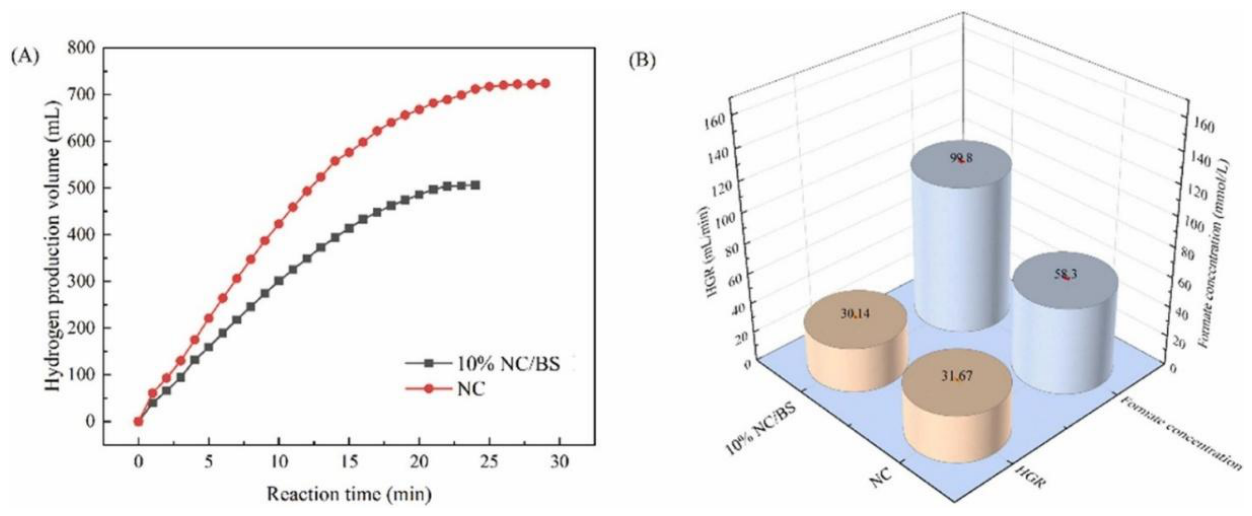
Figure 5.
(a) CO yield on the different photocatalysts; (b) CO evolution rate on the different samples. Adapted from reference [28] with permission from Elsevier, Copyright 2025.
Figure 5.
(a) CO yield on the different photocatalysts; (b) CO evolution rate on the different samples. Adapted from reference [28] with permission from Elsevier, Copyright 2025.
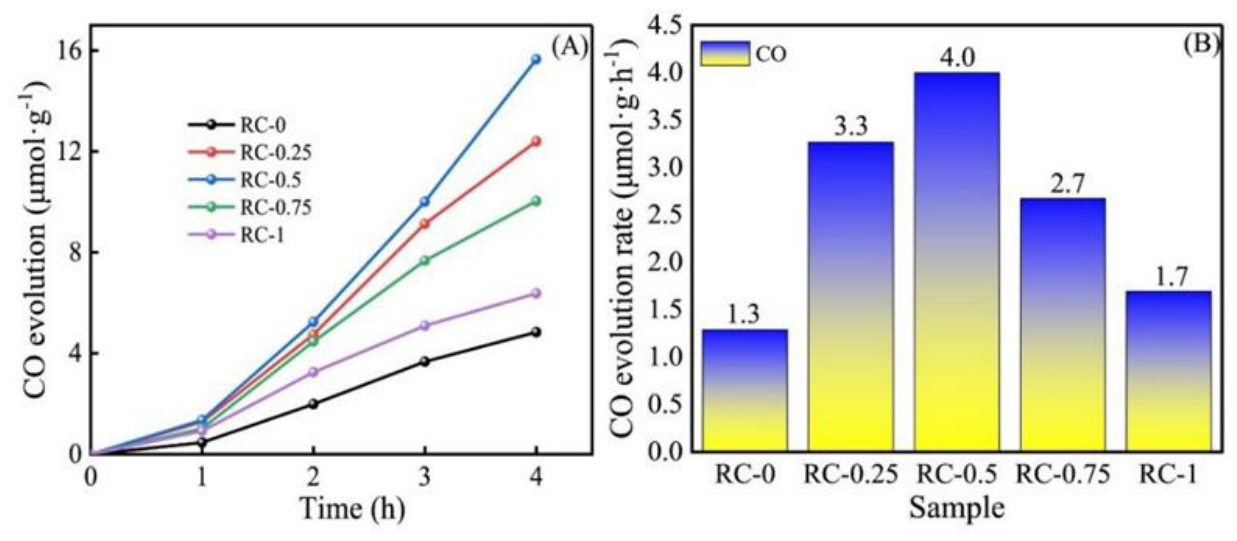
Figure 6.
Schematic illustration of the synthetic route of PCCN. Adapted from reference [31] with permission from Wiley & Sons, Copyright 2025.
Figure 6.
Schematic illustration of the synthetic route of PCCN. Adapted from reference [31] with permission from Wiley & Sons, Copyright 2025.
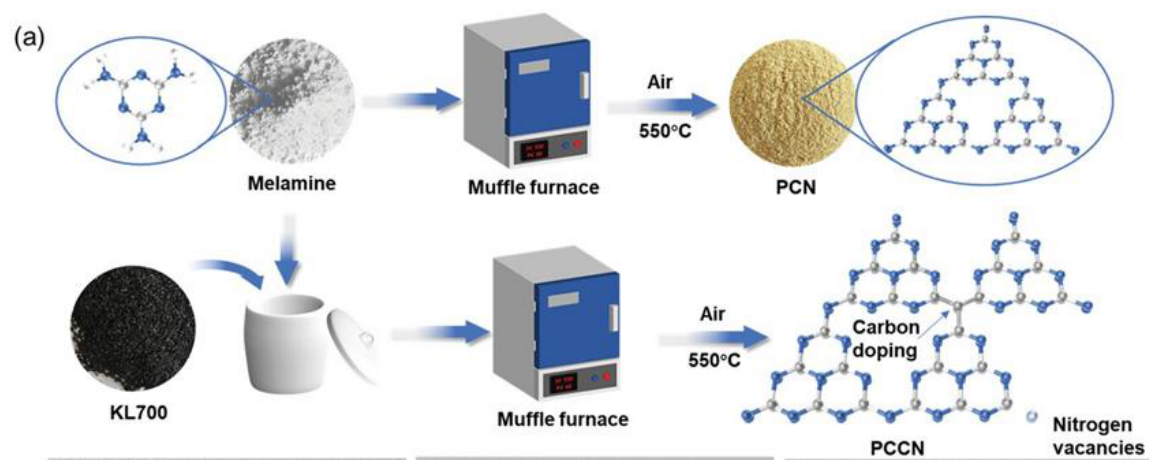
Figure 1.
Schematic synthesis of pig manure-derived biochar using a hydrothermal method. Adapted from reference [50] with permission from The Royal Society of Chemistry, Copyright 2025.
Figure 1.
Schematic synthesis of pig manure-derived biochar using a hydrothermal method. Adapted from reference [50] with permission from The Royal Society of Chemistry, Copyright 2025.
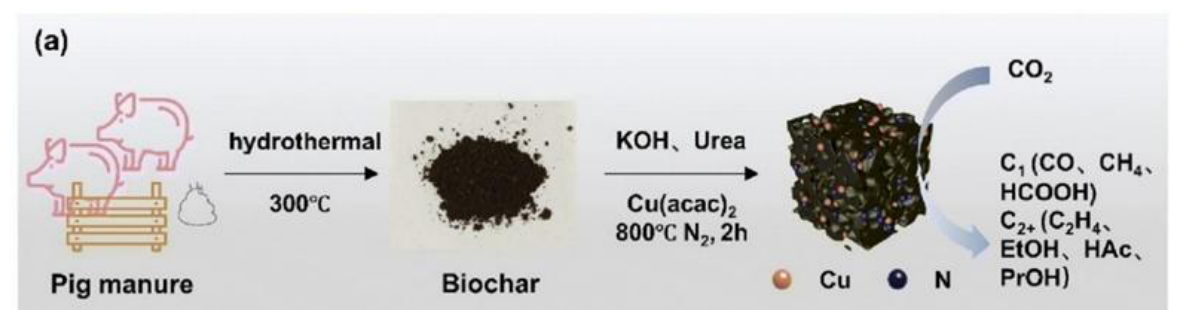
Figure 8.
Schematic illustration for the preparation of carbon aerogels. Adapted from reference [57] with permission from Elsevier, Copyright 2024.
Figure 8.
Schematic illustration for the preparation of carbon aerogels. Adapted from reference [57] with permission from Elsevier, Copyright 2024.
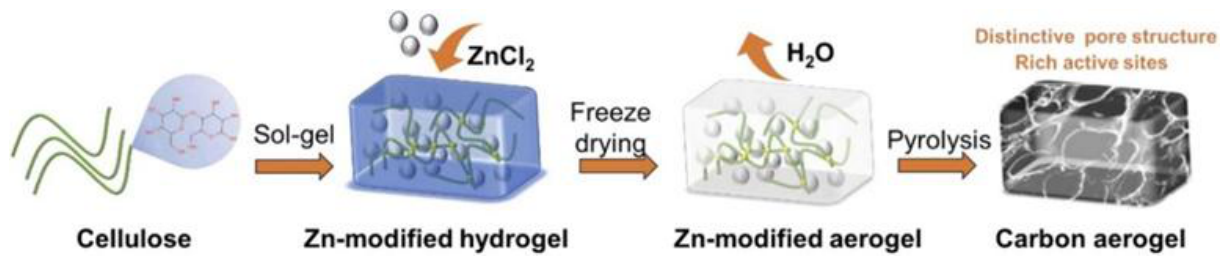
Figure 9.
(a) Comparison of total current density against cathodic potential. Plots of Faradaic efficiency against cathodic potential for (b) Ag on PTFE, (c) Ag-CH-700 on PTFE, (d) Ag-CH-800 on PTFE, and (e) Ag/CH-900 on PTFE. Adapted from reference [58] with permission from Elsevier, Copyright 2023.
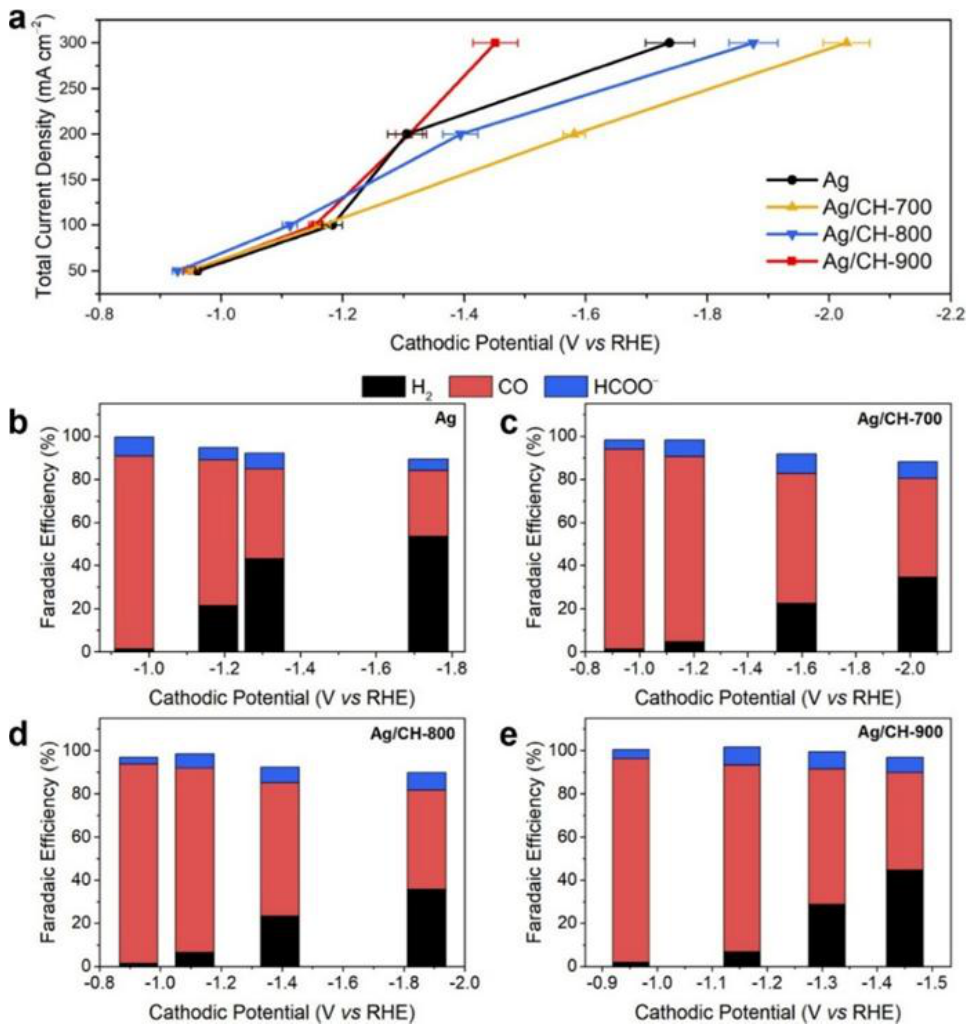
Figure 10.
Production rates and Faradaic efficiencies of HP (a, d), RR (b, e), and FH (c, f) at different applied potentials. Adapted from reference [63] with permission from Elsevier, Copyright 2020.
Figure 10.
Production rates and Faradaic efficiencies of HP (a, d), RR (b, e), and FH (c, f) at different applied potentials. Adapted from reference [63] with permission from Elsevier, Copyright 2020.
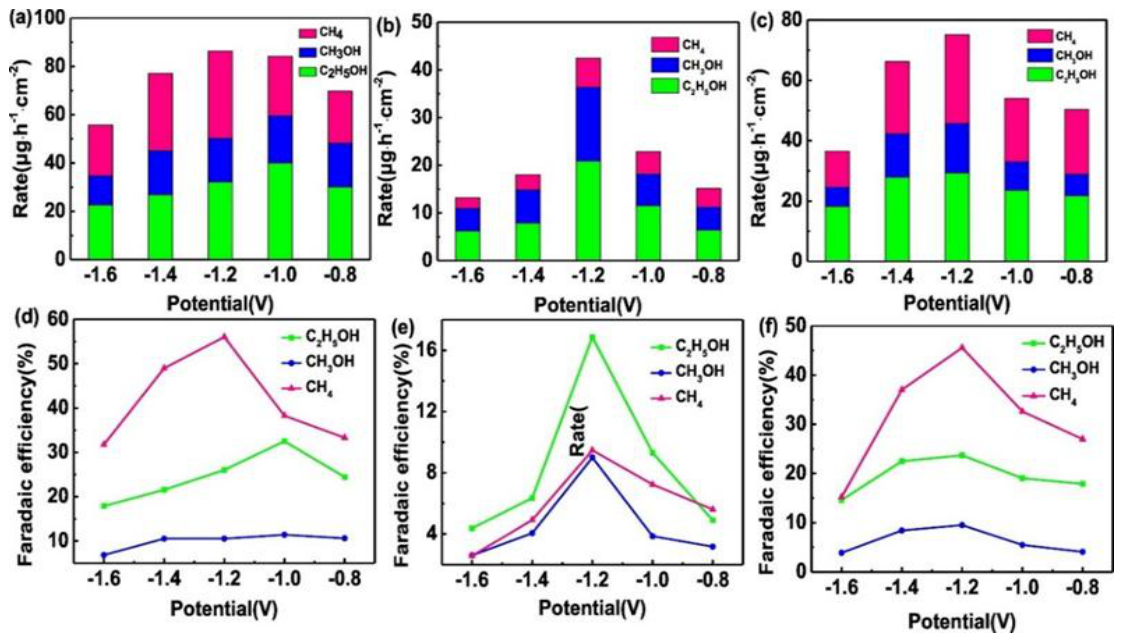
Figure 11.
Schematic illustration of the mechanism for photocatalytic reduction CO2 by Co–Al LDH–biochar composites and charge carrier transfer under UV-light irradiation. Adapted from reference [71] with permission from Springer Nature, Copyright 2022.
Figure 11.
Schematic illustration of the mechanism for photocatalytic reduction CO2 by Co–Al LDH–biochar composites and charge carrier transfer under UV-light irradiation. Adapted from reference [71] with permission from Springer Nature, Copyright 2022.
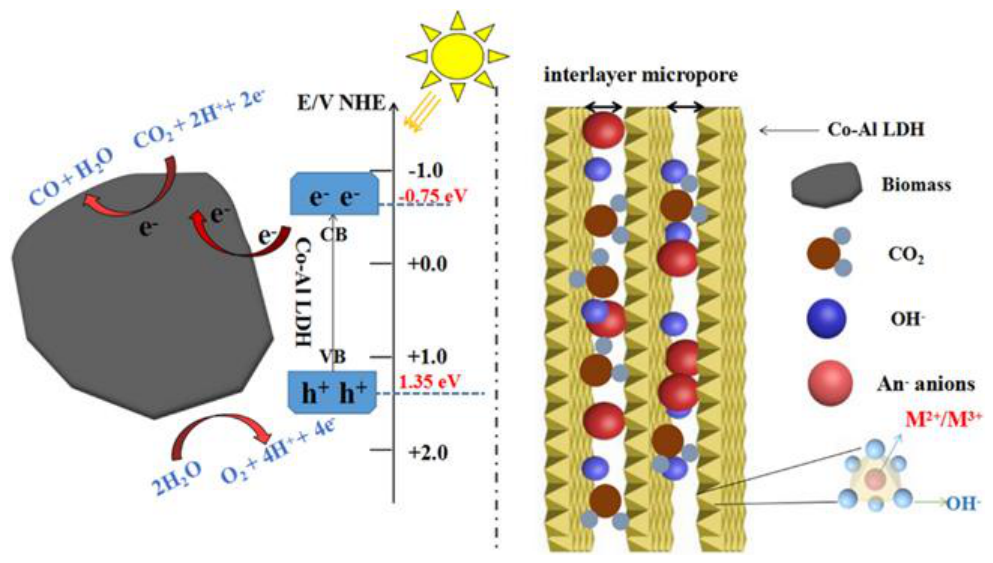

Table 1.
Catalytic chemical reduction of CO2.
| Entry | Catalyst (Source/physical properties) | Reduction products/observations | Ref. |
| 1 | Cu-Mo modified biochar, derived from Enteromorpha prolifera biomass Cu-Mo₂C/EPBC Metal content = 0.8 wt% Cu, 20 wt% Mo₂C SSA = 603.43 m²/g |
Main products: CO Conversion = 1354 μmol CO₂/g 50-hour long-term stability with >99% activity and 99.95% CO selectivity |
[16] |
| 2 | Cu-Mo modified biochar, derived from coconut shells (ordered mesoporous biochar - MB) Cu-Mo₂C/MB Metal content = 0.8 wt% Cu, 20 wt% Mo₂C SSA = 2693 m²/g |
Main products: CO Conversion = 1354 μmolCO₂/g cat 50-hour long-term stability with >99% activity and 99.95% CO selectivity |
[17] |
| 3 | Ni and Fe modified biochars, derived from fern and willow biomass FNi-A, FFe-B and FNiFe SSA for best catalyst (FFe-B): 188.5 m²/g Metal content: 13 wt% Fe in FFe-B, 1.4 wt% Ni in FNi-A; 8 wt% Ni and 10 wt% Fe in NNiFe |
Main product: CO CO₂ conversion up to ~17.2 % (FNi-A without pre-reduction) CO selectivity: typically >94%, up to 100% (FNi-A, FFe-B, FNiFe) Long-term stability: up to 288 h with no performance loss (FFe-B) |
[18] |
| 4 | Ni modified biochar, derived from Manihot esculenta (cyanogen-rich cassava) grown in Ni-contaminated soil Ni@CassCat Pore size: 25.85 nm. SSA: 10.75 m²/g Metal content = 1×10⁻⁴ wt% Ni |
Main product: formate Conversion = 485 μmolCO₂/g cat Turnover number (TON): 485 Selective production of potassium formate confirmed by ¹H NMR Recyclability of 3 cycles with gradual loss due to recovery inefficiency) |
[19] |
| 5 | Cu-Zn biochar, prepared from mesoporous biochar (MC) derived from coconut shell CuZn/MC SSA: 1420 m2/g |
Main product: methanol Conversion (STY): 121.25 g MeOH/kg_cat/h Long-term stability: Maintained >99.5% of initial STY after 50 h |
[20] |
| 6 | Ni-Cu bimetallic alloy supported on biochar modified with sodium hydroxide, from corn stalk NC/BS Metal content = 4.2 wt% Cu and 5.7 wt% Ni |
Main product: formate Conversion: 99.8% with NC/BS and NaBH4 as H donor; 58.3% with only NC/BS |
[21] |
Table 2.
CO2 photocatalytic reduction.
| Entry | Catalyst (Source / physical properties) | Reduction products/observations | Ref. |
| 1 | Si-Ce modified biochar, derived from cellulose nanocrystals (CNCs) Si-Ce-CNC SSA = 376.73 m²/g; pore diameter = 10.02 nm |
Main products: CO Irradiation source: undisclosed conversion = 59.5 μmol CO/h/g_cat 50-hour long-term stability with ~97% of original CO2 adsorption capacity after 10 cycles Solar-to-chemical energy conversion efficiency: 1.9% Mechanism: Under illumination, CeO₂ generates electron–hole pairs and the photogenerated electrons reduce CO2 adsorbed at oxygen vacancy sites to CO. |
[24] |
| 2 | Co-Ti modified biochar, derived from Li-ion battery anode waste (LiCoO₂ and Li₄Ti₅O₁₂) and onion powder H-ATP/Co(Ti)Oₓ metal content = 19 wt% Co3O4 and 0.98 TiO2 for H-ATP/Co(Ti)O-30% SSA = not reported |
Main products: CO (minor CH₄, CH₃OH) Irradiation source: 300 W visible light xenon lamp Conversion = 14.7 μmol·g⁻¹·h⁻¹ (solar light) Maintains activity over 5 cycles without loss in performance |
[25] |
| 3 | Zn-In modified biochar derived from corn flour with ZnIn₂S₄ (ZIS) nanosheets ZIS/BC SSA = 122.10 m²/g (for ZIS/BC-3) |
Main product: CO at 20.7 μmol g⁻¹ h⁻¹, approximately 34.5× higher than BC (0.6 μmol g⁻¹ h⁻¹) and 1.6× higher than ZIS alone (12.7 μmol g⁻¹ h⁻¹) Irradiation source: 300 W visible light xenon lamp Stability: The ZIS/BC-3 composite exhibited significantly reduced photocorrosion compared to bare ZIS, as shown by recyclability tests and lower Zn²⁺/In³⁺ leaching in ion-chromatography analysis |
[26] |
| 4 | Bi-modified biochar derived from rape straw BiOCl/RC 0.5 SSA = 9.9 m2/g |
Main products: CO Irradiation source: 300 W visible light xenon lamp CO yield: 4.0 μmol g⁻¹ h⁻¹ CO yield is ~3 × higher than with pure BiOCl Active species confirmed by EPR and radical trapping |
[27] |
| 5 | CQD/Cu₂O-modified biochar, prepared from empty fruit bunch CQDs/Cu₂O-BC particle size = 2.5–6.0 nm (CQDs) and 40–50 nm (Cu₂O) |
Main products: C₂H₆ Irradiation source: Visible light halogen lamp (undisclosed power) conversion = 101.83 μmol g cat⁻¹ (CQDs/Cu₂O-BC) 66.73 μmol g cat⁻¹ (Cu₂O) High photostability over 5 cycles (~90% retention) |
[28] |
| 6 | Bi-CeO2 modified biochar, derived from cattail with graphitic carbon nitride nanosheets g-C₃N₄–BIO/CeO₂ SSA not reported |
Main products: CO Irradiation source: 300 W visible light xenon lamp conversion = 69.1 μmol CO g⁻¹; CH₄ = 3.3 μmol g⁻¹ CO selectivity: >95% Stable over 4 reaction cycles with no significant activity loss |
[29] |
| 7 | KOH modified biochar, derived from graphitic carbon nitride nanosheets (g-C₃N₄) and KOH-activated biochar derived from lignin (KL700) PCCN-10 SSA = 11.61 m2/g |
Main products: C₂H₆ Irradiation source: 300 W visible light xenon lamp and sunlight Conversion = 99.14 μmol g⁻¹ h⁻¹ (in pure water, Xe lamp); 43.17 μmol g⁻¹ h⁻¹ (outdoor sunlight) Selectivity: 80.33% for C₂H₆ Minor products: CO = 9.20 μmol g⁻¹ h⁻¹; CH₄ = 15.07 μmol g⁻¹ h⁻¹ Solar-to-chemical (STC) efficiency: 1.13% Stability over 20 h (lab) and 50 h (outdoor) with no structural degradation |
[30] |
Table 3.
CO2 electrocatalytic reduction using Cu-based biochar catalysts.
| Entry | Catalyst (Source / physical properties) | Reduction products/observations | Ref. |
| 1 | Cu-modified biochar prepared from Elsholtzia Harchowensis Cu/C-S Cu content = 0.4 wt % SSA = 1006 m2/g |
Main products: CO and C2H4 Eonset = −0.61 V CD = 0.25 mA/cm2 at −0.32 V FE(CO)= 74.6% at −0.32 V; FE(C2+)= 8.7% at −0.52 V 8-hour long-term stability |
[43] |
| 2 | Cu-B/N-modified biochar prepared from Elsholtzia Harchowensis Cu/C-BN-1 Cu content = 0.6 wt% SSA: N.D. |
Main products: CO and CH4 Eonset: N.D. CD = 0.25 mA/cm2 at −0.32 V FE(CO)= 64.7% at −0.32 V; FE(CH4)= 12.0% at −0.32 V 8-hour long-term stability |
[44] |
| 3 | Cu-B/N-modified biochar prepared from Elsholtzia Harchowensis Cu/C-BN-2 Cu content = 25 wt% SSA: 6.9 m2/g |
Main products: CO and CH4 Eonset: N.D. CD = 0.33 mA/cm2 at −0.32 V FE(CO)= 26.9% at −0.32 V; FE(CH4)= 31.3% at −0.32 V 8-hour long-term stability |
[45] |
| 4 | Cu-modified biochar prepared from horticultural waste Cu/K2CO3-Cx and Cu/KOH-Cx Cu content = 55 wt% SSA (Cu/K2CO3-Cx) = ~900 m2/g; SSA (Cu/KOH-Cx) = ~1040 m2/g |
Main products: CO and HCOOH Eonset = –0.55 V CD = ~45 mA/cm2 at −1.6 V for both catalysts FE(CO) = 32% and FE(HCOOH) = 28% (at −1.4 V) for Cu/K2CO3-Cx and FE(CO) = 28% and FE(HCOOH) = 22% (at −1.4 V) 6-hour long-term stability |
[46] |
| 5 | Cu/CuO-modified biochar prepared from Ceratophyllum demersum L. Cu-CuO/P-CCDL-X Cu content = 1.55 wt% SSA (Cu/CuO-BC) = 211.5 m2/g |
Main products: CO and C2H5OH Eonset = −1.25 V at 10 mA/cm2 CD = N.D. FE(C2H5OH) = 39 % at −1.5 V; FE(CO) = 30% at −1.5 V 26-hour long-term stability |
[47] |
| 6 | Cu-modified biochar prepared from Locust leaves CuxO@C Cu content = 5.2 wt% SSA (CuxO-BC) = 68.8 m2/g |
Main products: C2H4 Eonset = –0.63 V at 10 mA/cm2 CD = 49.4 mA/cm2 at − 1.08 V FEC2H4 = 41.3 % at - 1.08 V 10-hour long-term stability |
[48] |
| 7 | Cu-modified biochar prepared from pig manure Cu-NB-2000 and Cu-NC-2000 Cu content = ~16 wt% (for both catalysts) SSA Cu-NB-2000 = 422 m2/g SSA Cu-NC-2000 = 257 m2/g |
Main products: C2H4 Eonset = N.D. CD = 150 mA/cm2 at − 1.51 V FE(C2H4) = 47.4 % at - 1.51 V (Cu-NB-2000) FE(C2H4) = 34.4 % at - 1.1 V (Cu-NC-2000) 8-hour long-term stability |
[49] |
| 8 | Cu-modified biochar prepared from maize stalk 20Cu/10HAP Cu content = N.D. SSA = N.D. |
Main products: CH4 Eonset = N.D. CD = 7.8 mA/cm2 at − 1.2 V Coulombic Efficiency: 866 ± 199 mmol/m2 d vs Ag/AgCl reference electrode 200-hour long-term stability |
[50] |
Table 4.
CO2 electrocatalytic reduction using metal-doped biochar-based catalysts.
| Entry | Catalyst (Source / physical properties) | Reduction products/observations | Ref. |
| 1 | Ni-modified biochar prepared from glossy privets of Ligustrum lucidum hp-Ni-BC and lp-Ni-BC SSA (hp-Ni-BC) = 1029 m2/g; SSA (lp-Ni-BC) = 84 m2/g Ni content = 0.3 wt% |
Main products: CO Eonset = –1.2 V CD = 25 mA/cm2 at −1.4 V FE(CO) of 97.4% at –1.2 V (hp-Ni-BC) 26-hour long-term stability |
[52] |
| 2 | Ni- and N-modified biochar prepared from sugarcane bagasse Ni-N-ANBC SSA (Ni-N-ANBC) = 1053.5 m2/g Ni content = 1.5 wt% |
Main products: CO Eonset = –0.9 V CD = 4 mA/cm2 at −0.9 V FE(CO) of 97% at –0.9 V 8-hour long-term stability |
[53] |
| 3 | Ni- and Ni-N-modified biochar prepared from sugarcane bagasse CN-Ni and BC-Ni SSA (CN-Ni) = 282.9 m2/g; SSA (BC-Ni) = 218.5 m2/g Ni content = 1.5 wt% |
Main products: CO Eonset = –0.6 V CD = 15.4 mA/cm2 for CN-Ni and CD = 6.2 mA/cm2 for CN-Ni (at −0.82 V) FE(CO) = 90% at –0.62 V (CN-Ni); FE(CO) = 46% at –0.62 V (CN-Ni); 8-hour long-term stability |
[54] |
| 4 | Ni-N-modified biochar prepared from pine sawdust and rice straw mixture NiPc/N-BMBC SSA = 404.8 m2/g NiPc/N-BMBC at 700 °C Ni content = 0.94 wt% |
Main products: CO Eonset = –0.5 V CD = 132 mA/cm2 at −1.8 V FE(CO) = 86% at –0.8V 24-hour long-term stability |
[55] |
| 5 | Zn-modified biochars prepared from chitosan and brewed coffee ZnO/CTO (chitosan) and ZnO/CBC (brewed coffee) SSA: N.D. ZnO content = ~51 – 82 wt% |
Main products: CO Eonset = N.D. CD = 75.6 mA/cm2 at -1.3 V (ZnO/CTO) FE(CO) = 86% at -1.3 V 14-hour long-term stability |
[56] |
| 6 | Zn-modified biochar prepared from cellulose Zn-BC SSA: 1589 m2/g (Zn-BC-2 prepared at 950 °C) Zn content = N.D. |
Main products: CO Eonset = -0.86 V CD = 24.76 mA/cm2 at -1.33 V FE(CO) = 50% at -1.0 V; FE(H2) = 50% at -1.0 V 8-hour long-term stability |
[57] |
| 7 | Ag-modified biochar prepared from coconut husk Ag/CHx SSA: N.D. Ag content = 0.2-0.3 wt% |
Main products: CO Eonset = N.D. CD = 50 mA/cm2 at -1.0 V FE(CO) = 94.4% at -1.0 V |
[58] |
| 8 | Sn-modified biochar prepared from rice husk SnO2-NH-BC and SnO2-BC SSA (SnO2-NH-BC) = 99 m2/g; SSA (SnO2-BC-1) = 63 m2/g Sn content = ~25 wt% in all catalysts |
Main products: HCOOH Eonset = N.D. CD = 17 mA/cm2 (SnO2-BC) at -1.0 V; CD = 15 mA/cm2 (SnO2-NH-BC) at -1.0 V FE(HCOOH) = 73.3 % at -1.5 V for SnO2-NH-BC FE(HCOOH) = 59.1 % at -1.5 V for SnO2-BC |
[59] |
| 9 | BiOx-modified biochar prepared from coffee waste BiOx-BC SSA: N.D. Bi content = 60-67 wt% |
Main products: HCOOH Eonset = N.D. CD = 5 mA/cm2 at -1.2 V FE(HCOOH) = 90 % at -1.2 V 5-hour long-term stability |
[60] |
Table 5.
Functional roles of biochar in integrated CO2 capture-conversion systems.
| Integrated function | Biochar contribution | Key benefits | Examples |
| CO2 adsorption | Mineral phases and surface functional groups enhance CO2 affinity | Local CO2 preconcentration near active sites | Co–Al–LDH [71] CeO2/g-C3N4 [72] |
| Catalytic support | Stabilises active metal or semiconductor sites | Improved dispersion and catalytic activity | CQDs/Cu2O [73] |
| Electron mediator | Conductive carbon network promotes charge transfer | Reduced recombination and enhanced photoreduction efficiency | [71,72,73] |
| Ion-coupled activation | Mineral interfaces assist CO2 release from bicarbonate species | Improved kinetics | General biochar systems |
Table 6.
Functional roles of biochar in integrated CO2 capture-conversion systems.
| Pathway | CO2 source | Conversion mechanism | Main products | Biochar contribution |
| Thermochemical | Adsorbed CO2 (carbonate species) | Hydrogenation (RWGS, Sabatier) | CO, CH4 | Adsorption + catalytic conversion in one matrix |
| Photochemical | Adsorbed CO2 + light irradiation | Multi-electron photoreduction | CO, CH4, C2+ | Electron mediation, light absorption |
| Electrochemical | Bicarbonate/carbamate solutions | Electroreduction | CO, formate, hydrocarbons | Conductive framework + CO2 regeneration |
Disclaimer/Publisher’s Note: The statements, opinions and data contained in all publications are solely those of the individual author(s) and contributor(s) and not of MDPI and/or the editor(s). MDPI and/or the editor(s) disclaim responsibility for any injury to people or property resulting from any ideas, methods, instructions or products referred to in the content. |
© 2026 by the authors. Licensee MDPI, Basel, Switzerland. This article is an open access article distributed under the terms and conditions of the Creative Commons Attribution (CC BY) license (http://creativecommons.org/licenses/by/4.0/).
Copyright: This open access article is published under a Creative Commons CC BY 4.0 license, which permit the free download, distribution, and reuse, provided that the author and preprint are cited in any reuse.