
Submitted:
10 October 2026
Posted:
14 October 2026
You are already at the latest version
Abstract
AI agents are increasingly expected to interact with changing users, tools, and environments over extended periods of time. However, current systems remain largely static: their parameters are fixed during deployment, while new experiences, domain knowledge, corrections, and behavioral adaptations are handled primarily through external memory management and in-context learning. In this position paper, we focus on lifelong AI: AI systems that can continually learn from their long-term experience throughout an extended deployment lifetime. This position paper argues that existing in-context mechanisms are insufficient for lifelong AI, and advocate In-Parameter Learning (IPL) as a necessary complement to In-Context Learning (ICL), referring to mechanisms that allow a deployed model to continually and safely update its parameters during use. More broadly, we aim to renew the community’s attention to in-parameter learning and to recalibrate the overly optimistic expectations placed on in-context learning alone. Our central claim is that future lifelong AI systems should be built around a hybrid paradigm: in-context learning for immediate, provisional, and reversible information, and in-parameter learning for durable, cumulative, and generalizable growth.
Keywords:
in-parameter learning
; in-context leaning
1. Introduction
The world an AI agent operates in is non-static: facts shift, tools and APIs change, domains drift, and users bring evolving goals, preferences, and working contexts. An agent deployed over extended periods must therefore be more than a capable problem-solver at a single moment, but an active learner that grows with its environment through interactions. We refer to this expectation as Lifelong AI: a system that continually accumulates experience and improves its capabilities throughout an extended deployment lifetime, rather than remaining fixed after release [1,2,3].
Today’s pretrained large language models (LLMs) are static: after a resource-intensive training process, models’ parameters are frozen, and all post-deployment adaptations are applied in the context window. Models rely on retrievers or search tools to obtain external knowledge during inference [4,5,6,7]; injected prompts reshape the model’s behavior [8,9], and context management techniques [10,11,12,13], accompanied by external documents, attempt to retain user history or project states across sessions; this has become the default practice in deployed agent systems. The central problem with this approach is that its mode of control is inherently unstable and ephemeral. The context window is bounded by a hard limit, and anything beyond it is inaccessible to the model at generation time. As a result, once important instructions, factual knowledge, or historical interactions are pushed out of the available context, the model ceases to condition on them, and its behavior correspondingly drifts away from what is desired (i.e., behavioral drift [14]).
This is why so much recent work, in both research and practice, has focused on long context: either expanding context window, or managing context more carefully. In Figure 1, we gather the number of publications about LLM long context, showing the exponentially increasing trend. While these advances enable models to process significantly more information, inherent context limitations remain. Furthermore, scaling context length becomes progressively harder: continually extending the context window demands disproportionate advancements in architecture, computation, training data, and infrastructure [15,16,17]. On the other hand, context management relies on approximate retrieval and lossy compression, constructing an unreliable external proxy that compounds errors over time and lacks the durable internal updates necessary for genuine knowledge accumulation and generalization [18,19]. More fundamentally, all these In-Context Learning (ICL) paradigms leave the model’s parameters unchanged: no matter how well context is managed, the model’s intrinsic capabilities remain bounded by what its pretrained weights already encode.
As a result, we must return to the essence of LLMs themselves. Their vast parameter spaces encode enormous amounts of information, constituting their most central, durable and consequential store of knowledge and skills [21]. Context, by contrast, is better viewed as an inference-time channel for temporal instructions, demonstrations, evidence, and transient environmental observations, enabling immediate adaptation without persistent parameter updates [22]. For lifelong AI, this distinction suggests that the parameter space should not remain a static artifact produced only before deployment, but should serve as the fundamental substrate through which useful knowledge, experience and skills are consolidated.
To this end, we emphasize that In-Parameter Learning (IPL), the counterpart to ICL, deserves far greater attention and study. We use IPL here to refer to “the timely and continual consolidation of newly acquired information into the model’s parameter space as enduring knowledge, behavioral habits, new skills and so on.”1
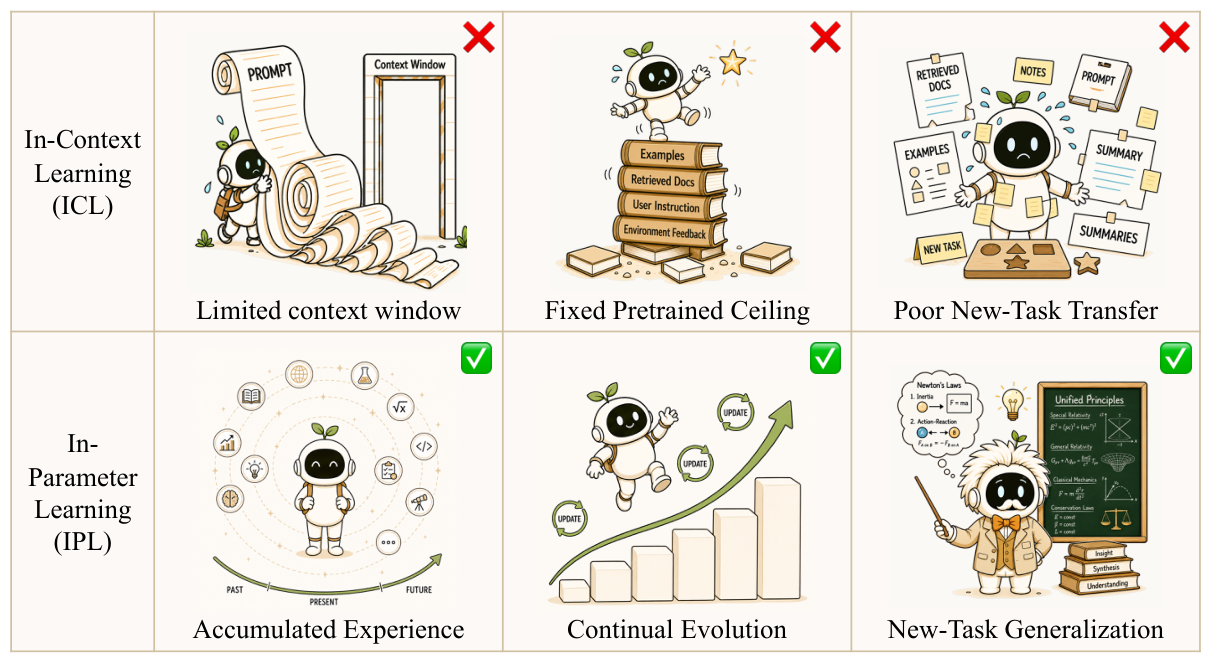
Such a capability promises more than simply overcoming the limits of finite context windows. Where ICL can interpret and use the supplied context only through the capabilities already encoded in the pretrained weights, IPL can raise this ceiling: by consolidating newly acquired information into parameters [23,24], the model can develop knowledge and skills previously inaccessible within the pretrained parameter space, generalize more robustly to out-of-distribution and compositionally novel tasks by reshaping its inductive biases [25,26], and reduce the recurring cost of re-processing the same evidence as unfamiliar, fragmented prompts at every inference step [27,28]. Figure 2 illustrates this contrast: ICL acts as the ordinary student who carries stacks of reference books into every exam, limited by what can fit in context, what the pretrained model can reliably leverage from them, and the growing overhead of processing them; IPL is the scholar who internalizes each lesson, compounding toward the kind of mastery no prompt can independently supply.
Importantly, this position should not be interpreted as a rejection of ICL. ICL retains crucial advantages (including transience, immediacy, and reversibility) and should work in tandem with IPL as the primary interface for external tools, user instructions, and short-term contextual adaptation. Therefore, the role of IPL is not to replace ICL’s function as the model’s working memory. Rather, it provides the vital pathway through which transient experience is elevated into permanent skills and raw knowledge is refined into competence. This role is analogous to long-term memory in the human brain: new knowledge is consolidated with lasting structural and synaptic changes rather than transient neural activity alone [29,30]. Similarly, lifelong AI requires that experience be consolidated into parameters, rather than only held temporarily in context. We argue that IPL should not be viewed as a dispensable extension to the current paradigm, but as a necessary path toward lifelong AI.
To clarify and substantiate this position, the remainder of this paper is organized as follows.
- Section 2 argues that no foreseeable expansion of the context window can carry the experience a lifelong AI needs to accumulate, due to fundamental limits in scale, compute, and architecture.
- Section 3 argues that context management faces an inherent capability ceiling and cannot provide genuine self-evolution or internalization.
- Section 4 contrasts IPL with periodic large-scale retraining, illustrating how high-frequency parameter updates drive a self-evolving intelligence flywheel and enable parameter-level personalization.
- Section 5 discusses concrete technical directions toward realizing Lifelong AI systems in practice.
2. Why Extending Context Windows Cannot Suffice
This section argues that no foreseeable expansion of the context window can carry the information required by a lifelong AI. First, the volume of experience a lifelong AI must accumulate exceeds the capacity of even today’s largest context windows by orders of magnitude (Section 2.1). Second, attempts to close this gap by further scaling context windows face fundamental obstacles in computation, data, and model architecture (Section 2.2). Finally, we argue that the parameter space of modern models, by contrast, offers a natural substrate to internalize what no context window can hold (Section 2.3).
2.1. Lifelong AI Requires More Context Than Any Window Can Hold
A lifelong AI must take in far more information than any context window can realistically accommodate. Consider language modality first: even a conservative estimate of words per day [31] amounts to roughly tokens over a human lifetime, already two orders of magnitude beyond today’s 1M-token frontier. And this counts only spoken conversation; reading, writing, and inner speech [32] would push the estimate considerably higher, and for AI agents the inclusion of intermediate reasoning traces would widen the gap further [33].
The mismatch widens dramatically once multi-modal and structured inputs enter the picture. Raw sensory input is vastly larger still [34], and video alone serves as a conservative lower bound: it captures only part of perceptual experience and is already heavily compressed by modern tokenizers, yet modern video tokenizers still require about 600K tokens per minute of video [35]. Scaled over years of experience, this reaches totals on the order of tokens. Structured inputs such as spreadsheets, relational databases, code repositories and tool-use traces [36,37,38] further compound the pressure, since their native structure must be serialized into long, often redundant token streams before an LLM can consume them [39]. Together, even conservative estimates place lifetime input across language, perception, and structured interaction at roughly two to seven orders of magnitude beyond current context capacity.
2.2. Scaling Context Windows Faces Multiple Bottlenecks
Although context windows have already grown rapidly, continuing to scale them runs into serious bottlenecks on multiple fronts. Frontier windows have expanded from GPT-3’s 2K tokens in 2020 to 1M+ tokens as the standard by early 2026, with specialized systems pushing 100M [40,41,42]; we summarize the trajectory across major closed- and open-source models in Appendix A. The strain is already empirically visible: model performance often fails to scale proportionally with the supported context length [43,44,45], the well-known “lost-in-the-middle” phenomenon causes information in the middle of long inputs to be ignored [27], and even perfect retrieval cannot prevent context length itself from hurting generation [46]. In the following, we examine the structural sources of this strain along three axes: compute, data, and architecture.
Attention compute scales quadratically while practical resources do not.
Self-attention requires FLOPs per layer, and Keles et al. [47] prove under SETH that no algorithm computes exact self-attention in strongly sub-quadratic time. KV cache memory is only per query, but it must be paid separately for each long-context request and cannot be amortized across a batch the way model weights can, so the per query memory footprint at lifelong-scale n rapidly outgrows the HBM of any single accelerator. Engineering optimizations such as FlashAttention [48], GQA/MQA [49], KV-cache quantization [50], and sparse or sliding-window attention [15] reduce the constant factor or trade exactness for cost, but leave the dependence of compute and per-query memory untouched. Although aggregate frontier compute is growing rapidly [51], these resources are broadly distributed across training larger models, conducting additional runs, and supporting higher inference throughput, rather than being allocated for serving longer single-query contexts. Therefore, reaching the –-token regime demanded by lifelong experience requires a fundamental regime change rather than a simple continuation of existing scaling trajectories.
Native long-context training data is scarce, and synthetic substitutes do not generalize.
Training a natively long-context model requires high-quality long documents, which are in short supply. Long natural documents are dominated by code and books [16], and open-source instruction-tuning corpora long enough to fill multi-hundred-thousand-token windows remain rare and small in scale [52], motivating an entire line of synthetic long-context data engineering. Frontier models therefore typically avoid native long-context pretraining in favor of staged context extension. For example, Qwen3 pretrains at 32K and extrapolates to 128K during inference [53], while DeepSeek-V3 reaches 128K through two 1000-step YaRN extension stages on top of a 4K-pre-trained base [54]. Although these resulting models successfully pass synthetic needle-in-a-haystack tests, their performance degrades on benchmarks that move past literal matching. In fact, real-world 32K inputs already noticeably degrade performance relative to short-context baselines [55].
Architectural mitigations reduce per-token cost but cannot remove the underlying floor.
Sparse attention sparsifies which tokens the cache retains and history compression compresses each retained token; both lower per-token cost but neither removes the memory floor. Sparse retention relies on heuristic importance scores that are fundamentally lossy and the achievable sparsity ratio is itself inherently bounded [15]; compression and quantization reduce per-token storage but introduce dequantization overhead, auxiliary metadata, and unpredictable quality degradation that compounds with context length [56].
2.3. Parameters as the Substrate for Accumulated Experience
The parameter spaces of modern LLMs, encompassing hundreds of billions to trillions of parameters, serve as a natural repository for accumulated experience that operates orthogonally to the context window. The interplay of linear transformations within the attention and MLP layers, combined with nonlinear activations, endows this space with an immense encoding capacity [21] that far exceeds the limits of any finite context window. This architecture strongly parallels the consolidation of human memory: much like the hippocampus solidifies valuable, frequently accessed experiences while allowing irrelevant information to decay (a process reinforced during sleep and offline consolidation [57,58]), parametric updates allow models to permanently internalize crucial knowledge, providing a fundamental complement to context-based knowledge [23]. Knowledge encountered during deployment is absorbed into parameter updates, while context continues to supply information from the current interaction; together, they realize a continuous spectrum of experience, from the distant past encoded in parameters to the immediate present carried in context. This integration enables genuine access to lifelong experience rather than the bounded, fragmented approximation that context management alone can provide [18,46].
3. Why Context Management Cannot Suffice
Having shown that no amount of context expansion can accommodate lifelong experience, one might turn to context management: if the context window cannot grow indefinitely, perhaps sufficiently intelligent curation of its contents (through retrieval, compression, memory hierarchy, and agentic control) could approximate the effect of lifelong learning. We argue that this paradigm, while practically useful, fundamentally falls short of the requirements for lifelong AI. First, historically, virtually all step-changes in LLM capability have stemmed from parameter updates rather than advanced prompting (Section 3.1). Second, we demonstrate that in-context learning (ICL) is constrained by a strict capability ceiling dictated by the pretrained weights, a boundary that cannot be overcome simply by evolving the provided context (Section 3.2). Finally, we detail how IPL systematically breaks through this ceiling (Section 3.3).
3.1. The Driver of Progress Has Always Been Parameters
The history of large language models provides a consistent and informative lesson: every major step-change in capability has been driven by improvements to the parameters (through larger models, richer training data, better objectives, or more effective post-training techniques), not by improvements to prompting or context management. The revolution from GPT-2 to GPT-3 was not a consequence of a better prompt templates; it was the result of 100× more parameters and vastly richer pretraining data [22]. Instruction-following emerged through RLHF, a form of parameter updating that reshaped the model’s internal representations rather than merely its input [8]. The recent wave of reasoning models makes this point especially sharp: although their capability surfaces through a chain-of-thought prompting format, the deliberative competence itself is acquired through large-scale reinforcement learning over reasoning trajectories [33], not conjured by the format alone.
Empirical evidence confirms that tuning parameters outperform adjusting prompts on specific tasks. When prompt tuning or related context adaptation methods are compared with full or parameter-efficient fine-tuning under matched conditions, parameter updates generally yield stronger performance, particularly on tasks that depart from the pretraining distribution [59]. Few-shot in-context learning, even on a substantial scale, falls behind parameter-efficient fine-tuning on many specialized tasks [25]. The interpretation is unambiguous: context can steer a model’s behavior within the envelope of what it has already learned but cannot extend that envelope. We should update the parameters to realize substantial model progress.
3.2. In-Context Learning Cannot Overcome Its Own Ceiling
Because ICL operates on fixed model parameters, the performance gains it yields on any given task are strictly bounded by what the model’s weights already encode. We demonstrate this fundamental ceiling from both theoretical and empirical perspectives.
ICL cannot surpass its pretrained foundations.
The quality of in-context reasoning is bounded by the model’s intrinsic pretrained capacity for ICL. From a Bayesian perspective, ICL conditions the model on new observations without altering its prior; consequently, the posterior can only assign high probability to hypotheses already present within that prior [60]. Although in-context instructions or examples can successfully activate latent competencies, they cannot create new ones [61,62]. As a vivid illustration: even if a model were supplied with all existing literature on the Langlands Program within its context window, it could not produce a Fields-Medal-level proof, not for lack of information but for lack of the deeply internalized mathematical intuition that no prompt can independently supply.
ICL cannot improve ICL itself.
Recent practices hope that iterative self-improvement, in which the model writes, refines, and accumulates its own skill files [63,64], could compound over time into expanded capability. This expectation has a fundamental limitation under an ICL-only paradigm. Reading a skill file is itself an act of ICL: the model’s parameters do not change, and therefore its capacity to interpret and apply the skills does not change either. Iterative writing can produce increasingly sophisticated artifacts, but the model’s ability to benefit from reading them is bounded by the same pretrained weights. As the gap between skill complexity and parametric interpretive capacity widens, self-evolved skills become either too complex to apply reliably or too abstract to be useful, and self-feedback accelerates this drift rather than correcting it. Zhong et al. [65] confirm this empirically: no feedback-driven self-evolution approach matches skills written by human experts, and self-feedback alone causes performance to degrade across iterations.
Context management overhead compounds as during lifelong operation.
As experience and skill documents accumulate, loading and reconciling an expanding set of external knowledge and guidance within a finite context window imposes an increasing burden. The underlying mechanisms are structurally unreliable: retrieval is approximate, since relevant evidence may be scattered across documents, left implicit in different conventions, or absent from any retrievable source [4]; and any compression is lossy by design, with omitted reasoning steps and may distort omitted reasoning steps, implicit assumptions, or requirements across sessions [18]. Even when retrieval succeeds, performance degrades as context length grows, because softmax attention dilutes the signal from relevant content as irrelevant tokens accumulate [46]. Managing context thus becomes an ever-growing tax on capability rather than a path toward it: a self-defeating dynamic for any system meant to improve with use.
3.3. In-Parameter Learning Raises the Capability Ceiling
Reducing inference burden through knowledge internalization.
In-Parameter Learning (IPL) allows a model to embed recurring knowledge and skills directly into its parameters, rather than carrying all relevant information in the context window for each inference. This reduces the cognitive and computational load: the model no longer needs to “carry a large textbook” every time it solves a problem. In contrast, In-Context Learning (ICL) relies entirely on the context, requiring the model to process instructions or demonstrations repeatedly. IPL enables the model to approach tasks with information “already in mind”, analogous to a cook who has internalized fundamental cooking principles and can intuitively apply them without consulting a recipe for every dish [1,2]. This internalization accelerates reasoning and improves efficiency, especially as the experience grows.
Enhancing generalization through parametric learning.
Large language models’ in-context learning exhibits distinct generalization behaviors compared to parameter-based learning. Multiple studies show that ICL can struggle with compositional generalization, where combinations of known primitives may fail to generalize to novel compositions, revealing a persistent compositional generalization gap in few-shot settings [19,66]. Mechanistically, these patterns reflect different inductive biases: generalization from contextual information is heavily exemplar-based, whereas transformers trained on parametric knowledge tend to generalize via parsimonious, internalized rules. This divergence aligns perfectly with the information-theoretic principle that intelligence emerges from data compression [67,68]. While ICL buffers raw, uncompressed information in a transient window, IPL forces the model to distill recurring experiences into incremental parameter updates. This parametric compression necessitates the discovery of deeper abstractions. By analogy, a cook who relies on ICL reads from a recipe book, able to prepare familiar dishes but fragile to new ingredient combinations, whereas an IPL-driven cook internalizes and compresses these experiences into fundamental culinary principles, allowing robust and systematic generalization over time [25,26].
IPL raises the model’s capability ceiling by internalizing novel knowledge and skills.
Beyond improving efficiency and generalization, IPL enables models to acquire competencies fundamentally out of reach for static parameters [61,65]. Because ICL operates over frozen weights, it acts essentially as an activation mechanism, limited to optimizing the use of a fixed, pre-existing capacity. In contrast, IPL incrementally assimilates continuous interactions, corrections, and preferences directly into the parameter space. This continuous consolidation reshapes the model’s inductive biases and intrinsic capabilities. By shifting from temporary contextual buffering to persistent weight modification, IPL transforms the model from a static reasoning engine into an evolving entity, serving as the critical engine for lifelong AI systems to grow continually.
4. From Periodic Retraining to Continual Evolution
The preceding sections establish that IPL is a necessary foundation for lifelong AI, which extends far beyond the limits of transient context management. A natural objection might accept this premise while defending the current industry standard: conducting large-scale periodic retraining, releasing updated model checkpoints, and treating each discrete cycle as a sufficient instance of IPL. We argue that while periodic retraining successfully advances baseline capabilities, transitioning to continual IPL fundamentally alters the model’s evolutionary trajectory. Rather than being bottlenecked by massive, human-curated engineering cycles, continual IPL operates at a high frequency, translating ongoing interactions into sensible, day-to-day capability enhancements. This rapid, automated capability improvement could kickstart a self-evolving intelligence flywheel. Furthermore, diverging from one-size-fits-all global checkpoints, such a continual and granular update mechanism naturally paves the way for parameter-level personalization, allowing models to dynamically tailor their weights to individual user experiences.
4.1. Periodic Retraining Incurs High and Redundant Costs
Each large-scale retraining cycle typically involves assembling extensive datasets, configuring complex training pipelines, and consuming weeks or months of high-performance compute resources. Even when only a modest amount of new information is added, these cycles often reprocess substantial portions of previously seen data to mitigate catastrophic forgetting [69]. Data curation, infrastructure coordination, and human annotation remain significant bottlenecks, meaning that capability improvements materialize only upon the cycle’s completion, often months after the initial experiences were acquired. Consequently, the resource cost of retraining is disproportionate to the amount of new knowledge incorporated, making periodic retraining inherently less efficient for a system intended to grow continually.
In contrast, IPL is designed to operate incrementally. Parameter updates may be applied over small, targeted batches as a new experience arrives, without necessarily reprocessing the full historical corpus each time. This allows computational overhead to be proportional to the volume of new information rather than the full history of the model. While technical challenges remain (such as stability, avoidance of catastrophic forgetting, and update scheduling), incremental updates offer a plausible pathway to amortize learning cost over long deployment horizons.
4.2. Continual IPL Enables an Intelligence Flywheel and Personalization
Beyond computational cost, the arbitrary cadence of periodic retraining severely bottlenecks a model’s evolutionary trajectory. When capabilities are bound by human-managed, quarterly or annual release cycles, models suffer from a persistent adaptation lag. Critical feedback (such as user corrections, implicit preferences, and novel edge cases) remains trapped in an offline buffer until the next scheduled update. During this interval, errors persist, and the system remains static, preventing the model’s growth from matching the real-time velocity of its environment. Continual IPL fundamentally bypasses these human-specified bottlenecks, transforming passive interactions into a self-sustaining “intelligence flywheel.” By incrementally assimilating real-world learning signals directly into the parameter space, the model adapts autonomously as experiences occur. Crucially, this cumulative improvement accelerates itself: a richer parametric foundation also enables the model to absorb new contexts more efficiently and effectively. Rather than improving at a linear, human-constrained pace, the system’s capacity to learn might accelerate over time, allowing its competence to evolve increasingly faster as the flywheel gains momentum.
Furthermore, liberating the model from monolithic, globally synchronized updates opens a direct pathway to parameter-level personalization. Because continual IPL allows weights to update dynamically based on localized interaction streams, models can organically diverge from a rigid “one-size-fits-all” baseline. This high-frequency mechanism enables individual instances to deeply tailor their internal representations to specific user preferences, specialized workflows, and unique environmental contexts, laying the necessary groundwork for truly individualized lifelong AI.
5. Promising Directions Towards Realizing In-Parameter Learning
5.1. Parameter Updates Without Catastrophic Forgetting
Continuously integrating new knowledge into parameters without catastrophic forgetting remains a fundamental challenge. Classical continual learning methods like EWC [70] and GEM [71] impose constraints from prior tasks, while parameter-efficient fine-tuning methods (e.g., LoRA) restrict update scope [72,73,74]. However, these approaches are coarse-grained, externally applied, and assume clear task boundaries, limiting their applicability to open-ended lifelong AI [75,76]. Recent work on on-policy self-distillation further explores how newly acquired contextual knowledge can be internalized into parameters while mitigating catastrophic forgetting [77]. Beyond such training-time mechanisms, a promising direction is native sparse update architectures, where selective parameter writing is an intrinsic property to the model design. Fully realizing this vision remains open, possibly requiring sophisticated gating mechanisms capable of dynamic write operations and structural plasticity to expand parameters without overwriting critical knowledge. Ultimately, future architectures should inherently balance stability and flexibility, enabling models to absorb novel experiences efficiently while preserving established capabilities.
5.2. Learning How to Update: Native Architectures and Meta-Learning
A deeper goal beyond designing better update mechanisms is to learn the update process itself, reducing reliance on hand-crafted retraining schedules and enabling more efficient and capable adaptation as deployment extends. Recent sub-quadratic architectures already perform a primitive form of in-parameter learning. State-space models [78] and the Titans/Atlas family [79,80] replace the growing KV cache with a fixed-size latent state that is updated by a learned online rule as each token arrives. From the IPL perspective, this state is itself a small set of internal parameters, and the per-token update is like writing the context into these parameters, despite that the writable parameter space is much smaller than the entire model weight space. Building on this view, meta-learning, or “learning to learn”, provides a more general framework to transform context into parameters [81,82]. Hypernetworks can generate parameters conditioned on context, effectively mapping new experiences into the model’s weights [83,84,85,86,87,88,89,90]. Test-time training (TTT) offers a complementary approach: performing gradient updates during inference to compress newly observed data into parameters [91,92]. Both approaches emphasize that knowledge should leave persistent traces in the model, not just in the ephemeral context.
5.3. Bridging Parameters and Context
Another practical challenge is building a system in which context and parameters work in concert: context handling what is immediate and transient, parameters encoding what is recurrent and durable, and a mechanism mediating the passage between them. The central challenge of this mediation is selective consolidation [57,58]: not all experience that passes through the context window deserve to be absorbed into parameters. A lifelong model must learn to distinguish signal from noise: privileging patterns that recur across sessions, corrections that reflect systematic error, and behavioral feedback that reshapes downstream performance, while filtering out low-quality, unreliable, or adversarially constructed inputs that should not be allowed to alter the model’s default computation. This is not merely a filtering problem but a deeper question of what it means for a model to learn from its own deployment. Naive absorption of all context information into parameters would be brittle and unsafe; indiscriminate consolidation risks encoding transient artifacts, conversational noise, or manipulative inputs as permanent behavioral tendencies.
5.4. Self-Evolving and Automatic IPL
A further promising direction is for the model to move beyond passive interaction: not merely updating from experience as it arrives, but actively identifying what it needs to learn, setting its own learning objectives, and generating or seeking out experience that targets its actual competence gaps. A passively updating system is at the mercy of whatever deployment happens to provide; a self-directing one monitors its own uncertainty, detects where its parametric knowledge is unreliable, and steers learning accordingly. Current self-training and self-play methods already show that models can improve themselves without human annotation [93,94,95], providing primitives for self-directed growth. Such self-directed IPL closes the loop between deployment and capability growth, removing the bottleneck of human curation and allowing improvement to scale with experience rather than with annotation effort. The ultimate expression of this is a model with an increasingly accurate model of its own competence, one that grows better at identifying its own gaps and more precise in targeting the experience that would address them.
5.5. Accelerating Scientific Discovery Through the Intelligence Flywheel
The technical directions outlined above lay the groundwork for a profound paradigm shift: realizing the “intelligence flywheel” introduced in Section 4.2. As continual IPL matures, the continuous internalization of new knowledge refines the model’s inductive biases, rendering subsequent learning cycles increasingly efficient and precise. This compounding effect holds transformative potential for AI-driven scientific discovery. Rather than functioning merely as an advanced literature retrieval engine, an IPL-enabled system acts as an evolving collaborator. It can organically assimilate novel experimental outcomes, adapt its internal representations to accumulating evidence, and generate increasingly sophisticated hypotheses based on deepened parametric intuition. Recent evidence supports this trajectory, demonstrating that targeted parametric updates empower models to surpass the performance of massive, parallel agentic search [96]. This underscores a critical principle: in the pursuit of novel knowledge, the strategic internalization of learning signals fundamentally outweighs the sheer volume of context passively buffered. The intelligence flywheel, therefore, represents far more than a computational optimization; it signifies a qualitative leap in AI’s capacity to drive scientific discovery, serving as the ultimate motivation for the IPL research agenda.
6. Conclusions
ICL is fundamentally constrained by two distinct but related limitations: bounded scale and bounded capability. Overcoming these limits requires a paradigm shift towards In-Parameter Learning (IPL) as the essential substrate for continuous growth, supported by the concrete research directions outlined above. Context and parameters are not competitors but complements: context handles what is immediate and reversible, and parameters encode what is durable and generalizable. The path forward is co-evolution: both growing together, each doing what the other cannot. The research community has invested enormously in making the context longer and smarter. It is time to invest with equal seriousness in making the parameters live.
Lifelong AI will not be built on context alone.
Appendix A. Context Window Growth Across Frontier Models
The past few years have seen an extraordinary expansion of context windows. Frontier models have grown from GPT-3’s 2K-token window in 2020 to over 1M tokens as the standard for every major frontier model by early 2026, at roughly per year since mid-2023 [40]. Google’s Gemini 1.5 Pro first broke the 1M barrier in February 2024 [41]; by 2026 this scale has been matched by Gemini 3.1 Pro [97], Anthropic’s Claude Opus 4.7 [98], OpenAI’s GPT-5.4 [99], and xAI’s Grok 4.1 [100], while specialized systems such as Magic’s LTM-2-mini push to 100M tokens [42]. The open-source ecosystem has converged on 128K–1M as the baseline, with Qwen3.5 natively supporting 256K (extensible to 1M) [101], DeepSeek-V3.2 at 128K [54], and Mistral Small 4 at 256K [102].
References
- Silver, D.L.; Yang, Q.; Li, L. Lifelong machine learning systems: Beyond learning algorithms. In Proceedings of the AAAI Spring Symposium: Lifelong Machine Learning, 2013; Vol. 13. [Google Scholar]
- Chen, Z.; Liu, B. Lifelong machine learning; Morgan & Claypool Publishers, 2018. [Google Scholar]
- Wang, L.; Zhang, X.; Su, H.; Zhu, J. A comprehensive survey of continual learning: Theory, method and application. IEEE Trans. Pattern Anal. Mach. Intell. 2024, 46, 5362–5383. [Google Scholar] [CrossRef] [PubMed]
- Lewis, P.; Perez, E.; Piktus, A.; Petroni, F.; Karpukhin, V.; Goyal, N.; Küttler, H.; Lewis, M.; Yih, W.t.; Rocktäschel, T.; et al. Retrieval-augmented generation for knowledge-intensive nlp tasks. Adv. Neural Inf. Process. Syst. 2020, 33, 9459–9474. [Google Scholar]
- Izacard, G.; Lewis, P.; Lomeli, M.; Hosseini, L.; Petroni, F.; Schick, T.; Dwivedi-Yu, J.; Joulin, A.; Riedel, S.; Grave, E. Atlas: Few-shot learning with retrieval augmented language models. J. Mach. Learn. Res. 2023, 24, 1–43. [Google Scholar] [CrossRef]
- Borgeaud, S.; Mensch, A.; Hoffmann, J.; Cai, T.; Rutherford, E.; Millican, K.; Van Den Driessche, G.B.; Lespiau, J.B.; Damoc, B.; Clark, A.; et al. Improving language models by retrieving from trillions of tokens. In Proceedings of the International conference on machine learning. PMLR, 2022; pp. 2206–2240. [Google Scholar]
- Nakano, R.; Hilton, J.; Balaji, S.; Wu, J.; Ouyang, L.; Kim, C.; Hesse, C.; Jain, S.; Kosaraju, V.; Saunders, W.; et al. Webgpt: Browser-assisted question-answering with human feedback. arXiv 2021, arXiv:2112.09332. [Google Scholar]
- Ouyang, L.; Wu, J.; Jiang, X.; Almeida, D.; Wainwright, C.; Mishkin, P.; Zhang, C.; Agarwal, S.; Slama, K.; Ray, A.; et al. Training language models to follow instructions with human feedback. Adv. Neural Inf. Process. Syst. 2022, 35, 27730–27744. [Google Scholar] [CrossRef]
- Sahoo, P.; Singh, A.K.; Saha, S.; Jain, V.; Mondal, S.; Chadha, A. A systematic survey of prompt engineering in large language models: Techniques and applications. arXiv 2024, arXiv:2402.079271. [Google Scholar]
- Zhong, W.; Guo, L.; Gao, Q.; Ye, H.; Wang, Y. Memorybank: Enhancing large language models with long-term memory. Proc. Proc. AAAI Conf. Artif. Intell. 2024, Vol. 38, 19724–19731. [Google Scholar] [CrossRef]
- Tan, Z.; Yan, J.; Hsu, I.H.; Han, R.; Wang, Z.; Le, L.; Song, Y.; Chen, Y.; Palangi, H.; Lee, G.; et al. In prospect and retrospect: Reflective memory management for long-term personalized dialogue agents. Proceedings of the Proceedings of the 63rd Annual Meeting of the Association for Computational Linguistics 2025, Volume 1, 8416–8439. [Google Scholar] [CrossRef]
- Hu, M.; Chen, T.; Chen, Q.; Mu, Y.; Shao, W.; Luo, P. Hiagent: Hierarchical working memory management for solving long-horizon agent tasks with large language model. Proceedings of the Proceedings of the 63rd Annual Meeting of the Association for Computational Linguistics 2025, Volume 1, 32779–32798. [Google Scholar] [CrossRef]
- Xu, W.; Liang, Y.; et al. A-Mem: Agentic Memory for LLM Agents. In Proceedings of the Advances in Neural Information Processing Systems (NeurIPS), 2025. [Google Scholar]
- Rath, A. Agent Drift: Quantifying Behavioral Degradation in Multi-Agent LLM Systems Over Extended Interactions. arXiv 2026, arXiv:2601.04170. [Google Scholar]
- Nawrot, P.; Li, R.; Huang, R.; Ruder, S.; Marchisio, K.; Ponti, E.M. The sparse frontier: Sparse attention trade-offs in transformer llms, 2025. Available online: https://arxiv. org/abs/2504.17768.
- Gao, C.; Wu, X.; Lin, Z.; Zhang, D.; Hu, S. Nextlong: Toward effective long-context training without long documents. arXiv 2025, arXiv:2501.12766. [Google Scholar]
- Chroma. Context Rot. 2025. Available online: https://www.trychroma.com/research/context-rot.
- Jiang, H.; Wu, Q.; Luo, X.; Li, D.; Lin, C.Y.; Yang, Y.; Qiu, L. LongLLMLingua: Accelerating and Enhancing LLMs in Long Context Scenarios via Prompt Compression. arXiv 2024, arXiv:cs.CL/2310.06839. [Google Scholar]
- Hosseini, A.; Vani, A.; Bahdanau, D.; Sordoni, A.; Courville, A.C. On the Compositional Generalization Gap of In-Context Learning. In Proceedings of the Proceedings of the Fifth BlackboxNLP Workshop on Analyzing and Interpreting Neural Networks for NLP, BlackboxNLP@EMNLP 2022; Abu Dhabi, United Arab Emirates (Hybrid), Bastings, J., Belinkov, Y., Elazar, Y., Hupkes, D., Saphra, N., Wiegreffe, S., Eds.; Association for Computational Linguistics, 8 December 2022; pp. 272–280. [Google Scholar] [CrossRef]
- Priem, J.; Piwowar, H.; Orr, R. OpenAlex: A fully-open index of scholarly works, authors, venues, institutions, and concepts. arXiv 2022, arXiv:2205.01833. [Google Scholar]
- Petroni, F.; Rocktäschel, T.; Riedel, S.; Lewis, P.; Bakhtin, A.; Wu, Y.; Miller, A. Language models as knowledge bases? In Proceedings of the Proceedings of the 2019 conference on empirical methods in natural language processing and the 9th international joint conference on natural language processing (EMNLP-IJCNLP), 2019; pp. 2463–2473. [Google Scholar]
- Brown, T.; Mann, B.; Ryder, N.; Subbiah, M.; Kaplan, J.D.; Dhariwal, P.; Neelakantan, A.; Shyam, P.; Sastry, G.; Askell, A.; et al. Language models are few-shot learners. Adv. Neural Inf. Process. Syst. 2020, 33, 1877–1901. [Google Scholar]
- Gururangan, S.; Marasović, A.; Swayamdipta, S.; Lo, K.; Beltagy, I.; Downey, D.; Smith, N.A. Don’t stop pretraining: Adapt language models to domains and tasks. In Proceedings of the Proceedings of the 58th annual meeting of the association for computational linguistics, 2020; pp. 8342–8360. [Google Scholar]
- Meng, K.; Sharma, A.S.; Andonian, A.; Belinkov, Y.; Bau, D. Mass-editing memory in a transformer. arXiv 2022, arXiv:2210.07229. [Google Scholar]
- Mosbach, M.; Pimentel, T.; Ravfogel, S.; Klakow, D.; Elazar, Y. Few-shot Fine-tuning vs. In-context Learning: A Fair Comparison and Evaluation. In Proceedings of the Findings of the Association for Computational Linguistics: ACL 2023; Toronto, Canada, Rogers, A., Boyd-Graber, J.L., Okazaki, N., Eds.; Association for Computational Linguistics, 2023, Findings of ACL, 9-14 July 2023; pp. 12284–12314. [Google Scholar] [CrossRef]
- Lampinen, A.K.; Chaudhry, A.; Chan, S.C.Y.; Wild, C.; Wan, D.; Ku, A.; Bornschein, J.; Pascanu, R.; Shanahan, M.; McClelland, J.L. On the generalization of language models from in-context learning and finetuning: a controlled study. CoRR 2025, abs/2505.00661, [2505.00661]. [Google Scholar] [CrossRef]
- Liu, N.F.; Lin, K.; Hewitt, J.; Paranjape, A.; Bevilacqua, M.; Petroni, F.; Liang, P. Lost in the middle: How language models use long contexts. Trans. Assoc. Comput. Linguist. 2024, 12, 157–173. [Google Scholar] [CrossRef]
- Hsieh, C.P.; Sun, S.; Kriman, S.; Acharya, S.; Rekesh, D.; Jia, F.; Ginsburg, B. RULER: What’s the Real Context Size of Your Long-Context Language Models? In Proceedings of the Conference on Language Modeling (COLM), 2024. [Google Scholar]
- Bailey, C.H.; Bartsch, D.; Kandel, E.R. Toward a molecular definition of long-term memory storage. Proc. Natl. Acad. Sci. 1996, 93, 13445–13452. [Google Scholar] [CrossRef] [PubMed]
- Bailey, C.H.; Kandel, E.R.; Harris, K.M. Structural components of synaptic plasticity and memory consolidation. Cold Spring Harb. Perspect. Biol. 2015, 7, a021758. [Google Scholar] [CrossRef] [PubMed]
- Mehl, M.R.; Vazire, S.; Ramírez-Esparza, N.; Slatcher, R.B.; Pennebaker, J.W. Are Women Really More Talkative than Men? Science 2007, 317, 82. [Google Scholar] [CrossRef] [PubMed]
- Hurlburt, R.T.; Heavey, C.L. Inner speaking as pristine inner experience. 2018. [Google Scholar] [CrossRef]
- Guo, D.; Yang, D.; Zhang, H.; Song, J.; Wang, P.; Zhu, Q.; Xu, R.; Zhang, R.; Ma, S.; Bi, X.; et al. Deepseek-r1: Incentivizing reasoning capability in llms via reinforcement learning. arXiv 2025, arXiv:2501.12948. [Google Scholar]
- Zheng, J.; Meister, M. The Unbearable Slowness of Being: Why Do We Live at 10 bits/s? Neuron 2025, 113, 192–204. [Google Scholar] [CrossRef] [PubMed]
- Wan, T.; Wang, A.; Ai, B.; Wen, B.; Mao, C.; Xie, C.W.; Chen, D.; Yu, F.; Zhao, H.; Yang, J.; et al. Wan: Open and advanced large-scale video generative models. arXiv 2025, arXiv:2503.20314. [Google Scholar]
- Sui, Y.; Zhou, M.; Zhou, M.; Han, S.; Zhang, D. Table meets llm: Can large language models understand structured table data? a benchmark and empirical study. In Proceedings of the Proceedings of the 17th ACM International Conference on Web Search and Data Mining, 2024; pp. 645–654. [Google Scholar]
- Fang, X.; Xu, W.; Tan, F.A.; Zhang, J.; Hu, Z.; Qi, Y.; Nickleach, S.; Socolinsky, D.; Sengamedu, S.; Faloutsos, C. Large Language Models (LLMs) on Tabular Data: Prediction, Generation, and Understanding–A Survey. arXiv 2024, arXiv:2402.17944. [Google Scholar]
- Wu, X.; Ritter, A.; Xu, W. Tabular data understanding with llms: A survey of recent advances and challenges. arXiv 2025, arXiv:2508.00217. [Google Scholar]
- Dong, H.; Zhao, J.; Tian, Y.; Xiong, J.; Xia, S.; Zhou, M.; Lin, Y.; Cambronero, J.; He, Y.; Han, S.; et al. Spreadsheetllm: Encoding spreadsheets for large language models. arXiv 2024, arXiv:2407.09025. [Google Scholar]
- Epoch, A.I. Trends in Context Window Sizes of Frontier AI Models. 2024. Available online: https://epoch.ai/data-insights/context-windows/ (accessed on 2026-04-16).
- Team, G.; et al. Gemini 1.5: Unlocking Multimodal Understanding Across Millions of Tokens of Context. arXiv 2024, arXiv:2403.05530. [Google Scholar]
- Magic. 100M Token Context Windows. 2024. Available online: https://magic.dev/blog/100m-token-context-windows.
- Kamradt, G. Needle in a Haystack - Pressure Testing LLMs. 2023. Available online: https://github.com/gkamradt/LLMTest_NeedleInAHaystack (accessed on 2025-05-01).
- Bai, Y.; Tu, S.; Zhang, J.; Peng, H.; Wang, X.; Lv, X.; Cao, S.; Xu, J.; Hou, L.; Dong, Y.; et al. LongBench v2: Towards deeper understanding and reasoning on realistic long-context multitasks. arXiv 2024, arXiv:2412.15204. [Google Scholar]
- He, Z.; Wang, Y.; Li, J.; Liang, K.; Zhang, M. LooGLE v2: Are LLMs Ready for Real World Long Dependency Challenges? arXiv 2025, arXiv:2510.22548. [Google Scholar]
- Du, Y.; Tian, M.; Ronanki, S.; Rongali, S.; Bodapati, S.; Galstyan, A.; Wells, A.; Schwartz, R.; Huerta, E.A.; Peng, H. Context length alone hurts LLM performance despite perfect retrieval. arXiv 2025, arXiv:2510.05381. [Google Scholar]
- Keles, F.D.; Wijewardena, P.M.; Hegde, C. On the Computational Complexity of Self-Attention. In Proceedings of the Proceedings of the 34th International Conference on Algorithmic Learning Theory (ALT). 2023, arXiv:2209.04881. [Google Scholar] [PubMed]
- Dao, T.; Fu, D.; Ermon, S.; Rudra, A.; Ré, C. Flashattention: Fast and memory-efficient exact attention with io-awareness. Adv. Neural Inf. Process. Syst. 2022, 35, 16344–16359. [Google Scholar] [CrossRef]
- Ainslie, J.; Lee-Thorp, J.; de Jong, M.; Zemlyanskiy, Y.; Lebrón, F.; Sanghai, S. GQA: Training Generalized Multi-Query Transformer Models from Multi-Head Checkpoints. In Proceedings of the Proceedings of the 2023 Conference on Empirical Methods in Natural Language Processing (EMNLP), 2023; pp. 4895–4901. [Google Scholar]
- Hooper, C.; Kim, S.; Mohammadzadeh, H.; Mahoney, M.W.; Shao, Y.S.; Keutzer, K.; Gholami, A. Kvquant: Towards 10 million context length llm inference with kv cache quantization. Adv. Neural Inf. Process. Syst. 2024, 37, 1270–1303. [Google Scholar] [CrossRef]
- Epoch, A.I. Training Compute of Frontier AI Models Grows by 4–5× per Year. 2024. Available online: https://epoch.ai/blog/training-compute-of-frontier-ai-models-grows-by-4-5x-per-year.
- He, L.; Wang, J.; Weber, M.; Zhu, S.; Athiwaratkun, B.; Zhang, C. Scaling instruction-tuned llms to million-token contexts via hierarchical synthetic data generation. arXiv 2025, arXiv:2504.12637. [Google Scholar]
- Yang, A.; Li, A.; Yang, B.; Zhang, B.; Hui, B.; Zheng, B.; Yu, B.; Gao, C.; Huang, C.; Lv, C.; et al. Qwen3 technical report. arXiv 2025, arXiv:2505.09388. [Google Scholar]
- DeepSeek, A.I. DeepSeek-V3 Technical Report. arXiv 2024, arXiv:2412.19437. [Google Scholar]
- Modarressi, A.; Deilamsalehy, H.; Dernoncourt, F.; Bui, T.; Rossi, R.A.; Yoon, S.; Schütze, H. Nolima: Long-context evaluation beyond literal matching. arXiv 2025, arXiv:2502.05167. [Google Scholar]
- Yao, D.; Yang, C.; Tong, Z.; Lin, Z.; Liu, W.; Luan, J.; Wang, W. VecInfer: Efficient LLM Inference with Low-Bit KV Cache via Outlier-Suppressed Vector Quantization. arXiv 2025, arXiv:2510.06175. [Google Scholar]
- Brodt, S.; Inostroza, M.; Niethard, N.; Born, J. Sleep—A brain-state serving systems memory consolidation. Neuron 2023, 111, 1050–1075. [Google Scholar] [CrossRef] [PubMed]
- Cowan, E.T.; Schapiro, A.C.; Dunsmoor, J.E.; Murty, V.P. Memory consolidation as an adaptive process. Psychon. Bull. Rev. 2021, 28, 1796–1810. [Google Scholar] [CrossRef] [PubMed]
- Lester, B.; Al-Rfou, R.; Constant, N. The Power of Scale for Parameter-Efficient Prompt Tuning. In Proceedings of the Conference on Empirical Methods in Natural Language Processing, 2021. [Google Scholar]
- Xie, S.M.; Raghunathan, A.; Liang, P.; Ma, T. An Explanation of In-Context Learning as Implicit Bayesian Inference. In Proceedings of the International Conference on Learning Representations (ICLR), 2022. [Google Scholar]
- Akyürek, E.; Schuurmans, D.; Andreas, J.; Ma, T.; Zhou, D. What learning algorithm is in-context learning? Investigations with linear models. In Proceedings of the ICLR, 2023. [Google Scholar]
- von Oswald, J.; Niklasson, E.; Randazzo, E.; Sacramento, J.; Mordvintsev, A.; Zhmoginov, A.; Vladymyrov, M. Transformers Learn In-Context by Gradient Descent. In Proceedings of the ICML, 2023. [Google Scholar]
- Anthropic. Equipping Agents for the Real World with Agent Skills. Anthropic Engineering Blog. 2025. Available online: https://www.anthropic.com/engineering/equipping-agents-for-the-real-world-with-agent-skills (accessed on 2026-04-20).
- Packer, C.; Wooders, S.; Lin, K.; Fang, V.; Patil, S.G.; Stoica, I.; Gonzalez, J.E. MemGPT: Towards LLMs as Operating Systems. arXiv 2024, arXiv:cs.AI/2310.08560. [Google Scholar]
- Zhong, S.; Lu, Y.; Ning, J.; Wan, Y.; Feng, L.; Ao, Y.; Ribeiro, L.F.R.; Dreyer, M.; Ammirati, S.; Xiong, C. SkillLearnBench: Benchmarking Continual Learning Methods for Agent Skill Generation on Real-World Tasks, 2026. arXiv arXiv:cs.CL/2604.20087.
- Chan, S.C.Y.; Dasgupta, I.; Kim, J.; Kumaran, D.; Lampinen, A.K.; Hill, F. Transformers generalize differently from information stored in context vs in weights. CoRR 2022, abs/2210.05675, [2210.05675]. [Google Scholar] [CrossRef]
- Hutter, M. Universal artificial intelligence: Sequential decisions based on algorithmic probability; Springer, 2005; Vol. 300. [Google Scholar]
- Delétang, G.; Ruoss, A.; Duquenne, P.A.; Catt, E.; Genewein, T.; Mattern, C.; Grau-Moya, J.; Wenliang, L.K.; Aitchison, M.; Orseau, L.; et al. Language Modeling Is Compression. In Proceedings of the International Conference on Learning Representations (ICLR), 2024. [Google Scholar]
- Kirkpatrick, J.; Pascanu, R.; Rabinowitz, N.; Veness, J.; Desjardins, G.; Rusu, A.A.; Milan, K.; Quan, J.; Ramalho, T.; Grabska-Barwinska, A.; et al. Overcoming catastrophic forgetting in neural networks. Proc. Natl. Acad. Sci. 2017, 114, 3521–3526. [Google Scholar] [CrossRef] [PubMed]
- Kirkpatrick, J.; Pascanu, R.; Rabinowitz, N.; Veness, J.; Desjardins, G.; Rusu, A.A.; Milan, K.; Quan, J.; Ramalho, T.; Grabska-Barwinska, A.; et al. Overcoming Catastrophic Forgetting in Neural Networks. Proc. Natl. Acad. Sci. 2017, 114, 3521–3526. [Google Scholar] [CrossRef] [PubMed]
- Lopez-Paz, D.; Ranzato, M. Gradient episodic memory for continual learning. Adv. Neural Inf. Process. Syst. 2017, 30. [Google Scholar]
- Houlsby, N.; Giurgiu, A.; Jastrzebski, S.; Morrone, B.; De Laroussilhe, Q.; Gesmundo, A.; Attariyan, M.; Gelly, S. Parameter-Efficient Transfer Learning for NLP. In Proceedings of the Proceedings of the 36th International Conference on Machine Learning, 2019; pp. 2790–2799. [Google Scholar]
- Hu, E.J.; Shen, Y.; Wallis, P.; Allen-Zhu, Z.; Li, Y.; Wang, S.; Wang, L.; Chen, W. LoRA: Low-Rank Adaptation of Large Language Models. In Proceedings of the International Conference on Learning Representations, 2022. [Google Scholar]
- Li, X.L.; Liang, P. Prefix-Tuning: Optimizing Continuous Prompts for Generation. Proceedings of the Proceedings of the 59th Annual Meeting of the Association for Computational Linguistics and the 11th International Joint Conference on Natural Language Processing 2021, Volume 1, 4582–4597. [Google Scholar] [CrossRef]
- Wang, X.; Chen, T.; Ge, Q.; Xia, H.; Bao, R.; Zheng, R.; Zhang, Q.; Gui, T.; Huang, X. Orthogonal Subspace Learning for Language Model Continual Learning. Proc. Find. Assoc. Comput. Linguist. EMNLP 2023, 2023, 10701–10716. [Google Scholar] [CrossRef]
- Jia, Z.; Wang, A.; Qu, X.; Yang, X.; Wang, J. Hierarchical-Task-Aware Multi-modal Mixture of Incremental LoRA Experts for Embodied Continual Learning. Proceedings of the Proceedings of the 63rd Annual Meeting of the Association for Computational Linguistics 2025, Volume 1, 28415–28427. [Google Scholar] [CrossRef]
- Shenfeld, I.; Damani, M.; Hübotter, J.; Agrawal, P. Self-Distillation Enables Continual Learning. arXiv 2026, arXiv:2601.19897. [Google Scholar]
- Gu, A.; Dao, T. Mamba: Linear-Time Sequence Modeling with Selective State Spaces. In Proceedings of the Conference on Language Modeling (COLM), 2024. [Google Scholar]
- Behrouz, A.; Zhong, P.; Mirrokni, V. Titans: Learning to memorize at test time. arXiv 2024, arXiv:2501.00663. [Google Scholar]
- Behrouz, A.; Li, Z.; Kacham, P.; Daliri, M.; Deng, Y.; Zhong, P.; Razaviyayn, M.; Mirrokni, V. Atlas: Learning to optimally memorize the context at test time. arXiv 2025, arXiv:2505.23735. [Google Scholar]
- Hospedales, T.; Antoniou, A.; Micaelli, P.; Storkey, A. Meta-learning in neural networks: A survey. IEEE Trans. Pattern Anal. Mach. Intell. 2021, 44, 5149–5169. [Google Scholar] [CrossRef] [PubMed]
- Finn, C.; Abbeel, P.; Levine, S. Model-agnostic meta-learning for fast adaptation of deep networks. In Proceedings of the International conference on machine learning. PMLR, 2017; pp. 1126–1135. [Google Scholar]
- Ha, D.; Dai, A.; Le, Q.V. Hypernetworks. arXiv 2016, arXiv:1609.09106. [Google Scholar]
- Munkhdalai, T.; Yu, H. Meta Networks. In Proceedings of the Proceedings of the 34th International Conference on Machine Learning, ICML 2017 PMLR; Sydney, NSW, Australia, Precup, D., Teh, Y.W., Eds.; Proceedings of Machine Learning Research, 6-11 August 2017; pp. 2554–2563. [Google Scholar]
- Chen, T.; Fang, H.; Xia, P.; Liu, X.; Durme, B.V.; Zettlemoyer, L.; Gao, J.; Cheng, H. Generative Adapter: Contextualizing Language Models in Parameters with A Single Forward Pass. In Proceedings of the The Thirteenth International Conference on Learning Representations, ICLR 2025, , OpenReview.net. Singapore, April 24-28, 2025; 2025. OpenReview.net. [Google Scholar]
- Liang, Z.; Tang, D.; Zhou, Y.; Zhao, X.; Shi, M.; Zhao, W.; Li, Z.; Wang, P.; Schürholt, K.; Borth, D.; et al. Drag-and-Drop LLMs: Zero-Shot Prompt-to-Weights. CoRR 2025, abs/2506.16406, [2506.16406. [Google Scholar] [CrossRef]
- Jukic, J.; Tutek, M.; Snajder, J. Context Parametrization with Compositional Adapters. CoRR 2025, abs/2509.22158, [2509.22158. [Google Scholar] [CrossRef]
- Charakorn, R.; Cetin, E.; Tang, Y.; Lange, R.T. Text-to-LoRA: Instant Transformer Adaption. In Proceedings of the Forty-second International Conference on Machine Learning, ICML 2025, Vancouver, BC, Canada, July 13-19, 2025; OpenReview.net. 2025. [Google Scholar]
- Charakorn, R.; Cetin, E.; Uesaka, S.; Lange, R.T. Doc-to-LoRA: Learning to Instantly Internalize Contexts. CoRR 2026, abs/2602.15902, [2602.15902. [Google Scholar] [CrossRef]
- Liu, Y.; Wang, X.; Mao, Y.; Gelbery, Y.; Maron, H.; Zhang, M. SHINE: A Scalable In-Context Hypernetwork for Mapping Context to LoRA in a Single Pass. CoRR 2026, abs/2602.06358, [2602.06358. [Google Scholar] [CrossRef]
- Sun, Y.; Li, X.; Dalal, K.; Xu, J.; Vikram, A.; Zhang, G.; Dubois, Y.; Chen, X.; Wang, X.; Koyejo, S.; et al. Learning to (Learn at Test Time): RNNs with Expressive Hidden States. In Proceedings of the Forty-second International Conference on Machine Learning, ICML 2025; Vancouver, BC, Canada, Singh, A., Fazel, M., Hsu, D., Lacoste-Julien, S., Berkenkamp, F., Maharaj, T., Wagstaff, K., Zhu, J., Eds.; PMLR / OpenReview.net; Proceedings of Machine Learning Research, 13-19 July 2025. [Google Scholar]
- Tandon, A.; Dalal, K.; Li, X.; Koceja, D.; Rød, M.; Buchanan, S.; Wang, X.; Leskovec, J.; Koyejo, S.; Hashimoto, T.; et al. End-to-End Test-Time Training for Long Context. CoRR 2025, abs/2512.23675, [2512.23675. [Google Scholar] [CrossRef]
- Zhao, A.; Wu, Y.; Yue, Y.; Wu, T.; Xu, Q.; Lin, M.; Wang, S.; Wu, Q.; Zheng, Z.; Huang, G. Absolute zero: Reinforced self-play reasoning with zero data. arXiv 2025, arXiv:2505.03335. [Google Scholar]
- Chen, Y.; Wang, Y.; Zhu, S.; Yu, H.; Feng, T.; Zhang, M.; Patwary, M.; You, J. Multi-agent evolve: Llm self-improve through co-evolution. arXiv 2025, arXiv:2510.23595. [Google Scholar]
- Liu, B.; Jin, C.; Kim, S.; Yuan, W.; Zhao, W.; Kulikov, I.; Li, X.; Sukhbaatar, S.; Lanchantin, J.; Weston, J. Spice: Self-play in corpus environments improves reasoning. arXiv 2025, arXiv:2510.24684. [Google Scholar]
- Yuksekgonul, M.; Koceja, D.; Li, X.; Bianchi, F.; McCaleb, J.; Wang, X.; Kautz, J.; Choi, Y.; Zou, J.; Guestrin, C.; et al. Learning to discover at test time. arXiv 2026, arXiv:2601.16175. [Google Scholar]
- Google DeepMind. Gemini 3.1 Pro: A Smarter Model for Your Most Complex Tasks. 2026. Available online: https://blog.google/innovation-and-ai/models-and-research/gemini-models/gemini-3-1-pro/.
- Anthropic. Introducing Claude Opus 4.7. 2026. Available online: https://www.anthropic.com/news/claude-opus-4-7.
- OpenAI. Introducing GPT-5.4. 2026. Available online: https://openai.com/index/introducing-gpt-5-4/.
- xAI. Grok 3 Beta — The Age of Reasoning Agents. 2025. Available online: https://x.ai/news/grok-3.
- Qwen Team. Qwen3.5: Multimodal Hybrid Reasoning LLMs. 2025. Available online: https://github.com/QwenLM/Qwen3.5.
- Mistral, A.I. Mistral Small 4. 2026. Available online: https://mistral.ai/news/mistral-small-4.
| 1 | We note that centralized paradigms such as pretraining and post-training also fall under the broad scope of IPL. However, our use of the term here is more specific: we focus on continual parameter updates during the model’s deployment, rather than centralized, large-scale training conducted before deployment. |
Figure 1.
Publication trends from 2018 to 2025, based on annual OpenAlex [20] hit counts for three curated keyword queries. Long-context modeling and context management have grown rapidly into major LLM research directions, while continual In-Parameter Learning remains an emerging area.
Figure 1.
Publication trends from 2018 to 2025, based on annual OpenAlex [20] hit counts for three curated keyword queries. Long-context modeling and context management have grown rapidly into major LLM research directions, while continual In-Parameter Learning remains an emerging area.
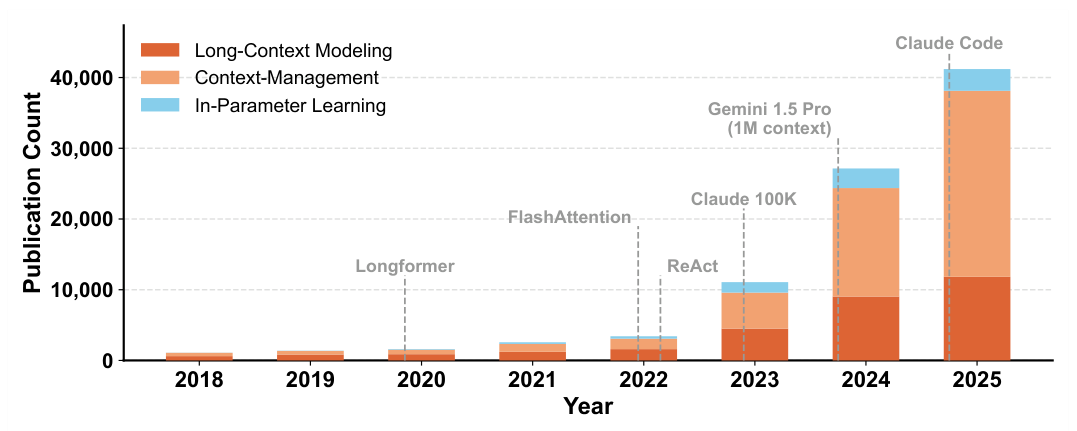
Figure 2.
A comparison of ICL and IPL across three dimensions: the scale of experience each can accumulate, the capability ceiling each imposes, and the degree to which each supports novel-task generalization.
Figure 2.
A comparison of ICL and IPL across three dimensions: the scale of experience each can accumulate, the capability ceiling each imposes, and the degree to which each supports novel-task generalization.
Disclaimer/Publisher’s Note: The statements, opinions and data contained in all publications are solely those of the individual author(s) and contributor(s) and not of MDPI and/or the editor(s). MDPI and/or the editor(s) disclaim responsibility for any injury to people or property resulting from any ideas, methods, instructions or products referred to in the content. |
© 2026 by the authors. Licensee MDPI, Basel, Switzerland. This article is an open access article distributed under the terms and conditions of the Creative Commons Attribution (CC BY) license (http://creativecommons.org/licenses/by/4.0/).
Copyright: This open access article is published under a Creative Commons CC BY 4.0 license, which permit the free download, distribution, and reuse, provided that the author and preprint are cited in any reuse.