

Submitted:
15 October 2026
Posted:
20 October 2026
Read the latest preprint version here
Abstract
Multimodal large language models (MLLMs) can generate plausible responses without using the relevant evidence or meeting task constraints. We separate the Modality Gap in cross-modal correspondence and evidence use from the Intent Gap in behavior relative to specified constraints, goals, and human expectations. Six dimensions organize the review: architecture, objective functions, data construction, training, evaluation, and applications. The first four control evidence access, optimization targets, supervision, and updates. Comparing mechanisms and supervision assumptions shows what interface compatibility, target imitation, preference learning, and verifiable rewards can each demonstrate about alignment. Evaluation at the representation, task, and behavior levels tests these choices through controlled input changes and reward-model validation, and we interpret each gain together with its model, task, and evaluation setup instead of comparing scores across conditions. Studies in robotics, safety, healthcare, recommendation, and climate decision support share three requirements: traceable evidence, valid supervision, and constraint-sensitive decisions. Stronger representations or higher benchmark scores can leave the claimed alignment mechanism unresolved, which motivates four research directions: evidence-consistent alignment across modalities, verified self-correction and test-time alignment, targeted repair from failure diagnosis, and reliable transfer to underrepresented settings.
Keywords:
alignment evaluation
; cross-modal alignment
; human preference alignment
; instruction tuning
; multimodal large language models
; representation learning
; safety alignment
1. Introduction
1.1. Background and Symptoms of MLLM Misalignment
Multimodal large language models (MLLMs) extend the understanding and generation capabilities of large language models (LLMs) to inputs such as images, audio, and video. Reliable performance of MLLMs depends not only on what these models can perceive, but also on how they use that information to respond under task and safety constraints. However, MLLMs can produce fluent responses that ignore evidence or violate task and safety requirements. Hallucination benchmarks reveal unsupported objects and misread relations [1,2], while visual jailbreaks elicit unsafe behavior even when the request is recognized [3]. Both failures sever the connection between evidence and appropriate behavior that alignment is meant to secure (Figure 1). Aggregate response quality mixes them, so evidence use and behavior need separate tests.
1.2. Scope of Multimodal Alignment and Fundamental Gaps
Multimodal alignment is the consistency of representations and observable behavior with input evidence, task requirements, and human expectations, where evidence is the task-relevant input content a response should depend on. Core studies concern MLLM interfaces, grounded generation, instruction and preference alignment, and evaluation. Vision–language foundations explain inherited objectives and supervision, adjacent applications illustrate transferable constraints, and text-only methods supply methodology, not multimodal results; GUI agents and image generation appear only where they inform MLLM alignment. We searched arXiv, IEEE Xplore, ACM Digital Library, ACL Anthology, CVF Open Access, OpenReview, and Google Scholar, and traced citations.
We diagnose misalignment through two gaps. The Modality Gap is a failure to establish or use task-relevant correspondence between multimodal evidence and the model’s representations or responses. It is broader than the embedding separation between modalities [4], because proximity alone does not establish object binding, temporal correspondence, or evidence-dependent answers. The Intent Gap is behavior inconsistent with specified task constraints, user goals, or human expectations. Its criteria must be explicit, since a refusal can satisfy safety yet fail a benign request.
The two gaps are complementary. In Figure 2, misreading the mug’s color is a Modality Gap failure, and an answer that stays the same after the color changes suggests a shortcut; lifting a correctly recognized mug against the instruction is an Intent Gap failure. Some errors belong to neither gap: an arithmetic mistake after correct visual reading is a reasoning error unless further tests implicate evidence use or constraint compliance. The gaps can also interact: preferences for fluent answers can reward unsupported detail, and refusal that ignores the image sacrifices benign utility. Joint assessment therefore records evidence sensitivity, task success, and constraint violations.
1.3. Analytical Dimensions of MLLM Misalignment
Six dimensions locate where methods act on the two gaps and how effects are checked. The first four are intervention dimensions: architecture controls which evidence reaches the large language model (LLM), objective functions define which discrepancies are optimized, data construction supplies supervision, and training decides which components are updated and when. Correspondence-oriented choices (bridges, contrastive losses, hard negatives) mainly target the Modality Gap; instruction and preference supervision targets the Intent Gap and can narrow the Modality Gap when it requires supporting evidence. Evaluation tests alignment claims at the representation, task, and behavior levels, and applications expose domain constraints. Table 2, Table 3, and Table 6 tag entries by intended gap. Each work is placed by its primary contribution and cross-referenced elsewhere: a preference loss under objectives, pair construction under data, policy updates under training, and graph construction under architecture.
1.4. Contributions and Organization
Existing surveys cover representation and behavior across stages [8], misalignment causes [6], alignment and fusion [9], representation transfer [7], hallucination mechanisms [10], and preferences [11]. General MLLM [5,12], hallucination [13], safety [14], and evaluation surveys [15,16] provide context. Table 1 compares their organizing dimensions. Building on them, this survey links mechanisms and supervision assumptions to the tests an alignment claim needs:
- 1)
- 2)
- Tests for alignment claims. Section 6 argues that a gain supports an alignment claim only when controlled input changes, constraint checks, validated judges, and within-study comparisons show which gap it narrows.
- 3)
2. Architecture: Bridging Modalities
Architecture is the first intervention dimension: it fixes which evidence reaches the LLM, so it mainly targets the Modality Gap. Flamingo [17], BLIP-2 [18], and LLaVA [19] connect modalities to language models, but compression may discard decisive details. Table 2 compares bridges, tokens, structure, attention, and experts. How the model uses this evidence and how it behaves (Intent Gap) depend on objectives (Section 3) and supervision (Section 4).

Table 2.
Architectural choices for evidence access, compared by evidence unit, access or selection, and principal trade-off; entries do not rank performance.
Table 2.
Architectural choices for evidence access, compared by evidence unit, access or selection, and principal trade-off; entries do not rank performance.
| Family | Examples | Evidence unit | Access or selection | Principal trade-off | Gap |
|---|---|---|---|---|---|
| Lightweight bridges | BLIP-2 [18]; TokenPacker [20] | Continuous visual features | Learned queries; regional detail injection | Token budget versus recoverable local detail | M |
| Discrete interfaces | SpeechT5 [21]; AnyGPT [22] | Shared or modality-specific codes | Codebook mixing; common token sequence | Compact codes versus quantization and sequence length | M |
| Structured representations | MAIL [23]; VideoTree [24] | Entities/relations; temporal hierarchy | Entity-mediated exchange; query-adaptive selection | Inspectable structure versus extraction error and omitted evidence | M |
| Attention and layer fusion | AGE-VLM [25]; Dense Connector [26] | Regions; encoder-layer features | Spatial anchoring; multi-layer aggregation | Fine detail versus feature-processing and memory cost | M |
| Modality-indexed experts | VLMo [27]; MoT [28] | Modality-labeled tokens | Fixed parameter selection; cross-modal interaction | Specialization versus parameter storage and shared transfer | M |
| Adaptive experts | OneLLM [29]; MoIIE [30] | Features or modality tokens | Dynamic projection routing; intra-/inter-modal experts | Conditional capacity versus routing and utilization overhead | M |
M: Modality Gap, the primary architectural target; behavioral requirements need further supervision and evaluation. Gap tags mark intended targets (see Section 6).
2.1. Lightweight Bridging-Module Alignment
Bridges map modality features into LLM inputs, so their design determines which evidence survives compression.
2.1.1. Modality-to-LLM Interface Bridging
CLIPTrans [31], a machine-translation precursor, maps M-CLIP features to mBART prefixes, and MMA [32] routes adapters while preserving text-only ability. EMG-Adaptor maps unvoiced electromyography (EMG) to frozen LLM embeddings [33], and SEMI generates projector low-rank adaptation (LoRA) adapters through a hypernetwork before few-example adaptation [34]. Speech Captioner instead verbalizes affective and prosodic cues [35]. Latent interfaces retain learned features, whereas verbalization exposes interpretable cues but may discard nonverbal detail.
2.1.2. Bridging Module Structure Refinement
AlignVLM constrains the destination space, mapping visual features to weighted LLM text embeddings [36]. On the source side, VPG-C recovers missed details through guidance-conditioned residual extraction [37], and AcFormer selects pretrained vision-token anchors instead of generic queries [38]. The two are complementary and can be compared on semantic compatibility and retained information under a fixed token budget.
2.1.3. Interface Extension for Complex Multimodal Scenarios
For images, LLaVA-UHD slices high-resolution inputs while preserving spatial layout [39], and TokenPacker injects regional detail into low-resolution queries [20]. For video, LLaMA-VID uses one query-conditioned context token and one content token per frame [40], and LLaVA-ST combines language-aligned coordinates with separate spatial and temporal compression [41]. Spatial selection and temporal compression keep different evidence, so their token efficiency should be judged on local and temporal tasks, respectively.
Continuous interfaces also support generation: EasyGen connects BiDiffuser to an LLM [42], and PUMA predicts multigranular visual features for diffusion decoding [43]. Both work without a shared discrete codebook, the alternative examined next, though their generation pipelines need not be lightweight.
2.2. Discretization-Based Alignment
Discretization creates shared codes or modality-specific tokens for a common sequence model, trading compact units against quantization loss of modality-specific detail.
2.2.1. Cross-Modal Codebook Construction
Cross-Modal Code Matching (CMCM) aligns distributions over shared codes [44], Finite Discrete Tokens (FDT) ground patches and words in shared concepts [45], and Uni-Code pretrains a unified code space [46]. SpeechT5 also mixes quantized speech/text states with contextual states for decoder attention [21], retaining context that code matching alone loses. Code utilization and modality-specific detail are therefore separate evaluation targets.
2.2.2. Vocabulary-Grounded Token Adaptation
LQAE quantizes images using pretrained word embeddings and a frozen language denoiser without paired data [47], Tar’s TA-Tok learns visual tokens from projected LLM embeddings [48], and UniAudio 1.5’s LLM-Codec represents audio with vocabulary words or subwords [49]. TA-VQ instead supervises visual codes with long-text semantics [50], and Lan et al. supplement optical character recognition (OCR) with multimodal codes for translation [51]. Vocabulary reuse gives a compatible interface without necessarily making code meanings interpretable; semantic supervision constrains those meanings separately.
2.2.3. Unified Token-Based Multimodal Modeling
AnyGPT places modality-specific image, speech, and music tokens alongside text in an autoregressive stream [22]. 4M instead tokenizes text, images, geometry, and semantics for masked multimodal prediction [52], and 4M-21 extends this to 21 modalities [53]. Despite similar token interfaces, autoregressive and masked-subset prediction expose different dependencies, and neither explicitly guarantees relational or temporal validity.
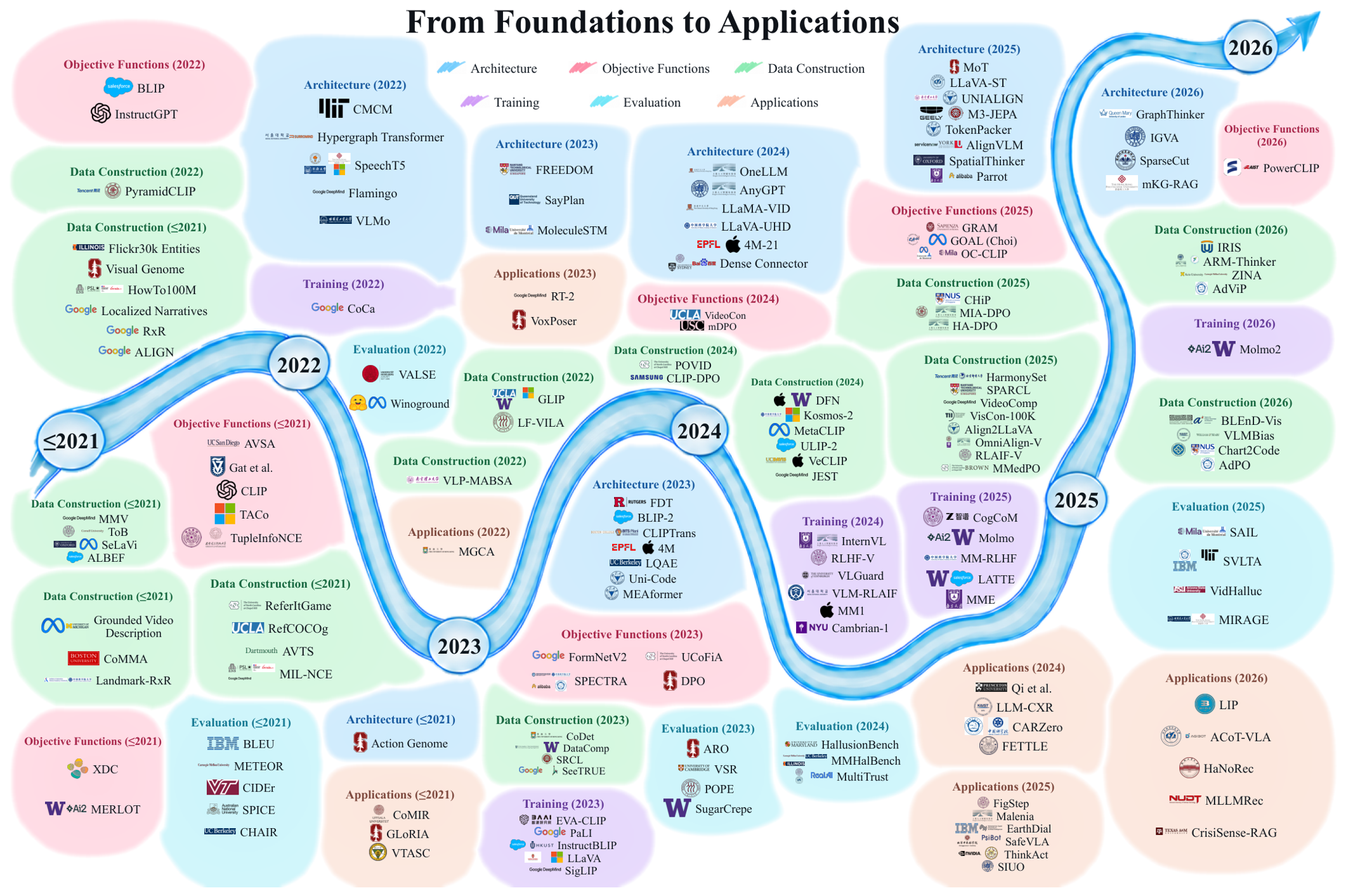
Figure 3.
Timeline of representative multimodal alignment work. Works are arranged by publication year along the river (–2026) and colored by their primary dimension: architecture, objective functions, data construction, training, evaluation, or applications. Logos indicate the institutions of first and co-first authors. The layout does not rank methods, and a work may contribute to more than one dimension.
Figure 3.
Timeline of representative multimodal alignment work. Works are arranged by publication year along the river (–2026) and colored by their primary dimension: architecture, objective functions, data construction, training, evaluation, or applications. Logos indicate the institutions of first and co-first authors. The layout does not rank methods, and a work may contribute to more than one dimension.
2.3. Structured Representation Alignment
Structured methods make relations explicit before reasoning: graphs encode pairwise relations, hypergraphs higher-order ones, and hierarchies or event sequences preserve granularity and temporal order.
Structural foundations from outside MLLM reasoning include MEAformer’s cross-graph entity alignment [54], FREEDOM’s interaction-edge pruning [55], and molecular structure–text alignment in MoleculeSTM and FineMolTex [56,57]. For visual scenes, Action Genome annotates evolving video relations [58], and LLaVA-SG exposes scene-graph features to an LLM [59]. Relation availability after construction should be distinguished from its downstream use.
2.3.1. Graph-Based Multimodal Representation
MAIL exchanges information between scene and concept graphs through shared entities [23], and MR-MKG combines multimodal graphs with RGAT encoding [60]. VaLiK verifies visually constructed graphs [61], whereas mKG-RAG retrieves graph evidence from documents [62]. GraphThinker models within- and cross-event relations [63], 3DGraphLLM encodes 3D objects and relations [64], SayPlan retrieves planning-relevant subgraphs [65], and SpatialThinker combines scene graphs with spatial rewards [66]. Construction makes relations inspectable and retrieval limits which remain accessible, so extraction errors and omitted subgraphs need separate tests even when reasoning is structurally coherent.
2.3.2. Hypergraph-Based Multimodal Representation
Hypergraph Transformer builds question and query-aware knowledge hypergraphs for multi-hop visual question answering (VQA) [67], and TAMO preserves row–column dependencies in tables before LLM integration [68]. The former derives higher-order structure from a query and the latter from the input format; both depend on valid hyperedge construction.
2.3.3. Hierarchical and Sequential Multimodal Representation
VideoTree selects video content through a query-adaptive hierarchy [24], HMR3D retains patch-, view-, and scene-level 3D context [69], and TRACE predicts ordered events with timestamps, salience, and captions [70]. Selection, spatial granularity, and event order constrain different dependencies, and omissions from abstraction should be evaluated alongside answer accuracy.
2.4. Attention-Based Alignment
Attention-based alignment controls where the model looks and which visual feature levels reach the language model, and so governs access to fine-grained evidence.
2.4.1. Spatial Attention and Local Anchoring
Spatial anchoring targets language-relevant regions. AGE-VLM [25] distills Segment Anything Model spatial knowledge into cross-attention, and Patch-Aligned Training [71] adds patch-level image–caption supervision. UniPixel [72] and MLLM-For3D [73] extend anchoring to segmentation and 3D regions, and IPLoc [74] learns in-context personalized localization. FLMR [75] preserves local evidence through late interaction rather than a global vector. Spatial supervision changes what is learned, whereas late interaction changes how local matches are kept at retrieval; in neither case does concentrated attention alone establish causal dependence on the selected region.
2.4.2. Cross-Layer Feature Fusion
Dense Connector [26] aggregates encoder layers, while SparseCut [76] and MMFuser [77] select complementary low- and high-level features. The instruction-guided vision aggregator (IGVA) weights layers by query [78], and Lin et al. examine layer choice and insertion point [79]. Broad aggregation favors feature coverage, whereas selective or query-conditioned fusion prioritizes relevance; neither is equivalent to spatial localization. Token-expanding and channel-wise fusion also differ in cost, so retained detail and memory are comparable only under matched inputs.
2.5. Expert-Based Alignment
Expert-based alignment assigns modality-specific or shared parameters while preserving cross-modal exchange. Modality-indexed pathways and adaptive routing determine where computation happens; objectives (Section 3) shape what parameters learn.
2.5.1. Modality-Indexed Parameter Pathways
VLMo selects modality-specific feed-forward experts by the known modality and shares self-attention without a learned load balancer [27]. Mixture-of-Transformers (MoT) partitions Transformer parameters by modality while retaining global cross-modal self-attention [28]; a mixture-of-experts (MoE) layer instead selects expert submodules, often feed-forward networks. Specialization alone implies neither sparse computation nor lower per-token cost.
2.5.2. Adaptive Expert Routing
Adaptive mechanisms adjust expert contributions to the input. OneLLM maps eight modalities through a universal projection module with dynamic routing [29], UNIALIGN combines modality-aware experts, LoRA, and soft binding within a shared encoder [80], and M3-JEPA uses a multi-gate MoE predictor to separate modality-specific and shared information in latent space [81]. Parrot routes visual tokens to language-conditioned experts for multilingual alignment [82], while MoIIE learns routes to intra- and inter-modality experts and adds a load-balancing term to discourage expert collapse [30]. Routing in a projector, shared encoder, or latent predictor alters different parts of the evidence path, so equal expert counts do not mean equivalent interventions; comparisons should report preserved evidence and active computation, including routing and balancing overhead.
Gains in compatibility, token efficiency, or specialization show at most that evidence is available, not that the decoder uses it. BLIP-2’s first-stage ablation supports staged design [18] but not grounding in general, so evidence use should be retested after tuning. Architectural gains are attributable only under matched backbones, resolution, and token budgets.
3. Objective Functions: Optimizing Multimodal Alignment
Given the evidence an architecture makes available, the objective specifies which discrepancies are minimized (Table 3). The five families below move from local correspondence through set-level geometry, generative prediction, and auxiliary constraints to whole responses. The first four mainly act on the Modality Gap; only the last scores responses and so acts on the Intent Gap directly.
Table 3.
Objective families for multimodal alignment, compared by supervision and learning signal and by the limitation discussed. Gap tags mark intended targets.
Table 3.
Objective families for multimodal alignment, compared by supervision and learning signal and by the limitation discussed. Gap tags mark intended targets.
| Objective family | Examples | Supervision and learning signal | Limitation discussed | Gap |
|---|---|---|---|---|
| Fine-grained structured contrastive | GLoRIA [83]; GOAL (Choi et al.) [84] | Region–word or object matches are contrasted with competing candidates. | Incorrect correspondences and false negatives corrupt local supervision. | M |
| Topological and distributional metric | [85]; GRAM [86] | Transport matches distributions; Gramian volume constrains joint geometry. | Global agreement leaves instance correspondence unresolved. | M |
| Generative implicit alignment | 4M [52]; BLIP [87] | Masked targets or image-conditioned captions supervise generation. | Redundant context can predict targets without the intended evidence. | M |
| Constraint and routing regularization | SPECTRA [88]; MoIIE [30] | Temporal constraints synchronize streams; router penalties balance utilization. | Synchronization and expert utilization need different checks; routing balance is an auxiliary target. | M |
| Instruction and preference alignment | LLaVA [19]; VLM-RLAIF [89]; RLHF-V [90] | Demonstrations specify responses; judgments compare candidate behavior or unsupported content. | Judge errors, narrow pair coverage, and textual shortcuts can survive preference gains. | M, I |
| Verifiable rewards | Visual-RFT [91] | Task-specific verifiers score sampled outputs for group-relative policy updates. | Correct outcomes leave intermediate reasoning and unsupervised safety constraints unverified. | M, I |
M: Modality Gap; I: Intent Gap; M, I: can target both gaps, the Modality Gap only when supervision requires supporting evidence.
3.1. Fine-Grained Structured Contrastive Loss
This family aligns local units (regions, tokens, or their combinations) and calibrates which candidates count as negatives. Let and be normalized visual and textual units, indicate an annotated or mined positive correspondence, and denote temperature-scaled similarity. A canonical multi-positive objective is
where indexes anchors and controls concentration. Matrix A supplies positive supervision; other candidates are negatives unless masked.
3.1.1. Precise Local Semantic Anchoring
CLIP’s global loss does not locate sentence-supporting evidence [92]. GLoRIA aligns medical regions with report words [83] (Section 7.3), GOAL combines global and local object alignment [84], and TACo uses token-aware cascaded video–text objectives [93]. PowerCLIP links region combinations to parse-tree nodes through bidirectional triplet losses [94]. UCoFiA contrastively learns coarse-to-fine similarities and applies Sinkhorn–Knopp normalization only at retrieval inference [95]. Fine-grained objectives are informative only when their correspondence labels are reliable; otherwise localization errors become supervision.
3.1.2. Structured Compositional Logic Constraint
Pairwise similarity can overlook incorrect relations or event order. TupleInfoNCE contrasts multimodal tuples [96], VideoCon perturbs caption entities, actions, attributes, relations, or order [97], and FormNetV2 applies multimodal graph contrast to documents [98]. Negative construction thus fixes which compositional errors each objective can expose, and ambiguous or partially correct negatives can create contradictory supervision.
3.1.3. Latent-Space Distribution Calibration
Duplicate semantic content and correlated samples can make unpaired items unreliable negatives. Calibration therefore reweights, masks, or groups candidates in (1), and audio–visual spatial alignment also uses physical co-location as a correspondence cue [99]. Reweighting changes a candidate’s influence, masking removes its constraint, and grouping changes the positive set; all three need a defensible notion of semantic equivalence, and batch-level geometry alone cannot establish instance-level correspondence.
3.2. Topological and Distributional Metric Loss
Set-level objectives align distributions, using optimal transport for many-to-many matching or geometric measures for higher-order structure. For empirical distributions and , entropic optimal transport gives
where is the transport cost, P the soft assignment, the feature masses, the entropy, and the smoothing strength. In (2), paired sets, masses, and costs replace one-to-one labels.
3.2.1. Optimal-Transport Soft Matching
adapts representations, aligning shifted modalities to domain-stable anchors through dimension-wise optimal transport and cross-domain adversarial alignment [85]. ProtoMM instead acts at test time, combining transport-based comparison with weighted updates of multimodal prototypes while network weights stay fixed [100]. Even a smooth transport plan is limited by the semantic validity of its features and costs.
3.2.2. High-Dimensional Geometric Metrics
Geometric objectives preserve neighborhoods, centroids, ranks, or volumes omitted by pairwise cosine similarity. GRAM minimizes a Gramian volume derived from the determinant of a multimodal Gram matrix [86], so several modalities are constrained jointly instead of anchored pairwise. Such agreement stays at the representation level; a smaller geometric loss shows neither downstream grounding nor numerical stability.
3.3. Generative Implicit Alignment Loss
Generative objectives align modalities implicitly by predicting missing or subsequent tokens. For target positions and visible input ,
where is a discrete target. Autoregressive context includes the preceding target prefix, whereas masked prediction uses the context permitted by its attention mask. Diffusion and other continuous-target losses fall outside (3).
3.3.1. Cross-Modal Masked Reconstruction
3.3.2. Autoregressive and Modality-Specific Generation
BLIP combines image-conditioned captioning with contrastive and matching objectives [87]. Modality-specific parameters do not dictate the generative loss. MoT’s Chameleon setting predicts discrete text and image tokens autoregressively, whereas its Transfusion setting pairs text prediction with image diffusion [28]; MoIIE mainly uses language-model cross-entropy with routing regularization [30].
MiCo [101] combines contrast, feature matching, and text generation through a shared multimodal encoder and contextual embeddings. Conditional generation encourages output compatibility, whereas auxiliary matching losses constrain input representations more directly; even combined, they leave open whether generated content depends on the intended evidence.
3.3.3. Self-Guided Proxy Supervision
Without dense labels, XDC exchanges cross-modal cluster assignments [102], whereas MERLOT predicts masked language from ordered video [103]. Cluster agreement and contextual prediction constrain different dependencies, and a successful proxy need not identify the evidence behind a particular response.
3.4. Constraint and Routing Regularization
Regularizers add temporal, spatial, or information-flow and routing constraints to the task loss:
where is contrastive or generative and each weights an optional penalty. Timestamps, coordinates/relations, or router assignments supervise these auxiliary constraints, which are not complete alignment objectives.
3.4.1. Spatiotemporal Synchronization
3.4.2. Spatial and Topological Grounding
Spatial penalties connect words to regions, pixels, or 3D entities. World-to-Words supervises grounded open-vocabulary acquisition [104], and OC-CLIP uses object-centric binding in contrastive pretraining [105]. Both rely on localized evidence at different units of correspondence; one-to-one matching does not suit abstract words or diffuse evidence.
3.4.3. Information-Flow and Routing Balance
Functional-entropy regularization targets modality dominance [106]. For expert models, MoIIE’s load-balancing penalty [30] follows Switch Transformer [107]: , where is the expert set, the assigned batch fraction, and the mean router probability. Balanced experts can still process language shortcuts: utilization and overflow measure computational balance, and only controlled input changes test evidence dependence.
3.5. Instruction and Preference Alignment Objectives
Response-level objectives address the Intent Gap: supervised fine-tuning (SFT) imitates targets, reward modeling learns comparative scores, proximal policy optimization (PPO) optimizes rewarded behavior under a reference-policy constraint, and direct preference optimization (DPO) fits the policy to preference pairs. Their effect on the Modality Gap depends on whether supervision separates grounded from unsupported responses.
3.5.1. Token-Level Supervised Fine-Tuning
For multimodal input x, instruction q, and target response , SFT minimizes
LLaVA and InstructBLIP imitate demonstrated answers [19,108] without comparing plausible alternatives. If instructions or preceding tokens predict the target, the loss in (5) can decrease without image use. Section 4.1 and Section 5 discuss evidence-grounded targets and their training use.
3.5.2. Reward Modeling and PPO
Given a preferred response and rejected response , a Bradley–Terry reward model minimizes
where is a learned scalar reward and is the logistic function. PPO then maximizes reward using the clipped surrogate , with policy ratio for generated token in state , advantage , and clipping range , typically plus a Kullback–Leibler (KL) penalty to a reference policy. InstructGPT uses this pipeline [109], and VLM-RLAIF applies it to video–language models with AI feedback [89] (Section 5). The main risk is reward misspecification or judge bias, amplified by on-policy optimization.
3.5.3. Direct Preference Optimization
3.5.4. Verifiable Rewards and Group-Relative Optimization
Reinforcement learning with verifiable rewards (RLVR) uses task-specific checks. Visual-RFT combines classification/localization rewards with Group Relative Policy Optimization (GRPO) [91], which compares samples from the same input through group-relative advantages, without a separately trained value model. Outcome verification leaves intermediate reasoning unverified, and safety and preference claims require constraints beyond the optimizer itself.
No objective is more reliable than its signal. Noisy correspondence labels, ambiguous negatives, invalid transport costs, judge bias, and unverified RLVR reasoning limit what a lower loss shows about either gap. Most of these signals are built during data construction (Section 4).
4. Data Construction: Building Alignment Signals
Data construction supplies the supervision that the objectives of Section 3 consume; an objective can penalize only the distinctions its data makes visible (Table 4). Pairs and hard negatives mainly target the Modality Gap, preference and safety labels the Intent Gap, and faithfulness corrections both. We compare strategies by annotation validity and coverage rather than size, and separate training resources from evaluation-only benchmarks.
4.1. High-Quality Pairing and Annotation
Pairs reduce the Modality Gap only when they expose supporting evidence (regions, annotation processes, spatiotemporal or embodied traces, or domain-specific structure) rather than loose co-occurrence.
4.1.1. Region-Level Grounding
ReferItGame and RefCOCOg identify referred objects [120,121]; Flickr30k Entities adds phrase–region links and coreference, and Visual Genome adds attributes, relations, and scene graphs [114,122]. Object annotations specify targets, whereas relational labels also constrain their connections, so evaluation should match the claimed granularity.
4.1.2. Process-Level Grounding
Localized Narratives synchronizes descriptions with mouse traces over 849k images [123]. Unlike boxes, traces preserve mention order and evidence attribution, but record the annotator’s process rather than the model’s reasoning.
4.1.3. Spatiotemporal and Embodied Grounding
RxR links instruction words to pose traces [115], and Landmark-RxR adds sub-trajectories and endpoint landmarks [124]. Grounded Video Description links noun phrases to boxes in video frames [125], SPECTRA supplies word-level speech boundaries [88], and HarmonySet labels video–music rhythm, emotion, theme, and cultural relevance [126]. Pose, region, and timing annotations specify different types of correspondence; semantic compatibility extends beyond synchronization.
4.1.4. Domain-Specialized Evidence
UCM-VeID V2 diversifies aerial RGB–infrared pairs for vehicle re-identification [127]; Zhang et al. preserve hierarchical-table adjacency and headers [128]. VLP-MABSA and World-to-Words (Section 3) ground opinions or new words in visual evidence [104,129]. These adjacent tasks require identity-, structure-, or sentiment-specific correspondence, which generic pair counts cannot measure.
4.2. Synthetic and Self-Supervised Alignment Data
Natural structure, model predictions, and generated examples replace dense annotation with approximate correspondence of varying reliability.
4.2.1. Naturally Occurring Weak Supervision
AVTS contrasts synchronized and temporally mismatched streams [130]. XDC and SeLaVi cluster unlabeled videos across modalities [102,131], complementing MERLOT’s masked prediction and PyramidCLIP’s negative sampling [103,132]. CLIP and ALIGN use noisy web pairs [92,133], and HowTo100M uses narrated clips [134]. These signals scale differently from precise object or event annotation and are not equivalent supervision.
4.2.2. Model-Based Refinement and Selection
Refinement changes content: ALBEF uses momentum distillation [135], BLIP generates and filters captions [87], and VeCLIP enriches alt-text [136]. Selection decides which samples are included: Align2LLaVA filters instructions using human criteria and LLM-aware selection [137], DataComp standardizes selection experiments and Data Filtering Networks learn filters [116,138], MetaCLIP balances metadata concepts [139], and HYPE removes vague pairs [140]. JEST’s jointly learnable batches also decide which samples co-occur [141]. DataComp’s fixed recipe isolates selection more directly than cross-model scores but does not establish optimal instruction-tuning or preference filters.
4.2.3. Structure-Derived Self-Supervision
MIL-NCE permits nearby narration matches [142], LF-VILA combines temporal contrast with hierarchical video attention [143], MMV joins video, audio, and text signals [144], and CoMMA grounds narration without manual boxes [145]. ToB uses 3D geometry, GRAFT co-located ground and satellite views, and ULIP-2 rendered image–text–3D triplets [146,147,148]. Temporal neighborhoods tolerate uncertain pairing; geometry and co-location impose acquisition constraints whose validity can change with sensors or scenes.
4.2.4. Model-Generated Targeted Data
GLIP supplies pseudo boxes [149], CoDet mines region–word links across images that share concepts [150], and Kosmos-2 links noun phrases to location tokens [151]. SPARCL instead generates minimally differing object, attribute, and relation pairs [152], and the SVLTA benchmark renders synthetic video situations to test temporal alignment [153]. Positive links identify supporting evidence and controlled alternatives identify relevant distinctions, but generation must preserve unrelated content to prevent artifact shortcuts.
4.3. Multimodal Preference Data Construction
Preferences constrain helpfulness, safety, and factuality for the Intent Gap and narrow the Modality Gap only when comparisons depend on visual support. Losses and updates appear in Section 3 and Section 5; here we compare what a judgment contains and who produced it.
4.3.1. Multi-Dimensional Rubrics
MM-RLHF provides image and video ratings, rankings, and critiques [117]; OmniAlign-V combines alignment examples with human evaluation [154]. Text-only RewardBench and SafetyBench contribute ranking and safety methodology, not multimodal training data [155,156]. In adjacent image generation, Q-Eval-100K separates visual quality and semantic alignment [157], and the Pick-High dataset is paired with an Image-Contained-Text reward for prompt content and an image-only High-Preference reward for aesthetics and detail [158]. Separating datasets, rewards, and rubrics prevents a single preference label from concealing conflicting criteria.
4.3.2. Hallucination and Faithfulness Correction
RLHF-V uses human corrections to response segments [90], HA-DPO uses style-matched GPT-4 corrections [111], and CHiP combines response-, segment-, and token-level preferences [159]. CHAIR-DPO ranks object hallucinations, and HalLoc and ZINA label unsupported spans [160,161,162]. OPA-DPO first adapts to ground-truth and corrected responses to reduce policy mismatch [163]. Localization, style control, and policy matching address distinct confounders, yet precise corrections still mislead if their wording reveals the preference label.
4.3.3. Annotation Sources and Judge Reliability
Human judgments remain important in high-risk domains despite their cost. VLM-RLAIF instead has a supervised video–language model judge its candidate responses [89] (Section 5), but the Silent Judge study and FairJudge identify evaluation biases from position, response length, and provenance [164,165]. ViLBench collects process-level reward data through tree search [166]. ARM-Thinker’s tools (image cropping, document retrieval, instruction verification) add external checks to reward judgments but do not provide step-level process supervision [167]. IRIS filters self-generated pairs using implicit rewards [168], and CycleReward derives preferences from image–text reconstruction consistency [169]; both reduce dependence on human annotation. Beyond response generation, DSPO adapts preference learning to diffusion score matching, and MAPLE transfers fine-grained signals to cross-modal retrieval embeddings [170,171]. Agreement within an automated pipeline is not independent validation, so these judgments need task-specific human or evidence-based checks.
4.4. Negative Sampling and Hard Negatives
Hard negatives isolate object, attribute, relation, or temporal mismatches that random sampling misses.
4.4.1. Lexical and Visual Perturbation
Text perturbations expose unsupported responses to a fixed image. POVID and RLAIF-V construct hallucinated negatives through error injection or atomic-claim scoring [113,172], SRCL weakens penalties on semantically close negatives, and RPO refines on-policy pairs through guided reflection [173,174]; CLIP-DPO forms preferences from CLIP similarity without new labels [175]. Input edits test visual dependence: Re-Align retrieves similar images and MIA-DPO inserts distractor images [176,177]; Image-DPO applies semantic edits, blur, or pixelation, and AdViP removes key visual elements [178,179]. AdPO updates the image encoder for clean and adversarial inputs [180], MSR-Align constructs policy-grounded safety reasoning data [181], and VisuoAlign builds safety-alignment trajectories through multimodal tree search [182]. Response and input edits target the Modality Gap by testing faithfulness and evidence use; policy-grounded negatives target the Intent Gap by testing acceptable behavior. Robustness and refusal quality therefore need separate evaluation.
4.4.2. Compositional and Temporal Negatives
Generation supplies contrasts absent from retrieved data. SynViTA generates videos for negative captions and weights samples to mitigate generation noise [183], VideoCon and SeeTRUE/ConGen minimally change captions to contradict images or videos [97,184], and VideoComp reorders events, replaces actions, and mismatches video–text segments, challenging bag-of-words shortcuts [185]. Mining draws on observed data instead: TACo mines hard pairs within a batch using sentence- and token-level similarity, and TupleInfoNCE replaces selected modalities to create partially mismatched tuples [93,96]. CONE contrasts positive and randomly sampled negative windows with coarse-to-fine proposal ranking [186]. Mining keeps observed data but may miss rare contradictions; generation targets specific failures but can add synthesis artifacts. In both cases a hard negative helps only if it stays semantically valid and isolates the intended error.
4.4.3. Representation-Level Constraints
MM-EMBED uses modality-aware hard-negative mining during retrieval fine-tuning, whereas CLIP-Refine aligns features through post-pretraining before task-specific fine-tuning [187,188]. AVSA adds spatial alignment for video, and AMiF combines hard-negative mining with selective fusion of the task’s answer vocabulary in medical VQA [99,189]. Because hard negatives alone may be insufficient, OC-CLIP introduces object-centric biases and scene-graph parsing for multi-object scenes [105], and READ adds token reconstruction through a frozen decoder and sentence-level paraphrase alignment, improving compositional reasoning while retaining CLIP’s retrieval architecture [190]. Sampling changes which mismatches are observed; structural biases and reconstruction change how they are represented. Controlled ablations should separate the two before crediting gains to harder negatives.
4.5. Dataset Bias and Debiasing
Bias can suppress visual evidence (a Modality Gap failure) or favor inappropriate behavior (an Intent Gap failure). Interventions change distributions, gradients, or coverage.
4.5.1. Breaking Language Priors and Shortcut Learning
Models often exploit textual co-occurrence rather than rely on visual evidence. LexSym encourages compositional generalization through consistent substitutions across text and image representations [191], and NaPO trains on modality-biased preference pairs generated by masking inputs while downweighting noisy supervision [118]. Causal methods intervene at different points: CRA uses front-door visual and back-door linguistic interventions for video grounding, whereas CausalMM uses back-door adjustment and counterfactual attention to mitigate hallucinations [192,193]. As diagnostics, DrML probes visual classifiers through text embeddings, and VLMBias tests whether familiar visual patterns override observed details [194,195]. Data substitutions, preference reweighting, and causal interventions act at different stages, and removing one shortcut does not close either gap across tasks.
4.5.2. Optimization and Gradient-Level Debiasing
Conflicting gradients and unequal learning difficulty can suppress harder modalities. Gat et al.’s functional-entropy regularizer (Section 3) counters modality dominance [106], and ARL weights updates through prediction variance and auxiliary bias terms rather than requiring equal dependence [196]. Chen et al.’s gradient-balancing GOAL rescales fusion-loss gradients using predictive entropy and removes conflicting cross-modal components [197]; it is distinct from Choi et al.’s global–local object-alignment GOAL [84]. DisentangledSSL separates shared and modality-specific information using conditional mutual information [198]. These optimization-side controls complement data curation: balancing updates counters dominance, and decomposition preserves useful modality differences.
4.5.3. Addressing Long-Tail, Safety, and Social Biases
Web data overrepresents common objects and settings, so specialized domains need targeted coverage. MMedPO targets medical-imaging preferences [199], and the evaluation-only Chart2Code benchmark exposes shortfalls in chart-to-code generation [200]. VisCon-100K’s “leaky modality mix” lets training questions draw on both images and contextual descriptions; the term names a supervision design, not test-set contamination [201]. For safety, VLGuard and MMSafe-PO pair harmful requests with appropriate refusals [119,202], and ReGap targets the representation separation left by pretraining and reduces unsafe response rates in the evaluated settings [203]. For social bias, counterfactual studies show that visual attributes such as race and gender can change the likelihood of toxic output, and BLEnD-Vis reveals weaknesses in multi-regional cultural knowledge [204,205]. Unified MLLMs also inherit demographic generation bias from their language component, which Balanced Preference Loss reduces without degrading image quality [206]. Broader coverage supplies missing evidence but need not make responses safer or fairer, so coverage and behavioral supervision need separate subgroup and utility checks.
Each source of supervision brings its own confounder: annotator processes, synthesis artifacts, judge bias, corrections whose wording reveals the label, or limited coverage. Section 5 asks which modules these signals update, with which mixture, and in which order.
5. Training: A Staged Process for Multimodal Alignment
Training decides where and when the losses of Section 3 and the supervision of Section 4.1, Section 4.2, Section 4.3, Section 4.4 and Section 4.5 are applied, and what is checked between stages. The emphasis moves from correspondence in pretraining to behavior in instruction tuning (SFT) and preference and reward optimization, that is, from the Modality Gap toward the Intent Gap. Later updates must still preserve grounding and safety [119]. Table 5 summarizes each stage.
5.1. Stage 1: Multimodal Pretraining
Pretraining sets the correspondence that later stages inherit.
5.1.1. Frozen Versus Jointly Updated Components
BLIP-2 trains a Q-Former with a fixed image encoder before connecting a frozen LLM [18]. Freezing confines adaptation to this interface and preserves pretrained weights but cannot recover what the fixed features lack. Joint updates can change the evidence representation, while text replay and separate learning rates limit forgetting. The diagnosed bottleneck, more than parameter count, should guide this choice.
5.1.2. Objective Scheduling and Batch Construction
CLIP learns from paired batches, and EVA-CLIP revisits initialization, optimization, and augmentation [92,213]. SigLIP’s pairwise loss reduces global-softmax batch dependence [214]; ALBEF and BLIP coordinate matching, contrastive, and predictive losses [87,135]. Comparisons of pairwise losses and loss schedules should match examples and updates while controlling false negatives from semantic duplicates.
5.1.3. Data Composition and Transition Criteria
Sources set the evidence encountered, interleaved contexts require image–text integration, text replay preserves language coverage, and objective mixtures set gradient targets. PaLI varies multilingual tasks; CoCa combines captioning and contrast [215,216]. In MM1’s ablation (Figure 5a in [207]), replacing caption-only data with a 50:50 caption/interleaved mix lowers mean zero-shot performance from 39.3 to 33.4 but raises eight-shot performance from 45.0 to 62.2. No single ratio serves both regimes, so transition checks should cover grounding, language retention, and the intended prompting regime. Qwen2.5-VL chains vision–language alignment, multimodal pretraining, long-context adaptation, and supervised and preference post-training [208]; unlike frozen-backbone recipes, its stages add input complexity and trainable parameters.
5.2. Stage 2: Instruction-Supervised Fine-Tuning
SFT minimizes (5); recipes differ in which modules adapt, how tasks are sampled, and what the targets contain.
5.2.1. Trainable Parameters and Optimization Schedule
LLaVA first aligns a projector, then updates it and the LLM with a fixed vision encoder [19], whereas InstructBLIP freezes both backbones and updates an instruction-aware Q-Former [108]. The former reshapes the language policy; the latter mainly conditions evidence extraction. Reports should name the updated modules and test retained grounding.
5.2.2. Mixture Sampling During SFT
InternVL mixes captioning, VQA, OCR, grounding, and conversation [217], and Cambrian-1 studies task trade-offs under fixed data budgets [218]. Molmo and Molmo2 reweight grounding and selected synthetic sources [219,220]; OmniAlign-V tests preferences alongside capabilities [154]. Gains may reflect coverage or sampling weight, so ratios should be compared at fixed updates and response length before crediting more data.
5.2.3. Evidence-Grounded Instruction Targets
SFT addresses the Modality Gap mainly when its targets carry evidence. CogCoM trains on chain-of-manipulation data [221], and LATTE on reasoning traces synthesized over vision-specialist outputs [222]; both invoke manipulations or tools at inference. VisProg and ViperGPT instead compose executable programs without task-specific training [223,224]. Learned tool use and observable program execution thus allow different checks of reasoning. POPE and MMHalBench diagnose remaining hallucinations, while MME tests broader perception/cognition [1,225,226]; neither readable traces nor these scores alone establish faithfulness or calibration.
5.3. Stage 3: Preference and Reward Optimization
Preference updates depend on judge validity, sampled candidates, reference strength, and coverage of current-policy failures.
5.3.1. Reward-Model-Based Optimization
Learning rewards from AI feedback, VLM-RLAIF optimizes a video–language policy with PPO [89]. Judge errors can propagate into policy updates, so judges need held-out human agreement and validation on policy-generated candidates; reports should specify judge prompts, rollout sampling, and KL strength. Rewards need not imply PPO: MM-RLHF uses critique scores to weight MM-DPO [117].
5.3.2. Offline Preference-Pair Optimization
RLHF-V derives Dense DPO from human corrections [90]; HA-DPO, mDPO, and POVID supply style-controlled, image-conditioned, and injected-hallucination comparisons [111,112,113], discussed in Section 4.3, Section 3, and Section 4.4, respectively. Fixed pairs aid reproducibility but can miss current-policy failures. Testing preference margins after image replacement, with style and length controlled, separates visual learning from response-artifact classification.
5.3.3. Verifiable-Reward Fine-Tuning
Visual-RFT’s verifier-based GRPO (Section 3) learns from current-policy samples [91]. Unlike demonstrations, they expose the policy’s own errors; unlike learned judges, verifiers impose specified correctness rules. Group size, filtering, reward composition, and task coverage shape training behavior, and faithful-reasoning claims need intermediate checks beyond outcome rewards.
5.4. Inference-Time Intervention and Deployment Checks
Without parameter updates, VCD contrasts predictions under original and distorted images [209], whereas OPERA penalizes attention over-concentration and reallocates decoding choices [210]; both target evidence use during decoding. Woodpecker instead verifies and corrects completed responses [211]. Grounding, utility, and extra calls should be compared under matched inference budgets.
Later adaptation can weaken alignment gained at earlier stages, so safety checks must span all stages. MultiTrust and VLGuard provide multimodal testing and safety supervision [119,212], and studies of indirect prompt injection in LLM-integrated applications add adjacent context [227]. Released behavior should be validated on harmful and benign requests, with false refusals reported. Section 6 asks what it takes to accept an alignment claim at any stage.
6. Evaluation: How to Measure Alignment
Interventions in the four dimensions above aim to reduce the Modality Gap, the Intent Gap, or both. Evaluation checks whether they do, testing evidence use and requirement-compliant behavior separately. Table 6 organizes these tests by representation, task, and behavior level.
Table 6.
Alignment tests at representation, task, and behavior levels, with supporting diagnostics. Each row’s reference or contrast limits what it can establish.
Table 6.
Alignment tests at representation, task, and behavior levels, with supporting diagnostics. Each row’s reference or contrast limits what it can establish.
| Level / role | Examples | Reference or contrast | Measured property | Unresolved attribution | Gap |
|---|---|---|---|---|---|
| Representation | SAIL [228]; MIR [229] | Mapped representations; layer distributions | Compatibility or integration | Whether the decoder uses the information | M |
| Task | Winoground [230]; VSR [231]; SVLTA [153] | Compositional, spatial, or temporal contrasts | Sensitivity to relevant distinctions | Shortcuts outside the tested contrasts | M |
| Behavior: response grounding | POPE [1]; CHAIR [232] | Object-presence annotations | Unsupported object claims | Error location and causal mechanism | M |
| Behavior: trust and safety | MultiTrust [212]; VLGuard [119] | Trustworthiness tests; harmful and benign requests | Constraint compliance and retained utility | Coverage of unseen settings and attacks | M, I |
| Reasoning diagnosis | MIRAGE [233] | Verified perception followed by reasoning | Inference failures given evidence | Whether a gap is involved | – |
| Reward judge | VL-RewardBench [234]; Multimodal RewardBench [235] | Human-validated preferences | Judge agreement by failure category | New policy-generated candidates | M, I |
| Reference metric | CIDEr [236] | Reference captions | Descriptive consensus | Evidence use and constraint compliance | Indirect |
| Controlled protocol | mDPO [112]; controlled input changes | Fixed model and settings; valid updated references | Sensitivity to the claimed intervention | Distribution-shift artifacts and component interactions | M, I |
M: Modality Gap; I: Intent Gap; M, I: complementary tests of both gaps (a single benchmark may test only one); –: no gap attribution alone; Indirect: supporting signal only. Controls support all three levels.
6.1. Evaluation Objectives and Diagnostic Challenges
Correct answers can come from dataset patterns [1,237], and fluent responses can remain unsupported [13,238], so scores need evidence-dependence controls.
6.1.1. Correctness and Evidence Grounding
6.1.2. Diagnosing the Modality and Intent Gaps
In Figure 2, the answer to a color question should change when the mug’s color changes (Modality Gap), and the action should change when lifting is authorized (Intent Gap). A wrong calculation after verified perception remains a reasoning error unless further tests implicate either gap.
6.1.3. Confounders and Shortcut Controls
6.1.4. Hallucination, Reasoning, and Calibration
Output support, inference validity, and confidence relative to correctness are distinct. VidHalluc tests output support [243], MIRAGE isolates reasoning-chain errors after correct perception [233], and text-only Answer-Free Confidence Estimation contributes calibration methodology, not multimodal results [244]. Lower hallucination rates therefore do not establish calibrated refusal.
6.2. Evaluation Across Representation, Task, and Behavior Levels
The three levels separate available information, task-specific use, and behavior under requirements. They mark where a failure is observed, not which gap causes it, so a behavior-level probe such as POPE can expose a Modality Gap failure.
6.2.1. Representation-Level Evaluation
SAIL probes mapped correspondence of individual image–text pairs [228], whereas Modality Integration Rate (MIR) measures layer-wise distribution distances [229]; SPECTRA’s speech timestamps and HarmonySet’s video–music labels capture temporal and semantic compatibility [88,126]. Such measurements show what is available, not whether the decoder uses it.
6.2.2. Task-Level Evaluation
Winoground and VALSE test compositional and linguistic distinctions [230,245], VSR spatial relations [231], and ARO attributes, relations, and order [246]; SugarCrepe exposes artifacts in compositional negatives [247]. VidHalluc tests video action, order, and transition hallucinations, and SVLTA targets temporal alignment [153,243]. Static relations and temporal synchronization need different contrasts, with plausible negatives that language alone cannot resolve.
6.2.3. Behavior-Level Evaluation
POPE probes object hallucinations, and HallusionBench tests illusions and errors involving perception and language priors [1,2]. MMHalBench and MM-RLHF assess factuality and response quality [117,225], and MultiTrust spans truthfulness, robustness, fairness, privacy, and safety [212]. Interactive use also needs cross-turn consistency and revision after evidence changes.
6.3. Metrics and Evaluators for Alignment
The metric follows the claim: correspondence, response support, or learned-judge reliability.
6.3.1. Retrieval and Localization Metrics
CLIP and ALIGN report recall at K for retrieval [92,133]; localization applies overlap or point criteria to labels such as RefCOCOg and Flickr30k Entities [114,121]. Temporal metrics should separate boundary accuracy, event order, and synchronization tolerance, since required timing precision varies by task.
6.3.2. Reference-Based Generation Metrics
6.3.3. Multimodal Reward-Model Evaluation
Human-verified preferences in VL-RewardBench cover general queries, hallucination, and reasoning [234]; Multimodal RewardBench broadens categories to correctness, knowledge, safety, and VQA [235]; MM-RLHF evaluates critique-based rewards [117]. Evaluations should report category-wise agreement and control candidate order, length, and image dependence. Accurate ranking of fixed pairs evaluates the judge, not policy generation or reliability on newly optimized outputs.
6.4. Controlled Protocols and Interpretation
Attributing a gain to an intervention requires within-study contrasts with fixed models and settings, which also expose trade-offs hidden by pooled scores.
6.4.1. Connecting Alignment Claims to Evidence
In mDPO’s matched Bunny-v1.0-3B comparison (Table 1 in [112]), DPO-to-mDPO lowers Object HalBench from 44.3 to 27.0 but also AMBER object coverage from 74.1 to 67.4. The two outcomes should be reported together but do not establish a universal grounding–utility trade-off. mDPO’s Table 2 separately ablates conditional preferences and the anchor term.
VLGuard’s appendix Table 14 reports XSTest-unsafe attack success, judged by Llama-Guard, of 1.5% for Vicuna-v1.5-7B versus 11.0% for LLaVA-v1.5-7B [119]. This matched text-query comparison motivates post-adaptation safety checks but does not show that every multimodal update reduces safety.
6.4.2. Evidence Checks and Decision Limits
A convincing alignment claim rests on tests that change relevant evidence, with valid updated references and irrelevant-change controls, under fixed prompts, resolution, decoding, and judges. Component attribution also needs localization tests or ablations, since removing the image can shift the input distribution; preference and safety claims need human-validated judges and must report benign utility and false refusals. Section 7 shows how domain constraints set the evidence and behavior these recommended checks must cover.
7. Applications: Alignment in Practice
We examine five domains in which the methods of Section 2, Section 3, Section 4, Section 5 and Section 6 meet a characteristic evidence type (Modality Gap) and explicit behavioral requirements (Intent Gap): embodied AI and robotics, content moderation and safety, healthcare, recommendation, and climate decision support. Their studies are compared on grounding, adaptation, and behavioral constraints, with task success as one measure among several.
7.1. Embodied AI and Robotics (Perception–Action Alignment)
A robot must ground an instruction in the scene and act within its goals and constraints. For spatial grounding, VoxPoser combines language-derived affordances and constraints with RGB-D observations in 3D value maps, specifying interaction targets and avoidance regions for motion planning [251].
Instruction-to-action mapping places alignment inside the policy. RT-2 co-fine-tunes vision–language–action (VLA) models on web data and robot demonstrations and encodes controls as tokens [252], but semantic generalization does not expand its demonstrated motor skills. ACoT-VLA guides action prediction with coarse reference trajectories and latent action priors [253]. Feedback and safety constraints act during execution. ThinkAct rewards a visual planner with demonstrated 2D gripper trajectories and conditions actions on latent plans [254]; in its video-conditioned execution examples, the planner replans after failed grasps. SafeVLA uses safety feedback in constrained reinforcement learning to maximize task reward subject to expected safety-cost limits [255]. Changed instructions and unseen layouts probe grounding (Modality Gap); safety-cost violations during execution indicate whether goals are pursued safely (Intent Gap).
7.2. Content Moderation and Safety (Value Alignment)
Moderation must judge an image and its text together and refuse unsafe requests without rejecting benign ones. Its failures fall into three categories. Qi et al.’s adversarial image perturbations bypass safeguards [256], so textual refusal does not establish multimodal robustness. Semantic transfer keeps harmful meaning but moves it to another channel: FigStep renders harmful instructions inside images and can thus bypass text-trained safeguards [3]. In cross-modal composition, individually benign inputs can jointly elicit unsafe responses, as SIUO shows [257], and filtering each modality separately cannot assess their combined meaning.
Defenses differ in what they modify. TGA changes the interface: it guides visual projection with retrieved image-related text and improves safety transfer in its tests [258]. VLGuard changes supervision, using safe and unsafe instruction–response examples in mixed or post-hoc fine-tuning [119]. Each failure type needs its own controls, and harmful responses should be reported with false refusals and benign utility to separate safety transfer from blanket rejection.
7.3. Healthcare (Clinical Evidence Alignment)
Medical alignment links clinical evidence across images and language (Modality Gap), while the Intent Gap concerns whether diagnosis, reporting, VQA, or segmentation meets clinical requirements for accuracy, uncertainty, and safety. Representation learning has moved from global to fine-grained alignment. GLoRIA [83] aligns global image–report and local region–word pairs, and MGCA [259] matches image–report instances, tokens through cross-attention, and diseases through cross-modal prototype assignments. VTASC [260] uses image–sentence matching and description-accuracy losses to promote report consistency. These methods supply representation foundations, not complete clinical MLLM alignment pipelines, and CoMIR [261] targets cross-modal image registration rather than image–report alignment.
Later work turns to clinical tasks. For zero-shot transfer, CARZero [262] classifies diseases through image–text cross-attention without target-task fine-tuning, although pretraining may already have covered the relevant concepts. Malenia [263] aligns 3D lesion-mask representations with textual attributes for unseen-category segmentation but needs segmentation labels for seen categories in training. Task-aware objectives target clinical interaction: LLM-CXR [264] instruction-tunes chest X-ray report generation, VQA, and text-conditioned image generation, and AMiF [189] brings hard-negative mining to medical VQA (Section 4.4). Multimodal Lego [265] addresses modular combination instead, reusing unimodal encoders across topologies and modalities through a common wrapper and frequency-domain representations.
Pretraining, zero-shot transfer, and interface adaptation need distinct tests: local and rare-finding recognition and supported reports for evidence use, and institutional transfer with safety and privacy checks for clinical requirements.
7.4. Recommendation Systems (User-Intent Alignment)
Recommendation must match item content to the interests that interaction histories and reviews reveal. FETTLE uses estimated feedback to align visual, textual, and interaction representations by recommendation utility, without a fixed modality reference [266]. LIP [267] and MLLMRec [268] instead ground item semantics in evidence of user interests. LIP enriches interaction-graph nodes and review-based edges with frozen LLaVA features and uses clustered review embeddings as intent prompts, whereas MLLMRec generates image descriptions and preference profiles from user history before refining noisy item relationships.
HaNoRec aligns sequential recommendation behavior beyond content representations: it weights examples by difficulty and policy responsiveness and smooths outputs through Gaussian LoRA-parameter perturbations [269]. FETTLE changes representations, LIP and MLLMRec construct preference evidence, and HaNoRec changes response optimization, so their ranking gains need separate tests of content dependence and user-constraint compliance.
Such gains should also survive end-to-end reproduction, not just reuse of supplied artifacts. Fioretti et al. [270] approximately reproduced the Netflix results of LLMRec, a system distinct from MLLMRec, from its released augmentations, but rebuilding the augmentation and comparing stronger baselines changed the performance conclusions; the result does not show that LLM augmentation fails in general.
7.5. Climate Resilience and Decision Support (Physical Evidence Alignment)
Climate decisions need observations that agree across sensors, locations, and times and must respect operational constraints. For multi-sensor grounding, EarthDial [271] uses instruction tuning to connect optical, radar, and multispectral observations with language across resolutions and time points, and its grounding and change-detection tasks assess spatial and temporal correspondence beyond generic scene descriptions.
Decision-oriented work selects or predicts the evidence a decision needs. For disaster assessment, CrisiSense-RAG retrieves text and images separately, prioritizing contemporaneous reports for peak inundation and later imagery for persistent structural damage [272]; its Hurricane Harvey study illustrates how the assessment target determines the relevant observation time. For heat adaptation, DeepShade [273], a diffusion model (not an MLLM) trained on simulated building shadows, generates urban shade maps conditioned on satellite imagery and textual time/solar-angle information, and its shade-aware routing shows how predicted physical conditions can feed decision support.
All three studies depend on location- and time-consistent evidence. Transfer across regions and events should therefore be evaluated separately from decision quality, with human review when evidence is incomplete or decisions are high-risk.
Across the five domains, three requirements recur: traceable evidence, valid supervision, and constraint-sensitive decisions. Ranking utility, report consistency, and safety-cost violations do not reduce to one alignment score; what transfers is a procedure that identifies evidence, specifies requirements, and tests both under controlled changes. Where such tests are missing, Section 8 proposes four research directions.
8. Open Challenges and Future Directions
Section 2, Section 3, Section 4, Section 5, Section 6 and Section 7 rest on one criterion: a gain counts as alignment only when a controlled test shows which gap it narrows and how. Four open problems still lack such tests; each motivates a research direction linking a diagnosed failure to a testable intervention.
8.1. Evidence-Consistent Alignment Across Modalities
Architecture and objective comparisons show that a compatible interface can hide local or temporal evidence loss. For token-based integration such as AnyGPT [22], it is unclear which correspondences remain necessary to the answer after compression and tuning. Chart2Code’s separate checks of executable output and rendered fidelity [200] illustrate why valid output structure and faithful source use need distinct evidence. Research should vary token budgets and evidence granularity under matched updates, then probe the Modality Gap through identity, relation, and event-order changes with irrelevant-change controls.
8.2. Verified Self-Correction and Test-Time Alignment
Preference and inference-time methods (Section 5) differ in whether feedback brings new evidence or recycles the model’s own judgment. Counterfactual VLA revises driving plans before trajectory generation [274], but showing that its mechanism transfers requires more than plausible revised plans. The open question is when to seek new observations or tool checks rather than revise internally; selective correction would do so only when their expected value exceeds their cost. Evaluation should compare repaired errors, newly introduced errors, and Intent Gap constraint violations against no-correction and compute-matched sampling baselines, with stopping rules tested under unreliable feedback.
8.3. From Failure Diagnosis to Targeted Repair
Section 6 separates detecting a failure from locating its cause. Vision-Language Introspection links hallucination-risk detection to localization and steering [275], and SIUO exposes unsafe combinations of individually benign inputs [257], yet which component to change for each failure remains unclear. Controlled replacement of perceptual features, retrieved evidence, or decision constraints can separate unavailable evidence, ignored evidence (both Modality Gap failures), reasoning errors, and Intent Gap constraint violations. Repair policies should be evaluated on this diagnosis and on retained capabilities, beyond the original failures.
8.4. Reliable Transfer to Underrepresented Settings
In the application domains, correspondence, supervision validity, and acceptable risk vary with the deployment setting. MMedPO adds clinical relevance to preferences [199], while BLEnD-Vis probes cultural knowledge across regions [205]. Accuracy may transfer even when the alignment criterion does not. Research should compare reusable grounding components (Modality Gap) with locally validated preference or constraint models (Intent Gap), holding out institutions, populations, sensors, or environments. Subgroup error, calibrated uncertainty, and benign utility would show whether adaptation meets the new constraint or sacrifices previously reliable behavior.
9. Conclusions
Fluent responses can mask two distinct failures; comparing the six dimensions yields three conclusions. First, an alignment mechanism is only as informative as its supervision: finer representations, preferred answers, and verifiable outcomes constrain different properties. Second, alignment must be evaluated separately at the representation, task, and behavior levels, since a correct answer or lower refusal rate can hide a different failure. Third, transfer across applications depends on traceable evidence, valid supervision, and constraint-sensitive decisions, motivating four research directions. The Modality and Intent Gaps make these claims diagnosable without treating every reasoning error as an alignment failure.
References
- Li, Y.; Du, Y.; Zhou, K.; Wang, J.; Zhao, X.; Wen, J.R. Evaluating object hallucination in large vision-language models. In Proceedings of the Proc. Conf. Empirical Methods Nat. Lang. Process. (EMNLP), 2023; pp. 292–305. [Google Scholar]
- Guan, T.; Liu, F.; Wu, X.; Xian, R.; Li, Z.; Liu, X.; Wang, X.; Chen, L.; Huang, F.; Yacoob, Y.; et al. HallusionBench: an advanced diagnostic suite for entangled language hallucination and visual illusion in large vision-language models. In Proceedings of the Proc. IEEE/CVF Conf. Comput. Vis. Pattern Recognit. (CVPR), 2024; pp. 14375–14385. [Google Scholar]
- Gong, Y.; Ran, D.; Liu, J.; Wang, C.; Cong, T.; Wang, A.; Duan, S.; Wang, X. FigStep: Jailbreaking large vision-language models via typographic visual prompts. Proc. Proc. AAAI Conf. Artif. Intell. 2025, Vol. 39, 23951–23959. [Google Scholar] [CrossRef]
- Liang, V.W.; Zhang, Y.; Kwon, Y.; Yeung, S.; Zou, J. Mind the Gap: Understanding the Modality Gap in Multi-modal Contrastive Representation Learning. Proc. Adv. Neural Inf. Process. Syst. 2022, Vol. 35, 17612–17625. [Google Scholar] [CrossRef]
- Caffagni, D.; Cocchi, F.; Barsellotti, L.; Moratelli, N.; Sarto, S.; Baraldi, L.; Cornia, M.; Cucchiara, R. The Revolution of Multimodal Large Language Models: A Survey. Proc. Find. Assoc. Comput. Linguist. ACL 2024, 2024, 13590–13618. [Google Scholar] [CrossRef]
- Shu, D.; Zhao, H.; Hu, J.; Liu, W.; Payani, A.; Cheng, L.; Du, M. Large Vision-Language Model Alignment and Misalignment: A Survey Through the Lens of Explainability. Proc. Find. Assoc. Comput. Linguist. EMNLP 2025, 2025, 1713–1735. [Google Scholar] [CrossRef]
- Lu, J.; Wang, H.; Xu, Y.; Wang, Y.; Yang, K.; Fu, Y. Representation Potentials of Foundation Models for Multimodal Alignment: A Survey. Proc. Proc. Conf. Empir. Methods Nat. Lang. Process. (EMNLP) 2025, 16669–16684. [Google Scholar] [CrossRef]
- Fang, Y.; Pang, X.; Yu, Q.; Min, F.; Cao, X.; Tao, P.; Li, T. Alignment in Large Vision Language Models: A Survey. Inf. Fusion 2026, 133, 104294. [Google Scholar] [CrossRef]
- Li, S.; Tang, H. Multimodal Alignment and Fusion: A Survey. Int. J. Comput. Vis. 2026, 134, 103. [Google Scholar] [CrossRef]
- Ho, Z.Y.; Liang, S.; Tao, D. Understanding Hallucinations in Large Visual and Language Models. ACM Comput. Surv. 2026, 58, 332:1–332:36. [Google Scholar] [CrossRef]
- Yu, T.; Zhang, Y.F.; Fu, C.; Wu, J.; Lu, J.; Wang, K.; Lu, X.; Shen, Y.; Zhang, G.; Song, D.; et al. Aligning Multimodal LLM with Human Preference: A Survey. arXiv 2025, arXiv:2503.14504. [Google Scholar]
- Yin, S.; Fu, C.; Zhao, S.; Li, K.; Sun, X.; Xu, T.; Chen, E. A survey on multimodal large language models. Natl. Sci. Rev. 2024, 11, nwae403. [Google Scholar] [CrossRef] [PubMed]
- Bai, Z.; Wang, P.; Xiao, T.; He, T.; Han, Z.; Zhang, Z.; Shou, M.Z. Hallucination of multimodal large language models: A survey. arXiv 2024, arXiv:2404.18930. [Google Scholar]
- Liu, X.; Zhu, Y.; Lan, Y.; Yang, C.; Qiao, Y. Safety of Multimodal Large Language Models on Images and Text. In Proceedings of the Proc. Int. Joint Conf. Artif. Intell. (IJCAI), 2024; pp. 8151–8159. [Google Scholar] [CrossRef] [PubMed]
- Li, J.; Lu, W.; Fei, H.; Luo, M.; Dai, M.; Xia, M.; Jin, Y.; Gan, Z.; Qi, D.; Fu, C.; et al. A Survey on Benchmarks of Multimodal Large Language Models. arXiv 2024, arXiv:2408.08632. [Google Scholar]
- Huang, J.; Zhang, J. A Survey on Evaluation of Multimodal Large Language Models. arXiv 2024, arXiv:2408.15769. [Google Scholar]
- Alayrac, J.B.; Donahue, J.; Luc, P.; Miech, A.; Barr, I.; Hasson, Y.; Lenc, K.; Mensch, A.; Millican, K.; Reynolds, M.; et al. Flamingo: a visual language model for few-shot learning. Proc. Adv. Neural Inf. Process. Syst. 2022, Vol. 35, 23716–23736. [Google Scholar] [CrossRef]
- Li, J.; Li, D.; Savarese, S.; Hoi, S. BLIP-2: Bootstrapping language-image pre-training with frozen image encoders and large language models. Proc. Proc. Int. Conf. Mach. Learn. (ICML) 2023, Vol. 202, 19730–19742. [Google Scholar]
- Liu, H.; Li, C.; Wu, Q.; Lee, Y.J. Visual instruction tuning. Proc. Adv. Neural Inf. Process. Syst. 2023, Vol. 36, 34892–34916. [Google Scholar] [CrossRef]
- Li, W.; Yuan, Y.; Liu, J.; Tang, D.; Wang, S.; Qin, J.; Zhu, J.; Zhang, L. TokenPacker: Efficient visual projector for multimodal LLM. Int. J. Comput. Vis. 2025, 133, 6794–6812. [Google Scholar] [CrossRef]
- Ao, J.; Wang, R.; Zhou, L.; Wang, C.; Ren, S.; Wu, Y.; Liu, S.; Ko, T.; Li, Q.; Zhang, Y.; et al. SpeechT5: Unified-modal encoder-decoder pre-training for spoken language processing. In Proceedings of the Proc. Annu. Meet. Assoc. Comput. Linguist. (ACL), 2022; pp. 5723–5738. [Google Scholar]
- Zhan, J.; Dai, J.; Ye, J.; Zhou, Y.; Zhang, D.; Liu, Z.; Zhang, X.; Yuan, R.; Zhang, G.; Li, L.; et al. AnyGPT: Unified multimodal LLM with discrete sequence modeling. In Proceedings of the Proc. Annu. Meet. Assoc. Comput. Linguist. (ACL), 2024; pp. 9637–9662. [Google Scholar]
- Dong, J.; Zhang, Q.; Zhou, H.; Zha, D.; Zheng, P.; Huang, X. Modality-aware integration with large language models for knowledge-based visual question answering. In Proceedings of the Proc. Annu. Meet. Assoc. Comput. Linguist. (ACL), 2024; pp. 2417–2429. [Google Scholar]
- Wang, Z.; Yu, S.; Stengel-Eskin, E.; Yoon, J.; Cheng, F.; Bertasius, G.; Bansal, M. VideoTree: Adaptive tree-based video representation for LLM reasoning on long videos. In Proceedings of the Proc. IEEE/CVF Conf. Comput. Vis. Pattern Recognit. (CVPR), 2025; pp. 3272–3283. [Google Scholar]
- Mahajan, S.; Le, H.; Park, H.; Farhadzadeh, F.; Hayat, M.; Porikli, F. Attention Guided Alignment in Efficient Vision-Language Models. arXiv 2025, arXiv:2511.17793. [Google Scholar]
- Yao, H.; Wu, W.; Yang, T.; Song, Y.; Zhang, M.; Feng, H.; Sun, Y.; Li, Z.; Ouyang, W.; Wang, J. Dense Connector for MLLMs. Proc. Adv. Neural Inf. Process. Syst. 2024, Vol. 37, 33108–33140. [Google Scholar] [CrossRef]
- Bao, H.; Wang, W.; Dong, L.; Liu, Q.; Mohammed, O.K.; Aggarwal, K.; Som, S.; Piao, S.; Wei, F. VLMo: Unified vision-language pre-training with mixture-of-modality-experts. Proc. Adv. Neural Inf. Process. Syst. 2022, Vol. 35, 32897–32912. [Google Scholar] [CrossRef]
- Liang, W.; Yu, L.; Luo, L.; Iyer, S.; Dong, N.; Zhou, C.; Ghosh, G.; Lewis, M.; Yih, W.t.; Zettlemoyer, L.; et al. Mixture-of-transformers: A sparse and scalable architecture for multi-modal foundation models. Trans. Mach. Learn. Res. 2025. [Google Scholar] [CrossRef]
- Han, J.; Gong, K.; Zhang, Y.; Wang, J.; Zhang, K.; Lin, D.; Qiao, Y.; Gao, P.; Yue, X. OneLLM: One Framework to Align All Modalities with Language. In Proceedings of the Proc. IEEE/CVF Conf. Comput. Vis. Pattern Recognit. (CVPR), 2024; pp. 26584–26595. [Google Scholar]
- Wang, D.; Wang, S.; Li, Z.; Wang, Y.; Li, Y.; Tang, D.; Shen, X.; Huang, X.; Wei, Z. MoIIE: Mixture of intra- and inter-modality experts for large vision language models. arXiv 2025, arXiv:2508.09779. [Google Scholar]
- Gupta, D.; Kharbanda, S.; Zhou, J.; Li, W.; Pfister, H.; Wei, D. CLIPTrans: transferring visual knowledge with pre-trained models for multimodal machine translation. In Proceedings of the Proc. IEEE/CVF Int. Conf. Comput. Vis. (ICCV), 2023; pp. 2875–2886. [Google Scholar]
- Luo, G.; Zhou, Y.; Ren, T.; Chen, S.; Sun, X.; Ji, R. Cheap and quick: Efficient vision-language instruction tuning for large language models. Proc. Adv. Neural Inf. Process. Syst. 2023, Vol. 36, 29615–29627. [Google Scholar] [CrossRef]
- Mohapatra, P.; Pandey, A.; Zhang, X.; Zhu, Q. Can LLMs understand unvoiced speech? Exploring EMG-to-text conversion with LLMs. In Proceedings of the Proc. Annu. Meet. Assoc. Comput. Linguist. (ACL), 2025; pp. 703–712. [Google Scholar]
- İnce, O.B.; Martins, A.F.T.; Mac Aodha, O.; Ponti, E.M. Sample-efficient Integration of New Modalities into Large Language Models. arXiv 2025, arXiv:2509.04606. [Google Scholar]
- Yan, H.; Zhu, Y.; Zheng, K.; Liu, B.; Cao, H.; Jiang, D.; Xu, L. Talk with human-like agents: Empathetic dialogue through perceptible acoustic reception and reaction. In Proceedings of the Proc. Annu. Meet. Assoc. Comput. Linguist. (ACL), 2024; pp. 15009–15022. [Google Scholar]
- Masry, A.; Rodriguez, J.A.; Zhang, T.; Wang, S.; Wang, C.; Feizi, A.; Suresh, A.K.; Puri, A.; Jian, X.; Noël, P.A.; et al. AlignVLM: Bridging Vision and Language Latent Spaces for Multimodal Document Understanding. Proc. Adv. Neural Inf. Process. Syst. 2025, Vol. 38, 161722–161748. [Google Scholar] [CrossRef]
- Li, J.; Pan, K.; Ge, Z.; Gao, M.; Ji, W.; Zhang, W.; Chua, T.S.; Tang, S.; Zhang, H.; Zhuang, Y. Fine-tuning Multimodal LLMs to Follow Zero-shot Demonstrative Instructions. In Proceedings of the Proc. Int. Conf. Learn. Represent. (ICLR), 2024. [Google Scholar]
- Liu, H.; You, Q.; Han, X.; Liu, Y.; Huang, H.; He, R.; Yang, H. Visual anchors are strong information aggregators for multimodal large language model. Proc. Adv. Neural Inf. Process. Syst. 2024, Vol. 37, 17696–17718. [Google Scholar] [CrossRef]
- Guo, Z.; Xu, R.; Yao, Y.; Cui, J.; Ni, Z.; Ge, C.; Chua, T.S.; Liu, Z.; Huang, G. LLaVA-UHD: An LMM perceiving any aspect ratio and high-resolution images. In Proceedings of the Proc. Eur. Conf. Comput. Vis. (ECCV), 2024; pp. 390–406. [Google Scholar]
- Li, Y.; Wang, C.; Jia, J. LLaMA-VID: An image is worth 2 tokens in large language models. In Proceedings of the Proc. Eur. Conf. Comput. Vis. (ECCV), 2024; pp. 323–340. [Google Scholar]
- Li, H.; Chen, J.; Wei, Z.; Huang, S.; Hui, T.; Gao, J.; Wei, X.; Liu, S. LLaVA-ST: A Multimodal Large Language Model for Fine-Grained Spatial-Temporal Understanding. In Proceedings of the Proc. IEEE/CVF Conf. Comput. Vis. Pattern Recognit. (CVPR), 2025; pp. 8592–8603. [Google Scholar]
- Zhao, X.; Liu, B.; Liu, Q.; Shi, G.; Wu, X.M. EasyGen: Easing multimodal generation with BiDiffuser and LLMs. In Proceedings of the Proc. Annu. Meet. Assoc. Comput. Linguist. (ACL), 2024; pp. 1351–1370. [Google Scholar]
- Fang, R.; Duan, C.; Wang, K.; Li, H.; Huang, L.; Tian, H.; Zeng, X.; Zhao, R.; Dai, J.; Li, H.; et al. PUMA: Empowering unified MLLM with multi-granular visual generation. In Proceedings of the Proc. IEEE/CVF Int. Conf. Comput. Vis. (ICCV), 2025; pp. 15447–15457. [Google Scholar]
- Liu, A.; Jin, S.; Lai, C.I.; Rouditchenko, A.; Oliva, A.; Glass, J. Cross-modal discrete representation learning. In Proceedings of the Proc. Annu. Meet. Assoc. Comput. Linguist. (ACL), 2022; pp. 3013–3035. [Google Scholar]
- Chen, Y.; Yuan, J.; Tian, Y.; Geng, S.; Li, X.; Zhou, D.; Metaxas, D.N.; Yang, H. Revisiting multimodal representation in contrastive learning: from patch and token embeddings to finite discrete tokens. In Proceedings of the Proc. IEEE/CVF Conf. Comput. Vis. Pattern Recognit. (CVPR), 2023; pp. 15095–15104. [Google Scholar]
- Xia, Y.; Huang, H.; Zhu, J.; Zhao, Z. Achieving cross modal generalization with multimodal unified representation. Proc. Adv. Neural Inf. Process. Syst. 2023, Vol. 36, 63529–63541. [Google Scholar] [CrossRef]
- Liu, H.; Yan, W.; Abbeel, P. Language quantized autoencoders: Towards unsupervised text-image alignment. Proc. Adv. Neural Inf. Process. Syst. 2023, Vol. 36, 4382–4395. [Google Scholar] [CrossRef]
- Han, J.; Chen, H.; Zhao, Y.; Wang, H.; Zhao, Q.; Yang, Z.; He, H.; Yue, X.; Jiang, L. Vision as a Dialect: Unifying Visual Understanding and Generation via Text-Aligned Representations. Proc. Adv. Neural Inf. Process. Syst. 2025, Vol. 38, 175918–175947. [Google Scholar] [CrossRef]
- Yang, D.; Guo, H.; Wang, Y.; Huang, R.; Li, X.; Tan, X.; Wu, X.; Meng, H. UniAudio 1.5: Large language model-driven audio codec is a few-shot audio task learner. Proc. Adv. Neural Inf. Process. Syst. 2024, Vol. 37, 56802–56827. [Google Scholar] [CrossRef]
- Liang, G.; Zhang, B.; Wen, Z.; Zhao, J.; Ye, Y.; Ye, K.; He, Y. Towards Improved Text-Aligned Codebook Learning: Multi-Hierarchical Codebook-Text Alignment with Long Text. In Proceedings of the Proc. IEEE/CVF Conf. Comput. Vis. Pattern Recognit. (CVPR), 2025; pp. 4060–4069. [Google Scholar]
- Lan, Z.; Yu, J.; Li, X.; Zhang, W.; Luan, J.; Wang, B.; Huang, D.; Su, J. Exploring better text image translation with multimodal codebook. In Proceedings of the Proc. Annu. Meet. Assoc. Comput. Linguist. (ACL), 2023; pp. 3479–3491. [Google Scholar]
- Mizrahi, D.; Bachmann, R.; Kar, O.; Yeo, T.; Gao, M.; Dehghan, A.; Zamir, A. 4M: Massively multimodal masked modeling. Proc. Adv. Neural Inf. Process. Syst. 2023, Vol. 36, 58363–58408. [Google Scholar] [CrossRef]
- Bachmann, R.; Kar, O.F.; Mizrahi, D.; Garjani, A.; Gao, M.; Griffiths, D.; Hu, J.; Dehghan, A.; Zamir, A. 4M-21: An Any-to-Any Vision Model for Tens of Tasks and Modalities. Proc. Adv. Neural Inf. Process. Syst. 2024, Vol. 37, 61872–61911. [Google Scholar] [CrossRef]
- Chen, Z.; Chen, J.; Zhang, W.; Guo, L.; Fang, Y.; Huang, Y.; Zhang, Y.; Geng, Y.; Pan, J.Z.; Song, W.; et al. MEAformer: Multi-modal Entity Alignment Transformer for Meta Modality Hybrid. In Proceedings of the Proc. ACM Int. Conf. Multimedia, 2023; pp. 3317–3327. [Google Scholar] [CrossRef]
- Zhou, X.; Shen, Z. A Tale of Two Graphs: Freezing and Denoising Graph Structures for Multimodal Recommendation. In Proceedings of the Proc. ACM Int. Conf. Multimedia, 2023; pp. 935–943. [Google Scholar] [CrossRef]
- Liu, S.; Nie, W.; Wang, C.; Lu, J.; Qiao, Z.; Liu, L.; Tang, J.; Xiao, C.; Anandkumar, A. Multi-modal molecule structure–text model for text-based retrieval and editing. Nat. Mach. Intell. 2023, 5, 1447–1457. [Google Scholar] [CrossRef]
- Li, Y.; Fang, Y.; Zhang, M.; Shi, C. Advancing Molecular Graph-Text Pre-training via Fine-grained Alignment. In Proceedings of the Proc. ACM SIGKDD Conf. Knowl. Discov. Data Min., 2025; pp. 1589–1599. [Google Scholar] [CrossRef]
- Ji, J.; Krishna, R.; Fei-Fei, L.; Niebles, J.C. Action Genome: Actions as Compositions of Spatio-Temporal Scene Graphs. In Proceedings of the Proc. IEEE/CVF Conf. Comput. Vis. Pattern Recognit. (CVPR), 2020; pp. 10236–10247. [Google Scholar]
- Wang, J.; Ju, J.; Luan, J.; Deng, Z. LLaVA-SG: Leveraging Scene Graphs as Visual Semantic Expression in Vision-Language Models. In Proceedings of the Proc. IEEE Int. Conf. Acoust., Speech Signal Process. (ICASSP), 2025; pp. 1–5. [Google Scholar] [CrossRef]
- Lee, J.; Wang, Y.; Li, J.; Zhang, M. Multimodal reasoning with multimodal knowledge graph. In Proceedings of the Proc. Annu. Meet. Assoc. Comput. Linguist. (ACL), 2024; pp. 10767–10782. [Google Scholar]
- Liu, J.; Meng, S.; Gao, Y.; Mao, S.; Cai, P.; Yan, G.; Chen, Y.; Bian, Z.; Wang, D.; Shi, B. Aligning vision to language: Annotation-free multimodal knowledge graph construction for enhanced LLMs reasoning. In Proceedings of the Proc. IEEE/CVF Int. Conf. Comput. Vis. (ICCV), 2025; pp. 981–992. [Google Scholar]
- Yuan, X.; Ning, L.; Ye, Q.; Fan, W.; Li, Q. mKG-RAG: Leveraging Multimodal Knowledge Graphs in Retrieval-Augmented Generation for Knowledge-intensive VQA. In Proceedings of the Proc. Int. ACM SIGIR Conf. Res. Develop. Inf. Retr., 2026; pp. 2274–2285. [Google Scholar] [CrossRef]
- Cheng, Z.; Li, D.; Hu, J.; Zang, Y.; Liu, Z.; Gong, S.; Li, W. GraphThinker: Reinforcing Temporally Grounded Video Reasoning with Event Graph Thinking. arXiv 2026, arXiv:2602.17555. [Google Scholar]
- Zemskova, T.; Yudin, D. 3DGraphLLM: Combining semantic graphs and large language models for 3D scene understanding. In Proceedings of the Proc. IEEE/CVF Int. Conf. Comput. Vis. (ICCV), 2025; pp. 8885–8895. [Google Scholar]
- Rana, K.; Haviland, J.; Garg, S.; Abou-Chakra, J.; Reid, I.; Suenderhauf, N. SayPlan: Grounding Large Language Models using 3D Scene Graphs for Scalable Robot Task Planning. Proc. Proc. Conf. Robot Learn. (CoRL) 2023, Vol. 229, 23–72. [Google Scholar]
- Batra, H.; Tu, H.; Chen, H.; Lin, Y.; Xie, C.; Clark, R. SpatialThinker: Reinforcing Scene Graph-Grounded Spatial Reasoning via Dense Rewards. arXiv 2025, arXiv:2511.07403. [Google Scholar]
- Heo, Y.J.; Kim, E.S.; Choi, W.S.; Zhang, B.T. Hypergraph Transformer: Weakly-supervised multi-hop reasoning for knowledge-based visual question answering. In Proceedings of the Proc. Annu. Meet. Assoc. Comput. Linguist. (ACL), 2022; pp. 373–390. [Google Scholar]
- Li, L.; Ye, C.; Ye, W.; Sun, Y.; Jiang, Z.; Wang, H.; Tian, J.; Zhang, Y.; Wang, N.; Fu, X.; et al. Table as a modality for large language models. Proc. Adv. Neural Inf. Process. Syst. 2025, Vol. 38, 29285–29308. [Google Scholar]
- Li, C.; Peh, E.; Fernando, B. HMR3D: Hierarchical Multimodal Representation for 3D Scene Understanding with Large Vision-Language Model. arXiv 2025, arXiv:2511.22961. [Google Scholar]
- Guo, Y.; Liu, J.; Li, M.; Liu, Q.; Chen, X.; Tang, X. TRACE: Temporal Grounding Video LLM via Causal Event Modeling. In Proceedings of the Proc. Int. Conf. Learn. Represent. (ICLR), 2025. [Google Scholar]
- Jiang, J.; Zhou, J.; Peng, B.; Ning, X.; Zhu, Z. Analyzing Fine-Grained Alignment and Enhancing Vision Understanding in Multimodal Language Models. Proc. Adv. Neural Inf. Process. Syst. 2025, Vol. 38, 1009–1034. [Google Scholar] [CrossRef]
- Liu, Y.; Ma, Z.; Pu, J.; Qi, Z.; Wu, Y.; Shan, Y.; Chen, C.W. UniPixel: Unified object referring and segmentation for pixel-level visual reasoning. Proc. Adv. Neural Inf. Process. Syst. 2025, Vol. 38, 126078–126108. [Google Scholar]
- Huang, J.; Chen, R.; Li, Z.; Gao, Z.; He, X.; Guo, Y.; Gong, M.; Liu, T. MLLM-For3D: Adapting multimodal large language model for 3D reasoning segmentation. Proc. Adv. Neural Inf. Process. Syst. 2025, Vol. 38, 54961–54984. [Google Scholar]
- Doveh, S.; Shabtay, N.; Schwartz, E.; Kuehne, H.; Giryes, R.; Feris, R.; Karlinsky, L.; Glass, J.; Arbelle, A.; Ullman, S.; et al. Teaching VLMs to localize specific objects from in-context examples. In Proceedings of the Proc. IEEE/CVF Int. Conf. Comput. Vis. (ICCV), 2025; pp. 9572–9582. [Google Scholar]
- Lin, W.; Chen, J.; Mei, J.; Coca, A.; Byrne, B. Fine-grained late-interaction multi-modal retrieval for retrieval augmented visual question answering. Proc. Adv. Neural Inf. Process. Syst. 2023, Vol. 36, 22820–22840. [Google Scholar] [CrossRef]
- Zhang, J.; Liang, F.; Zhang, Y.; Wang, W.; Zeng, R.; Hu, X. Sparse Shortcuts: Facilitating Efficient Fusion in Multimodal Large Language Models. arXiv 2026, arXiv:2602.00505. [Google Scholar]
- Cao, Y.; Huang, Y.; Zhu, W.; Liu, Y.; Chen, Z.; Shi, G.; Fa, Y.; Yang, Y.; Mei, S.; Lu, T. MMFuser: Multimodal Multi-layer Feature Fuser for Fine-Grained Vision-Language Understanding. Proc. Proc. Int. Conf. Pattern Recognit. (ICPR) 2026, Vol. 16816, 406–421. [Google Scholar] [CrossRef]
- Li, X.; Zheng, Y.; Chen, H.; Chen, X.; Liang, Y.; Lai, C.; Li, B.; Xue, X. Instruction-guided fusion of multi-layer visual features in large vision-language models. Pattern Recognit. 2026, 170, 111932. [Google Scholar] [CrossRef]
- Lin, J.; Chen, H.; Fan, Y.; Fan, Y.; Jin, X.; Su, H.; Fu, J.; Shen, X. Multi-layer visual feature fusion in multimodal LLMs: Methods, analysis, and best practices. In Proceedings of the Proc. IEEE/CVF Conf. Comput. Vis. Pattern Recognit. (CVPR), 2025; pp. 4156–4166. [Google Scholar]
- Zhou, B.; Li, L.; Wang, Y.; Liu, H.; Yao, Y.; Wang, W. UNIALIGN: Scaling Multimodal Alignment within One Unified Model. In Proceedings of the Proc. IEEE/CVF Conf. Comput. Vis. Pattern Recognit. (CVPR), 2025; pp. 29644–29655. [Google Scholar]
- Lei, H.; Cheng, X.; Qin, Q.; Wang, D.; Huang, H.; Gu, Q.; Wu, Y.; Ji, L. M3-JEPA: Multimodal Alignment via Multi-gate MoE based on the Joint-Embedding Predictive Architecture. Proc. Proc. Int. Conf. Mach. Learn. (ICML) 2025, Vol. 267, 33902–33917. [Google Scholar]
- Sun, H.L.; Zhou, D.W.; Li, Y.; Lu, S.; Yi, C.; Chen, Q.G.; Xu, Z.; Luo, W.; Zhang, K.; Zhan, D.C.; et al. Parrot: Multilingual Visual Instruction Tuning. Proc. Proc. Int. Conf. Mach. Learn. (ICML) 2025, Vol. 267, 57984–58007. [Google Scholar]
- Huang, S.C.; Shen, L.; Lungren, M.P.; Yeung, S. GLoRIA: A multimodal global-local representation learning framework for label-efficient medical image recognition. In Proceedings of the Proc. IEEE/CVF Int. Conf. Comput. Vis. (ICCV), 2021; pp. 3942–3951. [Google Scholar]
- Choi, H.; Jang, Y.K.; Eom, C. GOAL: Global-local Object Alignment Learning. In Proceedings of the Proc. IEEE/CVF Conf. Comput. Vis. Pattern Recognit. (CVPR), 2025; pp. 4070–4079. [Google Scholar]
- Sun, J.; Zhang, X.; Hong, S.; Zhu, J.; Zeng, L. Adversarial Alignment with Anchor Dragging Drift (A3D2): Multimodal Domain Adaptation with Partially Shifted Modalities. Proc. Proc. Annu. Meet. Assoc. Comput. Linguist. (ACL) 2025, 19680–19690. [Google Scholar] [CrossRef]
- Cicchetti, G.; Grassucci, E.; Sigillo, L.; Comminiello, D. Gramian Multimodal Representation Learning and Alignment. In Proceedings of the Proc. Int. Conf. Learn. Represent. (ICLR), 2025. [Google Scholar]
- Li, J.; Li, D.; Xiong, C.; Hoi, S. BLIP: Bootstrapping language-image pre-training for unified vision-language understanding and generation. Proc. Proc. Int. Conf. Mach. Learn. (ICML) 2022, Vol. 162, 12888–12900. [Google Scholar]
- Yu, T.; Gao, H.; Lin, T.E.; Yang, M.; Wu, Y.; Ma, W.; Wang, C.; Huang, F.; Li, Y. Speech-Text Dialog Pre-training for Spoken Dialog Understanding with Explicit Cross-Modal Alignment. In Proceedings of the Proc. Annu. Meet. Assoc. Comput. Linguist. (ACL), 2023; pp. 7900–7913. [Google Scholar] [CrossRef]
- Ahn, D.; Choi, Y.; Yu, Y.; Kang, D.; Choi, J. Tuning large multimodal models for videos using reinforcement learning from AI feedback. In Proceedings of the Proc. Annu. Meet. Assoc. Comput. Linguist. (ACL), 2024; pp. 923–940. [Google Scholar]
- Yu, T.; Yao, Y.; Zhang, H.; He, T.; Han, Y.; Cui, G.; Hu, J.; Liu, Z.; Zheng, H.T.; Sun, M.; et al. RLHF-V: Towards trustworthy MLLMs via behavior alignment from fine-grained correctional human feedback. In Proceedings of the Proc. IEEE/CVF Conf. Comput. Vis. Pattern Recognit. (CVPR), 2024; pp. 13807–13816. [Google Scholar]
- Liu, Z.; Sun, Z.; Zang, Y.; Dong, X.; Cao, Y.; Duan, H.; Lin, D.; Wang, J. Visual-RFT: Visual Reinforcement Fine-Tuning. In Proceedings of the Proc. IEEE/CVF Int. Conf. Comput. Vis. (ICCV), 2025; pp. 2034–2044. [Google Scholar]
- Radford, A.; Kim, J.W.; Hallacy, C.; Ramesh, A.; Goh, G.; Agarwal, S.; Sastry, G.; Askell, A.; Mishkin, P.; Clark, J.; et al. Learning transferable visual models from natural language supervision. Proc. Proc. Int. Conf. Mach. Learn. (ICML) 2021, Vol. 139, 8748–8763. [Google Scholar]
- Yang, J.; Bisk, Y.; Gao, J. TACo: Token-aware Cascade Contrastive Learning for Video-Text Alignment. In Proceedings of the Proc. IEEE/CVF Int. Conf. Comput. Vis. (ICCV), 2021; pp. 11542–11552. [Google Scholar]
- Kawamura, M.; Inoue, N.; Yanagi, R.; Kataoka, H.; Yokota, R. PowerCLIP: Powerset Alignment for Contrastive Pre-Training. In Proceedings of the Proc. IEEE/CVF Conf. Comput. Vis. Pattern Recognit. (CVPR), 2026; pp. 22111–22122. [Google Scholar]
- Wang, Z.; Sung, Y.L.; Cheng, F.; Bertasius, G.; Bansal, M. Unified Coarse-to-Fine Alignment for Video-Text Retrieval. In Proceedings of the Proc. IEEE/CVF Int. Conf. Comput. Vis. (ICCV), 2023; pp. 2816–2827. [Google Scholar]
- Liu, Y.; Fan, Q.; Zhang, S.; Dong, H.; Funkhouser, T.; Yi, L. Contrastive Multimodal Fusion with TupleInfoNCE. In Proceedings of the Proc. IEEE/CVF Int. Conf. Comput. Vis. (ICCV), 2021; pp. 734–743. [Google Scholar]
- Bansal, H.; Bitton, Y.; Szpektor, I.; Chang, K.W.; Grover, A. VideoCon: Robust Video-Language Alignment via Contrast Captions. In Proceedings of the Proc. IEEE/CVF Conf. Comput. Vis. Pattern Recognit. (CVPR), 2024; pp. 13927–13937. [Google Scholar]
- Lee, C.Y.; Li, C.L.; Zhang, H.; Dozat, T.; Perot, V.; Su, G.; Zhang, X.; Sohn, K.; Glushnev, N.; Wang, R.; et al. FormNetV2: Multimodal graph contrastive learning for form document information extraction. In Proceedings of the Proc. Annu. Meet. Assoc. Comput. Linguist. (ACL), 2023; pp. 9011–9026. [Google Scholar]
- Morgado, P.; Li, Y.; Vasconcelos, N. Learning Representations from Audio-Visual Spatial Alignment. Proc. Adv. Neural Inf. Process. Syst. 2020, Vol. 33, 4733–4744. [Google Scholar]
- Zhu, X.; Wang, S.; Zhu, B.; Li, M.; Li, Y.; Fang, J.; Wang, Z.; Wang, D.; Zhang, H. Dynamic Multimodal Prototype Learning in Vision-Language Models. In Proceedings of the Proc. IEEE/CVF Int. Conf. Comput. Vis. (ICCV), 2025; pp. 2501–2511. [Google Scholar]
- Zhang, Y.; Li, H.; Liu, J.; Yue, X. Scaling Omni-modal Pretraining with Multimodal Context: Advancing Universal Representation Learning Across Modalities. In Proceedings of the Proc. IEEE/CVF Int. Conf. Comput. Vis. (ICCV), 2025; pp. 1336–1348. [Google Scholar]
- Alwassel, H.; Mahajan, D.; Korbar, B.; Torresani, L.; Ghanem, B.; Tran, D. Self-Supervised Learning by Cross-Modal Audio-Video Clustering. Proc. Adv. Neural Inf. Process. Syst. 2020, Vol. 33, 9758–9770. [Google Scholar]
- Zellers, R.; Lu, X.; Hessel, J.; Yu, Y.; Park, J.S.; Cao, J.; Farhadi, A.; Choi, Y. MERLOT: Multimodal neural script knowledge models. Proc. Adv. Neural Inf. Process. Syst. 2021, Vol. 34, 23634–23651. [Google Scholar]
- Ma, Z.; Pan, J.; Chai, J. World-to-Words: Grounded Open Vocabulary Acquisition through Fast Mapping in Vision-Language Models. In Proceedings of the Proc. Annu. Meet. Assoc. Comput. Linguist. (ACL), 2023; pp. 524–544. [Google Scholar] [CrossRef]
- Assouel, R.; Astolfi, P.; Bordes, F.; Drozdzal, M.; Romero-Soriano, A. Object-centric binding in Contrastive Language-Image Pretraining. Proc. Adv. Neural Inf. Process. Syst. 2025, Vol. 38, 145626–145666. [Google Scholar] [CrossRef]
- Gat, I.; Schwartz, I.; Schwing, A.; Hazan, T. Removing Bias in Multi-modal Classifiers: Regularization by Maximizing Functional Entropies. Proc. Adv. Neural Inf. Process. Syst. 2020, Vol. 33, 3197–3208. [Google Scholar]
- Fedus, W.; Zoph, B.; Shazeer, N. Switch Transformers: Scaling to Trillion Parameter Models with Simple and Efficient Sparsity. J. Mach. Learn. Res. 2022, 23, 1–39. [Google Scholar]
- Dai, W.; Li, J.; Li, D.; Tiong, A.; Zhao, J.; Wang, W.; Li, B.; Fung, P.N.; Hoi, S. InstructBLIP: Towards general-purpose vision-language models with instruction tuning. Proc. Adv. Neural Inf. Process. Syst. 2023, Vol. 36, 49250–49267. [Google Scholar] [CrossRef]
- Ouyang, L.; Wu, J.; Jiang, X.; Almeida, D.; Wainwright, C.L.; Mishkin, P.; Zhang, C.; Agarwal, S.; Slama, K.; Ray, A.; et al. Training language models to follow instructions with human feedback. Proc. Adv. Neural Inf. Process. Syst. 2022, Vol. 35, 27730–27744. [Google Scholar] [CrossRef]
- Rafailov, R.; Sharma, A.; Mitchell, E.; Manning, C.D.; Ermon, S.; Finn, C. Direct Preference Optimization: Your Language Model is Secretly a Reward Model. Proc. Adv. Neural Inf. Process. Syst. 2023, Vol. 36, 53728–53741. [Google Scholar] [CrossRef]
- Zhao, Z.; Wang, B.; Ouyang, L.; Dong, X.; Wang, J.; He, C. Beyond Multimodal Hallucinations: Enhancing LVLMs through Hallucination-Aware Direct Preference Optimization. In Proceedings of the Proc. IEEE Int. Conf. Multimedia Expo (ICME), 2025; pp. 1–6. [Google Scholar] [CrossRef]
- Wang, F.; Zhou, W.; Huang, J.Y.; Xu, N.; Zhang, S.; Poon, H.; Chen, M. mDPO: Conditional Preference Optimization for Multimodal Large Language Models. In Proceedings of the Proc. Conf. Empirical Methods Nat. Lang. Process. (EMNLP), 2024; pp. 8078–8088. [Google Scholar] [CrossRef]
- Zhou, Y.; Cui, C.; Rafailov, R.; Finn, C.; Yao, H. Aligning Modalities in Vision Large Language Models via Preference Fine-tuning. arXiv 2024, arXiv:2402.11411. [Google Scholar]
- Plummer, B.A.; Wang, L.; Cervantes, C.M.; Caicedo, J.C.; Hockenmaier, J.; Lazebnik, S. Flickr30k Entities: Collecting Region-to-Phrase Correspondences for Richer Image-to-Sentence Models. Int. J. Comput. Vis. 2017, 123, 74–93. [Google Scholar] [CrossRef]
- Ku, A.; Anderson, P.; Patel, R.; Ie, E.; Baldridge, J. Room-Across-Room: Multilingual Vision-and-Language Navigation with Dense Spatiotemporal Grounding. In Proceedings of the Proc. Conf. Empirical Methods Nat. Lang. Process. (EMNLP), 2020; pp. 4392–4412. [Google Scholar] [CrossRef]
- Gadre, S.Y.; Ilharco, G.; Fang, A.; Hayase, J.; Smyrnis, G.; Nguyen, T.; Marten, R.; Wortsman, M.; Ghosh, D.; Zhang, J.; et al. DataComp: In search of the next generation of multimodal datasets. Proc. Adv. Neural Inf. Process. Syst. 2023, Vol. 36, 27092–27112. [Google Scholar] [CrossRef]
- Zhang, Y.; Yu, T.; Tian, H.; Fu, C.; Li, P.; Zeng, J.; Xie, W.; Shi, Y.; Zhang, H.; Wu, J.; et al. MM-RLHF: The Next Step Forward in Multimodal LLM Alignment. Proc. Proc. Int. Conf. Mach. Learn. (ICML) 2025, Vol. 267, 76625–76654. [Google Scholar]
- Zhang, Z.; Tang, H.; Sheng, J.; Zhang, Z.; Ren, Y.; Li, Z.; Yin, D.; Ma, D.; Liu, T. Debiasing Multimodal Large Language Models via Noise-Aware Preference Optimization. In Proceedings of the Proc. IEEE/CVF Conf. Comput. Vis. Pattern Recognit. (CVPR), 2025; pp. 9423–9433. [Google Scholar]
- Zong, Y.; Bohdal, O.; Yu, T.; Yang, Y.; Hospedales, T. Safety Fine-Tuning at (Almost) No Cost: A Baseline for Vision Large Language Models. Proc. Proc. Int. Conf. Mach. Learn. (ICML) 2024, Vol. 235, 62867–62891. [Google Scholar]
- Kazemzadeh, S.; Ordonez, V.; Matten, M.; Berg, T.L. ReferItGame: Referring to Objects in Photographs of Natural Scenes. In Proceedings of the Proc. Conf. Empirical Methods Nat. Lang. Process. (EMNLP), 2014; pp. 787–798. [Google Scholar]
- Mao, J.; Huang, J.; Toshev, A.; Camburu, O.M.; Yuille, A.; Murphy, K. Generation and Comprehension of Unambiguous Object Descriptions. In Proceedings of the Proc. IEEE/CVF Conf. Comput. Vis. Pattern Recognit. (CVPR), 2016; pp. 11–20. [Google Scholar]
- Krishna, R.; Zhu, Y.; Groth, O.; Johnson, J.; Hata, K.; Kravitz, J.; Chen, S.; Kalantidis, Y.; Li, L.J.; Shamma, D.A.; et al. Visual Genome: Connecting Language and Vision Using Crowdsourced Dense Image Annotations. Int. J. Comput. Vis. 2017, 123, 32–73. [Google Scholar] [CrossRef]
- Pont-Tuset, J.; Uijlings, J.; Changpinyo, S.; Soricut, R.; Ferrari, V. Connecting Vision and Language with Localized Narratives. In Proceedings of the Proc. Eur. Conf. Comput. Vis. (ECCV), 2020; pp. 647–664. [Google Scholar]
- He, K.; Huang, Y.; Wu, Q.; Yang, J.; An, D.; Sima, S.; Wang, L. Landmark-RxR: Solving Vision-and-Language Navigation with Fine-Grained Alignment Supervision. Proc. Adv. Neural Inf. Process. Syst. 2021, Vol. 34, 652–663. [Google Scholar]
- Zhou, L.; Kalantidis, Y.; Chen, X.; Corso, J.J.; Rohrbach, M. Grounded Video Description. In Proceedings of the Proc. IEEE/CVF Conf. Comput. Vis. Pattern Recognit. (CVPR), 2019; pp. 6571–6580. [Google Scholar]
- Zhou, Z.; Mei, K.; Lu, Y.; Wang, T.; Rao, F. HarmonySet: A Comprehensive Dataset for Understanding Video-Music Semantic Alignment and Temporal Synchronization. In Proceedings of the Proc. IEEE/CVF Conf. Comput. Vis. Pattern Recognit. (CVPR), 2025; pp. 3152–3162. [Google Scholar]
- Liu, X.; Qi, J.; Chen, C.; Bin, K.; Zhong, P. UCM-VeID V2: A Richer Dataset and A Pre-Training Method for UAV Cross-Modality Vehicle Re-Identification. In Proceedings of the Proc. IEEE/CVF Conf. Comput. Vis. Pattern Recognit. (CVPR), 2025; pp. 22286–22295. [Google Scholar]
- Zhang, X.; Song, A.; Qiu, J.; Jin, J.; Zhang, T.; Fang, X. Exploring Multimodal Relation Extraction of Hierarchical Tabular Data with Multi-task Learning. In Proceedings of the Proc. Annu. Meet. Assoc. Comput. Linguist. (ACL), 2025; pp. 26770–26781. [Google Scholar]
- Ling, Y.; Yu, J.; Xia, R. Vision-Language Pre-Training for Multimodal Aspect-Based Sentiment Analysis. In Proceedings of the Proc. Annu. Meet. Assoc. Comput. Linguist. (ACL), 2022; pp. 2149–2159. [Google Scholar]
- Korbar, B.; Tran, D.; Torresani, L. Cooperative Learning of Audio and Video Models from Self-Supervised Synchronization. In Proceedings of the Adv. Neural Inf. Process. Syst., 2018; Vol. 31. [Google Scholar]
- Asano, Y.M.; Patrick, M.; Rupprecht, C.; Vedaldi, A. Labelling unlabelled videos from scratch with multi-modal self-supervision. Proc. Adv. Neural Inf. Process. Syst. 2020, Vol. 33, 4660–4671. [Google Scholar]
- Gao, Y.; Liu, J.; Xu, Z.; Zhang, J.; Li, K.; Ji, R.; Shen, C. PyramidCLIP: Hierarchical Feature Alignment for Vision-Language Model Pretraining. Proc. Adv. Neural Inf. Process. Syst. 2022, Vol. 35, 35959–35970. [Google Scholar] [CrossRef]
- Jia, C.; Yang, Y.; Xia, Y.; Chen, Y.T.; Parekh, Z.; Pham, H.; Le, Q.; Sung, Y.H.; Li, Z.; Duerig, T. Scaling up visual and vision-language representation learning with noisy text supervision. Proc. Proc. Int. Conf. Mach. Learn. (ICML) 2021, Vol. 139, 4904–4916. [Google Scholar]
- Miech, A.; Zhukov, D.; Alayrac, J.B.; Tapaswi, M.; Laptev, I.; Sivic, J. HowTo100M: Learning a Text-Video Embedding by Watching Hundred Million Narrated Video Clips. In Proceedings of the Proc. IEEE/CVF Int. Conf. Comput. Vis. (ICCV), 2019; pp. 2630–2640. [Google Scholar]
- Li, J.; Selvaraju, R.; Gotmare, A.; Joty, S.; Xiong, C.; Hoi, S.C.H. Align before fuse: Vision and language representation learning with momentum distillation. Proc. Adv. Neural Inf. Process. Syst. 2021, Vol. 34, 9694–9705. [Google Scholar]
- Lai, Z.; Zhang, H.; Zhang, B.; Wu, W.; Bai, H.; Timofeev, A.; Du, X.; Gan, Z.; Shan, J.; Chuah, C.N.; et al. VeCLIP: Improving CLIP Training via Visual-Enriched Captions. In Proceedings of the Proc. Eur. Conf. Comput. Vis. (ECCV), 2024; pp. 111–127. [Google Scholar]
- Huang, H.; Liu, J.; Yu, Z.; Cai, L.; Jiao, D.; Zhang, W.; Tang, S.; Li, J.; Jiang, H.; Li, H.; et al. Align2LLaVA: Cascaded Human and Large Language Model Preference Alignment for Multi-modal Instruction Curation. Proc. Find. Assoc. Comput. Linguist. ACL 2025, 2025, 8759–8781. [Google Scholar] [CrossRef]
- Fang, A.; Jose, A.M.; Jain, A.; Schmidt, L.; Toshev, A.; Shankar, V. Data Filtering Networks. In Proceedings of the Proc. Int. Conf. Learn. Represent. (ICLR), 2024. [Google Scholar]
- Xu, H.; Xie, S.; Tan, X.E.; Huang, P.Y.; Howes, R.; Sharma, V.; Li, S.W.; Ghosh, G.; Zettlemoyer, L.; Feichtenhofer, C. Demystifying CLIP Data. In Proceedings of the Proc. Int. Conf. Learn. Represent. (ICLR), 2024. [Google Scholar]
- Kim, W.; Chun, S.; Kim, T.; Han, D.; Yun, S. HYPE: Hyperbolic Entailment Filtering for Underspecified Images and Texts. In Proceedings of the Proc. Eur. Conf. Comput. Vis. (ECCV), 2024; pp. 247–265. [Google Scholar]
- Evans, T.; Parthasarathy, N.; Merzic, H.; Henaff, O.J. Data curation via joint example selection further accelerates multimodal learning. Proc. Adv. Neural Inf. Process. Syst. 2024, Vol. 37, 141240–141260. [Google Scholar] [CrossRef]
- Miech, A.; Alayrac, J.B.; Smaira, L.; Laptev, I.; Sivic, J.; Zisserman, A. End-to-End Learning of Visual Representations From Uncurated Instructional Videos. In Proceedings of the Proc. IEEE/CVF Conf. Comput. Vis. Pattern Recognit. (CVPR), 2020; pp. 9876–9886. [Google Scholar]
- Sun, Y.; Xue, H.; Song, R.; Liu, B.; Yang, H.; Fu, J. Long-Form Video-Language Pre-Training with Multimodal Temporal Contrastive Learning. Proc. Adv. Neural Inf. Process. Syst. 2022, Vol. 35, 38032–38045. [Google Scholar] [CrossRef]
- Alayrac, J.B.; Recasens, A.; Schneider, R.; Arandjelović, R.; Ramapuram, J.; De Fauw, J.; Smaira, L.; Dieleman, S.; Zisserman, A. Self-Supervised MultiModal Versatile Networks. Proc. Adv. Neural Inf. Process. Syst. 2020, Vol. 33, 25–37. [Google Scholar]
- Tan, R.; Plummer, B.A.; Saenko, K.; Jin, H.; Russell, B.C. Look at What I’m Doing: Self-Supervised Spatial Grounding of Narrations in Instructional Videos. Proc. Adv. Neural Inf. Process. Syst. 2021, Vol. 34, 14476–14487. [Google Scholar]
- Wu, X.; Averbuch-Elor, H.; Sun, J.; Snavely, N. Towers of Babel: Combining Images, Language, and 3D Geometry for Learning Multimodal Vision. In Proceedings of the Proc. IEEE/CVF Int. Conf. Comput. Vis. (ICCV), 2021; pp. 418–427. [Google Scholar]
- Mall, U.; Phoo, C.P.; Liu, M.; Vondrick, C.; Hariharan, B.; Bala, K. Remote Sensing Vision-Language Foundation Models without Annotations via Ground Remote Alignment. In Proceedings of the Proc. Int. Conf. Learn. Represent. (ICLR), 2024. [Google Scholar]
- Xue, L.; Yu, N.; Zhang, S.; Panagopoulou, A.; Li, J.; Martín-Martín, R.; Wu, J.; Xiong, C.; Xu, R.; Niebles, J.C.; et al. ULIP-2: Towards Scalable Multimodal Pre-Training for 3D Understanding. In Proceedings of the Proc. IEEE/CVF Conf. Comput. Vis. Pattern Recognit. (CVPR), 2024; pp. 27081–27091. [Google Scholar]
- Li, L.H.; Zhang, P.; Zhang, H.; Yang, J.; Li, C.; Zhong, Y.; Wang, L.; Yuan, L.; Zhang, L.; Hwang, J.N.; et al. Grounded Language-Image Pre-training. In Proceedings of the Proc. IEEE/CVF Conf. Comput. Vis. Pattern Recognit. (CVPR), 2022; pp. 10955–10965. [Google Scholar]
- Ma, C.; Jiang, Y.; Wen, X.; Yuan, Z.; Qi, X. CoDet: Co-occurrence Guided Region-Word Alignment for Open-Vocabulary Object Detection. Proc. Adv. Neural Inf. Process. Syst. 2023, Vol. 36, 71078–71094. [Google Scholar] [CrossRef]
- Peng, Z.; Wang, W.; Dong, L.; Hao, Y.; Huang, S.; Ma, S.; Ye, Q.; Wei, F. Grounding Multimodal Large Language Models to the World. In Proceedings of the Proc. Int. Conf. Learn. Represent. (ICLR), 2024. [Google Scholar]
- Li, H.; Li, B.A. Enhancing Vision-Language Compositional Understanding with Multimodal Synthetic Data. In Proceedings of the Proc. IEEE/CVF Conf. Comput. Vis. Pattern Recognit. (CVPR), 2025; pp. 24849–24861. [Google Scholar]
- Du, H.; Wu, B.; Lu, Y.; Mao, Z. SVLTA: Benchmarking Vision-Language Temporal Alignment via Synthetic Video Situation. In Proceedings of the Proc. IEEE/CVF Conf. Comput. Vis. Pattern Recognit. (CVPR), 2025; pp. 13798–13809. [Google Scholar]
- Zhao, X.; Ding, S.; Zhang, Z.; Huang, H.; Cao, M.; Wang, W.; Wang, J.; Fang, X.; Wang, W.; Zhai, G.; et al. OmniAlign-V: Towards Enhanced Alignment of MLLMs with Human Preference. Proc. Proc. Annu. Meet. Assoc. Comput. Linguist. (ACL) 2025, 18490–18515. [Google Scholar] [CrossRef]
- Lambert, N.; Pyatkin, V.; Morrison, J.; Miranda, L.; Lin, B.Y.; Chandu, K.; Dziri, N.; Kumar, S.; Zick, T.; Choi, Y.; et al. RewardBench: Evaluating Reward Models for Language Modeling. Proc. Find. Assoc. Comput. Linguist. NAACL 2025, 2025, 1755–1797. [Google Scholar] [CrossRef]
- Zhang, Z.; Lei, L.; Wu, L.; Sun, R.; Huang, Y.; Long, C.; Liu, X.; Lei, X.; Tang, J.; Huang, M. SafetyBench: Evaluating the safety of large language models. In Proceedings of the Proc. Annu. Meet. Assoc. Comput. Linguist. (ACL), 2024; pp. 15537–15553. [Google Scholar]
- Zhang, Z.; Kou, T.; Wang, S.; Li, C.; Sun, W.; Wang, W.; Li, X.; Wang, Z.; Cao, X.; Min, X.; et al. Q-Eval-100K: Evaluating visual quality and alignment level for text-to-vision content. In Proceedings of the Proc. IEEE/CVF Conf. Comput. Vis. Pattern Recognit. (CVPR), 2025; pp. 10621–10631. [Google Scholar]
- Ba, Y.; Zhang, T.; Bai, Y.; Mo, W.; Liang, T.; Su, B.; Wen, J.R. Enhancing Reward Models for High-Quality Image Generation: Beyond Text-Image Alignment. In Proceedings of the Proc. IEEE/CVF Int. Conf. Comput. Vis. (ICCV), 2025; pp. 19022–19031. [Google Scholar] [CrossRef]
- Fu, J.; Huangfu, S.; Fei, H.; Shen, X.; Hooi, B.; Qiu, X.; Ng, S.K. CHiP: Cross-modal Hierarchical Direct Preference Optimization for Multimodal LLMs. In Proceedings of the Proc. Int. Conf. Learn. Represent. (ICLR), 2025. [Google Scholar]
- Compagnoni, A.; Caffagni, D.; Moratelli, N.; Baraldi, L.; Cornia, M.; Cucchiara, R. Mitigating Hallucinations in Multimodal LLMs via Object-aware Preference Optimization. In Proceedings of the Proc. Brit. Mach. Vis. Conf. (BMVC), 2025. [Google Scholar]
- Park, E.; Kim, M.; Kim, G. HalLoc: Token-level Localization of Hallucinations for Vision Language Models. In Proceedings of the Proc. IEEE/CVF Conf. Comput. Vis. Pattern Recognit. (CVPR), 2025; pp. 29893–29903. [Google Scholar]
- Wada, Y.; Matsuda, K.; Sugiura, K.; Neubig, G. ZINA: Multimodal Fine-grained Hallucination Detection and Editing. In Proceedings of the Proc. IEEE/CVF Conf. Comput. Vis. Pattern Recognit. (CVPR), 2026; pp. 32528–32538. [Google Scholar]
- Yang, Z.; Luo, X.; Han, D.; Xu, Y.; Li, D. Mitigating Hallucinations in Large Vision-Language Models via DPO: On-Policy Data Hold the Key. In Proceedings of the Proc. IEEE/CVF Conf. Comput. Vis. Pattern Recognit. (CVPR), 2025; pp. 10610–10620. [Google Scholar]
- Marioriyad, A.; Rohban, M.H.; Soleymani Baghshah, M. The Silent Judge: Unacknowledged Shortcut Bias in LLM-as-a-Judge. arXiv 2025, arXiv:2509.26072. [Google Scholar]
- Yang, B.; Feng, L.; Chen, Y.; Zhang, Y.; Xu, X.; Li, S. FairJudge: An Adaptive, Debiased, and Consistent LLM-as-a-Judge. arXiv 2026, arXiv:2602.06625. [Google Scholar]
- Tu, H.; Feng, W.; Chen, H.; Liu, H.; Tang, X.; Xie, C. ViLBench: A Suite for Vision-Language Process Reward Modeling. In Proceedings of the Proc. Conf. Empirical Methods Nat. Lang. Process. (EMNLP), 2025; pp. 6764–6779. [Google Scholar] [CrossRef]
- Ding, S.; Fang, X.; Liu, Z.; Zang, Y.; Cao, Y.; Zhao, X.; Duan, H.; Dong, X.; Liang, J.; Wang, B.; et al. ARM-Thinker: Reinforcing Multimodal Generative Reward Models with Agentic Tool Use and Visual Reasoning. In Proceedings of the Proc. IEEE/CVF Conf. Comput. Vis. Pattern Recognit. (CVPR), 2026; pp. 22195–22205. [Google Scholar]
- Li, Y.; Yan, Y.; Han, J.; Ming, F.; Lv, L.; Jin, Y. IRIS: Implicit Reward-Guided Internal Sifting for Mitigating Multimodal Hallucination. arXiv 2026, arXiv:2602.01769. [Google Scholar]
- Bahng, H.; Chan, C.; Durand, F.; Isola, P. Cycle Consistency as Reward: Learning Image-Text Alignment Without Human Preferences. In Proceedings of the Proc. IEEE/CVF Int. Conf. Comput. Vis. (ICCV), 2025; pp. 22934–22946. [Google Scholar] [CrossRef]
- Zhu, H.; Xiao, T.; Honavar, V. DSPO: Direct Score Preference Optimization for Diffusion Model Alignment. In Proceedings of the Proc. Int. Conf. Learn. Represent. (ICLR), 2025. [Google Scholar]
- Zhao, P.; Luan, R.; Zhang, W.; Wu, P.; He, S. Guiding Cross-Modal Representations with MLLM Priors via Preference Alignment. Proc. Adv. Neural Inf. Process. Syst. 2025, Vol. 38, 75649–75675. [Google Scholar] [CrossRef]
- Yu, T.; Zhang, H.; Li, Q.; Xu, Q.; Yao, Y.; Chen, D.; Lu, X.; Cui, G.; Dang, Y.; He, T.; et al. RLAIF-V: Open-Source AI Feedback Leads to Super GPT-4V Trustworthiness. Proc. Proc. IEEE/CVF Conf. Comput. Vis. Pattern Recognit. (CVPR) 2025, 19985–19995. [Google Scholar] [CrossRef]
- Jiang, C.; Ye, W.; Xu, H.; Huang, S.; Huang, F.; Zhang, S. Vision Language Pre-training by Contrastive Learning with Cross-Modal Similarity Regulation. In Proceedings of the Proc. Annu. Meet. Assoc. Comput. Linguist. (ACL), 2023; pp. 14660–14679. [Google Scholar] [CrossRef]
- Zhao, Z.; Li, Z. Reflective Preference Optimization (RPO): Enhancing On-Policy Alignment via Hint-Guided Reflection. arXiv 2025, arXiv:2512.13240. [Google Scholar]
- Ouali, Y.; Bulat, A.; Martinez, B.; Tzimiropoulos, G. CLIP-DPO: Vision-Language Models as a Source of Preference for Fixing Hallucinations in LVLMs. In Proceedings of the Proc. Eur. Conf. Comput. Vis. (ECCV), 2024; pp. 395–413. [Google Scholar] [CrossRef]
- Xing, S.; Li, P.; Wang, Y.; Bai, R.; Wang, Y.; Hu, C.W.; Qian, C.; Yao, H.; Tu, Z. Re-Align: Aligning Vision Language Models via Retrieval-Augmented Direct Preference Optimization. In Proceedings of the Proc. Conf. Empirical Methods Nat. Lang. Process. (EMNLP), 2025; pp. 2379–2397. [Google Scholar] [CrossRef]
- Liu, Z.; Zang, Y.; Dong, X.; Zhang, P.; Cao, Y.; Duan, H.; He, C.; Xiong, Y.; Lin, D.; Wang, J. MIA-DPO: Multi-Image Augmented Direct Preference Optimization For Large Vision-Language Models. In Proceedings of the Proc. Int. Conf. Learn. Represent. (ICLR), 2025. [Google Scholar]
- Luo, T.; Cao, A.; Lee, G.; Johnson, J.; Lee, H. Probing Visual Language Priors in VLMs. Proc. Proc. Int. Conf. Mach. Learn. (ICML) 2025, Vol. 267, 41120–41156. [Google Scholar]
- Lu, J.; Li, J.; Gao, Y.; Wu, J.; Wu, J.; Wang, X.; He, X. AdViP: Aligning Multi-modal LLMs via Adaptive Vision-enhanced Preference Optimization. Int. J. Comput. Vis. 2026, 134, 224. [Google Scholar] [CrossRef]
- Liu, C.; Gui, T.; Liu, Y.; Xu, L. AdPO: Enhancing the Adversarial Robustness of Large Vision-Language Models with Preference Optimization. In Proceedings of the Proc. Int. Conf. Learn. Represent. (ICLR), 2026. [Google Scholar]
- Xia, Y.; Jiang, Y.; Tan, Y.; Zhu, X.; Yue, X.; Zheng, B. MSR-Align: Policy-Grounded Multimodal Alignment for Safety-Aware Reasoning in Vision-Language Models. arXiv 2025, arXiv:2506.19257. [Google Scholar]
- Li, M.; Zhao, G.; Liu, S. VisuoAlign: Safety Alignment of LVLMs with Multimodal Tree Search. arXiv 2025, arXiv:2510.15948. [Google Scholar]
- Zanella, L.; Mancini, M.; Menapace, W.; Tulyakov, S.; Wang, Y.; Ricci, E. Can Text-to-Video Generation help Video-Language Alignment? In Proceedings of the Proc. IEEE/CVF Conf. Comput. Vis. Pattern Recognit. (CVPR), 2025; pp. 24097–24107. [Google Scholar]
- Yarom, M.; Bitton, Y.; Changpinyo, S.; Aharoni, R.; Herzig, J.; Lang, O.; Ofek, E.; Szpektor, I. What You See is What You Read? Improving Text-Image Alignment Evaluation. Proc. Adv. Neural Inf. Process. Syst. 2023, Vol. 36, 1601–1619. [Google Scholar] [CrossRef]
- Kim, D.; Piergiovanni, A.; Mallya, G.; Angelova, A. VideoComp: Advancing Fine-Grained Compositional and Temporal Alignment in Video-Text Models. In Proceedings of the Proc. IEEE/CVF Conf. Comput. Vis. Pattern Recognit. (CVPR), 2025; pp. 29060–29070. [Google Scholar]
- Hou, Z.; Zhong, W.; Ji, L.; Gao, D.; Yan, K.; Chan, W.; Ngo, C.; Shou, Z.; Duan, N. CONE: An Efficient COarse-to-fiNE Alignment Framework for Long Video Temporal Grounding. In Proceedings of the Proc. Annu. Meet. Assoc. Comput. Linguist. (ACL), 2023; pp. 8013–8028. [Google Scholar] [CrossRef]
- Lin, S.C.; Lee, C.; Shoeybi, M.; Lin, J.; Catanzaro, B.; Ping, W. MM-Embed: Universal Multimodal Retrieval with Multimodal LLMs. In Proceedings of the Proc. Int. Conf. Learn. Represent. (ICLR), 2025. [Google Scholar]
- Yamaguchi, S.; Feng, D.; Kanai, S.; Adachi, K.; Chijiwa, D. Post-pre-training for Modality Alignment in Vision-Language Foundation Models. In Proceedings of the Proc. IEEE/CVF Conf. Comput. Vis. Pattern Recognit. (CVPR), 2025; pp. 4256–4266. [Google Scholar]
- Zou, Y.; Yin, Z. Alignment, mining and fusion: Representation alignment with hard negative mining and selective knowledge fusion for medical visual question answering. In Proceedings of the Proc. IEEE/CVF Conf. Comput. Vis. Pattern Recognit. (CVPR), 2025; pp. 29623–29633. [Google Scholar]
- Kwon, J.; Min, K.; Sohn, J.y. Enhancing Compositional Reasoning in CLIP via Reconstruction and Alignment of Text Descriptions. Proc. Adv. Neural Inf. Process. Syst. 2025, Vol. 38, 15581–15608. [Google Scholar] [CrossRef]
- Akyurek, E.; Andreas, J. LexSym: Compositionality as Lexical Symmetry. In Proceedings of the Proc. Annu. Meet. Assoc. Comput. Linguist. (ACL), 2023; pp. 639–657. [Google Scholar] [CrossRef]
- Chen, W.; Liu, Y.; Chen, B.; Su, J.; Zheng, Y.; Lin, L. Cross-modal Causal Relation Alignment for Video Question Grounding. In Proceedings of the Proc. IEEE/CVF Conf. Comput. Vis. Pattern Recognit. (CVPR), 2025; pp. 24087–24096. [Google Scholar]
- Zhou, G.; Yan, Y.; Zou, X.; Wang, K.; Liu, A.; Hu, X. Mitigating Modality Prior-Induced Hallucinations in Multimodal Large Language Models via Deciphering Attention Causality. In Proceedings of the Proc. Int. Conf. Learn. Represent. (ICLR), 2025. [Google Scholar]
- Zhang, Y.; HaoChen, J.Z.; Huang, S.C.; Wang, K.C.J.; Zou, J.Y.; Yeung, S. Diagnosing and Rectifying Vision Models using Language. In Proceedings of the Proc. Int. Conf. Learn. Represent. (ICLR), 2023. [Google Scholar]
- Vo, A.; Nguyen, K.N.; Taesiri, M.R.; Dang, V.T.; Nguyen, A.T.; Kim, D. Vision Language Models are Biased. In Proceedings of the Proc. Int. Conf. Learn. Represent. (ICLR), 2026. [Google Scholar]
- Wei, S.; Luo, C.; Luo, Y. Improving Multimodal Learning via Imbalanced Learning. In Proceedings of the Proc. IEEE/CVF Int. Conf. Comput. Vis. (ICCV), 2025; pp. 2250–2259. [Google Scholar] [CrossRef]
- Chen, C.; Sun, J.; Zhang, H.; Wang, Z.; Ma, J.; Chen, B.; Liu, H. GOAL: Balance Multimodal Learning with Gradient Orthogonalization and Adaptive Leveraging. 2026. [Google Scholar] [PubMed]
- Wang, C.; Gupta, S.; Zhang, X.; Tonekaboni, S.; Jegelka, S.; Jaakkola, T.; Uhler, C. An Information Criterion for Controlled Disentanglement of Multimodal Data. In Proceedings of the Proc. Int. Conf. Learn. Represent. (ICLR), 2025. [Google Scholar]
- Zhu, K.; Xia, P.; Li, Y.; Zhu, H.; Wang, S.; Yao, H. MMedPO: Aligning Medical Vision-Language Models with Clinical-Aware Multimodal Preference Optimization. Proc. Proc. Int. Conf. Mach. Learn. (ICML) 2025, Vol. 267, 80207–80222. [Google Scholar]
- Tang, J.; Zhao, H.H.; Wu, L.; Zhang, Z.; Tao, Y.; Mao, D.; Wan, Y.; Tan, J.; Zeng, M.; Li, M.; et al. From Charts to Code: A Hierarchical Benchmark for Multimodal Models. Proc. Proc. Annu. Meet. Assoc. Comput. Linguist. (ACL) 2026, 13467–13566. [Google Scholar] [CrossRef]
- Kumar, G.K.; Chaabane, I.; Wu, K. VisCon-100K: Leveraging Contextual Web Data for Fine-tuning Vision Language Models. In Proceedings of the Proc. Pacific-Asia Conf. Knowl. Discov. Data Min. (PAKDD), 2025; pp. 389–401. [Google Scholar]
- Li, Y.; Yang, L.; Wang, J.; You, R.; Li, W.; Nie, L. Towards Harmless Multimodal Assistants with Blind Preference Optimization. In Proceedings of the Proc. ACM Int. Conf. Multimedia, 2025; pp. 4992–5000. [Google Scholar] [CrossRef]
- Yang, W.; Stice, S.M.; Payani, A.; Mirzasoleiman, B. Bootstrapping LLM Robustness for VLM Safety via Reducing the Pretraining Modality Gap. arXiv 2025, arXiv:2505.24208. [Google Scholar]
- Howard, P.; Fraser, K.C.; Bhiwandiwalla, A.; Kiritchenko, S. Uncovering Bias in Large Vision-Language Models at Scale with Counterfactuals. In Proceedings of the Proc. Conf. Nations Americas Chapter Assoc. Comput. Linguist., 2025; Hum. Lang. Technol. (NAACL-HLT); pp. 5946–5991. [Google Scholar] [CrossRef]
- Tan, B.C.Z.; Zheng, W.; Liu, Z.; Chen, N.F.; Lee, H.; Choo, K.T.W.; Lee, R.K.W. BLEnD-Vis: Benchmarking Multimodal Cultural Understanding in Vision Language Models. In Proceedings of the Proc. Conf. Eur. Chapter Assoc. Comput. Linguist. (EACL), 2026; pp. 4647–4669. [Google Scholar] [CrossRef]
- Liu, M.; Chen, H.; Wang, J.; Wang, L.; Raj, B.; Zhang, W. On Fairness of Unified Multimodal Large Language Model for Image Generation. Proc. Adv. Neural Inf. Process. Syst. 2025, Vol. 38, 159111–159144. [Google Scholar] [CrossRef]
- McKinzie, B.; Gan, Z.; Fauconnier, J.P.; Dodge, S.; Zhang, B.; Dufter, P.; Shah, D.; Du, X.; Peng, F.; Belyi, A.; et al. MM1: Methods, Analysis and Insights from Multimodal LLM Pre-training. In Proceedings of the Proc. Eur. Conf. Comput. Vis. (ECCV), 2024; pp. 304–323. [Google Scholar] [CrossRef]
- Bai, S.; Chen, K.; Liu, X.; Wang, J.; Ge, W.; Song, S.; Dang, K.; Wang, P.; Wang, S.; Tang, J.; et al. Qwen2.5-VL Technical Report. arXiv 2025, arXiv:2502.13923. [Google Scholar]
- Leng, S.; Zhang, H.; Chen, G.; Li, X.; Lu, S.; Miao, C.; Bing, L. Mitigating Object Hallucinations in Large Vision-Language Models through Visual Contrastive Decoding. In Proceedings of the Proc. IEEE/CVF Conf. Comput. Vis. Pattern Recognit. (CVPR), 2024; pp. 13872–13882. [Google Scholar]
- Huang, Q.; Dong, X.; Zhang, P.; Wang, B.; He, C.; Wang, J.; Lin, D.; Zhang, W.; Yu, N. OPERA: Alleviating Hallucination in Multi-Modal Large Language Models via Over-Trust Penalty and Retrospection-Allocation. In Proceedings of the Proc. IEEE/CVF Conf. Comput. Vis. Pattern Recognit. (CVPR), 2024; pp. 13418–13427. [Google Scholar]
- Yin, S.; Fu, C.; Zhao, S.; Xu, T.; Wang, H.; Sui, D.; Shen, Y.; Li, K.; Sun, X.; Chen, E. Woodpecker: hallucination correction for multimodal large language models. Sci. China Inf. Sci. 2024, 67, 220105. [Google Scholar] [CrossRef]
- Zhang, Y.; Huang, Y.; Sun, Y.; Liu, C.; Zhao, Z.; Fang, Z.; Wang, Y.; Chen, H.; Yang, X.; Wei, X.; et al. MultiTrust: A comprehensive benchmark towards trustworthy multimodal large language models. Proc. Adv. Neural Inf. Process. Syst. 2024, Vol. 37, 49279–49383. [Google Scholar] [CrossRef]
- Sun, Q.; Fang, Y.; Wu, L.; Wang, X.; Cao, Y. EVA-CLIP: Improved Training Techniques for CLIP at Scale. arXiv 2023, arXiv:2303.15389. [Google Scholar]
- Zhai, X.; Mustafa, B.; Kolesnikov, A.; Beyer, L. Sigmoid Loss for Language Image Pre-Training. In Proceedings of the Proc. IEEE/CVF Int. Conf. Comput. Vis. (ICCV), 2023; pp. 11941–11952. [Google Scholar] [CrossRef]
- Chen, X.; Wang, X.; Changpinyo, S.; Piergiovanni, A.J.; Padlewski, P.; Salz, D.; Goodman, S.; Grycner, A.; Mustafa, B.; Beyer, L.; et al. PaLI: A Jointly-Scaled Multilingual Language-Image Model. In Proceedings of the Proc. Int. Conf. Learn. Represent. (ICLR), 2023. [Google Scholar]
- Yu, J.; Wang, Z.; Vasudevan, V.; Yeung, L.; Seyedhosseini, M.; Wu, Y. CoCa: Contrastive Captioners are Image-Text Foundation Models. In Trans. Mach. Learn. Res.; 2022. [Google Scholar]
- Chen, Z.; Wu, J.; Wang, W.; Su, W.; Chen, G.; Xing, S.; Zhong, M.; Zhang, Q.; Zhu, X.; Lu, L.; et al. InternVL: Scaling up vision foundation models and aligning for generic visual-linguistic tasks. In Proceedings of the Proc. IEEE/CVF Conf. Comput. Vis. Pattern Recognit. (CVPR), 2024; pp. 24185–24198. [Google Scholar]
- Tong, S.; Brown, E.; Wu, P.; Woo, S.; Middepogu, M.; Akula, S.C.; Yang, J.; Yang, S.; Iyer, A.; Pan, X.; et al. Cambrian-1: A fully open, vision-centric exploration of multimodal LLMs. Proc. Adv. Neural Inf. Process. Syst. 2024, Vol. 37, 87310–87356. [Google Scholar] [CrossRef]
- Deitke, M.; Clark, C.; Lee, S.; Tripathi, R.; Yang, Y.; Park, J.S.; Salehi, M.; Muennighoff, N.; Lo, K.; Soldaini, L.; et al. Molmo and PixMo: Open weights and open data for state-of-the-art vision-language models. In Proceedings of the Proc. IEEE/CVF Conf. Comput. Vis. Pattern Recognit. (CVPR), 2025; pp. 91–104. [Google Scholar]
- Clark, C.; Zhang, J.; Ma, Z.; Park, J.S.; Tripathi, R.; Lee, S.; Salehi, M.; Ren, J.; Kim, C.D.; Yang, Y.; et al. Molmo2: Open weights and data for vision-language models with video understanding and grounding. In Proceedings of the Proc. IEEE/CVF Conf. Comput. Vis. Pattern Recognit. (CVPR), 2026; pp. 28652–28668. [Google Scholar]
- Qi, J.; Ding, M.; Wang, W.; Bai, Y.; Lv, Q.; Hong, W.; Xu, B.; Hou, L.; Li, J.; Dong, Y.; et al. CogCoM: A Visual Language Model with Chain-of-Manipulations Reasoning. In Proceedings of the Proc. Int. Conf. Learn. Represent. (ICLR), 2025. [Google Scholar]
- Ma, Z.; Zhang, J.; Liu, Z.; Zhang, J.; Tan, J.; Shu, M.; Niebles, J.C.; Heinecke, S.; Wang, H.; Xiong, C.; et al. LATTE: Learning to think with vision specialists. In Proceedings of the Proc. Conf. Empirical Methods Nat. Lang. Process. (EMNLP), 2025; pp. 11192–11229. [Google Scholar]
- Gupta, T.; Kembhavi, A. Visual Programming: Compositional Visual Reasoning without Training. In Proceedings of the Proc. IEEE/CVF Conf. Comput. Vis. Pattern Recognit. (CVPR), 2023; pp. 14953–14962. [Google Scholar]
- Surís, D.; Menon, S.; Vondrick, C. ViperGPT: Visual Inference via Python Execution for Reasoning. In Proceedings of the Proc. IEEE/CVF Int. Conf. Comput. Vis. (ICCV), 2023; pp. 11888–11898. [Google Scholar]
- Sun, Z.; Shen, S.; Cao, S.; Liu, H.; Li, C.; Shen, Y.; Gan, C.; Gui, L.; Wang, Y.X.; Yang, Y.; et al. Aligning large multimodal models with factually augmented RLHF. Proc. Find. Assoc. Comput. Linguist. ACL 2024, 2024, 13088–13110. [Google Scholar] [CrossRef]
- Fu, C.; Chen, P.; Shen, Y.; Qin, Y.; Zhang, M.; Lin, X.; Yang, J.; Zheng, X.; Li, K.; Sun, X.; et al. MME: A Comprehensive Evaluation Benchmark for Multimodal Large Language Models. Proc. Adv. Neural Inf. Process. Syst. 2025, Vol. 38, 162549–162567. [Google Scholar] [CrossRef]
- Greshake, K.; Abdelnabi, S.; Mishra, S.; Endres, C.; Holz, T.; Fritz, M. Not what you’ve signed up for: Compromising real-world LLM-integrated applications with indirect prompt injection. In Proceedings of the Proc. 16th ACM Workshop Artif. Intell. Secur., 2023; pp. 79–90. [Google Scholar]
- Zhang, L.; Yang, Q.; Agrawal, A. Assessing and learning alignment of unimodal vision and language models. In Proceedings of the Proc. IEEE/CVF Conf. Comput. Vis. Pattern Recognit. (CVPR), 2025; pp. 14604–14614. [Google Scholar]
- Huang, Q.; Dong, X.; Zhang, P.; Zang, Y.; Cao, Y.; Wang, J.; Zhang, W.; Yu, N. Deciphering Cross-Modal Alignment in Large Vision-Language Models via Modality Integration Rate. In Proceedings of the Proc. IEEE/CVF Int. Conf. Comput. Vis. (ICCV), 2025; pp. 218–227. [Google Scholar]
- Thrush, T.; Jiang, R.; Bartolo, M.; Singh, A.; Williams, A.; Kiela, D.; Ross, C. Winoground: Probing vision and language models for visio-linguistic compositionality. In Proceedings of the Proc. IEEE/CVF Conf. Comput. Vis. Pattern Recognit. (CVPR), 2022; pp. 5238–5248. [Google Scholar]
- Liu, F.; Emerson, G.; Collier, N. Visual Spatial Reasoning. Trans. Assoc. Comput. Linguist. 2023, 11, 635–651. [Google Scholar] [CrossRef]
- Rohrbach, A.; Hendricks, L.A.; Burns, K.; Darrell, T.; Saenko, K. Object hallucination in image captioning. In Proceedings of the Proc. Conf. Empirical Methods Nat. Lang. Process. (EMNLP), 2018; pp. 4035–4045. [Google Scholar]
- Dong, B.; Ni, M.; Huang, Z.; Yang, G.; Zuo, W.; Zhang, L. MIRAGE: Assessing hallucination in multimodal reasoning chains of MLLM. Proc. Adv. Neural Inf. Process. Syst. 2025, Vol. 38, 122910–122955. [Google Scholar]
- Li, L.; Wei, Y.; Xie, Z.; Yang, X.; Song, Y.; Wang, P.; An, C.; Liu, T.; Li, S.; Lin, B.Y.; et al. VL-RewardBench: A Challenging Benchmark for Vision-Language Generative Reward Models. In Proceedings of the Proc. IEEE/CVF Conf. Comput. Vis. Pattern Recognit. (CVPR), 2025; pp. 24657–24668. [Google Scholar]
- Yasunaga, M.; Zettlemoyer, L.; Ghazvininejad, M. Multimodal RewardBench: Holistic Evaluation of Reward Models for Vision Language Models. arXiv 2025, arXiv:2502.14191. [Google Scholar]
- Vedantam, R.; Zitnick, C.L.; Parikh, D. CIDEr: Consensus-based Image Description Evaluation. In Proceedings of the Proc. IEEE Conf. Comput. Vis. Pattern Recognit. (CVPR), 2015; pp. 4566–4575. [Google Scholar]
- Xu, P.; Shao, W.; Zhang, K.; Gao, P.; Liu, S.; Lei, M.; Meng, F.; Huang, S.; Qiao, Y.; Luo, P. LVLM-eHub: A comprehensive evaluation benchmark for large vision-language models. IEEE Trans. Pattern Anal. Mach. Intell. 2025, 47, 1877–1893. [Google Scholar] [CrossRef] [PubMed]
- Huang, W.; Liu, H.; Guo, M.; Gong, N. Visual hallucinations of multi-modal large language models. Proc. Find. Assoc. Comput. Linguist. ACL 2024, 2024, 9614–9631. [Google Scholar] [CrossRef]
- Geirhos, R.; Jacobsen, J.H.; Michaelis, C.; Zemel, R.; Brendel, W.; Bethge, M.; Wichmann, F.A. Shortcut learning in deep neural networks. Nat. Mach. Intell. 2020, 2, 665–673. [Google Scholar] [CrossRef]
- Golchin, S.; Surdeanu, M. Time travel in LLMs: Tracing data contamination in large language models. In Proceedings of the Proc. Int. Conf. Learn. Represent. (ICLR), 2024; pp. 43008–43029. [Google Scholar]
- Dong, Y.; Jiang, X.; Liu, H.; Jin, Z.; Gu, B.; Yang, M.; Li, G. Generalization or memorization: Data contamination and trustworthy evaluation for large language models. Proc. Find. Assoc. Comput. Linguist. ACL 2024, 2024, 12039–12050. [Google Scholar] [CrossRef]
- Feuer, B.; Goldblum, M.; Datta, T.; Nambiar, S.; Besaleli, R.; Dooley, S.; Cembalest, M.; Dickerson, J.P. Style outweighs substance: Failure modes of LLM judges in alignment benchmarking. In Proceedings of the Proc. Int. Conf. Learn. Represent. (ICLR), 2025; pp. 11552–11582. [Google Scholar]
- Li, C.; Im, E.W.; Fazli, P. VidHalluc: Evaluating temporal hallucinations in multimodal large language models for video understanding. In Proceedings of the Proc. IEEE/CVF Conf. Comput. Vis. Pattern Recognit. (CVPR), 2025; pp. 13723–13733. [Google Scholar]
- Wen, B.; Xu, C.; Han, B.; Wolfe, R.; Wang, L.L.; Howe, B. Mitigating overconfidence in large language models: A behavioral lens on confidence estimation and calibration. In Proceedings of the Proc. NeurIPS Workshop Behav. Mach. Learn., 2024. [Google Scholar]
- Parcalabescu, L.; Cafagna, M.; Muradjan, L.; Frank, A.; Calixto, I.; Gatt, A. VALSE: A task-independent benchmark for vision and language models centered on linguistic phenomena. In Proceedings of the Proc. Annu. Meet. Assoc. Comput. Linguist. (ACL), 2022; pp. 8253–8280. [Google Scholar]
- Yuksekgonul, M.; Bianchi, F.; Kalluri, P.; Jurafsky, D.; Zou, J. When and why vision-language models behave like bags-of-words, and what to do about it? In Proceedings of the Proc. Int. Conf. Learn. Represent. (ICLR), 2023. [Google Scholar]
- Hsieh, C.Y.; Zhang, J.; Ma, Z.; Kembhavi, A.; Krishna, R. SugarCrepe: Fixing hackable benchmarks for vision-language compositionality. Proc. Adv. Neural Inf. Process. Syst. 2023, Vol. 36, 31096–31116. [Google Scholar] [CrossRef]
- Papineni, K.; Roukos, S.; Ward, T.; Zhu, W.J. BLEU: a method for automatic evaluation of machine translation. In Proceedings of the Proc. Annu. Meet. Assoc. Comput. Linguist. (ACL), 2002; pp. 311–318. [Google Scholar]
- Banerjee, S.; Lavie, A. METEOR: An automatic metric for MT evaluation with improved correlation with human judgments. In Proceedings of the Proc. ACL Workshop Intrinsic and Extrinsic Evaluation Measures for Machine Translation and/or Summarization, 2005; pp. 65–72. [Google Scholar]
- Anderson, P.; Fernando, B.; Johnson, M.; Gould, S. SPICE: Semantic propositional image caption evaluation. In Proceedings of the Proc. Eur. Conf. Comput. Vis. (ECCV), 2016; pp. 382–398. [Google Scholar]
- Huang, W.; Wang, C.; Zhang, R.; Li, Y.; Wu, J.; Fei-Fei, L. VoxPoser: Composable 3D Value Maps for Robotic Manipulation with Language Models. Proc. Proc. Conf. Robot Learn. (CoRL) 2023, Vol. 229, 540–562. [Google Scholar]
- Zitkovich, B.; Yu, T.; Xu, S.; Xu, P.; Xiao, T.; Xia, F.; Wu, J.; Wohlhart, P.; Welker, S.; Wahid, A.; et al. RT-2: Vision-Language-Action Models Transfer Web Knowledge to Robotic Control. Proc. Proc. Conf. Robot Learn. (CoRL) 2023, Vol. 229, 2165–2183. [Google Scholar]
- Zhong, L.; Liu, Y.; Wei, Y.; Xiong, Z.; Liu, S.; Ren, G. ACoT-VLA: Action Chain-of-Thought for Vision-Language-Action Models. In Proceedings of the Proc. IEEE/CVF Conf. Comput. Vis. Pattern Recognit. (CVPR), 2026; pp. 8152–8162. [Google Scholar]
- Huang, C.P.; Wu, Y.H.; Chen, M.H.; Wang, F.; Yang, F.E. ThinkAct: Vision-Language-Action Reasoning via Reinforced Visual Latent Planning. Proc. Adv. Neural Inf. Process. Syst. 2025, Vol. 38, 82782–82802. [Google Scholar] [CrossRef]
- Zhang, B.; Zhang, Y.; Ji, J.; Lei, Y.; Dai, J.; Chen, Y.; Yang, Y. SafeVLA: Towards Safety Alignment of Vision-Language-Action Model via Constrained Learning. Proc. Adv. Neural Inf. Process. Syst. 2025, Vol. 38, 153335–153373. [Google Scholar] [CrossRef]
- Qi, X.; Huang, K.; Panda, A.; Henderson, P.; Wang, M.; Mittal, P. Visual Adversarial Examples Jailbreak Aligned Large Language Models. Proc. Proc. AAAI Conf. Artif. Intell. 2024, Vol. 38, 21527–21536. [Google Scholar] [CrossRef]
- Wang, S.; Ye, X.; Cheng, Q.; Duan, J.; Li, S.; Fu, J.; Qiu, X.; Huang, X.J. Safe inputs but unsafe output: Benchmarking cross-modality safety alignment of large vision-language models. Proc. Find. Assoc. Comput. Linguist. NAACL 2025, 2025, 3563–3605. [Google Scholar] [CrossRef]
- Xu, S.; Pang, L.; Zhu, Y.; Shen, H.; Cheng, X. Cross-Modal Safety Mechanism Transfer in Large Vision-Language Models. In Proceedings of the Proc. Int. Conf. Learn. Represent. (ICLR), 2025. [Google Scholar]
- Wang, F.; Zhou, Y.; Wang, S.; Vardhanabhuti, V.; Yu, L. Multi-granularity cross-modal alignment for generalized medical visual representation learning. Proc. Adv. Neural Inf. Process. Syst. 2022, Vol. 35, 33536–33549. [Google Scholar] [CrossRef]
- Zhou, Y.; Huang, L.; Zhou, T.; Fu, H.; Shao, L. Visual-textual attentive semantic consistency for medical report generation. In Proceedings of the Proc. IEEE/CVF Int. Conf. Comput. Vis. (ICCV), 2021; pp. 3965–3974. [Google Scholar]
- Pielawski, N.; Wetzer, E.; Öfverstedt, J.; Lu, J.; Wählby, C.; Lindblad, J.; Sladoje, N. CoMIR: Contrastive multimodal image representation for registration. Proc. Adv. Neural Inf. Process. Syst. 2020, Vol. 33, 18433–18444. [Google Scholar]
- Lai, H.; Yao, Q.; Jiang, Z.; Wang, R.; He, Z.; Tao, X.; Zhou, S.K. CARZero: Cross-attention alignment for radiology zero-shot classification. In Proceedings of the Proc. IEEE/CVF Conf. Comput. Vis. Pattern Recognit. (CVPR), 2024; pp. 11137–11146. [Google Scholar]
- Jiang, Y.; Lei, W.; Zhang, X.; Zhang, S. Unleashing the potential of vision-language pre-training for 3D zero-shot lesion segmentation via mask-attribute alignment. In Proceedings of the Proc. Int. Conf. Learn. Represent. (ICLR), 2025; pp. 38926–38951. [Google Scholar]
- Lee, S.; Kim, W.J.; Chang, J.; Ye, J.C. LLM-CXR: Instruction-Finetuned LLM for CXR Image Understanding and Generation. In Proceedings of the Proc. Int. Conf. Learn. Represent. (ICLR), 2024. [Google Scholar]
- Hemker, K.; Simidjievski, N.; Jamnik, M. Multimodal Lego: Model merging and fine-tuning across topologies and modalities in biomedicine. In Proceedings of the Proc. Int. Conf. Learn. Represent. (ICLR), 2025; pp. 51822–51843. [Google Scholar]
- Li, Y.; Zhao, Q.; Lin, C.; Su, J.; Zhang, Z. Who to align with: Feedback-oriented multi-modal alignment in recommendation systems. In Proceedings of the Proc. Int. ACM SIGIR Conf. Res. Develop. Inf. Retr., 2024; pp. 667–676. [Google Scholar]
- Jian, M.; Li, R.; Wang, T.; Shi, G.; Wu, L. Large multimodal model-based intent prompting learning for multimedia recommendation. Inf. Fusion 2026, 127, 103881. [Google Scholar] [CrossRef]
- Dang, Y.; Zhang, X.; Pan, Z.; Duan, Y.; Chen, W.; Cai, F.; Chen, H. MLLMRec: A Preference Reasoning Paradigm with Graph Refinement for Multimodal Recommendation. In Proceedings of the Proc. Int. ACM SIGIR Conf. Res. Develop. Inf. Retr., 2026; pp. 257–267. [Google Scholar] [CrossRef]
- Wang, Y.; Yang, Y.; Wu, L.; Zhang, Y.; Liu, F.; Hong, R. Multimodal large language models with adaptive preference optimization for sequential recommendation. In Proceedings of the Proc. Int. ACM SIGIR Conf. Res. Develop. Inf. Retr., 2026; pp. 1903–1913. [Google Scholar]
- Fioretti, M.L.; Laterza, N.; Preziosa, A.; Malitesta, D.; Pomo, C.; Narducci, F.; Di Noia, T. How powerful are LLMs to support multimodal recommendation? A reproducibility study of LLMRec. In Proceedings of the Proc. ACM Conf. Recommender Syst. (RecSys), 2025; pp. 774–782. [Google Scholar]
- Soni, S.; Dudhane, A.; Debary, H.; Fiaz, M.; Munir, M.A.; Danish, M.S.; Fraccaro, P.; Watson, C.D.; Klein, L.J.; Khan, F.S.; et al. EarthDial: Turning Multi-sensory Earth Observations to Interactive Dialogues. In Proceedings of the Proc. IEEE/CVF Conf. Comput. Vis. Pattern Recognit. (CVPR), 2025; pp. 14303–14313. [Google Scholar]
- Xiao, Y.; Yin, K.; Mostafavi, A. CrisiSense-RAG: Crisis Sensing Multimodal Retrieval-Augmented Generation for Rapid Disaster Impact Assessment. Comput.-Aided Civ. Infrastruct. Eng. 2026, 48, 100096. [Google Scholar] [CrossRef]
- Da, L.; Liu, X.; Shivakoti, M.; Kutralingam, T.P.; Yang, Y.; Wei, H. DeepShade: Enable Shade Simulation by Text-conditioned Image Generation. In Proceedings of the Proc. Int. Joint Conf. Artif. Intell. (IJCAI), 2025; pp. 9610–9618. [Google Scholar] [CrossRef] [PubMed]
- Peng, Z.; Ding, W.; You, Y.; Chen, Y.; Luo, W.; Tian, T.; Cao, Y.; Sharma, A.; Xu, D.; Ivanovic, B.; et al. Counterfactual VLA: Self-Reflective Vision-Language-Action Model with Adaptive Reasoning. In Proceedings of the Proc. IEEE/CVF Conf. Comput. Vis. Pattern Recognit. (CVPR), 2026; pp. 4022–4031. [Google Scholar]
- Liu, S.; Yang, S.; Fang, D.; Jia, S.; Tang, Y.; Su, L.; Peng, R.; Yan, Y.; Zou, X.; Hu, X. Vision-Language Introspection: Mitigating Overconfident Hallucinations in MLLMs via Interpretable Bi-Causal Steering. Proc. Proc. Annu. Meet. Assoc. Comput. Linguist. (ACL) 2026, 38518–38543. [Google Scholar] [CrossRef]
Figure 1.
Overview of multimodal alignment. (a) Inputs provide evidence. (b) Data supplies supervision, objectives define optimization targets, and training controls updates; architecture supports inference. (c) Outputs are assessed against evidence and behavioral requirements. (d) Evaluation informs refinement. Solid arrows indicate information flow or stage progression; dashed arrows indicate updates and feedback. Not all mechanisms occur in every model.
Figure 1.
Overview of multimodal alignment. (a) Inputs provide evidence. (b) Data supplies supervision, objectives define optimization targets, and training controls updates; architecture supports inference. (c) Outputs are assessed against evidence and behavioral requirements. (d) Evaluation informs refinement. Solid arrows indicate information flow or stage progression; dashed arrows indicate updates and feedback. Not all mechanisms occur in every model.
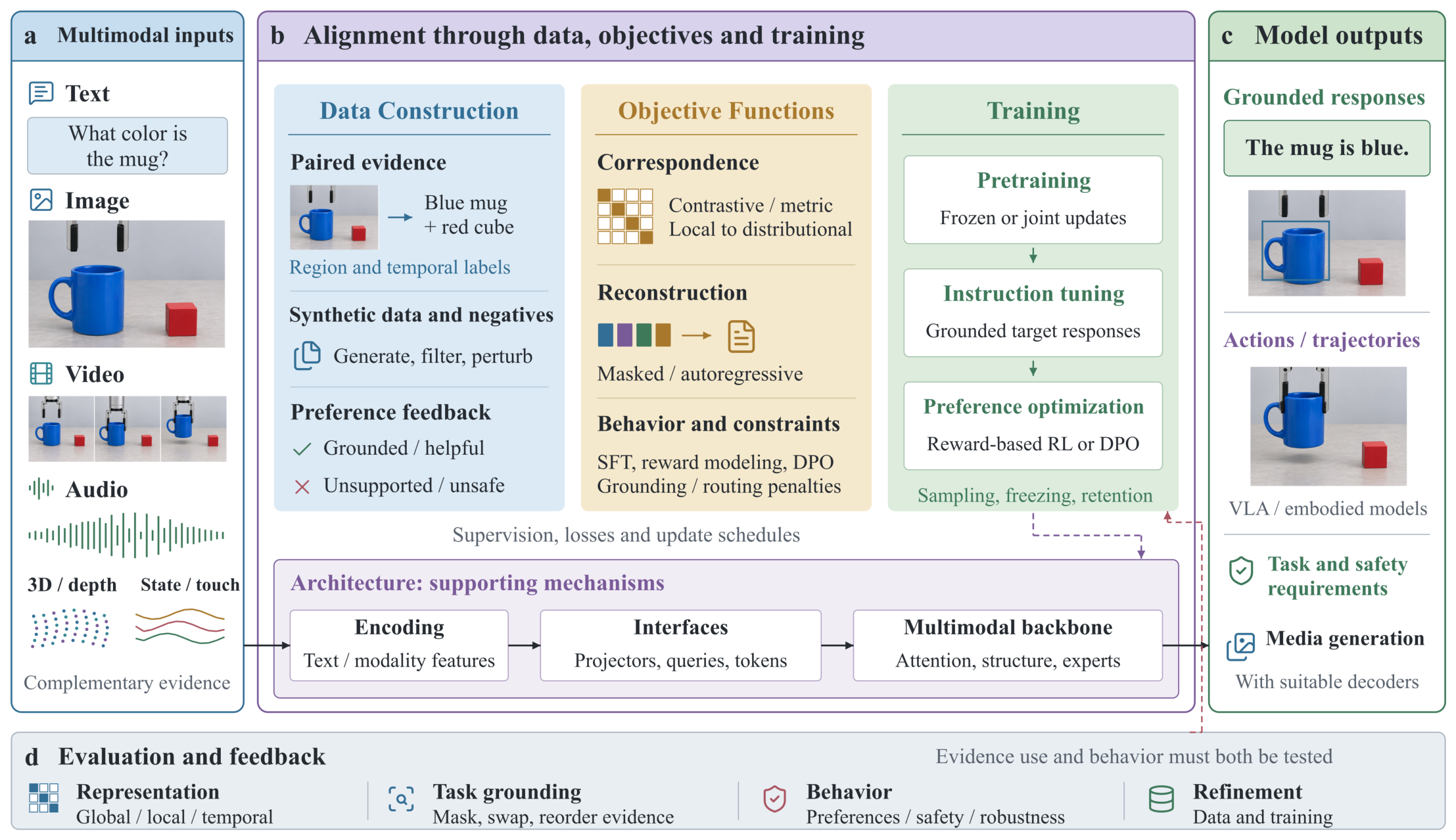
Figure 2.
Each column distinguishes between correct and incorrect perceptions of the mug’s color; each row distinguishes whether the instruction to “Leave the mug in place” was followed.
Figure 2.
Each column distinguishes between correct and incorrect perceptions of the mug’s color; each row distinguishes whether the instruction to “Leave the mug in place” was followed.
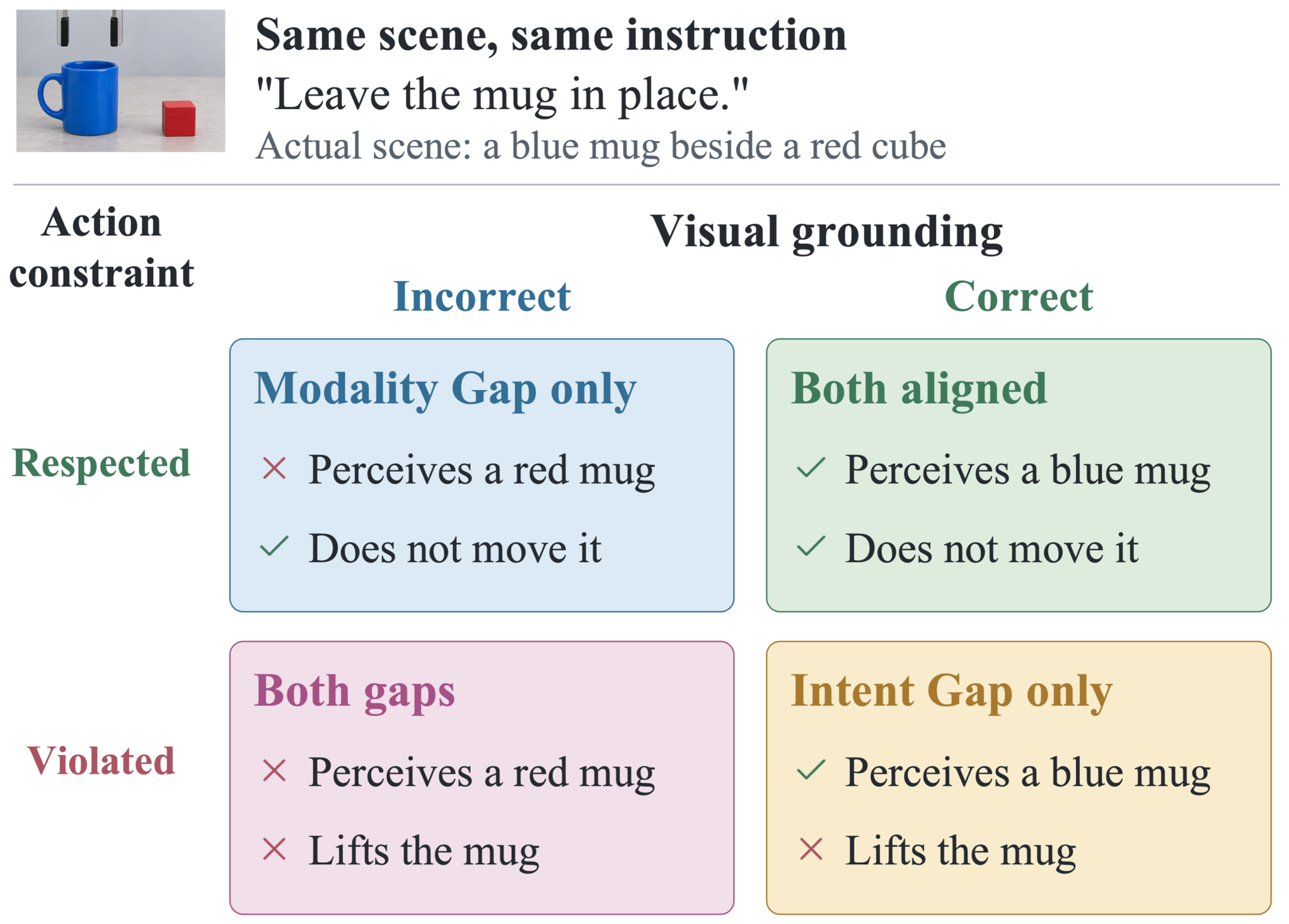
Table 1.
Organizing dimensions of related surveys. The marks record whether each of the six dimensions organizes a survey and whether its coverage is dedicated or distributed; they do not grade depth or quality.
Table 1.
Organizing dimensions of related surveys. The marks record whether each of the six dimensions organizes a survey and whether its coverage is dedicated or distributed; they do not grade depth or quality.
| Survey | Venue / Year | Arch. | Obj. | Data | Train. | Eval. | Appl. | Primary perspective |
|---|---|---|---|---|---|---|---|---|
| Caffagni et al. [5] | Findings ACL, 2024 | ✓ | ∘ | ✓ | ✓ | ✓ | ✓ | Model components and visual capabilities |
| Shu et al. [6] | Findings EMNLP, 2025 | ✓ | ✓ | ✓ | ✓ | ✓ | ✗ | Misalignment causes and remedies |
| Lu et al. [7] | EMNLP, 2025 | ∘ | ∘ | ∘ | ∘ | ✓ | ∘ | Representation similarity and transfer |
| Fang et al. [8] | Information Fusion, 2026 | ✓ | ✓ | ✓ | ✓ | ✓ | ✗ | Technical pillars of alignment |
| Li and Tang [9] | IJCV, 2026 | ✓ | ✓ | ✓ | ∘ | ∘ | ✓ | Alignment and fusion mechanisms |
| Ho et al. [10] | ACM CSUR, 2026 | ✓ | ✓ | ✓ | ✓ | ✓ | ✗ | Hallucination causes across the lifecycle |
| Yu et al. [11] | arXiv, 2025 (v2) | ✗ | ✓ | ✓ | ✓ | ✓ | ✓ | Preference learning and its applications |
| This survey | – | ✓ | ✓ | ✓ | ✓ | ✓ | ✓ | Two-gap diagnosis linking interventions to evidence |
✓: dedicated section, taxonomy, or comparative treatment, including appendices; ∘: partial or distributed discussion; ✗: not an organizing dimension (the topic may still be mentioned). Arch.: architecture; Obj.: objective functions; Data: data construction and supervision; Train.: training procedure; Eval.: evaluation metrics or protocols; Appl.: application groups.
Table 4.
Data construction strategies for multimodal alignment, compared by the evidence or behavioral contrast that training examples expose and the limitation that remains. The categories overlap.
Table 4.
Data construction strategies for multimodal alignment, compared by the evidence or behavioral contrast that training examples expose and the limitation that remains. The categories overlap.
| Data strategy | Examples | Signal exposed | Limitation discussed |
|---|---|---|---|
| Pairing and annotation | Flickr30k Entities [114]; RxR [115] | Phrase–region annotations identify local evidence; word–pose traces connect instructions to movement. | Validity depends on correspondence granularity; whether the model relies on the paired evidence needs separate tests. |
| Synthetic and self-supervised data | BLIP [87]; DataComp [116] | Generated and filtered captions refine content; standardized selection isolates curation choices. | Cleaner selected pairs may omit rare concepts; selection and caption changes need separate controls. |
| Preference construction | MM-RLHF [117]; RLHF-V [90] | Multidimensional ratings specify desirable behavior; segment corrections identify unsupported content. | Overall rankings can hide trade-offs; correction style or provenance may reveal preference labels. |
| Hard negatives | POVID [113]; VideoCon [97] | Injected hallucinations and controlled caption edits expose unsupported answers or compositional errors. | A difficult negative must remain unambiguously wrong; synthetic artifacts can replace the intended contrast. |
| Bias and coverage controls | NaPO [118]; VLGuard [119] | Modality-biased preference pairs target shortcuts; safety examples specify acceptable responses. | Reducing one shortcut leaves other biases untested; safety gains need separate benign-utility and subgroup checks. |
Table 5.
Training stages and deployment-time interventions, compared by key training or deployment choice and by validation priority. Inference-time interventions change outputs without parameter updates.
Table 5.
Training stages and deployment-time interventions, compared by key training or deployment choice and by validation priority. Inference-time interventions change outputs without parameter updates.
| Stage or layer | Examples | Key training or deployment choice | Validation priority |
|---|---|---|---|
| Multimodal pretraining | BLIP-2 [18]; MM1 [207]; Qwen2.5-VL [208] | Frozen versus updated components; mixture of caption, interleaved, and text-only data. | Local grounding, image dependence, and language retention, checked before SFT begins. |
| Instruction tuning (SFT) | LLaVA [19]; InstructBLIP [108] | Adapted modules (language policy and connector, or an instruction-aware interface); task balance and evidence-grounded targets. | Trainable modules and task ratios reported; retained grounding tested alongside response quality. |
| Preference and reward optimization | VLM-RLAIF [89]; RLHF-V [90]; MM-RLHF [117] | Learned rewards optimized with PPO, or direct response comparisons; critique scores can also weight DPO, as in MM-RLHF. | Judge validity and pair coverage; response-style controls; whether preference gains depend on the image. |
| Verifiable-reward fine-tuning | Visual-RFT [91] | Policy updates from sampled candidate responses scored with task-verifiable, group-relative rewards. | Verifier correctness, held-out tasks, sampling cost, and failures that final-answer rewards hide. |
| Inference-time intervention | VCD [209]; OPERA [210]; Woodpecker [211] | Adjusted decoding scores, or verification and revision of generated claims, without parameter updates. | Grounding and task utility at matched generation budgets; extra model or verifier calls reported. |
| Cross-cutting safety | VLGuard [119]; MultiTrust [212] | Safety supervision and independent tests of released model behavior. | Harmful responses, false refusals, and benign utility, rechecked under distribution shift. |
Disclaimer/Publisher’s Note: The statements, opinions and data contained in all publications are solely those of the individual author(s) and contributor(s) and not of MDPI and/or the editor(s). MDPI and/or the editor(s) disclaim responsibility for any injury to people or property resulting from any ideas, methods, instructions or products referred to in the content. |
© 2026 by the authors. Licensee MDPI, Basel, Switzerland. This article is an open access article distributed under the terms and conditions of the Creative Commons Attribution (CC BY) license (http://creativecommons.org/licenses/by/4.0/).
Copyright: This open access article is published under a Creative Commons CC BY 4.0 license, which permit the free download, distribution, and reuse, provided that the author and preprint are cited in any reuse.