

Submitted:
12 October 2026
Posted:
14 October 2026
You are already at the latest version
Abstract
Standard psychiatric rating scales such as the PANSS, HAM-D and MADRS remain the dominant outcome measures in clinical trials and routine care, yet they were built to quantify symptom severity rather than to register the full range of change that matters to patients. This narrative review synthesized psychometric, validation, epidemiological and trial evidence, together with consensus reports, to identify clinically and personally meaningful improvements that symptom-focused scales fail to detect. Evidence converged on ten under-measured outcome domains: real-world functioning, which correlates only weakly with symptoms and often lags behind them; cognition and social cognition; negative symptoms and motivational anhedonia; the subjective experience of medication; quality of life and positive mental health; personal recovery (connectedness, hope, identity, meaning and empowerment); internalized stigma; physical health and premature mortality, with all-cause mortality two to three-and-a-half times that of the general population; sleep and circadian function; and shared decision-making as a process outcome of care. Two cross-cutting limitations compound these gaps: systematic discordance among clinician, self-report and informant ratings, and the inability of retrospective, clinic-based instruments to capture the momentary, context-dependent dynamics now accessible through ecological momentary assessment and passive sensing. We propose a pragmatic, tiered outcome set that pairs every symptom scale with measures of functioning and of quality of life or recovery, adds physical health, sleep and medication burden, and reserves digital methods for settings that can support them. Improvement in psychiatry is multidimensional; measuring it as such is a scientific necessity, not a refinement.
Keywords:
outcome assessment
; rating scales
; functional recovery
; personal recovery
; quality of life
; measurement-based care
; digital phenotyping
1. Introduction
Psychiatric outcome measurement has long been anchored to symptom severity scales. The Positive and Negative Syndrome Scale (PANSS), the Hamilton Depression Rating Scale (HAM-D), the Montgomery–Åsberg Depression Rating Scale (MADRS) and their self-report counterparts served the field’s pragmatic needs well: they standardized diagnosis, enabled regulatory demonstrations of drug efficacy and gave clinicians a common language. They have also quietly defined what counts as improvement. Methodologists have argued that excessive reliance on the symptoms that constitute diagnostic criteria “has impoverished clinical assessment,” obscuring demoralization, psychological well-being, mental pain, social adjustment, illness behavior and patient satisfaction (Guidi et al., 2018).
This gap has practical consequences. Measurement-based care—the routine use of patient-reported and clinician-rated measures to guide treatment—demonstrably improves on usual care, yet fewer than one in five practitioners use it (17.9% of psychiatrists, 11.1% of psychologists and 13.9% of master’s-level practitioners), and as few as 5% measure at the empirically supported every-session frequency (Lewis et al., 2019). Where measurement is adopted, the instruments chosen are usually symptom scales, so the outcomes that matter most to patients may remain invisible even in services that do measure.
Previous critiques have typically examined one neglected outcome at a time—functioning, quality of life, or personal recovery. This review brings these literatures together to answer a single question: which clinically and personally meaningful improvements do standard psychiatric rating scales fail to capture, and how should measurement change in response? We map the evidence across ten outcome domains and two cross-cutting methodological limitations (Figure 1), summarize candidate measures for each (Table 1) and propose a pragmatic, tiered outcome set for routine care and research (Table 2).
2. Methods
This is a narrative review designed and reported with reference to the Scale for the Assessment of Narrative Review Articles (SANRA) criteria (Baethge et al., 2019). Targeted searches of PubMed/MEDLINE, Scopus and Google Scholar combined terms for outcome measurement (“rating scale,” “outcome assessment,” “measurement-based care,” “patient-reported outcome”) with domain-specific terms (functioning, cognition, social cognition, negative symptoms, anhedonia, subjective response, quality of life, well-being, personal recovery, self-stigma, mortality, sleep, ecological momentary assessment, digital phenotyping and shared decision-making). Reference lists of key reviews were hand-searched, and seminal conceptual papers were retrieved by citation chaining.
Priority was given to systematic reviews and meta-analyses, large measurement-validation studies, randomized controlled trials, and consensus statements or Commission reports; English-language, peer-reviewed sources were included. A domain was retained when three conditions were met: (a) evidence showed that it is dissociable from, or only weakly correlated with, symptom severity; (b) it carries prognostic value or is prioritized by patients; and (c) it is absent from, or under-represented in, conventional symptom scales. Evidence was synthesized thematically. Consistent with the narrative design, no formal risk-of-bias assessment or quantitative pooling was undertaken.
3. Results
3.1. Structural Limits of Symptom-Focused Scales
Several design features limit what conventional scales can see. First, they are optimized for diagnostic and severity classification rather than for detecting change in domains patients value. Second, they suffer from measurement problems that reduce assay sensitivity—the capacity to detect a true treatment effect. In depression trials, low assay sensitivity has been attributed to inappropriately broad measures, recall bias and poor inter-rater reliability, compounded by difficulty separating trait-like from state-like features of symptoms (Mofsen et al., 2019). Third, clinician administration, long treated as the gold standard, may compound rather than correct response bias; clinicians may magnify rather than neutralize patients’ reporting errors (Mofsen et al., 2019).
The field has begun to acknowledge these limits. Studying symptoms in the context of everyday life is increasingly recognized as a necessary addition to conventional assessment (Myin-Germeys et al., 2018), and the WPA–Lancet Psychiatry Commission on the Future of Psychiatry recommended a dimensional component to diagnosis and the broader uptake of measurement-based care using both clinician-administered and self-report instruments (Bhugra et al., 2017).
3.2. Domain 1: Real-World Functioning and Functional Capacity
Functioning is perhaps the most consequential omission. Although depression trials conventionally report both symptom severity and functional impairment, the relationship between them “remains unexpectedly weak and often bidirectional,” and functional change often lags behind symptomatic change (McKnight and Kashdan, 2009). Symptom remission is therefore not equivalent to functional recovery (Yang et al., 2022).
The divergence is measurable. Quality-of-life measures correlate only weakly to moderately with symptom measures, and symptom and quality-of-life trajectories diverge over time, both naturalistically and in response to treatment; some patients maintain role functioning despite severe symptoms, whereas others report marked functional decrements despite few symptoms (Murray et al., 2017).
Functional outcome also has a layered structure that symptom scales cannot resolve. Cognitive performance predicts performance-based functional skills, and those skills—rather than cognition directly—account for variance in work, community activities and interpersonal function; negative symptoms and depression relate to real-world performance independently of cognition (Bowie and Harvey, 2006). In the large VALERO validation study, correlations between cognition or functional capacity and real-world outcomes ranged from modest to negligible depending on the rating method, and many real-world functioning scales were “not strongly related to indices of functional abilities that are the state of the art outcomes in treatment studies” (P.D. Harvey et al., 2011).
3.3. Domain 2: Cognition and Social Cognition
Cognitive impairment is a core feature of psychotic disorders and is largely invisible to symptom scales. Its correlations with hallucinations and delusions are low, yet cognitive deficits are reliable predictors of functional outcome and disability—more strongly so than psychotic symptoms—partly because impairment limits the benefit patients can derive from rehabilitation (Green, 2016). The apparent size of this relationship depends on how functioning is measured: correlations with performance-based measures such as the UCSD Performance-based Skills Assessment range from r = 0.4 to 0.8, whereas those with interview-based ratings range from 0.1 to 0.3 (McCutcheon et al., 2023; Figure 2B). Cognitive impairment is also linked to poorer treatment adherence, more hospital admissions and longer stays, and—together with negative symptoms—is a major driver of lost productivity in a population in which 80–90% are unemployed (McCutcheon et al., 2023).
Social cognition is similarly neglected. Social-cognitive deficits explain variance in daily and community functioning beyond that explained by basic neurocognition (Shamsi et al., 2011), and social cognition has a multidimensional structure with distinct relationships to functional outcome (Mancuso et al., 2011). Because cognitive and social-cognitive competence are more proximal to functional capacity than to real-world functioning, their relationship with community performance is attenuated by personal factors such as motivation and self-efficacy and by socio-environmental factors such as disability policy (Mancuso et al., 2011).
3.4. Domain 3: Negative Symptoms, Motivation and Anhedonia
Negative symptoms add explanatory power that positive-symptom-weighted scores miss. Global negative symptoms contribute substantial variance in community functioning and employment beyond that explained by neurocognition and functional capacity (Yang et al., 2021), and they can mediate the path from functional capacity to real-world functioning (Couture et al., 2011).
Conventional instruments also misrepresent the construct. Anhedonia has long been defined as an inability to experience pleasure, but reward deficits in depression and schizophrenia are broader than hedonic response (Treadway and Zald, 2013). Widely used anhedonia measures emphasize consummatory pleasure, with little attention to anticipation, drive or effort (Nusslock and Alloy, 2017; Rizvi et al., 2016). Hedonic function is better understood as a sequence—reward association, interest and desire, anticipation, motivation, effort, hedonic response and feedback integration—and parsing these facets is essential to understanding their neurobiology (Rizvi et al., 2016). Impairments in the ability to pursue and learn about reward are documented across depression, schizophrenia and addiction (Thomsen, 2015). A patient whose motivation recovers while hedonic ratings remain unchanged will appear unimproved on most current scales.
3.5. Domain 4: Subjective Experience of Medication and Tolerability
Symptom scales report efficacy; they rarely capture how treatment feels. In a survey of 250 outpatients with schizophrenia-spectrum disorders, 93.6% rated efficacy and 83.6% rated side effects as “very” or “most” important when deciding whether to take prescribed medication, 87.6% valued being able to think more clearly, and weight gain, physical restlessness and somnolence were rated highly important by 61.6%, 60.8% and 58.8%, respectively (Achtyes et al., 2018; Figure 2A).
Subjective response is a legitimate clinical signal. Reviews of patients’ subjective experiences with antipsychotics concluded that clinicians should not dismiss such complaints as unreliable and that researchers should not treat them as non-scientific, because they inform both psychopathology and management (Awad et al., 1995). Treatment satisfaction depends on multiple factors beyond symptom reduction, and adverse effects deserve standing as outcome measures in their own right (Hamer and Haddad, 2007). Because these experiences shape adherence, they shape every downstream outcome.
3.6. Domain 5: Quality of Life and Positive Mental Health
Quality of life and well-being constitute a separate outcome axis. In people with schizophrenia, objective and subjective quality-of-life indices overlap only modestly, and patients’ reports remain essential even when they diverge from objective information, because motivation to engage in treatment rests on the person’s own appraisal of their functioning; unmet needs are a principal driver of quality of life in primary psychosis (Maj et al., 2021).
The conceptual basis is the dual-continua model: the absence of mental disorder is not the presence of positive mental health, and the two are correlated but distinct constructs that should both be assessed (Lukat et al., 2016). Keyes operationalized mental health as 13 dimensions of emotional, psychological and social well-being; “flourishing” requires high levels on at least one of two hedonic dimensions plus six of eleven dimensions of positive functioning, and complete mental health is the absence of mental illness together with flourishing (Keyes, 2002; Slade, 2010). Defining well-being through positive functioning broadens the field and improves prediction of distress and dysfunction (Dodge et al., 2012), and well-being can be measured reliably with instruments such as the Mental Health Continuum–Short Form, the Warwick–Edinburgh Mental Well-being Scale and the Flourishing Scale (Bohlmeijer and Westerhof, 2021).
3.7. Domain 6: Personal Recovery
Standard scales cannot capture recovery as patients define it. The dominant clinical view has defined recovery by symptom remission and level of functioning rather than by the individual’s subjective experience, and it often overlooks substantial disagreement between providers and clients about quality of life, with clients typically reporting better outcomes than their providers (Leonhardt et al., 2017). Personal recovery, by contrast, is a process defined and assessed by the person (Leonhardt et al., 2017), consistent with a recovery perspective that prioritizes agency, context, meaning-making and lived experience (Murray et al., 2017).
The most widely adopted operationalization is the CHIME framework—Connectedness, Hope and optimism, Identity, Meaning in life and Empowerment—derived from a systematic review and narrative synthesis of the personal recovery literature (Leamy et al., 2011). Clinical recovery does not guarantee personal recovery: symptom reduction does not necessarily increase personal recovery, which has been argued to offer a more holistic benchmark for evaluating services (Argentzell et al., 2020).
3.8. Domain 7: Internalized Stigma
Stigma affects outcomes through internalized processes that no symptom item indexes. About one-third of people with severe mental illness report high internalized stigma, which is associated with low self-esteem, empowerment, social support and hope, poorer adherence and lower subjective quality of life (Mashiach-Eizenberg et al., 2013). Internalized stigma is negatively related to hopefulness, self-esteem and social functioning, and it erodes the self-efficacy people need to pursue life goals (Yanos et al., 2008). Self-stigma threatens empowerment, which in turn predicts quality of life (Corrigan et al., 2010), and meta-analytic evidence confirms an association between stigma and subjective quality of life in psychosis (Degnan et al., 2021). A patient whose self-stigma falls may be meaningfully better, yet no conventional severity score will register it.
3.9. Domain 8: Physical Health and Premature Mortality
Conventional psychiatric scales are silent on the physical-health burden that dominates long-term prognosis in severe mental illness. Physical disorders account for approximately 70% of premature deaths in this population, with cardiovascular and metabolic disease the leading contributors (Stubbs et al., 2018). People with severe mental disorders have two- to three-fold higher average mortality and a 10–20-year reduction in life expectancy, with cardiovascular morbidity and mortality 1.5–3 times higher and diabetes prevalence two- to three-fold higher than in the general population (Gronholm et al., 2021; Figure 2D). Most systematic reviews report all-cause mortality 2–3.5 times that of the general population, and the gap has widened over time (de Mooij et al., 2019). The Lancet Psychiatry Commission accordingly identified cardiometabolic disease as a transdiagnostic target requiring reductions in both prevalence and life-course impact (Firth et al., 2019). An antipsychotic that halves PANSS scores while adding 10 kg of weight registers as a success on the primary outcome.
3.10. Domain 9: Sleep and Circadian Function
Sleep disturbance is a transdiagnostic process that symptom scales treat, at best, as a secondary item. Sleep disturbance and psychiatric disorder appear to be mechanistically intertwined, sharing serotonergic and dopaminergic substrates (A.G. Harvey et al., 2011). Insomnia, often assumed to be epiphenomenal to the “primary” disorder, is better understood as an under-recognized contributor to the onset and maintenance of psychiatric disorders (Harvey, 2008). In a highly comorbid sample, insomnia-type sleep disturbance and emotion dysregulation each uniquely predicted anxiety, depression, post-traumatic stress and substance-use symptom severity (Fairholme et al., 2013). In a community-based randomized trial, a transdiagnostic sleep and circadian intervention improved selected measures of functioning, comorbid symptoms and sleep–circadian outcomes—an axis of improvement distinct from the primary symptom scale (Harvey et al., 2021).
3.11. Domain 10: Shared Decision-Making and Person-Centered Process
Standard scales also omit the process outcomes of care. Recovery-oriented care requires greater emphasis on collaboration among professionals, people with mental health conditions and their families (Aoki et al., 2022), and the recovery model locates control with the individual rather than the professional (Slade, 2010). Offering people interventions that fit their preferences increases the likelihood that treatment will enhance personal meaning, satisfaction and quality of life (Schauer et al., 2007), and shared decision-making is best understood as one tool within a broader person-centered recovery-planning process oriented to a life the person has reason to value (Davidson et al., 2017). These are genuine outcomes of care, yet they are invisible to a symptom rating.
3.12. Cross-Cutting Limitation 1: Momentary, Contextual and Passive Dynamics
Retrospective, clinic-based scales cannot capture dynamics. Experience sampling methodology—structured, repeated self-report in daily life—captures variability over time, identifies internal and situational determinants of that variability and enables finer-grained evaluation of treatment effects beyond the clinic (Myin-Germeys et al., 2018). Psychometric challenges of ecological momentary assessment, including whether responses are truly momentary, response standards, selection bias and missingness, are being actively addressed (Stone et al., 2023).
Passively collected data extend this further. Personal sensing—collecting and analyzing data from sensors embedded in daily life—may support monitoring and next-generation mobile interventions (Mohr et al., 2017). Digital phenotyping, the “moment-by-moment quantification of the individual-level human phenotype in situ using data from personal digital devices,” offers fine-grained information potentially more relevant to illness phenotypes than active reports alone (Oudin et al., 2023). Smartphone sensor data have been associated with daily stress and with changes in depression, stress and loneliness (Ben-Zeev et al., 2015), and passive data predicted social anxiety severity (r = 0.702 between predicted and observed scores) with discriminant validity from depression and affect (Jacobson et al., 2020). What counts as a digital biomarker nevertheless remains debated (Montag et al., 2021).
3.13. Cross-Cutting Limitation 2: Discordance Between Raters
Different raters produce different pictures, and standard practice rarely reconciles them. Clinician-rated and self-report measures of depression carry complementary information, and complete assessment requires both (Uher et al., 2012). In schizophrenia, self-assessment accuracy is mood-dependent: in 406 outpatients, those reporting very low depression overestimated their everyday functioning relative to informant reports, whereas greater depression was associated with more accurate self-assessment (Harvey et al., 2017). Depression severity correlated with less overestimation of functioning, a response bias that substantially affects the accuracy of self-reported abilities (Durand et al., 2015). A single rating—clinician or patient—therefore captures only part of whatever improvement is, or is not, occurring.
4. Discussion
4.1. Principal Findings
Across ten domains and two cross-cutting limitations, the evidence converges on five conclusions. First, improvement is multidimensional. Symptoms, functioning, cognition, subjective experience, quality of life, personal recovery, physical health and sleep are related but distinct outcome axes; positive mental health and psychopathology are correlated but independent continua (Lukat et al., 2016), and symptom and quality-of-life trajectories diverge over time (Murray et al., 2017).
Second, the patient’s perspective is a core measure, not a soft supplement. Asked what defines remission, depressed patients ranked the presence of positive mental health, a return to their usual self and a return to usual functioning above the absence of symptoms (Zimmerman et al., 2006), and patient-reported functioning and quality of life add prognostic information on relapse beyond symptom severity (IsHak et al., 2013). The recovery literature is built on personally, not clinically, defined outcomes (Leamy et al., 2011; Leonhardt et al., 2017).
Third, function-relevant constructs require function-relevant measures. Because cognition and negative symptoms predict real-world outcome but correlate weakly with positive symptoms (Green, 2016; Yang et al., 2021), and because many real-world functioning scales relate weakly to state-of-the-art functional-capacity measures (P.D. Harvey et al., 2011), instrument choice determines which improvement is visible (Figure 2B).
Fourth, context and time matter. Momentary and passive methods capture variation, context and dynamics that retrospective, clinic-based scales cannot (Myin-Germeys et al., 2018; Oudin et al., 2023).
Fifth, physical health is an outcome domain in its own right. With all-cause mortality two to three-and-a-half times higher and life expectancy shortened by 10–20 years (de Mooij et al., 2019; Gronholm et al., 2021), a measurement system that ignores cardiometabolic outcomes measures the wrong thing.
4.2. Implications for Practice, Trials and Policy
These findings do not argue for abandoning symptom scales, which remain indispensable for diagnosis, safety monitoring and regulatory comparability. They argue for surrounding them. We propose a tiered minimum outcome set (Table 2). Tier 1, intended for all routine care, including busy outpatient clinics in low- and middle-income countries, pairs a brief symptom measure with a generic disability measure, a quality-of-life or well-being measure, basic cardiometabolic indicators, an insomnia screen and a side-effect checklist—almost all freely available and self-completed in minutes. Tier 2 adds informant-rated functioning, brief cognitive assessment, negative-symptom, recovery and self-stigma measures for specialist and early-intervention services. Tier 3 adds comprehensive cognitive and functional-capacity batteries, ecological momentary assessment or passive sensing, and hard physical-health endpoints for trials.
Standardized outcome sets developed through consensus, such as the International Consortium for Health Outcomes Measurement (ICHOM) standard set for depression and anxiety, already combine symptom burden with functioning and treatment-related outcomes (Obbarius et al., 2017), and our framework is compatible with them. For trials, regulators and sponsors should consider designating at least one functioning, quality-of-life or recovery measure as a key secondary endpoint. For services, measurement-based care is more likely to be adopted when measures answer questions that clinicians and patients actually ask (Lewis et al., 2019). Where clinician time is scarce, self-report and informant measures can extend coverage at low cost, but their divergence from clinician ratings should be interpreted as information rather than error (Harvey et al., 2017; Uher et al., 2012).
4.3. Future Research
Priorities include establishing minimal clinically important differences for functioning, recovery and self-stigma measures; validating these instruments across languages and cultures, particularly in South Asia and other low-resource settings; testing whether broader outcome sets change clinical decisions and patient outcomes; and defining which digital signals qualify as valid, equitable and privacy-preserving outcome measures (Montag et al., 2021; Stone et al., 2023).
4.4. Strengths and Limitations
This review integrates, within a single framework, literatures that are usually examined separately, and it translates the synthesis into a pragmatic measurement proposal. It is, however, narrative rather than systematic: study selection may be subject to bias, and no formal risk-of-bias assessment or meta-analytic pooling was performed. Several domains rest on heterogeneous measures and samples, and much of the functional-outcome literature derives from schizophrenia-spectrum and mood disorders, limiting generalization to the full diagnostic spectrum. Each instrument discussed carries its own psychometric limitations, and the tiered outcome set is a proposal that requires empirical testing. Finally, the emphasis on highly cited work may under-represent recent methodological innovation.
5. Conclusions
Standard psychiatric rating scales answer the question, How severe are the symptoms? They do not answer the questions patients, families and health systems ask: Can this person function, work and live independently? Is cognition improving? Is the treatment tolerable? Is life worth living again? Is the person recovering on their own terms? Are they physically healthy and sleeping well? How do these things fluctuate in daily life? The evidence reviewed here shows that meaningful improvement occurs—and is routinely missed—across functional, cognitive, motivational, experiential, recovery-related, stigma-related, physical and dynamic dimensions. Broadening psychiatric measurement to include these domains is a scientific necessity, not merely a humane preference, because these domains predict the outcomes that matter most and current instruments cannot see them.
Funding
This research did not receive any specific grant from funding agencies in the public, commercial, or not-for-profit sectors.
Ethics statement
Not applicable. This article is a narrative review of previously published literature; it involved no human participants, patient data or animals, and therefore did not require ethics committee approval or informed consent.
Data availability
Data sharing is not applicable to this article, as no new data were created or analyzed. All data discussed are available in the cited publications.
Acknowledgments
None.
Declaration of competing interest
The author declares that he has no known competing financial interests or personal relationships that could have appeared to influence the work reported in this paper.
Declaration of generative AI and AI-assisted technologies in the manuscript preparation process
During the preparation of this work the author used Claude (Anthropic) in order to assist with language editing, restructuring to the journal’s format, reference formatting and checking, and preparation of the figures and graphical abstract. After using this tool, the author reviewed and edited the content as needed and takes full responsibility for the content of the published article.
References
- Achtyes, E.D.; Simmons, A.; Skabeev, A.; Levy, N.; Jiang, Y.; Marcy, P.; et al. Patient preferences concerning the efficacy and side-effect profile of schizophrenia medications: a survey of patients living with schizophrenia. BMC Psychiatry 2018, 18, 292. [Google Scholar] [CrossRef] [PubMed]
- Aoki, Y.; Yaju, Y.; Utsumi, T.; Sanyaolu, L.; Storm, M.; Takaesu, Y.; et al. Shared decision-making interventions for people with mental health conditions. Cochrane Database Syst. Rev. 2022, 11, CD007297. [Google Scholar] [CrossRef] [PubMed]
- Argentzell, E.; Bäckström, M.; Lund, K.; Eklund, M. Exploring mediators of the recovery process over time among mental health service users, using a mixed model regression analysis based on cluster RCT data. BMC Psychiatry 2020, 20, 520. [Google Scholar] [CrossRef] [PubMed]
- Awad, A.G.; Hogan, T.P.; Voruganti, L.N.P.; Heslegrave, R.J. Patients’ subjective experiences on antipsychotic medications: implications for outcome and quality of life. Int. Clin. Psychopharmacol. 1995, 10 (Suppl. 3), 123–132. [Google Scholar] [CrossRef] [PubMed]
- Baethge, C.; Goldbeck-Wood, S.; Mertens, S. SANRA—a scale for the quality assessment of narrative review articles. Res. Integr. Peer Rev. 2019, 4, 5. [Google Scholar] [CrossRef] [PubMed]
- Ben-Zeev, D.; Scherer, E.A.; Wang, R.; Xie, H.; Campbell, A.T. Next-generation psychiatric assessment: using smartphone sensors to monitor behavior and mental health. Psychiatr. Rehabil. J. 2015, 38, 218–226. [Google Scholar] [CrossRef] [PubMed]
- Bhugra, D.; Tasman, A.; Pathare, S.; Priebe, S.; Smith, S.; Torous, J.; et al. The WPA-Lancet Psychiatry Commission on the Future of Psychiatry. Lancet Psychiatry 2017, 4, 775–818. [Google Scholar] [CrossRef] [PubMed]
- Bohlmeijer, E.T.; Westerhof, G.J. The model for sustainable mental health: future directions for integrating positive psychology into mental health care. Front. Psychol. 2021, 12, 747999. [Google Scholar] [CrossRef] [PubMed]
- Bowie, C.R.; Harvey, P.D. Cognitive deficits and functional outcome in schizophrenia. Neuropsychiatr. Dis. Treat. 2006, 2, 531–536. [Google Scholar] [CrossRef] [PubMed]
- Corrigan, P.W.; Morris, S.; Larson, J.; Rafacz, J.; Wassel, A.; Michaels, P.; et al. Self-stigma and coming out about one’s mental illness. J. Community Psychol. 2010, 38, 259–275. [Google Scholar] [CrossRef] [PubMed]
- Couture, S.M.; Granholm, E.L.; Fish, S.C. A path model investigation of neurocognition, theory of mind, social competence, negative symptoms and real-world functioning in schizophrenia. Schizophr. Res. 2011, 125, 152–160. [Google Scholar] [CrossRef] [PubMed]
- Davidson, L.; Tondora, J.; Pavlo, A.J.; Stanhope, V. Shared decision making within the context of recovery-oriented care. Ment. Health Rev. J. 2017, 22, 179–190. [Google Scholar] [CrossRef]
- de Mooij, L.D.; Kikkert, M.; Theunissen, J.; Beekman, A.T.F.; de Haan, L.; Duurkoop, P.W.R.A.; et al. Dying too soon: excess mortality in severe mental illness. Front. Psychiatry 2019, 10, 855. [Google Scholar] [CrossRef] [PubMed]
- Degnan, A.; Berry, K.; Humphrey, C.; Bucci, S. The relationship between stigma and subjective quality of life in psychosis: a systematic review and meta-analysis. Clin. Psychol. Rev. 2021, 85, 102003. [Google Scholar] [CrossRef] [PubMed]
- Dodge, R.; Daly, A.P.; Huyton, J.; Sanders, L.D. The challenge of defining wellbeing. Int. J. Wellbeing 2012, 2, 222–235. [Google Scholar] [CrossRef]
- Durand, D.; Strassnig, M.; Sabbag, S.; Gould, F.; Twamley, E.W.; Patterson, T.L.; et al. Factors influencing self-assessment of cognition and functioning in schizophrenia: implications for treatment studies. Eur. Neuropsychopharmacol. 2015, 25, 185–191. [Google Scholar] [CrossRef] [PubMed]
- Fairholme, C.P.; Nosen, E.L.; Nillni, Y.I.; Schumacher, J.A.; Tull, M.T.; Coffey, S.F. Sleep disturbance and emotion dysregulation as transdiagnostic processes in a comorbid sample. Behav. Res. Ther. 2013, 51, 540–546. [Google Scholar] [CrossRef] [PubMed]
- Firth, J.; Siddiqi, N.; Koyanagi, A.; Siskind, D.; Rosenbaum, S.; Galletly, C.; et al. The Lancet Psychiatry Commission: a blueprint for protecting physical health in people with mental illness. Lancet Psychiatry 2019, 6, 675–712. [Google Scholar] [CrossRef] [PubMed]
- Green, M.F. Impact of cognitive and social cognitive impairment on functional outcomes in patients with schizophrenia. J. Clin. Psychiatry 2016, 77 (Suppl. 2), 8–11. [Google Scholar] [CrossRef] [PubMed]
- Gronholm, P.C.; Chowdhary, N.; Barbui, C.; Das-Munshi, J.; Kolappa, K.; Thornicroft, G.; et al. Prevention and management of physical health conditions in adults with severe mental disorders: WHO recommendations. Int. J. Ment. Health Syst. 2021, 15, 22. [Google Scholar] [CrossRef] [PubMed]
- Guidi, J.; Brakemeier, E.-L.; Bockting, C.L.H.; Cosci, F.; Cuijpers, P.; Jarrett, R.B.; et al. Methodological recommendations for trials of psychological interventions. Psychother. Psychosom. 2018, 87, 276–284. [Google Scholar] [CrossRef] [PubMed]
- Hamer, S.; Haddad, P.M. Adverse effects of antipsychotics as outcome measures. Br. J. Psychiatry 2007, 191 (Suppl. 50), s64–s70. [Google Scholar] [CrossRef] [PubMed]
- Harvey, A.G. Insomnia, psychiatric disorders, and the transdiagnostic perspective. Curr. Dir. Psychol. Sci. 2008, 17, 299–303. [Google Scholar] [CrossRef]
- Harvey, A.G.; Murray, G.; Chandler, R.A.; Soehner, A. Sleep disturbance as transdiagnostic: consideration of neurobiological mechanisms. Clin. Psychol. Rev. 2011, 31, 225–235. [Google Scholar] [CrossRef] [PubMed]
- Harvey, A.G.; Dong, L.; Hein, K.; Yu, S.H.; Martinez, A.J.; Gumport, N.B.; et al. A randomized controlled trial of the Transdiagnostic Intervention for Sleep and Circadian Dysfunction (TranS-C) to improve serious mental illness outcomes in a community setting. J. Consult. Clin. Psychol. 2021, 89, 537–550. [Google Scholar] [CrossRef] [PubMed]
- Harvey, P.D.; Raykov, T.; Twamley, E.W.; Vella, L.; Heaton, R.K.; Patterson, T.L. Validating the measurement of real-world functional outcomes: phase I results of the VALERO study. Am. J. Psychiatry 2011, 168, 1195–1201. [Google Scholar] [CrossRef] [PubMed]
- Harvey, P.D.; Twamley, E.W.; Pinkham, A.E.; Depp, C.A.; Patterson, T.L. Depression in schizophrenia: associations with cognition, functional capacity, everyday functioning, and self-assessment. Schizophr. Bull. 2017, 43, 575–582. [Google Scholar] [CrossRef] [PubMed]
- IsHak, W.W.; Greenberg, J.M.; Cohen, R.M. Predicting relapse in major depressive disorder using patient-reported outcomes of depressive symptom severity, functioning, and quality of life in the Individual Burden of Illness Index for Depression (IBI-D). J. Affect. Disord. 2013, 151, 59–65. [Google Scholar] [CrossRef] [PubMed]
- Jacobson, N.C.; Summers, B.; Wilhelm, S. Digital biomarkers of social anxiety severity: digital phenotyping using passive smartphone sensors. J. Med. Internet Res. 2020, 22, e16875. [Google Scholar] [CrossRef] [PubMed]
- Keyes, C.L.M. The mental health continuum: from languishing to flourishing in life. J. Health Soc. Behav. 2002, 43, 207–222. [Google Scholar] [CrossRef]
- Leamy, M.; Bird, V.; Le Boutillier, C.; Williams, J.; Slade, M. Conceptual framework for personal recovery in mental health: systematic review and narrative synthesis. Br. J. Psychiatry 2011, 199, 445–452. [Google Scholar] [CrossRef] [PubMed]
- Leonhardt, B.L.; Huling, K.; Hamm, J.A.; Roe, D.; Hasson-Ohayon, I.; McLeod, H.J.; et al. Recovery and serious mental illness: a review of current clinical and research paradigms and future directions. Expert Rev. Neurother. 2017, 17, 1117–1130. [Google Scholar] [CrossRef] [PubMed]
- Lewis, C.C.; Boyd, M.; Puspitasari, A.; Navarro, E.; Howard, J.; Kassab, H.; et al. Implementing measurement-based care in behavioral health: a review. JAMA Psychiatry 2019, 76, 324–335. [Google Scholar] [CrossRef] [PubMed]
- Lukat, J.; Margraf, J.; Lutz, R.; van der Veld, W.M.; Becker, E.S. Psychometric properties of the Positive Mental Health Scale (PMH-scale). BMC Psychol. 2016, 4, 8. [Google Scholar] [CrossRef] [PubMed]
- Maj, M.; van Os, J.; De Hert, M.; Gaebel, W.; Galderisi, S.; Green, M.F.; et al. The clinical characterization of the patient with primary psychosis aimed at personalization of management. World Psychiatry 2021, 20, 4–33. [Google Scholar] [CrossRef] [PubMed]
- Mancuso, F.; Horan, W.P.; Kern, R.S.; Green, M.F. Social cognition in psychosis: multidimensional structure, clinical correlates, and relationship with functional outcome. Schizophr. Res. 2011, 125, 143–151. [Google Scholar] [CrossRef] [PubMed]
- Mashiach-Eizenberg, M.; Hasson-Ohayon, I.; Yanos, P.T.; Lysaker, P.H.; Roe, D. Internalized stigma and quality of life among persons with severe mental illness: the mediating roles of self-esteem and hope. Psychiatry Res. 2013, 208, 15–20. [Google Scholar] [CrossRef] [PubMed]
- McCutcheon, R.A.; Keefe, R.S.E.; McGuire, P.K. Cognitive impairment in schizophrenia: aetiology, pathophysiology, and treatment. Mol. Psychiatry 2023, 28, 1902–1918. [Google Scholar] [CrossRef] [PubMed]
- McKnight, P.E.; Kashdan, T.B. The importance of functional impairment to mental health outcomes: a case for reassessing our goals in depression treatment research. Clin. Psychol. Rev. 2009, 29, 243–259. [Google Scholar] [CrossRef] [PubMed]
- Mofsen, A.M.; Rodebaugh, T.L.; Nicol, G.E.; Depp, C.A.; Miller, J.P.; Lenze, E.J. When all else fails, listen to the patient: a viewpoint on the use of ecological momentary assessment in clinical trials. JMIR Ment. Health 2019, 6, e11845. [Google Scholar] [CrossRef] [PubMed]
- Mohr, D.C.; Zhang, M.; Schueller, S.M. Personal sensing: understanding mental health using ubiquitous sensors and machine learning. Annu. Rev. Clin. Psychol. 2017, 13, 23–47. [Google Scholar] [CrossRef] [PubMed]
- Montag, C.; Elhai, J.D.; Dagum, P. On blurry boundaries when defining digital biomarkers: how much biology needs to be in a digital biomarker? Front. Psychiatry 2021, 12, 740292. [Google Scholar] [CrossRef] [PubMed]
- Murray, G.; Leitan, N.D.; Thomas, N.; Michalak, E.E.; Johnson, S.L.; Jones, S.; et al. Towards recovery-oriented psychosocial interventions for bipolar disorder: quality of life outcomes, stage-sensitive treatments, and mindfulness mechanisms. Clin. Psychol. Rev. 2017, 52, 148–163. [Google Scholar] [CrossRef] [PubMed]
- Myin-Germeys, I.; Kasanova, Z.; Vaessen, T.; Vachon, H.; Kirtley, O.; Viechtbauer, W.; et al. Experience sampling methodology in mental health research: new insights and technical developments. World Psychiatry 2018, 17, 123–132. [Google Scholar] [CrossRef] [PubMed]
- Nusslock, R.; Alloy, L.B. Reward processing and mood-related symptoms: an RDoC and translational neuroscience perspective. J. Affect. Disord. 2017, 216, 3–16. [Google Scholar] [CrossRef] [PubMed]
- Obbarius, A.; van Maasakkers, L.; Baer, L.; Clark, D.M.; Crocker, A.G.; de Beurs, E.; et al. Standardization of health outcomes assessment for depression and anxiety: recommendations from the ICHOM Depression and Anxiety Working Group. Qual. Life Res. 2017, 26, 3211–3225. [Google Scholar] [CrossRef] [PubMed]
- Oudin, A.; Maatoug, R.; Bourla, A.; Ferreri, F.; Bonnot, O.; Millet, B.; et al. Digital phenotyping: data-driven psychiatry to redefine mental health. J. Med. Internet Res. 2023, 25, e44502. [Google Scholar] [CrossRef] [PubMed]
- Rizvi, S.J.; Pizzagalli, D.A.; Sproule, B.A.; Kennedy, S.H. Assessing anhedonia in depression: potentials and pitfalls. Neurosci. Biobehav. Rev. 2016, 65, 21–35. [Google Scholar] [CrossRef] [PubMed]
- Schauer, C.; Everett, A.; del Vecchio, P.; Anderson, L. Promoting the value and practice of shared decision-making in mental health care. Psychiatr. Rehabil. J. 2007, 31, 54–61. [Google Scholar] [CrossRef] [PubMed]
- Shamsi, S.; Lau, A.; Lencz, T.; Burdick, K.E.; DeRosse, P.; Brenner, R.; et al. Cognitive and symptomatic predictors of functional disability in schizophrenia. Schizophr. Res. 2011, 126, 257–264. [Google Scholar] [CrossRef] [PubMed]
- Slade, M. Mental illness and well-being: the central importance of positive psychology and recovery approaches. BMC Health Serv. Res. 2010, 10, 26. [Google Scholar] [CrossRef] [PubMed]
- Stone, A.A.; Schneider, S.; Smyth, J.M. Evaluation of pressing issues in ecological momentary assessment. Annu. Rev. Clin. Psychol. 2023, 19, 107–131. [Google Scholar] [CrossRef] [PubMed]
- Stubbs, B.; Vancampfort, D.; Hallgren, M.; Firth, J.; Veronese, N.; Solmi, M.; et al. EPA guidance on physical activity as a treatment for severe mental illness: a meta-review of the evidence and Position Statement from the European Psychiatric Association (EPA), supported by the International Organization of Physical Therapists in Mental Health (IOPTMH). Eur. Psychiatry 2018, 54, 124–144. [Google Scholar] [CrossRef] [PubMed]
- Thomsen, K.R. Measuring anhedonia: impaired ability to pursue, experience, and learn about reward. Front. Psychol. 2015, 6, 1409. [Google Scholar] [CrossRef] [PubMed]
- Treadway, M.T.; Zald, D.H. Parsing anhedonia: translational models of reward-processing deficits in psychopathology. Curr. Dir. Psychol. Sci. 2013, 22, 244–249. [Google Scholar] [CrossRef] [PubMed]
- Uher, R.; Perlis, R.H.; Placentino, A.; Dernovšek, M.Z.; Henigsberg, N.; Mors, O.; et al. Self-report and clinician-rated measures of depression severity: can one replace the other? Depress. Anxiety 2012, 29, 1043–1049. [Google Scholar] [CrossRef] [PubMed]
- Yang, H.; Gao, S.; Li, J.; Yu, H.; Xu, J.; Lin, C.; et al. Remission of symptoms is not equal to functional recovery: psychosocial functioning impairment in major depression. Front. Psychiatry 2022, 13, 915689. [Google Scholar] [CrossRef] [PubMed]
- Yang, Z.; Lee, S.H.; Abdul Rashid, N.A.; See, Y.M.; Dauwels, J.; Tan, B.L.; et al. Predicting real-world functioning in schizophrenia: the relative contributions of neurocognition, functional capacity, and negative symptoms. Front. Psychiatry 2021, 12, 639536. [Google Scholar] [CrossRef] [PubMed]
- Yanos, P.T.; Roe, D.; Markus, K.; Lysaker, P.H. Pathways between internalized stigma and outcomes related to recovery in schizophrenia spectrum disorders. Psychiatr. Serv. 2008, 59, 1437–1442. [Google Scholar] [CrossRef]
- Zimmerman, M.; McGlinchey, J.B.; Posternak, M.A.; Friedman, M.; Attiullah, N.; Boerescu, D. How should remission from depression be defined? The depressed patient’s perspective. Am. J. Psychiatry 2006, 163, 148–150. [Google Scholar] [CrossRef] [PubMed]
Figure 1.
Conceptual map of outcome domains that standard symptom-severity scales fail to capture. Ten domains (D1–D10) are grouped as functional and neurocognitive, experiential and recovery-oriented, somatic and process-of-care outcomes; the outer ring shows two cross-cutting methodological limitations that affect measurement in every domain. PANSS, Positive and Negative Syndrome Scale; HAM-D, Hamilton Depression Rating Scale; MADRS, Montgomery–Åsberg Depression Rating Scale; PHQ-9, Patient Health Questionnaire-9; CHIME, Connectedness, Hope and optimism, Identity, Meaning in life and Empowerment.
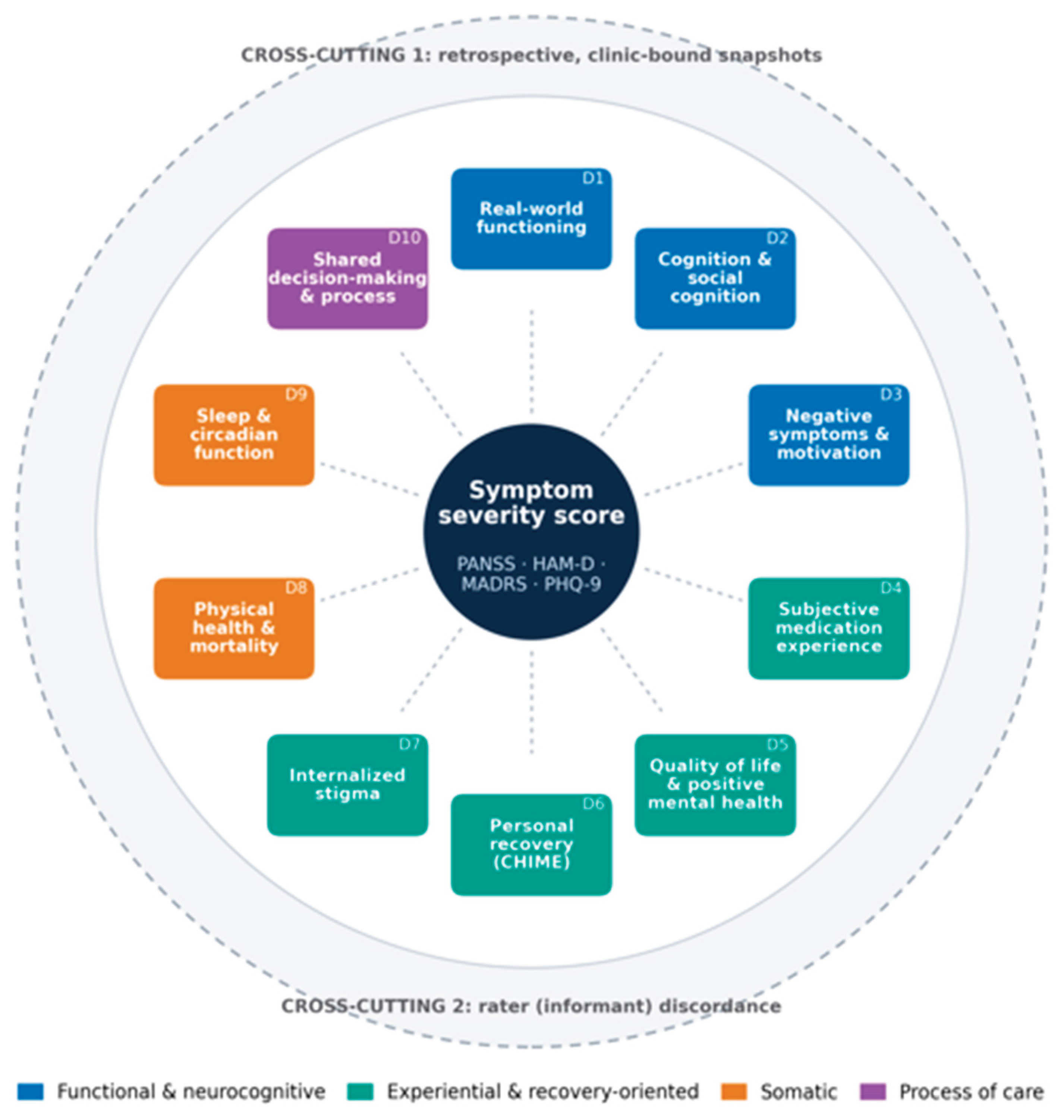
Figure 2.
Quantitative illustrations of what symptom scales miss. (A) Proportion of 250 outpatients with schizophrenia-spectrum disorders rating each antipsychotic attribute as “very” or “most” important (Achtyes et al., 2018). (B) Range of correlations between cognition and functioning by type of functioning measure (McCutcheon et al., 2023). (C) Uptake of measurement-based care by practitioner group and at the recommended every-session frequency (Lewis et al., 2019). (D) Excess all-cause mortality, cardiovascular morbidity and mortality, and diabetes prevalence in people with severe mental illness relative to the general population (dashed line = 1) (de Mooij et al., 2019; Gronholm et al., 2021). Values are as reported in the cited sources; ranges are displayed as bars.
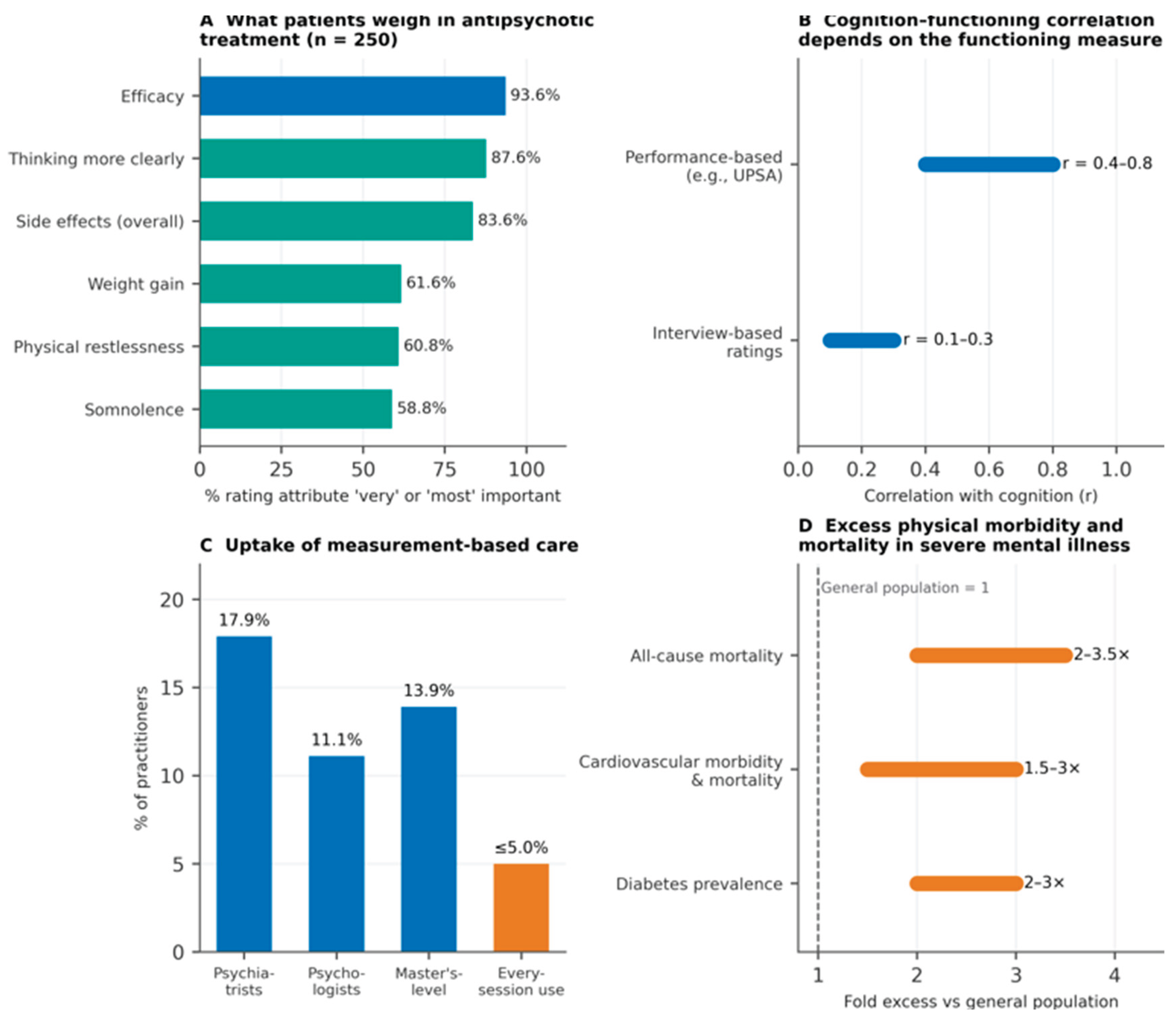

Table 1.
Outcome domains and cross-cutting limitations that standard symptom-severity scales fail to capture, with supporting evidence and illustrative measures.
Table 1.
Outcome domains and cross-cutting limitations that standard symptom-severity scales fail to capture, with supporting evidence and illustrative measures.
| Domain | What symptom scales miss | Key evidence | Illustrative measures |
|---|---|---|---|
| Functional and neurocognitive domains | |||
| D1. Real-world functioning | Work, independent living, social roles; functional change lags symptom change | Weak, bidirectional symptom–function relationship; remission ≠ functional recovery (McKnight and Kashdan, 2009; Yang et al., 2022) | WHODAS 2.0; SDS; PSP; SLOF (informant); UPSA-B (capacity) |
| D2. Cognition and social cognition | Neurocognitive and social-cognitive performance | Stronger predictor of disability than psychotic symptoms; r = 0.4–0.8 with performance-based vs 0.1–0.3 with interview-based functioning (Green, 2016; McCutcheon et al., 2023) | MCCB; BACS; social-cognition tasks (e.g., ER-40, Hinting Task) |
| D3. Negative symptoms, motivation and anhedonia | Anticipatory and motivational reward deficits; effort | Negative symptoms add variance in functioning beyond cognition; anhedonia scales emphasize consummatory pleasure (Yang et al., 2021; Rizvi et al., 2016) | BNSS; CAINS; TEPS; DARS |
| Experiential and recovery-oriented domains | |||
| D4. Subjective medication experience | Side-effect burden, tolerability, subjective well-being on treatment | 83.6% rate side effects as very/most important; subjective response guides adherence (Achtyes et al., 2018; Awad et al., 1995) | GASS; LUNSERS; SWN-K; DAI-10 |
| D5. Quality of life and positive mental health | Well-being as a distinct continuum from psychopathology | Dual-continua model; symptom and QoL trajectories diverge (Lukat et al., 2016; Murray et al., 2017) | WHOQOL-BREF; Q-LES-Q-SF; MHC-SF; WEMWBS |
| D6. Personal recovery | Connectedness, hope, identity, meaning, empowerment (CHIME) | Clinical recovery does not guarantee personal recovery (Leamy et al., 2011; Argentzell et al., 2020) | QPR; RAS |
| D7. Internalized stigma | Self-stigma, self-esteem, hope, empowerment | ~One-third of people with SMI report high self-stigma; linked to lower QoL and adherence (Mashiach-Eizenberg et al., 2013; Degnan et al., 2021) | ISMI |
| Somatic domains | |||
| D8. Physical health and mortality | Cardiometabolic health, premature death | Mortality 2–3.5×; life expectancy −10 to 20 years; ~70% of premature deaths physical (de Mooij et al., 2019; Gronholm et al., 2021; Stubbs et al., 2018) | Weight/BMI, waist, BP, glucose/HbA1c, lipids, smoking; mortality |
| D9. Sleep and circadian function | Insomnia and circadian dysfunction as mechanisms, not epiphenomena | Sleep disturbance predicts symptom severity across disorders; transdiagnostic treatment improves functioning (Fairholme et al., 2013; Harvey et al., 2021) | ISI; PSQI; sleep diary; actigraphy |
| Process-of-care domain | |||
| D10. Shared decision-making | Collaboration, choice and control in care | Preference-concordant care enhances meaning, satisfaction and QoL (Schauer et al., 2007; Davidson et al., 2017) | SDM-Q-9; CollaboRATE |
| Cross-cutting methodological limitations | |||
| C1. Momentary and contextual dynamics | Within-person variability and real-world context | EMA and passive sensing capture dynamics; passive data predicted social anxiety (r = 0.70) (Myin-Germeys et al., 2018; Jacobson et al., 2020) | EMA/ESM; smartphone and wearable sensing |
| C2. Rater discordance | Divergent clinician, self-report and informant views | Self-assessment accuracy depends on mood; clinician and self-report are complementary (Uher et al., 2012; Harvey et al., 2017) | Paired clinician + self-report (e.g., MADRS + PHQ-9); informant SLOF |
Abbreviations: BACS, Brief Assessment of Cognition in Schizophrenia; BNSS, Brief Negative Symptom Scale; BP, blood pressure; CAINS, Clinical Assessment Interview for Negative Symptoms; DAI-10, Drug Attitude Inventory-10; DARS, Dimensional Anhedonia Rating Scale; EMA, ecological momentary assessment; ER-40, Penn Emotion Recognition Test; ESM, experience sampling method; GASS, Glasgow Antipsychotic Side-effect Scale; ISI, Insomnia Severity Index; ISMI, Internalized Stigma of Mental Illness scale; LUNSERS, Liverpool University Neuroleptic Side-Effect Rating Scale; MCCB, MATRICS Consensus Cognitive Battery; MHC-SF, Mental Health Continuum–Short Form; PSP, Personal and Social Performance scale; PSQI, Pittsburgh Sleep Quality Index; Q-LES-Q-SF, Quality of Life Enjoyment and Satisfaction Questionnaire–Short Form; QoL, quality of life; QPR, Questionnaire about the Process of Recovery; RAS, Recovery Assessment Scale; SDM-Q-9, 9-item Shared Decision Making Questionnaire; SDS, Sheehan Disability Scale; SLOF, Specific Levels of Functioning scale; SMI, severe mental illness; SWN-K, Subjective Well-being under Neuroleptics (short form); TEPS, Temporal Experience of Pleasure Scale; UPSA-B, UCSD Performance-based Skills Assessment–Brief; WEMWBS, Warwick–Edinburgh Mental Well-being Scale; WHODAS 2.0, WHO Disability Assessment Schedule 2.0; WHOQOL-BREF, WHO Quality of Life–BREF. Measures are illustrative; suitability, licensing and validated translations should be confirmed for the target population.
Table 2.
Proposed tiered minimum outcome set to accompany symptom-severity measurement.
| Tier and setting | Add to the symptom measure | Suggested frequency | Rationale |
|---|---|---|---|
| Tier 1 — All routine care, including primary care and resource-limited outpatient clinics | Brief self-report symptom scale (e.g., PHQ-9, GAD-7) Disability: WHODAS 2.0 (12-item) or SDS QoL/well-being: WHOQOL-BREF or SWEMWBS Weight/BMI, waist, BP; glucose and lipids when on antipsychotics Insomnia screen (ISI); side-effect checklist (e.g., GASS) |
Symptoms every visit; function, QoL and sleep every 3 months; metabolic per guideline (at least annually) | Low burden, mostly free, self-completed in <15 min; captures D1, D4, D5, D8 and D9 and aligns with the ICHOM depression and anxiety set (Obbarius et al., 2017) |
| Tier 2 — Specialist, early-intervention and severe mental illness services | Tier 1 plus: Informant/clinician-rated functioning (PSP or SLOF) Brief cognitive assessment (e.g., BACS) Negative symptoms (BNSS) Personal recovery (QPR) and self-stigma (ISMI) Shared decision-making (SDM-Q-9 or CollaboRATE) |
Every 6 months and at key transitions (discharge, medication change) | Adds D2, D3, D6, D7 and D10 and reconciles rater discordance (C2) |
| Tier 3 — Clinical trials and research cohorts | Tier 2 plus: Comprehensive cognition (MCCB) and functional capacity (UPSA-B) Motivational anhedonia (CAINS, TEPS, DARS) EMA and/or passive sensing Hard physical-health endpoints and mortality linkage |
Per protocol; EMA in bursts (e.g., 7–14 days) at baseline and endpoints | Maximizes assay sensitivity and captures dynamics (C1); designate ≥1 functioning, QoL or recovery measure as a key secondary endpoint |
Tiers are the author’s proposal synthesized from the evidence reviewed and require empirical testing. D1–D10 and C1–C2 refer to the domains and cross-cutting limitations in Figure 1 and Table 1. Abbreviations as in Table 1; GAD-7, Generalized Anxiety Disorder-7; ICHOM, International Consortium for Health Outcomes Measurement; PHQ-9, Patient Health Questionnaire-9; SWEMWBS, Short Warwick–Edinburgh Mental Well-being Scale.
Disclaimer/Publisher’s Note: The statements, opinions and data contained in all publications are solely those of the individual author(s) and contributor(s) and not of MDPI and/or the editor(s). MDPI and/or the editor(s) disclaim responsibility for any injury to people or property resulting from any ideas, methods, instructions or products referred to in the content. |
© 2026 by the authors. Licensee MDPI, Basel, Switzerland. This article is an open access article distributed under the terms and conditions of the Creative Commons Attribution (CC BY) license (http://creativecommons.org/licenses/by/4.0/).
Copyright: This open access article is published under a Creative Commons CC BY 4.0 license, which permit the free download, distribution, and reuse, provided that the author and preprint are cited in any reuse.