
Submitted:
12 October 2026
Posted:
13 October 2026
You are already at the latest version
Abstract
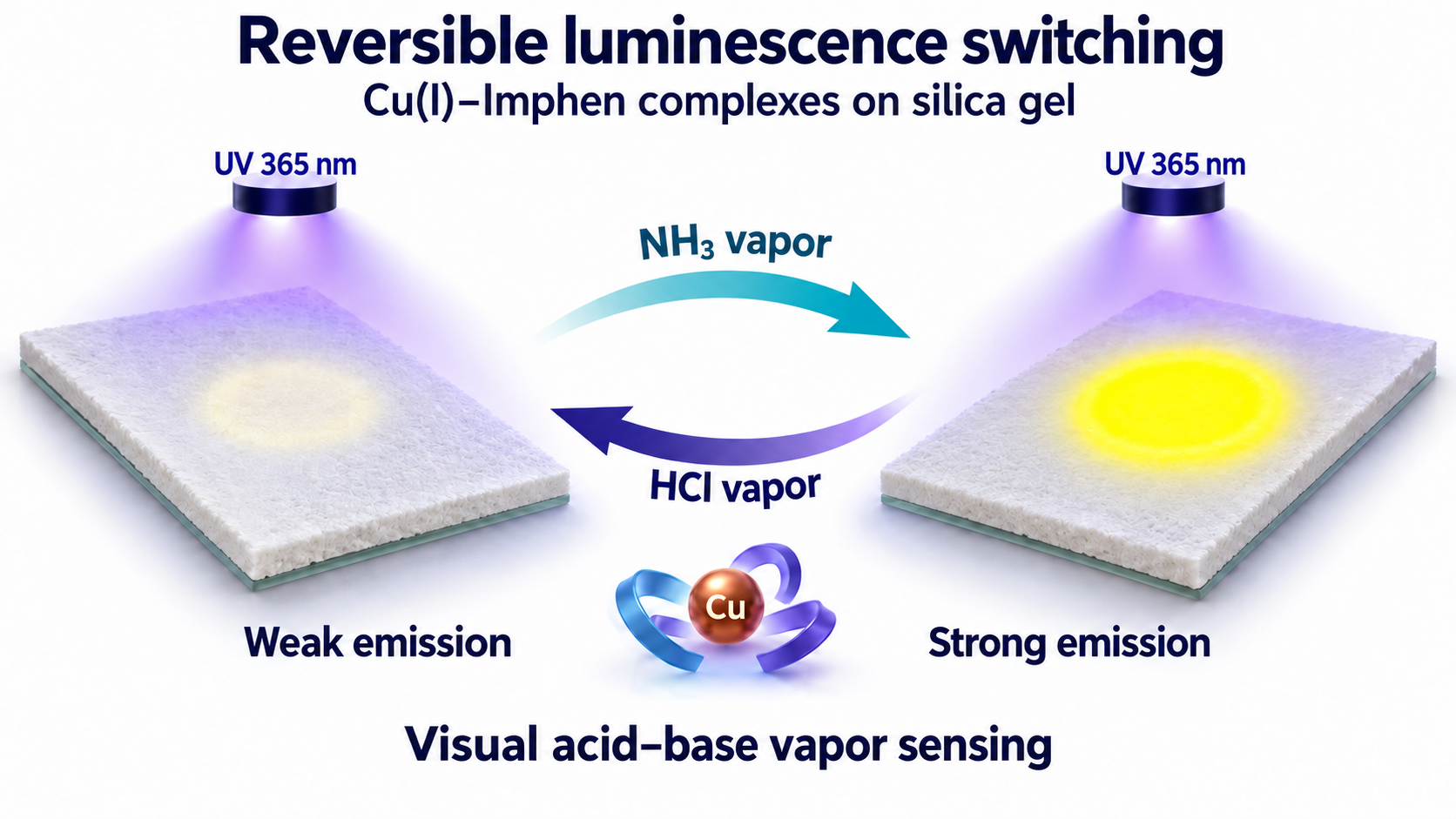
Vapor-responsive phosphorescent materials are desirable for sensing, yet reversible switching in Cu(I) complexes remains challenging. Here, a series of ionic and neutral Cu(I)–Imphen–diphosphine complexes were designed and synthesized to enable reversible phosphorescence switching upon exposure to NH₃ and HCl vapors. The complexes were characterized by IR, NMR, X-ray single-crystal diffraction, and ESI-MS. Photophysical studies revealed that absorption and emission are governed by both ligand deprotonation and solvent effects: in dichloromethane, ionic and neutral complexes show markedly different spectral profiles, whereas in DMSO, strong solvation and hydrogen-bond acceptance smooth the spectral differences between ionic and neutral complexes. Notably, when deposited on silica gel TLC plates, complexes 1a and 1b display reversible, visually detectable phosphorescence switching upon alternating exposure to NH₃ and HCl vapors. This response is attributed to reversible protonation/deprotonation, which modulates high-frequency vibrational quenching channels and the extent of π-conjugation, with additional influence from the confined silica gel microenvironment and heat-assisted volatilization of DMSO-d₆ during fuming. This work provides a robust foundation for developing Cu(I)-based materials for reversible acid–base vapor phosphorescent sensing.
Keywords:
phosphorescence switching
; acid-base vapor sensing
; Cu(I) complexes
; Imidazophenanthroline ligand
; reversible protonation/deprotonation
; silica gel
Copyright: This open access article is published under a Creative Commons CC BY 4.0 license, which permit the free download, distribution, and reuse, provided that the author and preprint are cited in any reuse.