

Submitted:
13 October 2026
Posted:
13 October 2026
You are already at the latest version
Abstract
As Advanced Driver Assistance Systems (ADAS) and Automated Driving Systems (ADS) technologies become more prevalent, evaluating their safety performance in complex, real-world environments has emerged as a critical research priority. This study presents a systematic literature review of crashes involving vehicles equipped with ADAS and ADS. Using the PRISMA methodology, this review analyzed 51 peer-reviewed articles and books published between 2018 and 2025. Articles were identified through comprehensive searches of ScienceDirect, TRID, and the Transportation Research Record. The selected studies were organized into five thematic categories: safety and crash characteristics, human interaction and user behavior, testing tools and simulations, cybersecurity and perception risks, and policy and governance. Findings reveal that while AV technologies show promise in reducing crash severity and frequency, performance is highly context-dependent, affected by roadway geometry, weather, system limitations, and user behavior. ADAS-related crashes are more common on highways and often involve human error, whereas ADS crashes are more likely in urban settings and linked to system disengagements. The review also highlights significant gaps in data availability, standardized evaluation protocols, and human-machine interaction research. Despite growing literature, many studies rely heavily on simulations and legacy datasets, limiting generalizability. To support safer AV deployment, future research must prioritize real-world testing and user trust frameworks deployment strategies. This review offers a knowledge base to guide policymakers, researchers, and industry stakeholders in advancing the development and regulation of vehicle automation technologies.
Keywords:
ADS
; ADAS
; AV
; Safety
; Systematic Review
1. Introduction
Automated vehicles (AVs) have become more common and popular nationwide due to their safety and control system features that provide additional support to the driver (Aria et al., 2016; Man et al., 2025; Saki and Soori, 2026; Shladover, 2018; Wang et al., 2024). Modern transportation is being shaped by the rapid adoption of Automated Driving Systems (ADS) and Advanced Driver Assistance Systems (ADAS), which shift crucial driving functions from humans to machines (“Advancing ADAS Acceptance,” n.d.; “Autonomous Driving and ADAS Embedded with AI,” n.d.; Nicolae et al., 2024; Samadi, 2026). These technologies are designed to enhance driving comfort, efficiency, and safety, offering a range of features from Level 1 assistance (such as lane keeping and adaptive cruise control) to more advanced Level 3 and higher automation systems (“An Analysis on the Impact of 5G in Advanced Driver Assistance Systems (ADAS),” n.d.; Chang et al., 2024; Dong et al., 2025; Hassan et al., 2025). The real-world performance of ADS and ADAS-equipped vehicles remains a major concern. Although simulation studies and control testing environments demonstrate significant safety improvements (“A Systematic Review on User Acceptance of Advanced Driver Assistance Systems (ADAS),” 2025; “Modelling and Simulation-Based Design Approach to Assisted and Automated Driving Systems Development,” n.d.; Gulino et al., 2025), the reliability of AVs is in doubt due to their involvement in crashes, particularly in complex scenarios, mixed traffic situations, and adverse weather conditions (Channamallu et al., 2025; He et al., 2025; Mintz, n.d.; Pourghasemi et al., 2026). Understanding AV performance in various conditions, particularly during crash events, is essential for advancing public safety and shaping effective policies.
Despite the rapid growth of research on AV-related crashes, methodological inconsistencies exist (Nazari et al., 2025; Xu and Zheng, 2024). For instance, studies rely on different data sources such as Department of Motor Vehicles (DMV) crash reports, basic driving data, or sensor-integrated datasets (“Comparability of driving automation crash databases,” 2025). They also differ in the type of system analyzed (ADS vs. ADAS), levels of automation (level 1 to level 3+), and crash typologies (e.g., rear-end, intersection, lane-change). Moreover, contributing factors such as road curvature, lighting, weather conditions, and driver trust in automation vary across studies(Alireza et al., 2025; Zhu et al., 2022). Analytical approaches also differ; some studies use machine learning techniques for analysis, while others apply statistical models or sensor-based simulations (“Exploring Machine Learning for Faster Mapping and Scheduling of Automotive Applications on ADAS Platforms,” n.d.; Manjunath T K, 2024; Moghadam et al., n.d.).
This systematic literature review synthesizes peer-reviewed research on crashes involving vehicles equipped with ADAS and ADS to address prevailing challenges and identify gaps in the current body of knowledge. Following the Preferred Reporting Items for Systematic Reviews and Meta-Analyses (PRISMA) guidelines, the review employed a structured search strategy across major scholarly databases and applied rigorous screening criteria to select studies that examined contributing factors, crash typologies, and system-level characteristics.
The final set of studies was organized into five thematic categories: safety and crash analysis, user behavior and trust, testing tools and validation frameworks, cybersecurity and AI reliability, and policy and governance. This thematic structure enabled a multidimensional understanding of automation-related crashes and the context in which they occur. This review seeks to answer the following key research questions:
- How do environmental, behavioral, and system-level factors influence crash occurrence and severity?
- What analytical methods and datasets are most frequently employed to study these incidents?
- How can existing empirical evidence inform the development, validation, and regulation of future vehicle automation technologies?
- What are the most common crash types involving ADAS- and ADS-equipped vehicles?
By systematically mapping the existing evidence, this review provides a comprehensive understanding of the safety performance of ADAS and ADS. It also identifies methodological gaps and highlights priority areas for future research to support the safe and efficient deployment of automated vehicle technologies.
2. Review Methodology
This literature review outlines the crash incidents and contributing factors associated with ADAS and ADS-operated vehicles, drawing from a range of relevant research conducted over the past seven years. The reviewed studies are categorized based on their thematic focus to better illustrate their findings. Understanding the current body of knowledge helps identify the broad sources of information and studies relevant to autonomous vehicle safety research, as well as the evolution of research in this sector over recent decades. A systematic review helps address the limitations of individual studies by offering a comprehensive synthesis of key findings, research gaps, and methodological approaches. This study follows the Preferred Reporting Items for Systematic Reviews and Meta-Analyses (PRISMA) guidelines to ensure a structured and transparent review process. The literature search was conducted across three of the most widely used and reputable academic databases for transportation research.
ScienceDirect (“ScienceDirect.com | Science, health and medical journals, full text articles and books.,” n.d.) yielded 375 articles, of which 28 met the inclusion criteria. The second source is the Transportation Research Record (TRR) (“Sage Journals,” n.d.), a leading and key journal in the field of transportation, covering topics such as safety, policy, and infrastructure. The initial search retrieved 47 peer-reviewed articles, of which 3 were selected for their relevance to ADAS and ADS crash-related studies. The third source is Transport Research International Documentation (TRID) (“Home - Transport Research International Documentation - TRID,” n.d.), which is another widely used repository for transportation literature. A total of 101 entries were identified, and after applying the inclusion criteria, 18 relevant articles were selected. The last criterion applies to other journals, where, out of 15 relevant papers, only two were chosen for this review. The final review included 51 articles. A detailed flowchart illustrating the selection process is provided in Figure 1.
The keyword search for this review included terms such as: “ADAS,” “ADS,” “CAV+Safety,” and “AV+Safety.” The search was limited to articles and books published between 2018 and 2025 and the final database search was conducted on July 30, 2025, a time range that reflects the rapid advancement in ADAS and ADS technologies. By focusing on this recent literature, the review ensures an up-to-date synthesis of the most relevant and impactful findings in the field. On the other hand, for reviewers, two people independently screened the titles and abstracts of all retrieved records according to the inclusion and exclusion criteria. Disagreements were resolved through discussion. Inter-rater agreement for full-text inclusion was substantial (Cohen’s κ ≳ 0.80), indicating a high level of consistency between reviewers.
For each study, a standardized information extraction form was created for gathering the following details: category, publication date, title, author, objectives, methodology, key findings, identified research gaps, study limitations, and recommendations for future studies. The complete data-extraction table is provided in Supplementary Table S1.
3. Results
The methods and steps followed in this study are illustrated in Figure 1. The PRISMA flowchart outlines the systematic review process, detailing the number of articles retrieved from various sources and those excluded. In the initial search phase, 523 articles were identified across multiple databases. During the second step, 45 duplicate records were removed. The third step involved title screening, which led to the exclusion of 411 articles, followed by abstract screening, which eliminated an additional 20 articles. In the final screening stage, 62 articles were selected for full-text review. After a thorough evaluation, 51 articles were retained and included in this systematic review. Duplicates, irrelevant content, and insufficiently detailed studies were removed during the screening process.
Based on their content and focus, the reviewed studies were classified into five primary categories. Some studies fell into more than one category, depending on their scope and methodology. The categories are as follows:
- Safety & Crash Analysis: This category primarily includes studies related to crash data, safety performance, and real-world impacts of ADAS and ADS. There were 19 studies included in this category, accounting for 37% of all included studies. Human Interaction & User Behavior: This group focuses on user responses, driver adaptation, trust, and behavior in relation to vehicle automation systems. A total of 8 studies fell into this category, representing 16% of the overall sample.
- Testing Tools & Simulations: Studies in this category explore scenario-based testing frameworks, simulation environments, and validation techniques for AV technologies. Overall, 14 studies (27%) were classified under this category
- Cybersecurity & Perception Risks: This includes research on system vulnerabilities, perception failures, and risk mitigation strategies in AV operations. In total, 4 studies, equivalent to 8% of the included literature, were grouped in this category
- Policy, Standards & Governance: Articles in this category examine the regulatory landscape, governance frameworks, and policy implications surrounding the deployment of ADS and ADAS.
These categories were developed based on the studies’ objectives, methodologies, key findings, and overall thematic direction. The following sections provide a more detailed discussion of these findings. Among all included studies, 12% (n = 6) were assigned to this category.
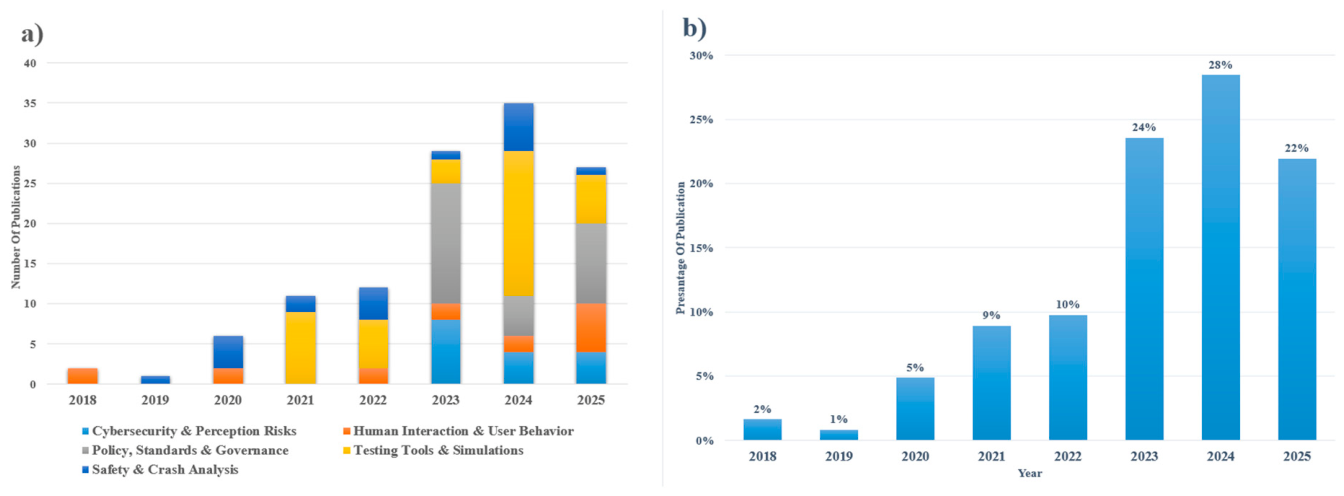
Figure 2(a) shows the percentage distribution of the reviewed studies from 2018 to 2025. The time-series analysis reveals a significant increase in the number of published articles beginning in 2023, suggesting that crashes involving ADS- and ADAS-equipped vehicles are receiving growing attention. This trend may be partially attributed to improved data availability and broader adoption of these technologies. Also, Figure 2(b) illustrates the number of studies published each year, categorized into five thematic areas. Notably, studies focusing on Testing Tools and Simulations have seen increased attention compared to other categories since 2018.
4. Safety & Crash Analysis
4.1. System Performance and Crash Characteristics
Numerous studies have investigated the relationship between system performance and crash outcomes in vehicles equipped with ADS and ADAS. A key area of focus has been sensor reliability under varied environmental conditions. To assess the reliability of ADS sensors, Zhang et al. examined existing algorithms, datasets, and experimental results under various conditions, including snow, rain, light, and contamination. Techniques, such as Dynamic Radius Outlier Removal (DROR), Local Iterative Outlier Removal (LIOR), and Dual-Domain Multi-Scale Network (DDMSNet), were shown to improve the perception performance of LiDAR systems. Additionally, enhancements in thermal cameras and image quality increased visibility under intense lighting. The study also found that sensor fusion and machine learning approaches contributed to more reliable perception and decision-making systems in AVs (Samadi et al., 2025; Zhang et al., 2023).
Environmental and roadway conditions play a pivotal role in the operational effectiveness of automation technologies. A study evaluated the real-world performance of Lane Support Systems (LSS) on rural two-lane roads under dry and daylight conditions to help define operational design domains (ODD). Using a white-box, open-road experimental setup across 735 road sections, the study demonstrated that environmental and roadway conditions significantly affect crash severity in ADS- and ADAS-equipped vehicles (Cafiso and Pappalardo, 2020). Dong et al. employed a two-mode social network and N-K modeling approach. The results indicated that highways were the primary setting for ADAS-related crashes, while ADS crashes were more frequent on urban streets. Certain conditions, such as wet pavement and rain, were found to increase crash risk, especially at intersections. While most ADAS-related crashes resulted in non-injury outcomes, crashes involving ADS were more likely to involve injuries (Dong et al., 2025). Similarly, Liu et al. found that AVs were 1.6 times more likely than conventional vehicles to be involved in rear-end collisions, and lane-change collisions were the most common. These incidents were often caused by delayed perception-reaction (PR) times, poor lane change prediction, and inadequate time-space path planning (Liu et al., 2021).
Further disaggregation of crash data has enabled researchers to explore differences in crash initiation. For instance, Boggs et al. categorized crash data by initiator (human or ADS). They found that 75% of disengagements were caused by human intervention, while ADS-initiated incidents were primarily related to software, hardware, or planning errors. As the technology matured, system-triggered disengagements slightly increased (Boggs et al., 2020a). Additional highlights by Scanlon et al. showed that San Francisco had the highest AV crash rate, while Maricopa County closely aligned with the national average. The study also highlighted that passenger vehicles and surface streets experienced higher crash rates than broader datasets suggest (Scanlon et al., 2024). Complementing these insights, Huang et al. reported that rear-end crashes were more frequent among ADAS vehicles (52.4%) compared to ADS (40%). They also found that crash likelihood was more strongly influenced by speed-gap ratio and crash partner movement than by environmental conditions (Huang et al., 2024).
These studies demonstrate that, although automation technologies have advanced in terms of perception and control, their effectiveness remains context-dependent. Adaptive system designs and better edge case modeling are necessary because adverse conditions, complicated road geometries, and interaction with human-driven vehicles continue to present difficulties.
4.2. Human Factors and Crash Severity
While technological advancement is critical, human interaction with automated systems remains a fundamental determinant of safety outcomes. Hungund et al. found that engaging in non-driving tasks during The Society of Automotive Engineers (SAE) Level 3 automation led to longer takeover times, decreased situational awareness, and increased driver workload (Hungund and Kumar Pradhan, 2023). Similar behavioral risks were identified in the study by Boggs et al. applied text mining to exclude narrative data and crash reports, integrating them with the built environment and roadway condition. Using a Full Bayesian framework and estimated fixed and random binary logit models via Markov Chain Monte Carlo (MCMC), they found that responsibility-focused driver training reduced long glances away from the road, improved anticipatory behaviors, and shortened takeover times (Boggs et al., 2020b).
Crash severity has also been linked to a combination of system level, roadway features, and behavioral variables. Yan et al. revealed that automation level and speed limit predicted crash pattern types, while factors such as crash patterns, roadway type, surface condition, and incident time influenced contact location and injury severity (Yan et al., 2024). Han et al. studied Intersection ADAS (I-ADAS) systems by analyzing intersection collisions using black-box camera footage. They found that speed significantly increased injury severity, and 80% of drivers failed to perform avoidance maneuvers. Video-based methods using object movement and size detection helped predict high-risk scenarios (Han, 2020).
Several studies have examined broader implications for planning and safety policy. A Minnesota-based study focused on ADAS-equipped vehicle crash records to develop a planning tool for estimating the net statewide safety impact. Using probabilistic models, the tool incorporated vehicle characteristics, driver demographics, and environmental conditions to provide data-driven estimates for supporting ADAS policy and planning decisions (“Tool to estimate the safety impact of vehicle levels of automation on Minnesota roads [Project]”). Schoner et al. used descriptive analysis and hypothesis testing to assess crash severity in ADAS-equipped vehicles. They found that vehicles with ADAS were involved in fewer fatal crashes, experienced less severe injuries, and had lower crash energy (Delta V). Although these vehicles were involved in slightly more angle crashes, they were in fewer head-on and rear-end collisions, and the crashes tended to be less severe overall (Schoner et al., 2024).
Finally, Combs et al. examined the potential of AVs to reduce pedestrian fatalities by virtually reconstructing 5,000 pedestrian deaths in 2015 using sensors available in 2017. Their analysis showed that combining multiple sensor types could reduce fatalities. However, high implementation costs and limited use in rural and non-freeway areas may restrict the real-world benefits of this technology (Combs et al., 2019). These results support the assumption that, although automated systems can reduce the frequency and severity of crashes, optimizing safety benefits requires context-specific deployment strategies and efficient human-machine interaction. The ways that system architecture, policy frameworks, and driver behavior can cooperate to promote safer automated mobility should be further investigated in future studies.
A notable difference in the results of these studies reveals that when focusing on the more detailed aspects. Although specific studies indicate substantial decreases in rear-end collisions in urban ADS deployments, others report constant risks at complex intersections and also during adverse weather conditions. The differences come from variations in regional policy frameworks, system development, and datasets (e.g., early highway pilots vs. large-scale urban fleets). These differences highlight the need for adaptive system designs and improved advanced case modeling, as well as demonstrating that the advantages of remaining are still dependent on context.
5. Human Interaction and User Behavior
Understanding how human users interact with automated systems is critical for ensuring safe integration of AVs and ADAS into the transportation ecosystem. A key theme across recent research is the role of risk perception and visual input. Using the Human and Vehicle-in-the-Loop (Hu&ViL) method to assess the AV passenger's perception of interaction with the pedestrian. Steimle et al. demonstrate that risk perception was strongly influenced by visual input in T-junctions, and they highlight the role of motion realism in a particular situation (Steimle et al., 2025).
Another central factor is trust, which plays a significant role in long-term adaptation and user behavior. A PRISMA paper focuses more on long-term adaptation to ADS, and the finding shows that ADS adaptation relies more on incident quality than exposure time. Additionally, Nkusi et al. noted that trust and well-formed mental models enhanced performance in the results of their review (Nkusi et al., 2025). Forster et al., in their research of 80 participants in a driving simulator, demonstrate that education enhanced mental model accuracy and transition performance. This research shows that manual and tutorial user education conditions yield the best initial results (Forster et al., 2020).
Driver training interventions have also been explored in terms of their effect on anticipation and takeover quality. DeGuzman and Donmez have similar research with 47 participants. However, their results show that visual attention, anticipatory behavior, and takeover timing were enhanced by responsibility-focused training in critical events. In contrast, limitation-focused training showed no advantage over no training (DeGuzman and Donmez, 2024). Zhang et al. conducted the same research, but with 34 ADAS-equipped drivers on the road. They illustrated trustful drivers showed more hands-off behavior, delayed actions, and less monitoring, especially in complex circumstances. They also found that ADAS functionality and accumulated mileage were linked to increased trust and reduced visual tracking (Zhang et al., 2025). The personalization of system warnings appears to influence trust and perceived effectiveness further. In another on-road study with 10 drivers, C. Panou et al. used time headway and reaction time to personalize CAS warnings. The results show that the research participants received higher trust and preference scores than those in the non-personalized group. Warnings were considered timelier and more appropriate, showing that personalization enhanced driver acceptance without decreasing safety (C. Panou, 2018).
User characteristics, including demographics and personality traits, also shape system interaction. A large-scale survey of 634 U.S. drivers revealed that younger males with high self-rated driving skills tended to report lower knowledge of ADAS technologies, despite expressing greater confidence. Conversely, female drivers reported greater concerns about safety and reliability and were more inclined to prefer hands-on experiences when adopting new vehicle technologies (Greenwood et al., 2022). Finally, while driver trust, education, and personalization strategies are critical to improving safety outcomes, broader systemic interventions are also necessary. ADAS technologies enhance safety, but achieving fewer fatalities in crashes depends on various factors, as Chalmers mentioned in its research, including integration with infrastructure, policy, education, enforcement, and emergency response under the safe system approach (Chalmers, 2023).
6. Testing Tools and Simulations
The validation of advanced driver assistance systems (ADAS) and automated driving systems (ADS) increasingly relies on structured scenario generation and robust simulation platforms. The study for ADS testing using an extended Systems Theoretic Process Analysis (STPA) hazard analysis method generated over 3000 scenario-driven test cases for 51 unsafe control actions. Khastgir et al. applied this method to a real-world SAE Level 4 low-speed automated driving (LSAD). This approach illustrates the coverage of known and unknown failure modes compared to traditional testing methods. Also, Khastgir et al. argue for hazard-focused, structured validation techniques over traditional statistical criteria (Khastgir et al., 2021). Complementing this, Kroger et al. proposed measurable levels of risks that provide consistent safety standards based on engineering, regulatory, and sociological considerations (Kröger, 2025).
Advanced modeling techniques have further enabled more nuanced scenario design. Using 3D LiDAR point cloud data, XGBoost classifiers, and Shapley Additive Explanations (SHAP), Kang et al. proposed a data-driven framework for generating realistic AV safety scenarios. This study achieved almost 95% classification accuracy for accident-triggered vehicles (Kang et al., 2024; Samadi et al., 2025). At the U.S. National Highway Traffic Safety Administration (NHTSA), Albrecht et al. developed high-precision testing protocols capable of evaluating ADS/ADAS performance in complex scenarios such as traffic jams and intersections, emphasizing the need for repeatable, accurate safety assessments (Albrecht et al., 2021). Similarly, Markofsky et al. used a simulation-based virtual calibration method for optimizing the behavior of ADS- and ADAS-equipped vehicles in several scenarios. The results of this study show that by using a modular framework with PSO optimization, test efficiency was boosted by almost 39% and showed safety and comfort-oriented behavior under several circumstances (Markofsky et al., 2023).
Real-time fault detection and increased scenario variety were also explored through combinatorial and search-based simulation, as demonstrated by Klampfl et al., who used answer set programming (ASP) to identify object-tracking errors and system-layer conflicts (Klampfl et al., 2024). To facilitate cross-platform validation, Ali et al. introduced OpenCat, a tool for converting OpenDrive files to Catmull-Rom splines, highlighting how tightly coupled ADAS benchmarks can hinder generalization across simulation environments (Ali et al., 2025). Other studies focused on co-simulation platforms and test coverage metrics. Jooriah et al. combined the CARLA simulator with Artery Vehicle-to-Everything (V2X) and Robot Operating System (ROS), enabling hardware-in-the-loop (HIL) testing, dynamic obstacle control, and V2X message exchange within scenario-based testing frameworks (Jooriah et al., 2024). Machida and Shitaoka introduced a test coverage index based on real-world aspects of the scenarios, such as road, geometry, and traffic conditions, to optimize ADAS and ADS evaluation routes. The index showed improvement in scenario coverage up to 90.4% with reduced mileage and revealed regional differences in test relevance between Japan, Europe, and North America (Machida and Shitaoka, 2022).
The validity of simulation environments remains a challenge. The last three studies in this category highlighted the challenges of ensuring simulation validity and scenario accuracy in ADAS/ADS testing. Singh et al. emphasized the impact of simulator-specific architectures and assumptions on ADAS, and they found that encouraging the use of generalized simulation platforms increases the reliability of results across platforms (Singh et al., 2021). Scally et al. focused on partial overlap conditions between the lead vehicle and the driving lane, showing how these edges have an impact on the reliability of Forward Collision Warning (FCW) and Automated Emergency Braking (AEB) systems (Scally et al., 2024). Kibalama et al. contributed a structured method to generate safety-critical scenarios from real-world crash data, tailored to the validation needs of Level 3 ADS on highways (Kibalama et al., 2022).
Collectively, these studies underscore the growing sophistication and multiplicity of validation techniques, reflecting a shift from purely statistical evaluation to structured, scenario-based, and real-time adaptive testing frameworks. They also reveal a common goal: ensuring that simulation environments are representative, flexible, and robust enough to reflect the complex realities of automated driving.
7. Cybersecurity and Perception Risks
While this category contains a limited number of studies directly aligned with the core themes of this review, the selected research offers important insights into emerging AI frameworks, cybersecurity vulnerabilities, and risk assessment methods relevant to ADS and ADAS development. Beyond computational efficiency, several studies explored the vulnerabilities of AI systems within AVs and proposed targeted countermeasures. Llorca et al. emphasized the challenges AI introduces to AVs and found that AI undeniably affects all aspects of AVs, such as localization, perception, planning, and human-vehicle interaction. This study also proposed a model that addresses cybersecurity risks (Llorca et al., 2024). In a complementary approach, another study used UV lighting and cryptographic authentication to address the risk of visual disturbance. Karaaslan et al. introduced a UV-enhanced machine vision system with encrypted visual ID to protect ADS and ADAS from adversarial traffic sign attacks. They tested proof-of-concept, and during testing, the system detected inaccurate ADAS responses, identified modified signs, and stayed resilient in various conditions (Karaaslan et al., 2023). Finally, Molloy et al. applied the Hazard and Operability (HAZOP) methodology to assess safety risks in a machine learning-based perception module, specifically, a camera-dependent Automatic Lane Centering (ALC) system. Their analysis identified critical failure modes, including object misclassification, delayed detection, and sensor-specific faults. This work reinforces the importance of structured, system-wide risk assessments, particularly in scenarios involving sensor fusion and adaptive perception frameworks (Molloy et al., 2024).
Taken together, these studies emphasize a dual imperative: enhancing computational efficiency and real-time capability in AI models for AVs, while also addressing the security and interpretability challenges inherent in data-driven perception and control systems.
8. Policy, Standards, and Governance
As ADS continues to evolve, researchers increasingly emphasize the critical need for robust policy frameworks, data-informed governance structures, and standardized safety protocols to guide their implementation. A consistent theme across recent literature is the alignment of regulatory efforts with operational realities, such as the definition of operational design domains (ODDs), system limitations, and crash response protocols.
Galassi et al. introduced the European Union’s (EU) evolving regulatory framework for the approval of Level 4 AVs based on the General Safety Regulation (GSR). The regulation highlighted the importance of scenario, lifetime performance tracking, and alignment with operational design domain (ODD) (Galassi et al., 2023). Similarly, another study presents a sensor-based data pipeline for crash recreation in AVs, using multimodal inputs such as LiDAR, radar, cameras, Global Positioning System (GPS), and Inertial Measurement Unit (IMU), processed with tools like YOLOv5 and AdaBins. Beck et al. highlighted the findings of the importance of sensor fusion and simulation in post-crash analyses (Beck et al., 2023).
Through the analysis of real-world fatal incidents, Ballingall et al. identified critical gaps in safety management systems (SMS), failure mitigation strategies, and the definition and enforcement of appropriate design domains. Their multi-case study emphasized the need for proactive oversight mechanisms and better integration of risk mitigation redundancies in ADS deployments (Ballingall et al., 2025). Quantitative assessments of policy impact were also evident in recent modeling efforts. Aleksa et al., in their study using Austria’s official crash data, developed a software model to estimate the safety potential of nine ADAS technologies through 2040, observing notable drops in collisions and fatalities, particularly from systems like Automatic Emergency Braking (AEB) and Lane Keeping Assist (LKA), with effectiveness by user group and type of system (Aleksa et al., 2024).
Despite these advances, concerns remain regarding the consistency and coordination of safety standards across regions and manufacturers. Pimentel et al. mentioned the limitations of the current framework, such as the lack of coordination on validation standards, measurement accuracy, and AV safety guidelines. Also, they introduced an Enterprise-Wide Quality and Integrated Management System (EWQIMS) as a possible ISO-compliant way to support AV development and safety analysis (Pimentel, 2024).
9. Discussion
This systematic review aimed to systematically review 51 scholarly articles relevant to ADAS and ADS, with an emphasis on the causes of crashes, safety evaluation, and reliability methods. The PRISMA method is used to identify the limitations and gaps in the studies and how the researchers plan to address them in future studies. These articles are classified by their findings, results, and objectives. Those articles included five categories: safety, user behavior, testing tools, cybersecurity, and policies on autonomous vehicles. According to Figure 2, more than 70% of the research was done after 2023, showing the increasing importance of ADS and ADAS-equipped vehicles in recent years.
Across the reviewed literature, the most utilized data sources include the NHTSA crash dataset, DMV crash reports, and real-world sensor data, particularly from LiDAR and onboard AV perception systems. These data sources provide rich insight into crash dynamics, system performance, and driver behavior under varied operational conditions. Recent intersection studies have also used LiDAR data to quantify conflict severity and evaluate changes in red-light running following yellow interval adjustments (Dehestanimonfared et al., 2026; Naseri et al., 2026). In terms of methodology, statistical analysis and spatial analysis emerged as the most frequently applied approaches. These techniques were often used to assess crash frequency, severity, and spatial distribution, as well as to evaluate the effectiveness of automated systems under different roadways, environmental, and behavioral contexts. A consistent theme across studies is the increased crash risk in complex environments, including adverse weather conditions, intersections, and areas with high traffic density. Findings also reveal persistent challenges in the reliability and robustness of ADAS and ADS technologies, particularly in comparison to human drivers in non-ideal conditions. Moreover, while automation holds promises for reducing crash severity and fatalities, its effectiveness is highly context-dependent, requiring further refinement of system design, testing protocols, and human-machine interaction strategies.
Despite the growing body of literature on ADS and ADAS, several limitations were identified across studies. A common issue is the overreliance on simulation environments and controlled test scenarios, which often fail to capture the complexity and unpredictability of real-world driving conditions. Many studies that were reviewed in this study continue to utilize legacy datasets, including outdated crash reports or limited sensor feeds, rather than incorporating updated, high-resolution data from real-world deployments. This constrains the generalizability of findings and the development of safety assessments. Moreover, a critical challenge observed throughout the literature reviewed in this study is the limited treatment of adverse weather and complex traffic conditions, which are among the most influential factors affecting AV performance. Real-time environmental variability, such as fog, glare, snow, and dynamic roadway hazards, remains underrepresented in most testing and analysis protocols. Furthermore, inconsistencies in data availability, particularly from automotive manufacturers, restrict the ability to compare systems across platforms or validate findings against field performance. Additionally, there was insufficient research on how drivers establish trust in these systems or how well different crashes and driver groups were represented. The most essential, yet often overlooked, area is how AVs behave in cities and urban areas, and how people from various backgrounds interact with these systems. Several studies also highlighted the lack of standardized protocols for evaluating behavioral responses and mental model adaptation in Human-Machine Interface (HMI) contexts, particularly for higher SAE levels. Furthermore, this review has several limitations, including an over-reliance on a limited set of academic journals and databases that have a focus on the field of transportation, as well as the underutilization of grey literature, such as government and industry reports. This study also excludes research that is not peer-reviewed, which has an impact on the methodology and screening criteria. These factors should be considered when interpreting the synthesized findings.
This review aims to support transportation researchers, policymakers, and industry stakeholders in identifying critical gaps in the current body of literature on the safety of ADAS- and ADS-equipped vehicles. While advancements in automation technologies have demonstrated potential for improving roadway safety, this potential is constrained by limitations in testing environments, data quality, and user-centered evaluation frameworks. Beyond vehicle automation, research on EV charging infrastructure highlights the importance of considering queuing, stopping, and parking conflicts in infrastructure planning and safety policy (Nasim et al., 2026). Future research should prioritize the real-world testing of autonomous systems under various and challenging conditions, moving beyond simulation-based scenarios to capture the complexity of actual driving environments. Equally important is the need to promote user trust and satisfaction, particularly through studies that examine mental model development, behavioral adaptation, and human-machine interaction across varied populations.
10. Summary and Conclusion
This study conducted a systematic review of crashes involving vehicles equipped with ADAS and ADS to identify crash causes, contributing factors, prevalent crash patterns, and methodological limitations across the existing literature. The review encompassed a wide range of influencing domains, including environmental conditions, roadway characteristics, human behavior, and technological system design. The findings indicate that factors such as automation level, roadway type, adverse weather, and system response time significantly influence crash occurrence and severity. Vehicles equipped with ADS, in particular, demonstrate reduced performance reliability in complex urban environments, where unpredictable interactions and dense traffic present considerable operational challenges. In contrast, the performance of ADAS-equipped vehicles varies more substantially depending on driver behavior and roadway context, often exhibiting mixed safety outcomes. These insights underscore the importance of context-aware evaluation and the need for improved system adaptability across various driving conditions.
Several studies investigated disengagements, injury severity, and the role of perception and planning failures in AV crashes. Several studies employed various methods, including simulation, real-world trajectory data, and social network analysis. The analysis also highlighted the limitations of current standards due to data availability and the differences in crash performance resulting from varying automation levels. This review demonstrates the growing need for standardized evaluation frameworks to assess the real-world safety of AV systems. Future research should incorporate more various data sources and context-specific variables to gain a deeper understanding of AV behavior across various scenarios. Policymakers and transportation agencies should also prioritize transparent crash reporting and scenario-based safety testing to improve AV readiness and public trust. The findings from this review can guide researchers in selecting appropriate methodologies and identifying gaps for future investigation.
References
- A Systematic Review on User Acceptance of Advanced Driver Assistance Systems (ADAS). Transportation Research Procedia 2025, 82, 3472–3482. [CrossRef]
- Advancing ADAS Acceptance: Interventions and Comparative Analysis of Robotic Human Machine Interfaces | Adjunct Proceedings of the 16th International Conference on Automotive User Interfaces and Interactive Vehicular Applications [WWW Document]. ACM Conferences. n.d. [CrossRef]
- Albrecht, H.; Barickman, F.S.; Schnelle, S.C. National Highway Traffic Safety Administration: Vehicle Research and Test Center Advanced Test Tools for ADAS and ADS; National Highway Traffic Safety Administration, 2021. [Google Scholar] [CrossRef]
- Aleksa, M.; Schaub, A.; Erdelean, I.; Wittmann, S.; Soteropoulos, A.; Fürdös, A. Impact analysis of Advanced Driver Assistance Systems (ADAS) regarding road safety – computing reduction potentials. Eur. Transp. Res. Rev. 2024, 16, 39. [Google Scholar] [CrossRef]
- Ali, Q.; Stocco, A.; Mariani, L.; Riganelli, O. OpenCat: Improving Interoperability of ADS Testing. 2025. [Google Scholar] [CrossRef]
- Alireza, A.; Nasim, S.; Mansoureh, J. Investigating Truck Driver Behavior under Distracted Conditions to Enhance Road Safety. In International Conference on Transportation and Development 2025. Presented at the International Conference on Transportation and Development 2025; American Society of Civil Engineers: Glendale, Arizona, 2025; pp. 273–285. [Google Scholar] [CrossRef]
- An Analysis on the Impact of 5G in Advanced Driver Assistance Systems (ADAS) [WWW Document]. n.d. Available online: https://ieeexplore.ieee.org/abstract/document/10575646?casa_token=L6oNkAT_bOIAAAAA:k4Sr4fJYLrZa3-6sK-2pprF9LHGQ0W9D4Ei57h3Cv4v35IYLXbNZFv0AETTX6CU30qLc5YT80VQ (accessed on 25 May 2025).
- Aria, E.; Olstam, J.; Schwietering, C. Investigation of Automated Vehicle Effects on Driver’s Behavior and Traffic Performance. Transportation Research Procedia, International Symposium on Enhancing Highway Performance (ISEHP), Berlin, June 14-16; 2016. 15, 761–770. [Google Scholar] [CrossRef]
- Autonomous Driving and ADAS Embedded with AI: Comparing the AI Norms [WWW Document]. n.d. Available online: https://ieeexplore.ieee.org/abstract/document/10581391?casa_token=b4Rd17DJzSUAAAAA:xnHsHcTg7jyP48bGTX5Tr7LyCH0aJNjU0_S_2aWYQRNNyhq_9Hf-Pd-TGHJUJD0Pz_KGhCAz64U (accessed on 25 May 2025).
- Ballingall, S.; Sarvi, M.; Sweatman, P. Safety assurance for automated systems in transport: A collective case study of real-world fatal crashes. Journal of Safety Research 2025, 92, 27–39. [Google Scholar] [CrossRef] [PubMed]
- Beck, J.; Arvin, R.; Lee, S.; Khattak, A.; Chakraborty, S. Automated vehicle data pipeline for accident reconstruction: New insights from LiDAR, camera, and radar data. Accident Analysis & Prevention 2023, 180, 106923. [Google Scholar] [CrossRef] [PubMed]
- Boggs, A.M.; Arvin, R.; Khattak, A.J. Exploring the who, what, when, where, and why of automated vehicle disengagements. Accident Analysis & Prevention 2020a, 136, 105406. [Google Scholar] [CrossRef] [PubMed]
- Boggs, A.M.; Wali, B.; Khattak, A.J. Exploratory analysis of automated vehicle crashes in California: A text analytics & hierarchical Bayesian heterogeneity-based approach. Accident Analysis & Prevention 2020b, 135, 105354. [Google Scholar] [CrossRef] [PubMed]
- C. Panou, M. Intelligent personalized ADAS warnings. Eur. Transp. Res. Rev. 2018, 10, 59. [Google Scholar] [CrossRef]
- Cafiso, S.; Pappalardo, G. Safety effectiveness and performance of lane support systems for driving assistance and automation – Experimental test and logistic regression for rare events. Accident Analysis & Prevention 2020, 148, 105791. [Google Scholar] [CrossRef] [PubMed]
- Chalmers, S. Reducing Human Driver Error and Setting Realistic Expectations with Advanced Driver Assistance Systems. SAE EDGETM Research Reports EPR2023016. 2023. [CrossRef]
- Chang, I.; Lee, J.; Ahn, S. Evaluation of Level 2 Automated Driving Safety on Curved Sections. KSCE J Civ Eng 2024, 28, 4023–4031. [Google Scholar] [CrossRef]
- Channamallu, S.S.; Almaskati, D.; Kermanshachi, S.; Pamidimukkala, A. Autonomous vehicle safety: An advanced bagging classifier technique for crash injury prediction. Multimodal Transportation 2025, 4, 100189. [Google Scholar] [CrossRef]
- Combs, T.S.; Sandt, L.S.; Clamann, M.P.; McDonald, N.C. Automated Vehicles and Pedestrian Safety: Exploring the Promise and Limits of Pedestrian Detection. American Journal of Preventive Medicine 2019, 56, 1–7. [Google Scholar] [CrossRef] [PubMed]
- Comparability of driving automation crash databases, 2025. Journal of Safety Research 92, 473–481. [CrossRef] [PubMed]
- DeGuzman, C.A.; Donmez, B. Training benefits driver behaviour while using automation with an attention monitoring system. Transportation Research Part C: Emerging Technologies 2024, 165, 104752. [Google Scholar] [CrossRef]
- Dehestanimonfared, N.; Samadi, N.; Laaly, S.; Jeihani, M. A LiDAR-Based Framework for Proactive Safety Assessment Using a Severity-Weighted Conflict Index (SWCI) 881–893; 2026. [Google Scholar] [CrossRef]
- Dong, S.; Cui, Z.; Sun, D.J.; Ye, L.; Ding, S. How do environmental and road factors impact automated vehicle crashes? An evidence from ADAS and ADS. Journal of Transportation Safety & Security 2025, 17, 376–404. [Google Scholar] [CrossRef]
- Exploring Machine Learning for Faster Mapping and Scheduling of Automotive Applications on ADAS Platforms [WWW Document]. n.d. Available online: https://ieeexplore.ieee.org/abstract/document/10903351?casa_token=CLlCY1IrkqYAAAAA:aC9ImBGB2IlFpIQsLQjWoPRQyy5fw4xNvQLpee4rR8Y3YPCzz-FI6dy-uBvUVlLLRHpAEPMDQLE (accessed on 25 May 2025).
- Forster, Y.; Hergeth, S.; Naujoks, F.; Krems, J.F.; Keinath, A. What and how to tell beforehand: The effect of user education on understanding, interaction and satisfaction with driving automation. Transportation Research Part F: Traffic Psychology and Behaviour 2020, 68, 316–335. [Google Scholar] [CrossRef]
- Galassi, M.C.; Lagrange, A.; Ciuffo, B.; Bertoa, R.S.; Vass, S.; Mattas, K.; Donà, R.; Sollima, C. Safety Approval of Automated Vehicles in the EU: Moving Beyond Highway Applications. Transportation Research Procedia, TRA Lisbon 2022 Conference Proceedings Transport Research Arena (TRA Lisbon 2022), Lisboa, Portugal, 14th-17th November; 2022; 72, pp. 4396–4403. [Google Scholar] [CrossRef]
- Greenwood, P.M.; Lenneman, J.K.; Baldwin, C.L. Advanced driver assistance systems (ADAS): Demographics, preferred sources of information, and accuracy of ADAS knowledge. Transportation Research Part F: Traffic Psychology and Behaviour 2022, 86, 131–150. [Google Scholar] [CrossRef]
- Gulino, M.-S.; Vichi, G.; Vangi, D. Validation of a virtual forward simulation tool for ADAS assessment. Eur. Transp. Res. Rev. 2025, 17, 1–29. [Google Scholar] [CrossRef]
- Han, I. Scenario Establishment and Characteristic Analysis of Intersection Collision Accidents for Advanced Driver Assistance Systems; Traffic Injury Prevention 21; 2020; pp. 354–358. [Google Scholar] [CrossRef] [PubMed]
- Hassan Ahmed, A.M.; Al-Aswadi, F.N.; Saleh AlDharhani, G.; Hamad, O.M.I.; Iqbal, Z. Development and implementation of an autonomous vehicle prototype with ADAS. IET Conference Proceedings; 2025. [Google Scholar] [CrossRef]
- He, Y.; Xiang, D.; Wang, D. Traffic safety evaluation of emerging mixed traffic flow at freeway merging area considering driving behavior. Sci Rep 2025, 15, 1–17. [Google Scholar] [CrossRef] [PubMed]
- Home - Transport Research International Documentation - TRID [WWW Document]. n.d. Available online: https://trid.trb.org/ (accessed on 16 May 2025).
- Huang, C.; Wen, X.; He, D. Characteristics of Rear-End Collisions: A Comparison between Automated Driving System-Involved Crashes and Advanced Driving Assistance System-Involved Crashes. Transportation Research Record: Journal of the Transportation Research Board 2024, 2678, 771–782. [Google Scholar] [CrossRef]
- Hungund, A.P.; Kumar Pradhan, A. Impact of non-driving related tasks while operating automated driving systems (ADS): A systematic review. Accident Analysis & Prevention 2023, 188, 107076. [Google Scholar] [CrossRef] [PubMed]
- Jooriah, M.; Datsenko, D.; Almeida, J.; Sousa, A.; Silva, J.; Ferreira, J. A Co-Simulation Platform for V2X-Based Cooperative Driving Automation Systems. 2024 IEEE Vehicular Networking Conference (VNC). Presented at the 2024 IEEE Vehicular Networking Conference (VNC); 2024; pp. 227–230. [Google Scholar] [CrossRef]
- Kang, M.; Eom, S.; Hwang, K. Advancing autonomous vehicle safety assessment: A novel methodology for moving from functional to concrete scenarios using kinetic 3D-LiDAR and SHAP. Results in Engineering 2024, 24, 103364. [Google Scholar] [CrossRef]
- Karaaslan, E.; Zakaria, M.; Ercan, T.; Sen, B.; Laman, H.; Banihashemi, M.; Pol, J. Encrypted Transfer of Traffic Sign Information for Advanced Driving Assistance Systems Using Invisible Security Patches. Transportation Research Record: Journal of the Transportation Research Board 2023, 2677, 991–998. [Google Scholar] [CrossRef]
- Khastgir, S.; Brewerton, S.; Thomas, J.; Jennings, P. Systems Approach to Creating Test Scenarios for Automated Driving Systems. Reliability Engineering & System Safety 2021, 215, 107610. [Google Scholar] [CrossRef]
- Kibalama, D.; Tulpule, P.; Chen, B.-S. AV/ADAS Safety-Critical Testing Scenario Generation from Vehicle Crash Data. Presented at the SAE Technical Paper, Society of Automotive Engineers (SAE). Society of Automotive Engineers (SAE), 2022. [CrossRef]
- Klampfl, L.; Klück, F.; Nica, M.; Tao, J.; Wotawa, F. Testing ADAS/ADS – from critical scenarios to automated testing oracles. Elektrotech. Inftech. 2024, 141, 392–399. [Google Scholar] [CrossRef]
- Kröger, W. How safe should automated vehicles be? - A survey and proposal for discussion. Next Research 2025, 2, 100238. [Google Scholar] [CrossRef]
- Liu, Q.; Wang, X.; Wu, X.; Glaser, Y.; He, L. Crash comparison of autonomous and conventional vehicles using pre-crash scenario typology. Accident Analysis & Prevention 2021, 159, 106281. [Google Scholar] [CrossRef] [PubMed]
- Llorca, D.F.; Hamon, R.; Junklewitz, H.; Grosse, K.; Kunze, L.; Seiniger, P.; Swaim, R.; Reed, N.; Alahi, A.; Gómez, E.; Sánchez, I.; Kriston, A. Testing autonomous vehicles and AI: perspectives and challenges from cybersecurity, transparency, robustness and fairness. 2024. [Google Scholar] [CrossRef]
- Machida, T.; Shitaoka, K. Test Coverage Index for ADAS/ADS Assessment Based on Various Real-World Information Points. IEEE Transactions on Intelligent Transportation Systems 2022, 23, 1443–1455. [Google Scholar] [CrossRef]
- Man, S.S.; Ding, M.; Li, X.; Chan, A.H.S.; Zhang, T. Acceptance of Highly Automated Vehicles: The Role of Facilitating Condition, Technology Anxiety, Social Influence and Trust. International Journal of Human–Computer Interaction. 2025. [Google Scholar] [CrossRef]
- Manjunath, T. K. Monitoring Fuel-Efficient Driving Patterns to Augment ADAS to regulate the fuel dynamically using Machine Learning. jes 2024, 20, 2625–2645. [Google Scholar] [CrossRef]
- Markofsky, M.; Schäfer, M.; Schramm, D. Use Cases and Methods of Virtual ADAS/ADS Calibration in Simulation. Vehicles 2023, 5, 802–829. [Google Scholar] [CrossRef]
- Mintz, A. Comparing the Effects of Traffic Speed and Driver Assistance on Different Age Groups: Mixed Methods User Testing, n.d.
- Modelling and Simulation-Based Design Approach to Assisted and Automated Driving Systems Development [WWW Document]. n.d. Available online: https://ieeexplore.ieee.org/abstract/document/10497214 (accessed on 25 May 2025).
- Moghadam, M.H.; Borg, M.; Saadatmand, M.; Mousavirad, S.J.; Bohlin, M.; Lisper, B. Machine learning testing in an ADAS case study using simulation-integrated bio-inspired search-based testing. n.d. [Google Scholar] [CrossRef]
- Molloy, J.; Shahbeigi, S.; McDermid, J.A. Hazard and Safety Analysis of Machine-Learning-Based Perception Capabilities in Autonomous Vehicles. Computer 2024, 57, 60–70. [Google Scholar] [CrossRef]
- Naseri, M.; Dehestanimonfared, N.; Ardeshiri, A.; Samadi, N.; Mehryaar, E.; Jeihani, M. Impact of yellow interval adjustment on red-light running behavior: A before-and-after study using LiDAR. IATSS Research 2026, 50, 1146–1153. [Google Scholar] [CrossRef]
- Nasim, S.; Neda, D.; Mansoureh, J. The Advancement of Electric Vehicle Charging Infrastructure in Shaping Transportation Safety Policies 870–880. 2026. [CrossRef]
- Nazari, F.; Noruzoliaee, M.; Mohammadian, A. (Kouros) Autonomous Vehicle Adoption Behavior and Safety Concern: A Study of Public Perception. Multimodal Transportation 2025, 100252. [Google Scholar] [CrossRef]
- Nicolae, A.M.; Ștefan, B.; Ioan, S.; Bogdan, S.; Valentin, D.-U.; Mihail, M. A short review of the ADAS progress in the last decade and the potential concept of Human-Machine Symbiosis (HMS). The Scientific Bulletin of Electrical Engineering Faculty 2024, 24, 41–45. [Google Scholar] [CrossRef]
- Nkusi, E.M.; Grabbe, N.; Bengler, K. Long-term is no term: A systematic review of learning effects and the understanding of “long-term” in the context of driver-vehicle interaction. Transportation Research Part F: Traffic Psychology and Behaviour 2025, 112, 111–137. [Google Scholar] [CrossRef]
- Pimentel, J. Rigorous Safety Analysis and Design of ADAS and ADS: Implications on Tools. 2024. [Google Scholar] [CrossRef]
- Pourghasemi, M.; Rezaei, E.; Ansariyar, A.; Ardeshiri, A.; Jeihani, M.; Tootkaboni, M. Driving behavior recognition and scoring: A Bayesian approach to driving simulator data analytics. Accident Analysis & Prevention 2026, 232, 108523. [Google Scholar] [CrossRef] [PubMed]
- Sage Journals: Discover world-class research [WWW Document]. Sage Journals, n.d. Available online: https://journals.sagepub.com/ (accessed on 15 May 2025).
- Saki, S.; Soori, M. Artificial intelligence, machine learning and deep learning in advanced transportation systems, a review. Multimodal Transportation 2026, 5, 100242. [Google Scholar] [CrossRef]
- Samadi, N. The Impact of Intersection-Related Factors on Traffic Crash Severity: A Comparative Study of Chicago and New York City, 2026.
- Samadi, N.; Javid, R.; Ansaroudi, S.; Dehestanimonfared, N.; Naseri, M.; Jeihani, M. Machine Learning Assessment of Crash Severity in ADS and ADAS-L2 Involved Crashes with NHTSA Data. Safety 2025, 12, 2. [Google Scholar] [CrossRef]
- Scally, S.; Paradiso, M.; Koszegi, G.; Easter, C.; Kuykendal, M.; Alexander, R. Advanced Driver Assistance System (ADAS) Performance Variability with Partial Overlap Targets. Presented at the SAE Technical Paper; Society of Automotive Engineers (SAE), 2024. [Google Scholar] [CrossRef]
- Scanlon, J.M.; Kusano, K.D.; Fraade-Blanar, L.A.; McMurry, T.L.; Chen, Y.-H.; Victor, T. Benchmarks for retrospective automated driving system crash rate analysis using police-reported crash data. Traffic Injury Prevention 2024, 25, S51–S65. [Google Scholar] [CrossRef] [PubMed]
- Schoner, J.; Sanders, R.; Goddard, T. Effects of Advanced Driver Assistance Systems on Impact Velocity and Injury Severity: An Exploration of Data from the Crash Investigation Sampling System. Transportation Research Record 2024, 2678, 451–462. [Google Scholar] [CrossRef]
- ScienceDirect.com | Science, health and medical journals, full text articles and books. [WWW Document]. n.d. Available online: https://www.sciencedirect.com/ (accessed on 15 May 2025).
- Shladover, S.E. Connected and automated vehicle systems: Introduction and overview. Journal of Intelligent Transportation Systems 2018, 22, 190–200. [Google Scholar] [CrossRef]
- Singh, H.; Midlam-Mohler, S.; Tulpule, P. Simulation Based Virtual Testing for Safety of ADAS Algorithms - Case Studies. Presented at the SAE Technical Paper, Society of Automotive Engineers (SAE). Society of Automotive Engineers (SAE), 2021. [CrossRef]
- Steimle, M.; Stange, V.; Vollrath, M.; Maurer, M. Human&vehicle-in-the-loop test method in human factors research on automated vehicles: Conceptualization, realization, case-study, and lessons learned. Transportation Research Interdisciplinary Perspectives 2025, 29, 101282. [Google Scholar] [CrossRef]
- Tool to estimate the safety impact of vehicle levels of automation on Minnesota roads [Project].
- Wang, S.; Li, Z.; Wang, Y.; Zhao, W.; Liu, T. Evidence of automated vehicle safety’s influence on people’s acceptance of the automated driving technology. Accident Analysis & Prevention 2024, 195, 107381. [Google Scholar] [CrossRef] [PubMed]
- Xu, Z.; Zheng, N. Integrating connected autonomous shuttle buses as an alternative for public transport – A simulation-based study. Multimodal Transportation 2024, 3, 100133. [Google Scholar] [CrossRef]
- Yan, S.; Huang, C.; He, D. A comparison of patterns and contributing factors of ADAS and ADS involved crashes. Journal of Transportation Safety & Security 2024, 16, 1061–1088. [Google Scholar] [CrossRef]
- Zhang, Ruifo; Tan, Z.; Lin, Z.; Zhang, Ruiying; Liu, C. Exploring the trust and behavior of experienced advanced driver assistance system drivers: An on-road study. Accident Analysis & Prevention 2025, 217, 108071. [Google Scholar] [CrossRef] [PubMed]
- Zhang, Y.; Carballo, A.; Yang, H.; Takeda, K. Perception and sensing for autonomous vehicles under adverse weather conditions: A survey. ISPRS Journal of Photogrammetry and Remote Sensing 2023, 196, 146–177. [Google Scholar] [CrossRef]
- Zhu, J.; Tasic, I.; Qu, X. Flow-level coordination of connected and autonomous vehicles in multilane freeway ramp merging areas. Multimodal Transportation 2022, 1, 100005. [Google Scholar] [CrossRef]
Figure 1.
PRISMA flowchart for reporting systematic review.
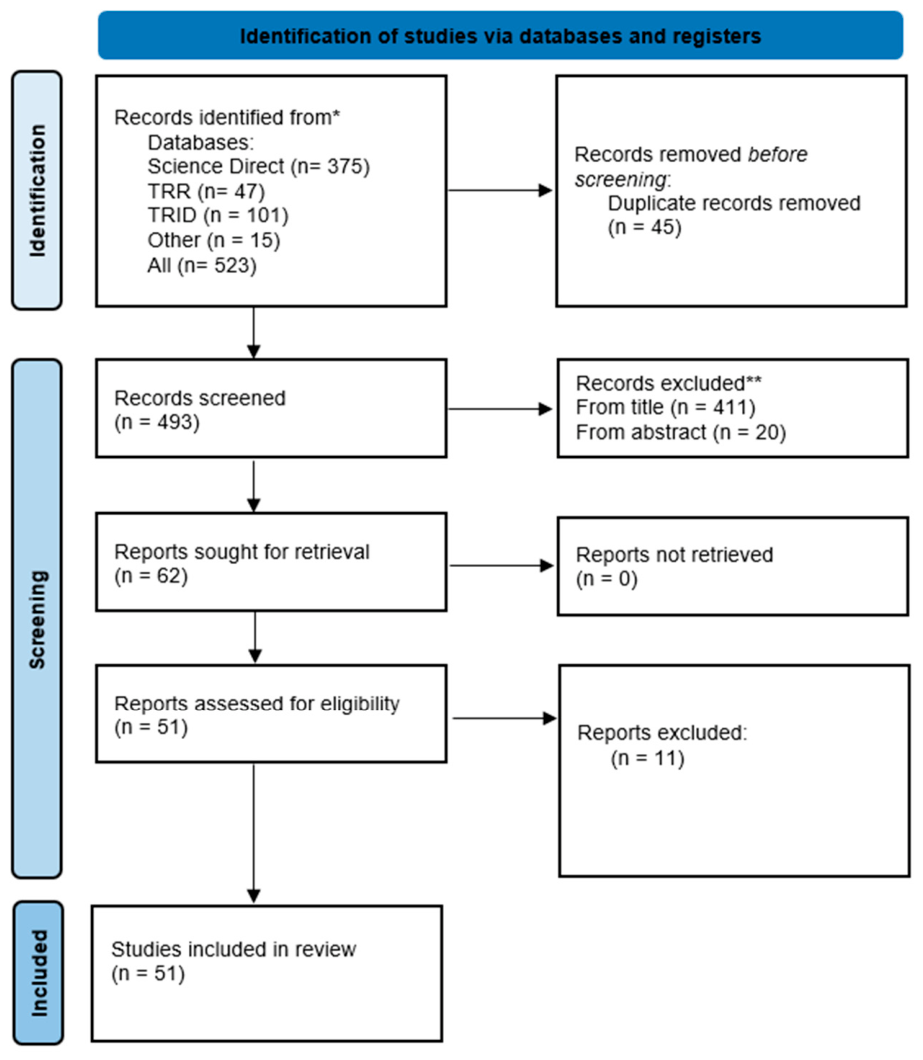
Figure 2.
(a) percentage by publication year and (b) number of publications by publication year, showing the five topic categories.
Figure 2.
(a) percentage by publication year and (b) number of publications by publication year, showing the five topic categories.
Disclaimer/Publisher’s Note: The statements, opinions and data contained in all publications are solely those of the individual author(s) and contributor(s) and not of MDPI and/or the editor(s). MDPI and/or the editor(s) disclaim responsibility for any injury to people or property resulting from any ideas, methods, instructions or products referred to in the content. |
© 2026 by the authors. Licensee MDPI, Basel, Switzerland. This article is an open access article distributed under the terms and conditions of the Creative Commons Attribution (CC BY) license.
Copyright: This open access article is published under a Creative Commons CC BY 4.0 license, which permit the free download, distribution, and reuse, provided that the author and preprint are cited in any reuse.