

Submitted:
11 October 2026
Posted:
13 October 2026
You are already at the latest version
Abstract
Introduction: Occupational social work is increasingly discussed alongside employee assistance, workplace wellbeing, trauma-informed practice and organisational support. However, the supplied evidence does not directly establish whether strategically integrated occupational social work improves long-term organisational sustainability or employee–employer relations in South African organisations. This systematic review examined the strategic value of repositioning occupational social work beyond conventional employee wellness, including its influence on organisational integration, sustainability, employee–employer relations, enabling conditions, risks and. Methods: The researcher-selected databases and information sources were ERIC, Google Scholar. The eligibility protocol restricted publication years to 2021–2026. The exact calendar date of search execution was not recorded in the verified identification provenance; this is distinct from the publication-year eligibility range. A systematic review searched ERIC and Google Scholar using a supplied Boolean strategy and restricted eligibility to English-language publications from 2021–2026. Results: Four higher-order findings emerged. Occupational social work has a distinct but overlapping mandate with employee assistance and can address psychosocial, relational, family, trauma, financial, developmental and referral needs. Sustainable integration depends on organisational resources, participation, management support and relational structures. Integration must be inclusive, culturally responsive, digitally aware and trauma-informed. Structural neglect, workload, insufficient resources, unsafe practice and role ambiguity constrain implementation. Direct evidence concerning occupational social work inside South African organisations remained limited, and no supplied finding directly compared a strategically integrated model with conventional wellness provision. Discussion/Conclusion: The evidence supports repositioning occupational social work as a potentially broader organisational function, but not as a demonstrated cause of improved productivity, retention, sustainability or employee–employer relations. Strategic value is conditional on resourcing, governance, participation, contextual responsiveness and practitioner safety.
Keywords:
employee assistance
; occupational social work
; organisational sustainability
; qualitative evidence synthesis
; South Africa
1. Introduction
Occupational social work is positioned in the supplied literature as a workplace-oriented form of social work concerned with the interaction between people, organisations and wider social conditions. Its boundaries overlap with employee assistance programmes, but the two are not interchangeable. Evidence from South Africa indicates that both address work-related, personal, interpersonal and productivity concerns, while differences in structure and legalisation remain important for professional identity, governance and service design (Terblanche et al., 2021). This distinction is central to the present study because repositioning occupational social work beyond conventional employee wellness requires more than relabelling existing counselling or referral services.
The supplied literature describes workplace and professional wellbeing as multidimensional. Social workers and other employees value manageable workloads, flexibility, autonomy, recognition, supportive management, supervision, adequate infrastructure, meaningful work and opportunities to be heard (Maboeta et al., 2023; Mseba, 2024; Mseba & Keet, 2025). Other studies show that psychosocial practice may involve trauma, family and social functioning, financial difficulty, development, referrals, disability inclusion, cultural responsiveness and collaborative service systems (Khosa, 2025; Patel et al., 2023; Zimba, 2021). These findings suggest that occupational social work may contribute to organisational relationships by connecting employee experience with organisational decision-making, rather than treating wellbeing as an exclusively individual problem.
The evidence also identifies substantial constraints. South African social workers report excessive workloads, insufficient resources, inadequate supervision, poor remuneration, weak management support and administrative pressures (Mmolokoe, 2026; Mseba, 2024; Sekgobela, 2026). Violence may be minimised or normalised, while employers may expect service delivery to continue after incidents of client violence (Pretorius & Herbst, 2022). Historical and intergenerational trauma, structural inequality, disability discrimination, cultural and religious beliefs, digital inequality and resource limitations further shape how social work is experienced and delivered (Chiwara, 2024; Keet, 2021; Safodien, 2021; Zimba, 2021).
What remains insufficiently understood is whether these capabilities and conditions translate into a strategic occupational social work model within South African organisations. The supplied findings do not directly establish long-term organisational sustainability, productivity, retention or improved employee–employer relations following integration. They also do not directly compare conventional employee wellness with an implemented strategically integrated occupational social work model. This systematic review was therefore conducted to synthesise evidence across occupational social work, employee assistance, workplace wellbeing, organisational support and adjacent South African social work contexts while preserving the limits of direct applicability.
2. Research Objectives
RO1: To examine how strategic repositioning of occupational social work services influences organizational integration, strategic value, and workplace sustainability among occupational social work practitioners and organizational stakeholders within South African changing world of work.
RO2: To identify the principal opportunities, benefits and enabling conditions associated with Strategic repositioning of occupational social work services in relation to Organizational integration, strategic value, and workplace sustainability.
RO3: To analyse the challenges, risks, ethical considerations and implementation barriers associated with Strategic repositioning of occupational social work services for Occupational social work practitioners and organizational stakeholders.
RO4: To determine the contextual, institutional and practice-related factors that shape the adoption and effective use of strategic repositioning of occupational social work services within South African changing world of work.
3. Research Methods
3.1. Review Design
The selected review type was a Systematic Review. A qualitative evidence synthesis was undertaken because the supplied evidence included qualitative accounts, conceptual material and adjacent evidence concerning workplace wellbeing, organisational support, social work practice and occupational social work. The review did not treat bibliometric prominence or study titles as substitutes for extracted findings.
3.2. Search Strategy and Information Sources
The researcher-selected databases and information sources were ERIC and Google Scholar. The eligibility protocol restricted publication years to 2021–2026. The exact calendar date of search execution was not recorded in the verified identification provenance; this is distinct from the publication-year eligibility range.
3.3. Inclusion and Exclusion Criteria
Inclusion
- Studies published between 2021 and 2026.
- Studies written in the English language.
- Peer-reviewed journal articles utilizing qualitative research methodologies.
- Studies focusing on occupational social workers or human resource management stakeholders within South African organizations.
- Studies exploring the strategic integration of occupational social work beyond traditional employee wellness programs.
- Studies addressing organizational sustainability or the enhancement of employee-employer relations through social work interventions.
- Studies reporting on the perceptions, operational mechanisms, or experiences of strategic social work integration in the workplace.
Exclusion
- Studies published before 2021 or after 2026.
- Studies written in languages other than English.
- Non-peer-reviewed literature, including grey literature, books, or conference proceedings.
- Studies utilizing purely quantitative or mixed-methods research designs.
- Studies focused exclusively on traditional employee wellness programs without a strategic or organizational integration component.
- Studies conducted outside the context of the South African world of work.
- Studies that do not involve occupational social workers or human resource management stakeholders as primary participants or subjects of analysis.
- Studies that focus solely on clinical individual-level counseling without addressing broader organizational or strategic outcomes.
3.4. Screening and Study Selection
The PRISMA selection counts are persisted, but the decision rule used during title/abstract screening is not available in the verified audit payload. COSTAQDA therefore reports the recorded workflow counts without reconstructing an unverified screening procedure.
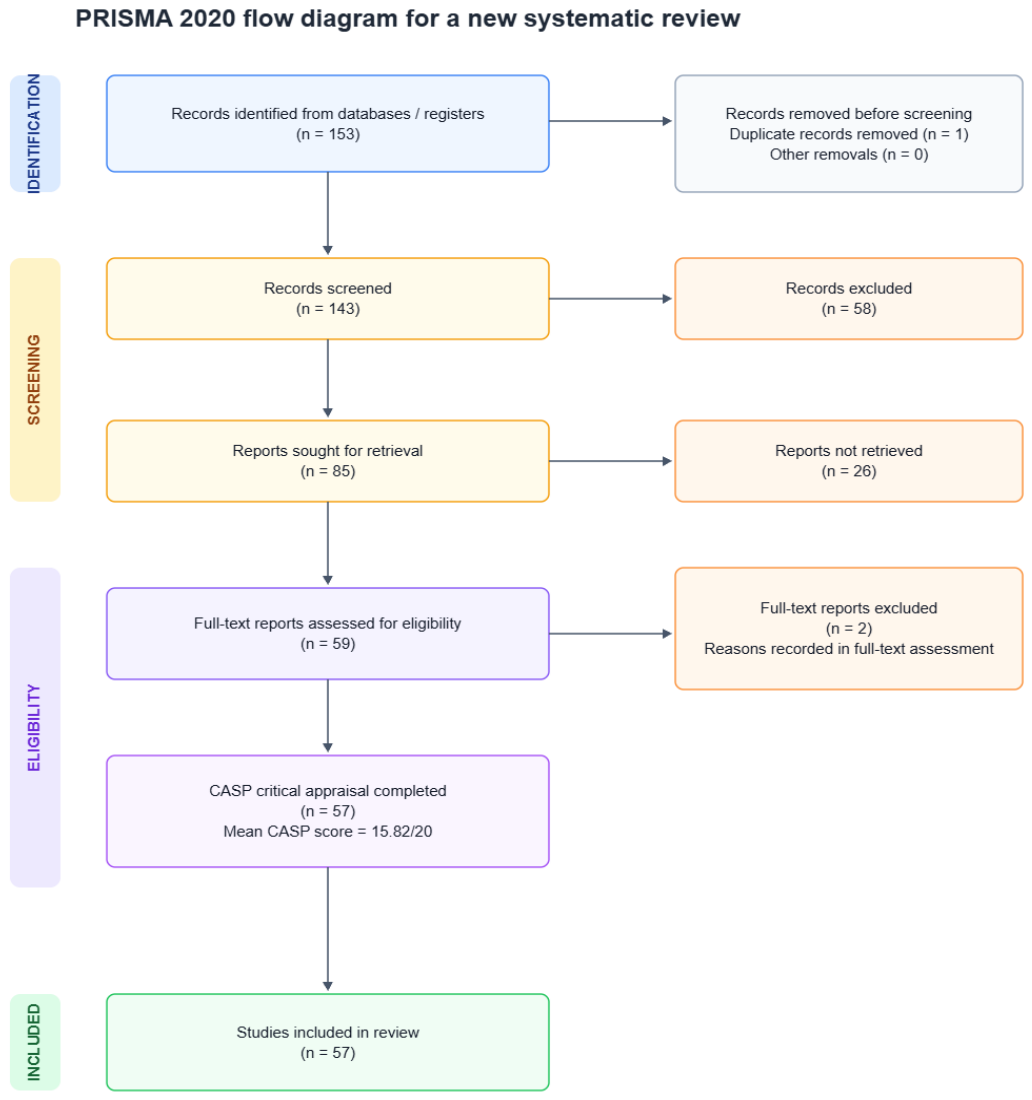
The persisted PRISMA workflow records 153 identified records, 1 duplicate, 143 records screened, 85 reports sought for retrieval, 58 records excluded at the title/abstract stage, 59 full texts assessed, 2 full-text exclusions and 57 included records. These counts describe study selection and are not substantive review findings.
Figure 1.
PRISMA 2020 Flow Diagram — Identification, Screening, Eligibility and Included. Source: COSTAQDA PRISMA Workflow, navigation item 8: PRISMA Flow Diagram; four-stage structure showing Identification, Screening, Eligibility (including CASP critical appraisal) and included; adapted from PRISMA 2020 (Page et al., 2021).
Figure 1.
PRISMA 2020 Flow Diagram — Identification, Screening, Eligibility and Included. Source: COSTAQDA PRISMA Workflow, navigation item 8: PRISMA Flow Diagram; four-stage structure showing Identification, Screening, Eligibility (including CASP critical appraisal) and included; adapted from PRISMA 2020 (Page et al., 2021).
3.5. Critical Appraisal
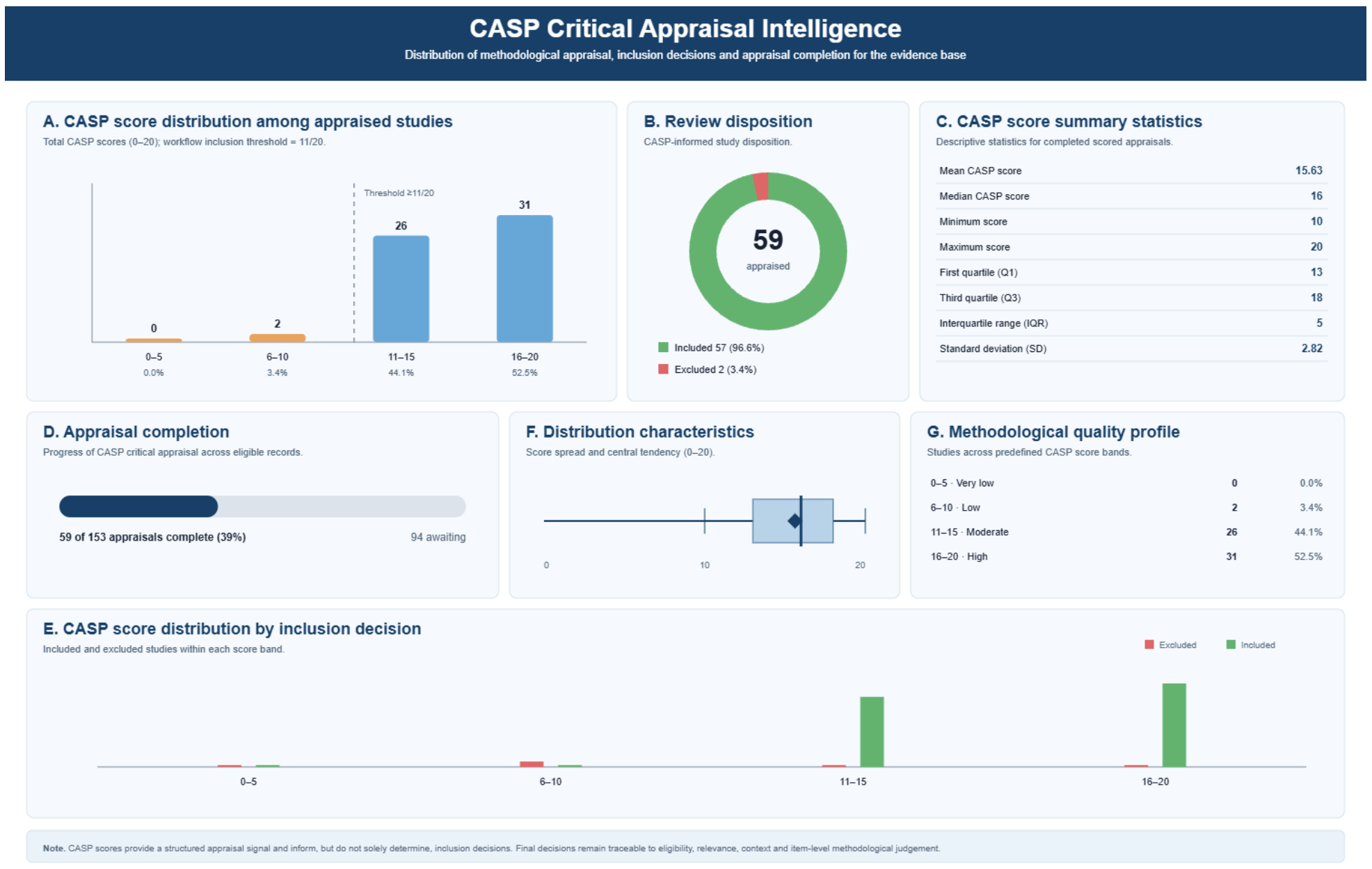
The Critical Appraisal Skills Programme (CASP) was used in the PRISMA full-text workspace. All 57 currently included studies had completed CASP appraisals. The recorded mean CASP score was 15.82. The appraisal workspace also recorded methodological concerns for individual studies, including unclear methods, contextual mismatch, incomplete reporting, conceptual or quantitative designs and limited qualitative evidence. CASP results were therefore used to qualify interpretation rather than converted into an unquestioned total-quality score.
The CASP figure represents completed appraisal records for all 57 included studies, with a recorded mean score of 15.82. The figure should be interpreted alongside study-specific methodological concerns and incomplete reporting; it does not establish a single definitive quality category for the evidence base.
Figure 2.
CASP Critical Appraisal Intelligence — PRISMA Workflow, Step 6: Full-Text Screening. Source: COSTAQDA PRISMA Workflow, navigation item 6: Full-Text Screening (CASP critical appraisal outputs). The Word figure is generated from the same deterministic COSTAQDA CASP visual.
Figure 2.
CASP Critical Appraisal Intelligence — PRISMA Workflow, Step 6: Full-Text Screening. Source: COSTAQDA PRISMA Workflow, navigation item 6: Full-Text Screening (CASP critical appraisal outputs). The Word figure is generated from the same deterministic COSTAQDA CASP visual.
3.6. Data Extraction
Data extraction was not recorded as a separate procedural field. Nevertheless, the verified synthesis workspace demonstrates that finding-level evidence was extracted: 294 findings from 42 studies were available for thematic synthesis, with supporting study IDs and finding IDs retained. Because the extraction form and fields were not supplied, no additional extraction procedure is claimed.
3.7. Data Synthesis and Analysis
Qualitative evidence synthesis was conducted on 294 extracted findings contributed by 42 studies. The COSTAQDA synthesis engine applied thematic synthesis, moving from traceable finding-level evidence to 8 initial codes, 3 categories, 1 descriptive themes and 3 analytical themes.
Theme development was constrained to the extracted finding-level evidence supplied by eligible studies. Each synthesised theme retained supporting study IDs and finding IDs, while contradictory evidence was preserved where identified. Titles, abstracts and bibliographic prominence were not treated as substitutes for extracted qualitative findings.
Recorded synthesis limitations included: Direct evidence on occupational social work inside South African organisations is limited in the supplied findings; much of the synthesis draws on adjacent evidence about social workers, employee assistance, workplace wellbeing and organisational support.; The supplied findings include studies from outside South Africa and outside occupational social work. These were not treated as direct South African evidence and can only provide contextual comparison where their findings were explicit.; Several extracted records contain incomplete text, bibliographic material, conceptual proposals or quantitative findings rather than qualitative participant accounts. They were used cautiously or excluded from interpretive claims.; The findings do not directly establish long-term organisational sustainability, productivity, retention or improved employee–employer relations following occupational social work integration.; No supplied finding directly compares conventional employee wellness practices with an implemented strategically integrated occupational social work model across South African organisations..
3.8. Bibliometric Intelligence and Confidence in the Evidence Base
Bibliometric intelligence provides a structural view of the evidence base that complements PRISMA selection, critical appraisal and qualitative synthesis. The following analyses examine citation relationships, scholarly influence, evidence connectivity and knowledge development within the included corpus. They provide contextual evidence about the intellectual structure and provenance of the literature and are not substitutes for methodological quality appraisal.
3.8.1. Local Citation Network
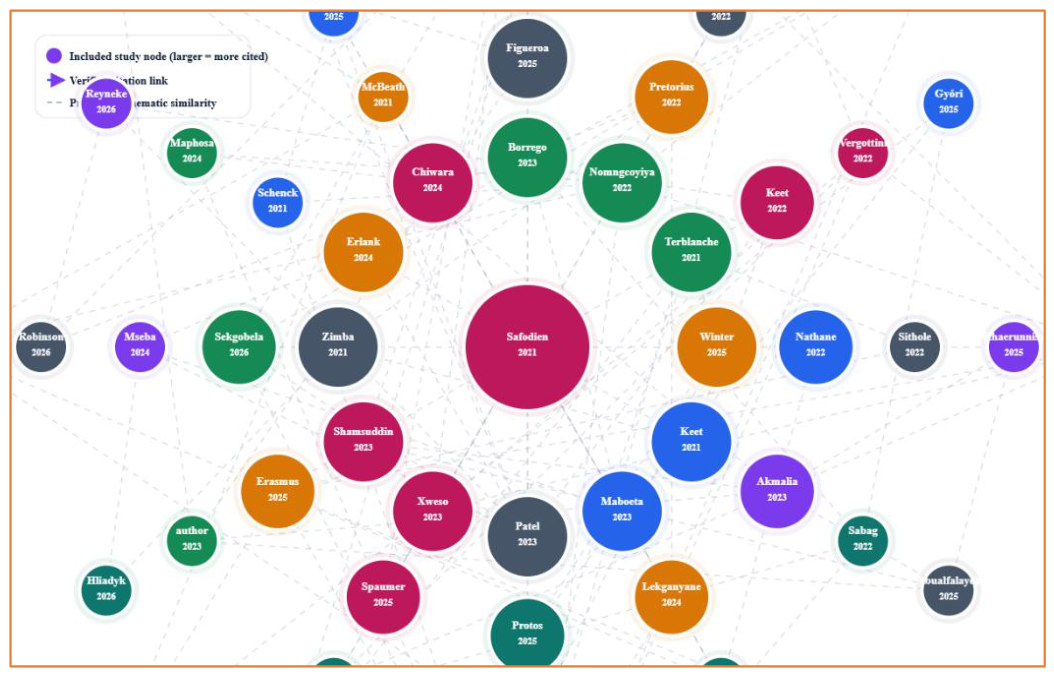
The Local Citation Network maps citation relationships within the included evidence base. It shows how studies are connected within the review corpus and supports examination of intellectual connectedness, centrality, bridging and isolation. These citation relationships describe the structure of the literature and do not, by themselves, establish methodological quality or validity.
Figure 3.
Local Citation Network. Source: COSTAQDA PRISMA Workflow, navigation item 12: Bibliometric Intelligence — Local Citation Network.
Figure 3.
Local Citation Network. Source: COSTAQDA PRISMA Workflow, navigation item 12: Bibliometric Intelligence — Local Citation Network.
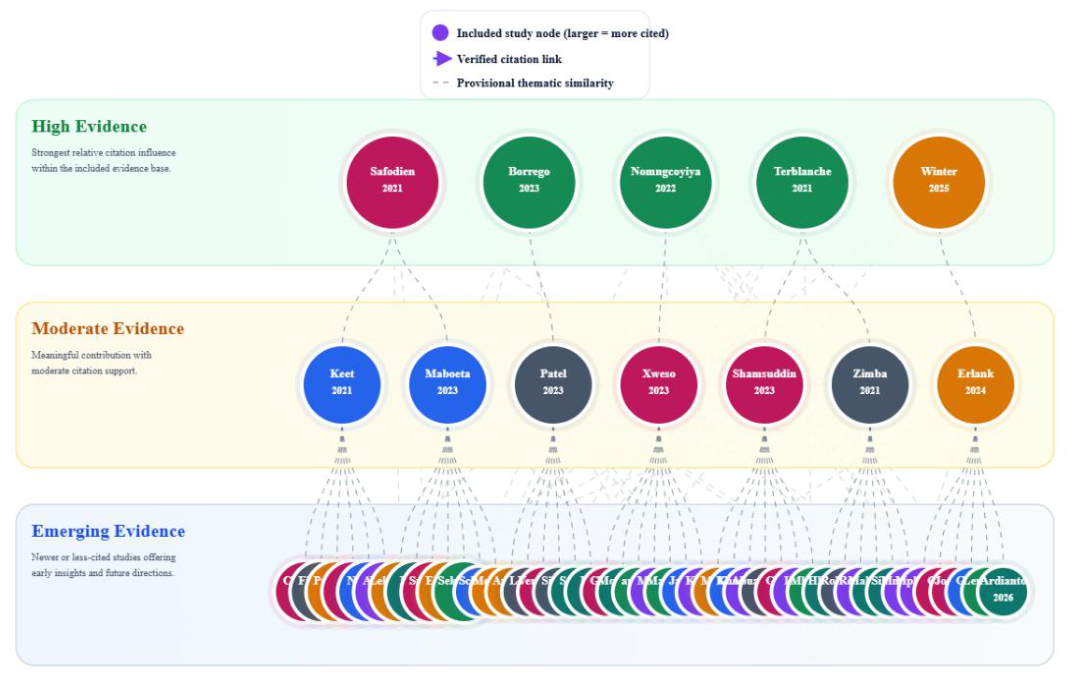
3.8.2. Influence Pyramid
The Influence Pyramid represents the distribution of scholarly influence within the included evidence base. It helps identify how bibliometric prominence is distributed across the reviewed studies. Influence is interpreted separately from methodological quality, which is assessed through critical appraisal.
Figure 4.
Influence Pyramid. Source: COSTAQDA PRISMA Workflow, navigation item 12: Bibliometric Intelligence — Influence Pyramid.
Figure 4.
Influence Pyramid. Source: COSTAQDA PRISMA Workflow, navigation item 12: Bibliometric Intelligence — Influence Pyramid.
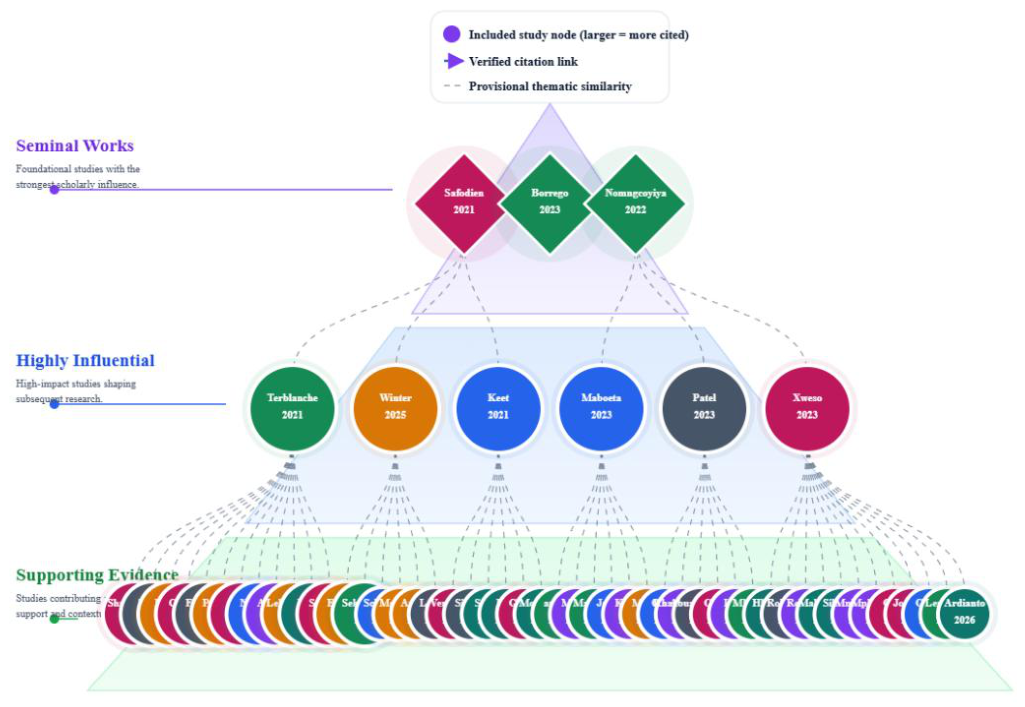
The Influence Pyramid represents bibliometric prominence or influence within the supplied evidence ecosystem, not methodological quality. OpenAlex intelligence identified 57 included records, 108 links, 49 thematic clusters and 64 global citations. Works classified as seminal or influential indicate visibility and connectivity, but these outputs cannot establish validity, causal strength or relevance to the South African occupational social work question.
3.8.3. Evidence Strength
The Evidence Strength analysis examines the structure and strength of relationships within the evidence ecosystem assembled for the review. It complements, but does not replace, CASP methodological appraisal and must not be interpreted as a direct estimate of causal effect.
Figure 5.
Evidence Strength Network. Source: COSTAQDA PRISMA Workflow, navigation item 12: Bibliometric Intelligence — Evidence Strength Network.
Figure 5.
Evidence Strength Network. Source: COSTAQDA PRISMA Workflow, navigation item 12: Bibliometric Intelligence — Evidence Strength Network.
The Evidence Strength Network represents the structure and strength of relationships within the evidence ecosystem. It does not replace CASP critical appraisal. Network relationships can identify convergence among themes such as organisational support, trauma-informed practice, digital adaptation and occupational social work, but they cannot demonstrate that an intervention caused improved sustainability or employee–employer relations.
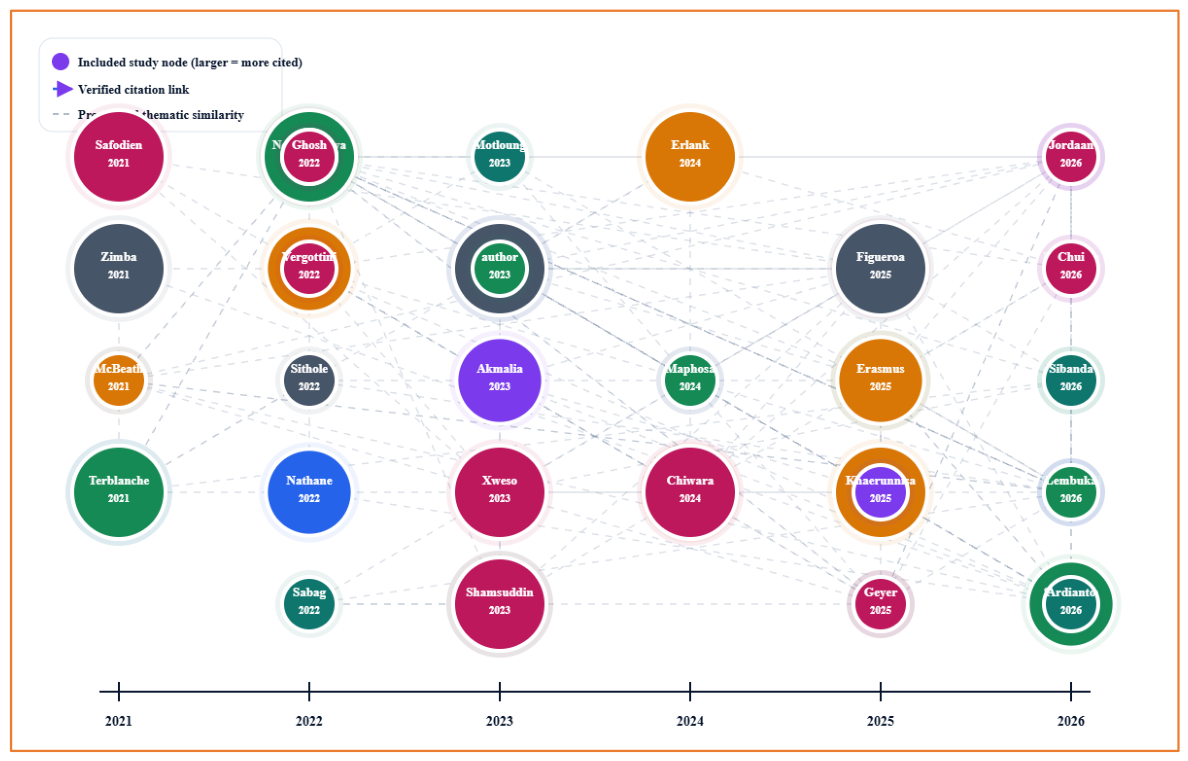
3.8.4. Knowledge Evolution
Knowledge Evolution examines the temporal and intellectual development of the included evidence base. It traces how research contributions develop over time and, where supported by the Step 12 data, how later studies extend, connect, challenge or consolidate earlier contributions.
Figure 6.
Knowledge Evolution. Source: COSTAQDA PRISMA Workflow, navigation item 12: Bibliometric Intelligence — Knowledge Evolution.
Figure 6.
Knowledge Evolution. Source: COSTAQDA PRISMA Workflow, navigation item 12: Bibliometric Intelligence — Knowledge Evolution.
3.8.5. Integrated Confidence in the Synthesised Evidence
Confidence was assessed by triangulating transparent PRISMA selection, CASP methodological appraisal, convergence and divergence in extracted evidence, and bibliometric intelligence. Confidence was not based on citation counts alone. Descriptive claims about the breadth of occupational social work and implementation conditions are more defensible than causal claims about long-term organisational sustainability, productivity, retention or employee–employer relations. The evidence base is further limited because direct occupational social work evidence inside South African organisations was scarce and much of the synthesis drew on adjacent or non-South African evidence.
4. Findings
4.1. Search and Selection Results
The persisted selection workflow identified 153 records and retained 57 included records after duplicate removal, screening and full-text assessment. Because the verified audit did not preserve the title/abstract decision rule, the review reports the actual counts without reconstructing screening criteria beyond the stated eligibility protocol. These workflow data are not substantive findings.
4.2. Characteristics of Included Studies
The included evidence was heterogeneous. It comprised South African qualitative studies of social workers, workplace wellbeing and organisational practice, alongside adjacent occupational, educational, policy, conceptual and international studies. Directly relevant evidence included the distinction between occupational social work and employee assistance (Terblanche et al., 2021), South African workplace wellbeing and job resources (Maboeta et al., 2023; Mseba, 2024; Mseba & Keet, 2025), trauma-informed practice (Erlank & Bopape, 2024; Keet, 2021), client violence (Pretorius & Herbst, 2022), digital transformation (Safodien, 2021), disability inclusion (Zimba, 2021) and collaborative practice (Patel et al., 2023).
The verified thematic synthesis used 294 extracted findings from 42 studies, although 57 records were included in the broader PRISMA workspace. This difference indicates that not every included record contributed eligible finding-level material to the verified synthesis. Several records contained incomplete text, bibliographic material, conceptual proposals or quantitative findings and were used cautiously or excluded from interpretive claims.
4.3. Methodological Strengths and Limitations of Included Studies
Methodological strengths included a persisted PRISMA selection record, completed CASP appraisals for all 57 included studies, traceable finding-level synthesis and preservation of contradictory evidence. Limitations included incomplete reporting, methodological heterogeneity, unclear contextual fit for many records, adjacent rather than direct evidence, and the inclusion workspace’s mixture of qualitative, quantitative, conceptual and non-journal material despite the stated eligibility criteria. These limitations reduce confidence in causal and generalisable conclusions.
4.4. Thematic Synthesis
Thematic synthesis is a systematic qualitative evidence-synthesis method used to integrate findings across multiple studies while retaining a transparent connection to the underlying evidence. The process moves iteratively from extracted study findings to coding, the grouping of related codes into descriptive categories or themes, and the development of higher-order analytical themes that answer the review question and research objectives. Its purpose is not merely to count how often an idea appears, but to identify patterned meaning across studies, examine convergence and divergence, preserve contextual differences, and develop an auditable interpretation that remains traceable to the contributing evidence.
In this review, thematic synthesis was applied to the verified extracted findings retained in the active COSTAQDA project. Findings were compared across eligible studies, coded and grouped according to conceptual similarity, and then developed into 5 analytical themes represented across 15 evidence-contributing studies. The active synthesis retained 26 verified theme-to-study support assignments, allowing the analytical interpretation to remain traceable to the underlying studies rather than being reconstructed from titles or bibliographic prominence. The resulting analytical themes include “Occupational social work as a broader organisational function”, “Sustainability depends on organisational resources and relational support”, “Opportunities and enabling conditions for strategic repositioning”, “Structural, ethical and safety barriers”, with the widest cross-study support recorded for “Opportunities and enabling conditions for strategic repositioning” (6 contributing studies). Table 1 therefore operationalises the synthesis as an auditable evidence map linking each analytical theme to the studies that supplied verified supporting findings.
Table 1 presents the thematic synthesis matrix linking the verified analytical themes only to studies with verified extracted evidence supporting at least one of the themes displayed in the matrix. Any study with no verified supporting contribution to any displayed theme is excluded, even if it was included elsewhere in the systematic review or qualitative evidence base. Rows represent analytical themes and columns represent theme-contributing studies. A check mark (✓) indicates that at least one verified extracted finding from that study was assigned to the theme; an em dash (—) indicates that the study contributed evidence to the synthesis overall but no supporting extracted finding from that study was assigned to that particular theme. The absence of a supporting assignment must not be interpreted as contradictory evidence. The totals report the number of evidence-contributing studies providing verified support to each theme. The matrix therefore functions as an audit trail between thematic interpretation and the underlying finding-level evidence rather than as a measure of methodological quality or effect size.
The most widely supported analytical theme was “Opportunities and enabling conditions for strategic repositioning”, with verified support from 6 of 15 studies. The least widely distributed theme was “Sustainability depends on organisational resources and relational support”, with verified support from 4 of 15 studies. Differences in the number of supporting studies indicate the distribution of traceable thematic evidence across the included literature, not the relative importance or quality of a theme. Themes supported by fewer studies may still be analytically important when the underlying findings are conceptually rich, contextually distinctive or directly relevant to the review question. Conversely, wider study support indicates cross-study recurrence but does not by itself establish stronger methodological quality. The thematic patterns shown in Table 1 should therefore be interpreted alongside critical appraisal, contextual variation, contradictory findings where verified, and the detailed theme-led discussion that follows.
4.5. RO1: Occupational Social Work as a Broader Organisational Function
The evidence indicates that occupational social work has a distinct but overlapping mandate with employee assistance. Both may address work-related, personal, interpersonal and productivity concerns, but differences in structure and legalisation mean they should not be treated as interchangeable (Terblanche et al., 2021). The broader strategic value suggested by the evidence lies in the range of issues addressed: psychosocial and interpersonal difficulty, trauma, family and social functioning, financial concerns, development, referrals and organisational relationships (Khosa, 2025; Terblanche et al., 2021).
This supports organisational integration as a plausible repositioning pathway, but not as proof of organisational performance gains. The supplied findings do not directly demonstrate that occupational social work integration improves productivity, retention, organisational sustainability or employee–employer relations. The strongest conclusion for RO1 is therefore conceptual and descriptive: occupational social work can connect individual wellbeing with relational, organisational and social conditions when its mandate is explicitly governed and resourced (Terblanche et al., 2021; Patel et al., 2023).
4.6. RO1: Sustainability Depends on Organisational Resources and Relational Support
Across the evidence, wellbeing and sustained practice were associated with manageable demands, flexibility, autonomy, recognition, meaningful work, opportunities to be heard, management support, supervision and adequate infrastructure (Maboeta et al., 2023; Mseba, 2024; Mseba & Keet, 2025). South African evidence also shows that organisational support can be absent or displaced into external support networks, indicating that individual resilience cannot substitute for institutional responsibility (Zimba, 2021).
Collaborative structures provide a mechanism for linking employee and service-user experience with organisational decisions. A South African community of practice brought together social workers, psychologists, nurses, educators, governing bodies and caregiver or child perspectives to assess vulnerability and plan interventions collectively (Patel et al., 2023). Related evidence positions social workers as contributors to holistic and trauma-informed support within organisational settings (Jordaan & Williams, 2026; Mabvurira, 2026). These findings address RO1 and indicate that sustainability is relational and institutionally produced rather than achieved through practitioner coping alone.
4.7. RO2: Opportunities and Enabling Conditions for Strategic Repositioning
The principal opportunity identified by the synthesis is the capacity to extend support beyond narrow wellness provision. Occupational social work can incorporate psychosocial, relational, family, trauma, financial, developmental and referral dimensions, while collaborative models can coordinate support across professional and institutional boundaries (Terblanche et al., 2021; Khosa, 2025; Sibanda & Sambo, 2026). The evidence therefore supports a holistic organisational function that is capable of identifying how workplace problems are connected to social and structural conditions.
Enabling conditions include manageable workloads, flexibility, autonomy, recognition, supervision, management support, infrastructure, participation and multidisciplinary collaboration (Maboeta et al., 2023; Mseba, 2024; Patel et al., 2023). Context-sensitive and trauma-informed training is also important in South African settings affected by historical and intergenerational trauma (Keet, 2021; Erlank & Bopape, 2024). Digital tools may broaden access and enable adaptive practice, but only when digital poverty, family impacts, cybersecurity and confidentiality are addressed (Safodien, 2021).
4.8. RO3: Structural, Ethical and Safety Barriers
Structural constraints were prominent across South African studies. High caseloads, resource shortages, poor remuneration, administrative demands, inadequate supervision and weak management support restrict practitioners’ ability to provide effective services and protect their own wellbeing (Mmolokoe, 2026; Mseba, 2024; Sekgobela, 2026). Excessive workload can delay statutory work, weaken record keeping and limit supervision of foster placements (Mmolokoe, 2026), demonstrating how organisational conditions can affect both service quality and institutional obligations.
Safety and ethical risks include client violence, discrimination, unsafe conditions, confidentiality and cybersecurity. South African social workers described the normalisation and minimisation of client violence, insufficient workplace support and expectations that service delivery should continue after violence (Pretorius & Herbst, 2022). Disability-related discrimination and inaccessible infrastructure further show that integration without inclusion may reproduce organisational harm (Zimba, 2021). Digital practice creates opportunities but requires explicit security and privacy safeguards (Safodien, 2021).
4.9. RO4: Contextual and Institutional Conditions Shaping Adoption
Adoption is shaped by historical, cultural, institutional and practice-related conditions. South African evidence links current social problems and service needs to apartheid-related displacement, structural inequality, poverty and intergenerational trauma (Chiwara, 2024; Keet, 2021). Cultural and religious interpretations of disability, unequal access to infrastructure and digital poverty can alter how support is experienced (Zimba, 2021; Safodien, 2021). These findings indicate that generic wellness models are unlikely to be equally appropriate across organisations or communities.
Institutional arrangements also matter. Collaborative communities of practice, state and organisational partnerships, professional role clarity and participation by affected people can support integrated responses (Patel et al., 2023; Chiwara, 2024). Conversely, weak policy implementation, limited resources and ambiguous expectations constrain effective practice (Erlank & Bopape, 2024; Vergottini & Weyers, 2022). The evidence supports context-sensitive adoption, but it does not establish a single South African model applicable across sectors.
5. Discussion
The findings answer RO1 by showing that occupational social work can be conceptually distinguished from employee assistance and can widen the organisational response to employee and workplace problems. The evidence supports a role that is psychosocial, relational and structurally informed rather than limited to individual wellness encounters (Terblanche et al., 2021). Yet this conclusion must remain appropriately bounded: the supplied evidence does not directly evaluate a strategically integrated occupational social work model across South African organisations. The review therefore identifies strategic potential rather than demonstrated organisational effect.
For RO2, the most consistent enabling conditions were organisational resources, participation, collaboration, supportive management, supervision, flexibility and context-responsive practice (Maboeta et al., 2023; Mseba, 2024; Patel et al., 2023). This convergence suggests that occupational social work cannot be strategically repositioned through professional rhetoric alone. It requires changes in how organisations allocate resources, hear employee and service-user perspectives, coordinate professional knowledge and recognise psychosocial conditions as organisational concerns.
The findings for RO3 show why a narrow wellness framing may be insufficient. Workload, inadequate resources, weak supervision, violence, discrimination and digital risks are not merely individual wellbeing problems; they are organisational and ethical conditions that shape whether practitioners can provide safe and effective services (Mmolokoe, 2026; Pretorius & Herbst, 2022; Zimba, 2021). The divergence in the evidence is important: some studies describe support and participation, whereas others describe support located outside the workplace or institutional neglect (Patel et al., 2023; Zimba, 2021). This suggests that the same strategic label may have different effects depending on institutional implementation.
For RO4, contextual differences are especially consequential. Historical trauma, apartheid-related inequality, cultural and religious meanings, disability, digital access and sectoral governance shape what counts as wellbeing and what forms of support are feasible (Chiwara, 2024; Keet, 2021; Safodien, 2021). The synthesis therefore contributes a context-sensitive interpretation rather than a universal occupational social work blueprint. Methodological heterogeneity and the substantial use of adjacent evidence further require caution when transferring findings from schools, public services, international settings or non-occupational social work to South African organisations.
The review’s principal contribution is to clarify the difference between strategic scope and demonstrated strategic outcome. The evidence strongly supports broader scope, relational integration and attention to organisational conditions, but it does not directly demonstrate improved sustainability, productivity, retention or employee–employer relations. Future claims should therefore distinguish the mechanisms that may enable value from outcomes that have actually been evaluated.
6. Conclusions
The review concludes that occupational social work has potential strategic value beyond conventional employee wellness because it can address psychosocial, relational, family, trauma, financial, developmental and organisational concerns through a broader person–organisation–environment lens. This answers RO1 and RO2 at the level of scope and enabling conditions.
The evidence also answers RO3 and RO4 by showing that strategic repositioning is constrained by workload, resource shortages, weak supervision, unsafe practice, role ambiguity, discrimination, digital risks and contextual inequalities. Effective adoption therefore requires clear mandates, organisational resourcing, participation, collaboration, contextual responsiveness and ethical safeguards. However, the supplied evidence does not establish that integration produces long-term organisational sustainability or improved employee–employer relations. The appropriate conclusion is conditional support for repositioning, accompanied by a clear need for direct evaluation in South African organisations.
7. Recommendations
Practice: Organisations considering occupational social work integration should define its mandate in relation to employee assistance, establish governance and referral pathways, provide supervision and management support, address workload and safety, and incorporate psychosocial, relational, trauma-informed, inclusive and digitally secure practice. These recommendations follow from the convergent findings on role distinction, organisational resources, collaboration, violence, disability and digital practice (Terblanche et al., 2021; Erlank & Bopape, 2024; Pretorius & Herbst, 2022; Safodien, 2021).
Policy: Organisational and sectoral policies should resource integrated psychosocial support, specify responsibilities across occupational social work, employee assistance, human resources and management, require responses to workplace violence and discrimination, and support culturally responsive and accessible services. Policy should be adapted to local institutional and historical contexts rather than implemented as a universal wellness template (Chiwara, 2024; Keet, 2021; Zimba, 2021).
Future research: South African organisations should be studied directly through qualitative and longitudinal designs involving occupational social workers, human resource stakeholders, managers and employees. Research should compare conventional wellness with strategically integrated occupational social work, examine mechanisms of organisational integration, and evaluate sustainability, productivity, retention, safety and employee–employer relations. Studies should report sampling, context, data collection, analysis, reflexivity and CASP-relevant methodological information clearly.
Funding
N/A.
Acknowledgments
COSTAQDA was used as an AI-assisted evidence-synthesis and manuscript-development environment. AI-assisted functions supported the organisation, synthesis and presentation of verified project evidence and manuscript preparation within the documented COSTAQDA workflow. AI did not replace researcher responsibility for study selection, eligibility decisions, critical appraisal, verification of extracted evidence, interpretation of findings or final scholarly judgement. The human authors reviewed and approved the final manuscript and remain responsible for its accuracy, integrity, interpretations, citations and conclusions.
Conflicts of Interest
N/A
References
- Chiwara, P. Structural Inequalities in Namibia and South Africa: A Critical Social Work Perspective. Southern African Journal of Social Work and Social Development 2024. [Google Scholar] [CrossRef]
- Erlank, E.; Bopape, R. Exploring Trauma-Related Social Work Practice in a Resource-Limited Context: Insights from Social Workers in the Waterberg District, South Africa. Southern African Journal of Social Work and Social Development 2024. [Google Scholar] [CrossRef]
- Jordaan, M. M.; Williams, H. Change the world: Social workers as catalysts for holistic care and support in basic education within Metro North education district Western Cape, South Africa. African Journal of Social Work 2026. [Google Scholar] [CrossRef]
- Keet, A. A Revision of Social Work Practice: Conceptualising Cultural Trauma and the Role of Social Workers in South African Under-Resourced Communities. Southern African Journal of Social Work and Social Development 2021. [Google Scholar] [CrossRef]
- Khosa, J. Z. Caring for foster children living with Human Immunodeficiency Virus (HIV) in Johannesburg, South Africa: Social workers’ perspectives. African Journal of Social Work 2025. [Google Scholar] [CrossRef]
- Mabvurira, V. School Social Work remains underdeveloped: Evidence, insights and solutions from the Global South Editorial Note for the Special Issue on School Social Work. African Journal of Social Work 2026. [Google Scholar] [CrossRef]
- Maboeta, B.; Schalkwyk, I. V.; Bloem, C. EXPLORING THE ROLE OF JOB RESOURCES IN THE WELL-BEING OF WOMEN ACADEMICS IN THE WORKPLACE. In Social Work/Maatskaplike Werk; 2023. [Google Scholar] [CrossRef]
- Mmolokoe, K. A. The impact of excessive workload on Social Workers effectiveness in foster care interventions at Bojanala district, South Africa. African Journal of Social Work 2026. [Google Scholar] [CrossRef]
- Mseba, P. Work-life Balance: An Essential Capability for Social Workers’ Well-being in Free State, South Africa. Southern African Journal of Social Work and Social Development 2024. [Google Scholar] [CrossRef]
- Mseba, P.; Keet, A. ACHIEVEMENT OF WELLBEING AMONG SOUTH AFRICAN SOCIAL WORKERS: CONSTRAINTS AND ENABLERS. Social Work/Maatskaplike Werk 2025. [Google Scholar] [CrossRef]
- Patel, L.; Schmid, J.; Sani, T.; Turton, Y. J. A community of practice approach for school-based developmental social work in South Africa: Reflections of social workers. In International Social Work; 2023. [Google Scholar] [CrossRef]
- Pretorius, L.; Herbst, A. G. South African Social Workers’ Lived Experiences of Client Violence. Southern African Journal of Social Work and Social Development 2022. [Google Scholar] [CrossRef]
- Safodien, M. SOCIAL WORK 4.0? THE FOURTH INDUSTRIAL REVOLUTION AND SOCIAL WORK EDUCATION: A SOUTH AFRICAN PERSPECTIVE. Social Work 2021. [Google Scholar] [CrossRef]
- Sekgobela, T. Coping Strategies of Social Workers Working with Nyaope Substance Users in South Africa. Southern African Journal of Social Work and Social Development 2026. [Google Scholar] [CrossRef]
- Sibanda, S.; Sambo, J. Components of a social work programme for women survivors of human trafficking: a South African perspective. Journal of Social Work Practice 2026. [Google Scholar] [CrossRef]
- Terblanche, L.; Gunya, T.; Pretorius, M.; Maruma, M. R.; Mbuyisa, K.; Maseko, T.; Mojapelo, K.; Myeni, N.; Tyson, W. D. EMPLOYEE ASSISTANCE PROGRAMMES AND OCCUPATIONAL SOCIAL WORK: INTERRELATED WITH DISTINCT FEATURES. In Social Work; 2021. [Google Scholar] [CrossRef]
- Zimba, Z. F. PRACTICE EXPERIENCES OF SOUTH AFRICAN SOCIAL WORKERS LIVING WITH DISABILITIES. In Social Work; 2021. [Google Scholar] [CrossRef]
- Keet, A. Cultural trauma in South African marginalised communities: Implications for social work training and practice. In Critical Social Work Studies in South Africa: Prospects and Challenges; 2022. [Google Scholar] [CrossRef]
- Grant, M. J.; Booth, A. A typology of reviews: An analysis of 14 review types and associated methodologies. Health Information & Libraries Journal 2009, 26(2), 91–108. [Google Scholar] [CrossRef]
- Mfolo, L.; Costa, K. Qualitative Evidence Synthesis Using COSTAQDA; 2024. [Google Scholar]
- Page, M. J.; McKenzie, J. E.; Bossuyt, P. M.; Boutron, I.; Hoffmann, T. C.; Mulrow, C. D.; et al. The PRISMA 2020 statement: an updated guideline for reporting systematic reviews. BMJ 2021, 372, n71. [Google Scholar] [CrossRef]

Table 1.
Thematic Synthesis Matrix.
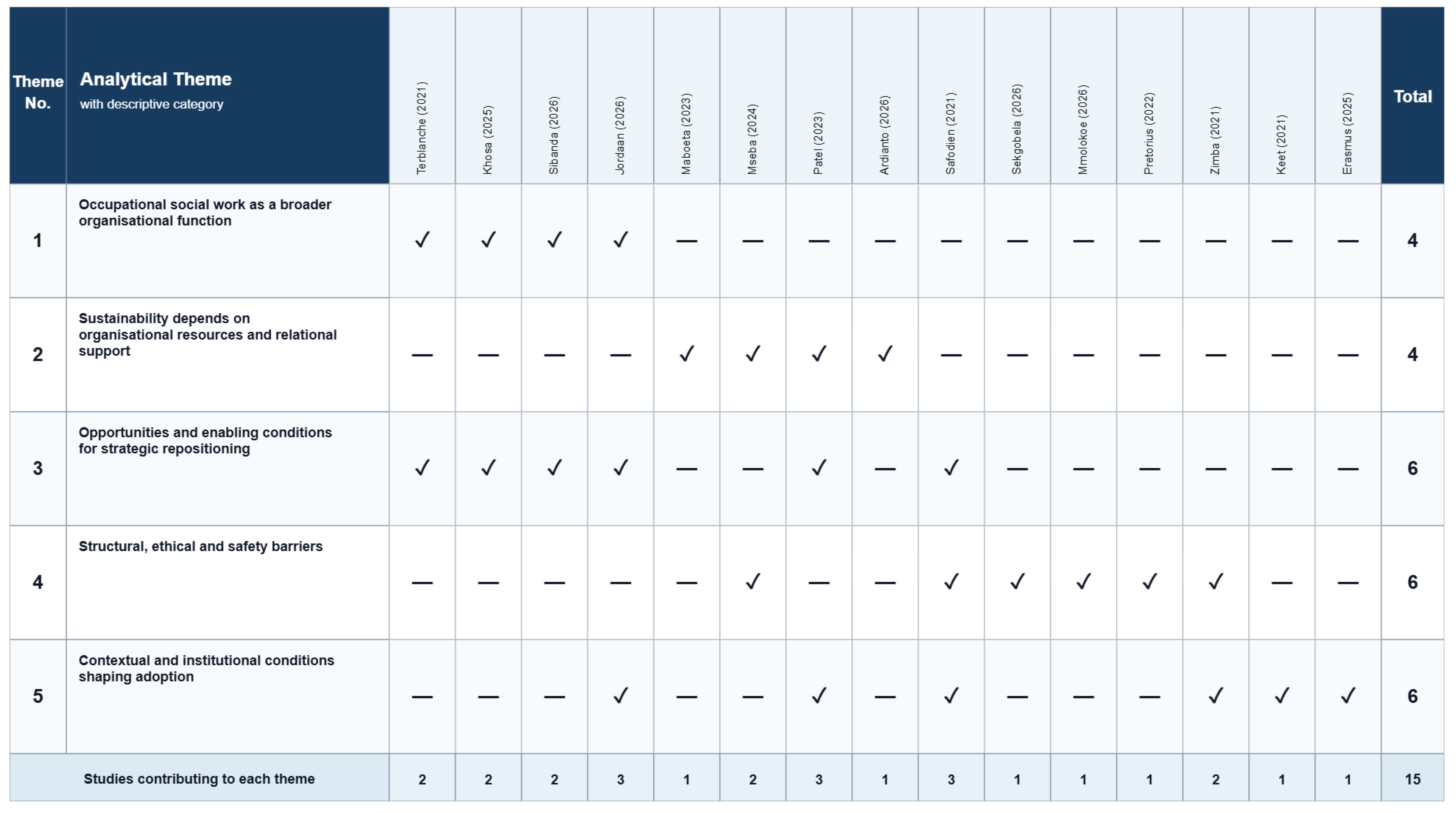
Table 1. legend: Only studies contributing verified extracted qualitative evidence are displayed. ✓ = verified extracted evidence from the study supports the theme; — = the study contributed to the synthesis but no supporting extracted finding from that study was assigned to this theme. An em dash does not indicate contradictory evidence.
Disclaimer/Publisher’s Note: The statements, opinions and data contained in all publications are solely those of the individual author(s) and contributor(s) and not of MDPI and/or the editor(s). MDPI and/or the editor(s) disclaim responsibility for any injury to people or property resulting from any ideas, methods, instructions or products referred to in the content. |
© 2026 by the authors. Licensee MDPI, Basel, Switzerland. This article is an open access article distributed under the terms and conditions of the Creative Commons Attribution (CC BY) license.
Copyright: This open access article is published under a Creative Commons CC BY 4.0 license, which permit the free download, distribution, and reuse, provided that the author and preprint are cited in any reuse.