

Submitted:
12 October 2026
Posted:
13 October 2026
You are already at the latest version
Abstract
The specific habitat conditions in different parts of the species’ range may give rise to intraspecific polymorphism at various levels (morphological, biological, genetic, etc.), but this phenomenon has not been sufficiently studied. The results of research of the morphological, biological, genetic, karyological, and parasitological characteristics of the gray rockfish Sebastes glaucus (Sebastidae, Scorpaeniformes) in two water bodies differing in habitat conditions are presented, i.e. a desalinated lagoon and adjacent sea areas off the Zavyalov Island (the northern Sea of Okhotsk). It was found that individuals in both water bodies differ significantly in terms of some morphological characters (the number of the lateral line pores and the total number of vertebrae), size (the fish in the lagoon has smaller length and body weight), maximum age and growth rates (individuals in the sea reach a greater age and grow faster), chromosome morphology and the number of chromosome arms, and the degree of infection with metacercariae of trematodes (100% in the lagoon and their complete absence in the sea). Furthermore, samples from the lagoon and the sea are reliably differentiated from each other based on genetic analysis using mtDNA markers. The identified differences may be due to a combination of factors, including both abiotic (lower temperature and salinity in the lagoon and its isolation from the sea) and biotic (limited forage resources and high parasite load in the isolated lagoon) factors.
Keywords:
desalinated lagoon
; Taui Bay
; Zavyalov Island
; morphometrics
; age and growth
; genetics
; karyology
; parasites
; anomalies
; microevolution
1. Introduction
Zavyalov Island (Figure 1) is one of the largest islands (area ca. 116 km2) in the Taui Bay, northern Sea of Okhotsk (Northwestern Pacific, Russia) being 21.5 km long and 4 to 7.5 km wide [1]. Meanwhile, its ichthyofauna, especially of the desalinated lagoon in the northern part of the island, has remained poorly understood until recently. According to the results of two expeditions in the summer of 2019 and 2025, it has been found that over 20 marine fish species occur in the waters of this island [2]. Among them, one of the most abundant is the gray rockfish Sebastes glaucus Hilgendorf, 1880.
This species is endemic to the North Pacific, occurring mainly along the Asian coast (the Sea of Japan, the Sea of Okhotsk and the Bering Sea, the Pacific waters of Japan, the Kuril Islands and eastern Kamchatka). In the north, its range is limited by the Bering Sea, in the south by the Pacific waters of Japan, Iwate Prefecture (northern Honshu). In the Sea of Japan, this species is distributed as far as the Tatar Strait to the north, and as far as the Peter the Great Bay along the mainland coast and to Toyama Bay along the insular coast in the south [3,4,5]. The range of this species is limited to the east by the waters of the Attu Island of the Aleutian Archipelago [6,7].
In most areas, S. glaucus is relatively scarce [8,9,10], reaching its maximum abundance in the northern Sea of Okhotsk [11,12]. It is likely that it may play a certain role in trophic chains, serving as food for fin whales [5]. It is considered an important target of fishing in the northern Sea of Okhotsk [11,12,13] or is considered as a promising target of longline/rod and line, net and trawl coastal fishing in other parts of the range [8,9,14,15,16,17,18,19,20].
The biology of this species has been poorly studied [21,22]. Information on its distribution and basic biological characteristics, although published in a number of papers (mostly in Russian that are hardly accessible to foreign readership) are quite disparate [8,9,10,13,14,15,16,17,23,24,25], while karyological and molecular genetic characteristics of this species and its parasite fauna is still missing. Furthermore, no attempts have yet been made to assess the impact of the varying habitat conditions of this species on the morphology of the axial skeleton, the age, and growth of its individuals, including using scales and otoliths.
The purpose of this publication is to provide the comparative morphological, ecological, biological, karyological, genetic, and parasitological characteristics of the gray rockfish Sebastes glaucus from the desalinated lagoon and adjacent sea waters of Zavyalov Island (northern Sea of Okhotsk) under different environmental conditions.
2. Materials and Methods
2.1. Brief Description of Desalinated Lagoon
The desalinated lagoon is formed by two merging spits (Figure 2), which once separated the lagoon from the sea. Apparently, the lagoon communicates with the sea through pebble spits, since it, like the surrounding sea, is characterized by tidal processes. The length of the spit is about 600 m, the maximum depth according to the echo sounder is 24 m. The salinity during the study period in the surface layer ranged from 22.6 to 25.0 psu, at a depth of about 20 m it was from 28.5 to 31.0 psu, which is significantly lower than the salinity in the adjacent sea areas, which in July is 31.2-31.4 psu at the surface and 32.6-33.0 psu near the bottom [1]. The water temperature during the study period was from 13.5 to 14.2 °C at the surface and from 4.9 to 8.0 °C at a depth of about 20 m, which is significantly higher than that in the sea, which in July is 9.0-10.5 °C at the surface and from -1.0 to 0 °C near the bottom [1]. Fucus thickets and mussel fouling of various ages were observed in the shallow part of the lagoon. Compared to the surrounding marine areas, the species composition of the fish fauna in the lagoon is depleted and includes, in addition to gray rockfish, five more species, i.e. Myoxocephalus stelleri (Cottidae) and Gadus chalcogrammus (Gadidae) in its deep-water areas, as well as Hadropareia middendorfii (Zoarcidae), Porocottus minutus (Cottidae), Alectrias alectrolophus (Stichaeidae) and Opisrocentrus ocellatus (Stichaeidae) in the coastal zone [2].
2.2. Data Collection
Data on S. glaucus were collected in a desalinated lagoon in the north of the Zavyalov Island from July 8 to 11, 2025, and in adjacent areas of the sea on July 7 and 12–16, 2025 (see Figure 1 and Figure 2). Stationary nets 30–50 m long, 1.9–3.0 m high, with mesh size 2.4–2.8 cm, were used as fishing gear. The caught gray rockfishes were subjected to biological analysis, which was carried out using generally accepted methods [26,27] and included measuring fork length (FL) and body weight, determining sex, and the stage of gonadal maturity, as well as the diet composition. The gonadal maturity stage of individuals was examined at the macroscopic level. 23 specimens (16 females and 7 males) from the desalinated lagoon and 79 specimens (29 females, 40 males, and 10 immature individuals) from the adjacent sea area were analyzed. Fork length was measured with a ruler with an accuracy of 1 mm, and body weight was measured on electronic scales with an accuracy of 0.05 g. The sizes of the otoliths (maximum length and height) were measured using a mechanical caliper with an accuracy of 0.1 mm, while their weight was determined using a Digital Mini Scale TL-series (Original Equipment Manufacturer, China) with an accuracy of 0.001 g.
2.3. Morphology
Seven specimens from the desalinated lagoon (ZIN No. 57453, 16.4–22.0 cm standard length - SL), as well as nine individuals collected in the Taui Bay and neighbor areas (northern Sea of Okhotsk), deposited in the collections of the Institute of Biological Problems of the North of the Far Eastern Branch of the Russian Academy of Sciences (IBPN FEB RAS not catalogued, SL 6.7–30.8 cm) and ZIN RAS (Nos. 34363, 37002, 43917, 52836; SL 6.2–18.3 cm) were subjected to comparative morphological analysis. To compare the external morphology of lagoon and marine fish, eight morphometric characters were examined: the number of rays in the first (D1) and second (D2) dorsal fins, the anal fin (A), the number of the lateral line pores (L.l.p.), the number of gill rakers on the 1st gill arch (Sp.br.), the number of trunk (Vert. abd.) and caudal (Vet. caud.) vertebrae, and the total number of vertebrae (Vert. tot.). The statistical significance of the differences between the compared morphological characters was assessed using the Student’s t-test. Photographs of the external appearance of specimens were obtained using digital cameras on smartphones of various models. Photographs of small-sized otoliths were taken using a Neoscan N80 computer microtomograph (Neoscan, Belgium), while those of larger ones were taken using a professional Nikon SMZ 25 stereomicroscope equipped with a specialized Nikon DS-RI2 digital camera (Nikon, Japan).
2.4. Biological Data Processing, Preparation of Otoliths and Age Determination
The relationship between fork length (FL, cm) and body weight (W, g) was described by the equation: W = a × FLᵇ [28,29,30], where “a” is the linear coefficient and “b” is the exponent. The latter was used to describe three-dimensional growth, which is characterized as isometric when b = 3.0, negative allometric (hypoallometric) when b < 3.0, and positive allometric (hyperallometric) when b > 3.0 [31].
To determine the growth rate of juvenile S. glaucus, the average annual growth increments on the scales of immature individuals (FL<26.0 cm) were calculated using the back-calculation method and direct proportionality formula [32]. In addition to determining the age, the processing of the collected scales included measuring the greatest radius of the scale and the annual zones, with the end of the zones being defined as the area of closely spaced or flattened sclerites (Figure 3). The measurements were carried out using the AmScope ToupView 3.1 software (ToupTek Photonics, China) based on images obtained with an OMAX XTL-3400 stereoscopic microscope and an A35100U digital camera (OMAX, Republic of Korea) at 30x magnification. In total, scales were examined from 32 specimens from the sea and 20 specimens from desalinated lagoon (Table S1). Statistical analysis of the results was performed using MS Excel (Microsoft Corporation, USA).
Otoliths (sagittae) were extracted from freshly caught fish. Age of fish in catches was determined by counting annual increments on sectioned otoliths (Figure 4). Otoliths were prepared using the ‘break and burn’ method, which has proven effective for long-lived fish species [33], following the recommendations for age determination of species of the genus Sebases [34]. Thin sections for large specimens and cross-sections for small- and medium-sized fish were prepared by grinding the burnt otolith fracture from both sides or one side respectively using aluminium-oxide- or silicon-carbide-coated grit of 0.1–0.9 µm (Buehler, Chicago, USA). Crystalbond 509 resin (Aremco Products, NY, USA) was used to secure the otolith during grinding. Growth zones were counted on photographs of otolith sections, which were coated with glycerine and imaged using a Motic SMZ-143 microscope camera (Motic, Hong Kong, China).
Age was determined for 74 fish captured in the sea, comprising 39 males, 28 females, and 7 juveniles. In the desalinated lagoon sample, age was determined for 20 fish, including 7 males and 13 females.
To compare growth parameters between males and females, the FL/Age ratio was used across different size classes. For groups with normal distribution, Student’s t-test was applied for small samples; in cases of deviation from normality, the Mann–Whitney U-test was used. Model selection for describing the growth of S. glaucus in the studied samples was based on the Akaike Information Criterion (AIC) [35]. Linear, power, Gompertz, logistic functions, and the von Bertalanffy growth equation (VBGE) were compared.
2.5. Genetics
Eleven S. glaucus specimens from the waters off Zavyalov Island (Taui Bay of the northern Sea of Okhotsk) were genotyped (Table 1). Variability of nucleotide sequences was analyzed for the following mtDNA fragments: the COI gene with a length of 1115 base pairs (bp), the tRNA-Thr – control region containing the genes tRNA threonine (Thr), tRNA proline (Pro) (119-122 bp) and 5’-part of the control region (388 bp). Data from GenBank (www.ncbi.nlm.nih.gov) were used for comparison based on the mtDNA of three specimens of S. glaucus, as well as other species of the genus Sebastes, used as an outgroup for rooting phylogenetic trees. The nucleotide sequences of the sequenced mtDNA regions were deposited in GenBank (see Table 1).
Genomic DNA was isolated from muscle tissue using a standard method that included tissue lysis with 1% SDS in the presence of proteinase K (0.2 mg/mL) and protein purification with phenol [36]. PCR and DNA sequencing were carried out in accordance with the conditions described earlier [37]. The DNA was sequenced using an ABI Prism 3500XL Genetic Analyzer (Applied Biosystems, USA) at the IBPN FEB RAS (Magadan, Russia).
MEGA 12 [38] was used for nucleotide sequence alignment, assessment of genetic marker variability, and calculation of genetic distances under a maximum likelihood model accounting for heterogeneity in substitution rates. Optimal substitution models were selected using the BIC criterion, and maximum likelihood phylogenetic trees were inferred with 10 000 bootstrap replicates for node support estimation. Branch nodes with bootstrap support ≥ 70% were considered reliable [39]. Estimates of haplotype diversity, genetic distances, and phylogenetic trees were obtained without accounting for deletions.
2.6. Karyology
Five specimens of the species used for molecular genetic analysis were karyotyped (see Table 1). The samples included a male and a female from the sea waters, and a male with two females from the desalinated lagoon of the Zavyalov Island. A chromosomal suspension was prepared according to the protocol by [40], which was applied to slides and stained for 25 minutes with a 4% solution of azure-eosin (Giemsa, Merck, Germany) in 0.067 M Sørensen phosphate buffer (pH 6.8).
Analysis of metaphase plates was performed using an Axio Imager.Z2 microscope. The images of the best metaphases were recorded with an AxioCam HR camera using the AxioVision software (Carl Zeiss MicroImaging GmbH, Germany). 170 metaphase plates from sea specimens and 200 plates from the lagoon specimens were analyzed. The study was carried out using the equipment of the Department of Electron and Light Microscopy at the A.V. Zhirmunsky National Scientific Center for Marine Biology, Far Eastern Branch of the Russian Academy of Sciences (Vladivostok, Russia).
Chromosome identification was carried out according to the criteria by [41]. Metacentrics were classified as bi-armed chromosomes, while subtelocentrics and acrocentrics with a very short or visually indistinguishable second arm were classified as uni-armed chromosomes.
2.7. Parasites
When collecting and processing parasitological material, standard methods were used [42,43]. Publications by [44,45] were used to identify parasites. The preparations were examined using a light microscope Mikmed-2 (var. 2) (JSC “LOMO”, Russia).
The study used traditional indicators of host infection by parasites, including the extent of infection (EI), i.e. the proportion of infected fish in the sample under study (%) and the intensity of infection (II), i.e. the extreme values (min–max) of the number of parasites in infected fish (inds.).
The data on the EI of S. glaucus with metacercariae of trematodes were obtained through visual assessment of 23 specimens from the desalinated lagoon and 73 specimens caught outside it in the coastal zone of Zavyalov Island. Data on II are the result of counting metacercariae from 7 specimens of the gray rockfish caught in the desalinated lagoon.
3. Results
3.1. Morphology
The gray rockfish from the desalinated lagoon had all the diagnostic characters typical of the species Sebastes glaucus Hilgendorf, 1880. The presence of more than 12 spines in the dorsal fin and more than 10 trunk vertebrae, combined with the absence of supraorbital spines, indicates their belonging to the subgenus Sebastodes. The presence of 8–9 branched anal fin rays, along with the absence of spines on the top of the head, a wide interorbital space, and the characteristic dark, greenish-brown coloration, allows for identification of this species as Sebastes glaucus.
A comparison of the main morphometric characters of specimens from desalinated lagoon of the Zavyalov Island and the marine waters of the Taui Bay of the Sea of Okhotsk showed no differences in most of them (Table 2). Nevertheless, individuals from the lagoon significantly differed from those inhabiting the sea areas by lower average values of the number of the lateral line pores (45.8 vs. 48.4) and the total number of vertebrae (28.6 vs. 29.0).
In addition, rockfishes inhabiting the lagoon were characterized by a high frequency of abnormalities in the structure of the axial skeleton. The latter included spinal curvature, partial scoliosis of some vertebrae, deformation of pterygiophores and fin rays, as well as loss of part of the latter (Figure 5). Five out of seven lagoon specimens studied had from one to five (a total of 13) such anomalies. At the same time, no such anomalies were found in fish collected in sea areas of the Taui Bay.
The general outline of the sagittal otoliths of both lagoon and marine specimens of S. glaucus is similar and can be characterized by a fusiform shape with a distinctly pronounced, large, broad and, as a rule, pointed rostrum, and short or poorly defined antirostrum (Figure 6).
Throughout the lifecycle, gray rockfish otoliths retain their basic shape and proportions, with the ratio of the otolith length to its height being approximately 2. However, the shape of the otoliths of S. glaucus from the sea areas of the Taui Bay is characterized by high individual variability, which clearly exceeds the age-related one. Thus, there are differences in the length of the rostrum, the degree of prominence of the anirostrum, and, accordingly, the depth and shape of the excisura major, the shape of the cauda, as well as the degree of development of the lobes on the dorsal and ventral edges of the otolith. At the same time, an analysis of the relative size of the otoliths (the ratio of otolith length to body length) revealed no differences between individuals from the sea areas and those from the desalinated lagoon, i.e. for marine areas, the value was 0.0387 ± 0.0029, while for the lagoon it was 0.0383 ± 0.0042 (Mann–Whitney U-test, p = 0.952). Meanwhile, the absolute sizes of the otoliths in the lagoon were smaller (10.13 ± 0.63 mm vs. 10.74 ± 2.70 mm in the sea), which corresponds to the smaller size of the fish. The correlation between the fork length of the fish (FL) and the length of the otoliths (OL) in the lagoon was weaker (R2 = 0.516) compared to individuals from adjacent sea areas (R2 = 0.954). In the meantime, the equations describing the relationships between the specified parameters also differed noticeably, i.e. for lagoon fish, FL = 35.56 OL – 93.92, while for the adjacent sea, FL = 31.18 OL – 50.75.
3.2. Biological Characteristics
The biological condition of S. glaucus in the lagoon and the sea differed significantly. In the lagoon, fish with a length of 22.3-31.9 cm (mean 26.2 ± 0.6 cm, modal class 23-28 cm) and a body weight of 154-456 g (mean 264.8 ± 19.9 g, modal classes 180-320 g) were recorded in catches. In the sea, rockfish sizes were 9.7-44.0 cm (mean 28.3 ± 1.0 cm, modal classes 15-16 and 30-38 cm) and 13-1440 g (mean 520.6 ± 43.3 g, modal classes 50-100 and 450-900 g) respectively. Length-weight relationships (LWR) in both samples also differed. Thus, linear coefficients “a” and exponent “b” of LWR equation were 2.23 × 10⁻² and 2.860 for the lagoon fishes and 7.85 × 10⁻³ and 3.239 for the sea ones respectively.
The catches in the lagoon were dominated by females (69.6%) and juveniles were absent, while males were more numerous (52.6%) in the sea and juvenile fish accounted there for 11.5%. In the lagoon, immature and maturing individuals formed the bulk of catches, while in the sea, they consisted of immature (40.8%), maturing (33.5%) and mature (25.7%) fish.
Both in the lagoon and in the sea, the gray rockfish exhibited a clearly defined sexual dimorphism in size, but in both areas, it had a different direction. In the lagoon, males were significantly larger than females, i.e. the average fork length and weight were 27.6 ± 1.1 cm and 311.1 ± 33.2 g versus 25.8 ± 0.7 cm and 250.0 ± 22.3 g respectively. In the sea, the corresponding figures of males averaged 29.0 ± 1.2 cm and 534.2 ± 56.1 g versus 32.1 ± 1.3 cm and 670.8 ± 66.6 g in females.
3.3. Age and Growth of Juveniles Based on Scale Readings
According to the results of back calculations (Table S2), the maximum increments in the length of S. glaucus were observed in the first year of life and amounted to 4.0–6.5 cm. Subsequently, over the next 10 years, a synchronous decline of growth rate to 0.8–1.1 cm per year was observed in both lagoon and sea samples, with the growth rate of lagoon fishes being lower. Particularly significant differences were observed in young individuals aged up to 8 years. Thus, the average increment in the length of gray rockfish from the desalinated lagoon during this period of life was 1.8 cm, while that from sea areas was 10% greater (2.0 cm).
The calculated growth of immature S. glaucus was best described by a logarithmic equation (Figure 7), which is reflected in the high values of the coefficient of determination (R2). The equation for sea and lagoon fishes, respectively, is as follows:
FL = 69.387 ln(x) + 38.511 with R2 = 0.963 and
FL = 62.581 ln(x) + 33.015 with R2 = 0.970, where FL is fork length (cm) and x is age (years).
3.4. Age and Growth Based on Otolith Readings
According to the obtained data, the age of male S. glaucus in sea catches ranged from 11 to 32 years, with a mean age of 20.7 ± 0.9 years. The age of females ranged from 12 to 35 years, with mean 21.7 ± 1.0 years. Juveniles were aged from 10 to 14 years, with a mean of 12.6 ± 0.5 years. In the desalinated lagoon sample, male age ranged from 19 to 31 years (mean 23.9 ± 1.3 years), and female age ranged from 19 to 28 years (mean 23.4 ± 0.7 years).
In all size classes, the ratio of fork length to age did not show significant differences between males and females (Table S3). Therefore, growth was subsequently analyzed jointly for specimens in the sample.
Comparison of age between fish of the same size class from the sea and the desalinated lagoon revealed that fishes were significantly younger in the sea than in lagoon within the 220–260 mm FL class, while in other size classes, the differences were not significant (Figure 8A). In a similar comparison based on body weight classes, sea fishes were consistently younger than in the lagoon across all classes, with significant differences found in 3 out of 4 groups (Figure 8B).
To select the model best describing the growth, we compared Akaike Information Criterion (AIC) values. The comparison showed that the von Bertalanffy growth equation (VBGE) provided the best fit for the studied species (Table S4). The growth curves described by this equation differed between the sea and desalinated lagoon samples (Figure 9). The VBGE parameters for sea fishes were L∞ = 46.29 cm, k = 0.076 y-1, t0 = 6.38 y with R2 = 0.9, while fordesalinated lagoon fishes, these parameters were L∞ = 554.5, k = 0.002 y-1, t0 = -1.45 y with R2 = 0.6.
Based on data on mtDNA sequences, phylogenetic trees were reconstructed (Figure 10), with the species S. schlegelii at their base. This is followed by the lineages of the other species of the outgroup and the S. glaucus cluster, which is differentiated into two subclusters and three separate lineages. Most of the branching nodes have high confidence (≥ 70%).
3.5. Genetics
The following mtDNA variability parameters have been identified in S. glaucus. The COI gene contained 28 nucleotide substitutions (13 transitions, 15 transversions), 12 phylogenetically informative sites, and out of 371 amino acid residue sites ten were variable. The tRNA-Thr – control region fragment contained 15 nucleotide substitutions (four transitions, 11 transversions), 14 informative sites, and three sites with single-nucleotide deletions. According to data on variable sites, S. glaucus had nine haplotypes for the COI gene, and seven haplotypes for the tRNA--Thr –control region. The average values of the genetic distances for the COI gene and the tRNA-Thr –control region were between S. glaucus and the species of the outer group 1.8-5.20 and 4.34-9.50%, within the S. glaucus species 0.49 and 0.99% respectively (Table 3).
3.6. Karyology
The karyotype of the sea specimens of S. glaucus (Figure 11A) contained 48 chromosomes (2n) and was represented by two metacentrics (pair 1) and 46 subtelocentrics and acrocentrics (pairs 2–24). The number of chromosome arms (NF) was 50. In the desalinated lagoon individuals (Figure 11B), corresponding characteristics were as follows: 2n = 48, all chromosomes were subtelocentric and acrocentric (pairs 1–24), NF = 48. On karyograms, subtelocentric and acrocentric chromosomes were arranged in a common series in descending order of their sizes. The diploid number of chromosomes (2n) was stable in all studied individuals. No differences were found in 2n and NF between males and females in either of the studied samples.
Parasites
A study of S. glaucus from the desalinated lagoon of Zavyalov Island showed its high infection with metacercariae of trematodes. The metacercariae capsules, stained with black pigment, were round (0.5–0.8 mm) or oval in shape (2.5–1.7 × 1.6–0.8 mm). The parasites were distributed throughout the fish body (oral and gill cavities, eyes, muscles, skin, and subcutaneous tissue). The prevalence of metacercaria invasion was 100%, the intensity was 151-1,009 specimens. On the surface of some fish, the pigmented capsules merged into an almost solid black “crust”. 167 metacercariae were found in the eyes of a single S. glaucus specimen (Figure 12). An external examination of a sample of the gray rockfishes from the coastal waters of Zavyalov Island revealed no such metacercariae.
4. Discussion
4.1. Morphology
The morphology of otoliths in members of the genus Sebastes has species-specific features [46] and is therefore often used for species identification [47,48]. Based on the study of the morphology of otoliths in 42 different Sebastes species [49], there were identified nine otolith morphotypes that formed under the influence of predominantly ecological and biogeographical factors. The otoliths of S. glaucus from the waters off the Zavyalov Island that we studied correspond well in shape to morphotype VIII [49], which, in addition to this species, is also characteristic of S. elongatus, S. rosaceus, S. mystinus, and S. constellatus. Moreover, in terms of otolith morphology, the gray rockfish turned out to be most similar to the latter species, which is distributed in the waters of California (USA) and Baja California (Mexico).
The relationship between the size of rockfishes (Sebastes spp.) and their otoliths is tight and is well described by a linear function [50]. An analysis of the relationship between the FL of 30 species of rockfishes of the genus Sebastes and the length of their otoliths (OL) showed that the coefficients “a” and “b” in the equation (FL = a × OL – b) range from 19.91 to 47.46 and from -32.97 to 170.11 respectively [51]. The coefficients of the relationships we obtained between the size of the gray rockfish and its otoliths, both in lagoon and sea individuals, fall within the ranges specified above for members of the genus Sebastes from the waters of the northeastern Pacific.
The statistically significant morphological differences identified in the lagoon population of the gray rockfish appear to be determined by the characteristics of its habitat. However, they may also be the result of the small sample size effect. Therefore, increasing the number of fish studied is an important task.
The number of the lateral line pores of fish from the lagoon sample is slightly lower than that of their sea counterparts, but it does not exceed the known variability for the species as a whole, i.e. from 17 [6,52] to 54 [53,54]. It is impossible to assess the significance of this feature without additional research.
The difference in the smaller number of vertebrae in fish from the lagoon sample appears to be more significant, since all morphological descriptions indicate that S. glaucus has 29–30 vertebrae [6,7,52,53,54]. If the latter is true, the reduction in the number of vertebrae to 28 in lagoon fish appears significant and may be a sign of the formation of a separate form within this species. According to [55], the variability in the total number of vertebrae among members of the Sebastidae family is low. In most species, it is absent or does not exceed 1 vertebra. Exceptions include S. hubbsi, S. longipinnis, S. norvegicus, S. mentella, and S. viviparus, for which this figure is 2, as well as S. fasciatus and S. owstoni, whose number of vertebrae varies by 3. In 38 specimens of S. glaucus, Barsukov [55] found variability of 1 vertebra (29–30). Since all subsequent researchers of this species likely relied on the data provided by [55], studying this trait using larger and geographically more distant samples appears to be relevant.
The number of anomalies in the axial skeleton of lagoon fish is noticeably higher than the frequency of this phenomenon in rockfishes as a whole. Among members of the family, based on 1,715 specimens studied, the number of individuals with abnormalities in the structure of the spine and unpaired fins is about 10% [56]. Currently, it is not possible to determine the cause of the high number of skeletal abnormalities in lagoon sample. The most likely factors negatively affecting skeletal formation in this case appear to be the development of juveniles in conditions of reduced salinity, as well as hyper-intensive parasitic infection at early stages of the lifecycle.
4.2. Biological Characteristics
The size composition of S. glaucus in various parts of its range has been fairly well studied (Table S5), but these data are difficult to compare with each other, as they were obtained using different fishing gear, in different seasons/years, and, moreover, have different completeness. Nevertheless, it can be quite definitely stated that the gray rockfish from the waters of Zavyalov Island (both in the lagoon and in the sea) is significantly smaller than those in the western Bering Sea and in the Pacific waters of southeastern Kamchatka and the northern Kurils. At the same time, in terms of average length, it is similar to individuals from the waters of the western Kamchatka, but in terms of body weight, it is one of the smallest representatives of the species, which is likely due to the more severe conditions in the northern the Sea of Okhotsk.
A comparison of the exponent “b” in the LWR equations for fish from the lagoon and the sea (Table S6) showed that in the former area, gray rockfish demonstrates negative allometric growth, while in the sea, its individuals exhibited positive allometric growth. The identified differences in the value of the exponent “b” indicate that the fish in the lagoon are in poorer condition [30]. Overall, this species exhibits growth that is close to isometric in the Pacific waters of southeastern Kamchatka and the northern Kuril Islands [8,9], and allometric growth in the western Bering Sea, both positive [23] and negative [25]. A comparison of the parameters in the LWR equations for gray rockfish shows significant differences at the intraspecific level, which may be related to the fish belonging to different populations, the characteristics of their physiological state at different times, the degree of stomach fullness and gonadal maturity, sex, and the presence of diseases [57,58]. Since our studies in the lagoon and adjacent sea areas off the Zavyalov Island were conducted at the same time, the differences in the condition of the gray rockfish are most likely due to variations in the degree of parasitic load and food availability.
The sex ratio in the catches of S. glaucus in most areas is characterized by a numerical predominance of males [18]. In the southwestern Sea of Okhotsk, they account for 68% of the total fish number [14]; in the northern Sea of Okhotsk — 65% [15]; in Avacha Bay, eastern Kamchatka — 69.5% [16]; and in the Pacific waters of southeastern Kamchatka and the northern Kurils — 66.1% [8,9]. However, there are exceptions to this rule. Thus, in the waters of western Kamchatka, an almost equal sex ratio was observed, while in the waters of the Commander Islands, females predominated – 59% [16]. Furthermore, there is evidence [24] that in the Taui Bay (the northern Sea of Okhotsk), the sex ratio of S. glaucus is subject to interannual dynamics, with the proportion of males in catches varying from year to year within the range of 46.1–60.7%. In the sea areas of the Zavyalov Island, males slightly predominated in the catches (52.6%), which is consistent with the data from the latest study. In the lagoon, by contrast, females predominated (69.6%). Based on the short period of observation, it is currently impossible to determine the cause of such differences.
The published information on sexual dimorphism in the size of S. glaucus is rather limited and contradictory. Panchenko [14] and Kondratiev [15] did not find significant differences in the growth rates of males and females based on net catches in the southwestern and northern Sea of Okhotsk, respectively. Slightly larger body sizes were observed in 12–15-year-old males in trawl catches in the western Bering Sea [23] and, in general, in angling catches off the South Kuril Islands [17]. Orlov and Tokranov [8,9] also reported that males of S. glaucus are larger than females in trawl catches in the Pacific waters of the northern Kurils and southeastern Kamchatka. Partially, sexual dimorphism in the size of this species may be due to the selectivity of fishing gear, which, depending on the sizes of mesh or hooks, may selectively remove larger or smaller individuals from the harvested population. Nevertheless, the use of the same fishing gear in the waters off the Zavyalov Island revealed larger males in the lagoon and females in the sea, which currently lacks a reasonable explanation and requires further research.
4.3. Age and Growth of Juveniles Based on Scale Readings
A comparison of the calculated growth of immature S. glaucus from the desalinated lagoon and adjacent sea waters of Zavyalov Island showed that marine fish exhibited a significantly higher growth rate. According to the observed data (see Table S1), gray rockfish with FL 21.0–22.0 cm showed a sharp increase in body weight compared to the previous size class (almost twice as much). This is most likely due to the onset of sexual maturation. Therefore, S. glaucus from sea waters becomes sexually mature when it reaches a length of 21.5–24.5 cm and a weight of 180–210 g at the age of 10–12+ years (based on scales), while the slow-growing fish from desalinated lagoon matures at a later age (14–16+ years, based on scales) when it reaches approximately the same fork length but has a lower body weight (150–180 g).
Overall, the growth of immature S. glaucus (largely in terms of weight) in the desalinated lagoon is significantly slower compared to that of fish in the sea coastal area, which may be due to the limited forage resources in the small, isolated water body, especially for larger, older fish. In addition, the slower growth rate in the lagoon may be partly due to heavy parasite infestation.
4.4. Age and Growth Based on Otolith Readings
The data obtained in this study on the longevity of S. glaucus significantly exceed previously reported values. The maximum age of the species in Kamchatka waters was previously estimated 26 years [19,23], in the southern Sea of Okhotsk it was estimated as 14 yeas [14], while in Taui Bay (northern Sea of Okhotsk) it did not exceed 20 years [13,15,24,59,60]. This discrepancy is most likely due to methodological differences. Some earlier studies [14,15] involved scales, while in later studies, otoliths were apparently not sectioned, and age was determined directly on burnt cross-sections. It has been shown for other long-lived members of the genus Sebastes that such an approach to otolith processing fails to account for narrow marginal growth zones, resulting in a significant age underestimation [34].
Statistical analysis revealed no significant differences in growth rates between males and females, which is consistent with previous studies that also reported no pronounced sexual dimorphism in growth for S. glaucus [23].
Comparison of the lagoon and sea fish showed that specimens from the lagoon grow more slowly. When grouped by body length, significant age differences were observed only in single size class (22.0–26.0 cm). This may be due to the presence of vertebral anomalies in some lagoon individuals, which affect body length and obscure age-related differences. Likely for the same reason, the VBGE curve for the lagoon sample resembles a linear function, with a low coefficient of determination (R2 = 0.6) and a biologically unrealistic asymptotic length (L∞ = 554.5 cm). When comparing the age by body weight, the differences were more pronounced and significant across most groups, confirming slower growth in the lagoon.
The reduced growth rate of lagoon fish may be related to both a poorer forage resources in the isolated water body and a high parasitic load (100% infestation with trematode metacercariae). It has been shown in many fish species that parasitic infection leads to a reallocation of energy resources from somatic growth to immune response [61]. Moreover, heavy eye infestation with metacercariae can impair foraging ability, leading to reduced food intake and consequently further growth retardation [62,63,64].
4.5. Genetics
In studies of the genus Sebastes, mtDNA analysis has been successfully used to determine intra- and interspecific relationships and to study the demographic history of species and their populations [37,65,66,67,68]. The molecular genetic data obtained in this study confirm that mtDNA markers are an informative tool for assessing intraspecific differentiation of S. glaucus.
A comparative analysis of individuals of the species representing different ecological and geographical groups revealed their differences both in conservative (COI gene) and highly polymorphic (tRNA Thr – control region) DNA fragments. The mtDNA sequences contain changes that mark lagoonal (a total of 11 nucleotide substitutions) and marine (4 substitutions and 3 deletions) individuals from the Zavyalov Island waters, as well as five nucleotide substitutions common to both groups. These common nucleotide changes distinguish Taui Bay S. glaucus (Sea of Okhotsk) from those inhabiting the Pacific waters of the Aleutian Islands and Hokkaido Island.
The S. glaucus sample is characterized by significant haplotype variability. For 14 individuals, there are seven to nine haplotypes, none of which is common to different fish groups, while each group (lagoonal, marine from Zavyalov Island waters, marine from the Aleutian Islands and from Hokkaido Island) has specific haplotypes. Within the species, a relatively high nucleotide variability has been detected, i.e. the values of genetic distances reach 1.83 and 2.48%, respectively, for the COI gene and the tRNA-Thr - control region. A considerable contribution to genetic heterogeneity is made by the gray rockfish from the desalinated lagoon of Zavyalov Island, which differs from marine individuals of adjacent sea areas by an average of 0.80% and 1.86%, respectively, and from individuals from off the Aleutian Islands and Hokkaido by 1.1% and 2.14%, while the differences between marine fishes from significantly distant habitats (Taui Bay vs. Aleutian Islands + Hokkaido) account for 0.97 and 0.69%.
A number of species in the genus Sebastes have been recorded to have levels of genetic variability comparable to the data obtained. In particular, significant intraspecific differentiation of the tRNA-Thr - control region was detected in S. aleutianus from the British Columbia waters (1.86%; Table 3), S. taczanowskii from Peter the Great Bay in the Sea of Japan (1.40%; [66]), S. thompsoni from the Pacific Ocean and Sea of Japan coasts off Honshu Island (3.45%; [65]).
The structure of phylogenetic trees indicates intraspecific variability in S. glaucus associated with its habitat. The haplotypes of lagoon and adjacent sea fishes from off the Zavyalov Island form two independent subclusters, which combine with the haplotypes of individuals from the Aleutian Islands and Hokkaido Island into a single cluster of the species. The high estimates of the probability of branching nodes confirm the reliability of the data obtained.
4.6. Karyology
Cytogenetic studies of the genus Sebastes are few in number [69,70,71,72]. In particular, out of more than 100 species of the genus, only 13 have been karyotyped [73,74].
A study of the chromosome set of S. glaucus (2n = 48, NF = 50) revealed its correspondence to the karyotypic organization typical for most members of the genus, characterized by the presence of two medium-sized bi-armed chromosomes and 46 uni-armed chromosomes [69,70]. As with other Sebastes species [70], the gradual reduction in the size of subtelocentric and acrocentric chromosomes in S. glaucus does not allow for the identification of marker chromosomes in this group.
The results of our study are consistent with the notion of high karyotypic conservatism in most members of the genus Sebastes, although exceptions are also known. Thus, in S. hubbsi, unlike in S. glaucus and other studied species, a Robertsonian fusion was recorded, which led to a reduction in 2n to 46 while the NF remained unchanged at 50 [69]. In contrast, in S. schlegelii, the change affected the number of chromosome arms (2n = 48, NF = 50–52) (Arai, 2011), which indicates the involvement of another chromosomal rearrangement in the evolution of the karyotypes of the genus Sebastes, i.e. possibly a pericentric inversion.
A comparative analysis of marine and lagoonal S. glaucus showed that in lagoonal individuals, while maintaining the diploid number (2n = 48), there was a reduction in the number of chromosomal arms (NF = 48). Unlike in marine fish, their karyotype lacks metacentrics. Most likely, this is a consequence of structural rearrangement of chromosomes in one of the pairs, which occurred as a result of pericentric inversion. The stable nature of this rearrangement is confirmed by its presence in specimens caught both in 2019 and 2025.
The fixation of the chromosomal rearrangement in the lagoon group is likely due to spatial isolation, which has limited gene flow from the marine population. Similar phenomena have been described for other species. For example, in Arctic cod Arctogadus glacialis (Gadidae) from Arctic fjords, intraspecific chromosomal polymorphism (6 karyotype variants) has been detected, associated with the presence of B chromosomes, changes in the distribution of heterochromatin, and the localization of rDNA clusters [75]. This indicates that local environmental conditions influence genome organization.
At the same time, all the individuals we studied from the lagoon were 100% infected with metacercariae of trematodes. The metabolic products of the helminths induce unstable chromosomal aberrations with loss of genetic material [76,77]. The high parasite load likely increased the overall level of genomic instability in these fish. However, the detected pericentric inversion is a balanced rearrangement that is atypical for mutagenesis induced by helminths. Consequently, the isolation from the marine population played a decisive role in its fixation.
4.7. Parasites
Since this study was based on the formalin-preserved fish, difficulties in taxonomic identification of the parasites were encountered. Nevertheless, there were evaluated that S. glaucus was infested by metacercariae of trematodes belonging to the genera Liliatrema Gubanov, 1953 and Cryptocotyle Lühe, 1899 (Trematoda: Plagiorchiida: Opisthorchiidae), which are common intestinal and stomach parasites of fish–eating birds in the Sea of Okhotsk basin [78,79,80]. The metacercariae of these trematodes are common, often abundant parasites of various marine fish in the Sea of Okhotsk and the Taui Bay, in particular [45,80,81,82,83]. In S. glaucus from the Taui Bay, metacercariae of trematodes of the genera Liliatrema and Cryptocotyle have not been previously detected.
The high infestation of S. glaucus in the lagoon with metacercariae of trematodes can be explained by the fact that five species of seabirds are nesting on the Zavyalov Island, and, in addition, migratory birds pass along its coast [1]. Undoubtedly, they periodically visit the lagoon, and since many species among them are the definitive hosts of trematodes of the genera Liliatrema and Cryptocotyle, this water body becomes infested with these trematodes. The lagoon has no obvious connection to the sea, so a high concentration of parasites forms in it. In the coastal waters of the island, such conditions do not exist, since a rather strong North Okhotsk Current flows along the northern and southern shores of the island [1], and it is likely that most of the parasitological material is carried away from the shore into the sea. Perhaps this circumstance explains the absence of these metacercariae in gray rockfish in the coastal areas of Zavyalov Island.
A prerequisite for the development of trematodes is the presence in the water body of various mollusks which are their first intermediate hosts. For the genus Liliatrema, this host is not yet known [45], while for Cryptocotyle in the Taui Bay, it is the gastropod Littorina sitkana [80]. This species was found in the diet of S. glaucus from the lagoon in this study. In the sea, the diet of S. glaucus consists mainly of euphausiids, gelatinous organisms (jellyfish, ctenophores, salps), and fish [8,9,11,15,21] (, while its diet does not include mollusks, which are intermediate hosts for parasites.
5. Conclusions
Thus, lagoonal and marine S. glaucus specimens from the waters off Zavyalov Island demonstrate significant differences in several morphological characters, size, age and growth rate, chromosome morphology and the number of chromosome arms, the degree of infection with metacercariae of trematodes, and also show significant genetic differentiation.
A factor negatively affecting the formation of the skeleton of S. glaucus in the desalinated lagoon is the early ontogenesis occurring under conditions of reduced salinity, as well as intensive infection with metacercariae of trematodes already at the early stages of the lifecycle. Some differences in the results of age and growth studies based on scales and otoliths may be due to the fact that otoliths, when used to study of Sebastes spp., provide more accurate and reliable age estimates compared to scales, especially for older fish [84,85]. In addition, age estimates by different readers may differ [86]. Nevertheless, using both hard structures, unambiguous conclusions were drawn regarding the lower growth rates of fish in the lagoon compared to the adjacent sea areas. The poorer condition of the fish and the slower growth rates in the lagoon may be due to the higher temperature, the limited forage resources of the isolated water body, and the high parasite load. The influence of temperature on the development and growth of juvenile rockfishes of the genus Sebastes, as well as the duration of their pelagic phase and the size at which they settle to the bottom, is well known [87,88,89]. The diet of the gray rockfish usually consists of euphausiids, gelatinous organisms (jellyfish, ctenophores, salps), and fish [8,9,11,15,21], in the absence of which it has to switch to feeding in the lagoon on atypical prey items as benthic shrimps, hermit crabs, and gastropods. The results of parasitological studies make it possible to diagnose the so–called “black-spotted disease” in individuals from the lagoon, one of the most well-known parasitic diseases of fish, which is easily recognized by external examination [90] and can cause body deformity, curvature of the spine, destruction of body integuments and musculature in juvenile fish, and is also one of the powerful factors regulating their abundance [43,91,92].
Genetic differentiation between lagoon and marine individuals may be due to the influence of a number of factors, which include spatial isolation, leading to limited gene flow; an increased role of genetic drift due to a reduction in the effective size of the lagoon population; and the diversifying selection against on the background of differences in ecological conditions (temperature, salinity, hydrological regime) between the desalinated lagoon and the sea. The karyotype of marine S. glaucus from the Taui Bay is typical for the genus Sebastes. Lagoon individuals are similar to most studied species of the genus in terms of their diploid chromosome number (2n = 48), but they differ from them, as well as from marine individuals, in chromosome morphology and the number of chromosome arms (NF = 48 vs NF = 50). The observed differences appear to be due to a pericentric inversion that arose and became fixed in the lagoon group under the conditions of an isolated water body.
Despite the wide range of studies conducted, a number of questions remain unresolved: (1) is the gray rockfish population in the lagoon self-sustaining and self-reproducing, (2) how long has it existed in the lagoon, and (3) how did this species get into the lagoon from the sea? Based on the presence in the lagoon catches of both small immature and large mature fish, as well as significant genetic differentiation between marine and lagoonal individuals, the latter may well represent an independent self-reproducing population. Judging by the age composition in the catches (from 9 to 32 years), the lagoon population may have existed for quite a long time. Several hypotheses can be proposed regarding the penetration of S. glaucus into the lagoon from the adjacent sea. One of the sources of fish dispersal between different water bodies is provided by birds, which can carry fish eggs and juveniles on their feet, feathers, in their crop and excrements [93,94]. Female gray rockfishes release larvae in the northern Sea of Okhotsk in June–July at a depth of 2–3 m [18]. For acclimation, naturalization and maintaining a sufficient population level of S. glaucus in the lagoon, the transfer of its offspring by birds must be regular. Therefore, this scenario does not seem very realistic. Since the lagoon is connected to the sea via spits and its depth is more than 20 m, there is a possibility that not only S. glaucus larvae but also other marine fish observed in the lagoon may enter it with the water coming from the sea [2]. It is also possible that early juveniles of the gray rockfish, which develop in the coastal zone, could be carried into the lagoon by storms. Although such storms occur relatively rarely in summer, their frequency during this period is about 5% [95].
If the gray rockfish population in the lagoon turns out to be self-reproducing and largely isolated from external gene flow, the biological, morphological, and genetic characteristics of the fish that make it up should probably be considered as the initial stages of speciation according to the dispersalist model [96]. If this population is maintained, in the long term it could evolve into a separate species adapted to living in a small, isolated water body with reduced salinity. A striking example of such an evolutionary process is the Kildin cod Gadus morhua kildinensis, which inhabits Lake Mogilnoye on Kildin Island in the Barents Sea [97]. Thus, further monitoring of the lagoon population of S. glaucus on the Zavyalov Island appears to be extremely necessary.
Supplementary Materials
The following supporting information can be downloaded at the website of this paper posted on Preprints.org. Table S1: The length and weight of immature and maturing (FL<26.0 cm) gray rockfishes Sebastes glaucus from Zavyalov Island at different ages determined by scales (here and in Table S2: above the line – mean value and standard error, below the line – range, FL – fork length; n – number of fish examined, NA – not available).; Table S2: Average annual length increments of juvenile gray rockfish Sebastes glaucus (cm) up to the age of 12 years calculated by scales (number of measurements is given in parentheses); Table S3: Comparison of growth rate (FL/Age, mm year-1) between male and female gray rockfish Sebastes glaucus across length classes in desalinated lagoon and adjacent sea samples (data are presented as mean ± standard deviation); Table S4: Akaike Information Criterion (AIC) values for different growth functions of gray rockfish Sebastes glaucus (most reliable AIC value is given in bold); Table S5: Size of the gray rockfish Sebastes glaucus in various parts of its range (n - sample size; NA - not available); Table S6: Parameters of relationships between length and weight (LWR) equation of gray rockfish Sebastes glaucus in different parts of its range (n - sample size, NA - not available; * - FL and weight are presented as range/mean ± standard error).
Author Contributions
Data sampling in the expedition, O.A.R., A.V.S., M.V.Z., A.M.O.; genetic analysis, O.A.R., A.V.P.; karyological analysis, I.N.M.; morphological analysis, M.V.N.; biological studies, A.V.S., M.V.N., N.B.K., A.M.O.; parasitological studies, V.V.P.; writing—original draft preparation, O.A.R., I.N.M., M.V.N., N.B.K., A.V.S., V.V.P., A.M.O.; writing—review and editing, O.A.R., I.N.M., M.V.N., N.B.K., A.V.S., V.V.P., A.M.O. All authors have read and agreed to the published version of the manuscript.
Funding
The study was conducted within the framework of the state assignment of the Ministry of Science and Higher Education of the Russian Federation No. 122041900012-6 for IBPN FEB RAS (O.A.R., A.N.S., V.V.P., and A.V.P.), No. 24021900011-9 for NSCMB FEB RAS (I.N.M.), No. 125012800885-4 for ZIN RAS (M.V.N.) and with the financial support of the Russian Science Foundation, grant No. 25-24-00262, https://rscf.ru/project/25-24 - 00262/ (N.B.K. and A.M.O.).
Institutional Review Board Statement
Not applicable.
Informed Consent Statement
Not applicable.
Data Availability Statement
The data presented in this study might be available on request from the first or the corresponding authors.
Acknowledgments
The authors are deeply grateful to Alexander Shcherbakov (IBPN FEB RAS) for his assistance in carrying out the field work, and to Marina Shedko (Federal Scientific Center for Biodiversity of Terrestrial Biota of East Asia, FEB RAS, Vladivostok) for her assistance in identifying trematode metacercariae.
Conflicts of Interest
The authors declare no conflicts of interest.
References
- Zelenskaya, L.A.; Khoreva, M.G. (Eds.) Zavyalov Island (Geology, Geomorphology, History, Archaeology, Flora and Fauna). GEOS: Moscow, Russia, 2012, pp. 1-212.
- Radchenko, O.A.; Moreva, I.N.; Nazarkin, M.V.; Shestakov, A.V.; Orlov, A.M. Studies of the ichthyofauna of the desalinated lagoon in the north of Zavyalov Island (Northern Sea of Okhotsk). Oceanology 2025, 65, 961-963. [CrossRef]
- Masuda, H.; Amaoka, K.; Araga, C.; Uyeno, T.; Yoshino, T. (Eds.) The Fishes of the Japanese Archipelago. Vol. 1. Tokai University Press: Tokyo, Japan, 1984, pp. 1-437.
- Snytko, V.A. Rockfishes of the Northern Part of the Pacific Ocean. TINRO: Vladivostok, 2001, pp. 1-468.
- Barsukov, V.V. Annotated and illustrated catalog of rockfishes of the world ocean. Proc. Zool. Ins. Russ. Acad. Sci. 2003, 295, 1–320.
- Orr, J.W.; Baker, D.C. New North American records of the Northeast Pacific scorpaenids Adelosebastes latens and Sebastes glaucus. Alaska Fish. Res. Bull. 1996, 2, 94-102.
- Mecklenburg, C.W.; Mecklenburg, T.A.; Thorsteinson, L.K. Fishes of Alaska. Am. Fish. Soc.: Bethesda, MD, USA, 2002, pp. 1-1116.
- Orlov, A.M.; Tokranov, A.M. Spatial distribution and dynamics of catches of Sebastes glaucus, S. iracundus, and S. polyspinis in Pacific waters off the Kuril Islands and Kamchatka. J. Ichthyol. 2006, 46, 625-639. [CrossRef]
- Orlov, A.M.; Tokranov, A.M. New data on distribution and biology of gray, angry, and northern rockfishes from the northwestern Pacific. In Biology, Assessment, and Management of North Pacific Rockfishes. Alaska Sea Grant College Program: Fairbanks, AK, USA, 2007; pp. 59-85.
- Tokranov, A.M. Specific features of distribution and size composition of the gray rockfish Sebastes glaucus (Sebastidae) in the near Kamchatka waters of the Sea of Okhotsk. Bull. Kamchatka State Tech. Univ. 2017, 40, 86-93. [CrossRef]
- Chereshnev, I.A.; Volobuev, V.V.; Khovanskii, I.E.; Shestakov, A.V. Coastal Fish from the Northern Part of the Sea of Okhotsk. Dal’nauka: Vladivostok, 2001, pp. 1-197.
- Fedorov, V.V.; Chereshnev, I.A.; Nazarkin, M.V.; Shestakov, A.V.; Volobuev, V.V. Catalog of Marine and Freshwater Fishes of the Northern Part of the Sea of Okhotsk. Dalnauka: Vladivostok, 2003, pp. 1-204.
- Santalova M.Y.; Smirnov A.A. Gray rockfish Sebastes glaucus in the Taui Bay of the Sea of Okhotsk: ecology, current state of the stock and fishing prospects. Rybn. Khoz. 2019, 1, 56-59.
- Panchenko, V.V. Data on the biology of the blue rockfish Sebastes glaucus (Scorpaenidae) in the Southern Sea of Okhotsk. J. Ichthyol. 1996, 36, 124-125.
- Kondratiev, M.A. On the biology of the gray rockfish Sebastes glaucus in Tauiskaya Bay of the Sea of Okhotsk. Biol. Morya 1996, 22, 252–254.
- Chetvergov, A.V. Some data on the biology of Sebastes glaucus Hilgendorf (Scorpaenidae) from waters off Kamchatka. In Studies of the Biology and Population Dynamics of Commercial Fish from Kamchatka Shelf. Iss. 4. KamchatNIRO: Petropavlovsk-Kamchatskii, Russia, 1998; pp. 43–45.
- Nemchinov, O.Yu. On the biology and fishery of Sebastes glaucus Hilgendorf (1880) with passive fishing gear in the Sea of Okhotsk waters off the Southern Kuril Islands. In Abstracts of Papers of the International Scientific and Practical Conference on Coastal Fishery — 21st Century. Sakhalin. Oblast. Knizh. Izd-vo: Yuzhno-Sakhalinsk, Russia, 2001; pp. 79–80.
- Orlov, A.M. Gray rockfish – Sebastes glaucus Hilgendorf, 1880. In Commercial Fishes of Russia; Gritsenko, O.F.; Kotlyar, A.N.; Kotenev, B.N., Eds; VNIRO: Moscow, Russia, 2006; pp. 483-484.
- Monakhtina, S.M.; Terentyev, D.A. Fishery and age-size composition of rockfishes (Sebastidae) in the waters adjacent East Kamchatka in 2000–2008. Res. Aquat. Biol. Resour. Kamchatka Northw. Pac. Ocean 2011, 20, 58-62.
- Tokranov, A.M. Potential objects of coastal fishery in the near Kamchatka waters of the Sea of Okhotsk and problems of its resources exploitation. Bull. Kamchatka State Tech. Univ. 2018, 44, 109-113. [CrossRef]
- Novikov, N.P.; Sokolovsky, A.S.; Sokolovskaya, T.G.; Yakovlev, Yu.M. The Fishes of Primorye. Far Eastern State Tech. Fish. University Press: Vladivostok, Russia, 2002, pp. 1-552.
- Love, M.S.; Yoklavich, M.; Thorsteinson, L.; The Rockfishes of the Northeast Pacific. Univ. Calif.: Berkeley and Los Angeles, CA, USA, 2002; pp. 1-404.
- Monakhtina, S.M. Some data on the biology of gray rockfish Sebastes glaucus Hilgendorf (Scorpaenidae) in the waters adjacent to Kamchatka. Res. Aquat. Biol. Resour. Kamchatka Northw. Pac. Ocean 2009, 10, 15–19.
- Shershenkov, S.Yu.; Rakitina, M.V.; Smirnov, A.A. Biological indicators and fishing of the gray rockfish Sebastes glaucus in Tauiskaya Bay of the Sea of Okhotsk in 2012–2021. In Conservation of Biodiversity of Kamchatka and Coastal waters: Materials of the ХХIII International Scientific Conference, Dedicated to the 130th Anniversary of One from the First Kamchatka’s Scientist-Naturalists, Local Historian and Teacher P.T. Novograblenov’s Birthday. Kamchatpress, Petropavlovsk-Kamchatsky, Russia, 2022; pp. 275-278.
- Kurbanov, Y.K. Distribution and ecology of the gray rockfish Sebastes glaucus (Sebastidae) in the southwestern part of the Bering Sea in the summer-autumn period. J. Ichthyol. 2026, 66, 416–430. [CrossRef]
- Laevatsu, T. Manual of Methods in Fishery Biology. FAO: Rome, Italy, 1965, pp. 1-51.
- Pravdin, I.F. Guide to the Study of Fish. Pishchevaya Promyshlennost’: Moscow, USSR, 1966, pp. 1-376.
- Vinberg, G.G. Linear dimensions and body weight of animals. Zhur. Obshch. Biol. 1971, 32, 714–723.
- Mina, M.V.; Klevezal’, G.A. Growth of Animals. Nauka: Moscow, USSR, 1976, pp. 1-292.
- Froese, R. Cube law, condition factor and weight–length relationships: history, meta-analysis and recommendations. J. Appl. Ichthyol. 2006, 22, 241-253. [CrossRef]
- Froese, R.; Tsikliras, A.C.; Stergiou, K.I. Editorial note on weight-length relations of fishes. Acta Ichthyol. Piscat. 2011, 41, 261–263. [CrossRef]
- Lea, E. 1. Contributions to the methodics in herring-investigations. Publ. Circ. 1910, 1, 7-33.
- Beamish, R.J.; Chilton, D.E. Preliminary evaluation of a method to determine the age of sablefish (Anoplopoma fimbria). Can. J. Fish. Aquat. Sci. 1982, 39, 277–287. [CrossRef]
- Hutchinson, C.E.; Kastelle, C.R.; Kimura, D.K.; Gunderson, D.R. Using radiometric ages to develop conventional ageing methods for shortraker rockfish (Sebastes borealis). In Biology, Assessment, and Management of North Pacific Rockfishes. Alaska Sea Grant: Fairbanks, AK, USA, 2007; pp. 237–249.
- Katsanevakis, S.; Maravelias, C.D. Modelling fish growth: multi-model inference as a better alternative to a priori using von Bertalanffy equation. Fish Fish. 2008, 9, 178-187. [CrossRef]
- Maniatis, T.; Fritsch, E.F.; Sambrook, J. Molecular Cloning, a Laboratory Manual. Cold Spring Harbor Laboratory: N.Y., NY, USA, 1982, pp. 1-545.
- Hyde R.J., Vetter D.R. The origin, evolution, and diversification of rockfishes of the genus Sebastes (Cuvier, 1829). Mol. Phylogen. Evol. 2007, 44, 790-811. [CrossRef]
- Kumar, S.; Stecher, G.; Suleski, M.; Sanderford, M.; Sharma, S.; Tamura, K. MEGA12: molecular evolutionary genetic analysis version 12 for adaptive and green computing. Mol. Biol. Evol. 2024, 41, msae263. [CrossRef]
- Leaché, A.D.; Reeder, T.W. Molecular systematics of the Eastern Fence Lizard (Sceloporus undulatus): a comparison of parsimony, likelihood, and Bayesian approaches. Syst. Biol. 2002, 51, 44–68. [CrossRef]
- Kligerman, A.D.; Bloom S.E. Rapid chromosome preparations from solid tissues of fishes. J. Fish. Res. Board Can. 1977, 34, 266–269. http://dx.doi.org/10.1139/f77-039.
- Levan, A.; Fredga, K.; Sandberg, A.A. Nomenclature for centromeric position on chromosomes. Hereditas 1964, 52, 201–220. http://dx.doi.org/10.1111/j.1601-5223.1964.tb01953.x.
- Bykhovskaya-Pavlovskaya, I.P. Fish Parasites: A Study Guide. Nauka: Leningrad, USSR, 1985, pp. 1-121.
- Sudarikov, V.E.; Shigin, A.A.; Kurochkin, Yu.V.; Lomakin, V.V.; Stenko, R.P.; Yurlova, N.I. Trematode Metacercariae – Parasites of Freshwater Hydrobionts of Central Russia. Nauka: Moscow, Russia, 2002, pp. 1-298.
- Bauer, O.N. (Ed.) Key to Parasites of Freshwater Fishes of the USSR. Vol. 3: Parasitic Multicellular. Part 2. Nauka: Leningrad, USSR, 1987, pp. 1-583.
- Sokolov, S.; Frolov, E.; Novokreshchennykh, S.; Atopkin, D. An opisthorchiid concept of the genus Liliatrema (Trematoda: Plagiorchiida: Opisthorchioidea): an unexpected systematic position. Zool. J. Linn. Soc. 2021, 192, 24-42. [CrossRef]
- Morrow, J.E. Preliminary keys to otoliths of some adult fishes of the Gulf of Alaska, Bering Sea, and Beaufort Sea. U.S. Dept. Commer. NOAA Tech. Rep. NMFS Circ. 1979, 420, 1-120.
- Zhuang, L.; Ye, Z.; Zhang, C. Application of otolith shape analysis to species separation in Sebastes spp. from the Bohai Sea and the Yellow Sea, northwest Pacific. Environ. Biol. Fish. 2015, 98, 547–558 (2015). [CrossRef]
- Harris, J.P.; Hutchinson, C.; Wildes, S. Using otolith morphometric analysis to improve species discrimination of blackspotted rockfish (Sebastes melanostictus) and rougheye rockfish (S. aleutianus). Fish. Bull. 2019, 117, 234–244. [CrossRef]
- Tuset, V.M.; Otero-Ferrer, J.L.; Omez-Zurita, J.G.; Venerus, L.A.; Stransky, C.; Imondi, R.; Orlov, A.M.; Ye, Z.; Santschi, L.; Afanasiev, P.K.; Zhuang, L.; Farre, M.; Love, M.S.; Lombarte, A. Otolith shape lends support to the sensory drive hypothesis in rockfishes. J. Evol. Biol. 2016, 29, 2083-2097. [CrossRef]
- Munk, K.M.; Smikrud, K.M. Relationships of otolith size to fish size and otolith ages for yelloweye Sebastes ruberrimus and quillback S. maliger rockfishes. Reg. Inf. Rep. 5J02-05. Alaska Department of Fish and Game: Juneau, AK, USA, 2002; pp. 1-39.
- Harvey, J.T.; Loughlin, T.R.; Perez, M.A.; Oxman, D.S. Relationship between fish size and otolith length for 63 species of fishes from the Eastern North Pacific Ocean. U.S. Dept. Commer. NOAA Tech. Rep. NMFS 2000, 150, 1-36.
- Orr, J.W.; Brown, M.A.; Baker, D.C. Guide to rockfishes (Scorpaenidae) of the genera Sebastes, Sebastolobus, and Adelosebastes of the Northeast Pacific Ocean, second edition. U.S. Dep. Commer., NOAA Tech. Memo. NMFS-AFSC 2000, 117, 1-47.
- Lindberg, G.U.; Krasyukova, Z.V. Fishes of the Sea of Japan and adjacent parts of the Okhotsk and Yellow Seas. Part 5. Nauka: Leningrad, USSR, 1987, pp. 1-526.
- Nakabo, T. Scorpaenidae. Scorpionfishes. In Fishes of Japan with Pictorial Keys to the Species, English Edition; Nakabo, T., Ed.; Tokyo: Tokai Univ. Press, 2002, pp. 565–595, 1519–1521.
- Barsukov, V.V. Rockfishes (Sebastinae) of the World Ocean – Their Morphology, Ecology, Distribution, Dispersal and Evolution. Doctoral Dissertation. Zoological Institute of the USSR Academy of Sciences; Leningrad, USSR, 1981, pp. 1-513.
- Barsukov, V.V. Anomalies in the structure of the spine and skeleton of unpaired fins in the subfamily Sebastinae. In Zoogeography and Systematics of Fish; Skarlato, O.A., Ed.; Zoological Institute of the USSR Academy of Sciences, Leningrad, USSR, 1976; pp. 190–192.
- Dutta, S.; Orlov, A.; Hazra, S. Population biology and exploitation status of four commercially important marine fishes of the northern Bay of Bengal, India. Iran. J. Fish. Sci. 2021, 20, 62–83. [CrossRef]
- Orlov, A.M.; Mishin, A.V.; Artemenkov, D.V.; Murzina, S.A. Length-weight characteristics of some pelagic fishes in the high latitudes of Atlantic sector of the Southern Ocean. J. Ichthyol. 2022, 62, 1137-1148. [CrossRef]
- Rakitina, M.V. Stock status and fishing prospects of coastal fish complex of Tauiskaya Bay (walleye pollock, Asian smelt, gray rockfish). Tr. MagadanNIRO 2001, 1, 185–196.
- Rakitina, M.V. Gray (blue) rockfish. In Landscapes, Climate and Natural Resources of the Tauiskaya Bay of the Sea of Okhotsk; Chereshnev, I.A., Ed.; Dalnauka: Vladivostok, Russia, 2006; pp. 415-417.
- Barber, I.; Hoare, D.; Krause, J. Effects of parasites on fish behaviour: A review and evolutionary perspective. Rev. Fish Biol. Fish. 2000, 10, 131–165. [CrossRef]
- Crowden, A.E.; Broom, D.M. Effects of the eyefluke, Diplostomum spathaceum, on the behaviour of dace (Leuciscus leuciscus). Anim. Behav. 1980, 28, 287–294. [CrossRef]
- Owen, S.F.; Barber, I.; Hart, P.J.B. Low level infection by eye fluke, Diplostomum spp., affects the vision of three-spined sticklebacks, Gasterosteus aculeatus. J. Fish Biol. 1993, 42, 803–806. [CrossRef]
- Vivas Muñoz, J.C.; Feld, C.K.; Hilt, S.; Manfrin, A.; Nachev, M.; Köster, D.; Jochmann, M.A.; Schmidt, T.C.; Sures, B.; Ziková, A.; Knopf, K. Eye fluke infection changes diet composition in juvenile European perch (Perca fluviatilis). Sci. Rep. 2021, 11, 3440. [CrossRef]
- Higuchi M.; Kato K. Sequence variability in the mitochondrial DNA control region of five Sebastes species. Fish. Sci. 2002, 68, 643-650. [CrossRef]
- Katugina, A.O. Comparative genetic analysis of some rockfishes of genus Sebastes using sequence data of the first part of control region (D-Loop) mitochondrial DNA. Vest. Tomsk State Univ. 2014, 19, 1015-1018.
- Rolskii, A.Y.; Artamonova, V.S.; Makhrov, A.A. The evolution of redfishes of the genus Sebastes (Perciformes: Sebastidae) of the Atlantic and Arctic oceans: budding speciation in a species flock. Biol. Bull. 2023, 50, 1071-1080. [CrossRef]
- Matthews, S.A.; Scott, O.M.; Everett, M.V.; Shaffer, M.R.; Allan, E.A.; Shelton, A.O.; Williams, G.D.; Wells, A.; Nichols, K.M.; Kelly R.P. eDNA reveals spatial differences in species composition of protected rockfishes. PLoS One 2025, 20, e0337724. [CrossRef]
- Nishikawa, S.; Honda, M.; Wakatsuki, A. Comparative studies on the chromosomes in Japanese fishes–II. Chromosomes of eight species in scorpion fishes. J. Shimonoseki Univ. Fish. 1977, 25, 187–191.
- Ida H.; Iwasawa T.; Kamitori M. Karyotypes in eight species of Sebastes from Japan. Jpn. J. Ichthyol. 1982, 29, 162–168. [CrossRef]
- Fowler, B.L.S.; Buonaccorsi, V.P. Genomic characterization of sex-identification markers in Sebastes carinatus and Sebastes chrysomelas rockfishes. Mol. Ecol. 2016, 25, 2165–2175. [CrossRef]
- Sykes, N.T.B.; Raj Kolora, S.R.; Sudmant, P.H.; Owens, G.L. Rapid turnover and evolution of sex-determining regions among Sebastes rockfishes. bioRxiv 2023. [CrossRef]
- Kai Y.; Nakayama K.; Nakabo T. Molecular phylogenetic perspective on speciation in the genus Sebastes (Scorpaenidae) from the Northwest Pacific and the position of Sebastes within the subfamily Sebastinae. Ichthyol. Res. 2003, 50, 239–244. [CrossRef]
- 74 Arai, R. Fish Karyotypes. A Check List. Springer: Tokyo, Japan, 2011, pp. 1-340. [CrossRef]
- Ghigliotti, L.; Christiansen, J.S.; Carlig, E.; Di Blasi, D.; Pisano, E. Latitudinal cline in chromosome numbers of ice cod A. glacialis (Gadidae) from Northeast Greenland. Genes 2020, 11, 1515. [CrossRef]
- Bekish, V.Ya.; Bekish, O.-Ya.L. Mechanisms of genotoxic effects in host somatic and generative cells in helminthisms. Vitebsk Med. J. 2005, 4, 73-79.
- Grishina, E.A. Helminth antigens and metabolites as regulatory factors of antiparasitic immunity. Epidemiol. Infect. Dis. Curr. Items 2016, 2, 58–63.
- Gubanov, N.M. A new trematode subfamily Liliatrematinae nov. subfam. from marine fish-eating birds. In Raboty po Gel’mintologii k 75-letiyu Akademika K.I. Skrjabina; Petrov, A.M. et al., Eds.; Izdatel’stvo AN SSSR, Moscow, USSR, 1953; pp. 176–183.
- Belogurov, O.I.; Leonov, V.A.; Zueva, L.S. Helminth fauna of fish-eating birds (gulls and guillemots) of the coast of the Sea of Okhotsk. In Helminths of Animals of the Pacific Ocean; Ul’ianov, O.G.; Orlov, G.M., Eds.; Nauka, Moscow, USSR, 1968; pp. 105-124.
- Atrashkevich, G.I.; Orlovskaya, O.M.; Regel, K.V.; Pospekhov, V.V. Parasitic worms of animals of the Tauyskaya Bay. In Biological Diversity of the Tauyskaya Bay of the Sea of Okhotsk; Chereshnev, I.A. et al., Eds.; Dalnauka: Vladivostok, Russia, 2005; pp. 175-251.
- Pozdnyakov, S.E., Ed. Parasitic Worms of Fishes of the Far Eastern Seas and Adjacent Waters of the Pacific Ocean. TINRO-Center: Vladivostok, Russia, 1999, pp. 1-123.
- Pospekhov, V.V. Helminth fauna in the most abundant fish species in Nagaev Bay (Taui Bay, northern part of the Sea of Okhotsk). Amur. Zool. J. 2026, 13, 122–142. https://www. doi.org/10.33910/2686-9519-2026-18-1-122-142.
- Skorobrekhova, E.M. Encapsulation of the metacercariae of two species of trematodes in the skin and musculature of the stone cockscomb Alectrias alectrolophus (Pallas, 1814). Russ. J. Mar. Biol. 2009, 35, 178-182. [CrossRef]
- Westrheim, S.J. Age determination and growth of Pacific Ocean perch (Sebastes alutus) in the northeast Pacific Ocean. J. Fish. Board Can. 1973, 30, 235-247. [CrossRef]
- Nedreaas, K. Age determination of northeast Atlantic Sebastes species. ICES J. Mar. Sci. 1990, 47, 208-230. [CrossRef]
- Kimura, D.K.; Mandapat, R.R.; Oxford, S.L. Method, validity, and variability in the age determination of yellowtail rockfish (Sebastes flavidus), using otoliths. J. Fish. Board Can. 1979, 36, 377-383. [CrossRef]
- Boehlert, G.W.; Yoklavich, M.M. Effects of temperature, ration, and fish size on growth of juvenile black rockfish, Sebastes melanops. Environ. Biol. Fish. 1983, 8, 17–28. [CrossRef]
- Matta, M.E.; Helser, T.E.; Black, B.A. Intrinsic and environmental drivers of growth in an Alaskan rockfish: an otolith biochronology approach. Environ. Biol. Fish. 2018, 101, 1571–1587. [CrossRef]
- Markel, R.W.; Shurin, J.B. Contrasting effects of coastal upwelling on growth and recruitment of nearshore Pacific rockfishes (genus Sebastes). Can. J. Fish. Aquat. Sci. 2020, 77, 950–962. [CrossRef]
- Kurochkin, Yu.V.; Biserova, L.I. On the etiology and diagnostics of “black-spotted disease” of fish. Parasitol. 1996, 30, 117-124.
- Golovina, N.A.; Bauer, O.N., Eds. Ichthyopathology. Mir, Moscow, Russia, 2003, pp. 1-448.
- Gaevskaya, A.V. The World of Human Parasites. I. Trematodes and Trematodoses of Food Origin. ECOSI-Gidrofizika: Sevastopol, Russia, 2015, pp. 1-410.
- Lovas-Kiss, Á.; Vincze, O.; Löki, V.; Pallér-Kapusi, F.; Halasi-Kovács, B.; Kovács, G.; Green, A.G.; Lukács, B.A. Experimental evidence of dispersal of invasive cyprinid eggs inside migratory waterfowl. Proc. Natl. Acad. Sci. 2020, 117, 15397-15399. [CrossRef]
- Garcia, F.; Paz-Vinas, I.; Gaujard, A.; Olden, J.D.; Cucherousset, J. Multiple lines and levels of evidence for avian zoochory promoting fish colonization of artificial lakes. Biol. Lett. 2023, 19, 20220533. [CrossRef]
- Anonymous. Pilotage of the Sea of Okhotsk. No. 1406. Main Directorate of Navigation and Oceanography of the Ministry of Defense of the Russian Federation: Sankt-Peterburg, Russia, 2018, pp. 1-400.
- Rosen, D.E. Vicariant patterns and historical explanation in biogeography. Syst. Zool. 1978, 27, 159–188. [CrossRef]
- Popov, I. The lake cod Gadus morhua kildinensis in the context of conservation biology. Wat. Biol. Secur. 2025, 4, 100325. [CrossRef]
Figure 1.
The map of Zavyalov Island showing study sites (desalinated lagoon in the northern part of the island (→) and (●) adjacent sea).
Figure 1.
The map of Zavyalov Island showing study sites (desalinated lagoon in the northern part of the island (→) and (●) adjacent sea).
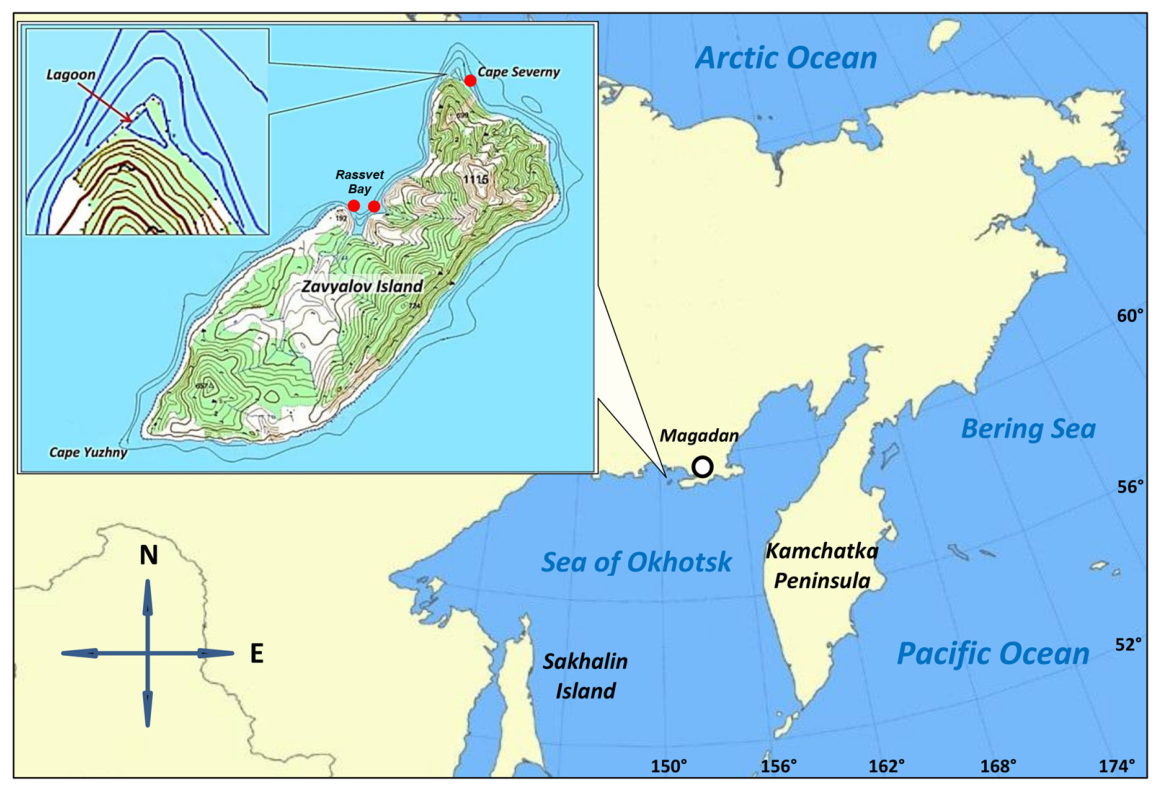
Figure 2.
Image of the desalinated lagoon on the northern tip of the Zavyalov Island, northern Sea of Okhotsk (taken from website https://magadansky.livejournal.com/198374.html).
Figure 2.
Image of the desalinated lagoon on the northern tip of the Zavyalov Island, northern Sea of Okhotsk (taken from website https://magadansky.livejournal.com/198374.html).
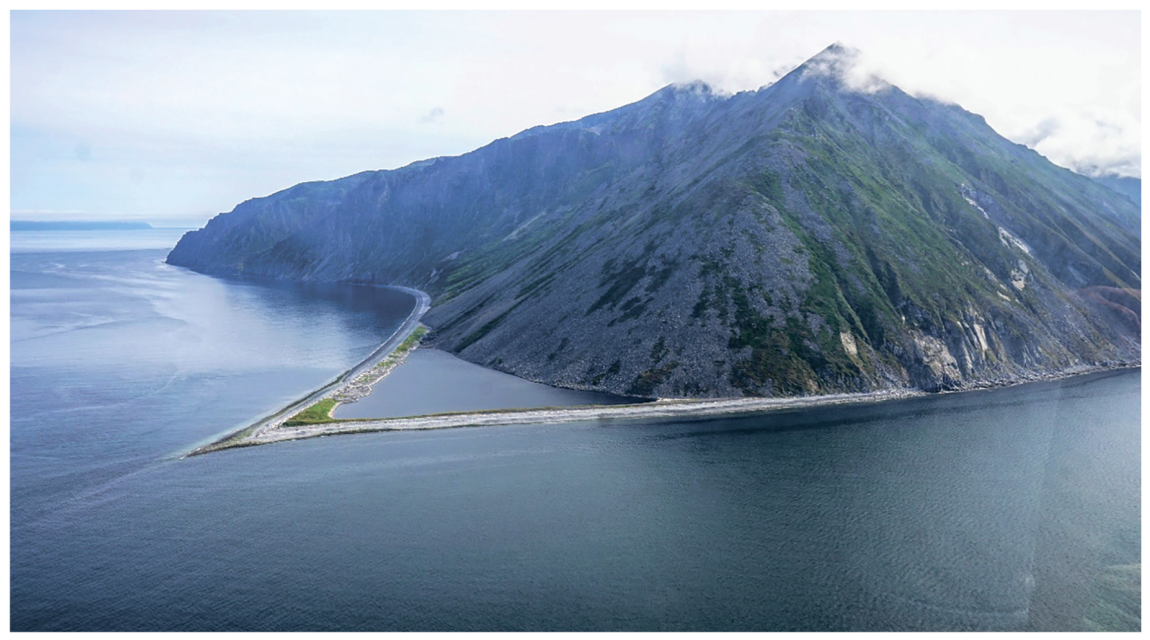
Figure 3.
Scales of the gray rockfish Sebastes glaucus from the marine areas (A, B) and the desalinated lagoon (C) of Zavyalov Island: A – juvenile FL 9.7 cm, age 2+; B – male FL 17.9 cm, age 7+; C – male FL 22.4 cm, age 15+. R – the greatest radius of the scale; 1–15 – the radii of the corresponding annuli.
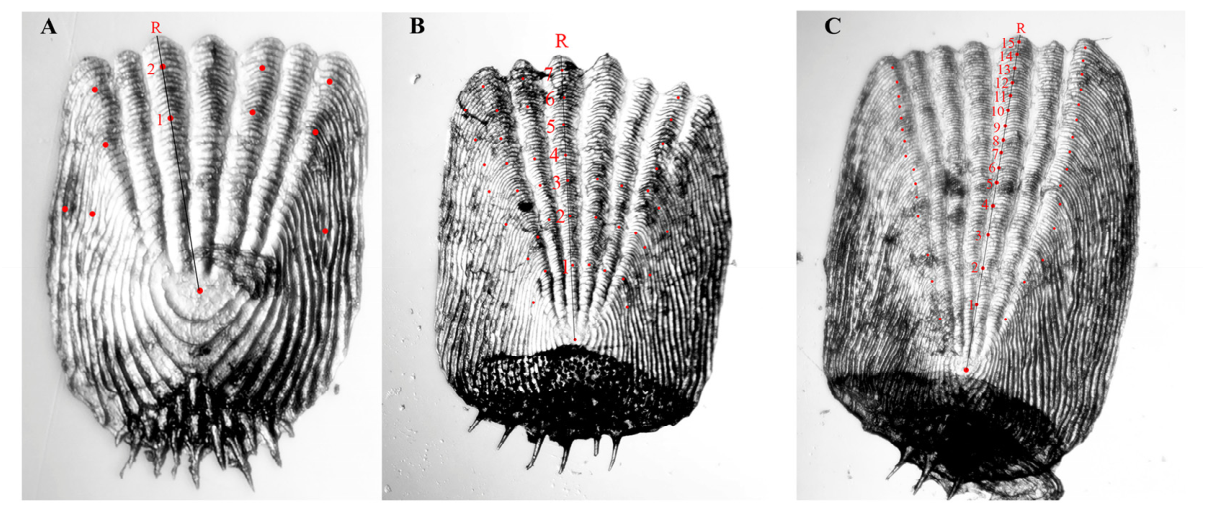
Figure 4.
Sectioned otoliths of the gray rockfishSebastes glaucus from marine waters (A, C) and desalinated lagoon (B) of Zavyalov Island. (a) – FL 17.0 cm, 16 years; (b) – FL 31.8 cm, 23 years; (c) – FL 44.0 cm, 35 years.
Figure 4.
Sectioned otoliths of the gray rockfishSebastes glaucus from marine waters (A, C) and desalinated lagoon (B) of Zavyalov Island. (a) – FL 17.0 cm, 16 years; (b) – FL 31.8 cm, 23 years; (c) – FL 44.0 cm, 35 years.
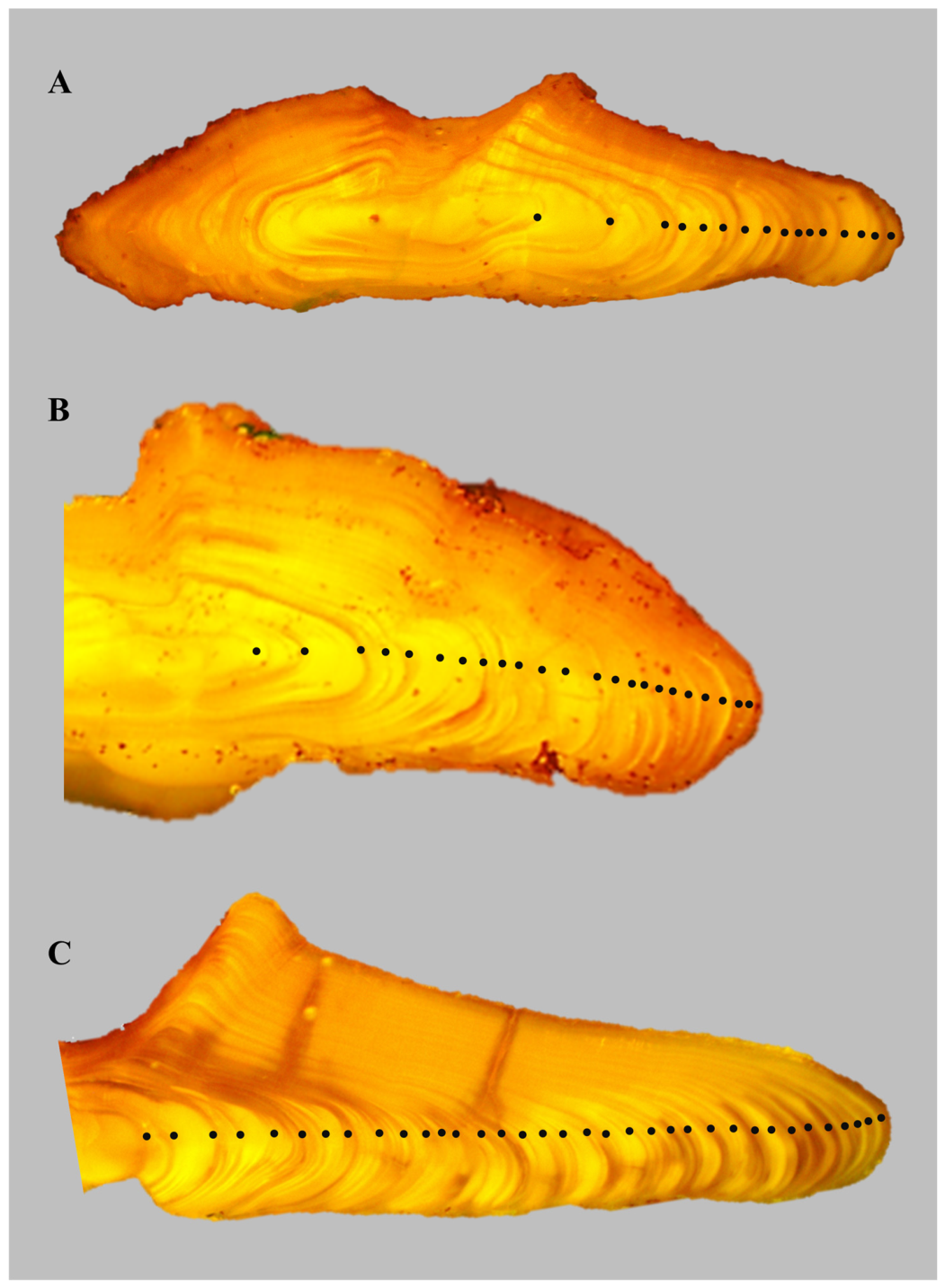
Figure 5.
Abnormalities in the skeletal structure of a lagoon gray rockfish Sebastes glaucus specimen (ZIN 57453, 22.0 cm SL): 1 - scoliosis of the 5th–8th trunk vertebrae, 2 - curvature of the rays of the second dorsal fin, 3 - reduction of the upper shortened rays of the caudal fin, 4 - overgrowth of the neural process of the 13th vertebra and the pterygiophore in front of it, 5 - curvature of the vertebral column in the caudal peduncle area.
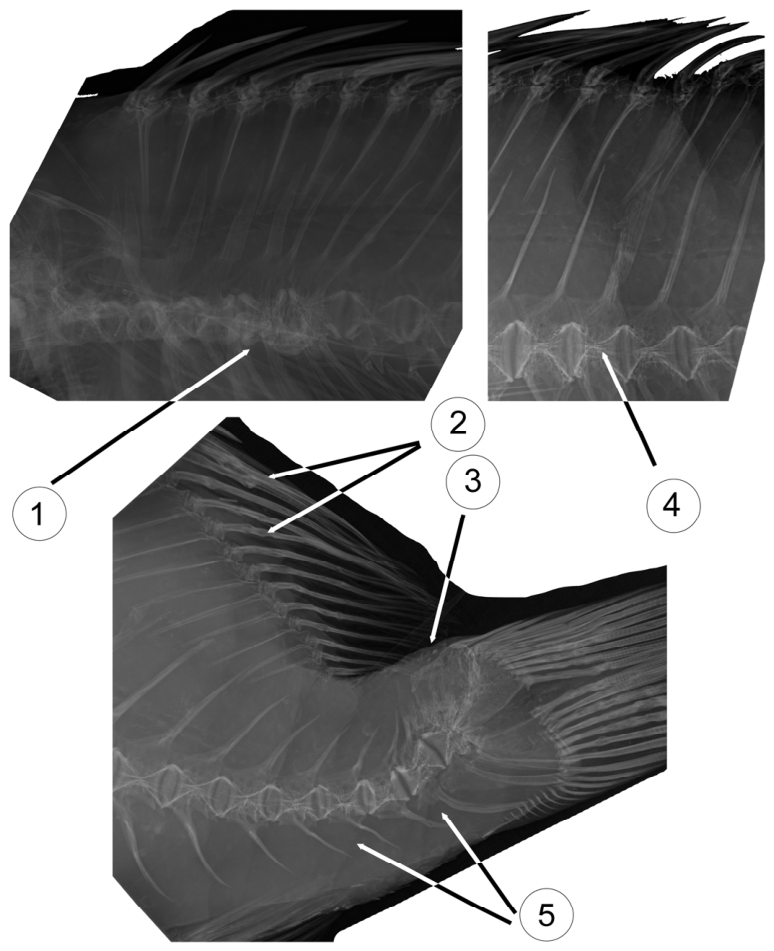
Figure 6.
Left sagittal otolith of the gray rockfish Sebastes glaucus specimens of different sizes (medially, scale 1 mm).
Figure 6.
Left sagittal otolith of the gray rockfish Sebastes glaucus specimens of different sizes (medially, scale 1 mm).
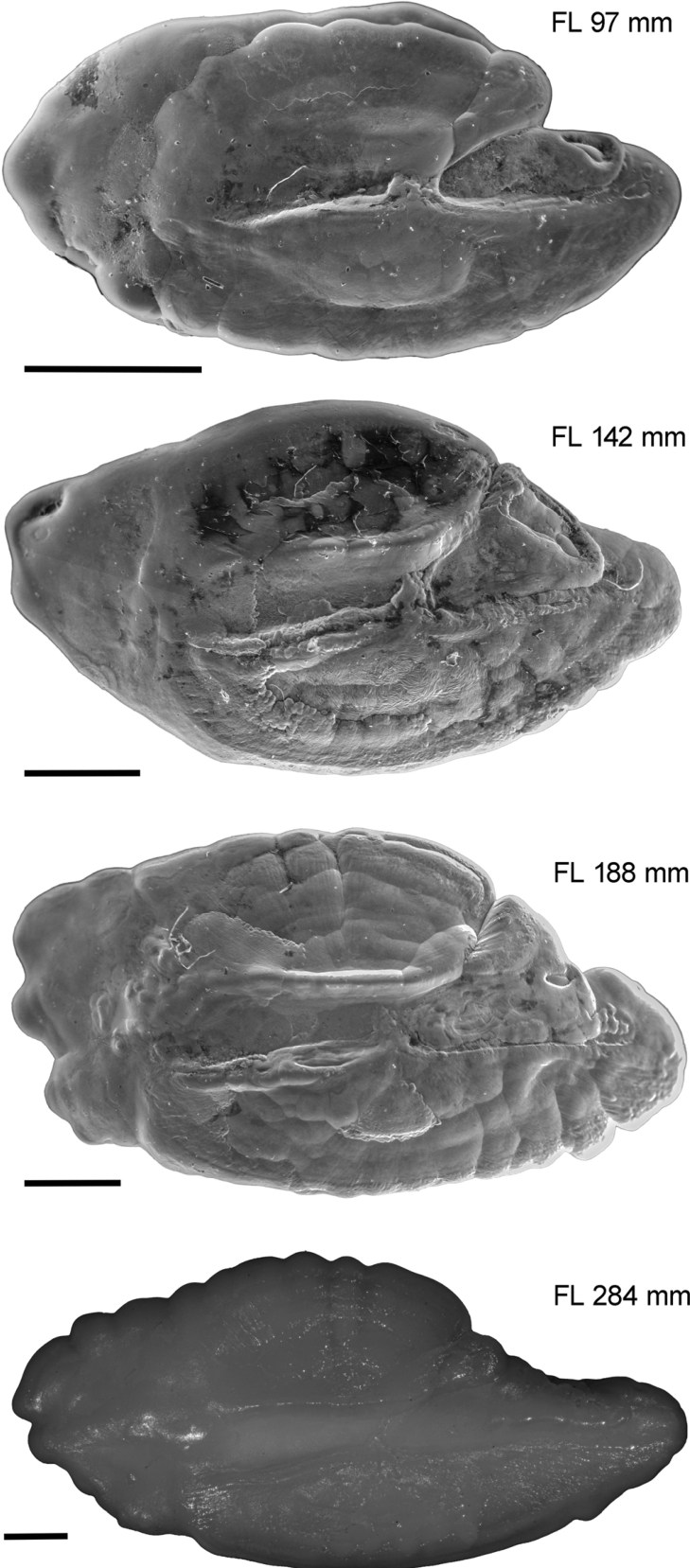
Figure 7.
Growth curves of juvenile and maturing gray rockfish Sebastes glaucus based on the analysis of scales: mean values in the desalinated lagoon (∙∙●∙∙) and adjacent sea (--■--), (⌶) – 95% confidence intervals.
Figure 7.
Growth curves of juvenile and maturing gray rockfish Sebastes glaucus based on the analysis of scales: mean values in the desalinated lagoon (∙∙●∙∙) and adjacent sea (--■--), (⌶) – 95% confidence intervals.
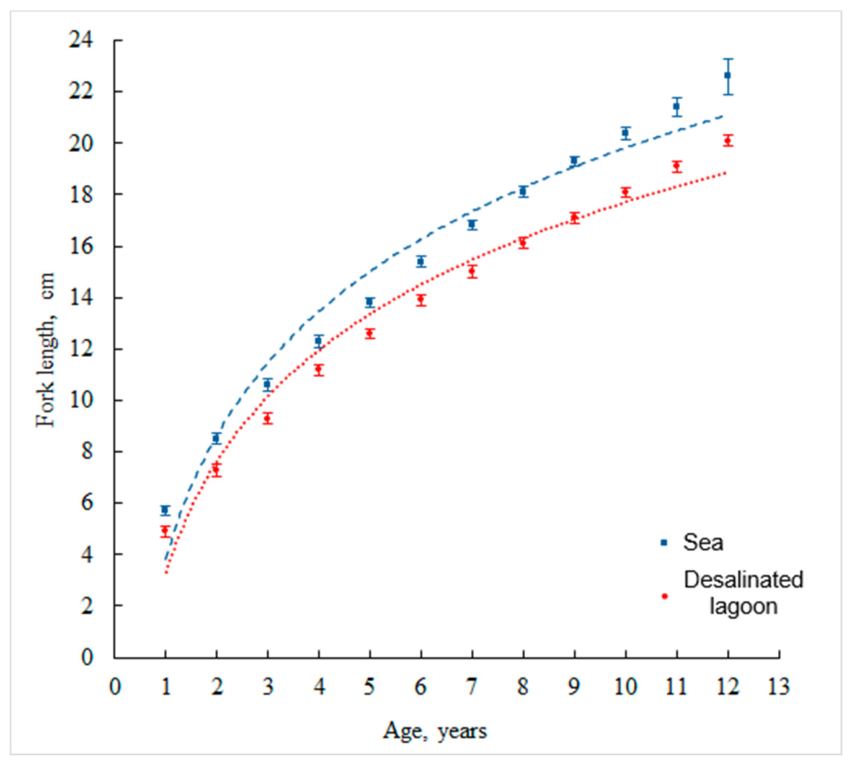
Figure 8.
Comparison of age of the gray rockfish Sebastes glaucus across different size classes from the desalinated lagoon and adjacent sea: A — fork length (FL) classes, B — body weight (W) classes. The upper and lower boundaries of each box represent the 75th and 25th percentiles respectively, while the horizontal line within each box indicates the median. The whiskers extend to the minimum and maximum values; circles (○) indicate individual outliers beyond this range. Asterisks indicate the significance level of differences between lagoon and adjacent sea samples (Mann–Whitney U-test): **p < 0.01; *p < 0.05; ns — not significant.
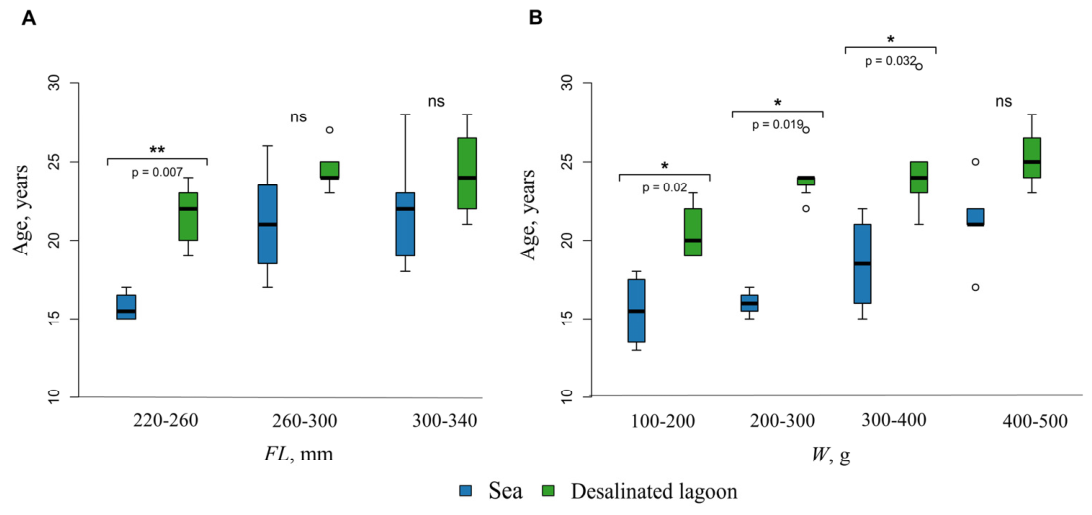
Figure 9.
Fitted von Bertalanffy curve to growth data of the gray rockfish Sebates glaucus from desalinated lagoon and adjacent sea of Zavyalov Island.
Figure 9.
Fitted von Bertalanffy curve to growth data of the gray rockfish Sebates glaucus from desalinated lagoon and adjacent sea of Zavyalov Island.
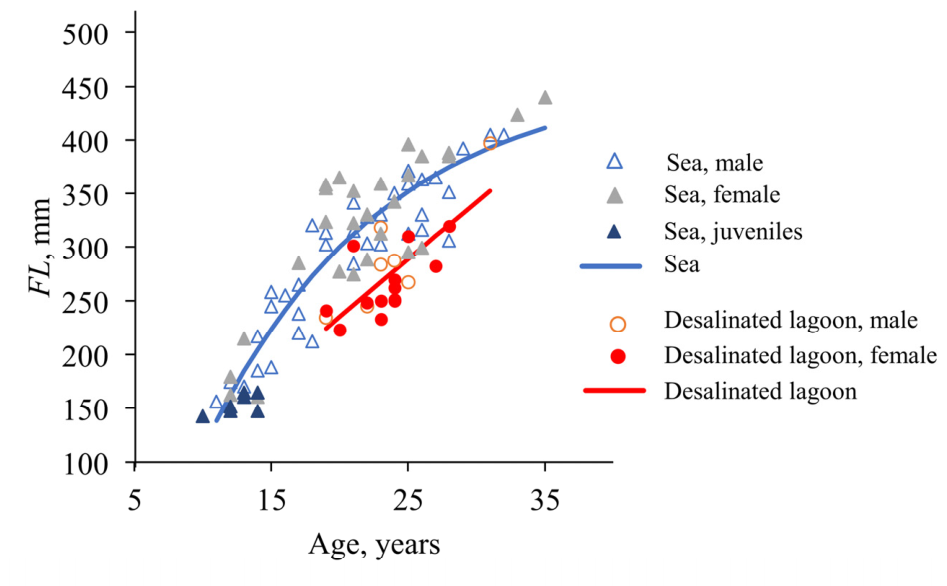
Figure 10.
Phylogenetic trees reconstructed using the maximum likelihood (ML) method based on data on the variability of nucleotide sequences of the COI gene (A) and the tRNA Thr region – the control region (B) of mtDNA. The sample number is indicated in parentheses after the species name (see Table 1), bootstrap support values (in % from 10,000 replicates) are shown at the branching nodes, the branch length is shown as the number of substitutions per site.
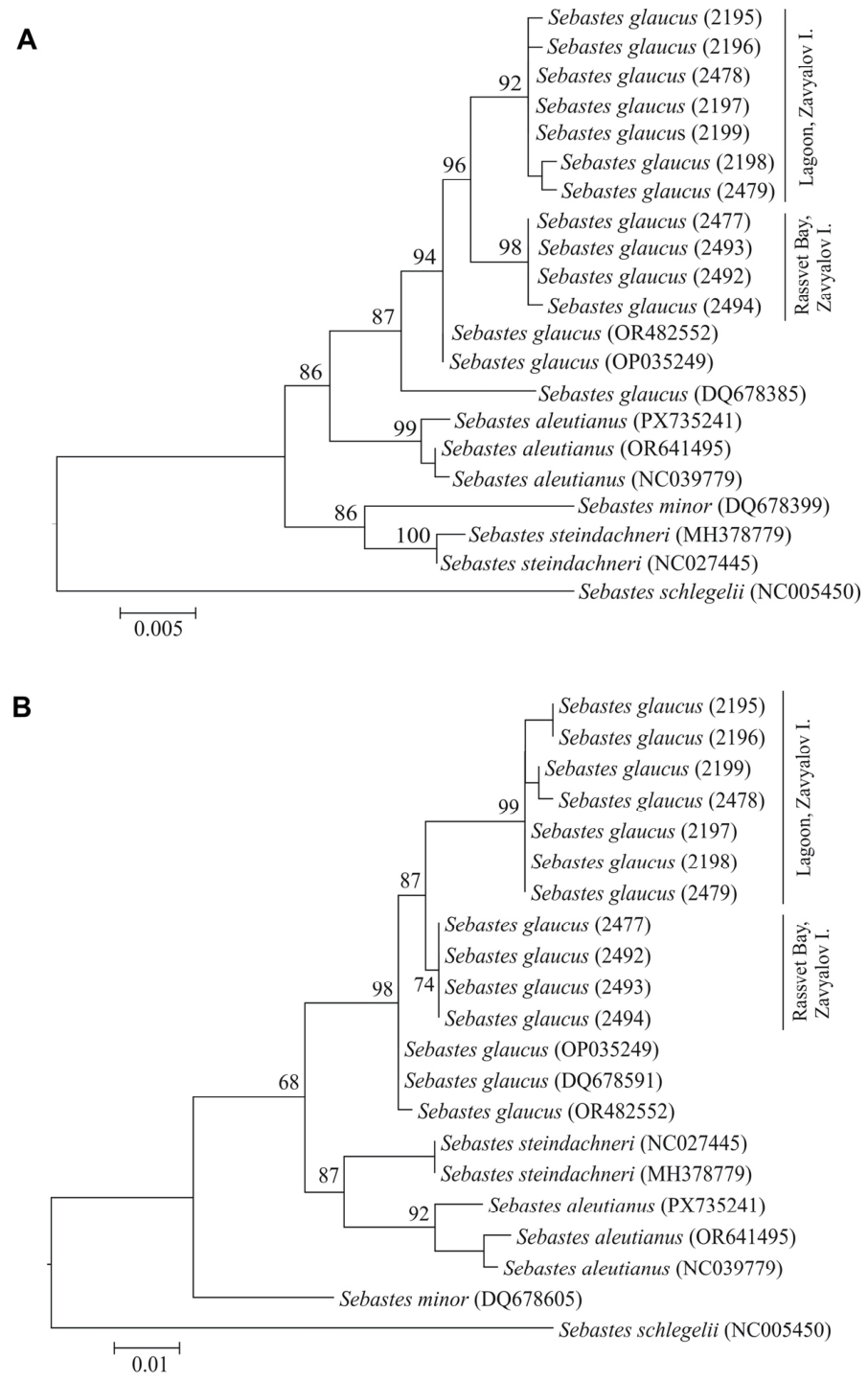
Figure 11.
Karyograms of the gray rockfish Sebastes glaucus from off the Zavyalov Island: A – Rassvet Bay (2n = 48, NF = 50), B – desalinated lagoon (2n = 48, NF = 48); m – metacentrics; st+a – subtelocentrics and acrocentrics; numerals – chromosome pair numbers. Magnification: 10 × 100.
Figure 11.
Karyograms of the gray rockfish Sebastes glaucus from off the Zavyalov Island: A – Rassvet Bay (2n = 48, NF = 50), B – desalinated lagoon (2n = 48, NF = 48); m – metacentrics; st+a – subtelocentrics and acrocentrics; numerals – chromosome pair numbers. Magnification: 10 × 100.
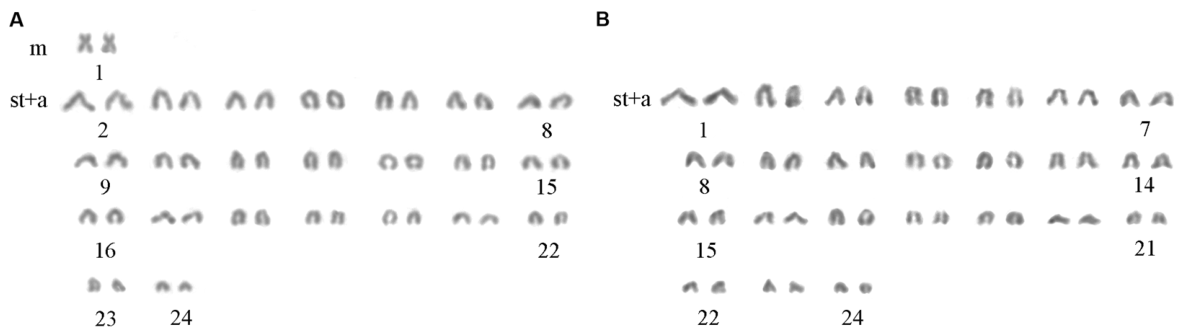
Figure 12.
General view of the gray rockfish Sebastes glaucus (A) from the desalinated lagoon of Zavyalov Island infected with metacercariae of trematodes, eye of S. glaucus (B) with metacercarial capsules (caps.).
Figure 12.
General view of the gray rockfish Sebastes glaucus (A) from the desalinated lagoon of Zavyalov Island infected with metacercariae of trematodes, eye of S. glaucus (B) with metacercarial capsules (caps.).
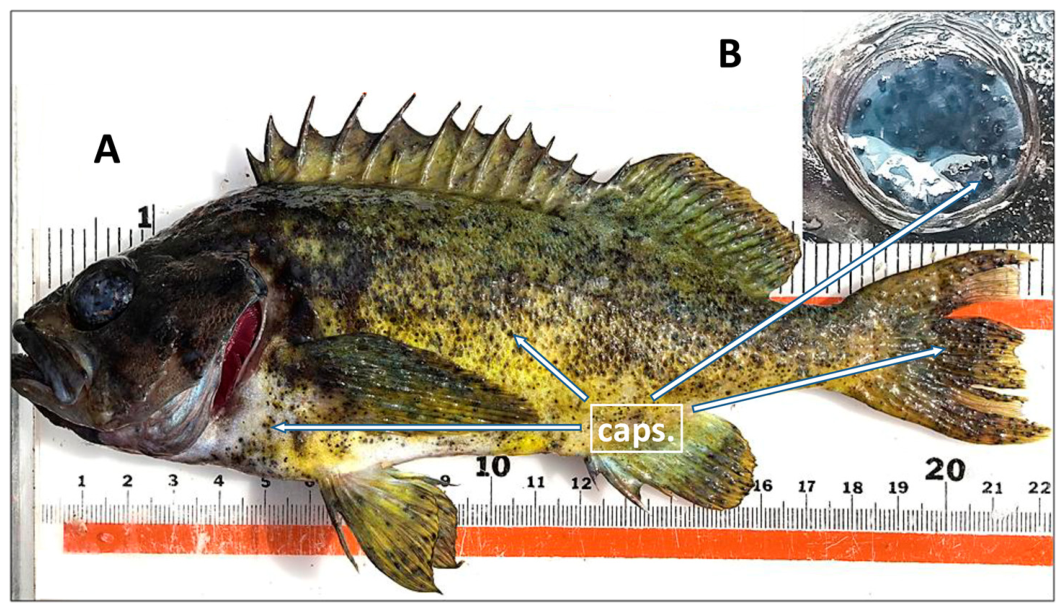

Table 1.
Data on gray rockfish Sebastes glaucus samples studied using genetic and karyological methods along with the information about the outgroup species (GB – GenBank (www.ncbi.nlm.nih.gov), NA – not available; * – karyotyped samples).
Table 1.
Data on gray rockfish Sebastes glaucus samples studied using genetic and karyological methods along with the information about the outgroup species (GB – GenBank (www.ncbi.nlm.nih.gov), NA – not available; * – karyotyped samples).
| Species | Sample no. or data source | Sample site | mtDNA fragment | ||
| COI | tRNA-Thr – tRNA-Pro | Control region | |||
| Main group | |||||
| Sebastes glaucus | 2195* | Sea of Okhotsk, Zavyalov Isl., Cape Severny, desalinated lagoon | PZ263094 | PZ246832 | PZ229233 |
| 2196 | Sea of Okhotsk, Zavyalov Isl., Cape Severny, desalinated lagoon | PZ263095 | PZ246833 | PZ229234 | |
| 2197 | Sea of Okhotsk, Zavyalov Isl., Cape Severny, desalinated lagoon | PZ263096 | PZ246834 | PZ229235 | |
| 2198 | Sea of Okhotsk, Zavyalov Isl., Cape Severny, desalinated lagoon | PZ263097 | PZ246835 | PZ229236 | |
| 2199 | Sea of Okhotsk, Zavyalov Isl., Cape Severny, desalinated lagoon | PZ263098 | PZ246836 | PZ229237 | |
| 2478* | Sea of Okhotsk, Zavyalov Isl., Cape Severny, desalinated lagoon | PZ263099 | PZ246837 | PZ229238 | |
| 2479* | Sea of Okhotsk, Zavyalov Isl., Cape Severny, desalinated lagoon | PZ263100 | PZ246838 | PZ229239 | |
| 2477 | Sea of Okhotsk, Zavyalov Isl., Rassvet Bay | PZ263101 | PZ246839 | PZ229240 | |
| 2492* | Sea of Okhotsk, Zavyalov Isl., Rassvet Bay | PZ263102 | PZ246840 | PZ229241 | |
| 2493* | Sea of Okhotsk, Zavyalov Isl., Rassvet Bay | PZ263103 | PZ246841 | PZ229242 | |
| 2494 | Sea of Okhotsk, Zavyalov Isl., Rassvet Bay | PZ263728 | PZ246842 | PZ229243 | |
| GB | Pacific Ocean, Hokkaido | DQ678385 | DQ678893 | DQ678591 | |
| GB | Pacific Ocean, Aleutian Islands | OR482552 | |||
| GB | Pacific Ocean, Aleutian Islands | OP035249 | |||
| Out group | |||||
| S. steindachneri | GB | Sea of Japan, Korean Peninsula | NC027445 | ||
| GB | NA | MH378779 | |||
| S. aleutianus | GB | Pacific Ocean, British Columbia | PX735241 | ||
| GB | Pacific Ocean, British Columbia | OR641495 | |||
| GB | NA | NC039779 | |||
| S. minor | GB | Sea of Okhotsk, Hokkaido | DQ678399 | DQ678907 | DQ678605 |
| S. schlegelii | GB | Yellow Sea, Korean Peninsula | NC005450 | ||
Table 2.
The main morphometrics of the gray rockfish Sebastes glaucus from desalinated lagoon and adjacent sea (statistically significant differences in characters at p<0.05 are highlighted in bold).
Table 2.
The main morphometrics of the gray rockfish Sebastes glaucus from desalinated lagoon and adjacent sea (statistically significant differences in characters at p<0.05 are highlighted in bold).
| Character | Desalinated lagoon (n=7) |
Marine waters (n=18) |
t-Student | ||
| limits | average | limits | average | ||
| SL, mm | 164–220 | 194 | 62–308 | 160.1 | >0.05 |
| D1 | XIV | XIV | XIV | XIV | >0.05 |
| D2 | 15–16 | 15.7 | 13–17 | 15.7 | >0.05 |
| A | 8–9 | 8.4 | 8–9 | 8.7 | >0.05 |
| L.l.p. | 43–49 | 45.8 | 42–53 | 48.4 | 0.003 |
| Sp. br. | 33–36 | 34.4 | 34–38 | 35.8 | >0.05 |
| Vert. abd. | 12–13 | 12.4 | 12–14 | 13.1 | >0.05 |
| Vert. caud. | 15–17 | 16.1 | 15–17 | 16.0 | >0.05 |
| Vert. tot. | 28–29 | 28.6 | 29–29 | 29.0 | 0.021 |
Table 3.
The values of genetic distances (%), calculated using the maximum likelihood method for the nucleotide sequences of the mtDNA COI gene (above the diagonal) and the tRNA-Thr – control region (below the diagonal). The values of genetic distances between lagoonal and marine specimens of Sebastes glaucus are highlighted in bold.
| Species | Sample no. or data source | No. | 1 | 2 | 3 | 4 | 5 | 6 | 7 | 8 | 9 | 10 | 11 | 12 | 13 | 14 | 15 | 16 | 17 | 18 | 19 | 20 | 21 |
| Sebastes glaucus | 2195 | 1 | 0.18 | 0.09 | 0.27 | 0.09 | 0.09 | 0.27 | 0.82 | 0.82 | 0.82 | 0.91 | 0.63 | 0.63 | 1.74 | 2.58 | 2.77 | 1.92 | 1.83 | 1.92 | 3.24 | 5.26 | |
| 2196 | 2 | 0 | 0.09 | 0.27 | 0.09 | 0.09 | 0.27 | 0.82 | 0.82 | 0.82 | 0.91 | 0.63 | 0.63 | 1.74 | 2.58 | 2.77 | 1.92 | 1.83 | 1.92 | 3.24 | 5.26 | ||
| 2197 | 3 | 0.41 | 0.41 | 0.18 | 0 | 0 | 0.18 | 0.73 | 0.73 | 0.73 | 0.82 | 0.54 | 0.54 | 1.65 | 2.49 | 2.68 | 1.83 | 1.74 | 1.83 | 3.15 | 5.17 | ||
| 2198 | 4 | 0.41 | 0.41 | 0 | 0.18 | 0.18 | 0.18 | 0.73 | 0.73 | 0.73 | 0.82 | 0.73 | 0.73 | 1.83 | 2.67 | 2.87 | 2.02 | 1.92 | 2.02 | 3.34 | 5.37 | ||
| 2199 | 5 | 0.62 | 0.62 | 0.21 | 0.21 | 0 | 0.18 | 0.73 | 0.73 | 0.73 | 0.82 | 0.54 | 0.54 | 1.65 | 2.49 | 2.68 | 1.83 | 1.74 | 1.83 | 3.15 | 5.17 | ||
| 2478 | 6 | 0.41 | 0.41 | 0.41 | 0.41 | 0.21 | 0.18 | 0.73 | 0.73 | 0.73 | 0.82 | 0.54 | 0.54 | 1.65 | 2.49 | 2.68 | 1.83 | 1.74 | 1.83 | 3.15 | 5.17 | ||
| 2479 | 7 | 0.41 | 0.41 | 0 | 0 | 0.21 | 0.41 | 0.91 | 0.91 | 0.91 | 1.00 | 0.73 | 0.73 | 1.83 | 2.67 | 2.87 | 2.02 | 1.92 | 2.02 | 3.34 | 5.37 | ||
| 2477 | 8 | 2.07 | 2.07 | 1.66 | 1.66 | 1.86 | 2.07 | 1.66 | 0 | 0 | 0.09 | 0.54 | 0.54 | 1.65 | 2.49 | 2.68 | 1.83 | 1.74 | 1.83 | 3.15 | 5.27 | ||
| 2492 | 9 | 2.07 | 2.07 | 1.66 | 1.66 | 1.86 | 2.07 | 1.66 | 0 | 0 | 0.09 | 0.54 | 0.54 | 1.65 | 2.49 | 2.68 | 1.83 | 1.74 | 1.83 | 3.15 | 5.27 | ||
| 2493 | 10 | 2.07 | 2.07 | 1.66 | 1.66 | 1.86 | 2.07 | 1.66 | 0 | 0 | 0.09 | 0.54 | 0.54 | 1.65 | 2.49 | 2.68 | 1.83 | 1.74 | 1.83 | 3.15 | 5.27 | ||
| 2494 | 11 | 2.07 | 2.07 | 1.66 | 1.66 | 1.86 | 2.07 | 1.66 | 0 | 0 | 0 | 0.64 | 0.64 | 1.74 | 2.77 | 2.58 | 1.92 | 1.83 | 1.92 | 3.24 | 5.36 | ||
| GB | 12 | 2.28 | 2.28 | 1.86 | 1.86 | 2.07 | 2.28 | 1.86 | 0.62 | 0.62 | 0.62 | 0.62 | 0 | 1.09 | 1.92 | 2.11 | 1.46 | 1.36 | 1.45 | 2.57 | 4.76 | ||
| GB | 13 | 2.48 | 2.48 | 2.07 | 2.07 | 2.28 | 2.48 | 2.07 | 0.83 | 0.83 | 0.83 | 0.83 | 0.21 | 1.09 | 1.92 | 2.11 | 1.46 | 1.36 | 1.45 | 2.57 | 4.76 | ||
| GB | 14 | 2.28 | 2.28 | 1.86 | 1.86 | 2.07 | 2.28 | 1.86 | 0.62 | 0.62 | 0.62 | 0.62 | 0 | 0.21 | 2.39 | 2.57 | 2.01 | 1.92 | 2.01 | 3.23 | 5.34 | ||
| S. steindachneri | GB | 15 | 5.38 | 5.38 | 4.97 | 4.97 | 5.18 | 5.38 | 4.97 | 3.73 | 3.73 | 3.73 | 3.73 | 3.11 | 3.31 | 3.11 | 0.18 | 1.92 | 1.82 | 1.92 | 1.73 | 4.96 | |
| GB | 16 | 5.38 | 5.38 | 4.97 | 4.97 | 5.18 | 5.38 | 4.97 | 3.73 | 3.73 | 3.73 | 3.73 | 3.11 | 3.31 | 3.11 | 0 | 1.92 | 1.83 | 1.92 | 1.92 | 5.16 | ||
| S. aleutianus | GB | 17 | 6.00 | 6.00 | 5.59 | 5.59 | 5.80 | 6.00 | 5.59 | 4.35 | 4.35 | 4.35 | 4.35 | 3.73 | 3.93 | 3.73 | 3.11 | 3.11 | 0.27 | 0.36 | 2.76 | 5.05 | |
| GB | 18 | 6.00 | 6.00 | 5.59 | 5.59 | 5.80 | 6.00 | 5.59 | 4.35 | 4.35 | 4.35 | 4.35 | 3.73 | 3.93 | 3.73 | 3.52 | 3.52 | 1.86 | 0.09 | 2.66 | 5.14 | ||
| GB | 19 | 6.00 | 6.00 | 5.59 | 5.59 | 5.80 | 6.00 | 5.59 | 4.35 | 4.35 | 4.35 | 4.35 | 3.73 | 3.93 | 3.73 | 3.31 | 3.31 | 1.66 | 0.62 | 2.75 | 5.24 | ||
| S. minor | GB | 20 | 6.63 | 6.63 | 6.21 | 6.21 | 6.42 | 6.63 | 6.21 | 4.97 | 4.97 | 4.97 | 4.97 | 4.35 | 4.14 | 4.35 | 4.14 | 4.14 | 5.38 | 4.76 | 4.76 | 5.15 | |
| S. schlegelii | GB | 21 | 10.56 | 10.56 | 10.14 | 10.14 | 10.35 | 10.56 | 10.14 | 8.90 | 8.90 | 8.90 | 8.90 | 8.28 | 8.49 | 8.28 | 8.70 | 8.70 | 8.49 | 8.28 | 8.28 | 8.49 |
Disclaimer/Publisher’s Note: The statements, opinions and data contained in all publications are solely those of the individual author(s) and contributor(s) and not of MDPI and/or the editor(s). MDPI and/or the editor(s) disclaim responsibility for any injury to people or property resulting from any ideas, methods, instructions or products referred to in the content. |
© 2026 by the authors. Licensee MDPI, Basel, Switzerland. This article is an open access article distributed under the terms and conditions of the Creative Commons Attribution (CC BY) license (http://creativecommons.org/licenses/by/4.0/).
Copyright: This open access article is published under a Creative Commons CC BY 4.0 license, which permit the free download, distribution, and reuse, provided that the author and preprint are cited in any reuse.