

Submitted:
11 October 2026
Posted:
13 October 2026
You are already at the latest version
Abstract
Introduction: Land policies are frequently presented as instruments for correcting colonial, racial, feudal and elite‐concentrated land inequality. Across the supplied literature, however, formal redistribution, restitution, recognition and titling do not consistently produce secure tenure or improved socioeconomic conditions for historically disadvantaged populations. This systematic review examined how land reform, redistribution, restitution, tenure regularization and titling relate to socioeconomic impacts and tenure security, while identifying enabling conditions, risks and implementation barriers. Methods: The researcher‐selected databases and information sources were Google Scholar, PubMed (MEDLINE) and ERIC. The eligibility protocol restricted publication years to 2025–2026. The exact calendar date of search execution was not recorded in the verified identification provenance; this is distinct from the publication‐year eligibility range. Google Scholar, PubMed (MEDLINE) and ERIC were searched using the supplied Boolean strategy for English peer‐ reviewed studies published between 2025 and 2026. Results: Land reform was consistently framed as a project of distributive and reparative justice, but redistribution was constrained by political instability, elite accommodation, weak administrative capacity, regulatory overlap and inadequate conflict resolution. Formal recognition frequently protected only partial or selected rights. Socioeconomic benefits depended on complementary water, infrastructure, inputs, services, livelihood support and recognition of local knowledge. Poorly planned reform, conservation restrictions and resettlement generated displacement, livelihood disruption, food insecurity and conflict. Participation, inclusion, accessible information, accountability and free, prior and informed consent were recurrent enabling conditions. Discussion/Conclusion: Land policies can advance justice and livelihood security, but their effects are conditional rather than automatic. Effective reform requires institutional capacity, substantive redistribution, inclusive tenure recognition and integrated socioeconomic support.
Keywords:
agrarian justice
; historically disadvantaged populations
; land redistribution
; land reform
; tenure security
1. Introduction
Land remains simultaneously an economic asset, a livelihood foundation, a source of social identity and an instrument of political inclusion. In settings shaped by colonial dispossession, racial exclusion, feudal relations or concentrated ownership, land reform is commonly intended to correct historically produced inequality. The supplied literature presents agrarian reform as a distributive and reparative project linked to social justice, rural development and the rights of Indigenous peoples, women and peasants (Chhachhar et al., 2025; Arisaputra & Ashri, 2025; Paradza & Zulch, 2026).
Existing evidence indicates that the effects of land policy depend substantially on institutional and political conditions. Comparative analyses describe reform being terminated by political transformation in Indonesia or diluted through elite-protective compromises in the Philippines (Aini et al., 2026). Studies from Africa and South Africa similarly identify limited state capacity, bureaucratic inefficiency, elite capture, inadequate post-settlement support and weak coordination as constraints on meaningful redistribution (Karadag et al., 2025; Paradza & Zulch, 2026; Author not available, 2026).
The literature also shows that formal recognition or titling is not equivalent to effective tenure security. Recognition of customary forests in Indonesia protected communal forest rights but excluded productive cultivated areas and restricted customary autonomy (Cahyono et al., 2026). Likewise, land registration may provide legal certainty for some owners while leaving structural inequalities intact (Sutarto et al., 2026). Benefits from land access are conditional on water, infrastructure, agricultural support, viable plot sizes, secure tenure and recognition of local knowledge (Makapela & Chigbu, 2026; Zuma et al., 2026; Carmona & Simpson, 2026).
What remains insufficiently understood is how these conditions operate across diverse historically unequal settings and how policy design translates into lived socioeconomic outcomes. The supplied evidence is heterogeneous, with direct measures of income, wealth accumulation, housing stability and food security unevenly reported. A systematic review was therefore needed to synthesise cross-study convergence and divergence, distinguish intended policy benefits from observed or documented consequences, and identify the institutional and participatory conditions under which land policies may advance or undermine justice.
2. Research Objectives
RO1: To examine how Land policies, including land reform, land restitution, land redistribution, and land tenure security programs. influences Socio-economic impacts, including changes in income, wealth accumulation, housing stability, food security, and social equity
RO2: To identify the principal opportunities, benefits and enabling conditions associated with Land policies, including land reform, land restitution, land redistribution, and land tenure security programs. in relation to Socio-economic impacts, including changes in income, wealth accumulation, housing stability, food security, and social equity
RO3: To analyse the challenges, risks, ethical considerations and implementation barriers associated with Land policies, including land reform, land restitution, land redistribution, and land tenure security programs. for Historically disadvantaged individuals, including marginalized, disenfranchised, or historically oppressed groups
3. Research Methods
3.1. Review Design
The selected review type was Systematic Review. The design used transparent identification, eligibility assessment, critical appraisal and qualitative thematic synthesis. The review included 24 records, while the verified qualitative synthesis used extracted findings from 19 studies.
3.2. Search Strategy and Information Sources
The researcher-selected databases and information sources were Google Scholar, PubMed (MEDLINE), ERIC. The eligibility protocol restricted publication years to 2025–2026. The exact calendar date of search execution was not recorded in the verified identification provenance; this is distinct from the publication-year eligibility range.
3.3. Inclusion and Exclusion Criteria
Inclusion
- Studies focusing on historically disadvantaged populations, including indigenous peoples, racial or ethnic minorities, marginalized communities, or low-income/landless peasants.
- Studies examining land policies such as land reform, land redistribution, land restitution, land tenure regularization, or land titling programs.
- Studies reporting on socioeconomic impacts, including income, livelihood security, or asset accumulation, and/or land tenure security.
- Studies set in regions with a documented history of institutionalized land inequality, colonial dispossession, or agrarian reform.
- Peer-reviewed journal articles published between 2025 and 2026.
- Studies published in the English language.
- Studies that provide empirical evidence or systematic analysis of the relationship between land policies and the specified outcomes.
Exclusion
- Studies that do not focus on historically disadvantaged individuals or marginalized groups.
- Studies that do not examine land policy interventions such as reform, redistribution, restitution, or titling.
- Studies that do not report on socioeconomic outcomes or land tenure security.
- Studies set in contexts that lack a history of institutionalized land inequality, colonial dispossession, or agrarian reform.
- Studies published before 2025 or after 2026.
- Studies published in languages other than English.
- Non-peer-reviewed documents, including grey literature, books, book chapters, conference proceedings, or editorials.
- Studies that focus exclusively on theoretical frameworks without empirical application to the specified populations or policies.
3.4. Screening and Study Selection
The PRISMA selection counts are persisted, but the decision rule used during title/abstract screening is not available in the verified audit payload. COSTAQDA therefore reports the recorded workflow counts without reconstructing an unverified screening procedure.
The persisted PRISMA workflow records 480 identified records, 8 duplicates, 83 records screened, 79 reports sought for retrieval, 4 records excluded at the title/abstract stage, 75 full texts assessed, 0 full-text exclusions and 24 included records. These counts describe study selection and are not substantive review findings.
Figure 1.
PRISMA 2020 Flow Diagram — Identification, Screening, Eligibility and Included.Source: COSTAQDA PRISMA Workflow, navigation item 8: PRISMA Flow Diagram; four-stage structure showing Identification, Screening, Eligibility (including CASP critical appraisal) and Included; adapted from PRISMA 2020 (Page et al., 2021).
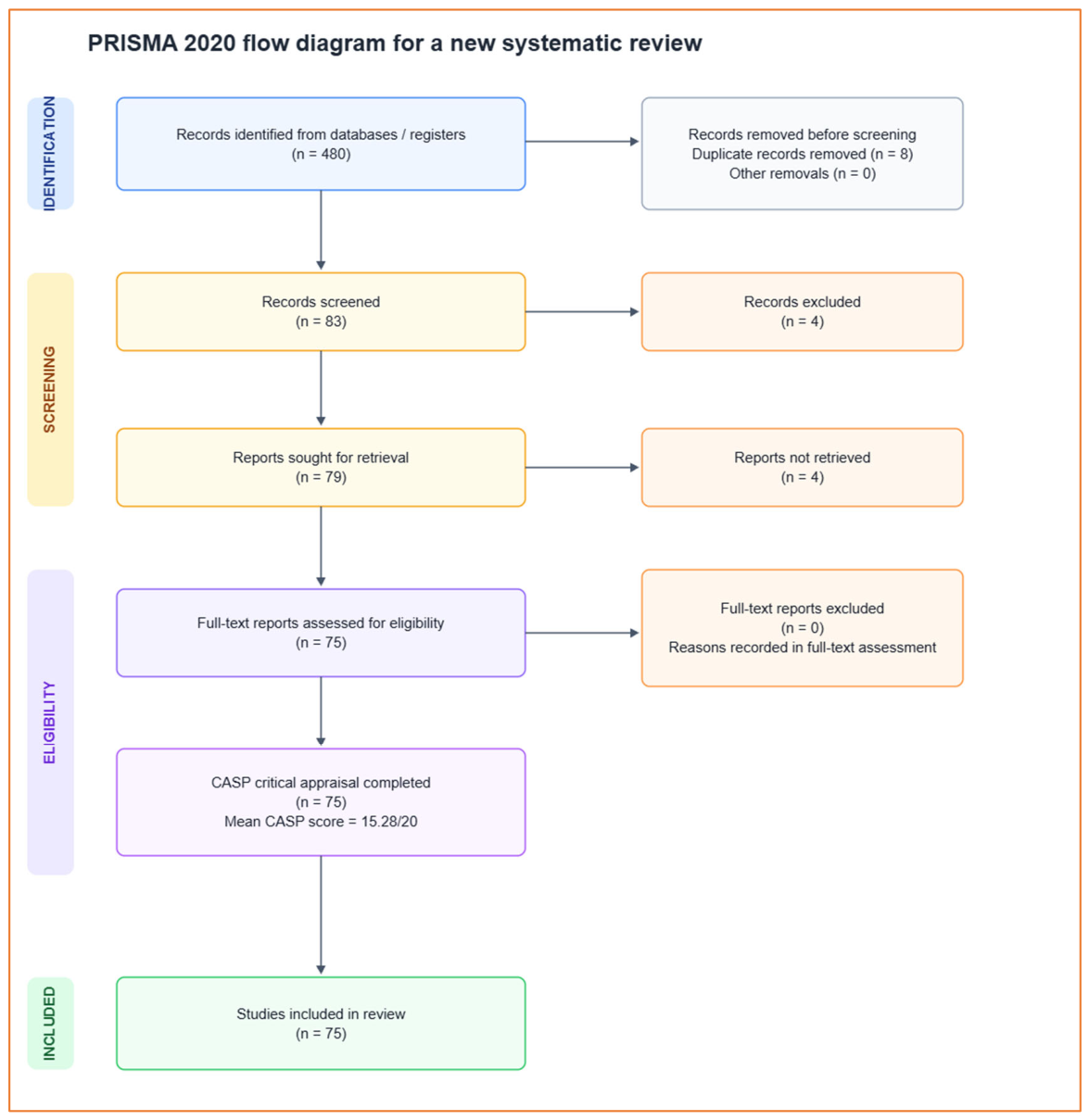
The PRISMA figure should represent the verified workflow of 480 identified records, 8 duplicates removed, 83 records screened, 4 title or abstract exclusions, 79 reports sought, 75 full texts assessed, 0 full-text exclusions and 24 included records. These counts describe selection and are not substantive findings.
3.5. Critical Appraisal
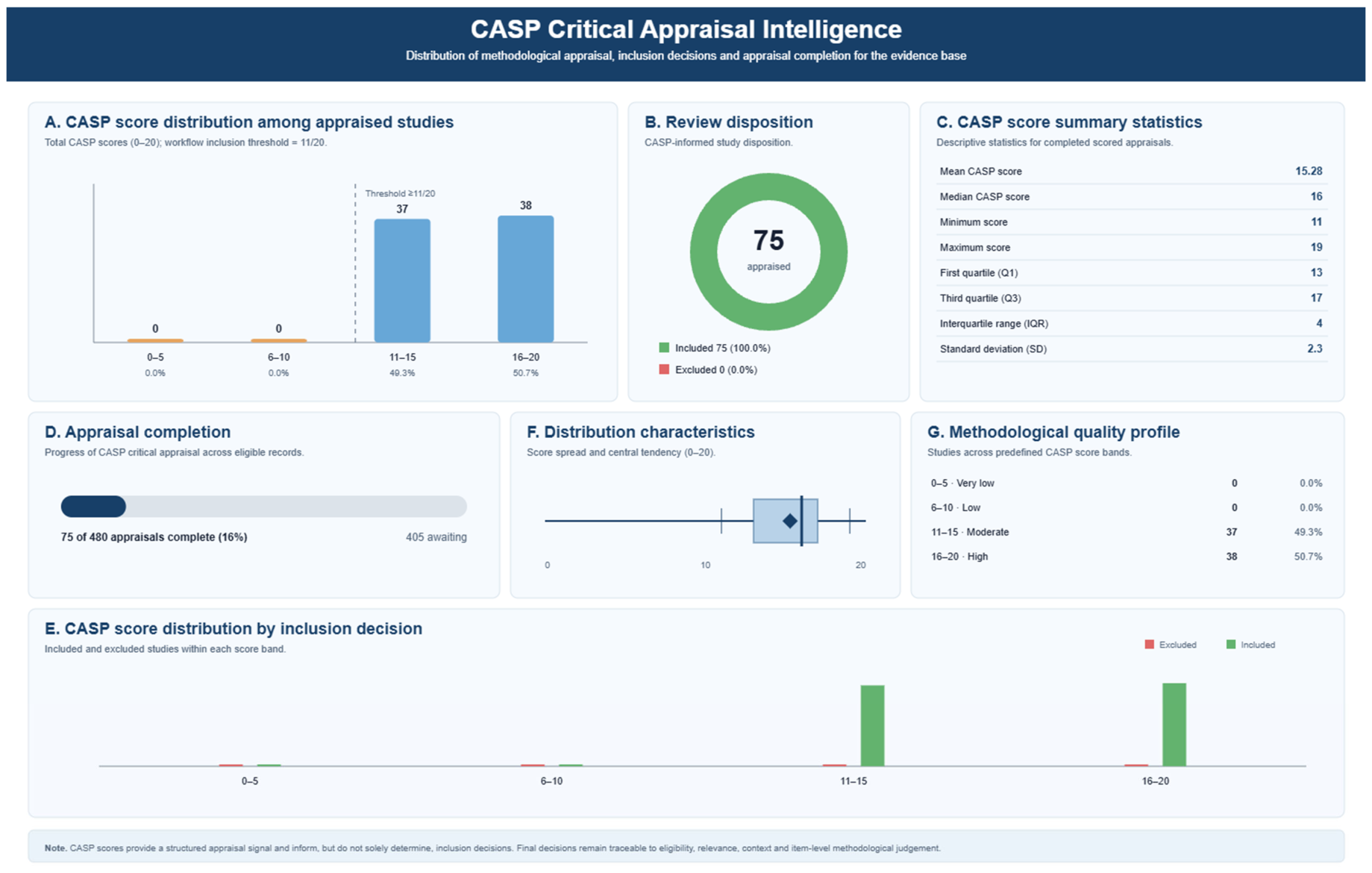
CASP was used in the PRISMA full-text workspace, and 24 of 24 included studies had completed appraisals. CASP was used in the PRISMA full-text workspace, and 24 of 24 included studies had completed appraisals. The reported mean score was 15.13, but CASP results were not treated as an unquestioned total-quality score. Appraisals identified recurring concerns involving incomplete methodological reporting, limited empirical detail, absent or unclear recruitment and data-collection procedures, weakly documented analysis, limited reflexivity and the use of conceptual, legal or secondary-review designs. Several appraisals were conservative text-evidence assessments requiring researcher verification.
The critical appraisal stage was essential because inclusion in a systematic review does not, by itself, mean that every study offers equally dependable evidence. Using the Critical Appraisal Skills Programme (CASP), the review examined the methodological strengths and limitations of the included literature before drawing conclusions about land policies and the experiences of historically disadvantaged communities. This approach reflects the importance of assessing how knowledge was produced, rather than relying only on the relevance of a study’s topic (Grant & Booth, 2009; Costa & Mfolo, 2024).
The manuscript records completed appraisals for 24 included studies, with a reported mean score of 15.13 out of 20 and individual scores ranging from 11 to 19. These figures suggest variation in the quality of methodological reporting across the evidence base. Importantly, a numerical score cannot tell the whole story. A study may raise valuable questions about justice, tenure security or livelihoods while providing insufficient detail about participant recruitment, data collection or analysis. The appraisal therefore considered the meaning of identified weaknesses alongside the recorded scores.
Several recurring concerns deserve particular attention. Some studies offered limited empirical detail, while others relied on legal interpretation, conceptual discussion or secondary evidence rather than direct accounts of affected communities. Reporting on researcher reflexivity and ethical considerations was also uneven. These gaps matter because land reform is not simply an administrative process: it shapes people's security, access to resources and prospects for a sustainable livelihood. Conclusions about these experiences require evidence that is both contextually meaningful and methodologically transparent (Paradza & Zulch, 2026).
Taken together, the CASP findings support a cautious but constructive reading of the review. They help distinguish recurring insights from claims that require further verification, while encouraging readers to consider the circumstances in which each study was conducted. The landscape CASP dashboard that follows offers a visual overview of appraisal scores and completion. However, its display of 75 appraised studies differs from the 24 appraisals described in this manuscript; these counts and the associated mean scores should be reconciled against the underlying COSTAQDA records before publication (Grant & Booth, 2009; Costa & Mfolo, 2024).
The CASP figure should represent 24 completed appraisals among 24 included studies. The appraisal workspace reported scores ranging from 11 to 19 and a mean of 15.13, but the scores are interpreted alongside study design and appraisal limitations rather than as a single definitive quality ranking.
Figure 2.
CASP Critical Appraisal Intelligence — PRISMA Workflow, Step 6: Full-Text Screening.Source: COSTAQDA PRISMA Workflow, navigation item 6: Full-Text Screening (CASP critical appraisal outputs). The Word figure is generated from the same deterministic COSTAQDA CASP visual.
Figure 2.
CASP Critical Appraisal Intelligence — PRISMA Workflow, Step 6: Full-Text Screening.Source: COSTAQDA PRISMA Workflow, navigation item 6: Full-Text Screening (CASP critical appraisal outputs). The Word figure is generated from the same deterministic COSTAQDA CASP visual.
3.6. Data Extraction
A formal data-extraction procedure was not recorded in the project evidence. Nevertheless, the verified synthesis contains 128 traceable extracted findings from 19 studies, each linked where available to study and finding identifiers. The absence of a recorded extraction protocol limits reproducibility and requires caution when interpreting the completeness and comparability of extracted outcomes.
3.7. Data Synthesis and Analysis
Qualitative evidence synthesis was conducted on 128 extracted findings contributed by 19 studies. The COSTAQDA synthesis engine applied thematic synthesis, moving from traceable finding-level evidence to 6 initial codes, 3 categories, 2 descriptive themes and 4 analytical themes.
Theme development was constrained to the extracted finding-level evidence supplied by eligible studies. Each synthesised theme retained supporting study IDs and finding IDs, while contradictory evidence was preserved where identified. Titles, abstracts and bibliographic prominence were not treated as substitutes for extracted qualitative findings.
Recorded synthesis limitations included: The supplied findings are heterogeneous and frequently consist of partial excerpts, review conclusions, legal or policy analysis, and methodological material rather than complete accounts of participant experiences. Direct evidence on changes in income, wealth accumulation, housing stability, or food security is therefore limited and uneven across settings. Several findings describe intended reforms or proposed solutions rather than verified outcomes, and the extraction does not consistently identify study quality or implementation duration. Interpretations should consequently be read as cross-study patterns and conditional explanations, not as evidence of uniform effects..
3.8. Bibliometric Intelligence and Confidence in the Evidence Base
Bibliometric intelligence provides a structural view of the evidence base that complements PRISMA selection, critical appraisal and qualitative synthesis. The following analyses examine citation relationships, scholarly influence, evidence connectivity and knowledge development within the included corpus. They provide contextual evidence about the intellectual structure and provenance of the literature and are not substitutes for methodological quality appraisal.
3.8.1. Local Citation Network
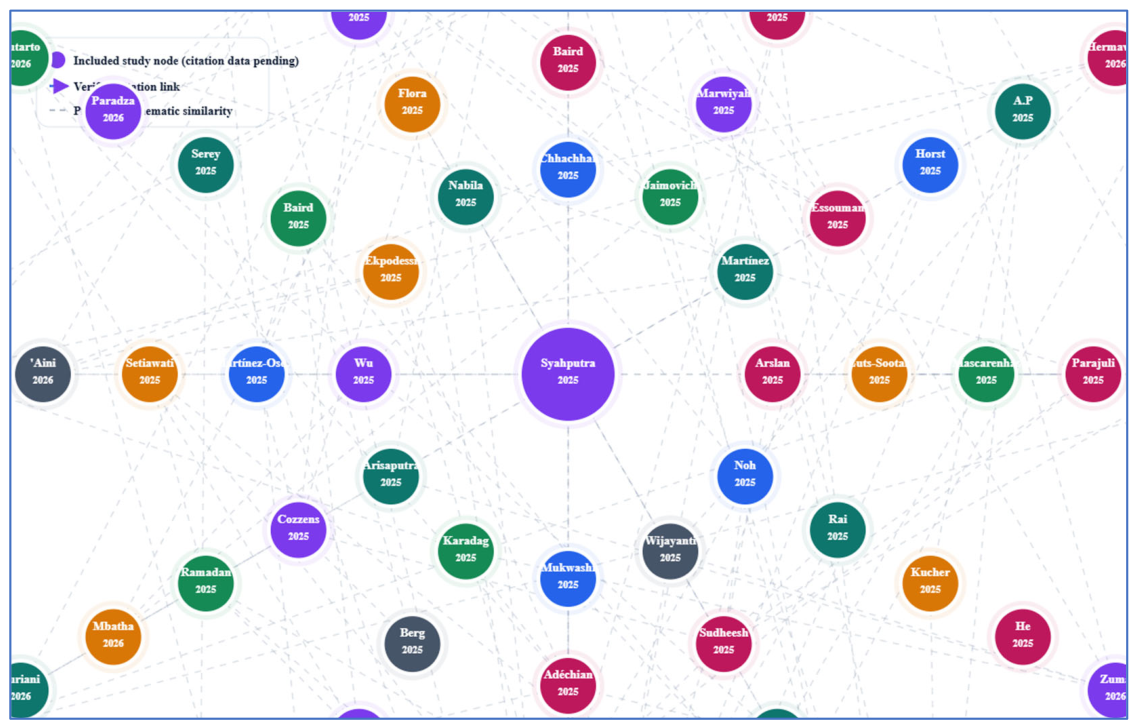
The Local Citation Network maps citation relationships within the included evidence base. It shows how studies are connected within the review corpus and supports examination of intellectual connectedness, centrality, bridging and isolation. These citation relationships describe the structure of the literature and do not, by themselves, establish methodological quality or validity.
Figure 3.
Local Citation Network.Source: COSTAQDA PRISMA Workflow, navigation item 12: Bibliometric Intelligence — Local Citation Network.
Figure 3.
Local Citation Network.Source: COSTAQDA PRISMA Workflow, navigation item 12: Bibliometric Intelligence — Local Citation Network.
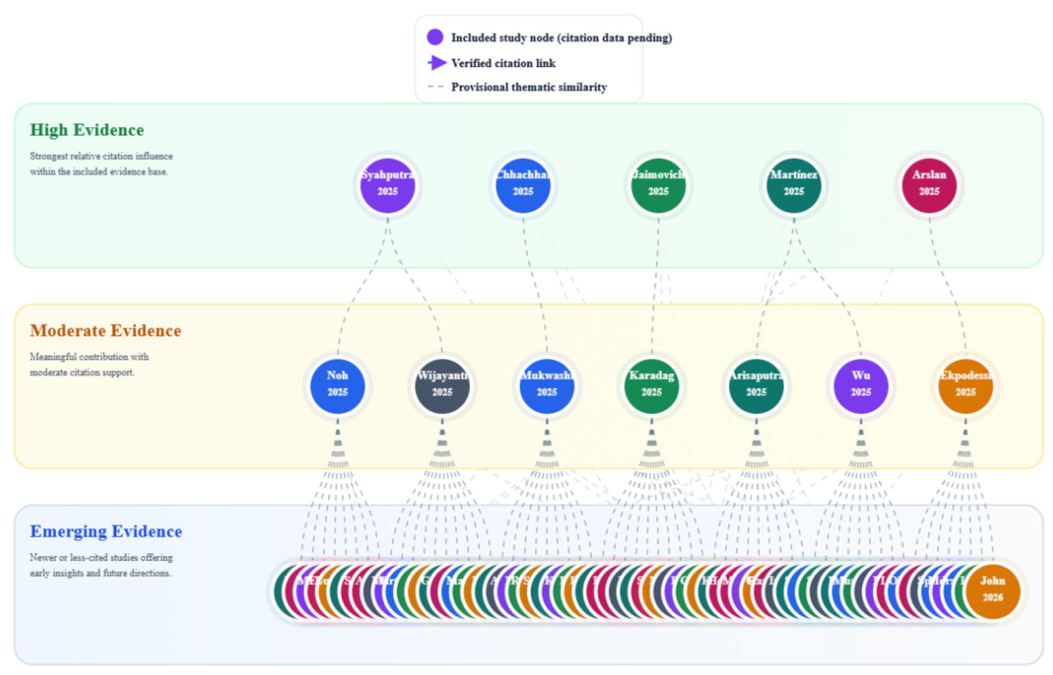
3.8.2. Influence Pyramid
The Influence Pyramid represents the distribution of scholarly influence within the included evidence base. It helps identify how bibliometric prominence is distributed across the reviewed studies. Influence is interpreted separately from methodological quality, which is assessed through critical appraisal.
Figure 4.
Influence Pyramid.Source: COSTAQDA PRISMA Workflow, navigation item 12: Bibliometric Intelligence — Influence Pyramid.
Figure 4.
Influence Pyramid.Source: COSTAQDA PRISMA Workflow, navigation item 12: Bibliometric Intelligence — Influence Pyramid.
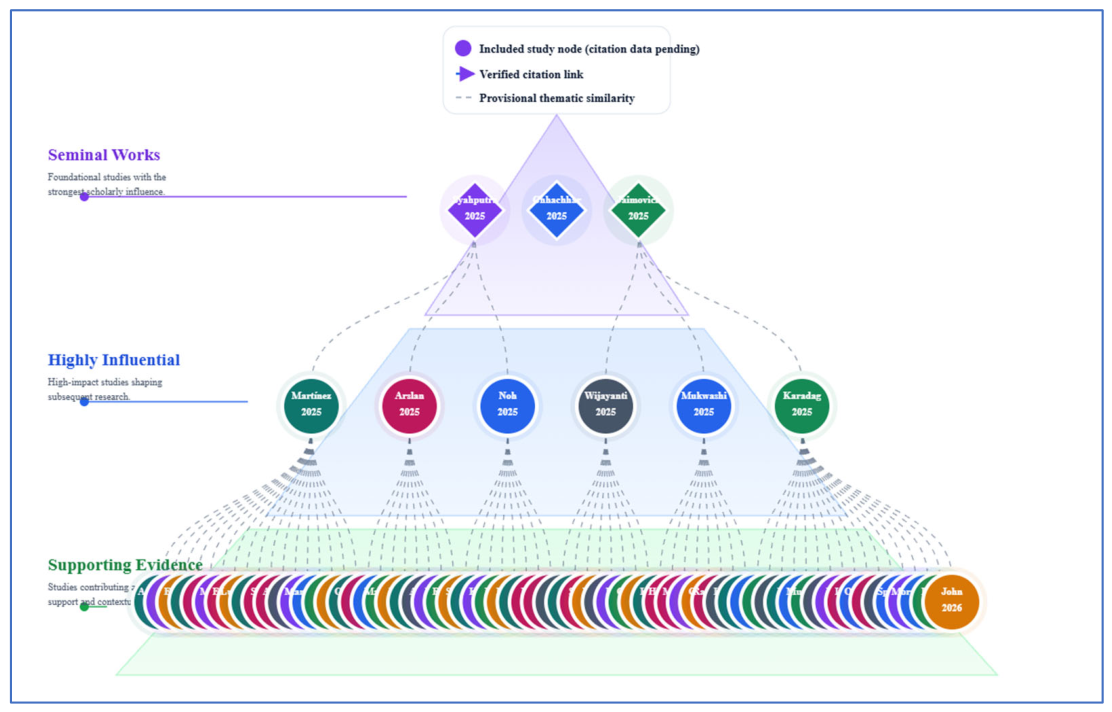
The Influence Pyramid represents bibliometric prominence and influence within the supplied evidence ecosystem, not methodological quality. OpenAlex identified 24 included works, 35 links, 22 clusters and 9 global citations. Its prominent or influential positioning was used only to contextualize the visibility and connectedness of studies, not to upgrade or downgrade CASP appraisal.
3.8.3. Evidence Strength
The Evidence Strength analysis examines the structure and strength of relationships within the evidence ecosystem assembled for the review. It complements, but does not replace, CASP methodological appraisal and must not be interpreted as a direct estimate of causal effect.
Figure 5.
Evidence Strength Network.Source: COSTAQDA PRISMA Workflow, navigation item 12: Bibliometric Intelligence — Evidence Strength Network.
Figure 5.
Evidence Strength Network.Source: COSTAQDA PRISMA Workflow, navigation item 12: Bibliometric Intelligence — Evidence Strength Network.
The Evidence Strength Network represents the structure and strength of relationships within the evidence ecosystem and does not replace critical appraisal. Its relationships were considered as contextual bibliometric intelligence alongside CASP, extracted evidence and convergence across studies. Methodological confidence therefore comes from triangulation rather than from network position, citation counts or influence scores alone.
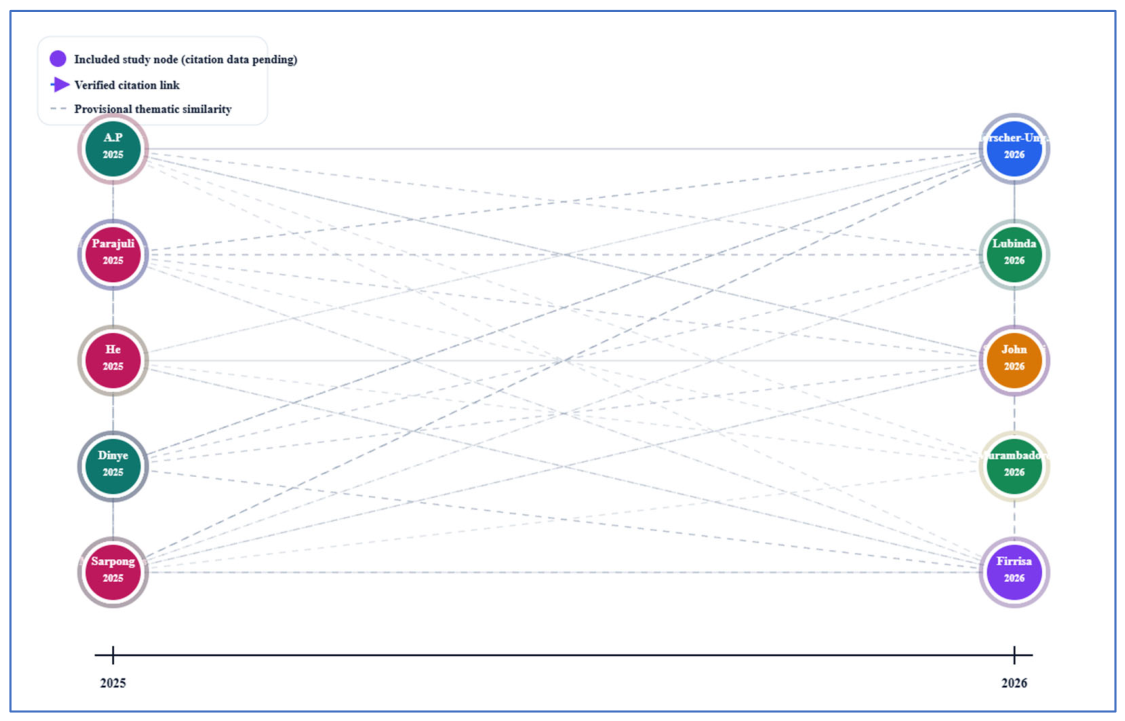
3.8.4. Knowledge Evolution
Knowledge Evolution examines the temporal and intellectual development of the included evidence base. It traces how research contributions develop over time and, where supported by the Step 12 data, how later studies extend, connect, challenge or consolidate earlier contributions.
Figure 6.
Knowledge Evolution.Source: COSTAQDA PRISMA Workflow, navigation item 12: Bibliometric Intelligence — Knowledge Evolution.
Figure 6.
Knowledge Evolution.Source: COSTAQDA PRISMA Workflow, navigation item 12: Bibliometric Intelligence — Knowledge Evolution.
3.8.5. Integrated Confidence in the Synthesised Evidence
Confidence was assessed narratively by triangulating transparent PRISMA selection, CASP methodological appraisal, convergence and divergence across extracted findings, and bibliometric intelligence. Confidence is therefore conditional: recurring patterns supported by multiple studies and compatible evidence were treated as more credible than isolated claims, while findings based on conceptual, legal, partial or secondary evidence were interpreted cautiously. Citation prominence alone was not used to establish confidence.
4. Findings
4.1. Search and Selection Results
The recorded workflow produced 24 included records from 480 identified records. Because the verified audit does not preserve the title and abstract decision rule, the four title or abstract exclusions cannot be characterized beyond the persisted count. The absence of full-text exclusions should not be interpreted as evidence that all included studies had comparable methodological strength.
4.2. Characteristics of Included Studies
The included evidence covered land reform, redistribution, restitution, customary recognition, titling and land administration across contexts including India, Indonesia, the Philippines, Chile, South Africa, Zimbabwe, Africa more broadly, Spain, North Korea and North Vietnam. The evidence base combined empirical and mixed-methods studies with normative legal analyses, historical comparisons, narrative or integrative reviews, commentaries and conceptual syntheses. This heterogeneity enabled cross-context analysis but limited direct comparison of outcomes.
The bibliometric workspace identified 22 thematic clusters among 24 included works, with 35 links and 9 global citations. These outputs indicate a connected but diverse evidence ecosystem; they do not establish substantive effect sizes or methodological quality.
4.3. Methodological Strengths and Limitations of Included Studies
The principal methodological strength was the availability of a persisted selection workflow, completed CASP appraisals for all 24 included studies and a traceable thematic synthesis of 128 findings from 19 studies. Important limitations were the absence of a recorded search execution date, source-level retrieval counts and formal data-extraction procedure; incomplete methodological reporting in several studies; inclusion of legal, conceptual and secondary-review designs; and uneven direct evidence on income, wealth, housing and food security. The synthesis limitations are therefore substantial and findings should be read as conditional cross-study patterns rather than uniform causal effects.
4.4. Thematic Synthesis
Thematic synthesis is a systematic qualitative evidence-synthesis method used to integrate findings across multiple studies while retaining a transparent connection to the underlying evidence. The process moves iteratively from extracted study findings to coding, the grouping of related codes into descriptive categories or themes, and the development of higher-order analytical themes that answer the review question and research objectives. Its purpose is not merely to count how often an idea appears, but to identify patterned meaning across studies, examine convergence and divergence, preserve contextual differences, and develop an auditable interpretation that remains traceable to the contributing evidence.
In this review, thematic synthesis was applied to the verified extracted findings retained in the active COSTAQDA project. Findings were compared across eligible studies, coded and grouped according to conceptual similarity, and then developed into 7 analytical themes represented across 16 evidence-contributing studies. The active synthesis retained 22 verified theme-to-study support assignments, allowing the analytical interpretation to remain traceable to the underlying studies rather than being reconstructed from titles or bibliographic prominence. The resulting analytical themes include “Land reform as distributive and reparative justice”, “Conditional socioeconomic and livelihood effects”, “Formal recognition and differentiated tenure security”, “Institutional and political enabling conditions”, with the widest cross-study support recorded for “Land reform as distributive and reparative justice” (4 contributing studies). Table 1 therefore operationalises the synthesis as an auditable evidence map linking each analytical theme to the studies that supplied verified supporting findings.
Table 1 presents the thematic synthesis matrix linking the verified analytical themes only to studies with verified extracted evidence supporting at least one of the themes displayed in the matrix. Any study with no verified supporting contribution to any displayed theme is excluded, even if it was included elsewhere in the systematic review or qualitative evidence base. Rows represent analytical themes and columns represent theme-contributing studies. A check mark (✓) indicates that at least one verified extracted finding from that study was assigned to the theme; an em dash (—) indicates that the study contributed evidence to the synthesis overall but no supporting extracted finding from that study was assigned to that particular theme. The absence of a supporting assignment must not be interpreted as contradictory evidence. The totals report the number of evidence-contributing studies providing verified support to each theme. The matrix therefore functions as an audit trail between thematic interpretation and the underlying finding-level evidence rather than as a measure of methodological quality or effect size.
The most widely supported analytical theme was "Land reform as distributive and reparative justice", with verified support from 4 of 16 studies. The least widely distributed theme was "Formal recognition and differentiated tenure security", with verified support from 2 of 16 studies. Differences in the number of supporting studies indicate the distribution of traceable thematic evidence across the included literature, not the relative importance or quality of a theme. Themes supported by fewer studies may still be analytically important when the underlying findings are conceptually rich, contextually distinctive or directly relevant to the review question. Conversely, wider study support indicates cross-study recurrence but does not by itself establish stronger methodological quality. The thematic patterns shown in Table 1 should therefore be interpreted alongside critical appraisal, contextual variation, contradictory findings where verified, and the detailed theme-led discussion that follows.
4.5. RO1: Land Reform as Distributive and Reparative Justice
Across India, Indonesia, South Africa and wider postcolonial settings, land reform was framed as a response to colonial, feudal, racial or elite-concentrated landholding and as a means of advancing social and economic justice (Chhachhar et al., 2025; Paradza & Zulch, 2026; Makapela & Chigbu, 2026; Arisaputra & Ashri, 2025). Constitutional and legal frameworks were described as capable of supporting distributive objectives, although the supplied evidence established the normative purpose of reform more clearly than consistent improvements in income, wealth or living conditions (Chhachhar et al., 2025; Syahputra et al., 2025).
4.6. RO1: Conditional Socioeconomic and Livelihood Effects
The synthesis found that land access may support autonomy, wellbeing, ecological sustainability, recovery and resilience, but benefits were conditional on secure tenure, water, infrastructure, inputs, services, viable plot sizes and recognition of local knowledge (Makapela & Chigbu, 2026; Zuma et al., 2026; Carmona & Simpson, 2026). Land transfer without changes in labour relations, livelihood support or epistemic authority could leave beneficiaries dependent on insecure work or subsistence-level production (Makapela & Chigbu, 2026). Evidence from South Africa and historical European cases similarly indicated that redistribution without coordinated water, infrastructure and productive support may remain nominal or fail to generate durable investment (Zuma et al., 2026; Carmona & Simpson, 2026).
4.7. RO1: Formal Recognition and Differentiated Tenure Security
Formal recognition did not necessarily produce comprehensive or equitable tenure security. In Kasepuhan Karang, recognition protected communal forest rights but covered only part of the proposed area, excluded productive cultivated land and restricted customary autonomy through conservation rules (Cahyono et al., 2026). The Indonesia PTSL case similarly described persistent agrarian inequality despite land registration, with most smallholders operating very small plots while incorporated enterprises controlled disproportionately larger areas (Sutarto et al., 2026). These findings show that legal certainty for selected parcels or owners can coexist with continuing structural inequality.
4.8. RO2: Institutional and Political Enabling Conditions
The main enabling conditions were coherent legal frameworks, capable and coordinated institutions, transparent land information, conflict-resolution mechanisms, local administrative capacity and protection against elite capture. Comparative evidence showed that Indonesian reform was terminated by political transformation, whereas the Philippine program endured but was diluted by compromises protecting agrarian elites (Aini et al., 2026). Indonesian studies additionally identified overlapping claims, unequal access to information, bureaucratic procedures, weak coordination and inadequate conflict resolution as barriers to effective redistribution (Hermawan & Suhadi, 2026; Wijayanti et al., 2025).
4.9. RO2: Participation, Inclusion and Accountability as Enabling Conditions
Participation, accessible information, gender inclusion, local coordination, monitoring, accountability and free, prior and informed consent were repeatedly identified as conditions for fairer implementation (Cahyono et al., 2026; Wijayanti et al., 2025; Mukwashi, 2025). The evidence emphasized that women, tenant farmers, displaced households and other non-elite groups can be excluded unless inclusion is deliberately designed into recognition, redistribution and resettlement. In the Kasepuhan case, a women's cooperative represented a locally initiated response, but the same study documented continuing exclusion of non-elite women from agrarian resources (Cahyono et al., 2026).
4.10. RO3: Political Power, Elite Capture and Implementation Barriers
Redistributive ambition was constrained by political destabilization, elite accommodation, weak state capacity, fragmented regulation, insufficient resources and limited administrative authority. African cases described difficulties in enforcing equal access through cooperatives, investing in irrigation and support facilities, setting realistic production goals and preventing local elites from capturing reform mechanisms (Karadag et al., 2025). South African analyses similarly identified bureaucratic inefficiency, corruption, inadequate post-settlement support and elite capture as persistent barriers (Paradza & Zulch, 2026; Author not available, 2026; Khumalo, 2026).
4.11. RO3: Conflict, Displacement and Livelihood Disruption
Poorly implemented reform, counter-reform, conservation restrictions and resettlement could intensify insecurity and conflict. In Chile, former expropriated plots were reported to be more likely to experience attacks and property destruction, although the study cautioned that the instrumental-variable strategy had weaknesses and that effects reflected the joint history of reform and counter-reform (Jaimovich & Toledo-Concha, 2025). In Zimbabwe, displacement associated with Tokwe-Mukosi was linked to deteriorating housing, disrupted livelihoods, food insecurity, reduced income opportunities and weakened community influence (Mukwashi, 2025). Conservation restrictions in Indonesia similarly reduced access to food, firewood and productive resources and disproportionately affected women (Cahyono et al., 2026).
5. Discussion
The review addressed RO1 by showing that land policies can create the legal and institutional basis for justice but do not reliably produce improved socioeconomic outcomes without complementary conditions. The convergence across South African, Indonesian, African and historical European evidence suggests that land alone is rarely a sufficient livelihood intervention (Makapela & Chigbu, 2026; Zuma et al., 2026; Carmona & Simpson, 2026). The evidence does not support a uniform conclusion that redistribution increases income, wealth or food security; those outcomes were directly and unevenly documented.
For RO2, the synthesis identifies enabling conditions that connect policy entitlement to lived benefit: coherent regulation, capable local institutions, transparent information, water and infrastructure, agricultural and livelihood support, participation and accountability. These conditions explain why similar policy instruments can have divergent results. The contrast between political termination in Indonesia and elite-protective endurance in the Philippines demonstrates that durability alone is not equivalent to substantive redistribution (Aini et al., 2026).
For RO3, the review shows that risks arise when reform is exclusionary, coercive, poorly planned or disconnected from local conditions. Conflict in Chile, displacement in Zimbabwe and livelihood restrictions in Indonesia illustrate different harm pathways (Jaimovich & Toledo-Concha, 2025; Mukwashi, 2025; Cahyono et al., 2026). These cases should not be generalized into a claim that land reform inherently causes harm; rather, they show how unresolved claims, counter-reform, conservation regimes, weak planning and limited participation can transform reform into renewed insecurity.
The contribution of this synthesis is therefore interpretive rather than an estimate of a common effect size. It links justice aims, institutional design, differentiated tenure security and livelihood conditions in a single explanation. Confidence remains constrained by the mixture of empirical studies, legal analyses, reviews, commentaries and partial excerpts; by the absence of a recorded extraction procedure; and by the limited direct measurement of specified socioeconomic outcomes. CASP appraisal and bibliometric intelligence support transparent interpretation but do not eliminate these limitations.
6. Conclusions
Land policies among historically disadvantaged populations are best understood as conditional instruments of justice rather than automatic mechanisms of poverty reduction or tenure security. They can support redistribution, autonomy, resilience and social equity when they provide substantive and inclusive rights, operate through capable and accountable institutions, and are combined with water, infrastructure, services, livelihood support and meaningful participation. Where recognition is partial, redistribution is captured or implementation is coercive and poorly planned, policies may reproduce inequality, displacement, food insecurity or conflict. The review therefore answers RO1, RO2 and RO3 by identifying potentially beneficial but highly contingent effects, the institutional and participatory conditions that enable them, and the political, ethical and implementation barriers that limit them.
7. Recommendations
Practice recommendations should prioritize integrated implementation packages that connect land access with secure tenure, water, infrastructure, agricultural inputs, livelihood rebuilding, conflict resolution and recognition of Indigenous and local knowledge. Implementers should include affected communities from the design stage, apply free, prior and informed consent where relevant, disaggregate participation and outcomes by gender and social position, and monitor whether formal rights translate into productive and livelihood access.
Policy recommendations should harmonize land and related regulations, strengthen local coordination and administrative capacity, improve transparent land information and registration systems, establish accessible dispute-resolution mechanisms, and protect against elite capture. Recognition and titling policies should assess cultivated, communal, gendered and customary rights rather than treating certification of selected parcels as sufficient evidence of tenure security.
Future research should use longitudinal and mixed-methods designs to measure income, wealth accumulation, housing stability, food security, livelihood security and tenure security before and after policy implementation. Studies should report participant selection, implementation duration, comparison conditions, gender and group differences, direct community experiences and methodological quality in sufficient detail to support stronger causal and comparative inference.
Funding
No funding.
Conflicts of Interest
No conflicting interests.
AI-Assisted Technology and COSTAQDA Declaration: COSTAQDA was used as an AI-assisted evidence-synthesis and manuscript-development environment. AI-assisted functions supported the organisation, synthesis and presentation of verified project evidence and manuscript preparation within the documented COSTAQDA workflow. AI did not replace researcher responsibility for study selection, eligibility decisions, critical appraisal, verification of extracted evidence, interpretation of findings or final scholarly judgement. The human authors reviewed and approved the final manuscript and remain responsible for its accuracy, integrity, interpretations, citations and conclusions.
References
- 'Aini, L. E.; Ali, H. H.; Nuriansyah, J. S.; Majah, M. I.; Akila, R. G.; Irawan, R.; Kurniawan, V. A. State Power and Agrarian Reform in Southeast Asia: Comparing Indonesia (1960–1965) and The Philippines (1988–2009). F1000Research 2026. [Google Scholar] [CrossRef]
- Arisaputra, M. I.; Ashri, A. M. Agrarian reform as a human rights imperative: Bridging inequality and justice in land distribution; MASALAH-MASALAH HUKUM, 2025. [Google Scholar] [CrossRef]
- Arslan, Y. The land reform of the Gracchi Brothers: A struggle for social justice. İçtimaiyat 2025. [Google Scholar] [CrossRef]
- Cahyono, E.; Satria, A.; Soetarto, E.; Adiwibowo, S.; Suhardjito, D. Beyond state recognition of customary forests: Initiating agrarian reform in Indigenous Peoples. Jurnal Pemikiran Sosiologi 2026. [Google Scholar] [CrossRef]
- Carmona, J.; Simpson, J. The economic viability of land redistribution. Revista Portuguesa de História 2026. [Google Scholar] [CrossRef]
- Chhachhar, V.; Niravita, A.; Verma, K.; Sankrit, S. Agrarian reforms vis-à-vis constitutionalism in India: A comparative analysis with Indonesia. Journal of Indonesian Legal Studies 2025. [Google Scholar] [CrossRef]
- Grant, M. J.; Booth, A. A typology of reviews: An analysis of 14 review types and associated methodologies. Health Information & Libraries Journal 2009, 26(2), 91–108. [Google Scholar] [CrossRef]
- Hermawan, A. S.; Suhadi, S. Land Redistribution of Accretion Land within Indonesia’s Agrarian Reform Framework; JURNAL USM LAW REVIEW, 2026. [Google Scholar] [CrossRef]
- Jaimovich, D.; Toledo-Concha, F. The grievances of a failed reform: Chilean land reform and conflict with Indigenous communities. SSRN Electronic Journal 2025. [Google Scholar] [CrossRef]
- Karadag, R.; Penteado, S. K. D. C.; Thyen, K.; Wolkenhauer, A. Decolonisation, socialism, and development: The fate of land reform in Africa; Global Dynamics of Social Policy, 2025. [Google Scholar] [CrossRef]
- Khumalo, S. S. The mediating role of Corporate Social Responsibility (CSR) in enhancing land reform policies in South Africa; Durban University of Technology, 2026. [Google Scholar] [CrossRef]
- Makapela, S. L.; Chigbu, B. I. Land reform, knowledge systems, and the reconfiguration of work and livelihoods in Southern Africa. Frontiers in Sustainable Resource Management 2026. [Google Scholar] [CrossRef]
- Mfolo, L.; Costa, K. Qualitative Evidence Synthesis Using COSTAQDA; 2024. [Google Scholar]
- Mukwashi, T. Rural-to-rural displacement and the socioeconomic fallout of land redistribution and disaster risk reduction: Lessons from Tokwe-Mukosi. The Review of Rural Resilience Praxis 2025. [Google Scholar] [CrossRef]
- Noh, H. J. A comparative study on land reform in North Korea and North Vietnam: The impact of colonial legacy and state capacity. The Korean Journal of International Studies 2025. [Google Scholar] [CrossRef]
- Page, M. J.; McKenzie, J. E.; Bossuyt, P. M.; Boutron, I.; Hoffmann, T. C.; Mulrow, C. D.; et al. The PRISMA 2020 statement: an updated guideline for reporting systematic reviews. BMJ 2021, 372, n71. [Google Scholar] [CrossRef]
- Paradza, P.; Zulch, B. G. Over three decades of land distribution in South Africa: A review of progress, challenges and prospects. Frontiers in Sustainable Food Systems 2026. [Google Scholar] [CrossRef]
- Ramaprabha, N.; Balamurugan, J. What do tribes reveal about ecotourism, land, and livelihoods? A scoping review. Frontiers in Ecology and Evolution 2026. [Google Scholar] [CrossRef]
- Rights and Resources Initiative. Sustaining resilient pathways: A thematic analysis of funding to secure collective tenure rights. Rights and Resources Initiative 2026. [Google Scholar] [CrossRef]
- Suriani, R.; Indriasari, E.; Putri, V. R.; Judijanto, L. Agrarian reform as a solution to overcome land mafia in the Indonesian agrarian legal system. Jurnal Akta 2026. [Google Scholar] [CrossRef]
- Sutarto, A. H.; Harianto; Sumarwan, U.; Asnawi, Y. H. From tenure security to inequality reproduction: Reassessing Indonesia's PTSL program through a structural poverty lens. Sodality Jurnal Sosiologi Pedesaan 2026. [Google Scholar] [CrossRef]
- Syahputra, R. D.; Misranto, M.; Sunardi, S. Implications of asset structuring and access on land tenure in realizing agrarian reform. Eduvest - Journal of Universal Studies 2025. [Google Scholar] [CrossRef]
- Wijayanti, D. S. S.; Koeswahyono, I.; Andreassari, L. D. Effectiveness of land redistribution policy in agrarian reform program: Implementation analysis and solutions to land reform land registration obstacles. Legal Horizons 2025. [Google Scholar] [CrossRef]
- Wu, J. Supplement to related research; Understanding China, 2025. [Google Scholar] [CrossRef]
- Zhou, S.; Landa, N. Discourses of land reform legitimation and electioneering in Southern Africa. Frontiers in Sustainable Resource Management 2026. [Google Scholar] [CrossRef]
- Zuma, N. P.; Zantsi, S.; Slayi, M. Water rights and land reform in South Africa: policy intentions and lived outcomes. Frontiers in Sustainable Food Systems 2026. [Google Scholar] [CrossRef]

Table 1.
Thematic Synthesis Matrix.
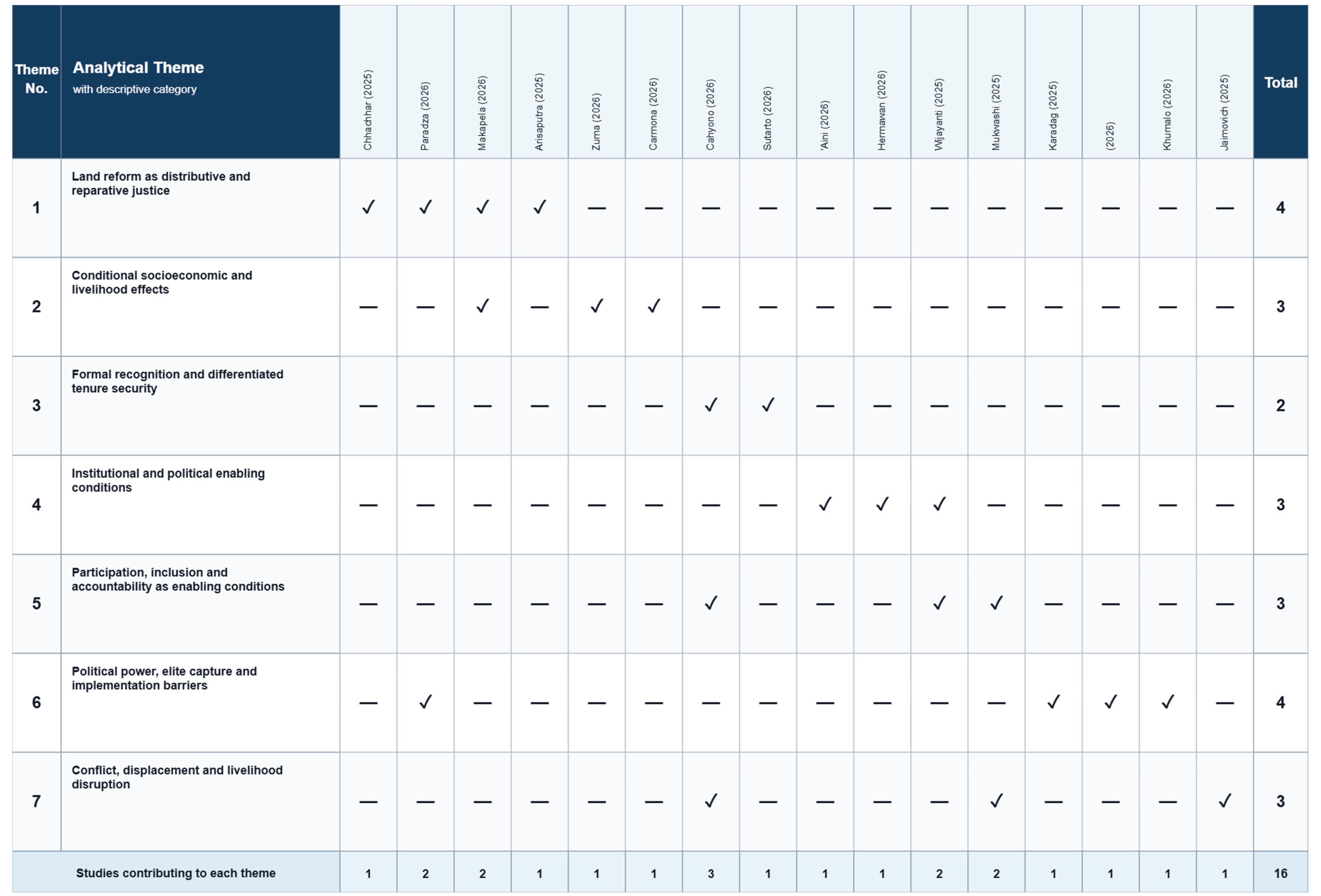 |
Table 1 legend: Only studies contributing verified extracted qualitative evidence are displayed. ✓ = verified extracted evidence from the study supports the theme; — = the study contributed to the synthesis but no supporting extracted finding from that study was assigned to this theme. An em dash does not indicate contradictory evidence.
Disclaimer/Publisher’s Note: The statements, opinions and data contained in all publications are solely those of the individual author(s) and contributor(s) and not of MDPI and/or the editor(s). MDPI and/or the editor(s) disclaim responsibility for any injury to people or property resulting from any ideas, methods, instructions or products referred to in the content. |
© 2026 by the authors. Licensee MDPI, Basel, Switzerland. This article is an open access article distributed under the terms and conditions of the Creative Commons Attribution (CC BY) license.
Copyright: This open access article is published under a Creative Commons CC BY 4.0 license, which permit the free download, distribution, and reuse, provided that the author and preprint are cited in any reuse.