

Submitted:
11 October 2026
Posted:
13 October 2026
You are already at the latest version
Abstract
Purpose–Public infrastructure procurement in Ghana continues to grapple with persistent inefficiencies and weak enforcement of existing accountability framework despite the existence of the Public Procurement Act and related legal instruments. As a result, this study examines the key barriers and enablers of Value for Money (VfM) in the procurement of sustainable public infrastructure and proposes key practices for achieving VfM within the emerging regulatory landscape shaped by the Value For Money Office Act, 2026 (Act 1172). Design/methodology/approach-The study further adopted a quantitative research method by utilising survey questionnaires to collect 100 responses. The collected data were analysed using descriptive and inferential statistics. Findings and value–The findings indicate that achieving VfM in sustainable public infrastructure procurement in Ghana depends on interconnected managerial, institutional, and sustainability factors. Key barriers identified include ineffective use of VfM tools, poor contract management, corruption, inadequate risk management, weak stakeholder engagement, limited competition, political interference, and poor data management. Major enablers also include ethical and sustainable procurement, strategic planning, effective competition, performance management, technology adoption, and effective stakeholder engagement. Finally, key VfM practices identified include ethical sourcing, cost-benefit analysis, life-cycle assessment, environmental considerations, capacity building, and stakeholder engagement across procurement processes. Practical implications – In practice, the findings provide a roadmap for developing more effective and sustainable procurement policies and strategies for the quantity surveyor and procurement professional in infrastructure delivery. Originality–This study provides an integrated Ghana-specific empirical account of how barriers, enablers and sustainability-oriented VfM practices interact in public infrastructure procurement, offering evidence directly relevant to emerging VfM governance reforms. Conclusion – The study recommended strengthening training and capacity building for quantity surveyors and procurement professionals on technology adoption, ethical, and sustainable procurement practices for accountable, transparent, value-driven public infrastructure delivery.
Keywords:
value for money
; sustainable procurement
; public infrastructure
; stakeholder engagement
; VfM practices
1. Introduction
Public infrastructure procurement represents one of the most important mechanisms through which governments translate public expenditure into economic development and essential infrastructure. It is a fundamental element of any nation's development, encompassing the construction of critical infrastructure and services that impact the lives and well-being of its citizens. In Ghana, as in many developing countries, the efficient allocation and utilisation of resources within the public infrastructure procurement sector are significant for fostering sustainable development. This allocation and utilisation must not only yield the intended benefits but also be achieved in a manner that ensures the highest possible value for the investments made. Increasing pressure on public finances combined with growing sustainability expectations, has expanded the meaning of value for money (VfM) beyond acquisition price to include efficiency, effectiveness, quality, accountability and long-term performance. Sustainable public procurement similarly requires public organisations to meet their needs in a manner that achieves value for money across the life cycle while generating economic and social benefits and reducing adverse environmental impacts. This broader understanding is consistent with Sustainable Development Goal 12.7, which calls for the promotion of sustainable public procurement practices in accordance with national policies and priorities.
The relationship between VfM and sustainability is particularly important in public infrastructure procurement because decisions made during planning, design, tendering and contractor selection can create financial, environmental and social consequences that extend throughout an asset's life cycle. A procurement approach dominated by the lowest tender price may create an appearance of immediate savings while overlooking maintenance requirements, operating costs, durability, resource efficiency, environmental externalities and eventual replacement costs. Conversely, incorporating sustainability does not automatically constitute value for money where additional expenditure cannot be justified by measurable whole-life benefits. The fundamental challenge is therefore not to choose between VfM and sustainability, but to establish procurement practices that integrate cost, quality, performance and sustainability considerations in determining the overall value generated from public expenditure.
This challenge is highly relevant to Ghana. In Ghana, public procurement is governed principally by the Public Procurement Act, 2003 (Act 663) as amended, which establishes the institutional and procedural framework for public procurement. Nevertheless, achieving VfM in infrastructure procurement has remained problematic. Previous studies in Ghana have identified institutional and policy constraints, weaknesses in accountability and transparency, technical and decision-making deficiencies, and human-related limitations as important impediments to achieving VfM. For instance, Osei-Tutu et al. (2010) identified that corruption practices in public procurement pose significant challenges to achieving VfM in Ghana. More recent evidence also identifies organisational commitment, market conditions, and policy and regulatory constraints as significant barriers to green construction procurement in Ghana. These persistent challenges have gained renewed institutional significance following the enactment of the Value for Money Office Act, 2026 (Act 1172). Assented to on 11 May 2026, the Act establishes the Value for Money Office with responsibility for regulating, monitoring, coordinating and conducting VfM assessments, reviewing procurement practices, costestimation methodologies, contract-management processes and expenditure-control mechanisms, and promoting efficiency in public expenditure. The reform reflects concern that weaknesses in project appraisal and expenditure oversight have contributed to problems such as inflated contracts, cost overruns, project delays and abandoned projects. The Act 1172 therefore is to enhance efficiency, transparency and accountability in the management of public expenditure and procurement.
Despite these developments, important knowledge gaps remain. Existing Ghanaian studies have largely examined VfM shortcomings and sustainable procurement as separate research domains. Sustainable procurement research has predominantly focused on implementation barriers of specific procurement stages. However, VfM studies have concentrated principally on cost, project performance and institutional deficiencies (Atanga et al., 2026a). Consequently, limited empirical evidence explains how VfM and sustainability can be operationally integrated in public infrastructure procurement, particularly through practices that simultaneously strengthen accountability, transparency, whole-life value and sustainable outcomes. Furthermore, the enactment of Act 1172 creates a new regulatory framework environment, yet there remains limited empirical understanding of the barriers, enabling conditions, and practical procurement strategies required to translate the broader VfM mandate into sustainable infrastructure delivery.
Against this backdrop, this study aims to examine VfM practices in sustainable public infrastructure procurement in Ghana. Specifically, it investigates the key barriers constraining VfM, identifies the principal enablers that can strengthen its achievement, and determines practical strategies for integrating VfM and sustainability within the emerging regulatory landscape. In doing so, the study seeks to provide an evidence-based basis for quantity surveyors, procurement professionals, public institutions and policymakers to strengthen procurement decision-making and support the delivery of more accountable, transparent, sustainable and value-driven public infrastructure in Ghana.
2. Literature Review
2.1. Value for Money Practices in Sustainable Public Infrastructure Procurement
The application of VfM in sustainable public infrastructure procurement extends the conventional focus on economy, efficiency and effectiveness by incorporating the environmental, social and longterm economic consequences of procurement decisions. Sustainable procurement therefore requires public organisations to evaluate infrastructure not only according to its initial acquisition cost, but also according to the value generated throughout the procurement and asset life cycle. Montalbán-Domingo et al. (2020) argue that integrating economic, environmental and social considerations into procurement can improve the effectiveness of public infrastructure delivery, while Walker et al. (2009) emphasise that such considerations should extend from project planning and design through contract management to post-project evaluation.
From this perspective, achieving VfM requires procurement decisions to reconcile potentially competing dimensions of value. Environmentally, procurement decisions should incorporate environmental considerations into procurement policies and procedures to minimise resource consumption and adverse ecological impacts (Atanga et al., 2026b; Eskandarpour et al., 2015). Additionally, social VfM practices include incorporating social criteria in tender documents, engaging with stakeholders, conducting social impact assessments, encouraging diversity, and responsible supply-chain practices (Stoffel et al., 2019). Economically, VfM requires attention to maintenance, operation, and alternative cost analysis of infrastructure delivery, so that decisions reflect long-term rather than merely upfront affordability. Ethical and transparent contractor/supplier selection further strengthens this relationship by aligning procurement decisions with wider sustainability objectives (SoustVerdaguer et al., 2017).
Consequently, sustainable VfM must be operationalised through specific procurement practices. These include life-cycle costing, cost-benefit analysis, competitive tendering, value engineering, contractor performance monitoring and continuous procurement improvement. These economic practices should operate alongside environmental criteria in tender specifications, life-cycle assessment and sustainability performance monitoring, as well as social criteria, stakeholder engagement, ethical sourcing, human-rights due diligence and capacity building (Atanga et al., 2026b). Thus, VfM in sustainable public infrastructure procurement is best understood as the optimisation of whole-life economic, environmental and social value while maintaining accountability, transparency and procurement performance.
2.2. Barriers to achieving VfM in Sustainable Public Infrastructure Procurement
Several barriers can prevent organisations from achieving effective value for money in procurement management. At the institutional and procedural level, Abidin and Pasquire (2005) identified the absence of formal guidelines for the effective use of some VfM tools as a barrier. Inflexible procurement processes can also limit the ability of procurement professionals to adapt to changing circumstances and take advantage of new opportunities (Knutsson and Thomasson, 2017). These constraints can be compounded where procurement methods restrict competition and limit the number of potential suppliers or contractors. According to Aghimien et al. (2018), such restrictions reduce the chances of obtaining competitive tendering, meaning that projects may not benefit from the best prices, quality or innovation available in the market.
Alongside these procedural and market constraints, governance-related barriers can further undermine VfM. Panya and Awuor (2023) found that without transparency, it can be difficult to ensure that procurement decisions are made objectively and fairly. This can lead to suspicions of corruption or favouritism, which can undermine confidence in the procurement process and make it difficult to achieve VfM. Simaya and Maro (2018) similarly identified political interference as a key barrier, as it can undermine the ability of quantity surveyors and procurement professionals to make decisions based on value for money. Corruption and fraud can further distort procurement processes by awarding contracts to tenderers who do not offer the best value, resulting in increased costs and reduced quality (Okolie and Nnamani, 2017). These governance weaknesses are reinforced by deficiencies in information and organisational capacity. Helby-Petersen (2019) identified a lack of data for VfM assessment as a barrier, while Barnett et al. (2010) indicated that inadequate data can make VfM analysis highly subjective. Poor data management can therefore make it difficult to access the information required to assess VfM and identify areas for improvement. Similarly, organisations that lack the necessary procurement skills, knowledge and tools may struggle to make effective procurement decisions (Olatunji et al., 2017). In procurement, lack of collaboration between procurement professionals, tenderers, and other stakeholders can further constrain opportunities for improvement (Rathenam and Dabup, 2017), while ineffective stakeholder engagement may prevent procurement decisions from reflecting the needs and priorities of affected groups (Barton et al., 2019).
These barriers ultimately extend into contracting and post contract implementation and performance control. Odundo (2016) revealed that inadequate monitoring and evaluation makes it difficult to determine whether procurement decisions are achieving value for money. Poor contract management can result in cost overruns, delays, and poor quality, all of which undermine VfM (Ikechukwu et al., 2017). Likewise, ineffective performance measurement and risk management limit the ability to identify areas for improvement, while poor contractor/consultant performance can result in delays, quality problems and increased costs (Zhou et al., 2022). Thus, barriers to VfM operate across the procurement process, from institutional arrangements and market competition to governance, information, stakeholder coordination and post-award performance management. The Value for Money Bill, 2026 identifies lack of statutory framework as barrier to achieving VfM at preaward, post-award and post completion stages of infrastructure delivery, leading to ineffective use of VfM tools.
2.3. Enablers to Achieving VfM in Sustainable Public Infrastructure Procurement
Enablers of VfM in procurement management are factors that can help organisations achieve better outcomes and overcome barriers to achieving VfM (Dethine et al., 2020). At the strategic level, clear procurement strategies help organisations align their procurement activities with their overall goals and objectives, while effective competition ensures that contractors are competing on a level playing field, leading to better prices and quality. These strategic conditions are supported by efficient procurement processes, which streamline the procurement cycle, reduce delays and inefficiencies, and help ensure that infrastructure is delivered on time and to the required quality standards (Changalima et al., 2022). Achieving these outcomes further depends on the capability of procurement professionals. According to Hawkins et al. (2014), skilled procurement professionals have the knowledge and expertise to make informed decisions and negotiate favourable contracts. This therefore calls for robust performance management, which allows organisations to monitor and evaluate supplier performance and identify areas for improvement. Effective risk management similarly helps organisations identify and mitigate potential risks in the procurement process.
These professional and managerial capabilities can be reinforced through technology, contract management and data use. The use of technology, such as e-procurement systems, can improve transparency, efficiency and accuracy in procurement. In addition, robust contract management ensures that contracts are effectively managed throughout their lifecycle, reducing the risk of disputes and non-compliance (Ibrahim et al., 2017), while data analytics allows organisations to analyse procurement data and identify trends and opportunities for improvement (Marinelli and Antoniou, 2019). Beyond internal procurement controls, stakeholder engagement ensures that the needs and expectations of all stakeholders are considered in the procurement process. Ethical and sustainable procurement practices also promote social and environmental responsibility and can help deliver better value for money over the long term by mitigating risks such as reputational damage and supply chain disruptions. Finally, collaboration and knowledge sharing enable organisations to learn from each other, share best practices, and drive continuous improvement in procurement activities. These enablers help organisations optimise procurement processes, minimize risks, and achieve better outcomes for stakeholders. Figure 1 illustrates how VfM enablers support sustainable procurement practices, while identified barriers constrain their implementation. Together, these relationships influence economic, environmental, social, accountability, transparency, and long-term public infrastructure outcomes.
The Act 1172 identifies aids for conducting VfM assessment, including the establishment of VfM Unit at public institutions, power and scope of VfM money assessment, setting down monetary thresholds for public infrastructure delivery and procurements, requirement for VfM certificate of clearance, capacity building and technical assistance supports, and sanctions and penalties for non-compliance through statutory framework as enablers to achieving VfM.
3. Methodology
3.1. Research Design and Philosophical Position
This study adopted an exploratory research design. An exploratory design provides the researcher with a higher level of understanding of the subject matter and allows relevant issues surrounding the phenomenon to be identified and examined (Fowler, 2013). In this study, the exploratory design was considered appropriate because the research sought to examine VfM practices in sustainable public infrastructure procurement and identifies the barriers and enablers influencing their achievement. The study further adopted an objectivist ontology and positivist epistemological position. The rationale for this choice lies in the fact that the study investigates the tangible and factual aspects of VfM practices in sustainable public infrastructure procurement without the researcher’s influence on the issues. Hence, the positivist position was appropriate because the issues being examined were treated as objective and measurable rather than being dependent on the researcher’s ideas or constructions.
3.2. Research Approach and Strategy
For this study, the deductive research strategy was chosen as it functions by shifting viewpoints from broad to specialised and generating conclusions based on data (Burney, 2008). The study further employed a quantitative research approach to collect data so that information can be quantified and subjected to statistical treatment to support or refute “alternative knowledge claims” (Creswell, 2003, p. 153). Quantitative research utilises questionnaires and surveys and collects data that is reviewed, tabulated, and statistically analysed to determine its characteristics. In quantitative research, research instruments rather than human judgement or sentiments are used to collect the majority of the objective measures (Borrego et al., 2009).
Based on the objectives and research questions of this research, the survey research strategy was adopted. Survey research is especially useful when a researcher aims to describe or explain the features of a large group or groups. The research survey is suited for research questions of the type who, what, where, how many, and how much (Yin, 2012).
3.3. Population and Sampling
Given the specific objectives of the study, suitable participants included procurement professionals and experts in Ghana, including procurement managers, project managers, quantity surveyors, construction managers, contract managers, and environmental managers. The study, in order to increase its generalisability in Ghana, was not limited to any particular cities or regions in the country, and respondents selected hailed from various areas of the country. Ghana was selected as several new construction and infrastructure projects are routinely undertaken by both the government and private sectors (Ahadzie, 2007).
Convenience and purposive sampling were used to obtain the sample. According to Naoum (2012), one’s judgement will be the main deciding element in identifying the person who can provide the most information to achieve research objectives. After determining the sampling frame for this study, Cochran’s (1977) formula was employed to calculate the sample size. For this study, the target population, that is, procurement professionals and experts in Ghana, is large, and exact numbers are typically not known. Thus, this formula is suitable for generalizing findings for large heterogeneous populations (Cochran, 1968, p.75). The formula is shown below:
N0 =
Where;
Z = Z-score for the confidence level p = Estimated proportion (use 0.5 for maximum variability) e = Margin of error (use 0.1 for maximum variability)
Table 1 presents the required sample sizes at different confidence levels (90%, 95% and 99%) and error margins (e = 0.03, 0.05, and 0.1), based on Cochran's (1977) sample size formula.
In this research, the confidence level was set to 99%, where Z = 2.576, p = 0.5, and e = 0.1, which gives a sample size of 166.
3.4. Data Collection
Following the selection of the sample, the present study used primary and secondary data sources. Primary data for the study were obtained through questionnaires to get information directly from respondents. The study, being a deductive study, also made use of data obtained from secondary sources such as published research papers, institutional documents, online portals, and repositories that provide a rich source of information on the research topic. The questionnaire was divided into two sections. The demographic profile of respondents was the focus of Section I of the instrument. This was required to verify that respondents were eligible to participate in the survey. Section II covered questions on the objectives of the study. Respondents were asked to rank the variables on a Likert scale of 1 to 5.
3.5. Data Processing and Analysis
Following data collection, Statistical Package for the Social Sciences Windows Version 27 was used to input the data gathered from the surveys. Descriptive statistics, including mean, standard deviation, frequency distribution, mean score ranking, Relative Importance Index (RII), and Normalisation Value (NV) technique, were used to analyse the data. Inferential statistics, including correlation analysis, Kendall concordance analysis, one-sample t-test, and principal component factor analysis, were used to analyse the study’s objectives. Frequency tables were further utilised to analyse respondents’ demographic information. Cronbach’s Alpha Coefficient was used to check the internal consistency of the variables.
3.6. Reliability and Validity Test
Reliability was assessed using Cronbach’s Alpha to determine the internal consistency of the measurement items under each study construct. The analysis was conducted separately for barriers, enablers, and VfM practices. Table 2 presents the number of items and corresponding Cronbach’s Alpha coefficients for each study construct.
The reliability test confirmed a high level of internal consistency across all study constructs.
Cronbach’s Alpha values were 0.931 for barriers, 0.896 for enablers, and 0.918 for VfM practices. Since all coefficients exceeded the commonly accepted threshold of 0.70, the measurement items were considered highly reliable and suitable for further statistical analysis.
4. Analysis of Data
This section analyses and interprets the empirical data collected from the respondents in relation to the study objectives. The analysis employed both descriptive and inferential statistical techniques to systematically interpret the study findings. Relative Importance Index (RII), mean score ranking, and principal component analysis (PCA) were complemented by Cronbach’s Alpha, Pearson correlation, Kruskal–Wallis, and Kendall’s coefficient of concordance (W) to assess the reliability, relationships, rankings, and respondent agreement. Out of the total 166 questionnaires that were distributed, 100 valid responses were obtained for analysis, with a response rate of 60.24%. This rate exceeds the average response rates reported for organisational and management-based survey research (Holtom et al., 2022). Therefore, this response rate was deemed adequate and reliable for analysing VfM practices in sustainable procurement.
4.1. Demographic Characteristics of Respondents
The demographic characteristics of the respondents provide insights into the composition of the study participants and instil trust in the accuracy and reliability of the gathered data. The analysis considered the respondents’ age, academic qualification, position in their organisations, and working experience as presented in Table 3.
The demographic profile has important implications for the credibility and interpretive strength of the study. The strong representation of Procurement Managers (31%), Quantity Surveyors (30%) and Contract Managers (24%) indicates that the findings are largely informed by professionals directly involved in procurement decision-making, contract administration, and project delivery. The experience profile further strengthens the study, with the largest proportion of respondents having 11–15 years of experience, followed by those with 5–10 years. This suggests that the responses reflect views from professionals with substantial exposure to procurement and construction practice, while still incorporating perspectives across different career stages. Educationally, the dominance of bachelor’s degree holders, together with respondents holding HND, Master’s and Doctoral qualifications, indicates an adequate academic and professional foundation for engaging with the technical, managerial and sustainability dimensions of VfM. Overall, the profile supports the reliability, contextual relevance and practical applicability of the study findings.
4.2. Barriers to Achieving VfM in Sustainable Public Infrastructure Procurement
The barriers to achieving VfM in sustainable public infrastructure procurement were examined using principal component analysis (PCA) to identify the underlying dimensions among the 20 barrier variables. The suitability of the data for PCA was confirmed by the Kaiser–Meyer–Olkin (KMO) measure and Bartlett’s test of sphericity, as indicated in Table 4.
The KMO value exceeded the recommended threshold of 0.50, while Bartlett’s test was statistically significant (p < 0.001), indicating adequate relationships among the variables for factor analysis. Based on the eigenvalue-greater-than-one criterion and scree plot, six components were retained, collectively explaining 76.263% of the total variance.

Table 5.
The extracted factors, factor loadings, and cumulative percentage of variance.
| Barriers to achieving VfM in sustainable public Infrastructure procurement | Factor loading | ||||||
|---|---|---|---|---|---|---|---|
| 1 | 2 | 3 | 4 | 5 | 6 | ||
| Component 1 (28.655% of variance) | |||||||
| Lack of awareness of some VfMs tools | 0.649 | ||||||
| Technicalities of VfM management tool | 0.627 | ||||||
| Non-effective use of VfM management tools | 0.812 | ||||||
| Poor contract management | 0.885 | ||||||
| Corruption and fraud | 0.763 | ||||||
| Inadequate risk management | 0.660 | ||||||
| Component 2 (20.823% of variance) | |||||||
| Lack of supplier diversity | 0.501 | ||||||
| Lack of stakeholder engagement | 0.862 | ||||||
| Inflexible procurement processes | 0.829 | ||||||
| Lack of skills and expertise | 0.852 | ||||||
| Lack of collaboration | 0.739 | ||||||
| Lack of incentives in government contracts | 0.760 | ||||||
| Component 3 (10.381% of variance) | |||||||
| Lack of competition | 0.834 | ||||||
| Lack of transparency | 0.874 | ||||||
| Insufficient capacity | 0.796 | ||||||
| Political interference | 0.600 | ||||||
| Component 4 (6.014% of variance) | |||||||
| Poor data management | 0.873 | ||||||
| Limited access to information | 0.710 | ||||||
| Component 5 (5.375% of variance) | |||||||
| Inadequate monitoring and evaluation | 0.831 | ||||||
| Component 6(5.015% of variance) | |||||||
| Inadequate specification | 0.714 | ||||||
| Notes: Extraction Method: PCA; Rotation Method: Varimax with Kaiser Normalization; Rotation converged in 6 iterations. | |||||||
Source: Field data (2026).
The first component explained 19.555% of the rotated variance and brought together barriers associated with VfM tools, contract and risk management, and corruption and fraud. Within this component, poor contract management recorded the highest factor loading (0.885), followed by ineffective use of VfM management tools (0.812). Beyond these management-related constraints, the second component revealed a broader set of stakeholder and procurement process barriers, accounting for 17.772% of the variance. These included limited supplier diversity, stakeholder engagement, skills and expertise, collaboration, procurement flexibility, and incentives in government contracts, with lack of stakeholder engagement (0.862) and lack of skills and expertise (0.852) recording the strongest loadings.
Closely connected to these stakeholder and process limitations were wider institutional constraints captured by the third component, which explained 16.304% of the variance. This component comprised lack of competition, lack of transparency, insufficient capacity, and political interference, with lack of transparency showing the strongest loading (0.874). The fourth component shifted attention to information-related barriers, explaining a further 8.968% of the variance through poor data management (0.873) and limited access to information (0.710). Building on these information challenges, the fifth component highlighted inadequate monitoring and evaluation (0.831), accounting for 8.267% of the variance and pointing to difficulties in systematically tracking procurement performance. Finally, the sixth component, explaining 5.397% of the variance, captured inadequate specification (0.714). Collectively, the six components demonstrate that achieving VfM in sustainable public infrastructure procurement is constrained by interconnected management, stakeholder, institutional information, monitoring, and specification-related barriers.
4.3. Enablers to Achieving VfM in Sustainable Public Infrastructure Procurement
This section of the study delves into the complex dynamics of VfM in sustainable public infrastructure procurement, focusing specifically on identifying the enablers that facilitate its attainment. Utilizing the extensive normalization value analytical technique, the identified enablers were transformed from numerical data into a standardized range, making it easier to compare different variables. The normalization value technique involves scaling numerical data within a predefined range, typically between 0 and 1, as proposed by Omer (2023). This process entails converting the variable with the highest mean value to 1, while the variable with the lowest mean value is converted to 0. The formula below was utilized to calculate the NV for the various strategies. According to Omer (2023), a NV of 0.60 serves as a threshold to identify crucial variables. Consequently, all enablers with NV of 0.60 and above were regarded as significant to achieving VfM in sustainable public infrastructure procurement. Table 6 presents the descriptive statistics for the identified enablers to achieving VfM in sustainable public infrastructure procurement

The NV computed in Table 7 revealed that 6 out of the 12 enablers identified were significant to achieving VfM in sustainable public infrastructure procurement, even though all the strategies had mean values greater than the hypothesized mean of 3.5. Table 7 shows that the enablers considered to be significant were E12 (ethical and sustainable procurement), E1 (clear Procurement Strategy), and E2 (effective competition) with NVs of 1.000, 0.976, and 0.913, respectively. The fourth to sixthranked enablers, according to the NV computations are E5 (robust performance management), E7 (adoption of technology), and E8 (stakeholder engagement), with NVs of 0.768, 0.710, and 0.652, respectively. The remaining six strategies demonstrated NVs below 0.60, signifying that the respondents perceived them as enablers but not significant to achieving VfM in sustainable public infrastructure procurement.
4.4. VfM Practices in Sustainable Public Infrastructure Procurement in Ghana
This section of the analysis examined 29 identified economic, environmental, and social VfM practices in sustainable public infrastructure procurement. Using 3.5 as the test value, the onesample t-test showed positive t-values for all 29 practices, with all mean scores exceeding 3.5 and all differences being statistically significant (p < 0.05). Thus, the results provide statistical evidence that respondents rated each practice significantly above the predetermined benchmark, supporting their relevance to achieving VfM. Table 8 and Table 9 present the One-sample t-test analysis and statistics for the identified practices respectively.
Despite the statistical significance of all practices, their mean scores reveal differences in their relative importance. Promoting ethical sourcing to support local economies and reduce costs recorded the highest mean (M = 4.40), followed by evaluating procurement decisions through costbenefit analysis (M = 4.38). Both practices also recorded the largest mean differences from the test value, at 0.90 and 0.88, respectively, indicating particularly strong respondent ratings. Environmental considerations were also prominent, with conducting life cycle assessments (M = 4.26) and incorporating environmental considerations into procurement policies and procedures (M = 4.25) ranking third and fourth overall. This pattern suggests that respondents associate VfM not only with immediate economic efficiency but also with environmental performance across the procurement and project life cycle.
The social dimension was similarly evident. Human rights due diligence ranked fifth (M = 4.24), while incorporating social criteria into tender documents and training and capacity building both recorded means of 4.22. Stakeholder engagement (M = 4.20) and social impact assessment (M = 4.19) also remained well above the benchmark. Although community engagement received the lowest mean (M = 3.98), it was still significantly above 3.5. Overall, the statistical results show broad agreement on the relevance of all 29 practices, while the variation in mean scores indicates differing levels of perceived importance across the economic, environmental, and social dimensions of VfM.
5. Discussion of Findings
5.1. Barriers to Achieving VfM in Sustainable Public Infrastructure Procurement
The findings on barriers to achieving VfM in sustainable public infrastructure procurement revealed that the barriers are multidimensional, spanning management, stakeholder, tenderer selection, access to information, monitoring and evaluation, and specification barriers. Management barriers accounted for the largest variation, highlighting poor contract management, corruption and fraud, inadequate risk management, and ineffective use of VfM tools as particularly critical. This aligns with Walker and Brammer (2009) and Vaidya et al. (2006), who emphasised management support, risk management and effective procurement tools, and is consistent with Atanga et al.’s (2026a) systematic review identifying limited awareness and technical understanding of green procurement tools as critical barriers to GPP performance. It also supports the bedrock of Act 1172, which is statutory framework as tools for achieving VfM. Stakeholder barriers similarly reflect weaknesses in engagement, collaboration, skills and supplier diversity, consistent with Adhi and Muslim (2023). Tenderer selection barriers further reinforce the importance of competition, transparency, and capacity, supporting Uyarra and Flanagan (2018). Information, monitoring and specification barriers also confirm earlier findings by Brammer and Walker (2011) and Grandia and Meehan (2017), collectively demonstrating that VfM constraints extend across the entire procurement process. Figure 2 shows the six key interconnected barrier categories that constrain VfM achievement, demonstrating how management, stakeholder, tendering, access to information, monitoring and evaluation, and specification weaknesses, collectively undermine sustainable public infrastructure procurement performance.
5.2. Enablers to Achieving VfM in Sustainable Public Infrastructure Procurement
The findings indicate that achieving VfM in sustainable public infrastructure procurement depends on a combination of strategic, managerial, technological, and stakeholder-related enablers. Ethical and sustainable procurement practices emerged as particularly important, reinforcing Osei-Tutu et al. (2014), Grandia and Meehan (2017), who similarly link responsible procurement with transparency, integrity, and reduced exposure to fraud and corruption. The significance of a well-defined procurement strategy also supports Changalima et al. (2022) and Marinelli and Antoniou (2019), whose findings associate procurement planning with improved resource allocation, competition, and cost efficiency. Effective competition further confirms Pitkänen’s (2022) argument that stronger market contestability can improve quality while reducing procurement costs. Likewise, the importance of robust performance management and technology adoption is consistent with Vaidya et al. (2006), who emphasise monitoring, transparency, and process efficiency. Stakeholder engagement also aligns with elderman et al. (2015), highlighting its role in trust-building and integrating broader sustainability priorities. However, the lower normalisation values recorded for the remaining enablers suggest that, although still important, they function more as supporting conditions than dominant drivers of VfM. Figure 3 therefore shows how key identified enablers like strategic, technological, managerial, and stakeholder enablers, supported by professional capability and collaboration, strengthen procurement processes and create the conditions necessary for achieving sustainable VfM outcomes.
5.3. VfM Practices in Sustainable Public Infrastructure Procurement in Ghana
The findings under the VfM practices in Table 8 and Table 9 indicate that VfM in sustainable public infrastructure procurement in Ghana is not driven by cost efficiency alone, but by the combined application of economic, environmental, social and managerial practices. The prominence of ethical sourcing supports Huq and Stevenson (2020), although their emphasis is largely on local economic development and supply-chain efficiency, whereas the present study positions ethical sourcing more directly as a VfM practice within sustainable public infrastructure procurement. Likewise, the significance of cost-benefit analysis confirms Henke et al. (2020), but the present findings extend this perspective by showing that economic appraisal operates alongside life cycle assessment and environmental considerations rather than as a stand-alone financial tool. This contrasts with more conventional VfM approaches centred primarily on cost and project efficiency. The importance of waste reduction and recycling reinforces Ayarkwa et al. (2020), while the strong role of human rights due diligence, social criteria and stakeholder engagement extends previous sustainability studies by embedding social accountability directly within VfM assessment. Moreover, contractor performance monitoring and capacity building indicate that VfM depends not only on procurement-stage decisions, but also on post-award control and institutional capability (Afful et al., 2023). Figure 4 presents a conceptual framework showing how economic, environmental, and social procurement practices, reinforced by capacity building, operate together to deliver integrated VfM through efficiency, sustainability, accountability, leading to improved implementation outcomes. This strategy supports the regulatory framework of Act 1172.
Overall, the findings demonstrate that achieving VfM in sustainable public infrastructure procurement requires simultaneously addressing institutional and operational barriers, strengthening enabling conditions, and integrating economic, environmental, and social procurement practices. Together, these elements provide a coordinated basis for improving accountability, transparency, efficiency, sustainability, and the overall value derived from public infrastructure expenditure.
6. Conclusions
This study assessed VfM practices in sustainable public infrastructure procurement in Ghana by identifying existing practices, barriers, and enablers that influence the efficiency, transparency, and sustainability of public procurement processes leading to the achievement of VfM. A quantitative survey approach was adopted, with variables identified through an extensive literature review and incorporated into a structured questionnaire administered to 100 procurement and construction professionals. The responses were analysed using descriptive and inferential statistical techniques to establish the significance and underlying structure of the identified VfM practices, barriers, enablers and strategies.
The findings reveal that achieving VfM in sustainable public infrastructure procurement involves a complex interplay of management, stakeholder engagement, tenderer selection, information handling, monitoring and evaluation, and specification issues. Management-related barriers, including lack of awareness and ineffective use of VfM tools, poor contract management, corruption and fraud, and inadequate risk management, emerged as particularly critical impediments. Stakeholder-related constraints, limited competition and transparency, political interference, inadequate data management, and weak specifications further undermine effective procurement and VfM achievement eventually. Conversely, ethical and sustainable procurement practices, strategic procurement planning, effective competition, robust performance management, technology adoption and stakeholder engagement were identified as crucial enablers. The study further established that ethical sourcing, cost-benefit analysis, life-cycle assessment, environmental considerations, human rights due diligence, waste reduction, contractor performance monitoring, social criteria, capacity building and stakeholder engagement significantly contribute to VfM achievement in sustainable public infrastructure procurement.
These findings have direct practical implications for Ghanaian procurement entities. Greater emphasis should be placed on ethical sourcing, life-cycle assessment, electronic procurement systems, robust data management, continuous professional training, stakeholder engagement and effective contract performance monitoring. More importantly, the findings provide timely empirical support for operationalising the Value for Money Office Act, 2026 (Act 1172), which establishes the Value for Money Office to regulate and conduct VfM assessments, review procurement practices, apply cost-estimation methodologies, contract-management processes, and expenditure controls. The study therefore provides evidence that can support the statutory framework of the VfM Office’s emerging oversight, assessment and compliance functions, particularly by embedding sustainability, transparency, whole-life value and performance monitoring within public infrastructure procurement and enforcing sanctions and penalties for non-compliance. The study relied on a relatively small, non-probability sample of professionals; therefore, future studies should employ larger, more geographically and institutionally representative samples and examine how implementation of Act 1172 changes VfM performance, procurement accountability, sustainable and value-driven public infrastructure delivery over time.
References
- Adhi, A. B.; Muslim, F. Development of stakeholder engagement strategies to improve sustainable construction implementation based on lean construction principles in Indonesia. Sustainability 2023, 15(7), 6053. [Google Scholar] [CrossRef]
- Aghimien, D. O.; Oke, A. E.; Aigbavboa, C. O. Barriers to the adoption of value management in developing countries. Eng. Constr. Archit. Manag. 2018, 25(7), 818–834. [Google Scholar] [CrossRef]
- Afful, A. E.; Acquah, G. K. K.; Baah, B. Systemic capacity building of built environment professionals for construction 4.0: a review of conceptsEmerging debates in the construction industry; 2023; pp. 193–206. [Google Scholar]
- Atanga, R.A.; Ayarkwa, J.; Osei-Asibey, D.; Abu, I.M.A.M.; Baah, B.; Ennin, A.A. A systematic review of the critical barriers to green public procurement (GPP) performance evaluation for public sector institutions. J. Public Procure. 2026a, 1–38. [Google Scholar] [CrossRef]
- Atanga, R. A.; Ayarkwa, J.; Osei-Asibey, D.; Abu, I. M. A.; Ennin, A. A.; Baah, B.; Ograh, T. Advancing green public procurement (GPP) criteria: a conceptual framework for GPP performance evaluation in public institutions. Manag. Sustain. An. Arab Rev. 2026b, 1–30. [Google Scholar] [CrossRef]
- Ayarkwa, J.; Agyekum, K.; Opoku, D. G. J.; Appiagyei, A. A. Barriers to the implementation of environmentally sustainable procurement in public universities. Int. J. Procure. Manag. 2020, 13(1), 24–41. [Google Scholar] [CrossRef]
- Barnett, C.; Newbatt, E.; Schatz, F.; Allen, J.; MacPherson, S. Measuring the Impact and Value for Money of Governance & Conflict Programmes; 2010. [Google Scholar]
- Barton, R.; Aibinu, A. A.; Oliveros, J. The value for money concept in investment evaluation: Deconstructing its meaning for better decision making. Proj. Manag. J. 2019, 50(2), 210–225. [Google Scholar] [CrossRef]
- Borrego, M.; Douglas, E. P.; Amelink, C. T. Quantitative, qualitative, and mixed research methods in engineering education. J. Eng. Educ. 2009, 98(1), 53–66. [Google Scholar] [CrossRef]
- Brammer, S.; Walker, H. Sustainable procurement in the public sector: an international comparative study. Int. J. Oper. Prod. Manag. 2011, 31(4), 452–476. [Google Scholar] [CrossRef]
- Burney, S. M. A.; Saleem, H. Inductive & Deductive Research Approach. Lecture delivered on 06-03-2008 at the Auditorium of the Faculty of Arts and Science, University of Karachi, Karachi, Pakistan, 2008. [Google Scholar]
- Changalima, J.; Mbohwa, C.; Muzenda, E. Obtaining the best value for money through procurement planning: can procurement regulatory compliance intervene? J. Money Bus. 2022, 1(1), 1–15. [Google Scholar] [CrossRef]
- Cochran, W. G. Sampling Techniques, 3rd ed.; John Wiley & Sons: New York, 1977. [Google Scholar]
- Creswell, J. W. Research Design: Qualitative, Quantitative, and Mixed Methods Approaches, 2nd ed.; Sage Publications: Thousand Oaks, CA, 2003. [Google Scholar]
- Dethine, B.; Enjolras, M.; Monticolo, D. Digitalization and SMEs' export management: Impacts on resources and capabilities. Technol. Innov. Manag. Rev. 2020, 10(4), 18–34. [Google Scholar] [CrossRef]
- Eskandarpour, M.; Dejax, P.; Miemczyk, J.; Péton, O. Sustainable supply chain network design: An optimization-oriented review. Omega 2015, 54, 11–32. [Google Scholar] [CrossRef]
- Fowler, A.; Khosmood, F.; Arya, A.; Lai, G. The global game jam for teaching and learning. Proccedings of the 4th Annual Conference on Computing and Information Technology Research and Education New Zealand, 2013, October; pp. 28–34. [Google Scholar]
- Grandia, J.; Meehan, J. Public procurement as a policy tool: using procurement to reach desired outcomes in society. Int. J. Public Sect. Manag. 2017, 30(4), 302309. [Google Scholar] [CrossRef]
- Helby-Petersen, O. Evaluating the costs, quality, and value for money of infrastructure public-private partnerships: a systematic literature review. Ann. Public Coop. Econ. 2019, Vol. 90(No. 2), 227–244. [Google Scholar] [CrossRef]
- Henke, I.; Cartenì, A.; Di Francesco, L. A sustainable evaluation processes for investments in the transport sector: A combined multi-criteria and cost–benefit analysis for a new highway in Italy. Sustainability 2020, 12(23), 9854. [Google Scholar] [CrossRef]
- Holtom, B.; Baruch, Y.; Aguinis, H.; Ballinger, G. A. Survey response rates: Trends and a validity assessment frameworkHuman Relations; 2022. [Google Scholar]
- Huq, F. A.; Stevenson, M. Implementing socially sustainable practices in challenging institutional contexts: Building theory from seven developing country supplier cases. J. Bus. Ethics 2020, 161(2), 415–442. [Google Scholar] [CrossRef]
- Ibrahim, M.; Bawole, J. N.; Obuobisa-Darko, T.; Abubakar, A. B.; Kumasey, A. S. The legal regime and the compliance façade in public procurement in Ghana. Int. J. Public Sect. Manag. 2017, 30(4), 370–390. [Google Scholar] [CrossRef]
- Ikechukwu, A. C.; Fidelis, I. E.; Kelvin, O. A. Causes and Effects of Cost Overruns in Public Building Construction Projects Delivery, In Imo State, Nigeria. J. Bus. Mgt 2017, 7, 13–20. [Google Scholar] [CrossRef]
- Knutsson, H.; Thomasson, A. Innovation in the Public Procurement Process: A study of the creation of innovation-friendly public procurementInnovation in Public Services; Routledge, 2017; p. 152165. [Google Scholar]
- Marinelli, M.; Antoniou, F. Improving public infrastructure' value for money: A new procurement strategy. Int. J. Manag. Proj. Bus. 2019, 13(1), 85–102. [Google Scholar] [CrossRef]
- Montalbán-Domingo, L.; Aguilar-Morocho, M.; García-Segura, T.; Pellicer, E. Study of Social and Environmental Needs for the Selection of Sustainable Criteria in the Procurement of Public Infrastructure. Sustainability 2020, 12(18), 7756. [Google Scholar] [CrossRef]
- Odundo, L. M. Factors Influencing Completion of Construction of Court Projects in Judiciary: A Case of Magistrate Courts in Western, Nyanza and Rift Valley Regions of Kenya. Doctoral dissertation, University of Nairobi, 2016. [Google Scholar]
- Okolie, A. M.; Nnamani, K. E. Reflection on the nexus between public procurement reforms and economic development in Nigeria. Afr. J. Politics Adm. Stud. 2017, 9(1), 1–21. [Google Scholar]
- Olatunji, S. O.; Olawumi, T. O.; Awodele, O. A. Achieving value for money (VFM) in construction projects. J. Civ. Environ. Res. 2017, 9(2). [Google Scholar]
- Omer, Y. Facilitating sustainable consumption practices in the workplace: a study of energy and everyday consumables in a Hospital Trust. Doctoral dissertation, University of Surrey, 2023. [Google Scholar]
- Osei-Tutu, E.; Badu, E.; Owusu-Manu, D. Exploring corruption practices in public procurement of infrastructural projects in Ghana. Int. J. Manag. Proj. Bus. 2010, 3(2), 236–256. [Google Scholar] [CrossRef]
- Osei-Tutu, E.; Kissi, E.; Osei-Tutu, S. Sole Sourcing Procurement: The Ghanaian Procurement ExperienceBuilding and Road Research Institute; Kumasi Council for Scientific and Industrial Research, Ghana, 2010. [Google Scholar]
- Panya, K. O.; Awuor, E. Public procurement reforms in Africa: challenges, constraints and improvement opportunities. Strateg. J. Bus. Change Manag. 2023, 10(2), 1435–1456. [Google Scholar] [CrossRef]
- Pitkänen, V. Competition and efficiency in repeated procurements: Lessons from the Finnish rehabilitation markets. Health Econ. 2022, 31(5), 820–835. [Google Scholar] [CrossRef] [PubMed] [PubMed Central]
- Rathenam, B.D.C.; Dabup, N.L. Impact of community engagement on public construction projects – a case study of hammanskraal pedestrian bridge, city of Tshwane, South Africa. Univers. J. Manag. 2017, Vol. 5(No. 9), 418–428. [Google Scholar] [CrossRef]
- Republic of Ghana. Value For Money Office Bill, 2026; Ministry of Finance and Economic Planning: Accra, 2026. [Google Scholar]
- Simaya, H.; Maro, G. Assessment of the performance of value for money for building projects in local government authorities in Tanzania. Int. J. Constr. Eng. Manag. 2018, Vol. 7(No. 3), 101–112. [Google Scholar]
- Soust-Verdaguer, B.; Llatas, C.; García-Martínez, A. Critical review of bim-based LCA method to buildings. Energy Build. 2017, 136, 110–120. [Google Scholar] [CrossRef]
- Stoffel, T.; Cravero, C.; La Chimia, A.; Quinot, G. Multidimensionality of Sustainable Public Procurement (SPP)—Exploring Concepts and Effects in Sub-Saharan Africa and Europe. Sustainability 2019, 11(22), 6352. [Google Scholar] [CrossRef]
- Uyarra, E.; Flanagan, K. Understanding the innovation impacts of public procurement. Eur. Plan. Stud. 2018, 18(1), 123–143. [Google Scholar]
- Vaidya, K.; Sajeev, A. S. M.; Callender, G. Critical factors that influence e-procurement implementation success in the public sector. J. Public Procure. 2006, 6(1/2), 70–99. [Google Scholar] [CrossRef]
- Walker, H.; Brammer, S.; Sustainable procurement in the United Kingdom public sector; Yin, R. K. Case study methods. Supply Chain Manag. An. Int. J. 2009, 14(2), 128–137. [Google Scholar]
- Zhou, R.; Bhuiyan, T. H.; Medal, H. R.; Sherwin, M. D.; Yang, D. A stochastic programming model with endogenous uncertainty for selecting supplier development programs to proactively mitigate supplier risk. Omega 2022, 107, 102542. [Google Scholar] [CrossRef]
Figure 1.
Conceptual Framework for VfM in Sustainable Public Infrastructure Procurement. Source: Author’s own work (2026).
Figure 1.
Conceptual Framework for VfM in Sustainable Public Infrastructure Procurement. Source: Author’s own work (2026).

Figure 2.
Key Barriers to Achieving VfM in Sustainable Public Infrastructure Procurement. Source: Author’s own work (2026).
Figure 2.
Key Barriers to Achieving VfM in Sustainable Public Infrastructure Procurement. Source: Author’s own work (2026).
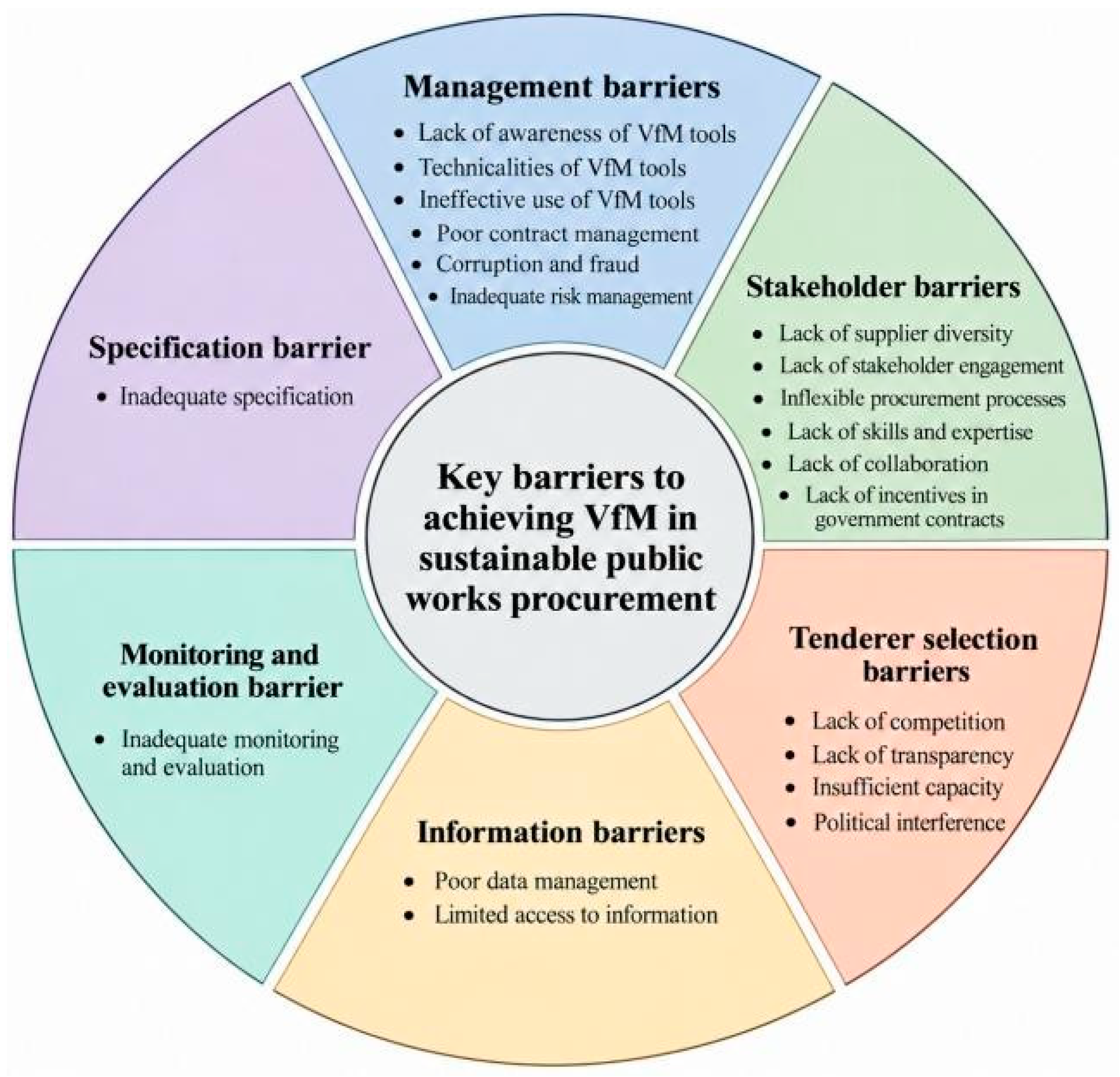
Figure 3.
Key Enablers to Achieving VfM in Sustainable Public Infrastructure Procurement. Source: Author’s own work (2026).
Figure 3.
Key Enablers to Achieving VfM in Sustainable Public Infrastructure Procurement. Source: Author’s own work (2026).
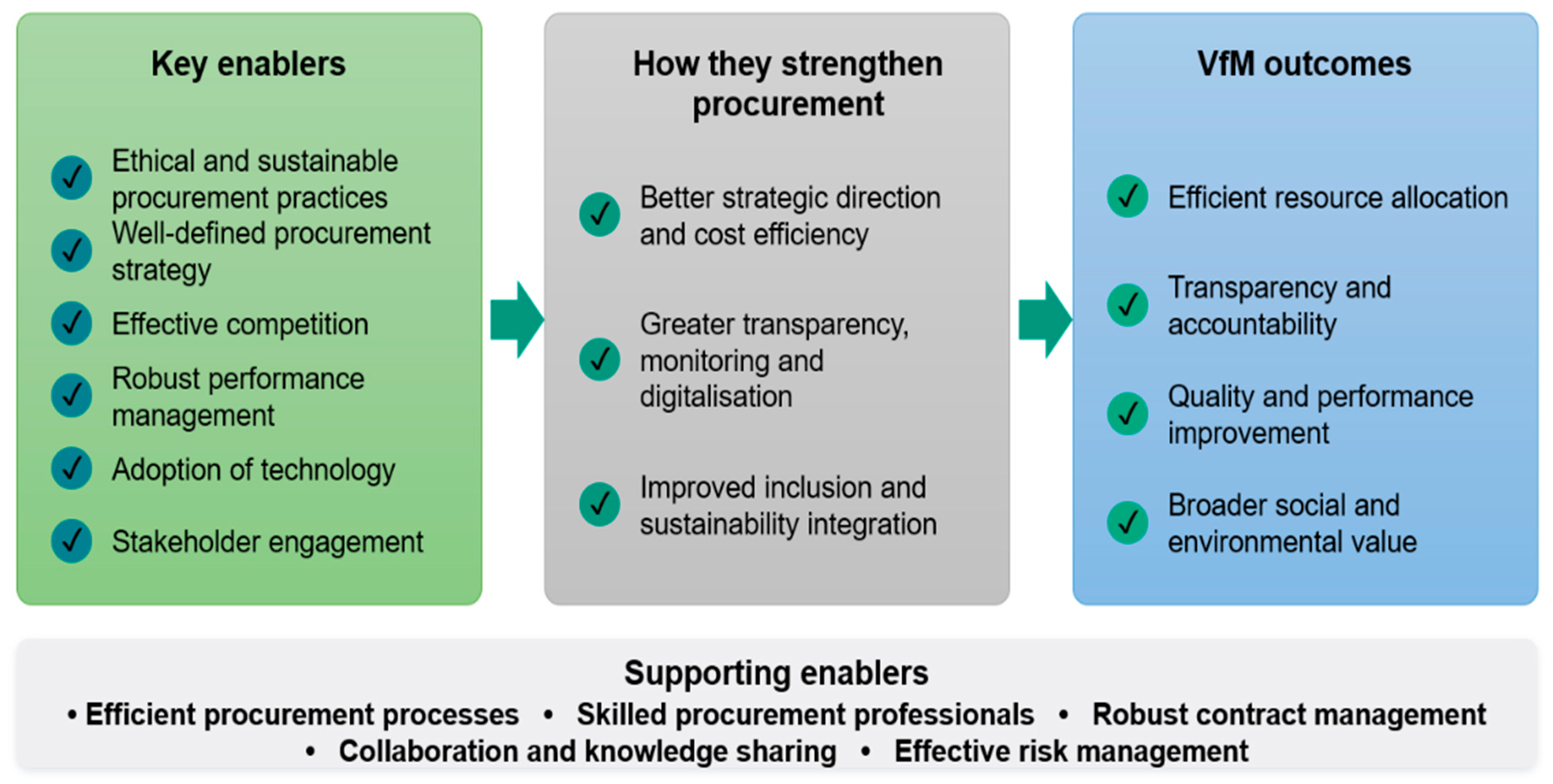
Figure 4.
Conceptual Framework of VfM Practices in Sustainable Public Infrastructure Procurement. Source: Author’s own work (2026).
Figure 4.
Conceptual Framework of VfM Practices in Sustainable Public Infrastructure Procurement. Source: Author’s own work (2026).
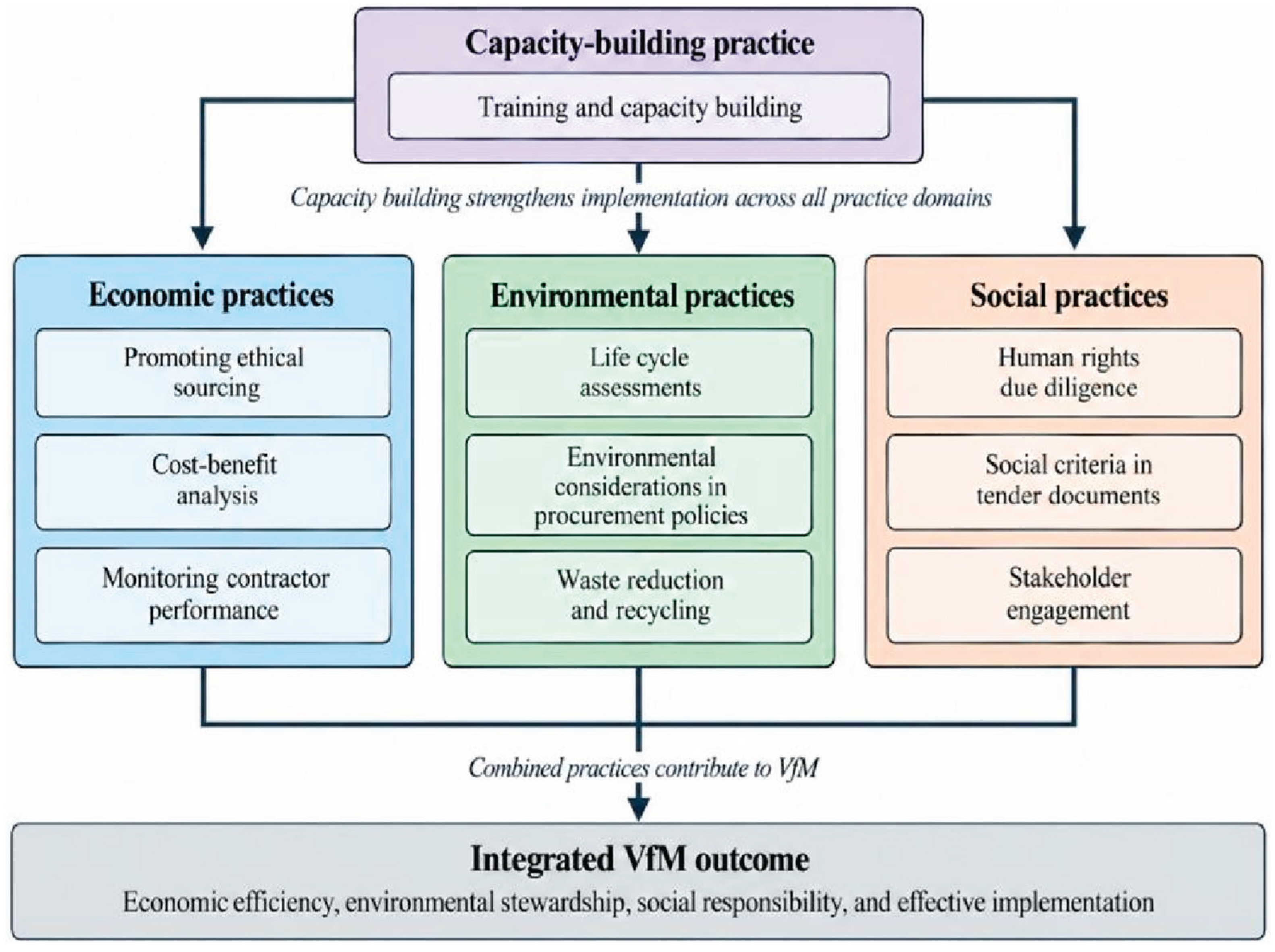
Table 1.
Sample size for different confidence intervals and precision.
| Confidence level and Z value | Sample size (N0) for precision (e) of: | ||
|---|---|---|---|
| e = 0.03 | e = 0.05 | e = 0.1 | |
| 90% (Z=1.645) | 751 | 271 | 68 |
| 95% (Z=1.960) | 1,067 | 384 | 96 |
| 99% (Z= 2.576) | 1,849 | 666 | 166 |
Source: Calculated from Cochran (1977).
Table 2.
Reliability and Validity Test results.
| Objective | No. of Items | Cronbach's Alpha |
|---|---|---|
| Barriers to achieving VfM in sustainable Public Infrastructure Procurement in Ghana | 20 | 0.931 |
| Enablers to achieving VfM in sustainable public infrastructure procurement in Ghana | 12 | 0.896 |
| VfM Practices in Sustainable Public Infrastructure Procurement in Ghana | 29 | 0.918 |
Source: Authors’ Own Work (2026).
Table 3.
Demographic Characteristics of Respondents.
| Item | Frequency (n= 100) | Percentage (%) |
|---|---|---|
|
Age 18–30 years |
8 |
8.0 |
| 31–40 years | 34 | 34.0 |
| 41–50 years | 40 | 40.0 |
| 51–60 years | 17 | 17.0 |
| 61 years and above | 1 | 1.0 |
|
Educational level Higher National Diploma (HND) |
20 |
20.0 |
| Bachelor’s Degree | 56 | 56.0 |
| Master’s Degree | 19 | 19.0 |
| Doctoral Degree (PhD) | 5 | 5.0 |
| Role/position in organization Project Manager |
6 |
6.0 |
| Quantity Surveyor | 30 | 30.0 |
| Procurement Manager | 31 | 31.0 |
| Contract Manager | 24 | 24.0 |
| Construction Manager | 9 | 9.0 |
|
Work experience Less than 5 years |
7 |
7.0 |
| 5–10 years | 27 | 27.0 |
| 11–15 years | 36 | 36.0 |
| 16–20 years | 19 | 19.0 |
| Over 20 years | 11 | 11.0 |
Source: Field data (2026).
Table 4.
KMO and Bartlett's Test.
| Kaiser-Meyer-Olkin measure of sampling adequacy | 0.732 | |
| Bartlett's Test of Sphericity | Approx. Chi-Square | 1305.934 |
| Df | 190 | |
| Sig. | 0.000 | |
Source: Field data, 2026.
Table 6.
Descriptive statistics for enablers to achieving VfM in sustainable public infrastructure procurement.
Table 6.
Descriptive statistics for enablers to achieving VfM in sustainable public infrastructure procurement.
| Descriptive Statistics | ||||||
|---|---|---|---|---|---|---|
| Code | Mean | Std. Deviation | ||||
| N | Sum | Statistic | Std. Error | Statistic | ||
| E12 | Ethical and sustainable procurement | 100 | 436.0 | 4.360 | 0.078 | 0.785 |
| E1 | Clear Procurement Strategy | 100 | 434.0 | 4.340 | 0.099 | 0.997 |
| E2 | Effective Competition | 100 | 430.0 | 4.300 | 0.093 | 0.937 |
| E5 | Robust Performance Management | 100 | 420.0 | 4.200 | 0.097 | 0.974 |
| E7 | Adoption of Technology | 100 | 416.0 | 4.160 | 0.098 | 0.982 |
| E8 | Stakeholder Engagement | 100 | 412.0 | 4.120 | 0.073 | 0.728 |
| E3 | Efficient Procurement Processes | 100 | 406.0 | 4.060 | 0.086 | 0.862 |
| E4 | Skilled Procurement Professionals | 100 | 403.0 | 4.030 | 0.085 | 0.858 |
| E10 | Ethical and Sustainable Procurement Practices | 100 | 393.0 | 3.930 | 0.096 | 0.966 |
| E9 | Robust Contract Management | 100 | 392.00 | 3.920 | 0.094 | 0.939 |
| E11 | Collaboration and Knowledge Sharing | 100 | 388.0 | 3.880 | 0.0782 | 0.782 |
| E6 | Effective Risk Management | 100 | 367.0 | 3.670 | 0.082 | 0.817 |
Source: Field data (2026).
Table 7.
Normalization value (NV) technique.
| CODE | MEAN | STD | NV | CRITICAL | RANK |
| E12 | 4.360 | 0.785 | 1.000 | Yes | 1ST |
| E1 | 4.340 | 0.997 | 0.976 | Yes | 2ND |
| E2 | 4.300 | 0.937 | 0.913 | Yes | 3RD |
| E5 | 4.200 | 0.974 | 0.768 | Yes | 4TH |
| E7 | 4.160 | 0.982 | 0.710 | Yes | 5TH |
| E8 | 4.120 | 0.729 | 0.652 | Yes | 6TH |
| E3 | 4.060 | 0.862 | 0.565 | No | 7TH |
| E4 | 4.030 | 0.858 | 0.522 | No | 8TH |
| E10 | 3.930 | 0.967 | 0.377 | No | 9TH |
| E9 | 3.920 | 0.939 | 0.362 | No | 10TH |
| E11 | 3.880 | 0.782 | 0.304 | No | 11TH |
| E6 | 3.670 | 0.817 | 0 | No | 12TH |
Source: Field data (2026).
Table 8.
One-sample t-test analysis.
| Value: 3.5 | ||||||
| VfM Practices in Sustainable publicinfrastructureprocurement | t | df | Sig. (2-tailed) | Mean Difference | 95% Confidence Interval of the Difference | |
| Lower | Upper | |||||
| ESP 1: Incorporating environmental considerations into procurement policies and procedures | 11.988 | 99 | 0.000 | 0.75 | 0.626 | 0.874 |
| ESP 2: Conducting life cycle assessments | 9.663 | 99 | 0.000 | 0.76 | 0.604 | 0.916 |
| ESP 3: Using green procurement criteria | 6.523 | 99 | 0.000 | 0.54 | 0.376 | 0.704 |
| ESP 4: Implementing sustainable transportation practices | 6.971 | 99 | 0.000 | 0.51 | 0.365 | 0.655 |
| ESP 5: Monitoring and reporting environmental sustainability performance | 7.106 | 99 | 0.000 | 0.51 | 0.368 | 0.652 |
| ESP 6: Practicing sustainable supply chain management | 8.248 | 99 | 0.000 | 0.56 | 0.425 | 0.695 |
| ESP 7: Implementing environmental management systems | 8.248 | 99 | 0.000 | 0.56 | 0.425 | 0.695 |
| ESP 8: Incorporating environmental criteria into tender specifications | 8.459 | 99 | 0.000 | 0.67 | 0.513 | 0.827 |
| ESP 9: Encouraging the use of environmentally certified products | 8.927 | 99 | 0.000 | 0.63 | 0.490 | 0.770 |
| ESP 10: Reducing waste and promoting recycling | 10.432 | 99 | 0.000 | 0.72 | 0.583 | 0.857 |
| ESP 11: Conducting environmental assessments | 6.013 | 99 | 0.000 | 0.54 | 0.362 | 0.718 |
| ECSP 1: Developing long-term relationships with contractors | 7.799 | 99 | 0.000 | 0.62 | 0.462 | 0.778 |
| ECSP 2: Considering the full life cycle costs ofinfrastructureor services | 7.007 | 99 | 0.000 | 0.59 | 0.423 | 0.757 |
| ECSP 3: Obtaining bids from multiple suppliers | 6.754 | 99 | 0.000 | 0.57 | 0.403 | 0.738 |
| ECSP 4: Identifying cost reduction opportunities without compromising quality | 7.163 | 99 | 0.000 | 0.61 | 0.441 | 0.779 |
| ECSP 5: Monitoring contractor’s performance and enforcing contract terms | 9.646 | 99 | 0.000 | 0.72 | 0.572 | 0.868 |
| ECSP 6: Continually reviewing procurement processes and practices to identify areas for improvement | 7.450 | 99 | 0.000 | 0.62 | 0.455 | 0.785 |
| ECSP 7: Evaluating the procurement decision through a cost-benefit analysis | 10.653 | 99 | 0.000 | 0.88 | 0.716 | 1.044 |
| ECSP 8: Promoting ethical sourcing to support local economies and reduce costs | 11.373 | 99 | 0.000 | 0.9 | 0.743 | 1.057 |
| SSP 1: Including social criteria in tender documents | 8.875 | 99 | 0.000 | 0.72 | 0.559 | 0.881 |
| SSP 2: Engaging with stakeholders | 7.886 | 99 | 0.000 | 0.7 | 0.524 | 0.876 |
| SSP 3: Conducting social impact assessments | 8.490 | 99 | 0.000 | 0.69 | 0.529 | 0.851 |
| SSP 4: Encouraging diversity and inclusion | 6.447 | 99 | 0.000 | 0.53 | 0.367 | 0.693 |
| SSP 5: Ethical sourcing | 8.326 | 99 | 0.000 | 0.67 | 0.510 | 0.830 |
| SSP 6: Community engagement | 5.630 | 99 | 0.000 | 0.48 | 0.311 | 0.649 |
| SSP 7: Socially responsible supply chain management | 6.952 | 99 | 0.000 | 0.63 | 0.450 | 0.810 |
| SSP 8: Partnership and collaboration | 7.744 | 99 | 0.000 | 0.67 | 0.498 | 0.842 |
| SSP 9: Human rights due diligence | 9.333 | 99 | 0.000 | 0.74 | 0.583 | 0.897 |
| SSP 10: Training and capacity building | 8.376 | 99 | 0.000 | 0.72 | 0.549 | 0.891 |
Source: Field survey, 2026.
Table 9.
One-sample statistics for VfM practices in sustainable public infrastructure procurement in Ghana.
Table 9.
One-sample statistics for VfM practices in sustainable public infrastructure procurement in Ghana.
| VfM practices in sustainable publicinfrastructureprocurement in Ghana | N | Mean | Std. Deviation | Std. Error Mean | Rank |
| ECSP 8: Promoting ethical sourcing to support local economies and reduce costs | 100 | 4.40 | 0.791 | 0.079 | 1ST |
| ECSP 7: Evaluating the procurement decision through a cost-benefit analysis | 100 | 4.38 | 0.826 | 0.083 | 2ND |
| ESP 2: Conducting life cycle assessments | 100 | 4.26 | 0.787 | 0.079 | 3RD |
| ESP 1: Incorporating environmental considerations into procurement policies and procedures | 100 | 4.25 | 0.626 | 0.063 | 4TH |
| SSP 9: Human rights due diligence | 100 | 4.24 | 0.793 | 0.079 | 5TH |
| ESP 10: Reducing waste and promoting recycling | 100 | 4.22 | 0.690 | 0.069 | 6TH |
| ECSP 5: Monitoring contractor’s performance and enforcing contract terms | 100 | 4.22 | 0.746 | 0.075 | 7TH |
| SSP 1: Including social criteria in tender documents | 100 | 4.22 | 0.811 | 0.081 | 8TH |
| SSP 10: Training and capacity building | 100 | 4.22 | 0.860 | 0.086 | 9TH |
| SSP 2: Engaging with stakeholders | 100 | 4.20 | 0.888 | 0.089 | 10TH |
| SSP 3: Conducting social impact assessments | 100 | 4.19 | 0.813 | 0.081 | 11TH |
| ESP 8: Incorporating environmental criteria into tender specifications | 100 | 4.17 | 0.792 | 0.079 | 12TH |
| SSP 8: Partnership and collaboration | 100 | 4.17 | 0.865 | 0.087 | 13TH |
| SSP 5: Ethical sourcing | 100 | 4.17 | 0.805 | 0.080 | 14TH |
| ESP 9: Encouraging the use of environmentally certified products | 100 | 4.13 | 0.706 | 0.071 | 15TH |
| SSP 7: Socially responsible supply chain management | 100 | 4.13 | 0.906 | 0.091 | 16TH |
| ECSP 1: Developing long-term relationships with contractors | 100 | 4.12 | 0.795 | 0.079 | 17TH |
| ECSP 6: Continually reviewing procurement processes and practices to identify areas for improvement | 100 | 4.12 | 0.832 | 0.083 | 18TH |
| ECSP 4: Identifying cost reduction opportunities without compromising quality | 100 | 4.11 | 0.852 | 0.085 | 19TH |
| ECSP 2: Considering the full life cycle costs of works or services | 100 | 4.09 | 0.842 | 0.084 | 20TH |
| ECSP 3: Obtaining bids from multiple suppliers | 100 | 4.07 | 0.844 | 0.084 | 21ST |
| ESP 7: Implementing environmental management systems | 100 | 4.06 | 0.679 | 0.068 | 22ND |
| ESP 6: Practicing sustainable supply chain management | 100 | 4.06 | 0.679 | 0.068 | 23RD |
| ESP 11: Conducting environmental assessments | 100 | 4.04 | 0.898 | 0.090 | 24TH |
| ESP 3: Using green procurement criteria | 100 | 4.04 | 0.828 | 0.083 | 25TH |
| SSP 4: Encouraging diversity and inclusion | 100 | 4.03 | 0.822 | 0.082 | 26TH |
| ESP 5: Monitoring and reporting environmental sustainability performance | 100 | 4.01 | 0.718 | 0.072 | 27TH |
| ESP 4: Implementing sustainable transportation practices | 100 | 4.01 | 0.732 | 0.073 | 28TH |
| SSP 6: Community engagement | 100 | 3.98 | 0.853 | 0.085 | 29TH |
Source: Field survey, 2026.
Disclaimer/Publisher’s Note: The statements, opinions and data contained in all publications are solely those of the individual author(s) and contributor(s) and not of MDPI and/or the editor(s). MDPI and/or the editor(s) disclaim responsibility for any injury to people or property resulting from any ideas, methods, instructions or products referred to in the content. |
© 2026 by the authors. Licensee MDPI, Basel, Switzerland. This article is an open access article distributed under the terms and conditions of the Creative Commons Attribution (CC BY) license (http://creativecommons.org/licenses/by/4.0/).
Copyright: This open access article is published under a Creative Commons CC BY 4.0 license, which permit the free download, distribution, and reuse, provided that the author and preprint are cited in any reuse.