

Submitted:
11 October 2026
Posted:
12 October 2026
Read the latest preprint version here
Abstract
We disprove the conjecture of Camacho, Khudoyberdiyev and Omirov that \(x_i^2 = \sum_j b_{ij} x_j\) has a solution with every coordinate nonzero for every nonsingular complex matrix \(B\). Dimension three is the smallest in which the conjecture fails. In that dimension, all counterexamples are equivalent under simultaneous coordinate permutations and nonzero diagonal rescalings. The exceptional locus in \(\mathrm{GL}_3(\mathbb{C})\) is the disjoint union of six smooth, closed, three-dimensional algebraic tori, each a complete intersection of codimension six. Every exceptional matrix has exactly seven nonzero entries, the minimum possible for a counterexample. A regular three-dimensional evolution algebra with at most six nonzero structure constants has a full-support idempotent, and this bound is sharp. We also give polynomial equations characterizing the exceptional locus. The proof uses elimination, traces in an Artinian complete intersection, and local multiplicities.
Keywords:
evolution algebras
; full-support idempotents
; monomial equivalence
; Artinian traces
; local multiplicities
MSC: Primary 17D92; Secondary 14M10
1. Introduction
Evolution algebras arose in the study of non-Mendelian inheritance [1]. Tian’s monograph [2] provides a systematic account of their theory. Camacho, Khudoyberdiyev and Omirov asked whether, for every nonsingular complex matrix , the quadratic system has a solution with all coordinates nonzero [3, Conjecture 5.1]. They verified the assertion in dimensions one and two. García-Martínez and Pérez-Rodríguez proved that, for , a solution with at least two nonzero coordinates always exists [4, Theorem 2.1]. They also proved two conjectures concerning complete evolution algebras [4, Theorems 3.2 and 3.3] and showed that every complex regular evolution algebra has a nonzero idempotent [4, Theorem 3.5]. Neither the two-coordinate existence result nor the nonzero-idempotent result guarantees full support in dimension three.
We exhibit a counterexample in dimension three and classify all nonsingular matrices for which full-support solvability fails. Theorem 4 shows that these matrices form a single class under the coordinate changes preserving the system. Corollary 2 describes their locus and gives the sharp lower bound of seven nonzero entries for a counterexample. Proposition 1 gives a polynomial membership test that does not require solving the quadratic system. Corollary 3 extends the sharp sparsity bound to structure matrices and shows that every simple three-dimensional complex evolution algebra has a full-support idempotent. The counterexample extends to higher dimensions by direct sum, but the classification here is restricted to dimension three.
Let E be an evolution algebra with a natural basis and invertible structure matrix , where . A vector is idempotent if and only if , or equivalently . Such an idempotent has full support exactly when all its natural-basis coordinates are nonzero. For a regular evolution algebra, the nonzero solutions of this system correspond to the nonzero one-dimensional subalgebras of the algebra. Each such subalgebra contains a unique nonzero idempotent [5, Lemma 1]. Mukhamedov and Qaralleh study the extendibility of evolution subalgebras generated by idempotents [6]. For , changes of natural basis are monomial [7, Theorem 4.4]. The extension of natural families to natural bases is examined in [8]. Costoya, Mayorga and Viruel recall the monomial change-of-basis theorem in their study of permutation representations of automorphism groups [9, Theorem 2.4]. The corresponding description of isomorphism classes is given in [10, Corollary 1.1]. The isomorphism type associated with our counterexample already occurs in the classification of Cabrera Casado, Siles Molina and Velasco [11, Theorem 3.5(iv)] and is also covered by [12, Theorem 11] and the later classification of three-dimensional non-degenerate evolution algebras [13, Theorem 30]. Related work treats the classification of two-dimensional complex evolution algebras [14], ideals and decompositions in arbitrary dimensions [15], and simple evolution algebras in dimensions two and three [16]. For finite-dimensional perfect evolution algebras, ideals can be described using hereditary subsets of the associated graph [17, Theorem 5.8]. Our result concerns the existence of full-support idempotents, not a new isomorphism type. Its proof uses elimination, multiplication traces and local multiplicities in a finite complete intersection.
2. The Counterexample
For , write for
In [3, Conjecture 5.1], the assertion that (1) always has a solution in is stated using the transpose coefficient convention. As B ranges over all nonsingular matrices, this has no effect on the conjecture. The cases are established in [3]. The weaker conclusion that a solution with at least two nonzero coordinates exists for is proved in [4, Theorem 2.1].
Theorem 1.
The nonsingular matrix
does not admit a solution to (1) in . Consequently, dimension three is minimal and is a counterexample for every .
Proof.
Write . If , the equations
force and . The third equation then reduces to . Since , it follows that and hence , a contradiction. The cases , proved in [3, Conjecture 5.1 and the discussion following it], establish minimality. The block construction preserves the contradiction in the first three coordinates. □
3. Rigidity for an Uncoupled Coordinate Equation
For an invertible diagonal matrix D, the substitution replaces B by . Simultaneous permutations of rows and columns also preserve full-support solvability. We refer to compositions of these changes as monomial equivalences.
Theorem 2.
Let satisfy . Then (1) has no full-support solution if and only if B is monomially equivalent to .
Proof.
Write the first row as with . If , invertibility implies . With , choose a nonzero root of , followed by a nonzero root of . Thus a counterexample must have .
Diagonal coordinate scalings put B in the form
Every full-support solution has . Set
The remaining equations are and . If , then . A nonzero root of can be chosen first, followed by a nonzero root of . Thus a counterexample must have . The polynomial P also has a nonzero root. Otherwise , whose cubic and linear coefficients would give .
Assume no full-support solution exists. For every nonzero root r of P, we have and therefore . Since , all nonzero roots must coincide at some . It follows that , with . Coefficient comparison and give
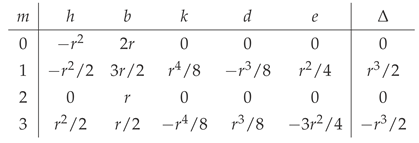 Thus by invertibility. The substitution transforms C into
respectively. Swapping the second and third coordinates of and then negating the second coordinate gives . The converse follows from Theorem 1. □
4. A Sparse-Row Existence Lemma
Lemma 1.
Let . If one row of B has exactly one nonzero entry, and this entry is outside the diagonal, then (1) admits a full-support solution.
Proof.
After permuting coordinates, assume that the first row is , . If , invertibility forces . Then , and the second equation becomes . Every root of this cubic is nonzero because its constant term is nonzero. The third equation is quadratic in w with nonzero linear coefficient , so it has a nonzero root.
Suppose . A diagonal coordinate change reduces the first two rows to and , respectively. Write the third as . We then have
For , the third equation is equivalent to
The polynomial H is monic of degree seven and its coefficient of is zero. It must have a nonzero root. If , comparison of the coefficients of and 1 would successively force , contradicting invertibility.
Suppose no root of H produces a full-support solution. Since , every nonzero root of H must satisfy . By (3) it therefore satisfies . If , H has at most one distinct nonzero root r. It must be , where and , contradicting the vanishing coefficient of . If and , no such nonzero root can exist, another contradiction. Finally, if , invertibility gives . Setting and choosing a root of gives . □
5. Rigidity in the Presence of an Off-Diagonal Zero
The preceding results cover two sparse-row configurations. We now classify all nonsingular matrices with at least one off-diagonal zero.
Lemma 2.
Let and suppose, after a simultaneous permutation of coordinates, that its first row is with . Then admits a solution in .
Proof.
Write the remaining rows as and . If , then . By the two-dimensional case of [3, Conjecture 5.1, discussion following it], the first two equations have a solution with . The remaining equation has a nonzero root because .
If , the substitution with transforms B into a matrix of the form
For a solution with , the first two equations give
The third equation then becomes , where
This polynomial is monic of degree seven, its coefficient is , and . Hence all seven roots, counted with multiplicity, are nonzero and give solutions through (5).
Suppose none of these solutions has full support. Every root of H then equals 1 (so that ) or is a root of C (so that ). For the latter kind, (6) forces
If , invertibility implies . Setting reduces the first two equations to
The quartic is monic, with nonzero constant term and coefficient . Its roots cannot all equal 1, since has coefficient . Thus a root different from 0 and 1 gives a full-support solution. If and , condition (7) is impossible, so all seven roots would equal 1, contradicting the coefficient of .
We can therefore assume and put . If , then . At that boundary value, a root with would require . In that case the first column of B is , and the invertible lower-right subsystem admits a solution with . The first equation then has a nonzero root, giving full support. Otherwise, all the roots of H would have to equal 1, contradicting its prescribed sixth-degree coefficient. Thus , and . If , all roots would also have to equal 1, because . Consequently . The assumption that no full-support solution exists now forces
The last equality follows from comparing the coefficients.
Theorem 3.
For having at least one zero off-diagonal entry, the system has no full-support solution if and only if B is monomially equivalent to .
Proof.
Choose an off-diagonal zero and permute coordinates so that . If , apply Lemma 2. If and , the first row has only one nonzero entry, outside the diagonal, so Lemma 1 applies. If , invertibility forces , and Theorem 2 shows that the exceptional matrices are precisely those in the monomial orbit of . The converse follows from Theorem 1. □
Corollary 1.
Let , and put . Then is the monomial orbit of . It is the disjoint union of six closed three-dimensional algebraic tori, and therefore has dimension three and codimension six in .
Proof.
The orbit description follows from Theorem 3. On the locus where all three diagonal entries are nonzero, put
Then , so N is invariant under diagonal coordinate rescalings and is equivariant under simultaneous permutations. In particular,
The six resulting normalized matrices are distinct. The row with two zeros determines its position, while interchanging the remaining two rows and columns changes the -entry from 2 to . Thus the six normalized matrices have three distinct off-diagonal zero patterns, with two matrices for each pattern.
The orbit of is therefore the disjoint union of the six fibres . Taking diagonal entries identifies each fibre with , and the inverse parametrization is Laurent-polynomial. It is closed in the nonzero-diagonal locus as a fibre of the regular map N. Every matrix in these fibres satisfies . Their closures inside therefore cannot meet a diagonal coordinate hyperplane. Hence all six fibres are closed in . □
Remark 1.
The preceding corollary describes the exceptional locus on the coordinate hyperplanes. The next section excludes any additional components outside their union.
6. Global Rigidity
The proof of [4, Theorem 2.1] already uses the total intersection count , with multiplicities, and the fact that the origin is a simple point. Here multiplication traces are used to exclude counterexamples whose six off-diagonal entries are all nonzero.
Lemma 3.
For , let and let denote multiplication by f in . Then
The origin is a simple point of the solution scheme, and the nonzero solutions have total multiplicity seven. If those solutions are , with local multiplicities , then for every ,
Proof.
With respect to any degree-compatible monomial order, the defining polynomials have leading monomials . The leading monomials are pairwise coprime. Buchberger’s criterion therefore shows that the defining polynomials form a monic Gröbner basis, and the eight squarefree monomials form a basis of . For multiplication by , each of the four basis monomials containing has diagonal coefficient , while the other four have diagonal coefficient zero. For , multiplication by has diagonal coefficient on the two monomials containing both variables, coefficient on the four monomials containing exactly one of them, and zero on the two containing neither. Adding these contributions gives the stated trace identities.
The Jacobian of at the origin is , which is invertible. Hence the origin has local length one and the remaining local lengths sum to seven. The finite-dimensional algebra decomposes into its local Artinian factors. On the factor at P, multiplication by f has sole eigenvalue , repeated with the local length. Taking traces proves the last assertion. □
Theorem 4.
For every , the system has no solution in if and only if B is monomially equivalent to .
Proof.
Theorem 3 treats matrices with at least one off-diagonal zero. It remains to consider B with all six off-diagonal entries nonzero. Assume, for a contradiction, that the system has no full-support solution.
No nonzero solution can have support of size one, because the other two coordinate equations would force two off-diagonal coefficients to vanish. For a solution on with the other two coordinates nonzero, the kth equation determines their ratio because both relevant off-diagonal coefficients are nonzero. Either remaining equation then determines the common scale. Consequently, at most one nonzero solution lies on each coordinate plane. By Lemma 3, the nonzero solution scheme has total length seven and is supported at distinct boundary points.
If , a coordinate permutation and scaling put the sole point at , with multiplicity seven. The first two linear trace identities give . Since , we also have . The mixed trace identity gives
which is impossible.
If , the two points lie on different coordinate planes. After a permutation and scaling of coordinates, write them as
with multiplicities m and , respectively, where . The equations and force
The traces of and give
Every solution has , so its mixed trace vanishes. The displayed matrix, however, gives
This contradicts , since the quadratic has discriminant 13.
It remains to exclude . Normalize the three boundary solutions as follows, with .
Let and set
Since , the equalities and imply . If , then X would be singular while Y would be invertible. In addition, because B is invertible. Thus
All its off-diagonal entries are nonzero. Hence .
Let the multiplicities of be positive integers , with . The three linear trace identities give
A cyclic permutation of the coordinates induces a cyclic permutation of . The fifteen positive integer triples summing to seven therefore reduce to the representatives , , , and . To avoid dividing by a coefficient that might vanish, write the linear relations as
For and , the undivided equations exclude and . At each value, one coefficient on the left vanishes while its right-hand side does not. For all remaining values, solving the three relations in (12) gives, in both cases,
Since , this would force , already excluded.
For , the first relation gives . If , the second forces . Otherwise . For , the first gives . If , the second relation reads . Otherwise . Thus neither multiplicity triple is possible.
For the remaining triple , the equations (11) give
The denominators cannot vanish. Substituting or into the corresponding undivided equations gives a contradiction in either case. Since vanishes at and equals r at , Lemma 3 gives . Using as in (10), this becomes
Since and , it follows that and hence . This contradicts and completes the proof. □
Corollary 2.
The exceptional set
is the disjoint union of six closed algebraic tori, each isomorphic to . In particular,
Every matrix in has exactly seven nonzero entries. Thus every nonsingular complex matrix with at most six nonzero entries has a full-support solution, and this bound is sharp.
Proof.
By Theorem 4, is the monomial orbit of . Corollary 1 identifies that orbit as six disjoint closed three-dimensional tori. Nonzero diagonal coordinate scalings and simultaneous permutations preserve the number of nonzero entries, and has precisely seven nonzero entries. □
7. Explicit Polynomial Equations for the Exceptional Locus
The classification also gives a recognition criterion involving only the matrix entries. On the exceptional locus, the determinant relation ensures that all three diagonal parameters are nonzero.
Proposition 1.
Put
A matrix has no full-support solution if and only if its rows and columns can be simultaneously permuted so that the resulting matrix, with its entries denoted as above, satisfies the following six polynomial equations.
For the displayed coordinate order, the six equations generate a prime ideal of height six, and
Each of the six irreducible components of the reduced exceptional locus is therefore a smooth complete intersection of codimension six. The radical ideal of the exceptional locus in is the intersection of the six permutation-conjugates of J.
Proof.
Because is invertible, the last equation in (13) forces . The remaining relations and the determinant identity then give
The three relations involving determine these entries. Since , the determinant is , so also gives . Conversely, every matrix in (14) satisfies the six equations and has determinant . Taking gives . Theorem 4 proves the equivalence after allowing simultaneous permutations.
In the quotient of by the six equations, is invertible. Hence are units, while are uniquely determined by the Laurent-polynomial expressions in (14). The quotient is therefore the displayed Laurent polynomial ring, which is regular of dimension three. The Jacobian minor of the six defining polynomials with respect to is on this locus, so it never vanishes. The equations thus form a regular sequence and define a smooth complete intersection of codimension six in . By Corollary 2, the six permuted loci are pairwise disjoint and exhaust the exceptional set. The intersection of their prime defining ideals is therefore the radical ideal of the reduced exceptional locus. □
8. Structure Matrices and Earlier Classifications
Under the row convention , the structure matrix associated with is . Cabrera Casado, Siles Molina and Velasco use the column convention, in which the coefficients of form column j. Their matrix for this algebra is therefore
Let S interchange the first and third coordinates, and put . In the column convention, the change of natural basis determined by S and D gives
The resulting matrix belongs to the first seven-entry family in [18, Table 22], with parameters . The monomial change of natural basis for perfect evolution algebras is described in [11, Proposition 3.2(iv)]. The corresponding orbit classification over arbitrary fields is given in [10, Corollary 1.1]. Thus the associated algebra belongs to an already classified isomorphism type. Although matrix inversion need not preserve zero patterns, the inverse transpose of every matrix in the exceptional orbit still has exactly seven nonzero entries.
Corollary 3.
Let E be a three-dimensional regular evolution algebra over , with structure matrix M in a natural basis. If E has no full-support idempotent, then M has exactly seven nonzero entries and E has a proper two-dimensional ideal. Consequently, E has a full-support idempotent whenever M has at most six nonzero entries, and this bound is sharp. In particular, every simple three-dimensional complex evolution algebra has a full-support idempotent.
Proof.
Put . If E has no full-support idempotent, Theorem 4 gives for an invertible diagonal matrix and a permutation matrix P. Thus , where . The matrix has exactly seven nonzero entries. In the algebra with structure matrix , is a proper ideal because the first entries of the second and third rows of vanish. Both properties are preserved under the displayed monomial change of natural basis. The example proves sharpness. Finally, simplicity implies regularity and excludes such a proper nonzero ideal. □
References
- J. P. Tian and P. Vojtěchovský, Mathematical concepts of evolution algebras in non-Mendelian genetics, Quasigroups Related Systems 14 (2006), no. 1, 111–122. Author PDF.
- J. P. Tian, Evolution algebras and their applications, Lecture Notes in Math., vol. 1921, Springer, Berlin, 2008. [CrossRef]
- L. M. Camacho, A. Kh. Khudoyberdiyev and B. A. Omirov, On the property of subalgebras of evolution algebras, Algebr. Represent. Theory 22 (2019), no. 2, 281–296.Preprint arXiv:1405.7126v3 (5 December 2014). [CrossRef]
- X. García-Martínez and A. Pérez-Rodríguez, A note on complete evolution algebras, Arch. Math. 126 (2026), 597–604. [CrossRef]
- M. Ladra and A. Pérez-Rodríguez, Regular evolution algebras are closed under subalgebras, C. R. Math. 363 (2025), 1461–1465. [CrossRef]
- F. Mukhamedov and I. Qaralleh, On extendibility of evolution subalgebras generated by idempotents, Mathematics 11 (2023), no. 12, 2764. [CrossRef]
- A. Elduque and A. Labra, Evolution algebras and graphs, J. Algebra Appl. 14 (2015), no. 7, 1550103. [CrossRef]
- N. Boudi, Y. Cabrera Casado and M. Siles Molina, Natural families in evolution algebras, Publ. Mat. 66 (2022), no. 1, 159–181. [CrossRef]
- C. Costoya, P. Mayorga and A. Viruel, Permutation representations and automorphisms of evolution algebras, Mediterr. J. Math. 22 (2025), article 149. [CrossRef]
- Y. Wei and Y. M. Zou, Isomorphism classes of idempotent evolution algebras, Linear Algebra Appl. 675 (2023), 142–178. [CrossRef]
- Y. Cabrera Casado, M. Siles Molina and M. V. Velasco, Classification of three-dimensional evolution algebras, Linear Algebra Appl. 524 (2017), 68–108. [CrossRef]
- M. E. Celorrio and M. V. Velasco, Classifying evolution algebras of dimensions two and three, Mathematics 7 (2019), no. 12, 1236. [CrossRef]
- A. J. Calderón Martín, A. Fernández Ouaridi and I. Kaygorodov, Non-degenerate evolution algebras, J. Pure Appl. Algebra 228 (2024), no. 6, 107594. [CrossRef]
- J. M. Casas, M. Ladra, B. A. Omirov and U. A. Rozikov, On evolution algebras, Algebra Colloq. 21 (2014), no. 2, 331–342. [CrossRef]
- Y. Cabrera Casado, M. Siles Molina and M. V. Velasco, Evolution algebras of arbitrary dimension and their decompositions, Linear Algebra Appl. 495 (2016), 122–162. [CrossRef]
- Y. Cabrera Casado, D. Martín Barquero, C. Martín González and A. Tocino, On simple evolution algebras of dimension two and three. Constructing simple and semisimple evolution algebras, Linear Multilinear Algebra 73 (2025), no. 3, 507–524. [CrossRef]
- Y. Cabrera Casado, D. Martín Barquero, C. Martín González and A. Tocino, Connecting ideals in evolution algebras with hereditary subsets of its associated graph, Collect. Math. 76 (2025), no. 2, 357–372. [CrossRef]
- Y. Cabrera Casado, M. Siles Molina and M. V. Velasco, Description of three-dimensional evolution algebras, arXiv:1701.07219v2 (2017). arXiv:1701.07219v2.
Disclaimer/Publisher’s Note: The statements, opinions and data contained in all publications are solely those of the individual author(s) and contributor(s) and not of MDPI and/or the editor(s). MDPI and/or the editor(s) disclaim responsibility for any injury to people or property resulting from any ideas, methods, instructions or products referred to in the content. |
© 2026 by the authors. Licensee MDPI, Basel, Switzerland. This article is an open access article distributed under the terms and conditions of the Creative Commons Attribution (CC BY) license (http://creativecommons.org/licenses/by/4.0/).
Copyright: This open access article is published under a Creative Commons CC BY 4.0 license, which permit the free download, distribution, and reuse, provided that the author and preprint are cited in any reuse.