

Submitted:
10 October 2026
Posted:
12 October 2026
You are already at the latest version
Abstract
Project management research increasingly recognises social and relational processes, yet the field has not developed an integrated project level account of how emotional dynamics emerge, circulate, stabilise and alter collective behaviour within temporary project systems. This paper develops a theory of emotional dynamics as emergent operating conditions: collectively produced emotional patterns that become sufficiently stabilised to shape how formal project mechanisms are interpreted and enacted. The argument is that project actors do not interpret plans, risks, decisions and relationships in emotionally neutral ways. Emotional dynamics arise from project conditions, are activated by affective triggers, propagate through interaction and shared interpretation, stabilise into project emotional climates, and may reach tipping points that redirect collective behaviour.
The theory identifies six constructs: project conditions, affective triggers, emotional propagation, project emotional climate, emotional tipping points and project emotional regulation mechanisms. It also distinguishes between amplifying trajectories that increase project fragility and integrative trajectories that strengthen resilience and collective action. The contribution is to shift attention from emotion as an individual trait, interpersonal issue or leadership competency to emotion as a project level process. Existing literatures on emotional intelligence, psychological safety, trust, conflict, leadership and wellbeing provide important building blocks, but they have not been integrated into a project level theory of emotional dynamics under temporary organising conditions.
Keywords:
emotional dynamics
; project management theory
; temporary project systems
; project emotional climate
; emotional propagation
; tipping points
; project governance
; project resilience
1. Introduction
Technically well managed projects can still derail. Projects may have formal plans, governance structures, risk registers, stakeholder processes and capable leaders, yet still experience breakdowns in judgement, trust, coordination, voice and collective action. These breakdowns are often interpreted as failures of communication, leadership, culture, stakeholder management or risk control. While these explanations are valuable, they do not fully account for how project actors come to interpret the same plans, risks, decisions and relationships through shifting collective emotional conditions.
The argument starts from a different premise: project actors do not simply execute formal mechanisms. They interpret and enact them through emotional dynamics that emerge, propagate and stabilize within temporary project systems. Emotional dynamics are therefore not peripheral human factors or individual psychological states. They can become project level operating conditions that shape how risks are perceived, how trust is formed or eroded, how conflict escalates, how voice is enabled or suppressed, and how decisions are enacted under uncertainty.
In this paper, emergent operating conditions refer to collectively produced emotional patterns that become sufficiently stabilized to shape how project actors interpret, prioritise and enact formal project mechanisms. Emotional dynamics become operating conditions when they no longer merely accompany project work, but begin to influence how plans are understood, how risks are judged, how trust is granted or withdrawn, how conflict is interpreted, and how decisions are enacted.
In this paper, emotional dynamics refers to socially expressed and interpreted affective responses as they move across actors, groups and formal project mechanisms. The term emphasizes process, propagation and stabilization rather than individual emotion alone. For example, repeated silence in risk meetings, recurring blame narratives after delays or shared confidence following transparent problem solving may each become emotional patterns when they persist across interactions and begin to shape later interpretation.
Project management research provides important insights into leadership, trust, conflict, communication, psychological safety, stakeholder behavior and wellbeing (Turner & Müller, 2005; Edmondson, 1999; Smyth et al., 2010; Kapsali et al., 2025). However, these literatures do not yet offer an integrated project level theory explaining how emotional dynamics unfold across actors, stabilize into collective emotional conditions, exhibit path dependence and reach tipping points that alter collective project behavior. This gap matters because projects are temporary, time bound and interdependent systems in which actors often work under compressed schedules, uncertain conditions, high stakes and limited shared history (Lundin & Söderholm, 1995; Bakker, 2010).
The proposed theory treats emotional dynamics in projects as emergent operating conditions in temporary project systems. It explains how project conditions heighten emotional sensitivity; how affective triggers activate emotional appraisal; how emotional responses propagate through interaction and shared interpretation; how repeated propagation stabilizes into project specific emotional climates; how these climates exhibit path dependence; and how accumulated affect may reach tipping points that reshape judgement, risk perception, trust, conflict, voice and coordination.
Two ideal type trajectories complete the model. Amplifying trajectories increase project fragility by intensifying fear, frustration, mistrust, silence, blame or distorted risk perception. Integrative trajectories strengthen collective action by stabilizing confidence, shared urgency, care, trust and adaptive problem solving. This distinction matters because emotional dynamics are not inherently dysfunctional. They can undermine project resilience, but they can also strengthen collective action.
A further construct is project emotional regulation mechanisms: leadership behaviors, peer practices, communication routines and governance processes through which project actors dampen, redirect or amplify emotional trajectories across the project system. These mechanisms contribute to the project’s regulatory capacity: the distributed ability of the project system to absorb, interpret and redirect emotional tension before it destabilizes collective behavior. By positioning regulation mechanisms as cross cutting rather than sequential, the theory explains how emotional dynamics may be shaped at multiple points: whether affective triggers propagate, whether propagation stabilizes into climate, whether climates reach tipping points, and whether consequences escalate or are contained.
The contribution is fourfold. The paper introduces emotional dynamics as emergent operating conditions in temporary project systems; develops six project level constructs; theorizes emotional dynamics as path dependent trajectories that may amplify fragility or strengthen resilience; and opens a research agenda for tracing emotional dynamics over time.
The result is an expanded account of what project management can explain. Project outcomes are shaped not only by formal plans, governance structures and risk processes, but also by the emotional operating conditions through which those mechanisms are interpreted, enacted and sometimes disrupted.
2. From Interpersonal Explanations to Project Level Emotional Dynamics
Project management scholarship has developed sophisticated accounts of planning, governance, risk management, stakeholder engagement and coordination (Winch, 2010; Morris et al., 2011; Turner & Müller, 2005). It has also moved beyond purely technical views of projects by recognizing projects as temporary forms of organizing. Temporary organizing scholarship shows that projects are time bound, task focused and contextually embedded systems rather than merely delivery instruments. Lundin and Söderholm’s (1995) theory of the temporary organization, and later reviews organized around time, team, task and context, provide the organizational foundation for theorizing projects as social systems (Bakker, 2010; Bakker et al., 2016; Burke & Morley, 2016). This broader shift is consistent with recent project studies scholarship that positions the field as an evolving theoretical domain rather than a narrow toolkit for delivery (Geraldi & Söderlund, 2018; Geraldi et al., 2020).
This shift matters because it establishes the conditions under which project behavior becomes socially and temporally dynamic. Yet temporary organizing theory does not provide a dedicated explanation of how emotional conditions emerge, circulate, stabilize and alter collective judgement within temporary project systems. The gap is therefore not a lack of social or behavioral insight in project management. It is the absence of an integrated project level theory explaining how emotional dynamics become operating conditions within temporary project systems.
Project management research has addressed emotion in several ways. Whitty’s (2010) work on emotions evoked by project management artefacts demonstrates that project artefacts can trigger affective responses. Other work examines emotional reactions to project work or project failure (Shepherd & Cardon, 2009). A substantial stream frames emotion through emotional intelligence, particularly the emotional capability of project managers or leaders (Clarke, 2010; Rezvani et al., 2016; Sunindijo & Zou, 2013). This research establishes that emotion is relevant to project outcomes. Its usual level of explanation, however, remains the individual, the leader, or the dyadic interaction rather than the collective and path dependent project condition.
A second body of work examines trust, conflict, psychological safety, communication and team behavior. Trust has been examined in project environments as a relational condition influencing cooperation and performance (Smyth et al., 2010; Bond-Barnard et al., 2018). Conflict research distinguishes between task, relationship and process conflict and their effects on team functioning (Jehn, 1995; de Wit et al., 2012). Psychological safety and voice research explain why actors speak up, withdraw, disagree, cooperate or withhold information (Edmondson, 1999; Morrison, 2014). However, these literatures generally treat trust, conflict, voice or safety as relational states or outcomes. They do not explain the prior dynamic process through which emotional conditions form, intensify and reshape those states over time.
Here, the prior dynamic process refers to the sequence through which project events are appraised emotionally, those appraisals are expressed and repeated through interaction, and repeated interpretations stabilize into a project level emotional condition before appearing as trust, conflict, voice, silence or psychological safety.
A third stream focuses on leadership and behavioral competence. This work is important because project leaders often play a central role in managing tension, uncertainty, conflict and stakeholder pressure (Turner & Müller, 2005; Clarke, 2010; Fisher, 2011). Yet when emotional issues are framed primarily as leadership competencies, the theoretical object becomes the project manager’s capability rather than the project system’s emotional condition. Leadership is better understood here as one set of project emotional regulation mechanisms: behaviors, routines and governance practices that may dampen, redirect or amplify emotional trajectories across the project system.
Recent research has also begun to examine wellbeing practices in project based organizations and psychosocial safety climate in construction settings, reflecting growing concern with the wellbeing, resilience and safety consequences of project based work (Kapsali et al., 2025; Zhao & Li, 2024). However, this literature identifies important psychosocial outcomes rather than explaining how emotional dynamics emerge, propagate, stabilize and reshape collective project behavior within temporary project systems.
The issue, then, is not whether these literatures are relevant. They are. Their limitation lies in how the phenomenon is located. Emotional intelligence foregrounds individual capability; psychological safety foregrounds voice and interpersonal risk taking; conflict and trust foreground relational states; leadership foregrounds behavioral influence; and wellbeing research foregrounds outcomes and organizational practices. What remains underdeveloped is a dynamic account of how emotional patterns become project level operating conditions.
This distinction is important. A project emotional climate is not simply an organizational climate applied to projects. Organizational emotional climates typically develop within relatively stable structures, repeated relationships and longer institutional histories (Ashkanasy & Dorris, 2017; Barsade & Gibson, 2012). Project emotional climates emerge under temporary, time bound and interdependent conditions, where actors may have limited shared history, compressed interaction cycles, uncertain authority relations and heightened delivery pressure (Lundin & Söderholm, 1995; Bakker, 2010; Sydow & Windeler, 2020). These features make projects especially sensitive to emotional propagation and escalation. Early affective episodes can become reference points for later interpretation, meaning that emotional dynamics in projects may become path dependent even within relatively short timeframes.
2.1. Levels of Analysis in Emotional Dynamics
The theory is project level, but it is not detached from individual or group processes. Emotional dynamics begin with individual appraisal, are reinforced through interaction, may stabilize within groups, and become project level when they shape how formal project mechanisms are interpreted and enacted across the wider project system. Clarifying these levels is essential because the argument does not claim that projects ‘feel’ emotion in a literal sense. Rather, it explains how emotional patterns become collective, patterned and consequential across temporary project systems.
At the individual level, actors appraise project events as threatening, fair, unfair, controllable, risky or meaningful. At the interactional level, these appraisals are expressed, repeated, challenged or reinforced through meetings, conversations, reports, digital communication and informal narratives. At the group level, emotional sub-climates may form within functional, professional, organizational or delivery groups. At the project system level, repeated emotional interpretations become operating conditions when they shape how actors collectively interpret risks, decisions, relationships, governance artefacts and delivery priorities. At the inter organizational level, emotional dynamics may travel across client, contractor, consultant and stakeholder boundaries through formal reporting, contractual exchanges, escalation processes and reputational histories.
Table 1 clarifies how the constructs in this theory are located across levels of analysis.
The next section explains how adjacent theories are combined to support the proposed project level theory of emotional dynamics.
The theoretical problem, then, is not whether emotion matters in projects. That claim is already established and would not constitute a sufficient contribution. The unresolved problem is how emotional dynamics become project level operating conditions. This paper addresses that problem by theorizing emotional dynamics as emergent, path dependent and subject to regulation within temporary project systems. The analysis therefore shifts from emotion as an individual attribute or interpersonal issue to emotion as a collective condition through which formal plans, risks, decisions and relationships are interpreted, enacted and sometimes disrupted.
3. Theoretical Foundations
The theory draws selectively on six adjacent literatures. Affective Events Theory helps explain activation; emotional contagion supports the propagation logic; sensemaking clarifies interpretation; social identity theory explains group level alignment; temporary organizing provides the project specific setting; and complexity theory supports the treatment of emergence, non linearity and tipping points.
Affective Events Theory provides the starting point for theorizing affective triggers. It explains how work events generate affective reactions that influence subsequent attitudes and behaviors (Weiss & Cropanzano, 1996). In project settings, affective triggers may include delays, design changes, safety incidents, contract disputes, stakeholder criticism, leadership decisions or perceived breaches of trust. Such events become consequential not only because of their technical content, but because project actors appraise what they signal about the competence of project leadership, delivery partners or the wider project system; the fairness of decisions; control over their work, exposure and ability to influence outcomes; risk; and relational commitment.
Emotional contagion theory explains how affective responses move beyond the individual. Emotional states may spread through interaction, tone, gesture, language, mimicry, shared concern and repeated communication (Hatfield et al., 1994; Barsade, 2002). In projects, this propagation may be intensified by dense interaction, time pressure, interdependence and uncertainty. A concern expressed in a meeting, frustration around a delayed decision or anxiety following a safety incident can therefore travel quickly across project actors and become collectively recognized, repeated and reinforced.
Sensemaking explains how emotional dynamics become tied to interpretation. Project actors rarely respond to events as neutral information. They interpret events through emerging narratives about what is happening, who can be trusted, whether risks are under control and whether the project remains viable (Weick, 1995). These interpretations are shaped not only by immediate emotion, but also by prior experiences, cognitive appraisal, professional identity and expectations formed earlier in the project. Emotional dynamics therefore shape not only how actors feel, but how they make sense of plans, risks, decisions and relationships. This is central to the paper’s argument: formal project mechanisms are interpreted and enacted at least partly through emotional conditions.
Social identity theory explains why emotional dynamics may align unevenly across project groups. Project actors participate not only as individuals, but also as members of functional groups, organizations, professions, contractors, client groups, site teams, design teams or leadership coalitions (Tajfel & Turner, 1979; Ashforth & Mael, 1989). These identities shape whose concerns are amplified, whose interpretations are trusted, and how emotional responses become shared within or across project groups. Emotional dynamics may therefore cluster within groups before spreading across the wider project system.
Temporary organizing provides a specific foundation for the theory. Projects are time bound, task focused and interdependent systems involving actors with limited shared history, compressed interaction cycles, uncertain authority relations and high delivery pressure (Lundin & Söderholm, 1995; Bakker, 2010; Sydow & Windeler, 2020). These features distinguish project emotional climates from more stable organizational climates. In permanent organizations, emotional climates may develop gradually through repeated institutional routines. In projects, emotional climates can form quickly, intensify rapidly and become consequential within compressed timeframes.
Complexity theory provides the final foundation by explaining emergence of project level emotional operating conditions, non linearity and thresholds. Emotional dynamics in projects do not necessarily unfold linearly or proportionately. A minor event may have little effect in one context but trigger significant escalation in another. Repeated emotional propagation may stabilize into climate, and accumulated affect may reach tipping points that alter collective judgement, risk perception, trust, conflict, voice and coordination (Geraldi et al., 2011). Complexity theory therefore supports treating emotional dynamics as emergent project level conditions rather than isolated individual reactions.
Taken together, these foundations support the central theoretical move. Emotional dynamics in projects can be understood as a temporal process through which affective triggers activate emotional responses, those responses propagate through interaction and interpretation, repeated propagation stabilizes into project emotional climates, and accumulated affect may reach tipping points that redirect collective behavior. Temporary organizing explains why this process is especially consequential in projects, while project emotional regulation mechanisms explain how emotional trajectories may be dampened, redirected or amplified.
4. A Theory of Emotional Dynamics in Projects
The proposed theory treats emotional dynamics in projects as emergent operating conditions within temporary project systems, building from temporary organizing, affect and project governance literatures (Lundin & Söderholm, 1995; Bakker, 2010; Ashkanasy & Dorris, 2017; Winch, 2010). Emergent operating conditions are collectively produced emotional patterns that become sufficiently stabilized to shape how project actors interpret, priorities and enact formal project mechanisms. These dynamics do not reside only in individual actors, nor are they reducible to leadership style, interpersonal conflict, communication quality or psychological safety. They arise through interaction, become patterned through shared interpretation, and may stabilize into project level conditions that shape how formal plans, risks, decisions and relationships are interpreted and enacted.
The theory is organized around six constructs. Project conditions create emotional sensitivity. Affective triggers activate appraisal. Emotional propagation carries and reinforces affective responses. Project emotional climate stabilizes repeated emotional interpretations. Emotional tipping points mark thresholds where accumulated affect shifts collective behavior. Project emotional regulation mechanisms shape whether emotional trajectories are dampened, redirected or amplified. Regulatory capacity refers to the available system level ability to absorb and redirect emotional tension; project emotional regulation mechanisms are the practices through which that capacity is enacted.
Two ideal type emotional trajectories are also distinguished. Amplifying trajectories increase project fragility by intensifying fear, frustration, mistrust, silence, blame or distorted risk perception. Integrative trajectories strengthen collective action by stabilizing confidence, shared urgency, care, trust and adaptive problem solving. These trajectories are not fixed categories, but dynamic pathways through which emotional dynamics become consequential for project behavior.
4.1. Project Conditions
Emotional dynamics do not emerge in a vacuum. They are shaped by project conditions that heighten emotional sensitivity and make particular events more likely to be interpreted affectively. Conditions such as uncertainty, time pressure, interdependence, high stakes, multi organizational delivery and leadership instability increase the likelihood that actors will interpret project events not only as technical or managerial issues, but as signals about control, competence, fairness, risk, trust and future viability (Lundin & Söderholm, 1995; Bakker, 2010; Hällgren et al., 2018).
Project conditions do not determine emotional responses in a linear way. Rather, they create sensitivity within the project system. A delay, design change, safety incident or stakeholder criticism may have limited emotional effect in one project but trigger substantial emotional propagation in another. The difference lies partly in whether actors already feel under pressure, whether relationships are fragile, whether authority is contested, whether risks are ambiguous, and whether there is confidence in the project’s capacity to respond.
Formal arrangements are also part of project conditions. Procurement choices establish organizational interfaces and incentives; contracts allocate obligations, discretion and exposure; and risk processes shape how concerns are recorded, assigned and escalated. These arrangements influence emotional sensitivity through actors’ perceptions of fairness, controllability and accountability. Their effects depend on implementation and perceived consequences: a formally collaborative arrangement may still generate anxiety where decision rights are unclear or commitments are unmet.
Project conditions are therefore not merely contextual variables. They form part of the emotional architecture of the project by shaping whether events are experienced as routine, threatening, unfair, destabilizing or mobilizing. These boundary conditions do not simply describe difficult projects; they specify when emotional dynamics are most likely to become emergent operating conditions that shape how formal mechanisms are interpreted and enacted.
4.2. Affective Triggers
Affective triggers are events, interactions or disruptions that activate emotional appraisal within the project system (Weiss & Cropanzano, 1996). They may include delays, scope changes, design failures, safety incidents, contractual disputes, resource shortages, stakeholder criticism, leadership decisions, public scrutiny or perceived breaches of trust. These triggers become emotionally consequential because actors interpret what they signal about the project and their position within it.
An affective trigger is therefore not defined only by the objective event itself. It is defined by the meaning actors attach to the event. A delayed approval may be interpreted as administrative inconvenience, but it may also be interpreted as evidence of disrespect, incompetence, political interference or loss of control. A design change may be understood as necessary adaptation, or as proof that earlier work was ignored. A safety incident may trigger fear, blame, defensiveness or renewed collective responsibility.
The same project event can generate different emotional responses across actors and groups. Clients, contractors, designers, consultants, site teams and project leaders may appraise the same trigger differently depending on their roles, identities, responsibilities, histories and perceived exposure. Affective triggers therefore provide the starting point for emotional dynamics, but not their full explanation.
The distinction between a condition and a trigger is important. A contractual notice requirement is an ongoing condition; the issuing, rejection or escalation of a notice is an event that may become an affective trigger. For example, a contractor may interpret rejection of a change claim as a threat to payment, while the client views it as appropriate cost control. How these emotional responses spread depends on how the decision is explained, discussed and connected to previous experiences.
4.3. Emotional Propagation
Emotional propagation refers to the spread of affective responses across project actors through interaction, communication and shared interpretation (Hatfield et al., 1994; Barsade, 2002; Weick, 1995). Propagation occurs through formal and informal channels: meetings, emails, site conversations, progress reports, risk reviews, stakeholder briefings, leadership messages and corridor narratives. It may occur through tone, language, gesture, repetition, silence, humor, frustration, anxiety or shared concern.
Propagation is not simply emotional contagion in a narrow interpersonal sense. In projects, emotions spread because actors repeatedly interpret events together. A concern raised in a meeting may become a shared narrative about project instability. Frustration with a decision may become a broader belief that leadership is not listening. Anxiety about safety issues may become a collective sense that the project is no longer under control. Through repeated interaction, individual emotional responses become socially recognized, circulated and reinforced.
Propagation is especially significant in projects because actors are often highly interdependent. Decisions made by one group affect the work, risk exposure and credibility of others. Dense interaction, ambiguous information and weak interpretive alignment increase the likelihood that affective responses will propagate rather than remain isolated.
4.4. Project Emotional Climate
Building on group affect research and temporary organizing theory, project emotional climate is theorized as a project specific emotional condition that emerges under temporariness, compressed interaction and interdependence (Barsade & Gibson, 2012; Ashkanasy & Dorris, 2017; Lundin & Söderholm, 1995; Bakker, 2010). Project emotional climate refers to a stabilized collective emotional condition that shapes how project actors interpret, coordinate and act. It is not the sum of individual moods, nor is it simply organizational climate applied to projects.
It is broader than psychological safety, which focuses on interpersonal risk taking within teams, and broader than trust, which concerns expectations about others’ intentions and actions. Project emotional climate describes the wider emotional condition through which such relational states form, persist or erode.
Project emotional climate differs from organizational emotional climate because it forms under temporary membership, compressed interaction cycles, high delivery pressure and often fragmented organizational loyalties. Unlike organizational emotional climates, which may develop gradually within relatively stable structures, project emotional climates can form quickly and intensify rapidly. Under these conditions, repeated emotional propagation can stabilize into shared expectations about the project: whether it is safe to speak, whether leadership can be trusted, whether risks are manageable, whether conflict is productive or threatening, and whether collective action remains possible.
Project emotional climates may also be uneven. Different groups may experience different emotional climates within the same project. A client leadership group may feel urgency and confidence, while a site team experiences anxiety and exhaustion. A design team may feel blamed, while a contractor group feels unsupported. These emotional sub-climates matter because they shape whose interpretations dominate, whose concerns are ignored, and where emotional escalation is likely to occur.
Once stabilized, project emotional climate becomes an operating condition: a background state that shapes how actors interpret and enact formal project mechanisms. Individual actors may experience, resist or reproduce the project emotional climate, but the construct becomes project level when these responses become patterned enough to shape collective interpretation and enactment. Emotional sub-climates may become consequential when they converge, spread across organizational boundaries, or become sufficiently misaligned to trigger conflict escalation, silence or coordination breakdown. Climate also shapes enactment. In a climate of shared responsibility, a risk review may be used to disclose uncertainty and coordinate responses. In a climate of anticipated blame, the same procedure may encourage selective reporting or defensive records. Emotional climate therefore influences the information and participation available to formal processes, rather than changing contractual obligations themselves.

Table 2.
Distinguishing project emotional climate from adjacent constructs.
| Construct | Primary focus | Difference from project emotional climate |
|---|---|---|
| Psychological safety | Interpersonal risk taking and voice | Project emotional climate is broader; it shapes risk interpretation, trust, conflict, coordination and decision enactment, not only voice. |
| Trust | Expectations about others’ intentions and actions | Trust may be an outcome or component of climate, but climate includes wider shared emotional interpretation. |
| Culture | Durable shared assumptions, values and norms | Project emotional climate can form rapidly within temporary systems without requiring long term cultural formation. |
| Organisational emotional climate | Shared affective patterns within relatively stable organizational contexts | Project emotional climate forms under temporariness, compressed interaction, delivery pressure and multi organizational loyalties. |
Note. The distinctions draw on psychological safety, trust, group affect and temporary organizing literatures.
4.5. Path Dependence
Emotional dynamics in projects exhibit path dependence because early affective episodes can shape later interpretations, expectations and responses through self-reinforcing emotional histories (Sydow et al., 2009). Once a project has developed a pattern of mistrust, defensiveness, silence or blame, later events may be interpreted through that pattern even when they are technically routine. Conversely, early episodes of transparency, care, competence or collective problem solving may create emotional resources that support later resilience.
The theory focuses primarily on short term path dependence within projects: early affective episodes become reference points for later interpretation during the life of a temporary project. However, emotional path dependence may also operate across projects when organizational memory, reputational histories or prior collaboration experiences shape how actors enter a new project. This distinction matters because within project path dependence explains how emotional histories accumulate under compressed delivery cycles, while cross project path dependence explains how actors may carry prior emotional expectations into temporary project systems.
Path dependence explains why emotional dynamics cannot be understood as isolated reactions to discrete events. A dispute early in the project may become a reference point for later suspicion. A poorly handled safety concern may make future assurances less credible. A leadership decision perceived as unfair may alter how later decisions are interpreted. Emotional history therefore becomes part of the project’s operating condition.
This temporal feature is particularly important in temporary project systems. Because projects unfold under compressed timeframes, emotional patterns can stabilize quickly. There may be limited opportunities for slow relational repair, gradual cultural adjustment or long term institutional learning. Early affective episodes can therefore have disproportionate consequences for later project behavior.
4.6. Emotional Tipping Points
Emotional tipping points occur when accumulated affect exceeds the project’s regulatory capacity. Regulatory capacity is the project system’s available ability to absorb, interpret and redirect emotional tension before it destabilizes collective behavior. It is distributed across routines, governance forums, escalation pathways, relational norms and sensemaking practices. Project emotional regulation mechanisms are the practices through which that capacity is enacted. This threshold logic is consistent with complexity informed understandings of project behavior, where non-linearity, thresholds and disproportionate effects can redirect collective action (Geraldi et al., 2011). When regulatory capacity is exceeded, project emotional climate shifts from a background condition to an active driver of project behavior.
An emotional tipping point is not simply a moment of high emotional intensity. It is identifiable when accumulated affect produces a qualitative shift in collective behavior. Such shifts may include sudden conflict escalation, withdrawal of participation, persistent silence, defensive decision making, distorted risk perception, loss of confidence in governance forums, or collective reluctance to surface weak signals. These indicators distinguish emotional tipping points from temporary frustration or episodic disagreement.
At this point, formal project mechanisms may remain in place, but their effectiveness is weakened because actors interpret and enact them through altered emotional conditions. The concept of emotional tipping points therefore explains why technically manageable issues can become behaviorally destabilizing. The formal system may continue to function on paper while its practical effectiveness declines because actors no longer interpret risks, decisions or relationships through the same emotional conditions.
4.7. Amplifying and Integrative Trajectories
Emotional dynamics may follow different ideal type trajectories. In amplifying trajectories, fear, frustration, mistrust or resentment propagate across actors and stabilize into climates that increase project fragility. Such trajectories may produce conflict escalation, silence, blame, defensive communication, distorted risk perception, decision paralysis or coordination breakdown.
In integrative trajectories, confidence, shared urgency, mutual care or collective responsibility propagate across actors and stabilize into climates that support trust, resilience, coordinated action and adaptive problem solving. These trajectories are not fixed categories. They are dynamic pathways through which emotional dynamics become consequential for project behavior.
The distinction between amplifying and integrative trajectories prevents the theory from treating emotion only as a source of failure. Emotional dynamics can destabilize projects, but they can also mobilize collective effort. The theoretical issue is not whether emotion is positive or negative, but how emotional trajectories form, stabilize and influence collective behavior under particular project conditions. This dual trajectory logic is consistent with group affect research showing that affective dynamics can shape collective outcomes, and with extreme context research showing that pressure can produce divergent patterns of sensemaking and action (Barsade & Gibson, 2012; Hällgren et al., 2018).
Table 3.
Amplifying and integrative emotional trajectories.
| Dimension | Amplifying trajectory | Integrative trajectory |
|---|---|---|
| Trigger patterns | Repeated perceived breaches of fairness, competence, control or trust | Repeated experiences of competent, transparent or caring response |
| Propagation modes | Blame narratives, gossip, defensive reporting, anxiety transfer, silence | Shared problem framing, transparent communication, collective mobilization |
| Climate features | Mistrust, threat, resentment, silence, blame | Trust, shared urgency, care, voice, collective responsibility |
| Tipping point manifestations | Withdrawal, escalation, decision paralysis, distorted risk perception | Collective mobilization, renewed coordination, adaptive problem solving |
| Typical effect | Increased fragility | Strengthened resilience |
4.8. Project Emotional Regulation Mechanisms
Drawing on project leadership, governance, sensemaking and emotion regulation literatures, project emotional regulation mechanisms are defined here as leadership behaviors, peer practices, communication routines and governance processes that dampen, redirect or amplify emotional trajectories (Turner & Müller, 2005; Winch, 2010; Weick, 1995; Vuori & Huy, 2022). These mechanisms are not limited to individual self-regulation or project leaders’ emotional intelligence. They are project level practices that shape how emotional dynamics unfold.
Regulation is not only something done by leaders to others. Project actors participate in regulation through how they frame issues, respond to concerns, reinforce narratives, escalate risks or repair relationships.
Regulation mechanisms may operate at multiple points in the pathway. They may influence whether affective triggers propagate, whether propagation stabilizes into emotional climate, whether climates reach tipping points, and whether consequences escalate or are contained. Examples include transparent communication routines, structured sensemaking forums, disciplined issue escalation, psychologically safe meeting practices, conflict resolution processes, reflective project reviews, visible leadership responsiveness and governance practices that surface early signs such as repeated silence, defensive wording, avoidance of escalation, blame narratives, withdrawal from meetings or reluctance to surface risk.
Project emotional regulation mechanisms can be categorized into four types. Structural mechanisms shape emotional dynamics through roles, escalation pathways, reporting structures and governance forums. Relational mechanisms operate through trust building, conflict handling, peer support and boundary spanning. Interpretive mechanisms operate through framing, sensemaking, narrative repair and shared problem definition. Temporal mechanisms operate through timing, pacing, early intervention, reflective reviews and moments for interpretive repair.
Table 4.
Project emotional regulation mechanisms.
| Type | How it operates | Examples | Typical point of intervention |
|---|---|---|---|
| Structural | Creates formal pathways for surfacing and responding to emotional tension | Issue escalation, risk forums, decision rights, reporting routines | Pre trigger; propagation; pre tipping point |
| Relational | Repairs or strengthens relational conditions | Trust building, conflict resolution, peer support, boundary spanning | Propagation; climate formation |
| Interpretive | Shapes how events are understood | Sensemaking forums, reframing, narrative repair, transparent explanation | Post trigger; climate formation |
| Temporal | Creates timing and pacing for response | Early intervention, pause points, reflective reviews, recovery meetings | Pre tipping point; post tipping point |
4.9. Emotional Dynamics and Project Governance
Emotional dynamics interact with project governance because formal mechanisms are interpreted and enacted through emotional operating conditions. Contracts, risk registers, reporting regimes, governance meetings, stakeholder engagement processes and issue escalation pathways do not operate only as technical artefacts. They also signal competence, fairness, control, responsiveness and relational commitment. Under integrative emotional conditions, governance artefacts may support transparency, shared risk ownership and coordinated action. Under amplifying emotional conditions, the same artefacts may be interpreted as blame devices, compliance rituals, defensive records or instruments of control.
Governance can therefore function as a project emotional regulation mechanism, but it can also amplify emotional fragility. Transparent reporting, disciplined escalation, timely decision forums and genuine risk discussion can dampen anxiety and redirect emotional tension into collective problem solving. Conversely, performative governance, delayed decisions, punitive escalation or ignored risk signals can intensify mistrust, silence and defensive behavior. The effectiveness of governance depends not only on its formal design but also on the emotional climate through which actors interpret and enact it.
This relationship develops recursively. Procurement incentives and contractual risk allocation shape actors’ perceptions of exposure. Contract administration and risk reviews create events that actors appraise emotionally. Repeated shared interpretations may then stabilize into a project emotional climate, which influences disclosure, escalation, cooperation and the exercise of contractual discretion. Formal design, administration events and climate conditioned enactment therefore occupy different positions in the same feedback loop.
This governance link is central to the project management contribution of the paper. The theory does not argue that emotional dynamics sit outside formal project management. It explains how emotional dynamics shape the practical functioning of formal project mechanisms. This makes governance one of the principal sites through which emotional operating conditions are either stabilized or disrupted.
Taken together, the six constructs explain how emotional dynamics become consequential in projects. Project conditions heighten emotional sensitivity. Affective triggers activate emotional appraisal. Emotional responses propagate through interaction and shared interpretation. Repeated propagation stabilizes into project emotional climates. These climates exhibit path dependence and may reach tipping points that shift collective behavior. Project emotional regulation mechanisms moderate this process by dampening, redirecting or amplifying emotional trajectories.
5. Propositions and Theoretical Model
The preceding section developed the theoretical model. The propositions below translate that model into testable relationships. They move from the conditions that heighten emotional sensitivity, through trigger activation, propagation and climate formation, to the thresholds and regulation mechanisms that shape project trajectories.
5.1. Project Conditions and Affective Triggers
Project conditions shape the likelihood that events will be experienced as emotionally consequential. Conditions such as uncertainty, time pressure, interdependence, high stakes, multi organizational delivery and leadership instability heighten emotional sensitivity because they increase ambiguity, perceived exposure and dependence on others’ actions. Under these conditions, project events are less likely to be interpreted as neutral technical occurrences and more likely to be appraised as signals about competence, fairness, control, risk, trust or future viability. This logic is consistent with temporary organizing research, which emphasizes time boundedness, interdependence and contextual pressure, and with extreme context research showing how high pressure conditions shape collective interpretation and action (Lundin & Söderholm, 1995; Bakker, 2010; Hällgren et al., 2018).
Proposition 1.
Project conditions such as uncertainty, time pressure, interdependence, high stakes, multi organizational delivery and leadership instability increase the likelihood that project events will be experienced as affective triggers.
5.2. Affective Triggers and Emotional Propagation
Affective triggers do not automatically propagate across the project system. Propagation is more likely when actors interact frequently, depend on one another’s work, face ambiguous information and lack shared interpretive alignment. Under these conditions, emotional responses are discussed, repeated, interpreted and reinforced through formal and informal communication. This relationship draws on emotional contagion and sensemaking perspectives, which show that affective responses spread through interaction and become meaningful through shared interpretation (Hatfield et al., 1994; Barsade, 2002; Weick, 1995). An event that initially affects one actor or group may therefore become a wider project concern.
Proposition 2.
Affective triggers are more likely to propagate across project actors when interaction is dense, information is ambiguous, interdependence is high and interpretive alignment is weak.
5.3. Emotional Propagation and Project Emotional Climate
Repeated emotional propagation can stabilize into project emotional climate. This occurs when affective responses become embedded in meetings, routines, informal narratives, leadership exchanges and group expectations. Over time, repeated emotional interpretations create shared assumptions about whether the project is controllable, trustworthy, fair, risky, safe for voice or capable of coordinated action. At this point, emotional dynamics move from episodic reactions to a stabilized project level condition. This proposition extends group affect research into temporary project settings by explaining how repeated affective interaction may stabilize into a project specific emotional climate (Barsade & Gibson, 2012; Ashkanasy & Dorris, 2017; Lundin & Söderholm, 1995).
Proposition 3.
Repeated emotional propagation stabilizes into project emotional climate when shared emotional interpretations become embedded in project routines, meetings, narratives and informal exchanges.
5.4. Project Emotional Climate and Path Dependence
Once project emotional climates stabilize, they shape how later events are interpreted. This reflects path dependence logic, in which earlier episodes create self reinforcing patterns that shape later interpretation and action (Sydow et al., 2009). Earlier affective episodes become reference points for subsequent judgement. A project marked by early mistrust may interpret later delays as further evidence of incompetence or bad faith. A project marked by early transparency and collective problem solving may interpret later difficulties as manageable challenges. Emotional climate therefore exhibits path dependence because accumulated emotional history shapes later expectations and responses.
Proposition 4.
Project emotional climates exhibit path dependence, whereby earlier affective episodes shape later interpretations, expectations and responses.
5.5. Emotional Climate and Tipping Points
Project emotional climates become especially consequential when accumulated affect exceeds the project’s regulatory capacity. Regulatory capacity refers to the distributed ability of the project system to absorb, interpret and redirect emotional tension through leadership behaviors, routines, governance forums, escalation pathways, relational norms and collective sensemaking practices. Regulatory capacity is the available system level ability to absorb and redirect emotional tension, whereas project emotional regulation mechanisms are the specific practices through which that capacity is enacted. This threshold logic is consistent with complexity informed accounts of projects, where nonlinearity and disproportionate effects can redirect collective behavior, and with emotion regulation research showing that regulation can be socially distributed across organizational actors (Geraldi et al., 2011; Vuori & Huy, 2022). When accumulated affect exceeds this capacity, project emotional climate may shift from a background condition to an active driver of collective behavior.
Proposition 5.
Project emotional climates are more likely to reach emotional tipping points when accumulated affect exceeds the project system’s regulatory capacity to absorb, interpret and redirect emotional tension.
5.6. Emotional Tipping Points and Collective Behavior
Emotional tipping points alter collective project behavior. These behavioral shifts connect emotional tipping points to established project relevant outcomes, including trust, conflict, voice and psychological safety (Smyth et al., 2010; Jehn, 1995; Edmondson, 1999; Morrison, 2014). At these thresholds, actors may change how they perceive risk, whether they trust others, whether they speak up or remain silent, whether conflict becomes productive or destructive, and whether coordination remains possible. Formal project mechanisms may continue to exist, but their effectiveness is weakened when actors interpret and enact them through altered emotional conditions.
Proposition 6.
Emotional tipping points reshape collective project behavior by altering risk perception, trust, conflict intensity, voice, silence, coordination and decision quality.
5.7. Project Emotional Regulation Mechanisms
Project emotional regulation mechanisms moderate the emotional dynamics pathway. They influence whether affective triggers propagate, whether propagation stabilizes into project emotional climate, whether emotional climates reach tipping points and whether consequences escalate or are contained. Such mechanisms include leadership behaviors, communication routines, issue escalation practices, structured sensemaking forums, conflict resolution processes and governance practices that surface weak emotional signals. This proposition draws on project leadership, governance, sensemaking and emotion regulation literatures, while treating regulation mechanisms as a project level synthesis rather than as an individual leadership trait (Turner & Müller, 2005; Winch, 2010; Weick, 1995; Vuori & Huy, 2022).
Proposition 7a.
Project emotional regulation mechanisms moderate the speed, breadth and interpretive framing of emotional propagation between affective triggers and project actors.
Proposition 7b.
Project emotional regulation mechanisms moderate the likelihood that project emotional climates will reach emotional tipping points.
5.8. Amplifying and Integrative Trajectories
Emotional dynamics may follow different ideal type trajectories. In amplifying trajectories, affective propagation stabilizes around threat, blame, mistrust or resentment, increasing project fragility through silence, defensive communication, distorted risk perception or coordination breakdown. In integrative trajectories, affective propagation stabilizes around shared urgency, trust, care or collective responsibility, strengthening resilience, coordinated action and adaptive problem solving. These trajectories are not fixed categories, but dynamic pathways through which emotional dynamics become consequential. This dual trajectory logic is consistent with group affect research showing that affective dynamics can shape collective outcomes, and with extreme context research showing that pressure can produce divergent patterns of sensemaking and action (Barsade & Gibson, 2012; Hällgren et al., 2018).
Proposition 8.
Emotional dynamics are more likely to follow amplifying trajectories when affective propagation stabilizes around threat, blame or mistrust, and more likely to follow integrative trajectories when affective propagation stabilizes around shared urgency, trust or collective responsibility.
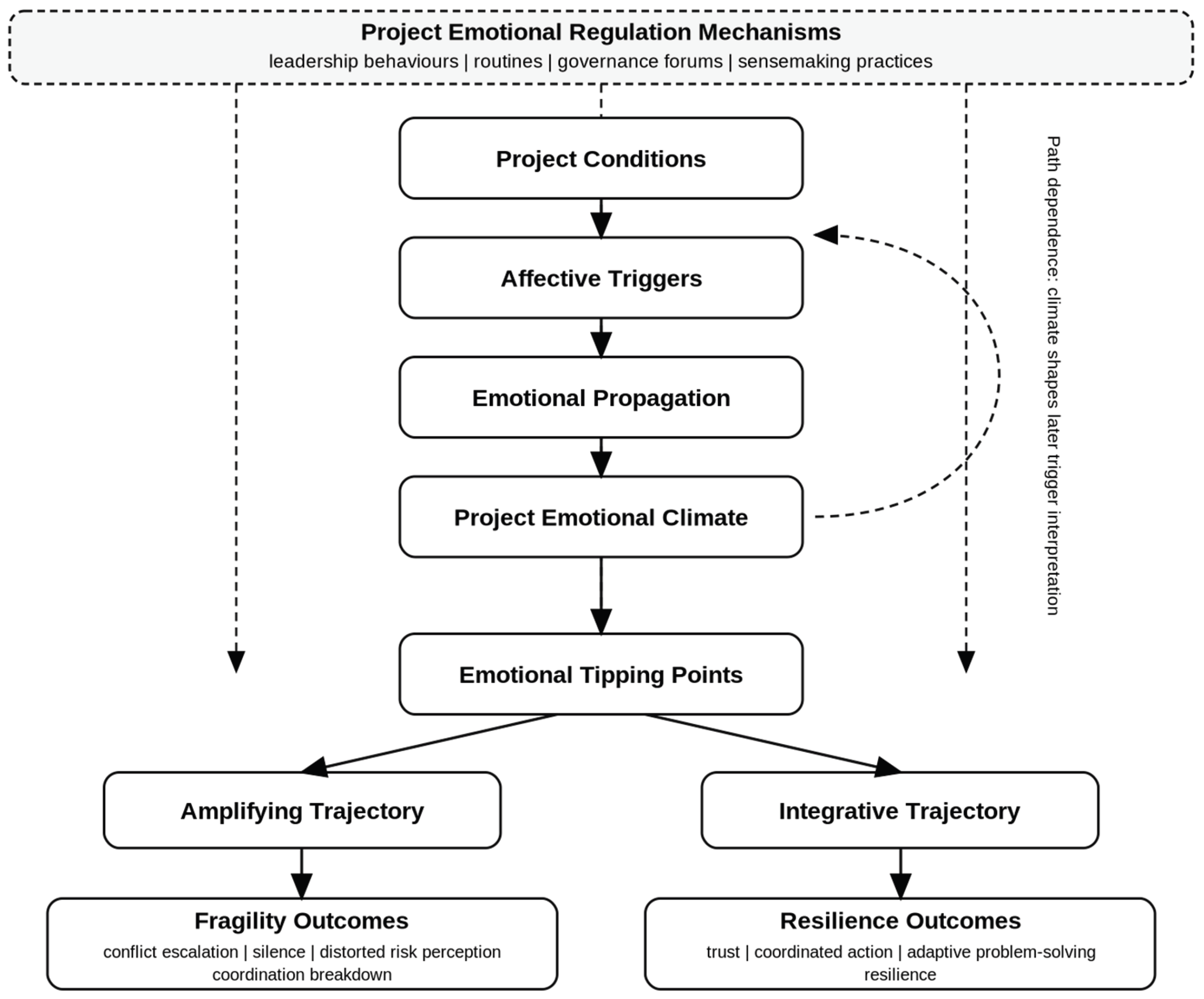
Figure 1.
Emotional Dynamics as Emergent Operating Conditions in Temporary Project Systems. Project conditions heighten emotional sensitivity and make project events more likely to be appraised as affective triggers. Affective responses then propagate through interaction and shared interpretation, stabilizing into project emotional climate. That climate introduces path dependence by shaping later trigger interpretation. Project emotional regulation mechanisms are depicted as cross cutting influences that can intervene at multiple points rather than as a separate stage. Emotional tipping points may lead to amplifying trajectories that increase fragility or integrative trajectories that strengthen resilience.
6. Research Agenda and Operationalization
Emotional dynamics are difficult to observe directly, but they leave traces in project events, interactions, routines, narratives, decisions and governance records. The empirical task is therefore to trace emotional dynamics as they unfold over time, rather than to measure emotion only as an individual variable.
This processual orientation is important. Emotional dynamics unfold through sequences of triggers, interpretations, interactions, stabilizations, thresholds and regulatory interventions. Research designs therefore need to capture temporal movement rather than static emotional states. Process research and project process methods are especially useful because they allow scholars to examine how events unfold, how meanings shift, and how collective patterns form over time (Langley, 1999; Brunet et al., 2021).
6.1. Empirical Tractability of the Model
Each construct in the theory can be operationalized through observable indicators. Project conditions can be examined through uncertainty, time pressure, interdependence, contractual complexity, stakeholder exposure, delivery stakes and leadership instability. Affective triggers can be captured through critical incidents such as delays, design changes, safety events, resource shortages, disputes, leadership decisions or perceived breaches of trust. Emotional propagation can be studied through repeated interaction, communication patterns, meeting exchanges, narrative convergence and the spread of affective language across project actors.
Project emotional climate can be inferred from recurring emotional interpretations: whether actors describe the project as safe or unsafe for voice, controllable or unstable, fair or unfair, trusted or mistrusted, resilient or fragile. Path dependence can be examined by tracing how earlier affective episodes shape later interpretations and responses. Emotional tipping points can be identified when accumulated affect coincides with shifts in collective behavior, such as conflict escalation, withdrawal of voice, defensive decision making, distorted risk perception or coordination breakdown. Project emotional regulation mechanisms can be studied through leadership behaviors, communication routines, governance practices, escalation processes, conflict resolution forums and structured sensemaking routines.
To examine reciprocity, researchers should distinguish formal design, administration events, emotional appraisal, collective climate and subsequent enactment. Silence, a disputed claim or delayed escalation should not be treated as evidence of emotional climate on its own. Alternative explanations, including cash flow pressure, contractual ambiguity, power asymmetry and staff turnover, must also be considered.
Table 5.
Operationalizing emotional dynamics in projects.
| Construct | Empirical markers | Possible data sources |
|---|---|---|
| Project conditions | Time pressure, uncertainty, interdependence, high stakes, multi organizational interfaces | Project plans, schedules, contracts, governance documents, stakeholder maps |
| Affective triggers | Delays, disputes, safety events, perceived breaches of trust, criticism, leadership decisions | Incident logs, meeting minutes, interviews, diaries, escalation records |
| Emotional propagation | Repeated affective language, narrative convergence, emotional repetition across actors | Meeting transcripts, email archives, collaboration platforms, observation notes |
| Project emotional climate | Recurring shared interpretations of safety, fairness, trust, control, voice or fragility | Interviews, meeting observations, narrative analysis, climate coding |
| Path dependence | Earlier affective episodes used as reference points for later interpretation | Longitudinal case data, process tracing, project histories, reflective reviews |
| Emotional tipping points | Qualitative shifts in voice, risk perception, trust, conflict, coordination or decision making | Critical incidents, decision logs, governance records, meeting transcripts |
| Regulation mechanisms | Framing, escalation, governance forums, sensemaking routines, conflict repair | Governance records, leader communications, workshop notes, intervention records |
This operational logic means that the theory does not require researchers to access private emotional states directly. Instead, it invites researchers to study how emotions become socially expressed, interpreted, transmitted and stabilized within project systems. The object of analysis is not emotion as a private state, but emotional dynamics as a visible, relational and temporal project process.
6.2. Methodological Approaches
Longitudinal qualitative research is especially well suited to this theory because emotional dynamics unfold over time. Longitudinal case studies of live projects could trace how affective triggers develop into propagation, climate formation, tipping points and trajectories across project phases, governance cycles and stakeholder interactions.
Ethnographic and observational work is useful where the aim is to capture emotional dynamics as they happen. Meeting observations, site visits, governance forums and informal interactions can show how concern, frustration, confidence, anxiety, silence, humor, blame or care are expressed and reinforced in practice.
Diary and experience sampling designs would bring researchers closer to the moment of appraisal (Bolger & Laurenceau, 2013). Project actors could record emotionally salient incidents, perceived causes, interaction patterns and subsequent behavioral responses over time.
Network analysis offers a different lens on propagation (Borgatti et al., 2018). Communication, advice, trust, conflict, escalation and informal influence networks can reveal how emotional signals move through project systems and whether particular actors act as amplifiers, brokers or stabilizers.
Text based analysis could complement these approaches. Project emails, meeting minutes, issue logs, risk registers, change requests and collaboration platform records may contain affective signals that can be tracked over time (Gentzkow et al., 2019). Such analysis should not replace interpretation, but it can help identify changes in emotional tone, recurring affective themes and moments where project narratives shift.
Critical incident analysis is particularly useful for studying tipping points. It can reconstruct emotionally salient project episodes and examine how actors interpreted an incident, how responses propagated, whether the episode altered project climate, and whether regulation mechanisms contained or amplified the trajectory (Flanagan, 1954).
The strongest empirical designs will be multi method. For example, a longitudinal case study could combine meeting observations, interviews, diary entries, communication artefacts and network data. Such designs would allow researchers to triangulate emotional dynamics across what actors say, how they interact, how communication changes and how project behavior shifts. They also support stronger theory building by aligning method choice with the temporal and relational nature of the phenomenon (Bansal et al., 2018).
6.3. Units of Analysis
The theory supports multiple units of analysis, but the primary unit is the project system. This is important because the theory does not treat emotion as merely an individual attribute. Individual actors matter because they appraise events and express affective responses. Teams matter because emotional interpretations are often reinforced through local interaction. Organizations matter because identities, incentives and governance structures shape emotional alignment. However, the distinctive contribution of the theory lies in explaining how emotional dynamics become project level operating conditions.
Researchers may therefore study emotional dynamics at several nested levels. At the individual level, they may examine how actors appraise affective triggers. At the interactional level, they may examine how emotional responses are communicated and reinforced. At the group level, they may examine emotional sub-climates within functional, professional, organizational or project coalitions. At the project level, they may examine how emotional climates shape collective judgement, coordination and decision making. At the inter organizational level, they may examine how emotional dynamics move across client, contractor, consultant and stakeholder boundaries.
This multi-level logic is important because emotional dynamics may not be evenly distributed across the project. A project may contain pockets of trust and mistrust, confidence and anxiety, voice and silence. Future research should therefore examine not only whether a project has an emotional climate, but how emotional sub-climates interact, compete, converge or destabilize one another.
6.4. Boundary Conditions and Comparative Designs
The theory is not intended to apply equally to all projects. Emotional dynamics are expected to be more consequential under conditions of high uncertainty, time pressure, interdependence, high stakes, multi organizational delivery and leadership instability. These conditions matter because they heighten emotional sensitivity in different ways. Uncertainty increases appraisal ambiguity; time pressure reduces opportunities for interpretive repair; interdependence accelerates propagation across actors; high stakes increase emotional salience; multi organizational delivery creates identity, loyalty and incentive fragmentation; and leadership instability weakens regulatory capacity. Comparative research designs can test this boundary logic by examining projects that differ in complexity, contractual structure, stakeholder exposure, safety risk, schedule pressure or organizational fragmentation.
Construction, infrastructure, engineering, health, defense, emergency response and digital transformation projects may be especially useful empirical settings because they often combine uncertainty, interdependence, compressed schedules and high consequences. The theory is expected to be less explanatory in highly routine, low stakes or loosely coupled projects where affective triggers are less salient, propagation is slower, and emotional conditions are less likely to stabilize into project level operating conditions. Comparative studies could examine whether emotional propagation differs between alliance and adversarial contracting models, whether safety critical projects display different emotional regulation mechanisms, or whether integrated teams develop project emotional climates differently from fragmented delivery systems.
Boundary conditions should also be used to challenge the theory. Future research should examine cases where emotional dynamics do not propagate despite strong affective triggers, where negative emotional climates do not reach tipping points, or where severe project disruptions generate integrative rather than amplifying trajectories. Such cases would help refine the role of regulatory capacity, leadership routines, relational norms and governance practices.
These are boundary conditions, not limitations. They specify where the theory is expected to have greatest explanatory power, rather than identifying weaknesses in the theory.
Several limitations follow from the theory’s current stage of development. First, the model has not yet been empirically tested. Second, collective emotional conditions must be inferred from observable traces rather than accessed directly. Third, aggregation remains challenged in fragmented project systems where sub-climates may diverge. Fourth, emotional dynamics may be culturally and institutionally contingent. Fifth, empirical studies will need to distinguish emotional effects from contractual, political and economic drivers. Finally, studies using email, collaboration platform or behavioral data raise ethical and privacy concerns that require careful governance.
6.5. Future Research Directions
The theory opens several research directions. First, future studies can map emotional trajectories across project life cycles, examining whether emotional climates form differently during initiation, design, procurement, delivery, commissioning and close out. Second, researchers can investigate emotional tipping points by identifying threshold moments where accumulated affect alters collective behavior. Third, scholars can examine emotional propagation networks, including the role of brokers, boundary spanners, project leaders and informal influencers.
Fourth, future research can study project emotional regulation mechanisms. This includes examining which leadership behaviors, routines and governance practices dampen destructive trajectories, which redirect emotional tension into problem solving, and which unintentionally amplify mistrust, silence or conflict. Fifth, scholars can investigate emotional sub-climates across project groups and examine how these sub-climates converge, fragment or compete. Sixth, future work can develop indicators of project emotional climate that may support project assurance, early warning systems and reflective governance practices.
A final research direction concerns the relationship between emotional dynamics and project performance. The theory does not assume that negative emotion necessarily produces poor outcomes or that positive emotion automatically improves performance. Frustration may surface important risks, anxiety may sharpen attention, and shared urgency may mobilize action. Conversely, excessive confidence may suppress dissent or mask weak signals. Future research should therefore examine how emotional trajectories interact with risk perception, voice, decision quality, resilience and performance under different project conditions.
Future research could also examine reciprocal links between formal mechanisms and emotional climate, including how contractual administration and risk escalation generate emotional appraisal, and how stabilized emotional climates later shape disclosure, cooperation and use of formal governance mechanisms.
By making emotional dynamics empirically tractable, this research agenda shifts the study of emotion in projects from individual traits and interpersonal episodes to temporal, relational and project level processes. It invites scholars to examine how emotional conditions emerge, propagate, stabilize, tip and become regulated within temporary project systems.
7. Discussion and Contribution
The value of the theory lies in what it allows project management scholarship to explain: why formal mechanisms may remain intact while collective judgement, voice, trust and coordination deteriorate. Emotional dynamics matter here not as background sentiment, but as operating conditions through which project work is interpreted and enacted.
The theory contributes to project management scholarship in four ways.
7.1. Theoretical Contribution: Emotional Dynamics as Project Level Operating Conditions
The first contribution is theoretical. The paper shifts the study of emotion in projects from individual emotion, interpersonal behavior and leadership capability to project level emotional dynamics. Existing project management research has shown that emotion, trust, conflict, psychological safety, leadership and wellbeing matter for project outcomes. However, these literatures have not yet been integrated into a theory explaining how emotional dynamics become collective, temporal and consequential within temporary project systems.
By theorizing emotional dynamics as emergent operating conditions, the paper expands what project management theory can explain. Formal project mechanisms do not operate only through their technical design. Plans, risk registers, governance structures, communication protocols and stakeholder processes are interpreted and enacted through emotional conditions. A project may therefore remain formally well managed while becoming emotionally fragile. Conversely, a project under significant pressure may remain adaptive when emotional dynamics stabilize into trust, shared urgency and collective responsibility.
This contribution does not replace existing explanations based on governance, leadership, risk or stakeholder management. It explains how these mechanisms become effective depending on the emotional operating conditions through which actors interpret and enact them.
7.2. Conceptual Contribution: Six Constructs and Two Emotional Trajectories
The second contribution is conceptual. The paper develops six constructs for studying emotional dynamics in projects: project conditions, affective triggers, emotional propagation, project emotional climate, emotional tipping points and project emotional regulation mechanisms. These constructs provide a vocabulary for analyzing how emotional dynamics are activated, transmitted, stabilized, intensified and regulated over time.
The construct of project emotional climates is especially important because it distinguishes project specific emotional climates from more stable organizational climates. Project emotional climates emerge under temporary, time bound and interdependent conditions, often with limited shared history, compressed interaction cycles, uncertain authority relations and heightened delivery pressure. This makes them more rapidly formed, more volatile and potentially more consequential within shorter timeframes.
The paper also introduces path dependence and emotional tipping points into the study of project emotion. Path dependence explains how early affective episodes shape later interpretations, expectations and responses. Emotional tipping points explain how accumulated affect may reach thresholds that alter collective behavior. Together, these concepts move the study of emotion in projects beyond isolated emotional episodes and toward a dynamic account of emotional trajectories.
The distinction between amplifying and integrative trajectories is also central. Amplifying trajectories may intensify fear, frustration, mistrust, silence, blame or distorted risk perception, thereby increasing project fragility. Integrative trajectories may stabilize confidence, shared urgency, care, trust and adaptive problem solving, thereby strengthening resilience and collective action. This dual pathway logic avoids treating emotion as either a problem to be controlled or a resource to be celebrated.
7.3. Methodological Contribution: Studying Emotion as a Temporal Project Level Process
The third contribution is methodological. The theory provides a basis for studying emotional dynamics as temporal, relational and project level processes rather than static individual variables. It identifies observable indicators for each construct: project conditions, affective triggers, propagation patterns, emotional climates, path dependent interpretations, tipping points and regulation mechanisms.
The methodological contribution is not simply that multiple methods can be used. It is that the theory specifies what research should trace: the movement from individual appraisal to collective emotional condition, and from collective emotional condition to project behavior. This provides a more precise empirical agenda for future research on emotion in project management.
7.4. Practical Contribution: Reframing Governance, Assurance and Leadership
The fourth contribution is practical. The theory suggests that project assurance should attend not only to cost, schedule, scope, risk and governance compliance, but also to the emotional operating conditions through which these mechanisms are interpreted and enacted. Emotional dynamics shape whether risks are surfaced, whether warnings are heard, whether conflict becomes productive or destructive, whether actors trust governance processes and whether teams retain the capacity for coordinated action under pressure.
This does not reduce the theory to emotional intelligence or leadership advice. Project emotional regulation mechanisms include leadership behaviors, but they also include routines, governance practices, communication structures, escalation processes, sensemaking forums, conflict resolution practices and reflective reviews. These mechanisms can dampen destructive escalation, redirect emotional tension into problem solving or amplify constructive urgency around shared risks.
For practitioners, the theory encourages earlier attention to weak emotional signals. Repeated silence in meetings, defensive communication, avoidance of risk escalation, recurring blame narratives, growing mistrust between groups or sudden withdrawal of participation may indicate that emotional climate is shifting. These signals should not be treated merely as interpersonal issues. They may indicate changes in the project’s operating conditions.
7.5. Implications for Project Management Theory
The broader implication is that project management theory needs to treat formal and emotional conditions as intertwined. Plans, governance structures, risk processes and stakeholder mechanisms remain essential, but their effects depend on how project actors interpret and enact them. Emotional dynamics influence those interpretations. They shape whether formal mechanisms generate confidence or suspicion, voice or silence, coordination or fragmentation, resilience or fragility.
The argument extends project management theory by explaining how emotional dynamics become collective, temporal, path dependent and consequential within temporary project systems. In doing so, it provides a theoretical foundation for a new research stream on emotional dynamics in projects.
Future research can refine, test and challenge this theory across project types, sectors and delivery models. The most valuable studies will not ask whether projects contain emotion. They will ask how emotional dynamics emerge, how they propagate, when they stabilize, when they tip, how they are regulated and how they shape the interpretation and enactment of formal project mechanisms.
8. Conclusions
This paper has developed a theory of emotional dynamics as emergent operating conditions in temporary project systems. The central argument is that project actors do not interpret and enact formal plans, risks, decisions and relationships in emotionally neutral ways. Emotional dynamics arise from project conditions, are activated by affective triggers, propagate through interaction, stabilize into project emotional climates, exhibit path dependence and may reach tipping points that redirect collective behavior.
The theory shifts attention from emotion as an individual trait, interpersonal issue or leadership competency to emotion as a project level process. It explains how emotional conditions become consequential for judgement, trust, risk perception, conflict, voice, coordination and decision quality. It also distinguishes between amplifying trajectories that increase project fragility and integrative trajectories that strengthen resilience and collective action.
By introducing six constructs — project conditions, affective triggers, emotional propagation, project emotional climate, emotional tipping points and project emotional regulation mechanisms — the paper provides a vocabulary for analyzing how emotional dynamics unfold within temporary project systems. It also identifies methodological pathways for future research capable of tracing how emotional conditions emerge, propagate, stabilize, tip and become regulated.
The contribution is to explain how emotion becomes collective, temporal, path dependent and project level. Formal mechanisms may remain in place, but their effectiveness can be weakened by the emotional conditions through which actors interpret and enact them. In doing so, the paper adds a missing explanatory layer to project management theory and opens a research agenda on emotional operating conditions in temporary project systems.
Author Contributions
Conceptualization, Z.V.; theoretical development, Z.V.; methodology, Z.V.; writing – original draft preparation, Z.V.; writing – review and editing, Z.V., M.S., R.M. and M.C.; critical review and conceptual refinement, M.S., R.M. and M.C.; visualization, Z.V.; project administration, Z.V. All authors have read and agreed to the submitted version of the manuscript.
Funding
This research received no external funding.
Generative AI Disclosure
Generative AI tools were used to support language refinement and the development of the figure under the authors’ direction. The authors take full responsibility for the work.
Conflicts of Interest
The authors declare no conflict of interest.
References
- Ashforth, B. E.; Mael, F. Social identity theory and the organization. Acad. Manag. Rev. 1989, 14(1), 20–39. [Google Scholar] [CrossRef]
- Ashkanasy, N. M.; Dorris, A. D. Emotions in the workplace. Annu. Rev. Organ. Psychol. Organ. Behav. 2017, 4, 67–90. [Google Scholar] [CrossRef]
- Bakker, R. M. Taking stock of temporary organizational forms: A systematic review and research agenda. Int. J. Manag. Rev. 2010, 12(4), 466–486. [Google Scholar] [CrossRef]
- Bakker, R. M.; DeFillippi, R. J.; Schwab, A.; Sydow, J. Temporary organizing: Promises, processes, problems. Organ. Stud. 2016, 37(12), 1703–1719. [Google Scholar] [CrossRef]
- Bansal, P.; Smith, W. K.; Vaara, E. New ways of seeing through qualitative research. Acad. Manag. J. 2018, 61(4), 1189–1195. [Google Scholar] [CrossRef]
- Barsade, S. G. The ripple effect: Emotional contagion and its influence on group behavior. Adm. Sci. Q. 2002, 47(4), 644–675. [Google Scholar] [CrossRef]
- Barsade, S. G.; Gibson, D. E. Group affect: Its influence on individual and group outcomes. Curr. Dir. Psychol. Sci. 2012, 21(2), 119–123. [Google Scholar] [CrossRef]
- Bolger, N.; Laurenceau, J.-P. Intensive longitudinal methods: An introduction to diary and experience sampling research; Guilford Press, 2013. [Google Scholar]
- Bond-Barnard, T. J.; Fletcher, L.; Steyn, H. Linking trust and collaboration in project teams to project management success. Int. J. Manag. Proj. Bus. 2018, 11(2), 432–457. [Google Scholar] [CrossRef]
- Borgatti, S. P.; Everett, M. G.; Johnson, J. C. Analyzing social networks, 2nd ed.; Sage, 2018. [Google Scholar]
- Brunet, M.; Fachin, F. F.; Langley, A. Studying projects processually. Int. J. Proj. Manag. 2021, 39(8), 834–848. [Google Scholar] [CrossRef]
- Burke, C. M.; Morley, M. J. On temporary organizations: A review, synthesis and research agenda. Hum. Relat. 2016, 69(6), 1235–1258. [Google Scholar] [CrossRef]
- Clarke, N. Emotional intelligence and its relationship to transformational leadership and key project manager competences. Proj. Manag. J. 2010, 41(2), 5–20. [Google Scholar] [CrossRef]
- de Wit, F. R. C.; Greer, L. L.; Jehn, K. A. The paradox of intragroup conflict: A meta-analysis. J. Appl. Psychol. 2012, 97(2), 360–390. [Google Scholar] [CrossRef] [PubMed]
- Edmondson, A. C. Psychological safety and learning behavior in work teams. Adm. Sci. Q. 1999, 44(2), 350–383. [Google Scholar] [CrossRef]
- Fisher, E. What practitioners consider to be the skills and behaviours of an effective people project manager. Int. J. Proj. Manag. 2011, 29(8), 994–1002. [Google Scholar] [CrossRef]
- Flanagan, J. C. The critical incident technique. Psychol. Bull. 1954, 51(4), 327–358. [Google Scholar] [CrossRef] [PubMed]
- Gentzkow, M.; Kelly, B.; Taddy, M. Text as data. J. Econ. Lit. 2019, 57(3), 535–574. [Google Scholar] [CrossRef]
- Geraldi, J.; Maylor, H.; Williams, T. Now, let’s make it really complex (complicated): A systematic review of the complexities of projects. Int. J. Oper. Prod. Manag. 2011, 31(9), 966–990. [Google Scholar] [CrossRef]
- Geraldi, J.; Söderlund, J. Project studies: What it is, where it is going. Int. J. Proj. Manag. 2018, 36(1), 55–70. [Google Scholar] [CrossRef]
- Geraldi, J.; Söderlund, J.; van Marrewijk, A. Advancing theory and debate in project studies. Proj. Manag. J. 2020, 51(4), 351–356. [Google Scholar] [CrossRef]
- Hällgren, M.; Rouleau, L.; de Rond, M. A matter of life or death: How extreme context research matters for management and organization studies. Acad. Manag. Ann. 2018, 12(1), 111–153. [Google Scholar] [CrossRef]
- Hatfield, E.; Cacioppo, J. T.; Rapson, R. L. Emotional contagion; Cambridge University Press, 1994. [Google Scholar]
- Jehn, K. A. A multimethod examination of the benefits and detriments of intragroup conflict. Adm. Sci. Q. 1995, 40(2), 256–282. [Google Scholar] [CrossRef]
- Kapsali, M.; Prouska, R.; Hajikazemi, S. The experience of wellbeing practices in project-based organisations. Int. J. Manpow. 2025, 46(3), 573–596. [Google Scholar] [CrossRef]
- Langley, A. Strategies for theorizing from process data. Acad. Manag. Rev. 1999, 24(4), 691–710. [Google Scholar] [CrossRef]
- Lundin, R. A.; Söderholm, A. A theory of the temporary organization. Scand. J. Manag. 1995, 11(4), 437–455. [Google Scholar] [CrossRef]
- Morris, P. W. G.; Pinto, J. K.; Söderlund, J. (Eds.) The Oxford handbook of project management; Oxford University Press, 2011. [Google Scholar] [CrossRef]
- Morrison, E. W. Employee voice and silence. Annu. Rev. Organ. Psychol. Organ. Behav. 2014, 1, 173–197. [Google Scholar] [CrossRef]
- Rezvani, A.; Chang, A.; Wiewiora, A.; Ashkanasy, N. M.; Jordan, P. J.; Zolin, R. Manager emotional intelligence and project success: The mediating role of job satisfaction and trust. Int. J. Proj. Manag. 2016, 34(7), 1112–1122. [Google Scholar] [CrossRef]
- Shepherd, D. A.; Cardon, M. S. Negative emotional reactions to project failure and the self-compassion to learn from the experience. J. Manag. Stud. 2009, 46(6), 923–949. [Google Scholar] [CrossRef]
- Smyth, H.; Gustafsson, M.; Ganskau, E. The value of trust in project business. Int. J. Proj. Manag. 2010, 28(2), 117–129. [Google Scholar] [CrossRef]
- Sunindijo, R. Y.; Zou, P. X. W. The roles of emotional intelligence, interpersonal skill, and transformational leadership on improving construction safety performance. Constr. Econ. Build. 2013, 13(3), 97–113. [Google Scholar] [CrossRef]
- Sydow, J.; Schreyögg, G.; Koch, J. Organizational path dependence: Opening the black box. Acad. Manag. Rev. 2009, 34(4), 689–709. [Google Scholar] [CrossRef]
- Sydow, J.; Windeler, A. Temporary organizing and permanent contexts. Curr. Sociol. 2020, 68(4), 480–498. [Google Scholar] [CrossRef]
- Tajfel, H.; Turner, J. C. An integrative theory of intergroup conflict. In The social psychology of intergroup relations; Austin, W. G., Worchel, S., Eds.; Brooks/Cole, 1979; pp. 33–47. [Google Scholar]
- Turner, J. R.; Müller, R. The project manager’s leadership style as a success factor on projects: A literature review. Proj. Manag. J. 2005, 36(2), 49–61. [Google Scholar] [CrossRef]
- Vuori, T. O.; Huy, Q. N. Regulating top managers’ emotions during strategy making: Nokia’s socially distributed approach enabling radical change. Acad. Manag. J. 2022, 65(1), 331–361. [Google Scholar] [CrossRef]
- Weick, K. E. Sensemaking in organizations; Sage, 1995. [Google Scholar]
- Weiss, H. M.; Cropanzano, R. Affective events theory: A theoretical discussion of the structure, causes, and consequences of affective experiences at work. Res. Organ. Behav. 1996, 18, 1–74. [Google Scholar]
- Whitty, S. J. Project management artefacts and the emotions they evoke. Int. J. Manag. Proj. Bus. 2010, 3(1), 22–45. [Google Scholar] [CrossRef]
- Winch, G. M. Managing construction projects: An information processing approach, 2nd ed.; Wiley-Blackwell, 2010. [Google Scholar]
- Zhao, W.; Li, S. How does psychosocial safety climate affect safety behavior in the construction industry? A cross-level analysis. Front. Public Health 2024, 12, 1473449. [Google Scholar] [CrossRef] [PubMed]
Table 1.
Levels of analysis in emotional dynamics.
| Level | Role in the theory | Relevant constructs |
|---|---|---|
| Individual | Actors appraise events emotionally | Affective triggers |
| Interactional | Emotional responses are expressed and transmitted | Emotional propagation |
| Group / subproject | Shared interpretations stabilize within subgroups | Emotional sub-climates |
| Project system | Emotional patterns shape formal mechanisms and collective behavior | Project emotional climate; emotional tipping points |
| Inter organizational | Emotional dynamics cross organizational, contractual and stakeholder boundaries | Propagation; regulation mechanisms; path dependence |
Disclaimer/Publisher’s Note: The statements, opinions and data contained in all publications are solely those of the individual author(s) and contributor(s) and not of MDPI and/or the editor(s). MDPI and/or the editor(s) disclaim responsibility for any injury to people or property resulting from any ideas, methods, instructions or products referred to in the content. |
© 2026 by the authors. Licensee MDPI, Basel, Switzerland. This article is an open access article distributed under the terms and conditions of the Creative Commons Attribution (CC BY) license (http://creativecommons.org/licenses/by/4.0/).
Copyright: This open access article is published under a Creative Commons CC BY 4.0 license, which permit the free download, distribution, and reuse, provided that the author and preprint are cited in any reuse.