

Submitted:
09 October 2026
Posted:
12 October 2026
You are already at the latest version
Abstract
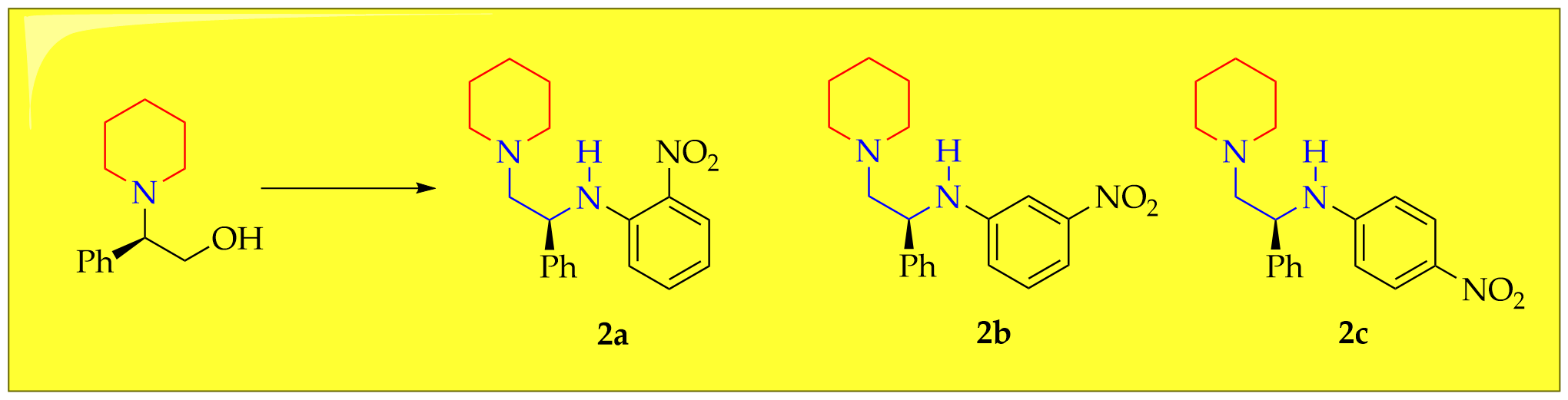
Three chiral 1,2-diamines were successfully synthesized from readily available (R)-2-phenyl-2-(piperidin-1-yl)ethan-1-ol. The reaction proceeded through the regioselective ring opening of a common N,N-dialkylaziridinium ion by weakly nucleophilic anilines. The structures of newly synthesized diamines were confirmed by 1H and 13C nuclear magnetic resonance (NMR) spectroscopy, infrared (IR) spectroscopy, and high-resolution mass spectrometry (HRMS). Anticancer activity assays of the synthesized compounds are currently underway.
Keywords:
chiral diamines
; ring opening
; aziridinium ion
; (R)-(−)-2-phenylglycinol
1. Introduction
Vicinal diamines are among the most valuable synthetic intermediates, as they have been employed as pharmacological agents [1,2], organocatalysts [3], chiral auxiliaries [4] and building blocks for the construction of heterocycles [5] and nitrogen containing macrocycles [6]. In addition, 1,2-diamines have been widely used as chiral ligands in important reactions, including Michael additions [7], alkylation of aldehydes [8], epoxidation [9] and Diels-Alder [10].
More specifically, (S)-1-phenyl-2-(piperidin-1-yl)ethan-1-amine derivatives have been shown to exhibit biological activity [11] and have been employed as chiral chelated lithium amides in enantioselective reactions [12,13]. Among the various approaches for synthesizing these derivatives, one of the most efficient methods is based on the nucleophilic ring opening of N,N-dialkylaziridinium ions by primary or secondary amines [14]. Ring-opening reactions with aniline nucleophiles have also been reported [15]; however, to the best of our knowledge, the use of weakly nucleophilic anilines, such as nitroanilines, in the ring opening of these intermediates has not yet been investigated.
In line with our interest in the synthesis of chiral, non-racemic heterocyclic compounds derived from (R)-(−)-2-phenylglycinol [16,17,18], we herein report the synthesis of chiral 1,2-diamines through the regioselective ring opening of a common N,N-dialkylaziridinium ion (I) with weakly nucleophilic anilines.
2. Results and Discussion
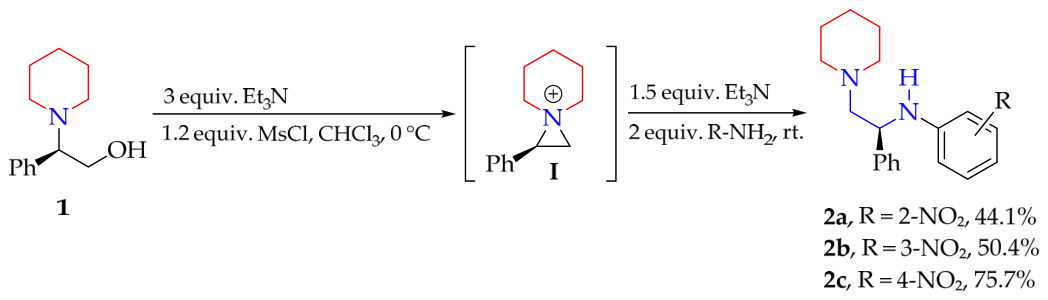
The synthetic methodology for obtaining the target compounds 2 involves the use of (R)-2-phenyl-2-(piperidin-1-yl)ethan-1-ol (1) as the heterocyclic core. Compound 1 could be easily synthesized from (R)-(−)-2-phenylglycinol following our previously reported reaction conditions [19]. Next, we turned our attention to the synthesis of chiral 1,2-diamines with weakly nucleophilic anilines using a modified version of O´Brien´s method [14]. Therefore, we explored o-, m-, and p-nitroanilines as nucleophiles in the ring-opening reaction of the common N,N-dialkylaziridinium ion I, affording the corresponding chiral 1,2-diamines 2a–c in 44, 50, and 75% yields, respectively, with high regio- and stereoselectivity (Scheme 1). The observed regio- and stereoselectivity of the ring-opening process are consistent with those previously reported for anilines bearing electron-donating substituents [15]. On the other hand, the lower yield with o-nitroaniline may be attributed to steric and electronic effects associated with the proximal nitro group, including intramolecular hydrogen bonding [20].
The structures of the synthesized diamines were confirmed by analytical and spectral data (see Supporting Information, SI). As a representative example, chiral diamine 2c was obtained as a yellow solid with a molecular formula of C19H23N3O2, as determined by HRMS (ESI-TOF), which showed an [M+H]+ ion at m/z 326.1859 (calcd for C19H24N3O2, 326.1869). The 1H-NMR spectrum displayed two doublets at δ 7.97 and 6.45 ppm, which were assigned to the aromatic protons of the aniline moiety. The NH proton appeared as a broad single signal at δ 6.17 ppm. In contrast, the NH proton of the corresponding o-nitroaniline derivative 2a was observed at approximately δ 9.0 ppm, which may be attributed to intramolecular hydrogen bonding with the adjacent nitro group.
Notably, the chiral benzylic proton (δ 4.40, ddd) was observed at a higher chemical shift than typical benzylic proton [21]. This chemical shift can be attributed to the combined deshielding effects of the adjacent phenyl ring and the α-amino environment of the stereogenic carbon. The signals at δ 2.56, 2.33, 1.60, and 1.47 ppm were assigned to the diastereotopic methylene protons of the piperidine moiety (Figure S13). The 13C NMR and HSQC spectra of 2c displayed 13 distinct carbon signals, including four methylene signals, six methine signals and three ipso carbon signals, in agreement with the proposed structure (Figure S14 and Figure S16).
3. Materials and Methods
3.1. General
All reagents and solvents were purchased from commercial sources. The 1H and 13C spectra were determined with a Bruker Avance III Spectrometer (CDCl3 solvents) operating at 500 and 125 MHz, respectively. The chemical shifts are reported in parts per million (ppm), downfield from SiMe4 (δ 0.0) and relative to the signal of chloroform-d (δ 7.26, singlet). Multiplicities were afforded as follows s (singlet); d (doublet); t (triplet); q (quartet); dd (doublets of doublet); ddd (doublet of doublets of doublets); or m (multiplets). The number of protons for a given resonance is indicated by nH. The coupling constants are reported as J values in Hz. Thin layer chromatography (TLC) was used to monitor the reaction on Merck 60 F254 precoated silica gel plates (0.2 mm thickness). Optical rotations were measured with an Autopol-III polarimeter using the sodium D line (589 nm). High-resolution mass spectra (HRMS) were obtained in a Synapt G2-Si (Waters) spectrometer equipped with electrospray ion source (ESI), single quadrupole mass filter and time of flight mass analyzer (Q-TOF). Mass spectrometer was operated in positive mode, calibrated with HCOONa and exact mass was corrected with leucine enkephaline (556.2771). Infrared spectra were recorded on a Bruker Tensor 27 spectrometer. The products were purified by column chromatography on silica gel 60 (63–200 nm).
3.2. Synthesis of (R)-2-Phenyl-2-(Piperidin-1-yl)Ethan-1-ol (1).
Chiral enantiopure (R)-2-phenyl-2-(piperidin-1-yl)ethan-1-ol 1 was prepared using the reaction conditions previously established by our group [19].
Yellow oil; yield (135 mg, 90%); [α]D20 = -28.9 (c = 1.0, CH2Cl2); FT-IR νmax 3446, 1637 cm-1. 1H NMR (500 MHz, CDCl3) δ 7.34-7.16 (m, 5H); 3.97 (t, J = 10.00 Hz, 1H); 3.66 (dd, J = 9.77, 5.34 Hz, 1H); 3.60 (dd, J = 10.28, 5.28 Hz, 1H); 3.47 (s, 1H-OH); 2.54 (m, 2H); 2.24 (m, 2H); 1.57 (m, 4H); 1.32 (m, 2H). 13C NMR (126 MHz, CDCl3) δ 135.65, 128.99, 128.09, 127.80, 70.37, 59.94, 50.23, 26.49, 24.48. MS-EI (m/z) = [205]+.
3.3. Experimental Procedures of Products 2a–c.
To a solution of (R)-2-phenyl-2-(piperidin-1-yl)ethanol 1 (0.05 g, 0.243 mmol) in CHCl3 (4 mL) at 0 °C was added triethylamine (0.10 mL, 0.731 mmol, 3 equiv.). Then, methanesulfonyl chloride (0.02 mL, 0.292 mmol, 1.2 equiv.) was added dropwise to maintain the reaction temperature below 5 °C. After 30 min, the reaction was monitored by TLC (CH2Cl2/MeOH, 95:5), which indicated that the reactants were consumed. Triethylamine (0.05 mL, 0.365 mmol, 1.5 equiv.) was added. Finally, the corresponding nitroaniline (2 equiv.) was added, and the reaction mixture was left at room temperature for 16 h. After completion of the reaction as indicated by TLC, the solvent was removed under vacuum, and the residue was dissolved in CH2Cl2 and washed with water, and brine before drying over anhydrous sodium sulfate. The solvent was removed under vacuum, and the crude product was purified by column chromatography (CH2Cl2/MeOH, 97:3) which afforded the desired 1,2-diamines 2a–c.
3.3.1. Synthesis of (S)-2-Nitro-N-(1-Phenyl-2-(Piperidin-1-yl)Ethyl)Aniline (2a).
Yellow solid; yield (35 mg, 44.1%); Mp 108 °C; FT-IR max 3350, 3066, 2940, 2919, 2360, 1566, 1350 cm-1; [α]D25 = -422.0 (c 1.0, CH2Cl2). 1H NMR (500 MHz, CDCl3) δ 9.09 (s, 1H), 8.17 (dd, J = 8.6, 1.9 Hz, 1H) 7.36 – 7.24 (m, 5H), 7.17 (m, 1H), 6.55 (m, 1H), 4.55 (t, J = 7.1 Hz, 1H), 2.66 (d, J = 7.4 Hz, 2H), 2.53 (t, J = 9.2 Hz, 2H), 2.37 (s, 2H), 1.61 (m, 4H), 1.43 (m, 2H). 13C NMR (125 MHz, CDCl3) δ 145.0, 141.7, 135.7, 133.0, 129.1, 127.6, 126.8, 126.3, 116.1, 115.5, 65.6, 55.6, 54.4, 26.1, 24.5. HRMS (ESI-TOF) m/z: [M+H]+ calcd for C19H24N3O2, 326.1869; found, 326.1869.
3.3.2. Synthesis of (S)-3-Nitro-N-(1-Phenyl-2-(Piperidin-1-yl)Ethyl)Aniline (2b).
Yellow solid; yield (40 mg, 50.4%); Mp 116 °C; FT-IR max 3332, 2947, 2915, 2360, 1525, 1350 cm-1; [α]D25 = +8.4 (c 1.0, CH2Cl2). 1H NMR (500 MHz, CDCl3) δ 7.46 (dd, J = 8.1, 2.2 Hz, 1H) 7.41 – 7.32 (m, 5H), 7.26 (d, J = 7.1 Hz, 1H), 7.14 (t, J = 8.1 Hz, 1H), 6.75 (dd, J = 8.2, 2.4 Hz, 1H, 5.68 (s, 1H) 4.31 (dd, J = 9.7, 5.8 Hz, 1H), 2.54 (m, 4H), 2.32 (s, 2H), 1.64 (m, 4H), 1.45 (m, 2H). 13C NMR (125 MHz, CDCl3) δ. 149.1, 149.1, 141.7, 129.4, 128.9, 127.5, 126.2, 119.6, 112.0, 108.3, 65.7, 55.2, 54.0, 26.0, 24.3. HRMS (ESI-TOF) m/z: [M+H]+ calcd for C19H24N3O2, 326.1869; found, 326.1867.
3.3.3. Synthesis of (S)-4-Nitro-N-(1-Phenyl-2-(Piperidin-1-yl)Ethyl)Aniline (2c).
Yellow solid; yield (60 mg, 75.7%); Mp 144 °C; FT-IR max 3351, 2933, 1596, 1300, 1107 cm-1; [α]D25 = -2.6 (c 1.0, CH2Cl2). 1H NMR (500 MHz, CDCl3) δ 7.97 (d, J = 9.3 Hz, 2H), 7.39-7.25 (m, H-5), 6.45 (m, 2H), 6.17 (s, 1H), 4.40 (ddd, J = 9.1, 6.3, 2.1 Hz, 1H), 2.56 (m, 4H), 2.33 (m, 2H), 1.60 (m, 4H), 1.47 (m, 2H) 13C NMR (125 MHz, CDCl3) δ 153.5, 141.2, 138.3, 129.1, 127.8, 126.2, 126.1, 112.8, 65.4, 54.8, 54.1, 26.0, 24.3. HRMS (ESI-TOF) m/z: [M+H]+ calcd for C19H24N3O2, 326.1869; found, 326.1859.
4. Conclusions
In conclusion, three chiral 1,2-diamines bearing nitroaniline moieties were synthesized from (R)-2-phenyl-2-(piperidin-1-yl)ethan-1-ol through the regioselective ring opening of a common N,N-dialkylaziridinium ion with o-, m-, and p-nitroanilines. The corresponding diamines were obtained in moderate to good yields (44–75%), and their structures were established by comprehensive spectroscopic and analytical characterization, providing useful data for these new chiral diamine derivatives. The anticancer activity of these new compounds is currently being evaluated.
Supplementary Materials
The following supporting information can be downloaded online. Figure S1:-1H NMR of (S)-2-nitro-N-(1-phenyl-2-(piperidin-1-yl)ethyl)aniline (2a); Figure S2: 13C NMR of (S)-2-nitro-N-(1-phenyl-2-(piperidin-1-yl)ethyl)aniline (2a); Figure S3: NMR COSY of (S)-2-nitro-N-(1-phenyl-2-(piperidin-1-yl)ethyl)aniline (2a); Figure S4: NMR HSQC of (S)-2-nitro-N-(1-phenyl-2-(piperidin-1-yl)ethyl)aniline (2a); Figure S5: IR of (S)-2-nitro-N-(1-phenyl-2-(piperidin-1-yl)ethyl)aniline (2a); Figure S6: HRMS (ESI-TOF) of (S)-2-nitro-N-(1-phenyl-2-(piperidin-1-yl)ethyl)aniline (2a); Figure S7: 1H NMR of (S)-3-nitro-N-(1-phenyl-2-(piperidin-1-yl)ethyl)aniline (2b); Figure S8: 13C NMR of (S)-3-nitro-N-(1-phenyl-2-(piperidin-1-yl)ethyl)aniline (2b); Figure S9: NMR COSY of (S)-3-nitro-N-(1-phenyl-2-(piperidin-1-yl)ethyl)aniline (2b); Figure S10: NMR HSQC of (S)-3-nitro-N-(1-phenyl-2-(piperidin-1-yl)ethyl)aniline (2b); Figure S11: IR of (S)-3-nitro-N-(1-phenyl-2-(piperidin-1-yl)ethyl)aniline (2b); Figure S12: HRMS (ESI-TOF) of (S)-3-nitro-N-(1-phenyl-2-(piperidin-1-yl)ethyl)aniline (2b); Figure S13:1H NMR of (S)-4-nitro-N-(1-phenyl-2-(piperidin-1-yl)ethyl)aniline (2c); Figure S14: 13C NMR of (S)-4-nitro-N-(1-phenyl-2-(piperidin-1-yl)ethyl)aniline (2c); Figure S15: NMR COSY of (S)-4-nitro-N-(1-phenyl-2-(piperidin-1-yl)ethyl)aniline (2c); Figure S16: NMR HSQC of (S)-4-nitro-N-(1-phenyl-2-(piperidin-1-yl)ethyl)aniline (2c); Figure S17: IR of (S)-4-nitro-N-(1-phenyl-2-(piperidin-1-yl)ethyl)aniline (2c); Figure S18: HRMS (ESI-TOF) of (S)-4-nitro-N-(1-phenyl-2-(piperidin-1-yl)ethyl)aniline (2c).
Author Contributions
A.A.G.: data curation, investigation, methodology. S.T.R.: data curation, investigation, methodology. C.A.S.: data curation, formal analysis, investigation, validation. O.S.S.: data curation, formal analysis, supervision, validation. J.R.J.P.: investigation, supervision, validation, project administration, funding acquisition, writing—reviewing and editing, writing—original draft. M.V.X.: conceptualization, formal analysis, investigation, methodology, supervision, validation, writing—original draft. All authors have read and agreed to the published version of the manuscript.
Funding
This research received no external funding.
Data Availability Statement
The original contributions presented in this study are included in the article/supplementary material. Further inquiries can be directed to the corresponding author(s).
Acknowledgments
A.A.G thanks SECIHTI (México), for scholarship number 350168.
Conflicts of Interest
The authors declare no conflicts of interest.
References
- Michalson, E.T.; Szmuszkovicz, J. Medicinal agents incorporating the 1,2-diamine functionality. In Progress in Drug Research; Jucker, E., Ed.; Birkhäuser: Basel, Switzerland, 1989; pp. 135–149. [Google Scholar]
- Saibabu Kotti, S.R.; Timmons, C.; Li, G. Vicinal diamino functionalities as privileged structural elements in biologically active compounds and exploitation of their synthetic chemistry. Chem. Biol. Drug Des. 2006, 67, 101–114. [Google Scholar] [CrossRef] [PubMed]
- Zlotin, S.G.; Kochetkov, S.V. C2-symmetric diamines and their derivatives as promising organocatalysts for asymmetric synthesis. Russ. Chem. Rev. 2015, 84, 1077–1099. [Google Scholar] [CrossRef]
- Kizirian, J.-C. Chiral tertiary diamine in asymmetric synthesis. Chem. Rev. 2008, 108, 140–205. [Google Scholar] [CrossRef] [PubMed]
- Al-Shameri, A.; Borlinghaus, N.; Weinmann, L.; Scheller, P.N.; Nestl, B.M.; Lauterbach, L. Synthesis of N-heterocycles from diamines via H2-driven NADPH recycling in the presence of O2. Green Chem. 2019, 21, 1463–9262. [Google Scholar]
- Yoon, S.S.; Still, W.C. An Exceptional Synthetic Receptor for Peptides. J. Am. Chem. Soc. 1993, 115, 823–824. [Google Scholar] [CrossRef]
- Evans, D.A.; Seidel, D. Ni(II)−Bis[(R,R)-N,N‘-dibenzylcyclohexane-1,2-diamine]Br2 catalyzed enantioselective Michael additions of 1,3-dicarbonyl compounds to conjugated nitroalkenes. J. Am. Chem. Soc. 2005, 127, 9958–9959. [Google Scholar] [CrossRef] [PubMed]
- Duguet, N.; Petit, S. M.; Marchand, P.; Harrison-Marchand, A.; Maddaluno, J. Heterocyclic lithium amides as chiral ligands for an enantioselective hydroxyalkylation with n-BuLi. J. Org. Chem. 2008, 73, 5397–5409. [Google Scholar] [CrossRef] [PubMed]
- Jacobsen, E.N.; Zhang, W.; Muci, A.R.; Ecker, J.R.; Deng, L. Highly enantioselective epoxidation catalysts derived from 1,2-diaminocyclohexane. J. Am. Chem. Soc. 1991, 113, 7063–7064. [Google Scholar] [CrossRef]
- Biaggi, C.; Benaglia, M.; Rossi, S.; Proto, S.; Annunziata, R. Synthesis of new chiral cyclic 1,2-diamines and their evaluation as catalysts for enantioselective Diels–Alder reactions. Tetrahedron Lett. 2007, 48, 8521–8525. [Google Scholar] [CrossRef]
- Kurteva, V.; Lyapova, M. Synthesis of a series of vicinal diamines with potential biological activity. Cent. Eur. J. Chem. 2004, 2, 686–695. [Google Scholar] [CrossRef]
- Shirai, R.; Aoki, K.; Sato, D.; Kim, H.-D.; Murakata, M.; Yasukata, T.; Koga, K. Stereoselective reactions. XXII. Design and synthesis of chiral chelated lithium amides for enantioselective reactions. Chem. Pharm. Bull. 1994, 42, 690–693. [Google Scholar] [CrossRef]
- Ly, D. P.; Lu, L.; Kandiyal, P.; Zakarian, A. Chiral Lithium Amides as Key Reagents in Enantioselective Synthesis of 2-Alkylpyridines with Multiple Stereocenters. J. Am. Chem. Soc. 2025, 147, 39036–39041. [Google Scholar] [CrossRef] [PubMed]
- E. de Sousa, S.; O’Brien, P.; Poumellec, P. Two expedient methods for the preparation of chiral diamines. J. Chem. Soc. Perkin Trans. 1998, 1483–1492. [Google Scholar] [CrossRef]
- Saravanan, P.; Bisai, A.; Baktharaman, S.; Chandrasekhar, M.; Singh, V. K. Synthesis of chiral non-racemic 1, 2-diamines from O-acetyl mandelic acid: application in enantioselective deprotonation of epoxides and diethylzinc addition to aldehydes. Tetrahedron 2002, 58, 4693–4706. [Google Scholar] [CrossRef]
- Sanchez-Perez, D. P.; Gómez-Calvario, V.; Jiménez, J.; Velasco, M.; Mendoza, A.; Juárez, J. R. Design and synthesis of a new chiral macrocyclic dilactam and its characterization by NMR and single-crystal X-ray diffraction. J. Incl. Phenom. Macrocycl. Chem. 2025, 105, 159–166. [Google Scholar] [CrossRef]
- Torres, S.; Velasco, M.; Gallegos-Rojas, J. Á.; Bernès, S.; Orea, M. L.; Terán, J. L.; Huelgas, G.; Gomez-Carlvario, V.; Juárez, J. R. A Concise Stereoselective Synthesis of (R)-2-Benzylmorpholine and ML398 from (R)-(−)-2-Phenylglycinol. J. Heterocycl. Chem. 2019, 56, 2677–2682. [Google Scholar] [CrossRef]
- Velasco, M.; Hernández, U.; Terán, J.L.; Gnecco, D.; Orea, M.L.; Aparicio, D.M.; Gómez-Calvario, V.; Bernès, S.; Juárez, J.R. Stereoconvergent synthesis of N-Boc-(2R,3S)-3-hydroxy 2-phenylpiperidine. Tetrahedron Lett. 2019, 60, 820–824. [Google Scholar]
- Juárez, J.R.; Gnecco, D.; Marazano, C.; Reynolds, W. C.D. Synthesis of α-phenyl-1-(R)-(−)-piperidineacetic esters. Tetrahedron Asymmetry 1997, 8, 203–206. [Google Scholar] [CrossRef]
- Ibrahim, K.A. Synthesis and characterization of polyaniline and poly(aniline-co-o-nitroaniline) using vibrational spectroscopy. Arab. J. Chem. 2017, 10, S2668–S2674. [Google Scholar] [CrossRef]
- Lobato-García, C. E.; Guadarrama, P.; Lozada, C.; Enríquez, R. G.; Gnecco, D.; Reynolds, W. F. Study of minimum energy conformers of N-substituted derivatives of piperidine and pyrrolidine. Evidence of weak H-bonding by theoretical correlation with experimental NMR data. J. Mol. Struct. 2006, 786, 53–64. [Google Scholar] [CrossRef]
Scheme 1.
Regio- and stereoselective synthesis of chiral 1,2-diamines 2a–c.
Disclaimer/Publisher’s Note: The statements, opinions and data contained in all publications are solely those of the individual author(s) and contributor(s) and not of MDPI and/or the editor(s). MDPI and/or the editor(s) disclaim responsibility for any injury to people or property resulting from any ideas, methods, instructions or products referred to in the content. |
© 2026 by the authors. Licensee MDPI, Basel, Switzerland. This article is an open access article distributed under the terms and conditions of the Creative Commons Attribution (CC BY) license (http://creativecommons.org/licenses/by/4.0/).
Copyright: This open access article is published under a Creative Commons CC BY 4.0 license, which permit the free download, distribution, and reuse, provided that the author and preprint are cited in any reuse.