

Submitted:
09 October 2026
Posted:
12 October 2026
You are already at the latest version
Abstract
Aim: To examine multilevel sexual-health vulnerability in higher education and distinguish evidence about knowledge, preventive behaviour, service use and infection-related outcomes. Subject and Methods: The authors conducted a structured critical review of a pre-existing 118-reference bibliography, retaining a publication boundary of 25 May 2026. The reference-based evidence map was documented on 8 October 2026. Sources were classified by population, design and relevance; 38 candidate reports received content-level assessment. Source-linked information and the availability of supporting material were recorded. The review was human-led, with artificial intelligence used as an assistive tool. Results: Thirty-three empirical higher-education reports were charted and 85 references retained as context. The mapped reports comprised 18 cross-sectional analyses, six randomised trials, five other intervention evaluations, three qualitative studies and one participatory mixed-methods study. They described gaps between knowledge and practice, uneven testing and vaccine uptake, and barriers involving confidentiality, stigma and service design. Digital interventions had outcome-specific findings: educational gains did not consistently translate into behaviour or vaccination. Companion reports and mixed denominators precluded summing participants. The documentation supporting many charted fields was limited to abstracts or excerpts. Conclusion: University prevention should connect education and behavioural capability with accessible testing, biomedical prevention and continuity of care. The proposed five-level framework is a service-design and research proposition, not a validated risk score. The bounded bibliography and uneven source documentation limit completeness and certainty.
Keywords:
sexual health
; sexually transmitted infections
; university students
; vulnerability
; evidence mapping
; health services accessibility
1. Introduction
Sexually transmitted infections (STIs) remain a major public health challenge. The World Health Organization (WHO) estimated that more than one million curable STIs were acquired daily among people aged 15–49 years and that 374 million new infections with chlamydia, gonorrhoea, syphilis or trichomoniasis occurred in 2020. These are global estimates, not prevalence estimates for university students. Across the broader group of bacterial, parasitic and viral STIs, consequences include reproductive morbidity, psychosocial harm and, for particular viral infections, cancer; several STIs also increase susceptibility to human immunodeficiency virus (HIV) (World Health Organization 2025).
Sexual health, however, cannot be reduced to infection avoidance. WHO frames sexual health as physical, emotional, mental, and social well-being in relation to sexuality and emphasizes the roles of access to quality information, awareness of vulnerability, access to care, safety, and enabling social environments (World Health Organization n.d.). This broader definition is particularly relevant to university students, whose transition into higher education often coincides with expanded autonomy, new peer and partner networks, digital dating environments, changes in alcohol or substance use, and a shift from family-mediated to self-directed healthcare.
The university setting has generated a large but conceptually fragmented literature. An earlier scoping review of sexual health knowledge among university students found a dominance of cross-sectional studies and wide variation in knowledge measures (Cassidy et al. 2015). A more recent scoping review of sexual and reproductive health literacy similarly reported heterogeneous tools, a strong concentration of cross-sectional evidence, and limited representation of diverse sociocultural settings (Alhussaini et al. 2025). A separate U.S.-focused scoping review of STI/HIV self-testing identified very few eligible studies despite a large initial search, underscoring how limited the evidence remains for testing innovations in college populations (Reeves et al. 2024).
Primary studies illustrate why knowledge alone is an insufficient organising principle. In Portugal, health literacy and sexual risk behaviours were related but not interchangeable (Quaresma and Santos 2026). An Italian university survey found differences in STI knowledge according to medical education and sexual experience, while consistent condom use remained suboptimal (Tocco Tussardi et al. 2026). Colombian research among medical students in two universities examined psychosocial factors associated with testing intention (Loaiza-Guevara et al. 2024). In Albania, awareness of testing locations was associated with use of services (Gabrani et al. 2026). These findings concern specific study populations and cannot be generalised to all students in the respective countries.
Prevention approaches also extend beyond information provision. University-focused research considers vaccination and self-efficacy, knowledge of HIV prophylaxis, self-sampling, and digital sexual health education (Voegele and Polenz 2024; Lima et al. 2024; Anya and Reeves 2026; Chima-Oduko and Odeyemi 2025; Can Gürkan et al. 2025). Understanding their relevance requires connecting individual practices with stigma, confidentiality, practical access and the organisation of services, rather than treating each technology as an isolated solution.
Accordingly, this structured critical review asks: How has vulnerability to sexually transmitted infections among university students been conceptualized and investigated in the scientific literature, which determinants have been identified, and what are the main gaps in prevention, screening, and access to care? The review aims to interpret and map the evidence on multilevel determinants of STI-related sexual health vulnerability; identify conceptual frameworks, methods, instruments, and indicators; characterize prevention and screening strategies; and identify evidence gaps relevant to university policy, public health practice, and future research.
In this manuscript, vulnerability does not denote a fixed property of a student’s identity. It describes the relationship between exposure, preventive capabilities, social conditions and access to respectful care, consistent with the broader understanding of sexual health (World Health Organization n.d.).
An institution-level perspective is essential because prevention is not delivered only through individual decisions. In qualitative interviews at US colleges, students assigned responsibilities both to themselves and to campus organisations, although expectations differed between two- and four-year institutions (Lechner et al. 2013). The distinction between obtaining information, appraising it and having real opportunities to act is also consistent with established health-literacy frameworks and outcome syntheses (Sørensen et al. 2012; Berkman et al. 2011). These sources establish the conceptual distinction between individual understanding and institutional opportunity.
University-specific research has operationalised sexual-health literacy in different ways. The University of Tasmania studies addressed student literacy and the modifying role of sexuality-related attitudes (Simpson et al. 2015, 2017), whereas other college studies examined literacy as a multidimensional concept, associations with preventive behaviours, and knowledge of reproductive processes (Vamos et al. 2020; Thongnopakun et al. 2018; Sons and Eckhardt 2023). These are conceptually related but not interchangeable measures; their contributions are used below to interpret measurement heterogeneity rather than to produce a pooled estimate.
2. Subjects and Methods
2.1. Design and Temporal Boundary
This is an author-led structured critical review with a reference-based evidence map. Its analytic population is students in universities and other clearly described postsecondary training institutions. Its sampling frame is the 118 references in the manuscript bibliography, rather than all potentially eligible publications in bibliographic databases. The design supports critical interpretation and transparent source accounting; it does not claim exhaustive database coverage. Population–Concept–Context definitions and source separation draw on evidence-mapping guidance (Arksey and O’Malley 2005; Peters et al. 2020, 2024).
The authors’ original article-review phase concluded on 25 May 2026. The source-linked classification and extraction underlying this version were documented during manuscript preparation on 8 October 2026. Cited publications had to be publicly available by 25 May 2026; an online-first date took precedence over a later issue date. The later documentation date does not extend the publication boundary. This reference-based mapping was not prospectively registered.
2.2. Source Identification and Eligibility
The input bibliography contained 115 distinct digital object identifier (DOI)-bearing records and three WHO web documents. DOI strings were normalised by removing resolver prefixes and standardising case; web documents were compared by canonical destination. No duplicate bibliography records were identified. All 118 records received metadata-level triage, using the inherited citation and source information. Candidate empirical reports with possible higher-education relevance were examined further by direct source retrieval or exact-title/DOI lookups. Publisher pages, PubMed-indexed abstracts and author-institution records were preferred. This was targeted reference checking; no search-engine hit count, Scopus export or other database-search yield is claimed.
Table 1 specifies the mapping boundary. Reports were retained in the empirical map when accessible primary content established a higher-education population and a relevant sexual-health/STI construct or preventive/service outcome. Primary research in school, community or clinical populations, secondary syntheses, methods and guidance remained contextual. Mixed student/staff studies without separately available student outcomes were not used as direct student estimates. Educational-level ambiguity was resolved conservatively as context, not assumed to meet eligibility. The disposition of every reference and each content-level reassessment is supplied in Online Resource 2.
2.3. Human Review, AI Assistance and Source Documentation
The literature review was conducted by the authors with the support of ChatGPT Pro (OpenAI). The authors reviewed the articles and retained responsibility for source selection, critical interpretation and conclusions. ChatGPT Pro assisted bibliographic organisation and retrieval, preliminary source classification and extraction, synthesis structuring, drafting, translation and consistency checking. It was used as an assistive tool, not as an autonomous reviewer or author. The authors retain full responsibility for the accuracy, integrity and interpretation of the manuscript and its supplementary materials. The process is described as collaborative author review, not as independently documented duplicate screening. No inter-reviewer agreement coefficient or separate adjudication log is claimed. Identifier and count checks are reproducible from the supplied data.
Charted fields were reference ID, country, setting, design, sample/denominator, thematic domain, source-supported finding, interpretive limit, source URL, availability basis, date and known overlap. For the supplementary documentation, availability was coded A for a published or author-repository abstract, E for an abstract supplemented by indexed primary-text excerpts, and T for relevant Methods/Results sections. These codes describe the accessible support for the recorded fields; they are not an inventory of every reading activity undertaken by the authors. T does not certify inspection of every page or supplement. Values absent from the documented source were recorded as unreported, not imputed. Participant denominators, vaccine doses, kit counts and survey observations were kept distinct.
2.4. Synthesis, Appraisal and Reproducibility
Source dispositions and design counts describe this bibliography-defined set only. The two RUSSL publications were linked as companion reports, and no aggregate participant count was calculated. The five thematic levels were individual/cognitive, behavioural/digital, interpersonal/psychosocial, institutional/service and structural/contextual. Equity dimensions were treated as contexts of opportunity and access, not inherent characteristics of risky identities. Numeric statements were restricted to the denominators reported by individual sources.
No pooled effect, causal model, formal certainty grade or completed study-level risk-of-bias instrument is presented. Instead, the extraction records design-specific constraints, reporting conflicts, self-report, attrition and potential sample dependence. A relevance score is not a critical-appraisal result, and AMSTAR 2 assesses reviews rather than replacing assessment of primary reports (Shea et al. 2017). The reporting principles in the Preferred Reporting Items for Systematic Reviews and Meta-Analyses (PRISMA) and its scoping-review extension (PRISMA-ScR) inform transparent accounting but are not used to certify this as an exhaustive systematic or scoping review (Page et al. 2021; Tricco et al. 2018). Clinical recommendations from WHO and STI treatment guidance provide context rather than empirical student findings (World Health Organization 2021; Workowski et al. 2021).
Online Resource 1 documents the scope, decision rules, human-review and AI-assistance statement, limitations and reporting crosswalk. Online Resource 2 provides all 118 dispositions, the 33-report extraction, the 38-record source-retrieval log and formula-based counts. Online Resource 3 supplies machine-readable tables and code for reproducing the counts. These materials document the reference-based map; they are not historical multi-database search exports.
3. Results
3.1. Source Disposition and Profile
All 118 bibliography records were classified. Eighty were retained as contextual at metadata triage and 38 proceeded to content-level assessment. Five of these 38 remained contextual: a mixed student/staff sample without separated student outcomes, two secondary-school reports, a pregnancy-focused measurement study and a vocational-college study with unresolved educational level. The empirical map therefore contains 33 reports; the contextual bibliography contains 85 sources (Table 2). These are results of the new bounded assessment, not numbers recovered from a historical database search.
The 33 reports comprise 18 cross-sectional analyses, six randomised trials, two quasi-experiments, one controlled educational pilot, two uncontrolled before–after evaluations, three qualitative studies and one participatory mixed-methods report. Fourteen reports concern the United States; three China (including Hong Kong); two each Australia, Türkiye and Uganda; and one each Albania, Brazil, Colombia, Germany, Italy, Japan, Kenya, Malaysia, Nigeria and Portugal. These counts reflect 15 country settings, not a representative geographic distribution of all research.
In the source documentation, seventeen records are supported by published abstracts (A), five by abstracts plus indexed primary-text excerpts (E), and eleven by relevant Methods and/or Results sections (T). These categories describe the support recorded for the map, not the authors’ overall review activity. The two Tasmania reports analyse the RUSSL dataset and cannot be treated as independent replications (Simpson et al. 2015, 2017). The largest secondary survey reported 164,577 observations, whereas other reports counted doses, kit distribution or different survey waves (Li et al. 2026; Gerend et al. 2020; Olson et al. 2024). Summing these units would be invalid. Table 3 highlights ten source-specific findings; Online Resource 2 provides all 33 records.
3.2. Knowledge, Literacy and Preventive Capability
The empirical reports operationalised vulnerability through distinct constructs rather than a common validated index. Knowledge, general health literacy, sexuality-related attitudes, self-efficacy, condom practices and HIV-prophylaxis awareness should not be collapsed into one score. The historical Kampala survey, the RUSSL analyses and more recent Portuguese and Italian work illustrate this diversity across populations and instruments (Sekirime et al. 2001; Simpson et al. 2015, 2017; Quaresma and Santos 2026; Tocco Tussardi et al. 2026).
In the Brazilian university survey, 27.83% met the source-defined criterion for adequate HIV/PrEP/PEP knowledge, a threshold distinct from actual use of prophylaxis (Lima et al. 2024). College research also separates HPV knowledge from vaccine status and distinguishes general literacy from specific reproductive knowledge (Albright and Allen 2018; Kitur et al. 2022; Sons and Eckhardt 2023). The latter questionnaire included STI-prevention questions, but its inspected abstract did not report a separate STI-prevention effect estimate. Qualitative accounts explain how access, understanding, appraisal and application depend on students’ information and service environments (Vamos et al. 2020, 2024).
3.3. Behavioural, Psychosocial and Service Conditions
Observed behaviours and source-defined risk categories varied markedly. The Malaysian sexual-risk composite and the Colombian medical-student category cannot be compared as though they estimate the same phenomenon (Mohamad et al. 2025; Loaiza-Guevara et al. 2024). German research examined self-efficacy and preventive behaviours without establishing an intervention effect (Voegele and Polenz 2024). The review therefore interprets behavioural practices alongside consent, resources and opportunity for protection, not as evidence that particular identities or partner configurations are inherently pathological.
Confidentiality, service visibility, relationships and stigma emerged through surveys and qualitative/participatory approaches. Interviews about campus responsibility and concept mapping of testing barriers show how individual decisions connect with institutional expectations and practical access (Lechner et al. 2013; Ramos et al. 2026). Low testing in the Albanian and minority-student surveys concerns specific recruited samples, not national or ethnic-group prevalence (Gabrani et al. 2026; Anya and Reeves 2026). Differences in HPV completion among US undergraduates likewise require attention to service and social context (Lee et al. 2015).
3.4. Prevention Interventions: Different Outcomes, Different Conclusions
Randomised student trials did not yield one uniform digital-prevention effect. Tailored HPV information did not improve uptake in the Bennett trial, and an interactive programme did not significantly improve consistent condom use in the Wong trial (Bennett et al. 2015; Wong et al. 2021). Other trials reported educational, attitude or stigma outcomes, including midwifery teaching, condom-motivation support and WeChat education; those endpoints are not incident infections (Gonenc et al. 2021; Starosta et al. 2016; Zha et al. 2021). Web-based HPV work also distinguishes willingness from actual vaccination (Zhang et al. 2022), while Japanese survey data concern intention rather than intervention effectiveness (Suzuki et al. 2022).
The Instagram pilot requires particular caution: its Results text reports no significant adjusted between-group knowledge difference, although the abstract’s wording can suggest an advantage. It is retained with a reporting-conflict flag, not counted as proof of educational or clinical effectiveness (Can Gürkan et al. 2025). In the Ugandan app report, the defensible utilisation sequence is 543 offered access, 464 downloaders and 374 users; the parent recruitment totals contain an inconsistency, so they are not silently reconciled (Nalwanga et al. 2021).
Service-linked approaches provide different forms of evidence. The Kenyan text-message study recruited women at four training colleges and is directly relevant to postsecondary education, rather than a purely community sample (Njuguna et al. 2016). The Lagos quasi-experiment, campus vaccination campaign and student-led access programme address behaviour or service delivery with nonrandom or uncontrolled designs (Chima-Oduko and Odeyemi 2025; Gerend et al. 2020; Olson et al. 2024). Their findings motivate implementation research but do not validate the integrated five-level model as a tested intervention.
3.5. Proposed Multilevel Framework
The conceptual synthesis links individual/cognitive, behavioural/digital, interpersonal/psychosocial, institutional/service and structural/contextual conditions with prevention, testing and continuity of care (Figure 1). These are analytic relationships, not estimated causal paths. The framework is neither a validated psychometric scale nor a predictive model. Table 4 translates its levels into proposed service actions and separately measurable outcomes; these proposals are distinguished from the empirical findings that motivate them.
Author synthesis informed by Lechner et al. (2013), Reeves et al. (2024), Wong et al. (2021), Nalwanga et al. (2021), Ramos et al. (2026) and Olson et al. (2024). Actions are proposals, not trial results.
4. Discussion
The central contribution of this synthesis is conceptual integration. University sexual health studies may use the vocabularies of knowledge, risk behaviour, testing intention, self-efficacy, stigma or service access while examining overlapping problems. A multilevel framework relates these constructs without assuming that they measure the same phenomenon or that their findings can be pooled indiscriminately. The heterogeneity documented in earlier reviews supports this approach (Cassidy et al. 2015; Alhussaini et al. 2025; Reeves et al. 2024).
4.1. From Risk Behaviour to Multilevel Vulnerability
The proposed framework treats vulnerability as relational and context-dependent. Knowledge and risk perception interact with opportunities for protection, relationships, social norms and the organisation of care. This interpretation is compatible with the WHO’s broader understanding of sexual health (World Health Organization n.d.) and with study-specific evidence that information and preventive practice are not equivalent (Quaresma and Santos 2026; Tocco Tussardi et al. 2026). It shifts the analytic question from whether students “know enough” to the conditions under which they can use knowledge, negotiate protection and access trustworthy services.
Studies outside higher education help clarify possible mechanisms but cannot establish student-level effects. Research on sexual-health information sources among young people in Britain and on comprehensive sexuality education barriers in Nepal draws attention to educational delivery and sociocultural context (Tanton et al. 2015; Rivenes Lafontan et al. 2024). A Malaysian vocational-college health-message intervention addresses short-term knowledge and attitudes rather than incident infection (Ujang and Sutan 2018), while a review of interventions for women examines prevention in a broader population (Gil-Llario et al. 2014). These comparisons suggest questions for campus research, not outcomes that should be attributed to university students generally.
Sexual autonomy is also embedded in relationships and social expectations. Clinical and adolescent literature has examined sexual health alongside mental and social well-being and the role of advocacy in vulnerability (Hensel et al. 2016; Kuzma and Peters 2016). Cultural or religious meanings require sensitive interpretation rather than being assigned an inherent risk value (Arousell and Carlbom 2016). Together, these strands support a relational model while remaining external contextual evidence where student-specific estimates are unavailable.
4.2. The Knowledge–Behaviour Paradox and Measurement Heterogeneity
The knowledge–behaviour gap should not be interpreted as a reason to abandon education. Rather, it indicates that factual knowledge is an incomplete surrogate for preventive capability. Measurement should distinguish knowledge, critical appraisal of information, self-efficacy, communication and negotiation skills, perceived norms, exposure and structural constraints. Earlier reviews highlight substantial variation in the instruments used (Cassidy et al. 2015; Alhussaini et al. 2025). Portuguese and Italian findings illustrate why knowledge scores and reported practices should remain separate outcomes (Quaresma and Santos 2026; Tocco Tussardi et al. 2026). A future multidimensional measure would require explicit construct definition, content validation, psychometric evaluation and testing across populations; the present conceptual figure does not provide that validation.
Conceptual precision matters for any proposed vulnerability measure. Instruments and reviews of adolescent health literacy show the importance of evaluating domains and psychometric properties rather than collapsing diverse questions into an unvalidated single score (Ghanbari et al. 2016; Massey et al. 2013). Clinical evidence among dermatology patients in Vietnam and a sub-Saharan African synthesis further illustrates that knowledge deficits and opportunities to exercise knowledge depend on population and services (Nguyen et al. 2019; Amanu et al. 2023). Because neither population is a representative university cohort, these sources offer construct and transferability context, not campus prevalence estimates.
The need to separate student knowledge, attitudes and behaviour is reinforced by campus studies addressing literacy domains (Simpson et al. 2015, 2017; Vamos et al. 2020) and risk-related behaviour in higher education (Thongnopakun et al. 2018). Knowledge of female reproduction in an undergraduate sample is an informative adjacent construct, but it should not be treated as a measure of STI exposure or infection incidence (Sons and Eckhardt 2023). Such distinctions are essential before proposing a multidimensional scale.
4.3. Testing as a Behavioural and Structural Outcome
Testing is both a behavioural event and a service-system outcome. Stigma, confidentiality, cost, service visibility and trust may shape whether a student seeks testing, but their importance varies by setting (Reeves et al. 2024; Loaiza-Guevara et al. 2024; Gabrani et al. 2026; Anya and Reeves 2026; Ramos et al. 2026). More frequent testing may also increase detection, while students receiving PrEP may differ in baseline exposure from those who do not (Li et al. 2026). Consequently, cross-sectional associations between service use and STI diagnoses cannot determine whether a service increases or reduces transmission. Studies should distinguish access, intention, test uptake, indication, frequency, positivity, confirmatory diagnosis and linkage to treatment.
Confidentiality has a practical, not merely attitudinal, dimension. US surveillance research among sexually experienced people aged 15–25 years addresses concern over confidentiality and service use, but is not a campus-only sample (Leichliter et al. 2017). Digital or remote testing studies have assessed kit returns, personalised health-management access and tailoring to eHealth literacy (Brown et al. 2018; Mortimer et al. 2015; Horvath and Bauermeister 2017). These designs have different endpoints—service engagement, acceptability, or test completion—and should not be read as equivalent evidence of reduced STI transmission.
The Kenyan text-message pilot is a college-based study in four midlevel training institutions and is therefore part of the empirical map (Njuguna et al. 2016). By contrast, the Singapore video trial recruited men who have sex with men in a community service context (Tan et al. 2022). Both inform pathway design, but only the former supplies a directly postsecondary sample.
4.4. Prevention Innovation and the Need for Integrated Campus Systems
A comprehensive prevention model combines education with practical access to protection, vaccination, testing and appropriate biomedical prevention. The broader literature on STI-prevention behaviour supports attention to multiple complementary strategies rather than reliance on a single intervention (de Wit et al. 2023). Campus digital interventions report different outcomes and levels of support; the Instagram pilot also contains a conflict between abstract wording and its adjusted Results comparison (Chima-Oduko and Odeyemi 2025; Can Gürkan et al. 2025). These findings do not establish uniform behavioural or infection effects. Studies of technology preferences and student-led efforts further indicate the value of designing services around users’ needs (Vamos et al. 2024; Olson et al. 2024). Integration therefore requires a real referral pathway and continuity of care, not simply online dissemination.
The digital evidence base is heterogeneous in population and methodological design. Reviews of new media and mobile-phone approaches among adolescents catalogued promising delivery mechanisms but differed in outcomes and eligible intervention types (Guse et al. 2012; Jones et al. 2014; L’Engle et al. 2016). Wider reviews address participatory online health promotion, low- and middle-income implementation barriers and mHealth service uptake (Martin et al. 2020; Feroz et al. 2021; Nwaozuru et al. 2021; Onukwugha et al. 2022). Evidence from this wider youth literature is used to formulate transferable design questions, not to enlarge the university-study denominator.
A complementary cross-setting literature considers eHealth infrastructure and access, umbrella-review evidence on digital strategies and gender-based violence, and adolescent telehealth programmes (Minichiello et al. 2013; Huang et al. 2022; Saragih et al. 2024). Broader adolescent intervention syntheses likewise address multiple endpoints and intervention components (Salam et al. 2016). Variation in intervention intensity, comparison groups, study length and measurement makes it inappropriate to turn the entire digital literature into a single assertion that online education prevents STIs.
University trials allow a more focused test of that assumption. In a multicentre randomised trial among female Chinese university students, an interactive web-based programme temporarily improved some psychosocial measures but did not significantly increase consistent condom use compared with a simpler information webpage (Wong et al. 2021). A WeChat trial among Chinese college students reported improvements in HIV knowledge, attitudes and stigma measures, which are not clinical endpoints (Zha et al. 2021). These contrasting endpoints argue for reporting knowledge, behaviour and infection separately, even within student-targeted digital studies.
A Ugandan university study examined app use for information, goods and services rather than only educational knowledge (Nalwanga et al. 2021). WhatsApp teaching was evaluated in midwifery students (Gonenc et al. 2021), whereas the computer-based intervention reported by Musiimenta (2012) was delivered in secondary schools. Student status alone does not make these populations equivalent.
Contextual trials outside university settings address family communication, emergency-department education, Colombian adolescent sexual education and mobile support for youth sexual risk and testing (Bourdeau et al. 2021; Chernick et al. 2022; Chong et al. 2020; Cordova et al. 2020). An online entertainment-education intervention directed at Colombian men who have sex with men concerns HIV knowledge and testing in another population (Del Río-González et al. 2021), while a pilot texting programme examined safer-sex behaviours in young people more generally (Free et al. 2016). Their value lies in design and implementation lessons; student-specific clinical effectiveness cannot be assumed.
The format of digital delivery also matters. Adolescent text-message and behaviour-change work has explored usability, engagement and perceived usefulness, including early mobile HIV-prevention development (Cornelius et al. 2012). Trials and evaluations have tested reproductive-health messaging at scale and programme replication under different conditions (Rokicki and Fink 2017; Manlove et al. 2021; Gonsalves et al. 2019). These studies make it essential to distinguish delivery, uptake and retention from the desired behavioural or clinical outcome; messages received are not equivalent to prevention achieved.
Further trials or implementation studies have examined on-demand mobile interfaces, text-message curricula, hospital-linked sexual-health modules and app-supported risk communication (Macharia et al. 2022; Perez-Lu et al. 2022; Riese et al. 2019; Rinehart et al. 2020). Studies of brief digital storytelling, school-based web education and school-aged digital interventions complement this implementation literature (Ofoegbu et al. 2020; Marsch et al. 2015). As these samples differ from higher education, their outcomes are best treated as hypotheses about usability, accessibility and equity for campus adaptation.
Games and interactive narratives offer yet another intervention family. Investigations have addressed gamified sexuality education for adolescents (Haruna et al. 2018, 2021), technology-enabled school curricula (Shegog et al. 2014), and a smartphone game intended to reduce HIV vulnerability among young Africans (Winskell et al. 2018; Sabben et al. 2019). An AIDS educational game has also been studied among young students in China (Tang et al. 2022). Acceptability, enjoyment or HIV knowledge should not be interpreted as evidence of lower infection incidence without appropriate follow-up and biological or service-based endpoints.
Alternative audiovisual, motivational and targeted programmes have included streamed soap-opera videos, mobile HIV prevention for adolescents and youth, and web-based condom-use support (Jones et al. 2013; Ybarra et al. 2021; Schnall et al. 2020; Starosta et al. 2016). A pragmatic youth mobile intervention and a Cameroon messaging trial illuminate delivery challenges across settings (Nielsen et al. 2021; Wirsiy et al. 2022). An online intervention on sexual assertiveness offers an adjacent behavioural-skills perspective (Widman et al. 2018), whereas a meta-analysis of adolescent sexting studies addresses correlates rather than demonstrating a prevention intervention (Handschuh et al. 2019). Such differences preclude attributing a uniform causal effect to ‘digital prevention’.
4.5. Equity and Underrepresented Contexts
Equity is a cross-cutting concern rather than a label applied to particular identities. Studies involving minority and Latino college students identify barriers within social and service contexts (Anya and Reeves 2026; Ramos et al. 2026). These observations should not be extrapolated to all students with similar identities. Likewise, findings from medical students in two Colombian universities do not establish national prevalence or represent the Colombian Caribbean (Loaiza-Guevara et al. 2024). Comparative interpretation must attend to academic discipline, recruitment, local health systems, socioeconomic conditions and the availability of confidential care. The limited distribution of settings in this map motivates context-sensitive research; it cannot measure global geographic gaps.
Equity-sensitive interpretation requires recognising that study populations are not interchangeable. Research on sexual-health literacy among young people with refugee backgrounds, access among South Asian immigrant adolescents in Canada, and mobile HIV service support for young adult trans women concerns different exposures and care structures (Kaczkowski and Swartout 2020; Meherali et al. 2021; Reback et al. 2021). Vaccine-literacy disparities among Asian American and Pacific Islander undergraduates provide a directly university-relevant comparison (Lee et al. 2015). These sources justify investigating mechanisms, not assuming that the same barriers occur to the same degree in every campus or demographic group.
Latin American relevance also requires population discipline. A Colombian study of adolescents aged 14–19 years from Bogotá and Barranquilla analysed knowledge, norms, perceived control and condom-related behaviour (Morales et al. 2018); its findings cannot be represented as evidence about university students. By contrast, a Ugandan study of university students in Kampala explicitly examined STI knowledge and practices (Sekirime et al. 2001). Such contrasts highlight why setting, age, sampling and local service access must accompany any cross-regional comparison.
4.6. Implications for University Practice
The synthesis supports the following service-design considerations, which are proposals for context-sensitive implementation rather than claims that the integrated model has already been tested as a whole (de Wit et al. 2023; Vamos et al. 2024; Olson et al. 2024):
Universities should consider inclusive sexual health education that develops communication and preventive skills; clear information about confidential and affordable testing; access to condoms and lubricants; vaccination; and assessment or referral for HIV PrEP and post-exposure prophylaxis. Self-sampling and self-testing pathways should connect to appropriate confirmation and care rather than end at distribution of a kit (Reeves et al. 2024; Voegele and Polenz 2024; de Wit et al. 2023; Lima et al. 2024).
Digital outreach should protect privacy and connect users with accessible services. Targeted support should respond to documented social or structural barriers and be developed with student participation. Monitoring should assess access, uptake, linkage, continuity and equity, not simply information reach or satisfaction (Chima-Oduko and Odeyemi 2025; Anya and Reeves 2026; Ramos et al. 2026; Vamos et al. 2024; Olson et al. 2024).
The HPV literature illustrates why endpoints should be disaggregated. Studies among students address misconceptions, literacy, vaccine status and intentions (Albright and Allen 2018; Kitur et al. 2022; Suzuki et al. 2022), while research with Asian American/Pacific Islander undergraduates explicitly raises questions of vaccine-literacy inequity (Lee et al. 2015). Adult survey data and a cross-population systematic review broaden the understanding of literacy and vaccination, but are not university-specific estimates (Bhoopathi et al. 2022; Siena et al. 2022). Knowledge and intention cannot be reported as confirmed vaccine uptake.
The intervention evidence is similarly mixed. In a randomised trial among previously unvaccinated female university students, tailored online information did not improve HPV vaccine uptake compared with a standard information sheet at three months, despite gains in knowledge (Bennett et al. 2015). A separate university health-services intervention reported an increase in doses administered after a campus campaign, but its before–after comparison cannot on its own isolate the causal impact of each campaign component (Gerend et al. 2020). Web-based interventions, text messaging and outreach strategies have also been evaluated (McRee et al. 2018; Gerend et al. 2021; Zhang et al. 2022). Systematic syntheses map the range of HPV interventions and their limitations (Barnard et al. 2019; Rodriguez et al. 2019). A campus programme should measure eligibility, initiation, completion and equity alongside information reach.
4.7. Research Agenda
First, the recurrent gap between factual knowledge and preventive practice motivates longitudinal university cohorts that measure exposure, changes in agency, condom use, testing and clinical outcomes over time; repeated cross-sectional correlations cannot establish temporal direction (Cassidy et al. 2015; Quaresma and Santos 2026; Tocco Tussardi et al. 2026). A proposed vulnerability instrument must define its domains before testing content validity, structural validity and invariance across student subgroups; the established health-literacy frameworks and adolescent measures inform item development but do not validate a university STI-vulnerability scale (Sørensen et al. 2012; Ghanbari et al. 2016; Massey et al. 2013).
Second, a service-implementation agenda should follow students from awareness and perceived confidentiality to test ordering, result receipt, confirmed diagnosis, treatment and continuity. Work on campus self-testing and testing barriers establishes the importance of the pathway, while contextual service-design interventions identify plausible mechanisms (Reeves et al. 2024; Gabrani et al. 2026; Anya and Reeves 2026; Brown et al. 2018; Leichliter et al. 2017). Equity analyses should be pre-specified and paired with participatory design, rather than treating minority status as a risk proxy (Loaiza-Guevara et al. 2024; Ramos et al. 2026).
Third, future campus trials should separate proximal educational outcomes from behavioural, service and biological outcomes. Direct student trials illustrate why greater knowledge need not imply a detectable change in condom use or HPV vaccine uptake (Wong et al. 2021; Bennett et al. 2015), while campus service interventions and app-usage studies point to other actionable endpoints (Gerend et al. 2020; Nalwanga et al. 2021). Digital tools, including conversational agents and artificial intelligence, warrant prospective evaluation of privacy, accuracy, fairness, consent and clinical referral; exploratory adolescent chatbot research establishes feasibility questions, not validated effectiveness for university STI prevention (Crutzen et al. 2011).
4.8. Strengths and Limitations
The strength of this review is an explicit, source-linked accounting of a bounded bibliography and a distinction between measured outcomes and conceptual interpretation. Every bibliography entry has a disposition, every mapped report has a source location, and companion analyses are identified where known. The five-level framework connects individual capability with institutional responsibility without claiming causal validation.
The sampling frame is the manuscript bibliography, so selection bias, citation-selection effects and omitted studies remain possible. The predominance of US reports describes this set only. Human review with AI support is not equivalent to independently documented duplicate screening, and automated suggestions may introduce classification or extraction errors. The accessible material substantiating eleven records included relevant Methods and/or Results sections; seventeen records were supported by abstracts, and five additionally by indexed excerpts. Details of allocation, adjustment, attrition, instrument validity and participant overlap may therefore remain incompletely documented. These limits preclude claims of exhaustive coverage, a pooled effect or formal certainty grading.
Primary sources also impose distinct constraints: self-reported outcomes, context-specific recruitment, heterogeneous constructs, source-reporting conflicts and short intervention follow-up. The RUSSL companion reports, app-user denominators, vaccine doses and repeat survey observations illustrate why publication totals and participant totals are not interchangeable. Contextual school, community, clinical and methodological sources inform interpretation but do not add to the 33-report empirical map. The supplementary flow documents only the October bibliography-based assessment, not a historical PRISMA-ScR search.
5. Conclusion
Within this bibliography-defined evidence map, sexual-health vulnerability in higher education is better interpreted as the interaction of preventive capability, relational conditions and service opportunities than as an isolated information deficit. The 33 charted reports support separating knowledge, intention, behaviour, service use and infection-related measures. University programmes should connect inclusive education with confidential testing, appropriate biomedical prevention and continuity of care, while evaluating each stage explicitly. The proposed five-level framework is a testable organisational proposition, not a validated scale or demonstrated intervention effect. Its broader applicability requires more complete, independently assessed primary evidence.
Supplementary information
The following supporting information can be downloaded at the website of this paper posted on Preprints.org. Online Resource 1 (ESM_1.pdf): Methodological appendix, source disposition flow, reporting crosswalk and interpretation rules. Online Resource 2 (ESM_2.xlsx): All 118 bibliography dispositions, full 33-report extraction, 38-record retrieval log and derived counts. Online Resource 3 (ESM_3.zip): CSV/JSON data, reproducible counting script and integrity manifest.
Author Contributions
Anderson Díaz-Pérez: Conceptualization, Methodology, Supervision, Writing – original draft, Writing – review and editing. Sarith Saray Romero Funieles: Investigation, Data curation, Writing – review and editing. Shury Camila Fonseca Castillo: Investigation, Data curation, Writing – review and editing. All authors participated in the human review of the literature and its critical interpretation. ChatGPT Pro was used as a supporting tool and is not an author.
Funding
No specific external funding was reported for this work.
Institutional Review Board Statement
Not applicable. This review and bibliographic mapping use published aggregate information and do not recruit human participants or access identifiable participant-level data.
Informed Consent Statement
Not applicable. No participants were recruited and no identifiable participant information or photographs are reported.
Data Availability Statement
The bibliography dispositions, report-level extraction and source-retrieval log are supplied in Online Resources 1–3 accompanying this preprint. No underlying individual participant dataset was obtained or created. Third-party articles remain subject to their publishers’ licences.
Code Availability
The deterministic counting and consistency-check script is provided in Online Resource 3 with its input tables. It reproduces the report and classification counts, not the external literature searches or human judgements.
Protocol and Registration
The reference-based mapping was not prospectively registered. Its publication boundary is 25 May 2026; the source-linked record was documented on 8 October 2026. Its scope and decision rules are described in the manuscript and Online Resource 1.
Use of Artificial Intelligence
The literature review was conducted by the human authors with the support of ChatGPT Pro (OpenAI), as described in Section 2.3. The authors retained responsibility for source selection, critical interpretation and conclusions. ChatGPT Pro assisted bibliographic organisation and retrieval, preliminary classification and extraction, synthesis structuring, drafting, translation and consistency checking; it was not an autonomous reviewer or author. The graphical rendering of Figure 1 was prepared with generative AI assistance in ChatGPT/OpenAI from the authors’ conceptual scheme; it does not represent observed participant data or estimated causal effects.
Acknowledgments
None.
Conflicts of Interest
The authors declare no conflicts of interest.
References
- Albright, AE; Allen, RS. HPV misconceptions among college students: the role of health literacy. J Community Health 2018, 43, 1192–1200. [Google Scholar] [CrossRef] [PubMed]
- Alhussaini, NWZ; Elshaikh, U; Abdulrashid, K; Elashie, S; Hamad, NA; Al-Jayyousi, GF. Sexual and reproductive health literacy of higher education students: a scoping review of determinants, screening tools, and effective interventions. Glob Health Action 2025, 18, 2480417. [Google Scholar] [CrossRef] [PubMed]
- Amanu, A; Birhanu, Z; Godesso, A. Sexual and reproductive health literacy among young people in Sub-Saharan Africa: evidence synthesis and implications. Glob Health Action 2023, 16, 2279841. [Google Scholar] [CrossRef] [PubMed]
- Anya, NF; Reeves, JM. HIV testing and STI self-sampling behaviors among minority college students: a brief report. J Am Coll Health 2026, 74, 1586–1589. [Google Scholar] [CrossRef] [PubMed]
- Arksey, H; O’Malley, L. Scoping studies: towards a methodological framework. Int J Soc Res Methodol 2005, 8, 19–32. [Google Scholar] [CrossRef]
- Arousell, J; Carlbom, A. Culture and religious beliefs in relation to reproductive health. Best Pract Res Clin Obstet Gynaecol 2016, 32, 77–87. [Google Scholar] [CrossRef] [PubMed]
- Barnard, M. Interventions to increase uptake of the human papillomavirus vaccine in unvaccinated college students: a systematic literature review. Prev Med Rep 2019, 14, 100884. [Google Scholar] [CrossRef] [PubMed]
- Bennett, AT; Patel, DA; Carlos, RC; Zochowski, MK; Pennewell, SM; Chi, AM; Dalton, VK. Human papillomavirus vaccine uptake after a tailored, online educational intervention for female university students: a randomized controlled trial. J Womens Health 2015, 24, 950–957. [Google Scholar] [CrossRef] [PubMed]
- Berkman, ND. Low health literacy and health outcomes: an updated systematic review. Ann Intern Med 2011, 155, 97–107. [Google Scholar] [CrossRef] [PubMed]
- Bhoopathi, V. Health literacy and its association with human papilloma virus vaccination among adults: findings from the Behavioral Risk Factor Surveillance System. Hum Vaccin Immunother 2022, 18, 2135930. [Google Scholar] [CrossRef] [PubMed]
- Bourdeau, B; Miller, BA; Byrnes, HF; Woodall, WG; Buller, DB; Grube, JW. Efficacy of a web-based intervention (Smart Choices 4 Teens) for facilitating parent-adolescent communication about relationships and sexuality: randomized controlled trial. JMIR Pediatr Parent 2021, 4, e19114. [Google Scholar] [CrossRef] [PubMed]
- Brown, LJ; Tan, KS; Guerra, LE; Naidoo, CJ; Nardone, A. Using behavioural insights to increase HIV self-sampling kit returns: a randomized controlled text message trial to improve England’s HIV self-sampling service. HIV Med 2018, 19, 585–596. [Google Scholar] [CrossRef] [PubMed]
- Can Gürkan, Ö; Kırık, B; Eş, Y; Modanlar, N; Atakan, E; Demir, F. The effect of sexually transmitted disease education via Instagram on the knowledge and attitudes of university students: a pilot study. Rev Assoc Med Bras 2025, 71, e20241602. [Google Scholar] [CrossRef] [PubMed]
- Cassidy, C; Curran, J; Steenbeek, A; Langille, D. University students’ sexual health knowledge: a scoping literature review. Can J Nurs Res 2015, 47, 18–38. [Google Scholar] [CrossRef] [PubMed]
- Chernick, LS. A multi-media digital intervention to improve the sexual and reproductive health of female adolescent emergency department patients. Acad Emerg Med 2022, 29, 308–316. [Google Scholar] [CrossRef] [PubMed]
- Chima-Oduko, AA; Odeyemi, KA. Effect of a digital intervention on sexual and reproductive health knowledge, behaviour, and service uptake among university youths in Lagos, Nigeria: a quasi-experimental study. Reprod Health 2025, 22, 271. [Google Scholar] [CrossRef] [PubMed]
- Chong, A; Gonzalez-Navarro, M; Karlan, D; Valdivia, M. Do information technologies improve teenagers’ sexual education? Evidence from a randomized evaluation in Colombia. World Bank Econ Rev 2020, 34, 371–392. [Google Scholar] [CrossRef]
- Cordova, D; Munoz-Velazquez, J; Mendoza Lua, F; Fessler, K; Warner, S; Delva, J; Adelman, N; Youth Leadership Council; Fernandez, A; Bauermeister, J. Pilot study of a multilevel mobile health app for substance use, sexual risk behaviors, and testing for sexually transmitted infections and HIV among youth: randomized controlled trial. JMIR Mhealth Uhealth 2020, 8, e16251. [Google Scholar] [CrossRef] [PubMed]
- Cornelius, JB; St Lawrence, JS; Howard, JC; Shah, D; Poka, A; McDonald, D; White, AC. Adolescents’ perceptions of a mobile cell phone text messaging-enhanced intervention and development of a mobile cell phone-based HIV prevention intervention. J Spec Pediatr Nurs 2012, 17, 61–69. [Google Scholar] [CrossRef] [PubMed]
- Crutzen, R; Peters, GJY; Dias Portugal, S; Fisser, EM; Grolleman, JJ. An artificially intelligent chat agent that answers adolescents’ questions related to sex, drugs, and alcohol: an exploratory study. J Adolesc Health 2011, 48, 514–519. [Google Scholar] [CrossRef] [PubMed]
- Del Río-González, AM; Zea, MC; Calabrese, SK; Betancourt, F; Pacheco-Cabrales, J; Estrada-Santiago, Y; Poppen, PJ. Development and evaluation of an online education-entertainment intervention to increase knowledge of HIV and uptake of HIV testing among Colombian men who have sex with men (MSM). Int J Environ Res Public Health 2021, 18, 1811. [Google Scholar] [CrossRef] [PubMed]
- de Wit, JBF; Adam, PCG; den Daas, C; Jonas, K. Sexually transmitted infection prevention behaviours: health impact, prevalence, correlates, and interventions. Psychol Health 2023, 38, 675–700. [Google Scholar] [CrossRef] [PubMed]
- Feroz, AS; Ali, NA; Khoja, A; Asad, A; Saleem, S. Using mobile phones to improve young people sexual and reproductive health in low and middle-income countries: a systematic review to identify barriers, facilitators, and range of mHealth solutions. Reprod Health 2021, 18, 9. [Google Scholar] [CrossRef] [PubMed]
- Free, C. Can text messages increase safer sex behaviours in young people? Intervention development and pilot randomised controlled trial. Health Technol Assess 2016, 20(57), 1–82. [Google Scholar] [CrossRef] [PubMed]
- Gabrani, J; Merkuri, L; Gjergji, V; Cela, K; Rrugia, I; Kushta, RL. Barriers to sexual and reproductive health services among Albanian university students. Front Reprod Health 2026, 7, 1637583. [Google Scholar] [CrossRef] [PubMed]
- Gerend, MA. An intervention for increasing HPV vaccination on a university campus. Vaccine 2020, 38, 725–729. [Google Scholar] [CrossRef] [PubMed]
- Gerend, MA. Evaluation of a text messaging-based human papillomavirus vaccination intervention for young sexual minority men: results from a pilot randomized controlled trial. Ann Behav Med 2021, 55, 321–332. [Google Scholar] [CrossRef] [PubMed]
- Ghanbari, S. Health literacy measure for adolescents (HELMA): development and psychometric properties. PLoS One 2016, 11, e0149202. [Google Scholar] [CrossRef] [PubMed]
- Gil-Llario, MD. Effectiveness of HIV prevention for women: what is working? AIDS Behav 2014, 18, 1924–1933. [Google Scholar] [CrossRef] [PubMed]
- Gonenc, IM; Alan Dikmen, H; Golbasi, Z. The effect of WhatsApp-based and conventional education methods on sexual myths and sexual health knowledge: a comparative intervention study in midwifery students. Int J Sex Health 2021, 33, 326–341. [Google Scholar] [CrossRef] [PubMed]
- Gonsalves, L. Research and implementation lessons learned from a youth-targeted digital health randomized controlled trial (the ARMADILLO study). JMIR Mhealth Uhealth 2019, 7, e13005. [Google Scholar] [CrossRef] [PubMed]
- Guse, K; Levine, D; Martins, S; Lira, A; Gaarde, J; Westmorland, W; Gilliam, M. Interventions using new digital media to improve adolescent sexual health: a systematic review. J Adolesc Health 2012, 51, 535–543. [Google Scholar] [CrossRef] [PubMed]
- Handschuh, C; La Cross, A; Smaldone, A. Is sexting associated with sexual behaviors during adolescence? A systematic literature review and meta-analysis. J Midwifery Womens Health 2019, 64, 88–97. [Google Scholar] [CrossRef] [PubMed]
- Haruna, H; Hu, X; Chu, SKW; Mellecker, RR; Gabriel, G; Ndekao, PS. Improving sexual health education programs for adolescent students through game-based learning and gamification. Int J Environ Res Public Health 2018, 15, 2027. [Google Scholar] [CrossRef] [PubMed]
- Haruna, H; Okoye, K; Zainuddin, Z; Hu, X; Chu, S; Hosseini, S. Gamifying sexual education for adolescents in a low-tech setting: quasi-experimental design study. JMIR Serious Games 2021, 9, e19614. [Google Scholar] [CrossRef] [PubMed]
- Hensel, DJ; Nance, J; Fortenberry, JD. The association between sexual health and physical, mental, and social health in adolescent women. J Adolesc Health 2016, 59, 416–421. [Google Scholar] [CrossRef] [PubMed]
- Horvath, KJ; Bauermeister, JA. eHealth literacy and intervention tailoring impacts the acceptability of a HIV/STI testing intervention and sexual decision making among young gay and bisexual men. AIDS Educ Prev 2017, 29, 14–23. [Google Scholar] [CrossRef] [PubMed]
- Huang, KY. Applying technology to promote sexual and reproductive health and prevent gender based violence for adolescents in low and middle-income countries: digital health strategies synthesis from an umbrella review. BMC Health Serv Res 2022, 22, 1373. [Google Scholar] [CrossRef] [PubMed]
- Jones, R. A randomized controlled trial of soap opera videos streamed to smartphones to reduce risk of sexually transmitted HIV in young urban African American women. Nurs Outlook 2013, 61, 205–215.e3. [Google Scholar] [CrossRef] [PubMed]
- Jones, K; Eathington, P; Baldwin, K; Sipsma, H. The impact of health education transmitted via social media or text messaging on adolescent and young adult risky sexual behavior: a systematic review of the literature. Sex Transm Dis 2014, 41, 413–419. [Google Scholar] [CrossRef] [PubMed]
- Kaczkowski, W; Swartout, KM. Exploring gender differences in sexual and reproductive health literacy among young people from refugee backgrounds. Cult Health Sex 2020, 22, 369–384. [Google Scholar] [CrossRef] [PubMed]
- Kitur, H. HPV knowledge, vaccine status, and health literacy among university students. J Cancer Educ 2022, 37, 1606–1613. [Google Scholar] [CrossRef] [PubMed]
- Kuzma, EK; Peters, RM. Adolescent vulnerability, sexual health, and the NP’s role in health advocacy. J Am Assoc Nurse Pract 2016, 28, 353–361. [Google Scholar] [CrossRef] [PubMed]
- Lechner, KE; Garcia, CM; Frerich, EA; Lust, K; Eisenberg, ME. College students’ sexual health: personal responsibility or the responsibility of the college? J Am Coll Health 2013, 61, 28–35. [Google Scholar] [CrossRef] [PubMed]
- Lee, HY. Disparities in human papillomavirus vaccine literacy and vaccine completion among Asian American Pacific Islander undergraduates: implications for cancer health equity. J Am Coll Health 2015, 63, 316–323. [Google Scholar] [CrossRef] [PubMed]
- Leichliter, JS; Copen, CE; Dittus, PJ. Confidentiality issues and use of sexually transmitted disease services among sexually experienced persons aged 15–25 years—United States, 2013–2015. MMWR Morb Mortal Wkly Rep 2017, 66, 237–241. [Google Scholar] [CrossRef] [PubMed]
- L’Engle, KL; Mangone, ER; Parcesepe, AM; Agarwal, S; Ippoliti, NB. Mobile phone interventions for adolescent sexual and reproductive health: a systematic review. Pediatrics 2016, 138, e20160884. [Google Scholar] [CrossRef] [PubMed]
- Li, Y; Wen, K; Chung, H; Hou, X. PrEP use and risk of sexually transmitted infections among U.S. college students. J Am Coll Health 2026, 74, 1937–1943. [Google Scholar] [CrossRef] [PubMed]
- Lima, ALS; Sesnik, HH; Lima, LV; Pavinati, G; Merino, MFGL; Paiano, M. Factors associated with university students’ knowledge about HIV and pre- and post-exposure prophylaxis. Rev Bras Enferm 2024, 77 (Suppl 2), e20240092. [Google Scholar] [CrossRef] [PubMed]
- Loaiza-Guevara, V; Gómez Acosta, MA; Aguirre Álvarez, AV; Agudelo Martínez, V; Montes Montoya, MC; Agudelo Ramírez, A. Exploring psychosocial factors influencing sexually transmitted infection intention testing among medical students: a cross-sectional study in two universities. Front Public Health 2024, 12, 1407070. [Google Scholar] [CrossRef] [PubMed]
- Macharia, P; Pérez-Navarro, A; Sambai, B; Inwani, I; Kinuthia, J; Nduati, R; Carrion, C. An Unstructured Supplementary Service Data-based mHealth app providing on-demand sexual reproductive health information for adolescents in Kibra, Kenya: randomized controlled trial. JMIR Mhealth Uhealth 2022, 10, e31233. [Google Scholar] [CrossRef] [PubMed]
- Manlove, J; Whitfield, B; Finocharo, J; Cook, E. Lessons learned from replicating a randomized control trial evaluation of an app-based sexual health program. Int J Environ Res Public Health 2021, 18, 3305. [Google Scholar] [CrossRef] [PubMed]
- Marsch, LA. Comparative effectiveness of web-based vs. educator-delivered HIV prevention for adolescent substance users: a randomized, controlled trial. J Subst Abuse Treat 2015, 59, 30–37. [Google Scholar] [CrossRef] [PubMed]
- Martin, P; Cousin, L; Gottot, S; Bourmaud, A; de La Rochebrochard, E; Alberti, C. Participatory interventions for sexual health promotion for adolescents and young adults on the internet: systematic review. J Med Internet Res 2020, 22, e15378. [Google Scholar] [CrossRef] [PubMed]
- Massey, P. Findings toward a multidimensional measure of adolescent health literacy. Am J Health Behav 2013, 37, 342–350. [Google Scholar] [CrossRef] [PubMed]
- McRee, AL; Shoben, A; Bauermeister, JA; Katz, ML; Paskett, ED; Reiter, PL. Outsmart HPV: acceptability and short-term effects of a web-based HPV vaccination intervention for young adult gay and bisexual men. Vaccine 2018, 36, 8158–8164. [Google Scholar] [CrossRef] [PubMed]
- Meherali, S; Salami, B; Okeke-Ihejirika, P; Vallianatos, H; Stevens, G. Barriers to and facilitators of South Asian immigrant adolescents’ access to sexual and reproductive health services in Canada: a qualitative study. Can J Hum Sex 2021, 30, 329–338. [Google Scholar] [CrossRef]
- Minichiello, V; Rahman, S; Dune, T; Scott, J; Dowsett, G. E-health: potential benefits and challenges in providing and accessing sexual health services. BMC Public Health 2013, 13, 790. [Google Scholar] [CrossRef] [PubMed]
- Mohamad, F; Kamaruddin, KN; Shibraumalisi, NA; Syed Mohamad, SN; Mohd Azlan, S; Dahlan, R. Sexual risk behaviour and its associated factors among university students in Malaysia. Discov Soc Sci Health 2025, 5, 79. [Google Scholar] [CrossRef]
- Morales, A; Vallejo-Medina, P; Abello-Luque, D; Saavedra-Roa, A; García-Roncallo, P; Gomez-Lugo, M. Sexual risk among Colombian adolescents: knowledge, attitudes, normative beliefs, perceived control, intention, and sexual behavior. BMC Public Health 2018, 18, 1377. [Google Scholar] [CrossRef] [PubMed]
- Mortimer, NJ; Rhee, J; Guy, R; Hayen, A; Lau, AYS. A web-based personally controlled health management system increases sexually transmitted infection screening rates in young people: a randomized controlled trial. J Am Med Inform Assoc 2015, 22, 805–814. [Google Scholar] [CrossRef] [PubMed]
- Musiimenta, A. A controlled pre-post evaluation of a computer-based HIV/AIDS education on students’ sexual behaviors, knowledge and attitudes. Online J Public Health Inform 2012, 4, ojphi.v4i1.4017. [Google Scholar] [CrossRef] [PubMed]
- Nalwanga, R; Nuwamanya, E; Nuwasiima, A; Babigumira, JU; Asiimwe, FT; Babigumira, JB. Utilization of a mobile phone application to increase access to sexual and reproductive health information, goods, and services among university students in Uganda. Reprod Health 2021, 18, 95. [Google Scholar] [CrossRef] [PubMed]
- Nguyen, SH. Lack of knowledge about sexually transmitted diseases (STDs): implications for STDs prevention and care among dermatology patients in an urban city in Vietnam. Int J Environ Res Public Health 2019, 16, 1080. [Google Scholar] [CrossRef] [PubMed]
- Nielsen, AM. The MOSEXY trial: mobile phone intervention for sexual health in youth—a pragmatic randomised controlled trial to evaluate the effect of a smartphone application on sexual health in youth in Stockholm, Sweden. Sex Transm Infect 2021, 97, 141–146. [Google Scholar] [CrossRef] [PubMed]
- Njuguna, N; Ngure, K; Mugo, N; Sambu, C; Sianyo, C; Gakuo, S; Irungu, E; Baeten, J; Heffron, R. The effect of human immunodeficiency virus prevention and reproductive health text messages on human immunodeficiency virus testing among young women in rural Kenya: a pilot study. Sex Transm Dis 2016, 43, 353–359. [Google Scholar] [CrossRef] [PubMed]
- Nwaozuru, U. Mobile health interventions for HIV/STI prevention among youth in low- and middle-income countries (LMICs): a systematic review of studies reporting implementation outcomes. Implement Sci Commun 2021, 2, 126. [Google Scholar] [CrossRef] [PubMed]
- Ofoegbu, TO. Impact of an educational digital storytelling intervention on HIV risk perception among Nigerian adolescents. J Int Med Res 2020, 48, 0300060519854635. [Google Scholar] [CrossRef] [PubMed]
- Olson, R; Lehman, J; Mejia, A; Ojeikhodion, R; Osiecki, K; Kathambi, E; Kati, SS; Randolph, A. Just in case: undergraduate students identifying and mitigating barriers to their sexual and reproductive health needs. BMC Womens Health 2024, 24, 96. [Google Scholar] [CrossRef] [PubMed]
- Onukwugha, FI; Smith, L; Kaseje, D; Wafula, C; Kaseje, M; Orton, B; Hayter, M; Magadi, M. The effectiveness and characteristics of mHealth interventions to increase adolescent’s use of sexual and reproductive health services in Sub-Saharan Africa: a systematic review. PLoS One 2022, 17, e0261973. [Google Scholar] [CrossRef] [PubMed]
- Page, MJ. The PRISMA 2020 statement: an updated guideline for reporting systematic reviews. BMJ 2021, 372, n71. [Google Scholar] [CrossRef] [PubMed]
- Perez-Lu, JE. The ARMADILLO text message intervention to improve the sexual and reproductive health knowledge of adolescents in Peru: results of a randomized controlled trial. PLoS One 2022, 17, e0262986. [Google Scholar] [CrossRef] [PubMed]
- Peters, MDJ; Marnie, C; Tricco, AC; Pollock, D; Munn, Z; Alexander, L. Updated methodological guidance for the conduct of scoping reviews. JBI Evid Synth 2020, 18, 2119–2126. [Google Scholar] [CrossRef] [PubMed]
- Peters, MDJ; Godfrey, C; McInerney, P; Munn, Z; Tricco, AC; Khalil, H. Scoping reviews (2020). In JBI Manual for Evidence Synthesis; Aromataris, E, Lockwood, C, Porritt, K, Pilla, B, Jordan, Z, Eds.; JBI, 2024. [Google Scholar] [CrossRef]
- Quaresma, B; Santos, P. Health literacy and risk behaviours related to sexually transmitted infections among Portuguese university students: a cross-sectional study. BMC Public Health 2026, 26, 541. [Google Scholar] [CrossRef] [PubMed]
- Ramos, SD; Manzur, A; Arkadie, N. A participatory mixed-methodology study of HIV and STI testing barriers among Latino college students in the California Inland Empire. J Community Health 2026, 51, 676–686. [Google Scholar] [CrossRef] [PubMed]
- Reback, CJ; Fletcher, JB; Kisler, KA. Text messaging improves HIV care continuum outcomes among young adult trans women living with HIV: Text Me, Girl! AIDS Behav 2021, 25, 3011–3023. [Google Scholar] [CrossRef] [PubMed]
- Reeves, JM; Zigah, EY; Shamrock, OW; Khan, D; Batten, J; Abu-Ba’are, GR. Exploring facilitators and barriers to STD/STI/HIV self-testing among college students in the United States: a scoping review. J Prim Care Community Health 2024, 15, 21501319241291758. [Google Scholar] [CrossRef] [PubMed]
- Riese, A; Houck, C; Abdullahi, N; Davies, AC; Baird, J; Alverson, B. An electronic sexual health module for hospitalized adolescent girls. Hosp Pediatr 2019, 9, 880–887. [Google Scholar] [CrossRef] [PubMed]
- Rinehart, DJ; Leslie, S; Durfee, MJ; Stowell, M; Cox-Martin, M; Thomas-Gale, T; Shlay, JC; Havranek, EP. Acceptability and efficacy of a sexual health texting intervention designed to support adolescent females. Acad Pediatr 2020, 20, 475–484. [Google Scholar] [CrossRef] [PubMed]
- Rivenes Lafontan, S; Jones, F; Lama, N. Exploring comprehensive sexuality education experiences and barriers among students, teachers and principals in Nepal: a qualitative study. Reprod Health 2024, 21, 131. [Google Scholar] [CrossRef] [PubMed]
- Rodriguez, AM. Human papillomavirus vaccine interventions in the U.S.: a systematic review and meta-analysis. Am J Prev Med 2019, 56, 591–602. [Google Scholar] [CrossRef] [PubMed]
- Rokicki, S; Fink, G. Assessing the reach and effectiveness of mHealth: evidence from a reproductive health program for adolescent girls in Ghana. BMC Public Health 2017, 17, 969. [Google Scholar] [CrossRef] [PubMed]
- Sabben, G; Mudhune, V; Ondeng’e, K; Odero, I; Ndivo, R; Akelo, V; Winskell, K. A smartphone game to prevent HIV among young Africans (Tumaini): assessing intervention and study acceptability among adolescents and their parents in a randomized controlled trial. JMIR Mhealth Uhealth 2019, 7, e13049. [Google Scholar] [CrossRef] [PubMed]
- Salam, RA; Faqqah, A; Sajjad, N; Lassi, ZS; Das, JK; Kaufman, M; Bhutta, ZA. Improving adolescent sexual and reproductive health: a systematic review of potential interventions. J Adolesc Health 2016, 59, S11–S28. [Google Scholar] [CrossRef] [PubMed]
- Saragih, ID; Tonapa, SI; Porta, CM; Lee, BO. Effects of telehealth interventions for adolescent sexual health: a systematic review and meta-analysis of randomized controlled studies. J Telemed Telecare 2024, 30, 201–214. [Google Scholar] [CrossRef] [PubMed]
- Schnall, R. Preliminary results from a pragmatic clinical trial of MyPEEPS mobile to improve HIV prevention behaviors in young men. Stud Health Technol Inform 2020, 270, 1365–1366. [Google Scholar] [CrossRef] [PubMed]
- Sekirime, WK. Knowledge, attitude and practice about sexually transmitted diseases among university students in Kampala. Afr Health Sci 2001, 1(1), 16–22. [Google Scholar] [CrossRef]
- Shea, BJ. AMSTAR 2: a critical appraisal tool for systematic reviews that include randomised or non-randomised studies of healthcare interventions, or both. BMJ 2017, 358, j4008. [Google Scholar] [CrossRef] [PubMed]
- Shegog, R. It’s your game-tech: toward sexual health in the digital age. Creat Educ 2014, 5, 1428–1447. [Google Scholar] [CrossRef] [PubMed]
- Siena, LM; Isonne, C; Sciurti, A; De Blasiis, MR; Migliara, G; Marzuillo, C; De Vito, C; Villari, P; Baccolini, V. The association of health literacy with intention to vaccinate and vaccination status: a systematic review. Vaccines 2022, 10, 1832. [Google Scholar] [CrossRef] [PubMed]
- Simpson, S. Sexual health literacy of the student population of the University of Tasmania: results of the RUSSL study. Sex Health 2015, 12, 207–216. [Google Scholar] [CrossRef] [PubMed]
- Simpson, S; Clifford, C; Quinn, MG; Ross, K; Sefton, N; Owen, L; Blizzard, L; Turner, R. Sexuality-related attitudes significantly modulate demographic variation in sexual health literacy in Tasmanian university students. Sex Health 2017, 14, 244–253. [Google Scholar] [CrossRef] [PubMed]
- Sons, A; Eckhardt, AL. Health literacy and knowledge of female reproduction in undergraduate students. J Am Coll Health 2023, 71, 836–843. [Google Scholar] [CrossRef] [PubMed]
- Sørensen, K. Health literacy and public health: a systematic review and integration of definitions and models. BMC Public Health 2012, 12, 80. [Google Scholar] [CrossRef] [PubMed]
- Starosta, AJ; Cranston, E; Earleywine, M. Safer sex in a digital world: a web-based motivational enhancement intervention to increase condom use among college women. J Am Coll Health 2016, 64, 184–193. [Google Scholar] [CrossRef] [PubMed]
- Suzuki, T. HPV vaccine intention among university students during suspension of active recommendation in Japan. Hum Vaccin Immunother 2022, 18, 2116900. [Google Scholar] [CrossRef] [PubMed]
- Tan, RKJ; Koh, WL; Le, D; Banerjee, S; Chio, MTW; Chan, RKW; Wong, CM; Tai, BC; Wong, ML; Cook, AR; Chen, MIC; Wong, CS. Effect of a popular web drama video series on HIV and other sexually transmitted infection testing among gay, bisexual, and other men who have sex with men in Singapore: community-based, pragmatic, randomized controlled trial. J Med Internet Res 2022, 24, e31401. [Google Scholar] [CrossRef] [PubMed]
- Tang, J; Zheng, Y; Zhang, D; Yu, X; Ren, J; Li, M; Luo, Y; Tian, M; Chen, Y. Evaluation of an AIDS educational mobile game (AIDS Fighter · Health Defense) for young students to improve AIDS-related knowledge, stigma, and attitude linked to high-risk behaviors in China: randomized controlled trial. JMIR Serious Games 2022, 10, e32400. [Google Scholar] [CrossRef] [PubMed]
- Tanton, C. Patterns and trends in sources of information about sex among young people in Britain: evidence from three national surveys of sexual attitudes and lifestyles. BMJ Open 2015, 5, e007834. [Google Scholar] [CrossRef] [PubMed]
- Thongnopakun, S; Pumpaibool, T; Somrongthong, R. The association of sociodemographic characteristics and sexual risk behaviors with health literacy toward behaviors for preventing unintended pregnancy among university students. J Multidiscip Healthc 2018, 11, 149–156. [Google Scholar] [CrossRef] [PubMed]
- Tocco Tussardi, I; Cazzoletti, L; Busch, IM; Poli, S; Benoni, R; Rimondini, M. STI knowledge and risk behaviors among university students in northeastern Italy: the role of medical education and sexual experience. Front Public Health 2026, 14, 1797397. [Google Scholar] [CrossRef] [PubMed]
- Tricco, AC; Lillie, E; Zarin, W; O’Brien, KK; Colquhoun, H; Levac, D. PRISMA Extension for Scoping Reviews (PRISMA-ScR): checklist and explanation. Ann Intern Med 2018, 169, 467–473. [Google Scholar] [CrossRef] [PubMed]
- Ujang, F; Sutan, R. The effects of short health messages intervention in improving knowledge and attitude on sexual and reproductive health among late adolescents at colleges in Malaysia. Open J Prev Med 2018, 8, 207–228. [Google Scholar] [CrossRef]
- Vamos, CA. Exploring college students’ sexual and reproductive health literacy. J Am Coll Health 2020, 68, 79–88. [Google Scholar] [CrossRef] [PubMed]
- Vamos, CA; Puccio, JA; Griner, SB; Logan, RG; Piepenbrink, R; Richardson Cayama, M. Health literacy needs and preferences for a technology-based intervention to improve college students’ sexual and reproductive health. J Am Coll Health 2024, 72, 477–486. [Google Scholar] [CrossRef] [PubMed]
- Voegele, P; Polenz, W. Prevention and health promotion regarding sexually transmitted infections (STI) among university students in Germany. J Public Health 2024, 32, 1401–1407. [Google Scholar] [CrossRef] [PubMed]
- Widman, L; Golin, CE; Kamke, K; Burnette, JL; Prinstein, MJ. Sexual assertiveness skills and sexual decision-making in adolescent girls: randomized controlled trial of an online program. Am J Public Health 2018, 108, 96–102. [Google Scholar] [CrossRef] [PubMed]
- Winskell, K; Sabben, G; Akelo, V; Ondeng’e, K; Obong’o, C; Stephenson, R; Warhol, D; Mudhune, V. A smartphone game-based intervention (Tumaini) to prevent HIV among young Africans: pilot randomized controlled trial. JMIR Mhealth Uhealth 2018, 6, e10482. [Google Scholar] [CrossRef] [PubMed]
- Wirsiy, FS. A randomized controlled trial on mobile phone text messaging to improve sexo-reproductive health among adolescent girls in Cameroon. Contracept Reprod Med 2022, 7, 12. [Google Scholar] [CrossRef] [PubMed]
- Wong, JYH; Zhang, W; Wu, Y; Choi, EPH; Lo, HHM; Wong, W; Chio, JHM; Tam, HLC; Ngai, FW; Tarrant, M; Wang, MP; Ngan, HY; Fong, DY. An interactive web-based sexual health literacy program for safe sex practice for female Chinese university students: multicenter randomized controlled trial. J Med Internet Res 2021, 23, e22564. [Google Scholar] [CrossRef] [PubMed]
- Workowski, KA. Sexually transmitted infections treatment guidelines, 2021. MMWR Recomm Rep 2021, 70(4), 1–187. [Google Scholar] [CrossRef] [PubMed]
- World Health Organization. Global progress report on HIV, viral hepatitis and sexually transmitted infections, 2021: accountability for the global health sector strategies 2016–2021: actions for impact; World Health Organization: Geneva, 2021; Available online: https://www.who.int/publications/i/item/9789240027077/ (accessed on 8 October 2026).
- World Health Organization. 2025) Sexually transmitted infections (STIs). Fact sheet. 10 September 2025. Available online: https://www.who.int/news-room/fact-sheets/detail/sexually-transmitted-infections-%28stis%29 (accessed on 8 October 2026).
- World Health Organization. Defining sexual health. Sexual and Reproductive Health and Research. n.d. Available online: https://www.who.int/teams/sexual-and-reproductive-health-and-research/key-areas-of-work/sexual-health/defining-sexual-health (accessed on 8 October 2026).
- Ybarra, ML; Agaba, E; Nyemara, N. A pilot RCT evaluating InThistoGether, an mHealth HIV prevention program for Ugandan youth. AIDS Behav 2021, 25, 3437–3448. [Google Scholar] [CrossRef] [PubMed]
- Zha, P; Mahat, G; Qureshi, R; Zhao, L; Shen, Q; Chao, YY; Liu, Y. Utilising a WeChat intervention to improve HIV and AIDS education among college students in China. Health Educ J 2021, 80, 1002–1013. [Google Scholar] [CrossRef]
- Zhang, X; Chen, H; Zhou, J; Huang, Q; Feng, XY; Li, J. Impact of web-based health education on HPV vaccination uptake among college girl students in Western and Northern China: a follow-up study. BMC Womens Health 2022, 22, 46. [Google Scholar] [CrossRef] [PubMed]
Figure 1.
Proposed five-level framework. Arrows indicate analytic relationships, not established causal effects; the framework is not a validated instrument. The conceptual content was developed by the authors; its graphical rendering was prepared with generative AI assistance in ChatGPT/OpenAI. The diagram does not present observed data or estimated causal effects.
Figure 1.
Proposed five-level framework. Arrows indicate analytic relationships, not established causal effects; the framework is not a validated instrument. The conceptual content was developed by the authors; its graphical rendering was prepared with generative AI assistance in ChatGPT/OpenAI. The diagram does not present observed data or estimated causal effects.
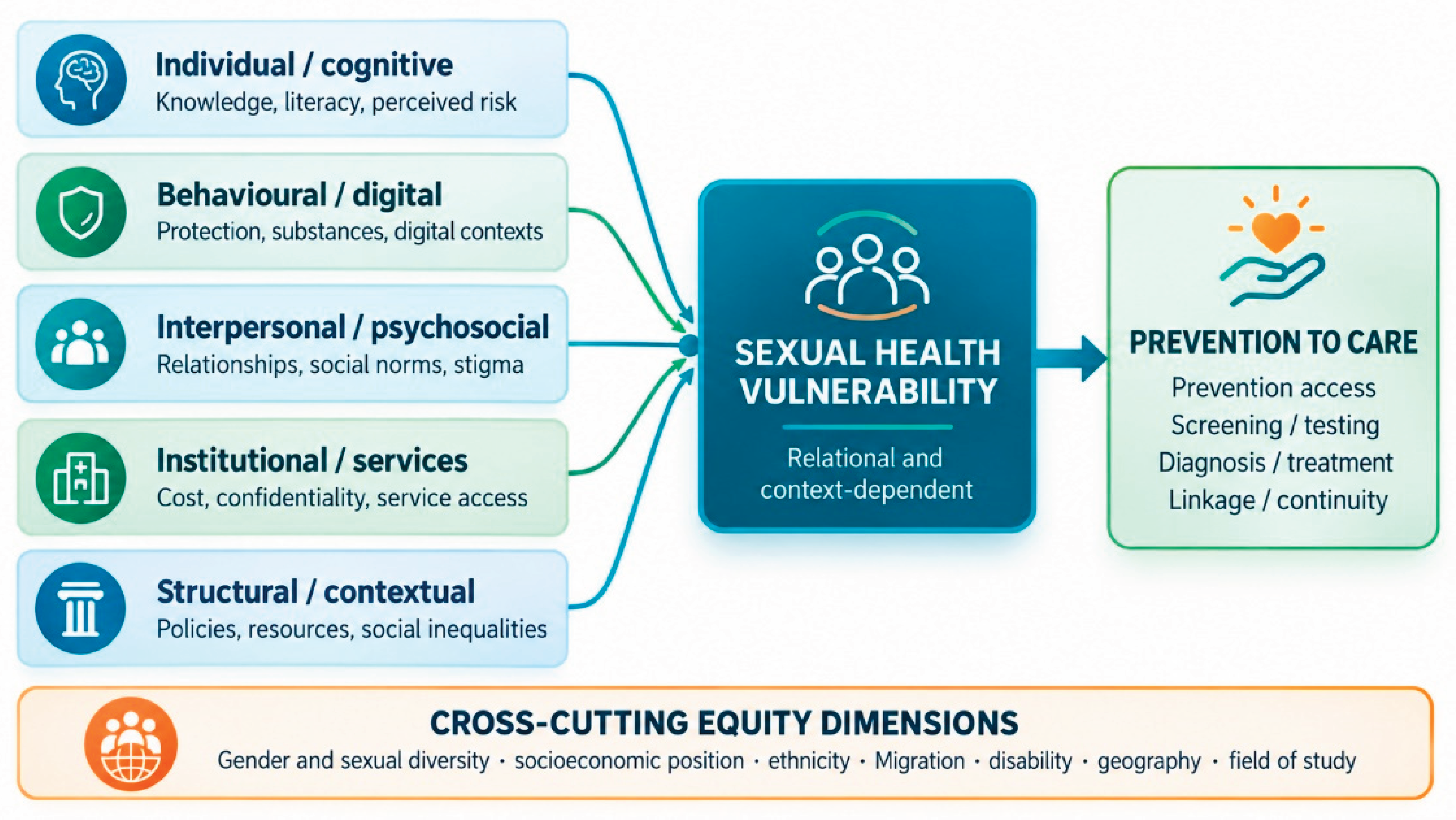

Table 1.
Operational boundary of the bibliography-based map.
| Domain | Definition |
|---|---|
| Frame | The 118 citations of the inherited manuscript; no claims of a comprehensive database search. |
| Population | Students in universities or clearly postsecondary training; separable student findings for mixed samples. |
| Concept | STI/HIV knowledge or prevention, HPV vaccination, sexual-health literacy, relevant behaviours, testing, stigma or service access. |
| Source | Empirical report supported by primary abstract/text. Reviews, guidance and other populations are context. |
| Time | Publicly available by 25 May 2026; assessment performed 8 October 2026. |
| Unit / certainty | Report, not necessarily independent study; no pooled effect or formal certainty grade. |
Table 2.
Selection flow of the October bibliography-based assessment.
| Stage | n | Meaning |
|---|---|---|
| Input bibliography | 118 | 115 DOI records + 3 WHO documents |
| Duplicate references removed | 0 | Normalised DOI / document destination |
| Retained as context at metadata triage | 80 | Methods, guidance, reviews or other populations |
| Candidate reports assessed in primary content | 38 | Abstracts or accessible primary text, not all full texts |
| Candidates retained as context after content assessment | 5 | 2 school; 1 mixed staff/student; 1 topic; 1 education-level ambiguity |
| Empirical higher-education reports charted | 33 | Report-level map; no aggregate participant total |
| All contextual references | 85 | 80 + 5; remain in the bibliography |
| Reconciliation | 118 | 33 empirical + 85 context = 118 |
Table 3.
Selected empirical findings and interpretive limits; full charting in Online Resource 2.
| Source | Denominator / design | Finding | Boundary |
|---|---|---|---|
| Quaresma and Santos (2026) | 790; cross-sectional | 49.7% problematic literacy; 47.7% condom use at last sex | Different measures; no causal effect. |
| Tocco Tussardi et al. (2026) | 2,187 analysed; cross-sectional | 672/1,727 sexually active respondents always used condoms | 9.8% response rate; not national prevalence. |
| Loaiza-Guevara et al. (2024) | 284; cross-sectional | 32.4% testing intention | Intention is not completed testing. |
| Anya and Reeves (2026) | 110; cross-sectional | 73.6% never HIV-tested; 2.7% used self-sampling | Convenience sample; service-specific endpoints. |
| Njuguna et al. (2016) | 600; quasi-experimental | HIV testing 67% versus 51% | Postsecondary training sample; nonrandom design. |
| Nalwanga et al. (2021) | 464 downloaders; utilisation analysis | 374/464 used the app in six months | Not the parent trial effect; conflicting recruitment totals. |
| Bennett et al. (2015) | 661; randomised | No difference in HPV vaccination uptake (p=0.98) | Knowledge and uptake are distinct. |
| Gerend et al. (2020) | Campus doses; before–after | 75% more vaccine doses administered | Doses ≠ unique recipients; no concurrent control. |
| Wong et al. (2021) | 781; randomised | No significant improvement in consistent condom use | Some educational effects were temporary. |
| Can Gürkan et al. (2025) | 69; controlled pilot | Adjusted post-training knowledge comparison: p>0.05 | Ambiguous abstract versus Results; not proof of efficacy. |
Table 4.
Proposed translation from conceptual level to evaluable university practice.
| Level | Proposed action | Separate outcomes | Evidence boundary |
|---|---|---|---|
| Individual / cognitive | Teach appraisal and preventive skills | Knowledge, critical appraisal and skills, separately | Literacy surveys and trials; not a validated vulnerability score |
| Behavioural / digital | Connect digital education to practical protection | Condom practice, engagement and privacy incidents | Educational gains do not establish infection reduction |
| Interpersonal / psychosocial | Provide non-stigmatising, confidential pathways | Perceived safety, test uptake and completed referral | Local qualitative findings require contextual adaptation |
| Institutional / services | Coordinate testing, vaccine access and follow-up | Access → uptake → results → care; eligible denominators | Proposed integrated pathway, not a tested combined intervention |
| Structural / contextual | Reduce cost and barriers; co-design with students | Access/uptake disparities and continuity by context | Equity is not an identity-based risk label |
Disclaimer/Publisher’s Note: The statements, opinions and data contained in all publications are solely those of the individual author(s) and contributor(s) and not of MDPI and/or the editor(s). MDPI and/or the editor(s) disclaim responsibility for any injury to people or property resulting from any ideas, methods, instructions or products referred to in the content. |
© 2026 by the authors. Licensee MDPI, Basel, Switzerland. This article is an open access article distributed under the terms and conditions of the Creative Commons Attribution (CC BY) license (http://creativecommons.org/licenses/by/4.0/).
Copyright: This open access article is published under a Creative Commons CC BY 4.0 license, which permit the free download, distribution, and reuse, provided that the author and preprint are cited in any reuse.