

Submitted:
07 October 2026
Posted:
10 October 2026
You are already at the latest version
Abstract
Sustainability in the textile supply chain involves complex trade-offs across economic, environmental and social aspects, driven by the variability in materials, manufacturing processes and technologies, industrial management, geographical locations, working conditions, logistics, and product use. While multi-criteria decision-making (MCDM) methods have been increasingly applied to navigate these trade-offs, existing reviews have narrowly focused on bibliometric trends, offering limited insight into the contextual application and sustainability criteria used in these assessments. This study addresses this gap through a systematic literature review by analysing 96 studies that investigate the application of MCDM methods in sustainability management across the textile supply chain, with specific attention to methodological rigor and contextual relevance. The review identifies two key research dimensions: (1) the MCDM methods employed and their application contexts in respective scope of studies, and (2) the applied and prioritized criteria for sustainability management in textile industries. Results show that the identification of influential factors for sustainability implementation is the most common scope of study, with DEMATEL being the dominant MCDM tool and identifying government policies as the most influential factor. This is followed by sustainable supplier selection, with frequent use of hybrid AHP-TOPSIS methods, often in fuzzy settings, and a predominant focus on economic criteria, particularly cost and financial flexibility. The majority of corporate sustainability assessments rely on quantitative environmental data derived from corporate reports, and public data and use single-method MCDM models without explicit weighting schemes. Product-level assessments commonly employ distance-based MCDM methods to support the interpretation of Life Cycle Assessment results or to expand the sustainability perspective by incorporating economic and social dimensions. This review advances the understanding of how MCDM methods support sustainability decision-making in different contexts and settings of textile supply chain and highlights key criteria shaping such evaluations.
Keywords:
textile and apparel supply chain
; multi criteria decision making (MCDM)
; sustainability assessment
; systematic literature review
1. Introduction
The textile industry plays a vital role in meeting basic human needs, generating employment, and supporting economic development. In recent decades, the textile supply chain has become increasingly globalized and complex, involving multiple stakeholders across raw material production, manufacturing, distribution, retail, and consumption. Alongside rapid growth in textile production and demand, concerns regarding the sustainability of the industry have intensified [1,2,3]. The textile supply chain is associated with substantial environmental impacts, including high resource and energy consumption, greenhouse gas emissions, water use, pollution from dyeing and finishing processes, microfiber release, and large volumes of textile waste [4,5,6,7,8,9]. In parallel, the industry faces persistent social challenges such as child labor, unsafe working conditions, inadequate wages, gender inequality, and weak labor protections in several production regions [10]. These sustainability issues occur across different stages of the supply chain and involve stakeholders with diverse and often conflicting priorities.
Addressing such challenges requires sustainability management approaches capable of balancing economic, environmental, and social considerations simultaneously. In this context, Multiple Criteria Decision Making (MCDM) methods have gained increasing attention as tools for supporting complex decision-making processes. MCDM methods enable the evaluation and prioritization of alternatives based on multiple quantitative and qualitative criteria, making them particularly suitable for sustainability-related problems where trade-offs between competing objectives are unavoidable [11]. Because supply chain management inherently involves multiple actors, conflicting objectives, and diverse evaluation criteria, sustainable textile supply chain management can be understood as a multi-criteria decision-making problem [12,13]. Consequently, a growing body of research has applied MCDM methods to support decisions related to sustainable supplier selection, sustainability performance assessment, material and technology selection, circular economy strategies, and identification of critical sustainability factors in textile industries [12,14,15].
Although previous reviews have examined MCDM applications in supply chain management and sustainability separately [12,15], there remains a lack of a systematic literature review focusing specifically on the intersection of sustainability assessment, textile supply chains, and MCDM methods. Existing reviews also provide limited insight into how sustainability criteria are selected and prioritized across different textile contexts and scope of studies. To address this gap, this study conducts a systematic literature review of MCDM applications in sustainability management within the textile supply chain. Specifically, the review seeks to answer the following research questions:
RQ1. Which MCDM methods have been used for sustainability assessment in the textile industry, and in which study scopes are they applied to evaluate sustainability criteria?
RQ2. What sustainability criteria and factors have been used and prioritized in MCDM-based assessments of textile industry practices?
Following the systematic literature review framework proposed by Durach, Kembro, and Wieland [16], this study categorizes the reviewed literature according to application context (scope of study), unit of analysis, methodological approach, and sustainability criteria. By doing so, the review contributes to a clearer understanding of how MCDM methods support sustainability decision-making across different settings in the textile supply chain.
2. Materials and Methods
2.1. Theoretical Framework – Textile Industry Towards Sustainability
One of the most widely adopted conceptualizations of sustainability is the Triple Bottom Line (TBL), which frames sustainability through economic, environmental, and social dimensions. However, it has been noted that the TBL concept did not emerge from a single theoretically rigorous definition, but rather evolved through interdisciplinary critiques of the economic status quo from ecological and social perspectives [17]. Therefore, sustainable development requires balancing competing and often non-comparable economic, ecological, and sociocultural objectives, including income generation, ecosystem preservation, equity, and participation [18]. These interconnected sustainability dimensions are particularly relevant to the textile industry, where economic pressures for low-cost and rapid production often conflict with environmental concerns such as resource consumption, pollution, and waste generation, as well as social issues related to labor conditions and equity across global supply chains. While this review categorizes sustainability criteria according to the traditional economic, environmental, and social dimensions, several studies extend sustainability assessment to additional domains such as governance and technology. Namely, the central role of governance and politics in enabling sustainability transitions and the importance of technology as a key factor influencing sustainable business performance have been highlighted along with their interaction with the classical sustainability dimensions [19,20].
The textile industry serves the societies by providing essential human needs, creating employment opportunities, and contributing to economic development. In an increasingly globalized economy, the textile supply chain has evolved in the form of a multi-layer and complex system with stakeholders in different parts of the world all contributing to the growing textile production. The global capita textile production increased from 5.9 kg to 13 kg per year between 1975 and 2018 [1]. World textile demand report by International Cotton Advisory Committee predicted the global demand for textile fibres to continue growing, reaching 117.3 million tons in 2025 [2]. This growth was projected after a significant decline in 2020 due to supply chain disruption, widespread lockdowns, and decrease in consumers’ spending that was followed by a strong recovery in 2021 and a slight dip in 2022 [2]. Looking into raw material production for the textile industry, Textile Exchange reports that the global textile fibre production increased by 7%, rising from 116 million tons in 2022 to 124 million tons in 2023 [3]. According to the report, if current trends continue, global fibre production is expected to reach 160 million tons by 2030. This growth is associated with significant environmental impacts including extensive resource and energy use, emissions to the environment, water and land use, etc. along with increasing concerns in the social domain such as child labor, safety at work, fair wages, among others.
Sustainability assessments are essential for evaluating impacts, determining progress toward targets, identifying the hotspots in the textile supply chain and strategizing towards SDGs. Sustainability assessment methods including Environmental and Social Life Cycle Assessment (e-LCA and s-LCA), standards and reporting systems like ISO 14001 series and GRI have been widely used by researchers and stakeholders in the textile supply chain for evaluating of the impacts, reporting and improving sustainability, scoring materials, processes, and supply sources [21].
As reported in multiple sources [4,5,6,7,8], and summarized in [9], the industry generates 8-10% of global CO2 emissions, equivalent to 4-5 billion tons annually, consumes approximately 79 trillion litters of water per year and contributes to about 20% of industrial water pollution from textile treatment and dyeing. The sector contributes around 35% of primary micro-plastic pollution in the oceans, releasing an estimated 190,000 tons annually and also produces more than 92 million tons of textile waste each year, much of which ends up in landfills, is incinerated, or discarded as unsold products [9]. Polyester and cotton are dominant fibre materials in the textile sector contributing to 77% of global textile fibre consumption [3]. Therefore, comparing the environmental impacts of these two textile raw materials illustrates the complexity of environmental impact assessments. Respective life cycle impacts within the production phase for 264 g of fibre shows that while cotton has a slightly higher carbon footprint (1.2 kg CO2-eq vs. 1.1 kg CO2-eq for polyester), it requires significantly less non-renewable energy (9.1 MJ-eq vs. 24.5 MJ-eq) but its water footprint is significantly higher than polyester (50 m³ vs. <1 m³) [22]. This example demonstrates the conflicting nature of criteria for environmental impact assessment. Moreover, sustainability is a multi-pillar concept in environmental, economic and social contexts each with a pool of different criteria and influencing factors. The concept also has spatial and temporal aspects that expand all around the globe from the past to the far future. Unlike isolated environmental impact assessments, sustainability assessments must integrate social and environmental aspects that introduce significant complexity due to the interwoven nature of socio-ecological systems [23].
Each material and process combination within the textile supply chain presents trade-offs across various environmental and social impacts. The environmental impact of processes used to produce textile products excluding wet processing (as it is common in almost all textile materials) and energy use (due to data limitations) was analysed in [24]. The study highlighted the broad environmental footprint of textiles including water and land use, resource depletion, recyclability, and biodegradability. Furthermore, the trade-offs among natural, synthetic, and regenerated fibres in terms of their environmental impact were identified [24]. While impact assessment methods such as Life Cycle Assessments (LCAs) have shown significant utility for sustainability evaluations, they also include a challenging step of normalization and weighting of impact categories that are influenced by decision-maker preferences. A case study [25] addressed the challenges of interpreting and comparing environmental life cycle assessment (e-LCA) results of t-shirts made from cotton, polyester, and viscose across various environmental impacts such as global warming potential, ozone depletion potential, acidification potential, water consumption, etc. The study demonstrated the utility of MCDM methods to evaluate and select optimal alternatives [25].
On the social front, results of a case study based on Social Life Cycle Assessment (s-LCA) methodology using the Swedish clothing consumption data highlighted important hotspots in the supply chain based on 11 social indicators chosen by consumers [10]. The study flagged sectors like commerce and business services in Bangladesh and China as hotspots for multiple indicators of concern including risk for child labor, non-ratification of ILO conventions, non-fair wages among others. Additionally, key sectors in the textile supply chain, such as plant-based fibre production, textile materials processing, and apparel production, were highlighted as significant negative social hotspots in multiple locations including India, Uzbekistan and China with indicators such as risk of wages falling below the country’s minimum wage, gender inequality and, non-adequate labor laws [10]. In the light of such data, for the textile supply chain to be aligned with the Sustainable Development Goals (SDGs), those issues must be addressed considering the viewpoints of worldwide stakeholders, including farmers, workers, manufacturers, retailers, brand owners, consumers, and communities who do not necessarily share similar interests, perspectives or, priorities – like in Supply Chain Management (SCM).
SCM differs from traditional logistics operations in that it extends beyond the internal processes of a single organization. Instead, SCM is characterized as a coordinated network of multiple companies working collaboratively to deliver finished products to end consumers [12]. SCM is defined as the Decision Making (DM) in strategic, tactical, and operational levels to optimize the performance of supply chain [13]. Because supply chain activities are carried out by various actors within a network, each with distinct and often conflicting criteria, SCM can be characterized as a MCDM problem [12]. Indeed, literature reviews on the application of MCDM methods in sustainable engineering have identified sustainable supply chain management as a key area of application e.g., [14].
2.2. Multiple Criteria Decision
In recent decades, mathematical Multiple Criteria Decision Making (MCDM) methods have been developed to deal with such situations. As the name implies, MCDM assists decision-makers in addressing (solving or organizing) problems that involve multiple criteria (quantitative or qualitative) by logically determining the weights and interrelationships between those criteria. These methods are applied where there is no single optimal solution, so decision-makers’ preferences are used to distinguish between the available options [11]. Solving can mean selecting the "best" alternative, which is the most preferred by the decision-maker(s), or identifying a small set of good alternatives and grouping them into different preference sets – as needed in sustainability management in the textile supply chain engaging with a diversity of potentially competing criteria in holistic approaches that allow for selecting the optimal courses of action (e.g., adopting sustainable initiatives, materials, processes, or partners).
A systematic literature review [26] on MCDM methodologies and their applications from 1999 to 2009 identified 12 major application areas in scholarly research. Transportation and logistics emerged as the most prevalent topic, followed by business and financial management. Notably, they found a total of 32 studies applying MCDM methods in environmental management between 1999 to 2009. Water management, manufacturing and assembly, energy management, agricultural and forestry management, managerial and strategic planning, project management and evaluation, social service, and military service account for the remaining distinct application areas for MCDM methods [26].
While MCDM methods are diverse, they share certain aspects [27]:
Alternatives: These are the various courses of action available to the decision-maker, which will be screened, prioritized, and ultimately ranked.
Multiple criteria: These represent the various dimensions from which the alternatives are evaluated.
Conflicting criteria and different measurement units: Since the criteria reflect different aspects of the alternatives, they may have different units of measurement and could conflict with one another.
Decision weights: Many MCDM methods require assigning weights to the criteria based on their importance, and typically normalized during the process.
Decision matrix: This is the mathematical representation of the problem for calculating the relative performance of the alternatives and different criteria.
MCDM methods handle quantitative, qualitative, or mixed data, and typically use either crisp numerical values or fuzzy linguistic terms. These are mathematical models, there are plenty of them, and the field is still growing. There are also different ways of categorizing MCDM methods. One broad categorization of MCDM methods is differentiation based on the type of data that they handle, i.e., crisp and fuzzy methods. Fuzzy approaches are preferred when uncertainty and incomplete data require expert judgment. In some cases, initially crisp data are converted into linguistic terms for fuzzy set analysis. This conversion occurs when crisp data fail to capture system vagueness or when numerical values do not inherently indicate cost or benefit effect in decision making, leaving the interpretation to expert judgment [28]. Alternative approaches to categorizing MCDM methods are also documented in the literature. In a survey on MCDM methods and concepts [29], key differences of these methods were identified based on several factors: the complexity of the underlying algorithms, the criteria weighting schemes, the representation of a preference evaluation criteria, the handling of uncertainty in data, and the type of data aggregation employed. There are three general steps in a typical MCDM procedure including (1) identification and selection of criteria, (2) determination of resources weights, and (3) ranking the resources using a proper MCDM method [29]. Table 1 presents a list of those MCDM methods identified and repeated within our review sample with their primary function and original source of model development. The article combines weighting methods, ranking methods, causal-structuring approaches, optimization models, efficiency methods, and supporting frameworks under a broad MCDM label. It is important to recognize that while some MCDM methods have outranking function (e.g., AHP and BWM), others approach data differently, focusing on categorizing criteria into levels of importance (e.g., ISM) or examining the cause-effect relationships among them (e.g., DEMATEL).
Growing consumer awareness and increasing sustainability regulations, such as the European Green Deal and Circular Economy Action Plan (CEAP), Corporate Sustainability Reporting Directive (CSRD) in Europe and similarly, Corporate Sustainability Disclosure Standards (CSDR) of China have driven companies to integrate sustainability into their operations. Supplier selection by prioritizing environmentally and socially responsible suppliers while maintaining economic viability plays a key role in competitiveness and public image of companies. A review on the MCDM studies for sustainable supplier selection [52] identified 101 papers that were published between 2018 and 2022. Results supported the previous studies suggesting that DEA, TOPSIS, AHP and their variations are the most frequent MCDM methods for sustainable supplier selection [52]. While literature reviews have examined MCDM in supply chain management and sustainable development separately e.g., in [12,15], we have identified a lack of a systematic literature review (SLR) that explores the intersection of “sustainability assessment” within the “textile supply chain” using “MCDM” methods. Moreover, no existing systematic review thoroughly examines the scopes and context- specific selection of sustainability criteria in MCDM analyses of textile industries to track the trends, significance, and prevalence of criteria and influencing factors.
The aim of this study is to synthesize existing literature on the utility of MCDM methods for sustainability assessment and management in the textile supply chain. Theoretical background for this assumption has derived from the idea that sustainability criteria in the textile supply chain are diverse due to the variability in raw materials, manufacturing processes, locations, logistics, and product use phase. This diversity complicates interpreting sustainability assessment results and MCDM methods provide interpreting aid for determining the relative importance of criteria and impact categories, enabling the ranking and scoring of products, processes, and organizations in regard to sustainability. MCDM methods have been applied by researchers to balance trade-offs and select sustainable textile suppliers e.g., in [53], evaluate corporate sustainability e.g., in [54] and identify sustainable textile products e.g., in [55]. Furthermore, we analyse the environmental, social, and economic criteria used and highlighted in MCDM systems for sustainable decision-making in the textile supply chain and identify the scope of studies in which MCDM sustainability assessments are conducted.
3. Research Method
This study serves to establish connections between the attributes of the textile supply chain (e.g., environmental, social, and economic), the decision-making processes supported by MCDM, and their relevance to achieving sustainable outcomes in this domain. This study employs a systematic literature review (SLR) methodology, following six key stages of (1) defining research questions, (2) determining study characteristics, (3) retrieving a baseline sample of relevant literature, (4) filtering and selecting final set of synthetize studies, (5) synthesizing the findings, and (6) reporting the results [56]. We follow the structured approach outlined by Durach et al. (2017) which is tailored to the distinct characteristics of SLRs within the field of supply chain management [16], see Table 2.
Primary study characteristics are defined by establishing inclusion/exclusion criteria that align with the research purpose and questions, considering both the content and quality of the primary studies. Key concepts including “sustainability”, “assessment”, “MCDM”, “textile”, and “supply chain” are derived from the theoretical framework and expanded with relevant free text terms in line with the research questions. The keywords encompass various supply chain stakeholders, including production, manufacturing, retail, and corporations. Study contexts include dyadic relationships, evaluations within a single stage, and system-wide sustainability assessments. Since this review focuses on MCDM methods, the research method in the papers is primarily "model development," with often also involving "practical validation" through case studies. Various types of data (e.g., crisp and fuzzy) and MCDM models are included, along with papers that use single or hybrid models for criteria weighting and/or alternative ranking. In order to focus to upstream and production-oriented supply-chain decisions, studies with pivotal focus on consumer and post- consumer phases are excluded. Similarly, studies with highly technical scopes focusing on specific technologies or chemical developments are excluded, as they do not align with the research questions of this study.
A baseline sample of potentially relevant literature was retrieved through searches on Scopus and Web of Science on Aug. 07, 2025 with temporal constraint set to limit publish date after 2010. This period reflects recent technological, regulatory, and conceptual developments in the field and reduces the inclusion of studies based on substantially different institutional and market conditions. A combination of keywords and synonyms is used to ensure broad coverage and capture all aspects of the initial theoretical framework, including its limitations. Search terms are applied to titles, abstracts, and keywords based on database specifications. The final list of search terms reflects the diverse definitions and terminology related to sustainability assessment in the textile supply chain using MCDM methods. Inclusion and exclusion criteria are applied to filter relevant studies and refine the sample into a "synthesis sample." Following Durach et al. method [16], the screening process extends beyond titles and abstracts to assess each study’s relevance in refining the theoretical framework. As a result, 625 articles were identified. After title-and-abstract screening 97 papers were selected as the synthesis sample for comprehensive analysis. One study included in initial synthesis analysis was later retracted from database. Therefore, the analyses and results were re-run and updated after eliminating data from that specific study.
As suggested by Durach et al. [16], papers are categorized by scope of studies to offer a clearer contextual perspective and enable a structured and coherent analysis within each scope of study (see Table 3). Article titles, abstracts, and keywords were scanned to identify recurring themes, resulting in five categories which are presented in Table 4 of the results section. The primary analysis was conducted by one researcher using a standardized extraction and classification framework. This approach enabled the consistent application of the same coding and harmonization rules across all included studies. The resulting analytical framework, category definitions, and aggregated findings were subsequently reviewed by both authors.
Furthermore, to address terminological inconsistencies across studies and ensure consistency in reporting and analysis, within each scope of study, sustainability criteria were harmonized and subsequently categorized under a framework consisting of economic, environmental, social, technological, and governance dimensions [17,18,19,20]. For example, in the supplier selection scope of study, terms such as “price,” “material cost,” “purchase cost”, “discount opportunity,” and “payment terms” that were merged under the unified criterion of “Costs and financial flexibility”. Similarly, “repair service,” “recycle rate,” and “reverse logistics for recycling and reusing” were labelled with unified criterion of “circular supply chain practices”. To support transparency, the complete study-level evidence matrix and criteria-harmonization dictionary are provided in the Supplementary Materials.
4. Results
This section presents the results of an in-depth analysis of the synthesis sample. As illustrated in Figure 1, the number of publications addressing the application of MCDM methods for sustainability assessment in the textile supply chain has increased notably since 2019, peaking at 20 studies in 2024. In terms of publication venues, the Journal of Cleaner Production features the highest number of contributions (n=8), followed by Sustainability and the International Journal of Production Economics, each with 6 studies.
MCDM applications in the textile supply chain are highly context dependent. In the reviewed literature, MCDM methods are applied to diverse sustainability problems, including supplier selection, corporate sustainability assessment, prioritization of influential factors in sustainable and circular economy implementation, product evaluation, and strategy development. These applications involve different decision environments, stakeholders, and sustainability priorities, which directly influence the selection of criteria and MCDM techniques. Accordingly, Table 4 categorizes studies based on their thematic scope. This structure enables identification of methodological patterns and dominant sustainability priorities across application contexts. It also facilitates comparison of how different MCDM methods address sustainability trade-offs in textile supply chains, while revealing underrepresented dimensions and research gaps.
While all papers primarily focus on the development and application of MCDM methods to address sustainability-related decision-making challenges within the textile supply chain, they often validate their applicability through case studies, where the models are applied to real-world scenarios such as supplier selection, choice of alternative management strategies, evaluation of sustainability performance within a specific company, etc. Our scope of study classification and identification of units of analysis relies mainly on the case studies used for their practical validation. As illustrated by the number of studies in each study scope within our synthesis sample, MCDM applications in textile sustainability research are concentrated primarily on two scopes of studies: the “Identification of influential factors for sustainability and circularity implementation (drivers, barriers, metrics)” and “sustainable supplier selection”. This distribution highlights the strong research focus on strategic sustainability implementation challenges within textile industries and upstream supply chain decisions. The classification in Table 4 also shows that most studies adopt a system-wide perspective rather than limiting the analysis to a single organizational stage, reflecting the interconnected and global nature of textile supply chains. Moreover, the variation in units of analysis across scopes of studies indicates that the choice of MCDM method and sustainability criteria is strongly influenced by the specific decision-making problem being addressed.
Furthermore, grouping criteria into sustainability dimensions provides a clearer understanding of the relative emphasis placed on different sustainability aspects within textile-related decision-making problems. Table 5 provides study-level prevalence of sustainability dimensions and Table 6 presents a summary of the scope of the studies and the number of raw occurrences of sustainability criteria, categorized under economic, environmental, social, technological, and governance dimensions. A detailed overview is presented as A1 in the Appendix as well as in supplementary documents.
4.1. MCDM for Sustainable Supplier Selection in Textile Industries
Figure 2 presents the MCDM methods applied in our synthesis sample that focused on sustainable supplier selection in the textile industry. Regardless of the data type in the decision matrix (crisp, fuzzy, etc.), AHP is the most common method for criteria weighting, while TOPSIS is the most frequently applied for alternative (suppliers) ranking. The combination of these two methods is the dominant MCDM hybrid approach for supplier selection over the years. Appendix A1 presents detailed information including on data environment in which the problem of sustainable supplier selection has been solved.
However, in order to address the second research question, a structured analysis of the selected and prioritized criteria for sustainable supplier selection for the textile industry among the synthesis sample is required. Different criteria classification frameworks are visible within the studied papers. Besides Triple Bottom Line (TBL) sustainability framework, the Supply Chain Operation Management (SCOR) framework has been repeatedly embedded in criteria selection step. The SCOR model offers a standardized framework for describing supply chain processes, performance metrics, best practices, and enabling technologies. Its core structure encompasses five key processes: Plan, Source, Make, Deliver, and Return [150]. Table 7 presents the distribution of criteria categorized under economic, environmental, social, technological, and governance categories.
To enable consistent and efficient reporting, factors with similar definitions and concepts were grouped under unified criteria. Figure 3 present the raw criteria occurrences in our synthesis sample under the sustainable supplier selection scope of study. Furthermore, as presented in Figure 4, a decision importance criteria graph was created by compiling the top two ranked criteria from each study that included a criterion weighting MCDM system. As illustrated, economic dimension is prevailing both in raw occurrences decision importance criteria with costs and financial flexibility (n raw occurrences=56, n decision importance=14) followed by supply chain agility, capacity and delivery performance criteria in raw occurrences (n raw occurrences= 50) and product quality and design specification (n decision importance=10) in decision importance criteria. On the environmental front, green operational practices (n raw occurrences= 23) and environmental management systems and competencies (n raw occurrences= 22, n decision making= 7), and circular supply chain practices (n decision importance= 2) are prevailing. In social dimension, employees’ rights and interests is repeatedly used criteria (n raw occurrences= 13). However, it ranks second in decision importance (n decision importance= 1) after community, stakeholders and social impact (n decision making= 2). IT, information systems and smart manufacturing appears both in raw occurrences and decision importance diagrams (n raw occurrences= 14, n decision making= 1). Similarly, corporate governance, audits and compliance emerges in the government dimension (n raw occurrences= 3, n decision making= 1). Details on harmonized categorization and the process of compiling up the prioritized criteria by MCDM modelling (decision making importance) are provided as S1 and S2 in supplementary documents.
4.2. MCDM for Corporate Sustainability Assessment in Textile Industries
Several studies have highlighted the application of MCDM methods in the scope of corporate sustainability e.g., in [149]. Within our synthesis sample, eight studies have focused on the context of corporate sustainability performance evaluation. Table 8 provides an overview of these papers, including the applied MCDM methods, case study details, sustainability dimensions, and sources of data. Results shows that majority of these studies (6) do not incorporate a criterion weighting system but only focus on ranking alternatives. In our synthesis sample studies, alternatives are represented either by different years [54,89,93]; or different companies (e.g., in [88,90]). Additionally, TOPSIS is found to be the most frequently used MCDM method for corporate sustainability assessment in the textile industry.
In order to elaborate on the second research question about the selected criteria in MCDM methods, criteria were categorized in harmonized terms based on their definition similarities and context with details as provided in S3 in the supplementary documents.
Figure 5 shows the criteria raw occurrences results of our synthesis sample in the scope of corporate sustainability assessment. The assessment over Environmental dimension is dominant with criteria including energy and water use and waste types (n raw occurrences= 16), followed by environmental impact and emissions (n raw occurrence= 12) and waste types (n raw occurrences = 13). Social criteria including employees’ rights and welfare (n raw occurrences= 14) and organizational culture and leadership (n raw occurrence= 13) are also repeatedly used for corporate sustainability assessments. As mentioned above, majority of studies under this scope of study (6 out of 8) do not incorporate a criterion ranking/weighting method. Therefore, an overview of decision importance criteria is could not be generated.
4.3. MCDM for Identifying the Influential Factors for Sustainability and Circularity Implementation in Broader Contexts (Barriers, Drivers, and Metrics)
The largest number of studies (n=37) within our synthesis sample sought to identify the influential factors for sustainability and circularity implementation in the textile industry at a broader level (e.g., country-wide). As illustrated in Figure 6, DEMATEL is the prominent MCDM method (single or hybrid models) in this scope of study.
Table 9 shows the distribution of the influential factors (drivers, barriers, metrics) that were examined for sustainability and circularity implementation in broader system-wide sustainability scope of study. Overall, the economic dimension shows the highest number of the used criteria (n raw occurrences= 195) followed by environmental dimension (n raw occurrences= 166).
To provide a clearer overview, the influential factors for sustainability and circularity implementation were categorized based on similarities in their definitions and contextual interpretations across this scope of study. The results are presented in Figure 7 as an overview of raw occurrences of influential factors for broader system-wide sustainability studies in textile industries. Governmental policies and legislation factor (n raw occurrences= 62) is most frequently used in this scope of study, followed by costs and capital expenditure (n raw occurrences= 44), environmental impacts and emissions (n raw occurrences= 43), organizational culture and leadership (n raw occurrences= 35), and CE infrastructure: complexities and capabilities (n raw occurrences= 33). Details of this categorization is provided as S4 in supplementary documents for transparency.
Aggregation of findings within this scope of study in the form of a decision importance diagram from our synthesis samples is potentially problematic. As shown in Figure 6 (and also detailed in the Appendix A1) despite ranking/weighting MCDM methods like ANP, AHP, and BWM being applied, the application of DEMATEL is prominent in this scope of study (23 out of 37) alongside other structural analysis methods like ISM. DEMATEL has multiple functions primarily focused on the identification of cause-effect relations and also calculation of the relative dominance factor. Different studies have operationized and interpreted these functions differently to determine the importance level of the sustainability influential factors. This interpretation complexity is more evident when using hybrid models. Therefore, rather than aggregating all results, we zoomed into studies that used DEMATEL to identify relationships the factors. Based on the positive dominance factors, the top three factors in each study were identified and compiled up as the strongest causal influential factors and reported in Figure 8. Government policies and legislation (n decision importance= 9) and knowledge, skill and information gapes (n decision importance= 7) show the strongest causal influence. Details of these strongest casual factors is provided as S5 in supplementary documents.
4.4. MCDM for Sustainable Management Strategies
Several studies (n=14) within the synthesis samples, apply MCDM methods for decision making about adoption of sustainable management strategies and initiatives within the textile industries. These include supply chain managements strategies (e.g., [133,144]) or, sustainable production management strategies (e.g., [140]). An overview of the applied MCDM in this scope of study along with the alternative management strategies is provided as S6 in supplementary documents.
Table 10 presents of the number of relevant sustainability criteria across different dimensions for analysing management strategies. Number of raw occurrences in economic dimension is leading (n=88) followed by environmental dimension (n=64). The criteria were further processed and grouped together in harmonized categories based on the similarities in definitions and contexts. Figure 9 shows the distribution of raw occurrences of criteria in the sustainable management strategies scope of study over the harmonized categorization. Economic performance and costs (n raw occurrences= 37) appear to be the most frequently used criteria in this scope of study, followed by supply chain agility, capacity and delivery criteria (n raw occurrence= 24) and community, stakeholders and social impacts (n raw occurrences= 17). Details of the harmonized criteria categorisation is provided as S7 in supplementary documents.
Although ranking MCDM methods like AHP (n=4), WSM (n=2) and BWM (n=1) have been used in this scope of study, these methods have been primarily used to directly rank the alternative management strategies against the used criteria rather than initially giving weights to criteria. Therefore, providing an overview of decision importance criteria was not possible.
4.5. MCDM for Textile Product Sustainability Assessment
Lastly, few studies (n=5) within our synthesis sample use MCDM methods for product- specific sustainability assessment. As shown in Table 11, these studies primarily rely on quantitative data collected from on-site investigations, databases, and relevant literature, with the environmental dimension being the most prominent in the synthesis sample. Two studies integrate LCA with MCDM approaches to provide a more balanced evaluation of different environmental impact categories [25,146]. The remaining studies employ MCDM methods to incorporate additional sustainability dimensions, such as economic and social factors alongside environmental considerations.
Table 11 represents the challenge of assessment due to the diversity of materials, processes, logistics policies, and product usage. Therefore, optimizing supply chain scenarios for environmental impact is not a straightforward decision but a multiple criteria problem. One study applied PROMETHEE and ELECTRE to interpret LCA environmental impact data for cotton, viscose, and polyester t-shirts from cradle to grave [25]. Assessing 10 impact categories (e.g., global warming potential, human toxicity potential), this study concluded that cotton is the worst scenario while the preference relationship between polyester and viscose is sensitive to the applied MCDM method [25]. Two studies [145,148] integrated life cycle assessment (LCA) with economic data from denim fabric production sites to evaluate the sustainability performance of fabrics made from different fibre combinations. Using TODIM method, one of these studies extended the fibre combination analysis with varying energy supply systems (combined heat and power vs. grid energy) incorporating both environmental indicators such as global warming, acidification, eutrophication, water use, and cumulative energy demand with economic criteria of cost and quality [145]. The second LCA study on denim fabric production further explored alternative allocation approaches (cut-off and waste value) alongside fibre variation using EDAS method [148]. Results showed that recycled PET fibres demonstrated lower freshwater ecotoxicity and reduced eutrophication and acidification impacts, while cotton performed better in terms of human toxicity. Additionally, the cut-off allocation method yielded lower global warming potential for recycled PET, highlighting the importance of allocation choices in recycled material LCAs [148].
The circularity potential of fashion, home textiles, and technical textiles were evaluated by applying TOPSIS using 15 criteria across environmental (e.g., fabric origin, landfill waste), economic (e.g., market demand, production volume), technical (e.g., energy efficiency), and social (e.g., employment rate) categories. Sensitivity analysis showed that landfill waste, fabric origin, and production energy efficiency had minimal sensitivity to weight changes and were assigned the lowest weight. In contrast, environmental impact and number of washes criteria were most sensitive and received the highest weight. TOPSIS rankings indicated that fashion textiles have the highest circular economy potential due to their large market share and cost-effectiveness, followed by technical textiles and home textiles [147].
Table 12 presents the number criteria used for product sustainability assessments. The highest number belongs to the environmental dimension (n=41), followed by economic (n=10).
These criteria were further processed in harmonized categories based on the similarity of their definitions and contexts. Figure 10 shows the raw criteria occurrences in the product sustainability scope of study. Environmental impacts and emissions (n raw occurrences= 36) show the highest number, followed by energy and water use (n raw occurrences= 5) and product quality and specifications (n raw occurrences= 3) are the categories with highest number of used criteria for product sustainability assessment. Details of harmonized criteria categorization is presented as S8 in supplementary documents.
5. Key Findings and Discussion
This systematic literature review provides a context-sensitive synthesis of how multi-criteria decision-making methods have been employed to support sustainability assessment and management in textile and apparel supply chains. Whereas previous reviews have examined MCDM applications in supply chain management, sustainability engineering, sustainable development, or supplier selection more generally [12,14,15,52,152,153,154], the present review focuses specifically on the relationship between the decision context, the methodological function of the MCDM approach, and the sustainability criteria incorporated into textile-sector applications. The findings indicate that MCDM use in this field is not methodologically uniform. Instead, particular methods have become associated with particular types of decision problems, data sources, units of analysis, and sustainability interpretations. Three overarching conclusions emerge. First, the choice of MCDM method is strongly related to the decision context: AHP–TOPSIS combinations dominate supplier-selection applications, DEMATEL is particularly prevalent in studies identifying drivers and barriers, and distance-based approaches are commonly used in product-level assessments. Second, despite the nominal inclusion of environmental and social considerations, economic and conventional operational criteria remain highly influential in many applications. Third, the methodological sophistication of the reviewed models, including the use of hybrid and fuzzy approaches, does not necessarily imply that sustainability has been assessed comprehensively, transparently, or robustly. These findings have implications for both the methodological development of MCDM-based sustainability assessment and its practical use in textile supply chains.
5.1. Context-Dependent Patterns in the Application of MCDM Methods
The results confirm the broader observation that supply chain management constitutes an important field of application for MCDM methods [12,14]. Supply chains involve decisions at strategic, tactical, and operational levels and require the simultaneous consideration of multiple actors, objectives, and performance dimensions [13]. However, the present review demonstrates that the role performed by MCDM differs substantially across the five identified application contexts. Sustainable supplier selection constitutes the second-largest field of application in the reviewed sample. This prominence is consistent with previous reviews showing that supplier selection is one of the most established areas of MCDM application [52,152,153,154]. Supplier-selection decisions involve a clearly defined set of alternatives and criteria and are therefore well suited to methods that combine criteria weighting with alternative ranking. In the textile-sector literature, AHP is most frequently used to derive criteria weights, while TOPSIS is commonly used to rank suppliers according to their distance from positive and negative ideal solutions. The prevalence of AHP–TOPSIS combinations can therefore be explained by their functional complementarity rather than by the intrinsic superiority of either method.
AHP provides a relatively accessible procedure for structuring a decision hierarchy and eliciting decision-maker preferences through pairwise comparisons. TOPSIS then produces an intuitive ranking based on the relative proximity of each supplier to an ideal solution. This combination may be particularly attractive for company-level applications because the results are comparatively easy to communicate to managers. The dominance of AHP and TOPSIS is consistent with earlier reviews of green and sustainable supplier selection [152,153,154]. Nevertheless, their widespread adoption may also reflect methodological familiarity and ease of implementation. The popularity of a method should therefore not be interpreted as evidence that it is necessarily the most appropriate method for every supplier-selection problem. The compensatory logic underlying many AHP–TOPSIS applications deserves particular attention. In a fully compensatory model, poor performance regarding one criterion can be offset by good performance regarding another. From a conventional supplier-performance perspective, such compensation may be acceptable. From a sustainability perspective, however, it may become problematic when low costs or high product quality compensate for serious deficiencies in occupational health, labour rights, pollution control, or legal compliance. Future supplier-selection models should therefore consider whether particular social and environmental criteria should be treated as minimum requirements or exclusion thresholds rather than as fully compensable performance attributes. Outranking approaches or two-stage procedures combining eligibility thresholds with subsequent ranking could be particularly relevant in this regard.
The largest group of studies uses MCDM to identify and prioritize metrics, drivers, barriers, or critical success factors for the implementation of sustainability and circular economy practices. DEMATEL is the most frequent method in this application context. This finding is methodologically plausible because DEMATEL is specifically designed to represent interdependencies and perceived cause–effect relationships among factors [155]. Unlike methods that provide only an ordinal ranking, DEMATEL distinguishes between cause and effect groups and visualizes the structure of relationships within a decision problem. Such capabilities are relevant to sustainability transformations in textile supply chains, where regulatory, technological, organizational, financial, and market-related factors interact. Nevertheless, DEMATEL results should be interpreted carefully. The relationships identified by the method represent structured expert judgements and should not automatically be understood as empirically demonstrated causal relationships. The outcome depends on the composition of the expert panel, the formulation and aggregation of judgements, the threshold used to construct the relation map, and the specific institutional and geographical context. A factor identified as a “cause” in one national textile industry may operate differently in another institutional environment. DEMATEL is therefore most appropriately understood as a method for structuring perceived influence relationships and generating hypotheses about system dynamics rather than as a substitute for statistical or longitudinal causal analysis.
Hybrid DEMATEL–ANP applications partly address the limitation that DEMATEL alone does not provide a complete ranking procedure. DEMATEL can first reveal interdependencies, while ANP can subsequently derive criteria weights within a network structure. Such hybridization is useful when each method performs a clearly defined function. More generally, however, the value of hybrid MCDM models should be assessed according to whether their components solve distinct methodological problems. Combining several methods does not inherently improve the validity of the decision model. Hybridization may increase complexity without increasing explanatory power when methods are added primarily to demonstrate methodological novelty. Corporate sustainability assessment represents a smaller but distinct application field. In these studies, TOPSIS is commonly used to compare companies or to evaluate the performance of the same company across several years. This application is compatible with the structure of TOPSIS because companies or reporting years can be represented as discrete alternatives assessed against a common set of indicators. The use of TOPSIS for environmental and corporate performance evaluation has also been justified by its comparatively transparent mathematical structure and straightforward interpretation [94].
However, corporate sustainability rankings are only as reliable as the underlying data. The reviewed studies frequently draw on corporate sustainability reports, annual reports, or public databases. Although these sources provide quantitative information on emissions, energy, water, materials, and waste, their use raises questions regarding comparability. Companies may apply different organizational boundaries, reporting periods, consolidation rules, estimation methods, and levels of external assurance. Changes in a company’s reported performance may consequently reflect changes in reporting practices rather than changes in its actual sustainability performance. MCDM can aggregate available indicators, but it cannot resolve inconsistencies in the underlying data. Future corporate applications should therefore document data provenance, reporting boundaries, missing-data treatment, and external verification more explicitly. Studies focusing on sustainable management strategies apply a wider variety of methods. This methodological diversity reflects the heterogeneity of the underlying decisions, which range from energy-efficiency measures and cleaner-production practices to circular supply-chain and reverse-logistics strategies [136,137,141,145]. In these contexts, no single method can be expected to dominate because the alternatives, time horizons, stakeholders, and data types differ considerably. The appropriate method should therefore be selected according to the structure of the decision problem, the form of uncertainty, and the intended decision output, as emphasized in general MCDM literature [29].
Product-level sustainability assessment remains the least developed application field. Most product-related studies combine an environmental assessment, such as LCA or chemical footprint analysis, with a distance-based or outranking MCDM method [25,146,147,148,149]. This combination addresses a recurring problem in life-cycle assessment: environmental impact categories are expressed in different units and may point in conflicting directions. MCDM can support the interpretation of such multidimensional results by making preferences and trade-offs explicit. At the same time, the integration of LCA and MCDM must be undertaken cautiously. Normalization, weighting, and aggregation can strongly influence the resulting product ranking. Moreover, the use of economic, technical, and social criteria alongside environmental LCA indicators creates potential differences in scale, data quality, and system boundaries. Product cost may be measured directly, whereas social impacts may be represented through qualitative proxies and environmental impacts through modelled life-cycle data. Combining these different forms of evidence in a single index can create an appearance of precision that is not necessarily matched by the underlying information. Product-level studies should therefore report alternative weighting scenarios, rank stability, and the consequences of different normalization and aggregation procedures.
5.2. Handling Uncertainty: The Prevalence and Limitations of Fuzzy Approaches
The frequent use of fuzzy MCDM, particularly in supplier-selection studies, reflects the high degree of uncertainty and imprecision characterizing sustainability decisions. Decision-makers often lack precise numerical information regarding a supplier’s environmental competence, organizational commitment, social performance, flexibility, or innovation capacity. Linguistic assessments such as “high,” “medium,” or “low” can be represented by fuzzy numbers, thereby allowing qualitative judgements to be incorporated into a mathematical decision model. The reviewed applications of fuzzy AHP–TOPSIS are consistent with previous research demonstrating the usefulness of fuzzy representations for textile supplier selection under uncertain conditions [67]. However, fuzzy modelling should not be equated with the elimination of uncertainty. It transforms linguistic or imprecise judgements into numerical ranges but does not necessarily increase the reliability of the original judgement. The selection of linguistic scales, membership functions, defuzzification procedures, and aggregation operators introduces additional assumptions. Moreover, fuzzy models primarily address vagueness and imprecision. They do not automatically address other forms of uncertainty, such as disagreement between stakeholders, variability over time, incomplete system knowledge, measurement error, or uncertainty concerning future regulatory and market developments.
The results therefore suggest a need for a more differentiated treatment of uncertainty. Fuzzy methods may be appropriate when the primary concern is linguistic vagueness, whereas stochastic approaches may be more appropriate for probabilistic variability and interval or grey approaches for incomplete information. Scenario analysis may be required when the future development of prices, technologies, regulation, or consumer demand cannot be represented by a single probability distribution. Method selection should thus be based on the nature of the uncertainty rather than on the general popularity of fuzzy extensions. The reviewed literature also provides limited evidence of systematic comparisons between methods or uncertainty representations. Different MCDM models can produce different rankings even when applied to the same decision matrix. This is particularly relevant where small changes in criteria weights or normalization procedures can alter the preferred supplier, strategy, company, or product. Sensitivity analysis and robustness testing should therefore become standard components of MCDM-based sustainability assessment. At a minimum, studies should test alternative weighting scenarios, evaluate changes in ranking, and disclose criteria that exert a disproportionate influence on the final result.
5.3. Sustainability Criteria and the Persistence of Economic Decision Logics
The synthesis of criteria provides an important insight into how sustainability is operationalized in textile-sector MCDM research. The distribution (see table 6) confirms that the traditional economic, environmental, and social dimensions remain central but also supports the inclusion of technological and governance factors, as suggested in the conceptual literature [17,18,19,20]. The prominence of economic criteria is particularly evident in sustainable supplier selection and in studies of sustainability drivers and barriers. Cost, quality, delivery, flexibility, responsiveness, productivity, and financial capacity occur frequently. Some of these criteria are indispensable to the commercial viability of supply-chain decisions. A sustainability assessment that ignores economic feasibility may recommend alternatives that cannot be implemented or maintained. In this sense, the inclusion of economic and operational criteria is consistent with the multidimensional understanding of sustainable development, which requires consideration of economic, environmental, and social objectives [17,18]. Nevertheless, the results also indicate that many MCDM applications may extend conventional supplier or operational-performance models by adding environmental and social criteria without fundamentally altering the underlying decision logic. Product cost and quality not only occur frequently but also repeatedly receive high weights in supplier-selection models. By contrast, social criteria rarely appear among the most highly prioritized criteria. Occupational health and safety, employee rights, information disclosure, and community impacts are included in some models but seldom become decisive for the final ranking.
This finding has two possible interpretations. First, it may reflect the actual priorities of the decision-makers whose judgements determine the weights. Second, it may result from asymmetries in data availability and measurability. Cost, quality, lead time, and energy use are comparatively easy to quantify, while labor rights, gender equality, worker participation, community effects, and distributive justice are more difficult to represent through standardized indicators. MCDM models may therefore reproduce existing informational and organizational priorities rather than provide a neutral representation of sustainability. The distinction between frequently used criteria and highly prioritized criteria is consequently important. A criterion may occur in many models but receive little decision weight. Conversely, a less frequently used criterion may be decisive within a particular application. Frequency indicates the visibility of a topic in the literature, whereas weighting indicates its importance within a specific decision model. Neither measure independently establishes the substantive importance of a criterion for sustainability. Future reviews and empirical studies should therefore distinguish between criterion prevalence, decision weight, rank influence, and actual sustainability impact.
The results further show that the balance between dimensions varies according to the application context. Environmental criteria dominate product-level and many corporate assessments, whereas economic criteria dominate supplier-selection and strategy studies. Governance criteria occur most frequently in broader analyses of drivers and barriers, particularly through legislation, standards, certification, governmental support, and institutional coordination. This contextual variation indicates that sustainability dimensions should not be interpreted as independent and interchangeable categories. Governance and technological conditions often determine whether environmental and social improvements can be implemented, while economic and organizational conditions influence their persistence. Governance is particularly important in global textile supply chains because environmental and social impacts frequently occur outside the organizational and geographical boundaries of the focal company. Patterson et al. [19] emphasize that sustainability transformations are shaped by governance arrangements and political processes. The comparatively low overall occurrence of governance criteria may therefore represent an important limitation of current MCDM applications. Supplier-level assessments focusing predominantly on price, quality, and environmental management systems may overlook enforcement capacity, worker representation, access to grievance mechanisms, transparency, and power asymmetries between buyers and suppliers. The same applies to technological criteria. Technology can enable cleaner production, traceability, recycling, resource efficiency, and improved process control, but it should not automatically be treated as evidence of sustainability. The contribution of a technology depends on how it interacts with environmental, social, economic, and governance conditions [20]. Future MCDM models should therefore assess not only the availability or sophistication of a technology but also its actual sustainability outcomes, implementation requirements, potential trade-offs, and distributional effects.
5.4. Trade-Offs and the Limits of Aggregated Sustainability Scores
The textile supply chain is characterized by trade-offs between environmental impacts, economic feasibility, technical performance, and social conditions [24]. Comparisons between cotton, polyester, recycled fibers, and other materials illustrate that no alternative necessarily performs best across all relevant impact categories. Morrison-Saunders and Pope [23] argue that identifying and managing trade-offs is a central function of sustainability assessment. MCDM methods are potentially valuable because they make the aggregation of conflicting criteria more systematic and transparent. However, the reviewed applications often focus on producing a final ranking or identifying a single preferred alternative. Such an output may conceal rather than clarify the underlying trade-offs. A supplier can achieve a high aggregate score despite weak performance on a particular social criterion, while a product can be ranked as preferable even though it performs poorly in an individual environmental impact category. The final ranking therefore needs to be accompanied by a transparent account of which improvements are obtained, which disadvantages remain, and which forms of compensation were accepted. A more informative sustainability assessment would not only answer which alternative ranks first but also explain why it ranks first, under which weighting assumptions it remains preferable, which stakeholders’ benefit, which stakeholders bear the disadvantages, and whether minimum sustainability conditions are satisfied. Non-compensatory criteria, veto thresholds, dominance analyses, and scenario-based rankings may help preserve information that would otherwise disappear during aggregation. The review also suggests that the term “trade-off” is sometimes used broadly to describe the existence of multiple criteria without examining the substantive consequences of balancing them. The presence of an MCDM method does not demonstrate that trade-offs have been resolved legitimately. The weighting procedure determines whose preferences are represented, while the aggregation method determines which forms of compensation are permitted. Both steps therefore involve normative choices that should be disclosed and justified.
5.5. Data Sources, Stakeholder Representation, and Geographical Concentration
The validity of an MCDM model depends not only on the selected method but also on the actors and information used to construct it [150]: Many studies, particularly those concerned with drivers, barriers, and management strategies, rely heavily on expert panels. Expert knowledge is valuable where quantitative data are unavailable or where organizational and institutional relationships must be assessed. Nevertheless, the term “expert” can encompass very different stakeholder groups, including managers, academics, consultants, policymakers, suppliers, and technical specialists. The composition of expert panels affects the criteria selected, the relationships assumed, and the weights assigned [151]. A panel dominated by managers may place greater emphasis on cost, productivity, technological feasibility, and market performance, whereas workers, local communities, environmental organizations, or consumer representatives may prioritize different issues. The limited prominence of social criteria in final rankings may therefore be related not only to the characteristics of the methods but also to the distribution of decision-making power within the assessment process. Future studies should document panel composition, expertise, institutional affiliation, stakeholder role, selection procedure, and the treatment of disagreement. Including affected stakeholder groups would improve both the substantive validity and legitimacy of MCDM-based sustainability assessments. Where full participation is not feasible, separate stakeholder weighting scenarios could make differences in priorities visible rather than averaging them into a single consensus value.
The geographical distribution of studies also requires careful interpretation. Supplier-selection studies are concentrated particularly in Turkey, India, Vietnam, Pakistan, and Bangladesh, while broader studies of drivers and barriers frequently examine the Indian and Bangladeshi textile industries. This concentration is understandable because these countries play major roles in textile and apparel manufacturing and face significant sustainability challenges. However, the findings cannot automatically be transferred to other institutional and supply-chain contexts. Regulatory enforcement, industrial structure, labor-market conditions, technological capabilities, access to finance, infrastructure, and buyer–supplier relationships differ across countries. A barrier identified as central in one national industry may be less relevant in another. Likewise, criteria weights derived from one group of experts cannot be treated as universal sustainability preferences. The current evidence base is therefore more representative of export-oriented manufacturing contexts than of the textile supply chain as a whole. Other stages remain comparatively underrepresented, including fiber cultivation, logistics, retail, product use, repair, collection, sorting, reuse, and recycling. This is particularly relevant because circular economy strategies require coordination before, during, and after product use. Restricting analysis primarily to manufacturing and supplier selection risks overlooking decisions that determine product longevity, consumer behavior, reverse logistics, material recovery, and secondary-market development.
5.6. Theoretical and Practical Implications
The findings contribute to the MCDM and textile-sustainability literature by demonstrating that the relationship between method and application context can be represented as a sequence of interconnected design choices [150]. These choices include the decision problem, unit of analysis, stakeholder group, data source, type of uncertainty, methodological function, aggregation logic, and sustainability dimensions considered. The suitability of an MCDM method cannot therefore be assessed independently of these contextual characteristics. Based on the synthesis, a context–method–criteria framework can be proposed. Supplier-selection problems generally require criteria weighting and alternative ranking; analyses of drivers and barriers require the structuring of interdependencies; corporate assessments require comparable and verified performance data; management-strategy decisions require methods capable of accommodating heterogeneous alternatives and future uncertainty; and product assessments require transparent integration with life-cycle information. Across all contexts, stakeholder representation, data quality, trade-off assumptions, and robustness analysis constitute cross-cutting requirements.
For practitioners, the findings suggest that MCDM model design should begin with the decision problem rather than with a preferred method. Companies should identify:
- decision to be supported
- actors affected by the decision
- relevant sustainability boundaries
- available data and their quality
- form of uncertainty
- criteria that may or may not be compensated
- required type of decision output.
Only after these elements have been specified should a weighting, ranking, outranking, causal-structuring, or optimization method be selected. This problem-oriented procedure would reduce the tendency to apply familiar combinations such as AHP–TOPSIS without sufficient justification. The findings also have implications for policymakers and standard-setting organizations. Standardized indicator definitions and reporting boundaries could improve the comparability of corporate and supplier-level assessments. Policy frameworks could further encourage the use of minimum social and environmental requirements rather than relying exclusively on relative rankings. MCDM should support compliance and sustainability improvement but should not convert violations of fundamental requirements into ordinary trade-offs.
5.7. Future Research Directions
The results point to several priorities for future research. First, studies should move beyond demonstrating the technical feasibility of a newly developed hybrid model. Comparative applications using the same decision problem and dataset are needed to examine whether different methods produce materially different rankings and recommendations. Such comparisons should include sensitivity, uncertainty, and rank-stability analyses. Second, future research should evaluate the external validity of MCDM recommendations. Most reviewed studies validate their models through case application, but applying a model to a company or expert panel does not demonstrate that the recommended alternative produces better sustainability outcomes. Longitudinal studies could examine whether the selected supplier, strategy, technology, or product subsequently improves environmental and social performance. Third, stakeholder participation should be broadened [152]. Workers, suppliers, communities, consumers, civil-society organizations, and policymakers should be included alongside corporate and academic experts. Multi-actor approaches could reveal conflicts in preferences that are obscured by aggregated expert weights.
Fourth, social and governance dimensions require further conceptual and methodological development. Future models should incorporate more substantive indicators of labor rights, living wages, gender equality, worker participation, grievance mechanisms, community effects, transparency, regulatory enforcement, and power relations. Particular attention should be given to criteria that should function as thresholds rather than as compensable attributes. Fifth, product-level applications should be expanded. The limited number of studies integrating MCDM with LCA, LCC, social assessment, and circularity indicators suggests substantial scope for further research [25,146,147,148,149]. Such studies should cover the entire product life cycle and explicitly address use intensity, durability, repairability, reuse, collection, sorting, recycling quality, and end-of-life treatment. Finally, future research should develop more dynamic approaches. Most existing models provide a static assessment based on current expert opinions or available data. Textile supply chains are affected by changing regulation, technology, prices, consumer expectations, geopolitical conditions, and climate-related risks. Scenario-based, dynamic, and periodically updated MCDM models could therefore provide more relevant support for long-term sustainability decisions.
5.8. Limitations of the Review
The findings should be interpreted in light of several limitations. The review is restricted to publications indexed in Scopus and Web of Science, written in English, and published after 2010. Relevant studies available in other databases, languages, conference proceedings, industry reports, or grey literature may therefore have been omitted. This limitation may be particularly relevant for region-specific applications and practitioner-oriented decision-support models. The harmonization of heterogeneous criteria represents another limitation. Criteria reported under different names were grouped into unified categories to enable comparison. Although this procedure reduces terminological fragmentation, it may also conceal differences in definition, measurement, system boundary, and decision context [153]. Raw occurrence counts are additionally influenced by the number and granularity of criteria used in individual studies. They should therefore be interpreted as indicators of visibility within the literature rather than as direct measures of sustainability importance.
Each study was assigned to its most relevant application scope, although some studies could plausibly belong to more than one category. Furthermore, the current analysis distinguishes methodological functions, data environments, and sustainability criteria but does not provide a standardized quality appraisal of every included MCDM model. Future reviews could assess reporting transparency, expert-panel composition, consistency tests, sensitivity analysis, data quality, validation, and reproducibility in a more systematic manner. Despite these limitations, the review offers a structured overview of how MCDM methods have been applied across different textile-sector decision contexts and identifies recurring methodological and substantive imbalances. It therefore provides a foundation for developing more transparent, context-sensitive, stakeholder-inclusive, and robust sustainability decision-support models.
6. Conclusion
This systematic review examines how multi-criteria decision-making methods have been used to support sustainability-related decisions in textile and apparel supply chains. The findings reveal a clear relationship between decision context and methodological choice. AHP–TOPSIS combinations dominate sustainable supplier-selection studies, DEMATEL-based approaches are particularly prevalent in analyses of sustainability drivers and barriers, and product-level assessments primarily employ distance-based methods to support the interpretation of life-cycle information. At the same time, the review shows that sustainability remains unevenly operationalized. Conventional economic and operational criteria, including cost, quality, productivity, and delivery performance, are particularly prominent, whereas social and governance considerations are less frequently represented and rarely become decisive in final rankings. This indicates that many existing applications extend conventional decision models by adding sustainability criteria but do not necessarily transform the underlying decision logic. Methodological sophistication, including hybrid and fuzzy models, should therefore not be equated with comprehensive or robust sustainability assessment.
The principal contribution of this review is a context–method–criteria–framework that demonstrates how the suitability of an MCDM approach depends on the decision problem, unit of analysis, data source, stakeholder composition, uncertainty, and sustainability concept. For practitioners, the findings underline the need to justify method selection, disclose weighting assumptions, incorporate affected stakeholder perspectives, apply minimum social and environmental thresholds, and test the robustness of rankings. Future research should compare alternative MCDM methods using common datasets, examine sensitivity and rank stability, validate decision recommendations against observed sustainability outcomes, and improve the representation of workers, communities, consumers, and policymakers. Greater attention should also be given to product use, repair, reuse, collection, recycling, and other post-consumer stages. The findings must nevertheless be interpreted in light of the review’s database, language, temporal, and scope restrictions, as well as the challenges associated with harmonizing heterogeneous criteria and comparing studies of differing methodological quality.
Supplementary Materials
The following supporting information can be downloaded at the website of this paper posted on Preprints.org.
Author Contributions
Conceptualization, M.M.Kh. and M.G.A.; methodology, M.M.Kh. and M.G.A.; validation, M.M.Kh. and M.G.A.; formal analysis, M.M.Kh.; investigation, M.M.Kh.; resources, M.M.Kh.; data curation, M.M.Kh.; writing—original draft preparation, M.M.Kh.; writing—review and editing, M.G.A.; visualization, M.M. Kh; supervision, M.G.A.; project administration, M.M.Kh. and M.G.A. All authors have read and agreed to the published version of the manuscript.
Funding
This research received no external funding.
Institutional Review Board Statement
Not applicable.
Informed Consent Statement
Informed consent was obtained from all subjects involved in the study.
Data Availability Statement
Data could be made available on request.
Conflicts of Interest
The authors declare no conflict of interest.
References
- Peters, G.M.; Sandin, G.; Spak, B. Environmental Prospects for Mixed Textile Recycling in Sweden. ACS Sustain. Chem. Eng. 2019, 7, 11682–11690. [Google Scholar] [CrossRef]
- World Textile Demand; International Cotton Advisory Committee, 2024.
- Mater. Mark. Rep. 2024 Textile Exchange. 2024. [CrossRef] [PubMed]
- UN Helps Fashion Industry Shift to Low Carbon. United Nations Cliamte Change, 2018.
- Measuring Fashion: Insights from the Environmental Impact of the Global Apparel and Footwear Industries; Quantis, 2018.
- Kerr, J.; Landry, J. Pulse of the Fashion Industry; Global Fashion Agenda & The Boston Consulting Group, 2017. [Google Scholar]
- Dahlbo, H.; Aalto, K.; Eskelinen, H.; Salmenperä, H. Increasing Textile Circulation—Consequences and Requirements. Sustain. Prod. Consum. 2017, 9, 44–57. [Google Scholar] [CrossRef]
- Kant, R. Textile Dyeing Industry an Environmental Hazard. NS 2012, 04, 22–26. [Google Scholar] [CrossRef]
- Niinimäki, K.; Peters, G.; Dahlbo, H.; Perry, P.; Rissanen, T.; Gwilt, A. The Environmental Price of Fast Fashion. Nat. Rev. Earth Environ. 2020, 1, 189–200. [Google Scholar] [CrossRef]
- Zamani, B.; Sandin, G.; Svanström, M.; Peters, G.M. Hotspot Identification in the Clothing Industry Using Social Life Cycle Assessment—Opportunities and Challenges of Input-Output Modelling. Int. J. Life Cycle Assess. 2018, 23, 536–546. [Google Scholar] [CrossRef]
- Pohekar, S.D.; Ramachandran, M. Application of Multi-Criteria Decision Making to Sustainable Energy Planning—A Review. Renew. Sustain. Energy Rev. 2004, 8, 365–381. [Google Scholar] [CrossRef]
- Khan, S.A.; Chaabane, A.; Dweiri, F.T. Multi-Criteria Decision-Making Methods Application in Supply Chain Management: A Systematic Literature Review. In Multi-Criteria Methods and Techniques Applied to Supply Chain Management; Salomon, V.A.P., Ed.; InTech, 2018; ISBN 978-1-78923-334-6. [Google Scholar]
- Fox, M.S.; Barbuceanu, M.; Teigen, R. Agent-Oriented Supply-Chain Management. Int. J. Flex. Manuf. Syst. 2000, 12, 165–188. [Google Scholar] [CrossRef]
- Stojčić, M.; Zavadskas, E.K.; Pamučar, D.; Stević, Ž.; Mardani, A. Application of MCDM Methods in Sustainability Engineering: A Literature Review 2008–2018. Symmetry 2019, 11, 350. [Google Scholar] [CrossRef]
- Kandakoglu, A.; Frini, A.; Ben Amor, S. Multicriteria Decision Making for Sustainable Development: A Systematic Review. Multi Criteria Decis. Anal. 2019, 26, 202–251. [Google Scholar] [CrossRef]
- Durach, C.F.; Kembro, J.; Wieland, A. A New Paradigm for Systematic Literature Reviews in Supply Chain Management. J. Supply Chain Manag 2017, 53, 67–85. [Google Scholar] [CrossRef]
- Purvis, B.; Mao, Y.; Robinson, D. Three Pillars of Sustainability: In Search of Conceptual Origins. Sustain Sci. 2019, 14, 681–695. [Google Scholar] [CrossRef]
- Munasinghe, M. Environmental Economics and Sustainable Development; World Bank environment paper; World Bank: Washington, D.C, 1993; ISBN 978-0-8213-2352-6. [Google Scholar]
- Patterson, J.; Schulz, K.; Vervoort, J.; Van Der Hel, S.; Widerberg, O.; Adler, C.; Hurlbert, M.; Anderton, K.; Sethi, M.; Barau, A. Exploring the Governance and Politics of Transformations towards Sustainability. Environ. Innov. Soc. Transit. 2017, 24, 1–16. [Google Scholar] [CrossRef]
- Drejeris, R.; Oželienė, D. NEW APPROACH TO THE TECHNOLOGICAL ASPECT OF CORPORATE SUSTAINABLE DEVELOPMENT. Bus. Theory Pract. 2019, 20, 363–371. [Google Scholar] [CrossRef]
- Gonçalves, A.; Silva, C. Looking for Sustainability Scoring in Apparel: A Review on Environmental Footprint, Social Impacts and Transparency. Energies 2021, 14, 3032. [Google Scholar] [CrossRef]
- Schmutz, M.; Hischier, R.; Som, C. Factors Allowing Users to Influence the Environmental Performance of Their T-Shirt. Sustainability 2021, 13, 2498. [Google Scholar] [CrossRef]
- Morrison-Saunders, A.; Pope, J. Conceptualising and Managing Trade-Offs in Sustainability Assessment. Environ. Impact Assess. Rev. 2013, 38, 54–63. [Google Scholar] [CrossRef]
- Chen, H.-L.; Burns, L.D. Environmental Analysis of Textile Products. Cloth. Text. Res. J. 2006, 24, 248–261. [Google Scholar] [CrossRef]
- Boufateh, I.; Perwuelz, A.; Rabenasolo, B.; Desodt, A.M.J. Multiple Criteria Decision-Making for Environmental Impacts Optimisation. IJBPSCM 2011, 3, 28. [Google Scholar] [CrossRef]
- Toloie-Eshlaghy, A.; Homayonfar, M. MCDM Methodologies and Applications: A Literature Review from 1999 to 2009. Res. J. Int. Stud. 2011, 86–137. [Google Scholar]
- Triantaphyllou, E. Introduction to Multi-Criteria Decision Making. In Multi-criteria Decision Making Methods: A Comparative Study; Applied Optimization; Springer US: Boston, MA, 2000; Vol. 44, pp. 1–4. ISBN 978-1-4419-4838-0. [Google Scholar]
- Wang, Z.; Baydaş, M.; Stević, Ž.; Özçil, A.; Irfan, S.A.; Wu, Z.; Rangaiah, G.P. Comparison of Fuzzy and Crisp Decision Matrices: An Evaluation on PROBID and sPROBID Multi-Criteria Decision-Making Methods. Demonstr. Math. 2023, 56, 20230117. [Google Scholar] [CrossRef]
- Taherdoost, H.; Madanchian, M. Multi-Criteria Decision Making (MCDM) Methods and Concepts. Encyclopedia 2023, 3, 77–87. [Google Scholar] [CrossRef]
- Saaty, T.L.; Vargas, L.G. Models, Methods, Concepts & Applications of the Analytic Hierarchy Process, International series in operations research & management science, 2nd ed.; Springer: New York, 2012; ISBN 978-1-4614-3597-6. [Google Scholar]
- Saaty, T.L. The Analytic Network Process. In Decision Making with the Analytic Network Process; International Series in Operations Research & Management Science; Springer US, 2006; Vol. 95, pp. 1–26. ISBN 978-0-387-33859-0. [Google Scholar]
- Rezaei, J. Best-Worst Multi-Criteria Decision-Making Method. Omega 2015, 53, 49–57. [Google Scholar] [CrossRef]
- Yazdani, M.; Zarate, P.; Kazimieras Zavadskas, E.; Turskis, Z. A Combined Compromise Solution (CoCoSo) Method for Multi-Criteria Decision-Making Problems. MD 2019, 57, 2501–2519. [Google Scholar] [CrossRef]
- Charnes, A.; Cooper, W.W.; Rhodes, E. Measuring the Efficiency of Decision Making Units. Eur. J. Oper. Res. 1978, 2, 429–444. [Google Scholar] [CrossRef]
- Gabus, A.; Fontela, E.J. World Problems, an Invitation to Further Thought within the Framework of DEMATEL 1972. [PubMed]
- Roy, M.; Sen, P.; Pal, P. An Integrated Green Management Model to Improve Environmental Performance of Textile Industry towards Sustainability. J. Clean. Prod. 2020, 271, 122656. [Google Scholar] [CrossRef]
- Kulak, O.; Goren, H.G.; Supciller, A.A. A New Multi Criteria Decision Making Approach for Medical Imaging Systems Considering Risk Factors. Appl. Soft Comput. 2015, 35, 931–941. [Google Scholar] [CrossRef]
- Pamučar, D.; Stević, Ž.; Sremac, S. A New Model for Determining Weight Coefficients of Criteria in MCDM Models: Full Consistency Method (FUCOM). Symmetry 2018, 10, 393. [Google Scholar] [CrossRef]
- Warfield, J.N. An Assault on Complexity; monograph series; Battelle, Ed.; Battelle, Office of Corporate Communications: Columbus, Ohio, 1973. [Google Scholar]
- Gigović, L.; Pamučar, D.; Bajić, Z.; Milićević, M. The Combination of Expert Judgment and GIS-MAIRCA Analysis for the Selection of Sites for Ammunition Depots. Sustainability 2016, 8, 372. [Google Scholar] [CrossRef]
- Stević, Ž.; Pamučar, D.; Puška, A.; Chatterjee, P. Sustainable Supplier Selection in Healthcare Industries Using a New MCDM Method: Measurement of Alternatives and Ranking According to COmpromise Solution (MARCOS). Comput. Ind. Eng. 2020, 140, 106231. [Google Scholar] [CrossRef]
- Brauers, W.B.; Zavadskas, E. The MOORA Method and Its Application to Privatization in a Transition Economy. Control Cybern. 2006, 35, 445–469. [Google Scholar]
- Brans, J.P. Lingenierie de la Decision. Elaboration DinstrumentsDaide a la Decision, Methode PROMETHEE. In Laide a la Decision: Nature, Instruments et Perspectives Davenir; de Universite Laval: Quebec, Canada, 1982; pp. 183–214. [Google Scholar]
- Maniya, K.; Bhatt, M.G. A Selection of Material Using a Novel Type Decision-Making Method: Preference Selection Index Method. Mater. Des. 2010, 31, 1785–1789. [Google Scholar] [CrossRef]
- Akao, Y. Quality Function Deployment: Integrating Customer Requirements into Product Design, 1st ed.; Productivity Press: New York, 2004; ISBN 978-1-003-57883-3. [Google Scholar]
- Paelinck, J.H.P. QUALITATIVE MULTIPLE CRITERIA ANALYSIS, ENVIRONMENTAL PROTECTION AND MULTIREGIONAL DEVELOPMENT. Pap. Reg. Sci. 1976, 36, 59–74. [Google Scholar] [CrossRef]
- Keršulienė, V.; Zavadskas, E.K.; Turskis, Z. SELECTION OF RATIONAL DISPUTE RESOLUTION METHOD BY APPLYING NEW STEP-WISE WEIGHT ASSESSMENT RATIO ANALYSIS (SWARA). J. Bus. Econ. Manag. 2010, 11, 243–258. [Google Scholar] [CrossRef]
- Gomes, L.F.A.M.; Lima, M.M.P.P. TODIM: Basics and Application to Multicriteria Ranking of Projects with Environmental Impacts. Found. Comput. Decis. Sci. 1992, 16, 113–127. [Google Scholar]
- Hwang, C.-L.; Yoon, K. Multiple Attribute Decision Making; Lecture Notes in Economics and Mathematical Systems; Springer Berlin Heidelberg: Berlin, Heidelberg, 1981; Vol. 186, ISBN 978-3-540-10558-9. [Google Scholar]
- Opricovic, S. Multicriteria Optimization of Civil Engineering Systems; Faculty of Civil Engineering: Belgrade, 1998. [Google Scholar]
- Stanujkić, D.; Đorđević, B.; Đorđević, M. Comparative Analysis of Some Prominent MCDM Methods: A Case of Ranking Serbian Banks. Serb. J. Manag. 2013, 8, 213–241. [Google Scholar] [CrossRef]
- Karakoç, Ö.; Memiş, S.; Sennaroglu, B. A Review of Sustainable Supplier Selection with Decision-Making Methods from 2018 to 2022. Sustainability 2023, 16, 125. [Google Scholar] [CrossRef]
- Rahman, M.M.; Bari, A.B.M.M.; Ali, S.M.; Taghipour, A. Sustainable Supplier Selection in the Textile Dyeing Industry: An Integrated Multi-Criteria Decision Analytics Approach. Resour. Conserv. Recycl. Adv. 2022, 15, 200117. [Google Scholar] [CrossRef]
- Özdağoğlu, A.; Acar, E.; Güner, M.; Çetmeli Bakadur, A. Applications of MCDM Methods for the Assessment of Sustainable Development: A Case Study of Fashion Textile Group. MEQ 2024, 35, 1028–1047. [Google Scholar] [CrossRef]
- Fadara, T.G.; Wong, K.Y. A Decision Support System for Sustainable Textile Product Assessment. Text. Res. J. 2023, 93, 1971–1989. [Google Scholar] [CrossRef]
- Tranfield, D.; Denyer, D.; Smart, P. Towards a Methodology for Developing Evidence-Informed Management Knowledge by Means of Systematic Review. Br. J. Manag. 2003, 14, 207–222. [Google Scholar] [CrossRef]
- Jakhar, S.K. Designing the Green Supply Chain Performance Optimisation Model. Glob. J. Flex. Syst. Manag 2014, 15, 235–259. [Google Scholar] [CrossRef]
- Jia, P.; Govindan, K.; Choi, T.-M.; Rajendran, S. Supplier Selection Problems in Fashion Business Operations with Sustainability Considerations. Sustainability 2015, 7, 1603–1619. [Google Scholar] [CrossRef]
- Sivaprakasam, R.; Selladurai, V.; Sasikumar, P. Integrating Environmental Factors in the Suppliers Assessment Using Analytic Hierarchy Process as a Decision Making Tool. J. Mater. Environ. Sci. 2015, 6, 2097–2104. [Google Scholar]
- Guo, Z.; Liu, H.; Zhang, D.; Yang, J. Green Supplier Evaluation and Selection in Apparel Manufacturing Using a Fuzzy Multi-Criteria Decision-Making Approach. Sustainability 2017, 9, 650. [Google Scholar] [CrossRef]
- Kannan, D. Role of Multiple Stakeholders and the Critical Success Factor Theory for the Sustainable Supplier Selection Process. Int. J. Prod. Econ. 2018, 195, 391–418. [Google Scholar] [CrossRef]
- Gustina, A.; Ridwan, A.Y.; Deni Akbar, M. Multi-Criteria Decision Making for Green Supplier Selection and Evaluation of Textile Industry Using Fuzzy Axiomatic Design (FAD) Method. In Proceedings of the 2019 5th International Conference on Science and Technology (ICST), Yogyakarta, Indonesia, July 2019; IEEE; pp. 1–6. [Google Scholar]
- Guarnieri, P.; Trojan, F. Decision Making on Supplier Selection Based on Social, Ethical, and Environmental Criteria: A Study in the Textile Industry. Resour. Conserv. Recycl. 2019, 141, 347–361. [Google Scholar] [CrossRef]
- Rodrigues, L.V.S.; Casado, R.S.G.R.; Carvalho, E.N.D.; Silva, M.M.; Silva, L.C.E. Using FITradeoff in a Ranking Problem for Supplier Selection under TBL Performance Evaluation: An Application in the Textile Sector. Prod. 2020, 30, e20190032. [Google Scholar] [CrossRef]
- Wang, C.-N.; Viet, V.T.H.; Ho, T.P.; Nguyen, V.T.; Nguyen, V.T. Multi-Criteria Decision Model for the Selection of Suppliers in the Textile Industry. Symmetry 2020, 12, 979. [Google Scholar] [CrossRef]
- Yang, Y.; Wang, Y. Supplier Selection for the Adoption of Green Innovation in Sustainable Supply Chain Management Practices: A Case of the Chinese Textile Manufacturing Industry. Processes 2020, 8, 717. [Google Scholar] [CrossRef]
- Chowdhury, M.M.H.; Paul, S.K.; Sianaki, O.A.; Quaddus, M.A. Dynamic Sustainability Requirements of Stakeholders and the Supply Portfolio. J. Clean. Prod. 2020, 255, 120148. [Google Scholar] [CrossRef]
- Bhattacharya, R.; Raut, R.D.; Gardas, B.B.; Kamble, S.S. Sustainable Partner Selection: An Integrated AHP-TOPSIS Approach. IJOR 2020, 39, 205. [Google Scholar] [CrossRef]
- Celik, E.; Yucesan, M.; Gul, M. Green Supplier Selection for Textile Industry: A Case Study Using BWM-TODIM Integration under Interval Type-2 Fuzzy Sets. Environ. Sci. Pollut. Res. 2021, 28, 64793–64817. [Google Scholar] [CrossRef] [PubMed]
- Wang, C.-N.; Pham, T.-D.T.; Nhieu, N.-L. Multi-Layer Fuzzy Sustainable Decision Approach for Outsourcing Manufacturer Selection in Apparel and Textile Supply Chain. Axioms 2021, 10, 262. [Google Scholar] [CrossRef]
- Taş, M.A.; Çakır, E.; Ulukan, Z. Spherical Fuzzy SWARA-MARCOS Approach for Green Supplier Selection. 3C Tecnol. 2021, 115–133. [Google Scholar] [CrossRef]
- Utama, D.M.; Asrofi, M.S.; Amallynda, I. Integration of AHP-MOORA Algorithm in Green Supplier Selection in the Indonesian Textile Industry. J. Phys. Conf. Ser. 2021, 1933, 012058. [Google Scholar] [CrossRef]
- Kaushik, V.; Kumar, A.; Gupta, H.; Dixit, G. A Hybrid Decision Model for Supplier Selection in Online Fashion Retail (OFR). Int. J. Logist. Res. Appl. 2022, 25, 27–51. [Google Scholar] [CrossRef]
- Wang, C.-N.; Pan, C.-F.; Tinh Nguyen, V.; Tam Husain, S. Sustainable Supplier Selection Model in Supply Chains During the COVID-19 Pandemic. Comput. Mater. Contin. 2022, 70, 3005–3019. [Google Scholar] [CrossRef]
- Khattak, B.K.; Naseem, A.; Ullah, M.; Imran, M.; El Ferik, S. Incorporating Management Opinion in Green Supplier Selection Model Using Quality Function Deployment and Interactive Fuzzy Programming. PLoS ONE 2022, 17, e0268552. [Google Scholar] [CrossRef] [PubMed]
- Caristi, G.; Boffardi, R.; Ciliberto, C.; Arbolino, R.; Ioppolo, G. Multicriteria Approach for Supplier Selection: Evidence from a Case Study in the Fashion Industry. Sustainability 2022, 14, 8038. [Google Scholar] [CrossRef]
- Ulutaş, A.; Topal, A.; Pamučar, D.; Stević, Ž.; Karabašević, D.; Popović, G. A New Integrated Multi-Criteria Decision-Making Model for Sustainable Supplier Selection Based on a Novel Grey WISP and Grey BWM Methods. Sustainability 2022, 14, 16921. [Google Scholar] [CrossRef]
- Tuş, A.; Aytaç Adali, E. Green Supplier Selection Based on the Combination of Fuzzy SWARA (SWARA-F) and Fuzzy MARCOS (MARCOS-F) Methods. Gazi Univ. J. Sci. 2022, 35, 1535–1554. [Google Scholar] [CrossRef]
- Kusi-Sarpong, S.; Gupta, H.; Khan, S.A.; Chiappetta Jabbour, C.J.; Rehman, S.T.; Kusi-Sarpong, H. Sustainable Supplier Selection Based on Industry 4.0 Initiatives within the Context of Circular Economy Implementation in Supply Chain Operations. Prod. Plan. Control 2023, 34, 999–1019. [Google Scholar] [CrossRef]
- Ali, H.; Zhang, J. A Fuzzy Multi-Objective Decision-Making Model for Global Green Supplier Selection and Order Allocation under Quantity Discounts. Expert Syst. With Appl. 2023, 225, 120119. [Google Scholar] [CrossRef]
- Pamucar, D.; Ulutaş, A.; Topal, A.; Karamaşa, Ç.; Ecer, F. Fermatean Fuzzy Framework Based on Preference Selection Index and Combined Compromise Solution Methods for Green Supplier Selection in Textile Industry. Int. J. Syst. Sci. Oper. Logist. 2024, 11, 2319786. [Google Scholar] [CrossRef]
- Ghasemy Yaghin, R.; Toorani, M. Data-Driven Planning in Socially Responsible Textile Units amidst Uncertainty. Appl. Soft Comput. 2024, 166, 112131. [Google Scholar] [CrossRef]
- Ecer, F.; Torkayesh, A.E. A Stratified Fuzzy Decision-Making Approach for Sustainable Circular Supplier Selection. IEEE Trans. Eng. Manag. 2024, 71, 1130–1144. [Google Scholar] [CrossRef]
- Sithi, S.S.; Ara, Mst.A.; Dhrubo, A.T.; Rony, A.H.; Shabur, Md.A. Sustainable Supplier Selection in the Textile Industry Using Triple Bottom Line and SWARA-TOPSIS Approaches. Discov. Sustain 2025, 6, 344. [Google Scholar] [CrossRef]
- Yıldırım Söylemez, E.; Kayabaşı, A.; Demirağ, F. Prioritization and Relational Analysis of Green Supplier Evaluation Criteria in the Textile Industry. JEIM 2025, 38, 849–871. [Google Scholar] [CrossRef]
- Ulutaş, A.; Topal, A.; Ecer, F. Green-Resilient Supplier Selection via a New Integrated Rough Multi-Criteria Framework. J. Ind. Inf. Integr. 2025, 47, 100913. [Google Scholar] [CrossRef]
- Ara, Mst.A.; Tamanna, Mst.S.; Ali, M.; Amin, A.; Shabur, Md.A. A Hybrid AHP and Statistical Validation Approach for Sustainable Supplier Selection in Apparel Industry. Discov. Sustain 2025, 6, 538. [Google Scholar] [CrossRef]
- Escrig-Olmedo, E.; Fernández-Izquierdo, M.-Á.; Muñoz-Torres, M.-J.; Rivera-Lirio, J.-M. Fuzzy TOPSIS for an Integrative Sustainability Performance Assessment: A Proposal for Wearing Apparel Industry. In Scientific Methods for the Treatment of Uncertainty in Social Sciences; Advances in Intelligent Systems and Computing; Gil-Aluja, J., Terceño-Gómez, A., Ferrer-Comalat, J.C., Merigó-Lindahl, J.M., Linares-Mustarós, S., Eds.; Springer International Publishing: Cham, 2015; Vol. 377, pp. 31–39. ISBN 978-3-319-19703-6. [Google Scholar]
- Acar, E.; Kiliç, M.; Güner, M. MEASUREMENT OF SUSTAINABILITY PERFORMANCE IN TEXTILE INDUSTRY BY USING A MULTI-CRITERIA DECISION MAKING METHOD. 2015. [Google Scholar] [PubMed]
- Mejías, A.M.; Bellas, R.; Pardo, J.E.; Paz, E. Traceability Management Systems and Capacity Building as New Approaches for Improving Sustainability in the Fashion Multi-Tier Supply Chain. Int. J. Prod. Econ. 2019, 217, 143–158. [Google Scholar] [CrossRef]
- Tseng, M.-L.; Wu, K.-J.; Ma, L.; Kuo, T.C.; Sai, F. A Hierarchical Framework for Assessing Corporate Sustainability Performance Using a Hybrid Fuzzy Synthetic Method-DEMATEL. Technol. Forecast. Soc. Change 2019, 144, 524–533. [Google Scholar] [CrossRef]
- Mirza, S.; Mansouri, N.; Arjmandi, R.; Azizinejad, R. Evaluation and Comparison of Health, Safety and Environmental Management System in Oil and Petrochemical Downstream Industries (Case Study of Textile Factories). J. Health Saf. At. Work 2021, 11, 136–150. [Google Scholar]
- Gündüz Gonca, Ş.; Çağdaş, G. Performance Evaluation of Sustainability in a Textile Firm via Multi-Criteriadecision-Making Method. Ind. Textila 2023, 74, 426–432. [Google Scholar] [CrossRef]
- Li, J.; Li, Y.; Fan, C. A Performance Evaluation System for Product Eco-Design in the Fashion Supply Chain. J. Clean. Prod. 2024, 440, 140716. [Google Scholar] [CrossRef]
- Zhu, Q.; Sarkis, J.; Geng, Y. Barriers to Environmentally-Friendly Clothing Production among Chinese Apparel Companies. Asian Bus. Manag. 2011, 10, 425–452. [Google Scholar] [CrossRef]
- Sivaprakasam, R.; Selladurai, V.; Sasikumar, P. Implementation of Interpretive Structural Modelling Methodology as a Strategic Decision Making Tool in a Green Supply Chain Context. Ann. Oper. Res. 2015, 233, 423–448. [Google Scholar] [CrossRef]
- Tseng, M.-L.; Bui, T.-D. Identifying Eco-Innovation in Industrial Symbiosis under Linguistic Preferences: A Novel Hierarchical Approach. J. Clean. Prod. 2017, 140, 1376–1389. [Google Scholar] [CrossRef]
- Thanki, S.; Thakkar, J. A Quantitative Framework for Lean and Green Assessment of Supply Chain Performance. IJPPM 2018, 67, 366–400. [Google Scholar] [CrossRef]
- Raut, R.; Gardas, B.B.; Narkhede, B. Ranking the Barriers of Sustainable Textile and Apparel Supply Chains: An Interpretive Structural Modelling Methodology. BIJ 2019, 26, 371–394. [Google Scholar] [CrossRef]
- Moktadir, Md.A.; Kumar, A.; Ali, S.M.; Paul, S.K.; Sultana, R.; Rezaei, J. Critical Success Factors for a Circular Economy: Implications for Business Strategy and the Environment. Bus. Strat Env. 2020, 29, 3611–3635. [Google Scholar] [CrossRef]
- Kazancoglu, I.; Sagnak, M.; Kumar Mangla, S.; Kazancoglu, Y. Circular Economy and the Policy: A Framework for Improving the Corporate Environmental Management in Supply Chains. Bus. Strat Env. 2021, 30, 590–608. [Google Scholar] [CrossRef]
- Li, Y.; Barrueta Pinto, M.C.; Diabat, A. Analyzing the Critical Success Factor of CSR for the Chinese Textile Industry. J. Clean. Prod. 2020, 260, 120878. [Google Scholar] [CrossRef]
- Hashim, M.; Nazam, M.; Abrar, M.; Hussain, Z.; Nazim, M.; Shabbir, R. Unlocking the Sustainable Production Indicators: A Novel TESCO Based Fuzzy AHP Approach. Cogent Bus. Manag. 2021, 8, 1870807. [Google Scholar] [CrossRef]
- Chen, W.-K.; Lin, C.-T. Interrelationship among CE Adoption Obstacles of Supply Chain in the Textile Sector: Based on the DEMATEL-ISM Approach. Mathematics 2021, 9, 1425. [Google Scholar] [CrossRef]
- Vahabi Nejat, S.; Avakh Darestani, S.; Omidvari, M.; Adibi, M.A. Evaluation of Green Lean Production in Textile Industry: A Hybrid Fuzzy Decision-Making Framework. Environ. Sci. Pollut. Res. 2022, 29, 11590–11611. [Google Scholar] [CrossRef] [PubMed]
- Venkatesh, V.G.; Zhang, A.; Deakins, E.; Mani, V. Antecedents of Social Sustainability Noncompliance in the Indian Apparel Sector. Int. J. Prod. Econ. 2021, 234, 108038. [Google Scholar] [CrossRef]
- Chen, W.-K.; Nalluri, V.; Hung, H.-C.; Chang, M.-C.; Lin, C.-T. Apply DEMATEL to Analyzing Key Barriers to Implementing the Circular Economy: An Application for the Textile Sector. Appl. Sci. 2021, 11, 3335. [Google Scholar] [CrossRef]
- Koca, G.; Eği̇Lmez, Ö.; Demi̇R, E.; Karamaşa, Ç.; Gökcan, H. ANALYSIS OF DRIVERS AND CHALLENGES IN CIRCULAR ECONOMY WITH SWARA AND BWM METHODS IN CLOTHING SECTOR. Mehmet Akif Ersoy Üniversitesi İktisadi ve İdari Bilimler Fakültesi Dergisi 2022, 9, 763–787. [Google Scholar] [CrossRef]
- Shaw, M.; Majumdar, A.; Govindan, K. Barriers of Social Sustainability: An Improved Interpretive Structural Model of Indian Textile and Clothing Supply Chain. Sustain. Dev. 2022, 30, 1616–1633. [Google Scholar] [CrossRef]
- Thinakaran, S.; Chandravelu, P.; Ponnambalam, S.G.; Sankaranarayanan, B.; Karuppiah, K. Analyzing the Challenges to Circular Economy in Indian Fashion Industry. IEEE Access 2023, 11, 711–727. [Google Scholar] [CrossRef]
- Yadav, V.S.; Majumdar, A. Mitigating the Barriers of Industrial Symbiosis for Waste Management: An Integrated Decision-Making Framework for the Textile and Clothing Industry. Waste Manag Res. 2024, 42, 544–555. [Google Scholar] [CrossRef] [PubMed]
- Govindan, K. How Digitalization Transforms the Traditional Circular Economy to a Smart Circular Economy for Achieving SDGs and Net Zero. Transp. Res. Part E Logist. Transp. Rev. 2023, 177, 103147. [Google Scholar] [CrossRef]
- Jianguo, D.; Solangi, Y.A. Sustainability in Pakistan’s Textile Industry: Analyzing Barriers and Strategies for Green Supply Chain Management Implementation. Environ. Sci. Pollut. Res. 2023, 30, 58109–58127. [Google Scholar] [CrossRef] [PubMed]
- Ponnambalam, S.G.; Sankaranarayanan, B.; Karuppiah, K.; Thinakaran, S.; Chandravelu, P.; Lam, H.L. Analysing the Barriers Involved in Recycling the Textile Waste in India Using Fuzzy DEMATEL. Sustainability 2023, 15, 8864. [Google Scholar] [CrossRef]
- Tushar, S.R.; Imtiazh, Md.S.A.; Noor, R.B.; Alam, Md.F.B.; Bari, A.B.M.M.; Islam, A.R.Md.T.; Kabir, M.M. An Intuitionistic Fuzzy Approach to Modeling the Drivers to Promote Energy-Efficient Textile Manufacturing: Implications for Sustainable Development. J. King Saud Univ.-Sci. 2024, 36, 103214. [Google Scholar] [CrossRef]
- Debnath, B.; Taha, M.R.; Siraj, Md.T.; Jahin, Md.F.; Ovi, S.I.; Bari, A.B.M.M.; Islam, A.R.Md.T.; Raihan, A. A Grey Approach to Assess the Challenges to Adopting Sustainable Production Practices in the Apparel Manufacturing Industry: Implications for Sustainability. Results Eng. 2024, 22, 102006. [Google Scholar] [CrossRef]
- Chen, G.; Geng, D.; Zhu, Q. Implementation Barriers to the Circular Supply Chain Mode for Pre-Consumer Textile Waste Reprocessing in China. Resour. Conserv. Recycl. 2024, 206, 107621. [Google Scholar] [CrossRef]
- Imran, Md.T.I.; Karmaker, C.L.; Karim, R.; Misbauddin, S.M.; Bari, A.B.M.M.; Raihan, A. Modeling the Supply Chain Sustainability Imperatives in the Fashion Retail Industry: Implications for Sustainable Development. PLoS ONE 2024, 19, e0312671. [Google Scholar] [CrossRef] [PubMed]
- Hemal, Md.H.H.; Parvin, F.; Aziz, A. Analyzing the Obstacles to the Establishment of Sustainable Supply Chain in the Textile Industry of Bangladesh. BenchCouncil Trans. Benchmarks Stand. Eval. 2024, 4, 100185. [Google Scholar] [CrossRef]
- Vishwakarma, A.; Mehrotra, D.; Agrahari, R.; Kharub, M.; Gupta, S.; Jagtap, S. Breaking Barriers: Paving the Path to Sustainable Fashion – Insights for a Greener Apparel and Textile Sector. JAMR 2024, 21, 376–397. [Google Scholar] [CrossRef]
- Bui, T.-D.; Nguyen, T.T.V.; Wu, K.-J.; Lim, M.K.; Tseng, M.-L. Green Manufacturing Performance Improvement under Uncertainties: An Interrelationship Hierarchical Model. Int. J. Prod. Econ. 2024, 268, 109117. [Google Scholar] [CrossRef]
- Yontar, E.; Zengin, S. ASSESSMENT OF SUSTAINABILITY CRITERIA WITH DEMATEL AND MOORA METHODS: A CASE STUDY IN TEXTILE SECTOR. Environ. Eng. Manag. J. 2024, 23, 11–28. [Google Scholar] [CrossRef]
- Fadara, T.G.; Wong, K.Y.; Zarei, H. A Comprehensive Framework for the Sustainability Indicators in the Textile Industry of Developing Countries. Bus. Strat Dev. 2024, 7, e332. [Google Scholar] [CrossRef]
- Yadav, K.; Daga, S.; Saini, A. Structural Analysis of Sustainable Fashion Adoption: An Integrated TISM and MICMAC Approach. jsm 2025, 1–24. [Google Scholar] [CrossRef]
- Shivani, S.; Datta, M.; Sharma, S.; Singh, S. Peering into the Mechanism: Uncovering Critical Drivers of Green Entrepreneurial Orientation through Total Interpretive Structural Modelling. IJEBR 2025, 31, 914–953. [Google Scholar] [CrossRef]
- Akash, M.H.; Aziz, R.A.; Karmaker, C.L.; Bari, A.B.M.M.; Kabir, K.M.A.; Islam, A.R.Md.T. Investigating the Attributes for Implementing Circular Economy in the Textile Manufacturing Supply Chain: Implications for the Triple Bottom Line of Sustainability. Sustain. Horiz. 2025, 14, 100129. [Google Scholar] [CrossRef]
- Nisrina, N.; Ardi, R.; Tjahjono, B. Designing Sustainable Supply Chain Metrics for the Indonesian Fashion Industry: A DEMATEL-Based ANP Approach. Clean. Eng. Technol. 2025, 25, 100921. [Google Scholar] [CrossRef]
- Rashid, Kh.H.O.; Aziz, R.A.; Karmaker, C.L.; Bari, A.B.M.M.; Raihan, A. Evaluating the Challenges to Circular Economy Implementation in the Apparel Accessories Industry: Implications for Sustainable Development. Green Technol. Sustain. 2025, 3, 100140. [Google Scholar] [CrossRef]
- Sharma, R.; Yadav, V.; Gaur, T.S. Barriers to Adopting Circular Economy Practices in Indian Textile Industries. Discov. Sustain 2025, 6, 345. [Google Scholar] [CrossRef]
- Bui, T.-D.; Rosiana, R.; Tsai, F.-M.; Chiu, A.; Tseng, M.-L. Circular Economy Challenges under Uncertainty in the Indonesian Fashion Industry: A Causal Hierarchical Model. Int. J. Prod. Econ. 2025, 288, 109719. [Google Scholar] [CrossRef]
- Wang, X.; Chan, H.K.; Yee, R.W.Y.; Diaz-Rainey, I. A Two-Stage Fuzzy-AHP Model for Risk Assessment of Implementing Green Initiatives in the Fashion Supply Chain. Int. J. Prod. Econ. 2012, 135, 595–606. [Google Scholar] [CrossRef]
- Zhang, X.; Xu, Z.; Liu, M. Hesitant Trapezoidal Fuzzy QUALIFLEX Method and Its Application in the Evaluation of Green Supply Chain Initiatives. Sustainability 2016, 8, 952. [Google Scholar] [CrossRef]
- Poh, K.L.; Liang, Y. Multiple-Criteria Decision Support for a Sustainable Supply Chain: Applications to the Fashion Industry. Informatics 2017, 4, 36. [Google Scholar] [CrossRef]
- Paras, M.K.; Curteza, A.; Varshneya, G. Identification of Best Reverse Value Chain Alternatives: A Study of Romanian Used Clothing Industry. JFMM 2019, 23, 396–412. [Google Scholar] [CrossRef]
- Lombardi Netto, A.; Salomon, V.A.P.; Ortiz-Barrios, M.A.; Florek-Paszkowska, A.K.; Petrillo, A.; De Oliveira, O.J. Multiple Criteria Assessment of Sustainability Programs in the Textile Industry. Int. Trans. Oper. Res. 2021, 28, 1550–1572. [Google Scholar] [CrossRef]
- Ozturk, E.; Cinperi, N.C.; Kitis, M. Improving Energy Efficiency Using the Most Appropriate Techniques in an Integrated Woolen Textile Facility. J. Clean. Prod. 2020, 254, 120145. [Google Scholar] [CrossRef]
- Badi, I.; Mathematics and Computer Science Department, Federal University of Kashere, Gombe- Nigeria; Abubakar, M.; Department of Mathematical Sciences, Al-Qalam University, Katsina State – Nigeria; Bakır, M.; Department of Aviation Management, Samsun University, Samsun - Turkey Measuring Sustainability Performance Indicators Using FUCOM-MARCOS Methods. Oper. Res. Eng. Sci. Theor. Appl. 2022, 5, 99–116. [CrossRef]
- Aytekin, A.; Okoth, B.O.; Korucuk, S.; Karamaşa, Ç.; Tirkolaee, E.B. A Neutrosophic Approach to Evaluate the Factors Affecting Performance and Theory of Sustainable Supply Chain Management: Application to Textile Industry. MD 2023, 61, 506–529. [Google Scholar] [CrossRef]
- Govindan, K. Theory Building Through Corporate Social Responsibility 4.0 for Achieving SDGs: A Practical Step Toward Integration of Digitalization With Practice-Based View and Social Good Theory. IEEE Trans. Eng. Manag. 2024, 71, 2103–2120. [Google Scholar] [CrossRef]
- Simsek, E.; Demirel, Y.E.; Ozturk, E.; Kitis, M. Use of Multi-Criteria Decision Models for Optimization of Selecting the Most Appropriate Best Available Techniques in Cleaner Production Applications: A Case Study in a Textile Industry. J. Clean. Prod. 2022, 335, 130311. [Google Scholar] [CrossRef]
- Sarker, Md.R.; Islam, M.; Marma, U.A.S.; Alam, Md.M.; Shabur, Md.A.; Rahman, M.S. Circular Economy Strategies: A Fuzzy DEMATEL Decision Framework for the Fast Fashion Footwear Manufacture. Discov. Sustain 2024, 5, 260. [Google Scholar] [CrossRef]
- Rahee, S.P.; Sarker, Md.R. Circular Product Design Strategies in the Apparel Industry: Toward the Circular Economy. Discov. Sustain 2024, 5, 437. [Google Scholar] [CrossRef]
- Dytianquin, N.; Paindavoine, S.; Kalogeras, N. Going Circular with What We Wear and How We Build: Parallelisms between the Dutch and French Catwalks of Fashion and Construction. Front. Sustain. 2024, 5, 1456302. [Google Scholar] [CrossRef]
- Ali, S.S.; Torğul, B.; Paksoy, T.; Luthra, S.; Kayikci, Y. A Novel Hybrid Decision-making Framework for Measuring Industry 4.0-driven Circular Economy Performance for Textile Industry. Bus. Strat Env. 2024, 33, 7825–7854. [Google Scholar] [CrossRef]
- Fidan, F.Ş.; Aydoğan, E.K.; Uzal, N. An Integrated Life Cycle Assessment Approach for Denim Fabric Production Using Recycled Cotton Fibers and Combined Heat and Power Plant. J. Clean. Prod. 2021, 287, 125439. [Google Scholar] [CrossRef]
- Qian, W.; Qiu, X.; Guo, Y.; Ji, X.; Li, Y.; Wang, L. Chemical Footprint of the Wet Processing of Cotton Fabric. FIBRES Text. East. Eur. 2021, 29, 100–104. [Google Scholar] [CrossRef]
- Valtere, M.; Bezrucko, T.; Blumberga, D. Analysis of Textile Circularity Potential. Environ. Clim. Technol. 2023, 27, 220–232. [Google Scholar] [CrossRef]
- Fidan, F.Ş.; Aydoğan, E.K.; Uzal, N. Sustainability Assessment of Denim Fabric Made of PET Fiber and Recycled Fiber from Postconsumer PET Bottles Using LCA and LCC Approach with the EDAS Method. Integr. Environ. Assess. Manag. 2024, 20, 2347–2365. [Google Scholar] [CrossRef] [PubMed]
- Kitsios, F.; Kamariotou, M.; Talias, M.A. Corporate Sustainability Strategies and Decision Support Methods: A Bibliometric Analysis. Sustainability 2020, 12, 521. [Google Scholar] [CrossRef]
- Hunger, T.; Arnold, M.G.; Engesser; S.; Gerald Van Den Boogaart, K. Integrating Sustainability Facets into the Early Stages of New Product Development Using Multi-Criteria Tools - a Critical Review. J. Clean. Prod. 2025, 517, 145834. [Google Scholar] [CrossRef]
- Schifano, J.; Niederberger, M. How Delphi Studies in the Health Sciences Find Consensus: A Scoping Review. Syst. Rev. 2025, 14, 14. [Google Scholar] [CrossRef] [PubMed]
- Arnold, M.G.; Pfaff, C.; Pfaff, T. Circular Business Model Strategies Progressing Sustainability in the German Textile Manufacturing Industry. Sustainability 2023, 15, 4595. [Google Scholar] [CrossRef]
- Ulrich, H.; Kock-Schoppenhauer, A.-K.; Deppenwiese, N.; Gött, R.; Kern, J.; Lablans, M.; Majeed, R.W.; Stöhr, M.R.; Stausberg, J.; Varghese, J.; et al. Understanding the Nature of Metadata: Systematic Review. J. Med. Internet Res. 2022, 24, e25440. [Google Scholar] [CrossRef] [PubMed]
Figure 1.
Number of published papers focused on textile sustainability using MCDM methods over the studied time period.
Figure 1.
Number of published papers focused on textile sustainability using MCDM methods over the studied time period.
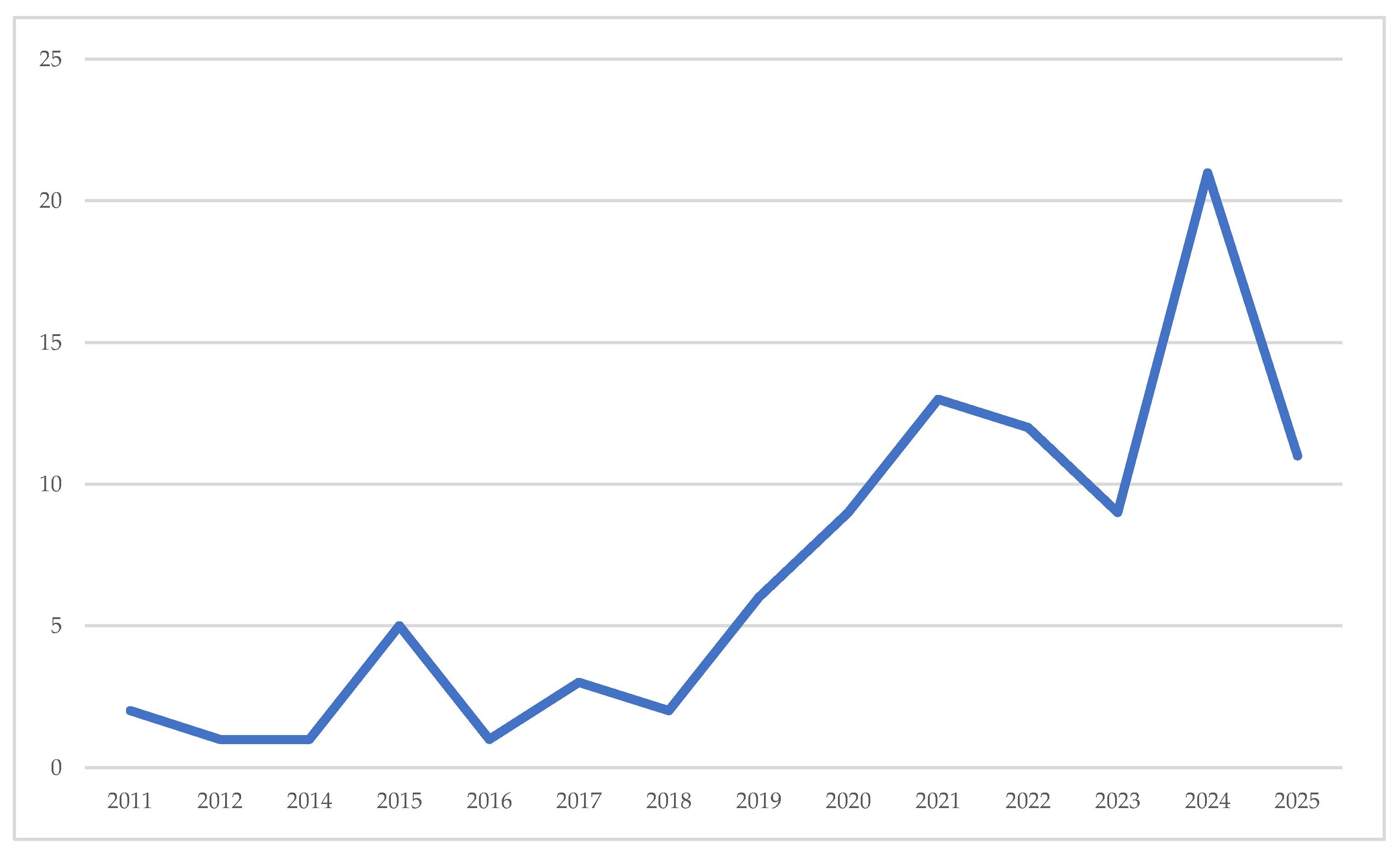
Figure 2.
MCDM methods for sustainable supplier selection in the synthesis sample (source: own compilation).
Figure 2.
MCDM methods for sustainable supplier selection in the synthesis sample (source: own compilation).
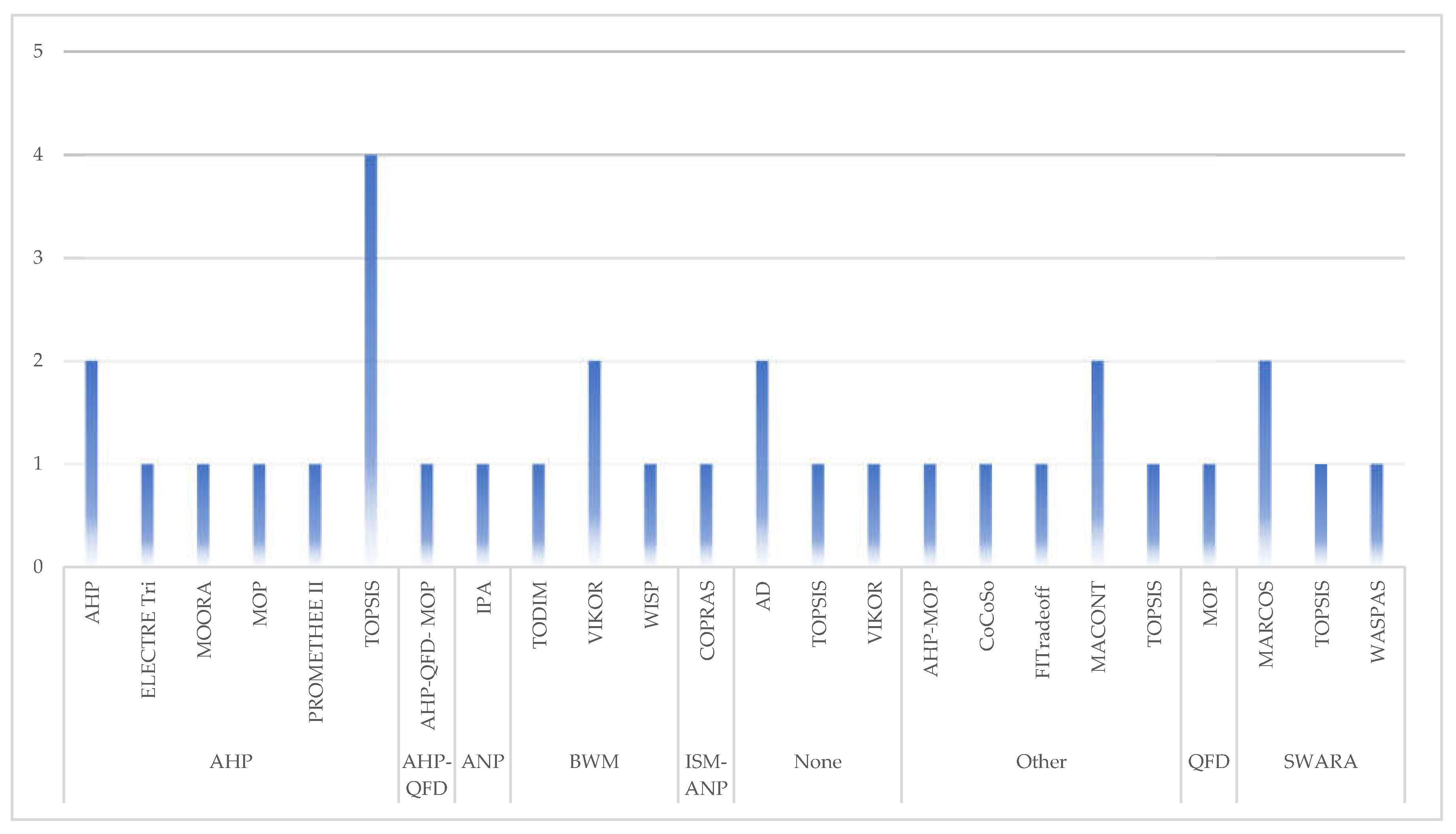
Figure 3.
Raw criteria occurrences for the sustainable supplier selection scope of study (source: own compilation).
Figure 3.
Raw criteria occurrences for the sustainable supplier selection scope of study (source: own compilation).
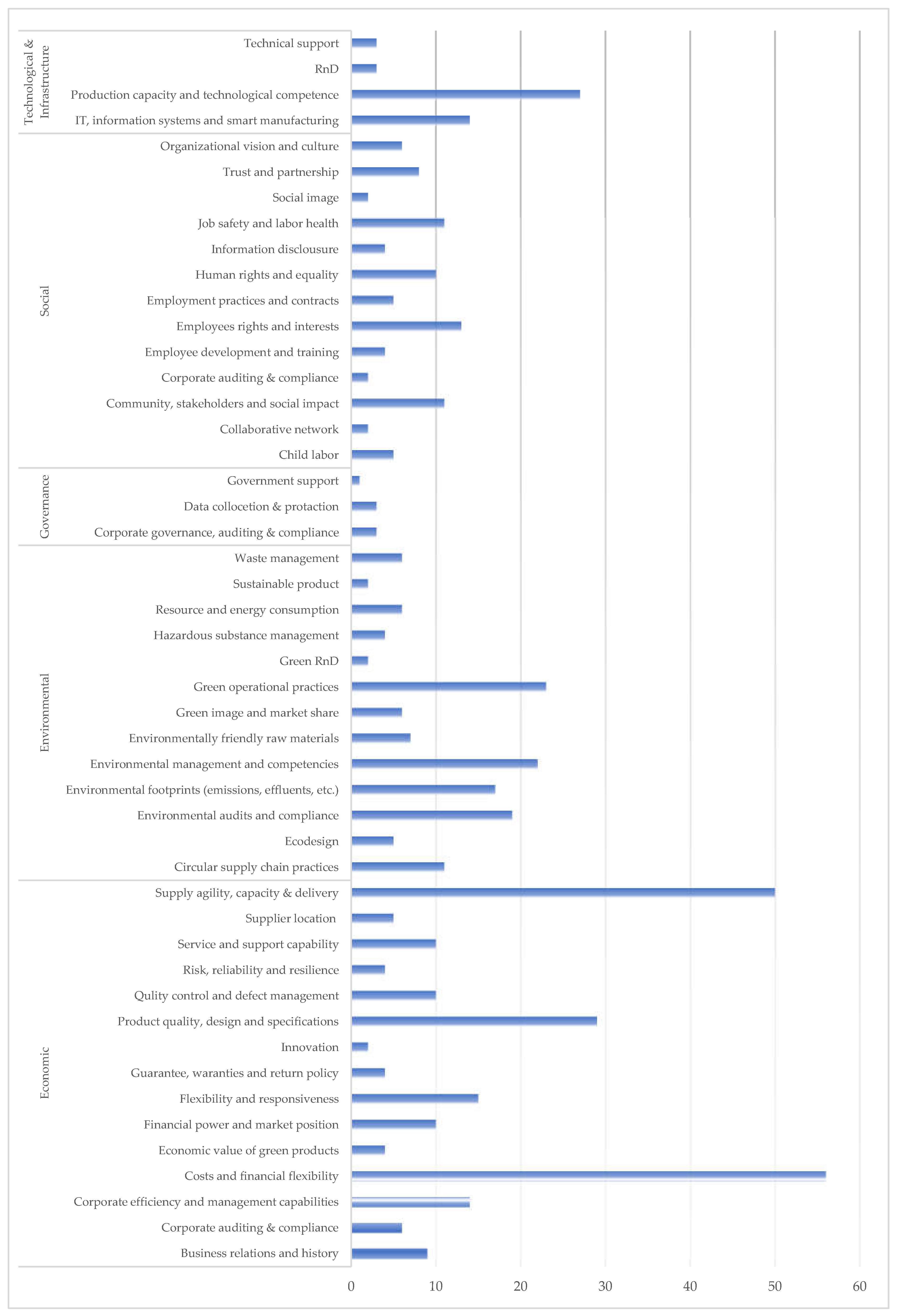
Figure 4.
Decision importance criteria: frequently highlighted criteria after MCDM modelling in supplier selection scope (source: own compilation).
Figure 4.
Decision importance criteria: frequently highlighted criteria after MCDM modelling in supplier selection scope (source: own compilation).
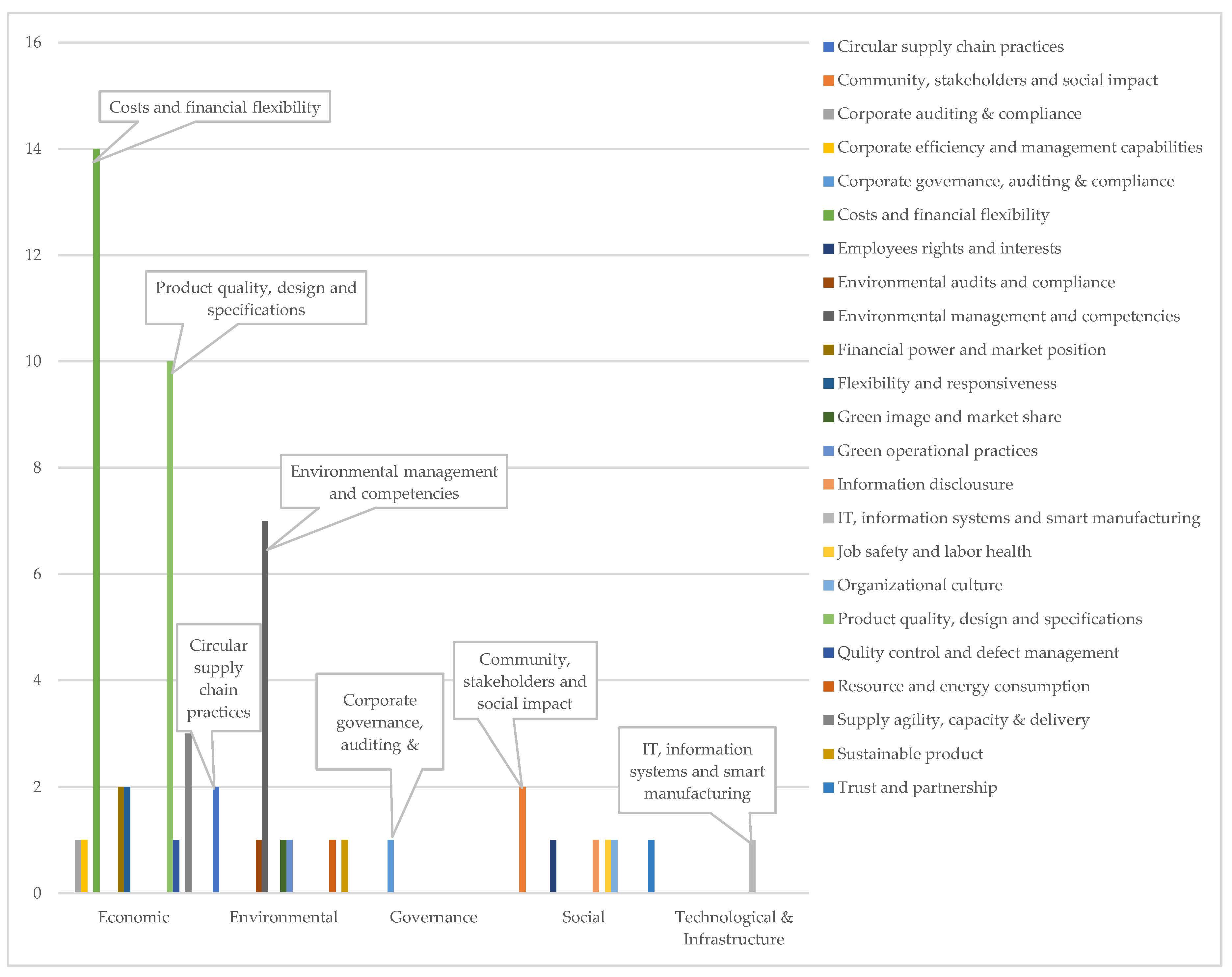
Figure 5.
Raw criteria occurrences in the corporate sustainability assessment scope of study (source: own compilation).
Figure 5.
Raw criteria occurrences in the corporate sustainability assessment scope of study (source: own compilation).
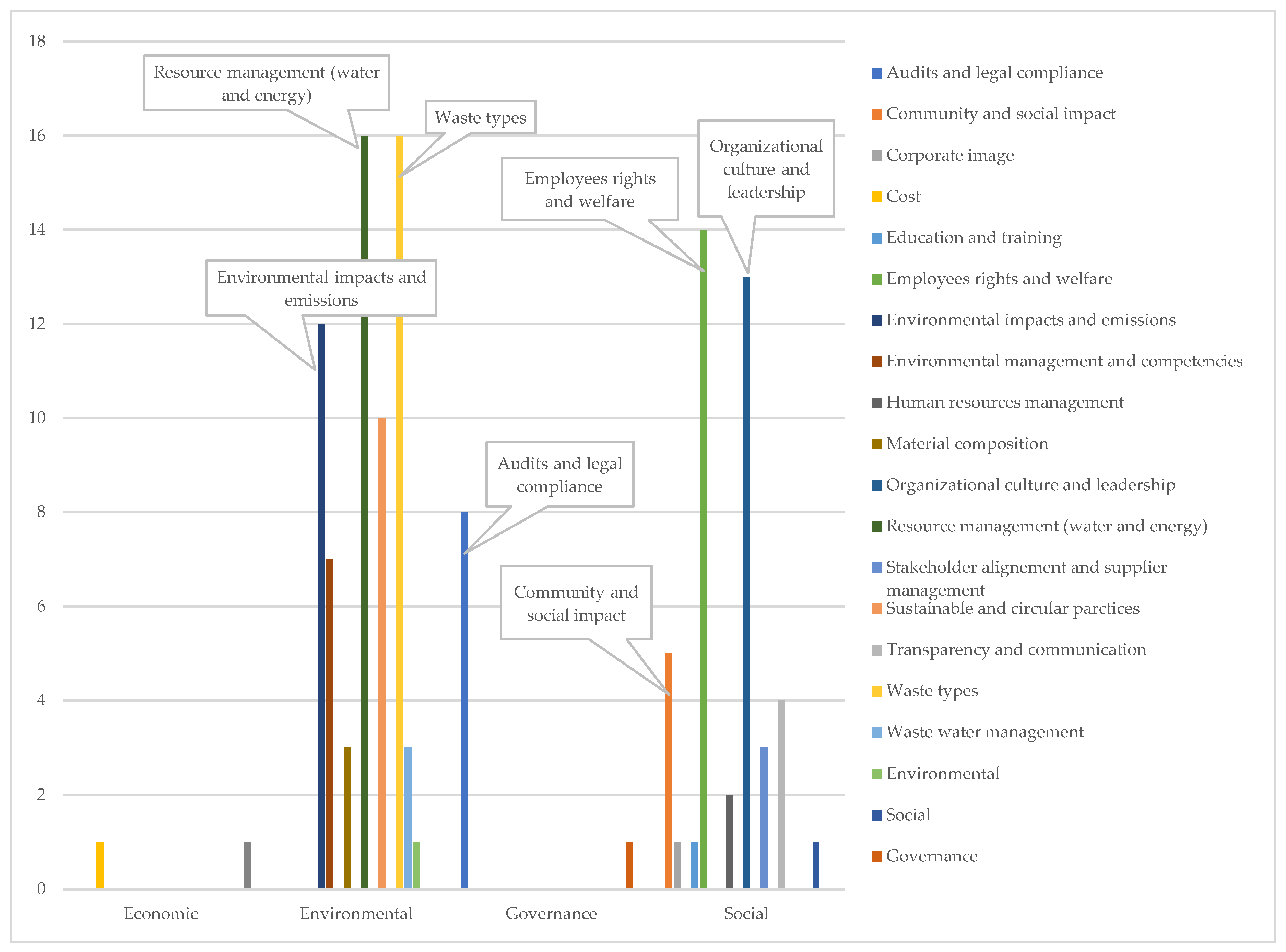
Figure 6.
MCDM methods for influential factors for sustainability and circularity implementation in broader contexts (source: own compilation).
Figure 6.
MCDM methods for influential factors for sustainability and circularity implementation in broader contexts (source: own compilation).
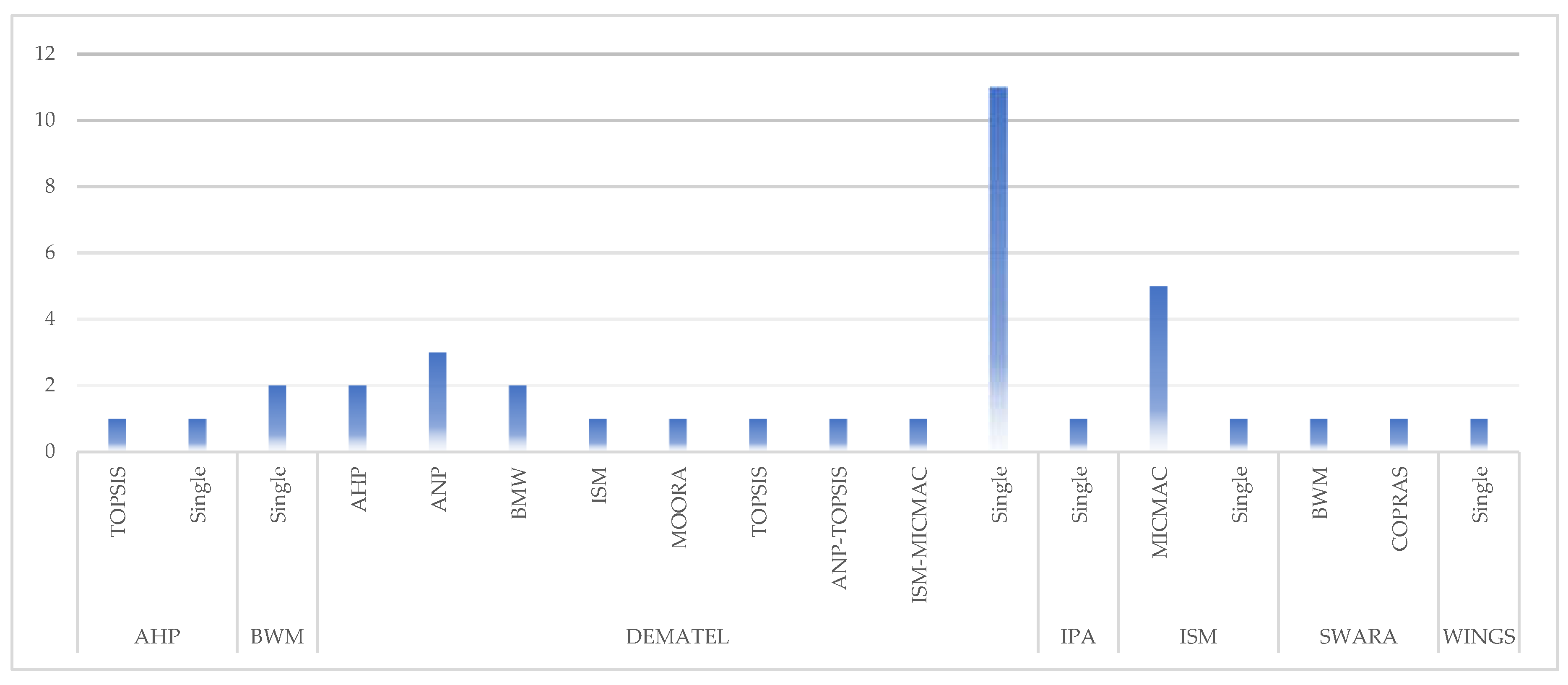
Figure 7.
Number of raw occurrence of criteria in MCDM models for the analysis of influential factors for sustainability and circularity implementation.
Figure 7.
Number of raw occurrence of criteria in MCDM models for the analysis of influential factors for sustainability and circularity implementation.
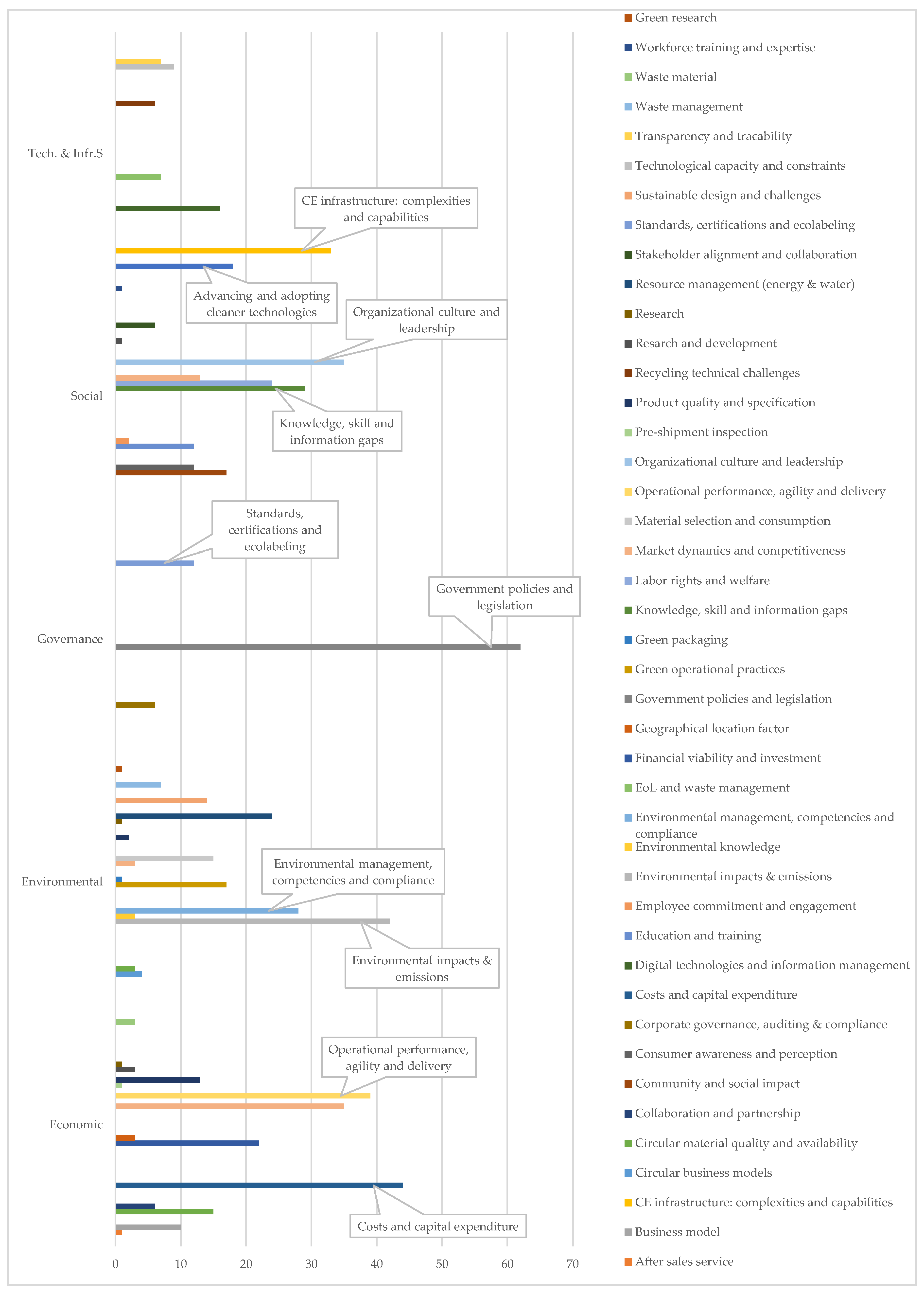
Figure 8.
Strongest causal influential factors (based on calculated dominace by DEMATEL) in sustainability and circularity implementation in broader contexts (own compilation).
Figure 8.
Strongest causal influential factors (based on calculated dominace by DEMATEL) in sustainability and circularity implementation in broader contexts (own compilation).
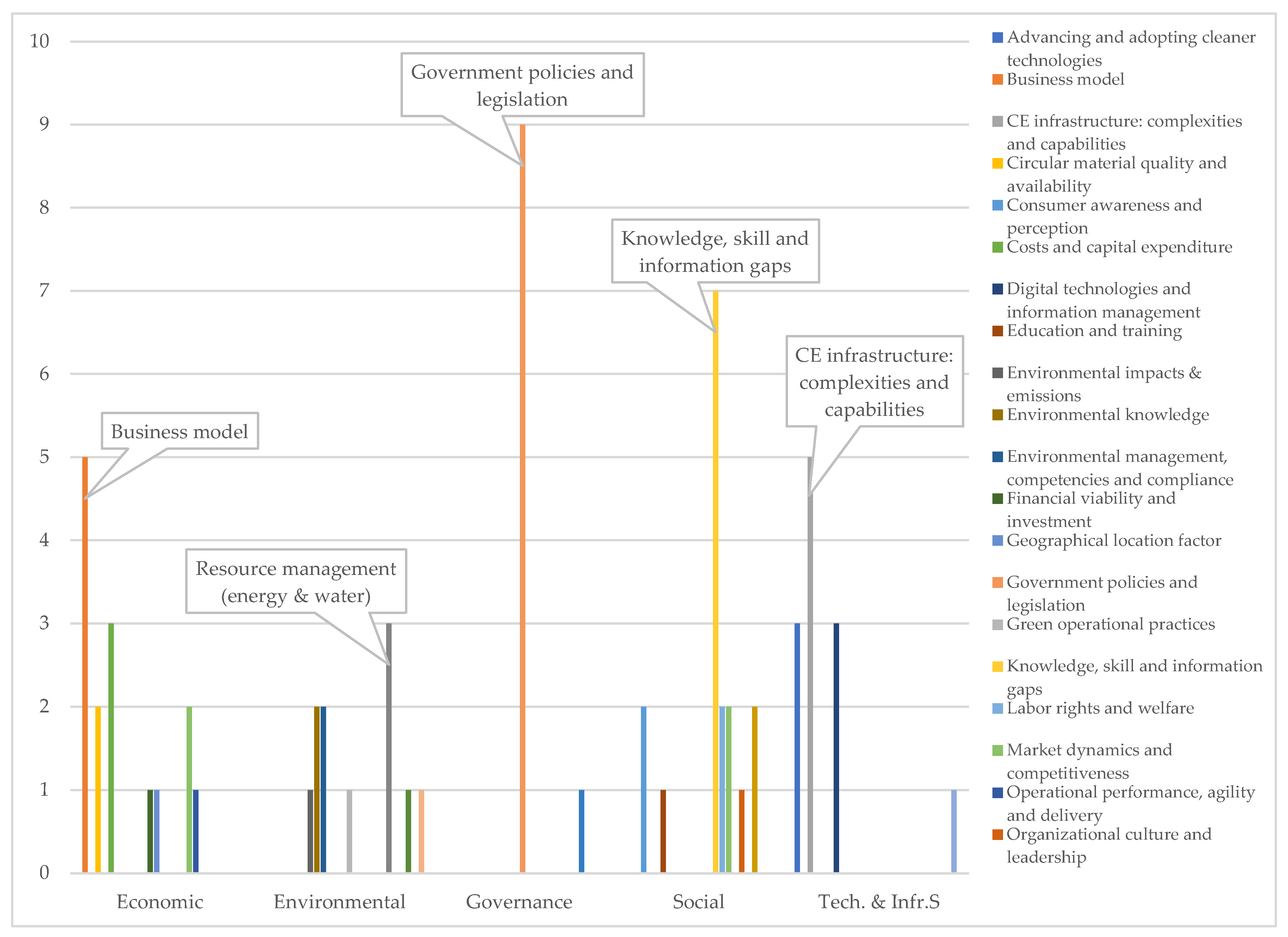
Figure 9.
Number of raw occurance of criteria in MCDM models for analysing sustainable management strategies (grouped in harmonized clusters).
Figure 9.
Number of raw occurance of criteria in MCDM models for analysing sustainable management strategies (grouped in harmonized clusters).
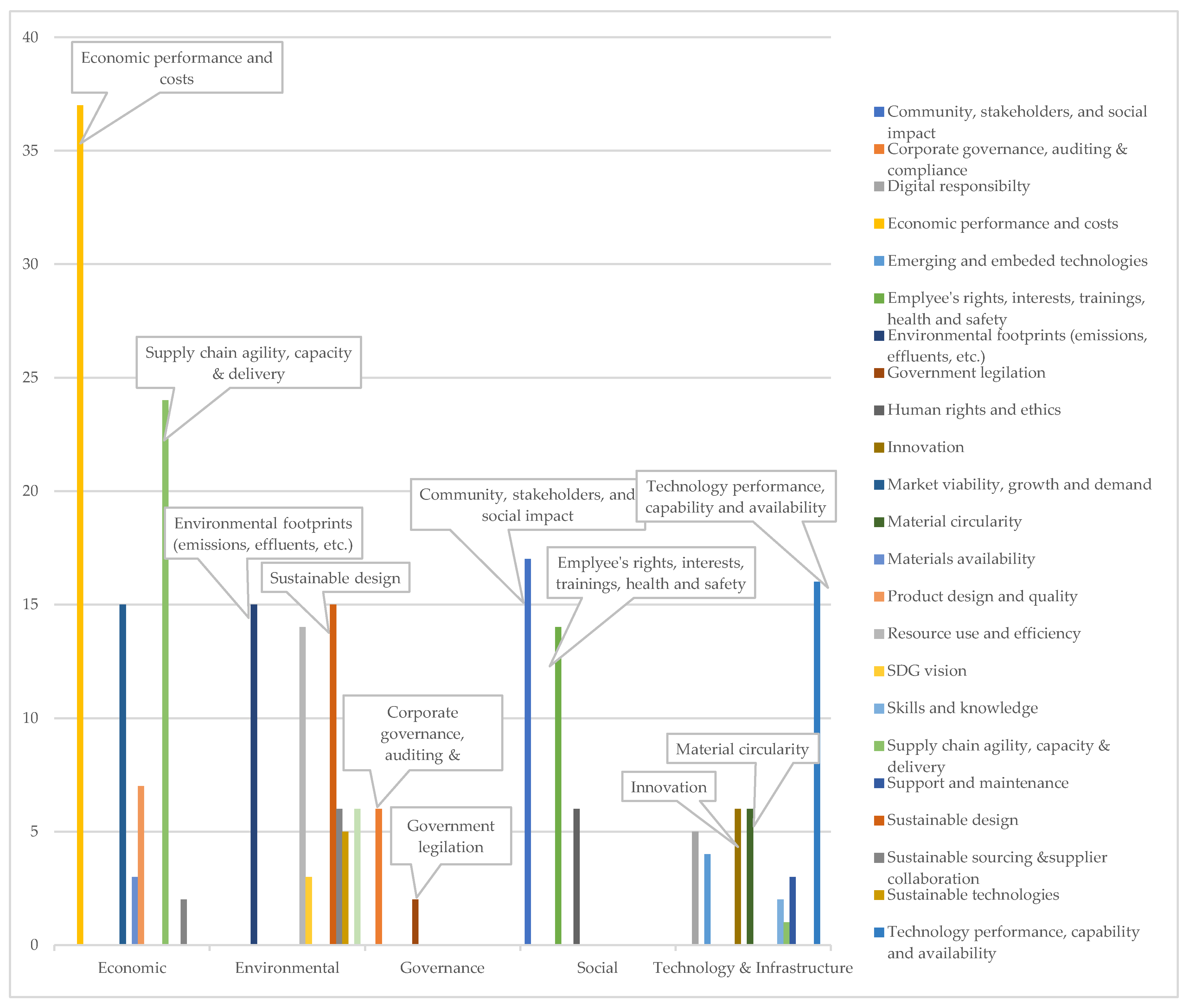
Figure 10.
Raw criteria occurances in product sustainability assessment scope of study (source: own compilation).
Figure 10.
Raw criteria occurances in product sustainability assessment scope of study (source: own compilation).
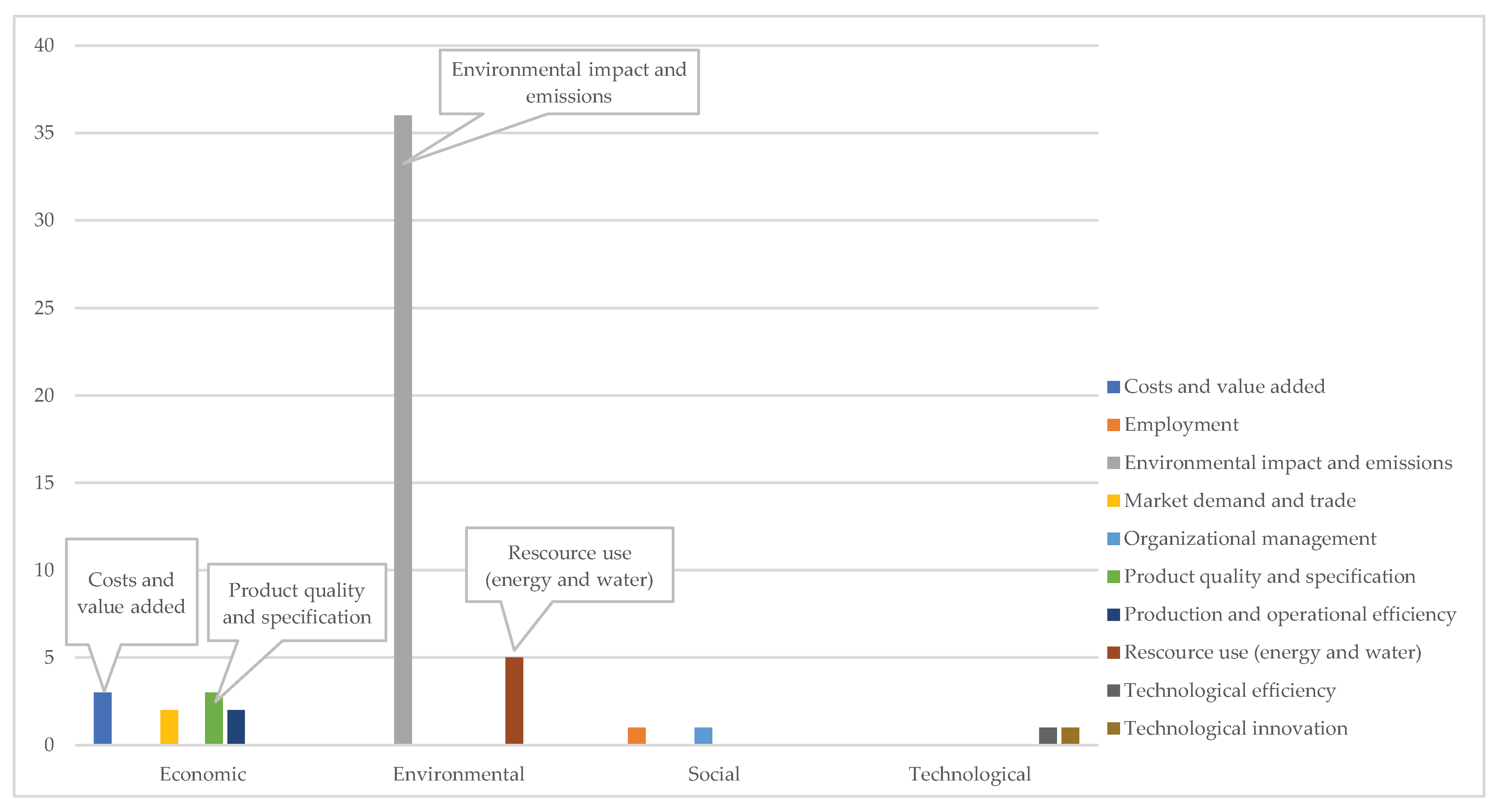

Table 1.
Overview of MCDM methods (source: own compilation).
| MCDM Method | Primary function | Underlying Source | ||
|---|---|---|---|---|
| AHP | Analytical Hierarchy Process | Alternative ranking and criteria weighting | [30] | |
| ANP | Analytic network process | Alternative ranking and criteria weighting | [31] | |
| BWM | Best Worst Method | Criteria weighting | [32] | |
| COCOSO | Combined Compromise Solution | Alternative ranking | [33] | |
| DEA | Data Envelopment Analysis | Efficiency and performance benchmarking | [34] | |
| DEMATEL | Decision-Making Trial and Evaluation Laboratory | Causal relationship analysis | [35] | |
| ELECTRE | Elimination and Choice Translating Reality | Alternative ranking | [36] | |
| FAD | (Fuzzy) Axiomatic Design | Design evaluation and structuring | [37] | |
| FUCOM | Full Consistency Method | Criteria weighting | [38] | |
| ISM | Interpretive Structural Modelling | Hierarchical system relationship modeling | [39] | |
| MAIRCA | Multi Attributive Ideal-Real Comparative Analysis | Alternative ranking | [40] | |
| MARCOS | Measurement of Alternatives and Ranking according to COmpromise Solution | Alternative ranking | [41] | |
| MOORA | Multi-Objective Optimization by Ratio Analysis | Alternative ranking | [42] | |
| PROMETHEE | Preference Ranking Organization Method for Enrichment Evaluation | Alternative ranking via outranking | [43] | |
| PSI | Preference Selection Index | Alternative ranking and statistical criteria weighting | [44] | |
| QFD | Quality Function Deployment | Requirement mapping, technical criteria weighting and alternatives benchmarking | [45] | |
| Qualiflex | Qualitative Flexible multiple criteria tool | Alternative ranking | [46] | |
| SWARA | Step-wise Weight Assessment Ratio Analysis | Criteria weighting | [47] | |
| TODIM | TOmada de Decisão Interativa Multicriterial | Alternative ranking (combined with Prospect Theory) | [48] | |
| TOPSIS | Technique for Order Preference by Similarity to Ideal Solution | Alternative ranking | [49] | |
| VIKOR | VlseKriterijuska Optimizacija I Komoromisno Resenje | Alternative ranking | [50] | |
| WISP | Weighted Integrated Sum Product | Alternative ranking | [51] | |
Table 2.
Research method.
| Search string (applied Aug. 07, 2025) | |||||
| The primary objective of the search query is to identify studies that have applied MCDM methods for sustainability assessment within the textile supply chain | |||||
| Key concepts | |||||
| Sustainability | Assessment | MCDM | Textile | Supply Chain | |
| Free text terms | |||||
| “sustainable” or “environmental” or “social” or “green” | “management” or “measurement” or “evaluation” or “modelling” or “reporting” or “framework” or “development” | “multi criteria decision making” or “multi criteria decision analysis” or “MCDA” | “textile” or “apparel” or “fashion” | “industry” “producer” “manufacturer” “corporate” “factory” or “retail” or “supplier” | |
|
(sustainab* OR social* OR environment* OR green) AND (assess* OR evalua* OR report* OR framework OR manag* OR model OR measur* OR develop) AND ("mcdm" OR "decision making" OR "decision analysis" OR "MCDA") AND (“textile" OR "apparel" OR "fashion”) AND (“industry" OR "produce*" OR "manufactur*" OR "corporate" OR "factory" OR "supply chain" OR "suppl*" OR "retail") | |||||
| Scopus (499) | WoS (410) | ||||
| Exclusion of 284 duplicates | |||||
| Screening of 625 titles and abstracts | |||||
| Exclusion of 528 papers | Inclusion of 97 papers | ||||
|
Non-English language Irrelevant study design (e.g., review) Non- appropriate paper type (e.g., early access, technical note, editorial) Broader study topics that are not textile specific (e.g., agriculture, wastewater treatment industries) Limited focus (overly technical focus on specific chemical or technology) Incompatible boundaries (consumer and post-consumer phases) |
Dyadic relationships, evaluations within a single stage, and system-wide sustainability assessments The research method in the papers is "model development," and/or "practical validation" through case studies MCDM models using different data types (e.g., quantitative/qualitative converted to fuzzy/crisp numbers) Single or hybrid MCDM models Applied to different stages of textile and apparel supply chain |
||||
| In depth analysis of 97 articles | |||||
| Exclusion of one retracted study and updating results of 96 articles | |||||
Table 3.
Procedure for categorizing studies according to scope of study.
| Description | Examples of recurring keywords/themes | Output | |
|---|---|---|---|
| Initial screening and pattern identification | Titles, abstracts, and keywords of the selected articles were scanned to identify recurring keywords and themes. | “Supplier selection”, “drivers”, “challenges”, “barriers”, “performance evaluation”, “sustainability/ green initiatives”, “circular/ sustainability strategies”, “sustainable techniques”, “supply chain management” | Preliminary thematic clusters |
| Contextual assessment for final categorization | Articles were further examined based on their research objectives, decision problem, and application context to validate and refine the preliminary clusters | Research objectives, decision-making context, assessment focus | Refined study classification and Identification if five distinct scopes of studies. Each article was assigned to the most relevant scope of study. |
Table 4.
Classification of the scope of studies, type and sources of data and units of analysis (source: own compilation).
Table 4.
Classification of the scope of studies, type and sources of data and units of analysis (source: own compilation).
| Scope of study | Type and sources of data | Number of studies | Category details and units of analysis |
|---|---|---|---|
| Sustainable supplier selection | Quantitative and qualitative supplier selection criteria across economic, environmental, social, technological and corporate governance dimension. Expert opinion is the dominant source of data | 32 | These studies use MCDM methods to assess and rank suppliers based on sustainability criteria, focusing on the buyer-supplier (dyadic) relationship in manufacturing and retail. [53,57,58,59,60,61,62,63,64,65,66,67,68,69,70,71,72,73,74,75,76,77,78,79,80,81,82,83,84,85,86,87] |
| Corporate sustainability assessment | Quantitative data based on corporate reports & public database, and qualitative criteria based on expert opinions across economic, environmental, social, and corporate governance dimensions. | 8 | These studies vary in units of analysis. The assessment could remain within one stage when studying the internal operations of a textile firm. However, assessments by major fashion brands that include suppliers or raw material selection expand to system-wide analysis with multiple supply chain stages. [54,88,89,90,91,92,93,94] |
| Influential factors for sustainability and circularity implementation (drivers, barriers, metrics) | Qualitative assessments using expert opinion as the source of data on sustainability and circularity related barriers and challenges (mainly in the form of cause-effect analysis) across economic, environmental, social, technological & infrastructural, and governance dimensions | 37 | These studies evaluate the influential factors for implementing sustainability within the textile industry on a broader level (e.g., national) and their focus extends beyond a single organization typically involving system-wide supply chain considerations and across multiple stages or actors. [95,96,97,98,99,100,101,102,103,104,105,106,107,108,109,110,111,112,113,114,115,116,117,118,119,120,121,122,123,124,125,126,127,128,129,130] |
| Sustainable management strategies | Qualitative data based on expert opinion, along with quantitative onsite data covering economic, environmental, social, technological and governance criteria | 14 | This category includes studies that use MCDM methods to support decision making for adopting sustainable management strategies and practices within the textile supply chain. These studies also vary in units of analysis. System wide studies include e.g., the identification of best reverse logistics national-wide strategy for used clothing industry, while developing a decision system for identifying energy efficiency strategies has a limited focus within manufacturing stage. [131,132,133,134,135,136,137,138,139,140,141,142,143,144] |
| Product sustainability assessment | Quantitative impact data from life cycle assessments (LCA) and onsite data mainly in environmental but also in economic, social, and technological dimensions. Expert opinion used less frequently | 5 | These papers use MCDM methods to assess and compare the sustainability performance of textile products in system-wide analyses as product sustainability assessments typically account for impacts across multiple supply chain stages and actors, from raw material sourcing to manufacturing and end-of-life disposal. [25,145,146,147,148] |
Table 5.
Study-level prevalence of sustainability dimensions: number of studies containing a sustainability dimension. (EC=economic, EN=environmental, SO=social, T&I=technological and infrastructure, GOV=governance).
Table 5.
Study-level prevalence of sustainability dimensions: number of studies containing a sustainability dimension. (EC=economic, EN=environmental, SO=social, T&I=technological and infrastructure, GOV=governance).
| Scope of study | EC | EN | SO | T & I | GOV | Total number of studies |
|---|---|---|---|---|---|---|
| Sustainable supplier selection | 30 | 29 | 20 | 22 | 4 | 32 |
| Corporate sustainability assessment | 2 | 7 | 6 | 0 | 6 | 8 |
| Influential factors for sustainability and circularity implementation | 36 | 28 | 35 | 30 | 32 | 37 |
| Sustainable management strategies | 12 | 12 | 7 | 10 | 7 | 14 |
| Product sustainability assessment | 3 | 5 | 1 | 1 | 0 | 5 |
Table 6.
General overview of criteria distribution (raw occurrences) over the identified scope of studies and sustainability dimensions.
Table 6.
General overview of criteria distribution (raw occurrences) over the identified scope of studies and sustainability dimensions.
| Scope of study | EC | EN | SO | T&I | GOV |
|---|---|---|---|---|---|
| Sustainable supplier selection | 228 | 130 | 83 | 47 | 7 |
| Corporate sustainability assessment | 2 | 68 | 44 | 0 | 9 |
| Influential factors for sustainability and circularity implementation | 195 | 166 | 152 | 96 |
80 |
| Sustainable management strategies | 88 | 64 | 37 | 43 | 8 |
| Product sustainability assessment | 10 | 41 | 2 | 2 | 0 |
| Total number of criteria | 523 | 469 | 318 | 188 | 104 |
Table 7.
Distribution of criteria categories (row occurrences) for sustainable supplier selection (source: own compilation).
Table 7.
Distribution of criteria categories (row occurrences) for sustainable supplier selection (source: own compilation).
| Category | Number observed per category |
|---|---|
| Economic criteria | 228 |
| Environmental criteria | 130 |
| Social criteria | 83 |
| Technological criteria | 47 |
| Governance | 7 |
| Total | 495 |
Table 8.
Corporate sustainability scenarios in the synthesis sample (EC=economic, EN=environmental, SO=social, T&I=technological and infrastructure, GOV=governance).
Table 8.
Corporate sustainability scenarios in the synthesis sample (EC=economic, EN=environmental, SO=social, T&I=technological and infrastructure, GOV=governance).
| Study context | Sustainability dimension | MCDM method | Type and source of data | |
|---|---|---|---|---|
| Corporate sustainability performance assessment for 54 world companies in the apparel industry and check their results with the ASSET4 ranking [88] | EC, EN, SO, and GOV | Fuzzy TOPSIS | Qualitative based on expert opinion converted to fuzzy numbers | |
| Sustainability performance evaluation of a multinational clothing company (Inditex group) over 4 years (2008-2012) [89] | EN | TOPSIS | Quantitative data from Annual sustainability reports of the company | |
| Corporate sustainability framework for Taiwanese textile industries [91] | EC, EN, SO, and GOV | Fuzzy DEMATEL | Qualitative data based on expert opinion expressed in fuzzy numbers | |
| Comparing the multi-tier sustainability performance of 3 big fashion brands (Inditex, H&M, GAP) through traceability management [90] | EC, EN, SO, GOV | AHP | Quantitative data from sustainability reports (2011–2016) published by the studied fast fashion companies | |
| Corporate HSE performance in textile manufacturing, case study in 2 Iranian textile factories [92] | SO, GOV | ANP- DEMANTEL | Qualitative data based on expert opinions in crisp numbers | |
| Sustainability performance evaluation of a Turkish technical textile manufacturer [93] | EN | TOPSIS | Quantitative data from company’s GRI reports | |
| Sustainability performance evaluation of a multinational clothing company (Inditex group) over 4 years (2018-2021) [54] | EN, SO, GOV | COCOSO- MAIRCA | Quantitative data from annual sustainability reports of the company over 4 years (2018-2021) | |
| Comparing the eco-design performance of 16 big multinational fashion companies [94] | EN, SO, GOV | DEA | Quantitative data from Corporate Information Transparency Index (CITI) -The database of consumer-facing companies that have a sizeable supply chain in China | |
Table 9.
Distribution of influential factors categories (raw occurrences) for broader sustainability and circularity implementation (source: own compilation).
Table 9.
Distribution of influential factors categories (raw occurrences) for broader sustainability and circularity implementation (source: own compilation).
| Category | Number observed per category |
|---|---|
| Economic criteria | 195 |
| Environmental criteria | 166 |
| Social criteria | 152 |
| Technological criteria | 96 |
| Governance | 80 |
| Total | 689 |
Table 10.
Number of applied criteria (raw occurrences) for decision making about management strategies.
Table 10.
Number of applied criteria (raw occurrences) for decision making about management strategies.
| Category | Number observed per category |
|---|---|
| Economic criteria | 88 |
| Environmental criteria | 64 |
| Social criteria | 37 |
| Technological criteria | 43 |
| Governance | 8 |
| Total | 240 |
Table 11.
MCDM methods for textile products sustainability assessment.
| Scope and context of study | MCDM method | Sustainability dimension | Type and source of data |
|---|---|---|---|
| Support system for LCA interpretation of textile products in the context of a T-shirt made of Polyester, Cotton, and Viscose [25] |
PROMETHEE ELECTRE | Environmental (10) | LCA impact data following the principals of the standard series ISO 14040 calculated according to the method CML 2001. |
| Analysis of chemical footprint of dyed cotton fabric Via a case study in a Chinese dyeing company using 1200 tons of dyed cotton fabric as the functional unit [146] |
Grey Euclidean distance minimization | Environmental (2) | On-site collected data. The toxicity characterization factor of chemical substances obtained from the USEtox model and other databases, such as the Estimation Programs Interface Suite and Pesticide Action Network Pesticide database. |
| Denim fabric sustainability by varying virgin/rec. cotton blends & energy supply Through a case study in a denim fabric producer in Turkey, using 1-m finished denim fabric with weight 638.2 g. as the functional unit (equal to 1.5 m2 of denim fabric) [145] |
TODIM | Economic (4) Environmental (5) |
Ecoinvent 3.0 and on-site data |
| Analysis of circularity potential of different textile product groups Categories of fashion textiles, home textiles, and technical textiles were analysed using publicly available data [147] |
TOPSIS | Economic (5) Environmental (6) Social (2) T&I (2) |
Quantitative data from literature or international databases in the years 2015, 2018, 2019, 2021 |
| Denim fabric sustainability by varying virgin/recycled PET /cotton and allocation types Through a case study in a denim fabric producer in Turkey, using 1 m of denim fabric weighing 365 g and measuring 1.35 m2 as the functional unit [148] |
EDAS | Economic (1) Environmental (18) |
Ecoinvent (v. 3.7.1) database, on-site data, and literature |
Table 12.
Number of applied criteria (raw occurrences) for product sustainability assessments.
| Category | Number observed per category |
|---|---|
| Economic criteria | 10 |
| Environmental criteria | 41 |
| Social criteria | 2 |
| Technological criteria | 2 |
| Governance | 0 |
| Total | 55 |
Disclaimer/Publisher’s Note: The statements, opinions and data contained in all publications are solely those of the individual author(s) and contributor(s) and not of MDPI and/or the editor(s). MDPI and/or the editor(s) disclaim responsibility for any injury to people or property resulting from any ideas, methods, instructions or products referred to in the content. |
© 2026 by the authors. Licensee MDPI, Basel, Switzerland. This article is an open access article distributed under the terms and conditions of the Creative Commons Attribution (CC BY) license (http://creativecommons.org/licenses/by/4.0/).
Copyright: This open access article is published under a Creative Commons CC BY 4.0 license, which permit the free download, distribution, and reuse, provided that the author and preprint are cited in any reuse.