

Submitted:
08 October 2026
Posted:
10 October 2026
You are already at the latest version
Abstract
Within the hospitality industry, the continuing introduction of Artificial Intelligence (AI) is attracting increasing attention. Although there is a rapidly growing literature on the role of AI within the industry, how specific companies have publicly reported on their introduction of AI has attracted little or no attention in the business and management literature. This gap highlights a broader challenge regarding the absence of a structured approach to AI deployment, leaving stakeholders with limited visibility of how organizations are managing the associated risks. Using an interpretivist inductive approach, this exploratory paper first looks to contribute to helping to fill that gap by providing a narrative synthesis of relevant literature and some case examples of how four major hotel groups, namely Hilton Worldwide Holdings, Marriott International, International Hotel Group (IHG) Hotels and Resorts, and Wyndham Hotels and Resorts are introducing AI. The main process “touchpoints” where AI is impacting hospitality operators are identified and the key challenges and potential downsides of AI deployment are outlined. To cope with these challenges, drawing on the case examples and the literature, the paper then puts forward a structured Governance, Risk, and Compliance (GRC) based framework rooted in the ISO/IEC 42001 AI Management System standard. This approach offers a practical and auditable pathway for mitigating risks such as data privacy violations, algorithmic bias, and operational disruptions. This will be of relevance not only to researchers but also to hotel operators looking to progress AI change projects responsibly and strategically within their operations.
Keywords:
hospitality industry
; hotel industry
; artificial intelligence
; AI
; digitalization
; process touchpoints
; governance risk and compliance
; GDC
; operational framework
1. Introduction
The hospitality industry consists of companies of varying size and structure, including multinational groups, integrated resorts and independent hotels. The deployment of digital technologies has also varied within the sector, with some of the larger operators, in particular, having aggressively pursued digitalization across a range of their main process areas, but notably in terms of customer service [1]. Digitalization projects have increased in scale and scope in the industry in recent years, driven by customer expectations, the search for greater efficiencies and the pace of technology change [2]. Within this context, the continuing introduction of Artificial Intelligence (AI) within the industry is attracting increasing attention, and there is rapidly growing awareness that it offers a wide range of opportunities to improve operational efficiency and to create more profitable business strategies. Such opportunities include personalizing guest experiences, analyzing guest data, predicting maintenance requirements, enhancing guest safety, optimizing staff scheduling, and streamlining employee recruitment. Powell [3] recently observed that “hotel leaders believe AI will fundamentally change how people search, book, and experience travel. The guest journey is becoming more conversational, more personalized, and less transactional. As guests start turning first to conversational interfaces rather than traditional search engines, there will be a reimagining of how people plan and experience travel” (para. 14). Indeed, Ruel and Njoku [4] (p.53), went so far as to claim claimed that AI had “redefined the hospitality industry”, while Jiwnani [5], writing under the Deloitte banner, argued that “the continual advancements in Artificial Intelligence (AI) are not just reshaping, but fundamentally reinventing how hotels interact with guests, streamline operations and envisage the future of travel” (para. 1).
The potential impact of AI in hospitality is emphasized by Eshaer et al. [6], in their study of AI in the hotel supply chain. The authors noted “artificial intelligence is a strategic tool capable of reshaping hotel supply chains by improving demand forecasting, inventory management, enhancing coordination with suppliers, and supporting real-time decision-making” (p.2). However, they concluded that “the literature on hotel supply chain management has yet to sufficiently address the role of artificial intelligence (AI) or explore strategies and practices that leverage AI to foster supply chain innovation and capabilities, such as agility and resilience” (p. 2). At the same time, how individual players within the industry have publicly reported on their introduction of AI has attracted little or no attention in the hospitality literature. More specifically, the paper addresses two research questions (RQs):
RQ1. How are the hospitality companies using AI?
RQ2. What are the potential challenges of AI adoption in the hospitality sector?
RQ3. Can a framework be developed based on ISO/IEC 42001 to manage these challenges?
The contribution of the paper lies in its examination of relevant literature and hospitality company websites to set out the current and potential applications of AI in hospitality and the associated challenges. It also puts forward a regulatory framework to manage these challenges and the associated risks. The paper provides some illustrations of how four major hotel groups, namely Hilton Worldwide Holdings, Marriott International, International Hotel Group (IHG) Hotels and Resorts, and Wyndham Hotels and Resorts, are introducing AI and the proposed framework is based on the international standard ISO/IEC 42001 [7], which is designed for AI-related risk management. The paper is set out as follows. Following this brief introduction, Section 2 presents a synthesis of relevant literature, highlighting key issues that contribute to subsequent analytical framework development. Section 3 then presents the research method, focusing on an integrative review of relevant sources and an analysis of company case examples. Section 4 then sets out the results, addressing the three research questions. Finally, Section 5 concludes the paper, summarizing the contribution, noting the limitations and pointing out possible future research initiatives in this field of study.
2. Literature Review
2.1. Introduction
In the context of the hospitality industry, the expansion of internet services and platforms and growth in cloud applications have brought new possibilities to exploit digital technologies for improved customer experience and greater operational efficiencies. The use of IT can now provide significant competitive advantage to more advanced users. Law et al. [8] (p. 599) concluded that “IT is increasingly becoming critical for the competitive operations of the tourism and hospitality organizations as well as for managing the distribution and marketing of organizations on a global scale”. This includes a range of digital technologies that are now in evidence in everyday operations in the tourism industry: analytics, robotics, and virtual reality, as well as artificial intelligence. Nevertheless, Nannelli et al. [90] point out that “although the literature on AI and tourism is growing, scientific research on these themes is still fuzzy and fragmented” (p. 1325).
Nevertheless, the integrative review of available literature (the process is briefly outlined in section 3) revealed a number of emergent themes that are set out here: the AI technologies and devices used in the industry; the applications of AI in different hospitality business functions and processes; and models and frameworks of relevance to AI deployment in the sector. The aim here is to offer some of the flavor of the literature relating to these themes, rather than to provide a comprehensive review.
2.2. AI Technologies and Devices
AI can be viewed as a set of technologies that enables machines to perform tasks that typically require human intelligence, though there are a variety of definitions. For IBM [10] (para.2), “artificial intelligence is technology that enables computers and machines to simulate human learning, comprehension, problem solving, decision making, creativity and autonomy”, while Craig et al. [11] (para.1) defined “artificial intelligence” as “the simulation of human intelligence processes by machines, especially computer systems”. However, in looking to provide a legal definition, Schuett [12] (p. 62) argued that “there is a vast spectrum of definitions”, and that the term is “highly ambiguous”.
Perhaps more realistically, AI is perhaps best seen as an umbrella term “for a range of algorithm-based technologies that solve complex tasks by carrying out functions that previously required human thinking” [13] (para. 2). As such, AI might be seen to embrace a range of cognitive functions in that it can see, understand and respond to spoken or written language and sounds, it can analyze data and make recommendations, it can learn, reason, plan and act to solve complex problems, and it can create original images and text. AI can be used in many applications, including customer support, personalizing customer experiences, and analyzing data from smart sensors and monitoring tools, and more specifically includes machine learning, deep learning, optical recognition, and the creation of new content from large amounts of training data.
Citak et al. [14] focused on the analysis and evaluation of state-of-the art AI applications in the hospitality industry. Their findings revealed that the major deployments concern in-person customer services, chatbots and messaging tools, business intelligence tools powered by machine learning, and virtual reality and augmented models. Further, the authors discussed how the industry can be motivated by potential guests to apply selected AI solutions but argued that more research was required to quantify the potential benefits and risks of AI implementation, to determine and evaluate the factors affecting AI adoption by guests, and to measure the guest experience of the hotel services, fueled by AI-based technologies. While Doborjeh et al. [15] recognized that several papers had been published on AI applications within the tourism and hospitality industry, they also argued that the effectiveness of these applications had received little research attention. The authors claimed that their work offered both researchers and practitioners a broad understanding of the proper selection of AI methods that will improve decision making and decision support within the tourism and hospitality industries.
More specifically, Diwedi et al. [16] looked to establish a research agenda for the implementation of AI, such as ChatGPT and similar tools in the hospitality and tourism industry and drew its data from practitioners working with ChatGPT. The authors reported that AI technologies would have a transformational impact on the tourism and hospitality industry, and that the example of ChatGPT was a significant point of reference for those tourism and hospitality companies planning to use AI in their businesses. The authors also highlighted the wider implications of harnessing AI, and noted the potential problems that ChatGPT enabled systems face during the service delivery process.
2.3. AI Applications within the Hospitality Industry
Dorgu et al. [17] recognized that AI offered important opportunities for the hospitality and tourism industry across a wide spectrum of functions and processes, including operations, design, marketing, destination management, human resources, revenue management, accounting and finance, and strategic management. Zahidi et al. [18] also looked to identify and explore the impact of AI across the hospitality industry, an arena traditionally seen to be reliant on the human touch. AI was seen to be important in augmenting customer service and in personalizing guest experiences, refining service delivery, and enhancing security. The authors made several recommendations, including stressing the importance of a balanced approach that harnesses the strengths of AI to complement and enhance the traditional human elements of hospitality.
Achayra and Mahapatra [19] examined the role of AI in enhancing guest satisfaction in the hotel industry. The aim was to identify key AI applications that boosted satisfaction and efficiency, and more specifically to investigate the impact of AI integration on guest experience within the hotel industry. The results revealed that improvements in operational efficiency through AI were evident as guests recognized the benefits of streamlined processes and optimized services. Manzoor et al. [20] explored tourists’ perceptions of the use of AI devices in the hotel industry. They used the “artificially intelligent device use acceptance” (AIDUA) framework to uncover the factors that influence tourists’ attitudes to AI devices and their willingness to use them. The authors’ analysis demonstrated that social influence had a positive effect on AI devices’ performance expectations and a negative effect on their effort expectations. In addition, they reported that the performance expectations of AI devices were positively impacted by hedonic motivation, and that the adoption of AI devices was significantly impacted if the devices had similar characteristics to human beings.
Wynn and Lam [21], in their study of digitalization in four major hotel chains, found that AI and robotics were seen as prevalent in the industry by half of the respondents, but that robotics were evident in only one of the four hotel groups studied. In similar vein, Buhalis and Moldavska [22] looked to investigate Voice Activated (VA) interactions between hotels and guests, and they examined consumer perceptions and expectations of hospitality VA capabilities via expert technology providers. The findings illustrated both the hotel and guest requirements and demonstrated that VAs help hotels to improve customer service, expand operational efficiency, and reduce costs. The authors also explained how to use VAs cost effectively while adding value to travelers’ experiences. Gursoy et al. [23] recognized that ChatGPT may revolutionize operations in the hospitality industry, and more particularly that it will result in major changes in how customers search for information and make decisions, and in how businesses produce, create and deliver customized services and experiences. The authors concluded their work by proposing a future research agenda for using ChatGPT in creating and delivering hospitality and tourism experiences.
Milton [24] reported on his investigation into the incorporation of AI into the financial management practices within the hotel sector. The main aims of the investigation were to examine the innovations, obstacles and strategic implications linked with the fusion of AI and financial management in hotels. The findings reveal that AI, and more specifically, predictive analytics, expenditure tracking systems, fraud detection algorithms and personalized pricing strategies, were revolutionizing financial decision-making processes in hotels. However, concerns over data privacy, biases within algorithms, and adherence to regulatory frameworks pose barriers to the integration of AI into financial management. Saleh et al. [25] investigated the effects of AI on the quality and interpretation of financial statements in hotels in Jordan. Their work clarified how AI can interact with accounting systems to help hotel managers deliver high quality accounting details.
The importance of investing in employee training to work alongside AI tools was emphasized by Zahidi et al. [18], as well as adopting transparent data practices and fostering an organizational culture that embraces both technological innovation and human engagement. Al-Romeedy [26] looked to investigate AI integration into human resource management within Egypt’s tourism and hospitality industry, specifically with an eye to its potential impact and future implications. Further, the authors saw AI playing an increasingly important role within human resource management within the industry, and suggested that it offered greater efficiency, effectiveness and competitiveness.
In addressing the dark side of AI, Zhao et al. [27] looked to clarify the potential negative impact of AI on the work outcomes of employees who use AI in the hospitality and tourism industries. The findings revealed that employees’ technical fear towards AI was negatively associated with their sense of realism, and self-investment, but “positively associated with the perceived threat of job intelligence to employment” (p.191). The authors suggested that when employees increase their self-investment in AI, this enhances their proficiency in AI. Koo et al. [28] explored the hotel employees’ perceptions of the impact of AI, focusing on the critical role of job insecurity, job engagement and turnover. Their results indicated that perceived job insecurity significantly affected perceived job engagement, and perceived job insecurity indirectly affected turnover intention.
2.4. Relevant Frameworks and Standards
A number of relevant models and frameworks are discussed in the literature. The concept of change dimensions dates back to the 1990s in the era of business process reengineering [29]. The identification of three main change dimensions—process, people and technology—has been used in many research studies of information technology. For example, Heeks [30] used these dimensions of change (along with organizational structure as a fourth dimension) as an analytical framework in his studies of systems implementation in developing world environments and many subsequent studies have reinforced the value of differentiating these separate but overlapping concepts [31,32] (Figure 1). The value of this approach to digital transformation in general has been highlighted in a number of sources. Launch Consulting [33] note that “the road to successful digital transformation is paved with four essential pillars: technology, process, people, and skills” (para. 1), and Kirvan [34], in proposing a “digital transformation roadmap”, concludes “many, if not all, of the business processes will need to change and adapt to the new technologies. Corporate culture also will likely need to change. This can result in modifying -- or even eliminating -- established procedures, experimenting with, and adopting new ones” (para. 2).
The Governance, Risk, and Compliance (GRC) approach provides an operational framework for addressing the challenges of AI adoption in the hospitality sector. The core principles of this approach [35] are of relevance in developing an effective framework for risk governance for AI deployment. GRC dates back to 2007, when the Open Compliance and Ethics Group (OCEG) introduced the approach as a strategy for risk governance that would also maintain compliance with industry and government regulations. The ISO 31000 [36] standard defines risk as the effect of uncertainty on objectives. Challenges in AI usage may create uncertainties, and thus a GRC-based framework appears appropriate and useful. Madanchian et al. [37] state that “as organizations increasingly integrate AI technologies into their workflows, they encounter various obstacles that can hinder successful implementation and overall effectiveness” (page 1), highlighting the need for a new framework.
3. Research Methodology
AI is attracting considerable attention within the hospitality industry, but until recently, few, if any, companies within the industry have publicly illustrated its introduction within their businesses, and the main aim of the literature search was to identify hospitality enterprises that had made public their approach to AI. As such, the study adopted an interpretivist research philosophy based on a narrative review of the available literature and an assessment of selected company websites. This approach is seen to be cost effective, to offer a practical and feasible approach where the authors do not have access to, and information about, all hospitality groups who are using AI, and Gill and Johnson [38] suggest that such an approach is most appropriate when the research aim is exploratory in nature, as it is in this study.
The research comprised two main phases (Figure 1). Phase 1 centered on the integrative review of available literature to identify key themes and firm up the research questions, whilst at the same time, locating industry examples where the companies had publicly recorded their approach to AI usage. Bell et al. [39] have observed that “the narrative review may be more suitable for qualitative or inductive researchers, whose research strategies are based on an interpretative epistemology” (p.97). In this context, Naeem et al. [40] also note that “a ‘goal-free’ evaluation aligns well with inductive research where theories are developed from the data” (p. 2). A range of search strings was used to find appropriate material between October and December 2024 in various academic databases, including SCOPUS and Web of Science (chosen for their recognized impact indices and coverage of credible peer-reviewed literature in digital technology deployment and digital transformation), plus some “grey” material sources available on the Internet (blogs, consultancy reports, various websites). An initial review of the results indicated a number of key themes emerging from the literature as outlined in section 2, which were pursued and consolidated via related references. In addition, new publications were monitored using a search alert based on the search strings, which included “artificial intelligence”, “AI”, “hospitality industry”, “digital transformation”, “digital technologies”, “models”, “frameworks” and “theory”. Searches were limited to articles published since 2010, as relatively little attention was given to the application of AI in the hospitality sector prior to that date. Only English-language publications were included for feasibility and reference lists were screened manually to identify additional eligible studies.
Phase 2 then focused on these case examples and searched for appropriate evidence to address the RQs. The internet searches had revealed that four international hotel groups, namely, Hilton Worldwide Holdings, Marriott, Wyndham Hotels and Resorts, and International Hotel Group, had posted some details on the Internet of how they are employing AI, and this information provides the empirical material for Phase 2 of this study. Hilton Worldwide Holdings is a US multinational hospitality company, founded in 1919, headquartered in Tysons, Virginia, and has 1.18 million rooms. Marriott International is a US multinational hospitality company, founded in 1927, headquartered in Bethesda, Maryland, and has over 1.5 million rooms. Wyndham Hotels and Resorts, which claims to be the world’s largest hotel franchisor, is a US hospitality company, originally founded in 1981, headquartered in Parsippany, New Jersey, and has over 890,000 rooms. International Hotels Group (IHG) Hotels and Resorts is a UK multinational hospitality company, founded in 2003, headquartered in Windsor, England, and has over 880,000 rooms.
These can be viewed as case examples or micro case studies as defined by Alpi and Evans [41]: they occur within a brief time frame, are simple and straightforward, with reporting being brief. The analysis of the websites used framework analysis [42], in which themes evident from a reading and re-reading of the websites were clustered together and matched against the appropriate companies. These findings do not pretend to provide a comprehensive or comparable picture of how the four hotel groups are introducing AI in their companies, but rather they provide valuable illustrations on AI within the hotel industry. In presenting these case examples, the authors sometimes looked to capture the hotel groups’ approach to AI by quoting directly from the source material in the belief that such quotations helped to convey corporate authenticity. The inductive approach to assessing these case examples sought to examine the interface of AI with different process touch points as evidenced in the company websites, and also to identify the key challenges of AI adoption in the spheres of process change, people skills and competencies, as well as in the technology adoption itself, as put forward by Heeks [30] as noted above. This provided the basis for the development of an analytical framework and application of ISO/IEC 42001to the identified challenges of AI deployment in the hospitality sector.
4. Results
This section directly addresses the two RQs. First, the four hospitality company websites are examined to illustrate how AI is being used in different process areas (RQ1) (Table 1). Then, evidence from both the company websites and the extant literature discussed above is used to identify the critical challenges and possible negative impacts of AI deployment in the industry (RQ2).
4.1. RQ1. How Are the Hospitality Companies Using AI?
In October 2024, Hilton Worldwide Holdings [43] announced its new partnership with Be My Eyes (a free app service that connects people who are blind or visually impaired with sighted people and companies to undertake a number of tasks) to bring “AI powered virtual assistance and dedicated Hilton Reservations and Customer Care support to Be My Eyes users across the U.S. and Canada” (para. 2). The rationale for the initiative was that while checking into a hotel can be the start of an adventure for many guests, it can be a daunting challenge for those who are blind or have low vision, and the initiative directly connects guests with a Hilton team of dedicated and specially trained English-speaking reservations and customer care agents.
The company’s dedicated agents are also available to help users navigate their rooms, identify and adjust in-room thermostats, to operate coffee machines, and to navigate to the hotel’s meeting spaces and amenities. Under this AI-powered initiative, Hilton Worldwide Holdings looks to offer assistance across a variety of its brands, including Waldorf Astoria Hotels and Resorts, Conrad Hotels and Resorts, Double Tree by Hilton, and Hampton by Hilton, and in the hotels under these brands, the service is available to both leisure and business travelers, who are blind or have low vision. More generally, Hilton Worldwide Holdings, claimed that its introduction of AI is part of its longstanding commitment to providing a welcome for every guest, at every hotel, every time.
Marriott International announced the pilot launch of RENAI, its AI-powered virtual concierge service, available at selected hotels in its Renaissance brand. RENAI connects guests with local information about local services and facilities, including restaurants, bars, entertainment, tours and activities. The information is made available for 24 hours every day of the week, by so-called navigators, who are hotel employees, and is provided by merging employees’ information with data collected by ChatGPT and from other open-source outlets, which make contributions to a curated and constantly refreshed directory. Guests can initiate a conversation requesting information on local facilities, and the virtual concierge responds with its recommendations.
Marriott International [44] (paras. 3-4) claimed that RENAI was “a fusion of the latest technology and the trademark hospitality”, that was a hallmark of the company, and that its introduction was based on the company’s recognition that its guests are “interested in emerging tech that is clever and has personality”. More generally, future guests can use RENAI to undertake their own research before they embark on a business trip or vacation, and they can scan a QR code to make the connection via a text message or WhatsApp, to start a conversation. Looking to the future, the full rollout of RENAI is projected to include more enhancements to the service including additional communication platforms such as Instagram as well as curated recommendations from neighborhood tastemakers such as musicians, DJs, artists, and fashion designers. The vice president of product and digital innovation at Marriott Bonvoy recently noted that “AI makes it easier to go from idea to prototype. As long as people know what’s acceptable and where the guardrails are, individual curiosity drives progress” [3] (para. 9).
In July 2024, Wyndham Hotels and Resorts [45] reported the roll-out of Wyndham Connect, which uses AI to enhance the guest and owner experience and is powered by Canary Technologies, with the service being available in all the company’s hotels and resorts in the US. The system “leverages one of the most powerful AI-driven large language models, allowing owners to cater to modern travelers and their evolving needs” (para.3). The benefits claimed for Wyndham Connect include allowing staff to use AI generated messages to help respond to guests via text messages, speeding up the check-in process, a faster contactless check-out process, alerting front desk employees and housekeeping staff when guest rooms become available, and boosting the number of on-line reviews.
The company claimed that the roll out of its Connect platform was an integral part of its approach to the use of new technologies, and AI is seen to have an important role in driving efficiency and productivity, and in enhancing experiences for employees, owners and guests. More specifically, Wyndham Hotels and Resorts reported that its call centers were embracing AI. The company’s vice president of hotel technology strategy and services has identified the call center as an area where significant cost savings can be achieved from AI being used to process thousands of reservation calls every week. He noted that “If AI can handle those calls, we reduce expenses and free up staff for higher-value interactions” [3] (para. 4). The company is also looking to use a chatbot within its mobile app to enhance customer care. In addition, AI is increasingly able to address owner needs, relating, for example, to inquiries on brand standards, and AI is being employed to analyze and forecast opportunities related to room rates, in optimizing occupancy, and in following sales leads, thus helping owners to maintain competitive advantage, and maximize revenues. A further benefit is envisaged in using AI to increase direct bookings as against bookings via online travel agents. The vice-president noted “I think it’s a channel that gives us more control, more first-party guest data, and (by increasing direct bookings), it will help us avoid the margin given up to the OTA business” [3] (para. 6).
In April 2024, IHG announced the launch of a generative AI-powered travel planner, within the IHG One Rewards mobile app, in partnership with Google Cloud. Here the focus is on helping guests to plan forthcoming vacations. The scale of the initiative is impressive in that it embraces some 6,000 of the company’s hotels across 19 brands in over 100 countries. Guests can use the travel planner to make requests, and receive personalized recommendations, embracing both general and specific information, for example, including dining and entertainment options near the company’s hotels.
The company sees its investment in AI as an integral part of attempts to grow customer loyalty and engagement, and the focus is on combining Google’s technical expertise with IHG’s traditional commitment to service. Google became IHG’s cloud provider in 2022 when the company migrated some of its data to BigQuery, a serverless data warehouse. IHG’s reasons for choosing to partner with Google were based on several factors, including Google’s range of AI technologies, and its broad system of consumer products and services, that facilitates opportunities for IHG to create personalized experiences for guests. At the same time, IHG [46] (para. 8) argued that Google Cloud’s “approach to cybersecurity, data governance, and privacy also allows IHG to retain control over its data and enable data and applications to meet compliance and security standards”, and that “Google Cloud’s responsible and ethical approach to generative AI also means that IHG has access to tools which enable direct review of model responses for appropriateness and accuracy”.
4.2. RQ2. What Are the Potential Challenges of AI Adoption in the Hospitality Sector?
The case examples provide some valuable illustrations of how some of the world’s leading hotel groups are introducing AI into their businesses. All four hotel groups paint a positive picture of the benefits that the introduction of AI is generating, both for their business and their customers. In many ways, the customer focus also benefits the hotel groups, in that it also promotes their business strategies. However, benefits should be balanced against the challenges and potential negative impacts of AI evidenced in the literature and the case examples, which are set out below.
Loss of “personal touch” with customers (personalization erosion): While AI enhances operational efficiency, concerns arise over losing the human touch that has long defined the hospitality industry. Providing the personal touch with customers has traditionally been seen as one of the hallmarks of the hospitality industry, but the introduction of AI may mean that personalization is eroded. On the one hand, while AI-powered apps may bring speed and convenience to a range of interactions between guests and hotel groups, it may lack the much-valued warmth, empathy, and understanding often associated with the familiar face of a known employee. Ultimately, the challenge is for AI to be seen by guests to complement and augment the traditional human touch. Balancing AI integration with human interaction is crucial to maintaining personalized and authentic guest experiences. Balancing AI’s benefits with the need to maintain personalized and authentic guest experiences presents a crucial challenge [47].
Concerns over data integrity and privacy: Much of the information available via AI is generated from the Internet, rather than being based on personal experience and expertise, and as such ethical issues may arise in ensuring the integrity of the information provided to customers, and in maintaining what may be hard-won trust between guests and hotels. Customer trust in a hospitality business is greatly influenced by the transparency of its privacy practices. Transparent data privacy practices enhance customer commitment, while a perceived lack of control over data can have the opposite effect. Guests may also have privacy concerns—for example, if they discover, or suspect, that AI-driven payment systems are failing to adequately safeguard their personal, and particularly their financial, details, such guests may seek alternative hotels perceived to be more committed to protecting such information. The collection and analysis of large volumes of guest data—ranging from booking details to in-room preferences—raises significant privacy concerns. Protecting this sensitive information from breaches and ensuring it is used ethically in compliance with regulations like GDPR presents a major challenge [48].
AI technology implementation problems: Despite the hospitality industry’s enthusiasm for AI, it may not always provide win-win situations for hotel groups, and they may face a variety of implementation challenges, including the rapid development of AI and problems in integrating AI technologies into their businesses and existing technology portfolio [21]. Senior executives at Hilton have suggested hotel companies need to be aware that “the strategy involved with AI content generation is fundamentally different from traditional SEO tools, so hoteliers need to learn the language” [3] (para. 8). Related issues include ensuring that specific AI applications are fit for purpose, and training employees. Given the rapid development of AI, it is most unlikely that many companies in the hospitality industry have the in-house expertise to harness its power effectively, so as noted in some of the case examples above, they have little option but to buy in expertise from AI developers and consultants. This can be an expensive process, and it may raise corporate concerns about whether investment in AI represents a good return.
Algorithmic bias in AI: AI bias poses significant ethical and operational risks, but research in this area is limited. Obermeyer et al. [49] show that a widely used algorithm in the health sector, which affects millions of patients, exhibits significant racial bias, and Reed et al. [50] have studied revealing and mitigating bias in marketing in the software industry. In the hospitality sector, risks become apparent when biased training data leads to discriminatory outcomes, such as providing preferential pricing or services to specific demographic groups. For example, older tourists are less likely to make purchases when they encounter AI-driven discrimination compared to situations without discrimination [51]. This kind of unintended discrimination not only contradicts principles of fairness and equity, but it can also lead to reputational damage and legal repercussions for the brand.
The black box problem: This problem arises because the internal workings of AI systems, especially those using deep learning, are often not understandable to humans. This lack of transparency can lead to trust issues, as stakeholders cannot see how decisions are made. The hospitality industry relies heavily on trust and transparency. The black box nature of AI can undermine trust if customers and staff cannot understand or predict AI decisions [52]. This situation also creates accountability gaps. When an AI system makes a mistake—like overbooking a hotel or failing to handle an important guest request—determining who is responsible can be challenging. It could be the AI developer, the hotel that implemented the system, or another party involved in the process.
AI Compliance Challenge: The European Union’s Artificial Intelligence Act [53] proposes a comprehensive regulatory framework for artificial intelligence (AI), emphasizing transparency, accountability, and ethical considerations [54]. Different jurisdictions have distinct approaches to AI regulation, which can complicate compliance for multinational organizations. For example, the EU’s AI Act prioritizes transparency and accountability, whereas the US emphasizes innovation and sector-specific oversight [55].
Staff redundancy concerns: As AI gains increasing traction within the hospitality industry, so employees within the industry also face growing challenges. On the one hand, AI can be seen to create new opportunities and to enable employees to develop important skills which will have currency not only in the hospitality industry but more widely across the employment spectrum. On the other hand, the introduction of AI raises the specter of widespread job losses in the industry, with Bowen and Morosan [56], for example, citing unreferenced estimates suggested that robots will make up 25% of the workforce in the hospitality industry by 2030. Here, some employees with conventional information technology expertise could be replaced by new employees who will be specifically recruited for their AI knowledge and skills. More generally AI has the capability to automate a wide range of repetitive and mundane tasks, which may lead to substantial job losses within the hospitality sector.
Challenge to commitment to sustainable development: Many leading companies within the hospitality industry have publicly emphasized their commitment to sustainable development. Marriott International [57] (para. 3), for example, reported that “sustainability is embedded into our business strategy”. However, the introduction of AI poses a challenge to those commitments in a variety of ways. On the one hand, many of the mundane and repetitive jobs within the hospitality industry are currently occupied by the poorer and less advantaged sections of communities, particularly in less developed economies. If the advent of AI leads to the wholesale displacement of these jobs, this will reduce employment opportunities and thus erode corporate commitments to reduce poverty and inequalities and provide decent work. While such impacts may be most keenly felt in less developed countries, they will also hit both females and the unskilled within modern capitalist economies. On the other hand, the growth of AI will have a potentially damaging impact on the environment. The growth in data centers that will provide the computing power and data storage required by AI, may have a major environmental impact, increasing energy consumption and the production of toxic e-waste, and noise. In addition, they consume large volumes of water for cooling. Arguably more critically, the increase in energy consumption by data centers driven by the demands of AI, and the associated increases in greenhouse gas emissions, will contribute to global warming. As such, AI can be seen to pose a direct threat to a transition to a more sustainable future.
New social responsibilities: If hospitality customers become increasingly aware of the power AI is having over their lives, the industry may have to address their social responsibilities to AI much more publicly. The increasing use of AI in the hospitality industry also raises issues about corporate social responsibility. As hospitality companies increasingly look to introduce AI, so they face, and may need to address, new sets of responsibilities, which embrace many of the issues raised above. While the four hotel groups included in this paper have published some illustrations of how they are introducing AI, they have not published any details of how they are addressing their new responsibilities associated with AI [58]. Rather, they have focused on emphasizing the benefits to their businesses and to their guests. Looking to the future, as guests, and society as a whole, become more aware of the power of AI, so the hospitality industry may have to address its social responsibilities to AI much more publicly.
The analysis of the company websites highlights the current significance of the customer journey and service automation as the key application areas (touchpoints) for AI deployment. Powell [3] suggests there is an inevitable reshaping of the guest journey in which “AI will fundamentally change how people search, book, and experience travel” and that “as guests start turning first to conversational interfaces rather than traditional search engines, there will be a reimagining of how people plan and experience travel” (para. 10]. In parallel, the need for operational efficiencies will drive new AI applications to facilitate service automation. However, the rapid and radical change instigated by AI deployment brings a range of management challenges and company risks that require a clear and effective governance framework (Figure 2).
4.3. RQ3. Can a Framework be Developed Based on ISO/IEC 42001 to Manage These Challenges?
The challenges in implementing AI, identified in the case examples and depicted in Figure 2, require an effective framework and method that encompasses the process, people and technology dimensions of these challenges. In this context, the Governance, Risk, and Compliance (GRC) framework, noted above in section 2.4, provides one possible option for addressing the challenges of AI adoption in the hospitality sector. This methodology [59] begins by identifying and analyzing the main challenges and potential negative impacts associated with a particular area of risk—in this instance, AI deployment. It then addresses governance, and here the ISO/IEC 42001 standard [7] is of particular relevance as a formal system to manage these identified risks. The GRC framework also incorporates compliance, providing a structured pathway to adhere to legal, regulatory, and ethical obligations. By first defining the risks and then applying a comprehensive governance framework, the GRC approach can underpin a holistic and actionable strategy for the responsible implementation of AI.
ISO/IEC 42001 [7] is an international standard that provides a formal framework for establishing, implementing, maintaining, and continually improving an Artificial Intelligence Management System (AIMS). For the hospitality sector, which grapples with a unique set of challenges in adopting AI, this standard offers a pathway to move from a reactive, case-by-case approach to a proactive and systematic governance strategy. By implementing a structured AIMS, a hospitality organization can systematically address critical issues ranging from data privacy and algorithmic bias to technology integration and workforce adaptation. The standard provides a comprehensive toolkit for managing risks, ensuring regulatory compliance, and aligning AI deployments with core business objectives and ethical principles. This structured approach not only helps in mitigating the potential negative impacts of AI but also fosters trust among guests and stakeholders by demonstrating a clear commitment to responsible innovation.
From the literature review and case examples, key challenges and AI impact areas—process touchpoints—were identified in a holistic conceptual framework shown in Figure 3. The challenges are in the three interrelated change dimensions of process, people and technology as put forward in Heeks’ design-actuality gap [30] and represent the Risk Management pillar of the GRC model. It illustrates the necessity of systematically identifying, assessing, and mitigating the diverse risks associated with AI adoption. Table 2 provides a detailed mapping of the key challenges to the specific ISO 42001 clauses and controls that offer actionable solutions. Figure 3 and Table 2 together provide a holistic model for the strategic implementation of AI within the hospitality sector, structured around the core GRC principles. It positions the ISO/IEC 42001 standard as the central engine for managing AI responsibly and effectively. The framework can guide hospitality organizations from strategy to execution, ensuring innovation is balanced with control. At the heart of the model is ISO/IEC 42001 standard, which provides the operational core (the AIMS) for specific policies, processes, and certifiable controls for AI. This system drives a continuous cycle of internal transformation, as illustrated in Figure 3, comprising initial AI Technology Deployment, the subsequent cross-company Process Change required to adapt to new workflows, and ultimately, the creation of an Evolving Business Model that leverages AI for a sustainable competitive advantage. The development of AI Strategy and Policy represents the Governance pillar of the GRC approach. This foundational layer is where the organization’s leadership defines its vision for AI, establishes ethical principles, commits resources, and creates the overarching AI policy. It is the strategic starting point that ensures all AI initiatives are aligned with the company’s core values and business objectives. The process touchpoints represent the operationalization of the strategy and the realization of Compliance. This is where the governance policies and risk controls are applied across various business functions. These touchpoints are the operational areas where the AI system is deployed and have major impact. The inclusion of IT Governance here specifically highlights the Compliance aspect, ensuring that as AI adheres to all internal policies and external regulations, thereby completing the GRC cycle.
5. Conclusion
This exploratory paper offers some simple illustrations of how four major hotel groups (Hilton Worldwide Holdings, Marriott International, Wyndham Hotels and Resorts, and IHG) are introducing AI into their businesses. As such, the paper looks to make a modest contribution towards what was identified in its introduction as a gap in the business and management literature. While the four hotel groups paint a very positive picture of the benefits AI will generate, the authors also highlighted a number of issues, for guests, for hotel groups, and for employees, as well as for the industry’s commitment to sustainable development, and to corporate/digital social responsibility. The paper provides an analysis of how the hospitality industry is currently deploying AI and puts forward a GRC-based framework that can support hospitality organizations in moving beyond isolated AI projects. This framework can support hospitality companies to proactively manage a wide range of risks associated with AI deployment, ensure compliance with evolving standards, and strategically leverage AI to transform their business operations while maintaining the trust of customers and stakeholders.
The paper has its limitations. From a methodological perspective, it explores how just four hotel groups are reporting publicly on the introduction of AI, and it is based exclusively on secondary Internet sources. The potential for valid comparison and contrasts between hotel groups is thus limited, and the findings provide illustrations of how AI is being deployed, and associated challenges, rather than a detailed analysis. Generalization of findings to other hospitality companies and sectors must also be treated with caution. From a conceptual point of view, the paper assumes a blanket “umbrella” definition of AI, whereas in practice there are many different forms and applications which are evolving rapidly.
Future research could usefully focus on further application and development of the analytical framework, and its various components, many of which were evidenced in the case examples and literature analysis. As regards people change aspects, operative role changes and upskilling, new assessment methods for workers, cultural and mindset changes, and organizational restructuring could all be studied as AI spreads through the hospitality sector. Process change studies could encompass the integration of AI assistants into work routines, and the consequent redesign of working practices. In addition, empirical research on one, or more, of the major hotel groups and/or major players in other sectors of the hospitality industry, could provide some deeper insights into guests’ awareness of, and potential concerns about, how their personal data is being used to train AI applications, and about the impact of AI on employment within the hospitality sector. Researchers might also look to explore, and develop, theoretical approaches to understanding the role of AI in the hospitality industry, and to locating its development within a wider business and social context.
Funding Support
This research received no external funding.
Ethical Statement
This study does not contain any studies with human or animal subjects performed by any of the authors.
Conflicts of Interest
The authors declare that they have no conflicts of interest to this work.
Data Availability Statement
All data and quotations included in this paper can be found in the cited sources.
Author Contributions Statement
Martin Wynn: Conceptualization, Methodology, Formal analysis, Resources, Data curation, Writing—original draft, Writing—review & editing, Visualization, Project administration, Validation. Peter Jones: Conceptualization, investigation, Methodology, Formal analysis, Resources, Data curation, Writing—original draft. Bilgin Metin: Conceptualization, lnvestigation, Writing—original draft, Writing—review & editing, Validation.
References
- Buhalis, D. Technology in Tourism-from Information Communication Technologies to eTourism and Smart Tourism towards Ambient Intelligence Tourism: A Perspective Article. Tour. Rev. 2020, 75, 267–272. [Google Scholar] [CrossRef]
- Hollander, J. Digital Transformation in the Hotel Industry. Hotel Tech Report. 2022. Available online: https://hoteltechreport.com/news/digital-transformation (accessed on 29 October 2024).
- Powell, L. HM on Location: How Hotel Companies are Deploying AI Today. Hotel Management. 2025. Available online: https://www.hotelmanagement.net/tech/how-hotel-companies-are-deploying-ai-today?utm_medium=email&utm_source=nl&utm_campaign=HM-NL-Operations+%26+Technology&oly_enc_id=6099D6371767E1A (accessed on 12 January 2026).
- Ruel, H.; Njoku, E. AI redefining the hospitality industry. J. Tour. Futur. 2020, 7(1), 53–66. [Google Scholar] [CrossRef]
- Jiwnani, L. AI’s transformative role in the hospitality industry. 2024. Available online: https://www.deloitte.com/uk/en/Industries/consumer/blogs/embracing-the-future-ais-transformative-role-in-hospitality.html.
- Elshaer, I.; Azazz, A.; Aljoghaiman, A.; Mansor, M.; Ahmed Salama, M.; Fayyad, S. Artificial Intelligence-Driven Supply Chain Agility and Resilience: Pathways to Competitive Advantage in the Hotel Industry. Logistics 2026, 10(5), 1–21. [Google Scholar] [CrossRef]
- International Organization for Standardization. ISO/IEC 42001; Artificial intelligence—Management system. 2023. Available online: https://www.iso.org/standard/81230.html.
- Law, R.; Leung, R.; Buhalis, D. Information technology applications in hospitality and tourism: a review of publications from 2005 to 2007. J. Travel Tour. Mark. 2009, 26(5/6), 599–623. [Google Scholar] [CrossRef]
- Nannelli, M.; Capone, F.; Lazzaretti, L. Artificial Intelligence in hospitality and tourism. State of the art and future research avenues. Eur. Plan. Stud. 2023, 31(7), 1325–1344. [Google Scholar] [CrossRef]
- IBM. What is artificial intelligence? . 2024. Available online: https://www.ibm.com/topics/artificial-intelligence (accessed on 20 December 2024).
- Craig, L.; Laskowski, N.; Tucci, L. What is AI (Artificial Intelligence)? Definition, Types, Examples & Use Cases TechTarget. 2024. Available online: https://www.techtarget.com/searchenterpriseai/definition/AI-Artificial-Intelligence (accessed on 7 June 2025).
- Schuett, J. Defining the scope of AI regulations. Law Innov. Technol. 2023, 15(1), 60–82. [Google Scholar] [CrossRef]
- Information Commissioner’s Office. Glossary. Government Digital Service. 2025. Available online: https://ico.org.uk/about-the-ico/our-information/our-strategies-and-plans/artificial-intelligence-and-biometrics-strategy/glossary/#:~:text=Artificial%20intelligence%20(AI)%20refers%20to,or%20deploy%20an%20AI%20system (accessed on 7 June 2025).
- Citak, J.; Owok, M.L.; Weichbroth, P. A note on the applications of artificial intelligence in the hospitality industry. Procedia Comput. Sci. 192 2021, 4552–4559. [Google Scholar] [CrossRef]
- Doborjeh, Z.; Hemmington, N.; Doborjeh, M.; Kasabov, N. Artificial intelligence: a systematic review of methods and applications in hospitality and tourism. Int. J. Contemp. Hosp. Manag. 2022, 34(3), 1154–1176. [Google Scholar] [CrossRef]
- Diwedi, Y. K.; Pandey, N.; Currie, W. Leveraging ChatGPT and other generative artificial intelligence (AI)-based applications in the hospitality and tourism industry: practices, challenges and research agenda. Int. J. Contemp. Hosp. Manag. 2024, 36(1), 1–12. [Google Scholar] [CrossRef]
- Dogru, T.; Line, N.; Makarand, M.; Hanks, L.; et al. Generative Artificial Intelligence in the Hospitality and Tourism Industry: Developing a Framework for Future Research. J. Hosp. Tour. 2023, 49(2), 235–253. [Google Scholar] [CrossRef]
- Zahidi, F.; Kaluvilla, B. B.; Mulla, T. Embracing the new era: Artificial intelligence and its multifaceted impact on the hospitality industry. J. Open Innov. Technol. Mark. Complex. 2024, 10(4). Available online: https://www.sciencedirect.com/science/article/pii/S2199853124001847. [CrossRef]
- Achayra, P.; Mahapatra, S. Exploring the impact of artificial intelligence integration on guest experience in the hotel industry. Geoj. Tour. Geosites 2024, 54(2), 802–810. [Google Scholar]
- Manzoor, S.; Ullah, R.; Khattak, A.; Ullah, M.; Han, H. Exploring tourist perceptions of artificial intelligence devices in the hotel industry: impact of industry 4.0. J. Travel Tour. Mark. 2024, 41(2), 272–291. [Google Scholar] [CrossRef]
- Wynn, M.; Lam, C. Digitalisation and IT strategy in the hospitality industry Distinguishing case study as a research method from case reports as a publication type. In Systems;Journal of the Medical Library Association; Alpi, K.M., Evans, J.J., Eds.; 2023; Volume 11, 10). Art 501 107 (5, pp. 1–5. [Google Scholar] [CrossRef]
- Buhalis, D.; Moldavska, J. Voice assistants in hospitality: using artificial intelligence for customer service. J. Hosp. Tour. Technol. 2021, 13(3), 386–403. [Google Scholar] [CrossRef]
- Gursoy, D.; Chi, O.H.; Lu, L.; Nunkoo, R. Consumers acceptance of artificial intelligence (AI) device use in service delivery. Int. J. Inf. Manag. 2023, 49, 157–169. [Google Scholar]
- Milton, T. Exploring the Synergy of Artificial Intelligence and Financial Management in the Hotel Industry: A Critical Review of Innovations, Challenges and Strategic Implications for Enhancing Operational Efficiency and Competitive Advantage. Int. J. Multidimens. Res. Perspect. 2024, 2(2). Available online: https://chandigarhphilosophers.com/index.php/ijmrp/article/view/120.
- Saleh, M.M.A.; Jawabreh, O. A. A.; Shniekat, N. Artificial Intelligence (AI) and the Impact of Enhancing the Consistency and Interpretation of Financial Statements in the Classified Hotels in Aqaba, Jordan. Acad. Strateg. Manag. J. 2021, 20(3). Available online: https://www.researchgate.net/profile/Omar-Jawabreh/publication/352566853_Artificial_intelligence_AI_and_the_impact_of_enhancing_the_consistency_and_interpretation_of_financial_statement_in_the_classified_hotels_in_Aqaba_Jordan.
- Al-Romeedy, B.S. AI and HRM in Tourism and Hospitality in Egypt: Inevitability, Impact, and Future. In HRM, Artificial Intelligence and the Future of Work; Adekoya, O.D., Mordi, C., Ajonbadi, H.A., Eds.; Palgrave Macmillan: Cham, 2024. [Google Scholar] [CrossRef]
- Zhao, H.; Yuan, B.; Song, Y. Employees’ perception of generative artificial intelligence and the dark side of work outcomes. J. Hosp. Tour. Manag. 2024, 61, 191–199. [Google Scholar] [CrossRef]
- Koo, B.; Curtis, C.; Ryan, B. Examining the impact of artificial intelligence on hotel employees through job insecurity perspectives. Int. J. Hosp. Manag. 2021, 95. Available online: https://www.sciencedirect.com/science/article/pii/S0278431920303157. [CrossRef]
- Hammer, M.; Champny, J. Reengineering the Corporation: A Manifesto for Business Revolution; Harper Collins: New York, 1993. [Google Scholar]
- Heeks, R. Information Systems and Developing Countries: Failure, Success and Local Improvisation. Inf. Soc. 2002, 18, 101–112. [Google Scholar] [CrossRef]
- Wynn, M. Technology transfer projects in the UK: an analysis of university-industry collaboration. Int. J. Knowl. Manag. 2018, 14(2), 52–72. [Google Scholar] [CrossRef]
- Wynn, M.; Olayinka, O. E-Business Strategy in Developing Countries: A Framework and Checklist for the Small Business Sector. Sustainability 2021, 13(13), e7356. Available online: http://eprints.glos.ac.uk/9920/. [CrossRef]
- Launch Consulting. The Four Pillars of Digital Transformation: Tech, Process, People and Skills . n.d. Available online: https://www.launchconsulting.com/posts/the-four-pillars-of-successful-digital-transformation-tech-process-people-and-skills#:~:text=What%20are%20the%20four%20pillars,scalability%2C%20agility%2C%20and%20innovation (accessed on 15 January 2026).
- Kirvan, P. Build a digital transformation roadmap in 6 steps. TechTarget/SearchCIO. 2021. Available online: https://searchcio.techtarget.com/tip/How-to-build-a-digital-transformation-roadmap-in-6-steps.
- OneTrust. GRC: What is Governance, Risk and Compliance . 2025. Available online: https://www.onetrust.com/glossary/governance-risk-and-compliance-grc/ (accessed on 30 December 2025).
- International Organization for Standardization. ISO 31000; Risk management—Guidelines. 2018. Available online: https://www.iso.org/standard/65694.html.
- Madanchian, M.; Ramzani, S. R.; Taherdoost, H.; Farhaoui, Y. The Role of Artificial Intelligence in Shaping the Future of Business Operations. In The International Conference on Artificial Intelligence and Smart Environment; Springer Nature Switzerland: Cham, 2024; pp. 479–487. [Google Scholar]
- Gill, J.; Johnson, P. Research Methods for Managers, 3rd ed.; SAGE: London, UK, 2002. [Google Scholar]
- Bell, E.; Bryman, A.; Harley, B. Business Research Methods; Oxford University Press, 2018. [Google Scholar]
- Naeem, M.; Ozuem, W.; Howell, K.; Ranfagni, S. A Step-by-Step Process of Thematic Analysis to Develop a Conceptual Model in Qualitative Research. Int. J. Qual. Methods 2023, 22, 1–18. [Google Scholar] [CrossRef]
- Alpi, K.M.; Evans, J.J. Distinguishing case study as a research method from case reports as a publication type. J. Med. Libr. Assoc. 2019, 107(5), 1–5. [Google Scholar] [CrossRef] [PubMed]
- Goldsmith, L. J. Using Framework Analysis in Applied Qualitative Research. Qual. Rep. 2021, 26(6), 2061–2076. [Google Scholar]
- Hilton Worldwide Holdings. Hilton and Be My Eyes Launch Industry First Partnership to Enhance the Hilton stay for Guests who are Blind or Low Vision. 2024. Available online: https://stories.hilton.com/releases/hilton-and-be-my-eyes-launch-industry-first-partnership.
- Marriott International. Meet RENAI by Renaissance: the pilot programme for Renaissance Hotels New AI-powered Virtual Concierge Service. 2023. Available online: https://news.marriott.com/news/2023/12/06/meet-renai-by-renaissance-the-pilot-program-for-renaissance-hotels-new-ai-powered-virtual-concierge-service.
- Wyndham Hotels and Resorts. Wyndham Connect Rolls Out Across North America, Elevates the Guest and Owner Experience. 2024. Available online: https://investor.wyndhamhotels.com/news-events/press-releases/detail/333/wyndham-connect-rolls-out-across-north-america-elevates.
- IHG (International Hotels Group). IHG Hotels and Resorts Builds a New Travel Planner Powered by Google Cloud AI. 2024. Available online: https://www.ihgplc.com/en/news-and-media/news-releases/2024/ihg-hotels-and-resorts-builds-a-new-travel-planner-powered-by-google-cloud-ai.
- Jamshed, K.; Qureshi, M. A.; Kishwer, R.; Jamshaid, S. The benefits and challenges of artificial intelligence applications in tourism industry: How the hospitality industry in Japan is transforming. In The Role of Artificial Intelligence in Regenerative Tourism and Green Destinations; Emerald Publishing Limited, 2024; pp. 129–147. [Google Scholar]
- Chen, S. J.; Tran, K. T.; Xia, Z. R.; Waseem, D.; Zhang, J. A.; Potdar, B. The double-edged effects of data privacy practices on customer responses. Int. J. Inf. Manag. 2023, 69, 102600. [Google Scholar] [CrossRef]
- Obermeyer, Z.; Powers, B.; Vogeli, C.; Mullainathan, S. Dissecting racial bias in an algorithm used to manage the health of populations. Science 2019, 366(6464), 447–453. [Google Scholar] [CrossRef] [PubMed]
- Reed, C.; Wynn, M.; Bown, R. Artificial Intelligence in Digital Marketing: Towards an Analytical Framework for Revealing and Mitigating Bias. Big Data Cogn. Comput. 2025, 9, 40. [Google Scholar] [CrossRef]
- Jia, G.; Luo, X.; Wan, L. C. How the elderly tackle age discrimination from human or AI servers. Ann. Tour. Res. 2025, 113, 103975. [Google Scholar] [CrossRef]
- Kwong, A. T. M.; Omar, S. I.; Aliah, M. N. The ethical implications of AI-Powered personalization in hospitality and tourism. In Impact of AI and tech-driven solutions in hospitality and tourism; IGI Global, 2024; pp. 103–122. [Google Scholar]
- EU AI Act. Regulation (EU) 2024/1689 of the European Parliament and of the Council of 13 June 2024 laying down harmonised rules on artificial intelligence (Artificial Intelligence Act) and amending certain union legislative acts. Off. J. Eur. Union 2024, L208, 45–238. Available online: https://eur-lex.europa.eu/eli/reg/2024/1689/oj.
- Kalodanis, K.; Feretzakis, G.; Rizomiliotis, P.; Verykios, V. S.; Papapavlou, C.; Skrekas, A.; Anagnostopoulos, D. Assessing the Readiness of European Healthcare Institutions for EU AI Act Compliance. In Envisioning the Future of Health Informatics and Digital Health; IOS Press, 2025; pp. 50–54. [Google Scholar]
- Ricciardi Celsi, L.; Zomaya, A. Y. Perspectives on Managing AI Ethics in the Digital Age. Information 2025, 16(4), 318. [Google Scholar] [CrossRef]
- Bowen, J.; Morosan, C. Beware hospitality industry; the robots are coming. Worldw. Hosp. Tour. Themes 2018, 10(6), 726–733. [Google Scholar] [CrossRef]
- Marriott International. Sustain Responsible Operations. 2024. Available online: https://serve360.marriott.com/sustain/.
- Jones, P.; Wynn, M. Artificial Intelligence and Corporate Digital Responsibility. J. Artif. Intell. Mach. Learn. Data Sci. 2023, 1(2), 50–58. [Google Scholar] [CrossRef] [PubMed]
- Pratt, M. What is GRC? The rising importance of governance, risk, and compliance. CIO. 2023. Available online: https://www.cio.com/article/230326/what-is-grc-and-why-do-you-need-it.html (accessed on 09 December 2024).
Figure 1.
The two-phase research process. Source: Authors.
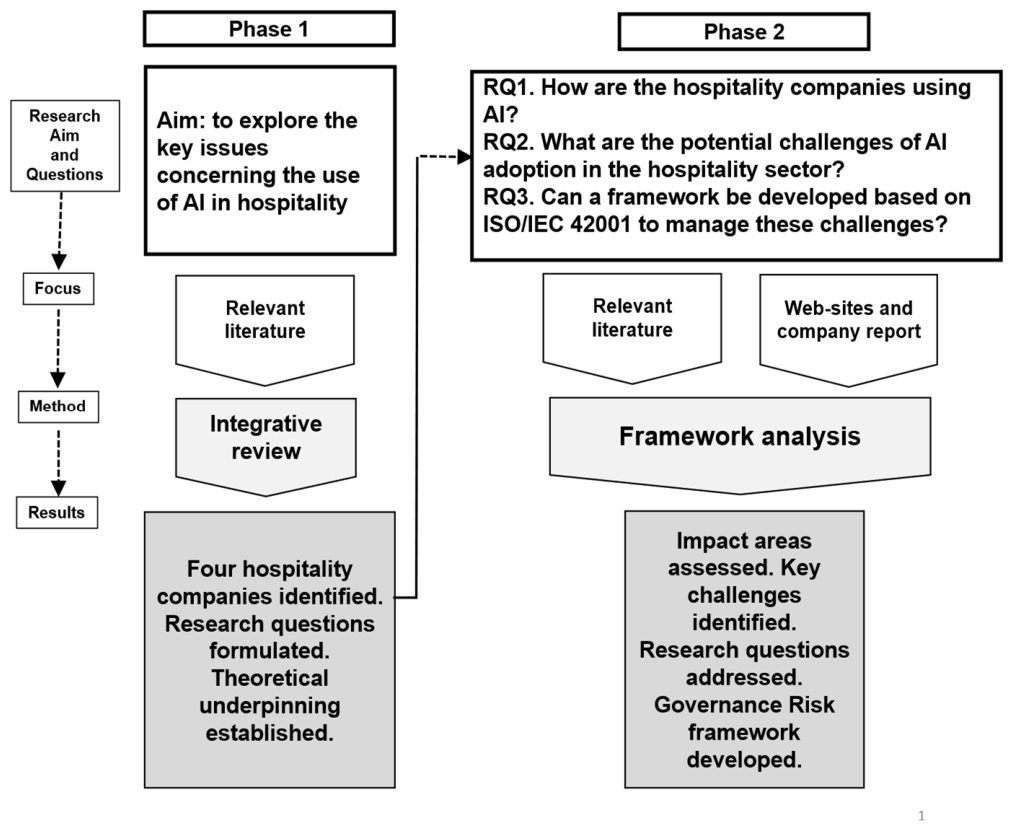
Figure 2.
Summary analytical framework. Source: Authors.
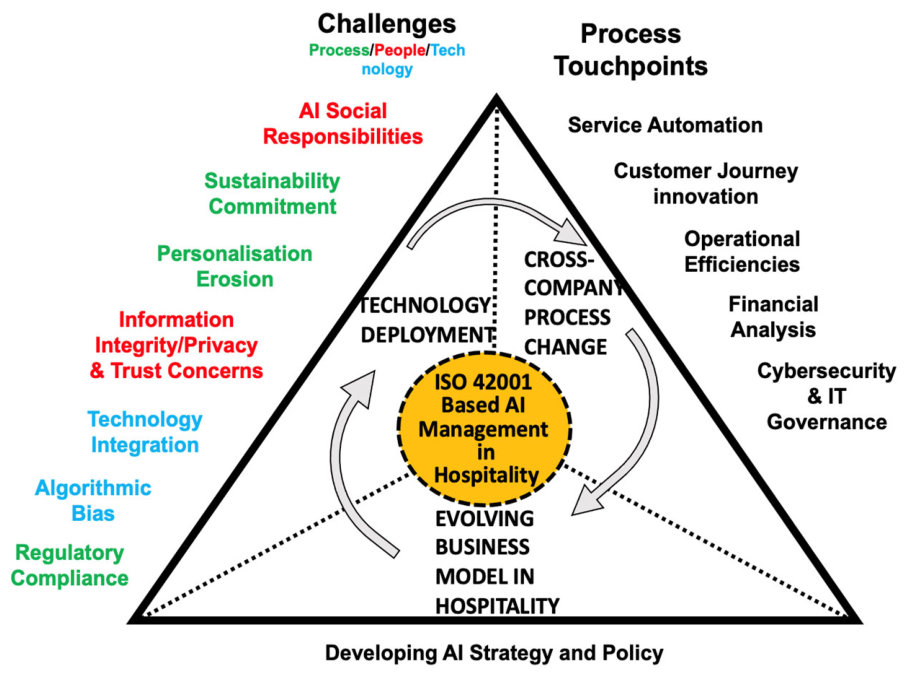

Table 1.
AI process touchpoints in the hospitality industry case examples.
| Hospitality Groups/AI Process Touchpoints | Hilton Worldwide Holdings | Marriott | Wyndham Hotels and Resorts | International Hotel Group |
|---|---|---|---|---|
| Customer Journey Innovation | “Be My Eyes” initiative for visually impaired customers | RENAI AI-powered virtual concierge service | Wyndham Connect | IHG Travel Planner |
| Service Automation | RENAI AI-powered virtual concierge service | Wyndham Connect | IHG One Rewards mobile app | |
| Human Resource Management | Wyndham Connect | |||
| Operational Efficiencies | Wyndham Connect (chatbots/call centers) | |||
| Cybersecurity & IT Governance | Google “BigQuery” warehouse | |||
| Financial Analysis | Wyndham Connect (AI apps) |
Table 2.
Addressing AI Challenges in Hospitality with ISO/IEC 42001 Artificial Intelligence Management System [7].
Table 2.
Addressing AI Challenges in Hospitality with ISO/IEC 42001 Artificial Intelligence Management System [7].
| Challenge | ISO/IEC 42001 Standard Item(s) | Addressing the Issue |
|---|---|---|
| 1. Loss of “personal touch” with customers | Clause 8.1—Operational planning and control Annex A.9—Use of AI systems: Objective: To ensure that the AI system is used responsibly and in line with the AI policy. | Clause 8.1 requires defining the need for human oversight in processes. The objective of Annex A.9 ensures this is part of a formal “responsible use” policy, compelling the organization to strategically define where AI is appropriate and where the human touch is an essential and non-negotiable part of its service commitment. |
| 2. Concerns over data integrity and privacy | Annex A.7—Data for AI systems: Objective: To define and implement processes and procedures for data management for AI systems. Annex A.5—Assessing impacts of AI systems: Objective: To assess and treat potential impacts on individuals, groups, and society resulting from the use of the AI system. | The objective of Annex A.7 ensures robust data management, including quality and provenance, to maintain integrity. The impact assessment objective from Annex A.5 forces the evaluation of privacy risks to guests, ensuring that trust is protected through systematic risk mitigation. |
| 3. AI technology implementation problems | Clause 6—Planning Annex A.6—AI system lifecycle: Objective: To define and implement a process for managing the AI system lifecycle in accordance with the organization’s principles and policies. | Clause 6 requires strategic planning to align AI projects with business goals. The objective of Annex A.6 imposes a structured, end-to-end management process for AI systems, from conception to retirement, which minimizes costly integration failures and ensures controlled, well-planned deployments. |
| 4. Algorithmic bias in AI | Clause 6.1.2—AI risk assessment Annex A.5—Assessing impacts of AI systems: Objective: To assess and treat potential impacts on individuals, groups, and society resulting from the use of the AI system. | The standard requires organizations to formally identify and treat risks related to fairness as part of their core risk assessment process (Clause 6.1.2). The impact assessment objective from Annex A.5 further compels the evaluation of how biases could negatively affect different groups of guests, ensuring that proactive steps are taken to promote equitable outcomes. |
| 5. The black box problem | Annex A.8—Information for interested parties of AI systems: Objective: To provide interested parties with relevant, accessible, and understandable information about the AI system and its outputs. Annex A.10—Record keeping: Objective: To retain documented information from the AI system to support analysis and evaluation of its performance. | The objective of Annex A.8 directly counters the black box by requiring transparency. The objective of Annex A.10 ensures that logs are kept, which provides the necessary data to investigate, explain, and understand the AI system’s behavior and specific decisions after the fact. |
| 6. AI Compliance Challenge | Clause 6.1.3—Identification of legal, statutory, regulatory, and contractual requirements: Objective: To identify and understand the legal, statutory, regulatory and contractual requirements related to the organization’s use of AI systems. | This clause’s objective makes legal compliance a foundational part of the management system. It mandates a proactive process for identifying and integrating all relevant laws (like the EU AI Act) into the organization’s policies and controls, ensuring demonstrable due diligence. |
| 7. Staff redundancy concerns | Clause 7.2—Competence: Objective: To ensure that persons doing work under the organization’s control have the competence required for their roles. Clause 7.4—Communication: Objective: To ensure that relevant information is communicated within the organization and to interested parties. | The objective of Clause 7.2 shifts focus from redundancy to reskilling by requiring the organization to define and ensure necessary staff competencies. The communication objective ensures that changes are managed transparently and that staff understand how AI will augment their roles, mitigating fear and resistance. |
| 8a. Sustainable Development (Social impact) | Annex A.5—Assessing impacts of AI systems: Objective: To assess and treat potential impacts on individuals, groups, and society resulting from the use of the AI system. Clause 4.1—Understanding the organization and its context | The objective of Annex A.5 explicitly requires the organization to look beyond its own operations and assess broader societal impacts, including socio-economic effects like job displacement in vulnerable community members. This forces a more ethical and socially responsible approach to AI deployment. |
| 8b. Sustainable Development (Environmental impact) | Clause 6.2—AI objectives and planning to achieve them Annex A.6—AI system lifecycle: Objective: To define and implement a process for managing the AI system lifecycle in accordance with the organization’s principles and policies. | Clause 6.2 allows for setting specific environmental performance goals for AI. The lifecycle objective in Annex A.6 supports this by enabling the planning for sustainable resource use during operation and responsible hardware decommissioning, thus addressing concerns about energy consumption and e-waste. |
| 9. New digital responsibilities (CSR) | Clause 5.2—Policy: Objective: To establish an AI policy that aligns with the organization’s purpose, objectives, and ethical principles. Annex A.2—Organizational accountability and governance: Objective: To establish and implement a framework for accountability and governance for AI systems. | The objectives of these items create a formal structure for CSR. A public AI policy (Clause 5.2) articulates commitment, while the governance framework (Annex A.2) establishes clear lines of responsibility, providing a transparent and auditable way to demonstrate digital ethics to the public. |
Disclaimer/Publisher’s Note: The statements, opinions and data contained in all publications are solely those of the individual author(s) and contributor(s) and not of MDPI and/or the editor(s). MDPI and/or the editor(s) disclaim responsibility for any injury to people or property resulting from any ideas, methods, instructions or products referred to in the content. |
© 2026 by the authors. Licensee MDPI, Basel, Switzerland. This article is an open access article distributed under the terms and conditions of the Creative Commons Attribution (CC BY) license (http://creativecommons.org/licenses/by/4.0/).
Copyright: This open access article is published under a Creative Commons CC BY 4.0 license, which permit the free download, distribution, and reuse, provided that the author and preprint are cited in any reuse.