

Submitted:
09 October 2026
Posted:
10 October 2026
You are already at the latest version
Abstract
Classical Chinese Medicine conceptualizes the human organism as a dynamic system of relationships in which structure, function, environment, and transformation are inseparable. Although derived from a fundamentally different epistemological framework, contemporary systems biology increasingly describes health and disease through interacting networks involving the nervous system, extracellular matrix and connective tissues, immune and endocrine signaling, metabolism, and the gut microbiome. This conceptual convergence provides an opportunity for dialogue, but not for direct equivalence between traditional constructs and modern biological structures. Acupuncture offers a particularly relevant model through which to examine this interface. Experimental studies have demonstrated that needle insertion and manipulation can generate measurable biomechanical effects within connective tissue, including tissue winding, fibroblast cytoskeletal remodeling, and mechanotransduction. Acupuncture and electroacupuncture can also activate somatosensory pathways and, under defined experimental conditions, engage somato-autonomic reflexes and central neural networks. Evidence for acupuncture-related neuroplasticity has been reported predominantly in preclinical studies and neuroimaging investigations, although its causal relationship with clinical outcomes remains incompletely established. The microbiota–gut–brain axis provides an additional level of biological integration through neural, immune, endocrine, metabolic, and barrier-mediated signaling. Emerging evidence suggests that acupuncture may modify gut microbial composition and microbiota-associated pathways in selected experimental and clinical contexts. However, this literature remains dominated by preclinical studies, substantial methodological heterogeneity, and associative rather than mediation-based evidence. This Perspective therefore proposes a multilayered framework in which connective-tissue mechanotransduction, somatosensory signaling, autonomic regulation, neuroplasticity, immune-metabolic pathways, and the microbiome are considered potentially interacting dimensions of the biological response to acupuncture. Importantly, these mechanisms should not be regarded as anatomical demonstrations of Qi, meridians, or other constructs of Classical Chinese Medicine. Scientific progress is more likely to emerge from rigorous comparison between distinct explanatory systems than from attempts to reduce one to the terminology of the other.
Keywords:
acupuncture
; Classical Chinese Medicine
; connective tissue
; fascia
; mechanotransduction
; fibroblasts
; neuroplasticity
; gut microbiome
; microbiota–gut–brain axis
; autonomic nervous system
; somatosensory signaling
; Qi
“The body is our general medium for having a world.”Maurice Merleau-Ponty, Phenomenology of Perception
1. Introduction: From Biological Components to Interacting Systems
For much of its modern history, Western biomedicine achieved extraordinary explanatory and therapeutic power through analytical decomposition. Organs were separated into tissues, tissues into cells, cells into molecular pathways, and diseases into increasingly precise pathophysiological categories [1]. This reductionist strategy has been indispensable to the development of contemporary medicine. Yet biological understanding cannot end with decomposition. The living organism must eventually be reconstructed as an integrated system.
Contemporary biology increasingly recognizes that organs and tissues do not function as autonomous compartments [2]. Neural activity influences immune responses [3]; immune mediators alter neuronal excitability [4]; extracellular-matrix mechanics affect cellular phenotype [5]; metabolic states modify signaling pathways [6]; intestinal microorganisms generate biologically active metabolites[7]; and bidirectional communication between the gastrointestinal tract and the central nervous system contributes to physiological homeostasis and disease [8,9,10]. The body therefore increasingly appears not simply as an assembly of anatomical components but as a dynamically organized network in which mechanical, neural, immune, endocrine, metabolic, and microbial processes continuously interact.
Classical Chinese Medicine developed within a profoundly different historical and epistemological context. Nevertheless, its physiology is likewise fundamentally relational. Constructs such as Qi, Xue (Blood), Jing, Shen, Zang-Fu, and the channel or meridian systems describe patterns of transformation, circulation, functional relationship, and adaptation rather than structures that correspond straightforwardly to modern anatomical entities [11]
This distinction is essential. Qi is not adenosine triphosphate. Jing is not mitochondrial DNA. Xue cannot be reduced to circulating blood. A meridian should not be presented as demonstrably identical to a peripheral nerve, blood vessel, fascial plane, or other discrete anatomical structure. Available anatomical observations remain hypothesis-generating rather than demonstrations of ontological equivalence. Attempts to establish one-to-one correspondences risk conflating distinct explanatory frameworks. Traditional concepts lose their historical and functional meaning, while biological observations are burdened with interpretations that the experimental evidence does not support [12,13,14]
A scientifically productive dialogue therefore requires neither equivalence nor opposition. It requires comparison across levels of description. Within this framework, acupuncture provides a particularly interesting experimental model because a spatially restricted physical stimulus can generate measurable local and, under appropriate conditions, remote physiological responses [15].
2. The Needle-Tissue Interface: Mechanical Coupling and Mechanotransduction
An acupuncture needle is mechanically simple, but the biological environment into which it is introduced is not. Needle insertion traverses skin and, depending on anatomical location and insertion depth, may interact with subcutaneous connective tissue, fascia, muscle, blood vessels, and sensory nerve endings. Subsequent rotation, lifting-thrusting, or electrical stimulation can modify the characteristics of the resulting biological stimulus. Langevin et al. [16] provided important experimental evidence that the phenomenon traditionally described as “needle grasp” has a measurable biomechanical component. In this study, needle rotation markedly increased pullout force, demonstrating that needle grasp has a measurable biomechanical component. Importantly, this effect was also observed at control locations and therefore does not by itself establish acupuncture-point specificity.
The proposed mechanism involves winding of connective-tissue fibers around the rotating needle, allowing mechanical forces to be transmitted into the surrounding extracellular matrix, potentially initiating mechanotransduction within connective tissue [17]. Importantly, that publication presented a mechanistic hypothesis; it should not be interpreted as demonstrating that connective-tissue mechanotransduction constitutes the universal or dominant mechanism underlying acupuncture efficacy.
Experimental support for a cellular response subsequently emerged. In mouse subcutaneous tissue explants, needle rotation induced fibroblast spreading and lamellipodia formation and produced cytoskeletal changes extending beyond the immediate needle–tissue interface [18]. These observations provided evidence that acupuncture-like mechanical stimulation can induce active fibroblast responses consistent with mechanotransduction.
Such findings are biologically plausible within the broader framework of extracellular-matrix physiology. Fibroblasts continuously sense mechanical characteristics of their environment through integrins, cytoskeletal structures, cell-matrix adhesions, and associated signaling systems. Mechanical forces can thereby influence cellular morphology, gene expression, matrix organization, and tissue homeostasis [19,20]. The important conclusion is therefore not that connective tissue “is” the meridian system. Rather, connective tissue constitutes one biologically responsive environment through which the physical act of needling can be converted into cellular signaling.
3. Connective Tissue as a Dynamic Biological Interface
Connective tissue should no longer be understood merely as passive packing material. The extracellular matrix constitutes a three-dimensional, mechanically responsive environment composed of collagens, elastin, proteoglycans, glycosaminoglycans, water, and numerous matrix-associated proteins [20]. Fibroblasts and other resident cells continuously monitor and remodel this environment.
Mechanotransduction describes the processes through which mechanical forces are sensed and converted into biochemical and cellular responses. These mechanisms are fundamental to normal tissue homeostasis and are relevant across multiple organ systems [19]. This framework offers a biologically plausible explanation for how a localized mechanical stimulus such as needle manipulation can produce responses extending beyond the microscopic trajectory of the needle itself. It does not, however, establish that such responses account for the clinical effects of acupuncture.
The distinction between biological plausibility and clinical mediation is crucial. An intriguing observation was reported examining the anatomical relationship between acupuncture points and connective-tissue planes and finding approximately 80% correspondence between mapped acupuncture locations and intermuscular or intramuscular connective-tissue planes in the anatomical regions examined [13]. The authors proposed a possible relationship between the traditional channel system and the connective-tissue network.
This observation remains hypothesis-generating. It neither establishes anatomical identity between meridians and fascia nor demonstrates that connective-tissue planes possess the functional properties attributed to meridians within Classical Chinese Medicine. Accordingly, fascia may reasonably be investigated as one biological interface of needling but should not be presented as the anatomical translation of the meridian system.
4. From Local Stimulation to Somatosensory, Autonomic, and Immune Regulation
Mechanical tissue responses represent only one level of acupuncture physiology. Skin, subcutaneous tissue, fascia, periosteum, and skeletal muscle contain sensory afferents capable of detecting mechanical, thermal, chemical, and nociceptive stimuli. Needling can therefore generate afferent activity that reaches the spinal cord and supraspinal structures and may interact with sensory, affective, autonomic, and pain-modulatory system [15,21,22].
Purinergic signaling represents one proposed peripheral mechanism. Mechanical stimulation associated with acupuncture can influence extracellular ATP and adenosine signaling, which may interact with purinergic receptors on sensory and non-neuronal cells. Experimental evidence has implicated P2X and adenosine receptors in acupuncture-associated antinociceptive responses, although much of the detailed mechanistic evidence derives from animal models [23].
The nervous system also provides a biologically plausible mechanism through which a localized somatic stimulus can influence distant physiological functions. Somato-autonomic reflexes connect peripheral somatosensory input with autonomic efferent output. Experimental acupuncture research has demonstrated that stimulation parameters, anatomical location, depth, and intensity can determine which autonomic pathways are recruited [24]. In mice, low-intensity electroacupuncture at the hindlimb ST36 region activated a vagal-adrenal anti-inflammatory pathway dependent on a population of PROKR2-expressing sensory neurons innervating deep hindlimb tissues [25]. Ablation of these neurons prevented activation of the pathway.
This represents compelling evidence for a defined neuroanatomical mechanism under a specific experimental condition. It should not, however, be generalized to imply that all acupuncture points, all needling techniques, or all clinical effects operate through the same pathway. Indeed, the emerging neurobiology of acupuncture suggests almost the opposite: biological effects appear to depend on where, how deeply, how intensely, and by which modality tissues are stimulated.
5. Acupuncture and Neuroplasticity: Evidence and Limits
The concept of neuroplasticity requires similar precision. Neuroplasticity refers to the capacity of the nervous system to modify functional organization, synaptic strength, connectivity, cellular properties, and, under some circumstances, structure in response to experience, injury, learning, or repeated stimulation [26]. A neural response to acupuncture is therefore not synonymous with neuroplasticity. Likewise, demonstrating a change in functional magnetic resonance imaging signal after acupuncture does not by itself establish enduring neural reorganization, nor does it demonstrate that such reorganization mediates a clinical outcome.
Preclinical studies have nevertheless generated evidence that repeated acupuncture or electroacupuncture can influence processes related to neurogenesis, synaptic remodeling, neurotrophic signaling, neurotransmission, and functional recovery, particularly in experimental neurological disease models [27]. Human neuroimaging studies have additionally reported changes in functional connectivity and network activity following acupuncture, including investigations in stroke and other neurological conditions [28].
The quality and interpretation of this literature vary substantially. Neuroimaging studies may be affected by small sample sizes, analytical flexibility, heterogeneity of acupuncture protocols, inadequate control procedures, and difficulty distinguishing treatment-specific effects from contextual and expectation-related responses. It is therefore more scientifically appropriate to state that acupuncture may engage processes associated with neural plasticity in selected experimental and clinical contexts than to claim that neuroplasticity represents a universal mechanism of acupuncture. This distinction becomes particularly important when neuroplasticity is connected conceptually to the microbiome.
6. The Microbiome: The Organism as Ecosystem
The human organism is not only multicellular; it is also ecological. The gastrointestinal tract contains complex microbial communities that participate in nutrient metabolism, xenobiotic transformation, epithelial homeostasis, immune regulation, and production or modification of numerous bioactive compounds [29].
Among the most extensively investigated microbial metabolites are the short-chain fatty acids (SCFAs), particularly acetate, propionate, and butyrate. These molecules are principally generated through microbial fermentation of dietary substrates and can influence intestinal epithelial biology, immune responses, metabolism, and signaling pathways relevant to communication between the gut and other organs [30,31].
The microbiota-gut-brain axis describes bidirectional communication among intestinal microorganisms, the gastrointestinal tract, and the nervous system [7,9,31]. Relevant pathways include vagal and other neural signaling, immune mediators, endocrine pathways, microbial metabolites, tryptophan metabolism, enteroendocrine signaling, and regulation of intestinal and neurovascular barriers. The term “axis” should not be interpreted as a single linear pathway. It describes a multidirectional biological network.
The brain can alter intestinal motility, secretion, permeability, immune activity, and microbial habitat through autonomic, neuroendocrine, behavioral, and dietary mechanisms [32]. Conversely, intestinal microorganisms and their products can influence host physiology through local and systemic pathways [33]. This bidirectionality is central to understanding the microbiome without attributing excessive causal power to microbial composition alone.
7. Microbiome and Neuroplasticity: Association Is Not Causation
A particularly attractive contemporary hypothesis proposes that microbiome-related signals may influence processes relevant to neuroplasticity [34]. This is biologically plausible. Microbial metabolites can interact with immune, endocrine, neural, and epigenetic mechanisms; intestinal barrier function can alter host exposure to microbial products; and microbiota-dependent signals may influence neuroinflammation, neurotransmission, neurotrophic pathways, and behavior [35].
Nevertheless, the evidence in humans requires caution. A systematic review of 16 unique human studies linking gut microbiota with structural or functional brain connectivity found associations involving several taxa and networks, but no discernible overall pattern; findings were poorly replicated and methods were substantially heterogeneous [36]. Thus, microbiome composition and brain connectivity can reasonably be investigated as interacting domains, but current human evidence does not establish a predictable causal sequence from a particular microbial profile to a specific neuroplastic state. This distinction is especially relevant when acupuncture is introduced into the proposed pathway.
8. Acupuncture and the Gut Microbiome: An Emerging but Unsettled Field
Interest in the possibility that acupuncture might influence intestinal microbial ecology has increased considerably. Experimental studies have reported changes in microbial diversity, relative abundance of selected taxa, intestinal barrier markers, inflammatory mediators, microbial metabolites, and behavioral or physiological outcomes after acupuncture or electroacupuncture [37]. Such findings have been described across several disease models.
However, the maturity of this evidence should not be overstated. A systematic review and meta-analysis examining acupuncture and/or moxibustion effects on gut microbiota included 20 preclinical studies but only three clinical studies [38]. The authors reported changes in selected microbial measures but also emphasized considerable heterogeneity among disease models and studies. Alpha-diversity findings were not consistently different between intervention and control groups across commonly used indices.
The imbalance between animal and human evidence is important. Experimental models permit mechanistic manipulation but cannot automatically establish human therapeutic mechanisms [39]. Conversely, small clinical studies reporting simultaneous symptom improvement and microbiome changes cannot establish that microbial alterations mediate the clinical response [40].
Three propositions must therefore be distinguished:
- acupuncture is followed by a change in microbial composition;
- acupuncture modifies host physiology in a manner that changes the intestinal ecological niche; and
- microbiome modification causally mediates the therapeutic effect of acupuncture.
These propositions are not equivalent. Current evidence provides considerably greater support for the first two than for the third. Recent disease-specific reviews have proposed microbiota-gut-brain mechanisms in conditions including neuropsychiatric, cognitive, and gastrointestinal disorders [41,42]. These models are scientifically interesting, but many remain dependent on preclinical evidence and correlations among microbial, inflammatory, metabolic, neurobiological, and behavioral outcomes. Accordingly, the microbiome should currently be considered a candidate component of a broader host response to acupuncture, rather than an established universal mediator of acupuncture efficacy.
9. The Acupuncture Point as a Biological Interface
This evidence invites reconsideration of what is meant biologically by an acupuncture point. From a biomedical perspective, needling a defined location can interact with multiple tissue components: extracellular matrix, fibroblasts, immune cells, blood vessels, sensory nerve endings, muscle fibers, and, depending on depth, periosteal or other deep-tissue structures [43].
No single component necessarily defines the acupuncture point. From the perspective of Classical Chinese Medicine, the point has a different epistemological status [44]. Its meaning derives from its position within a functional system of channels, its relationships with Zang-Fu, its traditional indications, and its role within patterns involving Qi, Xue, Yin-Yang, and the Five Phases. The two maps therefore operate at different explanatory levels. A contemporary biological map can ask what tissues are stimulated, which afferent populations are activated, which molecular mediators are released, which central networks respond, and which autonomic or immune functions change. The traditional map asks how the same intervention should be understood within a system of functional relationships developed through a different medical tradition. Scientific difficulty arises when observations made on one map are presented as proof of the ontological reality of constructs belonging to the other.
10. Qi, Connective Tissue, and Biological Information: The Importance of Non-Equivalence
Modern attempts to reinterpret Qi as bioelectricity, ATP, electromagnetic energy, extracellular-matrix signaling, interstitial fluid movement, or “information” are conceptually attractive but scientifically problematic. These terms describe different phenomena. Mechanotransduction belongs to cellular and molecular biology. Neuroplasticity belongs to neuroscience. Microbial ecology describes communities of microorganisms and their interactions with the host. Autonomic regulation concerns defined neural circuits and physiological outputs [12,13,14,43].
Qi, by contrast, belongs to a medical-philosophical framework in which physiological processes are described through transformation, movement, relationship, polarity, and functional pattern. The intellectual value of bringing these frameworks together therefore lies not in declaring equivalence, but in asking whether they generate complementary questions. The question should not be: What modern molecule is Qi? A more productive question is: Can the relational logic embodied in traditional medical concepts stimulate experimentally testable hypotheses about multilevel biological regulation? That formulation permits dialogue without pseudoscientific reductionism.
11. Toward a Multilayered Biological Model of Acupuncture
The available evidence supports a model in which several partially overlapping levels of biological response can be distinguished. However, the strength and directness of evidence differ substantially across these levels, ranging from direct biomechanical observations and experimentally defined neuroanatomical circuits to predominantly associative evidence for neuroplastic and microbiome-related effects. Representative mechanistic evidence across these biological levels, together with the principal limitations of each evidence domain, is summarized in Table 1.
Taken together, these observations support a context-dependent multilevel model in which acupuncture is conceptualized as a localized physical perturbation capable of engaging tissue, sensory, autonomic, central neural, immune–endocrine, and gut–microbial domains to varying degrees (Figure 1).
At the local mechanical level, needle insertion and manipulation deform tissues and can engage extracellular-matrix and fibroblast mechanotransduction [13,16,17,18,19]. At the peripheral neurochemical level, mechanical stimulation may influence sensory afferents and local signaling systems, including purinergic pathways [23]. At the neural level, somatosensory input can reach spinal and supraspinal networks and, under specific conditions, recruit defined autonomic reflex pathways [24,25]. At the central adaptive level, repeated stimulation may be associated with functional and structural processes relevant to neuroplasticity, although evidence and causal interpretation remain condition-specific [27,28]. At the immune and metabolic levels, neural, endocrine, and local tissue responses may modify inflammatory signaling and systemic physiology [22]. Finally, at the microbial-ecological level, changes in host autonomic activity, intestinal motility, secretion, immunity, barrier function, diet, metabolism, and behavior could alter the intestinal environment and thereby influence microbial communities. Conversely, microbiota-derived signals could theoretically participate in downstream host responses [8,10,30,31,36,38,47].
These levels should not be represented as a proven linear sequence: needle → fascia → nervous system → gut → microbiome → brain → clinical improvement. Current evidence does not justify such a deterministic pathway. A more appropriate representation is a multidirectional network with condition-dependent interactions, some of which are experimentally supported, some biologically plausible, and others still hypothetical.
12. The Living Network
The organism can therefore be viewed as containing multiple superimposed networks: an extracellular and mechanical network; a sensory and autonomic neural network; an immune network; endocrine and metabolic networks; an intestinal microbial ecosystem; and the higher-order neural networks through which perception, cognition, affect, and behavior emerge [22].
These systems are not independent. When a needle enters the body, it enters this interconnected biological environment. Mechanical forces can alter local tissues. Sensory afferents can encode the stimulus. Central neural structures can integrate the incoming information. Autonomic outputs can influence distant organs. Immune and metabolic pathways may participate in the response. Under particular circumstances, intestinal physiology and microbial ecology may also change.
This does not imply that an invisible signal travels directly from an acupuncture point to the intestine, nor that every level is recruited by every acupuncture intervention. It means something simultaneously simpler and more important: biological compartments are permeable to information from other compartments. In this respect, contemporary systems biology and Classical Chinese Medicine can enter into a meaningful conceptual conversation without becoming interchangeable.
13. Neuroplasticity as a Particular Expression of Biological Adaptability
Plasticity is not unique to the nervous system. Connective tissue remodels in response to mechanical load. Epithelia continuously renew themselves. Immune systems develop memory. Microbial communities change in response to diet, medications, host physiology, age, environment, and disease. Extracellular matrices are continually synthesized and degraded. Neuroplasticity represents the nervous system’s contribution to this broader biological capacity for adaptation.
Repeated acupuncture stimulation may therefore be conceptualized as one form of repeated sensory experience capable, under appropriate circumstances, of participating in adaptive nervous-system responses [48]. The magnitude, duration, specificity, and clinical relevance of those responses must nevertheless be demonstrated rather than assumed. This perspective replaces the vague claim that acupuncture “induces neuroplasticity” with a testable scientific question: Under which conditions does repeated acupuncture stimulation produce reproducible neural changes, through which mechanisms, and to what extent do those changes mediate clinically meaningful outcomes? The same question should be applied to the microbiome.
14. From Plausibility to Causality: A Research Agenda
The next phase of acupuncture mechanism research should distinguish biological response from causal mechanism. A useful hierarchy is: a response is observed after stimulation; the response covaries with an outcome; the response temporally precedes and statistically mediates the outcome; perturbing the pathway attenuates the outcome; and, where experimentally feasible, selective activation is sufficient to reproduce the relevant phenotype. The strength of a mechanistic claim should reflect how far the evidence progresses along this sequence (Figure 2).
First, stimulation must be treated as a doseable anatomical intervention rather than a binary exposure. Studies should prespecify location, depth, tissue compartment, manual manipulation, electrical frequency, pulse width, current intensity, duration, and relevant sensory or motor thresholds. Factorial experiments comparing body region, superficial versus deep stimulation, and intensity can test whether biological specificity is predicted by the recruited neural or tissue substrate [12,25,49].
Second, neuroplasticity studies require longitudinal rather than purely acute designs. Predefined imaging and physiological endpoints should be measured beyond the immediate stimulation period, linked to validated behavioral or clinical outcomes, and analyzed for temporal precedence and mediation. Multicenter replication, harmonized acquisition pipelines, and appropriately designed controls are particularly important given the heterogeneity and small samples of the current imaging literature [28].
Third, microbiome hypotheses require progression from association toward perturbation-based evidence, including depletion, transfer, strain-level testing, and ultimately defined microbial molecules. Serial metagenomic and metabolomic sampling in humans should establish temporal order and account for diet, medication, bowel function, geography, and other major confounders. In experimental models, antibiotic or germ-free perturbation, fecal microbiota transfer, strain-level testing, and ultimately candidate microbial molecules can progressively determine whether the microbiome is necessary, sufficient, or merely responsive [40].
Finally, the proposed “living network” should become measurable. Studies that synchronize tissue, autonomic, immune, metabolic, microbial, and neural readouts can test whether cross-system changes occur in a coherent temporal sequence. The aim is not to measure every layer in every experiment, but to identify the smallest set of interacting nodes required to explain a defined physiological or clinical effect and then reproduce that pathway independently [22,28]. The principal research priorities needed to advance these mechanistic claims from association toward causal inference are summarized in Table 2.
15. An Interpretative Boundary: From Network Biology to Classical Concepts
At this point the dialogue with Taoist thought becomes philosophical rather than experimental. The Tao is not an anatomical structure or measurable biological variable. It describes process, transformation, relation, and continuous becoming. Modern biology, from a completely different intellectual tradition, increasingly portrays the organism as a non-static system. Cells remodel their environment; neural circuits change with experience; immunity adapts to encounters; microbial ecosystems respond to ecological pressures [46].
The similarity should not be mistaken for scientific identity. Rather, it offers a productive metaphor: living systems maintain continuity not by remaining unchanged, but by continually reorganizing themselves in response to internal and external conditions.
Within this interpretative framework, acupuncture can be considered a controlled perturbation introduced into a complex adaptive system. The scientific task is to determine which components of that system actually respond, through which pathways, under which conditions, and with what clinical consequences. The philosophical task is different: to consider what such responsiveness tells us about the nature of the living body. Keeping these two tasks distinct makes their dialogue stronger rather than weaker.
Conclusions
This Perspective argues that a productive approach is to investigate acupuncture as a context-dependent biological stimulus capable of interacting with several levels of organization. This suggests that future scientific research on acupuncture may be more productive if it moves beyond attempts to identify a single anatomical counterpart of the meridian system or a direct molecular equivalent of Qi, and instead focuses on defining the interacting mechanical, neural, autonomic, immune, metabolic, and microbial processes through which acupuncture may exert context-dependent biological effects.
Connective tissue provides a mechanically responsive extracellular and cellular interface. Sensory afferents provide access to peripheral and central neural pathways. Somato-autonomic circuits offer experimentally demonstrable mechanisms through which appropriately delivered somatic stimulation can influence distant physiological functions. Neural networks provide the substrate for adaptive responses and potential neuroplasticity. Immune, endocrine, and metabolic systems extend this interaction throughout the organism. The gut microbiome introduces an additional ecological dimension, although its role as a mediator of acupuncture effects remains substantially less established than is sometimes suggested.
These biological observations neither validate nor invalidate the traditional constructs of Classical Chinese Medicine. They address different questions. The most intellectually rigorous dialogue between the two traditions begins precisely where forced equivalence ends. Classical Chinese Medicine describes the organism through Qi, Xue, Jing, Shen, Zang-Fu, channels, and relationships among Heaven, Earth, and the human being. Contemporary biology investigates neural circuits, extracellular matrices, mechanotransduction, immunity, metabolism, microbial ecosystems, and plasticity.
Their languages are different. Yet both invite reflection on a fundamental problem of medicine: how can a living organism preserve coherence while continuously changing? The answer may reside less in any isolated structure than in the relationships among structures. The needle is small and the initial perturbation local. The biological system into which it enters is neither.
Funding
This research received no external funding.
Ethical approval
Not applicable
Consent to participate
Not applicable
Consent to publication
Not applicable
Availability of data and materials
All the files relating to this research are available from the Corresponding Author, on reasonable request.
Acknowledgments
The authors wish to express their deepest and most sincere gratitude to VIBRA, part of the Fondazione Paolo Procacci, for its generous and sustained scientific support throughout all phases of the publication process. Its persistent commitment to advancing scientific research and promoting academic excellence has been pivotal in enabling the conception, development, refinement and dissemination of this work.
Conflicts of interest
The authors declare no conflicts of interest
References
- Evans, W.; Meslin, E.M.; Kai, J.; Qureshi, N. Precision Medicine-Are We There Yet? A Narrative Review of Precision Medicine’s Applicability in Primary Care. J. Pers. Med. [Internet] 2024, 14. [Google Scholar] [CrossRef] [PubMed]
- Carata, E.; Destino, M.; Tenuzzo, B.A.; Panzarini, E. Inter-Organ Crosstalk in Neurodegenerative Disease. Life 2025, 15, 1499. [Google Scholar] [CrossRef] [PubMed]
- Jin, H.; Li, M.; Jeong, E.; Castro-Martinez, F.; Zuker, C.S. A body-brain circuit that regulates body inflammatory responses. Nature 2024, 630, 695–703. [Google Scholar] [CrossRef] [PubMed]
- Moncada, M.A.A.; Tamayo, M.A.N.; Encinas, M.A.N.; Leoni, M.L.G.; Varrassi, G. Immuno-Inflammatory Mechanisms in the Chronification of Pain. Pain Ther. 2026, 15, 443–64. [Google Scholar] [CrossRef] [PubMed]
- Jang, J.-H. Extracellular matrix mechanics as a master regulator of mechanotransduction in tissue homeostasis and disease. Mechanobiology 2026, 1. [Google Scholar] [CrossRef]
- Dong, S.; Li, T. Metabolic reprogramming in cancer: signaling pathways and therapeutic targets. Mol Cancer [Internet] 2026, 25, 60. [Google Scholar] [CrossRef] [PubMed]
- Corriero, A.; Giglio, M.; Inchingolo, F.; Moschetta, A.; Varrassi, G.; Puntillo, F. Gut Microbiota Modulation and Its Implications on Neuropathic Pain: A Comprehensive Literature Review. Pain Ther. 2024, 13, 33–51. [Google Scholar] [CrossRef] [PubMed]
- Morais, L.H.; Schreiber, HL th; Mazmanian, S.K. The gut microbiota-brain axis in behaviour and brain disorders. Nat. Rev. Microbiol. 2021, 19, 241–55. [Google Scholar] [CrossRef] [PubMed]
- Corriero, A.; Giglio, M.; Soloperto, R.; Inchingolo, F.; Varrassi, G.; Puntillo, F. Microbial Symphony: Exploring the Role of the Gut in Osteoarthritis-Related Pain. A Narrative Review. Pain Ther. 2024, 13, 409–33. [Google Scholar] [CrossRef] [PubMed]
- Ohara, T.E.; Hsiao, E.Y. Microbiota-neuroepithelial signalling across the gut-brain axis. Nat. Rev. Microbiol. 2025, 23, 371–84. [Google Scholar] [CrossRef] [PubMed]
- Lv, W. Understanding traditional Chinese medicine. Hepatobiliary Surg. Nutr. 2021, 10, 846–8. [Google Scholar] [CrossRef] [PubMed]
- Ma, Q. Somatotopic organization of autonomic reflexes by acupuncture. Curr. Opin. Neurobiol. 2022, 76, 102602. [Google Scholar] [CrossRef] [PubMed]
- Langevin, H.M.; Yandow, J.A. Relationship of acupuncture points and meridians to connective tissue planes. Anat. Rec. 2002, 269, 257–65. [Google Scholar] [CrossRef] [PubMed]
- Kaptchuk, T.J. Acupuncture: theory, efficacy, and practice. Ann. Intern Med. 2002, 136, 374–83. [Google Scholar] [CrossRef] [PubMed]
- Guo, X.; Quan, X.; Wang, Y.; Liu, G.; Yang, H.T.; Zheng, D.M.; et al. Research progress on the mechanism of acupuncture in the regulation of exosome-mediated neuro-immune network. J. Tradit. Chin. Med. Sci. 2026. [Google Scholar] [CrossRef]
- Langevin, H.M.; Churchill, D.L.; Fox, J.R.; Badger, G.J.; Garra, B.S.; Krag, M.H. Biomechanical response to acupuncture needling in humans. J. Appl. Physiol. (1985) 2001, 91, 2471–8. [Google Scholar] [CrossRef] [PubMed]
- Langevin, H.M.; Churchill, D.L.; Cipolla, M.J. Mechanical signaling through connective tissue: a mechanism for the therapeutic effect of acupuncture. FASEB J. 2001, 15, 2275–82. [Google Scholar] [CrossRef] [PubMed]
- Langevin, H.M.; Bouffard, N.A.; Badger, G.J.; Churchill, D.L.; Howe, A.K. Subcutaneous tissue fibroblast cytoskeletal remodeling induced by acupuncture: evidence for a mechanotransduction-based mechanism. J. Cell Physiol. 2006, 207, 767–74. [Google Scholar] [CrossRef] [PubMed]
- Humphrey, J.D.; Dufresne, E.R.; Schwartz, M.A. Mechanotransduction and extracellular matrix homeostasis. Nat. Rev. Mol. Cell Biol. 2014, 15, 802–12. [Google Scholar] [CrossRef] [PubMed]
- Kamal, K.M.; Ghazali, A.R.; Selvarajah, G.T.; Mutalib, N.S.A.; Abu, N.; Chua, E.W.; et al. The extracellular matrix: structure, composition, biological functions, diseases, and therapeutic targets. Mol Biomed [Internet] 2026, 7. [Google Scholar] [CrossRef] [PubMed]
- Wang, Y.; Zhang, C.; Shen, L.; Wang, Y.; Wang, X.; Song, L.; et al. Mechanisms of Acupuncture on the Neurovascular Unit in Migraine: A Narrative Review. Eur. J. Neurol. 2026, 33, e70730. [Google Scholar] [CrossRef] [PubMed]
- Song, W.; Li, D. Network Mechanisms and Prospective Targets of Acupuncture in Regulating Systemic Inflammatory Responses Based on the Somatic–Autonomic Nervous–Immune Axis. Acupunct. Electro-Ther. Res. Int. J. Integr. Med. 2026. [Google Scholar] [CrossRef]
- He, J.R.; Yu, S.G.; Tang, Y.; Illes, P. Purinergic signaling as a basis of acupuncture-induced analgesia. Purinergic Signal. 2020, 16, 297–304. [Google Scholar] [CrossRef] [PubMed]
- Uchida, S.; Kagitani, F.; Sato-Suzuki, I. Somatoautonomic reflexes in acupuncture therapy: A review. Auton. Neurosci. 2017, 203, 1–8. [Google Scholar] [CrossRef] [PubMed]
- Liu, S.; Wang, Z.; Su, Y.; Qi, L.; Yang, W.; Fu, M.; et al. A neuroanatomical basis for electroacupuncture to drive the vagal-adrenal axis. Nature 2021, 598, 641–5. [Google Scholar] [CrossRef] [PubMed]
- Stampanoni Bassi, M.; Iezzi, E.; Gilio, L.; Centonze, D.; Buttari, F. Synaptic Plasticity Shapes Brain Connectivity: Implications for Network Topology. Int. J. Mol. Sci. [Internet] 2019, 20. [Google Scholar] [CrossRef] [PubMed]
- Xiao, L.Y.; Wang, X.R.; Yang, Y.; Yang, J.W.; Cao, Y.; Ma, S.M.; et al. Applications of Acupuncture Therapy in Modulating Plasticity of Central Nervous System. Neuromodulation 2018, 21, 762–76. [Google Scholar] [CrossRef] [PubMed]
- Zhang, J.; Lu, C.; Wu, X.; Nie, D.; Yu, H. Neuroplasticity of Acupuncture for Stroke: An Evidence-Based Review of MRI. Neural Plast. 2021, 2021, 2662585. [Google Scholar] [CrossRef] [PubMed]
- Farsi, D.N.; Cotter, P.D.; O’Sullivan, O. Fermented protein foods as modulators of the gut-muscle axis: mechanisms, evidence, and future directions. Commun Biol [Internet] 2026, 9. [Google Scholar] [CrossRef] [PubMed]
- Dalile, B.; Van Oudenhove, L.; Vervliet, B.; Verbeke, K. The role of short-chain fatty acids in microbiota-gut-brain communication. Nat. Rev. Gastroenterol. Hepatol. 2019, 16, 461–78. [Google Scholar] [CrossRef] [PubMed]
- Mann, E.R.; Lam, Y.K.; Uhlig, H.H. Short-chain fatty acids: linking diet, the microbiome and immunity. Nat. Rev. Immunol. 2024, 24, 577–95. [Google Scholar] [CrossRef] [PubMed]
- Vazquez-Sanroman, D.B.; Longaberger, L.; Chance, A.; Anderson, M.; Wilson, N.; Koehler, G. The Adolescent Microbiome-Gut-Brain Axis: Development, Mechanisms, and Translational Perspectives. Nutrients [Internet] 2026, 18. [Google Scholar] [CrossRef] [PubMed]
- Colica, C.; Vecchio, I.; Aiello, E.; Abenavoli, L.; Scarlata, G.G.M.; Aiello, V. Gut microbiota: origin or panacea for all ills? Gut microbiota and systemic diseases. Microb. Pathog. 2026, 212, 108299. [Google Scholar] [CrossRef] [PubMed]
- Johnstone, N.; Cohen Kadosh, K. Empirical evidence for gut microbial influence on human brain neurochemistry via the gut-brain axis. Mol Psychiatry [Internet] 2026. [Google Scholar] [CrossRef] [PubMed]
- Chen, C.; Wang, G.Q.; Li, D.D.; Zhang, F. Microbiota-gut-brain axis in neurodegenerative diseases: molecular mechanisms and therapeutic targets. Mol. Biomed. 2025, 6, 64. [Google Scholar] [CrossRef] [PubMed]
- Mulder, D.; Aarts, E.; Arias Vasquez, A.; Bloemendaal, M. A systematic review exploring the association between the human gut microbiota and brain connectivity in health and disease. Mol. Psychiatry 2023, 28, 5037–61. [Google Scholar] [CrossRef] [PubMed]
- Jiang, J.; Liu, H.; Wang, Z.; Tian, H.; Wang, S.; Yang, J.; et al. Electroacupuncture could balance the gut microbiota and improve the learning and memory abilities of Alzheimer’s disease animal model. PLoS ONE 2021, 16, e0259530. [Google Scholar] [CrossRef] [PubMed]
- Bae, S.J.; Jang, Y.; Kim, Y.; Park, J.H.; Jang, J.H.; Oh, J.Y.; et al. Gut Microbiota Regulation by Acupuncture and Moxibustion: A Systematic Review and Meta-Analysis. Am. J. Chin. Med. 2024, 52, 1245–73. [Google Scholar] [CrossRef] [PubMed]
- Marshall, L.J.; Bailey, J.; Cassotta, M.; Herrmann, K.; Pistollato, F. Poor Translatability of Biomedical Research Using Animals - A Narrative Review. Altern. Lab Anim. 2023, 51, 102–35. [Google Scholar] [CrossRef] [PubMed]
- Chaudhari, S.N.; McCurry, M.D.; Devlin, A.S. Chains of evidence from correlations to causal molecules in microbiome-linked diseases. Nat. Chem. Biol. 2021, 17, 1046–56. [Google Scholar] [CrossRef] [PubMed]
- Martínez-Porchas, M.; Medina-Félix, D.; Olivas Bernal, C.A.; Guirado-Flores, J.O.; Vargas-Albores, F.; Porchas-Quijada, M.; et al. Microbiota–Gut–Brain Axis: An Integrative Overview of Communication Pathways. Adv. Gut Microbiome Res. 2026. [Google Scholar] [CrossRef]
- Carnazzo, S.M.; Fanos, V. The Microbiota-Gut-Brain Axis Across the Lifespan: From Neurodevelopment to Neurodegeneration. J. Clin. Med. [Internet] 2026, 15. [Google Scholar] [CrossRef] [PubMed]
- Wen-chuan, Q.I.; Yong-ming, L.I. The Neuro-Vascular-Immune (NVI) functional unit: A proposed framework for understanding acupuncture action. Brain Behav. Immun. Integr. 2026, 16. [Google Scholar] [CrossRef]
- Schnorrenberger, C.C. Epistemological evaluation of chinese medicine and acupuncture - part ii. J. Chin. Med. 2011, 22, 1129–41. [Google Scholar]
- Liu, S.; Wang, Z.; Su, Y. A somatotopic organization of the vagal efferent–immune axis. Nature. 598. 598.
- Bao, C.; Wu, L.; Wang, D.; Chen, L.; Jin, X.; Shi, Y.; et al. Acupuncture improves the symptoms, intestinal microbiota, and inflammation of patients with mild to moderate Crohn’s disease: A randomized controlled trial. eClinicalMedicine 2022, 45, 101300. [Google Scholar] [CrossRef] [PubMed]
- Aburto, M.R.; Cryan, J.F. Gastrointestinal and brain barriers: unlocking gates of communication across the microbiota-gut-brain axis. Nat. Rev. Gastroenterol. Hepatol. 2024, 21, 222–47. [Google Scholar] [CrossRef] [PubMed]
- Liu, C.Z.; Kong, J.; Wang, K. Acupuncture Therapies and Neuroplasticity. Neural Plast. 2017, 2017, 6178505. [Google Scholar] [CrossRef] [PubMed]
- Liu, S.; Wang, Z.-F.; Su, Y.-S.; Ray, R.S.; Jing, X.-H.; Wang, Y.-Q.; et al. Somatotopic Organization and Intensity Dependence in Driving Distinct NPY-Expressing Sympathetic Pathways by Electroacupuncture. Neuron 2020, 108, 436–450.e7. [Google Scholar] [CrossRef] [PubMed]
Figure 1.
Acupuncture as a context-dependent multilevel biological perturbation. The figure summarizes local tissue, sensory, autonomic, central neural, immune–endocrine, gut, and microbial domains potentially engaged by acupuncture. These domains have different levels of evidential support and should not be interpreted as a single deterministic pathway or as biological equivalents of Qi or meridians.
Figure 1.
Acupuncture as a context-dependent multilevel biological perturbation. The figure summarizes local tissue, sensory, autonomic, central neural, immune–endocrine, gut, and microbial domains potentially engaged by acupuncture. These domains have different levels of evidential support and should not be interpreted as a single deterministic pathway or as biological equivalents of Qi or meridians.
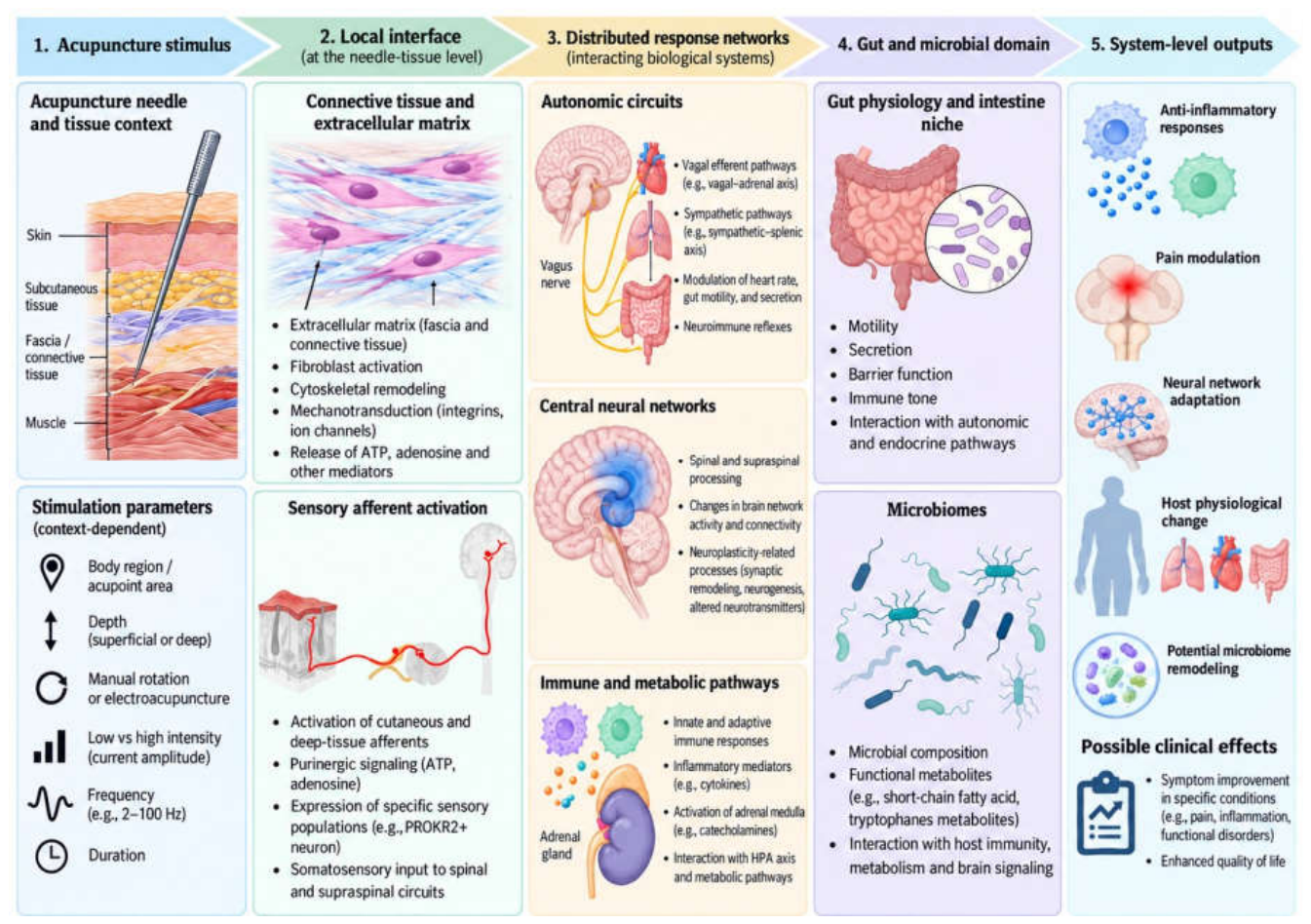
Figure 2.
A research roadmap from biological plausibility to causal mechanism in acupuncture research. The framework illustrates the progression from descriptive biological observations to association, mediation, and causal inference. Increasing mechanistic confidence requires temporal ordering, prespecified mediators, pathway-specific perturbation, tests of necessity and sufficiency, translational validation in humans, and independent replication. Biological change alone should not be interpreted as evidence of mechanism, and association does not establish mediation or causality.
Figure 2.
A research roadmap from biological plausibility to causal mechanism in acupuncture research. The framework illustrates the progression from descriptive biological observations to association, mediation, and causal inference. Increasing mechanistic confidence requires temporal ordering, prespecified mediators, pathway-specific perturbation, tests of necessity and sufficiency, translational validation in humans, and independent replication. Biological change alone should not be interpreted as evidence of mechanism, and association does not establish mediation or causality.
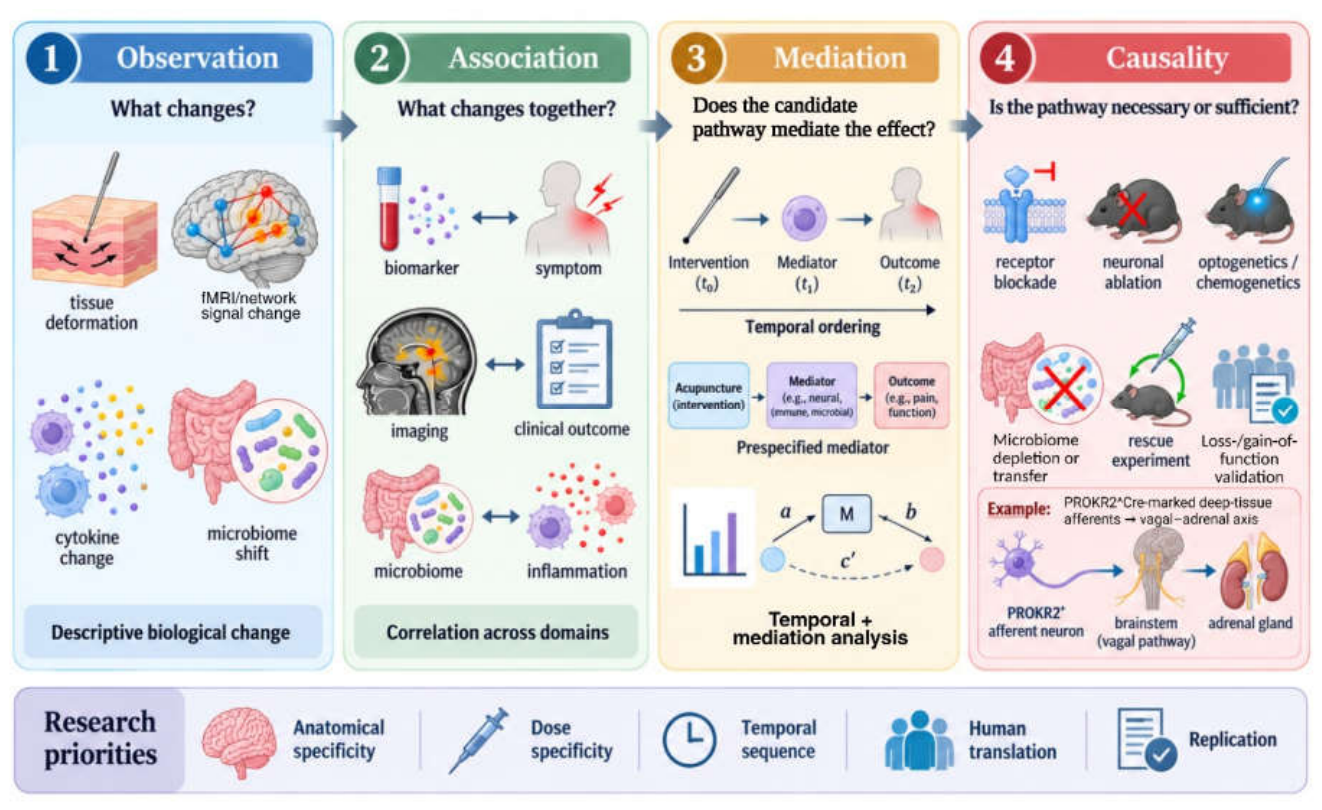

Table 1.
Representative evidence supporting a multilevel biological response to acupuncture.
| Biological level | Representative evidence | What the evidence supports | Evidence status | Key limitation |
|---|---|---|---|---|
| Local biomechanics | Langevin et al.[16] (n = 60): mean pullout force increased 167% after unidirectional and 52% after bidirectional rotation versus no rotation; force was 18% higher at acupuncture than control points. | Needle rotation produces measurable needle–tissue mechanical coupling (“needle grasp”). | Direct human biomechanical evidence. | Does not establish therapeutic mediation, meridian anatomy, or traditional point specificity; between-site differences may reflect local tissue anatomy. |
| Connective-tissue mechanotransduction | Langevin et al., [18]: in ex vivo mouse subcutaneous tissue, rotation induced fibroblast spreading and lamellipodia within 30 min; the response peaked at two revolutions and was blocked by actomyosin, Rho-kinase, and Rac inhibitors | Needle rotation can trigger an active, signaling-dependent fibroblast cytoskeletal response consistent with mechanotransduction. | Experimentally supported ex vivo cellular mechanism. | Mouse tissue explants; human in vivo relevance and mediation of clinical effects remain unproven. |
| Somato-autonomic / neuroimmune circuits | Liu et al., [45]: low-intensity hindlimb electroacupuncture engaged vagal–adrenal anti-inflammatory signaling, whereas high-intensity abdominal stimulation engaged spinal-sympathetic splenic signaling. Liu et al., [25]: PROKR2^Cre-marked deep-tissue afferents were necessary, and optogenetic terminal activation sufficient, for low-intensity ST36 stimulation to drive the vagal–adrenal axis. |
Anatomical site, stimulation intensity, and defined sensory/autonomic cell populations can determine which autonomic–immune circuit is recruited. | Strong causal mechanistic evidence in mice. | Shown in endotoxemia models using electroacupuncture; human target engagement and generalizability to manual acupuncture or other diseases are unestablished. |
| Neuroplasticity-related responses | Xiao et al., [27]reviewed preclinical evidence involving neurogenesis, synapses, neurotrophins, and neurotransmitters. Zhang et al., [28] identified 24 human and 5 animal MRI studies in stroke reporting functional and/ or structural brain changes. | Acupuncture/electroacupuncture is associated with changes compatible with neural adaptation. | Supportive, heterogeneous, and predominantly indirect evidence. | Durability, pathway necessity, and clinical mediation are rarely demonstrated; MRI change alone does not establish durable neuroplasticity. |
| Microbiome: preclinical | Jiang et al., [37] (SAMP8 mice, n = 8/group): electroacupuncture improved maze performance, reduced inflammatory cytokines, and altered 16S gut microbial profiles | Behavioral, inflammatory, and microbiome changes can occur in parallel after electroacupuncture in an Alzheimer-like mouse model. | Associative preclinical evidence. | No microbiota-depletion, fecal microbiota transplantation, gnotobiotic, or rescue/perturbation experiment tested microbiome necessity or sufficiency. |
| Microbiome: human/ synthesis | Bao et al.,[46]: 66 adults with active Crohn’s disease received acupuncture plus moxibustion or sham; clinical improvement coincided with inflammatory/barrier and microbial changes, including increased Faecalibacterium prausnitzii and Roseburia faecis. Bae et al.,[38] identified 3 clinical and 20 preclinical studies; alpha-diversity effects were largely non-significant except for the Simpson index, with substantial heterogeneity [36]. |
Human data show co-occurrence of clinical and microbiome changes after acupuncture-based treatment, not microbiome mediation. | Emerging human associative evidence; causal mediation not established. | The Crohn trial combined acupuncture with moxibustion, preventing attribution to acupuncture alone; the broader clinical evidence base is small and heterogeneous. |
| Abbreviations: EA, electroacupuncture; FMT, fecal microbiota transplantation. Evidence categories are interpretative for this Perspective and are not a formal grading system. | ||||
Table 2.
Research priorities for moving from association to causal mechanism.
| Research question | Why current evidence is insufficient | Minimum next-step design | Evidence that would materially strengthen causality |
|---|---|---|---|
| Does anatomical location matter? | “Acupoint” comparisons often confound body region, depth, tissue type, and stimulation dose. | Factorial mapping of point/non-point, superficial/deep, and intensity conditions with tissue/nerve phenotyping. | A reproducible response predicted by a defined anatomical substrate and lost when that substrate is selectively disrupted. |
| Which autonomic–immune pathway is recruited? | Animal studies define specific circuits, but human target engagement is incompletely characterized. | Parameter-controlled human studies with prespecified autonomic, neuroendocrine, and inflammatory readouts and temporal sampling. | Site - intensity interactions that reproduce circuit-specific physiological signatures and correlate with downstream immune effects. |
| Is a neural change truly neuroplastic? | Single-session fMRI or connectivity change may reflect transient activation, expectation, or nonspecific sensory input. | Longitudinal multimodal imaging/physiology with sham control, preregistered analysis, and clinical/behavioral outcomes. | Persistent neural change that precedes and mediates functional improvement and replicates independently. |
| Does the microbiome mediate benefit? | Most studies show concurrent taxonomic and clinical changes without causal perturbation. | Serial metagenomics/ metabolomics in humans; in models, microbiome depletion, FMT, strain and metabolite experiments. | Loss of benefit after microbiome disruption and transfer or rescue of the phenotype by defined microbial communities or molecules. |
| How do biological layers interact? | Mechanical, neural, immune, metabolic, and microbial outcomes are usually studied in separate experiments. | Synchronized multilevel sampling focused on a prespecified pathway and causal modeling of temporal order. | Perturbation of one node produces predicted downstream changes across the proposed pathway. |
| Can the mechanism translate across laboratories and patients? | Protocols vary in location, dose, controls, disease state, and outcome definitions. | Harmonized stimulation reporting, multicenter replication, and prospective validation of mechanistic biomarkers. | Independent replication with predefined effect direction and clinically relevant target engagement. |
Disclaimer/Publisher’s Note: The statements, opinions and data contained in all publications are solely those of the individual author(s) and contributor(s) and not of MDPI and/or the editor(s). MDPI and/or the editor(s) disclaim responsibility for any injury to people or property resulting from any ideas, methods, instructions or products referred to in the content. |
© 2026 by the authors. Licensee MDPI, Basel, Switzerland. This article is an open access article distributed under the terms and conditions of the Creative Commons Attribution (CC BY) license (http://creativecommons.org/licenses/by/4.0/).
Copyright: This open access article is published under a Creative Commons CC BY 4.0 license, which permit the free download, distribution, and reuse, provided that the author and preprint are cited in any reuse.