

Submitted:
09 October 2026
Posted:
10 October 2026
You are already at the latest version
Abstract
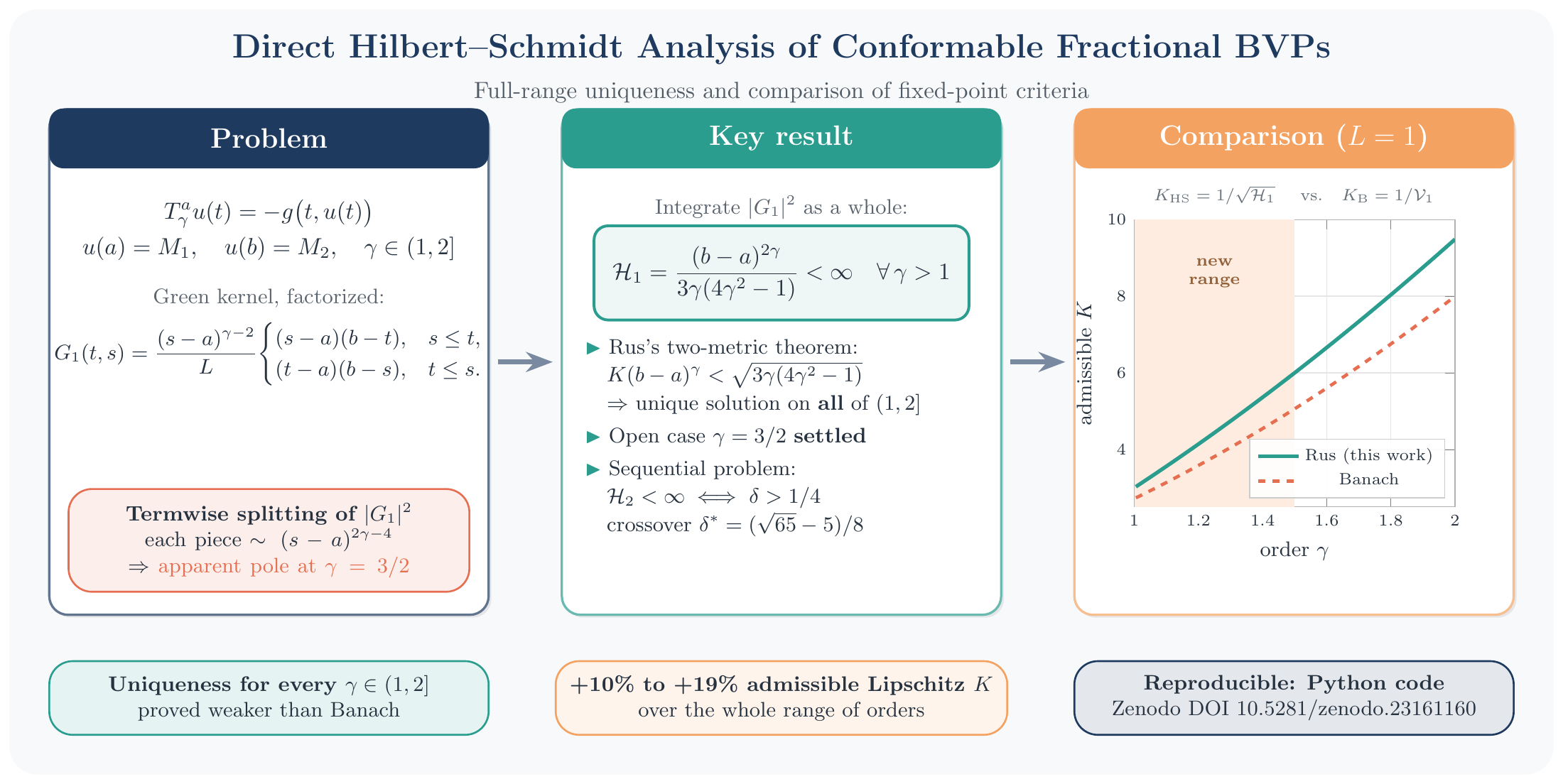
This study develops a direct Hilbert--Schmidt analysis for classical and sequential conformable fractional boundary value problems arising in fixed-point formulations. For the classical problem of order \( \gamma\in(1,2] \), factorizing the Green kernel before squaring preserves a cancellation that is lost in termwise estimates. This yields the exact expression \( \mathcal H_1=(b-a)^{2\gamma}/(3\gamma(4\gamma^2-1)) \), which is finite for every \( \gamma>1 \) and shows that the apparent singularity at \( \gamma=3/2 \) in the previously used representation is removable. Combined with a uniform kernel estimate and Rus's two-metric fixed point theorem, the result extends the corresponding uniqueness criterion to the full natural range \( \gamma\in(1,2] \). We also prove that this Hilbert--Schmidt criterion is strictly less restrictive than the Banach contraction criterion throughout that interval. For the sequential conformable kernel, we derive a compact closed form for the squared Hilbert--Schmidt norm, establish the exact square-integrability threshold \( \delta>1/4 \), and determine analytically the crossover order \( \delta^*=(\sqrt{65}-5)/8 \) between the Hilbert--Schmidt and Banach-type bounds. Numerical comparisons quantify the improvement in the admissible Lipschitz constant, and a nonlinear example with \( \gamma=1.25 \) demonstrates a regime in which the Banach condition fails while the full-range two-metric criterion guarantees uniqueness. The results show that preserving cancellation in singular-looking Green kernels can materially sharpen fixed-point criteria for fractional boundary value problems.
Keywords:
conformable fractional calculus
; fractional boundary value problem
; Green operator
; Hilbert–Schmidt norm
; fixed-point theory
; Rus theorem
; uniqueness
; numerical analysis
Copyright: This open access article is published under a Creative Commons CC BY 4.0 license, which permit the free download, distribution, and reuse, provided that the author and preprint are cited in any reuse.