
Submitted:
09 October 2026
Posted:
10 October 2026
You are already at the latest version
Abstract
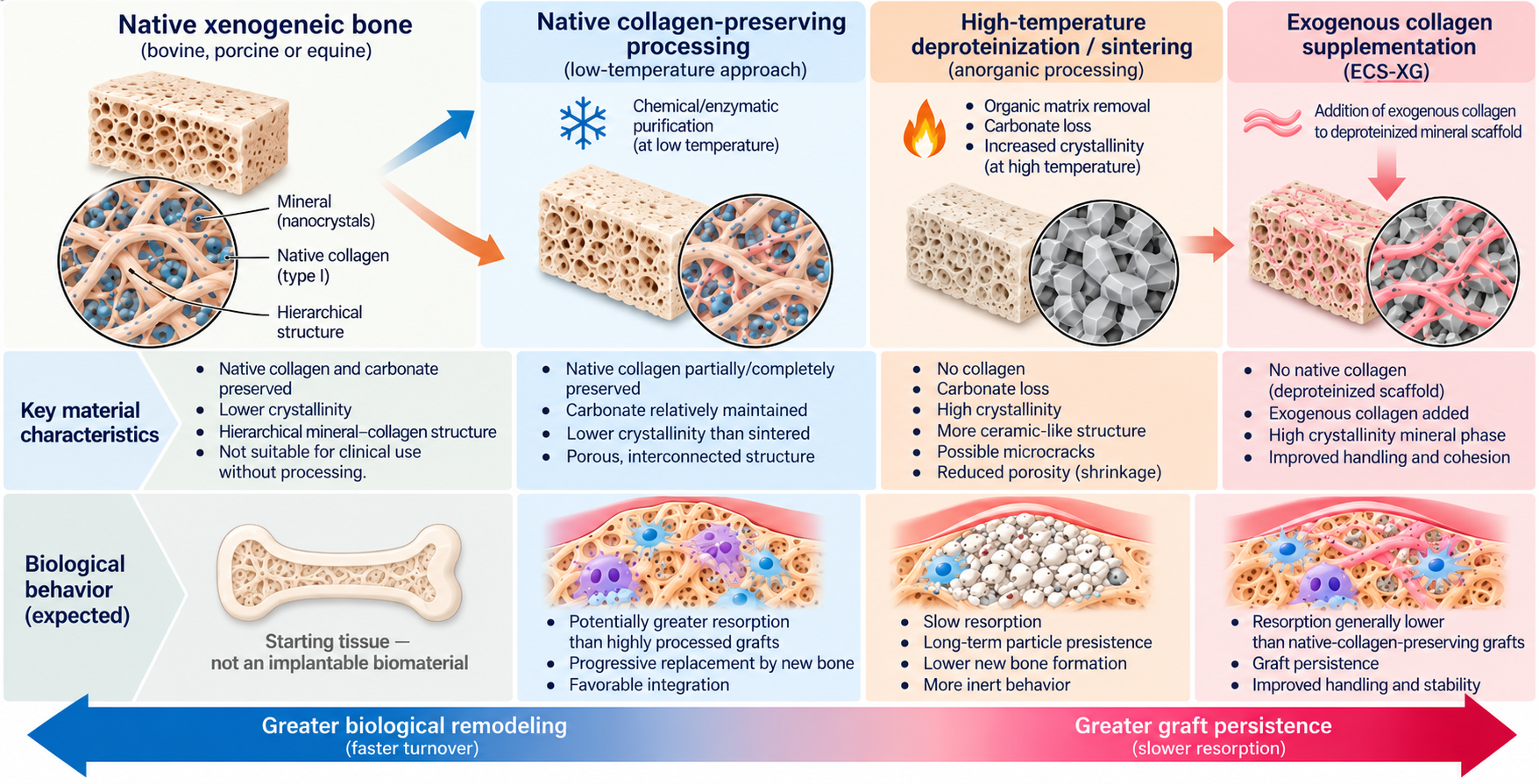
Xenogeneic bone substitutes are widely used in dental regeneration, yet materials commonly described as collagen-containing or collagenated may differ fundamentally in their composition and biological behavior. This narrative review examines xenografts from the perspective of their manufacturing process, focusing on the distinction between preservation of native bone collagen and addition of exogenous collagen after depro-teinization. Thermal processing progressively removes the native organic matrix and carbonate components and, particularly at higher temperatures, increases mineral crystallinity and promotes the transformation of bone into a more ceramic-like scaffold. Such materials are highly osteoconductive but may exhibit very slow resorption and long-term particle persistence. Exogenous collagen can subsequently be incorporated into the processed mineral scaffold to improve cohesion, handling, and adaptation, but does not restore the original hierarchical mineral–collagen architecture. Conversely, chemical or enzymatic processing may preserve native collagen together with a less extensively transformed mineral phase. Available preclinical and clinical evidence suggests that some native-collagen-preserving xenografts may undergo greater biological turnover and progressive replacement than highly processed anorganic comparators, although differences in animal source, porosity, mineral structure, and manufacturing protocols preclude attributing these effects exclusively to collagen preservation. We therefore propose distinguishing native-collagen-preserving xenografts (NCP-XG) from exoge-nous-collagen-supplemented xenografts (ECS-XG). This processing-based framework may provide a more biologically meaningful interpretation of collagen-containing xenografts and highlights the need to select biomaterials according to the desired balance between scaffold persistence, dimensional stability, and biological replacement.
Keywords:
xenograft
; bone substitute
; collagen
; bone regeneration
; crystallinity
; deproteinization
; remodeling
; biomaterials
Copyright: This open access article is published under a Creative Commons CC BY 4.0 license, which permit the free download, distribution, and reuse, provided that the author and preprint are cited in any reuse.