

Submitted:
12 October 2026
Posted:
13 October 2026
You are already at the latest version
Abstract
Background: Terminal sterilization is generally preferred for parenteral products when the formulation and container can tolerate the process. Retatrutide is a thermolabile peptide, making conventional moist heat unsuitable and creating a need to evaluate a nonthermal terminal modality. Objective: To establish an in silico decision framework for electron beam terminal sterilization of a 10 mg/mL retatrutide multidose cartridge and to define a stability indicating reversed phase high performance liquid chromatography method for post irradiation control. Methods: Moist heat, dry heat, ethylene oxide, sterile filtration with aseptic processing, and electron beam irradiation were compared by product specific criteria. A model electron accelerator configuration used a UELR-10-15-S-1 unit No. 128170401 at 9.5 MeV, 1.19 mA, 50 cm scan width, and 1.75 m/min conveyor speed. Three virtual batches were assigned dose maps, bioburden distributions, verification tests, sterility outcomes, and RP HPLC results. A Monte Carlo survivor model estimated the probability of a nonsterile unit. Results: The model selected electron beam irradiation as a candidate terminal method, subject to experimental qualification. Simulated minimum and maximum absorbed doses were 15.1 to 15.4 kGy and 18.1 to 18.4 kGy, respectively. All three virtual batches met the model criterion of a probability of a nonsterile unit not greater than 10 to the power of minus 6. Post irradiation retatrutide assay was 97.2 to 97.8 percent, while total related substances were 2.10 to 2.39 percent. Conclusions: The simulated dataset supports a bounded development hypothesis but does not demonstrate sterility, peptide integrity, process validation, or suitability for human use. Accelerator electrical settings do not define absorbed dose. Confirmatory work requires calibrated dose mapping, microbiological dose substantiation, validated RP HPLC and orthogonal structural and biological methods.
Keywords:
retatrutide
; electron beam
; terminal sterilization
; thermolabile peptide
; multidose cartridge
; RP HPLC
; sterility assurance
; simulated data
1. Introduction
Terminal sterilization provides a strong sterility assurance concept because the drug product is sterilized in its final container. Regulatory guidance therefore expects terminal processing whenever it is feasible, while any alternative must be justified through product and process evidence. For peptide injectables, the preferred method cannot be selected from modality labels alone: heat sensitivity, radiolysis, oxidation, aggregation, container closure integrity, dose penetration, and microbiological resistance must be considered together.
Retatrutide is a synthetic peptide agonist under clinical development and is not an approved active ingredient for the cartridge formulation evaluated here. The development candidate comprises retatrutide in an aqueous tromethamine mannitol phenol vehicle. Aqueous peptide products are especially vulnerable to ionizing radiation because water radiolysis generates reactive species that can induce oxidation, fragmentation, crosslinking, or aggregation. Evidence from other peptides, including insulin, indicates that acceptable recovery after irradiation cannot be assumed from low process temperature or from chromatographic main peak area alone.
This Original Article reframes formulation development around the terminal sterilization decision and addresses modality selection, electron beam process definition, microbiological assurance modelling, and analytical control. All batch, dose, sterility, and chromatographic results are synthetic. They were created to test a decision framework and must not be represented as measurements.
2. Materials and Methods
2.1. Formulation and Container System
The model product was a 3 mL multidose cartridge containing the candidate composition shown in Table 1. The formulation is a development hypothesis and not a clinical, commercial, or validated product. The primary package was represented as a glass cartridge with elastomeric closure components. Material grades, siliconization, extractables and leachables, headspace oxygen, and closure dimensions require product specific definition before irradiation studies.
2.2. Selection of the Sterilization Strategy
Five strategies were evaluated against peptide stability, applicability to a sealed liquid cartridge, residual risk, scalability, and regulatory burden. The decision was framed as selection of a confirmatory development pathway, not approval of a manufacturing process.

Table 2.
Product specific comparison of sterilization strategies.
| Method | Thermal burden | Final container fit | Dominant product risk | Decision |
|---|---|---|---|---|
| Moist heat | High | Excellent when compatible | High risk of peptide degradation and aggregation | Not selected for the aqueous peptide |
| Dry heat | Very high | Not suitable for aqueous filled cartridges | Product and closure incompatibility | Not selected |
| Ethylene oxide | Low | Poor fit for a sealed aqueous injectable | Residuals, diffusion, aeration, material effects | Not selected |
| Sterile filtration and aseptic filling | Low | Not terminal | Strong baseline option but relies on aseptic control | Fallback and comparator |
| Electron beam | Low average thermal load | Potential terminal application | Aqueous radiolysis and dose nonuniformity | Selected for experimental feasibility testing |
2.3. Electron Accelerator Configuration and Dose Concept
The simulated process used a UELR-10-15-S-1 electron accelerator, unit No. 128170401, with the supplied machine settings listed in Table 3. Nominal beam power was calculated as 9.5 MeV multiplied by 1.19 mA, equivalent to approximately 11.3 kW. This value describes electrical beam output and is not an absorbed dose.
A model target window of 15.0 to 18.5 kGy was used solely for feasibility calculations. The dose uniformity ratio was defined as maximum absorbed dose divided by minimum absorbed dose. Real minimum and maximum doses must be established using calibrated dosimeters placed at mapped product locations in a fully specified load. Product density, cartridge orientation, scan overlap, conveyor loading, irradiation from one or more sides, and electron energy losses must be recorded. The machine settings in Table 3 cannot be converted into a defensible product dose without those data.
2.4. Simulated Microbiological Qualification
Three virtual batches were assigned low presterilization bioburden distributions and batch specific minimum doses. The probability of a nonsterile unit was estimated from an exponential survivor approximation using sampled initial contamination, absorbed dose, and D10 values. For each batch, 200000 Monte Carlo iterations used a median D10 of 1.30 kGy with bounded uncertainty from 0.80 to 2.00 kGy. The study criterion was a model probability of a nonsterile unit not greater than 10 to the power of minus 6. Simulated verification dose tests contained 100 units per batch, and simulated final sterility tests contained 20 units per batch. These organism counts and test outcomes are generated values; they do not constitute ISO dose substantiation, pharmacopoeial sterility testing, or validation evidence.
2.5. RP HPLC Method for Retatrutide and Related Substances
A stability indicating RP HPLC diode array detection method was defined as the primary chromatographic control. A wide pore C18 column, 150 by 4.6 mm, 3.5 micrometre particles, and 300 angstrom pores was modelled at 30 °C. Mobile phase A was water with 0.1 percent trifluoroacetic acid and mobile phase B was acetonitrile with 0.1 percent trifluoroacetic acid. The gradient increased from 32 to 62 percent B over 20 min at 0.8 mL/min. Detection was at 214 nm, injection volume was 10 microlitres, and nominal sample concentration was 1.0 mg/mL. Assay was calculated against an external retatrutide reference standard. Related substances were calculated by corrected area normalization using experimentally established relative response factors when available.
The model system suitability criteria were retention time precision not greater than 1.0 percent relative standard deviation, peak area precision not greater than 2.0 percent, tailing factor not greater than 2.0, theoretical plates not less than 10000, and resolution from the nearest specified impurity not less than 1.5. Selectivity must be challenged with heat, oxidation, light, pH, and irradiation stressed samples. The proposed method can support assay and chromatographic purity but cannot by itself establish complete peptide identity, primary sequence preservation, aggregation state, or biological activity.
2.6. Simulated Analytical Validation and Decision Criteria
Validation characteristics were modelled in alignment with ICH Q2(R2). The simulated range was 0.5 to 1.5 mg/mL for assay and 0.05 to 3.0 percent for related substances. Provisional post irradiation decision criteria were retained assay of at least 95.0 percent of label claim, total related substances not greater than 3.0 percent, and no new individual impurity greater than 1.0 percent. These thresholds are study rules rather than release or shelf life specifications.
Table 4.
Simulated RP HPLC validation and system suitability outputs.
| Characteristic | Simulated result | Model criterion |
|---|---|---|
| Assay linearity | R squared 0.9998 | R squared at least 0.999 |
| Accuracy | 99.2 to 100.6 percent | 98.0 to 102.0 percent |
| Repeatability | 0.46 percent RSD | Not greater than 2.0 percent |
| Intermediate precision | 0.78 percent RSD | Not greater than 3.0 percent |
| Impurity quantitation limit | 0.05 percent | Not greater than 0.10 percent |
| System suitability peak area | 0.42 percent RSD | Not greater than 2.0 percent |
| Tailing factor | 1.08 | Not greater than 2.0 |
| Theoretical plates | 28400 | Not less than 10000 |
| Nearest peak resolution | 2.35 | Not less than 1.5 |
3. Results
3.1. Simulated Dose Mapping and Sterility Assurance
Table 5.
Simulated microbiological and dose outputs for three virtual batches.
| Batch | Bioburden CFU per cartridge | Dmin kGy | Dmax kGy | DUR | Positive verification tests | Positive sterility tests | Median model PNS | Upper 95 percent PNS | Iterations meeting PNS criterion percent |
|---|---|---|---|---|---|---|---|---|---|
| EB-R01 | 1.6 | 15.2 | 18.1 | 1.19 | 0/100 | 0/20 | 3.2e-12 | 2.1e-09 | 100.00 |
| EB-R02 | 2.0 | 15.4 | 18.4 | 1.19 | 0/100 | 0/20 | 2.8e-12 | 2.0e-09 | 100.00 |
| EB-R03 | 1.8 | 15.1 | 18.3 | 1.21 | 0/100 | 0/20 | 4.3e-12 | 2.6e-09 | 100.00 |
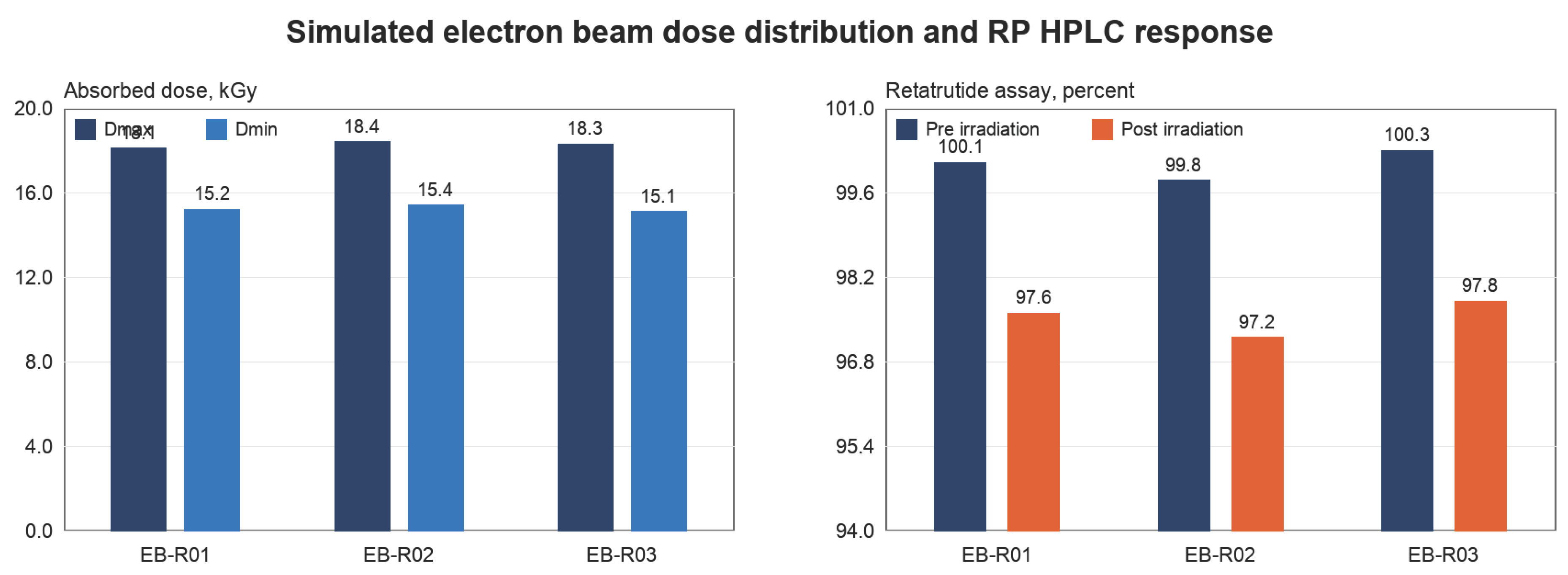
The simulated dose uniformity ratio ranged from 1.19 to 1.21. No positive units were generated in the model verification dose or sterility test datasets. Monte Carlo estimates met the predefined probability criterion in all batches. These favorable outputs reflect model assumptions, including low bioburden and the selected D10 distribution; zero simulated positives do not prove sterility or validate the dose window.
3.2. Simulated Post Irradiation RP HPLC Performance.
Table 6.
Simulated RP HPLC results before and after electron beam treatment.
| Batch | Assay pre percent | Assay post percent | Main peak pre area percent | Main peak post area percent | Total RS pre percent | Total RS post percent | Largest new impurity percent | Model decision |
|---|---|---|---|---|---|---|---|---|
| EB-R01 | 100.1 | 97.6 | 99.34 | 97.82 | 0.66 | 2.18 | 0.54 | Pass |
| EB-R02 | 99.8 | 97.2 | 99.28 | 97.61 | 0.72 | 2.39 | 0.65 | Pass |
| EB-R03 | 100.3 | 97.8 | 99.41 | 97.90 | 0.59 | 2.10 | 0.50 | Pass |
Across the three virtual batches, post irradiation assay was 97.53 ± 0.31 percent and total related substances were 2.22 ± 0.15 percent. Each batch passed the provisional model criteria. The decrease in assay and increase in related substances were intentionally included to represent a measurable radiation burden rather than a no effect assumption.
Figure 1.
Simulated absorbed dose and RP HPLC assay for three virtual batches. Values are generated outputs and are not experimental measurements.
Figure 1.
Simulated absorbed dose and RP HPLC assay for three virtual batches. Values are generated outputs and are not experimental measurements.
3.3. What HPLC Can and Cannot Confirm
The model RP HPLC method confirmed only that the simulated intact retatrutide peak remained quantitatively predominant and that the generated impurity burden remained within the predefined study rules. In a real study, coeluting oxidation products or sequence variants may remain undetected, and area percent may diverge from peptide mass recovery. A defensible integrity conclusion therefore requires mass balance and orthogonal evidence. At minimum, LC MS or LC MS MS identity, peptide mapping, size exclusion chromatography for high molecular weight species, subvisible particle testing, and a receptor based potency assay should accompany RP HPLC.
4. Discussion
4.1. Rationale for a Nonthermal Terminal Method
The selection exercise rejected heat based terminal methods because the aqueous peptide and phenol containing formulation has no demonstrated thermal tolerance at sterilizing conditions. Electron beam irradiation offers short exposure and low average heat input, but these advantages do not eliminate chemical risk. The dominant product specific hazard is indirect radiation chemistry in water, not bulk temperature. Published insulin work showed severe loss in unprotected aqueous solution at 10 kGy and improved recovery only after formulation protection and cryogenic irradiation. Accordingly, the favorable retatrutide simulation should be treated as a testable hypothesis rather than evidence that the selected dose window is safe.
4.2. Dose Setting and Process Validation
The model window of 15.0 to 18.5 kGy was chosen to create a narrow feasibility scenario below the conventional 25 kGy reference point. It does not establish a sterilization dose. An experimental programme must first characterize bioburden number and resistance, select an applicable substantiation approach, conduct verification dose experiments, and map minimum and maximum absorbed dose throughout the worst case load. Routine processing would require calibrated dosimetry, process interruption studies, load configuration control, and investigation limits. For a drug product, the strategy must also satisfy the applicable pharmacopoeial and regional regulatory expectations; medical device dose methods should not be imported uncritically.
4.3. Product Quality and Container Closure Risk
A phase appropriate irradiation matrix should compare 0, 5, 10, 15, 18.5, and 25 kGy at ambient, refrigerated, and frozen conditions, with air and nitrogen headspace where technically feasible. Immediate and time dependent testing should include assay, related substances, peptide mapping, molecular mass, aggregation, particles, appearance, pH, osmolality, phenol content, biological potency, endotoxin, sterility, preservative effectiveness, and container closure integrity. Glass, elastomer, lubricant, and adhesive changes should be assessed through functionality and extractables and leachables studies. Dose dependent changes should be linked to toxicological qualification of new impurities.
4.4. Decision Gate for Development
Electron beam development should advance only if the experimentally measured minimum dose achieves the microbiological target while the experimentally measured maximum dose remains within a validated product quality envelope. A predefined stop rule is recommended: if retained assay falls below 95 percent, a new impurity exceeds its qualified limit, potency falls outside the development criterion, aggregation increases materially, or container closure integrity fails, the terminal irradiation branch should be discontinued or reformulated. Sterile filtration followed by aseptic filling remains the scientifically credible comparator and fallback strategy.
4.5. Limitations
This study has five principal limitations. First, every dose, microbiological, and chromatographic result is simulated. Second, no organism distribution or product specific D10 value was measured. Third, accelerator settings were not linked to a defined load geometry or physical dosimetry. Fourth, the RP HPLC method was not experimentally validated and cannot alone establish full peptide integrity. Fifth, the formulation and container system are development candidates. The work therefore cannot support a sterility claim, a terminal sterilization validation, a release decision, a shelf life, or administration to humans.
5. Conclusions
This in silico Original Article identifies electron beam irradiation as a plausible candidate for terminal sterilization of a thermolabile retatrutide cartridge when moist heat is not compatible. Three explicitly simulated batches met the model dose, sterility assurance, assay, and related substance criteria. The result is a development decision framework, not experimental confirmation. Product dose must be measured by calibrated dosimetry, microbiological efficacy must be substantiated with real bioburden and verification studies, and peptide integrity must be demonstrated by validated RP HPLC plus orthogonal structural and biological methods. Until those requirements are met, sterile filtration and aseptic filling remain the default control strategy.
Author Contributions
Conceptualization, I.K. and O.C.; methodology, I.K.; investigation design, I.K. and O.C.; modelling, I.K.; writing original draft, I.K.; writing review and editing, I.K. and O.C. All authors have read and agreed to the submitted version of the manuscript. These contribution statements should be confirmed by both authors before journal submission.
Funding
This research received no external funding.
Institutional Review Board Statement
Not applicable. No human participants or animals were involved.
Informed Consent Statement
Not applicable.
Data Availability Statement
All numerical batch, sterility, dose, and HPLC outputs reported in this article are synthetic model data generated for methodological illustration. No primary experimental dataset exists. The deterministic batch inputs and Monte Carlo assumptions are fully described in the article.
Conflicts of Interest
The authors declare no conflict of interest.
References
- European Medicines Agency. EMA/CHMP/CVMP/QWP/850374/2015; Guideline on the sterilisation of the medicinal product, active substance, excipient and primary container. 2019.
- European Commission. EudraLex. EU Guidel. Good Manuf. Pract. Annex 1 Manuf. Sterile Med. Prod. 2022, Volume 4. [Google Scholar]
- United States Food and Drug Administration. Submission Documentation for Sterilization Process Validation in Applications for Human and Veterinary Drug Products. In Guidance for Industry; 1994. [Google Scholar]
- International Organization for Standardization. ISO 11137-2:2013; Sterilization of health care products Radiation Part 2 Establishing the sterilization dose. ISO: Geneva, 2013.
- United States Pharmacopeia. General Chapter 1229.10 Radiation Sterilization. In USP NF; United States Pharmacopeial Convention: Rockville, MD.
- International Council for Harmonisation. ICH Q2(R2) Validation of Analytical Procedures. Final version. 2023. [Google Scholar]
- Terryn, H.; Maquille, A.; Houée-Levin, C.; Tilquin, B. Irradiation of human insulin in aqueous solution, first step towards radiosterilization. Int. J. Pharm. 2007, 343, 4–11. [Google Scholar] [CrossRef]
- Matagne, D.; Delbar, N.; Hartmann, H.J.; Gray, M.; Stickelmeyer, M. Development of a process using electron beam for a terminal sterilization for parenteral formulations of pharmaceuticals. Radiat. Phys. Chem. 2004, 71, 421–424. [Google Scholar] [CrossRef]
- Sharma, N.; Kukreja, D.; Giri, T.; Kumar, S.; Shah, R.P. Synthetic pharmaceutical peptides characterization by chromatography principles and method development. J. Sep. Sci. 2022, 45, 2200–2216. [Google Scholar] [CrossRef]
- Kenley, R.A.; Tracht, S.; Stepanenko, A.; Townsend, M.; L'Italien, J. Kinetics of pramlintide degradation in aqueous solution as a function of temperature and pH. AAPS PharmSciTech 2000, 1, E7. [Google Scholar] [CrossRef]
- Jastreboff, A.M.; et al. Triple hormone receptor agonist retatrutide for obesity. N. Engl. J. Med. 2023, 389, 514–526. [Google Scholar] [CrossRef]
- International Council for Harmonisation. ICH Q1A(R2) Stability Testing of New Drug Substances and Products. 2003. [Google Scholar]
Table 1.
Candidate formulation used in the in silico study.
| Component | Concentration | Amount per 3 mL | Function or status |
|---|---|---|---|
| Retatrutide | 10.000 mg/mL | 30.000 mg | Peptide equivalent; development candidate |
| Tromethamine | 1.211 mg/mL | 3.634 mg | Buffer component |
| D-mannitol | 40.000 mg/mL | 120.000 mg | Tonicity and stabilisation candidate |
| Phenol | 5.000 mg/mL | 15.000 mg | Antimicrobial preservative candidate |
| Hydrochloric acid or sodium hydroxide | q.s. | q.s. | Adjustment to pH 7.50 ± 0.10 |
| Water for injection | to 1 mL | to 3 mL | Vehicle |
Table 3.
Supplied electron beam equipment settings.
| Parameter | Model setting |
|---|---|
| Accelerator | UELR-10-15-S-1, unit No. 128170401 |
| Electron energy | 9.5 MeV |
| Beam current | 1.19 mA |
| Scan width | 50 cm |
| Conveyor speed | 1.75 m/min |
| Nominal beam power | 11.3 kW, calculated; not product dose |
Disclaimer/Publisher’s Note: The statements, opinions and data contained in all publications are solely those of the individual author(s) and contributor(s) and not of MDPI and/or the editor(s). MDPI and/or the editor(s) disclaim responsibility for any injury to people or property resulting from any ideas, methods, instructions or products referred to in the content. |
© 2026 by the authors. Licensee MDPI, Basel, Switzerland. This article is an open access article distributed under the terms and conditions of the Creative Commons Attribution (CC BY) license (http://creativecommons.org/licenses/by/4.0/).
Copyright: This open access article is published under a Creative Commons CC BY 4.0 license, which permit the free download, distribution, and reuse, provided that the author and preprint are cited in any reuse.