

Submitted:
08 October 2026
Posted:
10 October 2026
You are already at the latest version
Abstract
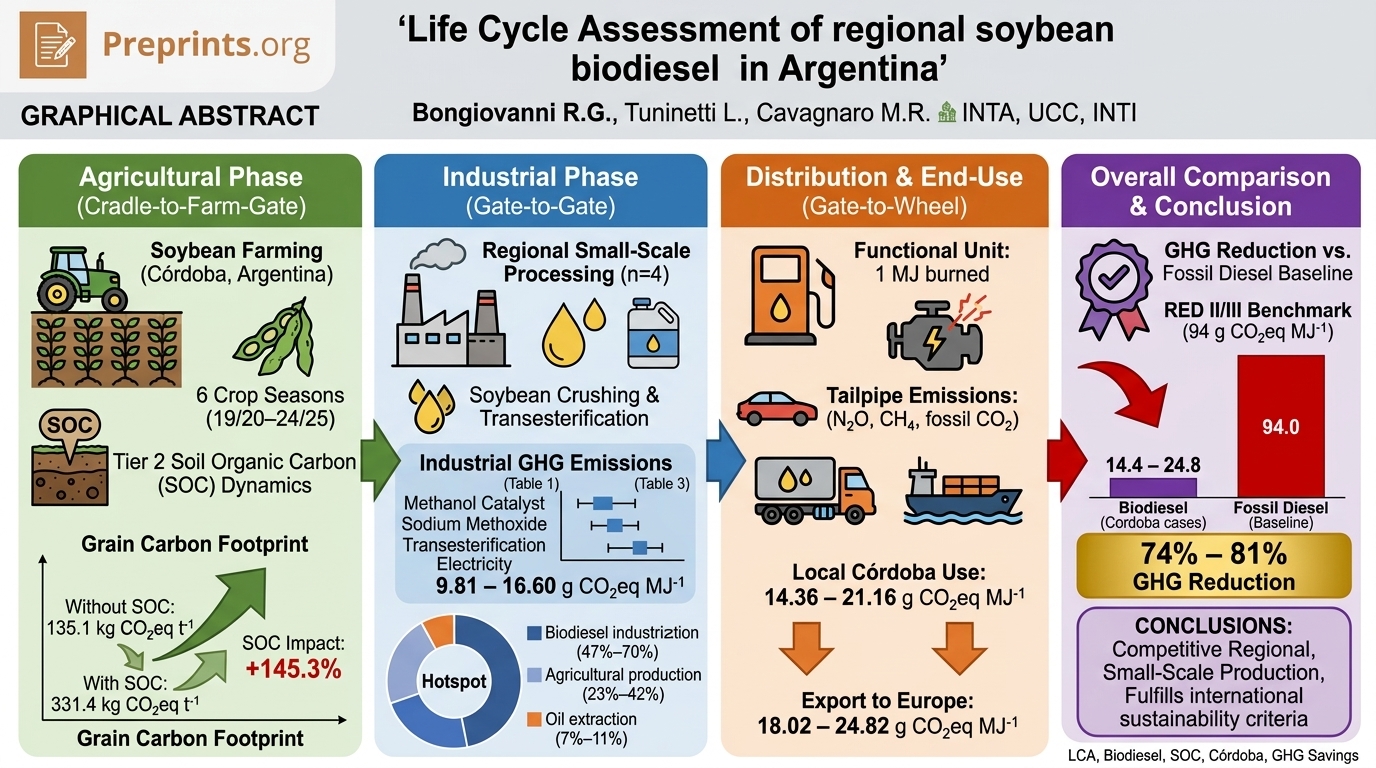
Soybean biodiesel plays a pivotal role in local bioeconomy strategies and global transport decarbonization. However, carbon footprint assessments often rely on national default values or exclude soil organic carbon (SOC) dynamics. This study provides a comprehensive cradle-to-wheel Life Cycle Assessment (LCA), unifying a six-crop-season agricultural inventory (2019/20–2024/25) in Córdoba province with primary industrial data from four local biodiesel processing plants. At the farm gate, the weighted average carbon footprint of soybean was 135.1 kg CO₂eq t⁻¹ excluding soil dynamics and 331.4 kg CO₂eq t⁻¹ (+145.3%) when incorporating Tier 2 SOC changes. For 1 MJ of soybean biodiesel burned in engines, total life cycle GHG emissions ranged from 14.36 to 21.16 g CO₂eq MJ⁻¹ for local combustion in Córdoba and from 18.02 to 24.82 g CO₂eq MJ⁻¹ when exported to Europe. These figures represent a 74% to 81% GHG emission reduction compared to the European Union fossil fuel benchmark (94 g CO₂eq MJ⁻¹). Agricultural production and transport accounted for 23%–42% of total emissions, oil extraction for 7%–11%, and biodiesel industrialization for 47%–70%. Results demonstrate that regional, small-scale biodiesel production in Argentina achieves environmental performances highly competitive with large agro-export facilities, fulfilling strict international RED II/III sustainability criteria.
Keywords:
life cycle assessment
; carbon footprint
; soybean biodiesel
; soil organic carbon
; GHG emissions
; biofuel sustainability
Copyright: This open access article is published under a Creative Commons CC BY 4.0 license, which permit the free download, distribution, and reuse, provided that the author and preprint are cited in any reuse.