

Submitted:
08 October 2026
Posted:
10 October 2026
You are already at the latest version
Preprints on COVID-19 and SARS-CoV-2
Abstract
Early news coverage helps make unfamiliar health threats intelligible, yet less is known about how language and imagery jointly organize crisis meanings in platform-distributed broadcast journalism. This study examines how the early COVID-19 outbreak was constructed in 66 BBC News and 195 CNA YouTube videos published between 20 January and 12 March 2020 and identified through the outlets’ designated playlists. Using inductive thematic analysis, the study coded the corpus qualitatively and interpreted recurring linguistic and visual patterns through discourse and multimodal analysis. Within the selected BBC News coverage, descriptions and images of enclosure, disrupted mobility, and repatriation represented Wuhan as an immobilized crisis space; narratives of hiding and escape associated restricted movement with vulnerability and departure with relative safety. Within the selected CNA coverage, evaluative language, quantification, and authoritative sourcing constructed the outbreak as severe, while inter-agency coordination, visible leadership, procedures, and regulatory enforcement represented it as administratively manageable and positioned public authorities as capable organizers of the response. These higher-order organizing logics are conceptualized as spatialization and governability. Governmental competence denotes an institutional identity constructed within CNA’s coverage, not an independent assessment of Singapore’s response. By showing how recurring verbal and visual resources cohered into outlet-specific crisis narratives, the study contributes an analytically transferable framework for multimodal crisis and health communication research. The findings remain limited to the two examined corpora and the defined period.
Keywords:
COVID-19
; YouTube journalism
; multimodal discourse analysis
; spatialization
; governability
1. Introduction
By early 2020, emerging infectious disease reporting was unfolding within a media environment in which digital news platforms, online news outlets, and social media had become central to public health communication and news consumption (Aharoni, 2026; Nickl et al., 2024). Social video platforms, most notably YouTube, had become important channels through which audiences accessed outbreak-related information and established broadcasters distributed news beyond conventional television schedules (Khatri et al., 2020; Tang et al., 2018). This platform context was particularly consequential during the formative stage of COVID-19, when limited scientific knowledge and rapidly changing conditions heightened public reliance on established news organizations to define the emerging threat and establish its initial interpretive boundaries (Ngai et al., 2022; Schätz & Kirchhoff, 2024).
Revisiting this formative phase retrospectively is analytically valuable because the earliest representations of an unfamiliar disease were produced before its subsequent trajectory, consequences, and dominant interpretations had become established. Temporal distance makes it possible to examine these initial constructions against the extensive scholarship and accumulated knowledge that emerged during and after the pandemic, thereby revealing how uncertainty was converted into comparatively coherent narratives of risk, safety, responsibility, and institutional action. The corpus is therefore treated not as current pandemic reporting but as a bounded historical corpus of an interpretively consequential moment: the period between each outlet’s first report on the outbreak and the World Health Organization (WHO)’s declaration of COVID-19 as a pandemic.
Research examining COVID-19 news has identified substantial variation in how the crisis was framed across media and national settings (Hossain et al., 2022; Ngai et al., 2022). Nevertheless, important gaps remain in understanding how verbal and visual resources interacted within platform-distributed broadcast journalism. Some studies have examined visual news representations within individual national settings (Aiello et al., 2022), while others have compared social media framing across countries without placing multimodal construction at the centre of the analysis (Hossain et al., 2022; Ngai et al., 2022). Nickl et al. (2024), for example, comparatively investigated COVID-19 visual health communication across German and Chinese social news media platforms. However, research focusing primarily on verbal discourse, including metaphorical and lexical constructions, offers more limited insight into how language, moving images, captions, and other semiotic resources jointly rendered an emerging health crisis intelligible (Ivanov et al., 2023; Lei, 2025; Rana et al., 2024). Moreover, comparative research has not examined all journalistic contexts equally, reinforcing the value of placing an established Asian broadcaster alongside a British broadcaster without treating either outlet as representative of a continent or a homogeneous journalistic tradition.
Addressing these gaps, this study integrates framing theory with discourse and multimodal analysis to examine how recurring linguistic and visual resources cohered into higher-order organizing logics within two bounded corpora of early COVID-19 coverage. Its contribution is threefold. First, it conceptualizes spatialization as the multimodal organization of crisis meaning around enclosure, mobility, distance, and safety. Second, it conceptualizes governability as a representational accomplishment through which authoritative knowledge, institutional coordination, procedural visibility, and enforcement rendered the outbreak administratively manageable. In this formulation, governability describes the construction of institutional competence rather than independently verifying effective governance. Third, by tracing how these logics were realized in the selected BBC News and CNA videos, the study offers an analytically transferable vocabulary for examining multimodal crisis reporting in other settings. The findings nevertheless remain specific to the two designated corpora and the defined investigation period and do not represent the entirety of either outlet’s output or broader national media systems.
2. Framing, Multimodality, and the Discursive Organization of Crisis
This study adopts a social constructionist understanding of news discourse. From this perspective, news does not transparently reproduce events but constructs particular accounts of them through processes of selection, emphasis, classification, and evaluation (Burr, 2015). These processes become especially consequential during the formative stage of an infectious disease outbreak, when scientific knowledge remains incomplete and the meaning of the crisis has not yet stabilized. Journalistic accounts can render an unfamiliar threat intelligible by identifying relevant problems, actors, causes, consequences, and responses. The study combines framing theory, discourse analysis, and multimodal analysis to examine how such meanings were organized within the selected BBC News and CNA YouTube coverage.
2.1. Frames as Organizing Structures
Framing is conceptualized here as the organization of meaning rather than simply the prominence of particular topics. Entman (1993) defines framing as selecting aspects of perceived reality and making them salient in ways that promote particular problem definitions, causal interpretations, evaluations, and proposed responses. From a cultural perspective, frames operate as socially available organizing principles that structure relations among events, actors, values, and possible courses of action (Reese, 2001). They are therefore not reducible to individual words or images. Instead, they acquire coherence through recurring configurations of framing and reasoning devices (Gamson & Modigliani, 1989; Van Gorp, 2010).
Framing devices constitute the observable resources through which broader interpretations are realized. These may include lexical choices, metaphors, exemplars, descriptions, quantified evidence, quoted sources, visual scenes, settings, and representations of actions (Entman, 1993; Gamson & Modigliani, 1989; Van Gorp, 2010). Reasoning devices connect these resources into interpretations by defining what the problem is, how it developed, who or what is responsible, how it should be evaluated, and what forms of response appear appropriate. A term such as “escape,” for example, does not constitute a complete frame independently. Its analytical significance emerges when it recurs alongside descriptions of restricted mobility, images of deserted roads, accounts of repatriation, and contrasts between those able and unable to leave. Similarly, images of officials do not inherently signify institutional competence. Such an interpretation becomes available when these images recur alongside narration emphasizing coordination, operational procedures, authority, and enforcement.
Discourse analysis supports this approach by examining how framing devices construct relations among social actors, actions, places, and values. Language does not merely label a pre-existing crisis; it can assign agency, establish distinctions, intensify or mitigate evaluations, authorize particular forms of knowledge, and normalize certain responses (Reisigl & Wodak, 2016; van Dijk, 2011). Lexical choices, predications, metaphors, oppositions, modality, quantification, and reported speech can consequently be examined as resources through which particular crisis interpretations are established. The present analysis does not impose a predetermined inventory of linguistic strategies. Instead, it uses discourse-analytical concepts to interpret recurrent linguistic patterns identified inductively within each corpus.
The visual dimension is equally important because television news distributed through YouTube communicates through moving images, narration, captions, editing, and other interacting modes. Visual framing extends the principles of selection and salience to the representation of people, places, events, and actions (Bock, 2020; Coleman, 2010). Images possess affordances that differ from those of language: their apparent resemblance to what they depict can give evidence, while their lack of explicit propositional syntax also makes their meanings context-dependent and potentially polysemous (Messaris & Abraham, 2001). Multimodal analysis therefore requires attention to the relationship between modes rather than an assumption that images merely illustrate words (Kress & van Leeuwen, 2021). Accordingly, the analysis distinguishes between what an image visibly depicts and the interpretation supported by its relationship with narration and the surrounding news sequence. A patient being transferred to an ambulance, for example, makes a medical emergency visible but does not independently signify entrapment. Similarly, an official appearing at an operational site does not, by itself, demonstrate effective governance. Such meanings become analytically relevant only when visual patterns interact recurrently with related linguistic constructions. This approach permits multimodal interpretation while limiting unsupported inferences about depicted actors’ intentions, emotions, or actual institutional performance.
2.2. Spatialization and Governability
Building on this framing perspective, the study uses the concept of higher-order organizing logics to describe a recurrent configuration through which multiple framing devices and discursive mechanisms establish a coherent relationship among problems, actors, spaces, and responses. A higher-order logic is therefore broader than a topic and more relational than an isolated frame label. It identifies the underlying principle through which different reports become mutually intelligible across a bounded corpus. In the present study, spatialization and governability were not predetermined coding categories. They were developed inductively through repeated comparison of linguistic and visual patterns and subsequently interpreted in relation to existing scholarship on outbreak narratives, territoriality, health communication, and governmental authority.
Spatialization refers to the discursive and multimodal organization of crisis through relations of location, distance, proximity, mobility, enclosure, and territorial boundaries. Spatialization does not simply refer to mentions of geographical locations. Rather, spatialization occurs when places and movements acquire evaluative significance: particular locations are associated with danger or protection, borders distinguish inside from outside, and mobility or immobility becomes consequential to the representation of vulnerability and safety. This conception draws on scholarship showing that outbreak narratives commonly make disease intelligible by locating its emergence, tracing routes of transmission, identifying carriers, and narrating attempts at containment (Wald, 2008). Such narratives can transform geographical locations into symbolic sites of contagion and connect mobility with the movement of disease. Research on earlier infectious disease reporting has similarly demonstrated how descriptions of origins, borders, travel, and cultural difference may construct affected places as sources of danger while creating imagined distance between threatened and comparatively protected populations (Wallis & Nerlich, 2005; Washer, 2004). During COVID-19, territorial practices—including closure, confinement, quarantine, and controls over entry and movement—operated across multiple scales, from national borders to cities, neighbourhoods, buildings, and homes (Iveson & Sisson, 2023).
Governability, by contrast, refers to the discursive construction of a crisis as administratively actionable and manageable through identifiable institutions, procedures, and forms of conduct. The concept is related to, but deliberately distinguished from, governance. Governance concerns the institutions and practices through which collective affairs are actually managed. Governability, as used here, concerns how news discourse represents an event as capable of being acted upon through authorized knowledge, coordinated intervention and compliance. It therefore denotes a representational accomplishment rather than an assessment of governmental effectiveness. This formulation is informed by governmentality scholarship examining how populations and social problems are rendered governable through knowledge, calculation, administrative procedures, and technologies of security (Foucault, 2007; Rose & Miller, 1992). From this perspective, governing depends not only on formal authority but also on practices that define problems, classify populations, assign responsibilities, and make intervention appear necessary and practicable. Hence, news coverage can privilege particular individuals as authoritative speakers while positioning specific institutions as possessing certain expertise and responsibilities. This relationship between health knowledge, media, and authority can be further understood through Briggs and Hallin’s (2007) concept of biocommunicability, which refers to normative assumptions about how health knowledge should be produced, circulated, received, and acted upon. The concept draws attention to how health reporting distributes communicative authority among medical experts, public institutions, journalists, and lay publics, rather than simply transmitting neutral information. In the present study, it provides a bridge between governability and the analysis of authoritative sourcing, institutional visibility, and representations of compliant conduct, without presuming how audiences received those representations.
The analytical framework therefore operates across three connected levels. At the micro-level, the study identifies linguistic and visual framing devices, including lexical choices, metaphors, quantification, reported actors and visualized actions. At the intermediate level, it examines recurrent mechanisms such as enclosure, restricted mobility, coordination, authoritative sourcing, visible leadership, and enforcement. At the higher level, it considers how these mechanisms cohere into the organizing logics. This layered approach makes it possible to connect detailed textual and visual evidence to broader crisis narratives. Therefore, the current study asked the following research questions:
RQ1: How did the examined BBC News and CNA YouTube coverage discursively and multimodally construct the early COVID-19 outbreak?
RQ2: What higher-order organizing logics emerged from recurring linguistic and visual resources within each outlet’s examined coverage?
3. Methodology
This study adopted a comparative qualitative research design integrating inductive thematic analysis, discourse analysis, and multimodal analysis. The videos identified through the two designated YouTube playlists formed bounded corpora of reporting produced during the formative phase of COVID-19. This design enabled an in-depth examination of how two established broadcasters organized an emerging health crisis through recurring linguistic and visual resources. The comparison was intended to identify similarities and differences between the two selected corpora rather than to generate representative claims about European, Asian, Western, or non-Western journalism.
3.1. Case Selection and Corpus Construction
BBC News and CNA were purposively selected for structured qualitative comparison. The two outlets shared a meaningful basis for comparison: both were established English-language broadcast news organizations, maintained active YouTube channels, created dedicated COVID-19 playlists, and produced substantial contemporaneous coverage of the emerging outbreak. At the same time, they operated within different national and institutional settings and reported from different geographical positions in relation to the initial outbreak. This combination of institutional comparability and contextual contrast provided a suitable basis for examining how the two broadcasters constructed the same emerging crisis through different discursive and multimodal logics. Neither outlet was selected to represent a national media system or homogeneous journalistic tradition.
The investigation period was defined as the interval between each outlet’s earliest available COVID-19 report and its reporting on the WHO’s declaration of COVID-19 as a pandemic. This temporal boundary captured a formative stage during which the nature, geographical reach, and consequences of the disease remained uncertain, while also providing a shared institutional milestone for delimiting the two corpora (Sastry & Lovari, 2017). The resulting period extended from 21 January to 12 March 2020 for BBC News and from 20 January to 12 March 2020 for CNA. The endpoint refers to the outlets’ reports on the WHO declaration rather than solely to the date on which the declaration was issued. The two YouTube channels were accessed between 27 April and 17 May 2026. The designated playlists—‘Coronavirus Pandemic’ on BBC News and ‘COVID-19 Coronavirus Pandemic’ on CNA—were used solely to identify eligible material and delimit the corpus; the study did not analyze playlist-level features. Because channel owners can remove or privatize videos and playlist contents may change, the corpus represents the material available during the 2026 collection period rather than an exhaustive reconstruction of everything originally uploaded in early 2020. Eligible videos and their hyperlinks were preserved during collection to reduce the risk of subsequent loss or inaccessibility, consistent with established practices in research using YouTube material (Nagpal et al., 2015).
All accessible videos falling within the temporal boundary were screened for inclusion. Candidate items included 66 BBC News videos and 275 CNA videos. Duplicate, private, or unavailable entries were excluded during the collection and screening process. A further 80 CNA videos consisting of extended governmental livestreams were removed because they differed materially from the editorially produced news stories constituting the unit of analysis. No BBC News videos met this exclusion criterion. Hence, the final corpus comprised 66 BBC News stories, amounting to approximately 792 minutes of coverage, and 195 CNA stories, amounting to approximately 780 minutes. Table 1 shows the details of data collection and selection process.
As shown in Table 1, CNA contributed a larger number of shorter stories. Nevertheless, the comparison remained methodologically appropriate because the total duration of the two corpora was broadly comparable. This temporal comparability provided a sound basis for qualitative comparison without presupposing numerical equivalence between the outlets. For each retained video, the title, upload date, duration, hyperlink, transcript, and relevant visual material were recorded.
3.2. Analytical Procedure
Each editorially produced news story served as the unit of analysis. NVivo 15 was used to organize the transcripts, coding records, and associated audiovisual material. The analysis was informed by Braun and Clarke’s (2006) six-phase procedure: familiarization with the corpus, generation of initial codes, development of candidate themes, review of themes, definition and naming of themes, and interpretation of the themes in relation to the research questions. The procedure was inductive in the sense that the initial codes and thematic categories were developed through engagement with the corpus rather than imposed through a predetermined set of news frames.
The lead researcher first viewed the retained videos and read their transcripts repeatedly to become familiar with the content and context of each corpus. During the initial coding cycle, the transcripts were examined line by line and descriptively labelled whenever a distinct topic, actor, action, evaluation, or representation emerged. Initial codes included categories such as ‘statistical reporting in China’, ‘South Korean government measures’, and ‘updates on the cruise ship’. Related codes were then compared and grouped into broader categories according to their shared meanings and narrative functions. Coding proceeded iteratively rather than as a single linear exercise (Akhter & Al-Zaman, 2025; Saldaña, 2016). The first cycle foregrounded explicit linguistic and visual features, including lexical choices, evaluative expressions, metaphors, reported actors, depicted locations, and recurring forms of visual representation. Subsequent cycles examined how these features interacted to construct broader patterns of crisis meaning. Particular attention was given to relationships between narration, quoted speech, captions, and moving images. Background music and other non-verbal audio elements were not included in the analysis. Candidate themes were repeatedly compared with the coded extracts and the wider corpus, refined where their boundaries overlapped, and organized into higher-order interpretive patterns. The analysis first established internally recurring patterns within each outlet and subsequently compared the two cases.
Because the study employed an interpretive qualitative design, analytical rigor was not equated with statistical reproducibility. Trustworthiness was supported through an audit trail documenting coding decisions and thematic revisions, repeated engagement with the complete corpus, multiple coding cycles, and regular discussion of emerging interpretations with the co-author. In addition, two independent coders applied the inductively developed codebook to the same stratified subsample, comprising approximately ten percent of each outlet’s final corpus. The purpose of this intercoder consistency check was to assess the conceptual clarity of the coding categories and identify definitions requiring further specification. Coding comparisons were discussed during four consecutive weekly meetings held at the faculty. Disagreements were resolved through consensus-based discussion. After the discussions, the researchers refined the relevant code definitions, incorporated the revisions into the master codebook, and consistently applied the clarified definitions in the subsequent coding. When a revised definition affected material coded previously, the relevant coding decisions were also revisited and updated. This use of collaborative coding as a process of reflection and codebook refinement is consistent with established qualitative research practice (MacQueen et al., 1998; Milford et al., 2017; O’Connor & Joffe, 2020). No numerical agreement coefficient was calculated because the exercise was designed to strengthen accuracy of the definition of the codes rather than to demonstrate statistical reproducibility.
The extracts and visual sequences presented in the findings section were selected as analytically representative examples of patterns identified recurrently across each outlet’s corpus rather than as isolated instances.
4. Findings
4.1. Spatializing Crisis Through Hiding and Escape in BBC News’s Examined Coverage
Within the examined BBC News clips, Wuhan was repeatedly represented through a contrast between connectivity and confinement. Reports invoked the city’s pre-outbreak identity as a commercially important and internationally connected metropolis and constantly contrasted it with scenes and descriptions of emptiness, restricted movement, and isolation during the outbreak. This transformation was constructed through two related spatial narratives: hiding and escape. In the selected reports, some Chinese communities were represented as restricting access to their localities, whereas British and other foreign nationals featured in repatriation reports were represented as attempting to escape from Wuhan. These contrasting forms of movement and immobility organized the emerging crisis through distinctions between inside and outside, enclosure and departure, and proximity to and distance from the outbreak. Sample 8 illustrated the hiding narrative:
In some smaller villages and towns, they’ve just taken it upon themselves to say anybody who’s an outsider, who doesn’t live there, can’t come in. So, they’re just kind of locking down the village and deciding we’re going to, as a group, ride this out and not let any outsiders in. That’s sort of an effective self-quarantine protective zone (BBC News, 2020a).
Sample 8 established an explicit distinction between residents and outsiders. The expressions “locking down the village,” “not let any outsiders in,” and “self-quarantine protective zone” represented protection as the territorial regulation of access. Rather than describing risk only as an abstract medical threat, the report located it spatially: the village became an enclosed interior to be protected from people entering from outside. The collective pronouns “we” and “as a group” further presented the restriction as a locally organized response. A similar spatial distinction appeared in Sample 15: “Across China, fewer are taking any chances. Villagers are putting up roadblocks and shutting out the world with great barriers of earth” (BBC News, 2020c). The expressions “roadblocks,” “shutting out,” and “barriers of earth” materialized precaution through visible restrictions on movement. In both samples, enclosure was therefore constructed through actions that established and maintained boundaries between residents and those attempting to enter.
The visual sequence accompanying Sample 15 supported this spatial construction. It first showed a high street in a Chinese town where nearly all the shops were closed (see Figure 1a). The footage then shifted to villagers wearing face masks and standing behind an earthen barricade while telling the reporters in Mandarin that “no outsiders are allowed in at all” (BBC News, 2020c; see Figure 1b).
As shown in Figure 1b, the mound of earth physically separated the villagers from the journalists and prevented ordinary access to the locality. Its placement made the boundary between residents and outsiders directly visible. In combination with the statement that outsiders were not permitted to enter, the image represented the village as a restricted interior and the surrounding environment as a possible source of infection. The visual and verbal resources therefore worked together to spatialize protection through enclosure.
The escape narrative linked mobility to safety through the reporting of repatriation flights among foreign nationals in China. Within these reports, expressions such as “race to get out,” “way out,” and “escape” represented departure as an urgently sought form of mobility. Conversely, those unable to secure places on the flights were described through the language of confinement and limited agency. Sample 19 illustrated this contrast:
Wuhan’s medics are locked in a daily battle against this epidemic, with infections still rising steeply. But for trapped British residents, at last, a way out [...] In a chaotic race to get out, relief for those who make it, further anguish and uncertainty for those who don’t [...] For those left behind, they find themselves in a city in the grip of an escalating crisis, an increasing number of infections, and an increasing number of deaths. They have no choice but to batten down the hatches and stay indoors to stay safe for as long as it takes (BBC News, 2020b).
The excerpt represented Wuhan as a place in which movement had become restricted and departure become difficult. Confinement-related expressions—including “locked,” “trapped,” “in the grip of,” and “batten down the hatches”—constructed immobility as a condition imposed by the escalating outbreak. The phrase “they have no choice” further reduced the agency attributed to those remaining in the city. By contrast, “at last, a way out” and “a chaotic race to get out” associated the repatriation flights with the recovery of mobility. Furthermore, this contrast was intensified through parallelism between “relief for those who make it” and “further anguish and uncertainty for those who don’t.” The report thereby differentiated foreign residents according to their ability to leave. Its final sequence moved from an “escalating crisis” to increasing infections and, ultimately, increasing deaths. Within this report, remaining in Wuhan was consequently associated with restricted movement and continued exposure to an intensifying crisis, whereas departure was associated with relief. The accompanying visual sequence further contextualized this narration through images of medical emergency and disrupted urban mobility (see Figure 2).
Figure 2a showed healthcare workers wearing protective equipment transferring a patient to an ambulance, making the clinical emergency visible. Figure 2b showed a British national recording her nighttime journey to the airport along largely empty multi-lane roads. Neither image independently established a narrative of entrapment. However, when combined with narration concerning restricted movement and evacuation, their juxtaposition reinforced the contrast between remaining within the affected city and departing through organized repatriation. In another excerpt, Sample 15 straightforwardly lexicalized repatriation as “escape” rather than only as evacuation or return (BBC News, 2020b). The full statement that “escape is not an option” positioned the inability to leave as constrained mobility rather than merely a logistical inconvenience. The same report also contrasted Wuhan as “one of the most dynamic and connected cities on the planet” with its transformation into “one of the hardest places to leave” further registered the city’s reported identity around a movement from connectivity to immobilization (BBC News, 2020b).
Taken together, the examined BBC News clips organized the early outbreak through a recurring spatial logic. Village restrictions constructed safety through controlling entry, while repatriation reports associated departure with relief and constrained mobility with continued exposure to crisis conditions. Within the investigation period, Wuhan was recurrently represented as an increasingly enclosed crisis space, and movement away from it was presented as a route towards relative safety. This pattern operationalizes spatialization as defined in Section 2.2: location, territorial boundaries, mobility, and distance acquired evaluative significance through their patterned relationship with danger and protection. The logic emerged not from a single term or image, but from the recurrence and interaction of linguistic and visual framing devices across the bounded corpus.
4.2. Constructing Severity and Governability in CNA’s Examined Coverage
Within the examined CNA clips, the outbreak was represented as an escalating threat while public institutions were positioned as capable of responding to it. Therefore, severity and governability operated as related rather than contradictory constructions on CNA. The severity of COVID-19 was constructed cumulatively through evaluative language, historical association, geographical expansion, mobility, institutional authority, and quantification. The same coverage also represented the crisis as manageable through coordinated institutional action, visible leadership, and regulatory enforcement. These semiotic means made the seriousness of the emerging outbreak increasingly reportable while representing it as manageable within Singapore.
Severity was constructed through a progressive recalibration of the outbreak: what initially appeared as an uncertain and geographically localized health event was gradually represented as an expanding, measurable, and institutionally recognized crisis. This development did not depend on any single lexical choice. Instead, evaluative language, geographical scaling, quantification, historical comparison, and authoritative sourcing worked cumulatively to stabilize the perceived seriousness of the outbreak while retaining uncertainty about its trajectory. At the lexical level, CNA’s descriptions negotiated the tension between incomplete knowledge and emerging danger. Early formulations such as “mysterious” and “potentially deadly pneumonia” combined epistemic caution with an explicit warning about possible consequences (CNA, 2020g, 2020k). Across the dataset, the modifier “potentially” withheld categorical certainty, whereas “deadly” established a horizon of severity against which subsequent developments could be interpreted. As reports accumulated evidence of infections and deaths, descriptions such as “deadly disease” and “deadly coronavirus outbreak” became more categorical (CNA, 2020g, 2020j). This movement from qualified possibility to stronger evaluation reflected a discursive escalation: uncertainty did not disappear, but the perceived seriousness of the disease became increasingly stabilized. This escalation was reinforced by an expanding scale of representation. The outbreak was initially located in Wuhan but was subsequently mapped across other parts of China and through references to cases in Taiwan, Thailand, Japan, and South Korea (CNA, 2020g). The accumulation of place names did more than report where cases had appeared; it reorganized the outbreak from a localized occurrence into a crisis characterized by geographical reach. References to extensive Lunar New Year travel in some reports further connected human mobility with viral transmission, making circulation itself part of the emerging risk narrative. Numerical accounts of deaths and infections performed a related scalar function. For instance, statements that the disease had “killed 213 people” and “infected nearly 10,000 people” in Sample 49 translated an unfamiliar threat into countable indicators, allowing severity to be represented as both empirically observable and progressively increasing (CNA, 2020e). Historical comparison and authoritative sourcing made this escalation interpretable. By associating the “mysterious Wuhan pneumonia outbreak” with “the deadly SARS,” CNA situated the unfamiliar virus within an established regional memory of epidemic danger (CNA, 2020k). The comparison supplied a recognizable interpretive framework before the characteristics of COVID-19 were fully understood: “mysterious” marked the limits of current knowledge, while the reference to SARS projected the possibility of severe consequences. This construction was further supported by the inclusion of governmental and medical voices, for instance, including the mayor of Wuhan (CNA, 2020e) and a Singapore-based medical expert (CNA, 2020l). Such sources did not eliminate uncertainty; rather, they authorized particular estimates and assessments as credible accounts of an evolving situation. Taken together, these resources produced a cumulative narrative of intensification. Evaluative language calibrated the level of threat, geographical and numerical accumulation enlarged its scale, and historical memory and institutional voices gave the developing crisis interpretive coherence and authority. On CNA, severity was therefore constructed not simply by describing COVID-19 as dangerous, but by progressively transforming an uncertain outbreak into a geographically expansive, quantitatively demonstrable, and institutionally validated crisis.
Alongside this construction of severity, the examined CNA clips developed a discourse of governability. Rather than representing the outbreak as a force beyond intervention, the reports foregrounded coordinated institutional action. Militarized cooperation, visible official participation, and regulatory enforcement positioned public institutions as active agents in managing the crisis. For instance, Sample 125 constructed crisis management through expressions including “fight,” “battle,” “frontline,” and “deploy” (CNA, 2020b). These lexical choices represented containment as a sustained and strategically coordinated undertaking. Ministries, police officers, Civil Defence personnel, and medical workers were presented as participating in an interconnected response rather than acting separately. The accompanying footage of uniformed officers assisting medical personnel made this inter-agency coordination visible (see Figure 3).
Official participation was also constructed visually. Figure 4 showed ministers and senior officials observing operational procedures and interacting with citizens and frontline personnel. The footage presented officials asking questions, listening to speakers, and appearing at sites associated with the response. These observable actions positioned the authorities within, rather than physically distant from, the operational settings being reported. In conjunction with the narration, the images invited a reading of officials as engaged participants in crisis management.
As illustrated in Figure 3 and Figure 4, footage of inter-agency coordination and officials in action positioned public authorities as active organizers of the response. Militarized vocabulary presented containment as a coordinated campaign, while recurring images associated authorities with operational participation. Together, these verbal and visual resources constructed governability by representing public institutions as capable of organizing personnel, implementing procedures, and maintaining a visible official presence. Regulatory enforcement constituted a further element of governability in the examined CNA coverage. Sample 145 presented a graduated sequence of administrative sanctions through expressions such as ‘revoked,’ ‘suspended,’ ‘have to be repatriated,’ and ‘permanently banned’ (CNA, 2020i). The phrase ‘have to be repatriated’ communicated obligation, while the specified period of ‘within 24 hours’ emphasized the immediacy of the administrative response. Together, these expressions represented enforcement as both consequential and promptly implemented.
Sample 178 extended this enforcement narrative into the judicial domain by reporting that a couple had been charged with providing false information to contact-tracing officials. References to the State Courts and expressions such as “being charged” and “gave false information” situated the incident within a formal legal process (CNA, 2020a). The report thereby foregrounded the legal consequences attached to non-compliance. Figure 5 captured the accompanying visual footage of reports in Sample 178.
As illustrated above, Figure 5 showed the woman leaving the State Courts accompanied by a lawyer while journalists attempted to question her. Her face was largely obscured by a hat, sunglasses, and a surgical mask, and she held down the brim of her hat as she moved past the reporters. Although these observable features do not establish her emotional state or intentions, the combination of the courthouse setting, media attention, and narration made the legal proceedings publicly visible. The visual footage therefore supplemented the verbal account by displaying the reported consequences of alleged non-compliance within the judicial setting. Taken together, the examined CNA clips constructed governability through coordinated institutional action, visible official participation, and administrative and judicial enforcement. The coverage positioned authorities as organizers of containment procedures and represented compliance as supported by identifiable sanctions. These patterns operationalize governability as defined in Section 2.2: authoritative knowledge, coordinated action, procedural visibility, and enforcement made the outbreak representable as administratively actionable. They also show that the distribution of communicative authority—who was positioned to define the threat, organize intervention, and specify expected conduct—formed part of the construction of institutional competence. This finding concerns a represented institutional identity and does not independently evaluate the actual effectiveness of Singapore’s response.
5. Discussion
This study examined how BBC News and CNA discursively and multimodally constructed the early COVID-19 outbreak in two bounded YouTube corpora, from each outlet’s first available report to its reporting on the WHO’s declaration of COVID-19 as a pandemic. Although both outlets represented the outbreak as a serious and escalating public health crisis, the examined coverage organized its meaning through different higher-order logics. BBC News primarily spatialized the crisis through enclosure, disrupted mobility, and repatriation, whereas CNA constructed the crisis through the relationship between severity and governability, emphasizing institutional coordination, visible leadership, procedural action, and regulatory enforcement.
In the examined BBC News coverage, images and descriptions of deserted streets, closed shops, village barricades, restricted movement, and evacuation journeys represented Wuhan as transformed from a connected urban centre into an immobilized crisis space. Narratives of hiding and escape associated protection either with controlling entry or with recovering mobility through departure. In the examined CNA coverage, evaluative language, geographical and numerical accumulation, historical comparison, and authoritative sourcing rendered the outbreak increasingly severe, while recurring representations of inter-agency coordination, official participation, operational procedures, and legal enforcement positioned public institutions as capable organizers of the response. These results answer the first research question by showing how linguistic and visual resources jointly constructed the outbreak, and the second by identifying spatialization and governability as the higher-order relations into which those resources cohered. Table 2 summarizes these outlet-specific patterns.
The BBC News pattern is consistent with outbreak-narrative scholarship that treats place, circulation, carriers, and containment as central to the cultural intelligibility of epidemic threat (Wald, 2008; Wallis & Nerlich, 2005; Washer, 2004). It also resonates with Iveson and Sisson’s (2023) account of COVID-19 bordering across urban scales. The present analysis extends this literature in two respects. First, territorialized risk was not produced only through references to China or Wuhan; it was assembled through recurring contrasts between inside and outside, entry and exclusion, connectivity and immobilization, and remaining and departure. Second, these relations were realized multimodally through the interaction of lexical choices, evacuation narratives, empty streets, barricades, and journeys to airports. Spatialization therefore specifies the semiotic mechanism through which outbreak narratives linked place and movement to relative danger and safety in the examined corpus.
The CNA pattern gives empirical specificity to governmentality and biocommunicability in platform-distributed health news. Governmentality scholarship emphasizes that problems become governable through knowledge, calculation, administrative procedure, and technologies of security (Foucault, 2007; Rose & Miller, 1992). Consistent with this account, CNA’s reports combined quantification and expert assessment with visual evidence of coordination, procedures, official presence, and sanctions. From a biocommunicability perspective, this combination also distributed communicative authority: officials and experts were repeatedly positioned to define severity and legitimate intervention, while publics were more often positioned as recipients of authorized guidance and subjects of expected compliance (Briggs & Hallin, 2007). The contribution is not evidence that governance was objectively effective; it is the identification of how governmental competence was made narratively and visually available as a plausible reading.
These outlet-specific patterns support comparative research showing that COVID-19 news organizations foregrounded different problems, emotions, actors, and response strategies (Hossain et al., 2022; Ngai et al., 2022). However, the present study qualifies a purely topic-based understanding of difference. The contrast concerned not only what each outlet covered but how recurring semiotic resources were relationally organized. CNA’s evaluative and militarized vocabulary is consistent with studies demonstrating the interpretive force of metaphor and lexical escalation in COVID-19 news (Ivanov et al., 2023; Rana et al., 2024; Schätz & Kirchhoff, 2024), whereas the BBC News pattern foregrounds a spatial dimension that can be obscured in analyses centred principally on lexical items. Spatialization and governability should therefore be treated as sensitizing concepts for tracing organizing relations rather than as universal frames or fixed attributes of the two outlets.
The findings also extend multimodal health-communication research. Studies of COVID-19 imagery have shown that recurring visuals can normalize belonging, cue threat, and shape visual health literacy (Aiello et al., 2022; Nickl et al., 2024). In the present corpora, images did not merely duplicate narration: barricades and empty roads materialized restricted mobility, while uniformed personnel, operational sites, and courthouse footage made institutional organization and enforcement visible. This modal complementarity supports the view that visual meaning is context-dependent and gains framing force through patterned relations with language and sequence (Bock, 2020; Kress & van Leeuwen, 2021; Messaris & Abraham, 2001). The analysis consequently moves from cataloguing verbal and visual motifs to explaining how their recurrence sustained coherent crisis logics.
6. Conclusion
This study identifies spatialization and governability as two higher-order organizing logics within the examined BBC News and CNA corpora. In the BBC News clips, enclosure, disrupted mobility, and repatriation organized relations among place, vulnerability, and relative safety. Read alongside outbreak-narrative and territoriality scholarship, this finding shows how familiar relations among contagion, borders, and movement were realized through recurring verbal and visual resources rather than through geographical reference alone (Iveson & Sisson, 2023; Wald, 2008). In the CNA clips, authoritative knowledge, quantification, coordination, procedural visibility, and enforcement organized the relationship between severity and governability. Read through governmentality and biocommunicability, this finding demonstrates how governmental competence was constructed by linking authorized definitions of the problem to visible institutions, interventions, and expected conduct (Briggs & Hallin, 2007; Foucault, 2007; Rose & Miller, 1992). Neither logic was predetermined as a coding category, and neither should be interpreted as a comprehensive characteristic of the outlets or an independent assessment of Singapore’s response.
The study’s multimodal contribution lies in demonstrating that these organizing logics were sustained by relations across modes. Images did not simply illustrate narration, and verbal descriptions did not exhaust the meaning of the visual sequences. Instead, barricades, empty roads, evacuation journeys, uniformed personnel, operational sites, and courthouse footage contributed different kinds of evidential and evaluative force to the developing narratives. This conclusion is consistent with research emphasizing the framing capacity of recurring crisis imagery and the contextual interdependence of verbal and visual meaning (Aiello et al., 2022; Kress & van Leeuwen, 2021; Nickl et al., 2024), while extending that work by identifying the higher-order relations into which these resources cohered. Spatialization and governability therefore offer an analytically transferable vocabulary for investigating other crisis corpora, not a universal inventory of frames whose presence can be assumed in advance.
The findings also carry cautious implications for journalistic practice during the early stages of infectious disease outbreaks. Affective and militarized expressions can accumulate into interpretive patterns when they recur alongside images of confinement, institutional mobilization, or punishment. Likewise, spatial and compliance-based binaries can make a fast-changing crisis easier to narrate while leaving less representational space for the experiences of those who remain, for ambiguity about institutional measures, or for alternative responses. Journalists should therefore remain attentive not only to isolated lexical choices or images but to their cumulative organization across successive reports. Because the study did not examine audience reception, it cannot determine how viewers interpreted these patterns or whether they affected risk perception or conduct. Its claim is more limited: within the two bounded corpora, recurring interactions between language and imagery made distinct yet internally coherent crisis realities available during a formative period of uncertainty.
7. Limitations
Several limitations define the scope of the study. First, the study does not claim statistical representativeness or numerical equivalence. BBC News and CNA were purposively selected as contrastive cases, and the two corpora differed in their institutional contexts, intended audiences, editorial practices, and composition. Second, the analysis examined media texts rather than production decisions or audience reception; it therefore cannot establish journalistic intention, institutional motivation, or audience effects. Third, the study relied on videos available in the designated YouTube playlists at the time of data collection. Because videos may subsequently be added, removed, privatized, or otherwise made unavailable, the retained corpora cannot be assumed to contain every report produced by either outlet during the investigation period.
The study’s potential transferability is analytical rather than statistical. Spatialization and governability were identified within the examined BBC News and CNA corpora, but the presence or form of these patterns elsewhere must be established through analysis rather than assumed from the present findings. Their applicability may vary according to the crisis, outlet, platform, period, institutional setting, and corpus composition. Future research could examine whether other crisis coverage is organized through mobility, enclosure, territorial differentiation, institutional coordination, visible authority, or compliance. Viewed retrospectively, the retained videos document an informative moment in which an unfamiliar outbreak was being rendered meaningful before its longer-term trajectory was known. Their value in 2026 lies not in treating early reporting as representative of the pandemic as a whole, but in identifying the narrative patterns through which two outlets responded to uncertainty during the crisis’s formative stage.
Appendix A: Source Details for Screenshots Reproduced in Figure 4

Table A1.
CNA YouTube Sources for the Screenshots Reproduced in Figure 4.
Table A1.
CNA YouTube Sources for the Screenshots Reproduced in Figure 4.
| Panel | Position | Video title | Upload date | URL |
|---|---|---|---|---|
| Figure 4a | Top left | ‘Coronavirus outbreak will have bigger impact on aviation sector than SARS: Khaw’ | 6 February 2020 | https://www.youtube.com/watch?v=pdDYKy-SpQQ |
| Figure 4b | Top right | ‘300,000 masks to be given out to cabbies, private-hire car drivers’ | 10 February 2020 | https://www.youtube.com/watch?v=WuKVapVNXJU |
| Figure 4c | Bottom left | ‘How Singapore teaches students to stay safe during the COVID-19 outbreak’ | 14 February 2020 | https://www.youtube.com/watch?v=d3OHg7IRMVY |
| Figure 4d | Bottom right | ‘SCDF has conveyed a total of 219 suspected COVID-19 cases to hospitals’ | 12 February 2020 | https://www.youtube.com/watch?v=RdDSq4UHXNI |
Appendix B: Illustrative Data Extracts from BBC News and CNA
BBC News Data Sample:
For some UK nationals, escape is not an option. [...] Wuhan was once one of the most dynamic and connected cities on the planet. This virus has made it one of the hardest places to leave. (Sample 15; BBC News, 2020b)
CNA Data Sample:
The mysterious Wuhan pneumonia outbreak was linked to the same family of viruses as the deadly SARS. (Sample 3; CNA, 2020k)
This new strain of coronavirus would cause potentially deadly pneumonia. [...] also in three other Asian Nations so far, including Thailand, Japan and South Korea. (Sample 8; CNA, 2020g)
The death toll in China [...] has jumped to 170 and in China there are over 7700 confirmed cases. [...] Authorities say that they are confident that they will win the fight against this deadly disease. (Sample 47; CNA, 2020j)
The mayor of Wuhan says the task of dealing with the coronavirus remains severe and complex. [...] So far, the disease has killed 213 people in Mainland China and infected nearly 10,000 people. [...] Zhou Xianwang said there are inadequate supplies of masks and other medical resources in Wuhan. (Sample 49; CNA, 2020e)
Professor Paul Tambyah, from the Department of Medicine at NUS Yong Loo Lin School of Medicine. [...] Given the number of infected and the upcoming surge in travel [...] how severe are we expecting the situation? How worried should we be? (Sample 17; CNA, 2020l)
Law and Home Affairs Minister K Shanmugam says that authorities will look into ensuring that Singapore’s fight against the novel coronavirus is sustainable [...] He visited police in the Civil Defense Office who have been roped in to work on the frontlines. [...] The Singapore Civil Defense Force is supporting the Health Ministry in its quarantine procedures. (Sample 125; CNA, 2020b)
The Manpower Ministry has revoked the work passes of two workers and suspended their employer’s worker pass privileges for a year after they breached entry approval requirements. [...] They will now have to be repatriated within 24 hours and are also permanently banned from working in Singapore. (Sample 145; CNA, 2020i)
A man from Wuhan and his wife [...] charged for lying to contact-tracing officials [...] gave false information to Ministry of Health officials [...]. (Sample 178; CNA, 2020a)
References
- Aharoni, T. (2026). Beyond audience evaluations: Re-thinking news trust in digital environments. Journalism Studies, 27(3), 340–359. [CrossRef]
- Aiello, G., Kennedy, H., Anderson, C. W., & Røstvik, C. M. (2022). Generic visuals of COVID-19 in the news: Invoking banal belonging through symbolic reiteration. International Journal of Cultural Studies, 25(3–4), 309–330. [CrossRef]
- Akhter, K., & Al-Zaman, M. S. (2025). Digital media in the economic empowerment of the Hijra community. Media Asia, 52(3), 349–366. [CrossRef]
- BBC News. (2020a, January 26). China coronavirus ‘spreads before symptoms show’—BBC News [Video]. YouTube. https://www.youtube.com/watch?v=0jAWPcyPFQc.
- BBC News. (2020b, January 31). Coronavirus: British citizens fly home—BBC News [Video]. YouTube. https://www.youtube.com/watch?v=7keUXhjy_qA.
- BBC News. (2020c, January 30). Coronavirus: Britons on Wuhan flights to be quarantined—BBC News [Video]. YouTube. https://www.youtube.com/watch?v=CAUUi8zEZBk.
- Bock, M. A. (2020). Theorising visual framing: Contingency, materiality and ideology. Visual Studies, 35(1), 1–12. [CrossRef]
- Braun, V., & Clarke, V. (2006). Using thematic analysis in psychology. Qualitative Research in Psychology, 3(2), 77–101. [CrossRef]
- Briggs, C. L., & Hallin, D. C. (2007). Biocommunicability: The neoliberal subject and its contradictions in news coverage of health issues. Social Text, 25(4), 43–66. [CrossRef]
- Burr, V. (2015). Social constructionism (3rd ed.). Routledge.
- CNA. (2020a, February 28). China couple charged for obstructing COVID-19 containment work in Singapore [Video]. YouTube. https://www.youtube.com/watch?v=lEDNArQ2beM.
- CNA. (2020b, February 12). Contact tracing work by police led to discovery of possible cluster at Paya Lebar church: Shanmugam [Video]. YouTube. https://www.youtube.com/watch?v=z6yq6ENMs4c.
- CNA. (2020c, February 6). Coronavirus outbreak will have bigger impact on aviation sector than SARS: Khaw [Video]. YouTube. https://www.youtube.com/watch?v=pdDYKy-SpQQ.
- CNA. (2020d, February 14). How Singapore teaches students to stay safe during the COVID-19 outbreak [Video]. YouTube. https://www.youtube.com/watch?v=d3OHg7IRMVY.
- CNA. (2020e, February 1). Inadequate supplies of masks, medical resources in Wuhan, says mayor Zhou Xianwang [Video]. YouTube. https://www.youtube.com/watch?v=pw92dmRcrms.
- CNA. (2020f, February 12). SCDF has conveyed a total of 219 suspected COVID-19 cases to hospitals [Video]. YouTube. https://www.youtube.com/watch?v=RdDSq4UHXNI.
- CNA. (2020g, January 21). Thailand confirms 2 cases of Wuhan virus [Video]. YouTube. https://www.youtube.com/watch?v=iv4xzLUgilc.
- CNA. (2020h, February 10). 300,000 masks to be given out to cabbies, private-hire car drivers [Video]. YouTube. https://www.youtube.com/watch?v=WuKVapVNXJU.
- CNA. (2020i, February 13). 2 workers, employers taken to task by MOM for flouting entry requirements [Video]. YouTube. https://www.youtube.com/watch?v=RG03nUnj9AY.
- CNA. (2020j, January 31). Wuhan coronavirus confirmed to have spread to every region in China [Video]. YouTube. https://www.youtube.com/watch?v=GI9IQyVGUiY.
- CNA. (2020k, January 20). Wuhan pneumonia outbreak: President Xi says people’s safety, health must be a top priority [Video]. YouTube. https://www.youtube.com/watch?v=YhlEq5MqAkQ.
- CNA. (2020l, January 22). Wuhan virus outbreak could be like 2009 H1N1 pandemic in ‘worst-case scenario’: Health expert [Video]. YouTube. https://www.youtube.com/watch?v=jUUAjxeFCUk.
- Coleman, R. (2010). Framing the pictures in our heads: Exploring the framing and agenda-setting effects of visual images. In P. D’Angelo & J. A. Kuypers (Eds.), Doing news framing analysis: Empirical and theoretical perspectives (pp. 233–261). Routledge.
- Entman, R. M. (1993). Framing: Toward clarification of a fractured paradigm. Journal of Communication, 43(4), 51–58. [CrossRef]
- Foucault, M. (2007). Security, territory, population: Lectures at the Collège de France, 1977–1978 (G. Burchell, Trans.). Palgrave Macmillan.
- Gamson, W. A., & Modigliani, A. (1989). Media discourse and public opinion on nuclear power: A constructionist approach. American Journal of Sociology, 95(1), 1–37. [CrossRef]
- Hossain, A., Abdul Wahab, J., & Khan, M. S. R. (2022). A computer-based text analysis of Al Jazeera, BBC, and CNN news shares on Facebook: Framing analysis on COVID-19 issues. SAGE Open, 12(1). [CrossRef]
- Ivanov, A., Nikonova, Z., Frolova, N., & Muratbayeva, I. (2023). Linguistic potential of COVID-19 neologisms in the metaphoric language of socio-political discourse. Communication and the Public, 8(3), 237–253. [CrossRef]
- Iveson, K., & Sisson, A. (2023). Transmission and territory: Urban bordering during COVID-19. Political Geography, 104, Article 102910. [CrossRef]
- Khatri, P., Singh, S. R., Belani, N. K., Yeong, Y. L., Lohan, R., Lim, Y. W., & Teo, W. Z. Y. (2020). YouTube as source of information on 2019 novel coronavirus outbreak: A cross-sectional study of English and Mandarin content. Travel Medicine and Infectious Disease, 35, Article 101636. [CrossRef]
- Kress, G., & van Leeuwen, T. (2021). Reading images: The grammar of visual design (3rd ed.). Routledge.
- Lei, H. (2025). Navigating health communication in China: A corpus-based critical discourse analysis of COVID-19 news from 2020 to 2023. Humanities and Social Sciences Communications, 12, Article 393. [CrossRef]
- MacQueen, K. M., McLellan, E., Kay, K., & Milstein, B. (1998). Codebook development for team-based qualitative analysis. Cultural Anthropology Methods, 10(2), 31–36. [CrossRef]
- Messaris, P., & Abraham, L. (2001). The role of images in framing news stories. In S. D. Reese, O. H. Gandy Jr., & A. E. Grant (Eds.), Framing public life: Perspectives on media and our understanding of the social world (pp. 215–226). Lawrence Erlbaum Associates.
- Milford, C., Kriel, Y., Njau, I., Nkole, T., Gichangi, P., Cordero, J. P., Smit, J. A., & Steyn, P. S. (2017). Teamwork in qualitative research: Descriptions of a multicountry team approach. International Journal of Qualitative Methods, 16(1). [CrossRef]
- Nagpal, S. J. S., Karimianpour, A., Mukhija, D., Mohan, D., & Brateanu, A. (2015). YouTube videos as a source of medical information during the Ebola hemorrhagic fever epidemic. SpringerPlus, 4, Article 457. [CrossRef]
- Ngai, C. S. B., Yao, L., & Singh, R. G. (2022). A comparative analysis of the U.S. and China’s mainstream news media framing of coping strategies and emotions in the reporting of the COVID-19 outbreak on social media. Discourse & Communication, 16(5), 572–597. [CrossRef]
- Nickl, B., Qiu, K., & Vidal-Robert, J. (2024). Comparative dimensions of COVID-19 visual health literacy: Social media news imagery in Germany and China. Humanities and Social Sciences Communications, 11, Article 1403. [CrossRef]
- O’Connor, C., & Joffe, H. (2020). Intercoder reliability in qualitative research: Debates and practical guidelines. International Journal of Qualitative Methods, 19, 1–13. [CrossRef]
- Rana, A., Ayoub, T., Ghilzai, S. A., & Shehzad, W. (2024). Metaphorical framing of the COVID-19 pandemic in Pakistan: A corpus-driven critical analysis of war metaphors in news media. PLOS ONE, 19(10), e0297115. [CrossRef]
- Reese, S. D. (2001). Prologue—Framing public life: A bridging model for media research. In S. D. Reese, O. H. Gandy Jr., & A. E. Grant (Eds.), Framing public life: Perspectives on media and our understanding of the social world (pp. 7–31). Lawrence Erlbaum Associates.
- Reisigl, M., & Wodak, R. (2016). The discourse-historical approach. In R. Wodak & M. Meyer (Eds.), Methods of critical discourse studies (3rd ed., pp. 23–61). SAGE.
- Rose, N., & Miller, P. (1992). Political power beyond the state: Problematics of government. The British Journal of Sociology, 43(2), 173–205. [CrossRef]
- Saldaña, J. (2016). The coding manual for qualitative researchers (3rd ed.). SAGE.
- Sastry, S., & Lovari, A. (2017). Communicating the ontological narrative of Ebola: An emerging disease in the time of ‘Epidemic 2.0’. Health Communication, 32(3), 329–338. [CrossRef]
- Schätz, K., & Kirchhoff, S. (2024). From party to pandemic: Frames and metaphors in the news coverage of the COVID-19 outbreak in Austria. Studies in Communication Sciences, 24(1), 9–26. [CrossRef]
- Tang, L., Bie, B., Park, S. E., & Zhi, D. (2018). Social media and outbreaks of emerging infectious diseases: A systematic review of literature. American Journal of Infection Control, 46(9), 962–972. [CrossRef]
- van Dijk, T. A. (2011). Discourse studies: A multidisciplinary introduction (2nd ed.). SAGE.
- Van Gorp, B. (2010). Strategies to take subjectivity out of framing analysis. In P. D’Angelo & J. A. Kuypers (Eds.), Doing news framing analysis: Empirical and theoretical perspectives (pp. 84–109). Routledge.
- Wald, P. (2008). Contagious: Cultures, carriers, and the outbreak narrative. Duke University Press.
- Wallis, P., & Nerlich, B. (2005). Disease metaphors in new epidemics: The UK media framing of the 2003 SARS epidemic. Social Science & Medicine, 60(11), 2629–2639. [CrossRef]
- Washer, P. (2004). Representations of SARS in the British newspapers. Social Science & Medicine, 59(12), 2561–2571. [CrossRef]
Figure 1.
Spatial Enclosure and Exclusion in the Examined BBC News Coverage. Note. Panel (a) shows closed shops during lockdown measures; panel (b) shows an earthen roadblock marking an insider–outsider boundary. Screenshots from Coronavirus: Britons on Wuhan Flights to Be Quarantined—BBC News [Video], by BBC News, 2020, YouTube (https://www.youtube.com/watch?v=CAUUi8zEZBk). Copyright 2020 by BBC.
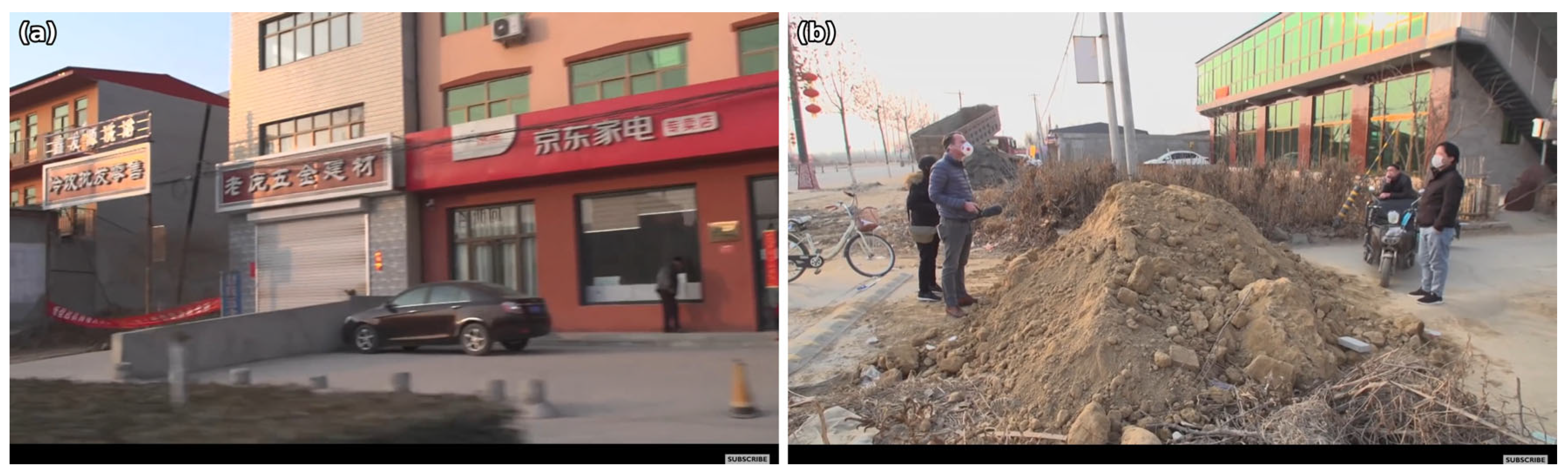
Figure 2.
Visual Construction of the Evacuation Narrative in the Examined BBC News Coverage. Note. Panel (a) shows healthcare workers transferring a patient to an ambulance; panel (b) shows a British national travelling at night to the airport for an evacuation flight. Screenshots from Coronavirus: British Citizens Fly Home—BBC News [Video], by BBC News, 2020, YouTube (https://www.youtube.com/watch?v=7keUXhjy_qA). Copyright 2020 by BBC.
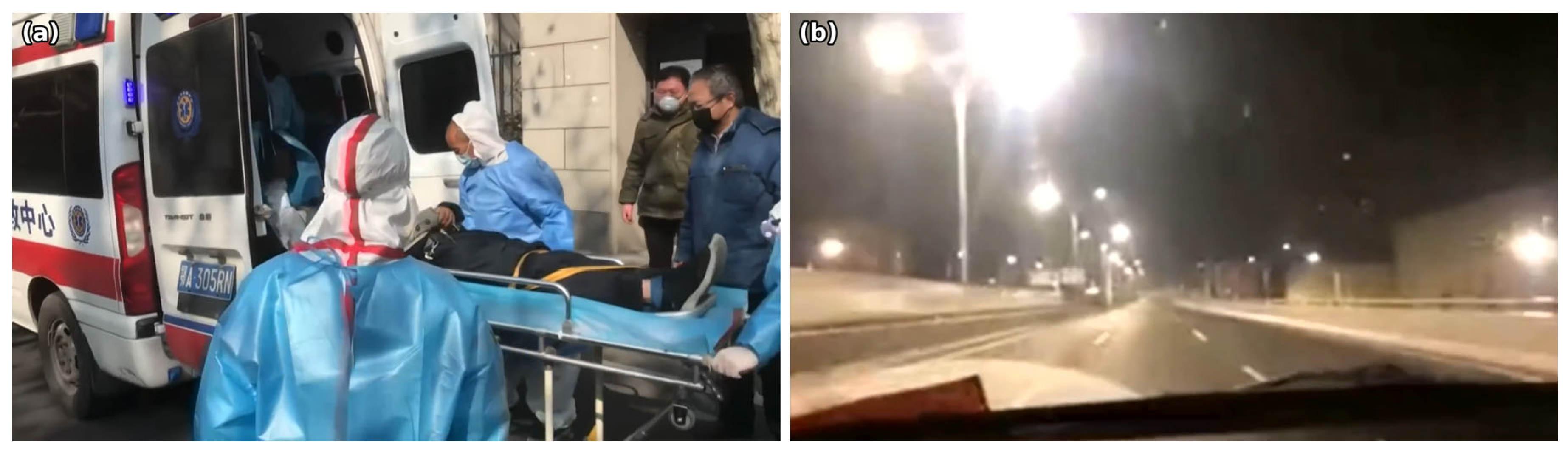
Figure 3.
Inter-Agency Coordination During COVID-19 Testing in the Examined CNA Coverage. Note. The screenshot shows uniformed Singapore Civil Defence Force officers assisting medical personnel during COVID-19 testing procedures. From Contact Tracing Work by Police Led to Discovery of Possible Cluster at Paya Lebar Church: Shanmugam [Video], by CNA, 2020, YouTube (https://www.youtube.com/watch?v=z6yq6ENMs4c). Copyright 2020 by Mediacorp Pte Ltd.
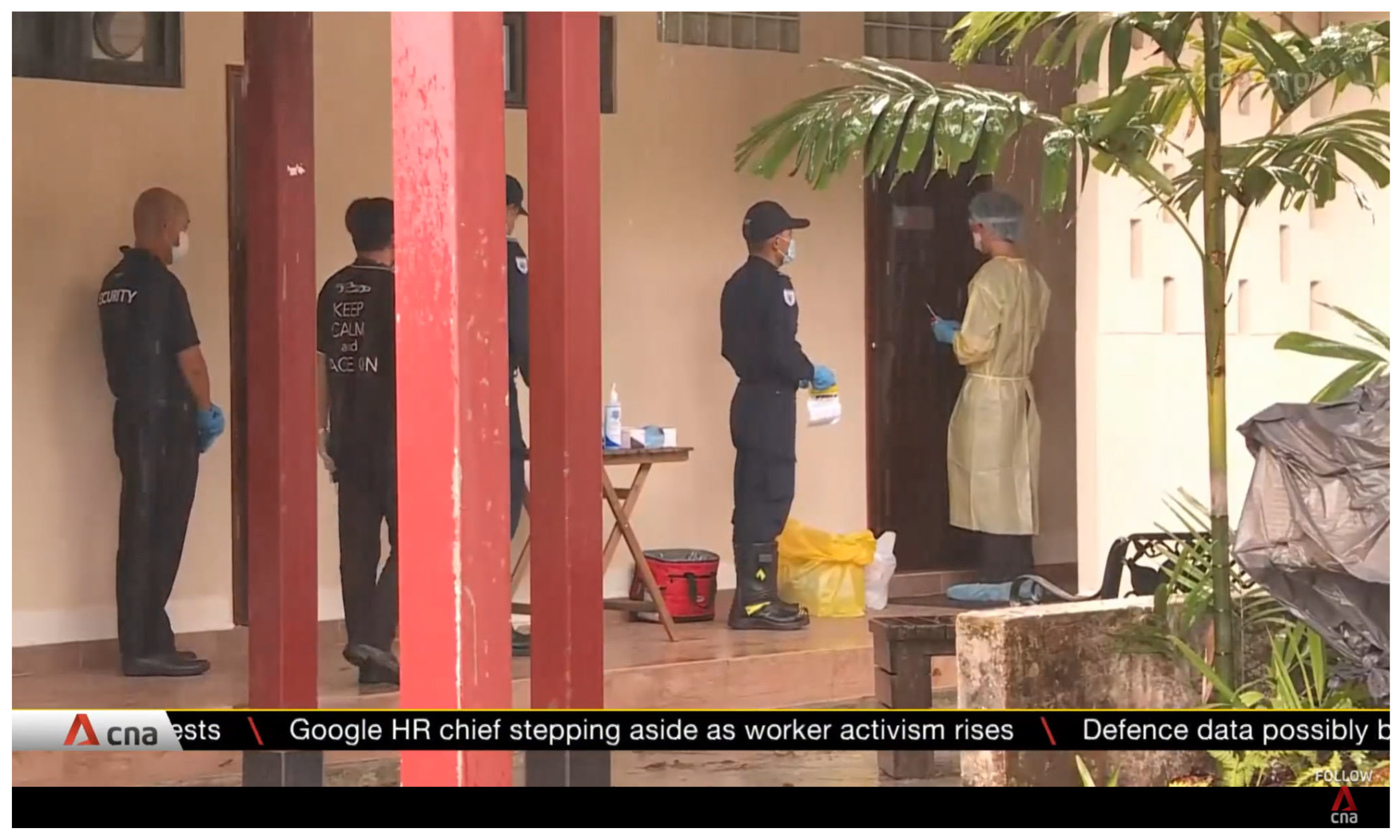
Figure 4.
Visible Leadership and Institutional Engagement in the Examined CNA Coverage. Note. Panel (a) shows officials observing airport operations (CNA, 2020c); panel (b) shows officials meeting transport-sector representatives (CNA, 2020h); panel (c) shows an official observing a school safety briefing (CNA, 2020d); and panel (d) shows officials observing Singapore Civil Defence Force operations (CNA, 2020f). Complete source information is provided in Table A1. Copyright 2020 by Mediacorp Pte Ltd.
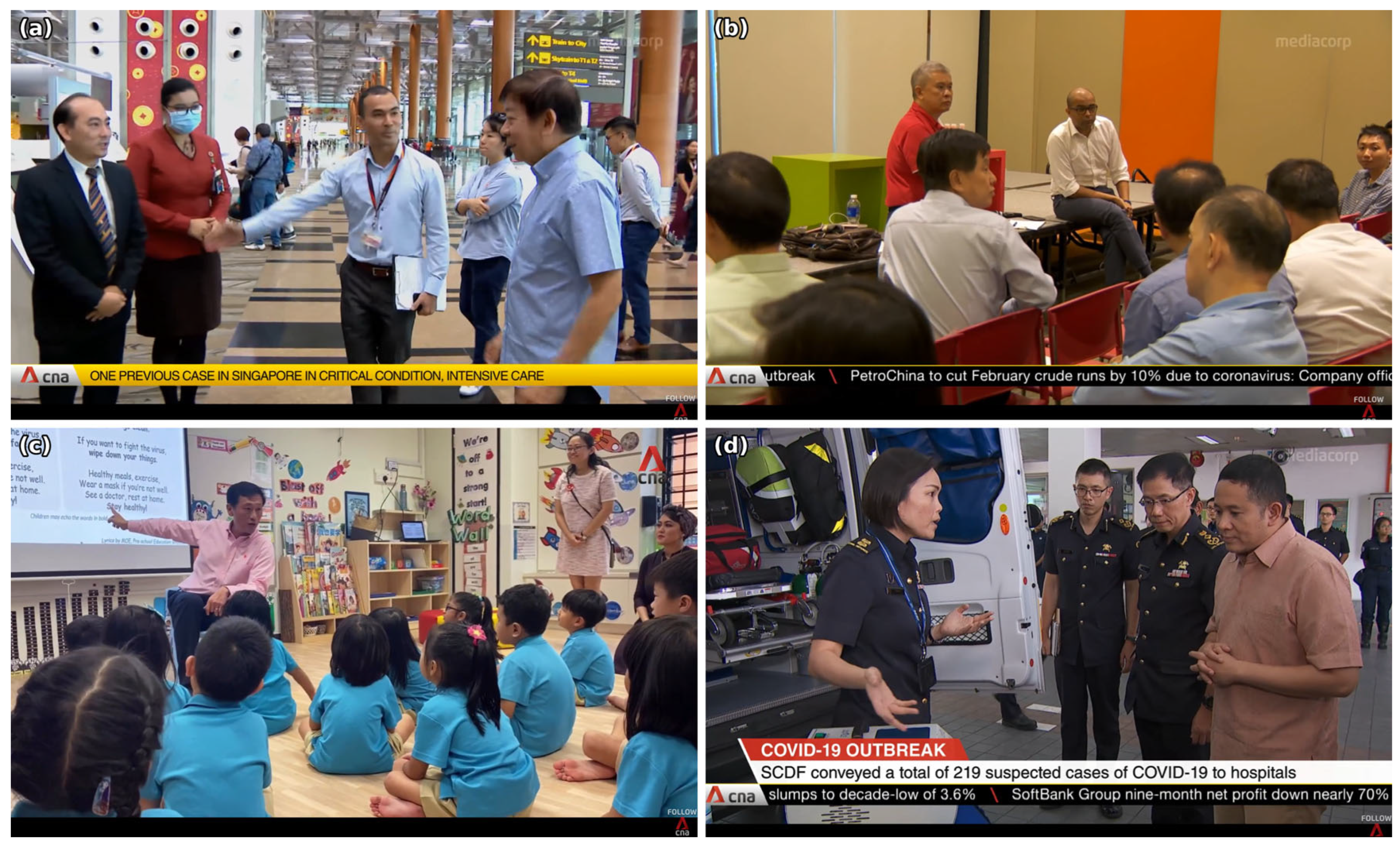
Figure 5.
Reported Legal Enforcement in the Examined CNA Coverage. Note. The screenshot shows a woman charged with providing false information to contact-tracing officials leaving the State Courts in Singapore accompanied by a lawyer. From China Couple Charged for Obstructing COVID-19 Containment Work in Singapore [Video], by CNA, 2020, YouTube (https://www.youtube.com/watch?v=lEDNArQ2beM). Copyright 2020 by Mediacorp Pte Ltd.
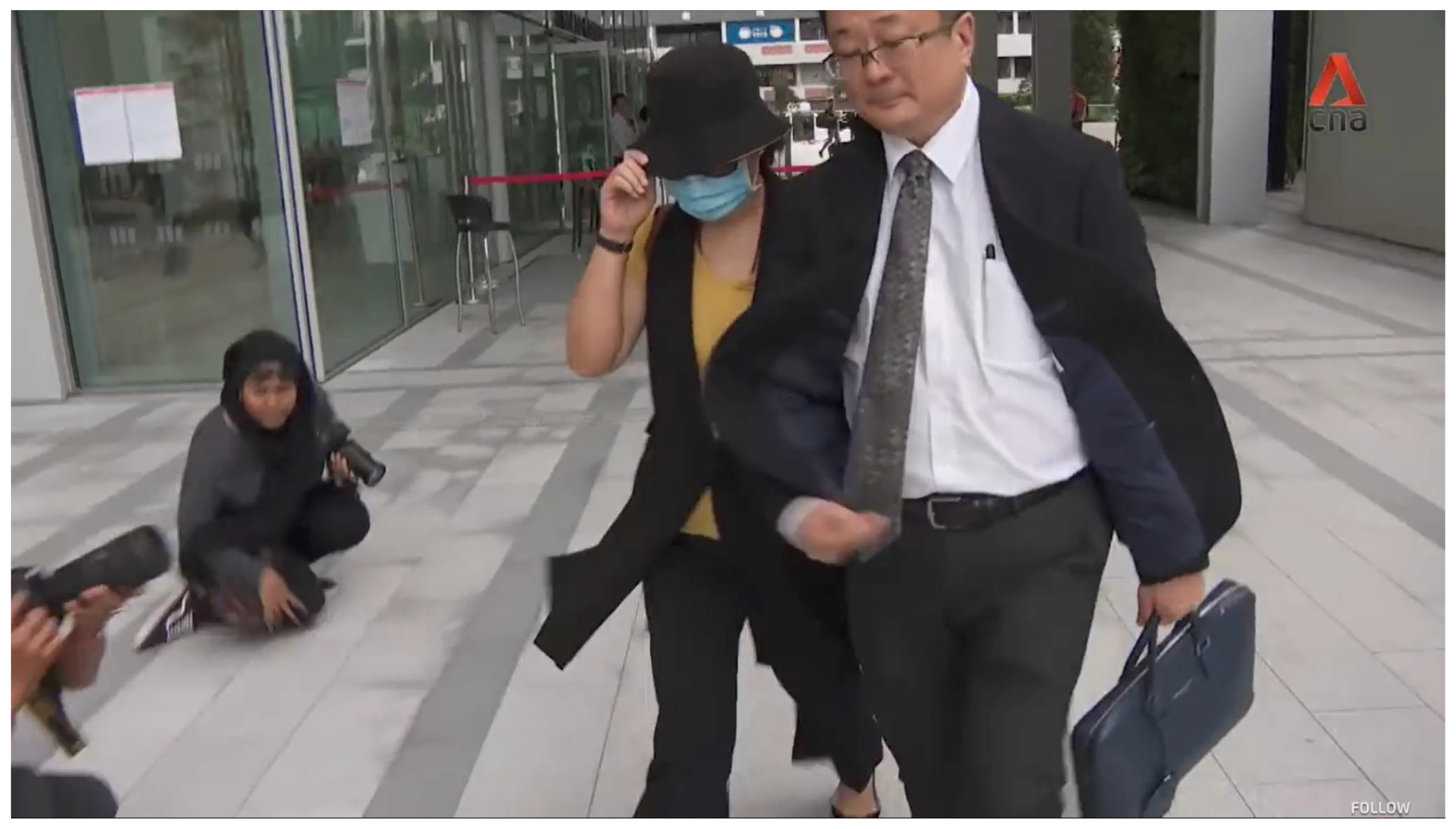
Table 1.
Data Collection and Selection Process for the BBC News and CNA Corpora.
| News Outlets | Sampling Events | Date | Time span(days) | Data Collection | Government Livestreams Removed |
Final Data |
|---|---|---|---|---|---|---|
| BBC News | From first reports on COVID-19 to reports on WHO declaration of COVID-19 pandemic | 21 January 2020 to 12 March 2020 | 51 | 66 | 0 | 66 |
| CNA | 20 January 2020 to 12 March 2020 | 52 | 275 | 80 | 195 |
Note. Extended governmental livestreams were excluded because they differed materially from the editorially produced news stories constituting the unit of analysis. The final corpus comprised 66 BBC News videos and 195 CNA videos.
Table 2.
Comparative Framework for the Discursive Organization of Early COVID-19 Coverage in the Examined BBC News and CNA Corpora.
Table 2.
Comparative Framework for the Discursive Organization of Early COVID-19 Coverage in the Examined BBC News and CNA Corpora.
| Analytical dimension | BBC News: examined coverage | CNA: examined coverage |
|---|---|---|
| Higher-order organizing logic | Spatialization | Governability |
| Recurring mechanisms | Enclosure, restricted mobility, repatriation, and escape | Coordination, visible leadership, and regulatory enforcement |
| Represented crisis configuration | Wuhan as an immobilized crisis space | Singapore as an administratively managed crisis space |
| Dominant interpretive emphasis | Human consequences of confinement and disrupted mobility | Institutional capacity, organized response, and compliance |
Note. Spatialization and governability identify recurrent higher-order organizing logics within the examined corpora. Governability refers to the representation of institutional capacity and should not be interpreted as an independent evaluation of the actual effectiveness of Singapore’s pandemic response.
Disclaimer/Publisher’s Note: The statements, opinions and data contained in all publications are solely those of the individual author(s) and contributor(s) and not of MDPI and/or the editor(s). MDPI and/or the editor(s) disclaim responsibility for any injury to people or property resulting from any ideas, methods, instructions or products referred to in the content. |
© 2026 by the authors. Licensee MDPI, Basel, Switzerland. This article is an open access article distributed under the terms and conditions of the Creative Commons Attribution (CC BY) license (http://creativecommons.org/licenses/by/4.0/).
Copyright: This open access article is published under a Creative Commons CC BY 4.0 license, which permit the free download, distribution, and reuse, provided that the author and preprint are cited in any reuse.