
Submitted:
07 October 2026
Posted:
10 October 2026
You are already at the latest version
Abstract
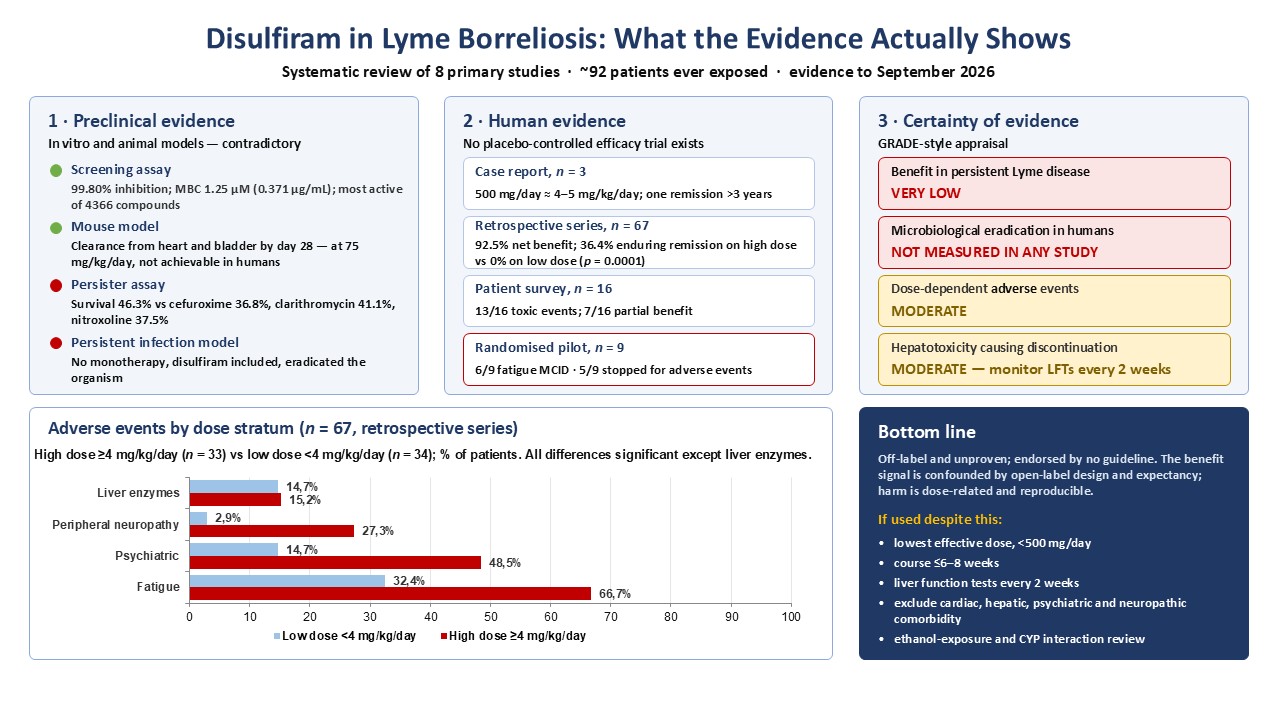
Disulfiram (tetraethylthiuram disulfide, DSF) has been approved for treating alcohol use disorder since 1951 and is one of the most extensively studied drug repurposing candi-dates in medicine. DSF and its metabolites target areas such as oncology, inflammation, virology, metabolic diseases, and infections, and since 2016, it has been used off-label for Lyme borreliosis. This review analyzes the pharmacology and molecular targets of di-sulfiram, evaluates evidence for each repurposing indication, and systematically reviews its potential use in Lyme borreliosis. The pharmacological and cross-indication sections constitute a comprehensive narrative review. For Lyme borreliosis, we systematically searched PubMed/PMC, Frontiers, MDPI, bioRxiv, and ClinicalTrials.gov for primary studies reporting disulfiram exposure against B. burgdorferi or in patients with a Lyme diagnosis; we assessed risk of bias using design-appropriate domains and summarized certainty within a GRADE-style framework. DSF acts as a prodrug, reduced to diethyl-dithiocarbamate, which chelates copper, zinc, and manganese, then converts to carbon disulfide and an oxidized carbamate that permanently inhibits aldehyde dehydrogenase. It targets over twelve molecular sites, including the p97 adaptor NPL4, the 20S pro-teasome, NF-κB signaling, DNMT1, MMP-2, MMP-9, ATF/CREB, FROUNT, gasdermin D, dopamine β-hydroxylase, and hepatic cytochrome P450 enzymes. However, only alcohol use disorders have solid regulatory-controlled evidence supporting it. In on-cology, results are inconsistent: a survival benefit is seen in some cases of metastatic non-small cell lung cancer, but no benefit and increased toxicity are observed in recur-rent glioblastoma. Its potential roles in inflammation, antiviral therapy, HIV latency, and metabolism are mostly preclinical or phase 2. Regarding Lyme borreliosis, eight primary studies involving around 92 patients have been reported, but findings are contradictory. The largest dataset is an uncontrolled, single-practice series, and the only randomized trial was terminated early, with five of nine participants dropping out due to adverse reactions. Conclusions: DSF is a mechanistically promiscuous molecule whose preclin-ical breadth has repeatedly failed to translate into controlled clinical benefit. For Lyme borreliosis, the certainty of benefit is very low, and the certainty of dose-dependent harm is moderate; all preclinical work used B. burgdorferi sensu stricto, so the evidence is also indirect for the B. afzelii- and B. garinii-dominated disease of Europe.
Keywords:
disulfiram
; drug repurposing
; diethyldithiocarbamate
; molecular targets
; chronic diseases
; lyme borreliosis
; Borrelia burgdorferi
; toxicity
; adverse events
; drug safety
; evidence-based data
Copyright: This open access article is published under a Creative Commons CC BY 4.0 license, which permit the free download, distribution, and reuse, provided that the author and preprint are cited in any reuse.