

Submitted:
08 October 2026
Posted:
10 October 2026
You are already at the latest version
Abstract
Background: Modern cancer medicine has improved survival and reduced mortality for several cancers. However, these advances coexist with major unresolved problems, including inadequate prevention, concerning early-onset cancer trends, limited durable benefit in many advanced malignancies, treatment-related harm, impaired quality of life, and substantial financial burden for patients, families, and society. Objective: To critically examine seven areas in which conventional measures of cancer progress may provide an incomplete picture of patient benefit: (1) prevention and early-onset cancer, (2) durable outcomes in advanced disease, (3) the real-world reach and magnitude of benefit from targeted therapies, (4) subsequent malignancies and other late treatment harms, (5) limitations of commonly used efficacy endpoints, (6) quality of life, and (7) financial toxicity and broader societal costs. Methods: We conducted a critical narrative review drawing on cancer surveillance data, primary clinical studies, health-economic research, and selected evidence from the existing manuscript literature, with targeted source verification through 6 October 2026. Published numerical data were re-examined with attention to denominators, absolute versus relative effects, and important methodological limitations. This was a purposive narrative review rather than a systematic review or meta-analysis. Findings: Declining age-adjusted cancer mortality represents meaningful progress but does not eliminate the continuing high absolute burden of cancer or poor outcomes in many advanced malignancies. Increases in early-onset cancer counts require careful distinction among population growth, changes in detection, and true changes in age-specific risk. Precision and targeted therapies can provide substantial benefit for selected, often relatively small subsets of cancer patients, but eligibility, response, progression-free survival, and regulatory approval should not automatically be interpreted as durable survival or cure. Cancer treatment may also produce important short- and long-term harms, including increased risks of subsequent malignancies, organ toxicity, functional impairment, and reduced quality of life. These outcomes are incompletely captured by tumor-centered endpoints and may therefore be underrecognized in assessments of cancer-treatment success. This incomplete picture can shape how governments, healthcare professionals, and the public perceive the benefits and harms of contemporary cancer care and, most importantly, may affect the information available to patients and families when making treatment decisions. Cancer treatment can also impose severe financial toxicity; studies from China and other settings document substantial financial distress and catastrophic health expenditure despite insurance coverage. Conclusions: Contemporary cancer medicine has achieved important successes, but its performance should be judged more comprehensively than by tumor response, drug approval, progression-based endpoints, or short-term survival alone. A more patient-centered assessment should ask whether cancer is prevented when possible, whether treatment produces meaningful and durable survival, whether patients preserve function and quality of life, whether treatment-related and late harms are minimized, and whether care is financially sustainable. These unresolved problems identify important priorities for prevention, research, clinical practice, patient communication, and health policy. Proposed alternatives or integrative approaches should be subjected to the same rigorous standards of evidence as existing treatments. This review therefore presents an integrated problem-to-solution research agenda rather than evidence that any alternative therapeutic framework is already clinically superior.
Keywords:
cancer control
; early-onset cancer
; prevention
; premature mortality
; precision oncology
; treatment-related harm
; quality of life
; financial toxicity
; systems medicine
1. Introduction
Modern cancer medicine has achieved substantial and important successes. Population cancer mortality has declined in many settings, screening and prevention have reduced the burden of selected cancers, and advances in surgery, radiotherapy, systemic therapy, immunotherapy, and molecularly targeted treatment have improved outcomes for many patients. These achievements should be recognized. At the same time, they do not resolve a broader question: How should progress against cancer ultimately be judged?
For patients and families, success is not defined by a single statistical endpoint. Meaningful progress may include preventing cancer in the first place, avoiding premature death, achieving durable rather than transient disease control, maintaining physical and cognitive function, minimizing treatment-related harm, preserving quality of life, and avoiding financial devastation. Health systems and governments must additionally consider population disease burden, access to effective care, resource use, long-term survivorship, and societal cost. These outcomes can move in different directions at the same time. A declining age-adjusted mortality rate, increasing numbers of cancer diagnoses, improving five-year survival, persistent poor outcomes in advanced disease, and rising treatment expenditures can coexist without contradiction.
This creates an important measurement problem. Conventional indicators such as tumor response, progression-free survival, regulatory approval, and five-year survival provide useful information, but each answers only part of the question. Five-year survival, for example, is informative for prognosis after diagnosis but can be influenced by lead-time bias and overdiagnosis; it therefore cannot by itself establish that fewer people are dying of cancer. [1] Similarly, drug eligibility or tumor response does not automatically establish durable overall survival, preserved function, improved quality of life, or cure. The interpretation of cancer progress therefore depends critically on the population studied, the denominator used, the endpoint selected, the comparator, and the duration of follow-up.
The same limitation applies to assessments of treatment-related harm. Cancer therapies can prolong life and cure disease, yet they may also produce acute toxicity, chronic organ injury, functional impairment, subsequent malignancies, and other late effects. These harms are not arguments against effective treatment; rather, they are part of the treatment's total clinical consequence and should be evaluated alongside benefit. Failure to capture them adequately may produce an incomplete assessment of treatment success, particularly when short-term tumor-centered endpoints dominate reporting.
Quality of life is similarly central. Longer survival is most meaningful when accompanied, as far as possible, by preserved function, independence, symptom control, and the ability to participate in activities patients value. Yet patient-reported outcomes and long-term functional outcomes remain less consistently measured than tumor response and progression. Financial toxicity adds another dimension. Cancer care can impose substantial out-of-pocket costs, loss of income, debt, and catastrophic health expenditure on patients and families, while governments and societies face increasingly complex questions about affordability, resource allocation, and the value delivered by expanding treatment portfolios.
These concerns do not imply that modern oncology has failed, nor do they justify dismissing therapies that produce meaningful benefit. Rather, they suggest that assessments of cancer progress may become misleading when improvements in one domain are allowed to stand in for overall patient benefit. A treatment may produce a high response rate without materially extending life; survival may improve while function deteriorates; mortality may decline while preventable incidence remains high; and therapeutic innovation may expand while its benefits remain confined to selected subsets of patients. Conversely, a population-level statistic can obscure major successes within particular cancers or molecularly defined groups. A rigorous assessment must therefore preserve both progress and unresolved problems.
Comprehensive cancer evaluation is not itself a new idea. The National Cancer Institute's Cancer Trends Progress Report already incorporates prevention, incidence, stage, survivorship, financial burden, mortality, and years of life lost. [2] The purpose of the present review is not to replace these established surveillance systems, but to examine several areas in which commonly emphasized measures may provide an incomplete picture of patient-centered benefit and to connect them within a single analytic framework.
We focus on seven unresolved domains: (1) prevention and early-onset cancer, (2) durable outcomes in advanced disease, (3) the real-world reach and magnitude of benefit from precision and targeted therapies, (4) subsequent malignancies and other late treatment-related harms, (5) limitations of commonly used efficacy endpoints, (6) quality of life and healthy survivorship, and (7) financial toxicity and broader societal costs. Across these domains, the objective is not to produce a single verdict on contemporary oncology, but to distinguish more carefully between disease occurrence, treatment activity, durable patient benefit, harm, and the broader consequences of care.
To support this analysis, we propose a Cancer Progress Scorecard as a structured reporting framework rather than a validated numerical index. Its purpose is to make denominators, time horizons, tradeoffs, missing information, and competing outcomes more visible. The framework is intended to reduce interpretive error rather than to predetermine whether a particular treatment, health system, or medical philosophy should be judged favorably or unfavorably.
The central question of this review is therefore not whether contemporary oncology should be celebrated or rejected. It is whether the way cancer progress is currently measured gives governments, healthcare professionals, the public, and, most importantly, patients and families a sufficiently complete picture of benefit, harm, and long-term consequence. The broader goal is to identify unresolved problems that can guide prevention, research, clinical practice, patient communication, and health policy, while applying the same evidentiary standards to conventional, integrative, and proposed alternative approaches.
2. Methods and Scope
2.1. Review Design and Source Selection
This study is a critical narrative review and methodological synthesis examining unresolved problems in contemporary cancer medicine through a patient-centered and population-level perspective. It integrates published evidence across seven domains: cancer prevention and early-onset disease; durable outcomes in advanced cancer; the population reach and magnitude of benefit from precision and targeted therapies; subsequent malignancies and other treatment-related harms; interpretation of commonly used efficacy endpoints; quality of life and healthy survivorship; and financial toxicity and broader societal costs.
Targeted literature searches and direct source verification were conducted through 6 October 2026. Evidence sources included official cancer surveillance systems, primary clinical and epidemiologic studies, randomized trials, long-term survivor cohorts, health-services and health-economic research, patient-reported outcome studies, and selected methodological literature relevant to interpretation of cancer endpoints. Principal source families included the National Cancer Institute (NCI), Surveillance, Epidemiology, and End Results (SEER) Program, Centers for Disease Control and Prevention (CDC), peer-reviewed cancer surveillance studies, studies of early-onset cancer, subsequent malignancies, treatment-related late effects, precision oncology, clinical-benefit assessment, supportive care, quality of life, and financial toxicity.
Primary studies and official surveillance data were prioritized where available. Sources were selected for their relevance to the questions under examination, clarity of population and denominator, adequacy of follow-up, and ability to illustrate either meaningful progress, persistent burden, treatment-related harm, or an important interpretive limitation. Favorable, neutral, and adverse findings were retained when relevant to the question being examined. Evidence was not selected solely to support a predetermined conclusion.
This review was purposive rather than systematic. It was not based on an exhaustive database search, a registered protocol, independent dual screening, or formal study-quality grading, and no PRISMA-style study-flow counts are implied. No meta-analysis or new pooled causal estimate was performed. Where full text was unavailable, interpretation was restricted to information contained in inspected primary abstracts, official records, or author-institution sources. These limitations are reflected in the strength of the claims made.
The review distinguishes three levels of analysis throughout: (1) empirical observations, such as incidence, mortality, treatment response, quality-of-life outcomes, or financial burden; (2) methodological interpretation, including limitations arising from denominators, endpoint selection, competing risks, lead-time bias, overdiagnosis, confounding, or incomplete follow-up; and (3) proposed reporting or research approaches, including the Cancer Progress Scorecard described later in the manuscript. Proposed frameworks are not presented as validated clinical instruments.
2.2. Descriptive Data and Figure Construction
Long-term U.S. cancer incidence and mortality estimates were consulted in the official NCI/SEER Cancer Stat Facts tables. The figures display selected published values for 1975 and 2023 (incidence) and for 1975, 1991, and 2024 (mortality), rather than complete annual time series. Registry incidence and national mortality measures have different geographic coverage; the specific registry population should be determined from the source table and its release notes. [3] Nationwide observed cancer counts were obtained separately from CDC sources. [4] Registry rates were not multiplied by population estimates to derive national case counts. The observation years are shown explicitly, and projections are not presented as observed data.
Additional figures re-express published data relevant to the central questions of the review, including global changes in early-onset cancer counts, treatment-associated subsequent malignancies, long-term changes in subsequent-cancer incidence among survivor cohorts, and estimates of the population reach or clinical benefit of genome-targeted therapies. These figures are intended to clarify published findings and denominators rather than generate new causal estimates.
Figures reproduce selected published estimates and explanatory summaries. Population, denominator, observation period, and available uncertainty are described in captions where appropriate. No confidence interval or causal estimate was generated from the selected values. Figures showing a few historical observations should not be read as fitted trends or complete annual trajectories.
Figures comparing different populations, eras, or treatment settings are presented as illustrative analyses rather than as a continuous historical series. In particular, survivor cohorts, targeted-therapy studies, and treatment-related malignancy analyses differ substantially in population, eligibility, follow-up, and clinical context and are not pooled into a common quantitative estimate.
2.3. Interpretation Rules
Counts, crude rates, age-specific rates, age-standardized rates, survival proportions, cumulative incidence, response rates, hazard ratios, relative risks, and absolute risks answer different questions and are not treated as interchangeable.
Percentage changes in descriptive annual series are calculated as 100 x (final value / initial value - 1). These are endpoint comparisons rather than estimated annual percentage changes, trend coefficients, or causal effects of cancer treatment. Changes in registry coverage, diagnostic classification, screening, staging, ascertainment, treatment patterns, and disruptions such as the COVID-19 pandemic must be considered when interpreting longitudinal data. The 2020 incidence disruption in the source series, for example, is not interpreted as evidence of prevention success. [3]
Five-year survival is treated as a prognostic measure conditional on diagnosis rather than as a direct substitute for population mortality. Treatment response and progression-free survival are treated as clinically relevant outcomes but are not assumed automatically to represent durable survival, preserved function, improved quality of life, or cure. Similarly, regulatory approval and biomarker eligibility are distinguished from treatment receipt and patient-level benefit.
Subsequent malignancy after cancer treatment is distinguished from recurrence or metastasis of the original cancer. Associations between treatment exposure and later malignancy are interpreted with attention to latency, competing mortality, survivor selection, baseline susceptibility, treatment combinations, and confounding. Relative-risk estimates are accompanied by absolute-risk context whenever available.
Quality-of-life findings are interpreted according to the population studied, timing of assessment, instrument used, baseline status, attrition, missing data, and clinically meaningful change. Financial toxicity is considered separately from formal cost-effectiveness analysis. Patient out-of-pocket burden, catastrophic expenditure, societal spending, and economic value represent related but distinct outcomes and are not combined without an explicit analytic framework.
Results from different countries, cancer types, age groups, treatment eras, or disease stages are not pooled to generate a single global judgment about contemporary oncology. Where evidence is heterogeneous, that heterogeneity is preserved rather than averaged away.
Throughout the manuscript, empirical findings, causal interpretations, and proposed solutions are explicitly separated. Neither shortcomings in existing care nor favorable findings for a proposed alternative establish the superiority of another framework. Conventional therapies, integrative approaches, nutritional or metabolic interventions, and other proposed strategies should be evaluated according to the evidentiary standards appropriate to their specific claims.
The proposed Cancer Progress Scorecard is therefore treated as a structured reporting framework and research hypothesis rather than a validated numerical index. Its value lies in making otherwise separated domains-disease occurrence, mortality, treatment benefit, treatment-related harm, quality of life, and financial burden-visible together. Its clinical and policy usefulness remains to be tested.
3. Cancer Occurrence, Prevention, and Early-Onset Disease
Cancer progress should be assessed not only by how successfully established disease is treated, but also by how often clinically consequential cancer develops in the first place. Treatment can improve survival after diagnosis, but it does not substitute for prevention. A comprehensive assessment therefore requires simultaneous attention to absolute numbers of cancers, age-specific and age-standardized incidence, disease stage, cancer subtype, and changes in younger populations.
3.1. Cancer Occurrence Is a Distinct Measure of Progress
Annual cancer diagnoses quantify the burden experienced by patients, families, and healthcare systems. Age-standardized incidence rates address a different question: whether the probability of diagnosis is changing after accounting for population age structure. Both measures are necessary.
An aging or growing population can generate more cancer diagnoses even when age-specific rates are stable or declining. Conversely, a stable national case count can conceal increasing incidence in a younger subgroup or particular cancer type. Neither counts nor standardized rates should therefore be interpreted in isolation.
Changes in diagnosis also do not necessarily represent equivalent changes in biologically consequential cancer. Screening intensity, imaging use, diagnostic thresholds, registry practices, and detection of indolent lesions can alter measured incidence. For this reason, increases in incidence should be examined alongside advanced-stage disease, mortality, tumor characteristics, and other measures of clinical consequence whenever possible.
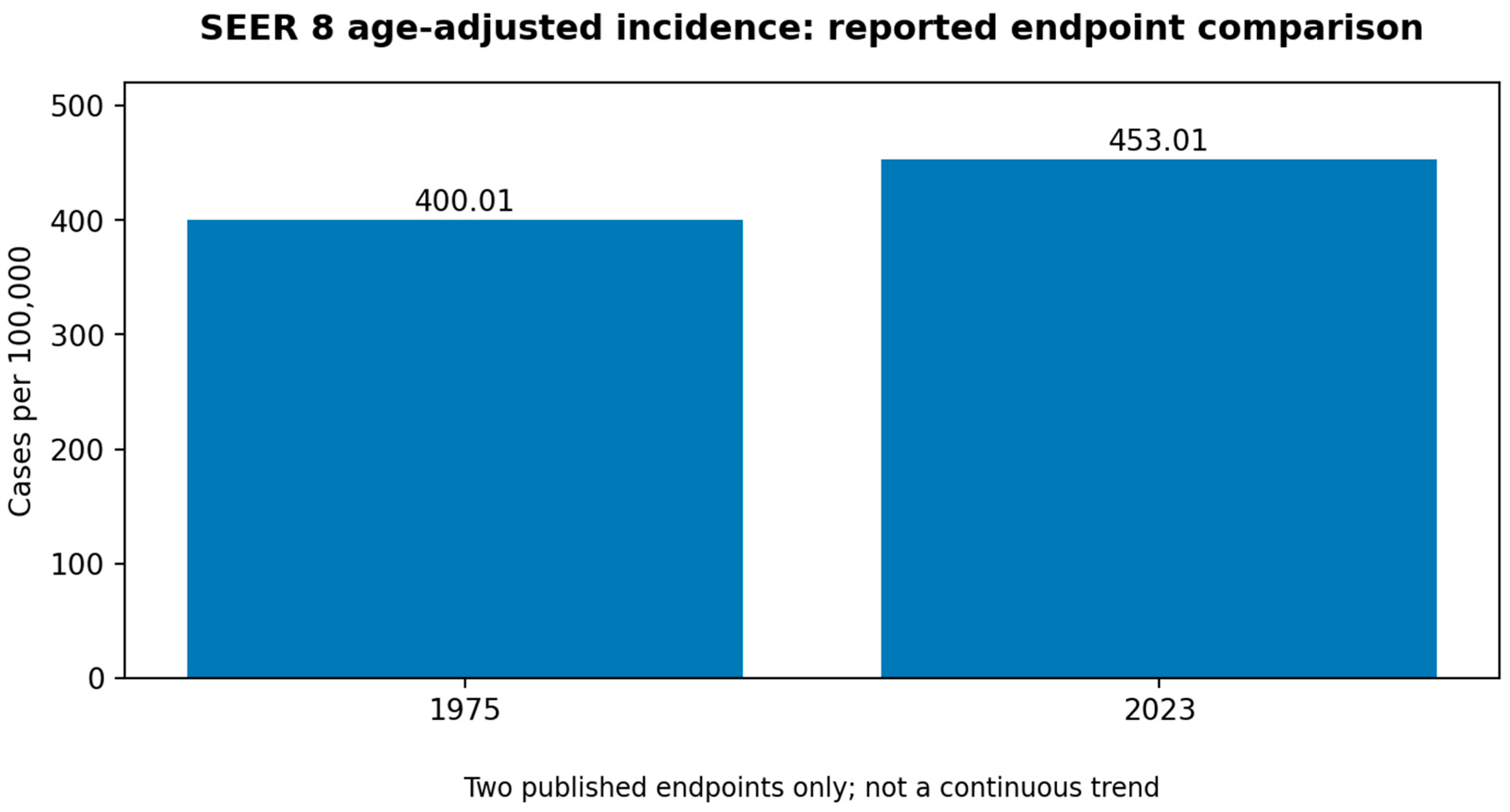
Long-term U.S. data illustrate this complexity. In the SEER incidence data presented by NCI, age-adjusted all-cancer incidence was 400.01 per 100,000 in 1975 and 453.01 per 100,000 in 2023, with substantially higher values during parts of the intervening period. [3] These endpoint values do not describe a monotonic trend and do not identify a cause. Separately, CDC recorded 1,941,540 new cancer cases in the United States in 2023. [4] The first number is a standardized registry rate; the second is a national case count. They answer different questions and should not be combined as though they were interchangeable measures.
For prevention-oriented assessment, incidence should therefore be reported using both absolute burden and standardized rates. Where feasible, analyses should distinguish first primary cancers from subsequent primaries and should report advanced-stage incidence per population rather than only the proportion of diagnosed patients presenting with advanced disease. A falling proportion of late-stage diagnoses, for example, can result from adding more early-stage diagnoses without reducing the absolute incidence of advanced disease.
This distinction is important because preventing clinically consequential cancer is itself an outcome, not merely an upstream strategy for improving later survival statistics.
Figure 1.
Selected reference values for age-adjusted cancer incidence in SEER registry data. Illustrative endpoint comparison from the published SEER 8 incidence series, 1975 and 2023, per 100,000 and age-adjusted to the U.S. 2000 standard population. The figure does not reproduce the annual time series or characterize year-to-year variation. SEER 8 is not a national case-count series. [3].
3.2. Early-Onset Cancer Represents an Important but Heterogeneous Warning Signal
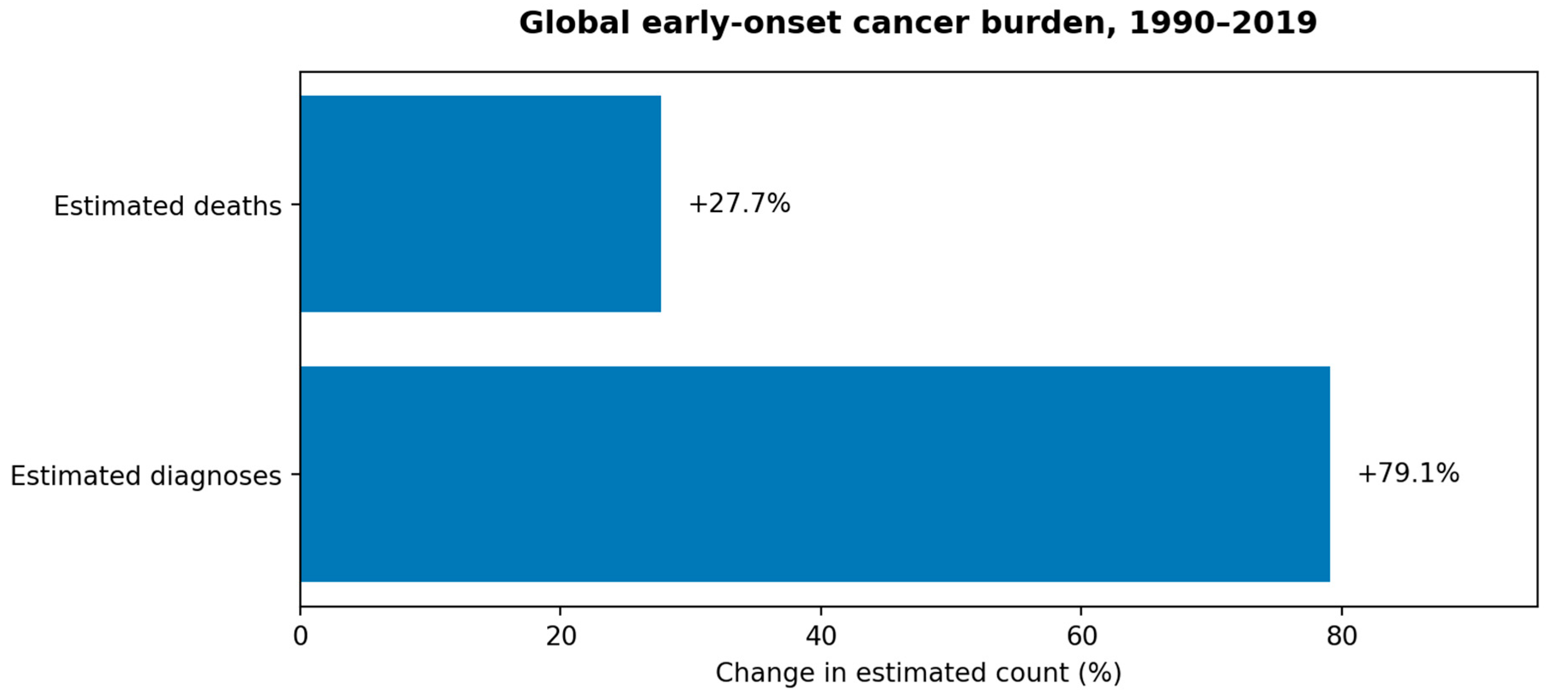
The reported increase in cancers among younger adults has generated substantial scientific and public concern. Zhao and colleagues, using Global Burden of Disease 2019 estimates, reported that the global number of early-onset cancer diagnoses among people younger than 50 increased by 79.1% between 1990 and 2019, while deaths increased by 27.7%. [5]
These figures describe changes in estimated numbers of cases and deaths, not a 79.1% increase in the cancer risk of an individual younger adult. Population growth, changing age distribution within the under-50 population, improved ascertainment, diagnostic practices, and true changes in age-specific incidence can all contribute to increases in counts. The distinction is essential.
Nevertheless, the methodological caution should not cause the signal itself to be dismissed. A large increase in cancer burden among younger populations-particularly when accompanied by rising age-specific incidence for selected malignancies-raises important questions about prevention, changing exposures, birth-cohort effects, and potentially modifiable determinants of disease.
The appropriate response is therefore neither to describe early-onset cancer as a uniform global epidemic nor to minimize it because population growth explains part of the increase. Rather, the trend should trigger more precise investigation into which cancers are increasing, in whom, where, when, and why.
Figure 2.
Global early-onset cancer burden: published changes in case and death counts. Reported changes in the estimated number of early-onset cancer diagnoses (+79.1%) and deaths (+27.7%) between 1990 and 2019 among people younger than 50 years, from Zhao et al. These values represent changes in counts rather than annual trajectories, age-standardized risk changes, or changes in individual cancer risk. [5].
3.3. Early-Onset Trends Differ Substantially by Cancer Type and Population
U.S. surveillance data demonstrate that early-onset cancer trends are heterogeneous. Shiels and colleagues examined incidence and mortality during 2010-2019 and identified 14 of 33 cancer types with significantly increasing incidence in at least one early-onset age group. [6] Trends differed by cancer type, sex, and age; some cancers increased while others declined.
More recent surveillance through 2023 has continued to identify increasing incidence for several early-onset cancers and has also shown that trend classifications can change as additional years of data become available. [7] This reinforces two conclusions. First, early-onset cancer is not a single disease phenomenon. Second, the persistence of increasing incidence in selected cancers and age groups warrants continued investigation rather than reassurance based solely on favorable all-cancer averages.
Analyses should therefore avoid treating adults younger than 50 as one homogeneous population. At minimum, narrower age categories such as 15-29, 30-39, and 40-49 years should be examined where data permit, with childhood cancers treated separately. Sex, geography, cancer site, histology, molecular subtype, socioeconomic characteristics, and birth cohort may provide additional information about changing disease patterns.
Birth-cohort analyses may be particularly informative when successive generations experience differing risks at comparable ages. However, descriptive age-period-cohort patterns cannot by themselves identify the responsible exposure or biological mechanism. Associations with diet, obesity, metabolic dysfunction, environmental exposure, infection, reproductive patterns, medications, or other candidate factors remain hypotheses requiring cancer-specific investigation.
3.4. Prevention Success Should Be Distinguished from Treatment Success
A central implication of these incidence trends is that improved treatment outcomes do not eliminate the need to ask why cancers continue to occur.
Population mortality can fall because treatment improves, screening shifts stage at diagnosis, major exposures decline, or combinations of these factors occur. Such improvement is meaningful. But if the incidence of a consequential cancer is simultaneously increasing in a younger population, that represents a separate unresolved problem even when survival after diagnosis improves.
The reverse is also true: rising incidence does not by itself demonstrate failure of cancer treatment. Incidence primarily addresses disease occurrence; treatment outcomes primarily address what happens after disease has developed. Combining the two into a single judgment obscures the distinction between preventing cancer and managing cancer after it occurs.
For this reason, prevention should remain a separate domain in assessments of cancer progress. Relevant questions include whether the incidence of clinically consequential cancer is declining, whether advanced-stage cancers are becoming less common per population, whether younger generations are experiencing higher age-specific risks for particular malignancies, whether known preventable causes are being effectively addressed, and whether newly emerging patterns are prompting timely etiologic investigation.
These questions are especially important because preventing a cancer can avoid not only cancer mortality but also surgery, radiation, systemic therapy, treatment toxicity, functional loss, psychological burden, and financial consequences.
3.5. From Surveillance Signal to Causal Investigation
Surveillance identifies patterns; it does not by itself establish their causes. Rising incidence should therefore initiate a structured etiologic investigation rather than a premature declaration of mechanism.
For early-onset cancer, useful analyses should examine cancer-specific age trends, birth cohorts, geographic differences, temporal changes in exposures, tumor biology, stage at diagnosis, screening patterns, and established or plausible risk factors. Increasing incidence attributable predominantly to improved detection would have different implications from increasing advanced-stage disease or mortality in the same age group.
The same evidentiary discipline should apply to proposed explanations. Lifestyle, metabolic, nutritional, environmental, infectious, hormonal, genetic, and treatment-related factors may all warrant investigation depending on the cancer under study, but none should be presumed to explain the entire early-onset pattern without appropriate evidence.
The unresolved problem is therefore not merely that more cancers are being counted. It is that selected cancers appear to be occurring more frequently in younger populations, while the causes of these changes remain incompletely understood and potentially preventable contributors may remain insufficiently addressed. A comprehensive assessment of contemporary cancer medicine should treat this as a major research and prevention priority rather than only as a surveillance curiosity.
4. Mortality, Premature Death, and Attribution of Progress
Mortality is one of the most important measures of cancer control because it captures whether fewer people are dying of cancer. However, mortality statistics also require careful interpretation. Population death rates, absolute numbers of deaths, years of life lost, stage-specific survival, and treatment-attributable survival benefit are related but distinct measures. None should be used as a substitute for the others. A central challenge is therefore to preserve two truths at once: overall cancer mortality has improved substantially, while major burdens, poor-prognosis cancers, and important subgroup reversals remain.
4.1. Overall Cancer Mortality Has Declined Substantially
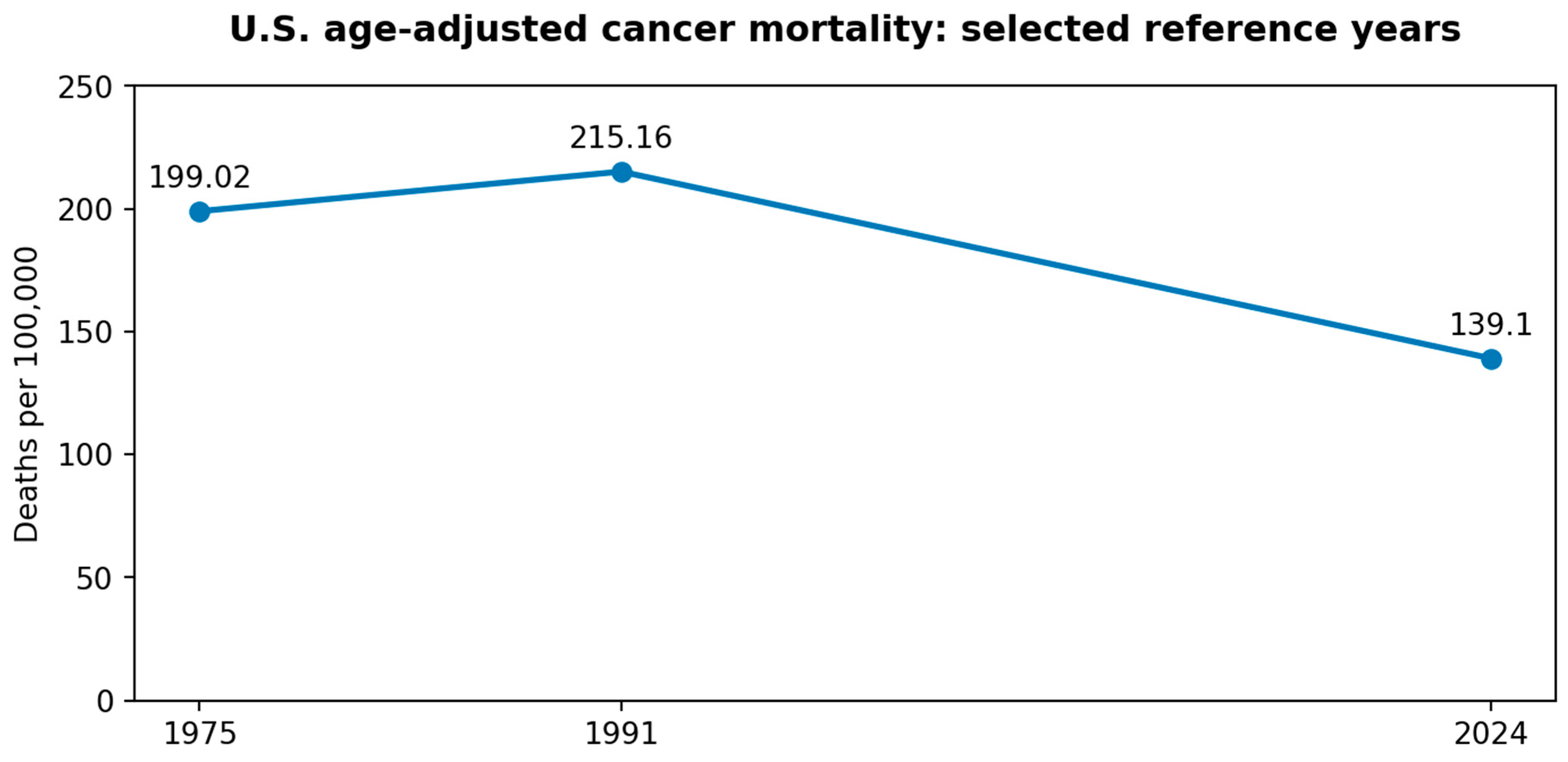
Long-term U.S. data demonstrate clear improvement in age-adjusted cancer mortality. The cancer death rate was 199.02 per 100,000 in 1975, reached 215.16 per 100,000 in 1991, and declined to 139.10 per 100,000 in 2024. [3] The 2024 rate was approximately 30.1% below the 1975 level and 35.4% below the 1991 peak.
These reductions represent meaningful population progress and should not be minimized. A rising incidence trend in one cancer, a poor outcome in a selected advanced malignancy, or an unfavorable subgroup cannot negate the overall decline in standardized mortality.
At the same time, declining rates do not imply that the absolute burden has become small. CDC reported 619,871 cancer deaths in the United States in 2024. [4] A growing and aging population can experience large numbers of deaths even as age-adjusted mortality falls. Absolute deaths therefore describe societal burden, while age-adjusted rates better describe changes in mortality risk over time. Both should be reported.
Figure 3.
U.S. cancer mortality over approximately five decades. Selected-year age-adjusted cancer death rates per 100,000, all races and both sexes, 1975–2024. Percentage reductions are calculated from reported endpoint values and should not be interpreted as causal estimates of treatment effectiveness. The mortality series is national and differs in geographic coverage from the registry-based incidence series shown in Figure 1. Source: NCI SEER/U.S. mortality numerical table. [3].
4.2. Premature Mortality Adds Information That Death Counts Alone Cannot Provide
Cancer deaths occurring at younger ages generally result in more lost life than deaths occurring near the end of expected lifespan. Measures such as years of life lost (YLL) therefore complement conventional death counts by incorporating age at death and remaining life expectancy. [8] These measures are particularly relevant when evaluating early-onset cancers or cancer mortality among working-age adults.
Using a shorter reference life expectancy for a disadvantaged population could mechanically make premature deaths in that population appear less consequential. For comparisons across populations, a common reference standard is therefore preferable, accompanied by the underlying age-specific mortality data.
Recent U.S. data provide an instructive example of simultaneous progress and reversal. Among people younger than 50, the overall cancer mortality rate declined from 25.5 to 14.2 per 100,000 between 1990 and 2023, a reported reduction of approximately 44%. [9] Yet colorectal cancer mortality increased by approximately 1.1% annually from 2005 through 2023 and became the leading cause of cancer death in this age group, sexes combined, in 2023. [9] These findings should not be forced into a single optimistic or pessimistic narrative.
4.3. Poor Outcomes in Selected Cancers Remain Major Unresolved Problems
Population averages can conceal malignancies for which durable survival remains poor, particularly in advanced disease. Pancreatic cancer illustrates this problem. Current SEER estimates report approximately 3.4% five-year relative survival for distant pancreatic cancer diagnosed during 2016-2022. [10] This figure should not be generalized to all pancreatic cancers or interpreted as the isolated effect of chemotherapy. It is a population prognosis estimate for patients diagnosed with distant disease.
Nevertheless, such outcomes remain clinically important even within an era of improving overall cancer mortality. Substantial population progress and persistent failure in selected malignancies are not contradictory. Assessments should retain site-, stage-, age-, and subtype-specific outcomes alongside all-cancer averages.
4.4. Survival After Diagnosis and Population Mortality Answer Different Questions
Relative or net survival measures the prognosis of people after cancer has been diagnosed. Population mortality measures the rate at which people in the population die of cancer. Both are useful, but they are not interchangeable.
Five- and ten-year survival can improve because treatment is more effective, because cancer is diagnosed earlier, because less aggressive disease is increasingly detected, or through combinations of these factors. Lead-time bias and overdiagnosis can therefore improve measured survival without necessarily postponing death. Conversely, population mortality can improve through prevention even if treatment of established advanced disease changes relatively little.
A comprehensive evaluation should therefore distinguish whether fewer people develop consequential cancer, whether cancers are diagnosed at more treatable stages, whether patients live longer after diagnosis, whether fewer people die of cancer at the population level, and whether treatment itself contributes meaningful incremental survival.
4.5. Mortality Improvement Does Not Identify What Caused the Improvement
A declining cancer mortality rate does not by itself reveal how much progress arose from prevention, screening, surgery, radiotherapy, systemic treatment, supportive care, or interactions among these factors.
Goddard and colleagues modeled changes in mortality for breast, cervical, colorectal, lung, and prostate cancers in the United States between 1975 and 2020. They estimated approximately 5.94 million deaths averted and attributed about 80% of the modeled reduction, in aggregate, to prevention and screening. [11] The contribution varied substantially across cancers; in breast cancer, treatment accounted for approximately 75% of the modeled deaths averted. [11]
These estimates are model-based counterfactual estimates for five cancer sites rather than randomized decompositions of all cancer mortality. The findings do not establish that 80% of all cancers are preventable or that treatment is generally unimportant. They do, however, illustrate an essential point: observed mortality improvement should not automatically be attributed to treatment alone.
4.6. Treatment Benefit Requires an Explicit Counterfactual
To estimate the effect of a treatment, the relevant question is not simply whether survival improved after the treatment became available. The question is what would have happened to comparable patients without that treatment or under the best alternative strategy.
Randomized controlled trials provide the strongest direct comparison when feasible, while carefully designed observational studies may be necessary for long-term, rare, or population-level outcomes. In both settings, the population, comparator, time zero, treatment strategy, follow-up, and outcome should be explicitly defined.
This distinction is especially important in contemporary oncology, where improvements may occur simultaneously in diagnosis, surgery, radiation, systemic therapy, supportive care, staging, and risk-factor reduction. Temporal association between treatment adoption and declining mortality does not, by itself, quantify treatment-attributable benefit. Likewise, response rate, progression-free survival, or regulatory approval should not automatically be interpreted as evidence of a comparable improvement in overall survival.
4.7. Mortality Should Be Interpreted Together with Healthy Survival and Treatment Burden
Death is a critical outcome, but it is not the only outcome important to patients. Two treatments can produce similar survival while differing substantially in toxicity, hospitalization, disability, cognitive or physical function, financial burden, and quality of life. Conversely, a treatment producing a modest survival gain may still be highly valuable if it preserves function and imposes little burden.
This creates an important distinction between survival and healthy survival. A patient-centered evaluation should therefore consider mortality together with duration of survival, function and independence, symptom burden, treatment-related toxicity, time spent in hospital or receiving treatment, quality of life, late adverse effects, and financial consequences. These outcomes should not be combined arithmetically without validated methods, but neither should they be omitted because overall survival is available.
4.8. Implications for Assessing Cancer Progress
The mortality record does not support the claim that cancer medicine has made no progress. Overall age-adjusted cancer mortality in the United States has declined substantially, and many of these gains are clinically meaningful.
The unresolved issue is different: what produced those gains, how widely they are distributed, how durable they are, and what costs and harms accompany them. Accordingly, cancer progress should be evaluated using a layered approach that includes population and premature mortality, cancer- and stage-specific survival, prevention and screening contributions, incremental treatment-attributable benefit, treatment burden and late harms, and quality and duration of the life gained.
5. Subsequent Malignancies and Other Late Treatment-Related Harms
Cancer treatment can cure disease, prolong survival, and reduce recurrence risk. At the same time, some treatments can produce important delayed harms, including subsequent malignancies, organ toxicity, functional impairment, and other long-term consequences. These effects should not be used to dismiss effective treatment, but they should be incorporated into the overall assessment of benefit. The central question is not whether cancer therapy can cause harm—it can—but how large that harm is, in which patients, after which exposures, over what time horizon, and how it compares with the benefit achieved by treatment.
5.1. Subsequent Primary Cancers Must Be Distinguished from Recurrence and Metastasis
A subsequent primary malignancy is biologically and clinically distinct from recurrence or metastatic spread of the original cancer. Cancer survivors may develop additional primary cancers for multiple reasons, including inherited susceptibility, shared environmental or lifestyle exposures, aging, intensified medical surveillance, prior cancer therapy, or combinations of these factors. [12,13]
For this reason, the observation that a second cancer occurred after chemotherapy, radiotherapy, or another treatment does not by itself establish causation. Chronology is necessary for attribution, but it is not sufficient.
Accurate reporting therefore requires stable definitions of second and later primary malignancies, clear separation from recurrence and metastasis, and transparent handling of conditions such as myelodysplastic syndrome progressing to acute leukemia. Registry rules, latency periods, diagnostic intensity, and competing mortality must all be considered.
5.2. Therapy-Related Myeloid Neoplasms Provide a Clear Example of Treatment-Associated Late Harm
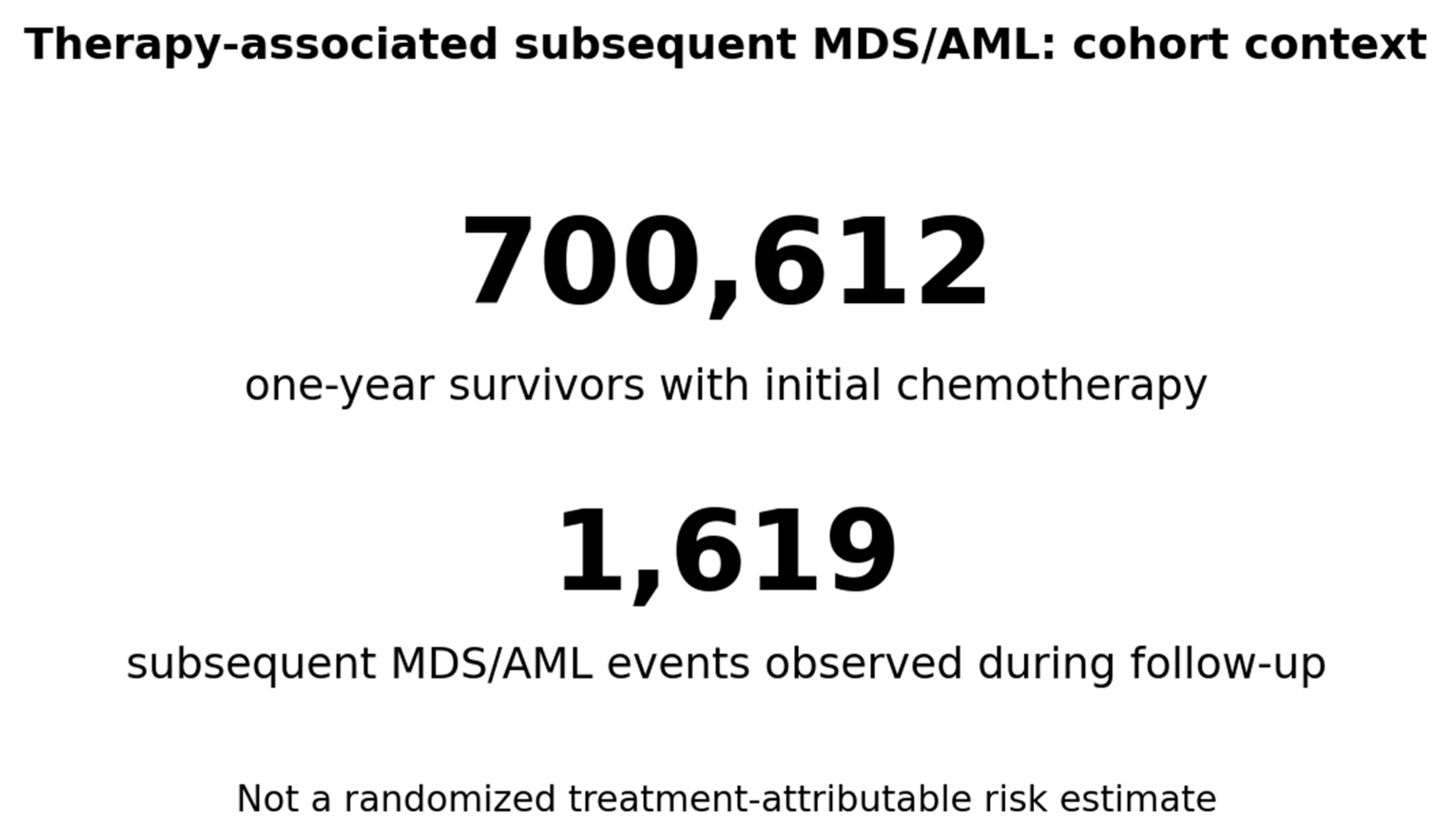
One of the best-established forms of treatment-related malignancy is therapy-related myelodysplastic syndrome or acute myeloid leukemia (t-MDS/AML). Morton and colleagues evaluated 700,612 adults with solid cancers diagnosed between 2000 and 2013 who received initial chemotherapy and survived at least one year. During follow-up, 1,619 subsequent MDS/AML events were identified. Risks were elevated relative to standardized general-population rates after 22 of 23 cancer types examined. [14]
These findings demonstrate a real association between chemotherapy exposure and later myeloid neoplasia across many solid tumors. However, the relative risks should be interpreted together with absolute risk. NCI's summary noted that the 10-year cumulative incidence of t-MDS/AML remained below 1% for most solid tumor types. [15] This does not make the harm unimportant, particularly when the condition is severe, but it illustrates why large relative increases should not be interpreted without absolute-event context.
The study also does not imply that every later MDS or AML case was caused solely by chemotherapy. Treatment regimens differed, some patients also received radiotherapy, agent-level exposure information was incomplete, and baseline biological susceptibility may have varied. [14] Thus, therapy-related myeloid malignancy is a genuine treatment-associated risk, while the absolute probability for most treated populations remains substantially smaller than the relative-risk figure alone may suggest.
Figure 4.
Subsequent MDS/AML after initial chemotherapy for solid cancers. Illustrative cohort context from Morton et al.: 700,612 one-year survivors exposed to initial chemotherapy, with 1,619 subsequent MDS/AML events identified during follow-up. This is not an exposure-attributable cumulative risk estimate or a standardized incidence ratio; detailed site-specific relative risks and confidence intervals should be consulted in the primary publication. [14].
5.3. Treatment-Related Carcinogenesis Is Biologically Heterogeneous
The mechanisms underlying treatment-related malignancies are more complex than direct mutagenesis alone. DNA-damaging chemotherapy and radiotherapy can produce new genomic injury, but cancer treatment can also alter the selective environment of pre-existing hematopoietic clones. Bolton and colleagues demonstrated treatment-associated selection of clones carrying DNA-damage-response alterations, supporting an evolutionary mechanism in the development of therapy-related myeloid neoplasia. [16]
This distinction matters. The term "toxic chemotherapy" is too broad to serve as a scientific causal explanation. Risk depends on the specific agent, cumulative dose, treatment combination, radiation exposure, age, baseline clonal hematopoiesis, inherited susceptibility, and duration of follow-up. A clinically useful assessment should therefore ask which treatment produces what excess risk in which patient population.
5.4. Long Latency Makes Late Harm Easy to Underestimate
Some treatment-related harms emerge many years or decades after the original cancer treatment. Consequently, short clinical trials and conventional treatment follow-up may substantially underestimate lifetime burden.
In the Childhood Cancer Survivor Study, Turcotte and colleagues reported a cumulative incidence of subsequent malignant neoplasms of approximately 3.9% at 30 years among five-year survivors treated with chemotherapy without radiotherapy, with a risk approximately 2.8 times that expected in the general population. [17] These estimates apply to long-term survivors of childhood cancer and should not be generalized directly to adult cancer patients, contemporary regimens, or all chemotherapy exposure.
Nevertheless, the findings illustrate a broader methodological issue: late harms require sufficiently long observation windows. This limitation becomes more important as cancer survival improves, because more patients live long enough for long-latency toxicity to become clinically relevant.
5.5. Late Carcinogenic Harm Can Decline When Treatment Becomes Safer
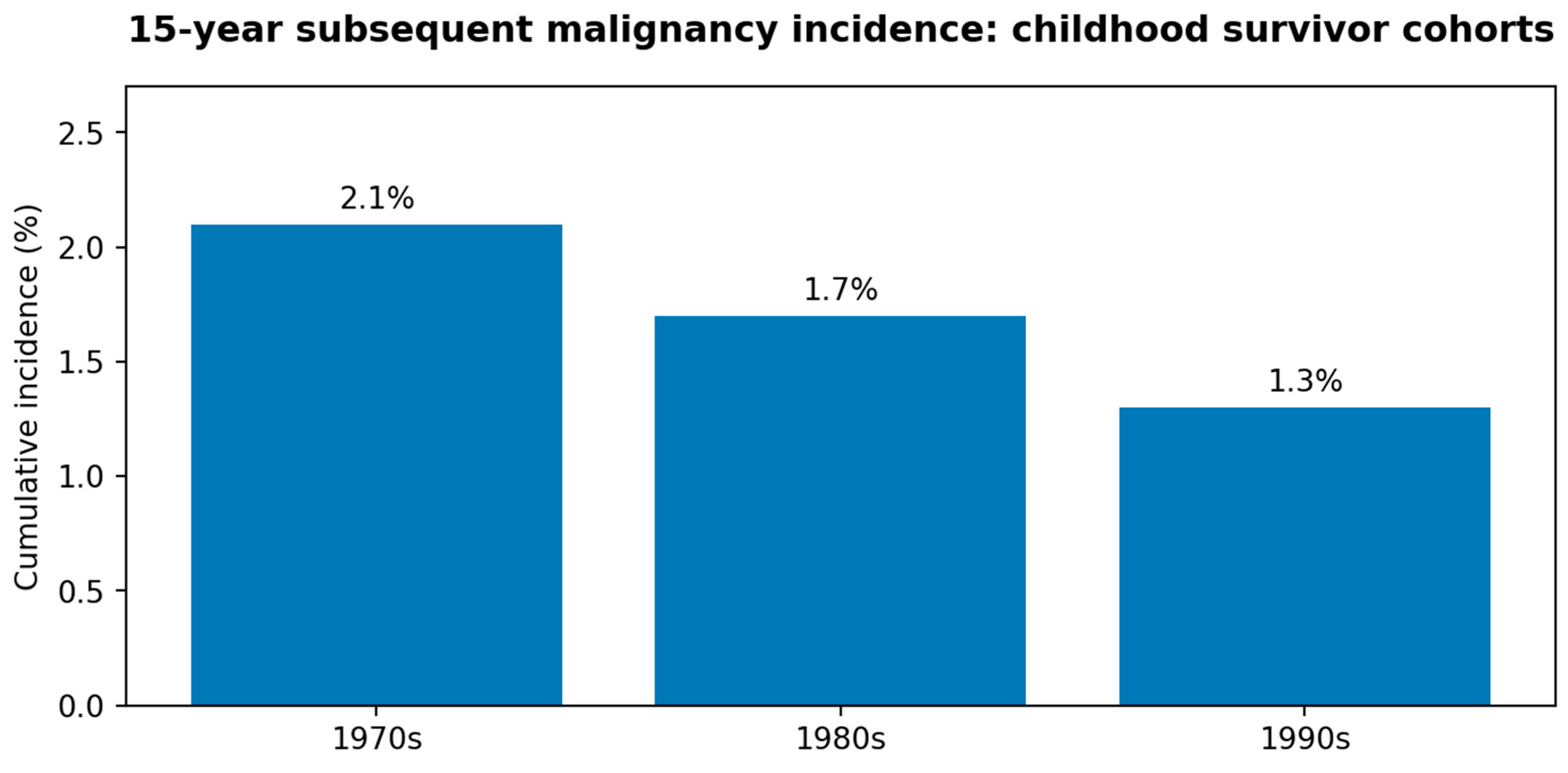
Evidence of treatment-related harm should not be interpreted as evidence that late toxicity inevitably worsens over time. A separate analysis of 23,603 five-year survivors of childhood cancer found that the 15-year cumulative incidence of subsequent malignancy declined across treatment eras-from approximately 2.1% among patients diagnosed in the 1970s to 1.7% in the 1980s and 1.3% in the 1990s. [18] Reduced exposure to therapeutic radiation contributed to this pattern.
The appropriate lesson is therefore not that effective cancer therapy should be avoided, but that treatment benefit should be preserved while avoidable long-term toxicity is progressively reduced.
Figure 5.
Subsequent-malignancy incidence across childhood-cancer diagnosis eras. Published 15-year cumulative incidence of subsequent malignancies among five-year childhood-cancer survivors: 2.1% for patients diagnosed in the 1970s, 1.7% in the 1980s, and 1.3% in the 1990s. These estimates illustrate declining late malignancy burden across treatment eras but should not be interpreted as general adult chemotherapy risks or as unconfounded comparisons of treatment effects. [18].
5.6. Competing Risks and Survivor Selection Are Essential to Interpretation
Subsequent malignancy is observed only among patients who survive long enough to experience it. A patient who dies early from the original cancer cannot later develop a documented second primary malignancy. This creates a competing-risk problem. Standard survival methods that treat death as ordinary independent censoring may overestimate the cumulative probability of a subsequent cancer. Competing-risk approaches are therefore required when estimating absolute incidence. [19]
Survivor selection also complicates comparisons across treatment eras or treatment groups. A group with more effective initial therapy may paradoxically accumulate more late adverse events simply because more patients survive long enough to experience them. Conversely, a group with high early mortality may appear to have fewer late malignancies because fewer patients remain at risk.
5.7. Association Is Not the Same as Causal Treatment Effect
A standardized incidence ratio compares observed subsequent cancers with the number expected in a reference population. An excess absolute risk expresses the additional event rate beyond that reference expectation. Both are useful surveillance measures, but neither automatically estimates the causal effect of treatment.
Stronger causal inference requires either long-term randomized comparisons when feasible or carefully designed observational analyses among clinically comparable patients. Target-trial principles can help define eligibility, treatment strategies, time zero, follow-up, outcomes, and confounding adjustment before analysis. [20] Comparisons between unselected treated and untreated survivors are especially vulnerable to confounding by indication.
For this reason, the review distinguishes carefully between subsequent cancer occurring after treatment, excess cancer associated with treatment exposure, and cancer causally attributable to a specific treatment.
5.8. The Clinically Relevant Question Is Net Patient Benefit
The existence of late harm does not determine whether a treatment should be used. A therapy that substantially reduces near-term mortality may remain highly beneficial despite a small increase in long-term secondary malignancy risk. Conversely, when immediate benefit is modest, severe or common delayed toxicity may meaningfully alter the treatment's overall value.
The appropriate question is: for a defined patient population, how do the immediate and durable benefits of treatment compare with its acute and delayed harms relative to the best available alternative? This requires consideration of cancer-specific and overall survival, magnitude and durability of treatment benefit, acute toxicity, chronic organ injury, subsequent malignancies, function and quality of life, treatment burden, and patient preferences.
5.9. Late Harms Should Be Incorporated into Cancer-Progress Assessment
Treatment-related malignancies illustrate a broader problem in how cancer progress is measured. Short-term endpoints can capture response and disease control while missing clinically important outcomes that emerge years later. As survivorship improves, late effects become increasingly important rather than less important.
A comprehensive assessment of cancer medicine should therefore ask not only whether treatment controls the original tumor, but also how long the benefit persists, what long-term toxicities accompany it, whether new serious disease is created, how well patients function after treatment, and how much healthy life is ultimately gained. This establishes a higher standard for success: maximize durable cancer benefit while minimizing preventable treatment-related harm.
6. Precision and Targeted Therapy: Reach, Magnitude, and Durability of Benefit
Precision oncology and targeted therapy represent major advances in modern cancer medicine. In selected molecularly defined cancers, targeted treatments can produce substantial and sometimes dramatic clinical benefit. These successes are important and should not be minimized. However, the term "targeted" describes a biological relationship between a therapy and a molecular or cellular target; it does not by itself establish how many patients are eligible, how many actually receive treatment, how many respond, how long the benefit lasts, whether overall survival improves, or whether cure is achieved. The central issue is therefore not whether targeted therapy works. It clearly can. The more important question is how broadly these benefits extend across the cancer population, how large they are, and how durable they are.
6.1. Biological Specificity Is Not the Same as Population Effectiveness
A highly specific treatment can be extremely effective for a small molecularly defined subgroup while having little relevance to the majority of patients with cancer. Population impact depends on whether an actionable target is present, whether validated testing is available and successfully performed, whether the patient meets the approved indication, whether treatment is accessible and received, whether the tumor responds, whether the response is durable, whether survival or quality of life improves, and whether benefit outweighs toxicity and treatment burden.
These steps have different denominators and should not be collapsed into a single measure of "precision oncology success." A drug may therefore have high biological specificity and substantial efficacy among selected eligible patients while producing a considerably smaller impact at the population level.
6.2. Historical Estimates Suggest Limited Population Reach, Although Reach Has Expanded
Marquart and colleagues estimated that, in 2018, approximately 8.33% of a modeled U.S. advanced-cancer population was eligible for genome-targeted therapy and approximately 4.90% was estimated to respond. Using a broader genome-informed definition, eligibility was estimated at 15.44% and response at 6.62%. [22] Haslam and colleagues later estimated genome-targeted eligibility at 13.60% and response at 7.04% for 2020. [23]
These estimates were model-based rather than direct measurements of contemporary population outcomes; annual cancer deaths were used as a proxy for advanced or metastatic cancer; definitions differed; and the response estimates do not represent the proportion of patients cured or necessarily the proportion achieving durable survival. They also should not be treated as current 2026 estimates. Nevertheless, the historical evidence supports an important distinction: substantial benefit for selected patients does not imply broad benefit for the entire cancer population.
6.3. Eligibility, Treatment, Response, and Durable Benefit Are Different Endpoints
The pathway from molecular testing to meaningful patient benefit should be reported explicitly: patients assessed for molecular testing; successfully tested; found to have an actionable alteration; meeting the clinical indication; actually treated; achieving objective response; experiencing durable disease control; and gaining meaningful survival, function, or quality of life. A large drop can occur at each step.
Consequently, the proportion of patients with a molecular target cannot be interpreted as the proportion benefiting from treatment. Likewise, the proportion responding cannot automatically be interpreted as the proportion achieving durable survival or cure.
6.4. Drug Approval Is Not Equivalent to Substantial Clinical Benefit
Regulatory approval establishes that a therapy has met the applicable evidentiary standard for a specific indication. It does not mean that every approved therapy produces a large or durable improvement in outcomes that patients value.
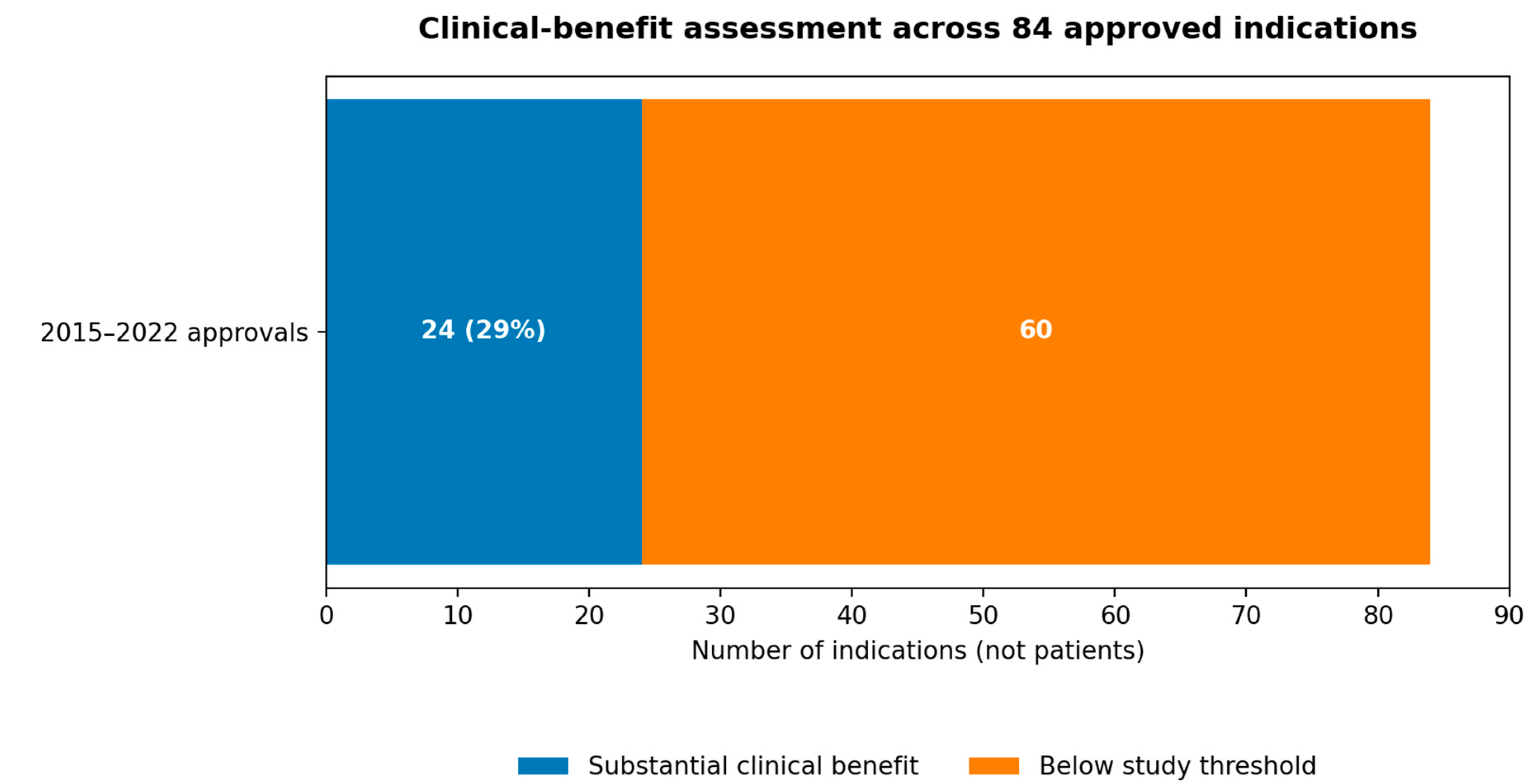
Tibau and colleagues evaluated 84 solid-tumor indications involving 50 genome-targeted drugs approved between 2015 and 2022. Using the European Society for Medical Oncology Magnitude of Clinical Benefit Scale, 24 indications (29%) met the study's threshold for substantial clinical benefit. [24] The denominator was approved indications, not patients. An indication falling below the threshold does not mean no efficacy; it may reflect moderate benefit, immature evidence, lack of survival data, limited quality-of-life information, or other shortcomings in the evidence available for scoring. Nevertheless, the study illustrates why the number of approved drugs or indications should not be used as a substitute for the number of patients achieving substantial, durable benefit.
Figure 6.
Clinical-benefit evidence for approved genome-targeted cancer indications. Among 84 solid-tumor indications involving 50 genome-targeted drugs approved during 2015–2022, 24 indications (29%) met the study-defined European Society for Medical Oncology Magnitude of Clinical Benefit Scale (ESMO-MCBS) threshold for substantial clinical benefit, whereas 60 did not. Failure to meet this threshold does not imply absence of efficacy; it may reflect moderate benefit, immature evidence, limited survival data, or other factors incorporated into the assessment. The denominator is approved indications, not treated patients. [24].
6.5. Response and Progression-Free Survival Should Not Automatically Be Interpreted as Durable Survival
Objective response and progression-free survival are clinically meaningful endpoints, particularly when symptoms are reduced or meaningful disease control is achieved. However, they are intermediate outcomes rather than automatic equivalents of improved overall survival, preserved function, or cure.
The SHIVA trial provides one example. In heavily pretreated patients with advanced cancer, off-label molecularly matched therapy did not significantly improve progression-free survival compared with physician-selected treatment: median progression-free survival was 2.3 versus 2.0 months, hazard ratio 0.88 (95% confidence interval 0.65-1.19). [25] This result should not be generalized to all targeted therapies, but it demonstrates that molecular matching alone is not sufficient to establish meaningful clinical benefit.
6.6. Some Targeted Therapies Produce Major and Durable Survival Benefit
A critical review should give equal weight to clear positive evidence. ADAURA provides an important example. Among patients with completely resected EGFR-mutated stage IB-IIIA non-small-cell lung cancer, five-year overall survival was 88% with adjuvant osimertinib compared with 78% with placebo; the hazard ratio for death was 0.49. [26] This represents a clinically important survival benefit in a well-defined molecular subgroup.
The appropriate interpretation is not that targeted therapies are generally ineffective, but that their value must be assessed indication by indication. Disease stage, molecular alteration, line of therapy, comparator, prior treatment, toxicity, follow-up duration, and maturity of survival evidence all matter.
6.7. Durability Is Central to Patient-Centered Benefit
Cancer therapy can produce a dramatic initial response yet fail to generate durable benefit because of residual disease, tumor heterogeneity, adaptive resistance, clonal evolution, or emergence of resistant populations. For patients, the relevant issue is therefore not simply whether the tumor shrank, but for how long, with what effect on survival and quality of life, and at what cost in toxicity and treatment burden.
The earlier conceptual proposal of an "effective target coverage" multiplier should not be treated as an observed clinical estimate. [21] Combining eligibility, response, heterogeneity, and durability into a single numerical percentage may create false precision when the underlying variables represent different biological and clinical phenomena.
6.8. Precision Oncology Should Be Evaluated Using Patient-Centered Outcomes
The most informative sequence for evaluating precision oncology is tested -> actionable target identified -> eligible -> treated -> response -> durable disease control -> survival and quality-of-life benefit. Each transition should have its own denominator.
Clinical evaluation should additionally include overall survival, duration of response, symptom improvement, patient-reported outcomes, acute and chronic toxicity, treatment discontinuation, financial burden, subsequent treatment requirements, and access to testing and therapy.
6.9. The Same Evidentiary Standards Should Apply to Alternative Targeting Concepts
The limitations of genomic targeting do not automatically establish the superiority of another targeting strategy. Metabolic, redox, immune, nutritional, microenvironmental, or systems-level vulnerabilities may represent important therapeutic opportunities. However, broader biological distribution of a proposed vulnerability does not prove broader clinical effectiveness.
A redox or metabolic intervention, for example, should be required to demonstrate a clearly defined target or mechanism, the relevant patient population, treatment exposure, comparative efficacy, durability of benefit, toxicity, survival or patient-centered outcomes, and reproducibility. Limitations in one therapeutic paradigm should generate hypotheses and comparative research-not serve as evidence that a preferred alternative is already superior.
6.10. Implications for Assessing Contemporary Cancer Medicine
Precision oncology has unquestionably changed the treatment of selected cancers and, in some settings, has produced major survival gains. Its scientific importance is not in dispute. The unresolved issue is the tendency to extrapolate from these highly successful examples to a broader perception of cancer-treatment effectiveness.
A patient-centered assessment should distinguish biological precision from clinical effectiveness; eligibility from treatment receipt; response from durable benefit; progression delay from overall survival; drug approval from magnitude of clinical benefit; and success in selected subgroups from population-level cancer impact.
The appropriate conclusion is neither that precision oncology has transformed cancer care for everyone nor that its achievements are unimportant. Rather, precision and targeted therapies can provide substantial—and occasionally transformative—benefit for selected, often relatively small subsets of cancer patients, while their broader population reach and durable impact remain substantially more limited than the existence of numerous molecular targets and approved drugs might suggest.
7. Integrating the Evidence: A Patient-Centered Cancer Progress Framework
The preceding sections illustrate a recurring problem in the evaluation of cancer medicine: individual indicators can be accurate while still providing an incomplete picture of overall progress.
The Cancer Progress Scorecard is a proposed nonweighted framework covering eight domains: (1) cancer occurrence and prevention; (2) mortality and premature death; (3) treatment reach and durable benefit; (4) acute and late treatment harm; (5) subsequent primary malignancies; (6) healthy survivorship and quality of life; (7) access and equity; and (8) financial toxicity and societal resources. It keeps denominators, time horizons, uncertainty, and missing information visible without reducing the domains to a single number.
These domains may move in different directions. Incidence may increase while mortality declines. Survival may improve while treatment burden remains high. A therapy may produce substantial tumor response in a selected subgroup yet have limited population reach or durability of benefit. Cancer treatment may prolong life while also producing acute toxicity, chronic organ injury, subsequent malignancies, impaired function, or financial hardship. Conversely, major therapeutic advances in particular cancers or molecularly defined subgroups can be obscured when results are averaged across highly heterogeneous diseases.
The appropriate response is therefore not to replace one preferred cancer statistic with another, but to evaluate multiple clinically meaningful outcomes together while preserving the distinct question addressed by each. The scorecard is intended as a structured multidomain profile rather than a weighted index, ranking system, or single measure of success.
Figure 7 and Table 3 present the same eight reporting domains. The framework is a nonweighted descriptive profile, not a validated scoring instrument.

Table 1.
Interpretation errors and corrective reporting rules.
| Potential error | Required distinction or corrective rule |
| More diagnoses prove prevention failure | Show population size, age-specific and age-standardized rates, diagnostic changes, and advanced-stage incidence. Counts quantify burden, not individual risk. |
| Higher five-year survival proves fewer deaths | Report population mortality and premature life lost; assess lead-time bias and overdiagnosis separately. |
| A rising cancer site proves no overall progress | Retain all-cancer trends and all prespecified site or age strata, including improving outcomes. |
| Any new cancer after chemotherapy was caused by it | Distinguish subsequent primary occurrence from attributable excess. State treatment exposure, comparator, latency, and confounding. |
| A large relative risk implies a large probability | Report absolute event risk or excess per person-time, with uncertainty and the same follow-up horizon. |
| Fewer second cancers necessarily mean safer treatment | Account for competing death, survivor selection, era differences, and equal observation windows. |
| Target specificity or drug approval demonstrates broad benefit | Separate biomarker eligibility, treatment receipt, response, durable outcome, and incremental benefit versus an appropriate comparator. |
| Several burden measures can simply be added | Do not double-count second-cancer deaths already in all-cancer mortality or add overlapping life-loss metrics. |
Proposed interpretation rules, not a validated scoring instrument.
Table 2.
Historical modeled reach of genomic oncology.
| Estimate year and source | Definition | Eligible (%) | Estimated response (%) |
| 2018; Marquart et al. [22] | Genome-targeted | 8.33 | 4.90 |
| 2018; Marquart et al. [22] | Genome-informed (includes genome-targeted) | 15.44 | 6.62 |
| 2020; Haslam et al. [23] | Genome-targeted | 13.60 | 7.04 |
Percentages refer to the modeled advanced/metastatic population and are not response rates among treated patients, cure fractions, or current 2026 uptake. Genome-informed includes genome-targeted; rows cannot be added. These estimates describe response-based reach, not a causal survival benefit.
Table 3.
Proposed Cancer Progress Scorecard.
| Domain | Core measure | Required interpretation |
| Cancer occurrence and prevention | Annual cases; age-standardized and age-specific incidence; advanced-stage incidence | Separate counts from rates and detection effects; state first-ever versus subsequent primaries. |
| Mortality and premature death | Cancer deaths; standardized mortality; years of life lost | Retain counts and rates; specify life table, age range, site, and stage. |
| Treatment reach and durable benefit | Tested, eligible, treated, responding, durable outcome; comparative survival | Specify each denominator, biomarker, disease setting, comparator, evidence maturity, toxicity, and follow-up. |
| Acute and late treatment harm | Acute toxicity; organ injury; function; late effects | Separate short- and long-term outcomes; use exposure-specific and absolute-risk context. |
| Subsequent primary malignancies | Cumulative incidence; excess rates; second/third primary burden | Account for competing risks and survivor selection; distinguish occurrence from causal attribution. |
| Healthy survivorship and quality of life | All-cause mortality; patient-reported symptoms and function; time outside hospital | Include baseline and longitudinal measures, missingness, and patient-valued outcomes. |
| Access and equity | Absolute and relative gaps across relevant strata | Do not let favorable averages obscure underserved populations or absent surveillance. |
| Financial toxicity and societal resources | Patient financial toxicity; catastrophic expenditure; comparative economic outcomes | Separate patient burden from formal cost-effectiveness and societal spending analyses. |
Every estimate should identify population, geography, data vintage, time origin, numerator, denominator, uncertainty, and observed/modeled/projected status. This is a proposed structured profile, not a validated weighted index. Missing domains remain visible as missing. At the center of the framework is the patient-centered objective: fewer consequential cancers, fewer premature deaths, and more healthy life. Each domain should be interpreted using its appropriate population, denominator, comparator, time horizon, uncertainty, and data status. The scorecard is a structured reporting profile rather than a weighted numerical index; improvement in one domain does not cancel deterioration, unresolved burden, or missing evidence in another.
7.1. A Multidomain Assessment of Cancer Progress
A comprehensive assessment should report the eight domains identified above, with advanced-stage incidence included under cancer occurrence, the magnitude and duration of clinical effects included under treatment reach and durable benefit, and broader resource consequences included under financial toxicity and societal resources. Different endpoints should retain their own denominators and follow-up periods; gains in one domain do not automatically offset harms in another.
These domains answer different questions and should not be collapsed into a single statistic. The value of the framework lies in making tradeoffs visible rather than allowing improvement in one domain to substitute automatically for success in all others.
7.2. Minimum Reporting Requirements
Every major cancer outcome should identify, where applicable, the population studied; cancer site, subtype, and stage; age and sex distribution; geographic setting; calendar or diagnosis period; time origin; numerator and denominator; duration of follow-up; whether the measure is a count, rate, proportion, hazard, or cumulative probability; uncertainty estimates; comparator; data vintage; and whether the result is observed, modeled, projected, or proposed.
These details are not methodological formalities. They determine what a result actually means. A cancer-progress framework should therefore make denominators and time horizons visible rather than leaving them implicit.
7.3. Missing Information Should Remain Visible
A common interpretive problem in cancer research is the tendency to treat an unmeasured outcome as though it were favorable or irrelevant. Absence of quality-of-life data does not imply preserved quality of life. Lack of long-term follow-up does not establish absence of late toxicity. Failure to measure financial burden does not mean treatment is economically neutral.
A structured scorecard should distinguish favorable evidence, unfavorable evidence, uncertain evidence, and evidence that has not yet been collected. Such transparency is preferable to creating a false impression of completeness.
7.4. Healthy Survivorship Should Be a Core Outcome
Cancer survivorship should be evaluated by more than absence of recurrence. For many patients, meaningful survival includes the ability to function, maintain independence, control symptoms, participate in personally valued activities, and minimize treatment burden.
Validated instruments such as the EORTC QLQ-C30 provide established approaches to measuring quality of life in oncology. [27] Interpretation requires longitudinal assessment, baseline measurement, reporting of missing data, and attention to clinically meaningful change. Patients lost to follow-up or too ill to complete questionnaires may differ systematically from respondents, so analyses restricted to surviving or healthier participants can produce an overly favorable picture.
Potential supporting measures include time alive outside hospital, treatment-free intervals, disability-free survival, symptom burden, longitudinal patient-reported function, return to work or valued activities, and quality-adjusted survival where appropriate. These measures should supplement rather than replace survival.
7.5. Financial Toxicity Is Part of Patient Outcome
Financial burden should not be treated solely as a health-economic or policy issue. For patients and families, it can become a direct consequence of cancer care. Relevant outcomes include out-of-pocket medical and nonmedical costs, income loss, debt, asset depletion, catastrophic health expenditure, cost-related treatment nonadherence, and financial distress affecting patients or caregivers.
Chinese evidence illustrates the magnitude of this problem. A 2024 cross-sectional study of 2,534 cancer patients treated in nine hospitals reported catastrophic health expenditure in approximately 72% after insurance compensation, with limited protection from social insurance. [34] A 2024 multisite study of 1,208 patients across three economically diverse provinces reported financial toxicity in 82.6%, with 40.9% meeting its high-toxicity threshold. [35] A systematic review of 30 Chinese studies also found wide but frequently substantial material, psychological, and behavioral financial toxicity, while emphasizing measurement heterogeneity. [36] These studies are largely hospital-based or cross-sectional and should not be treated as nationally representative causal estimates, but they show that financial distress can remain substantial despite insurance coverage.
Patient-level financial toxicity should be distinguished from formal cost-effectiveness analysis. Cost-effectiveness requires a specified comparator, perspective, time horizon, costs, health consequences, and sensitivity analysis. [28] Financial toxicity and societal economic evaluation therefore belong within the same broad assessment of cancer care, but they should remain analytically distinct.
7.6. Equity and Access Can Modify Apparent Progress
National averages can conceal important differences between populations. Treatment advances are meaningful only to patients who can access them. Molecular testing, specialist care, screening, supportive services, and expensive therapies may be unevenly distributed by geography, socioeconomic position, race or ethnicity, health-system resources, insurance status, or other relevant factors.
For this reason, absolute and relative disparities should be reported where data permit. An improving national mortality rate can coexist with persistent or widening inequality. The absence of surveillance or patient-reported data in an underserved population should also be treated as a data limitation rather than as evidence of favorable outcomes.
7.7. The Framework Should Prevent Double Counting
Several commonly reported cancer outcomes overlap. A death from a treatment-related second cancer may already be included in all-cancer mortality. Years of life lost, death counts, and quality-adjusted survival are alternative descriptions of related consequences, not independent quantities that can simply be added.
The purpose of a multidomain framework is transparent accounting, not numerical accumulation. A scorecard should display different outcomes side by side rather than mechanically combine them unless a validated composite methodology is used.
7.8. Interpretation Should Preserve Both Benefit and Harm
The framework is intentionally designed to resist one-sided interpretation. It should not permit treatment toxicity to erase major survival gains, but neither should strong tumor response erase clinically important long-term harm. Rising incidence should not negate falling mortality; falling mortality should not eliminate concern about prevention; subgroup treatment success should not automatically imply broad population benefit; historical treatment harm should not be assumed to describe all contemporary therapy; and limitations of conventional care should not be treated as evidence that an alternative framework is superior.
7.9. The Cancer Progress Scorecard Is a Proposed Framework, Not a Validated Instrument
The proposed scorecard has not been shown to improve clinical decision-making, public understanding, health policy, or patient outcomes. Its immediate purpose is more modest: to reduce interpretive error by presenting clinically relevant domains together and by making assumptions, denominators, missing information, and tradeoffs explicit.
A first validation study could compare individuals receiving the multidomain framework with those receiving a conventional cancer summary based primarily on incidence, survival, and mortality. Prespecified tasks might test whether participants can correctly distinguish counts from rates, survival from population mortality, response from durable benefit, association from causal treatment harm, relative from absolute risk, and missing evidence from evidence of no harm. A second stage could test reproducibility between analysts and transportability across cancer registries, health systems, and resource settings.
7.10. Falsifiability and Revision Are Essential
The framework should not be protected from failure simply because its goals appear reasonable. It should be revised, simplified, or abandoned if testing shows that it does not improve interpretation, increases misunderstanding, systematically exaggerates benefit or harm, hides rather than clarifies missing information, proves excessively burdensome to implement, or does not meaningfully improve decision-relevant understanding.
A claim that the framework improves clinical care would require substantially stronger evidence than improved presentation of statistics. Its current status is therefore that of a methodological and reporting proposal, not a clinical tool.
7.11. From Single Endpoints to a More Complete Definition of Progress
The broader purpose of the framework is to shift the question from "Did a cancer statistic improve?" to "Did fewer people develop consequential cancer, did fewer people die prematurely, did treatment provide durable benefit, and did patients gain healthy life without disproportionate harm or financial burden?" No single measure can answer all of these questions.
Accordingly, a more complete definition of cancer progress should encompass fewer preventable cancers, fewer premature deaths, more durable treatment benefit, less treatment-related harm, better quality of life, and greater financial and societal sustainability. The Cancer Progress Scorecard is proposed simply as one method for making those outcomes visible together.
8. Implications for I-OM Systems Medicine and a Broader Research Agenda
The unresolved problems identified in this review are compatible with a systems-oriented research agenda, but they do not validate any particular systems framework. The potential contribution of I-OM Systems Medicine is to examine the patient's trajectory before, during, and after cancer through multiple interacting domains rather than to replace cancer-specific evidence with a preferred explanatory vocabulary.
A related contextual-systems framework proposed by Cheng and Cheng distinguishes observed phenotype, physiological processes, graded causal contributors, intervention fit, and longitudinal updating; it remains a conceptual preprint rather than clinical validation. [29] Within a cancer research program, diet and metabolic state, micronutrient status, environmental exposures, infection, hormonal state, immune function, physical activity, sleep, and other host factors may help organize testable hypotheses. They should not be presented as equally established causes of every cancer, and the population curves in this review do not adjudicate between somatic-mutation, metabolic, immune, or other theories of carcinogenesis.
Established prevention should be distinguished from proposed interventions. Population evidence linking HPV vaccination with lower invasive cervical-cancer incidence illustrates an upstream intervention with a directly relevant clinical endpoint. [30] Similarly, adjunctive interventions require outcome trials. The CHALLENGE randomized trial found longer disease-free survival with a structured exercise program after adjuvant chemotherapy for colon cancer. [31] This supports the tested addition to standard treatment; it does not support omission of chemotherapy or universal extrapolation to other cancers.
The same discipline applies to nutritional interventions. In VITAL, vitamin D supplementation did not significantly reduce the primary invasive-cancer incidence endpoint in the studied population over a median 5.3 years. [32] SELECT found increased prostate-cancer incidence with the tested vitamin E regimen. [33] These findings do not resolve every question about deficiency correction, nutritional status, or pharmacologic nutrient dosing, but they preclude assuming that supplementation is inherently cancer-preventive or harmless.
A useful systems hypothesis must therefore specify the exposure or intervention, baseline phenotype, comparator, expected benefit, harms, and observation interval. Correction of documented deficiency, supplementation beyond adequacy, and pharmacologic nutrient dosing are different interventions. Conventional drugs, nutrients, diets, exercise, behavioral interventions, and multimodal programs should all be judged using methods appropriate to their causal question and with symmetric scrutiny of positive and negative findings.
The constructive research agenda is broader than choosing between conventional and integrative paradigms. It includes identifying causes of rising cancers in selected younger populations; strengthening prevention; improving durable outcomes in advanced disease; preserving treatment efficacy while reducing acute and late harm; incorporating patient-reported function and healthy life into trials; reducing financial toxicity; and testing combinations of tumor-directed and host-directed strategies when biologically plausible and ethically justified.
Within this agenda, a systems perspective may be useful if it generates testable, falsifiable questions and helps connect prevention, host resilience, tumor biology, treatment response, recovery, and survivorship. It becomes scientifically unhelpful if it is used to convert plausible mechanisms into claims of clinical superiority without comparative evidence. The same standard should apply to every therapeutic framework.
9. Limitations
This review is a purposive critical narrative review rather than a systematic review or meta-analysis. Source selection is therefore vulnerable to selection and interpretation bias, including possible allegiance to a systems-oriented perspective. Searches were targeted rather than exhaustive, studies were not independently double-screened, and no formal GRADE assessment was performed. The manuscript should therefore be interpreted as a critical synthesis and research agenda rather than a comprehensive evidence inventory.
The descriptive figures are intended to demonstrate measurement and interpretation issues rather than exhaustively quantify global cancer progress. The SEER incidence series covers registry populations, whereas the mortality series is national; they are not direct numerator-denominator counterparts. All-site averages conceal substantial biological and clinical heterogeneity. Coding, screening, staging, diagnostic intensity, registry expansion, and disruptions such as the COVID-19 pandemic can influence observed trends.
Evidence for treatment-related malignancy is strongest for certain exposures and outcomes and is not uniformly complete across all cancers or contemporary regimens. Historical survivor cohorts may differ substantially from current patients. Selection into survivor cohorts, incomplete treatment details, confounding, competing risks, and follow-up length constrain causal interpretation.
Historical estimates of genome-targeted therapy reach are not estimates of current 2026 uptake or benefit. Precision oncology is rapidly evolving, and the population impact of contemporary testing and therapy may be greater than older models indicate. Conversely, regulatory approval and response-based metrics do not by themselves establish durable patient-centered benefit.
Quality-of-life and financial-toxicity evidence is heterogeneous in instruments, timing, population, and setting. The Chinese financial-toxicity studies cited here provide important evidence of patient burden but are predominantly cross-sectional, hospital-based, or otherwise limited in national representativeness and causal inference. Their estimates should not be generalized automatically to all Chinese patients or other health systems.
The proposed Cancer Progress Scorecard is not a validated index, decision aid, or cost-effectiveness model. Claims of novelty concern the explicit integration of domains and interpretation rules, not the invention of outcomes already used in cancer surveillance or clinical research. Independent methodological critique, patient involvement, and prospective validation are required before claims of improved clinical or policy decision-making would be justified.
Finally, this review identifies shortcomings in existing cancer medicine but does not establish that I-OM Systems Medicine, nutritional interventions, metabolic therapy, or any other alternative or integrative framework is clinically superior. Proposed solutions must be tested under the same evidentiary discipline applied to conventional care.
10. Conclusion
Contemporary cancer medicine has achieved substantial progress, including major reductions in population mortality and important treatment successes in selected cancers. At the same time, prevention gaps, concerning early-onset patterns, poor durable outcomes in many advanced malignancies, treatment-related late harms, incomplete quality-of-life assessment, limited population reach of some precision approaches, and financial toxicity remain important unresolved problems.
These observations should not be forced into a simple verdict that oncology is either succeeding or failing. The disagreement between optimistic and pessimistic accounts often begins with different endpoints, denominators, populations, time horizons, and causal assumptions. Making those choices explicit is more informative than selecting a single statistic to support either narrative.
A more patient-centered definition of cancer progress should ask whether clinically consequential cancers are prevented when possible, whether premature deaths are reduced, whether treatment produces meaningful and durable survival, whether patients preserve function and quality of life, whether avoidable acute and late harms are minimized, and whether care remains financially sustainable for patients, families, and society.
The Cancer Progress Scorecard is proposed as one structured way to make these domains visible together, not as a validated numerical index. Its standards should apply equally to conventional oncology, precision medicine, supportive care, and proposed integrative or systems approaches.
The central research priority is therefore not simply to produce more interventions or more favorable intermediate endpoints, but to generate more healthy life with less preventable disease, less treatment-related harm, and less financial injury. Real progress against cancer should ultimately be measured in outcomes that patients and families can experience and value.
Author and Contributions: Richard Z. Cheng, MD, PhD, conceived the central evaluation question, developed the prevention-mortality-treatment-harm framework, and takes responsibility for the final manuscript following author review.
Affiliation and Correspondence: I-OM.ai, Columbia, South Carolina, USA. Correspondence: richzc@gmail.com.
Funding and Financial Disclosure: No external funding was received for the preparation of this manuscript.
Competing Interests: Richard Z. Cheng is associated with I-OM.ai and its educational and research activities and serves as Editor-in-Chief of the Orthomolecular Medicine News Service. These relationships are disclosed because the manuscript discusses systems and integrative approaches associated with the author.
Ethics and Consent: This work uses published literature and public aggregate statistics. It includes no participant recruitment, intervention, identifiable patient information, or individual-level record linkage. Participant consent is not applicable.
Data and Materials Availability: This narrative review uses published aggregate data. The figures reproduce selected reported values and explanatory summaries rather than newly derived individual-level results. Source data are available through the cited studies and surveillance resources. No original patient-level dataset or separate analytic code package accompanies this manuscript.
AI-Assisted Preparation: Artificial intelligence tools accessed through I-OM.ai, including OpenAI ChatGPT, were used to assist with literature discovery, drafting and editing, data transcription, calculations, reference management, and document formatting. The author is responsible for the scientific interpretations, verification of sources and numerical claims, and final manuscript. AI assistance does not constitute independent peer review.
Clinical Scope: This review does not establish a treatment protocol or justify delaying, discontinuing, or replacing evidence-based oncology care. It does not validate I-OM interventions. Individual decisions require appropriately qualified clinical assessment.
References
- Welch, H.G.; Schwartz, L.M.; Woloshin, S. Are increasing 5-year survival rates evidence of success against cancer? JAMA 2000, 283(22), 2975–2978. [Google Scholar] [CrossRef] [PubMed]
- National Cancer Institute. Cancer Trends Progress Report. 2026. Available online: https://progressreport.cancer.gov/ (accessed on 6 October 2026).
- National Cancer Institute, Surveillance, Epidemiology, and End Results Program. Cancer Stat Facts: Cancer of Any Site. 2026. Available online: https://seer.cancer.gov/statfacts/html/all.html (accessed on 6 October 2026).
- Centers for Disease Control and Prevention. Cancer Data and Statistics. 2026. Available online: https://www.cdc.gov/cancer/data/index.html (accessed on 6 October 2026).
- Zhao, J.; Xu, L.; Sun, J.; et al. Global trends in incidence, death, burden and risk factors of early-onset cancer from 1990 to 2019. BMJ Oncol. 2023, 2(1), e000049. [Google Scholar] [CrossRef] [PubMed]
- Shiels, M.S.; Haque, A.T.; Berrington de Gonzalez, A.; et al. Trends in cancer incidence and mortality rates in early-onset and older-onset age groups in the United States, 2010-2019. Cancer Discov. 2025, 15(7), 1363–1376. [Google Scholar] [CrossRef] [PubMed]
- Hong, Y.D.; Chen, H.S.; Liu, B.; et al. Recent trends in early-onset cancer incidence rates. J. Natl. Cancer Inst. 2026, djag237. [Google Scholar] [CrossRef] [PubMed]
- National Cancer Institute. Years of Life Lost. Cancer Trends Progress Report. 2026. Available online: https://progressreport.cancer.gov/end/life_lost (accessed on 6 October 2026).
- Siegel, R.L.; Wagle, N.S.; Jemal, A. Leading cancer deaths in people younger than 50 years. JAMA 2026, 335(7), 632–634. [Google Scholar] [CrossRef] [PubMed]
- National Cancer Institute, Surveillance, Epidemiology, and End Results Program. Cancer Stat Facts: Pancreatic Cancer. 2026. Available online: https://seer.cancer.gov/statfacts/html/pancreas.html (accessed on 6 October 2026).
- Goddard, K.A.B.; Feuer, E.J.; Mandelblatt, J.S.; et al. Estimation of cancer deaths averted from prevention, screening, and treatment efforts, 1975-2020. JAMA Oncol. 2025, 11(2), 162–167. [Google Scholar] [CrossRef] [PubMed]
- Sung, H.; Hyun, N.; Leach, C.R.; Yabroff, K.R.; Jemal, A. Association of first primary cancer with risk of subsequent primary cancer among survivors of adult-onset cancers in the United States. JAMA 2020, 324(24), 2521–2535. [Google Scholar] [CrossRef] [PubMed]
- National Cancer Institute; Division of Cancer Epidemiology and Genetics. Second Primary Cancers Among Cancer Survivors. 2026. Available online: https://dceg.cancer.gov/research/what-we-study/second-cancers (accessed on 6 October 2026).
- Morton, L.M.; Dores, G.M.; Schonfeld, S.J.; et al. Association of chemotherapy for solid tumors with development of therapy-related myelodysplastic syndrome or acute myeloid leukemia in the modern era. JAMA Oncol. 2019, 5(3), 318–325. [Google Scholar] [CrossRef] [PubMed]
- National Cancer Institute. Study finds increased risk of rare blood cancer after chemotherapy for most solid tumors. 2018. Available online: https://www.cancer.gov/news-events/press-releases/2018/tmds-aml-risk-chemo (accessed on 6 October 2026).
- Bolton, K.L.; Ptashkin, R.N.; Gao, T.; et al. Cancer therapy shapes the fitness landscape of clonal hematopoiesis. Nat. Genet. 2020, 52(11), 1219–1226. [Google Scholar] [CrossRef] [PubMed]
- Turcotte, L.M.; Liu, Q.; Yasui, Y.; et al. Chemotherapy and risk of subsequent malignant neoplasms in the Childhood Cancer Survivor Study cohort. J. Clin. Oncol. 2019, 37(34), 3310–3319. [Google Scholar] [CrossRef] [PubMed]
- Turcotte, L.M.; Liu, Q.; Yasui, Y.; et al. Temporal trends in treatment and subsequent neoplasm risk among 5-year survivors of childhood cancer, 1970-2015. JAMA 2017, 317(8), 814–824. [Google Scholar] [CrossRef] [PubMed]
- Fine, J.P.; Gray, R.J. A proportional hazards model for the subdistribution of a competing risk. J. Am. Stat. Assoc. 1999, 94(446), 496–509. [Google Scholar] [CrossRef]
- Hernan, M.A.; Robins, J.M. Using big data to emulate a target trial when a randomized trial is not available. Am. J. Epidemiol. 2016, 183(8), 758–764. [Google Scholar] [CrossRef] [PubMed]
- Cheng, R. Targeted cancer therapy has been defined at a narrow biological level-A hierarchical and semi-quantitative reassessment of genomic, redox, and metabolic targeting. Version 1; not peer reviewed. 2026. [Google Scholar] [CrossRef]
- Marquart, J.; Chen, E.Y.; Prasad, V. Estimation of the percentage of US patients with cancer who benefit from genome-driven oncology. JAMA Oncol. 2018, 4(8), 1093–1098. [Google Scholar] [CrossRef] [PubMed]
- Haslam, A.; Kim, M.S.; Prasad, V. Updated estimates of eligibility for and response to genome-targeted oncology drugs among US cancer patients, 2006-2020. Ann. Oncol. 2021, 32(7), 926–932. [Google Scholar] [CrossRef] [PubMed]
- Tibau, A.; Hwang, T.J.; Molto, C.; Avorn, J.; Kesselheim, A.S. Clinical value of molecular targets and FDA-approved genome-targeted cancer therapies. JAMA Oncol. 2024, 10(5), 634–641. [Google Scholar] [CrossRef] [PubMed]
- Le Tourneau, C.; Delord, J.P.; Goncalves, A.; et al. Molecularly targeted therapy based on tumour molecular profiling versus conventional therapy for advanced cancer (SHIVA): a multicentre, open-label, proof-of-concept, randomised, controlled phase 2 trial. Lancet Oncol. 2015, 16(13), 1324–1334. [Google Scholar] [CrossRef] [PubMed]
- Tsuboi, M.; Herbst, R.S.; John, T.; et al. Overall survival with osimertinib in resected EGFR-mutated NSCLC. N. Engl. J. Med. 2023, 389(2), 137–147. [Google Scholar] [CrossRef] [PubMed]
- Aaronson, N.K.; Ahmedzai, S.; Bergman, B.; et al. The European Organization for Research and Treatment of Cancer QLQ-C30: a quality-of-life instrument for use in international clinical trials in oncology. J. Natl. Cancer Inst. 1993, 85(5), 365–376. [Google Scholar] [CrossRef] [PubMed]
- Husereau, D.; Drummond, M.; Augustovski, F.; et al. Consolidated Health Economic Evaluation Reporting Standards 2022 (CHEERS 2022) statement: updated reporting guidance for health economic evaluations. BMJ 2022, 376, e067975. [Google Scholar] [CrossRef] [PubMed]
- Cheng, R.Z.; Cheng, E.K. Beyond evidence hierarchies: an intervention-aware, contextual systems framework for medical artificial intelligence. Version 1; not peer reviewed. 2026. [Google Scholar] [CrossRef]
- Lei, J.; Ploner, A.; Elfstrom, K.M.; et al. HPV vaccination and the risk of invasive cervical cancer. N. Engl. J. Med. 2020, 383(14), 1340–1348. [Google Scholar] [CrossRef] [PubMed]
- Courneya, K.S.; Vardy, J.L.; O'Callaghan, C.J.; et al. Structured exercise after adjuvant chemotherapy for colon cancer. N. Engl. J. Med. 2025, 393(1), 13–25. [Google Scholar] [CrossRef] [PubMed]
- Manson, J.E.; Cook, N.R.; Lee, I.M.; et al. Vitamin D supplements and prevention of cancer and cardiovascular disease. N. Engl. J. Med. 2019, 380(1), 33–44. [Google Scholar] [CrossRef] [PubMed]
- Klein, E.A.; Thompson, I.M., Jr.; Tangen, C.M.; et al. Vitamin E and the risk of prostate cancer: the Selenium and Vitamin E Cancer Prevention Trial (SELECT). JAMA 2011, 306(14), 1549–1556. [Google Scholar] [CrossRef] [PubMed]
- Fu, W.; Shi, J.; Liu, C.; Chen, W.; Liu, G.; He, J. Health insurance and inequalities in catastrophic health spending in cancer patients. A cross-sectional study in China. Gac. Sanit. 2024, 38, 102397. [Google Scholar] [CrossRef] [PubMed]
- Xu, B.; So, W.K.W.; Choi, K.C.; et al. Financial toxicity and its risk factors among patients with cancer in China: A nationwide multisite study. Asia Pac. J. Oncol. Nurs. 2024, 11(5), 100443. [Google Scholar] [CrossRef] [PubMed]
- Xu, B.; Hu, L.; Cheng, Q.; So, W.K.W. A systematic review of financial toxicity among cancer patients in China. Asia Pac. J. Oncol. Nurs. 2022, 9(8), 100071. [Google Scholar] [CrossRef] [PubMed]
Figure 7.
Proposed eight-domain Cancer Progress Scorecard. Conceptual illustration of a nonweighted reporting framework. Domains correspond toTable 3: (1) cancer occurrence and prevention, (2) mortality and premature death, (3) treatment reach and durable benefit, (4) acute and late treatment harm, (5) subsequent primary malignancies, (6) healthy survivorship and quality of life, (7) access and equity, and (8) financial toxicity and societal resources. These categories are presented side by side without assigning weights or implying clinical validation.
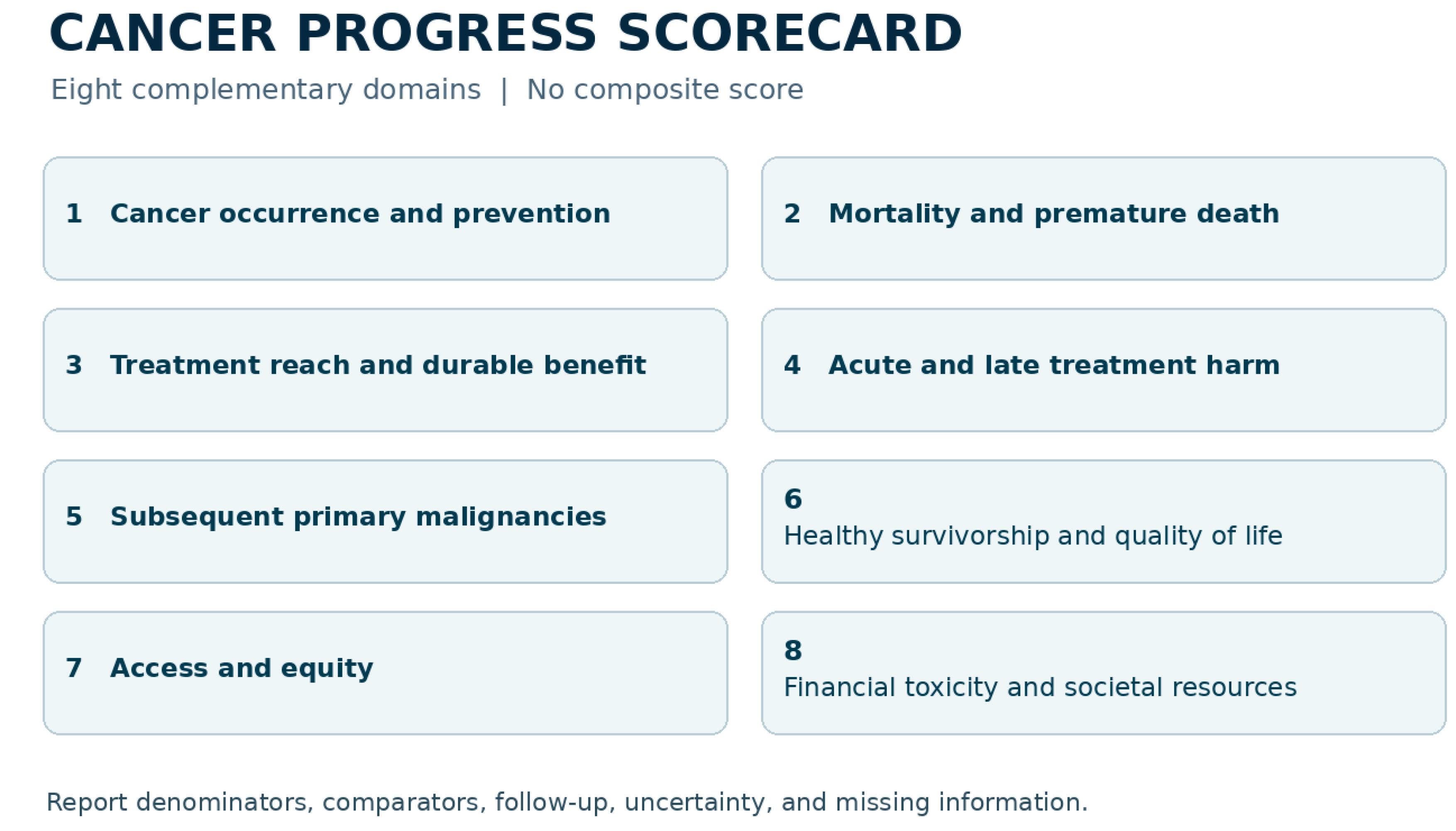
Disclaimer/Publisher’s Note: The statements, opinions and data contained in all publications are solely those of the individual author(s) and contributor(s) and not of MDPI and/or the editor(s). MDPI and/or the editor(s) disclaim responsibility for any injury to people or property resulting from any ideas, methods, instructions or products referred to in the content. |
© 2026 by the author. Licensee MDPI, Basel, Switzerland. This article is an open access article distributed under the terms and conditions of the Creative Commons Attribution (CC BY) license.
Copyright: This open access article is published under a Creative Commons CC BY 4.0 license, which permit the free download, distribution, and reuse, provided that the author and preprint are cited in any reuse.