

Submitted:
05 October 2026
Posted:
09 October 2026
You are already at the latest version
Abstract
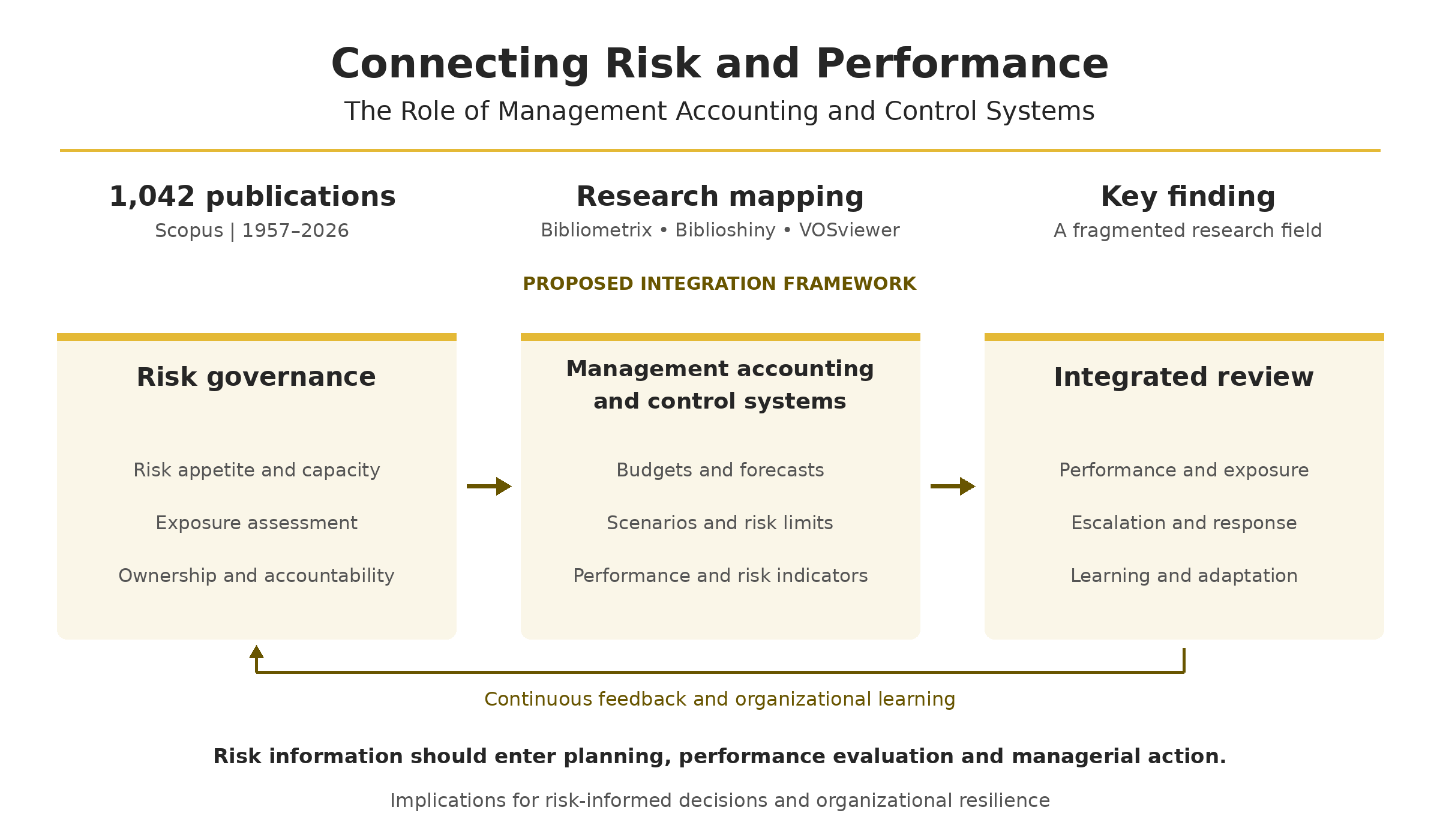
Enterprise risk management (ERM) and risk governance require organizations to connect risk identification, assessment, monitoring, and response with planning, performance evaluation, accountability, and organizational resilience. This study examines the development and intellectual structure of research at the intersection of ERM, risk governance, management accounting, and management control systems. A bibliometric analysis was conducted on 1,042 Scopus-indexed publications using Bibliometrix, Biblioshiny, and VOSviewer. The findings show sustained growth in the field and identify risk management, management control systems, and performance management as its principal motor theme. Management accounting occupies a central position in the keyword network and is closely connected with risk assessment, enterprise risk management, and performance measurement. However, the literature remains fragmented across risk governance, corporate governance, resilience, and sector-specific applications. The study therefore positions ERM and risk governance as the primary framework and interprets management accounting, control mechanisms, and information systems as enabling infrastructures through which risk information is translated into responsibilities, limits, resource-allocation decisions, corrective action, and organizational learning. The resulting framework clarifies how organizations can embed enterprise and financial risk considerations in established managerial routines rather than treating risk management as a separate reporting exercise.
Keywords:
enterprise risk management
; risk governance
; risk assessment
; management control systems
; management accounting
; financial risk
; organizational resilience
1. Introduction
Enterprise risk management (ERM) and risk governance have become central to organizational planning, decision-making, and performance. Financial volatility, technological disruption, regulatory change, operational uncertainty, and interconnected strategic exposures require organizations to evaluate not only expected returns but also the risks accepted in pursuing their objectives. ERM provides an enterprise-wide basis for identifying and assessing these exposures, while risk governance determines how risk appetite, oversight, accountability, and escalation responsibilities are distributed across the organization (Hudáková et al., 2026).
The effectiveness of ERM depends on whether risk information influences strategy, resource allocation, performance evaluation, and managerial action. When risk management remains detached from budgeting, forecasting, investment appraisal, and operational review, it may become primarily a compliance activity. Risk governance addresses this weakness by linking risk ownership, management responsibilities, board oversight, information flows, and review mechanisms to the organization’s objectives and capacity to absorb adverse outcomes (Almashhour et al., 2025; Mishra et al., 2019).
Management accounting and management control systems are therefore treated in this study as enabling mechanisms within ERM and risk governance rather than as the primary conceptual framework. Budgets, forecasts, scenarios, performance indicators, risk limits, reporting routines, and information systems make exposures visible and translate them into responsibilities and decisions. Through these mechanisms, organizations can integrate risk identification, assessment, monitoring, response, and learning into their established managerial processes and strengthen their capacity to manage enterprise and financial risks (Crawford & Jabbour, 2024).
This study maps the intellectual and thematic structure of this research domain through a bibliometric analysis of 1,042 Scopus-indexed publications. It examines scientific production, leading sources, geographical contributions, keyword relationships, thematic development, and conceptual clusters. The contribution is twofold: first, it clarifies how ERM and risk governance are connected with accounting, control, performance, and resilience; second, it develops an operating framework showing how accounting and control mechanisms can support risk-informed governance and organizational action. Section 2 establishes the theoretical framework and research questions, Section 3 explains the methodology, Section 4 presents the results, Section 5 discusses their academic and managerial implications, and Section 6 concludes the study and outlines future research directions.
2. Literature Review
2.1. Enterprise Risk Management and Risk Governance
ERM is an integrated organizational process through which material risks are identified, assessed, prioritized, monitored, and addressed in relation to strategic objectives. Its purpose extends beyond maintaining a risk register: it seeks to create an enterprise-wide understanding of exposure, risk appetite, risk capacity, and the interdependencies among financial, operational, strategic, regulatory, technological, and reputational risks. Effective ERM therefore requires risk information to enter the decisions through which objectives are selected, resources are committed, and performance is evaluated.
Risk governance provides the institutional architecture that makes ERM actionable. It defines the responsibilities of the board, risk committees, senior management, business units, risk owners, and control owners; establishes reporting and escalation channels; and determines how risk appetite and tolerance levels are approved and reviewed. Governance arrangements also shape how risk information is interpreted and challenged, because accounting practices and control information influence professional roles, collaboration, and organizational responses during periods of uncertainty (Carr & Beck, 2022).
Under disruption, ERM and risk governance must remain sufficiently structured to preserve accountability while also allowing rapid adaptation. Organizations responding to the COVID-19 crisis combined action, cultural, and results controls to coordinate operations, protect employees, monitor financial outcomes, and support adaptation. These findings show that uncertainty does not reduce the need for governance and control; instead, it changes how controls are used and increases the importance of linking operational coordination, financial monitoring, and organizational values (Passetti et al., 2021).
The design of governance and control responses also has behavioral consequences. Tighter budget controls may improve discipline, but they can increase role ambiguity, role conflict, and emotional exhaustion when managers do not understand how responsibilities should change. Enabling forms of control can reduce these effects by helping organizational actors interpret contingencies, solve problems, and act within clear boundaries (Bedford et al., 2022). Risk governance must therefore consider not only formal authority but also whether risk responsibilities are understood, accepted, and supported by usable information.
ERM also requires information that extends beyond internally generated accounting measures. External complexity may not be captured by conventional reporting systems, even when those systems are used interactively. Organizations can strengthen strategic surveillance by combining qualitative external information, digital systems, structured meetings, and collective managerial interpretation (Dávila et al., 2024). The configuration of belief, boundary, diagnostic, and interactive controls may also need to change as an organization moves from immediate crisis response to strategic renewal and innovation (Bassani et al., 2025).
Taken together, this literature positions ERM and risk governance as dynamic organizational capabilities rather than static compliance structures. Their effectiveness depends on the quality of risk information, the clarity of oversight and ownership, the alignment of risk appetite with strategic objectives, and the ability to reconfigure controls as conditions change. Management accounting and control systems contribute to this framework by providing the information, routines, and accountability mechanisms through which enterprise risks become visible and governable.
2.2. Management Accounting and Control Mechanisms within ERM
Within an ERM framework, risk-informed planning incorporates exposure, risk appetite, risk capacity, and possible deviations from expected outcomes into the selection of objectives and allocation of resources. Risk information becomes part of the economic reasoning behind strategic priorities rather than a separate register reviewed after major decisions have been made. Integrating risk analysis with accounting processes enables financial implications, operational vulnerabilities, and strategic consequences to be considered together when alternative courses of action are evaluated (Huber et al., 2025; Olaoye & Gracias, n.d.).
Budgeting is one of the principal mechanisms through which ERM is operationalized. Revenue expectations, cost estimates, investment proposals, cash-flow projections, and funding requirements depend on assumptions that may be affected by market movements, supply interruptions, regulatory developments, financing conditions, or implementation failures. A risk-informed budget makes these assumptions visible and connects them with scenarios, tolerances, responsibilities, and possible responses. Contingency provisions, sensitivity analysis, and forecast ranges can then be linked to specific exposures rather than treated as general financial buffers. Budget evaluation also helps distinguish weak execution from unrealistic assumptions, deliberate slack, and events outside managerial control (Sunaryo et al., 2025; Zhou et al., 2025).
At the strategic level, risk governance requires organizations to compare expected returns with the downside consequences of alternative investments, markets, technologies, and business models. Risk appetite defines the level and type of exposure the organization is prepared to accept, while risk capacity indicates the losses or volatility it can absorb without threatening its viability. Evidence from small and medium-sized enterprises suggests that ERM contributes to financial performance through strategic risk-management practices and an organizational culture that gives direction to risk-informed behavior (Syrová & Špička, 2023).
Risk appetite also creates a governance boundary around managerial ambition. Demanding growth, profitability, or investment targets may encourage decisions that improve short-term results while increasing leverage, liquidity pressure, earnings volatility, or exposure to activities outside the firm’s core operations. Evidence from listed non-financial companies indicates that greater managerial risk appetite is associated with increased corporate financialization, while internal control weakens this relationship (Jin, 2024). The objective is not to eliminate risk-taking, but to distinguish exposure that supports strategic value creation from exposure generated by incentives, opportunistic behavior, or insufficient oversight.
Performance measurement provides the operational connection between strategic objectives and enterprise risk exposure. Conventional measures indicate whether desired outcomes have been achieved, but they may reveal little about the risks accepted in producing those outcomes. Risk-adjusted evaluation supplements financial and non-financial indicators with key risk indicators (KRIs), concentration measures, control failures, forecast variability, liquidity pressure, project delays, compliance breaches, and exposure against approved limits. Managers and governing bodies can then distinguish sustainable performance from results produced by accepting risks outside organizational tolerances (Downes & Weerakoon, 2026).
The integration of the Balanced Scorecard with ERM illustrates how established performance frameworks can give risk information greater organizational influence (Garefalakis et al., 2025; Kaplan & Norton, 1992). Risk indicators should not be added as an isolated reporting category. They should affect how strategic objectives, measures, initiatives, and targets are interpreted across business units. When ERM is connected to an established performance-management practice, risk considerations gain visibility while performance evaluation becomes more sensitive to uncertainty, exposure, and the sustainability of results.
The relationship between ERM and organizational performance is also shaped by governance and oversight. Evidence from the insurance sector indicates a positive association between ERM and both underwriting performance and return on assets, while board size, independence, and gender diversity strengthen this relationship. Risk information gains practical significance when boards and senior managers use it to question assumptions, assess exposures, challenge reported outcomes, and verify their consistency with organizational priorities and approved risk appetite (Horvey & Odei-Mensah, 2024).
Digital analytics and information systems further expand the capacity of ERM by allowing organizations to process larger and more diverse datasets, identify emerging patterns, and revise forecasts before adverse effects are fully reflected in financial results. The convergence of big-data analytics and risk-management practices has been associated with improvements in economic, environmental, and social performance, particularly when descriptive, diagnostic, predictive, and prescriptive information is incorporated into managerial decisions (Abdelhalim & Hassan, 2025). These capabilities shift risk monitoring from retrospective variance explanation toward forward-looking indicators and alternative scenarios.
Management accounting and control mechanisms therefore support ERM by converting risk appetite, exposures, and uncertainties into budgets, scenarios, KPIs, KRIs, limits, responsibilities, and review routines. Their contribution is strongest when performance and risk are evaluated jointly. This integration enables organizations to make explicit trade-offs among expected returns, resource commitments, acceptable exposure, and long-term resilience while maintaining accountable managerial decision-making.
2.3. ERM, Risk Governance, and Organizational Resilience
Organizational resilience is an important outcome of effective ERM and risk governance. It develops through routines, relationships, knowledge, and decision structures that allow an organization to preserve essential functions while changing activities that are no longer viable. Risk governance contributes by directing attention toward critical dependencies, clarifying authority, establishing escalation routes, and ensuring that information about emerging vulnerabilities reaches the actors able to respond. Resilience-oriented ERM does not seek to predict every possible disruption; it creates sufficient visibility, preparedness, and decision capacity for action when established assumptions fail (Weber et al., 2024).
During disruption, the value of governance and control lies less in rigidly enforcing predetermined procedures than in supporting selective and coordinated intervention. Managers must determine which activities should be protected, which resources can be redeployed, which decisions require centralization, and where local discretion is necessary. Belief and interactive control systems can strengthen resilience by sustaining common direction, information exchange, and managerial engagement while preserving the flexibility required to modify activities without losing strategic coherence (Phan et al., 2023).
Resilience also depends on converting disruption into organizational knowledge. Reporting irregularities, operational failures, near misses, and unexpected outcomes should not be treated only as deviations requiring correction. They can reveal weaknesses in assumptions, responsibilities, processes, and strategic priorities. Management control contributes to learning when it preserves decision traces, makes alternative interpretations visible, and enables the organization to reconsider the relationship between actions and outcomes. In this way, control systems can develop resilience capabilities rather than merely restore previous operating conditions (Bracci & Tallaki, 2021).
The connection between ERM and resilience becomes especially important during major strategic transformation. Risk governance arrangements, risk culture, risk artifacts, and organizational awareness can create structural, relational, and cognitive resources that develop progressively. Their effectiveness depends on continued alignment with strategic change because new directions generate exposures that may not be addressed by established routines. Longitudinal evidence indicates that ERM can strengthen resilience by enabling organizations to reconfigure resources and capabilities and to move beyond recovery toward strategic renewal (Monazzam & Crawford, 2024).
ERM, risk governance, management control, and resilience should therefore be viewed as complementary rather than opposing concepts. Effective governance creates a stable basis for coordinated action while retaining the capacity to revise priorities, redistribute authority, and institutionalize learning. The central issue is not the quantity of control but whether the configuration of responsibilities, information systems, limits, and review mechanisms correspond to the organization’s changing risk profile and resilience needs (Weber et al., 2024).
2.4. Research Gaps and Study Direction
Although ERM, risk governance, management accounting, management control systems, and organizational resilience have each received increasing academic attention, their interrelationships remain fragmented. Existing studies frequently examine budgeting, performance evaluation, internal control, corporate governance, risk management, or resilience as separate organizational functions. Consequently, the literature does not yet provide a sufficiently integrated account of how governance structures and control mechanisms jointly support risk identification, assessment, monitoring, response, and learning across enterprise and financial risks.
This study addresses that gap by adopting ERM and risk governance as the primary analytical framework. Within this framework, management accounting generates and interprets financial and operational risk information; management control systems connect that information with objectives, responsibilities, limits, and managerial action; and information systems support timely monitoring and communication. Organizational performance and resilience are treated as outcomes that depend on how effectively these enabling mechanisms are integrated into enterprise-wide risk governance.
Accordingly, the study addresses the following research questions:
RQ1: What are the dominant intellectual and thematic structures of research connecting enterprise risk management and risk governance with management accounting and control systems?
RQ2: Through what mechanisms do management accounting and control systems enable risk identification, assessment, monitoring, response, governance, and organizational resilience?
3. Methodology
Bibliometric analysis is a widely applied research method for systematically examining the development, structure, and intellectual organization of a scientific field. Its increasing use has been supported by the availability of comprehensive academic databases such as Scopus and Web of Science, together with specialized software including Bibliometrix, Biblioshiny, and VOSviewer (Passas, 2024; Pranckutė, 2021). These tools enable researchers to process large volumes of bibliographic data and classify publications according to indicators such as authorship, citations, keywords, publication sources, countries, institutions, and thematic relationships. Bibliometric analysis therefore provides a structured overview of the existing literature and supports the identification of major research trends, influential contributions, conceptual relationships, collaboration patterns, and gaps requiring further investigation.
In this study, bibliometric analysis was used to examine the development and structure of research on ERM and risk governance at the intersection with management accounting, management control, uncertainty, resilience, crisis, and organizational disruption. The analytical focus was therefore not accounting control in isolation, but the ways in which accounting, control, and information mechanisms support enterprise-wide risk governance and risk-informed organizational action.
The search strategy was constructed around three groups of keywords. The first group represented the primary risk-management framework and included “risk*,” “enterprise risk management,” “risk management,” “risk governance,” “risk appetite,” “uncertainty,” “resilience,” “crisis,” and “disruption*.” These terms captured formal ERM practices, governance arrangements, organizational exposure, crisis conditions, and resilience-related research. The wildcard symbol was used where appropriate to retrieve alternative word endings and singular and plural forms.
The second group represented the enabling accounting and control mechanisms and included “management accounting,” “management control*,” “management control system*,” “strategic management accounting,” “performance measurement system*,” and “budgetary control*.” These expressions captured the information, planning, performance-measurement, accountability, and control processes through which risk considerations may be embedded in organizational decisions.
The third group included “organization*,” “firm*,” “enterprise*,” and “business” to restrict the analysis to organizational contexts. The final search query was: ((“enterprise risk management” OR “risk management” OR “risk governance” OR “risk appetite” OR “risk*” OR “uncertainty” OR “resilience” OR “crisis” OR “disruption*”) AND (“management accounting” OR “management control*” OR “management control system*” OR “strategic management accounting” OR “performance measurement system*” OR “budgetary control*”)) AND (“organization*” OR “firm*” OR “enterprise*” OR “business”).
The search was conducted in Scopus because of its extensive coverage of peer-reviewed publications in business, management, accounting, economics, finance, decision sciences, social sciences, and related fields. The search covered the period from 1957 to 2026 and initially identified 1,527 records. The records were then refined through a structured filtering procedure based on subject area, document type, and publication language, as shown in Figure 1.
The initial 1,527 records were first limited to subject areas relevant to the research objectives, including Business, Management and Accounting; Economics, Econometrics and Finance; Social Sciences; Decision Sciences; Computer Science; Environmental Science; Energy; Arts and Humanities; Earth and Planetary Sciences; Multidisciplinary Studies; Materials Science; Biochemistry, Genetics and Molecular Biology; and Agricultural and Biological Sciences. Applying the subject-area criteria reduced the dataset to 1,303 records and excluded 224 records outside the selected disciplinary areas.
The remaining records were then restricted by document type. Articles, book chapters, and books were retained because they provide sufficiently developed scholarly contributions for bibliometric analysis. This stage retained 1,069 publications and excluded 234 records of other document types. The final filtering stage retained English-language publications, excluding a further 27 records. The resulting dataset comprised 1,042 documents and was used for bibliometric performance analysis and science-mapping procedures.
Figure 2 presents the six-stage methodological process. The first stage defined the research focus and positioned ERM and risk governance as the primary interpretive framework. The second selected Scopus as the bibliographic database. The third established the eligibility criteria, including the publication period, subject areas, document types, and language. The fourth prepared the final dataset of 1,042 records. The fifth applied Bibliometrix, Biblioshiny, and VOSviewer for performance analysis, science mapping, network analysis, and visualization. The sixth interpreted and synthesized the findings in relation to ERM, risk governance, management accounting, control systems, and organizational resilience.
After filtering, the bibliographic data were exported from Scopus in formats compatible with Bibliometrix, Biblioshiny, and VOSviewer. Bibliometrix and Biblioshiny were used for descriptive performance analysis, including annual scientific production, publication sources, authors, institutions, countries, citation patterns, and international collaboration. VOSviewer was used to construct and visualize keyword co-occurrence, co-authorship, country-collaboration, co-citation, and bibliographic-coupling networks.
Annual scientific production was analyzed to assess the temporal development of the field and identify periods of expansion or decline. Source analysis identified the journals and publication outlets contributing most extensively to the research domain. Author, institutional, and country analyses evaluated scholarly productivity and collaboration. Citation, co-citation, and bibliographic-coupling analyses were used to identify influential contributions and examine the intellectual and knowledge structures underlying the field (Zyoud & Fuchs-Hanusch, 2017).
Keyword co-occurrence and word analyses identified the principal concepts and relationships among ERM, risk governance, risk assessment, management accounting, management control, performance measurement, budgeting, uncertainty, resilience, crisis, and organizational disruption. Author and indexed keywords were examined to identify established and emerging topics. Thematic mapping and thematic-evolution analyses classified themes according to centrality and development, while factorial analysis identified broader conceptual dimensions and clusters within the dataset (Kirby, 2023).
The final stage synthesized the bibliometric findings to explain how the research domain has developed and how its current intellectual structure connects ERM and risk governance with accounting, control, performance, and resilience. Particular attention was given to risk identification, risk assessment, risk monitoring, risk appetite, corporate governance, performance measurement, budgetary control, information systems, crisis management, and organizational adaptation. This approach enabled the study to identify areas of convergence, fragmentation, and future research priority.
4. Results
Figure 3 summarizes the bibliometric dataset, which comprises 1,042 documents published in 570 sources between 1957 and 2026. The annual growth rate of 5.8% indicates a steady expansion of research interest. The publications were produced by 2,384 authors, with an average of 2.61 co-authors per document, confirming that collaboration is common in the field. International co-authorship accounts for 23.13% of the dataset, indicating a moderate level of cross-country research cooperation.
The average document age of 9.44 years shows that the dataset combines established studies with recent contributions. The average of 30.03 citations per document indicates a notable level of scholarly influence. In addition, 2,732 author keywords and 56,555 references reflect the conceptual diversity and extensive knowledge base of research linking ERM, risk governance, management accounting, control systems, and risk-related organizational outcomes.
Figure 4 illustrates the evolution of annual scientific production on ERM, risk governance, management accounting, management control, and related organizational risks between 1957 and 2026. Publication activity remained very limited until the early 1980s and relatively low throughout the 1980s and 1990s. A gradual increase emerged in the early 2000s, followed by stronger expansion after 2005. From approximately 2010 onward, annual production increased steadily, indicating growing interest in the governance and control of risk, uncertainty, resilience, crisis, and organizational disruption. The strongest growth occurred in the early 2020s. The decline in the most recent year should be interpreted cautiously because publication and indexing data may be incomplete.
Table 1 presents the most productive publication sources in the research domain. Management Accounting Research ranks first with 29 publications, followed by the Journal of Accounting and Organizational Change with 21 and Accounting, Auditing and Accountability Journal with 20. Accounting, Organizations and Society contributed 19 publications, while the Journal of Management Control and Sustainability published 18 and 16 documents, respectively. The prominence of specialist accounting and management-control journals indicates that the information and control dimensions of ERM have developed primarily within the accounting literature, while the presence of governance, sustainability, and organizational-change outlets demonstrates the field’s wider interdisciplinary reach.
The journal co-occurrence network in Figure 5 shows that Accounting, Organizations and Society and Management Accounting Research occupy central positions and connect several publication clusters. The network links specialist accounting and control research with organizational change, auditing, accountability, governance, strategy, sustainability, and finance. This pattern indicates that the intellectual foundations of the field remain concentrated in accounting and management-control scholarship, but the questions addressed increasingly concern enterprise-wide risk governance and organizational outcomes.
Figure 6 presents the overlay visualization of author-keyword co-occurrence. Node size represents keyword frequency, links indicate relationship strength, and color reflects the average publication year. “Management accounting” occupies the most prominent position and is closely connected with “risk assessment,” “enterprise risk management,” “performance measurement system,” and “performance management.” The network also connects accounting information systems, control mechanisms, governance, and sector-specific applications. Earlier research is more closely associated with risk analysis, standardization, and established control practices, whereas recent work increasingly addresses strategic alignment, data analytics, artificial intelligence, and emerging risks. Overall, the visualization shows a shift toward more integrated, data-driven, and governance-oriented approaches to enterprise risk.
Figure 7 presents the countries with the highest scientific production in the research domain. The United States records the largest contribution with 233 documents, followed by the United Kingdom with 183 and Australia with 135. Italy contributes 94 publications, China 88, and Germany 80. Sweden, Canada, and Greece account for 48, 41, and 21 publications, respectively.
This distribution demonstrates a broad international base, although research production is concentrated in North America, Europe, Australia, and China. The strong contributions of the United States and the United Kingdom reflect the established position of management accounting, governance, and risk research in these countries, while participation from Australia, China, Italy, Germany, and Greece shows the continuing geographical expansion of ERM- and risk-governance-oriented studies.
Figure 8 presents the thematic structure of the research domain according to centrality and density. The upper-right quadrant contains the principal motor theme formed by “risk management,” “management control systems,” and “performance management,” indicating that these topics are both well developed and highly influential. The cluster combining “organizational performance,” “environmental uncertainty,” and “contingency theory” is also positioned close to the motor-theme area, confirming the importance of adapting governance and control systems to changing organizational conditions. “Management control,” “strategy,” and “innovation” appear near the center of the map, showing strong relevance but a more moderate level of internal development.
The upper-left quadrant includes the niche themes “management accounting,” “budgeting,” and “crisis,” together with a smaller cluster linking “enterprise risk management,” “performance measurement systems,” and “ERM.” These themes are developed but remain less connected to the wider literature. In the lower-right quadrant, “uncertainty,” “sustainability,” and “COVID-19” appear as basic themes requiring further conceptual development. The lower-left quadrant contains “risk” and “performance measurement,” as well as a cluster connecting “management control system,” “accounting,” and “corporate governance.” Overall, the map confirms that risk management and management control systems form the conceptual core, while ERM, corporate governance, and performance measurement require stronger integration within a unified risk-governance framework.
Figure 9 presents the conceptual structure of the research domain using multiple correspondence analysis. The first dimension explains 51.96% of the variation and the second 14.72%, indicating that the two dimensions capture a substantial proportion of the relationships among keywords. The large red cluster includes management control, risk management, risk assessment, decision-making, sustainability, environmental management, uncertainty analysis, benchmarking, control systems, and organizational factors. Their close positioning suggests that the literature commonly examines risk governance and control as interconnected elements of managerial decision-making and organizational performance. The smaller blue cluster contains performance assessment, conceptual frameworks, total quality management, healthcare, safety, and accident prevention. Its separation identifies a more specialized application-oriented stream. The map therefore reveals fragmentation between a broad organizational ERM-and-control literature and sector-specific research on quality, safety, and operational evaluation.
5. Discussion
The sustained increase in scientific production after 2005, followed by stronger expansion in the early 2020s, indicates that the relationship among ERM, risk governance, accounting, and control has developed from a peripheral topic into an established research domain. This growth reflects a broader shift from treating risk management as a stand-alone compliance process toward viewing it as an organizational capability that connects external uncertainty, strategic attention, resource allocation, accountability, and adaptation. Under conditions in which fixed plans and retrospective financial indicators are insufficient, organizations require governance arrangements and control systems capable of interpreting external complexity, revising priorities, and coordinating action (Dávila et al., 2024).
The thematic and keyword findings provide a direct response to RQ1. Risk management, management control systems, and performance management form the principal motor theme, while management accounting occupies the most central position in the keyword network and is closely connected with risk assessment, ERM, and performance measurement. These relationships show that the intellectual structure of the field is organized around the integration of enterprise risk with planning, target setting, resource allocation, performance evaluation, and managerial decision-making. ERM and risk governance therefore provide the overarching framework, while accounting and control mechanisms provide the organizational infrastructure through which that framework becomes operational.
The findings also reveal that this integration remains incomplete. ERM and performance-measurement systems appear as relatively specialized themes, while accounting, corporate governance, and control systems occupy a less developed position on the thematic map. The journal network shows that the intellectual core remains concentrated in specialist accounting and management-control journals even though the field extends into governance, sustainability, strategy, operations, quality management, and finance. The factorial analysis reinforces this fragmentation by separating a broad organizational cluster centered on risk, control, assessment, decision-making, and performance from a more application-oriented cluster concerned with quality, safety, and operational evaluation. A central research priority is therefore to connect these streams through a clearer ERM and risk-governance framework.
The results support an enterprise-wide interpretation of risk management rather than one restricted to financial instruments or financial institutions. Evidence from insurers indicates that ERM can be associated with accounting and underwriting performance, but that this relationship depends on board characteristics, oversight, and governance arrangements (Horvey & Odei-Mensah, 2024). Similarly, the indirect relationship between ERM and financial performance suggests that formal risk systems create value when they influence strategic orientation, organizational culture, incentives, and managerial practices rather than through adoption alone (Syrová & Špička, 2023).
The findings also answer RQ2 by identifying the mechanisms through which accounting and control enable ERM and risk governance. Management accounting makes exposures, resource constraints, assumptions, and deviations visible through budgets, forecasts, scenarios, investment appraisals, KPIs, and KRIs. Management control systems assign responsibility, establish limits, create review and escalation routines, and connect risk information with strategic and operational decisions. Information systems support continuous monitoring and communication, while governance bodies use these outputs to challenge assumptions, approve responses, and assess whether exposure remains within risk appetite. After disruption, the same mechanisms support organizational learning, the reconfiguration of routines, and strategic renewal (Bracci & Tallaki, 2021; Monazzam & Crawford, 2024).
From a managerial perspective, effective ERM depends less on producing additional risk reports than on embedding risk information in established planning, performance, and governance processes. Risk indicators must be capable of changing assumptions, targets, resource allocations, investment decisions, and the interpretation of reported performance. Boards and senior managers should review KPIs and KRIs together, assign accountable risk and control owners, and ensure that tolerance breaches trigger timely escalation and corrective action. Control should not be understood as the opposite of resilience: its value lies in providing sufficient structure for coordinated action while preserving the ability to revise priorities and redistribute authority when conditions change.
6. Conclusions
This study positions ERM and risk governance as the primary framework for understanding the relationship among enterprise risk, financial risk, management accounting, and management control systems. The bibliometric results show that risk management, management control systems, and performance management form the dominant thematic core, while management accounting provides a central information base connected with risk assessment, ERM, and performance measurement. Risk management becomes operational when risk information is embedded in planning, budgeting, performance evaluation, oversight, and managerial decision-making.
In response to RQ1, the research domain is organized around risk management, ERM, risk assessment, management control, performance measurement, strategy, and decision-making. The analysis also reveals fragmentation between general organizational research and specialized applications in corporate governance, quality, safety, healthcare, sustainability, and operational performance. The field has therefore not yet developed a fully integrated body of knowledge explaining how accounting, control, information systems, and governance arrangements jointly support enterprise-wide risk management.
In response to RQ2, management accounting and control systems enable ERM by translating enterprise and financial risks into information, responsibilities, limits, and action. Budgets, forecasts, scenarios, investment appraisals, KPIs, KRIs, and risk limits make exposures and deviations visible. Control systems assign risk and control ownership, establish reporting and escalation procedures, support corrective action, and connect risk information with organizational priorities. Their contribution to resilience lies in helping organizations maintain critical activities, reallocate resources, revise targets, learn from failures, and adapt plans when conditions change.
The practical implication is that ERM and risk governance should be embedded directly in the organization’s operating cycle. As shown in Figure 10, implementation begins by establishing the governance context and identifying material exposures. Risks are then assessed and prioritized in relation to appetite, capacity, and tolerance. The resulting exposures are translated into budgets, forecasts, scenarios, KPIs, KRIs, limits, and control responsibilities. Managers and governance bodies monitor performance and risk together, select and approve responses, and escalate material breaches. The cycle concludes with review, learning, and the revision of the risk register, assumptions, plans, and controls.
Figure 10 also provides implementation guidance. Each material risk should have an accountable risk owner, and each control response should have a clearly assigned control owner. Board, risk-committee, executive, and business-unit responsibilities should be explicit. KPIs and KRIs should be reviewed together in regular management and governance meetings, while budgets and forecasts should be linked to alternative risk scenarios rather than only to historical trends. Deviations that exceed approved appetite or tolerance levels should be escalated promptly, and lessons learned should be documented and used to redesign future plans and controls.
The principal contribution of the study is both academic and practical. Academically, it reframes the field by placing ERM and risk governance at the center and treating accounting, control, and information systems as enabling mechanisms. Practically, it shows that effective risk management depends on a continuous cycle connecting governance context, risk identification, assessment, accounting information, control, decision-making, monitoring, response, and review. When these activities are integrated, organizations are better positioned to balance performance objectives with acceptable risk exposure and to strengthen organizational resilience.
The findings should nevertheless be interpreted within the limitations of bibliometric analysis. The study identifies patterns, relationships, and dominant themes in published research, but it does not test the effectiveness of individual governance or control practices within specific organizations. Future empirical research should examine how different configurations of board oversight, risk ownership, risk appetite, budgeting, performance measurement, KRIs, information systems, and escalation mechanisms affect enterprise-risk exposure, financial stability, organizational continuity, and performance. Comparative studies across sectors, firm sizes, and institutional settings would also clarify which combinations are most effective under different forms of uncertainty.
Author Contributions
Conceptualization, A.G. and I.P.; methodology, A.G. and I.P.; software, A.G. and I.P.; validation, A.G. and I.P.; formal analysis, A.G. and I.P.; investigation, A.G. and I.P.; resources, A.G. and I.P.; data curation, A.G. and I.P.; writing—original draft preparation, A.G. and I.P.; writing—review and editing, A.G. and I.P.; visualization, A.G. and I.P.; supervision, A.G. and I.P.; project administration, A.G. and I.P. All authors have read and agreed to the published version of the manuscript.
Funding
This research received no external funding.
Data Availability Statement
The bibliographic dataset was obtained from Scopus and analyzed as described in the Methodology section.
Acknowledgments
Not applicable.
Conflicts of Interest
The author declares no conflicts of interest.
References
- Abdelhalim, A. M.; Hassan, M. Exploring the impact of big data analytics and risk management convergence on sustainability performance development: an accounting perspective. Discov. Sustain. 2025, 6(1). [Google Scholar] [CrossRef]
- Alkhatib, F.; Alsadi, J.; Antony, J.; Sony, M.; Bhat, S.; Lameijer, B.; Maalouf, M. Quality management and operational performance: a systematic literature review. Int. J. Product. Perform. Manag. 2026, 75(11), 54–81. [Google Scholar] [CrossRef]
- Almashhour, R.; Qazi, A.; Al-Mhdawi, M. K. S.; Daghfous, A.; Ayyub, B. M.; O’Connor, A. Analyzing Barriers to Sustainable Enterprise Risk Management in the Construction Sector: A Delphi Method and Interpretive Structural Modeling Approach. Sustainability 2025, 17(21), 9498. [Google Scholar] [CrossRef]
- Angelaki, E.; Garefalakis, A.; Kourgiantakis, M.; Sitzimis, I.; Passas, I. ESG Integration and Green Computing: A 20-Year Bibliometric Analysis. Sustainability 2025, 17(7). [Google Scholar] [CrossRef]
- Antwi, S.; Fentim Darkwa, B. Total Quality Management and Organizational Performance: A Literature Review; 2021. [Google Scholar]
- Anurag, A. S.; Johnpaul, M. Mapping the global research landscape of sustainable supply chains in the industry 4.0 era through a triple bottom line perspective. Clean. Logist. Supply Chain 2026, 19, 100323. [Google Scholar] [CrossRef]
- Bassani, G.; Panizza, A.; Santella, G. Levers of control in the age of COVID-19. J. Manag. Control 2025. [Google Scholar] [CrossRef]
- Bedford, D. S.; Speklé, R. F.; Widener, S. K. Budgeting and employee stress in times of crisis: Evidence from the Covid-19 pandemic. Account. Organ. Soc. 2022, 101, 101346. [Google Scholar] [CrossRef]
- Bracci, E.; Tallaki, M. Resilience capacities and management control systems in public sector organisations. J. Account. Organ. Change 2021, 17(3), 332–351. [Google Scholar] [CrossRef]
- Carr, M.; Beck, M. Accounting practices and professional power dynamics during a crisis. Br. Account. Rev. 2022, 54(3), 101085. [Google Scholar] [CrossRef]
- Crawford, J.; Jabbour, M. The relationship between enterprise risk management and managerial judgement in decision-making: A systematic literature review. In International Journal of Management Reviews; John Wiley and Sons Inc, 2024; Vol. 26, Number 1, pp. 110–136. [Google Scholar] [CrossRef]
- Dávila, A.; Derchi, G.-B.; Oyon, D.; Schnegg, M. External complexity and the design of management control systems: a case study. Manag. Account. Res. 2024, 63, 100875. [Google Scholar] [CrossRef]
- Del Gesso, C. Tracing the evolutionary path of visual disclosure research in corporate reporting: a longitudinal coword analysis and study agenda. Manag. Res. Rev. 2025, 48(13), 45–84. [Google Scholar] [CrossRef]
- Downes, J.; Weerakoon, C. Organisational performance and value (OPV) tool: an analytic autoethnographic study. Manag. Decis. 2026, 64(13), 242–267. [Google Scholar] [CrossRef]
- Elawadly, H. S. H. Comprehensive analysis of digitalization in management accounting: a bibliometric and coding analysis. J. Financ. Report. Account. 2026, 1–49. [Google Scholar] [CrossRef]
- Garefalakis, S.; Angelaki, E.; Spinthiropoulos, K.; Tsamis, G.; Garefalakis, A. The Implementation of ESG Indicators in the Balanced Scorecard—Case Study of LGOs. Risks 2025, 13(8). [Google Scholar] [CrossRef]
- Horvey, S. S.; Odei-Mensah, J. Enterprise risk management and performance of the South African insurers: the moderating role of corporate governance. Risk Manag. 2024, 26(4). [Google Scholar] [CrossRef]
- Huber, C.; Kraus, K.; Meidell, A. Integrating the balanced scorecard and enterprise risk management: Exploring the dynamics between management control anchor practices and subsidiary practices. Manag. Account. Res. 2025, 66, 100924. [Google Scholar] [CrossRef]
- Hudáková, M.; Kuricová, A.; Masár, M. Dynamics of the Approach to Enterprise Risk Management in the Context of Economic Growth and Global Crises. Adm. Sci. 2026, 16(3). [Google Scholar] [CrossRef]
- Jin, Y. Management risk appetite, internal control and corporate financialization. Financ. Res. Lett. 2024, 63, 105393. [Google Scholar] [CrossRef]
- Kaplan, R. S.; Norton, D. P. The Balanced Scorecard-Measures That Drive Performance; 1992. [Google Scholar]
- Kirby, A. Exploratory Bibliometrics: Using VOSviewer as a Preliminary Research Tool. Publications 2023, 11(1). [Google Scholar] [CrossRef]
- Mishra, B. K.; Rolland, E.; Satpathy, A.; Moore, M. A framework for enterprise risk identification and management: the resource-based view. Manag. Audit. J. 2019, 34(2), 162–188. [Google Scholar] [CrossRef]
- Monazzam, A.; Crawford, J. The role of enterprise risk management in enabling organisational resilience: a case study of the Swedish mining industry. J. Manag. Control 2024, 35(1), 59–108. [Google Scholar] [CrossRef]
- Nguyen, D. H.; Hiebl, M. R. W.; Quinn, M. Integrating a new management accounting routine into a routine cluster: the role of interactions between multiple management accounting routines. Qual. Res. Account. Manag. 2023, 20(4), 543–568. [Google Scholar] [CrossRef]
- Olaoye, F.; Gracias, A. How Organizations Establish and Maintain Risk Appetite Frameworks to Support Strategic Objectives. n.d. [Google Scholar]
- Seyi- Lande, Omorinsola Bibire; Johnson, Ebunoluwa; Adeleke, Gbenga Sheriff; Amajuoyi, Chinazor Prisca; Simpson, Bayode Dona. The role of data visualization in strategic decision making: Case studies from the tech industry. Comput. Sci. IT Res. J. 2024, 5(6), 1374–1390. [Google Scholar] [CrossRef]
- Page, M. J.; McKenzie, J. E.; Bossuyt, P. M.; Boutron, I.; Hoffmann, T. C.; Mulrow, C. D.; Shamseer, L.; Tetzlaff, J. M.; Akl, E. A.; Brennan, S. E.; Chou, R.; Glanville, J.; Grimshaw, J. M.; Hróbjartsson, A.; Lalu, M. M.; Li, T.; Loder, E. W.; Mayo-Wilson, E.; McDonald, S.; …; Moher, D. The PRISMA 2020 statement: an updated guideline for reporting systematic reviews. BMJ 2021, n71. [Google Scholar] [CrossRef] [PubMed]
- Passas, I. Bibliometric Analysis: The Main Steps. Encyclopedia 2024, 4(2), 1014–1025. [Google Scholar] [CrossRef]
- Passetti, E. E.; Battaglia, M.; Bianchi, L.; Annesi, N. Coping with the COVID-19 pandemic: the technical, moral and facilitating role of management control. Account. Audit. Account. J. 2021, 34(6), 1430–1444. [Google Scholar] [CrossRef]
- Pham, Q. H.; Vu, K. P. Management accounting control system and risk governance in public sector organizational resilience enhancement. Cogent Soc. Sci. 2025, 11(1). [Google Scholar] [CrossRef]
- Phan, T.; Baird, K.; Bhuyan, M.; Tung, A. The associations between management control systems, organisational capabilities and performance. J. Manag. Control 2023a, 34(4), 435–462. [Google Scholar] [CrossRef]
- Pranckutė, R. Web of Science (WoS) and Scopus: the titans of bibliographic information in today’s academic world. In Publications; Multidisciplinary Digital Publishing Institute (MDPI), 2021; Vol. 9. [Google Scholar] [CrossRef]
- Sunaryo, D.; Yanti, N. M.; Amrulloh, R.; Lestari, T. Evaluation of Traditional and Innovative Budget Approaches in Improving Resource Allocation Efficiency. Adv. Appl. Account. Res. 2025, 3(1), 55–68. [Google Scholar] [CrossRef]
- Syrová, L.; Špička, J. Exploring the indirect links between enterprise risk management and the financial performance of SMEs. Risk Manag. 2023, 25(1). [Google Scholar] [CrossRef]
- Tu Le, O. T.; Hong Le, A. T.; Thanh Vu, T. T.; Cam Tran, T. T.; Van Nguyen, C. Management control systems for sustainable development: a bibliographic study. In Cogent Business and Management; Cogent OA., 2024; Vol. 11, p. Number 1. [Google Scholar] [CrossRef]
- Ubaid, A. M. Organizational excellence in the digital era: a bibliometric and thematic analysis. Int. J. Lean Six. Sigma 2026, 1–37. [Google Scholar] [CrossRef]
- Wagner, J. A. Dimensional research on organization structure: meta-analysis and conceptual redirection. J. Manag. Organ. 2025, 31(4), 1854–1871. [Google Scholar] [CrossRef]
- Weber, M. M.; Pedell, B.; Rötzel, P. G. Resilience-oriented management control systems: a systematic review of the relationships between organizational resilience and management control systems. J. Manag. Control 2024, 35(4), 563–620. [Google Scholar] [CrossRef]
- Zhou, F.; Liu, Y.; Triwannakij, S.; Triatmanto, B. Strategic Budgeting and Budgeting Evaluation Effects on China’s Manufacturing Companies’ Performance. J. Risk Financ. Manag. 2025, 18(4). [Google Scholar] [CrossRef]
- Zyoud, S. H.; Fuchs-Hanusch, D. A bibliometric-based survey on AHP and TOPSIS techniques. In Expert Systems with Applications; Elsevier Ltd, 2017; Vol. 78, pp. 158–181. [Google Scholar] [CrossRef]
Figure 1.
Data-selection flow for the bibliometric analysis. Author elaboration.
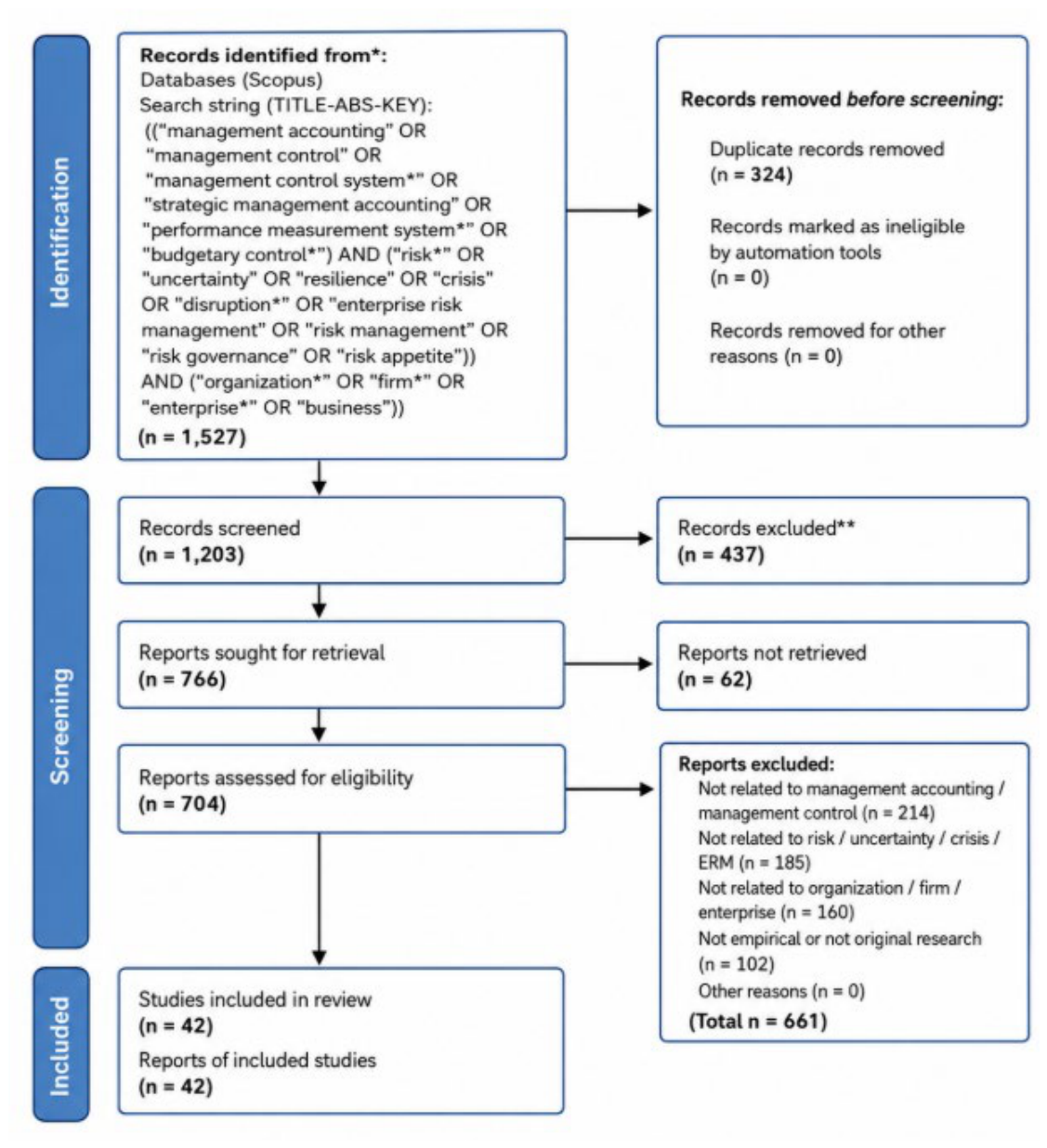
Figure 2.
Methodological process and analytical framework. Author elaboration.
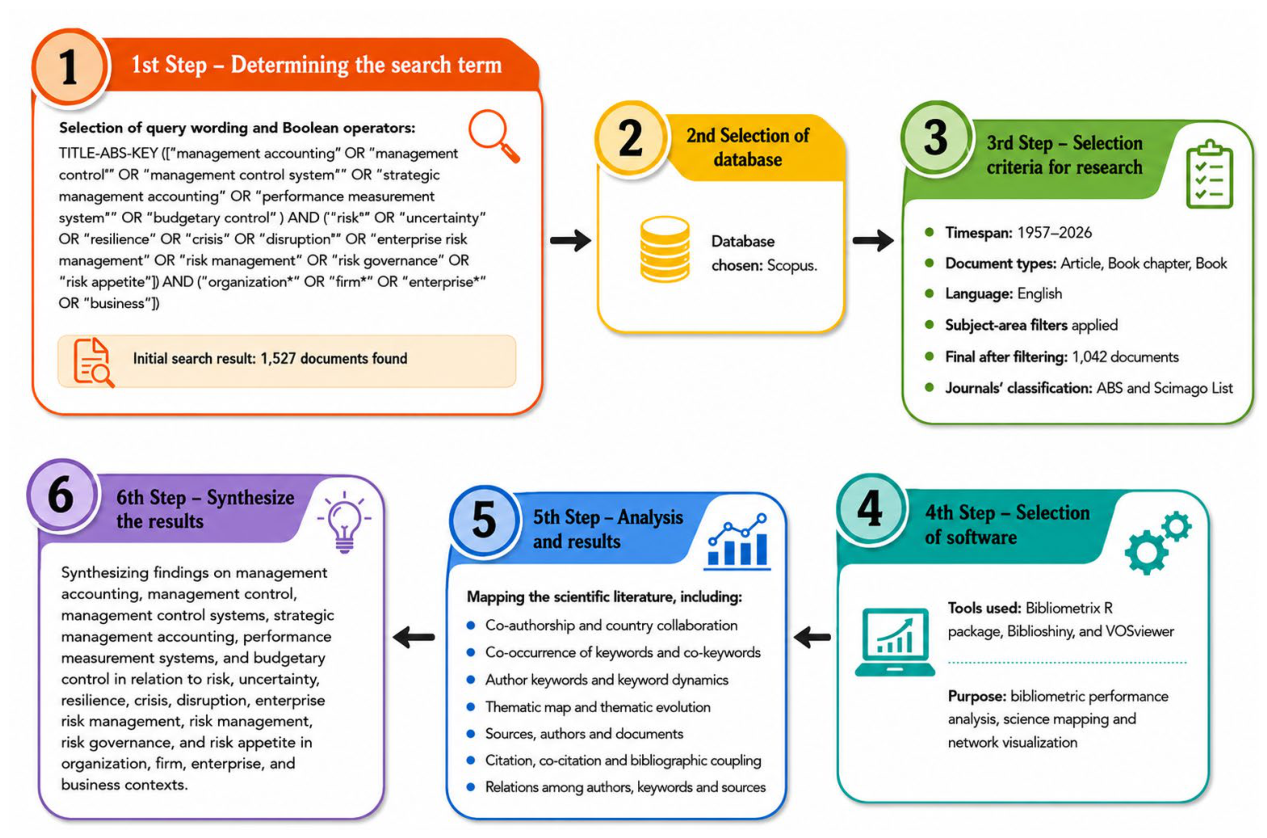
Figure 3.
Main characteristics of the bibliometric dataset. Source: Bibliometrix version 5.3.0.
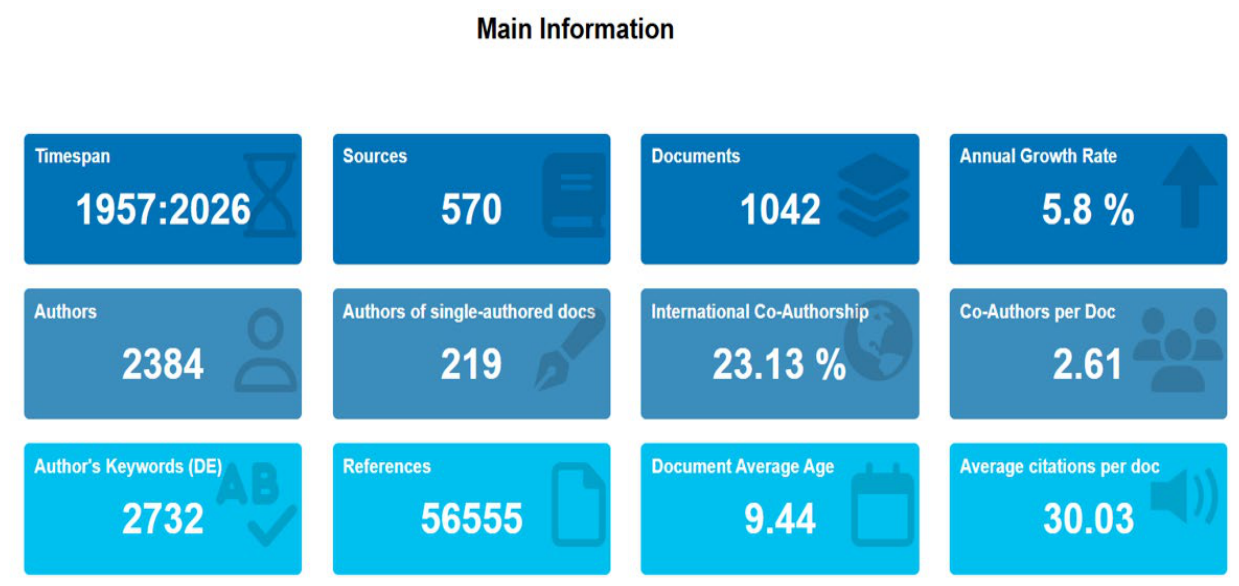
Figure 4.
Annual scientific production. Source: Bibliometrix version 5.3.0.
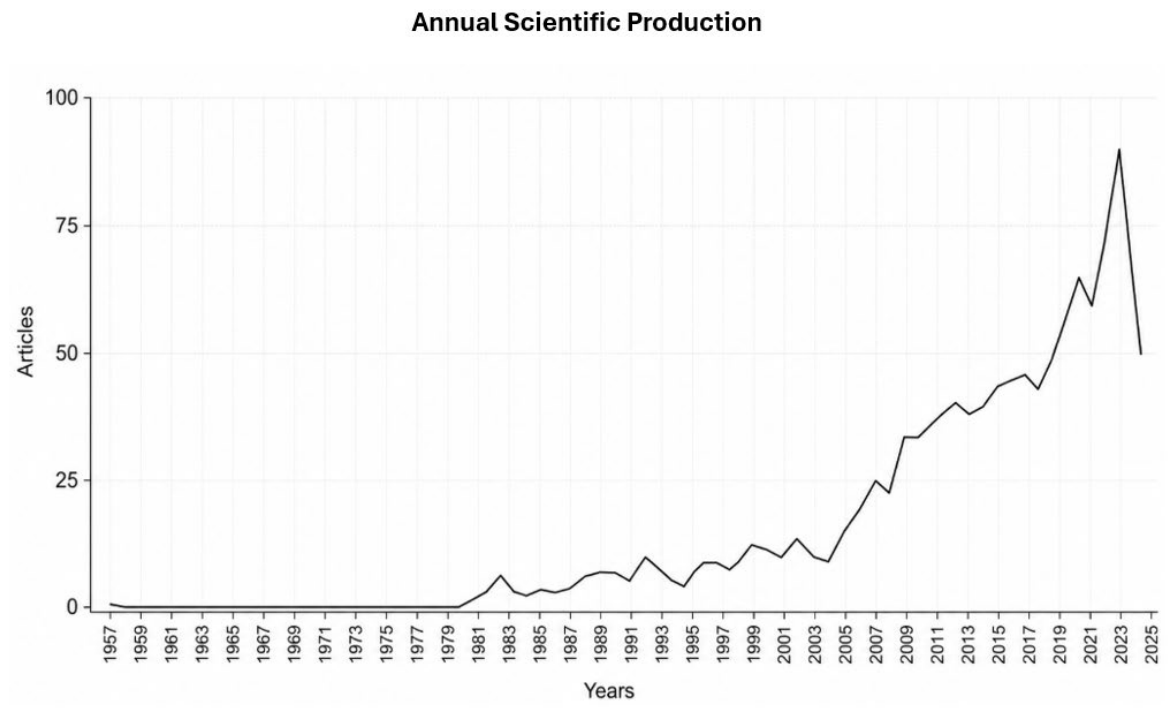
Figure 5.
Co-occurrence network of scientific journals. Source: VOSviewer v.1.6.20.
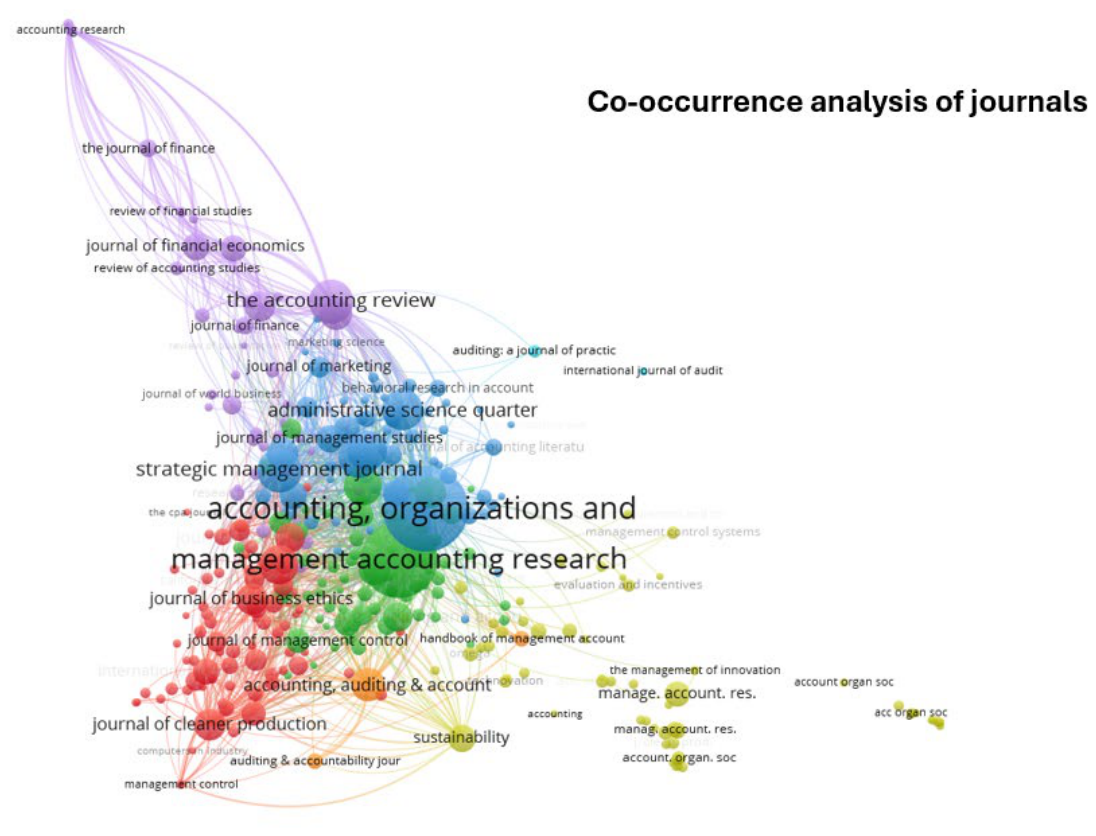
Figure 6.
Co-occurrence analysis of author keywords. Source: VOSviewer v.1.6.20.
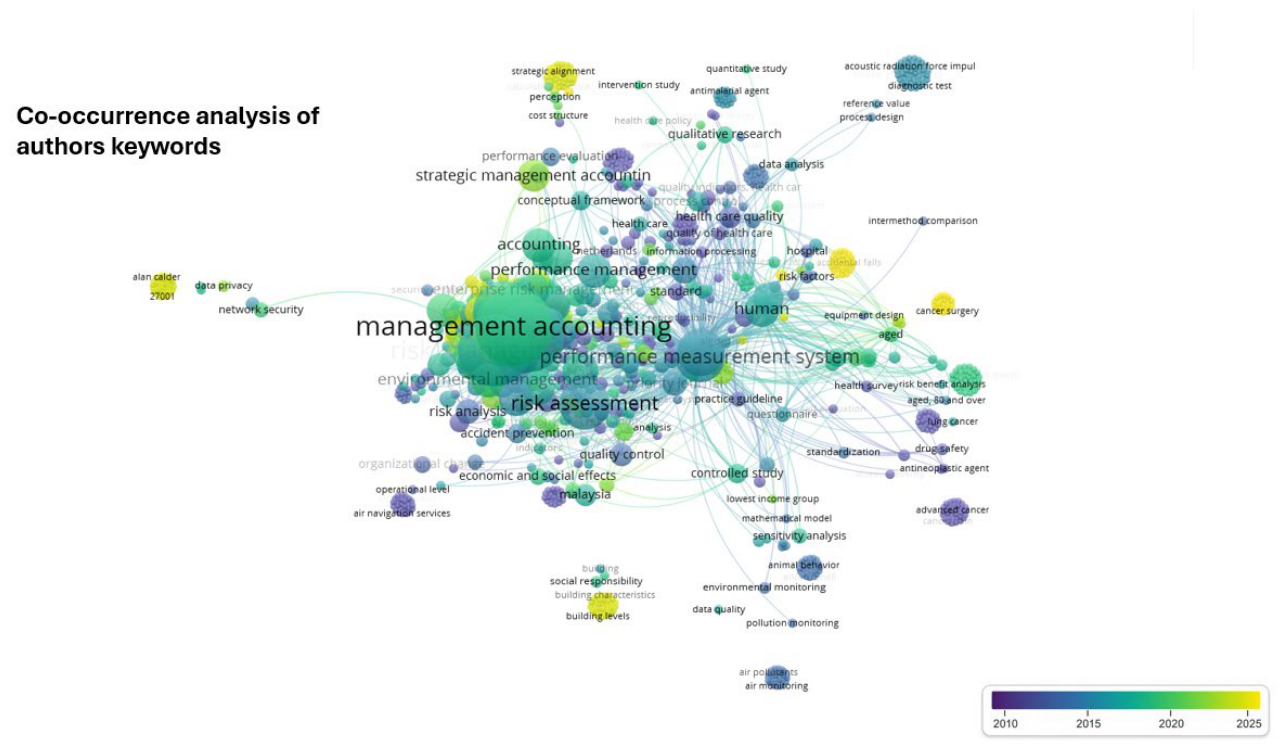
Figure 7.
Scientific production by country. Source: Bibliometrix version 5.3.0.
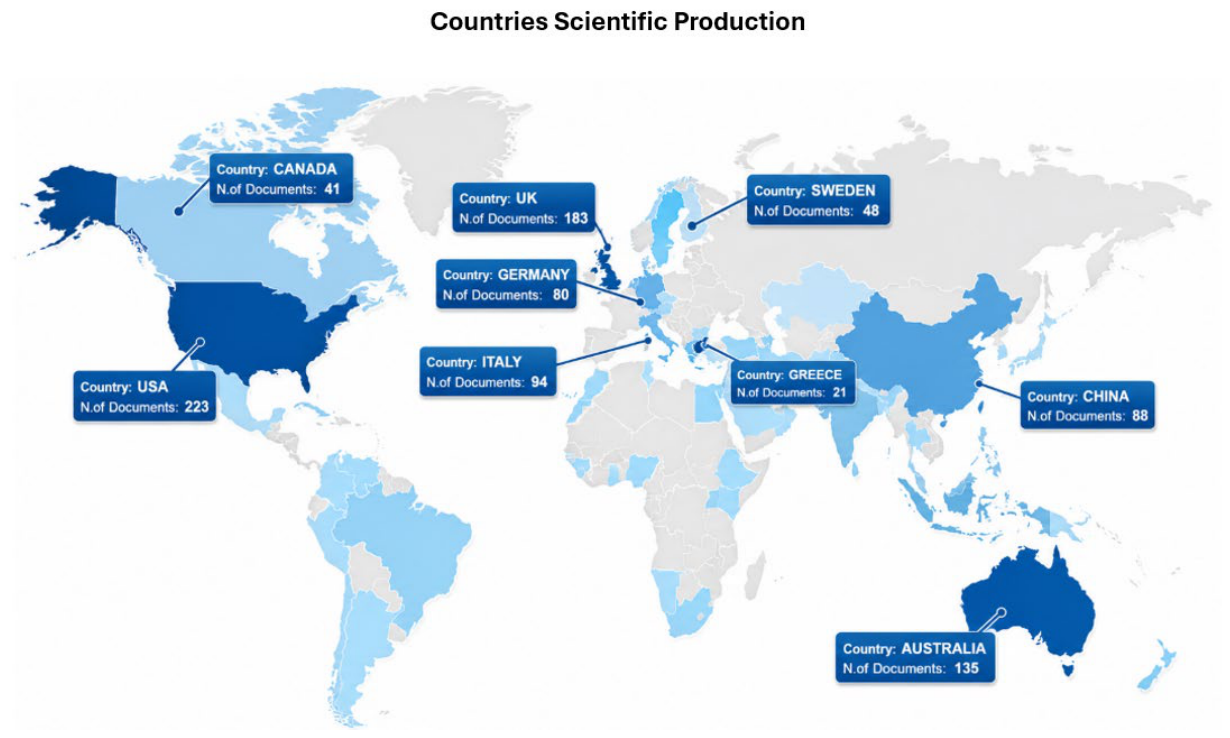
Figure 8.
Thematic map. Source: Bibliometrix version 5.3.0.
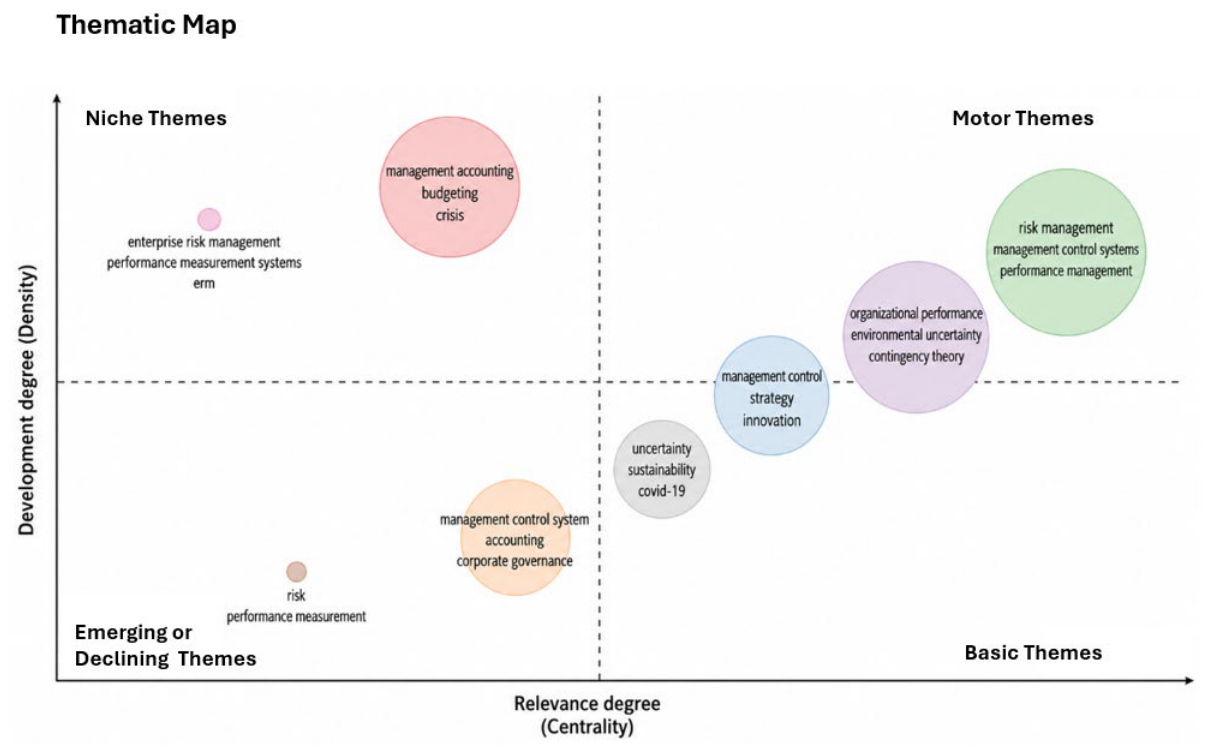
Figure 9.
Multiple correspondence analysis of the conceptual structure. Source: Bibliometrix version 5.3.0.
Figure 9.
Multiple correspondence analysis of the conceptual structure. Source: Bibliometrix version 5.3.0.
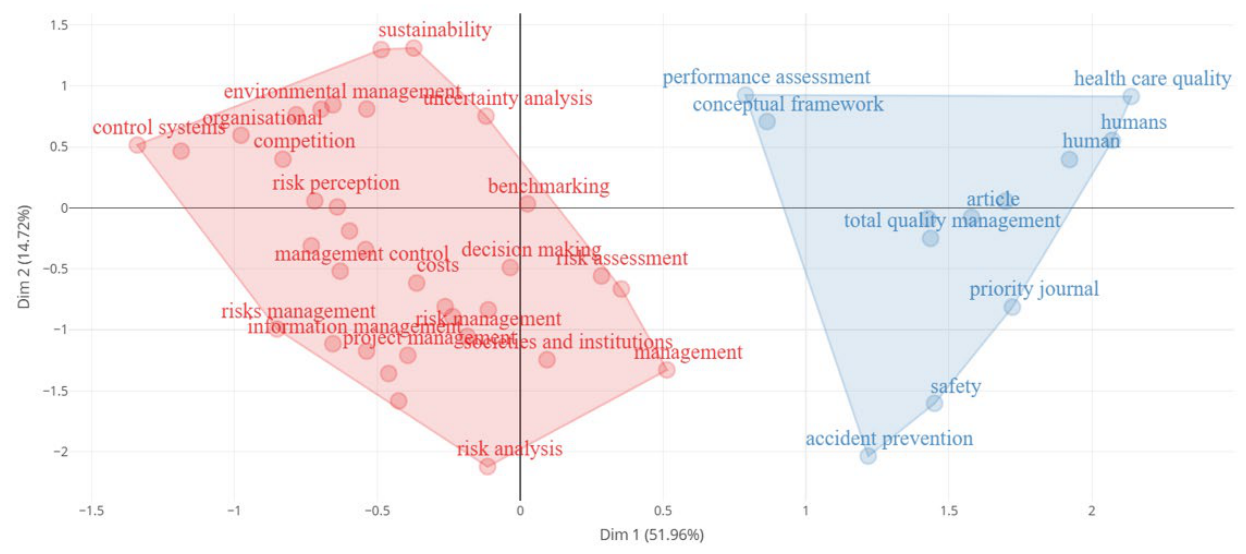
Figure 10.
ERM and risk governance operating cycle enabled by management accounting and control systems. Author elaboration.
Figure 10.
ERM and risk governance operating cycle enabled by management accounting and control systems. Author elaboration.
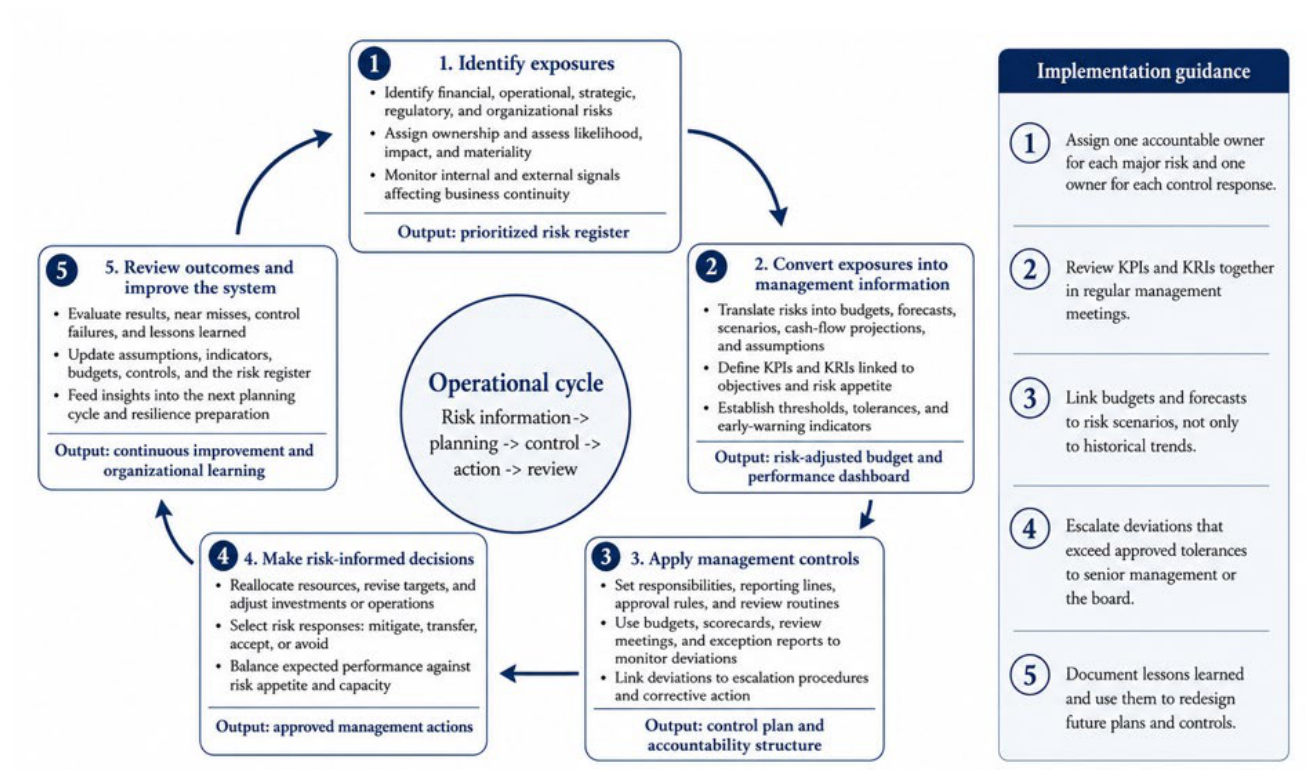

Table 1.
Most productive publication sources in ERM, risk governance, and management-control research. Source: Bibliometrix version 5.3.0.
Table 1.
Most productive publication sources in ERM, risk governance, and management-control research. Source: Bibliometrix version 5.3.0.
| Sources | Subject Area | Number of Publications |
h- Index |
Ranking by ABS |
Ranking by Scimago |
|---|---|---|---|---|---|
| Management Accounting Research | Management accounting; performance measurement; control systems | 29 | 109 | 3* | Q1 |
| Journal of Accounting and Organizational Change | Accounting; organizational change; management | 21 | 43 | 2* | Q1 |
| Accounting, Auditing and Accountability Journal | Accounting; auditing; accountability; governance | 20 | 136 | 3* | Q1 |
| Accounting, Organizations and Society | Accounting; organizations; social and behavioral research | 19 | 170 | 4* | Q1 |
| Journal of Management Control | Management accounting; control systems; strategy | 18 | 37 | 2* | Q1 |
| Sustainability (Switzerland) | Environmental, social and economic sustainability | 16 | 242 | N/A | Q1 |
| British Accounting Review | Accounting; finance; auditing | 15 | 100 | 3* | Q1 |
| Advances in Management Accounting | Management accounting (book series) | 13 | 20 | 2* | Q1† |
| European Accounting Review | Accounting; finance; auditing | 9 | 98 | 3* | Q1 |
| Journal of Applied Accounting Research | Applied accounting; auditing; governance | 9 | 50 | 2* | Q1 |
| Accounting and Business Research | Accounting; finance; business research | 8 | 77 | 3* | Q1 |
Notes: ABS = Chartered ABS Academic Journal Guide 2024. Scimago = SJR Best Quartile (2025 unless noted). “Not listed” means the source does not appear in AJG 2024. † Advances in Management Accounting is a book series; Q1 is its latest available quartile (2023).
Disclaimer/Publisher’s Note: The statements, opinions and data contained in all publications are solely those of the individual author(s) and contributor(s) and not of MDPI and/or the editor(s). MDPI and/or the editor(s) disclaim responsibility for any injury to people or property resulting from any ideas, methods, instructions or products referred to in the content. |
© 2026 by the authors. Licensee MDPI, Basel, Switzerland. This article is an open access article distributed under the terms and conditions of the Creative Commons Attribution (CC BY) license (http://creativecommons.org/licenses/by/4.0/).
Copyright: This open access article is published under a Creative Commons CC BY 4.0 license, which permit the free download, distribution, and reuse, provided that the author and preprint are cited in any reuse.