

Submitted:
07 October 2026
Posted:
09 October 2026
You are already at the latest version
Abstract
Generative AI increasingly supports clinical diagnosis and prognosis, but safe deployment into clinical practice requires standardized evaluation. Evaluation practices from 2022 to 2025 are surveyed, and a five-dimensional framework is introduced: (I) Factual and Contextual Correctness, (II) Safety, Alignment, and Robustness, (III) Reasoning Quality, (IV) Calibration and Uncertainty, and (V) Clinical Anthropomorphism. Current automated and human evaluation methods rely heavily on accuracy, lack multimodal assessment, and are not aligned with human judgment. Emerging benchmarks are assessed and linked to our framework. A hybrid evaluation approach combining automated scalability with expert clinical judgment is recommended for safe and effective deployment.
Keywords:
generative AI
; diagnosis
; prognosis
; large language models
; multimodal AI
; vision language models
; model evaluation
; clinical reasoning
; safety and robustness
; uncertainty and calibration
; anthropomorphism
1. Introduction
Generative artificial intelligence (AI) extends beyond traditional medical AI systems. Previous research has predominantly used AI algorithms for discriminative tasks, including medical image classification and patient risk stratification. In contrast, generative AI enables both discriminative tasks and generative clinical applications, producing new clinical data or content instead of only classifying existing data. Unlike conventional machine learning (ML) models constrained by narrow pattern recognition, generative AI systems can synthesize diverse data sources, such as structured patient histories and unstructured clinical notes, to perform clinical reasoning [1]. It generates differential diagnoses, formulates evidence-based treatment recommendations, adapts to individual clinical scenarios, and offers conversational interfaces that integrate into clinical workflows [2]. This progress has been driven primarily by large language models (LLMs), which have demonstrated strong capabilities across medical examinations, patient and clinician education, disease diagnosis [3], and clinical documentation [4]. However, as these systems move toward clinical deployment, their reliability in the real world remains uncertain, mainly due to limitations in current evaluation approaches [5]. Model performance is frequently summarized using accuracy-based metrics, which can obscure errors, including high-confidence incorrect predictions and non-faithful or logically inconsistent reasoning [6]. As a result, models may appear to perform well on benchmark datasets while remaining unsuitable for clinical deployment due to issues such as lack of robustness, which are not captured by standard benchmark metrics [7]. Moreover, current approaches lack standardization and rely heavily on subjective human judgments, making it difficult to assess performance and safety [8]. This fragmented evaluation landscape exacerbates the risk of premature clinical adoption, as researchers lack unified frameworks for deployment. Without rigorous evaluation methodologies, the gap between experimental promise and real clinical reliability will continue to widen.
In this paper, we review existing evaluation metrics for generative AI in clinical settings, with a focus on LLMs, vision language models (VLMs), and multimodal large language models (MLLMs). We focus on diagnosis and prognosis tasks, which involve the synthesis of multiple sources of evidence and clinical reasoning. We exclude administrative documentation and patient education, as these focus on efficiency and communication rather than the synthesis of incomplete evidence and reasoning under the uncertainty that diagnosis and prognosis require. Although other reviews examine the evaluation of generative AI in healthcare, this work addresses gaps through four contributions. First, we restrict our scope to clinical diagnosis, inference of current conditions and prognosis, prediction of future outcomes, providing a targeted framework for these specific applications rather than a broad assessment of AI in healthcare [7,9,10,11,12]. Second, existing reviews predominantly exclude multimodal AI systems [7,13,14]. Third, while existing reviews provide primarily descriptive overviews, we provide a technical introduction to evaluation metrics for the readers, examining their appropriate applications, limitations, and clinical applicability. Finally, we synthesize a comprehensive evaluation framework that covers multiple evaluation dimensions, including anthropomorphism, the attribution of characteristics similar to humans to non-human entities [15]. In clinical AI, behaviors of the anthropomorphic system shape clinician perceptions of accuracy, reliability, and trust [16]. We define clinical anthropomorphism as the extent to which AI systems exhibit human-like communication styles, affective cues, and empathetic responses during clinical interactions. Evaluating this dimension is critical because excessive anthropomorphism may lead to over-reliance or misplaced trust, while insufficient human-like interaction may hinder clinical adoption.
This review is structured as follows: We first describe the literature search strategy and inclusion criteria used to identify recent studies evaluating generative AI systems for clinical diagnosis and prognosis. We then introduce a task-based taxonomy of clinical applications and analyze how task formulation shapes evaluation design and metric choice. Next, we examine evaluation methodologies, distinguishing between automated metrics and human-centered assessment. We classify evaluation approaches in the literature across five core dimensions: Factual and Contextual Correctness, Safety, Alignment, and Robustness, Reasoning Quality, Calibration and Uncertainty Assessment, and Clinical Anthropomorphism. We also review existing medical benchmarks and discuss their limitations in reflecting real-world clinical reasoning, safety, and uncertainty. Finally, we identify key gaps and open challenges and offer recommendations for developing reliable and clinically meaningful evaluation practices for generative AI systems.
2. Search Methodology
We searched Web of Science and PubMed for publications that use generative AI to generate textual outputs for clinical diagnosis and prognosis. The primary search covered studies published between 2022 and 2025, with additional relevant papers identified during manuscript preparation. Appendix A details our search queries. From 2,267 papers, we selected 99 studies with explicit evaluation methodologies (Figure 1) published in peer-reviewed venues. Our inclusion criteria focused on primary research on diagnosis, risk assessment, and prognosis prediction that applied generative AI models (LLMs, VLMs, MLLMs) to generate free-text clinical output. We excluded applications such as administrative documentation and patient education, as these tasks differ from diagnostic decision-making, which involves reasoning under uncertainty and carries a higher risk of patient harm. We also excluded review papers to avoid using secondary analysis. When multiple studies used identical evaluation setups and metrics, representative examples were retained to avoid over-representation of a single evaluation strategy.
3. Models
This review examines three categories of generative AI architectures in clinical applications: LLMs, VLMs, and MLLMs. All three generate natural language outputs for clinical decision support, but use different input modalities. Throughout this review, we refer to these three architectures collectively as generative AI models.
LLMs process exclusively textual input; studies typically linearize structured clinical data into natural language prompts along with task-specific instructions [18]. VLMs process both image and text inputs [19]. MLLMs process multiple modalities, including text, audio, and images simultaneously [20]. (Figure 2) presents an abstracted schematic of these three families of models and their respective input-output characteristics. The applications of VLMs and MLLMs reflect the nature of clinical decision-making, which is often inherently multimodal [21,22]. Practitioners routinely combine radiological images, laboratory results, clinical notes, and patient histories to make decisions. An underexplored challenge in multimodal AI evaluation is assessing whether systems truly integrate multiple modalities or rely on a single dominant modality. Specifically, robust evaluation frameworks should assess whether these architectures integrate cross-modal information or continue to learn only unimodal signals.
4. Taxonomy of Clinical Tasks
Drawing from established frameworks [9,13,25,26] and tasks observed across the reviewed studies, we developed a taxonomy categorizing clinical applications of generative AI into six groups (Table 1). These task groups range from knowledge-retrieval applications, such as Open-ended Clinical Question and Answer (OQA) and Multiple Choice Questions (MCQ), commonly used as proxies for clinical competency in evaluations, to applied clinical workflow tasks requiring evidence synthesis, including Diagnostic Decision Support (DDS), Risk Prediction (RP), Triage and Referral (TR), and Report Generation (RG). Some tasks, such as MCQ, can assess both factual recall and clinical reasoning depending on the design of the question. Each task demands a different evaluation approach based on its clinical complexity. For example, MCQ tasks typically emphasize classification metrics and factual correctness measures. The DDS, RP, TR, and OQA studies also evaluate clinical reasoning quality, uncertainty quantification, adherence to guidelines, and safety considerations. The RG research focuses on text quality and coherence. The TR studies prioritize the model’s ability to rank patient severity. Tasks influence whether evaluation can be fully automated or needs human judgment. MCQs support automatic grading through answer-matching, whereas OQA, DDS, RP, TR, and RG require human-centric evaluation to assess reasoning quality and contextual correctness.
These tasks can be implemented using any of the model architectures described in Section 3. There is no strict one-to-one mapping between the task type and the model family; the modality of the input data primarily drives the architecture choice. Most reviewed studies use LLMs, reflecting the predominance of text-based clinical datasets and evaluation benchmarks. The clinical literature shows substantial overlap between VLMs and MLLMs, with many studies using MLLMs even for tasks that involve only text and image inputs. This direction likely reflects the growing availability of state-of-the-art MLLMs, which are often applied even when fewer modalities are required.
RG relies most often on VLMs and MLLMs because it typically requires interpreting images, such as radiological images, alongside textual clinical information. In contrast, TR, RP, MCQ, and OQA usually use LLMs and, less frequently, require VLMs or MLLMs. DDS covers a broad range of problem types, including text-only, image-based, and multimodal settings, and appears in studies using LLMs, VLMs, and MLLMs.
5. Evaluation
Standard evaluation metrics for discriminative models fail to capture the complexity of generative AI in clinical settings. Whereas discriminative models can often be evaluated using well-defined metrics such as accuracy, generative models produce open-ended textual outputs whose evaluation spans multiple dimensions, including coherence, relevance, and safety. This challenge is particularly pronounced in clinical contexts, where correctness alone is insufficient, and outputs must also be clinically actionable, relevant, and safe [27]. Thus, researchers are increasingly relying on human feedback and expert evaluation alongside automated metrics to assess the quality of system outputs [28]. In this paper, we organize the evaluation approaches into human and automatic methods.
5.1. Automated Evaluation
We categorize automated evaluation approaches for generative AI into four broad classes: (i) classification metrics, (ii) readability metrics, (iii) text similarity and semantic overlap measures, and (iv) LLM-as-a-judge methods, which employ large language models to assess generation quality along higher-level criteria.
5.1.1. Classification Metrics
Clinical tasks using discriminative approaches often rely on automated metrics [30,31,32]. As illustrated in (Table 2), we categorize these metrics into accuracy-, calibration-, and uncertainty-based measures. Classification metrics are particularly prevalent in MCQ [33] and RP [34] tasks, where models select from a predefined set of discrete outcomes, including binary (e.g., risk vs. no risk) or multiclass labels. In practice, researchers often prompt the generative models to provide a classification or use regular expression (Regex) parsing to map the model’s free-text generation onto a specific class label for quantitative evaluation [35,36].
Although Accuracy is widely used, it is unsuitable for datasets with significant imbalance, which are common in medical contexts. The F1-score and Matthews Correlation Coefficient (MCC) [30,37,38] are often used instead as more robust alternatives. F1-score, the harmonic mean of precision and recall, can be reported using micro or macro averaging. Micro-F1 aggregates classification outcomes across all classes prior to computing precision and recall, and therefore reflects prevalence-weighted, sample-level performance. Macro-F1 averages F1 scores across all classes with equal contribution from each class [39,40]. Unlike accuracy, MCC accounts for all four quadrants of the confusion matrix, ensuring that high performance is not the result of a model over-predicting the majority class [41]. Additionally, Likelihood Ratios offer more clinical utility than standard sensitivity by quantifying how much a positive or negative test result shifts the probability of a disease [29].
Top-k Accuracy is the proportion of examples in which the reference label, or any of multiple valid reference labels, appears within the model’s top-k highest-confidence predictions. This evaluation is prevalent in differential diagnosis generation, and TR, where clinical utility derives from presenting a ranked shortlist of plausible diagnoses rather than requiring a single correct prediction [42]. Top-k accuracy reflects clinical workflows where multiple valid diagnostic hypotheses may coexist, and comprehensive differential coverage may be more valuable than precise rank ordering. The Area Under the Receiver Operating Characteristic curve (AUROC) [43] and the Area Under Precision–Recall Curve (AUCPR) [44] are widely used discrimination metrics in healthcare classification tasks. AUCPR is often preferred for imbalanced clinical datasets, such as rare disease diagnosis, because AUROC gives overly optimistic estimates when performance in the minority class is poor [45]. However, recent theoretical analysis shows that the primary difference between AUROC and AUCPR is how they weigh model mistakes [46]. AUROC evaluates model performance uniformly across samples, treating improvements equally regardless of prediction confidence. AUCPR is sensitive to performance improvements in samples assigned high-confidence scores, those that the model predicts with greatest certainty as positive, while demonstrating relative insensitivity to changes in the ranking of lower-confidence predictions. This property has important clinical implications because AUCPR may prioritize model improvement in high-prevalence subpopulations at the expense of lower-prevalence groups, increasing algorithmic unfairness in diverse healthcare settings. Therefore, metric selection should be guided by clinical priorities and population characteristics. AUROC is appropriate for prevalence-invariant model comparisons and for safety-critical applications where false negative errors have severe consequences, such as cancer screening. AUCPR is more suitable in situations where false positives incur substantial costs and distributional fairness is a secondary concern, such as prioritizing high-confidence candidates in early-stage drug discovery pipelines rather than disease diagnosis and prognosis [46]. In multiclass classification, both metrics are typically calculated using aggregation strategies that reduce the problem to multiple binary evaluations [47].
The second category of metrics focuses on Uncertainty Quantification and Calibration. Calibration refers to the alignment between the predicted probabilities of a model and the true frequency of the outcomes and includes metrics such as Brier Score (BS) [38,48,49] and Expected Calibration Error (ECE) [32,50]. Although uncertainty quantification evaluates the model’s ability to express confidence levels in its predictions and includes metrics such as Monte Carlo (MC) Dropout, which obtains uncertainty estimates by performing multiple stochastic forward passes through the network at inference time with dropout mechanisms maintained active and calculating the sample variance across passes [51]. In high-stakes healthcare settings, the ability of a model to be aware of its uncertainty can be as important as its predictive capacity [52,53]. Overconfident but incorrect predictions can undermine clinician trust and lead to inappropriate interventions, while under-confident predictions may result in diagnostic delays. This assessment is vital for safe integration into clinical workflows, where the low confidence expression of an AI can trigger a manual review by a human specialist [54].
5.1.2. Readability Metrics
The readability and linguistic complexity metrics assess how easily diverse audiences can understand AI-generated medical content. To evaluate this, the researchers employ a variety of automated formulas as summarized in (Table 3). The FRE formula estimates the educational level required to comprehend a text [55]. The FKGL [56] is a simplified adaptation of the FRE that calculates the ease score using a grade scale rather than a numerical value from 0 to 100. GFI and Linsear Write Formula (LWF), also estimate grade level but factors in the number of complex words, those with three or more syllables [57,58]. Higher grade levels indicate greater text complexity. The SMOG [59] index calculates how many years of education a reader needs to comprehend a text by focusing on the number of polysyllabic words, defined as words with three or more syllables. ARI [60] and CLI measure complexity in terms of the number of letters per word and words per sentence. The Dale-Chall score [61] and Spache Readability score [62] use sentence length and word familiarity lists. These lists constitute a set of words that are considered difficult because they are not commonly used. These metrics help ensure that text remains accessible to patients and non-specialist clinicians by avoiding excessive medical or technical terminology [58,63].
5.1.3. Text Similarity and Semantic Overlap Measures
Traditional evaluations that use discrete labels for comparison cannot robustly assess open-ended output from tasks such as RG, OQA, and DDS. (Table 4) shows our categorization of text generation metrics into two main types: lexical overlap and embedding-based similarity. These metrics generally compare model output with gold-standard or expert-generated reference texts.
In the first group, lexical overlap, metrics rely on text matching between the model’s output and ground truth texts. Although computationally efficient and widely adopted due to their simplicity, they often do not capture semantic coherence, context, or clinical reasoning quality. They are based on n-gram matching, where n represents the number of consecutive words evaluated as a unit. The Bilingual Evaluation Understudy (BLEU) calculates a weighted geometric mean of n-gram precision scores [64]. Despite its popularity across generation tasks, BLEU often correlates poorly with human judgments in open-ended scenarios, likely because developers originally designed it for machine translation [65]. Exact Match (EM) quantifies the proportion of model predictions that match ground truth labels, providing a strict correctness measure. The F-score can also be used to quantify the overlap between generated and reference outputs by computing precision and recall over text units [66]. Recall-Oriented Understudy for Gisting Evaluation (ROUGE) measures n-gram recall and commonly assesses summarization tasks. ROUGE includes several variants based on the length of n-gram, most commonly measured as unigrams (ROUGE-1), bigrams (ROUGE-2), and the longest common subsequence (ROUGE-L) [67]. METEOR goes beyond word matching by considering synonym matching and morphological stemming, often better correlated with human rankings in contexts such as image captioning [65,68]. Embedding-based similarity measures move beyond surface-level lexical overlap and compare word vector representations of text. A commonly used metric is cosine similarity, which quantifies the semantic similarity between two embedding vectors [69]. BERTScore, illustrated in (Figure 3), computes cosine similarities between contextualized embeddings derived from a BERT model. By leveraging contextual embeddings, BERTScore is more aligned with semantic similarity than n-gram-based metrics, especially in summaries in RG or OQA settings [70].
5.1.4. LLM-as-a-Judge
The LLM-as-a-judge evaluation paradigm [71,72] prompts an LLM to assess the quality of the output of another generative AI model (Figure 4). This method combines the scalability and efficiency of automated evaluation with the potential to capture nuanced, multidimensional expert-like judgments. Building on the framework from [71], LLM-as-a-judge includes three variations: (i) Pairwise comparison: The LLM judge receives a question and two responses, then determines which answer is superior or whether they are equivalent in quality; (ii) Single-answer grading: In this method, the LLM rates a response with a score; (iii) Reference-guided grading: The LLM judge is provided with a gold-standard reference answer and uses it to evaluate the quality and correctness of the model-generated output.
Reviewed studies show a clear shift from simple, binary "Is this accurate?" queries to sophisticated, grounded evaluation frameworks. Instead of relying on unstructured model judgments, researchers often provide evaluator models with explicit rubrics and predefined criteria for assessment [73,74,75]. The choice of prompting strategy varies depending on the evaluation setting. Reference-guided grading is most commonly used when ground-truth answers are available, such as in DDS [74,76], whereas pairwise comparison [73] and single-answer grading are less common than reference-guided grading. Overall, the literature shows a trend toward increasingly structured prompt design that incorporates domain knowledge, explicit criteria, or reference-based grounding to obtain more reliable clinical evaluations.
LLM-as-a-judge can still work without ground-truth references, especially for criteria like conciseness and human-likeness. This advantage, lacking in traditional automated metrics, improves scalability. However, using one LLM to judge another raises concerns about the validity of the judgment and amplifies weaknesses such as prompt dependence, overconfident assessments, and bias of the evaluator’s model. Recent frameworks address these issues with techniques such as multi-source evaluation, in which LLM judgments are aggregated across multiple independent evaluation configurations to improve robustness and reduce stochastic variation. In practice, this often means running repeated evaluations on identical content using different prompts [77], as shown in the multi-round evaluation (Figure 4). To reduce single-model biases, some researchers use multi-model evaluation, in which different LLMs independently evaluate model output, as shown in (Figure 4). For example, some frameworks use voting mechanisms across multiple judge models to determine final evaluation outcomes, while others use peer-review architectures [78] wherein LLMs evaluate each other’s outputs [79].
Automated evaluation methods are often preferred due to their scalability, reproducibility, and suitability for large-scale benchmarking. However, widely used text-similarity measures, such as embedding-based metrics, have been shown to correlate poorly with expert clinical judgments [27]. In comparison, LLM-as-a-judge frameworks have a stronger alignment with human evaluations by assessing higher-level qualitative attributes such as clinical reasoning, coherence, and correctness [72]. This positions LLM-as-a-judge as a promising intermediary evaluation paradigm that partially bridges the gap between scalable automated metrics and expert human assessment.
Despite LLM-as-a-judge’s promise, human evaluation remains essential. Human experts detect subtle medical errors, context-dependent risks, and clinical nuances, such as whether recommendations balance individual risk and benefit. Robust evaluation frameworks increasingly emphasize hybrid strategies that combine automated metrics with human assessment. Some approaches implement human-in-the-loop validation, where expert evaluators review a subset of LLM-as-a-judge outputs, reducing workload while preserving expert oversight and reliability [74].
5.2. Human Evaluation
Despite advances in automated evaluation methods, expert human evaluation remains the gold standard for assessing generative AI in healthcare. Most studies use structured questionnaires or rating scales, in which clinicians assess predefined criteria such as correctness, guideline adherence, safety, empathy, and communicative quality [80,81]. Based on our review, the majority of studies use small panels of domain experts to evaluate the model’s outputs, typically involving one [82] to six clinicians [80,83], who evaluate multiple dimensions beyond correctness, including relevance, completeness, helpfulness, quality of explanations, and safety or guideline adherence. Larger evaluator panels have been reported in a limited number of studies (e.g., 11 or 28 evaluators [84,85]), although this remains rare due to resource constraints. Following the framework established by [65], we organize human evaluation approaches into intrinsic and extrinsic evaluation methods. We also examine commonly used questionnaires in healthcare settings and discuss inter-evaluator agreement metrics. We present a taxonomy of the human-based evaluation criteria most commonly used to evaluate generative AI systems in clinical settings in (Table 5).
5.2.1. Intrinsic Evaluation
Intrinsic evaluation focuses on assessing the quality of the outputs generated independently of any performance of the downstream task [65]. In clinical AI, this typically involves expert clinicians rating model responses across multiple criteria, including explanation quality, using structured rating instruments. The intrinsic evaluation criteria are presented in (Table 5). The Likert scale is the most commonly used metric here, which allows evaluators to assign scores within a specified range [83,86], where higher values indicate a better overall response quality. In our review, 5-point scales emerged as the predominant choice, although some studies employ 7-point scales to capture more nuanced distinctions in quality [87,88]. An alternative approach uses categorical grading schemes with descriptive labels (e.g., "excellent," "good," "acceptable," "poor," "very poor") [83].
5.2.2. Extrinsic Evaluation
Extrinsic human-evaluation assess the impact of a model on downstream clinical tasks. For example, [89] evaluated the performance of ChatGPT in managing postoperative complications after facial esthetic surgery. The study tested the model’s ability to perform clinical tasks, including generating differential diagnoses, gathering relevant patient histories, formulating diagnoses, and recommending appropriate dispositions, ranging from urgent emergency referrals to routine surgical follow-ups. The Extrinsic evaluation criteria are presented in (Table 5). Extrinsic evaluation directly measures the downstream clinical impact and provides a more meaningful assessment of the behavior of the model.
5.2.3. Questionnaires
A wide range of structured questionnaires are used for human evaluation in healthcare generative AI studies, such as DISCERN [90] and modified DISCERN (mDISCERN), Global Quality Score (GQS), JAMA benchmark criteria, and custom clinical relevance or safety rubrics tailored to specific specialties and tasks [91,92,93,94]. DISCERN is a standardized questionnaire originally developed to assess the quality and reliability of written health information with respect to treatment choices. It consists of a structured set of items that evaluate key dimensions, such as the clarity of aims, the relevance and balance of information, the transparency of sources, the discussion of benefits and risks, and the acknowledgement of uncertainty. Each item is typically rated on a Likert scale. In healthcare generative AI evaluation, DISCERN and its adapted variants (e.g., modified DISCERN, [95], which represents a subset of the original DISCERN tool [96]) are widely used in human-based evaluations to assess the reliability, clinical soundness, and overall quality of generated responses [97,98,99,97]. GQS [100] is a shorter instrument than DISCERN that evaluates the overall quality and usefulness of health information. It uses a five-point Likert scale, with scores from 1 (poor) to 5 (excellent). Originally designed for patient-facing health websites, researchers now use GQS to assess generative AI output because of its simplicity, clinical intuitiveness, and ability to summarize usefulness in one score. JAMA benchmarks criteria [101] are based on the evaluation of four key dimensions: (i) transparency of authorship, requiring clear identification of contributors; (ii) attribution, ensuring that all claims are supported by explicit references; (iii) disclosure, mandating full visibility of website ownership and potential conflicts of interest; and (iv) currency, which evaluates whether publication and update dates are clearly reported to reflect the timeliness of the content. This allows researchers to verify whether generative AI models can reference guidelines correctly [97].
5.3. Inter-Rater Agreement
Inter-rater agreement measures the reliability and consistency of expert assessments. Clinical interpretation and evaluation are subjective and can vary with experience, training, and institutional practices, so studies recruit multiple evaluators and report agreement metrics to address this subjectivity. Beyond measuring reliability, inter-rater agreement serves as a valuable indicator of multiple factors such as evaluator expertise, ambiguity or difficulty of the clinical task being evaluated, and the clarity of evaluation criteria and rating scales. Low agreement may signal poorly defined evaluation rubrics, clinical ambiguity requiring a larger number of experts, or insufficient evaluator training. High agreement may suggest well-operationalized assessment dimensions and consistent interpretation of quality standards [65]. The reviewed literature frequently uses Cohen’s kappa, Fleiss’s kappa, and the Intraclass Correlation Coefficient.
5.3.0.1. Cohen’s Kappa ().
It measures the agreement between two evaluators assigning categorical or ordinal labels while correcting for the agreement expected by chance [102]. It is widely used for categorical judgments such as correctness, safety, presence of hallucinations, or adherence to guidelines. The formula for Cohen’s Kappa is shown in Eq. (1), where denotes the observed proportion of agreement between evaluators, and represents the expected agreement by chance. The values of range from to 1, where 1 is perfect agreement between the evaluators, and 0 indicates chance-level agreement.
5.3.0.2. Fleiss’s Kappa ().
It extends Cohen’s kappa to scenarios involving more than two evaluators assigning categorical ratings [103]. It is commonly applied in studies that rely on expert panels to assess dimensions such as quality, safety, or clinical appropriateness. The formula for Fleiss’s Kappa is shown in Eq. (2), where denotes the mean observed agreement across all evaluated items, while represents the mean agreement expected by chance.
5.3.0.3. Intraclass Correlation Coefficient (ICC).
It is used to assess agreement for continuous or ordinal ratings. ICC is variance-based and quantifies the proportion of total variance attributable to differences between the evaluated items. There are multiple ICC formulations, depending on the experimental design and the definition of agreement; more details can be found in [104].
The above metrics are important when using multiple human raters to ensure alignment with experts. Consequently, transparent reporting of the evaluator scoring procedures and agreement metrics is essential to establish the credibility and reproducibility of human-based evaluation in the generative AI research of healthcare [65]. Although human evaluation is often considered the gold standard, it presents substantial methodological challenges. Evaluators can use crowd-sourcing for general-domain tasks, but clinical evaluation requires domain specialists, which is expensive to obtain. In addition, recruiting evaluators with comparable expertise and speciality training across studies is difficult, and many publications provide insufficient detail about their evaluation protocols, making replication difficult.
Human evaluation can introduce bias into expert assessments of AI-generated output. Human evaluators may show two contrasting forms of bias. First, evaluators can show automation bias by over-relying on or uncritically accepting AI recommendations, overestimating algorithmic capabilities [16,105,106]. Evaluators may also show algorithm aversion, applying overly strict standards to AI outputs due to skepticism about machine reliability or expectations of systematic errors [107]. These biases can compromise the validity of the evaluation, as quality ratings may reflect the prior beliefs of the evaluators about AI rather than objective assessments of clinical suitability and output quality. To mitigate these biases, some studies use blinded assessment, so human evaluators do not know whether outputs come from clinicians or AI systems [108,109]. This approach ensures that evaluators judge quality on the merit of the content rather than the source, isolating the clinical quality assessment from confounding beliefs about technology versus human competence.
Automated metrics, human evaluation, and LLM-as-a-judge approaches each offer distinct advantages, but none alone can evaluate generative AI systems for clinical diagnosis and prognosis. Automated metrics provide scalability and reproducibility, but do not capture clinically critical properties such as reasoning validity, safety, or contextual appropriateness. Human evaluation remains the gold standard for assessing these dimensions, but is limited by subjectivity, restricted reproducibility, and significant resource demands. LLM-as-a-judge frameworks partially address these limitations by enabling scalable assessment of higher-level qualities, but they introduce additional sources of bias and sensitivity to prompts. Evaluators should select and combine strategies based on the clinical risk level, the intended use case, and the maturity of the deployment. Low-risk exploratory tasks can be based on automated metrics, while high-risk diagnostic and prognostic applications require hybrid frameworks that combine expert human oversight with structured automated assessment. In clinical settings, relying on a single evaluation method risks misleading performance estimates and unwarranted confidence in the readiness of the system.
6. A Multi-Dimensional Evaluation Framework
Clinical diagnosis and prognosis require more than an accurate prediction; they require sound reasoning, clear expression of uncertainty, and responsible communication. Current evaluation practices for generative AI remain fragmented, and evaluations primarily focus on accuracy while overlooking essential properties for clinical reliability. To address these gaps, we unify existing methodologies into a five-dimensional evaluation framework and extend them to include under-evaluated aspects, such as reasoning quality. The framework includes: (i) Factual and Contextual Correctness, (ii) Safety, Alignment, and Robustness, (iii) Reasoning Quality, (iv) Calibration and Uncertainty, and (v) Clinical Anthropomorphism (see Figure 5 for a comprehensive taxonomy). Structuring evaluation along these dimensions provides a systematic basis for identifying weaknesses, comparing systems, and assessing readiness for real-world clinical integration.
6.1. Dimension I: Factual and Contextual Correctness
Because model outputs directly influence patient safety and clinical decision-making, factual and contextual correctness constitute a fundamental requirement. The literature (Table 6, Table 7, Table 8) primarily evaluates this dimension using either classification metrics or embedding similarity and semantic overlap measures. For classification tasks such as RP, researchers prompt models to generate discrete binary risk labels and rely on traditional classification metrics, including Accuracy, Recall, Specificity, Precision, and F1-score. For generative tasks such as DDS, RG, or OQA, correctness is evaluated using automated metrics, human evaluation, or a combination of both. Automated methods range from lexical overlap metrics, such as BLEU, METEOR, and ROUGE, to embedding-based metrics such as BERTScore and cosine similarity. In clinical settings, some studies also use medical language embeddings to evaluate whether the generated output accurately reflects domain-specific clinical concepts and terminology [87]. Beyond automated metrics, human evaluation remains a key component of factual correctness assessment, especially for validating clinical correctness, completeness, relevance, and detection of hallucinations. Researchers often systematize these qualitative assessments using a questionnaire or custom Likert scales.
Our review shows that most studies incorporate evaluation criteria from this dimension, either alone or with others. This is expected since factual correctness is the primary prerequisite for the validity and reliability of the system. However, focusing solely on correctness metrics is insufficient for clinical adoption. To facilitate acceptance among clinicians, evaluation frameworks should address additional dimensions, such as safety, transparency of reasoning, uncertainty quantification, and dynamics of human-system interaction. Without evaluation across additional dimensions, systems assessed solely on correctness metrics may demonstrate strong benchmark performance, yet remain unsuitable for clinical deployment.
6.2. Dimension II: Safety, Alignment, and Robustness
This dimension covers clinical safety, expert alignment, and output consistency. (Table 9) shows that the evaluation of these properties now plays a central role in the evaluation of AI generative systems in clinical settings. We organize this dimension into safety and clinical appropriateness, inter-rater concordance, output stability, and biases [75,123].
The safety evaluation focuses on identifying unsafe recommendations, possible patient harm, and clinical appropriateness. These assessments typically require expert human judgment or LLM-as-a-judge approaches, since they cannot be reliably quantified using standard automated metrics [76,80,81]. Another concern is over-recommendation, which involves unnecessary interventions, and under-recommendation, which involves failing to escalate appropriate care. Each has significant clinical and economic consequences.
Agreement metrics constitute a critical foundation for evaluating model alignment and trustworthiness within clinical workflows. These metrics capture both external and internal forms of agreement. External agreement metrics assess concordance between model output, experts, and established clinical standards, and consistency across outputs from different generative models [155]. The consistency across different generative models highlights whether independent systems converge on similar clinical conclusions when presented with identical cases. High agreement may indicate robust performance, while divergence warrants investigation of the sources of discordance.
Internal agreement metrics measure the consistency of a model’s own outputs across repeated evaluations. The stochastic nature of generative AI introduces variability across repeated inferences. Unlike deterministic systems that produce identical outputs for identical inputs, generative models may produce different responses when queried multiple times with the same clinical scenario due to decoding strategies. Researchers are increasingly evaluating output consistency by conducting multiple inference runs and quantifying response stability [125,133,156].
The bias assessment examines performance across linguistic and demographic variation. Some studies observe a stronger performance for English prompts than for other languages [157], whereas others report a more consistent multilingual performance [158]. These findings suggest that performance may differ across languages, possibly because some languages, such as English, are more prevalent in the model’s training data. When deploying clinical AI systems in underrepresented languages, researchers should perform language-specific evaluation to ensure reliable performance.
A limited but growing body of work evaluates whether diagnostic or treatment recommendations vary according to the characteristics of the protected patient [159]. Such biases pose substantial safety and equity concerns, particularly in large healthcare systems serving demographically diverse patient populations. [160] evaluated model performance across identical clinical scenarios with and without explicit demographic racial information and found that including racial identifiers led to inferior treatment recommendations while diagnostic accuracy largely stayed the same. These findings highlight the need to evaluate bias across demographic variables such as race, ethnicity, sex, age, and socioeconomic status, to identify and mitigate algorithmic inequity before deployment. This assessment ensures that generative AI systems provide equitable clinical decision support for all patients.
6.3. Dimension III: Reasoning Quality
This dimension examines whether the model reasons logically and justifies its clinical decisions appropriately. Our analysis included studies that explicitly evaluated model reasoning (Table 10). Researchers typically use chain-of-thought (CoT) prompting [161] to extract model reasoning, instructing models to think step by step and explain their reasoning. Reasoning evaluation metrics in healthcare AI research remain poorly standardized and vary considerably across studies. To improve reproducibility, we define four core metrics: (i) logical consistency, (ii) clinical reasoning, (iii) reasoning error, and (iv) reasoning clarity. Logical consistency refers to the alignment between the explanation of a model and its final diagnosis. For example, if a model diagnoses influenza, the symptoms described in its reasoning should match those of influenza rather than those of a generic respiratory infection. Clinical reasoning evaluates whether a model follows the clinical decision-making processes used by healthcare practitioners. Specifically, the model should (i) synthesize patient symptoms and medical histories, (ii) identify relevant clinical information, (iii) generate and assess diagnostic hypotheses, and (iv) provide a justified final diagnosis [162]. Reasoning error examines logical flaws within the reasoning process, such as incorrect intermediate steps, reasoning that violates clinical guidelines, or unsupported conclusions. Reasoning clarity evaluates how transparent and understandable the model’s reasoning steps are, ensuring that clinical experts can follow the logical progression from symptoms to diagnosis. These metrics are primarily evaluated using either human evaluators or LLM-as-a-judge approaches. Most studies rely on expert clinician evaluation rather than automated methods. This reflects both the complexity of reasoning evaluation and the current limitations in automated metrics to capture clinical logic. Future work should follow standardized reasoning evaluation with public datasets.
6.4. Dimension IV: Calibration and Uncertainty Assessment
Assessing model uncertainty is essential for the safe deployment of generative AI systems. This is true more so in healthcare environments, where a model’s capacity to recognize the limits of its knowledge is as important as its predictive accuracy [6,52]. Overconfident erroneous predictions may precipitate inappropriate clinical interventions or diagnostic errors, whereas under-confident predictions can result in diagnostic delays, unnecessary additional testing, or delayed escalation.
Multiple approaches have been developed to extract uncertainty estimates from generative AI models (Table 11), broadly categorized into white-box methods that require model access and black-box methods applicable to proprietary systems. Monte Carlo (MC) Dropout represents a white-box approach, and a key advantage is its practical accessibility, where uncertainty estimates can be extracted from existing dropout-trained networks without architectural modifications or retraining [51,110]. However, MC Dropout requires direct model access to estimate uncertainty, presenting significant challenges when evaluating closed-source generative AI, which provides limited access to internal model parameters. Closed-source models methodologies (Figure 6) include: (i) Confidence elicitation (CE) [163] which directly prompts the model to verbalize its uncertainty on a numerical scale, typically 0-100; (ii) Token-level probabilities (TLP) derive uncertainty metrics directly from the conditional probability distributions calculated at each generation step (as defined in Figure 2). By accessing the probabilities of the tokens, researchers can calculate uncertainty scores such as the average, maximum, minimum, or total entropy across the generated sequence. (iii) Sample consistency (SC) leverages the stochastic nature of generative AI by submitting identical prompts multiple times and measuring inter-response agreement. The underlying assumption is that confident models produce consistent responses, whereas uncertain models produce divergent responses [49,164].
Calibration is an important requirement for clinical deployment, because predicted probabilities should reflect true outcome frequencies. For example, when a diagnostic model expresses low confidence in its output, clinicians may choose to request additional tests or override automated recommendations. When employing metrics such as ECE BS, generative models are prompted to output confidence scores, which are then used to compute these metrics [32,38]. Well-calibrated models ensure that predictions reported with 90% confidence are correct approximately 90% of the time [50]. Current evidence indicates that calibration performance varies considerably across LLM uncertainty estimation methods. SC approaches demonstrate a stronger discriminative ability than CE and TLP methods to distinguish correct from incorrect predictions. Both CE and TLP frequently exhibit poor calibration. In particular, CE methods overestimate model certainty, with calibration plots revealing that models report high confidence even when actual accuracy is lower [49,136]. Overall, these findings suggest that reliable calibration and uncertainty estimation remain an unresolved challenge, underscoring the need for improved techniques and standardized protocols for evaluation before deploying generative AI systems in clinical settings.
6.5. Dimension V: Clinical Anthropomorphism
Human-like communication by generative AI can influence clinician trust and reliance beyond diagnostic accuracy; clinical anthropomorphism now plays a larger role in evaluation. Most studies (see Table 12) use human judgment to assess qualities such as empathy, helpfulness, user-friendliness, and human-likeness. Early studies measured this indirectly through readability indices and verbosity metrics. However, recent research has begun to explicitly examine how anthropomorphism affects trust and trust behaviors of clinicians [106]. Empirical evidence shows that the behaviors of the anthropomorphic system alter clinical decision processes. Specifically, recent work demonstrates that human-like linguistic competences and conversational framing can enhance perceived usability while increasing the risk of inappropriate reliance on erroneous recommendations [16]. This is especially salient in high-stakes clinical contexts, where persuasive, empathetic, or fluent responses may be interpreted as indicators of competence rather than as stylistic attributes [106]. The reviewed literature reveals two patterns. The first, which we term perceptual alignment, focuses on subjective impressions of system behavior, including empathy, human-likeness, helpfulness, and overall user friendliness. These metrics are typically assessed through human ratings or LLM-as-a-judge. The second, cognitive accessibility, measures how easily users process model output, typically using conciseness scores and established readability indices such as Flesch Reading Ease and Flesch–Kincaid Grade Level. These measures allow for automatic computation. Although conciseness is often valued to avoid "verbosity" issues, recent studies suggest that elaboration of recommendations, providing detailed justifications rather than brief answers, is a behavior that increases clinician trust [106]. This suggests that "helpfulness" in a clinical context is tied to the transparency of reasoning rather than the brevity of the response. [16] shows that anthropomorphism emerges during multi-turn interactions. As a result, static, single-turn evaluation protocols, which dominate the literature, likely underestimate the anthropomorphic impact of generative AI in real-world clinical tasks. These behavioral traits matter more in use cases that require sustained interaction (e.g., history-taking, follow-up consultations, clinical supervision) than in single-turn tasks like diagnosis or prognosis generation based on OQA [80,88] and case descriptions [81,123].
Dimension V remains less developed than traditional evaluation dimensions, such as correctness. Anthropomorphic behaviors influence clinician trust and perceived reliability, mediating the impact of other evaluation dimensions such as factual correctness, reasoning quality, and uncertainty communication. Developing anthropomorphism-aware evaluation frameworks can enhance clinician awareness of automation bias and support effective, usable human-AI interaction. As generative AI becomes increasingly integrated into clinical workflows, further methodological development to evaluate clinical anthropomorphism may be necessary to better understand its influence on clinician trust, responsible adoption, and potential automation bias.
7. The Evolving Landscape of Clinical Benchmarks
Although previous sections detail evaluation metrics and protocols, medical benchmarks provide the clearest empirical platform for testing generative AI in healthcare. These benchmarks combine diverse clinical tasks, from knowledge retrieval to reasoning, into standardized datasets for comparison. Typical evaluation benchmarks rely on question-answering and factual recall metrics, overlooking the longitudinal, context-sensitive demands of diagnosis and prognosis. Models that excel in standardized datasets often fail to generalize to real clinical workflows [165]. Recent studies show that LLMs often struggle in complex or rare scenarios [166], with errors in reasoning [167], temporal context [168], and uncertainty quantification [169]. The research community has increasingly recognized the limitations of generic evaluation frameworks, catalyzing a surge in specialized clinical benchmark datasets. To bridge the gap between theoretical evaluation and practical assessment, we curated a selection of benchmarks (Table 13) explicitly mapped to our five proposed dimensions. Although English-language datasets and MCQ formats remain prevalent due to their ease of automated scoring, we prioritize benchmarks that move beyond these constraints, incorporating multimodal inputs, multilingual evaluation, and structured assessment of clinical reasoning.
Benchmark contamination through data leakage in datasets such as MedMCQA [180] and MedQA [181] artificially inflates performance and obscures the true generalizability [182,183]. For example, a study [6] showed that when the benchmark answer choices were intentionally altered to include incorrect options and a ’None of the above’ choice, the model accuracy dropped, indicating a lack of understanding. This highlights the need for Dimension II and IV, which can be addressed through simple modifications of the dataset, such as restructuring multiple-choice questions to include scenarios without a correct answer [6]. Most benchmarks support automatic evaluation, but new frameworks increasingly stress the need for human evaluation of generative AI, especially open-ended responses [177]. Human evaluation, however, creates scalability challenges, making the development and refinement of LLM-as-a-judge methods even more crucial for large-scale assessment.
8. Five-Dimensional Evaluation Framework Tradeoffs and Staging
Although the proposed five-dimensional framework aims to provide comprehensive coverage of the evaluation of generative AI in clinical diagnosis and prognosis, not all dimensions are equally important in all stages of deployment. Evaluation priorities must therefore be context-dependent and staged, reflecting system maturity. We conceptualize the framework as a progressive, dependency-aware evaluation pipeline in which later dimensions presuppose satisfactory performance from earlier ones (Figure 7).
8.0.0.4. Stage I: Factual and Safety Preconditions.
In this stage, we focus on Dimensions I (Factual and Contextual Correctness) and II (Safety, Alignment, and Robustness), which constitute mandatory prerequisites for all clinical applications. The evaluation at this stage determines whether a system produces clinically valid information and avoids unsafe, harmful, or misaligned recommendations. Models that fail here cannot be meaningfully evaluated along higher-level dimensions, since incorrect or unsafe output undermines downstream reasoning, uncertainty assessment, and interaction quality.
8.0.0.5. Stage II: Internal Validity and Knowledge Reliability.
Once the factual correctness and safety are established, the evaluation moves toward assessing the internal validity of the behavior of the model. Dimension III (Reasoning Quality) examines whether outputs are supported by coherent, clinically plausible reasoning rather than superficial pattern matching or memorization. Dimension IV (Calibration and Uncertainty Assessment) evaluates whether the model appropriately represents confidence, acknowledges uncertainty, and exhibits awareness of its own limitations. Together, these dimensions probe whether the correct answers arise from reliable internal processes.
8.0.0.6. Stage III: Interaction and Deployment Readiness.
Dimension V (Clinical Anthropomorphism) is primarily relevant in patient-facing systems or applications that involve extended human–AI interaction, such as longitudinal monitoring or conversational decision support. At this stage, the evaluation focuses on communicative qualities, including empathy, tone, clarity, and perceived helpfulness, which influence trust, adherence, and usability.
Moving from benchmarks to real-world deployment introduces constraints that traditional research often overlooks. For example, a recent pilot study [184] at Marburg University Hospital evaluated a generative AI platform for triage, diagnosis, and report generation for non-urgent emergency department patients. The study, involving 20 patients, found strong usability of the system and high levels of trust in the system among participants. However, the average interaction time was 10.6 minutes, compared to 4 minutes for clinician-led triage. The interaction time refers to the patient assessment led by the system, which involves dialogue with the AI interface and the collection of clinical data. This discrepancy highlights the "clinical applicability" gap, which our framework assesses in its second evaluation dimension. Even a safe and accurate model may fail in practice if its interaction demands exceed the operational realities of an emergency department.
The staged approach highlights dependencies and tradeoffs among evaluation dimensions. By structuring the process linearly, researchers can diagnose specific points of failure and prevent premature emphasis on interaction quality before establishing clinical validity. Overall, the framework is not intended as a universal scoring rubric but as a structured evaluation logic that enforces clinical safety and correctness first, true model understanding second, and interaction quality last, aligning evaluation priorities with real-world clinical deployment. As underdeveloped regulatory frameworks [185] continue to evolve, these standardized criteria will provide the necessary rigor for systematic validation and safe clinical integration.
9. Open Challenges and Future Directions
Despite rapid progress in generative AI for clinical diagnosis and prognosis, the field still lacks a unified, rigorous evaluation approach that ensures scientific reproducibility and clinical safety. Most studies focus on isolated performance metrics and overlook critical aspects such as reasoning transparency, calibration, and multimodal integration. To address this gap, we propose a five-dimensional evaluation framework designed to provide a structured, reproducible methodology to validate generative AI systems in clinical settings.
This framework complements recently established reporting guidelines, most notably TRIPOD-LLM [25]. Although TRIPOD-LLM provides an essential consensus-based checklist that outlines what researchers must report when developing and validating LLM for clinical use, our framework provides a practical stage-based methodology for how to execute these evaluations, and which metrics evaluate which criteria. For example, TRIPOD-LLM mandates the transparent reporting of model uncertainty and safety protocols; our framework operationalizes these requirements through Dimensions II (Safety, Alignment, and Robustness) and IV (Calibration and Uncertainty) by detailing specific automated and human-in-the-loop metrics to extract these data. By adopting this multi-dimensional evaluation pipeline, researchers can ensure that the empirical data used to satisfy TRIPOD-LLM reporting standards are robust, clinically meaningful, and accurately reflect the model’s readiness for real-world deployment.
9.1. Evaluation of the Transparency of Clinical Reasoning
Researchers must evaluate the internal consistency of clinical reasoning. The current evaluation neglects whether the models demonstrate faithful clinical reasoning. Future frameworks should go beyond factual verification to examine the consistency and transparency of model reasoning. Achieving this at scale requires hybrid strategies that combine automated metrics with human-in-the-loop assessment. For example, researchers can use automatic metrics, such as BERTScore from Dimension I (Factual and Contextual Correctness), to verify answer correctness against a golden reference, and then use human-in-the-loop metrics, such as clinical reasoning from Dimension III (Reasoning Quality), to verify reasoning faithfulness. Emerging LLM-as-judge approaches may help scalability if evaluators account for their limitations.
9.2. Standardizing Uncertainty and Calibration Metrics
Most current evaluations lack uncertainty estimation and calibration. Future studies should report calibration and uncertainty as standard reporting requirements rather than optional analysis, since generative AI models tend to be overconfident [6]. Uncertainty estimation methods such as semantic entropy have been increasingly adopted and show promise in the assessment of model uncertainty [186,187]. Integrating such measures into clinical evaluation is essential for safe deployment in high-stakes environments.
9.3. Advancing Multimodal Integration Assessment
The evaluation of MLLMs and VLMs requires greater attention, particularly with respect to their ability to integrate information across modalities. Although a limited number of studies have begun to examine this aspect [137,188,189,190,191], the depth of multimodal evaluation remains insufficient. Evaluators must determine how much each modality contributes to performance. If a model relies mainly on one modality, multimodal integration might be unnecessary. Strong performance from a single modality where multimodal input is clinically required should prompt skepticism and deeper investigation.
This review has several limitations. First, the literature search covered only English-language publications in Web of Science and PubMed, likely excluding relevant studies in other languages or alternative databases. Second, the review primarily relies on peer-reviewed publications. Since generative AI research evolves rapidly, many recent findings appear first in preprints and may not be fully represented here. Third, publication bias likely affects the field, as studies with positive results are published more often than those with negative or inconclusive outcomes, which can create an overly optimistic view of the current model capabilities. Finally, as evaluation practices evolve, some metrics and frameworks discussed here may change with new consensus guidelines. Despite these limitations, this work provides a structured synthesis of current evaluation approaches and proposes a framework that can incorporate new metrics to support more rigorous and reproducible assessment of generative AI in clinical diagnosis and prognosis.
10. Conclusions
Traditional ML systems require task-specific labeled datasets, while generative AI models use a few-shot and zero-shot adaptation to handle diverse clinical tasks. This flexibility lowers barriers to rapid deployment, but evaluation practices have not kept pace. Current assessments remain fragmented and focus largely on correctness metrics. As generative systems assume broader clinical roles, evaluation must extend beyond accuracy to include safety, reasoning quality, uncertainty expression, and interaction effects.
This survey consolidates fragmented evaluation practices into a five-dimensional framework that reveals gaps in the current assessment of generative AI systems for clinical use. Instead of calling for additional metrics, it underscores the necessity of standardized, multidimensional evaluation protocols that collectively capture correctness, robustness, reasoning behavior, uncertainty expression, and interaction effects. Future research must translate these dimensions into standardized reporting practices and reproducible evaluation protocols that can be adopted across institutions.
Appendix A. Search Queries
Appendix A.1. Pubmed Query
( ( "Large Language Model"[Title/Abstract] OR "Large Language Models"[Title/Abstract] OR LLM[Title/Abstract] OR LLMs[Title/Abstract] OR "Multimodal Large Language Model"[Title/Abstract] OR "Multimodal Large Language Models"[Title/Abstract] OR MLLM[Title/Abstract] OR MLLMs[Title/Abstract] OR "Vision Language Model"[Title/Abstract] OR "Vision Language Models"[Title/Abstract] OR VLM[Title/Abstract] OR VLMs[Title/Abstract] OR ChatGPT[Title/Abstract] OR Llama[Title/Abstract] OR LLaMA[Title/Abstract] OR Gemini[Title/Abstract] OR "Generative AI"[Title/Abstract] )
AND ( Health[Title/Abstract] OR Medical[Title/Abstract] OR Clinical[Title/Abstract] OR Medicine[Title/Abstract] )
AND ( Test[Title/Abstract] OR Evaluate[Title/Abstract] OR Performance[Title/Abstract] OR Assess[Title/Abstract] )
AND ( Diagnos*[Title/Abstract] OR Prognos*[Title/Abstract] OR "Risk prediction"[Title/Abstract] ) )
AND ("2022/01/01"[Date - Publication] : "2025/12/31"[Date - Publication])
Appendix A.1.1. Web of Science Query
TS=( ( "Large Language Model*" OR LLM* OR "Multimodal Large Language Model*" OR MLLM* OR "Vision Language Model*" OR VLM* OR ChatGPT OR Llama OR LLaMA OR Gemini OR "Generative AI" )
AND ( Health OR Medical OR Clinical OR Medicine )
AND ( Test OR Evaluate OR Performance OR Assess )
AND ( Diagnos* OR Prognos* OR "Risk prediction" ) )
AND PY=(2022-2025)
References
- Reddy, S. Generative AI in healthcare: an implementation science informed translational path on application, integration and governance. Implement. Sci. 2024, 19, 27. [Google Scholar] [CrossRef] [PubMed]
- Maity, S.; Saikia, M.J. Large Language Models in Healthcare and Medical Applications: A Review. Bioengineering 2025, 12. [Google Scholar] [CrossRef] [PubMed]
- Wang, D.; Zhang, S. Large language models in medical and healthcare fields: applications, advances, and challenges. Artif. Intell. Rev. 2024, 57, 299. [Google Scholar] [CrossRef]
- Oliveira, J.D.; Santos, H.D.P.; Ulbrich, A.H.D.P.S.; Couto, J.C.; Arocha, M.; Santos, J.; Costa, M.M.; Faccio, D.; Tabalipa, F.O.; Nogueira, R.F. Development and evaluation of a clinical note summarization system using large language models. Commun. Med. 2025, 5, 376. [Google Scholar] [CrossRef] [PubMed]
- Mesinovic, M.; Watkinson, P.; Zhu, T. Explainability in the age of large language models for healthcare. Commun. Eng. 2025, 4, 128. [Google Scholar] [CrossRef] [PubMed]
- Griot, M.; Hemptinne, C.; Vanderdonckt, J.; Yuksel, D. Large Language Models lack essential metacognition for reliable medical reasoning. Nat. Commun. 2025, 16, 642. [Google Scholar] [CrossRef] [PubMed]
- Abbasian, M.; Khatibi, E.; Azimi, I.; Oniani, D.; Shakeri Hossein Abad, Z.; Thieme, A.; Sriram, R.; Yang, Z.; Wang, Y.; Lin, B.; et al. Foundation metrics for evaluating effectiveness of healthcare conversations powered by generative AI. npj Digit. Med. 2024, 7, 82. [Google Scholar] [CrossRef] [PubMed]
- Chang, Q.; Chen, F.; Chen, Y.; Cheng, L.; Dong, D.; Dong, J.; Feng, X.; Ge, J.; He, J.; He, Y.; et al. 2025 Expert consensus on retrospective evaluation of large language model applications in clinical scenarios. Intell. Med. 2025, 5, 318–330. [Google Scholar] [CrossRef]
- Bedi, S.; Liu, Y.; Orr-Ewing, L.; Dash, D.; Koyejo, S.; Callahan, A.; Fries, J.A.; Wornow, M.; Swaminathan, A.; Lehmann, L.S.; et al. Testing and Evaluation of Health Care Applications of Large Language Models: A Systematic Review. JAMA 2025, 333, 319–328. [Google Scholar] [CrossRef] [PubMed]
- Shool, S.; Adimi, S.; Saboori Amleshi, R.; Bitaraf, E.; Golpira, R.; Tara, M. A systematic review of large language model (LLM) evaluations in clinical medicine. BMC Med. Inform. Decis. Mak. 2025, 25, 117. [Google Scholar] [CrossRef] [PubMed]
- Lee, J.; Park, S.; Shin, J.; Cho, B. Analyzing evaluation methods for large language models in the medical field: a scoping review. BMC Med. Inform. Decis. Mak. 2024, 24, 366. [Google Scholar] [CrossRef] [PubMed]
- Ho, C.N.; Tian, T.; Ayers, A.T.; Aaron, R.E.; Phillips, V.; Wolf, R.M.; Mathioudakis, N.; Dai, T.; Klonoff, D.C. Qualitative metrics from the biomedical literature for evaluating large language models in clinical decision-making: a narrative review. BMC Med. Inform. Decis. Mak. 2024, 24, 357. [Google Scholar] [CrossRef] [PubMed]
- Wang, L.; Li, J.; Zhuang, B.; Huang, S.; Fang, M.; Wang, C.; Li, W.; Zhang, M.; Gong, S. Accuracy of Large Language Models When Answering Clinical Research Questions: Systematic Review and Network Meta-Analysis. J. Med. Internet Res. 2025, 27, e64486. [Google Scholar] [CrossRef] [PubMed]
- Yang, Y.; Jin, Q.; Zhu, Q.; Wang, Z.; Erramuspe Álvarez, F.; Wan, N.; Hou, B.; Lu, Z. Beyond Multiple-Choice Accuracy: Real-World Challenges of Implementing Large Language Models in Healthcare. Annu. Rev. Biomed. Data Sci. 2025, 8, 305–316. [Google Scholar] [CrossRef]
- Epley, N. A Mind like Mine: The Exceptionally Ordinary Underpinnings of Anthropomorphism. J. Assoc. Consum. Res. 2018, 3, 591–598. [Google Scholar] [CrossRef]
- Ibrahim, L.; Akbulut, C.; Elasmar, R.; Rastogi, C.; Kahng, M.; Morris, M.R.; McKee, K.R.; Rieser, V.; Shanahan, M.; Weidinger, L. Multi-turn Evaluation of Anthropomorphic Behaviours in Large Language Models. arXiv 2025, arXiv:cs. [Google Scholar]
- Haddaway, N.R.; Page, M.J.; Pritchard, C.C.; McGuinness, L.A. PRISMA2020: An R package and Shiny app for producing PRISMA 2020-compliant flow diagrams, with interactivity for optimised digital transparency and Open Synthesis. Campbell Syst. Rev. 2022, 18, e1230. [Google Scholar] [CrossRef]
- Zhao, X.; Liu, S.; Yang, S.Y.; Miao, C. MedRAG: Enhancing Retrieval-augmented Generation with Knowledge Graph-Elicited Reasoning for Healthcare Copilot. In Proceedings of the Proceedings of the ACM on Web Conference 2025, New York, NY, USA, 2025; WWW ’25, pp. 4442–4457. [Google Scholar] [CrossRef]
- Faria, F.T.J.; Baniata, L.H.; Choi, A.; Kang, S. Analyzing Diagnostic Reasoning of Vision–Language Models via Zero-Shot Chain-of-Thought Prompting in Medical Visual Question Answering. Mathematics 2025, 13. [Google Scholar] [CrossRef]
- Yin, S.; Fu, C.; Zhao, S.; Li, K.; Sun, X.; Xu, T.; Chen, E. A survey on multimodal large language models. Natl. Sci. Rev. 2024, 11, nwae403. [Google Scholar] [CrossRef] [PubMed]
- Xiao, H.; Zhou, F.; Liu, X.; Liu, T.; Li, Z.; Liu, X.; Huang, X. A comprehensive survey of large language models and multimodal large language models in medicine. Inf. Fusion 2025, 117, 102888. [Google Scholar] [CrossRef]
- Hartsock, I.; Rasool, G. Vision-language models for medical report generation and visual question answering: a review. Front. Artif. Intell. 2024, Volume 7. [Google Scholar] [CrossRef] [PubMed]
- Jurafsky, D.; Martin, J.H. Speech and Language Processing: An Introduction to Natural Language Processing, Computational Linguistics, and Speech Recognition, with Language Models, Online manuscript released, 3rd ed.; 2026. [Google Scholar]
- Alayrac, J.B.; Donahue, J.; Luc, P.; Miech, A.; Barr, I.; Hasson, Y.; Lenc, K.; Mensch, A.; Millican, K.; Reynolds, M.; et al. Flamingo: a Visual Language Model for Few-Shot Learning. In Proceedings of the Advances in Neural Information Processing Systems; Koyejo, S., Mohamed, S., Agarwal, A., Belgrave, D., Cho, K., Oh, A., Eds.; Curran Associates, Inc., 2022; Vol. 35, pp. 23716–23736. [Google Scholar]
- Gallifant, J.; Afshar, M.; Ameen, S.; Aphinyanaphongs, Y.; Chen, S.; Cacciamani, G.; Demner-Fushman, D.; Dligach, D.; Daneshjou, R.; Fernandes, C.; et al. The TRIPOD-LLM reporting guideline for studies using large language models. Nat. Med. 2025, 31, 60–69. [Google Scholar] [CrossRef] [PubMed]
- Chen, X.; Xiang, J.; Lu, S.; Liu, Y.; He, M.; Shi, D. Evaluating large language models and agents in healthcare: key challenges in clinical applications. Intell. Med. 2025, 5, 151–163. [Google Scholar] [CrossRef]
- Vasilev, Y.; Raznitsyna, I.; Pamova, A.; Burtsev, T.; Bobrovskaya, T.; Kosov, P.; Vladzymyrskyy, A.; Omelyanskaya, O.; Arzamasov, K. Evaluating Medical Text Summaries Using Automatic Evaluation Metrics and LLM-as-a-Judge Approach: A Pilot Study. Diagnostics 2026, 16. [Google Scholar] [CrossRef] [PubMed]
- Tam, T.Y.C.; Sivarajkumar, S.; Kapoor, S.; Stolyar, A.V.; Polanska, K.; McCarthy, K.R.; Osterhoudt, H.; Wu, X.; Visweswaran, S.; Fu, S.; et al. A framework for human evaluation of large language models in healthcare derived from literature review. npj Digit. Med. 2024, 7, 258. [Google Scholar] [CrossRef] [PubMed]
- Shreffler, J.; Huecker, M.R. Diagnostic Testing Accuracy: Sensitivity, Specificity, Predictive Values and Likelihood Ratios; StatPearls, Ed.; StatPearls Publishing.; StatPearls Publishing, 2025. [Google Scholar]
- Šimunović, I.; Rezić, K.; Franić, N.; Boduljak, G.; Batinić, M.; Jukić, I.; Jelovina, I.; Biočić, J.; Pogorelić, Z.; Markić, J. Can general purpose large language models assist pediatricians in predicting infants with serious bacterial infection? BMC Med. Inform. Decis. Mak. 2025, 25, 423. [Google Scholar] [CrossRef] [PubMed]
- Amacher, S.A.; Arpagaus, A.; Sahmer, C.; Becker, C.; Gross, S.; Urben, T.; Tisljar, K.; Sutter, R.; Marsch, S.; Hunziker, S. Prediction of outcomes after cardiac arrest by a generative artificial intelligence model. Resusc. Plus 2024, 18, 100587. [Google Scholar] [CrossRef]
- Ayhan, M.S.; Ong, A.Y.; Ruffell, E.; Wagner, S.K.; Merle, D.A.; Keane, P.A. In-Context Learning for Data-Efficient Diabetic Retinopathy Detection via Multimodal Foundation Models. Ophthalmol. Sci. 2026, 6. [Google Scholar] [CrossRef] [PubMed]
- Bicknell, B.T.; Butler, D.; Whalen, S.; Ricks, J.; Dixon, C.J.; Clark, A.B.; Spaedy, O.; Skelton, A.; Edupuganti, N.; Dzubinski, L.; et al. ChatGPT-4 Omni Performance in USMLE Disciplines and Clinical Skills: Comparative Analysis. JMIR Med. Educ. 2024, 10, e63430. [Google Scholar] [CrossRef] [PubMed]
- Basaran, A.E.; Güresir, A.; Knoch, H.; Vychopen, M.; Güresir, E.; Wach, J. Beyond traditional prognostics: integrating RAG-enhanced AtlasGPT and ChatGPT 4.0 into aneurysmal subarachnoid hemorrhage outcome prediction. Neurosurg. Rev. 2025, 48, 40. [Google Scholar] [CrossRef] [PubMed]
- Chiu, Y.J.; Chuang, C.C.; Hwa, K.Y. Enhancing Medical Diagnosis with Fine-Tuned Large Language Models: Addressing Cardiogenic Pulmonary Edema (CPE). In Proceedings of the Proceedings of the 2024 11th International Conference on Biomedical and Bioinformatics Engineering, New York, NY, USA, 2025; ICBBE ’24, pp. 66–71. [Google Scholar] [CrossRef]
- Ding, Z.; Zeng, J.; Fang, G.; Guo, P.; Zhou, W.; Zeng, Y. Evaluating the efficacy of using large language models in preoperative prediction of microvascular invasion in HCC: a multicenter study. Sci. Rep. 2025, 15, 27549. [Google Scholar] [CrossRef] [PubMed]
- Chung, P.; Fong, C.T.; Walters, A.M.; Aghaeepour, N.; Yetisgen, M.; O’Reilly-Shah, V.N. Large Language Model Capabilities in Perioperative Risk Prediction and Prognostication. JAMA Surg. 2024, 159, 928–937. [Google Scholar] [CrossRef] [PubMed]
- Bloom, B.; Haimovich, A.; Pott, J.; Williams, S.L.; Cheetham, M.; Langsted, S.; Skene, I.; Astin-Chamberlain, R.; Thomas, S.H. Digitalizing English-language CT Interpretation for Positive Haemorrhage Evaluation Reporting: the DECIPHER study. BMJ Health Care Inform. 2025, 32, e101433. [Google Scholar] [CrossRef] [PubMed]
- Takahashi, K.; Yamamoto, K.; Kuchiba, A.; Koyama, T. Confidence interval for micro-averaged F1 and macro-averaged F1 scores. Appl. Intell. 2022, 52, 4961–4972. [Google Scholar] [CrossRef] [PubMed]
- Opitz, J. A Closer Look at Classification Evaluation Metrics and a Critical Reflection of Common Evaluation Practice. Trans. Assoc. Comput. Linguist. 2024, 12, 820–836. [Google Scholar] [CrossRef]
- Chicco, D.; Jurman, G. The advantages of the Matthews correlation coefficient (MCC) over F1 score and accuracy in binary classification evaluation. BMC Genom. 2020, 21, 6. [Google Scholar] [CrossRef] [PubMed]
- Petersen, F.; Kuehne, H.; Borgelt, C.; Deussen, O. Differentiable Top-k Classification Learning. In Proceedings of the Proceedings of the 39th International Conference on Machine Learning; PMLR; Chaudhuri, K., Jegelka, S., Song, L., Szepesvari, C., Niu, G., Sabato, S., Eds.; Proceedings of Machine Learning Research , 17–23 Jul 2022; Vol. 162, pp. 17656–17668. [Google Scholar]
- Yang, T.; Ying, Y. AUC Maximization in the Era of Big Data and AI: A Survey. ACM Comput. Surv. 2022, 55. [Google Scholar] [CrossRef]
- Keilwagen, J.; Grosse, I.; Grau, J. Area under Precision-Recall Curves for Weighted and Unweighted Data. PLoS ONE 2014, 9, 1–13. [Google Scholar] [CrossRef] [PubMed]
- Ozenne, B.; Subtil, F.; Maucort-Boulch, D. The precision–recall curve overcame the optimism of the receiver operating characteristic curve in rare diseases. J. Clin. Epidemiol. 2015, 68, 855–859. [Google Scholar] [CrossRef]
- McDermott, M.B.; Zhang, H.; Hansen, L.H.; Angelotti, G.; Gallifant, J. A closer look at AUROC and AUPRC under class imbalance. In Proceedings of the Proceedings of the 38th International Conference on Neural Information Processing Systems, Red Hook, NY, USA, 2024; p. NIPS ’24. [Google Scholar]
- Hand, D.J.; Till, R.J. A Simple Generalisation of the Area Under the ROC Curve for Multiple Class Classification Problems. Mach. Learn. 2001, 45, 171–186. [Google Scholar] [CrossRef]
- Huang, Y.; Li, W.; Macheret, F.; Gabriel, R.A.; Ohno-Machado, L. A tutorial on calibration measurements and calibration models for clinical prediction models. J. Am. Med. Inform. Assoc. 2020, 27, 621–633. [Google Scholar] [CrossRef] [PubMed]
- Savage, T.; Wang, J.; Gallo, R.; Boukil, A.; Patel, V.; Safavi-Naini, S.A.A.; Soroush, A.; Chen, J.H. Large language model uncertainty proxies: discrimination and calibration for medical diagnosis and treatment. J. Am. Med. Inform. Assoc. 2025, 32, 139–149. [Google Scholar] [CrossRef] [PubMed]
- Guo, C.; Pleiss, G.; Sun, Y.; Weinberger, K.Q. On Calibration of Modern Neural Networks. In Proceedings of the Proceedings of the 34th International Conference on Machine Learning; PMLR; Precup, D., Teh, Y.W., Eds.; Proceedings of Machine Learning Research , 06–11 Aug 2017; Vol. 70, pp. 1321–1330. [Google Scholar]
- Gal, Y.; Ghahramani, Z. Dropout as a Bayesian Approximation: Representing Model Uncertainty in Deep Learning. In Proceedings of the Proceedings of The 33rd International Conference on Machine Learning; Balcan, M.F., Weinberger, K.Q., Eds.; Proceedings of Machine Learning Research : New York, New York, USA, 20–22 Jun 2016; Vol. 48, pp. 1050–1059. [Google Scholar]
- Kompa, B.; Snoek, J.; Beam, A.L. Second opinion needed: communicating uncertainty in medical machine learning. npj Digit. Med. 2021, 4, 4. [Google Scholar] [CrossRef] [PubMed]
- Van Calster, B.; McLernon, D.J.; Van Smeden, M.; Wynants, L.; Steyerberg, E.W. Calibration: the Achilles heel of predictive analytics. BMC Med. 2019, 17, 230. [Google Scholar] [CrossRef] [PubMed]
- Chang, Y.; Wang, X.; Wang, J.; Wu, Y.; Yang, L.; Zhu, K.; Chen, H.; Yi, X.; Wang, C.; Wang, Y.; et al. A Survey on Evaluation of Large Language Models. ACM Trans. Intell. Syst. Technol. 2024, 15. [Google Scholar] [CrossRef]
- Flesch, R. A new readability yardstick. J. Appl. Psychol. 1948, 32, 221–233. [Google Scholar] [CrossRef] [PubMed]
- Kincaid, J.P.; Fishburne, R.P.J.; Rogers, R.L.; Chissom, B.S. Derivation Of New Readability Formulas (Automated Readability Index, Fog Count And Flesch Reading Ease Formula) For Navy Enlisted Personnel, 1975; Institute for Simulation and Training; p. 56.
- Gunning, R. The technique of clear writing; McGraw-Hill, 1968. [Google Scholar]
- Gencer, A. Readability analysis of ChatGPT’s responses on lung cancer. Sci. Rep. 2024, 14, 17234. [Google Scholar] [CrossRef] [PubMed]
- Mc Laughlin, G.H. SMOG Grading-a New Readability Formula. J. Read. 1969, 12, 639–646. [Google Scholar]
- Smith, E.A. Automated readability index / E.A. Smith, R.J. Senter; Aerospace Medical Research Laboratories, Aerospace Medical Division, Air Force Systems Command: Ohio, 1967. [Google Scholar]
- Dale, E.; Chall, J.S. A Formula for Predicting Readability. Educ. Res. Bull. 1948, 27, 11–28. [Google Scholar]
- Spache, G. A New Readability Formula for Primary-Grade Reading Materials. Elem. Sch. J. 1953, 53, 410–413. [Google Scholar] [CrossRef] [PubMed]
- Yeung, A.W.K.; Goto, T.K.; Leung, W.K. Readability of the 100 Most-Cited Neuroimaging Papers Assessed by Common Readability Formulae. Front. Hum. Neurosci. 2018, 12–2018. [Google Scholar] [CrossRef] [PubMed]
- Papineni, K.; Roukos, S.; Ward, T.; Zhu, W.J. Bleu: a Method for Automatic Evaluation of Machine Translation. In Proceedings of the Proceedings of the 40th Annual Meeting of the Association for Computational Linguistics; Isabelle, P., Charniak, E., Lin, D., Eds.; Philadelphia, Pennsylvania, USA, 2002; pp. 311–318. [Google Scholar] [CrossRef]
- Celikyilmaz, A.; Clark, E.; Gao, J. Evaluation of Text Generation: A Survey, 2021. arXiv arXiv:cs.
- Melamed, I.D.; Green, R.; Turian, J.P. Precision and Recall of Machine Translation. In Proceedings of the Companion Volume of the Proceedings of HLT-NAACL 2003 - Short Papers, 2003; pp. 61–63. [Google Scholar]
- Lin, C.Y. ROUGE: A Package for Automatic Evaluation of Summaries. In Proceedings of the Text Summarization Branches Out, Barcelona, Spain, 2004; pp. 74–81. [Google Scholar]
- Banerjee, S.; Lavie, A. METEOR: An Automatic Metric for MT Evaluation with Improved Correlation with Human Judgments. In Proceedings of the Proceedings of the ACL Workshop on Intrinsic and Extrinsic Evaluation Measures for Machine Translation and/or Summarization; Goldstein, J., Lavie, A., Lin, C.Y., Voss, C., Eds.; Ann Arbor, Michigan, 2005; pp. 65–72. [Google Scholar]
- Mikolov, T.; Chen, K.; Corrado, G.; Dean, J. Efficient Estimation of Word Representations in Vector Space. arXiv 2013, arXiv:cs. [Google Scholar]
- Zhang*, T.; Kishore*, V.; Wu*, F.; Weinberger, K.Q.; Artzi, Y. BERTScore: Evaluating Text Generation with BERT. In Proceedings of the International Conference on Learning Representations, 2020. [Google Scholar]
- Zheng, L.; Chiang, W.L.; Sheng, Y.; Zhuang, S.; Wu, Z.; Zhuang, Y.; Lin, Z.; Li, Z.; Li, D.; Xing, E.P.; et al. Judging LLM-as-a-judge with MT-bench and Chatbot Arena. In Proceedings of the Proceedings of the 37th International Conference on Neural Information Processing Systems, Red Hook, NY, USA, 2023; p. NIPS ’23. [Google Scholar]
- Zhou, S.; Xie, W.; Li, J.; Zhan, Z.; Song, M.; Yang, H.; Espinoza, C.; Welton, L.; Mai, X.; Jin, Y.; et al. Automating expert-level medical reasoning evaluation of large language models. npj Digit. Med. 2025. [Google Scholar] [CrossRef] [PubMed]
- Cha, S.; Park, J.; Choi, H.; Ryu, H.; Seo, K. CLONE: Synthetic Guideline-based Clinical Reasoning with Large Language Models for Early Diagnosis of Mild Cognitive Impairment. In Proceedings of the Proceedings of the Extended Abstracts of the CHI Conference on Human Factors in Computing Systems, New York, NY, USA, 2025; CHI EA ’25. [Google Scholar] [CrossRef]
- Bhasuran, B.; Jin, Q.; Xie, Y.; Yang, C.; Hanna, K.; Costa, J.; Shavor, C.; Han, W.; Lu, Z.; He, Z. Preliminary analysis of the impact of lab results on large language model generated differential diagnoses. npj Digit. Med. 2025, 8, 166. [Google Scholar] [CrossRef] [PubMed]
- Chen, X.; Yi, H.; You, M.; Liu, W.; Wang, L.; Li, H.; Zhang, X.; Guo, Y.; Fan, L.; Chen, G.; et al. Enhancing diagnostic capability with multi-agents conversational large language models. npj Digit. Med. 2025, 8, 159. [Google Scholar] [CrossRef] [PubMed]
- Ahsan, H.; McInerney, D.J.; Kim, J.; Potter, C.; Young, G.S.; Amir, S.; Wallace, B.C. Retrieving Evidence from EHRs with LLMs: Possibilities and Challenges. In Proceedings of the Conference on Health, Inference, and Learning PMLR; New York, NY, USA, Pollard, T., Choi, E., Singhal, P., Hughes, M., Sizikova, E., Mortazavi, B., Chen, I., Wang, F., Sarker, T., McDermott, M., et al., Eds.; Proceedings of Machine Learning Research , 27-28 June 2024; Vol. 248, pp. 489–505. [Google Scholar]
- Sottana, A.; Liang, B.; Zou, K.; Yuan, Z. Evaluation Metrics in the Era of GPT-4: Reliably Evaluating Large Language Models on Sequence to Sequence Tasks. In Proceedings of the Proceedings of the 2023 Conference on Empirical Methods in Natural Language Processing; Bouamor, H., Pino, J., Bali, K., Eds.; Singapore, 2023; pp. 8776–8788. [Google Scholar] [CrossRef]
- Bai, Y.; Ying, J.; Cao, Y.; Lv, X.; He, Y.; Wang, X.; Yu, J.; Zeng, K.; Xiao, Y.; Lyu, H.; et al. Benchmarking Foundation Models with Language-Model-as-an-Examiner. In Proceedings of the Advances in Neural Information Processing Systems; Oh, A., Naumann, T., Globerson, A., Saenko, K., Hardt, M., Levine, S., Eds.; Curran Associates, Inc., 2023; Vol. 36, pp. 78142–78167. [Google Scholar]
- Gu, J.; Jiang, X.; Shi, Z.; Tan, H.; Zhai, X.; Xu, C.; Li, W.; Shen, Y.; Ma, S.; Liu, H.; et al. A Survey on LLM-as-a-Judge. arXiv 2025, arXiv:cs. [Google Scholar]
- Chen, J.; Ma, J.; Yu, J.; Zhang, W.; Zhu, Y.; Feng, J.; Geng, L.; Dong, X.; Zhang, H.; Chen, Y.; et al. A comparative analysis of large language models on clinical questions for autoimmune diseases. Front. Digit. Health 2025, 7–2025. [Google Scholar] [CrossRef] [PubMed]
- Aityan, S.K.; Mosaddegh, A.; Herrero, R.; Inchingolo, F.; Nguyen, K.C.D.; Balzanelli, M.; Lazzaro, R.; Iacovazzo, N.; Cefalo, A.; Carriero, L.; et al. Integrated AI Medical Emergency Diagnostics Advising System. Electronics 2024, 13. [Google Scholar] [CrossRef]
- Chen, C.; Hu, Y.; Cai, W.; Pan, H.; Shen, M.; Zhai, Y.; Wu, S.; Zhou, Q.; Guo, Y. Deep learning-based in-ambulance speech recognition and generation of prehospital emergency diagnostic summaries using LLMs. Int. J. Med. Inform. 2025, 203, 106029. [Google Scholar] [CrossRef]
- Birsel, S.E.; Oto, O.; Görgün, B.; İnan, İ.H.; Şeker, A.; İnan, M. Is it a pediatric orthopaedic urgency or not? Can ChatGPT answer this question? J. Orthop. Surg. Res. 2025, 20, 567. [Google Scholar] [CrossRef] [PubMed]
- Colapietro, F.; Piovani, D.; Pugliese, N.; Aghemo, A.; Ronca, V.; Lleo, A. Is ChatGPT-4 a Reliable Tool in Autoimmune Hepatitis? Off. J. Am. Coll. Gastroenterol. ACG 2025, 120. [Google Scholar] [CrossRef] [PubMed]
- Liu, Y.; Yuan, Y.; Yan, K.; Li, Y.; Sacca, V.; Hodges, S.; Cannistra, M.; Jeong, P.; Wu, J.; Kong, J. Evaluating the role of large language models in traditional Chinese medicine diagnosis and treatment recommendations. npj Digit. Med. 2025, 8, 466. [Google Scholar] [CrossRef] [PubMed]
- Aykac, K.; Cubuk, O.; Demir, O.O.; Choe, Y.J.; Aydin, M.; Ozsurekci, Y. Comparing ChatGPT-3.5, Gemini 2.0, and DeepSeek V3 for pediatric pneumonia learning in medical students. Sci. Rep. 2025, 15, 40342. [Google Scholar] [CrossRef] [PubMed]
- Afshar, M.; Gao, Y.; Gupta, D.; Croxford, E.; Demner-Fushman, D. On the role of the UMLS in supporting diagnosis generation proposed by Large Language Models. J. Biomed. Inform. 2024, 157, 104707. [Google Scholar] [CrossRef]
- BaşAksu, Ö.; Aydın, R.F.; Gökçay Canpolat, A.; Demir, Ö.; Şahin, M.; Emral, R.; Güllü, S. Artificial intelligence in endocrine practice: comparing ChatGPT, Gemini, and Claude for adrenal incidentaloma care. J. Endocrinol. Investig. 2025. [Google Scholar] [CrossRef] [PubMed]
- Abi-Rafeh, J.; Hanna, S.; Bassiri-Tehrani, B.; Kazan, R.; Nahai, F. Complications Following Facelift and Neck Lift: Implementation and Assessment of Large Language Model and Artificial Intelligence (ChatGPT) Performance Across 16 Simulated Patient Presentations. Aesthetic Plast. Surg. 2023, 47, 2407–2414. [Google Scholar] [CrossRef] [PubMed]
- Charnock, D.; Shepperd, S.; Needham, G.; Gann, R. DISCERN: an instrument for judging the quality of written consumer health information on treatment choices. J. Epidemiol. Community Health 1999, 53, 105–111. Available online: https://jech.bmj.com/content/53/2/105.full.pdf. [CrossRef] [PubMed]
- Arslan, H.Ç.; Arslan, K.; Gün, M.; Karkın, P.O.; Arslanoğlu, T. Evaluation of ChatGPT-5 responses in obstetric and gynecological emergencies: concordance, readability, and clinical reliability. BMC Emerg. Med. 2025, 25, 220. [Google Scholar] [CrossRef] [PubMed]
- Ostrowska, M.; Kacała, P.; Onolememen, D.; Vaughan-Lane, K.; Sisily Joseph, A.; Ostrowski, A.; Pietruszewska, W.; Banaszewski, J.; Wróbel, M.J. To trust or not to trust: evaluating the reliability and safety of AI responses to laryngeal cancer queries. Eur. Arch. Oto-Rhino-Laryngol. 2024, 281, 6069–6081. [Google Scholar] [CrossRef] [PubMed]
- Guven, Y.; Ozdemir, O.T.; Kavan, M.Y. Performance of Artificial Intelligence Chatbots in Responding to Patient Queries Related to Traumatic Dental Injuries: A Comparative Study. Dent. Traumatol. 2025, 41, 338–347. Available online: https://onlinelibrary.wiley.com/doi/pdf/10.1111/edt.13020. [CrossRef]
- Dolu, F.; Ay, O.F.; Kupeli, A.H.; Karademir, E.; Büyükavcı, M.H. Evaluation of ChatGPT-4 as an Online Outpatient Assistant in Puerperal Mastitis Management: Content Analysis of an Observational Study. JMIR Med. Inf. 2025, 13, e68980. [Google Scholar] [CrossRef] [PubMed]
- SINGH, A.G.; SINGH, S.; SINGH, P.P. YouTube for Information on Rheumatoid Arthritis — A Wakeup Call? J. Rheumatol. 2012, 39, 899–903. Available online: https://www.jrheum.org/content/39/5/899.full.pdf. [CrossRef] [PubMed]
- Li, Z.; Yan, C.; Lyu, X.; Li, F.; Zeng, R. Assessing quality and reliability of online videos on tachycardia: a YouTube video-based study. BMC Public Health 2024, 24, 2620. [Google Scholar] [CrossRef] [PubMed]
- Cherrez-Ojeda, I.; Faytong-Haro, M.; Alvarez-Muñoz, P.; Larco, J.; de Arruda Chaves, E.; Rojo, I.; Moncayo, C.V.; Ramon, G.D.; Rodas-Valero, G.; Kocatürk, E.; et al. How accurate are ChatGPT-4 responses in chronic urticaria? A critical analysis with information quality metrics. World Allergy Organ. J. 2025, 18. [Google Scholar] [CrossRef] [PubMed]
- Hirtsiefer, C.; Nestler, T.; Eckrich, J.; Beverungen, H.; Siech, C.; Aksoy, C.; Leitsmann, M.; Baunacke, M.; Uhlig, A. Capabilities of ChatGPT-3.5 as a Urological Triage System. Eur. Urol. Open Sci. 2024, 70, 148–153. [Google Scholar] [CrossRef]
- Keçeci, T.; Karagöz, B. Can large language models follow guidelines? A comparative study of ChatGPT-4o and DeepSeek AI in clavicle fracture management based on AAOS recommendations. BMC Med. Inform. Decis. Mak. 2025, 25, 350. [Google Scholar] [CrossRef] [PubMed]
- Bernard, A.; Langille, M.; Hughes, S.; Rose, C.; Leddin, D.; van Zanten, S.V. A Systematic Review of Patient Inflammatory Bowel Disease Information Resources on the World Wide Web. Off. J. Am. Coll. Gastroenterol. ACG 2007, 102. [Google Scholar] [CrossRef] [PubMed]
- Silberg, W.M.; Lundberg, G.D.; Musacchio, R.A. Assessing, Controlling, and Assuring the Quality of Medical Information on the Internet: Caveant Lector et Viewor—Let the Reader and Viewer Beware. JAMA 1997, 277, 1244–1245. [Google Scholar] [CrossRef]
- Cohen, J. A Coefficient of Agreement for Nominal Scales. Educ. Psychol. Meas. 1960, 20, 37–46. [Google Scholar] [CrossRef]
- Fleiss, J.L. Measuring nominal scale agreement among many raters. Psychol. Bull. 1971, 76, 378–382. [Google Scholar] [CrossRef]
- Koo, T.K.; Li, M.Y. A Guideline of Selecting and Reporting Intraclass Correlation Coefficients for Reliability Research. J. Chiropr. Med. 2016, 15, 155–163. [Google Scholar] [CrossRef]
- Romeo, G.; Conti, D. Exploring automation bias in human–AI collaboration: a review and implications for explainable AI. In AI & SOCIETY; 2025. [Google Scholar] [CrossRef]
- Spatscheck, N.; Schaschek, M.; Winkelmann, A. The effects of generative AI’s human-like competencies on clinical decision-making. J. Decis. Syst. 2024, 0, 1–39. [Google Scholar] [CrossRef]
- Dietvorst, B.J.; Simmons, J.P.; Massey, C. Algorithm Aversion: People Erroneously Avoid Algorithms After Seeing Them Err. J. Exp. Psychol. General. 2015, 144, 114–126. [Google Scholar] [CrossRef] [PubMed]
- Dermata, A.; Arhakis, A.; Makrygiannakis, M.A.; Giannakopoulos, K.; Kaklamanos, E.G. Evaluating the evidence-based potential of six large language models in paediatric dentistry: a comparative study on generative artificial intelligence. Eur. Arch. Paediatr. Dent. 2025, 26, 527–535. [Google Scholar] [CrossRef] [PubMed]
- Bucak, Ö.F.; Cinar, C. The Role of ChatGPT in osteoporosis management: a comparative analysis with clinical expertise. Arch. Osteoporos. 2025, 20, 51. [Google Scholar] [CrossRef] [PubMed]
- Ben Chaabane, N.; Bal-Ghaoui, M. Visual question answering for medical diagnosis. Intell. Syst. With Appl. 2025, 27, 200545. [Google Scholar] [CrossRef]
- Altermatt, F.R.; Neyem, A.; Sumonte, N.I.; Villagrán, I.; Mendoza, M.; Lacassie, H.J.; Delfino, A.E. Evaluating GPT-4o in high-stakes medical assessments: performance and error analysis on a Chilean anesthesiology exam. BMC Med. Educ. 2025, 25, 1499. [Google Scholar] [CrossRef] [PubMed]
- Riestra-Ayora, J.; Vaduva, C.; Esteban-Sánchez, J.; Garrote-Garrote, M.; Fernández-Navarro, C.; Sánchez-Rodríguez, C.; Martin-Sanz, E. ChatGPT as an information tool in rhinology. Can we trust each other today? Eur. Arch. Oto-Rhino-Laryngol. 2024, 281, 3253–3259. [Google Scholar] [CrossRef] [PubMed]
- Dastani, M.; Mardaneh, J.; Rostamian, M. Large language models’capabilities in responding to tuberculosis medical questions: testing ChatGPT, Gemini, and Copilot. Sci. Rep. 2025, 15, 18004. [Google Scholar] [CrossRef] [PubMed]
- Cao, M.; Wang, Q.; Zhang, X.; Liang, Z.; Qiu, J.; Yung, P.S.H.; Ong, M.T.Y. Large language models’ performances regarding common patient questions about osteoarthritis: A comparative analysis of ChatGPT-3.5, ChatGPT-4.0, and Perplexity. J. Sport Health Sci. 2025, 14, 101016. [Google Scholar] [CrossRef]
- Chen, Q.; Hong, Y. MedBLIP: Bootstrapping Language-Image Pretraining from 3D Medical Images and Texts. In Proceedings of the Computer Vision – ACCV 2024; Cho, M., Laptev, I., Tran, D., Yao, A., Zha, H., Eds.; Singapore, 2025; pp. 98–113. [Google Scholar]
- Talyshinskii, A.; Juliebø-Jones, P.; Zeeshan Hameed, B.; Naik, N.; Adhikari, K.; Zhanbyrbekuly, U.; Tzelves, L.; Somani, B.K. ChatGPT as a Clinical Decision Maker for Urolithiasis: Compliance with the Current European Association of Urology Guidelines. Eur. Urol. Open Sci. 2024, 69, 51–62. [Google Scholar] [CrossRef]
- Cai, L.Z.; Shaheen, A.; Jin, A.; Fukui, R.; Yi, J.S.; Yannuzzi, N.; Alabiad, C. Performance of Generative Large Language Models on Ophthalmology Board–Style Questions. Am. J. Ophthalmol. 2023, 254, 141–149. [Google Scholar] [CrossRef] [PubMed]
- Xu, P.; Wu, Y.; Jin, K.; Chen, X.; He, M.; Shi, D. DeepSeek-R1 outperforms Gemini 2.0 Pro, OpenAI o1, and o3-mini in bilingual complex ophthalmology reasoning. Adv. Ophthalmol. Pract. Res. 2025, 5, 189–195. [Google Scholar] [CrossRef]
- Bryan, D.S.; Platz, J.J.; Naunheim, K.S.; Ferguson, M.K.; Abbas, G.; Antonoff, M.; Ben-Or, S.; Demarest, C.; Finley, D.; Cameron, R.; et al. How soon will surgeons become mere technicians? Chatbot performance in managing clinical scenarios. J. Thorac. Cardiovasc. Surg. 2025, 170, 1179–1184. [Google Scholar] [CrossRef] [PubMed]
- Badia, J.M.; Casanova-Portoles, D.; Membrilla, E.; Rubiés, C.; Pujol, M.; Sancho, J. Evaluation of ChatGPT-4 for the detection of surgical site infections from electronic health records after colorectal surgery: A pilot diagnostic accuracy study. J. Infect. Public Health 2025, 18, 102627. [Google Scholar] [CrossRef]
- Brigo, F.; Broggi, S.; Leuci, E.; Turcato, G.; Zaboli, A. Can ChatGPT 4.0 Diagnose Epilepsy? A Study on Artificial Intelligence’s Diagnostic Capabilities. J. Clin. Med. 2025, 14. [Google Scholar] [CrossRef] [PubMed]
- Ayala-De la Cruz, S.; Arenas-Hernández, P.E.; Fernández-Herrera, M.F.; Quiñones-Díaz, R.A.; Llaca-Díaz, J.M.; Díaz-Chuc, E.A.; Robles-Espino, D.G.; San Miguel-Garay, E.A. Human-in-the-Loop Performance of LLM-Assisted Arterial Blood Gas Interpretation: A Single-Center Retrospective Study. J. Clin. Med. 2025, 14. [Google Scholar] [CrossRef] [PubMed]
- Andreadis, K.; Newman, D.R.; Twan, C.; Shunk, A.; Mann, D.M.; Stevens, E.R. Mixed methods assessment of the influence of demographics on medical advice of ChatGPT. J. Am. Med. Inform. Assoc. 2024, 31, 2002–2009. [Google Scholar] [CrossRef] [PubMed]
- Chee, J.; Kwa, E.D.; Goh, X. “Vertigo, likely peripheral”: the dizzying rise of ChatGPT. Eur. Arch. Oto-Rhino-Laryngol. 2023, 280, 4687–4689. [Google Scholar] [CrossRef] [PubMed]
- Berend, K.; Duits, A.; Gans, R.O.B. Challenging cases of hyponatremia incorrectly interpreted by ChatGPT. BMC Med. Educ. 2025, 25, 751. [Google Scholar] [CrossRef] [PubMed]
- Caruccio, L.; Cirillo, S.; Polese, G.; Solimando, G.; Sundaramurthy, S.; Tortora, G. Can ChatGPT provide intelligent diagnoses? A comparative study between predictive models and ChatGPT to define a new medical diagnostic bot. Expert Syst. With Appl. 2024, 235, 121186. [Google Scholar] [CrossRef]
- Gao, Y.; Li, R.; Croxford, E.; Caskey, J.; Patterson, B.W.; Churpek, M.; Miller, T.; Dligach, D.; Afshar, M. Leveraging Medical Knowledge Graphs Into Large Language Models for Diagnosis Prediction: Design and Application Study. JMIR AI 2025, 4, e58670. [Google Scholar] [CrossRef] [PubMed]
- Roberto, A.M.D.; Marco, F.D.; Biasi, L.D.; Rossi, D.; Tortora, G. Can ChatGPT-4o enhance ECG interpretation accuracy compared to cardiologists? In Proceedings of the IEEE International Conference on Bioinformatics and Biomedicine, BIBM 2024; Lisbon, Portugal, Cannataro, M., Zheng, H.J., Gao, L., Cheng, J., de Miranda, J.L., Zumpano, E., Hu, X., Cho, Y., Park, T., Eds.; IEEE, 3-6 December 2024; pp. 6852–6858. [Google Scholar] [CrossRef]
- Feng, R.; Brennan, K.A.; Azizi, Z.; Goyal, J.; Deb, B.; Chang, H.J.; Ganesan, P.; Clopton, P.; Pedron, M.; Ruipérez-Campillo, S.; et al. Engineering of Generative Artificial Intelligence and Natural Language Processing Models to Accurately Identify Arrhythmia Recurrence. Circ. Arrhythmia Electrophysiol. 2025, 18, e013023. [Google Scholar] [CrossRef] [PubMed]
- Tian, M.; Li, S.; Du, W.; Yang, S.; Zhao, X.; Xiong, H.; Li, H.; Lu, M.; Ying, Y.; Zhang, J.; et al. Novel Insights into the Application of Large Language Models in the Diagnosis and Treatment of Complex Cardiovascular Diseases: A Comparative Study. J. Med. Syst. 2025, 49, 135. [Google Scholar] [CrossRef] [PubMed]
- Chan, L.; Xu, X.; Lv, K. DeepSeek-R1 and GPT-4 are comparable in a complex diagnostic challenge: a historical control study. Int. J. Surg. 2025, 111. [Google Scholar] [CrossRef] [PubMed]
- Urda-Cîmpean, A.E.; Leucuța, D.C.; Drugan, C.; Duțu, A.G.; Călinici, T.; Drugan, T. Assessing the Accuracy of Diagnostic Capabilities of Large Language Models. Diagnostics 2025, 15. [Google Scholar] [CrossRef] [PubMed]
- Ding, L.; Fan, L.; Shen, M.; Wang, Y.; Sheng, K.; Zou, Z.; An, H.; Jiang, Z. Evaluating ChatGPT’s diagnostic potential for pathology images. Front. Med. 2025, Volume 11. [Google Scholar] [CrossRef] [PubMed]
- Fisch, U.; Kliem, P.; Grzonka, P.; Sutter, R. Performance of large language models on advocating the management of meningitis: a comparative qualitative study. BMJ Health Care Inform. 2024, 31, e100978. [Google Scholar] [CrossRef] [PubMed]
- Karaçay, P.; Goktas, P.; Yaşar, Ö.; Uyanik, B.; Uzlu, S.; Coşkun, K.; Benk, M. Investigation of Pressure Injuries With Visual ChatGPT Integration: A Descriptive Cross-Sectional Study. J. Adv. Nurs. 2026, 82, 479–492. Available online: https://onlinelibrary.wiley.com/doi/pdf/10.1111/jan.16905. [CrossRef]
- Gao, Y.; Myers, S.; Chen, S.; Dligach, D.; Miller, T.; Bitterman, D.S.; Chen, G.; Mayampurath, A.; Churpek, M.M.; Afshar, M. Uncertainty estimation in diagnosis generation from large language models: next-word probability is not pre-test probability. JAMIA Open 2025, 8, ooae154. [Google Scholar] [CrossRef] [PubMed]
- Hirosawa, T.; Harada, Y.; Tokumasu, K.; Ito, T.; Suzuki, T.; Shimizu, T. Evaluating ChatGPT-4’s Diagnostic Accuracy: Impact of Visual Data Integration. JMIR Med. Inf. 2024, 12, e55627. [Google Scholar] [CrossRef] [PubMed]
- Amador Barbosa, I.; Sergio Almeida Alves, M.; Rayse Zagalo de Almeida, P.; de Almeida Rodrigues, P.; Pimentel de Oliveira, R.; Augusto Fernades de Menezes, S.; Mendonça de Moura, J.D.; Roberto de Souza Fonseca, R. Assessing the diagnostic and treatment accuracy of Large Language Models (LLMs) in Peri-implant diseases: A clinical experimental study. J. Dent. 2025, 162, 106091. [Google Scholar] [CrossRef]
- Gargari, O.K.; Fatehi, F.; Mohammadi, I.; Firouzabadi, S.R.; Shafiee, A.; Habibi, G. Diagnostic accuracy of large language models in psychiatry. Asian J. Psychiatry 2024, 100, 104168. [Google Scholar] [CrossRef]
- Chen, G.; Lin, C.; Zhang, L.; Luo, Z.; Shin, Y.S.; Li, X. Virtual case reasoning and AI-assisted diagnostic instruction: an empirical study based on body interact and large language models. BMC Med. Educ. 2025, 25, 1493. [Google Scholar] [CrossRef] [PubMed]
- Fukuzawa, F.; Yanagita, Y.; Yokokawa, D.; Uchida, S.; Yamashita, S.; Li, Y.; Shikino, K.; Tsukamoto, T.; Noda, K.; Uehara, T.; et al. Importance of Patient History in Artificial Intelligence–Assisted Medical Diagnosis: Comparison Study. JMIR Med. Educ. 2024, 10, e52674. [Google Scholar] [CrossRef] [PubMed]
- Hirosawa, T.; Harada, Y.; Tokumasu, K.; Ito, T.; Suzuki, T.; Shimizu, T. Comparative Study to Evaluate the Accuracy of Differential Diagnosis Lists Generated by Gemini Advanced, Gemini, and Bard for a Case Report Series Analysis: Cross-Sectional Study. JMIR Med. Inf. 2024, 12, e63010. [Google Scholar] [CrossRef] [PubMed]
- Amacher, S.A.; Baumann, S.M.; Berger, S.; Arpagaus, A.; Egli, S.B.; Grzonka, P.; Kliem, P.S.C.; Hunziker, S.; Fisch, U.; Gebhard, C.E.; et al. Can the large language model ChatGPT-4omni predict outcomes in adult patients with status epilepticus? Epilepsia 2025, 66, 674–685. Available online: https://onlinelibrary.wiley.com/doi/pdf/10.1111/epi.18215. [CrossRef]
- Gakuba, C.; Le Barbey, C.; Sar, A.; Bonnet, G.; Cerasuolo, D.; Giabicani, M.; Moyer, J.D. Evaluation of ChatGPT in Predicting 6-Month Outcomes After Traumatic Brain Injury*. Crit. Care Med. 2024, 52. [Google Scholar] [CrossRef] [PubMed]
- Deng, L.; Wang, T.; Yangzhang; Zhai, Z.; Tao, W.; Li, J.; Zhao, Y.; Luo, S.; Xu, J. Evaluation of large language models in breast cancer clinical scenarios: a comparative analysis based on ChatGPT-3.5, ChatGPT-4.0, and Claude2. Int. J. Surg. 2024, 110. [Google Scholar] [CrossRef] [PubMed]
- Dai, X.; Xi, Y.; Hu, Y.; Ding, Q.; Zhang, Y.; Liu, H.; Chen, P.; Wang, X.; Wang, W.; Zhang, C. LLM evaluation for thyroid nodule assessment: comparing ACR-TIRADS, C-TIRADS, and clinician-AI trust gap. Front. Endocrinol. 2025, 16–2025. [Google Scholar] [CrossRef] [PubMed]
- Zhang, W.; Wu, M.; Zhou, L.; Shao, M.; Wang, C.; Wang, Y. A sepsis diagnosis method based on Chain-of-Thought reasoning using Large Language Models. Biocybern. Biomed. Eng. 2025, 45, 269–277. [Google Scholar] [CrossRef]
- Chakrabarti, L.; Zhang, B.; Tian, H.; Vakanski, A.; Xian, M. Automated Skin Cancer Report Generation via a Knowledge-Distilled Vision-Language Model. IEEE Access 2025, 13, 136320–136335. [Google Scholar] [CrossRef] [PubMed]
- Chen, Y.; Liu, Y.; Huang, Y.; Huang, X.; Zheng, Z.; Yang, F.; Lin, H.; Lin, H.; Li, X.; Xie, A.; et al. Assessing the ability of ChatGPT 4.0 in generating check-up reports. Front. Med. 2025, 12–2025. [Google Scholar] [CrossRef] [PubMed]
- Chen, Z.; Bie, Y.; Jin, H.; Chen, H. Large Language Model With Region-Guided Referring and Grounding for CT Report Generation. IEEE Trans. Med. Imaging 2025, 44, 3139–3150. [Google Scholar] [CrossRef] [PubMed]
- Li, C.Y.; Chang, K.J.; Yang, C.F.; Wu, H.Y.; Chen, W.; Bansal, H.; Chen, L.; Yang, Y.P.; Chen, Y.C.; Chen, S.P.; et al. Towards a holistic framework for multimodal LLM in 3D brain CT radiology report generation. Nat. Commun. 2025, 16, 2258. [Google Scholar] [CrossRef] [PubMed]
- Fraser, H.; Crossland, D.; Bacher, I.; Ranney, M.; Madsen, T.; Hilliard, R. Comparison of Diagnostic and Triage Accuracy of Ada Health and WebMD Symptom Checkers, ChatGPT, and Physicians for Patients in an Emergency Department: Clinical Data Analysis Study. JMIR Mhealth Uhealth 2023, 11, e49995. [Google Scholar] [CrossRef] [PubMed]
- Erkal, D.; Felek, T.; Butean, O.P.; Er, K. Dens invaginatus as a diagnostic challenge: evaluating large language models against expert endodontic reasoning. BMC Oral Health 2025, 25, 1552. [Google Scholar] [CrossRef] [PubMed]
- Gaber, F.; Shaik, M.; Allega, F.; Bilecz, A.J.; Busch, F.; Goon, K.; Franke, V.; Akalin, A. Evaluating large language model workflows in clinical decision support for triage and referral and diagnosis. npj Digit. Med. 2025, 8, 263. [Google Scholar] [CrossRef] [PubMed]
- Pagano, S.; Holzapfel, S.; Kappenschneider, T.; Meyer, M.; Maderbacher, G.; Grifka, J.; Holzapfel, D.E. Arthrosis diagnosis and treatment recommendations in clinical practice: an exploratory investigation with the generative AI model GPT-4. J. Orthop. Traumatol. 2023, 24, 61. [Google Scholar] [CrossRef] [PubMed]
- Bicknell, B.T.; Rivers, N.J.; Skelton, A.; Sheehan, D.; Hodges, C.; Fairburn, S.C.; Greene, B.J.; Panuganti, B. Domain-Specific Customization for Language Models in Otolaryngology: The ENT GPT Assistant. OTO Open 2025, 9, e70125. Available online: https://aao-hnsfjournals.onlinelibrary.wiley.com/doi/pdf/10.1002/oto2.70125. [CrossRef]
- Ying, L.; Li, S.; Chen, C.; Yang, F.; Li, X.; Chen, Y.; Ding, Y.; Chang, G.; Li, J.; Wang, X. Screening/diagnosis of pediatric endocrine disorders through the artificial intelligence model in different language settings. Eur. J. Pediatr. 2024, 183, 2655–2661. [Google Scholar] [CrossRef] [PubMed]
- Chimirri, L.; Caufield, J.H.; Bridges, Y.; Matentzoglu, N.; Gargano, M.; Cazalla, M.; Chen, S.; Danis, D.; Dingemans, A.J.M.; Gehle, K.; et al. Consistent performance of large language models in rare disease diagnosis across ten languages and 4917 cases. eBioMedicine 2025, 121. [Google Scholar] [CrossRef] [PubMed]
- Gourabathina, A.; Gerych, W.; Pan, E.; Ghassemi, M. The Medium is the Message: How Non-Clinical Information Shapes Clinical Decisions in LLMs. In Proceedings of the Proceedings of the 2025 ACM Conference on Fairness, Accountability, and Transparency, New York, NY, USA, 2025; FAccT ’25, pp. 1805–1828. [Google Scholar] [CrossRef]
- Bouguettaya, A.; Stuart, E.M.; Aboujaoude, E. Racial bias in AI-mediated psychiatric diagnosis and treatment: a qualitative comparison of four large language models. npj Digit. Med. 2025, 8, 332. [Google Scholar] [CrossRef] [PubMed]
- Wei, J.; Wang, X.; Schuurmans, D.; Bosma, M.; Ichter, B.; Xia, F.; Chi, E.H.; Le, Q.V.; Zhou, D. Chain-of-thought prompting elicits reasoning in large language models. In Proceedings of the Proceedings of the 36th International Conference on Neural Information Processing Systems, Red Hook, NY, USA, 2022; p. NIPS ’22. [Google Scholar]
- Jin, C.; Zhang, M.; Ma, W.; Li, Y.; Wang, Y.; Jia, Y.; Du, Y.; Sun, T.; Wang, H.; Fan, C.; et al. RJUA-MedDQA: A Multimodal Benchmark for Medical Document Question Answering and Clinical Reasoning. In Proceedings of the Proceedings of the 30th ACM SIGKDD Conference on Knowledge Discovery and Data Mining, New York, NY, USA, 2024; KDD ’24, pp. 5218–5229. [Google Scholar] [CrossRef]
- Lin, S.; Hilton, J.; Evans, O. Teaching Models to Express Their Uncertainty in Words, 2022. arXiv arXiv:cs.
- Huang, H.Y.; Yang, Y.; Zhang, Z.; Lee, S.; Wu, Y. A Survey of Uncertainty Estimation in LLMs: Theory Meets Practice. arXiv 2024, arXiv:cs. [Google Scholar]
- Agrawal, M.; Chen, I.Y.; Gulamali, F.; Joshi, S. The evaluation illusion of large language models in medicine. npj Digit. Med. 2025, 8, 600. [Google Scholar] [CrossRef] [PubMed]
- Shyr, C.; Cassini, T.A.; Tinker, R.J.; Byram, K.W.; Embí, P.J.; Bastarache, L.; Peterson, J.F.; Xu, H.; Hamid, R.; Network, U.D. Large Language Models for Rare Disease Diagnosis at the Undiagnosed Diseases Network. JAMA Netw. Open 2025, 8, e2528538–e2528538. [Google Scholar] [CrossRef] [PubMed]
- Qiu, P.; Wu, C.; Liu, S.; Fan, Y.; Zhao, W.; Chen, Z.; Gu, H.; Peng, C.; Zhang, Y.; Wang, Y.; et al. Quantifying the reasoning abilities of LLMs on clinical cases. Nat. Commun. 2025, 16, 9799. [Google Scholar] [CrossRef] [PubMed]
- Cui, H.; Unell, A.; Chen, B.; Fries, J.A.; Alsentzer, E.; Koyejo, S.; Shah, N.H. TIMER: temporal instruction modeling and evaluation for longitudinal clinical records. npj Digit. Med. 2025, 8, 577. [Google Scholar] [CrossRef] [PubMed]
- Thirunavukarasu, A.J. Large language models will not replace healthcare professionals: curbing popular fears and hype. J. R. Soc. Med. 2023, 116, 181–182. [Google Scholar] [CrossRef] [PubMed]
- Alonso, I.; Oronoz, M.; Agerri, R. MedExpQA: Multilingual benchmarking of Large Language Models for Medical Question Answering. Artif. Intell. Med. 2024, 155, 102938. [Google Scholar] [CrossRef]
- Luo, Z.; Xie, Q.; Ananiadou, S. Factual consistency evaluation of summarization in the Era of large language models. Expert Syst. With Appl. 2024, 254, 124456. [Google Scholar] [CrossRef]
- Xiong, G.; Jin, Q.; Lu, Z.; Zhang, A. Benchmarking Retrieval-Augmented Generation for Medicine. In Proceedings of the Findings of the Association for Computational Linguistics: ACL 2024; Ku, L.W., Martins, A., Srikumar, V., Eds.; Bangkok, Thailand, 2024; pp. 6233–6251. [Google Scholar] [CrossRef]
- Chen, X.; Mao, X.; Guo, Q.; Wang, L.; Zhang, S.; Chen, T. RareBench: Can LLMs Serve as Rare Diseases Specialists? In Proceedings of the Proceedings of the 30th ACM SIGKDD Conference on Knowledge Discovery and Data Mining, New York, NY, USA, 2024; KDD ’24, pp. 4850–4861. [Google Scholar] [CrossRef]
- Yue, X.; Ni, Y.; Zheng, T.; Zhang, K.; Liu, R.; Zhang, G.; Stevens, S.; Jiang, D.; Ren, W.; Sun, Y.; et al. MMMU: A Massive Multi-Discipline Multimodal Understanding and Reasoning Benchmark for Expert AGI. Proc. 2024 IEEE/CVF Conf. Comput. Vis. Pattern Recognit. (CVPR) 2024, 9556–9567. [Google Scholar] [CrossRef]
- Hu, Y.; Li, T.; Lu, Q.; Shao, W.; He, J.; Qiao, Y.; Luo, P. OmniMedVQA: A New Large-Scale Comprehensive Evaluation Benchmark for Medical LVLM. In Proceedings of the 2024 IEEE/CVF Conference on Computer Vision and Pattern Recognition (CVPR), Los Alamitos, CA, USA, 2024; pp. 22170–22183. [Google Scholar] [CrossRef]
- Qiu, P.; Wu, C.; Zhang, X.; Lin, W.; Wang, H.; Zhang, Y.; Wang, Y.; Xie, W. Towards building multilingual language model for medicine. Nat. Commun. 2024, 15, 8384. [Google Scholar] [CrossRef] [PubMed]
- Singhal, K.; Azizi, S.; Tu, T.; Mahdavi, S.S.; Wei, J.; Chung, H.W.; Scales, N.; Tanwani, A.; Cole-Lewis, H.; Pfohl, S.; et al. Large language models encode clinical knowledge. Nature 2023, 620, 172–180. [Google Scholar] [CrossRef] [PubMed]
- Zhang, X.; Wu, C.; Zhao, Z.; Lin, W.; Zhang, Y.; Wang, Y.; Xie, W. Development of a large-scale medical visual question-answering dataset. Commun. Med. 2024, 4, 277. [Google Scholar] [CrossRef] [PubMed]
- Wang, B.; Chang, J.; Qian, Y.; Chen, G.; Chen, J.; Jiang, Z.; Zhang, J.; Nakashima, Y.; Nagahara, H. DiReCT: Diagnostic Reasoning for Clinical Notes via Large Language Models. Proc. Adv. Neural Inf. Process. Syst. 2024, Vol. 37, 74999–75011. [Google Scholar] [CrossRef]
- Pal, A.; Umapathi, L.K.; Sankarasubbu, M. MedMCQA: A Large-scale Multi-Subject Multi-Choice Dataset for Medical domain Question Answering. In Proceedings of the Conference on Health, Inference, and Learning, CHIL 2022, 7-8 April 2022, Virtual Event PMLR; Flores, G., Chen, G.H., Pollard, T.J., Ho, J.C., Naumann, T., Eds.; Proceedings of Machine Learning Research , 2022; Vol. 174, pp. 248–260. [Google Scholar]
- Jin, D.; Pan, E.; Oufattole, N.; Weng, W.H.; Fang, H.; Szolovits, P. What Disease does this Patient Have? A Large-scale Open Domain Question Answering Dataset from Medical Exams, 2020. arXiv arXiv:cs.
- Gallifant, J.; Chen, S.; Moreira, P.J.F.; Munch, N.; Gao, M.; Pond, J.; Celi, L.A.; Aerts, H.; Hartvigsen, T.; Bitterman, D. Language Models are Surprisingly Fragile to Drug Names in Biomedical Benchmarks. In Proceedings of the Findings of the Association for Computational Linguistics: EMNLP 2024; Al-Onaizan, Y., Bansal, M., Chen, Y.N., Eds.; Miami, Florida, USA, 2024; pp. 12448–12465. [Google Scholar] [CrossRef] [PubMed]
- Zhao, Q.; Huang, Y.; Lv, T.; Cui, L.; Sun, Q.; Mao, S.; Zhang, X.; Xin, Y.; Yin, Q.; Li, S.; et al. MMLU-CF: A Contamination-free Multi-task Language Understanding Benchmark. In Proceedings of the Proceedings of the 63rd Annual Meeting of the Association for Computational Linguistics; Che, W., Nabende, J., Shutova, E., Pilehvar, M.T., Eds.; Vienna, Austria, 2025; Volume 1, pp. 13371–13391. [Google Scholar] [CrossRef]
- Russ, P.; Mross, P.M.; Kräling, G.; Lechner, F.; Eldakar, M.; Schlicker, N.; Bedenbender, S.; Brouwer, S.; Zantvoort, K.; Jerrentrup, A.; et al. Feasibility of a multimodal AI-based clinical assessment platform in emergency care: an exploratory pilot study. Front. Digit. Health 2025, 7–2025. [Google Scholar] [CrossRef] [PubMed]
- Tan, C.; Gunasekeran, D.V.; Low, C.O.; Sim, G.S.Y.; Foo, D.Y.; Morris, R.J.T.; Wong, T.Y. Regulation of clinical Artificial Intelligence (AI) in the Age of Agents: Unconfined Non-Deterministic Clinical Software (UNDCS) systems for healthcare. npj Digit. Med. 2026, 9, 186. [Google Scholar] [CrossRef] [PubMed]
- Farquhar, S.; Kossen, J.; Kuhn, L.; Gal, Y. Detecting hallucinations in large language models using semantic entropy. Nature 2024, 630, 625–630. [Google Scholar] [CrossRef] [PubMed]
- Penny-Dimri, J.C.; Bachmann, M.; Cooke, W.R.; Mathewlynn, S.; Dockree, S.; Tolladay, J.; Kossen, J.; Li, L.; Gal, Y.; Davis Jones, G. Measuring large language model uncertainty in women’s health using semantic entropy and perplexity: a comparative study. Lancet Obstet. Gynaecol. Women’s Health 2025, 1, e47–e56. [Google Scholar] [CrossRef] [PubMed]
- Jung, J.; Phillipi, M.; Tran, B.; Chen, K.; Chan, N.; Ho, E.; Sun, S.; Houshyar, R. Accuracy of large language models in generating differential diagnosis from clinical presentation and imaging findings in pediatric cases. Pediatr. Radiol. 2025, 55, 1927–1933. [Google Scholar] [CrossRef] [PubMed]
- Huang, L.; Lin, A.; Li, H.; Wang, Q.; Shen, J.; Jiang, A.; Qi, C.; Gan, W.; Zhu, L.; Mou, W.; et al. Unveiling large multimodal models in pulmonary CT: A comparative assessment of generative AI performance in lung cancer diagnostics. VIEW 2025, 6, 20250077. [Google Scholar] [CrossRef]
- Xue, J.; Wang, Z.; Chen, N.; Wu, Y.; Shen, Z.; Shao, Y.; Zhou, H.; Li, Z. Evaluating multimodal ChatGPT for emergency decision-making of ocular trauma cases. Front. Cell Dev. Biol. 2025, 13–2025. [Google Scholar] [CrossRef] [PubMed]
- Miyamoto, Y.; Nakaura, T.; Nakamura, H.; Hirai, T.; Iwatsuki, M. Performance of multimodal large language models in the Japanese surgical specialist examination. BMC Med. Educ. 2025, 25, 1379. [Google Scholar] [CrossRef] [PubMed]
Figure 1.
PRISMA flow diagram [17] of the study selection process for the review of evaluation methodologies in generative AI for clinical diagnosis and prognosis.
Figure 1.
PRISMA flow diagram [17] of the study selection process for the review of evaluation methodologies in generative AI for clinical diagnosis and prognosis.
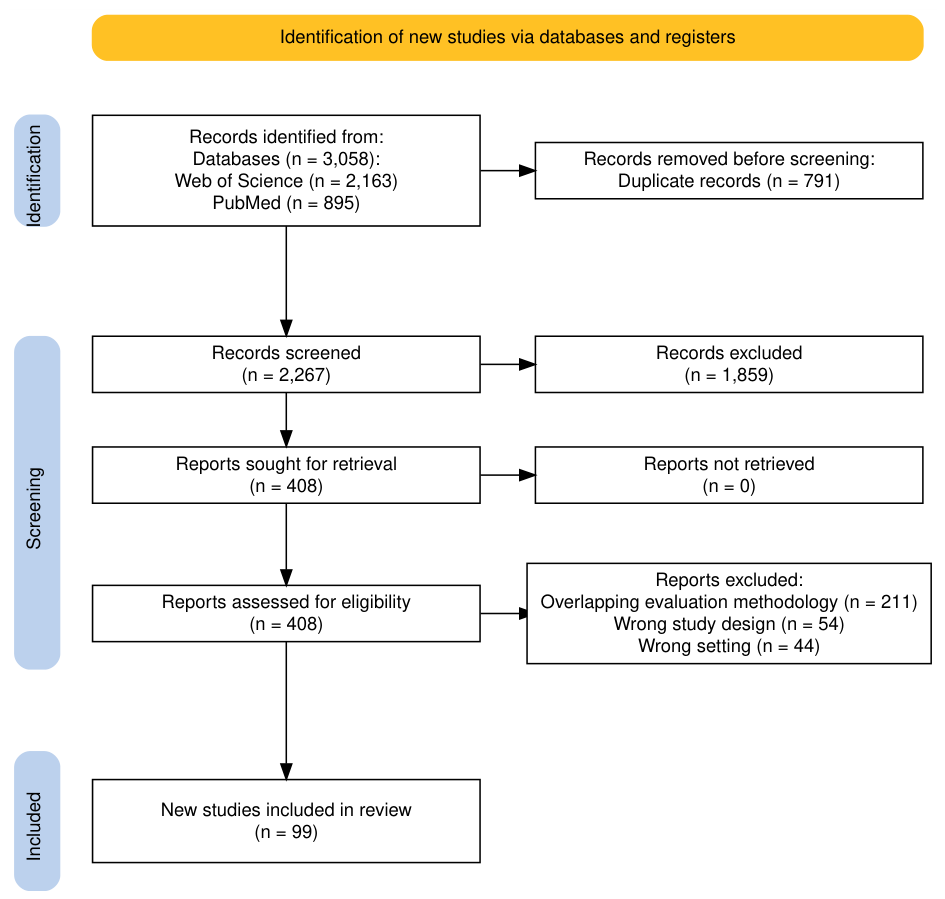
Figure 2.
Abstracted formulations of (a) LLMs, (b) VLMs, and (c) MLLMs. All models generate free-text outputs, but differ in their conditioning context; text-only input for LLMs, visual and text inputs for VLMs, and multimodal input for MLLMs [20,23,24].
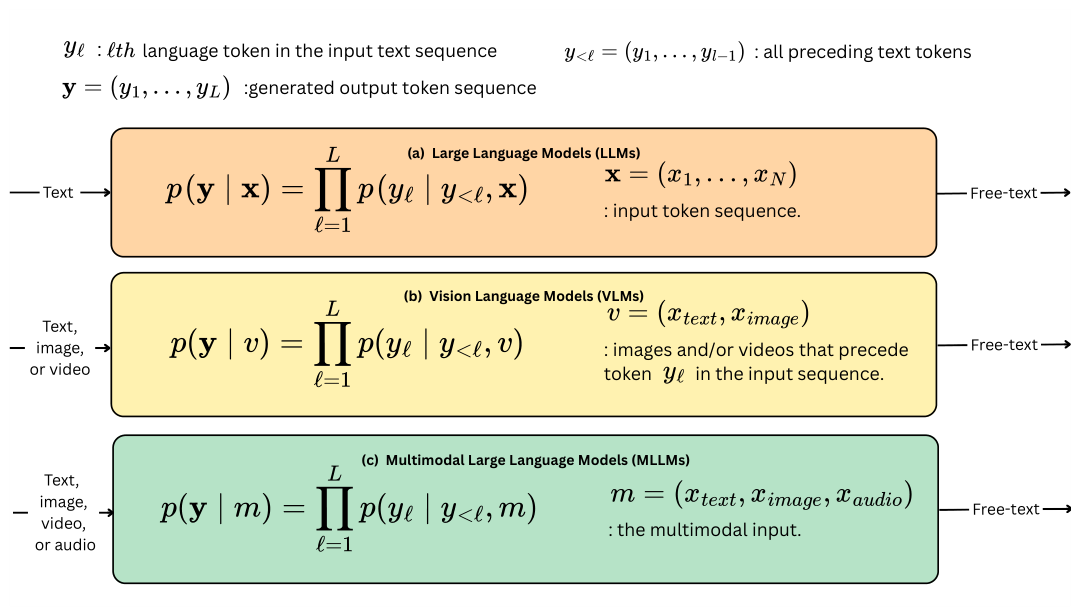
Figure 3.
Illustration of BERTScore computation [70]. Contextualized token embeddings are extracted for the reference and candidate texts, and pairwise cosine similarities are computed.
Figure 3.
Illustration of BERTScore computation [70]. Contextualized token embeddings are extracted for the reference and candidate texts, and pairwise cosine similarities are computed.
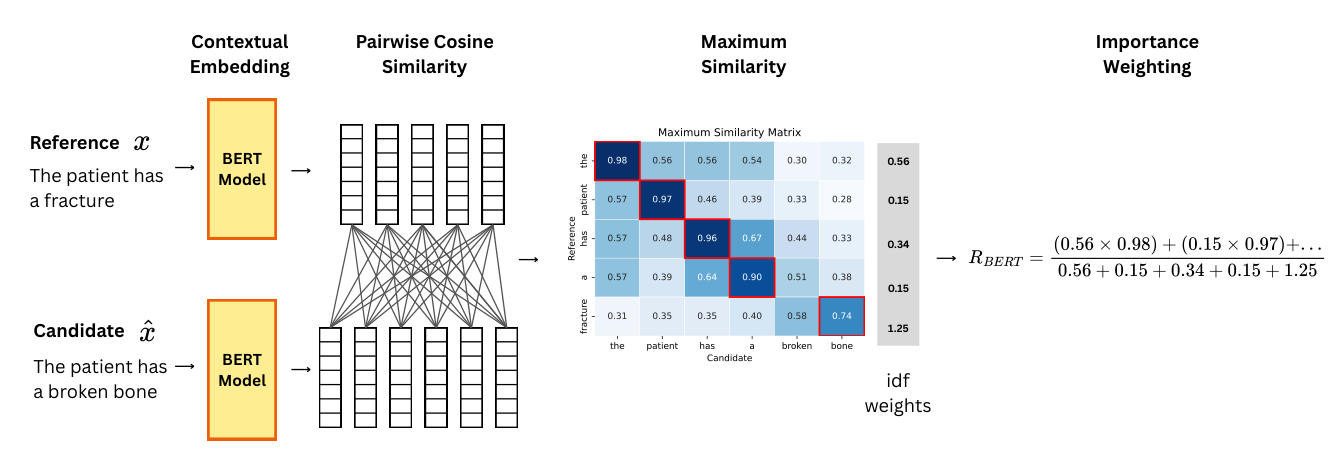
Figure 4.
LLM-as-a-judge frameworks evaluate generative AI outputs by prompting a language model to assess generated responses using predefined evaluation criteria. The model receives the output and explicit instructions describing the evaluation guidelines. Using these criteria, the judge model analyzes the response and decides whether the generated output meets the specified requirements. The evaluation is typically carried out using one of three different methods: (a) Single Run: The standard baseline where one LLM generates a single score. (b) Multi-Round Evaluation: Mitigates stochastic variation and accidental errors by aggregating results across multiple runs. (c) Multi-Model Evaluation: Addresses single-model bias and an ensemble approach. After obtaining the rating for each model, the final score can be obtained by majority voting.
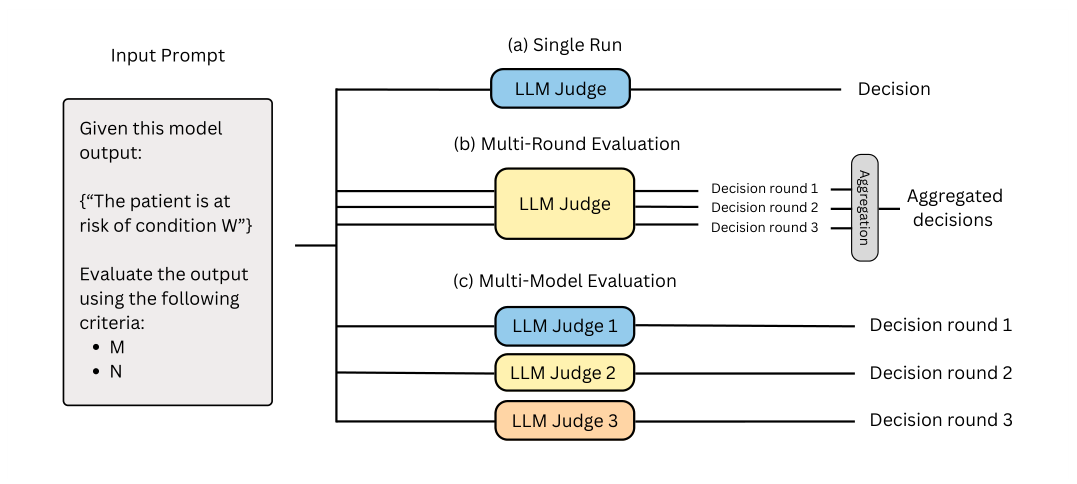
Figure 5.
Evaluation dimensions for clinical generative AI. Mind map illustrating a multi-dimensional evaluation framework for clinical generative AI systems. The framework is organized into five dimensions. Dimension I, factual and contextual grounding, Dimension II, safety, alignment, and robustness, Dimension III, reasoning quality, Dimension IV, calibration and uncertainty assessment, Dimension V, clinical anthropomorphism. Rectangles with lined borders indicate evaluation criteria that are primarily assessed by human evaluators or LLM-as-a-judge approaches.
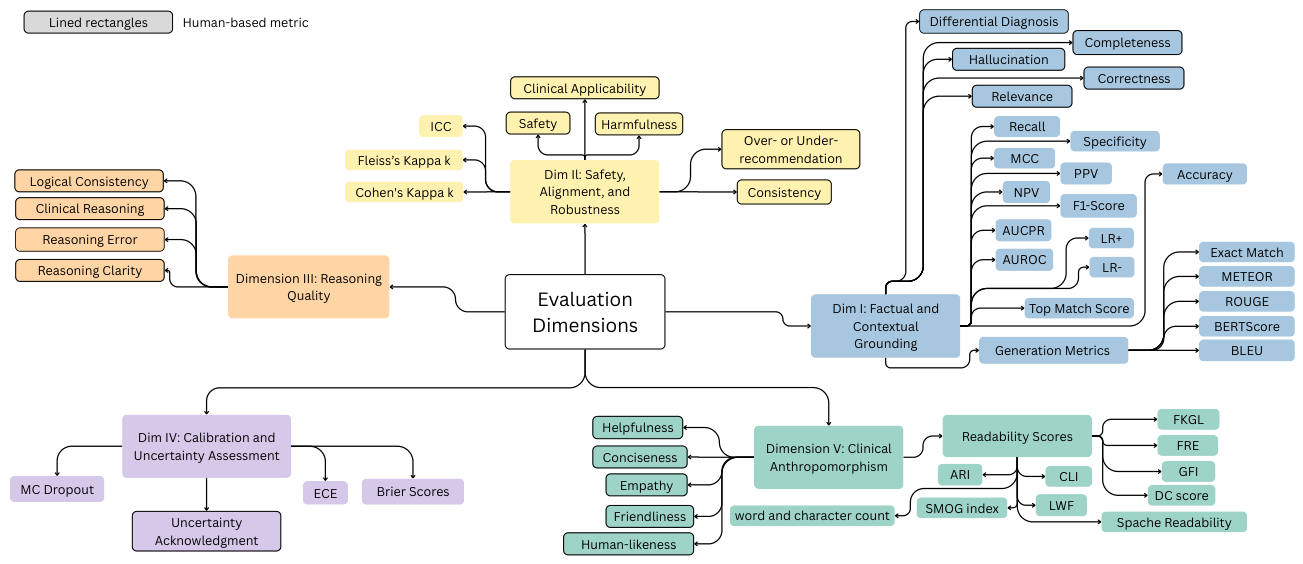
Figure 6.
Uncertainty estimation proxies for closed-source generative AI models. (a) CE prompts the model to explicitly report a numerical confidence score alongside its prediction. (b) TLP derives uncertainty estimates from the distribution of token likelihoods produced during generation. (c) SC estimates uncertainty by measuring agreement across multiple stochastic generations from identical prompts.
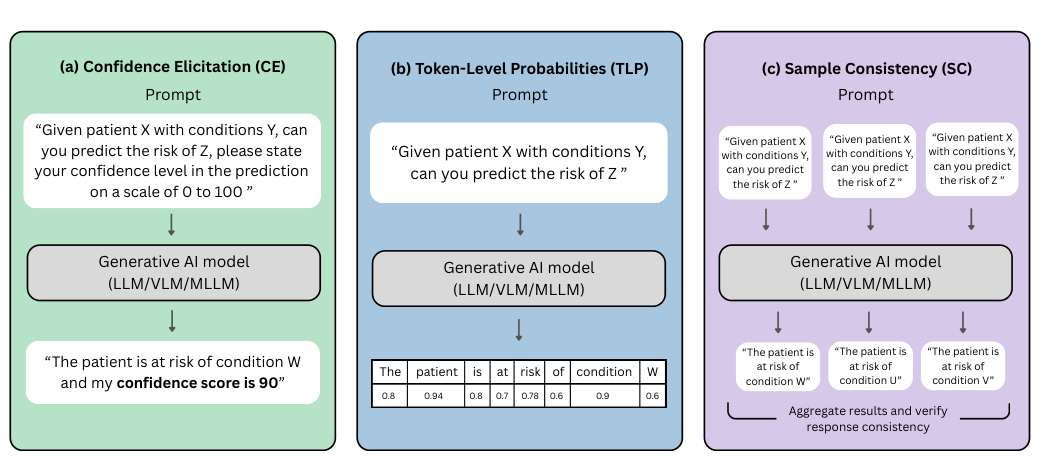
Figure 7.
The proposed five-dimensional evaluation framework is organized into three chronological stages. Stage I and II represent the Research Stages, focusing on fundamental model performance and robustness. Stage III represents the Deployment Stage, incorporating clinical anthropomorphism to ensure real-world readiness. Each stage builds upon the dimensions of the previous stages as mandatory prerequisites.
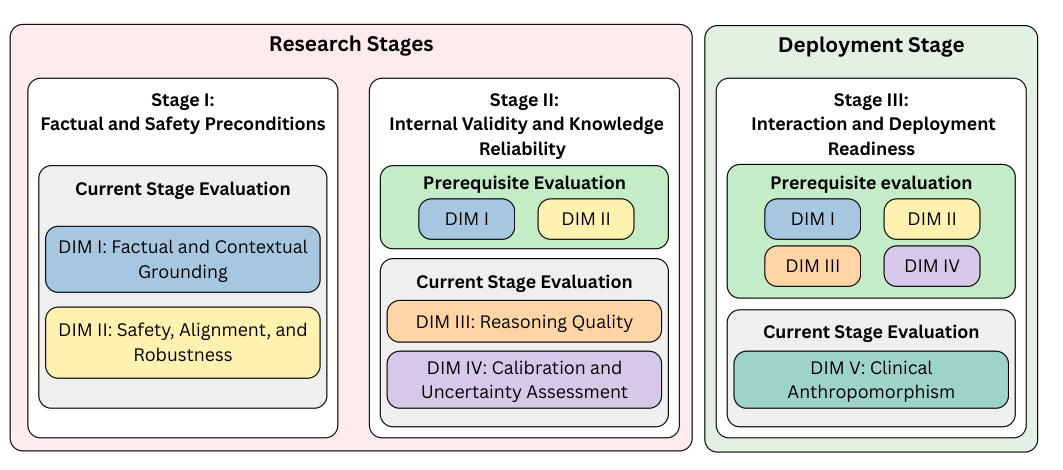

Table 1.
Taxonomy of clinical tasks for generative AI.
| Task | Definition | Model Use Case |
|---|---|---|
| Open-ended Clinical Question Answering (OQA) | Free-text responses to medical queries without predefined options. | VLM, LLM |
| Multiple-Choice Questions (MCQ) | Selecting a predetermined answer from a fixed set of options. | VLM, LLM |
| Diagnostic Decision Support (DDS) | Analyzing patient data, EHRs, or clinical narratives to generate a single diagnosis or a differential diagnosis. | VLM, LLM, MLLM |
| Report Generation (RG) | Synthesize clinical data into documentation for tasks that require diagnostic reasoning or integration of clinical evidence. Examples include generating radiology reports from imaging findings or compiling patient histories into clinical summaries. This process extends beyond purely administrative documentation. | VLM, LLM, MLLM |
| Risk Prediction (RP) | Estimating the likelihood of future outcomes, such as mortality or hospital admission, over time. | LLM, MLLM |
| Triage and Referral (TR) | Categorizing patient severity to determine priority and site of care. | LLM |
Table 2.
Automated evaluation metrics. , , , and denote true and false positives and negatives. Precision (), recall (R), specificity (), and negative predictive value () are standard classification measures. The area under the receiver operating characteristic curve () and the area under precision–recall curve () summarize performance across decision thresholds, with true positive rate () and false positive rate () defining the ROC curve. For calibration metrics, N is the number of samples, denotes the predicted probability for instance i, the ground-truth label. M are the prediction bins and denotes the set of samples with predicted confidence that fall into bin m, and are the accuracy and average confidence of , respectively [29].
| Metric | Equation |
|---|---|
| Accuracy / discrimination | |
| Accuracy | |
| Precision also Positive Predictive Value (PPV) | |
| Recall, also Sensitivity | |
| Specificity | |
| Negative Predictive Value | |
| F1-score | |
| Matthews Correlation Coefficient | |
| Positive Likelihood Ratio | |
| Negative Likelihood Ratio | |
| Area Under the ROC Curve | |
| Area Under Precision–Recall Curve | |
| Uncertainty / calibration | |
| Brier Score | |
| Expected Calibration Error | |
Table 3.
Automatic readability and linguistic complexity metrics.
| Metric | Formula |
|---|---|
| Flesch Reading Ease Score | |
| Flesch–Kincaid Grade Level | |
| Gunning Fog Index | |
| SMOG | |
| Coleman–Liau Index | |
| Automated Readability Index | |
| Dale–Chall | |
| Spache |
Table 4.
Automatic text similarity and semantic overlap measures. Where N stands for the length of n-grams, is the n-gram precision, is the positive weight, c is the length of candidate translation, r is the reference corpus length, and is the brevity penalty. corresponds to the highest count of overlapping n-grams between the candidate summary and the reference summaries. is the unigram precision, R is the unigram recall. For cosine similarity, u is the reference sentence and v is the candidate sentence.
| Metric | Equation |
|---|---|
| Lexical overlap (n-gram based) | |
| Bilingual Evaluation Understudy | , |
| Recall-Oriented Understudy for Gisting Evaluation | |
| Metric for Evaluation of Translation with Explicit ORdering | , |
| Embedding-based semantic similarity | |
| Cosine Similarity | |
Table 5.
Taxonomy of human-based evaluation criteria for clinical generative AI [7].
Table 5.
Taxonomy of human-based evaluation criteria for clinical generative AI [7].
| Category | Criterion | Refined definition |
|---|---|---|
| Intrinsic | Consistency | Stability of the model’s outputs under repeated queries or semantically similar cases. |
| Human-likeness | Naturalness of language and tone compared with human responses. | |
| Friendliness | The degree to which the model adopts a polite, encouraging tone that fosters a positive user experience, regardless of the medical accuracy of its content. | |
| Extrinsic | Differential Diagnosis | The model’s ability to generate a comprehensive list of potential diagnoses from patient data. |
| Hallucination | The presence of generated content that is factually incorrect. | |
| Relevance | The degree to which the response addresses the prompt without drifting to tangential content. | |
| Correctness | Alignment with established medical facts, clinical guidelines, and gold-standard evidence. | |
| Completeness | Inclusion of all essential clinical components (e.g., diagnosis and symptom analysis) without omitting critical information. | |
| Safety | Absence of errors that could lead to clinical risk (e.g., under-triaging emergency presentations). | |
| Conciseness | Ability to convey necessary information efficiently without excessive verbosity. | |
| Harmfulness | Potential for the output to cause physical or psychological harm to a patient. | |
| Clinical Applicability | Practical ease with which the output can be integrated into the clinical workflow or translated into action. | |
| Over-/Under-recommendation | Errors where the model over-recommends (wastes resources) or under-escalates (misses severity). | |
| Empathy | Appropriateness of tone and compassion, particularly for patient-facing communication. | |
| Helpfulness | Perceived utility in reducing clinician cognitive load or improving understanding. | |
| Uncertainty Acknowledgment | The model’s ability to express doubt or defer to a human expert when a case is ambiguous or outside its knowledge. |
Table 6.
Factual and Contextual Correctness Metrics for OQA and MCQ. Abbreviations: Size: dataset size (Q = number of questions), Real: real or synthetic data, Public: is the data public (Part. = partially), D/P: can be Diagnosis (D) or Prognosis (P), Eval: human or automatic (Auto) evaluation and includes LLM-as-a-judge (LLMJ), Code: is the code or prompt open access, Multi: Multimodal, Acc: Accuracy, DD: Differential diagnosis, Corr: Correctness, Rel: Relevance, Comp: Completeness, R: Recall (Sensitivity), Spec: Specificity, F1: F1-score, MCC: Matthews Correlation Coefficient, AUC: AUROC or AUCPR, Gen: generation/semantic metrics BLEU (B), ROUGE (RO), BERTScore (BR), METEOR (M), Exact Match (EM), cosine similarity (cos), TopM: Top match score, Hall: Hallucination, PPV: Positive Predictive Value (Precision), NPV: Negative Predictive Value, LR: Likelihood ratios. * Papers marked with an asterisk provide prompts, enabling reproducibility when the same model version is used.
| Year | ref | Size | Real | Public | D/P | Eval | Code | Multi | Acc | DD | Corr | Rel | Comp | R | Spec | F1 | MCC | AUC | Gen | TopM | Hall | PPV | NPV | LR |
|---|---|---|---|---|---|---|---|---|---|---|---|---|---|---|---|---|---|---|---|---|---|---|---|---|
| Task: OQA | ||||||||||||||||||||||||
| 2025 | [80] | 46 Q | ✓ | ✓ | D,P | Both (6 humans) | ✓* | - | - | - | ✓ | ✓ | ✓ | - | - | - | - | - | - | - | - | - | - | - |
| 2025 | [110] | 24573 QA | ✓ | ✓ | D | Both | - | ✓ | - | - | - | ✓ | - | ✓ | - | - | - | - | B, RO, EM, BR, M | - | - | ✓ | - | - |
| 2025 | [111] | 183 Q | - | ✓ | D | Both (3 humans) | - | - | ✓ | - | ✓ | - | ✓ | - | - | - | - | - | - | - | ✓ | - | - | - |
| 2025 | [88] | 38 Q / scenarios | - | - | D | Both (6 humans) | ✓* | - | - | - | ✓ | - | - | - | - | - | - | - | - | - | ✓ | - | - | - |
| 2024 | [112] | 65 Q | - | ✓ | D,P | Both (6 humans) | - | - | - | - | ✓ | - | - | - | - | - | - | - | - | - | - | - | - | - |
| 2025 | [94] | 15 Q | - | - | D,P | Both (5 humans) | ✓* | - | - | - | ✓ | ✓ | ✓ | - | - | - | - | - | - | - | - | - | - | - |
| 2025 | [113] | 23 Q | - | - | D | 1 human | - | - | - | - | ✓ | ✓ | - | - | - | - | - | - | - | - | - | - | - | - |
| 2024 | [114] | 25 FAQs | - | ✓ | D,P | Both (3 humans) | ✓* | - | - | - | ✓ | - | ✓ | - | - | - | - | - | - | - | - | - | - | - |
| 2025 | [115] | >30,000 image and text | ✓ | ✓ | D | Auto | ✓ | ✓ | ✓ | - | - | - | - | - | - | - | - | - | - | - | - | - | - | - |
| 2024 | [84] | 12 Q | ✓ | ✓ | D | Both (11 humans) | ✓* | - | - | - | ✓ | - | ✓ | - | - | - | - | - | - | - | - | - | - | - |
| 2024 | [116] | 11 Q | - | ✓ | D | 2 human | ✓* | - | - | - | ✓ | - | - | - | - | - | - | - | - | - | - | - | - | - |
| 2024 | [49] | 723 Q | ✓ | ✓ | D | Both (3 humans) | ✓ | - | - | - | ✓ | - | - | - | - | - | - | ✓ | - | - | - | - | - | - |
| 2025 | [97] | 24 Q | - | ✓ | D | Both (5 humans) | ✓* | - | - | - | ✓ | - | - | - | - | - | - | - | - | - | - | - | - | - |
| Task: MCQ | ||||||||||||||||||||||||
| 2024 | [33] | 750 MCQs | - | - | D | Auto | ✓* | - | ✓ | - | - | - | - | - | - | - | - | - | - | - | - | - | - | - |
| 2025 | [19] | 100 VQA | ✓ | ✓ | D | Both (2 humans) | ✓* | ✓ | ✓ | - | ✓ | ✓ | - | ✓ | - | ✓ | - | - | - | - | - | ✓ | - | - |
| 2023 | [117] | 250 Q | - | - | D,P | Both | - | - | ✓ | - | - | - | - | - | - | - | - | - | - | - | ✓ | - | - | - |
| 2025 | [118] | 130 MCQs | - | ✓ | D | Both (2 humans) | ✓* | - | ✓ | - | - | - | - | - | - | - | - | - | - | - | - | - | - | - |
Table 7.
Factual and Contextual Correctness Metrics for DDS. Abbreviations as in Table 6.
Table 7.
Factual and Contextual Correctness Metrics for DDS. Abbreviations as in Table 6.
| Year | ref | Size | Real | Public | D/P | Eval | Code | Multi | Acc | DD | Corr | Rel | Comp | R | Spec | F1 | MCC | AUC | Gen | TopM | Hall | PPV | NPV | LR |
|---|---|---|---|---|---|---|---|---|---|---|---|---|---|---|---|---|---|---|---|---|---|---|---|---|
| 2024 | [87] | - | ✓ | - | D | Both | - | - | - | - | ✓ | - | ✓ | ✓ | ✓ | ✓ | - | - | RO, BR | - | ✓ | - | - | - |
| 2024 | [119] | 10 clinical scenarios | - | ✓ | D | 4 humans | - | - | - | - | ✓ | - | - | - | - | - | - | - | - | - | - | - | - | - |
| 2025 | [18] | 13,230/ 551 patients | Part. | Part. | D | Both | ✓ | - | ✓ | ✓ | - | - | - | - | - | - | - | - | BR, B, RO, M | - | - | - | - | - |
| 2025 | [120] | 122 patients | ✓ | - | D | Auto | ✓* | - | ✓ | - | - | - | - | ✓ | ✓ | - | - | ✓ | - | - | - | ✓ | ✓ | - |
| 2025 | [73] | 65 patients | ✓ | - | D | Auto (LLMJ) | ✓ | - | ✓ | - | ✓ | - | ✓ | ✓ | ✓ | ✓ | - | - | - | - | - | ✓ | - | - |
| 2024 | [35] | 141 patient reports | ✓ | ✓ | D | Auto | - | - | ✓ | - | - | - | - | - | - | - | - | - | - | - | - | - | - | - |
| 2025 | [32] | 516 Photographs | ✓ | ✓ | D | Auto | ✓ | ✓ | ✓ | - | - | - | - | - | - | ✓ | - | - | - | - | - | - | - | - |
| 2025 | [121] | 597 patients | ✓ | - | D | Auto | - | - | - | - | - | - | - | ✓ | ✓ | - | - | - | - | - | - | ✓ | ✓ | - |
| 2025 | [122] | 200 patients | ✓ | - | D | Both (3 humans) | ✓* | - | ✓ | ✓ | - | - | - | ✓ | ✓ | ✓ | - | - | - | - | - | ✓ | ✓ | - |
| 2024 | [123] | 540 vignettes | - | ✓ | D | Both (3 humans) | ✓* | - | ✓ | ✓ | - | - | - | - | - | - | - | - | - | ✓ | - | - | - | - |
| 2023 | [124] | 8 scenarios | - | - | D | Humans | ✓* | - | - | - | ✓ | - | - | - | - | - | - | - | - | - | - | - | - | - |
| 2025 | [91] | 15 scenarios | - | - | D | Both (4 humans) | ✓* | - | - | - | ✓ | ✓ | ✓ | - | - | - | - | - | - | - | - | - | - | - |
| 2025 | [125] | 4 case vignettes | ✓ | ✓ | D | Humans | ✓* | - | - | - | ✓ | - | - | - | - | - | - | - | - | - | - | - | - | - |
| 2023 | [126] | 6,576 samples | Part. | Part. | D | Auto | - | - | ✓ | - | - | - | - | ✓ | - | ✓ | - | - | - | - | - | ✓ | - | - |
| 2025 | [127] | 5820 notes | ✓ | Part. | D | Both (2 humans) | ✓ | - | - | - | - | - | - | ✓ | - | ✓ | - | - | RO | - | - | ✓ | - | - |
| 2024 | [128] | 47 patients | ✓ | ✓ | D | Auto | - | ✓ | ✓ | - | - | - | - | ✓ | - | ✓ | - | - | - | - | - | - | - | - |
| 2024 | [129] | 490 notes | ✓ | - | D | Auto | ✓ | - | ✓ | - | - | - | - | ✓ | ✓ | ✓ | - | - | cos | - | - | ✓ | ✓ | - |
| 2025 | [130] | 200 cases | ✓ | ✓ | D | 3 humans | ✓* | - | - | - | ✓ | - | ✓ | - | - | - | - | - | - | - | - | - | - | - |
| 2025 | [131] | 100 cases | - | ✓ | D | Both (2 humans) | ✓* | - | ✓ | ✓ | - | - | - | - | - | - | - | - | - | ✓ | - | - | - | - |
| 2025 | [132] | 228 Q | - | - | D | 2 humans | - | - | - | - | ✓ | - | - | - | - | - | - | - | - | - | - | - | - | - |
| 2025 | [133] | 144 images | ✓ | Part. | D | Both (4 humans) | ✓* | ✓ | ✓ | - | - | - | - | ✓ | ✓ | ✓ | - | - | - | - | - | ✓ | ✓ | - |
| 2024 | [134] | 1 scenario | - | ✓ | D | Both | ✓* | - | - | - | ✓ | - | - | - | - | - | - | - | - | - | - | - | - | - |
| 2025 | [85] | 1 case | ✓ | ✓ | D | 28 humans | ✓* | - | - | - | ✓ | - | - | - | - | - | - | - | - | - | - | - | - | - |
| 2025 | [74] | 50 cases | ✓ | ✓ | D | Both (3 humans, LLMJ) | ✓ | - | ✓ | ✓ | ✓ | ✓ | - | - | - | - | - | - | - | ✓ | - | - | - | - |
| 2025 | [75] | 302 cases | ✓ | ✓ | D | Both (LLMJ, 3 humans) | ✓ | - | - | - | ✓ | - | - | - | - | - | - | - | - | - | - | - | - | - |
| 2025 | [135] | 155 patients | ✓ | - | D | Auto | - | ✓ | ✓ | - | - | - | - | ✓ | ✓ | - | - | ✓ | - | - | - | ✓ | ✓ | - |
| 2025 | [136] | 660 patients | ✓ | - | D | Auto | ✓ | - | - | - | - | - | - | - | - | - | - | ✓ | - | - | - | - | - | - |
| 2024 | [137] | 363 cases | - | ✓ | D | 3 humans | ✓* | ✓ | - | ✓ | - | - | - | - | - | - | - | - | - | - | - | - | - | - |
| 2025 | [138] | 6 cases | - | ✓ | D | Both (1 human) | ✓* | - | - | - | ✓ | - | - | - | - | - | - | - | - | - | - | - | - | - |
| 2024 | [139] | 20 cases | - | ✓ | D | 1 human | ✓* | - | - | - | ✓ | - | - | - | - | - | - | - | - | - | - | - | - | - |
| 2025 | [140] | 3 cases | - | - | D | Both (2 humans) | ✓* | - | ✓ | - | - | - | ✓ | - | - | - | - | - | - | - | - | - | - | - |
| 2024 | [141] | 30 clinical vignettes | - | ✓ | D | 3 humans | ✓* | - | - | - | ✓ | - | - | - | - | - | - | - | - | - | - | - | - | - |
| 2024 | [142] | 392 reports | ✓ | ✓ | D | Both (3 humans) | ✓* | - | - | ✓ | ✓ | - | - | - | - | - | - | - | - | ✓ | - | - | - | - |
Table 8.
Factual and Contextual Correctness Metrics for RP and DDS, RG, and TR. Abbreviations as in Table 6.
Table 8.
Factual and Contextual Correctness Metrics for RP and DDS, RG, and TR. Abbreviations as in Table 6.
| Year | ref | Size | Real | Public | D/P | Eval | Code | Multi | Acc | DD | Corr | Rel | Comp | R | Spec | F1 | MCC | AUC | Gen | TopM | Hall | PPV | NPV | LR |
|---|---|---|---|---|---|---|---|---|---|---|---|---|---|---|---|---|---|---|---|---|---|---|---|---|
| Task: RP and DDS | ||||||||||||||||||||||||
| 2024 | [81] | 600 cases | ✓ | - | D | Both | - | ✓ | ✓ | ✓ | - | - | - | - | - | - | - | - | - | - | - | - | - | - |
| 2024 | [76] | MIMIC: 332, BWH: 352 | ✓ | Part. | D | Both (LLMJ) | ✓ | - | - | - | - | ✓ | - | ✓ | - | ✓ | - | ✓ | - | - | ✓ | - | - | - |
| 2024 | [31] | 713 patients | ✓ | - | P | Both | ✓* | - | - | - | - | - | - | ✓ | ✓ | - | - | ✓ | - | - | ✓ | ✓ | ✓ | B |
| 2024 | [143] | 760 patients | ✓ | - | P | Auto | ✓* | - | - | - | - | - | - | ✓ | ✓ | - | - | - | - | - | - | ✓ | ✓ | - |
| 2025 | [34] | 82 patients | ✓ | - | P | Auto | ✓* | - | - | - | - | - | - | ✓ | ✓ | - | - | ✓ | - | - | - | ✓ | ✓ | - |
| 2024 | [144] | 80 patients | ✓ | - | P | Auto | - | - | - | - | - | - | - | ✓ | ✓ | - | - | ✓ | - | - | - | ✓ | ✓ | - |
| 2024 | [37] | 7000 cases | ✓ | - | P | Auto | ✓ | - | - | - | - | - | - | ✓ | ✓ | ✓ | ✓ | - | - | - | - | ✓ | ✓ | - |
| 2025 | [36] | 300 patients | ✓ | - | P | Auto | - | - | - | - | - | - | - | ✓ | ✓ | - | - | ✓ | - | - | - | - | - | - |
| 2025 | [30] | 742 patients | ✓ | - | D | Auto | - | - | - | - | - | - | - | ✓ | ✓ | ✓ | ✓ | - | - | - | - | ✓ | ✓ | - |
| 2024 | [145] | 9 cases | - | - | D,P | Both (5 humans) | ✓* | - | - | - | - | ✓ | ✓ | - | - | - | - | - | - | - | - | - | - | - |
| 2025 | [146] | 63 patients | ✓ | - | D | Both (2 humans) | ✓* | - | - | - | ✓ | - | - | ✓ | ✓ | - | - | ✓ | - | - | - | ✓ | ✓ | - |
| 2025 | [147] | 1,698 samples | ✓ | Part. | D | Both | ✓* | - | ✓ | - | - | - | - | ✓ | - | ✓ | - | - | - | - | - | ✓ | - | - |
| Task: RG | ||||||||||||||||||||||||
| 2025 | [38] | 898 reports | ✓ | - | D | Auto | - | - | ✓ | - | - | - | - | ✓ | ✓ | ✓ | ✓ | ✓ | - | - | - | ✓ | ✓ | - |
| 2025 | [148] | 305 images | ✓ | ✓ | D | Both (1 human) | - | ✓ | - | - | ✓ | ✓ | ✓ | ✓ | ✓ | - | - | - | B, RO, BR | - | - | - | - | - |
| 2025 | [82] | 200 hours | ✓ | Part. | D | Humans | - | ✓ | - | - | ✓ | ✓ | - | - | - | - | - | - | - | - | - | - | - | - |
| 2025 | [149] | 89 reports | ✓ | - | D | 3 humans | ✓* | - | - | - | ✓ | - | ✓ | - | - | - | - | - | - | - | - | - | - | - |
| 2025 | [150] | 27,496 reports | ✓ | ✓ | D | Auto | ✓ | ✓ | - | - | - | - | - | ✓ | - | ✓ | - | - | B, M, RO | - | - | ✓ | - | - |
| 2025 | [151] | 18,885 text-scan pairs | ✓ | Part. | D | Both | ✓ | ✓ | - | - | - | - | - | - | - | ✓ | - | - | B, M, RO | - | - | - | - | - |
| Task: TR | ||||||||||||||||||||||||
| 2025 | [83] | 5 scenarios | - | ✓ | D | Both (2 humans) | - | - | - | ✓ | - | - | ✓ | - | - | - | - | - | - | - | - | - | - | - |
| 2023 | [152] | 40 patients | ✓ | ✓ | D | Both | ✓* | - | - | ✓ | ✓ | - | - | - | - | - | - | - | - | ✓ | - | - | - | - |
| 2025 | [153] | 19 cases | ✓ | - | D,P | Auto | ✓* | - | ✓ | - | - | - | - | - | - | - | - | - | - | - | - | - | - | - |
| 2025 | [154] | 2000 cases | ✓ | Part. | D | Both (4 humans and LLMJ) | ✓ | - | - | ✓ | ✓ | - | - | - | - | - | - | - | - | ✓ | - | - | - | - |
Table 9.
Safety, Alignment, and Robustness Metrics. Abbreviations: Size: dataset size (Q = number of questions), Real: real or synthetic data, Public: is the data public (Part. = partially), D/P: can be Diagnosis (D) or Prognosis (P), Eval: human or automatic (Auto) evaluation and includes LLM-as-a-judge (LLMJ), Code: is the code or prompt open access, Multi: Multimodal, Safety: Safety (Score/Scale/urgency/risk), APP: Clinical Applicability, Harm: Harmfulness, OVUNR: /Over- or Under-recommendation, Cons: Consistency, Kappa: Cohen’s Kappa k, ICC: Intraclass Correlation Coefficient, FLK: Fleiss’s Kappa k. * Papers marked with an asterisk provide prompts, enabling reproducibility when the same model version is used.
| Year | Paper | Size | Real | Public | D/P | Eval | Code | Multi | Safety | APP | Harm | OVUNR | Cons | Kappa | ICC | FLK |
|---|---|---|---|---|---|---|---|---|---|---|---|---|---|---|---|---|
| Task: DDS | ||||||||||||||||
| 2024 | [119] | 10 clinical scenarios | - | ✓ | D | 4 humans | - | - | ✓ | - | ✓ | - | - | - | - | - |
| 2025 | [120] | 122 patients | ✓ | - | D | Auto | ✓* | - | - | - | - | - | - | ✓ | - | - |
| 2025 | [32] | 516 Photographs | ✓ | ✓ | D | Auto | ✓ | ✓ | - | - | - | - | - | ✓ | - | - |
| 2025 | [121] | 597 patients | ✓ | - | D | Auto | - | - | - | - | - | - | - | ✓ | - | - |
| 2025 | [122] | 200 patients | ✓ | - | D | Both (3 humans) | ✓* | - | - | - | - | - | - | ✓ | - | - |
| 2024 | [123] | 540 vignettes | - | ✓ | D | Both (3 humans) | ✓* | - | ✓ | - | - | - | - | - | - | - |
| 2023 | [124] | 8 scenarios | - | - | D | Humans | ✓* | - | ✓ | ✓ | - | - | ✓ | - | - | - |
| 2025 | [91] | 15 scenarios | - | - | D | Both (4 humans) | ✓* | - | ✓ | ✓ | - | - | - | ✓ | ✓ | - |
| 2025 | [125] | 4 case vignettes | ✓ | ✓ | D | Humans | ✓* | - | ✓ | - | - | - | ✓ | - | - | - |
| 2025 | [73] | 65 patients | ✓ | - | D | Auto (LLMJ) | ✓ | - | - | - | - | - | ✓ | - | - | - |
| 2024 | [134] | 1 scenario | - | ✓ | D | Both | ✓* | - | - | - | - | - | ✓ | - | - | - |
| 2025 | [130] | 200 cases | ✓ | ✓ | D | 3 humans | ✓* | - | ✓ | - | - | - | - | - | - | ✓ |
| 2025 | [133] | 144 images | ✓ | Part. | D | Both (4 humans) | ✓* | ✓ | - | - | - | - | ✓ | ✓ | ✓ | - |
| 2025 | [75] | 302 cases | ✓ | ✓ | D | Both (LLMJ, 3 humans) | ✓ | - | - | - | ✓ | - | - | - | - | - |
| 2025 | [135] | 155 patients | ✓ | - | D | Auto | - | ✓ | - | - | - | - | - | ✓ | - | - |
| 2025 | [138] | 6 cases | - | ✓ | D | Both (1 human) | ✓* | - | - | ✓ | - | - | - | ✓ | - | ✓ |
| 2025 | [140] | 3 cases | - | - | D | Both (2 humans) | ✓* | - | ✓ | ✓ | - | - | ✓ | - | - | - |
| Task: OQA | ||||||||||||||||
| 2025 | [80] | 46 Q | ✓ | ✓ | D,P | Both (6 humans) | ✓* | - | ✓ | - | - | - | - | - | - | ✓ |
| 2025 | [111] | 183 Q | - | ✓ | D | Both (3 humans) | - | - | - | - | - | - | - | ✓ | - | - |
| 2025 | [88] | 38 Q / scenarios | - | - | D | Both (6 humans) | ✓* | - | - | ✓ | - | - | - | - | ✓ | - |
| 2024 | [112] | 65 Q | - | ✓ | D, P | Both (6 humans) | - | - | ✓ | - | - | - | - | - | - | ✓ |
| 2025 | [94] | 15 Q | - | - | D,P | Both (5 humans) | ✓* | - | ✓ | - | - | - | - | - | ✓ | - |
| 2025 | [113] | 23 Q | - | - | D | 1 human | - | - | ✓ | ✓ | - | - | - | - | - | - |
| 2024 | [114] | 25 FAQs | - | ✓ | D,P | Both (3 humans) | ✓* | - | - | - | - | - | - | - | - | ✓ |
| 2024 | [84] | 12 Q | ✓ | ✓ | D | Both (11 humans) | ✓* | - | ✓ | - | - | - | - | - | - | ✓ |
| 2025 | [97] | 24 Q | - | ✓ | D | Both (5 humans) | ✓* | - | - | - | - | - | - | - | ✓ | - |
| Task: TR | ||||||||||||||||
| 2025 | [83] | 5 scenarios | - | ✓ | D | Both (2 humans) | - | - | - | - | - | - | - | ✓ | - | - |
| Task: DDS and RP | ||||||||||||||||
| 2024 | [76] | MIMIC: 332, BWH: 352 | ✓ | Part. | D | Both | ✓ | - | ✓ | - | - | - | - | ✓ | - | - |
| 2024 | [145] | 9 cases | - | - | D,P | Both (5 humans) | ✓* | - | - | ✓ | - | - | - | - | - | ✓ |
| 2025 | [146] | 63 patients | ✓ | - | D | Both (2 humans) | ✓* | - | ✓ | ✓ | - | - | - | ✓ | - | - |
| 2024 | [81] | 600 cases | ✓ | - | D | Both | - | ✓ | ✓ | ✓ | - | - | - | - | - | - |
| Task: DDS and TR | ||||||||||||||||
| 2023 | [152] | 40 patients | ✓ | ✓ | D | Both | ✓* | - | ✓ | - | - | ✓ | - | - | - | - |
| Task: RG | ||||||||||||||||
| 2025 | [149] | 89 reports | ✓ | - | D | 3 humans | ✓* | - | - | - | - | - | ✓ | - | - | - |
| Task: MCQ | ||||||||||||||||
| 2025 | [118] | 130 MCQs | - | ✓ | D | Both (2 humans) | ✓* | - | - | - | - | - | - | ✓ | - | - |
Table 10.
Reasoning Quality Metrics. Abbreviations: Size: dataset size (Q = number of questions), Real: real or synthetic data, Public: is the data public (Part. = partially), D/P: can be Diagnosis (D) or Prognosis (P), Eval: human or automatic (Auto) evaluation and includes LLM-as-a-judge (LLMJ), Code: is the code or prompt open access, Multi: Multimodal, LogCons: Logical Consistency, ClinReas: Clinical Reasoning, ReasErr: Reasoning Error, ReasClarity: Reasoning Clarity. * Papers marked with an asterisk provide prompts, enabling reproducibility when the same model version is used.
| Year | Paper | Size | Real | Public | D/P | Eval | Code | Multi | LogCons | ClinReas | ReasErr | ReasClarity |
|---|---|---|---|---|---|---|---|---|---|---|---|---|
| Task: DDS | ||||||||||||
| 2025 | [91] | 15 scenarios | - | - | D | Both (4 humans) | ✓* | - | - | ✓ | - | - |
| 2025 | [73] | 65 patients | ✓ | - | D | Auto (LLMJ) | ✓ | - | ✓ | - | ✓ | - |
| 2025 | [127] | 5820 notes | ✓ | Part. | D | Both (2 humans) | ✓ | - | - | - | ✓ | - |
| 2025 | [132] | 228 Q | - | - | D | 2 humans | - | - | - | ✓ | - | - |
| 2025 | [138] | 6 cases | - | ✓ | D | Both (1 human) | ✓* | - | - | ✓ | - | - |
| 2024 | [139] | 20 cases | - | ✓ | D | 1 human | ✓* | - | - | - | ✓ | - |
| 2025 | [140] | 3 cases | - | - | D | Both (2 humans) | ✓* | - | ✓ | - | - | ✓ |
| Task: MCQ | ||||||||||||
| 2025 | [19] | 100 VQA | ✓ | ✓ | D | Both (2 humans) | ✓* | ✓ | - | ✓ | - | ✓ |
| 2025 | [118] | 130 MCQs | - | ✓ | D | Both (2 humans) | ✓* | - | - | - | ✓ | - |
| Task: RP and DDS | ||||||||||||
| 2025 | [147] | 1,698 samples | ✓ | Part. | D | Both | ✓* | - | - | ✓ | - | ✓ |
Table 11.
Calibration and Uncertainty Assessment Metrics. Abbreviations: Size: dataset size (Q = number of questions), Real: real or synthetic data, Public: is the data public (Part. = partially), D/P: can be Diagnosis (D) or Prognosis (P), Eval: human or automatic (Auto) evaluation and includes LLM-as-a-judge (LLMJ), Code: is the code or prompt open access, Multi: Multimodal, ECE: Expected Calibration Error, BS: Brier Scores, MC: Monte Carlo (MC) Dropout, UNAKC: Uncertainty Acknowledgment. * Papers marked with an asterisk provide prompts, enabling reproducibility when the same model version is used.
| Year | Paper | Size | Real | Public | D/P | Eval | Code | Multi | ECE | BS | MC | UNAKC |
|---|---|---|---|---|---|---|---|---|---|---|---|---|
| Task: OQA | ||||||||||||
| 2025 | [110] | 24573 QA | ✓ | ✓ | D | Both | - | ✓ | - | - | ✓ | - |
| 2025 | [113] | 23 Q | - | - | D | 1 human | - | - | - | - | - | ✓ |
| 2024 | [49] | 723 Q | ✓ | ✓ | D | Both (3 humans) | ✓ | - | ✓ | ✓ | - | - |
| Task: DDS | ||||||||||||
| 2025 | [32] | 516 photographs | ✓ | ✓ | D | Auto | ✓ | ✓ | ✓ | - | - | - |
| 2025 | [91] | 15 scenarios | - | - | D | Both (4 humans) | ✓* | - | - | - | - | ✓ |
| 2025 | [136] | 660 patients | ✓ | - | D | Auto | ✓ | - | ✓ | - | - | - |
| Task: RG | ||||||||||||
| 2025 | [38] | 898 reports | ✓ | - | D | Auto | - | - | - | ✓ | - | - |
Table 12.
Clinical Anthropomorphism Metrics. Abbreviations: Size: dataset size (Q = number of questions), Real: real or synthetic data, Public: is the data public (Part. = partially), D/P: can be Diagnosis (D) or Prognosis (P), Eval: human or automatic (Auto) evaluation and includes LLM-as-a-judge (LLMJ), Code: is the code or prompt open access, Multi: Multimodal, Emp: Empathy, Help: Helpfulness, UI: User Friendliness, Read: Readability Scores, HL: Human-likeness, Con: Conciseness. * Papers marked with an asterisk provide prompts, enabling reproducibility when the same model version is used.
| Year | Paper | Size | Real | Public | D/P | Eval | Code | Multi | Emp | Help | UI | Read | HL | Con |
|---|---|---|---|---|---|---|---|---|---|---|---|---|---|---|
| Task: OQA | ||||||||||||||
| 2025 | [80] | 46 Q | ✓ | ✓ | D,P | Both (6 humans) | ✓* | - | - | ✓ | - | - | - | - |
| 2025 | [88] | 38 Q / scenarios | - | - | D | Both (6 humans) | ✓* | - | - | - | - | Word count; FKGL; GFI; FRE | - | - |
| 2024 | [112] | 65 Q | - | ✓ | D,P | Both (6 humans) | - | - | - | - | - | word count | - | - |
| 2025 | [94] | 15 Q | - | - | D,P | Both (5 humans) | ✓* | - | - | - | ✓ | FKGL | - | - |
| 2024 | [114] | 25 FAQs | - | ✓ | D,P | Both (3 humans) | ✓* | - | - | - | - | word and character counts | - | - |
| 2025 | [97] | 24 Q | - | ✓ | D | Both (5 humans) | ✓* | - | - | - | - | FRE,FKGL | - | - |
| 2024 | [58] | 80 Q | - | ✓ | D,P | Auto | - | - | - | - | - | FRE, FKGL, GFI, SMOG, ARI, CLI, LWF, DC, Spache | - | - |
| Task: DDS and RP | ||||||||||||||
| 2024 | [81] | 600 cases | ✓ | - | D | Both | - | ✓ | - | - | ✓ | - | - | - |
| 2024 | [145] | 9 cases | - | - | D,P | Both (5 humans) | ✓* | - | - | - | - | word count | - | - |
| Task: DDS | ||||||||||||||
| 2024 | [123] | 540 vignettes | - | ✓ | D | Both (3 humans) | ✓* | - | ✓ | - | - | FKGL | - | - |
| 2025 | [73] | 65 patients | ✓ | - | D | Auto (LLMJ) | ✓ | - | - | ✓ | - | - | ✓ | - |
| 2025 | [91] | 15 scenarios | - | - | D | Both (4 humans) | ✓* | - | - | - | - | FRE, FKGL, SMOG, CLI, Lexical density | - | - |
| 2024 | [134] | 1 scenario | - | ✓ | D | Both | ✓* | - | - | - | - | word count | - | - |
| 2025 | [75] | 302 cases | ✓ | ✓ | D | Both (LLMJ, 3 humans) | ✓ | - | - | ✓ | - | - | - | - |
| 2025 | [140] | 3 cases | - | - | D | Both (2 humans) | ✓* | - | - | - | ✓ | SMOG, GFI, grammar | - | - |
| Task: RG | ||||||||||||||
| 2025 | [82] | 200 hours | ✓ | Part. | D | Humans | - | ✓ | - | - | ✓ | - | - | - |
| 2025 | [149] | 89 reports | ✓ | - | D | 3 humans | ✓* | - | - | - | ✓ | - | - | - |
| 2025 | [151] | 18,885 text-scan pairs | ✓ | Part. | D | Both | ✓ | ✓ | - | - | - | - | ✓ | - |
| Task: TR | ||||||||||||||
| 2025 | [83] | 5 scenarios | - | ✓ | D | Both (2 humans) | - | - | - | - | - | - | - | ✓ |
Table 13.
Emerging benchmarks for evaluating generative AI in clinical diagnosis and prognosis. Abbreviations: Multi: Multimodal, Eval: human or automatic evaluation, Dim: Evaluation dimension (I: Factual & Contextual Grounding, II: Safety & Robustness, III: Reasoning Fidelity, IV: Calibration & Uncertainty, V: Clinical Anthropomorphism), Lang: language.
| Benchmark | Input | Output | Multi | Eval | Dim | Lang. |
|---|---|---|---|---|---|---|
| MedExpQA [170] | Clinical case with MCQ | Predicted option and free-text explanation | - | Automatic (accuracy) | I, III | Multi |
| TreatFact [171] | Document and generated summary | Binary label for summary factual consistency | - | Automatic (balanced accuracy) | I, III | EN |
| MIRAGE [172] | MCQ | Selected answer option | - | Automatic (accuracy) | I | EN |
| RareBench [173] | EHRs | Phenotype extraction and diagnosis | - | Automatic (precision, recall, F1, top-k recall, median rank) | I | EN |
| MMMU [174] | MCQs and open-ended questions | Answer choice or free-text response | ✓ | Micro-averaged accuracy | I | EN |
| OmniMedVQA [175] | MCQs | Selected answer option | ✓ | Automatic (accuracy) | I | EN |
| MMedBench [176] | MCQs | Selected answer option with answer rationales | - | Automatic (accuracy, BLEU, ROUGE, BERTScore); Human and LLM-as-judge evaluation of accuracy and reasoning | I, II, III | Multi |
| MetaMedQA [6] | MCQs | Answer option with self-reported confidence | - | Automatic (accuracy) | I, IV | EN |
| MedR-Bench [167] | Open-ended clinical cases | Free-text answer with explanation reference | - | Automatic (accuracy, precision, recall); LLM-as-judge | I, III | EN |
| MultiMedQA [177] | MCQs and OQA | Answer option or free-text response | - | Automatic (accuracy) | I | EN |
| MedThink-Bench [72] | QA | Answer option with rationale | - | Automatic (accuracy, LLM-as-judge) | I, III | EN |
| PMC-VQA [178] | MCQs and OQA | Answer option or free-text response | ✓ | Automatic (accuracy, BLEU) | I | EN |
| DiReCT [179] | Clinical notes and diagnostic knowledge graph | Predicted diagnosis with rationale | - | Accuracy of Diagnosis, Completeness, and Faithfulness of Explanations | I, III | EN |
Disclaimer/Publisher’s Note: The statements, opinions and data contained in all publications are solely those of the individual author(s) and contributor(s) and not of MDPI and/or the editor(s). MDPI and/or the editor(s) disclaim responsibility for any injury to people or property resulting from any ideas, methods, instructions or products referred to in the content. |
© 2026 by the authors. Licensee MDPI, Basel, Switzerland. This article is an open access article distributed under the terms and conditions of the Creative Commons Attribution (CC BY) license (http://creativecommons.org/licenses/by/4.0/).
Copyright: This open access article is published under a Creative Commons CC BY 4.0 license, which permit the free download, distribution, and reuse, provided that the author and preprint are cited in any reuse.